
 The tragedy of childhood is that you can’t quite see it on the ground. Looking back the truth is plainer but it’s also painful, containing all the warmth of those times but also the regrets and irreconcilable longings. Alex Law’s small scale personal tale of inevitable tragedies mixed with intense nostalgia, Echoes of the Rainbow (歲月神偷, Shui Yuet Sun Tau), is deeply sincere and more than earns its turn for the sentimental in its never wavering feeling of authenticity as it paints a picture of a rapidly disappearing Hong Kong and a childhood lived in a big brother’s shadow.
Eight-year-old “Big Ears” (Buzz Chung) lives with his cobbler father (Simon Yam) at the end of a long, run-down street of shopkeepers. Amusingly enough, Big Ears’ uncle (Paul Chun) lives at the other end of the street where he cuts hair so the family kind of has the full run of the place, head to toe. While Big Ears whiles his time away daydreaming, putting a fish bowl on his head and pretending to be an astronaut or indulging in his favourite hobby – kleptomania, his big brother Desmond (Aarif Lee) is busy doing everything right. A tall, strong teenager with more than a passing resemblance to Bruce Lee, Desmond is a track and field star and academically gifted student at the prestigious Diocesan Boys’ School. Big Ears loves everything about his big brother, including his sort of girlfriend Flora (Evelyn Choi).
Law sketches the everyday lives of this ordinary family with the sort of details which randomly recall themselves years later – the tear on his father’s T-shirt from where it hits the end of his chisel, the taste of Autumn Moon Cake, the random conversations with passersby. The small community on this run-down street more is like an extended family in and of itself as the families take their meals on tables outside, each overhearing each other’s conversations and interfering in various family dramas. Big Ears quips that his mum (Sandra Ng) is known as “Mrs. Outlaw” because she’ll talk her way into or out of anything and has a talent for talking people around to her way of thinking, but the warmth and love between his parents is never shaken. Even in the midst of an encroaching tragedy, Mr. Law takes the time to design a pretty pair of ultra comfortable shoes for his harried wife who often complains about her corns.
Seen through little Big Ears’ eyes, the film avoids the bigger picture or any political concerns save for the presence of the corrupt colonial forces as represented by Sergeant Brian who speaks fluent Cantonese but stresses that English is essential for “getting on” in Hong Kong. Sergeant Brian is also going to get one whole box of the moon cakes Big Ears wanted all for himself and his mum has been paying for in instalments for the last few months, but the reason for his visit is a rise in the protection money the local police takes from shopkeepers. If the Laws can’t pay it (and they can’t, really) they’ll be evicted. Not that Big Ears would know, but business is bad and the family is spending most of its income on Desmond’s expensive school fees so it’s doubly galling to them when his grades and athletic success begin to decline.
Big Ears is a naughty little boy, but often gets away with it because he’s just so darn cute. His pilfering habit goes largely undetected even though he steals quite ostentatious items like a glowing goblet souvenir from a movie starring his favourite actress whose picture he also sells with a fake signatures attached, a British flag from a nearby base, and even a pottery statue of the Monkey King from an actual temple. Desmond has this theory about about double rainbows that are an inversion of each other – something that could easily work for himself and his brother with Desmond’s essential goodness contrasting nicely with Big Ears’ roguish adventures whilst also speaking for the enduring bond between the brothers.
Even before the literal typhoon rips through Big Ears’ idyllic childhood home, there are signs of trouble on the horizon – firstly in Desmond’s melancholy love story with fellow tropical fish enthusiast Flora who turns out to come from an entirely different world filled with all the ease and possibility so absent from the Law’s, and then in Desmond’s gradual slowing down. The respective catch phrases of Big Ears’ parents signify the twin pillars of the age with his father’s insistence that “nothing is more important than the roof” as he works steadily to keep one over his boys, and his mother’s instances that life is “half difficult, half wonderful” but “you have to keep believing”. Earning a right to melodrama through fierce authenticity, Echoes of the Rainbow does not negate its tearjerking premise but rings it for all of its joy and sorrow, revelling in nostalgia but also in a kind of hopefulness born of having weathered a storm and survived to witness the birth of new rainbows lighting up the sky.
Screened at Creative Visions: Hong Kong Cinema 1997 – 2017
Original trailer (English subtitles)






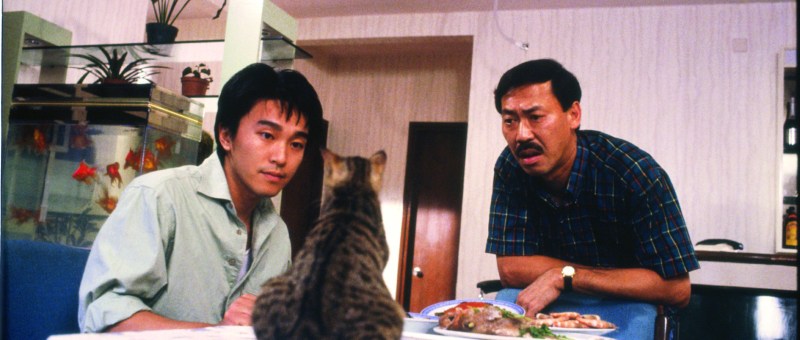

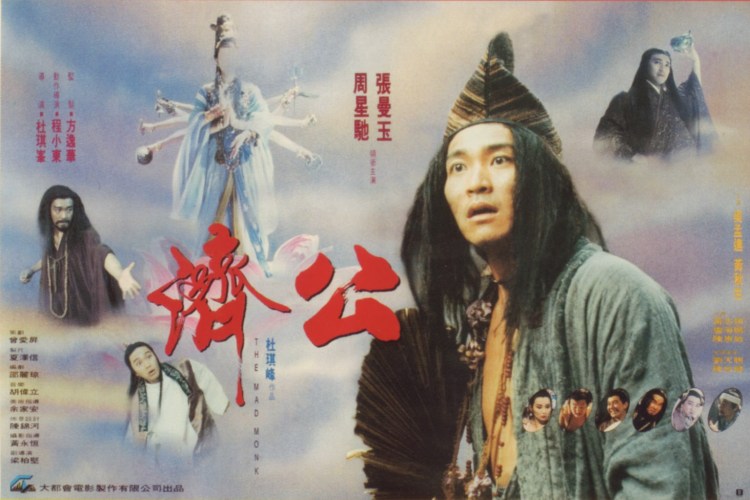 “The Mad Monk” sounds like a great name for a creepy ghost, emerging robed and chanting from the shadows to make you fear for your mortal soul. Sadly, The Mad Monk (濟公, Jì Gōng) features only one “ghost”, but it might just be the cutest in cinema history. The second of Johnnie To’s Shaw Brothers collaborations with comedy star Stephen Chow is another wisecracking romp in which Chow revels in his smart alec superiority, settling bets made in heaven and eventually vowing to spread peace and love across the whole world.
 Windows on Worlds