
 Children – not always the most tolerant bunch. For every kind and innocent film in which youngsters band together to overcome their differences and head off on a grand world saving mission, there are a fair few in which all of the other kids gang up on the one who doesn’t quite fit in. Given Japan’s generally conformist outlook, this phenomenon is all the more pronounced and you only have to look back to the filmography of famously child friendly director Hiroshi Shimizu to discover a dozen tales of broken hearted children suddenly finding that their friends just won’t play with them anymore. Where A Silent Voice (聲の形, Koe no Katachi) differs is in its gentle acceptance that the bully is also a victim, capable of redemption but requiring both external and internal forgiveness.
Classmates Shoko (Saori Hayami) and Shoya (Miyu Irino/Mayu Matsuoka) are almost mirror images of each other, sharing the first syllable of their names (at least phonetically) but representing two entirely opposite poles. Before Shoko transferred into his school, Shoya was the class clown, behaving disruptively and acting as the leader of a group of mean kids who, if not exactly bullies, certainly exert a degree of superiority over their meeker classmates. Shoko, hard of hearing, remains necessarily quiet, communicating through messages written on a notepad. Though some of the other pupils are fascinated by the novelty of someone like Shoko suddenly appearing, delighting in writing messages back and for and eagerly embracing the opportunity to learn sign language in order to communicate with her more easily, the mean kids, with Shoya as the ringleader, delight in making her life a misery just because they can.
Though some of the other children object to the way Shoya and the others are behaving, they do little to defend their new friend. Some of the more impressionable kids even halfheartedly join in, perhaps feeling bad about it but also enjoying being part of the angsty pre-teen group of nasty kids, but when it all gets too much and Shoko decides to move on everyone is suddenly struck with remorse and a need to blame someone else for the harm they’ve caused. Hence, Shoya gets a taste of his own medicine, ostracised by his peers as the lowlife who hounded a deaf girl out of school. Who’d want to hang around with someone like that?
Humbled, the stigma follows Shoya on into his next school as feelings of guilt and self loathing intensify until he reaches a point at which he can’t go on. Intending to finally end it all, Shoya unexpectedly runs into Shoko again and eventually manages to make a kind of motion towards an apology, attempting to make friends after all this time and making use of the sign language he’s taught himself to show his sincerity.
Isolated both by the continuing rumours of his primary school days and an intense personal feeling of unworthiness, Shoya finds it impossible to interact with his fellow students whose faces are each covered by a large blue cross. Bonding first with another lonely outcast, Shoya’s world begins to open up again but the spectre of his past continues to haunt him. Reconnecting with some of the other kids from primary school he finds that not everyone remembers things the same way they’ve become engraved in his mind. Though a few are anxious to atone, one of his former friends, Naoka (Yuki Kaneko), takes a different approach to the problem in continuing to blame Shoko – for the “attention” her condition attracts, the “requirement” for others to modify their behaviour to suit her, for simply existing in the first place enabling the behaviour which took place (about which Naoka remains unrepentant), and being the root cause that her merry band of friends fell apart.
If it seems like the tale disproportionately focuses on Shoya’s guilt and and redemption rather than Shoko’s suffering the balance shifts back towards the end as the pair truly mirror each other with another suicide attempt forming the climax of the second act. Shoko responds to her often cruel treatment with nothing other than friendliness, smiling with hands outstretched even whilst continuing to receive nothing but rejection. Though she may seem all smiles and sweetness, her overly genial persona is itself an act as she tries to overcompensate for the “burden” she feels herself to be causing through her need for “special treatment”. Eventually, Shoko snaps – firstly in primary school as her well meaning attempts to bring Shoya over to her side fail once again, and then later in a much more final way as she decides that there is nothing left for her in a world which fails to accommodate for difference.
The story of a girl who struggles to be heard, and a boy who refuses to listen, A Silent Voice is a quiet plea for the power of mutual understanding and reconciliation. Director Naoko Yamada and screenwriter Reiko Yoshida bring the same kind of quirky slice of life humour which made K-On and Tamako Market so enjoyable along with the raw visual beauty which has come to define Kyoto Animation to this often dark tale, perfectly integrating the more dramatic elements into the otherwise warm and forgiving world in a believable and natural way. Nuanced, complicated and defiantly refusing total resolution, A Silent Voice is one of the more interesting animated projects to come out of Japan in recent times and further marks out Yamada as one of its most important animation auteurs.
Screened as part of the Japan Foundation Touring Film Programme 2017.
Original trailer (English subtitles)
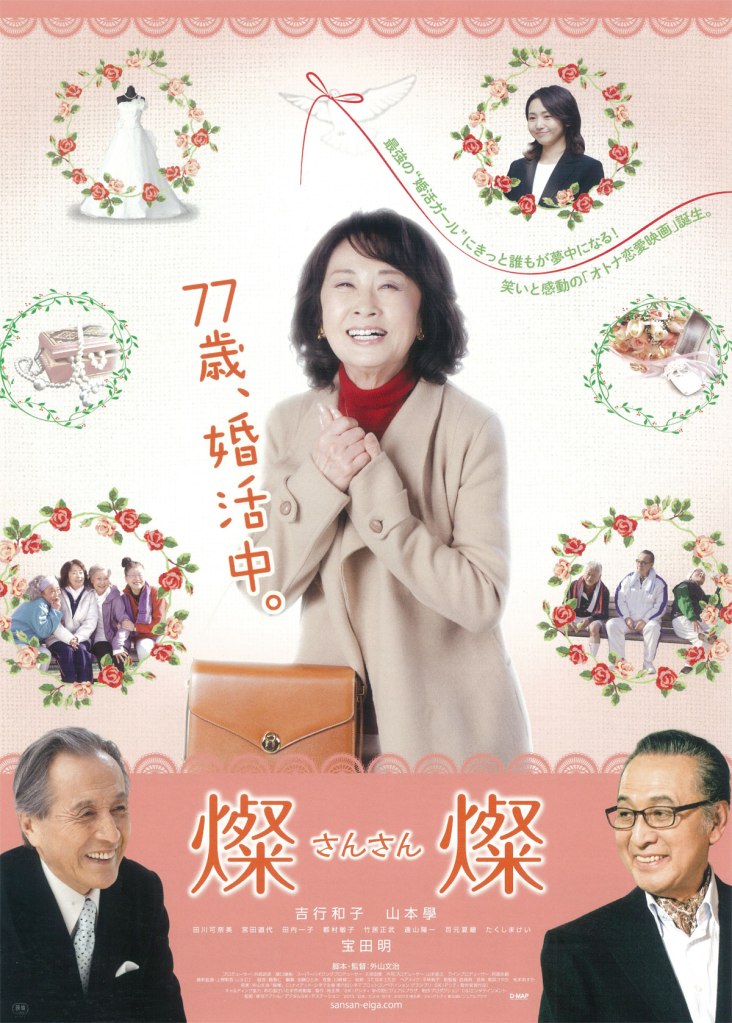 As Japan’s society ages, the lives of older people have begun to take on an added dimension. Rather than being relegated to the roles of kindly grandmas or grumpy grandpas, cinema has finally woken up to the fact that older people are still people with their own stories to tell even if they haven’t traditionally fitted established cinematic genres. Of course, some of this is down to the power of the grey pound rather than an altruistic desire for inclusive storytelling but if the runaway box office success of A Sparkle of Life (燦燦 さんさん, Sansan) is anything to go by, there may be more of these kinds of stories in the pipeline.
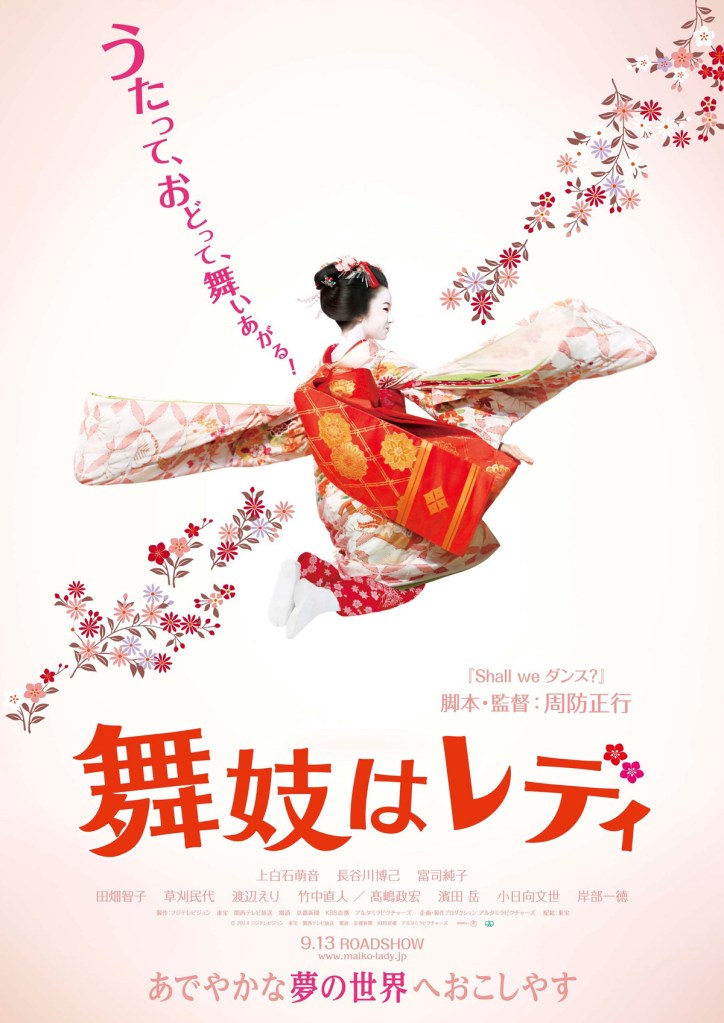 When Japan does musicals, even Hollywood style musicals, it tends to go for the backstage variety or a kind of hybrid form in which the idol/singing star protagonist gets a few snazzy numbers which somehow blur into the real world. Masayuki Suo’s previous big hit, Shall We Dance, took its title from the classic Rodgers and Hammerstein song featured in the King and I but it’s Lerner and Loewe he turns to for an American style song and dance fiesta relocating My Fair Lady to the world of Kyoto geisha, Lady Maiko (舞妓はレディ, Maiko wa Lady) . My Fair Lady was itself inspired by Shaw’s Pygmalion though replaces much of its class conscious, feminist questioning with genial romance. Suo’s take leans the same way but suffers somewhat in the inefficacy of its half hearted love story seeing as its heroine is only 15 years old.
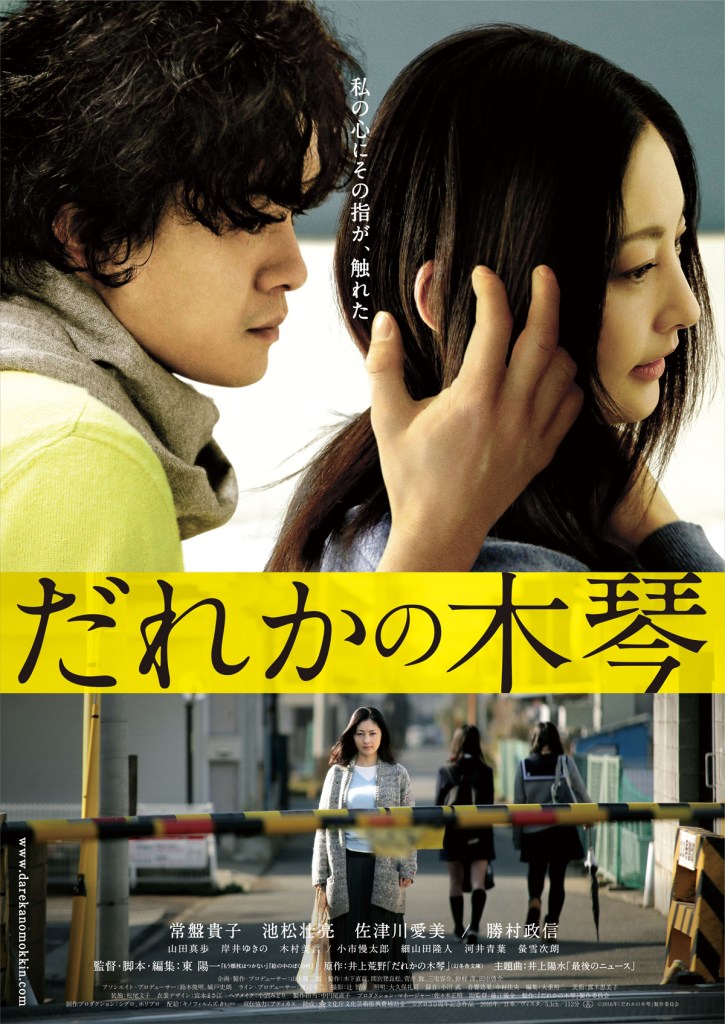 Yoichi Higashi has had a long and varied career, deliberately rejecting a particular style or home genre which is one reason he’s never become quite as well known internationally as some of his contemporaries. This slightly anonymous quality serves the veteran director well in his adaptation of Arane Inoue’s novel which takes a long hard look at those living lives of quiet desperation in modern Japan. Though sometimes filled with a strange sense of dread, the world of Someone’s Xylophone (だれかの木琴, Dareka no Mokkin) is a gentle and forgiving one in which people are basically good though driven to the brink by loneliness and disconnection.
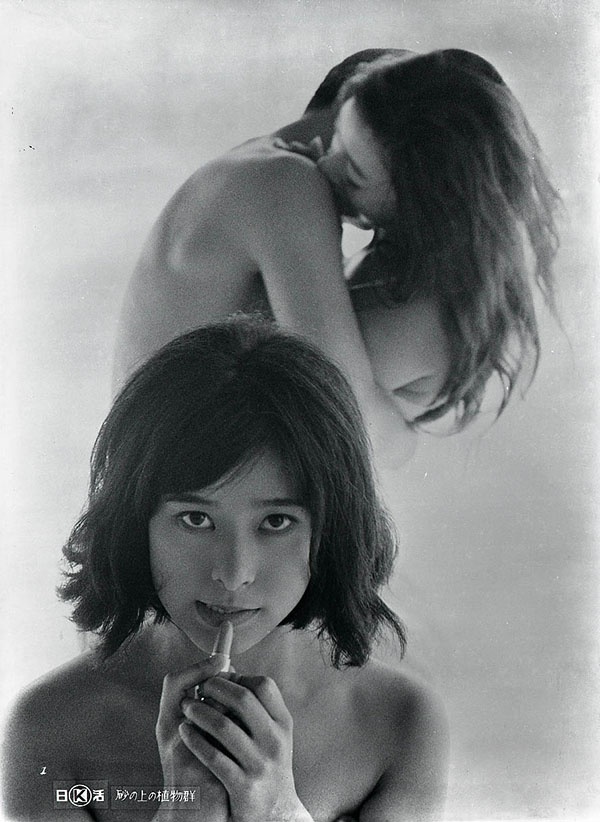 Despite being among the directors who helped to usher in what would later be called the Japanese New Wave, Ko Nakahira remains in relative obscurity with only his landmark movie of the Sun Tribe era, Crazed Fruit, widely seen abroad. Like the other directors of his generation Nakahira served his time in the studio system working on impersonal commercial projects but by 1964 which saw the release of another of his most well regarded films Only on Mondays, Nakahira had begun to give free reign to experimentation much to the studio boss’ chagrin. Flora on the Sand (砂の上の植物群, Suna no Ue no Shokubutsu-gun), adapted from the novel by Junnosuke Yoshiyuki, puts an absurd, surreal twist on the oft revisited salaryman midlife crisis as its conflicted hero muses on the legacy of his womanising father while indulging in a strange ménage à trois with two sisters, one of whom to he comes to believe he may also be related to.
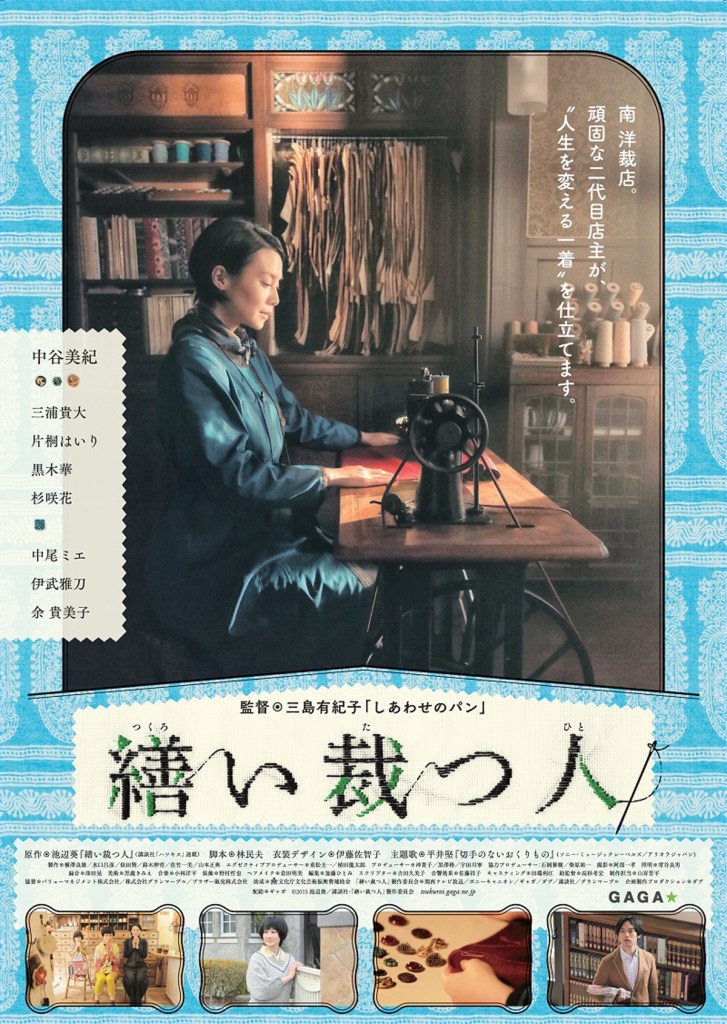 Tradition vs modernity is not so much of theme in Japanese cinema as an ever present trope. The characters at the centre of Yukiko Mishima’s adaptation of Aoi Ikebe’s manga, A Stitch of Life (繕い裁つ人, Tsukuroi Tatsu Hito), might as well be frozen in amber, so determined are they to continuing living in the same old way despite whatever personal need for change they may be feeling. The arrival of an unexpected visitor from what might as well be the future begins to loosen some of the perfectly executed stitches which have kept the heroine’s heart constrained all this time but this is less a romance than a gentle blossoming as love of craftsmanship comes to the fore and an artist begins to realise that moving forward does not necessarily entail a betrayal of the past.
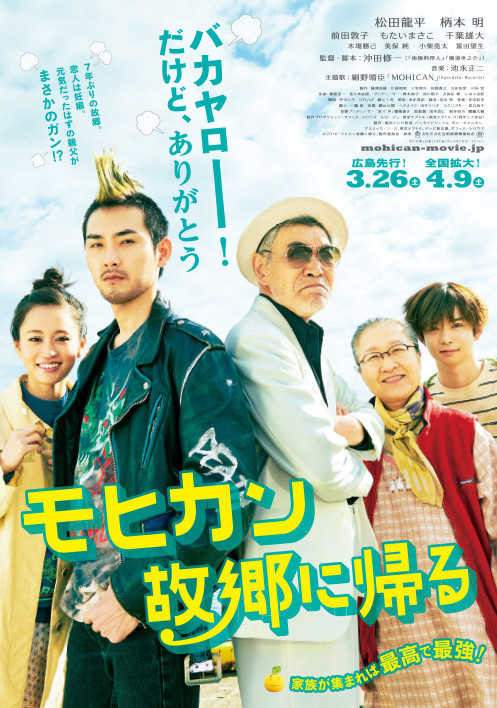 Japan may be famous for its family dramas, but there is a significant substrain of these warm and gentle comedies which sees a prodigal child return to their childhood home either to rediscover some lost aspect of themselves or realise that they no longer belong in the place which raised them. Shuichi Okita’s The Mohican Comes Home (モヒカン故郷に帰る, Mohican Kokyo ni Kaeru) includes an obvious reference in its title to Keisuke Kinoshita’s colourful 1954 escapade
 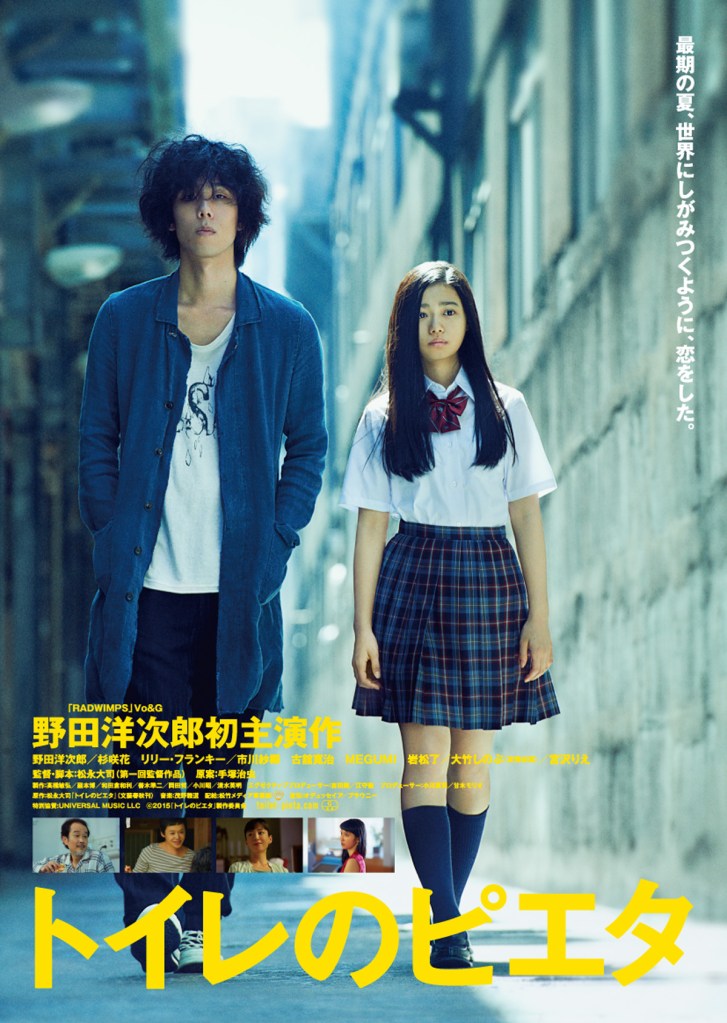 Somewhere near the beginning of Daishi Matsunaga’s debut feature, Pieta in the Toilet (トイレのピエタ, Toire no Pieta), the high rise window washing hero is attempting to school a nervous newbie by “reassuring” him that the worst thing that could happen up here is that you could die. This early attempt at black humour signals Hiroshi’s already aloof and standoffish nature but his fateful remark comes back to haunt him after he is diagnosed with an aggressive and debilitating condition of his own. Noticeably restrained in contrast with the often melodramatic approach of similarly themed mainstream pictures, Pieta in the Toilet is less a contemplation of death than of life, its purpose and its possibilities.
 Junichiro Tanizaki is widely regarded as one of the major Japanese literary figures of the twentieth century with his work frequently adapted for the cinema screen. Those most familiar with Kon Ichikawa’s art house leaning pictures such as war films The Burmese Harp or Fires on the Plain might find it quite an odd proposition but in many ways, there could be no finer match for Tanizaki’s subversive, darkly comic critiques of the baser elements of human nature than the otherwise wry director. Odd Obsession (鍵, Kagi) may be a strange title for this adaptation of Tanizaki’s well known later work The Key, but then again “odd obsessions” is good way of describing the majority of Tanizaki’s career. A tale of destructive sexuality, the odd obsession here is not so much pleasure or even dominance but a misplaced hope of sexuality as salvation, that the sheer force of stimulation arising from desire can in some way be harnessed to stave off the inevitable even if it entails a kind of personal abstinence.
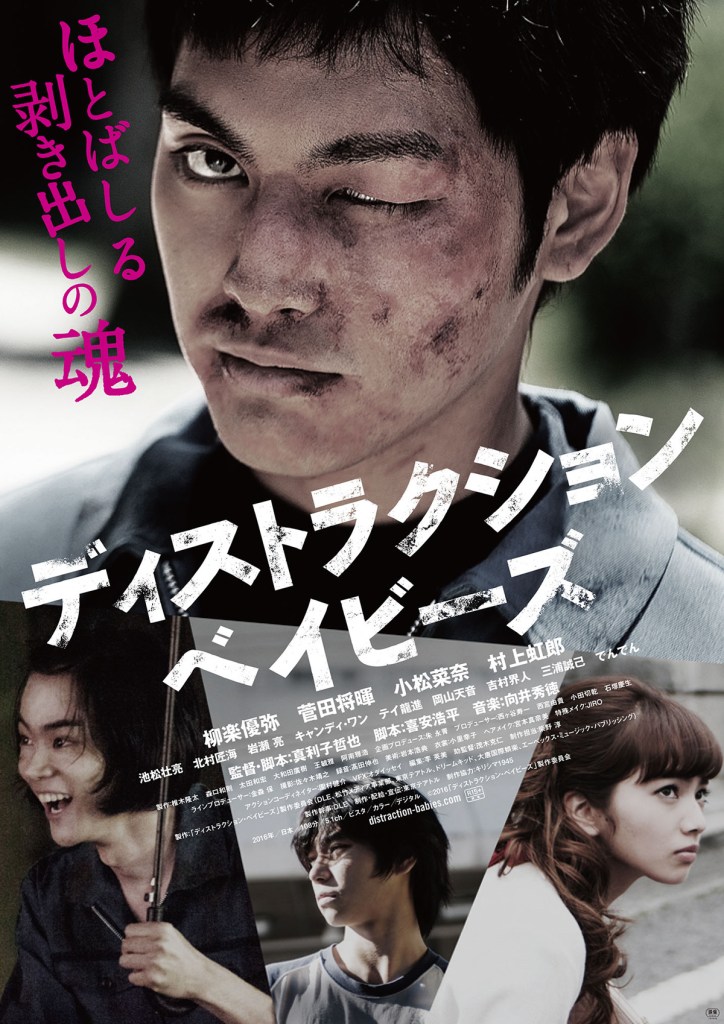 Post-golden age, Japanese cinema has arguably had a preoccupation with the angry young man. From the ever present tension of the seishun eiga to the frustrations of ‘70s art films and the punk nihilism of the 1980s which only seemed to deepen after the bubble burst, the young men of Japanese cinema have most often gone to war with themselves in violent intensity, prepared to burn the world which they feel holds no place for them. Tetsuya Mariko’s Destruction Babies (ディストラクション・ベイビーズ) is a fine addition to this tradition but also an urgent one. Stepping somehow beyond nihilism, Mariko’s vision of his country’s future is a bleak one in which young, fatherless men inherit the traditions of their ancestors all the while desperately trying to destroy them. Devoid of hope, of purpose, and of human connection the youth of the day get their kicks vicariously, so busy sharing their experiences online that reality has become an obsolete concept and the physical sensation of violence the only remaining truth.
 Windows on Worlds