Snakes and Earrings (蛇にピアス, Yukio Ninagawa, 2008)

91+iM1s07LL._SL1500_When 21 year old Hitomi Kanehara’s Snakes and Earrings (蛇にピアス, Hebi ni Piasu) was published back in 2003 it took the coveted Akutagawa prize for literature and the country by storm. Its scandalous depictions of the dark and nihilistic sex life of its outsider youngsters outraged and fascinated enough people to get it onto the best seller lists and earn a cinematic adaptation from Japan’s top theatre director Yukio Ninagawa in only his second foray into the world of moving pictures. However, Snakes and Earrings is perhaps that rare instance of an adaptation which clings to closely to its source material as its detached, emotionless and straightforward approach end in something of a miss fire.

Lui (Yuriko Yoshitaka) is a typical “gyaru” – for those of you reading from the future, this is an “ultra feminine” fashion trend which encourages young women to barbie doll it up to the max. It’s a little strange then when she catches sight of young punk Ama (Kengo Kora) in a nightclub and becomes fascinated with his forked tongue. In actuality, it’s the tongue she falls for, not the guy, but the two become a couple and she moves into his apartment. Before long she too gets a tongue ring and becomes determined on splitting her own tongue as well as getting herself a large tattoo. That’s how she meets Ama’s tattooist friend Shiba (Arata Iura) who becomes equally fascinated with Lui. Lui trades sex with Shiba in return for designing her body art and the two begin an illicit, sado-masochistic affair behind Ama’s back but even after Lui’s tattoo is completed it only sends her further into a spiral of nihilistic self annihilation.

Snakes and Earrings opens with a beautifully shot near silent sequence which pans across the skyline of modern Tokyo picking out the neon lights and advertising boards that proclaim it as a city which belongs to the young. Even when we’re with Lui inside the nightclub, the sound remains muted as young men and women dance to music that we cannot hear – even when Lui spots Ama it’s only the visuals that hang until he comes over and talks to her and we realise she’s had her headphones in the entire time. This sequence is neatly echoed at the film’s conclusion but is, however, something of an anomaly when it comes to the prevailing style of the film which is relentlessly detached and straightforward in approach.

Lui – short for “Louis Vuitton” remains something of a cypher. She’s torn between her two lovers – the punkish dope Ama who would kill for her and the cold, sadistic Shiba who would kill her given half the chance. She doesn’t seem to know what she wants or who she is and quickly loses herself in alcoholism and self disgust. It feels as if there should be more to this – a critique of the emptiness of modern life or the dehumanising effects of the city but all there is is a great nothingness. Perhaps that’s the point, there is nothing to Lui – not even a real name. She possesses no clearly defined identity and therefore does not exist. This is a fine idea, on paper, but does leave a great gaping hole where the protagonist ought to be.

Lui’s two love interests, the oddly vibrant Ama and the restrained Shiba represent two sides of the same thing as Lui is torn between pleasure in pain and pain in love. Kengo Kora does what he can with a thinly defined role which often feels more like a plot device than anything else. Arata Iura fares a little better with the meatier role of Shiba who is accorded more screen time but the film remains resolutely cold and distant. In a minor instance of distraction, Shun Oguri and more prominently Tatsuya Fujiwara turn up as bit players in the roles of two street punks who get into a fight with Ama which is, frankly, baffling.

Though opting for simplistic, straightforward compositions much of Snakes and Earrings is beautifully captured even if deliberately alienating. As in the book, even the frequent, semi-explicit sex scenes are shot in such a matter of fact way as to render them totally neutered, devoid of any kind of sensation. Ultimately, Snakes and Earrings finishes as a noble failure, neatly echoing its heroine’s nihilistic mindset whilst simultaneously failing to engage.


The Hong Kong DVD/blu-ray release (as well as the Japanese blu-ray) of Snakes and Earrings includes English Subtitles.
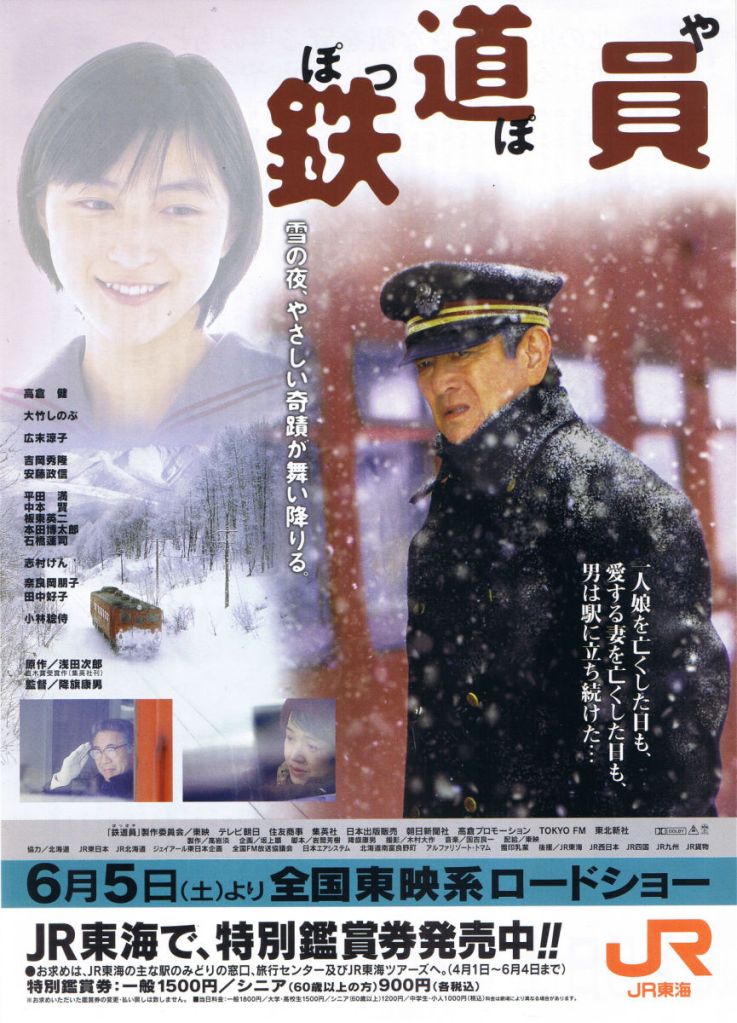
 

Poppoya (鉄道員, Yasuo Furuhata, 1999)

img_0The late Ken Takakura is best remembered as cinema’s original hard man but when the occasion arose he could provoke the odd tear or two just the same. 1999’s Poppoya (鉄道員) directed by frequent collaborator Yasuo Furuhata sees him once again playing the tough guy with a battered heart only this time he’s an ageing station master of a small town in deepest snow country which was once a prosperous mining village but is now a rural backwater.
Otomatsu Sato has spent his life in service to the railway. Like his father before him who believed the key to the modernisation of Japan after its defeat in the second world war was in its transportation network, Sato started as an engineer before being promoted to station master. Morning and evening in the freezing cold he bid in and sent out each passenger and freight train travelling through his one track station. However, though he clearly loves his job Sato has experienced a great deal of personal tragedy in pursuit of his career. He wasn’t there when his baby daughter died, nor was he there when his wife lay dying in hospital. He was where he always is, on the platform until the last train goes out. Now, however, the mine has closed, the town is full of old people and there are no passengers on the train so the line will be closing. Having given his life to something which will be so unceremoniously erased, what is a man like Sato to do now?

In true Takakura fashion, Sato appears tough and fairly unapproachable on the outside but actually he’s quite well respected in the town and even if some of the other residents bemoan his rigid ways, they grudgingly respect him for being the way he is. He takes his duties seriously and would never countenance breaching them for something as trivial as personal concerns, even when those concerns are something as understandable as the death of a family member. The way he sees things, this is his duty and must be fulfilled, properly each day no matter what. This may seem a little obsequious in Western eyes, though many of the other (particularly female) characters also agree Sato takes things much further than he needs to, but dedication to one’s duty is, after all, an admirable trait.

However, now it’s all been for nowt. The railway line is to be closed, the land will engulf it once again erasing the years of Sato’s work just as if he were never there. He’s sacrificed final moments with his wife and child – not even that, just sacrificed moments. He’s given all to the railway and now there’s no place left there for him. His best friend, the father of a son also in the railway business, is to take another job at a hotel complex but Sato is a railwayman through and through – he’ll work on the tracks or not at all.

Around this time Sato also starts seeing some strange new children around. He assumes they’ve come to stay with grandparents in the village, this being the time of the New Year holiday. The little one has a strangely old fashioned looking doll that reminds Sato of one he bought for his infant daughter only she never really had the chance to enjoy it. Then he meets an older sister who’s kind of a live wire before meeting the oldest – a high school student dressed in an old fashioned looking uniform who really reminds him of someone he used to know. All these strange encounters force Sato to further re-examine his past, reliving old regrets and assessing a life lived in service to an ideal at the expense of the joy he might have felt as a happy family man.

Beautifully photographed with picturesque shots of trains against the deep snows of Northern Japan, Poppoya was Japan’s submission for the 1999 Oscars and does have all the trappings of a prestige melodrama. It unabashedly pulls at the hearts strings and even if the rather sentimental score takes things too far, Poppoya does nevertheless manage to draw the odd tear for Sato’s lonely, regretful old age. Sentimental yet genuinely affecting, Poppoya is an effectively crafted weepy which serves as a timely reminder to embrace the things which are most important to you while there’s still time.


The Hong Kong blu-ray release of Poppoya includes English subtitles (though they are a little “imperfect”).

Only trailer I can find has Korean subs:


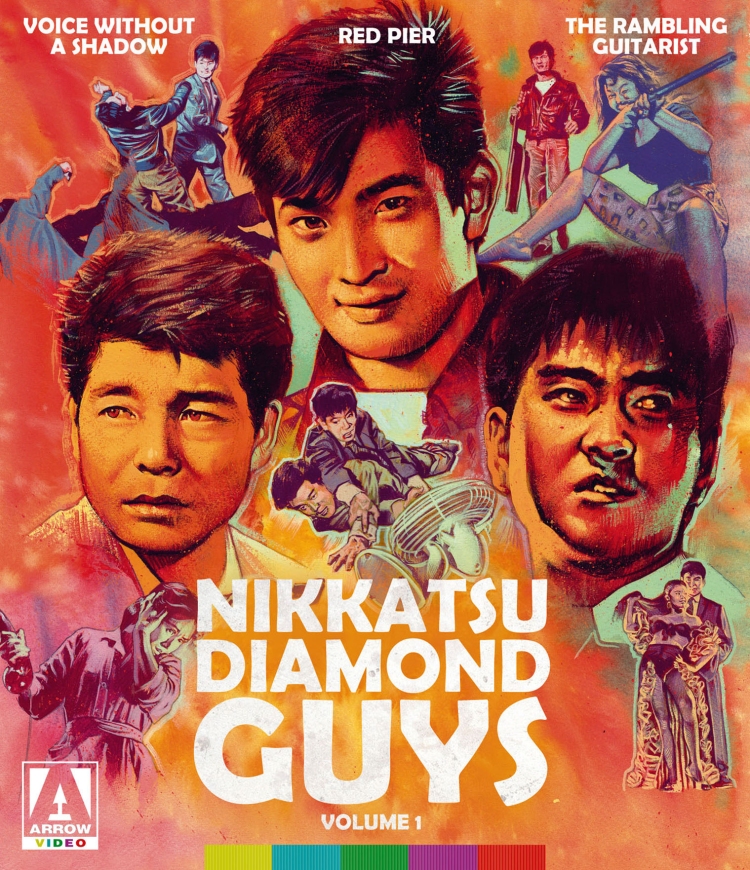
Nikkatsu Diamond Guys Vol. 1

nikkatsudg_av037Review of Arrow’s Nikkatsu Diamond Guys Volume 1 first published on UK Anime Network.


“Diamond Guys” is the name given to the top line of A-list stars at Japan’s oldest film studio Nikkatsu during their period of relaunching themselves as a major production house during the 1950s. At this time, Japanese studios, like their Hollywood counterparts, worked largely on a star system where they held a number of actors and actresses under contract and slotted them into their productions as and where they saw fit. Of the three stars in these pictures, Yujiro Ishihara perhaps burned brightest as a James Dean style apathetic hero and icon of the “sun tribe” era. Hideaki Nitani ultimately carved a niche for himself as a second lead rather than in starring roles and is a little more on the soulful side than the other guys. Akira Kobayashi who’s still fairly young here is probably the most familiar to overseas audiences later starring in a number of gangster pictures including Arrow’s previous releases Retaliation and the Battles Against Honour and Humanity series.

The first film included in the set, Voice Without a Shadow, is a notable inclusion as it’s a little seen, early effort from the notorious master of the surreal, Seijun Suzuki. In a significantly restrained mood here, Suzuki adapts a Seicho Matsumoto short story with noirish overtones as a telephone switchboard operator accidentally connects a wrong number and unwittingly hears the voice of a murderer at a crime scene. Hideaki Nitani plays a conflicted reporter who’s fallen in love with the switchboard operator who is, alas, already engaged. Three years later she hears the voice again in a gangster her husband unwisely becomes involved with only to have him killed and her husband become the prime suspect.

Film number two, Red Pier, comes from Toshio Masuda and stars pinup of the day Yujiro Ishihara in a characteristically cheeky, nihilistic gangster role. Dressed in a bright white suit and sunglasses, “Jiro the Lefty” is a petty yakuza street kid who found a home in a gang but dreams of a better life somewhere else. After witnessing the strange death of a potential target who gets crushed by a crane at the docks, Jiro ends up meeting the man’s sister and, of course, falls for her. Unfortunately, just about everyone now has it in for Jiro and his happily ever after seems very far off indeed.

The Rambling Guitarist, by contrast, is the only film in the collection to be filmed in colour but makes fantastic use of its super bright, psychedelic look. Starring Akira Kobayashi as a drifter with a guitar, the film starts out like a western but ends as a yakuza pic with a little youth drama thrown in for good measure. It’s fighting, music, and gunplay with Jo Shishido lending grinning support as a late addition hitman.

In some senses each of these films was built around its star – men want to be them, women want to be with them, you get the picture. The Rambling Guitarist is sort of the odd one out here as it’s of a slightly different strand than the other two with a lighter emphasis on crime and a shift from noir to western in terms of its overseas influences. Both Voice Without a Shadow and Red Pier lean much more towards film noir with Red Pier leaning a little more towards Europe than America. That said, The Rambling Guitarist is perhaps the weakest film on offer simply because of its up to the moment youth orientation which leaves it feeling a little more dated than the other two which can rely on their more classical style to find a modern appeal.

Each of these little seen gems would have been worthy of a solo buy in any case but finding them all offered in this fantastic new package from Arrow is a real treat. Each offered in stunning HD re-masters on blu-ray, even if they show their age in a couple of places the transfers are particularly fine and are likely to be the best these films will ever look. The Nikkatsu films from this era offered crowd pleasing thrills and good looking actors, but they were often also made by interesting directors who injected a little of their own individual, often youthful, flair to lift them well above the generic genre movies also on offer. That isn’t to say that each of their pictures was a smash hit, but the three on offer as part of this set are certainly each worthy of consideration even if for quite different reasons and if the included trailers for Vol. 2 are anything to go by we have even more undiscovered gems to look forward to in the future!


Nikkatsu Diamond Guys Volume 1 is out now on dual format DVD/blu-ray in the UK and USA courtesy of Arrow.


Voice Without a Shadow (影なき声, Seijun Suzuki, 1958)

Snapshot-2016-01-24 at 10_45_06 PM-571365520
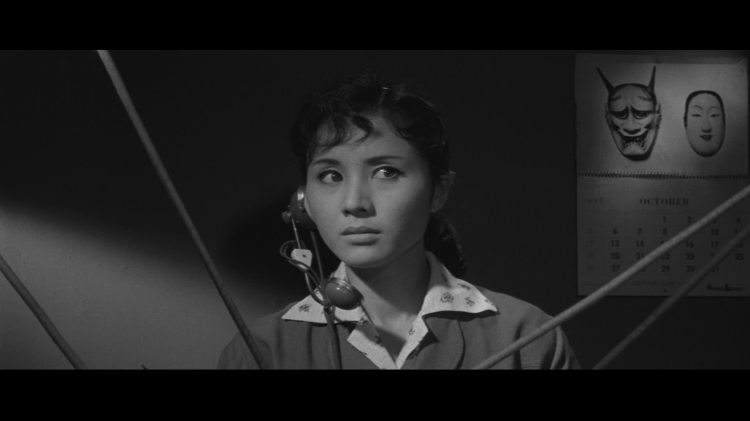
Make friends with this Oni mask – you will be seeing a lot of him throughout the film.

Seijun Suzuki might be best remembered for his surrealist pop art masterpieces from the late sixties or his even less comprehensible art films which followed his return to directing after settling his dispute with Nikkatsu, but everyone’s got to start somewhere and it comes as something of a relief to know that Suzuki was perfectly capable of making a straightforward movie if he wanted to. Voice Without a Shadow (影なき声, Kagenaki Koe) is exactly what it sounds like – a fifties style, US inspired noir however, Suzuki adds his usual flourishes and manages to wrong foot us pretty much the whole way through so that we never end up where we thought it was that we were going.

To begin with, our story is fairly straightforward. Reporter Ishikawa (Hideaki Nitani) provides our film noir style voice over as switchboard operator Asako (Yoko Minamida) accidentally dials a wrong number only have it picked up by a strange man who tells her she’s rung a crematorium then laughs hysterically. It turns out that the number was actually for a pawn shop which was in the process of being knocked over and the owner killed – Asako heard the perpetrator’s voice and thanks to her switchboard experience isn’t going to forget it. Ishikawa grows closer to Asako as the case becomes a media sensation but backs off after learning she’s already engaged.

Three years later Asako hears the voice again – a friend of her husband’s who keeps co-opting their living room for mahjong games that go on for days and cost everyone but him a lot of money. Before long Hamazaki (Jo Shishido) is found dead and Asako’s husband is the prime suspect but did he really do it? And if he didn’t, does Ishikawa really want to find out who did?

As you can see it’s a story that wouldn’t be out of place in any B movie noir from the fifties and the telephone set up is even a little reminiscent of Sorry, Wrong Number (though that film has a very different conclusion indeed). Based on a short story by Seicho Matsumoto, Voice, Voice Without a Shadow is full of the classic play of light and shadow that characterises the best film noir and the mood is ably supported by a suitably jazzy score from Hikaru Hayashi. If there’s a criticism to be made in this area, it’s that Nitani’s Ishikawa is a little too nice and pure hearted in comparison to the broken hearted heroes from the detective serials. He seems content to try and help Asako whilst uncovering the truth even if it ends up costing him in the end.

Although Asako herself is technically the leading character she quickly gets relegated to a more conventional woman in peril role. She is the one who recognises Hamazaki’s voice and the only clue linking him to the pawn shop murder three years ago but, while he’s alive anyway, Hamazaki is more interested in having fun terrorising everyone rather than trying to rub her out. In fact, the sudden demise of Hamazaki, played by an extremely young Jo Shishido, is one of the most surprising things about the film in which you’d expect him to remain the central antagonist right up until the grand finale.

Voice Without a Shadow is then a fairly conventional, noir inflected B movie which wears its Hollywood influences on its sleeve. However, there are glimpses of Suzuki’s individual style leaking through such as in his occasional and surprising use of double exposure, innovative composition and other modernist techniques which all help to lift the rather workmanlike script onto another level. In someways, it’s all a little too nice – even Hamazaki’s nasty lowlife activities are neatly skirted around almost like a film noir that’s been through a car wash though its strange pleasantness also has a nicely refreshing quality.

A minor film from the master of the surreal then, but an interesting one none the less. The mystery element proves satisfying even if it could do with a little more dirt under its fingernails and the committed performances also do their bit to enhance the mood. A prime example of its genre, Voice Without a Shadow is a notably restrained entry in Suzuki’s back catalogue but its classical style mixed with an offbeat, absurdist undercurrent make it one worth seeking out.


Voice Without a Shadow is the first film included in Arrow’s Nikkatsu Diamond Guys Vol. 1 collection.


Gate of Flesh (肉体の門, Seijun Suzuki, 1964)

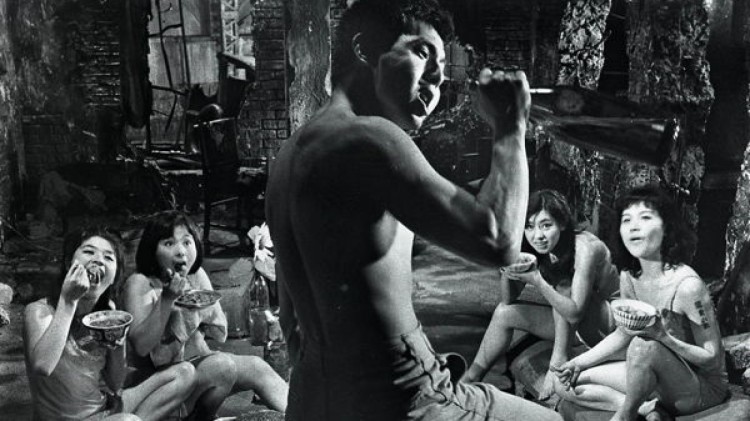
nikutai_no_mon_2_film-1600x900-c-defaultWhat are you supposed to do when you’ve lost a war? Your former enemies all around you, refusing to help no matter what they say and there are only black-marketers and gangsters where there used to be merchants and craftsmen. Everyone is looking out for themselves, everyone is in the gutter. How are you supposed to build anything out of this chaos? Perhaps you aren’t, but you have to go one living, somehow. The picture of the immediate post-war world which Suzuki paints in Gate of Flesh (肉体の門, Nikutai no Mon) is fairly hellish – crowded, smelly marketplaces thronging with desperate people. Based on a novel by Taijiro Tamura (who also provided the source material for Suzuki’s Story of a Prostitute), Gate of Flesh has its lens firmly pointed at the bottom of the heap and resolutely refuses to avert its gaze.
A nervous young woman, clearly tired, starving and alone wanders through a marketplace in desperation before a yakuza offers to buy her something to eat. She is wary but has little choice. Soon after she meets toughened prostitute Sen who is the de-facto head of a small group of streetwalkers committed to supporting and protecting each other. They have few rules but the biggest one is no giving it away for free. Maya joins their “merry” band and things are going OK for them until they make the fateful decision to take in a wounded ex-soldier on the run from the American military police. Shin puts a great big wedge between the members of the group, deepening the cracks which were present all along. Sure enough, Maya starts to fall for this damaged man threatening to fall foul of the gang’s single taboo. When you’ve lived like this, without hope, without a future, can you ever go back to being a “real human being” ever again?

Make no mistake, this is a ruined world. Almost post-apocalyptic, it’s populated by the starving and the desperate. The sweet potato seller is king here – the working girls are depicted like packs of rabid animals, descending on any passing male ready to extract any amount of loose change which they immediately run out to thrust into the hands of anyone who has food. The great horror is hunger.

The other great horror is, of course, violence and particularly male violence against women. Maya is assaulted early on and a truck carrying two army officers and a priest tries to make a quick escape after noticing her lying wounded by the roadside. The Americans aren’t going to help her, she’s just another raped Japanese woman after all, but the priest stops and offers another kind of salvation shining from his dangling crucifix. He repeatedly turns up later and tries to convince Maya to come back to church but you can’t live on a communion wafer alone and eventually Maya puts a definite end to the idea of any kind of religious solution to her predicament.

Sex is business for the woman under Sen’s command. They sell their bodies, hence the prohibition on giving them away. Breaking the rules will get you cruelly beaten and humiliated before being thrown out of the group and it’s near impossible to survive alone. The other women have all been injured by the war, they’re all among those left behind. One of them, Machiko, stands a little to the side as a middle class war widow rigidly sticking to her kimono and dreaming of becoming someone’s wife again. Needless to say, she and Sen do not always see eye to eye as Machiko’s desire to return to a more innocent age conflicts with Sen’s hard nosed pragmatism.

This is Japan in defeat. The girls live in a warren of ruined buildings haunted by visions of the past. Shin has returned from the war to a land devoid of hope. He’s a broken man and, as the woman have been “reduced” to prostitution, he has been “forced” into crime. There aren’t any real people here anymore, just animals willing to do whatever it takes just to stay alive.

When Suzuki was given this assignment, they wanted him to make a soft-core exploitation pic full of the sleazy lives of the red light district. Suzuki doesn’t give them that, he gives them another round of beautifully composed, surrealist social commentary in which the downtrodden citizens of Japan are defeated for a second time by the corrupting influences of the American occupation. The final shot of the ascendant Stars and Stripes flapping in the wind while the Japanese flag lies drowned in the muddy river speaks for itself and though Suzuki shows us those defiantly trying to live his prognosis for them is not particularly hopeful. He uses multiple exposure here more than in any other film as the past continues to haunt the traumatised populace in quite a literal way where one scene of degradation leads on to another. Extended metaphor, surrealist examination of the post-war world and also the low level exploitation feature Suzuki was hired to direct (albeit in more ways than one) Gate of Flesh proves one of his most complicated and accomplished features even given his long and varied career.


Gate of Flesh is available with English subtitles on R1 DVD from The Criterion Collection.

Chasuke’s Journey (天の茶助, SABU, 2015)

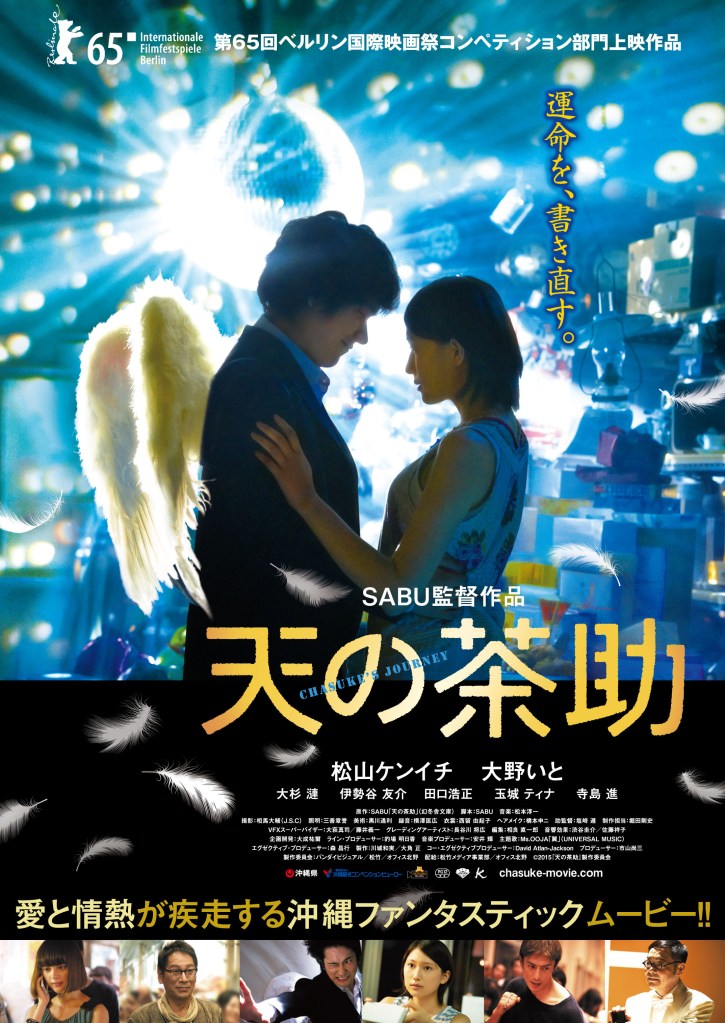
jon_chirashiNo fate but what we make – to steal the lines from another film just as one of the heavenly scriptwriters might in the latest film from the prolific Japanese director SABU (otherwise known as the actor Hiroyuki Tanaka), Chasuke’s Journey (天の茶助, Ten no Chasuke). Adapting his own novel for the screen (though the book was actually published after the film was completed), Sabu creates a romantic fantasy in which a lowly tea boy from heaven descends to Earth on a quest to save the woman he loves from certain death.
Chasuke (Kenichi Matsuyama) is the tea boy in “heaven” (his name, “Chasuke” literally means “tea assistant”). Here, there is a room full of scriptwriters who draft life stories for the people down below in service to The Man. Their task is a difficult one as each change in one person’s screenplay necessitates a change in all the others. It’s the butterfly effect gone mad. So, when The Man sends in a request for everything to suddenly go “more avant-garde” everyone is a little bit overworked. One writer asks Chasuke’s advice on what this might mean but all he comes up with is moving the action to a karaoke booth which has the unfortunate effect on the scene of getting the man’s proposal of marriage rejected causing him to leave in a mood and callously run Yuri (Ito Ono), whom Chasuke has developed a fondness for, over. Yuri’s screenwriter begs Chasuke to go down to Earth and use his unique powers to save her before it’s too late.

Luckily two of the other scriptwriters have pledged to support Chasuke’s mission from up above so he gets help from a former aspiring actor who now runs a small antique shop (Ren Osugi) and a broken hearted former boxer who now runs a ramen bar (Yusuke Iseya). Co-incidentally, both know and like Yuri who is a regular customer at both of their establishments. Coming from up above, Chasuke is already quite familiar with each of the character’s backstories and is able to fill us in with a touch of storytelling of his own. SABU has a dig here at unimaginative screenwriters who’ve ripped off most of their best ideas from other movies, which is sort of ignoring the fact that someone must have crafted the movies from up above anyway though the thought of screenwriters scripting screenwriters writing scripts about scriptwriters sort of makes your head spin.

Anyway, without venturing too far into spoiler territory, Chasuke’s quest is finished within the first half of the film with the remainder given over to a confused series of episodes featuring him as a celebrity healer committed to correcting all the awful scripts full of misery that his hack friends have come up with. That’s in addition to the constant threats of correction to Chasuke’s edits threatened by the jilted lover and a policeman who’ve both been given white painted faces (to be more “avant-garde”, as requested). Oh, and Chasuke’s memories of a former mortal life also start to return with a fairly surprising backstory of his own.

In truth, it’s all a little messy – almost as if someone were still working on the second draft even as we’re watching it. However, that’s sort of the point – we are watching someone re-writing on the hoof, trying to accommodate for someone else’s notes right as the keys are hitting the paper (or in this case, the ink splashing the parchment). When you come right down to it, life is a messy business and rarely makes any kind of sense during the “live broadcast”. Chasuke’s final message proves something of a riddle as he at once advises you to stick to The Man by living your own life and forging your own destiny whilst also putting his salvation down to the power of prayer which is about as close as you can get to an existential paradox.

Often beautifully photographed with Chasuke’s escape from up above an early highlight, Chasuke’s Journey is certainly a handsome looking film whatever faults it may have. Though the performances are committed, it never quite makes the jump from gentle satire to anything more emotionally engaging undermining the impact of its final sequence. However, for the vast majority of its running time Chasuke’s Journey does prove an interesting, if slightly flippant, take on freewill versus predestination with a hearty dose of social criticism thrown in to boot.


The Japanese blu-ray/DVD release of Chasuke’s Journey includes English subtitles.

(Unsubtitled trailer again though, sorry).


Kamome Diner (かもめ食堂, Naoko Ogigami, 2006)

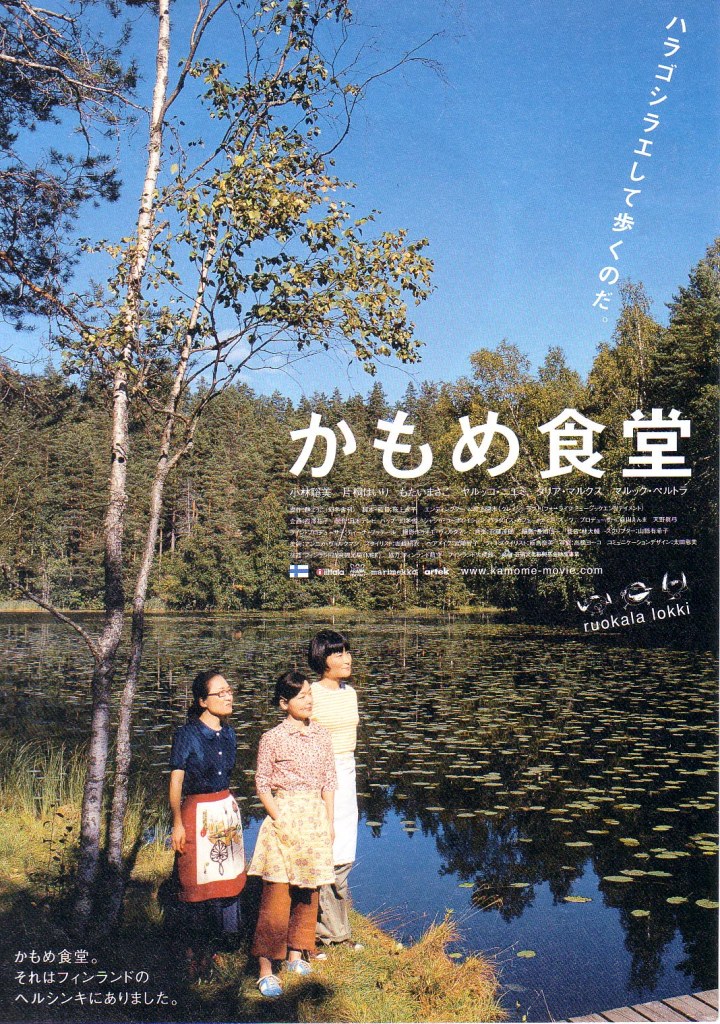
wsVs9OWFinland, Finland, Finland. That’s the country for me! Where better could there possibly be to open up a small Japanese cafe than in Helsinki? On second thoughts, don’t answer that but moving to Finland and opening her own diner all alone is exactly what the leading lady, Sachie, has done in this warm hearted comedy drama from Naoko Ogigami, Kamome Diner (かもめ食堂, Kamome Shokudou). As in most of her films, Ogigami has assembled an eclectic cast of eccentric characters who each find themselves turning up at Sachie’s restaurant largely by chance but this time there’s a little added cross cultural pollination too.

Sachie (Satomi Kobayashi) has learned fluent Finnish and put together a welcoming space serving coffee and sweet goods as well as full meals in a fairly central location though she’s yet to receive a single customer through her doors. Three middle aged women often stop outside and stare making some sort of derogatory comment before scuttling off when Sachie spots them. Then, one day a teenage boy comes in and unexpectedly tries out some of his Japanese. He turns out to be a bit of a Japanophile and asks Sachie to teach him all the words to the Gatachman theme tune though she can’t remember past the opening. The tune gets stuck in her head and starts to drive her so mad that when she spots another Japanese woman in a bookshop cafe she marches up to ask her if she can remember the whole thing and luckily she can. Sachie then offers to let the woman, Midori (Hairi Katagiri), stay at her place in return and the two become friends. Later another Japanese lady, Masako (Masako Motai), turns up after her luggage goes missing and together the three start to make a success of Sachie’s diner.

Why Sachie chose Finland remains a mystery, though she has taken the time to learn Finnish to a near native level and also seems to know quite a lot about the various local legends. She doesn’t seem particularly rushed though and is fairly content to wait around for the customers to come of their own accord rather than trying to chase them down herself. In fact she gives her very first customer, the Japanese pop culture enthusiast Tommi, free coffee for life which doesn’t seem like the best business decision.

Likewise, we learn how Midori came to choose Finland as a holiday destination but she seems a little sad and the fact that her stay is open ended perhaps hints at having run away from something though once again we aren’t told much about her backstory. Not that that matters very much, quite the contrary in fact. Masako proves the most eccentric of the three though we actually learn quite a bit about what brought her to Finland.

Other than Tommi who seems most interested in the stereotypical aspects of Japanese culture (to the slight consternation of Midori) with his T-shirts bearing non sensical slogans and illustrations of geisha, the restaurant does start to attract a few Finns albeit mostly ones who are in some sort of trouble. One man teaches Sachie how to make better coffee, a middle aged woman simply stares angrily at them from outside until she comes in one day and downs a few of the local spirit before collapsing, and then there are the other three gossips who turn out to be won over with something as simple as sweet smelling pastries.

Simply put, warmth, kindness and patience eventually break down all barriers. The Kamome Diner becomes a refuge for all the lonely misfits from home and abroad watched over by Sachie & co always ready to pour some delicious smelling coffee for the next needy customer through the door. Wonderfully low-key and filled with absurd yet oddly plausible situations, Kamome Diner blends the dual eccentricities of these two stereotypically “wacky” countries beautifully and just goes to prove there’s nowt so queer as folk wherever you land.


The Japanese region A blu-ray release of Kamome Diner includes English subtitles!

Short (unsubtitled) scene from near the beginning of the film:

Megane (めがね, Naoko Ogigami, 2007)

119236783696916311605When considering their next holiday destination, many people like to peruse some brochures, have a read of trip advisor or head to a well known tourist spot that is likely to impress the guests at their next soirée but then there are always others who just simply show up somewhere and hope for the best. The central character of Megane, Taeko (Satomi Kobayashi), perhaps wishes she’d done a little research before heading out to a very strange inn on a very strange island but the longer she stays, the more the ways of the laid-back islanders seem to make sense to her.

The film begins as inn owner Yuji (Ken Mitsuishi) plays with his dog on the beach before suddenly realising “She’s here!” – referring to a favourite, annual guest who operates a shaved ice stand on that very same beach but for the spring only. Sakura (Masako Motai) has, indeed, arrived but unexpectedly there is also a second visitor, Taeko, all the way from the big city. Yuki seems impressed Taeko managed to find the out of the way hotel and points out their tiny sign (if they had a bigger one there would be too many customers).

Taeko might have been looking for an escape but this is a little more than she bargained for. First off, she gets a wake up call every morning in the form of Sakura kneeling next to her bed and commenting on the weather and she’s sort of expected to attend meals at the same time as everyone else, convenient or not. Sakura also leads a strange callisthenics session on the beach each morning which Taeko is encouraged to join as well as constantly being offered Sakura’s shaved ice which she always declines.

There isn’t much to do in this strange place, Yuji, Sakura and another woman who isn’t a guest but hangs round all the time anyway are convinced Taeko has come for the purpose of “twilighting” which Taeko doesn’t quite understand and they refuse to elaborate on but apparently this weird island is very good for it. Getting sick of these strange people and their odd habits Taeko decides to just check out and try another hotel. BIG MISTAKE. The other hotel on the island turns out to be an even more bizarre cult commune which makes Yuji and co seem much more appealing all of a sudden. Returning humbly to the extremely relaxed hotel and sacrificing her suitcase in the process, Taeko finally begins to embrace the odd ways of the island and open herself up to its benign indifference.

However, part way through she’s rudely interrupted by one of her students who’s managed to track her down despite her having chosen this place specifically for its remoteness and lack of cellphone signal. Yomogi (Ryo Kase) takes to the weird ways of the island like a fish to water, in fact his hipsterish adaptability is a little odd in itself, but against expectations his arrival only slightly irritates Taeko and creates no major drama of its own. The mystery of the overly jealous hanger on, Haruna (Mikako Ichikawa), is partially solved towards the end though her gentle possessiveness of the inn bound family and passive aggression to Taeko’s gradual acclimatisation is also more of the comic variety and eventually works itself out in a gentle way.

“Gentle” may well be the best way to describe Megane. Someone should probably market a “calm” mix which consists entirely of the relaxing island sounds of this film. These people take things slow and are all the happier for it. They know the pleasure of a sunset, shaved ice on the beach on a sunny day, drinking beer outside or enjoying a barbecue with friends. Mellow to the core, Megane is the ideal way to find your own spot of serenity at the end of a busy day and is sure to ease even the heaviest of hearts with its subtle, absurd humour.


The Japanese region A blu-ray release of Megane includes English subtitles!


Crying Out Love, in the Center of the World (世界の中心で、愛をさけぶ, Isao Yukisada, 2004)

sekachuJust look at at that title for a second, would you? Crying Out Love, in the Center of the World, you’d be hard pressed to find a more poetically titled film even given Japan’s fairly abstract titling system. All the pain and rage and sorrow of youth seem to be penned up inside it waiting to burst forth. As you might expect, the film is part of the “Jun ai” or pure love genre and focusses on the doomed love story between an ordinary teenage boy and a dying girl. Their tragic romance may actually only occupy a few weeks, from early summer to late autumn, but its intensity casts a shadow across the rest of the boy’s life.

The story begins 17 years later, in 2004 when Sakutaro is a successful man living in the city and engaged to be married. Whilst preparing to move, his fiancée, Ritsuko, who happens to be from the same hometown, finds an old jacket of hers in a box which still has a long forgotten cassette tape hidden in the pocket. Dated 28th October 1986, the tape takes Ritsuko back to her childhood and a long forgotten, unfulfilled promise. She leaves a note for Sakutaro and heads home for a bit to think about her past while he, unknowingly, chases after her back to the place where he grew up and the memories of his lost love which he’s been unable to put to rest all these years…

In someways, Crying Out Love is your typical weepy as a young boy and girl find love only to have it cruelly snatched away from them by fate. Suddenly everything becomes so much more intense, time is running out and things which may have taken months or even years to work out have to happen in a matter of hours. In real terms, it’s just a summer when you’re 17 but then when you’re 17 everything is so much more intense anyway even when you don’t have to invite Death to the party too. Aki may have a point when suggesting that the the love the local photographer still carries for their recently deceased headmistress who married another man only lasted so long because it was unfulfilled. Perhaps Aki and Sakutaro’s love story would have been over by the end of high school in any case, but Sakutaro was never given the chance to find out and that unfinished business has continued to hover over him ever since, buzzing away in the back of his mind.

“Unfinished business” is really what the film’s about. Even so far as “pure love” goes, there comes a time where you need to move on. Perhaps the photographer might have been happier letting go of his youthful love and making a life with someone else, although, perhaps that isn’t exactly fair on the “someone else” involved. The photographer’s advice, as one who’s lived in the world a while and knows loneliness only too well, is that the only thing those who’ve been left behind can do is to tie up loose ends. Sakutaro needs to come to terms with Aki’s death so he can finally get on with the rest of his life.

There is a fair amount of melodrama which is only to be expected but largely Crying out Love skilfully avoids the maudlin and manages to stay on the right side of sickly. The performances are excellent across the board with a masterfully subtle performance from Takao Osawa as the older Sakutaro equally matched by the boyishness of a young Mirai Moriyama as his teenage counterpart. The standout performance however comes from Masami Nagasawa who plays the seemingly perfect Aki admired by all for her well rounded qualities from her sporting ability to her beauty and intelligence but also has a mischievous, playful side which brings her into contact with Sakutaro. Her decline in illness is beautifully played as she tries to put a brave face on her situation, determined not to give in and clinging to her romance with Sakutaro even though she knows that she will likely not survive. Kou Shibasaki completes the quartet of major players in a slightly smaller though hugely important role of Sakutaro’s modern day fiancée saddled with a difficult late stage monologue which she carries off with a great deal of skill.

Impressively filmed by Isao Yukisada who neatly builds the films dualities through a series of recurrent motifs, Crying Out Love, in the Center of the World is not without its melodramatic touches but largely succeeds in being a painfully moving “pure love” story. Beautiful, tragic, and just as poetic as its title, Crying Out Love, in the Center of the World is a cathartic romance that like Sakutaro’s memories of Aki is sure to linger in the memory for years to come.


The Japanese R2 DVD release of Crying Out Love, In the Center of the World includes English subtitles (Hurray!).

(Unsubbed trailer though, sorry)


If You Were Young: Rage (君が若者なら, Kinji Fukasaku, 1970)

51AM0Z0Z2cLFor 1970’s If You We’re Young: Rage (君が若者なら, Kimi ga Wakamono Nara), Fukasaku returns to his most prominent theme – disaffected youth and the lack of opportunities afforded to disadvantaged youngsters during the otherwise booming post-war era. Like the more realistic gangster epics that were to come, Fukasaku laments the generation who’ve been sold an unattainable dream – come to the city, work hard, make a decent life for yourself. Only what the young men find here is overwork, exploitation and a considerably decreased likelihood of being able to achieve all they’ve been promised.

Our story revolves around five young men who meet whilst working at a factory which later goes bust. The central pair, Kikuo and Asao have been friends since childhood. Both of their fathers were killed in mining accidents and the boys are part of the “golden egg” movement bringing in workers from the rural towns to increase prosperity in the capital. The other three are a fisherman’s son, Kiyoshi, a boxing enthusiast Ryuji and fifth wheel Ichiro. After a short spell in gaol, the guys hatch on the idea of clubbing together to buy a dumper truck and start a business of their own. However, by the time they’ve actually got the truck one of them’s in prison, one pulls out because of a shotgun marriage and the other is killed in a labour dispute. Asao and Kikuo get on with living the dream and are doing pretty well with the truck until their imprisoned friend decides to escape and ruins all of their lives in the process.

Almost proto-punk in tone, If You Were Young: Rage takes a long hard look at the put upon masses who rebuilt Japan but were left with little in return. These five guys left their small towns for the big city promised high wages, access to education and a path to a better life but largely what they found was cold rooms and overwork. There are frequent strike motions in the film as the construction and factory workers attempt to insist on better pay and conditions but are constantly defeated by the white collar bosses who can just bus in even more desperate young men who will agree to cross the picket line because they have no other choice. Our central five now have a dream and something to work towards, their truck isn’t just “a truck” – it’s a hundred trucks somewhere down the line and a symbol of the path to prosperity.

However, at the end of the film all of their dreams have been shattered. Some of this is not their fault, merely the vicissitudes of fate and changing times, some of it is down to poor choices but largely the odds were always stacked against them because the world is unfair. Kiyoshi lies all the time because he’s scared of pretty much everything, possibly because of an abusive (though perhaps not uncommon) upbringing. His selfishness and, ultimately, cowardice is about to mess things up for everyone else and there are somethings you just can’t come back from. Like many of Fukasaku’s heroes, what Asao dreams of is the friendship he found when the five guys were all together and working as a team. He wants to go back to that time of perpetual hope and friendship rather than live in this lonely prosperity.

Fukasaku veers between quirky new wave style optimism and the extreme pessimism of his general world view. The film is bright and colourful for the majority of its running time with memory and fantasy often relegated to black and white. He uses his usual freeze frames, often in times of violence, hand held cameras and dynamic framing to achieve his youthful, freewheeling atmosphere but as usual there’s a kind of desperation lurking in the background. As might be expected, the ending is all flames and ashes – youth lies ruined, dreams shattered, and the possibility of moving on seems woefully far off. Another characteristically caustic look at modern youth from Fukasaku, this more indie effort is one of his most searing and bears out his rather bleak prognosis for the future of his nation.


If You Were Young: Rage is available with English subtitles on R1 US DVD from Homevision and was previously released as part of the Fukasaku Trilogy (alongside Blackmail is My Life and Black Rose Mansion) by Tartan in the UK.