The Discarnates (異人たちとの夏, Nobuhiko Obayashi, 1988)

discarnatesNobuhiko Obayashi is no stranger to a ghost story whether literal or figural but never has his pre-occupation with being pre-occupied about the past been more delicately expressed than in his 1988 horror-tinged supernatural adventure, The Discarnates (異人たちとの夏, Ijintachi to no Natsu). Nostalgia is a central pillar of Obayashi’s world, as drenched in melancholy as it often is, but it can also be pernicious – an anchor which pins a person in a certain spot and forever impedes their progress.

Hidemi Harada (Morio Kazama) is a successful TV scriptwriter whose career is on the slide. He’s just gotten a divorce and seems to be conflicted about the nature of his new found bachelordom. As if he didn’t have enough despair in his life, the closest thing he has to a friend – his boss at the TV station, tells him he thinks it’s better if they end their professional relationship because he plans to start dating Harada’s ex-wife and it would all get very awkward.

Feeling unloved, Harada takes a trip to his hometown on a location scout for another project and takes in a few familiar sights along the way. It’s here that he runs into a youngish man who looks just like Harada’s father did when he was a boy. Not only that, accompanying his new found friend home, the man’s wife looks just like his mother, but Harada’s parents died when he was just twelve years old. The mysterious couple are glad to have him in their house and treat him with the warmth and kindness that seemed to have been missing in his life, leaving him the happiest and most cheerful he’s been in years.

Now in a much better mood, Harada feels guilty about rudely dismissing the woman from upstairs who’d come to visit him the day before. Apologising, Harada strikes up a friendship and then a romance with the equally damaged Kei (Yuko Natori) but even if his mental health is improving, his physical strength begins to deteriorate. Looking pale and old, Harada’s teeth rot and fall out while his hair loses its color. Even so, Harada cannot bear to pull himself away from the warmth and security that was so cruelly taken away from him when he was just a child.

Harada doesn’t start off believing that the mysterious couple really are his late parents, but if even if they weren’t these two people who are actually younger than him take him in as a son, feeding and entertaining him. When Harada returns a little while later confused by what exactly has happened, his mother immediately treats him as a mother would – physically taking off his polo shirt and urging him to remove his trousers lest they get wrinkled from sitting on the floor. Having lost his parents at such a young age, Harada has been a adrift all his life, unable to form true, lasting emotional bonds with other people. Lamenting his failure as a husband and a father, this very ordinary kindness provides the kind of warmth that he’s been craving.

However, there is always a price to be paid. Harada’s visits become increasing tiring, taking a physical toll on his ageing body. Each hour spent in the past is an hour lost to the dead. His parents are both dead and alive, existing in a strange, golden hued bubble filled with the comforting innocence of childhood free from the concerns of the adult world. Yet each time Harada succumbs to his weakness and goes to visit them, he is doing so as a way of avoiding all of his real world problems. According to one of Harada’s scripts, the past becomes a part of you and is never lost, but memory can be an overly seductive drug and an overdose can prove fatal.

Contrasted with the warm glow of the post-war world of Harada’s childhood home, his life in bubble era Tokyo is one filled with blues and a constant sense of the sinister. Harada believes himself to mostly be alone in the apartment block save for a mysterious third floor light that hints at another resident who also favours late nights over early mornings. The light turns out to belong to a lonely middle-aged woman, Kei, who is also a fan of Harada’s work. Kei has her own set of problems including a wound on her chest that she is too ashamed to let anyone see. Ultimately, Harada’s self-centred inability to lay the past to rest and fully take other people’s feelings into account will deal Kei a cruel blow.

Harada sees everything with a writer’s eye. His childhood world is a dream, but his life is a film noir filled with shadows and misery. His environments appear too perfectly composed, like a TV stage set and, as if to underline the fact, at the end of each “scene” the colour drains from the screen to leave a blue tinted black and white image shrinking into a rectangle and disappearing like the dot going out in the days when television really did close down overnight. Whether any of this happened outside of Harada’s mind or reflects a constructed reality he wrote for himself in the midst of a mental breakdown, his dilemma is an existential one – return to childhood and the side of his parents by accepting the death of his present self, or say goodbye to remnants of the abandoned child inside him and start living an adult, fully “fleshed” life by killing off this unattainable dream of a long forgotten past which never took place.

Filled with melancholy, longing and regret, The Discarnates is the story of a hollow man made whole by coming to terms with his traumatic past and all of the ways it’s influenced the way in which he’s lived his life. Harada’s parents treat him as their twelve year old son, barely acknowledging that he’s a middle aged man with a teenage son of his own. They feel regret for all of the thousand things they were never able to teach him though they are unable to see the full depths of his inability to escape his interior bubble for the wider world. Unsettling, though not as obviously surreal as some of Obayashi’s other efforts, The Discarnates is one of his most melancholic works speaking of the danger of nostalgia and all of its false promises whilst also acknowledging its seductive appeal.


Original trailer (no subtitles)
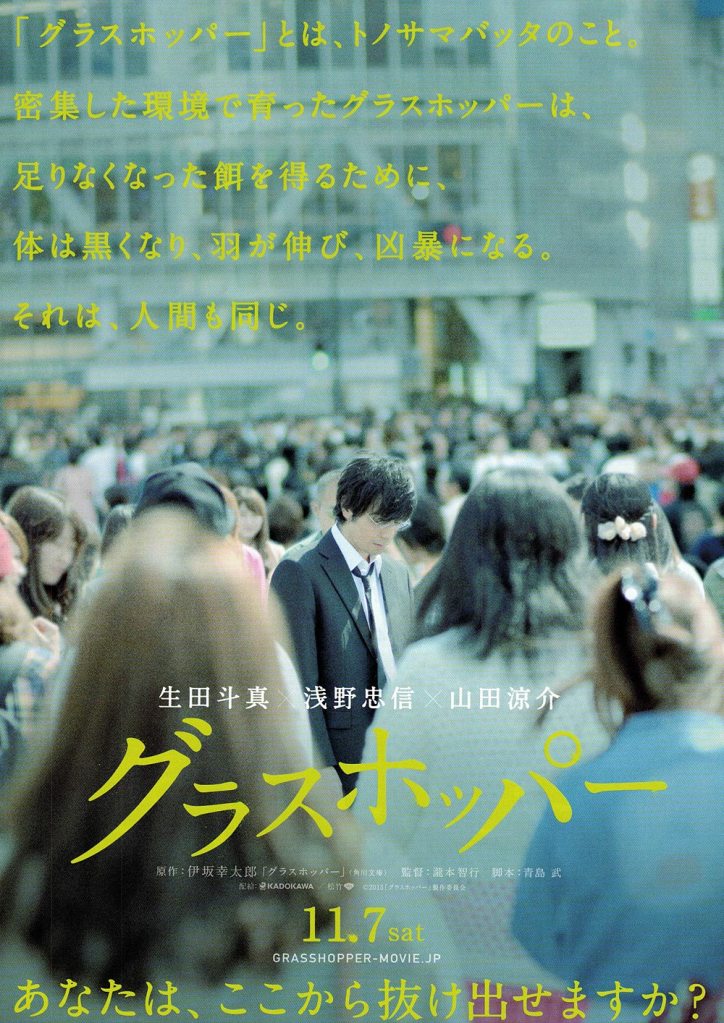
Grasshopper (グラスホッパー, Tomoyuki Takimoto, 2015)

grasshopperThe best revenge is living well, but the three damaged individuals at the centre of Tomoyuki Takimoto’s Grasshopper (グラスホッパー) might need some space before they can figure that out. Reuniting with Brain Man star Toma Ikuta, Takimoto moves away from the more overtly sci-fi elements but maintains a level of everyday strangeness that adds weight to this standard B-movie affair. A revenge thriller in which revenge itself is shown to be a fallacy, Grasshopper manages to mix its grimy grind house violence aesthetic with an oddly hopeful view of human nature.

One tragedy connects three very different people. Halloween, Shibuya – a crazed man at the wheel of a 4×4 receives a phone call instructing him to “crush all those bugs”, because he’s “the saviour”. The man obeys and plows into the holiday revellers crushing them like insects under his wheels. One victim, Yuriko (Haru), who died pushing a child out of harm’s way happened to be the fiancée of middle school science teacher, Suzuki (Toma Ikuta). Revisiting the spot where she fell, Suzuki unexpectedly receives a letter informing him that the events which occurred at Halloween were not as straightforward as the media asserts and he should set about investigating the father and son working at “Fraulein”. His mind burning with thoughts of vengeance, Suzuki abandons his old life and launches himself headlong into the criminal underworld in search of answers.

Meanwhile, the evil kingpins at the centre of things have sent their ace hitman with a difference, Kujira (Tadanobu Asano), to silence a troublesome reporter. Kujira’s unusual assassination method involves a kind of hypnosis in which he forces his victims to acknowledge their darkest sins and eventually commit suicide. Though this sounds like the ideal plan for evading detection, the gangsters are nervous that Kujira has learned to much through his near death conversations with his targets and send a duo of slightly less competent killers on his trail. This leads us to our third strand – sociopathic blade wielding killer, Semi (Ryosuke Yamada), and his stray cat rescuing handler, Iwanishi (Jun Murakami).

Suzuki finds himself out of his depth in the murky, crime ridden underworld. Talking to yet another hitman he crosses paths with, Suzuki is offered the grasshopper analogy which lies at the centre of the film. Pusher (Hidetaka Yoshioka) tells him that unlike regular migratory locusts which are generally green, there is a mutant breed which undergoes a “swarm phase” in which their wings grown darker and longer, becoming ever more destructive in the quest to feed themselves in a crowded environment. People, Pusher claims, are no different. The film is filled with these mutant insects, crushing their fellow humans like roaches under boots, yet there’s something to be said for the migratory guys who keep moving and oppose the mutant breed through stealth and cunning.

Each of the three men is looking for a kind of revenge even if it’s ultimately self inflicted. Unusual hitman Kujira has hit the assassin’s version of angel wings in that he can see the faces of all the men and women he has killed, quite literally haunting his every move and offering a running commentary on his life. Setting out for vengeance against the men who’ve ordered his death, Kujira knows he’s nearing the end of his path yet before he gets there he will have to face off against Semi with whom he has no particular quarrel despite having just given Semi a reason to seek vengeance against him. Semi’s quest for revenge is pointed at Kujira but their mutual need for satisfaction will destroy each of them whilst also bringing them together as equals.

Everything prior to the fateful Halloween is bathed in golden light where warm colours predominate in Suzuki’s fond memories of his fiancée, but everything after is dark, reds and blacks tinged with insect green as grasshoppers swarm like harbingers of a great evil. Revenge itself is constantly frustrated and ultimately swept away from each party by shadowy forces secretly working against the darkness. Nothing is quite as it seems, no one is quite telling the truth. Yet as deep as the original conspiracy goes, the counter conspiracy consistently exceeds it.

Filled with impressive action sequences from Semi’s well choreographed balletic knife displays to large scale crowd scenes and good old fashioned fist fights, Grasshopper owns its down and dirty origins but reinvigorates them with a degree of modern sophistication. Yuriko, a soup chef, insists that the true secret ingredient in her cooking is genuine emotion – that this is what’s left behind when everything else is gone. Suzuki could choose to dive inside his cocoon of unresolved vengeance for the rest of his life but that would not have been what Yuriko wanted for him. In this anti-revenge drama, vengeance is the fallacy that detracts from the truth – that the ultimate form of revenge is learning to live with the past rather than wasting time settling scores.


Original trailer (no subtitles)

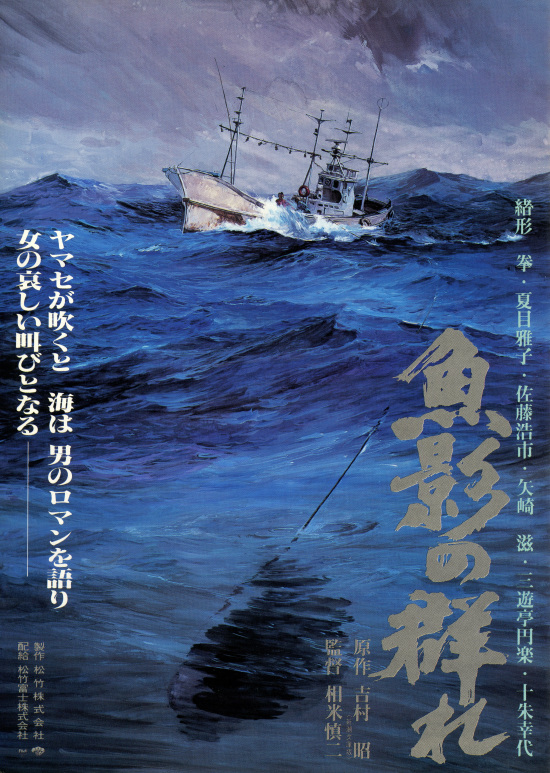
The Catch (魚影の群れ, Shinji Somai, 1983)

the-catch

Some men become their work, the quest for success consumes them to the extent that there is barely anything left other than the chase. The Catch (魚影の群れ, Gyoei no Mure), Shinji Somai’s 1983 opus of fishermen at home on the waves and at sea on land is a complex examination of masculinity but also of fatherhood in a rapidly declining world filled with arcane ritual and ancient thought.

Fusajiro (Ken Ogata) is a middle aged man who looks old for his years. Man and boy he’s spent his life at sea, hunting down the elusive tuna fish which can be sold for vast amounts of money in the rare event that one is actually caught. This “first summer” as the title card refers to it, marks a change in his life as the daughter he’s been raising alone since his wife left him many years ago, Tokiko (Masako Natsume), has found a man she wants to marry. Her boyfriend, Shunichi (Koichi Sato), owns a coffee shop in town and Fusajiro has his doubts about a city boy marrying into a fisherman’s family. However, Shunichi isn’t just interested in Tokiko, he wants to set sail too. Though originally reluctant, Fusajiro eventually agrees to take Shunichi as a kind of apprentice but is dismayed when he gets seasick and seems to have no hint of a fisherman’s instinct.

Fusajiro is a legend among his peers – a big man of the sea, a true sailor and top hunter. He’s the one people turn to whenever anything goes wrong on the waves. However, he’s also a gruff man who speaks little and seems to prefer his own company.  In the rare event that he is speaking, it’s generally about tuna. When Shunichi first meets Fusajiro he remarks that he knew it must be him because he “smells of the sea”.

A later scene sees Fusajiro catch sight of a woman caught in the rain who immediately starts running away from him. Chasing her  just like one of his ever elusive tuna he eventually pins the woman down and takes her back to his boat to complete his conquest. The woman turns out to be his ex-wife, who left him precisely because of this violent behaviour. After momentarily considering returning to him, she realises that he hasn’t changed and accuses him of being unable to distinguish people from fish – he hooks them, reels them in, and if they don’t come willingly he hits them until they do so he can keep them with him. This overriding obsession with domination also costs Fusajiro his daughter when Shunichi is gravely injured on the boat and Fusajiro delays returning to port until he’s secured the tuna he was chasing at the time. Shunichi’s blood and the fish’s mingle together on the deck, one indistinguishable from the other, both victims of Fusajiro’s need to reign supreme over man and fish alike.

Fusajiro tried to warn Tokiko not to marry a fisherman, it would only make her miserable. Shunichi is warned that a fisherman’s life is a difficult one and the seas in this area less forgiving than most, but his mind is made up. Finally acquiring his own boat after selling his cafe, Shunichi, just like Fusajiro, starts to fall under the fisherman’s curse – endlessly chasing, living only for the catch. Unlike Fusajiro, however, Shunichi has little instinct for life at sea and fails to bring home his prey. Little by little, the mounting failures eat away at his self esteem as he feels belittled and humiliated in front of the other sailors culminating in an attempt to reinforce his manhood by raping his own wife. These men are little better than animals, consumed by conquest, permanently chasing at sea and on land. To be defeated, is to be destroyed.

Somai never shies away from the grimness and brutality of the work at hand. Ogata catches and spears these magnificent fish for real and the unfortunate creatures are then carved up right on the dockside before our very eyes. As we’re constantly reminded, physical strength is what matters for a fisherman and Fusajiro is a strong man, duelling with the tuna fish and straining to hold the line with all his might. Yet he’s getting old, his body is failing and like an aged toreador in the ring, his victory is no longer assured. The Japanese title of the film which translates as crowds of shadows of solitary fish expresses his nature more clearly, his fate and the tuna’s are the same – a lonely battle to the death. Unable to forge real human connections on land Fusajiro and his ilk are doomed to live out their days alone upon the sea wreaking only misery for those left behind on the shore.


Original trailer (No subtitles, graphic scenes of animal cruelty)

A Double Life (二重生活 , Yoshiyuki Kishi, 2016)

double-lifeA Double Life (二重生活, Nijyuu Seikatsu ), the debut feature from director Yoshiyuki Kishi adapted from Mariko Koike’s novel, could easily be subtitled “a defence of stalking with indifference”. As a philosophical experiment in itself, it recasts us as the voyeur, watching her watching him, following our oblivious heroine as she becomes increasingly obsessed with the act of observance. Taking into account the constant watchfulness of modern society, A Double Life has some serious questions to ask not only of the nature of existence but of the increasing connectedness and its counterpart of isolation, the disconnect between the image and reality, and how much  the hidden facets of people’s lives define their essential personality.
Tama (Mugi Kadowaki) is an MA philosophy student working on a thesis regarding the nature of existence in contemporary Japan. Discussing her work with her supervisor, Shinohara (Lily Franky), Tama reveals that she was drawn to her subject because she is unable to understand why she herself is alive. Her proposal was largely based on the tried and tested method of a survey but Shinohara is hoping for something more original. Catching sight of a Sophie Calle book on his desk, he suggests that Tama’s project might benefit from examining the life of one subject in depth and so he tasks her with following a random person and observing their daily activities in order to figure out what makes them tick.

Tama is conflicted, but when she catches sight of her neighbour at a book shop she makes an impulsive decision to follow him which will later develop into an all consuming obsession. Ishizaka (Hiroki Hasegawa) is a successful editor at a high profile publishing house with a pretty wife, cute daughter and lovely home just over the way from the apartment Tama lives in with her illustrator and game designer boyfriend, Takuya (Masaki Suda). However, while following Ishizaka to a local coffee shop Tama catches him illicitly meeting another woman. Not quite believing what she sees, Tama’s obsession with her target continues to grow until the fateful day that her cover is finally blown.

Tama, and her supervisor, both regard the exercise as essentially harmless because all Tama is supposed to do is observe. The nature of her experiment means that she must remain unseen so that the subject does not change his or her behaviour but Tama quickly becomes a passive observer to an unpleasant domestic episode when Ishizaka’s wife discovers the affair. Tama is, always, a passive presence. As she says herself, she carries a deep-seated sense of emptiness that prevents her from fully connecting with other people. Her stalking activities, however, reawaken a sense of connectedness that she had been unable to find in her everyday life.

While Tama is watching Ishizaka, she herself is also being watched. Firstly, of course, by us, but also by the busybody landlady whose obsession with the proper way to dispose of rubbish has led to her installing spy cameras to capture the offending tenants on film. Of course, the cameras capture a lot of other stuff too which, when used alongside other forms of evidence, paint a slightly different picture. The old lady is a classic curtain twitcher, albeit one with access to more sophisticated equipment, and looms big brother-like over her tiny domain, the possessor and disseminator of all information. Tama’s rules mean she must not be seen, but someone is always watching, collecting information to be repurposed and repackaged at the convenience of the collector.

Cameras capture images but humans conjure pictures. From the outside, the Ishizakas are the perfect model family – a successful husband, warm and friendly housewife who is quick to get involved in community events, and a lovely, well behaved little daughter. As we find out Ishizaka is not the committed family man which he first seems. After treating all of the women in his life extremely badly, Ishizaka adds Tama to his list after the affair is exposed and his life ruined. Tama was only ever a passive observer whose presence had no effect on the narrative, yet Ishizaka blames his predicament on her rather than address the fact the situation is entirely his own fault. He does, however, have a point when he accuses Tama of exploiting his secrets for her own gain.

Tama’s observations are limited to the public realm and so she’s left with a lot of unknown data making her conclusions less than reliable. The gap between her perception and the reality becomes even more apparent once she begins observing the life of her supervisor, Shinohara. In an elliptical fashion, the film begins with Shinohara’s presumed suicide attempt and for much of the first half we seem him struggle with the grief of his mother’s terminal illness. This again turns out to be not quite as it seems, undermining Tama’s whole research proposal as her conclusions on Shinohara’s reason for living were based on a deliberately constructed scenario.

Ironically enough, Tama’s attempts to connect eventually ruin her own relationship as she finds herself living “a double life” as a vicarious voyeur. Abandoning her sense of self and living through her subjects, Tama begins to connect with the world around her but it’s more overlapping than a true union of souls in which she becomes a passive receptacle for someone else’s drama. Hers is the life of a double, shadowy and incomplete. Take away a man’s life lie and you take away his happiness, so Ibsen told us. Tama would seem to come a similar conclusion, that the essence of life may lie in these petty secrets and projected images. An intriguing philosophical text in itself, A Double Life is an intense look at modern society and all of its various artifices which marks Kishi out as a promising new cinematic voice.


Reviewed at Raindance 2016

Original trailer (English subtitles)

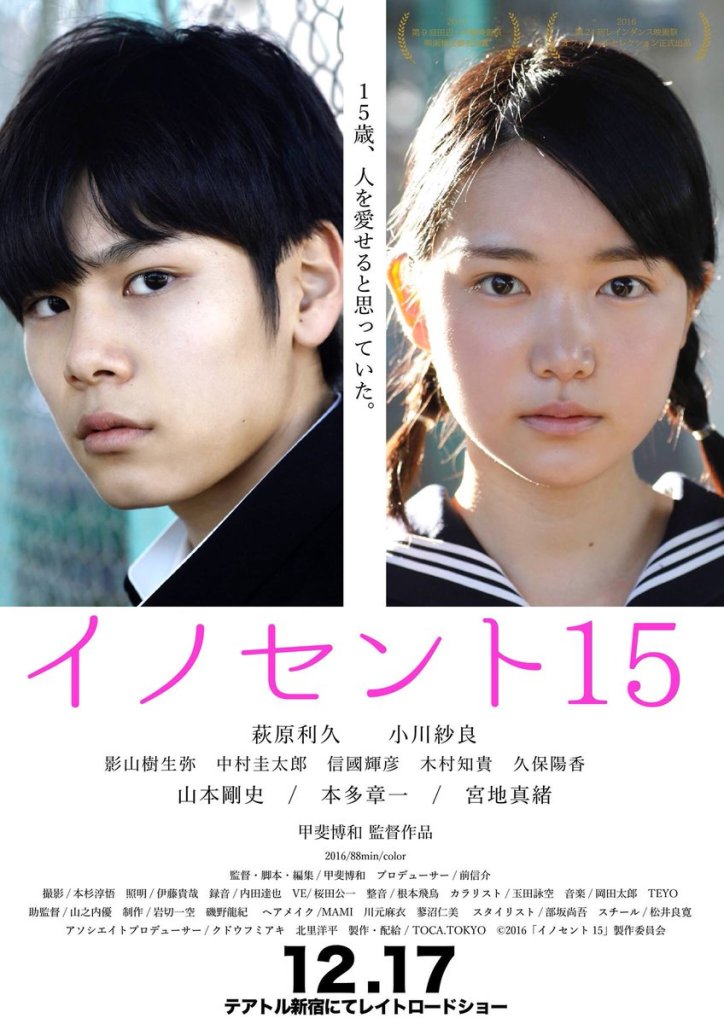
Innocent15 (イノセント15, Hirokazu Kai, 2016)

innocent-15Innocence is a fairly nebulous concept and one often misused but if you were expecting an “innocent” tale of youthful romance, Hirokazu Kai’s Innocent15 (イノセント15) is out to wrong foot you from the get go. Kai does not shy away from the darker sides of human nature in examining abusive parenting and forced prostitution as well as the damage done when a secret is broken after long years of being unable to be honest about who you really are. This is a bleak tale, but one with with hope shining round the edges, even if uncertainly.

Narumi (Sara Ogawa) and Gin (Riku Hagiwara) are ordinary middle school students living in small town not far from the capital. When Narumi plucks up the courage to confess her love to her friend, she receives the kindest of brush offs but Gin is left confused. His two drop out friends who spend their days skateboarding around the neighbourhood can’t understand his decision to turn down such a pretty girl though they remember that he’s done the same thing before. Gin himself doesn’t quite know why, but even if he feels sorry for not returning Narumi’s feelings, he is unable to accept them.

Though Narumi may seem like the perfect high school girl – quiet, studious, and refined, if a little sad, her home life is anything but ordinary. Saddled with an aggressive woman child for a mother who demands Narumi abandon her homework to cook her dinner while she plays on her gameboy, Narumi keeps her head down and makes the best of things. After putting up with her mother’s regular beatings, she finally decides to leave when she learns that her mother has sold her virginity to her boyfriend for 100,000 yen.

Meanwhile, Gin’s life is turned upside-down when he learns his father is in love with another man. Already in a state of confusion about his own adolescent feelings, Gin is unable to comprehend this sudden bombshell and lashes out at all around him. Therefore when Narumi arrives and tells him she’s leaving for Tokyo to look for her father he immediately says he’ll come with her. However, their youthful ideas of going it alone in the big city are quickly dashed.

Gin’s problems are of a more immediate kind but Narumi has endured long term suffering at the hands of her abusive mother. When she belittles Narumi’s studying and remarks that she’s no need to go to high school because the world always needs more hookers, it seems like an instance of cruel sarcasm but it turns out she really is intent on prostituting her own daughter to her no good boyfriend.

When her mother’s boyfriend viciously attacks Gin, Narumi is left with nowhere else to go. The tragedy is that intense social pressures and her already existing isolation make it impossible for Narumi to confide in someone about the abuse she’s suffering at home. Being only 15, even if she were to simply walk out of her mother’s house she would have no way to support herself, leaving her with little choice between possible starvation on the streets and allowing her mother to sell her to her cruel and violent boyfriend.

Narumi’s “innocent” love for Gin becomes her last lifeline and his rejection a crushing end to her dreams of being saved. By contrast, Gin’s problems are much easier to solve. His resentment towards his father is more likely driven by the shock of the revelation rather than directly because he has fallen in love with another man. Gin may have temporarily rejected his father, but his father has not rejected him. Guilt and embarrassment over his actions aside, Gin is always welcome to return home where his father would welcome him with open arms. All of Gin’s problems are internal as he struggles with his adolescent confusion. All of Narumi’s problems are external – when Gin spots the scars and bruises on her shoulder, she tells him that she was able to put up with her mother’s cruelty because it only hurt her body and never touched her soul. Narumi’s interior is solid, but she’s trapped in a desperate situation from which there is no obvious way to escape.

Mirroring each other, Gin and Narumi try to run away from their problems but are each unable to escape. Kai opts for a series of reverses towards the film’s conclusion which offer hope only to dash it again and the final scene with only the sound of a motorbike’s flooded engine and eventual kickstart adds a note of anxious ambivalence in which there is a chance for the pair to ride away together but no further evidence that this attempt will be any more successful than the last. The general tone is one of gritty realism though Kai also admits the existence of life’s strange coincidence’s such as in the repeated appearance of a “weird lady” on a pink mobility scooter whose eccentric driving style has disastrous consequences. A necessarily bleak tale highlighting the plight of children in danger in their own homes and left with nowhere else to go coupled with a tentative, innocent teenage love story, Innocent15 is a tense, often horrifying experience filled with outrage but is careful to leave at least the possibility of a better way out, however far off it may be.


Reviewed at Raindance 2016.

Original trailer (English subtitles)

Seto and Utsumi (セトウツミ, Tatsushi Omori, 2016)

seto-and-utsumiThere are two very distinct sides to the career of Tatsushi Omori. Brother of the well known actor, Nao, Omori may be best known to certain audiences for his hard hitting, often gloomy and pessimistic dramas of human misery such as festival favourite Ravine of Goodbye or the little seen The Whispering of the Gods which proved so controversial that his only option of screening the film involved erecting a tent where he could show it himself. However, a closer look at his filmography discovers a steady strain of laid-back comedy such as the Tada’s Do It All House series in which two brothers played by Eita and Ryuhei Matsuda act as bumbling handymen-cum-detectives-cum-whatever-you-need-them-to-be. It might be less surprising therefore that his latest effort is an adaptation of Kazuya Konomoto’s comedy manga Seto and Utsumi (セトウツミ, Setoutsumi) which revels in the everyday absurdity of teenage life in Southern Japan.

Seto (Masaki Suda) and Utsumi (Sosuke Ikematsu) are ordinary high school boys heading into their final year with the exam season and the end of their youthful, carefree days looming. Utsumi is a quiet, serious sort who generally doesn’t like a lot of company. Seto, by contrast, is a real live wire and not exactly a top student. Nevertheless, they found each other by a river one day and have been more or less inseparable ever since. Every day after school they meet and hang out in the same spot over looking the water where they shoot the breeze about various ordinary things from a non-argument over a girl to venus fly traps, Buddhist terminology, and ghosts.

Like many teenagers, Seto and Utsumi kill time doing nothing in particular and their conversations are generally inconsequential. Yet for all of their inherent randomness and absurdity, there’s a layer of poignancy underpinning each of them as the boys let slip various aspects of their private, interior lives. Seto’s big life drama involves the possible separation of his parents following the illness of the family cat which everyone in the family decided to indulge seeing as the poor thing didn’t have long left, but against expectation it’s two years later, the cat is still alive and Seto’s father is growing ever more resentful at spending so much money on luxury cat food. Seto’s family are a rowdy bunch, just as prone to drama as he is yet for all their complaining they seem fairly close – close enough for Seto to complain about the constant random text updates from his mother (a trait which Seto seems to have inherited himself).

Utsumi, by contrast, is much more aloof and keeps himself to himself. When Seto complains after his mother spots the boys at the river with bags full of shopping in her hands he remarks sadly that he rarely eats at home, implying it must be nice to have someone cook you a meal everyday. His approach to life is cerebral, calculating odds and planning angles, as he reveals to Seto in a piece of possibly not very helpful dating advice. Utsumi’s unseen parents are, presumably, just as aloof as he is, austere and religious. Nevertheless, in Seto he’s found a true sparring partner and someone he can waste time with amiably.

Utsumi’s parents are useful for one thing, they belong to the temple in which Seto’s crush, Kashimura (Ayami Nakajo), lives. Seto has been secretly trying to brush up on Buddhist terminology to impress her, but predictably she prefers the cool indifference of Utsumi to his friend’s energetic banter. Utsumi isn’t interested in Kashimura in any case, but not even this possible subject of conflict is big enough to seriously risk damaging the two boys’ friendship. As one character remarks towards the end of the film, it really is a once in a lifetime connection.

Omori keeps things simple, mostly sticking to static shots of the boys sitting on the steps near the river but he makes the stillness add to the sense of the absurd running through the quiet backwater town. After beginning with accordion music and ride through the canals, Seto and Utsumi’s first conversation takes place in front of an unintentional audience of a perfectly motionless older man, staring vacantly out at the river. The man turns out to have a valid (if sad) reason for being where he is, but the presence of the balloon animal vending clown from Eastern Europe (called Mr. Balloon) is a little harder to explain given that other than Seto, Utsumi, the aforementioned man, a high school bully, Seto’s mum, and a senile grandpa, no one else comes anywhere near this tranquil spot for the entire film. Using occasional dissolves and superimpositions to create a fleeting, dreamlike atmosphere with a handful of cutaways and flashbacks for comedic context, Seto and Utsumi is a truly charming ode to teenage friendship in all its pleasantly ridiculous absurdity.


Reviewed at Raindance 2016.

Original trailer (English subtitles)

There are also a few bonus web episodes of Seto and Utsumi enjoying even more pointless conversations:

No. 1 – Kendama (a kind of Japanese cup and ball game) (English subtitles)

No. 2: Timing (English subtitles)

3. Standing Ovation (no subtitles but you don’t really need them)

The Boss’ Son at College (大学の若旦那, Hiroshi Shimizu, 1933)

vlcsnap-2016-09-25-01h32m39s471It’s tough being young. The Boss’ Son At College (大学の若旦那, Daigaku no Wakadanna) is the first, and only surviving, film in a series which followed the adventures of the well to do son of a soy sauce manufacturer set in the contemporary era. Somewhat autobiographical, Shimizu’s film centres around the titular boss’ son as he struggles with conflicting influences – those of his father and the traditional past and those of his forward looking, hedonistic youth.

Fuji (Mitsugu Fujii) is the star of the university rugby team. In fact his prowess on the rugby field has made him something of a mini celebrity and a big man on campus which Fuji seems to enjoy very much. At home, he’s the son of a successful soy sauce brewer with distinctly conservative attitudes. Fuji’s father has just married off one of his daughters to an employee and is setting about sorting out the second one despite the reluctance of all parties involved. Everyone seems very intent on Fuji also hurrying up with finishing his studies so he can conform to the normal social rules by working hard and getting married.

Fuji, however, spends most of his off the pitch time drinking with geisha, one of whom has unwisely fallen in love with him. Like many teams, Fuji’s rugby buddies have a strict “orderly conduct” rule which Fuji has been breaking thanks to his loose ways. His top player status has kept him safe but also made him enemies and when an embarrassing incident proves too much to overlook he’s finally kicked off the team.

The times may have been changing, but Fuji’s soy sauce shop remains untouched. Gohei (Haruro Takeda), the patriarch, grumpily rules over all with a “father knows best” attitude, refusing to listen to his son’s complaints. In fact, he tries to bypass his son altogether by marrying off another employee to his younger daughter, Miyako. Though Miyako tries to come to the employee’s defence (as well as her own) by informing her father that “this way of treating employees is obsolete”, she is shrugged off by Gohei’s authoritarian attitude. He’s already tried this once by arranging a marriage for his older daughter but his son-in-law spends all his time in geisha houses, often accompanied by Fuji, and the match has produced neither a happy family nor a successful business arrangement.

Fuji is a young man and he wants to enjoy his youth, in part because he knows it will be short and that conformity is all that awaits him. His dalliance with a geisha which contributes to him being kicked off the rugby team is in no way serious on his part (caddish, if not usually so). However, when he befriends an injured teammate and meets his showgirl sister, Fuji falls in love for real. This presents a problem for the friend whose main commitment is to the rugby team who were thinking of reinstating Fuji because they have a big match coming up and need him to have any chance of not disgracing themselves. This poor woman who has apparently been forced onto the stage to pay her brother’s school fees is then physically beaten by him (if in a childishly brotherly way) until she agrees to break things off with Fuji for the good of the rugby team.

Fuji is finally allowed onto the pitch again, in part at the behest of his previously hostile father who thinks rugby training is probably better than spending all night drinking (and keeping his brother-in-law out all night with him). The loss of status Fuji experienced after leaving the team rocked him to the core though his central conflict goes back to his place as his father’s son. At one point, Fuji argues with a friend only for a woman to emerge and inform him that his friend had things he longed to tell him, but he could never say them to “the young master”. Fuji may have embraced his star label, but he doesn’t want this one of inherited burdens and artificial walls. Hard as he tries, he can never be anything other than “the boss’ son”, with all of the pressures and responsibilities that entails but with few of the benefits. Getting back on the team is, ironically, like getting his individual personality back but also requires sacrificing it for the common good.

In contrast with some of Shimizu’s post-war films which praise the importance of working together for a common good but imply that the duty of the individual is oppose the majority if it thinks it’s wrong, here Fuji is made to sacrifice everything in service of the team. At the end of his final match, Fuji remarks to his teammate that this is “the end of their beautiful youth”. After graduation, they’ll find jobs, get married, have children and lose all rights to any kind of individual expression. Fuji is still torn between his “selfish” hedonistic desires and the growing responsibilities of adulthood, but even such vacillation will soon be unavailable to him. Ending on a far less hopeful note than many a Shimizu film with Fuji silently crying whilst his teammates celebrate victory, The Boss’ Son Goes to College is a lament for the necessary death of the self as a young man contemplates his impending graduation into the adult world, but it’s one filled with a rosy kind of humour and an unwilling resignation to the natural order of things.


Mr. Shosuke Ohara (小原庄助さん, AKA Ohara Shosuke-san, Hiroshi Shimizu, 1949)

vlcsnap-2016-09-25-01h34m07s636Ohara Shousuke-san (小原庄助さん) is the name of a character from a popular folk song intended to teach children how not to live their lives. The Ohara Shosuke-san of Aizu Bandaisan has lost all his fortune but no one feels very sorry for him because it’s his own fault – he spent his days in idleness, drinking, sleeping in, and bathing in the morning. The central character of Hiroshi Shimizu’s 1937 film has earned this nickname for himself because he also enjoys a drink or too and doesn’t actually do very much else, but unlike the character in the song this a goodhearted man much loved by the community because he’s a soft touch and just can’t refuse when asked for a favour. An acknowledgement of the changing times, Shimizu’s Mr. Shousuke Ohara is a tribute to the soft hearted but also an argument for action over passivity.
If you turn up one day and ask for directions to the Sugimoto household, everyone will look at you with confusion but if you ask for Mr. Shousuke Ohara everyone will gladly walk you over and introduce you. Saheita Sugimoto (Denjiro Okochi) is the head of a once proud samurai household but his fortunes are far from those of his ancestors. Despite his pecuniary difficulties, Sugimoto is good hearted man who wants to help everyone that he can (out of a sense of altruism rather than duty or vanity). Consequently he is deeply in debt and nearing bankruptcy yet he can’t give up any of his three vices – drinking, gambling, and generosity.

The nature of the changing times is at the centre of this 1949 film. As Sugimoto is fond of telling people, his noble house used to stand for something but all of that historical influence is next to meaningless now. Though Western dress is not uncommon, the village is pretty much as it’s always been – children play in the fields and Sugimoto travels everywhere by donkey. Other than the tale of Sugimoto’s fall from grace, the central narrative concerns an election for a new village chief. Yoshida, a youngish man, wants Sugimoto’s support for his election campaign. His main campaign policy is modernisation – the introduction of electricity, modern transportation and communications, as well as greater cultural involvement starting with opening Western style ballroom dance classes for the children. Unfortunately his policies are not that firm and his motto seems to be “I’ll do that first!” to all aspects of his plan which is not very encouraging but still the desire is very much to move away from old fashioned village life towards a more sophisticated urbanism.

This of course also means an end to the inherited influence of idle nobleman such as Sugimoto. Though he’s a kind man who likes nothing other than helping other people, Sugimoto has been a passive steward, more consumed with his own idle pursuits than with making an active attempt at leading the village. This passivity has contributed to his downfall as he’s neglected the business of maintaining his own fortune. After taking out numerous loans which he only ever uses to help the villagers, Sugimoto has let the estate which ancestors founded, and which he was supposed to look after in the names of all that have gone before and all were to come after him, slip away. The ultimate failure and a disgrace to his ancestors, this loss of the ancestral home is an unforgivable betrayal yet there is something in Sugimoto which seems to regard it as right and proper that it should go.

Change is coming to the village, even if it isn’t coming with the speed that a young man like Yoshida may be hoping for. Change is also coming to Japan which is in the progress of rebuilding itself anew following long years of folly followed by confusion. There is no room for genial idleness anymore. “If you can work honestly with your hands you can make a living”, Sugimoto tells two would-be-burglars that he invites in for a drink as a apology for not having anything left for them to steal, but means the advice more for himself than anyone else. It’s time to say goodbye to Shousuke Ohara and the burden of inherited privilege and chart a new course as Seihata Sugimoto. Finishing on another of Shimizu’s much loved road shots, Sugimoto, like his nation, walks confidently along the road to an uncertain future yet he is not alone as he goes and may make something of himself yet.


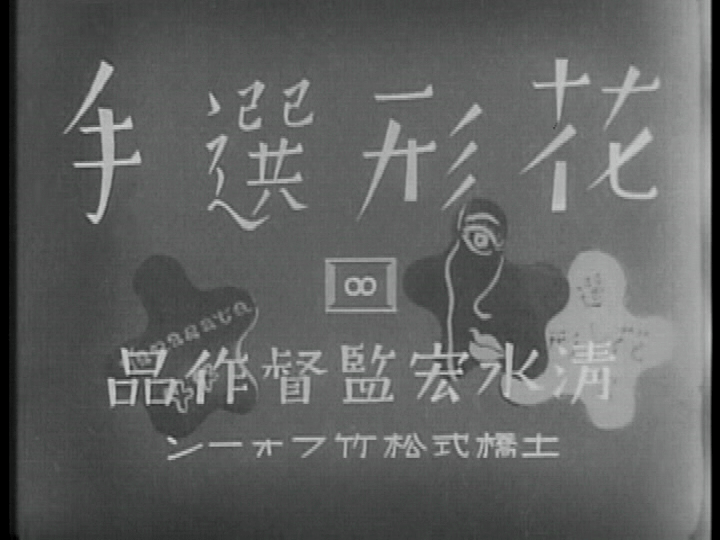
Star Athlete (花形選手, Hiroshi Shimizu, 1937)

vlcsnap-2016-09-23-01h52m32s055Japan in 1937 – film is propaganda, yet Hiroshi Shimizu once again does what he needs to do in managing to pay mere lip service to his studio’s aims. Star Athlete (花形選手, Hanagata senshu) is, ostensibly, a college comedy in which a group of university students debate the merits of physical vs cerebral strength and the place of the individual within the group yet it resolutely refuses to give in to the prevailing narrative of the day that those who cannot or will not conform must be left behind.

Seki (Shuji Sano) is the star of the athletics club and shares a friendly rivalry with his best friend Tani (Chishu Ryu). Tani likes to train relentlessly but Seki thinks that winning is the most important thing and perhaps it’s better to be adequately rested to compete at full strength. While the two of them are arguing about the best way to be productive, their two friends prefer to settle the matter by sleeping. The bulk of the action takes place as the guys take part in a military training exercise which takes the form of a long country march requiring an overnight stay in a distant town. The interpersonal drama deepens as Seki develops an interest in a local girl who may or may not be a prostitute, casting him into disrepute with his teammates though he’s ultimately saved by Tani (in an unconventional way).

Far from the austere and didactic nature of many similarly themed films, Shimizu allows his work to remain playful and even a little slapsticky towards the end. These are boys playing at war, splashing through lakes and waving guns around but it’s all fun to them. Their NCO maybe taking things much more seriously but none of these men is actively anticipating that this is a real experience meant to prepare them for the battlefield, just a kind of fun camping trip that they’re obliged to go on as part of their studies. The second half of the trip in which the NCO comes up with a scenario that they’re attempting to rout a number of survivors from a previous battle can’t help but seem ridiculous when their “enemies” are just local townspeople trying to go about their regular business but now frightened thinking the students are out for revenge for ruining their fun the night before.

That said, the boys do pick up some female interest in the form of a gaggle of young women who are all very taken with their fine uniforms. The women continue to track them on their way with a little of their interest returned from the young men (who are forbidden to fraternise). Singing propaganda songs as they go, the troupe also inspires a group of young boys hanging about in the village who try to join in, taken in by Tani’s mocking chant of “winning is the best” and forming a mini column of their own. After this (retrospectively) worrying development which points out the easy spread of patriotic militarism, the most overtly pro-military segment comes right at the end with an odd kind of celebration for one of the men who has received his draft card and will presumably be heading out to Manchuria and a situation which will have little in common with the pleasant boy scout antics of the previous few days.

Physical prowess is the ultimate social marker and Seki leads the pack yet, when he gets himself into trouble, his NCO reminds him that “even stars must obey the rules” and threatens to expel him though relents after Tani takes the opportunity to offer a long overdue sock to the jaw which repairs the boys’ friendship and prevents Seki being thrown out of the group. Seki’s individuality is well and truly squashed in favour of group unity though Shimizu spares us a little of his time to also point out the sorrow of the young woman from the inn, left entirely alone, excluded from all groups as the students leave.

Employing the same ghostly, elliptical technique of forward marching dissolves to advance along the roadway that proved so effective during Mr. Thank you, Shimizu makes great use of location shooting to follow the young men on the march. Though the final scene is once again a humorous one as the two sleepyheaded lazybones attempt to keep pace with the front runners, the preceding scene is another of Shimizu’s favourite sequences of people walking along a road and disappearing below a hill, singing as they go. However, rather than the cheerful, hopeful atmosphere this conveyed in Shiinomi School there is a feeling of foreboding in watching these uniformed boys march away singing, never to reappear. Shimizu casts the “training exercise” as a silly adolescent game in which women and children are allowed to mockingly join in, but he also undercuts the irony with a subtle layer of discomfort that speaks of a disquiet about the road that these young men are marching on, headlong towards an uncertain future.


The Golden Demon (金色夜叉, Hiroshi Shimizu, 1937)

vlcsnap-2016-09-22-02h33m21s455Perhaps best known for his work with children, Hiroshi Shimizu changes tack for his 1937 adaptation of the oft filmed Ozaki Koyo short story The Golden Demon (金色夜叉, Konjiki Yasha) which is notable for featuring none at all – of the literal kind at least. A story of love and money, The Golden Demon has many questions to ask not least among them who is the most selfish when it comes to a frustrated romance.

Poor relation Kanichi (Daijiro Natsukawa) is a university student living with friends of his deceased father. He and the daughter of the family which took him in, Miya (Hiroko Kawasaki), have grown up together and formed an emotional attachment they each believed would naturally lead to marriage. However, Miya has received a proposal from a wealthy gentlemen which her cash strapped father is strongly advising her to accept. Though she loves Kanichi deeply, Miya is torn – both by a feeling of duty to marry well and keep her parents in comfort, and by a fear of leaving her middle-class lifestyle for a life of uncertain poverty with the still studying Kanichi.

When she ultimately agrees to the arranged marriage, Kanichi becomes angry and accuses Miya of placing monetary concerns over true feeling. Disappearing from Miya’s life entirely, Kanichi determines to destroy himself in a vicious quest for revenge. Abandoning his idealistic, progressive concerns, Kanichi becomes a heartless money lender with a plan to one day amass a great fortune only to throw it in the face of his former love. When Miya’s husband, Tomiyama (Toshiaki Konoe), appears at his door apparently fallen on hard times, Kanichi’s plan looks set for success.

In true Shimizu fashion, he remains non-judgemental of his characters save for that of the elderly money lender who, when questioned by his son, offers a series of flimsy justifications for his line of work which his son brands dirty and disgraceful. The money lender points out that he’s only operating a business – he never attempts to hide his terms so customers know they will pay a heavy price for the loans, and thereafter the decision is their own. When his son points out how selfish a point of view that is and that all he’s doing is exploiting the desperation of vulnerable people, he’s told that he reads to many books and should learn to live in the “real world”. If Shimizu wants to criticise anything at all (even obliquely, this is 1937), it’s this “real world” thinking which legitimises the selfishness of those who seek to profit from the misfortune of others.

The same money lender has a somewhat strained relationship with his equally cynical wife. After she complains about his complaint about how much makeup she’s putting on “to go to a temple”, he tells her that his jealously proves he loves her. She’s a precious object that he’s afraid of losing to another man. To him all is about possession. Kanichi, who once thought himself so different is more or less the same as he refuses to think about why exactly Miya has made the decision she has, or even allow her the right to make that decision. Obviously broken hearted, he decides to abandon emotion all together as “you can’t trust the human heart.” He even attempts to enact the final terms of the usurious loans on the contracts of some of his university friends who, just as he was with Miya, are unable to understand how he could be so cruel to those he was once so close to. Even Tomiyama, who had hitherto looked after Miya as a husband should finally exclaims “I can’t love you without money” as if in a tacit acceptance of the fact that he essentially bought her, obtaining her duty and service but not, perhaps, her heart.

In contrast some of Shimizu’s other work he focusses much more on Kanichi’s moral meandering than on Miya’s suffering but she herself pays a heavy price throughout. In sacrificing her love for Kanichi and a chance at a self directed future in agreeing to the arranged marriage, Miya ultimately chose to familial duty over romantic feeling. Having grown up in comfort, a degree of fear may have also influenced her decision but the choice has broken her own heart just as much as Kanichi’s. Guilt and a regret threaten to frustrate her new married life even though she does her best to become the ideal wife. Miya searches for Kanichi to obtain his forgiveness but Kanichi is nowhere to be found.

The eventual reunion is one of chilling coldness and repressed emotions which causes only more pain for everyone involved. Neatly avoiding melodrama, Shimizu opts for a more realistic solution in which everyone realises the error of their ways. Kanichi perseveres in his desire for vengeance yet leaves feeling like “the stupidest man in the world”, pausing only to offer a few words of parting encouragement to Miya if stopping short of forgiveness (or an apology which she is most likely owed if only for the previous ten minutes of cruelty). The past remains the past and must be accepted as such, yet there is at least a glimmer of hope for Kanichi whose abortive plan of revenge may have reawakened within him the very thing he’d been trying to bury even if the future for Miya seems nowhere near as certain.