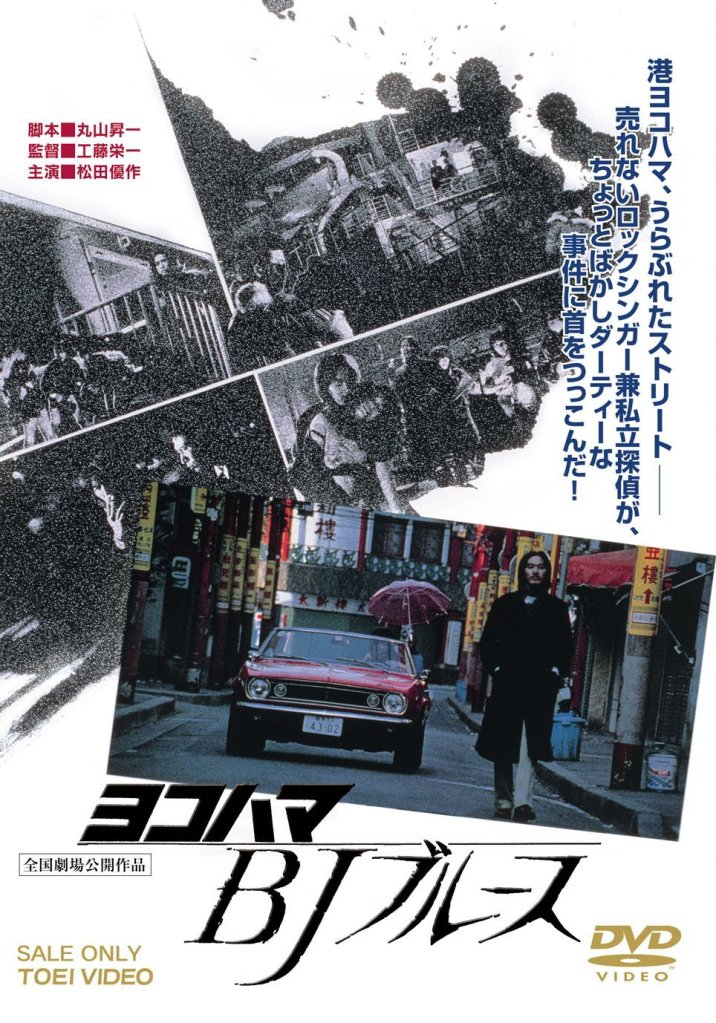
Yokohama BJ Blues (ヨコハマBJブルース, Eiichi Kudo, 1981)

Yokohama bj bluesYusaku Matsuda may have been the coolest action star of the ‘70s but by the end of the decade he was getting bored with his tough guy persona and looked to diversify his range a little further than his recent vehicles had allowed him. Matsuda had already embarked on a singing career some years before but in Eiichi Kudo’s Yokohama BJ Blues (ヨコハマBJブルース), he was finally allowed to display some of his musical talents on screen as a blues singer and ex-cop who makes ends meet through his work as a detective for hire.

After his set at a rundown jazz bar, BJ’s first job is tracking down a missing son. When he finds the guy, Akira, he seems to have become the employee (and possible sex slave?) of a gay gangster. Akira says he’s fine with his new life and wants his mother to leave him alone so BJ gets the hell out of there to give her the message but the unpleasantness of the situation lingers with him a little.

Shortly after, BJ receives a telephone call from an old police buddy, Ryo, who needs his help. Ryo got in too deep with the same gang BJ just came up against and is thinking of quitting the force in a bid to make the “Family” lose interest in him. However, Ryo is gunned down in broad daylight leaving his partner, Beniya, convinced that BJ is somehow responsible. BJ now doubly has it in for Family and starts working on his own behalf to try and find some answers and possibly a little vengeance too.

You see, back when Ryo and BJ were partners, they both liked the same girl, Tamiko, who eventually married Ryo. Beniya thinks BJ killed his friend to steal his wife and is much more interested in giving BJ a good kicking rather than investigating this very strange gang set up which seems to have some kind of drug smuggling gig going with the triads in Hong Kong.

BJ forms an odd sort of friendship with Akira in the hopes of tracking down the four gay, leather clad punk henchmen of Ali who probably gunned down his friend. However, the conspiracy only deepens and BJ finds himself suspecting even his closest of friends.

With its jazz soundtrack and melancholy tone, Yokohama BJ Blues is channelling hard boiled in a big way though does so in a distinctly modern fashion. BJ sings the blues whilst walking around this strange noir world which seems to endlessly disappoint him. Unfortunately for him, BJ is quite a good detective and quickly gets himself in way over his head only to end up finding out a few things it might be better not to know.

One of the film’s most notable components is its use of homoerotic themes with its gangs of gay gangsters, rent boys and punks. Indeed, though the wife of his former partner is floated as a possible motive, the love interest angle is never fully explored and all of BJ’s significant interactions in the film are with other men. Firstly his relationship with his former police partner Ryo which kick starts the entire adventure and then his strange almost date-like experience with Akira about half way through. BJ remains otherwise alone, a solo voice seeking justice for his fallen friends.

Of course, the film’s selling point is Matsuda’s singing so he’s allowed to play his own chorus in a sense by narrating the events from the stage in the form of the blues. Not quite “The Singing Detective”, but almost – BJ tries to bring some kind of order to his world by turning it into a song. In addition to adding to the noir tone, the bluesy soundtrack even allows for a New Orleans-esque musical funeral which oddly fits right in with the film’s weird, macabre atmosphere.

A surreal, noir inspired crime drama with musical elements, Yokohama BJ Blues is quite a hard film to categorise. Unusual for its homosexual milieu and overt homoerotic plotting the film occupies something of a unique place given its obvious marketing potential and star’s profile coupled with its decidedly murky noir tone. Difficult, yet interesting, Yokohama BJ Blues ultimately succeeds both as an intriguing crime drama and as a star vehicle for its versatile leading man.


This is a really, deeply, strange film.

Unsubtitled trailer:

I actually quite like Matsuda’s foray into the world of jazz, the title song from Yokohama BJ Blues which is heard in the trailer is called Brother’s Song and is included on Matsuda’s 1981 album Hardest Day. Here he is on a talk show singing Yokohama Honky Tonk Blues:
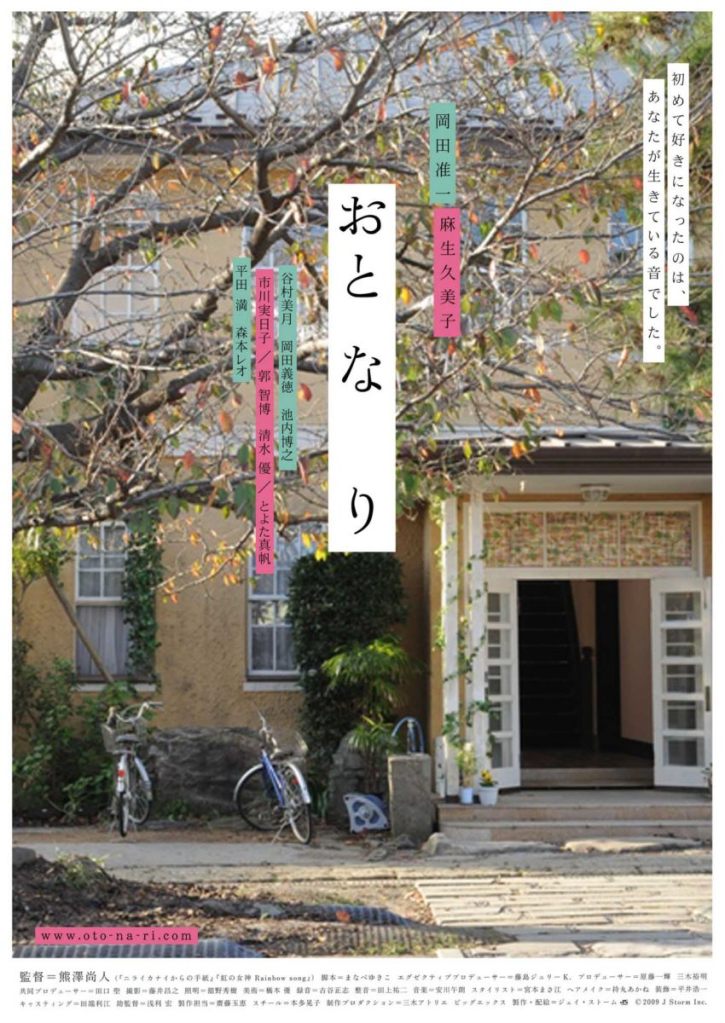
Romantic Prelude (おと・な・り, Naoto Kumazawa, 2009)

otonariSometimes when you live in the city it’s difficult to build meaningful connections with other people. You might find yourself a little lost, caught between the rat race and what it was that brought you to the city in the first place, but if you just close your eyes and listen, you can hear that you’re not alone. Romantic Prelude (おと・な・り, Oto-na-ri) is the story of two such people who build up a strange connection even though they’ve never really met.

Satoshi (Junichi Okada) and Nanao (Kumiko Aso) are next door neighbours in a small apartment block where the walls are paper thin. They’re both vaguely aware that a person of the opposite sex and around the same age lives next door, but they don’t know each other – in fact, they wouldn’t even recognise each other if they passed in the street. Still, they’re each aware of the other person through their particular soundscapes – Nanao hears Satoshi’s keys jangling on his belt as he leaves each morning and his rice cooker beeping in the evening, where as he thinks of Nanao as the humming girl and enjoys getting a free French lesson as he hears her language tapes through the wall.

Both are beginning to get frustrated with their lives in the city. Satoshi is a professional photographer doing fashion shoots but his real passion is landscape photography. He’s planning to go to Canada for a photo project but keeps getting held back as he only got into the fashion stuff because his childhood friend became a model and the two have now become entirely dependent on each other to keep working. When the friend, Shingo, finds out about Satoshi’s Canada plans, he goes missing causing his pregnant girlfriend Akane to come crashing into Satoshi’s life for a while.

Likewise Nanao is a lonely woman in her early thirties who works in a florist’s shop and plans to go to France to study flower arrangement after she’s passed the highest rank of exams. The guy at the local combini she often shops at seems to have developed a crush on her and Nanao isn’t really sure what to do with that but uses all of her time pursuing her dream of becoming a top florist.

Satoshi and Nanao are both feeling adrift, as if their lives are passing them by and it’s getting too late to not be getting anywhere. Just hearing the familiar sounds coming through the wall provides a comforting presence to not feel so alone. Though they don’t know each other, each has perhaps built up an image in their minds of the other person based on the sounds they create – keys, coffee, cooking vs French, classical music and humming an all too familiar song. Feeling the other person’s presence becomes reassuring and an absence of a familiar sound at its expected hour is unexpectedly disconcerting even if you really have no right to expect it.

Though Nanao is annoyed by the noisy and unprecedented arrival of Akane (who is not a good match for the rather uptight Satoshi) and slightly confused by her friendly greeting from the adjacent balcony, she still continues to derive comfort from the gentle presence of her neighbour. After having undergone a cruel humiliation and in something of a crisis, Nanao breaks down inside her apartment. Hearing her distress, Satoshi places his hand on the wall as if in comfort but rather than going next door to see if everything’s OK, he begins to hum and then sing the song he’s heard Nanao humming all along and eventually she too comes to sit beside the wall singing the song back to him.

As implied in the film’s English title, Romantic Prelude, music, and more particularly the symphony of sound that makes up a city, is the film’s major motif. This is further brought out by the original Japanese title which is a perfectly composed sonata of its own – Oto-na-ri. “Otonari” is Japanese for neighbour but the syllables which make up the word also have their own distinct meanings in that “oto” on its own means “sound” but put together “otona” means adult and then “nari” can also mean “to become”. Satoshi and Nanao are engaged in a blind slow dance where they’re falling in love with a stranger based on nothing other than a feeling of connection coupled with bond created by their shared soundscape.

Less a romance than an urban character study, Romantic Prelude is that rare case of a genuinely intriguing love story in which you’re really not sure which way things are going to go. This could just be another story of a tragic missed connection where Nanao heads off to France and Satoshi to Canada and they never even meet or it could give the audience the satisfying true love ending that it almost certainly wants but could have made either direction work. In the end, the important thing is seeing the pair work through their own difficulties and sort things out for themselves in the absence of each other before they finally begin to live the lives they’ve been yearning to lead.


The Japanese release of Romantic Prelude contains English subtitles.

Unsubtitled trailer:

and here’s the song they both keep singing – Kaze wo Atsumete by Happy End

Dead Run (疾走, SABU, 2005)

Dead run posterSABU might have gained a reputation for his early work which often featured scenes of characters in rapid flight from one thing or another but Dead Run both embraces and rejects this aspect of his filmmaking as it presents the idea of running and its associated freedom as an unattainable dream. Based on the novel by Kiyoshi Shigematsu, Dead Run (疾走, Shisso) is the tragic story of its innocent hero, Shuji, who sees his world crumble before him only to become the sacrifice which redeems it.
The story begins in a voice over narration offered in the second person by Shuji’s older brother, Shuichi. Shuji, it seems was a curious, if shy, little boy full of the usual childish questions and a curiosity about the way his world works. The boys live with their parents in an area they call “the shore” which is next to a settlement created through reclaimed land which the shore people refer to as “offshore” and somewhat look down on. One day, Shuji gets marooned offshore when his bicycle chain snaps and is rescued by the unlikely saviour of “Demon Ken” (Susumu Terajima) – a local petty gangster whom everyone is afraid of, and his girlfriend, Akane (Miki Nakatani), who is some kind of bar hostess. Soon after, Demon Ken is found buried in a shallow grave dead of a gunshot wound to the stomach, but somehow this improbable act of kindness has stuck in Shuji’s mind.

Moving on a few years, a creepy looking priest moves into the offshore area and opens up a church in a small hut complete with shiny silver crosses. Just like with Demon Ken, there’s a rumour about town that the priest, Father Yuichi (Etsushi Toyokawa), is a former criminal and murderer. Shuji becomes intrigued by the strange figure of the priest and a young girl his age, Eri (Hanae Kan), who likes to spend time in the church. However, more gangsters soon turn up wanting to buy up the offshore area to build an entertainment complex and even though most of the other residents have agreed to be resettled elsewhere, Father Yuichi won’t budge. Akane returns to the area as one of the higher ranking gangsters trying to force the church out and is happy to realise that Shuji, at least, has not forgotten Demon Ken. This won’t be the last time the pair meet again as circumstances conspire against the young boy to drag him ever deeper into the darkness of the shady adult world.

As a young boy, Shuji’s life is the ideal pastoral childhood full of bike rides through green fields and under cloudless blue skies, yet his once happy family dissolves and though he tries to run from his destiny he can not escape it. After his over achieving older brother Shuichi is caught cheating at school and is suspended, he begins to lose his mind becoming obsessed with the idea of the priest as a murderer and is fixated on exposing some dark secret about him. Of course, it turns out not to be exactly as he thought it was and Shuichi becomes increasingly disturbed before becoming a suspect in a series of local crimes which see him sent away to reform school. After this string of tragedies, Shuji’s parents start to fall apart too – his father disappearing and his mother mentally absent. Eventually even Eri leaves as the relocation programme finally kicks in.

Around this point our narrative voice shifts to that of Father Yuichi who becomes Shuji’s only responsible adult figure. However, Father Yuichi’s decision to take Shuji on a trip proves to be a disastrous one as it backfires massively forcing him onto the run and, coincidentally, straight into the arms of Akane. Though Akane had originally seemed an austere and difficult woman, she harbours an affection for Shuji as one of the few people to remember Demon Ken and to remember him for his kindness. Though she wants to help Shuji she ends up pulling him into a the darkness of her own world filled with violence and exploitation. Shuji runs again and eventually makes his way to Tokyo and to Eri who is just as broken as he is but there’s no salvation here either. Even when the pair attempt to travel back to their once idyllic childhood town, their problems follow them and destiny catches up with everyone, in the end.

Early on Father Yuichi and Eri are having a discussion about the difference between fate and karma and which might be more frightening. Eri says fate is better because you can’t change karma but perhaps you can change your fate. The film seems to disagree with her. You can try to run but somehow or other something will always stop you so the cold hand of fate can stretch its icy fingers around your heart. Different in both tone and style from SABU’s previous work, Dead Run is a bleak tale filled with loneliness and melancholy which, though it offers a glimmer of hope for those who are left behind, is not afraid to make a sacrificial lamb of its holy fool of a protagonist.


The Hong Kong R3 DVD release of Dead Run contains English subtitles.

Based on the book of the same name by Kiyoshi Shigematsu (as yet unavailable in English).

Unsubbed trailer:

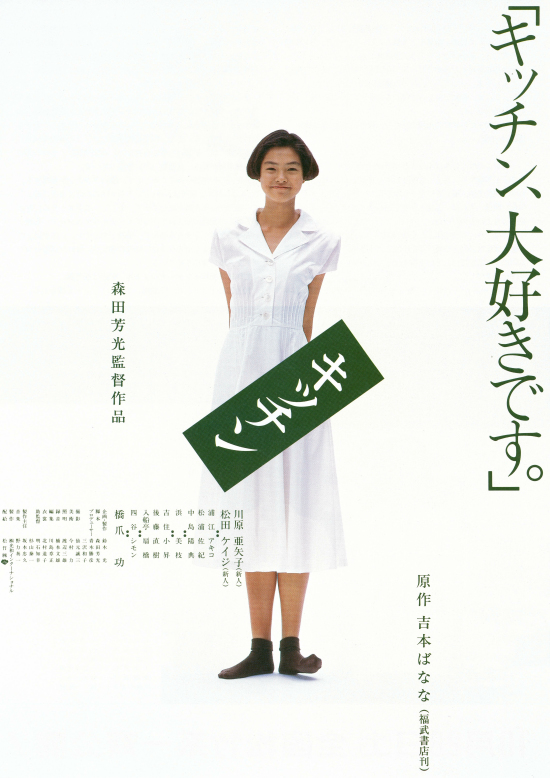
Kitchen (キッチン, Yoshimitsu Morita, 1989)

KitchenBanana Yoshimoto’s debut novel Kitchen was first published in 1988 and instantly became a publishing phenomenon. The first film adaptation came not long after with the identically titled Kitchen (キッチン) directed by Yoshimitsu Morita in 1989. Like most of Yoshimoto’s work, Kitchen deals with people learning to live with grief and cope with the aftermath of tragedy. However, though Morita’s script sticks closely to the novel for the first half of its running time, he later deviates into a conventional romantic youth drama much like his more populist offerings of the time.
The film opens with a strange image of a young woman asleep in front of a fridge in an otherwise entirely darkened kitchen. The young woman is Mikage Sakurai – orphaned at a young age, Mikage (Ayako Kawahara) was raised by her grandmother who has recently also passed away leaving her entirely alone in the world. The one place Mikage has learned to feel at peace is in a kitchen and she has her sights set on a culinary career.

At the funeral, Mikage meets a young man who had apparently become good friends with her grandmother through his part-time job at a florist. After striking up a friendship with Mikage, Yuichi (Keiji Matsuda) invites her to the upscale apartment he shares with his mother, Eriko (Isao Hashizume). Mikage falls in love a little bit with their well appointed and spacious Western style kitchen which is filled to the brim with all the latest gadgets. Soon after, Mikage moves in with Yuichi and Eriko and begins to rebuild her life with a new family beside her.

It’s difficult to avoid spoilers in this respect but for anyone who is familiar with Yoshimoto’s novel, it’s important to note that one particular tragedy which informs the entirety of book has been completely eliminated in this adaptation. The biggest change Morita has made is in his depiction of Eriko who is a trans woman and the father of Yuichi having undergone gender reassignment after the death of Yuichi’s mother.

The film is actually very positive in dealing with Eriko’s character and doesn’t try to elide or make a joke out of her. However, whereas Eriko in the book is described as an extremely glamorous and beautiful woman to the extent that she may seem slightly intimidating at first despite her warm and loving nature, here she is played by a male actor with a man’s haircut and slightly frumpy fashion sense as well as being depicted more like a stereotypically gay male character. Likewise, though Eriko’s friend Chika-chan is still in the movie, we never see anything of Eriko’s life at the gay club she runs or much of her life away from Yuichi and Mikage. That said, the change in question does offer a little more hope and happiness for Eriko than her outcome in the novel.

Morita also gives the film more of the quirky, light hearted feel he adopted in many of his other populist films from the ‘80s. Yoshimoto’s work often successfully straggles a difficult tonal gap in which it’s filled with a kind of existential despair but simultaneously light and cheerful. Though Mikage is numbed with grief throughout the novel which prevents her from assessing what it is she really wants from life, the film is satisfied with depicting her as a fairly ordinary young woman whose problems stem more from trying to step out alone for the first time rather than trying to emerge from a life altering tragedy like the death of your last remaining family member.

However, Morita retains the magical realist qualities of the novel through his use of dream sequences and expressionist imagery. Juxtaposing bright colours of nature with the often extremely dark backgrounds, he creates an impressive sense of differing realities with Mikage’s cheerful on the surface yet depressed inner life recreated through iconography rather than through performance or dialogue. He also retains the use of the moon as symbol for life and happiness, presenting a source bright light in an otherwise dark world which can help to guide the way in times of trouble.

As a film in its own right, Morita’s Kitchen is certainly very much of its time though perhaps not unwatchable, but as an adaptation of Yoshimoto’s novel it ultimately fails on all counts. Veering way off tone in its second half, Kitchen takes on much more of a conventionally romantic narrative eschewing Yoshimoto’s major messages about the need to come to terms with a traumatic past in order to move on and the importance of understanding your true feelings while there’s still time to act on them. Yoshimoto is more concerned with showing that joy and sorrow are two sides of the same coin and you can’t have one without the other but Morita’s story creates a much smoother, more natural path for a romance between Mikage and Yuichi which ultimately robs it of much of its power. That said even if Kitchen disappoints as a literary adaptation it isn’t entirely without interest and does at least offer several examples of Morita’s idiosyncratic gift for composition.


Opening scenes of the film (dialogue free)

Kitchen was also adapted as film in Hong Kong directed by Ho Yim in 1997, starring Yasuko Tomita and Jordon Chan. Banana Yoshimoto’s source novel was first published in English in 1993 (translated by Megan Backus) and is still in print from Faber & Faber in the UK and Grove Press in the US.


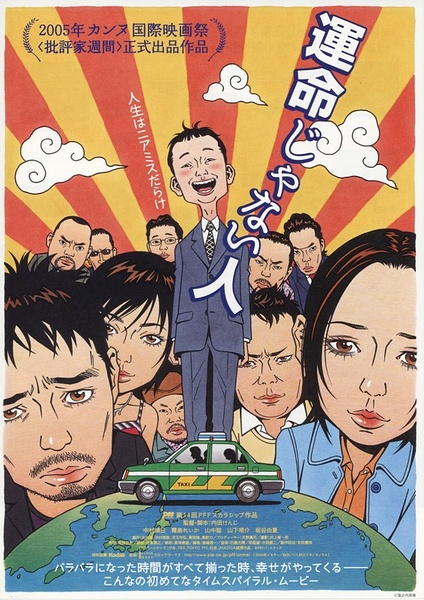
A Stranger of Mine (運命じゃない人, Kenji Uchida, 2005)

stranger of mineSometimes life throws you a pretty crazy night but unbeknownst to you the whole world has gone crazy too. For the disparate group of people at the centre of Kenji Uchida’s A Stranger of Mine (運命じゃない人, Unmei Janai Hito) , this proves to be more than usually true. A cute romantic encounter may end up going in a less than cinematic direction while ex-girlfriends, detectives and even the yakuza all conspire to frustrate the lovelorn dreams of a nice guy businessman who never even realises the total chaos which is ensuing all around him.

The film begins with a sad scene of a woman, Maki, carrying large bags and forlornly dropping a key through a letter box. She pawns what looks like an engagement ring and thinks about what to do next. Whilst sitting alone in a restaurant, a man asks her to join him and she is overjoyed to find some company. The man is Kanda, a small time detective and childhood friend of businessman Miyata who is also broken hearted as his girlfriend has left him. The girlfriend, “Ayumi”, is not all she seems and is already mixed up with yakuza boss Asai. Mix in a MacGuffin of some missing money and one ordinary night among millions just got very complicated indeed!

Uchida starts out with a fairly standard indie rom-com approach as the two brokenhearted jilted lovers Maki and Miyata are brought together by Kanda’s machinations but just as we think we’re about to head into some kind of Before Sunset scenario our perspective shifts and we find out just why it is that Kanda seems to be acting so manically. In fact, he’s been looking out for his friend all along but it’s getting kind of complicated at his end and the one thing he 100% does not want is for the rather innocent Miyata to figure out that he’s at the centre of dangerous mob caper because his ex-girlfriend, whom he still think is an angel, is really not the innocent flower he thought she was.

Just another night in the city, the point of view shifts around these five characters whose lives intersect like cogs turning some giant, unseen machine. We’re shown one set of events only to have our understanding of them undercut by seeing them again from another angle. Everything is a coincidence, or maybe nothing is, but each of these five characters wade into each other’s story leaving a drama filled wake with only poor Miyata seemingly oblivious to what’s really going on.

A Stranger of Mine plays like an extremely complex farce in which fate conspires to have some fun with five ordinary people and Uchida mines the situation for all the (sometimes dark) humour it can offer. Loosely split into three sections divided by title cards bearing the names of the characters, the film takes inspiration from classic Hollywood screwball comedies and film noir whilst adding a more modern, non-linear approach as Uchida plays and replays his scenes to make us see that things are not always the way they look at first glance.

While obviously a low budget, independent effort, A Stranger of Mine offers surprisingly high production values and boasts excellent performances from its tightly composed cast. The script is fiendishly complicated and exacting yet Uchida pulls it off with a keenly observed eye. Though improbable, the events are never implausible and play out with a kind of off beat inevitability that further underlines the film’s mildly ironic, comic tone. Gleefully playful, A Stranger of Mine may appear a little slight on the surface, but just as its multi-layered narrative suggests, the perspective only deepens on a closer look.


Unsubtitled trailer:

I Want to Be a Shellfish (私は貝になりたい, Shinobu Hashimoto, 1959)

shellfishAfter Japan was defeated and later occupied by the Americans, there came the painstaking exercise of examining what exactly had happened during the conflict and assessing is who, if anyone, could be held accountable for any wrongdoing. The so called “war criminals” were divided into classes according to the severity of their crimes with Tojo himself at the top who eventually paid with his life. However, many of the men who were given the same Class A rating were just rank and file soldiers who had been “following orders”, often because they feared for their own lives if they refused. The debut directorial effort from writer Shinobu Hashimoto who provided scripts for some of Akira Kurosawa’s most famous works, I Want to be a Shellfish (私は貝になりたい, Watashi wa Kai ni Naritai), examines just one of these tragically absurd cases.
Barber Shimizu has finally started to make headway in his very own shop where he lives happily with his wife and son when he’s unexpectedly drafted into the army towards the end of the war. Unused to heavy physical labour and a fairly gentle man, he doesn’t take well to the soldier’s life and gets himself into trouble with his C/O. Stationed near Tokyo, Shimizu’s squad is charged with searching for a pair of US airmen thought to have bailed out after their plane was hit by anti-aircraft fire during a bombing raid over the city. When they eventually find the pilots, both have already died of their injuries.

At this point Shimizu’s captain makes a cruel and rash decision – rather than sending the bodies back to HQ or burying them there, he decides to use them as target practice for his raw recruits. When ordered to pick out the two weakest soldiers, the NCO picks Shimizu and another man, Takita, who are then ordered to bayonet the corpses to prove what fine soldiers they have become. Though they both fail the first time the captain berates them until they finally comply.

The war ends and Shimizu goes home to his family only to receive a knock on the door from the war crimes commission who drag him off to Tokyo for trial. The trial itself is a farce, Shimizu is charged with executing a prisoner of war – the fact the pilots were both dead when found and therefore were never executed and were never even prisoners is never revealed by anyone. Finally classified as a Class A War Criminal, Shimizu is sentenced to death for having stabbed a corpse.

It goes without saying that, yes, terrible crimes were committed during the war and some of them deliberately and wilfully. However, in Shimizu’s case his crime is an absurd one. Though the way in which his superiors have treated the fallen soldiers of their enemies is far from humane, Shimizu has committed no murder and was just following the orders of his superiors. Improper as it may have been, it hardly warrants the loss of his own life and that he’s being placed in the same category as members of execution squads and those who wilfully participated in crimes against civilians is more than a little disproportionate.

Perhaps the most controversial element of the film is that Shimizu seems to have been denied a fair trial. To those who can understand both languages, or even just from the subtitles provided for the translation of the American prosecutor’s questions, it’s obvious that the way in which his questioning is being conducted is far from ideal. The translation gap between the two languages is immense and leads to a series of misunderstandings which in no way aid Shimizu’s case.

It’s also clear that the panel in charge of the trial have very little understanding of how the Japanese military works and how this might differ from American military law. Shimizu is repeatedly questioned about how he feels about the order he was given – a strange question given that the idea of not following an order is not one which immediately presents itself. Shimizu repeats the credo he was taught that an order from his C/O is the same as one coming directly from the Emperor. However, when translated, the prosecutor infers that Shimizu thinks his order came from the Emperor himself and stupidly asks if Shimizu actually met the Emperor in person. Likewise, they ask why he didn’t simply refuse to follow the order and when he replies that he believed he would be shot, they ask why he didn’t ask to be referred to a military court which is just not something that would have been reasonably feasible for a Japanese soldier in this sort of situation.

The fact that the soldiers were already dead to begin with is never even mentioned, by anyone. The highest ranking officer who ordered the search is held responsible even though his orders were to bring the men in alive. Shimizu’s captain has since killed himself, conveniently, leaving everyone else to take the fall for his inhumane decision.

At the end of the film as Shimizu is faced with saying goodbye to a world which has dealt him nothing but hardship other than the wife and son he will be forced to leave behind, Shimizu utters the film’s title. He wishes he were a shellfish buried deep at the bottom of the ocean far from humans and their capacity for cruelty. No poverty, no draft, no war, no absurd trials – free from this world of torment. A lament for the little guy paying the price for world gone mad, I Want to be a Shellfish is a bleak and tragic tale which is filled with universal quality of melancholic absurdity which continues into its heartbreaking final moments.


Bonus trivia – Frankie Sakai (more usually seen as a singer or in comedic roles) also played Shimizu the previous year in an enormously successful TV drama. This story has in fact been filmed several times, most recently as a feature film in 2008 and was inspired by the book by Tetsutaro Kato who was sentenced to death as a war criminal though later had his sentence commuted and was released for “good behaviour” in 1952 (but may not have been quite as innocent as poor old Shimizu).


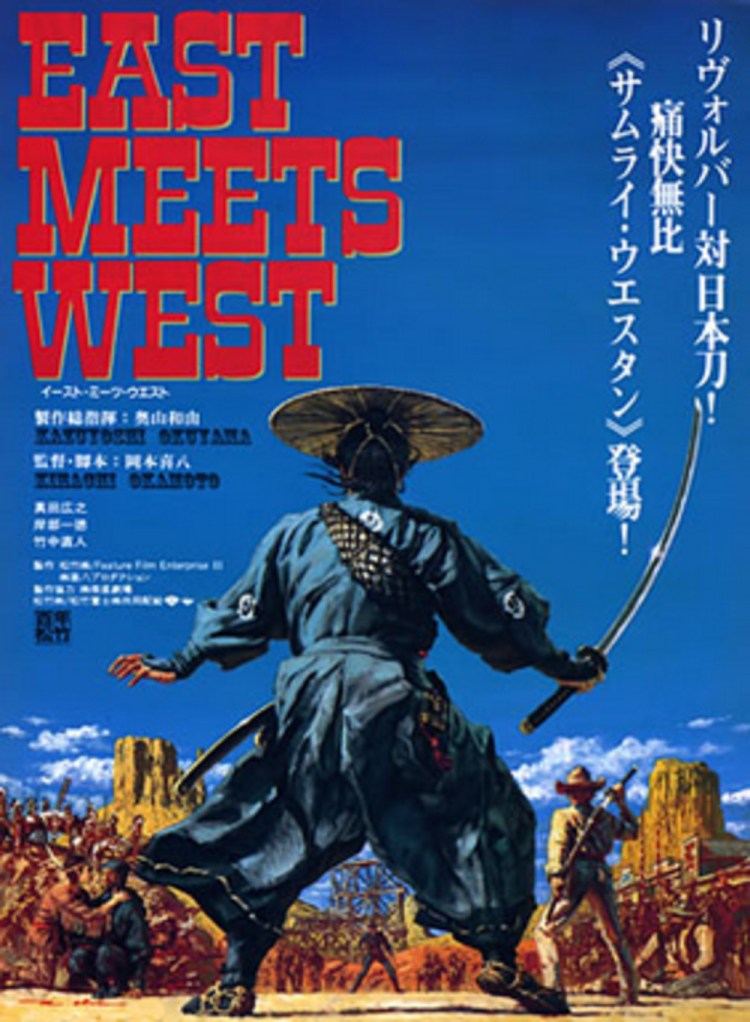
East Meets West (イースト・ミーツ・ウエスト, Kihachi Okamoto, 1995)

East_Meets_WestEast has been meeting West in the movies from time immemorial and though it’s often assumed that the traffic is only running in one direction, in reality the river runs both ways. Kihachi Okamoto was always fairly open about his love of Hollywood westerns, particularly those of John Ford, and even mixed a fair amount of wild west style action to his 1959 Manchurian war movie, Desperado Outpost. Returning to the theme almost 40 years later in East Meets West (イースト・ミーツ・ウエスト), Okamoto retains his wry, ironic eye but adopts a tone much more in keeping with the slightly silly exploitation cowboy movies of the ‘70s.
The tale begins with an American voiceover explaining the intricacies of the time period. It’s 1860 and America has been putting pressure on the recently opened Japan to agree to a trade deal. A delegation of two ships is shortly to arrive in San Fransisco which has also undergone many changes in the last few years after the influx of hopefuls during the 1848 goldrush transformed it from a peaceful fishing town to a dangerous prospector’s paradise. The situation in Japan is also turbulent and those who object to the recent foreign influences have a number of plots in motion. Once the boats leave a band of former samurai will assassinate the remaining official. The men on the boat will not hear of this until they return and the revolutionaries have also placed an assassin amongst those who will travel to America with the ultimate aim of assassinating the diplomat in charge of the delegation who was also responsible for the deaths of a number of “resistance” members in Japan.

However, everything gets derailed when a gang of bandits rob the bank just as the Japanese are about to deposit the money they’ve brought to seal the trade agreement. The group’s interpreter, Kamijo (Hiroyuki Sanada), takes advantage of his samurai training to cut down some of the bandits saving his own life but is unable to prevent them making off with the money. Taking to the road in the company of the young son of one of the bystanders who was killed, Kamijo becomes every inch the cowboy, standing apart ready to take his revenge. However, his mission is at times aided or hindered by an ace ninja working as a servant to the delegation, Tamejiro (Naoto Takenaka), who has accidentally ended up with a Native American wife.

East Meets West is a very silly film, it has very little in the way of serious intent but offers a fair amount of zany fun as its fish out of water samurai try to adapt to the ways of the Wild West. In many ways, it’s the classic cowboy movie as a bunch of strangers arrive and proceed to clean up the area which has become threatened by out of control bandit gangs. You have your mainstays like the lazy sheriff, meek vicar, and drunken doctor-cum-undertaker, the only difference is that the strangers are Japanese adventurers who fight with samurai swords and out of ideals of honour and justice rather than of survival or frontier values.

Indeed, it’s a little strange that East Meets West turned up in 1995 just a few years after Hollywood itself began to re-examine the western, re-injecting it with a little more realism and the grittiness and cruelty which filled frontier life but had been all but erased from the sanitised, romantic vision of the movie cowboy duelling pistols world. East Meets West references the classic western with its associated myths and tropes of clearly defined good guys taking down clearly defined bad guys to save the townspeople from moral and physical ruin. There are plenty of horse stunts and gunfights all offered with a kind of good natured (if sometimes black) humour that’s much more John Wayne than it is Clint Eastwood.

That said, there is a degree of cross cultural critique as the guys try to get used to their New World lives. Because English speakers have a problem with foreign names, Kamijo quickly becomes “Joe” and Tamejiro “Tommy” with Kamijo ending up with a little blond surrogate son and Tamejiro an enterprising Native American wife with whom he seems to develop quite a bond despite sharing no common language. Kamijo may have come to America with one singular mission in mind but once under the wide open skies he finds a kind of individual freedom that he hadn’t previously experienced and gradually loses his adherence to the rigid social codes of the samurai, exchanging them for the seemingly endless vistas of the ever expanding frontier.

Okamoto mines the dualities for all their worth – the chaos of the Meiji era contrasted with the organised lawlessness of the Wild West, yet East Meets West never quite transcends its western pastiche origins. With plenty of inventive and keenly observed comedy plus some nicely choreographed action scenes and excellent performances from the committed cast from both the English speaking American side and the Japanese actors, East Meets West proves an often entertaining experience but perhaps fails to offer the same level of social critique found in Okamoto’s previous work.


The Invisible Man vs The Human Fly (透明人間と蝿男, Mitsuo Murayama, 1957)

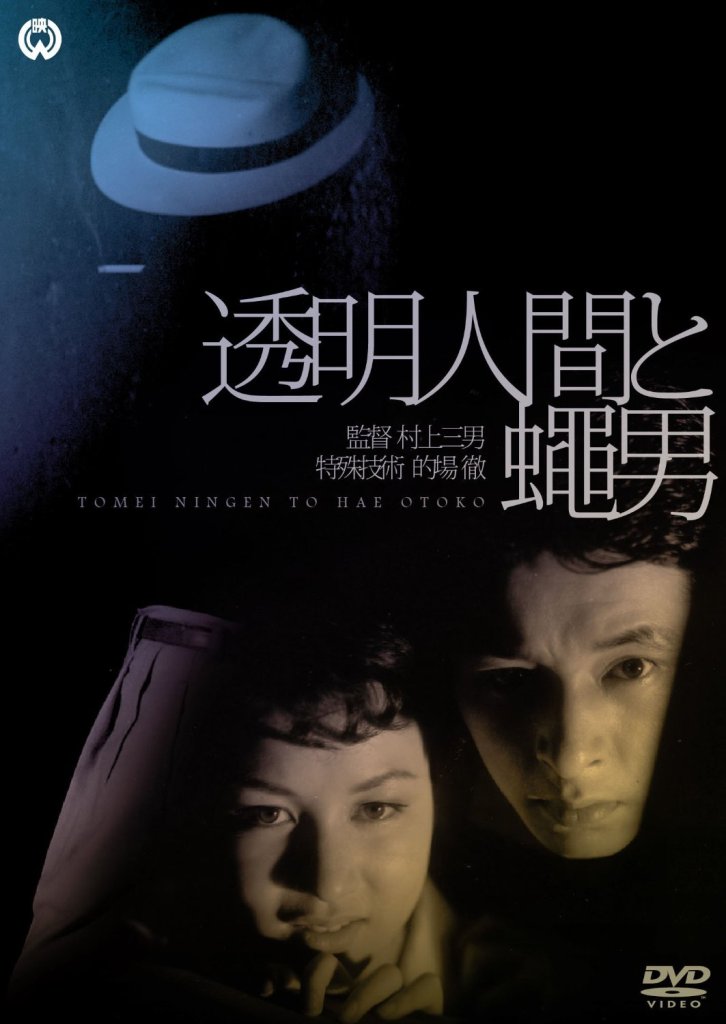
The Invisible Man Vs the Human FlyWho would win in a fight between The Invisible Man and The Human Fly? Well, when you think about it, the answer’s sort of obvious and how funny it would be to watch probably depends on your ability to detect the facial expressions of The Human Fly, but nevertheless Daiei managed to make an entire film out of this concept which is a sort of late follow-up to their original take on Invisible Man Appears from 1949. Like that film, The Invisible Man vs The Human Fly (透明人間と蝿男, Tomei Ningen to Hae Otoko) also adopts a deadpan, straightforward tone despite its rather ridiculous premise.

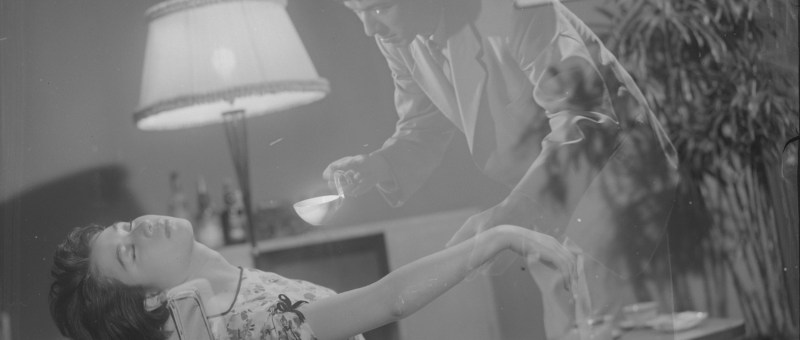
Tokyo is being plagued by a series of mysterious murders occurring in broad daylight in which the victim is stabbed through the back piercing the heart yet witnesses report seeing no suspicious activity near the crime scene. Perhaps The Invisible Man did it, hahaha….However, when the man sitting next to the professor in charge of researching the “imperceptibility device” is murdered in an aircraft toilet, the police get wise to a possibly surreal explanation for these bizarre crimes. The only other evidence they have is a connection between a sleazy nightclub owner, a friend of his and one of the murdered men who briefly served together during the war, the fact that one of the victims pointed at the sky before dying, and reports of a strange buzzing sound….

Interestingly, the major viewpoint here is from the policemen investigating the case and their attempts to get their heads around this extremely unusual series of events. As often happens with revisiting a form of technology which has been used for ill in the previous picture, here the “imperceptibility device” becomes a force for good as it might be able to help the powers at be stamp out The Human Fly. This time there’s not so much of the accompanying madness which is caused by going invisible but there’s still a heavy price to be paid as no one’s figured out a way of turning back which doesn’t involve rapid death from cancer immediately afterwards.

By contrast, The Human Fly is born of a man made serum developed by Japanese mad scientists during World War II and brought back by a man who was abandoned on an island by his comrades and subsequently left to take the wrap at a war crimes tribunal. He wants to use the technology to further his own success yet has a minion carrying out most of the dirty work. The Human Fly serum does, apparently, carry a number of psychological side effects including violent impulses, paranoia and addiction.

The special effects are not quite as good as in Invisible Man Appears though the invisible antics are not the focus of the film anyway. Bizarrely, The Human Fly is just a shrunken man who is somehow able to zip about like a regular fly even though he’s still dressed in his normal business suit and keeps his arms rigidly to his sides like some kind of human torpedo. Apparently, the buzzing sound is made because of his being very small (so says science) which gets around the inconvenient truth of him not having any wings or other fly-like characteristics other than the ability of flight.

It’s all very silly, though not quite silly enough in places. For the most part, the film plays out like a regular police procedural with slight noir undertones despite the obvious strangeness of the mysteries at hand. Though there’s obviously something to be made about the origin of the Human Fly serum and the anger of the “war criminal” who feels himself betrayed by his country, it’s a fairly subtle comment on post-war resentment. However, attitudes to the practice of scientific research do seem to have shifted with the researchers investigating the imperceptibility device cast as the good guys (though no particular reason for their work is ever offered) who can be relied upon to help catch the “bad guys” who are making use of “bad technology” to do “bad things”.

A fairly solid B-movie though one which is perhaps a little too po-faced for its genretastic title, The Invisible Man vs The Human Fly is an interesting mix of noir crime thriller with a little science fiction and even a few horror trappings thrown in. Thanks to its straightforward approach it may prove a little dull for genre enthusiasts but does offer its own kind of surreal iconography and it’s difficult to forget the sight of a tiny, angry looking besuited man flying around and committing random crimes while an invisible opponent stalks him from the shadows.


Invisible Man Appears (透明人間現る, Nobuo Adachi, 1949)

Invisible man appearsReleased in 1949, The Invisible Man Appears (透明人間現る, Toumei Ningen Arawaru) is the oldest extant Japanese science fiction film. Loosely based on the classic HG Wells story The Invisible Man but taking its cues from the various Hollywood adaptations most prominently the Claude Rains version from 1933, The Invisible Man Appears also adds a hearty dose of moral guidance when it comes to scientific research.

Once again the action centres around an esteemed chemist, Professor Nakazato, who has been working on a serum to render living things invisible. So far he has a sample which works on animals but is reluctant to move on to human testing as A) he hasn’t found a way to reverse the procedure, and B) there are some unpleasant side effects in which the subject becomes increasingly violent and irrational. The professor currently has two top students who are helping him towards his goal and, inconveniently, both have taken a shine to his daughter, Machiko. Half joking, the professor remarks that whoever can solve the problem first will win his daughter’s hand.

A business associate of the professor, Kawabe, is also interested in Machiko and also in the rights to the professor’s important new discovery. The professor, however, is a responsible man and refuses to sell it in case it falls into the wrong hands. Shortly after the professor is kidnapped by a gang of armed thugs who plan to use the serum to steal a set of diamonds known as The Tears of Amour.

There’s plenty of intrigue with various twists and turns to the original story which keep the viewer on their toes as they try to figure out who exactly is the invisible man and what he’s really after. Actually, the solution is sort of obvious and heavily signposted but that doesn’t make it any less fun. Kawabe is a moustache twirling villain from the get go and it’s obvious he has various things going on in the background but there’s more to the story than a greedy business man trying to manipulate everyone around him for his own gains. There’s also an interesting subplot in which the younger sister of one of the scientists is a top actress at the Takarazuka Review and turns out to have a connection to the Tears of Amour.

All of the classic B-movie hallmarks are here from the slightly ridiculous sci-fi jargon to the classic women in peril shenanigans as the serum starts to take hold and the Invisible Man becomes increasingly paranoid. There’s nothing good or bad but thinking makes it so – so it would be for science as far as the film is concerned. According to the message at the film’s beginning and end, there is no scientific discovery which is innately “evil” but each is apt to be misused. It’s not difficult to see why this would be a popular, even essential, message in the Japan of 1949 and indeed it recurs in many films of this type including, of course, the original Godzilla. The professor takes responsibility for having invented something which, although not created with evil intent, has wrought such destruction on society but finds himself with nothing left to do other than apologise.

Director Nobuo Adachi uses a lot of classic silent cinema techniques such as dissolves and montages with a fair amount of handheld camera and some location shooting (though the majority of the film is studio bound). The special effects were supervised by Eiji Tsuburaya who would later become the founding father of tokusatsu and co-creator of the Godzilla franchise and are top notch for the time period. An enjoyably silly B-movie, The Invisible Man appears is a well crafted addition to the Invisible Man corpus and a fantastic example of Daiei’s post-war genre output.


Original trailer (English subtitles) – I wish all trailers were this much fun!

Dolls (ドールズ, Takeshi Kitano, 2002)

dolls posterOutside of Japan where he is still primarily thought of as a TV comedian and celebrity figure, Takeshi Kitano is most closely associated with his often melancholy yet insistently violent existential gangster tales. His filmography, however, is one of the most diverse of all the Japanese “auteurs” and encompasses not only the aforementioned theatre of violence but also pure comedy and even coming of age drama. Dolls is not quite the anomaly that it might at first seem but perhaps few would have expected Kitano to direct such a beautifully colourful film inspired by one of Japan’s most traditional, if most obscure, art forms – bunraku puppet theatre.

After opening with a bunraku performance featuring an excerpt from the Chikamatsu play Courier For Hell, Kitano moves on to his overarching narrative which connects the tripartite structure in a tale inspired by the classic story The Bound Beggars. This first pair of lovers, Sawako and Matsumoto, wander blankly through the ever changing landscape tied together with a long red rope. The two had previously been a young couple, very much in love, but Matsumoto was pressured into abandoning Sawako to accept a semi-arranged marriage to his boss’ daughter. Distraught, Sawako attempts suicide only to survive but in an almost catatonic state.

The second pair of doomed romantics consists of an ageing yakuza who looks back on his life which has forced him to act in a way that he is not always proud of and now finds himself remembering the girlfriend he parted with thirty years ago after fearing he was about to lose his job. She promised to wait for him, he promised to return a fine man but he became a yakuza and never saw her again. All these years later, she’s still exactly where she said she’d be, waiting.

Story three is strange tale of modern love as a young man becomes obsessed with an idol star who only ever notices his rival. After she is injured in a car accident and decides to retire, the young man takes drastic action to be able to meet with her on what he sees as a more equal footing.

Fools for love, each and every one of them. Love has ruined them, removed rational choice from their field of vision, yet there’s something noble and beautiful in the way in which it has penetrated each of their lives. They love as if possessed by an incurable madness, Sawako tries to kill herself because her heart is broken, a woman grows old spending each Saturday lunch time sitting on a bench with a second lunch box which is going to go to waste, and a young man maims himself to finally get his love’s attention. Was it worth it, in the end? Perhaps not if the desperately sad outcomes of each of these stories is anything to go by.

Kitano rejects his idiosyncratic blue colour palate for a world of vibrant colours. Travelling through a year we move along the seasons as punctuated by their symbolic scenery from cherry blossoms to green verdant landscapes, the overwhelming redness of autumn leaves and finally the purity of the winter snow. We travel one way, but also in circles as we navigate the story of love as it too changes with its seasons yet remains unchanged in essence. Each of the lovers is no more free than a bunraku puppet, manipulated by forces outside of their control and forced into a desperate unhappiness that is in part vindicated by their romantic bonds.

Love is tender, love is cruel. Each of the men, in particular, makes terrible choices which cause only pain to the women they supposedly love and, in their pride and arrogance, they fail to realise the consequences of their actions until it is far too late. The tragic inevitability of life’s suffering and the inability to escape it are the foundation stones of Chikamatsu’s world.

Working with fashion designer Yohji Yamamoto Kitano has created a beautiful, theatrical world of hyper realistic colour and life. Like much of Kitano’s work, Dolls amounts to a sad collection of tales coloured by melancholy and a resignation to the pain and suffering inherent in being alive. The lovers are inexorably bound to each other for all eternity because of the suffering they have each endured at the other’s hand. This is a sad world, but it’s a beautiful one too and even if hurts one must try to live.


Dolls is re-released in the UK on blu-ray courtesy of Third Window films.

(This is an original release trailer and does not reflect the quality upgrade of Third Window Films’ blu-ray release)

I first saw this film I guess almost fifteen years ago (!) and I still occassionally get this song stuck in my head:

Review of Takeshi Kitano’s Dolls (ドールズ) – first published by UK Anime Network.