Thermae Romae

THERMAE ROMAE-T

Lucius ambulat in Tokyo? Review of improbable time travel comedy Thermae Romae up at UK-anime.net.


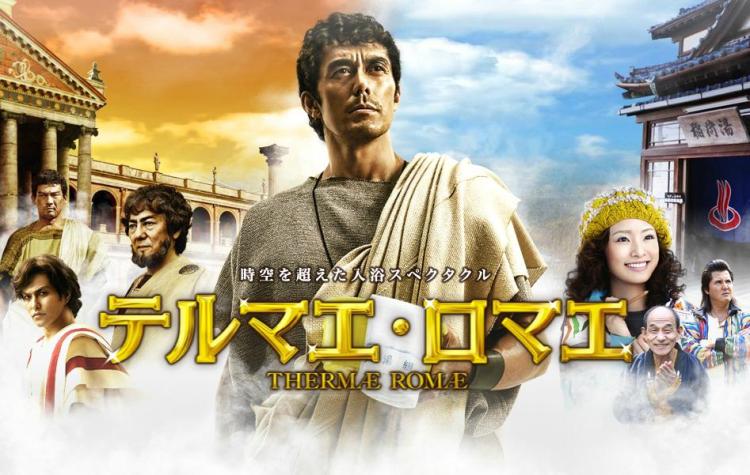
Pop quiz – what do modern day Japan and Ancient Rome have in common? Fish sauce? Emperor worship? Sandals? More than you thought, wasn’t it? Well, the correct answer is public bath houses and sure enough the people of modern day Tokyo still love going to the public bath even though they enjoy the luxury of being able to bathe at home! Of course, bath house culture with all its social and political uses and divisions was one of the things the Roman Empire took with it wherever it went. However, there must have been a time when some Romans began to feel their baths were getting a bit stale and in need of a new ‘modern’ twist, but what to do? What if they could leap forward in time and learn from the 21st century bath culture of modern Japan! Enter down on his luck architect Lucius who suddenly finds himself in a strange land full of strange looking people who seem to have taken bath technology to its very zenith.

Lucius Modestus (Hiroshi Abe) is a once successful bath architect with a case of serious designer’s block. Replaced on a prime project because he’s been unable to come up with any ideas he decides to go for a soak at the local bath house but whilst clearing his head underwater he finds himself sucked through a passage way only to reappear in a very strange looking place – it’s a bath house alright, but not as we know it! As they’re speaking a strange language he doesn’t understand, Lucius assumes the elderly men bathing here must be slaves and he’s been sucked into the “slaves only” part of the baths. Some of this stuff is kind of cool though – what are these funny spigot like things for, and these handy little buckets? Wait – they have baskets for their clothes?! We could do with some these in our bit! And so Lucius experiences the wonder of public bathing in Japan to the extent that it makes him cry with joy at which point he returns to Ancient Rome and begins to put some of these techniques to use in his designs. Travelling back and fore, Lucius always seems to run into the same Japanese girl who wants to make him the star of a manga and group of kindly old men. Can Lucius finally build the bath house of his dreams and stop a conspiracy against his beloved Emperor Hadrian at the same time?

Based on Mari Yamazaki’s manga of the same name (which also received an anime treatment from DLE), Thermae Romae sticks fairly closely to a fish out of water format for the the first half of the film as Lucius becomes by turns confused and then entranced by the various pieces of modern bathing technology he encounters on his travels. As a Roman encountering other people who are obviously not Roman, he of course adopts a superior attitude and assumes these people are either slaves or ought to be and so is extremely bewildered that their advancements seem to have eclipsed those of his own beloved Rome. These situations obviously provide a lot of room for humour as Lucius encounters various things that seem perfectly normal to us but strange and alien to him – his pure joy at discovering the wonder of the multifunctional Japanese toilet being particularly notable. It does though become fairly repetitive as Lucius finds himself in different situations which are essentially the same joke in different colours but then when the plot element begins to kick in later in the film it too fails to take off and feels a little too serious when taken with the wacky time travelling antics we began with.

Aided in his quest Lucius meets several amusing supporting characters including the group of elderly men from the baths who didn’t really need the help of an improbable ancient Roman to get themselves in trouble and Mami who functions as a kind of love interest who’s cast Lucius as the hero in her next manga. Mami begins learning about the Roman Empire and takes a course in Latin which helps a lot when she too finds herself in Ancient Rome and facilitates a kind of cross cultural exchange as she steals ideas from Rome for her manga as Lucius stole for the baths. However, the romantic comedy element never really comes together and even as Mami continues to pine over her noble Roman, Lucius remains aloof in the universal belief that all non-Romans are inferior. Though he does come to grudgingly acknowledge that the ‘flat faced people’ as he calls them have particular strengths such as their willingness to work as a team and put collective success ahead of personal gain, he never quite sheds his Roman arrogance.

It’s all very silly but undeniably quite funny if often absurd. We hear everyone in Rome speaking in Japanese and Lucius continues to think in Japanese wherever he actually is but obviously once he gets to Japan he can’t understand what anyone’s saying and attempts to communicate with them in Latin (whilst still giving his interior monologue in Japanese). Likewise, when Mami learns Latin she uses it to communicate with Lucius in Japan but once they get to Rome, all their ‘Latin’ is Japanese too which causes problems when the old men arrive because they’re speaking the same language as everyone else yet can’t understand anyone or be understood – which might be why they don’t get to say very much other than to Mami. It’s all quite strange and disorientating but kind of works as does the largely Puccini based score which screams 19th century Italy much more than Ancient Rome but helps to give the film the air of classical pomposity it’s aiming for. Big, ridiculous, silly fun – no one could accuse Thermae Romae of having any kind of serious message but it does provide genuinely entertaining silliness for the majority of its running time.

 

The Snow White Murder Case (白ゆき姫殺人事件, Yoshihiro Nakamura, 2014)

Review of The Snow White Murder Case (白ゆき姫殺人事件, Shiro Yuki Hime Satsujin Jiken) published on UK-anime.net


The sensationalisation of crime has been mainstay of the tabloid press ever since its inception and a much loved subject for gossips and curtain twitchers since time immemorial. When social media arrived, it brought with it hundreds more avenues for every interested reader to have their say and make their own hideously uniformed opinions public contributing to this ever growing sandstorm of misinformation. Occasionally, or perhaps more often than we’d like to admit, these unfounded rumours have the power to ruin lives or push the accused person to a place of unbearable despair. So when the shy and put upon office worker Miki Shirono (Mao Inoue) becomes the prime suspect in the brutal murder of a colleague thanks some fairly convincing circumstantial evidence and the work of one would-be microblogging detective, the resulting trial by Twitter has a profound effect on her already shaky sense of self worth.

The body of Miki Noriko (Nanao) has been found in a wood burned to a crisp after being viciously stabbed multiple times. Beautiful, intelligent and well connected, Noriko seems to have been well loved by her colleagues who are falling over themselves to praise her kind and generous nature, proclaiming disbelief that anyone would do such a thing to so good a person. One of these co-workers, Risako (Misako Renbutsu), happens to have gone to school with TV researcher, Akahoshi (Go Ayano) who’s a total twitter addict and can’t keep anything to himself, and decides to give him the lowdown on the goings on in her office. Apparently the offices of the popular beauty product Snow White Soap was a hotbed of office pilfering filled with interpersonal intrigue of boy friend stealing and complicated romantic entanglements. Working alongside Noriko and Risako was another ‘Miki’, Shirono (Mao Inoe), who tends to be overshadowed by the beautiful and confident Noriko who shares her surname. Shy and isolated, Shirono seems the archetypal office loner and the picture Risako paints of her suggests she’s the sort of repressed, bitter woman who would engage in a bit of revenge theft and possibly even unhinged enough to go on a stabbing spree. Of course, once you start to put something like that on the internet, every last little thing you’ve ever done becomes evidence against you and Shirono finds herself the subject of an internet wide manhunt.

In some ways, the actual truth of who killed Noriko and why is almost irrelevant. In truth, the solution to the mystery itself is a little obvious and many people will probably have encountered similar situations albeit with a less fatal outcome. Safe to say Noriko isn’t quite as white as she’s painted and the film is trying to wrong foot you from the start by providing a series of necessarily unreliable witnesses but in many ways that is the point. There are as many versions of ‘the truth’ as there are people and once an accusation has been made people start to temper their recollections to fit with the new narrative they’ve been given. People who once went to school with Shirono instantly start to recall how she was a little bit creepy and even using evidence of a childhood fire to imply she was some kind of witch obsessed with occult rituals to get revenge on school bullies. Only one university friend stands up for Shirono but, crucially, she is the first one to publicly name her and goes on to give a lot of embarrassing and unnecessary personal details which although they help her case are probably not very relevant. Even this act of seeming loyalty is exposed as a bid for Twitter fame as someone on the periphery of events tries to catapult themselves into the centre by saying “I knew her – I have the real story”.

Of course, things like this have always happened long before the internet and social media took their primary place in modern life. There have always been those things that ‘everybody knows’ that quickly become ‘evidence’ as soon as someone is accused of something. Some people (usually bad people) can cope with these accusations fairly well and carry on with their lives regardless. Other people, like Shirono, are brought down in many ways by their own goodness. What Risako paints as creepy isolation is really mostly crippling shyness. Shirono is one of those innately good people who often puts herself last and tries to look after others – like bringing a handmade bento everyday for a nutritionally troubled colleague or coming up with a way for a childhood friend to feel better about herself. These sorts of people are inherently more vulnerable to these kinds of attacks because they already have an underlying sense of inferiority. As so often happens, this whole thing started because Shirono tried to do something she already thought was wrong and of course it turned into a catastrophe which resulted in her being accused of a terrible crime. The person who manipulated her into this situation likely knew she would react this way and that’s why meek people like Shirono are the ultimate fall guy material.

Like Yoshihiro Nakamura’s previous films (Fish Story, The Foreign Duck, The Native Duck and God in a Coin Locker – both available from Third Window Films), The Snow White Murder Case is full of intersecting plot lines and quirky characters and manages to imbue a certain sense of cosmic irony and black humour into what could be quite a bleak situation. The Twitter antics are neatly displayed through some innovative on screen graphics and the twin themes of ‘the internet reveals the truth’ and ‘the internet accuses falsely’ are never far from the viewer’s mind. It’s testimony to the strength of the characterisation (and of the performances) that Shirono can still say despite everything she’s been through ‘good things will happen’ in attempt to cheer up someone who unbeknownst to her is the author of all her troubles, and have the audience believe it too. A skilful crime thriller in which the crime is the least important thing, The Snow White Murder Case might quite not have the emotional pull of some of the director’s other work but it’s certainly a timely examination of the power of rumour in the internet age.


Original trailer (English subtitles)

009 Re:Cyborg

branding

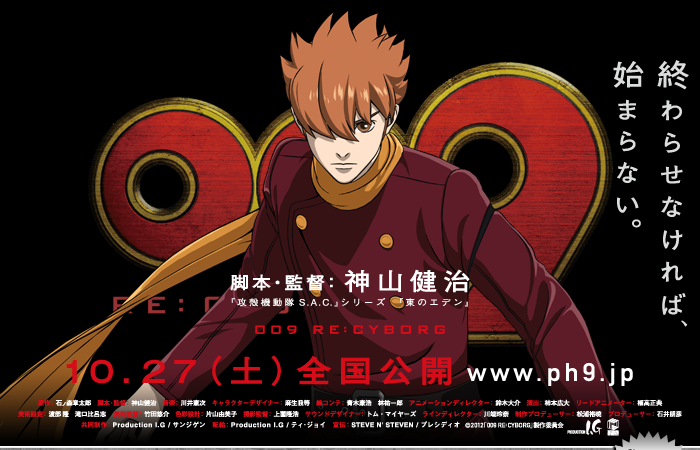
Cyborg 009 by Shotaro Ishinomori is one of the most widely read and well regarded manga series in Japan. It has been adapted as an anime movie and TV series several times, most recently in 2001 where it ran for fifty-one episodes. Although the manga dealt with some complex themes, most of these adaptations had leant decidedly to the family friendly with the team of nine cyborgs squaring off against various deadly enemies and saving the world week after week. For this new adaptation, however, director Kenji Kamiyama – the creator of Ghost in the Shell: Stand Alone Complex, Eden of the East and Moribito, famed for his willingness to engage mature, topical subject matter has decided to take the film back to the manga’s darker heart.

This is a world of mass destruction, sky scrapers fall, buildings explode, people run and scream yet it is normalised – this is the way of the world. Joe Shimamura is a bored high school student who feels as if he’s living his life in repetition. Recently he’s begun to hear a voice – His Voice that’s offering him a new purpose and a new path if he will only follow it. Follow it he must though what His Voice is asking him to do is something truly abhorrent. Thankfully, before he can accomplish the task he’s been charged with, a large Native American turns up and begins to beat the stuffing out of him seemingly with the guidance of a French woman giving instructions from an aircraft hovering above. Luckily for all concerned, Shimamura’s survival instincts kick back in and he remembers his true identity just in time to catch said French woman after she’s rather riskily jumped out of her plane. Shimamura isn’t a high school student at all, he’s the head of a nine cyborg crime fighting team and there’s something very wrong in the world. His Voice is reaching more and more people and convincing them to do awful things in His name – who is He, what does He want and how are they going to stop him?

It’s a truly international cast with each of the cyborgs representing a different nation – 001 Ivan (Russia), 002 Jet (America), 003 François (France), 004  Heinrich (Germany), 005 Geronimo (Native American), 006 Changku (China) 007 Great Britain (British), 008 Pyunma (Africa), 009 Joe Shimamura (Japan). Tellingly, Jet and Shimamura have had some kind of bust up prior to the action of the film and tension still lingers – is America behind these attacks? Why are the NSA so suspiciously present and why does it seem they’re so keen to scapegoat the cyborgs as a terrorist group? Can Jet still be trusted or has he become involved with this dark plot? If the team are going to succeed in figuring out just what is going on its going to need an awful lot of international cooperation.

A familiarity with the source material doesn’t feel a necessity whilst watching the film, however though those cognisant of Kamiyama’s typically complex themes may feel a lack of depth in some of the imagery used. Christian religious allusions abound with fossilised angels and biblical sounding pronouncements from our unknown assailant but the overarching mythology is never really addressed or explained in any significantly explicit manner. Despite this the dialogue sometimes leans towards clunkyness overloaded with the weight of complicated exposition. The lack of clarity in the cosmology at play may leave some scratching their heads as the film ends in its rather ambiguous fashion, few would deny though that it’s been fun getting there.

Alongside its cerebral offerings 009 Re: Cyborg also serves up its fair share of pedal to the floor action sequences. Making the most of its 3D production and accompanied by Kenji Kawai’s energetic score the film succeeds in providing some genuinely thrilling set pieces. The use of 3D here is truly inspired and provides a welcome level of depth and inclusivity which showcases the best use of the medium. Though it wears its 3D badge proudly, the animation has been rendered with a 2D, cel shaded look much favoured by Production I.G. in the past.  It may look hand drawn but it has of course been created with computer technology – this has its benefits but more than a few costs. Though the look of the piece is striking, the computerisation is at times overly obvious and detracts from the otherwise traditional aesthetic. Characters sometimes move oddly or lack expression – which might be accounted for when concerning the cyborgs themselves but is less easy to explain away when it occurs with characters intended to appear 100% human. Still, these are minor problems and if one is able to adjust to the stylisation of the film they shouldn’t overly effect the enjoyment of it.

009 Re: Cyborg is not without its faults but it is still a very enjoyable experience. Its use of 3D, unusual visual style and innovative technology mark it out as essential viewing for anyone interested in the future of anime film making. Fans of Kamiyama’s previous work may feel short changed that the confined format of a feature film hasn’t allowed him free reign to fully explore his complex ideas yet what 009 has provided is the opportunity to showcase his talents as a director whilst crafting an entertaining and intelligent action extravaganza.

Rebirth (Youkame no semi) 八日目の蝉

高解像度寒霞渓First of the Japan Foundation Touring Film Programme for this year up on UK-Anime.net. I’m going to do a general round-up later in the week but this was the best of the (impressive) bunch.


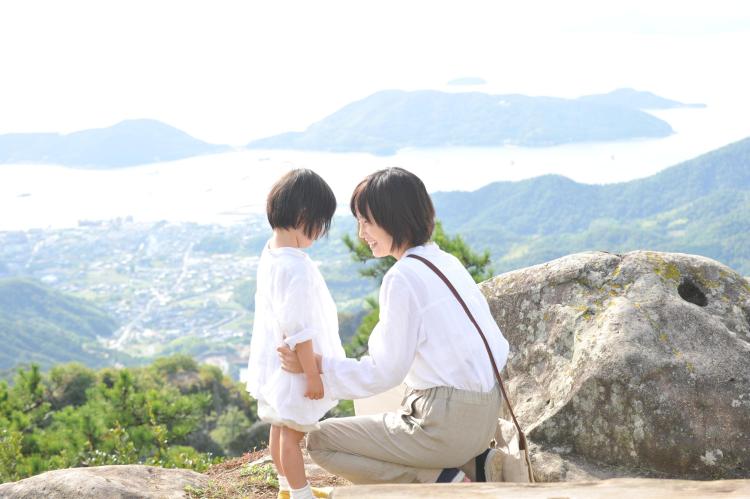
Kiwako has been having an affair with a married man who swears he’s going to leave his wife (just not right now) but now things have come to a head as she finds out she’s carrying his child. Despite her being desperately happy and excited about it – planning to call the child Kaoru and designing visions of the a domestic bliss, Kiwako’s married lover is decidedly less enthusiastic and persuades her to opt for a termination. However, complications from the procedure leave her unable to have any more children and she also begins being harassed by her lover’s wife who finally turns up on her doorstep one day, heavily pregnant, to taunt her – going so far as to remark that her ‘barren womb’ is a direct result of her immoral relations with her husband. One day Kiwako just snaps and in an act of madness abducts her lover’s newborn baby and raises the child as her own for four years until she is finally caught.

In the present day, Erina – who was Kaoru, raised by Kiwako for the first four years of her life, has grown up and is in college. She is deeply scarred by the traumatic events of her early childhood and seems to have difficulty with forming relationships with people, not that she seems to want to make any. After being returned to her birth parents she struggled to adapt to her new life and her birth parents struggled to come terms with everything that had happened. Now, as a young woman, Erina finds history begin to repeat itself in more ways than one and she’s forced to consider who she really is and what she wants out of life. In order to do that, she’ll finally have to confront her traumatic past and all of the complex questions and emotions that will inevitably arise.

In a Chalk Circle-esque way, Rebirth wants to ask a lot of questions about motherhood. Who is the mother of this child really? The woman who gave birth to it or the one who has cared for it all its life and who the child regards as its parent? It is obviously a terrible situation for all involved – the birth parents have lost their child, something truly awful, but the child now believes her abductor to be her mother and ‘returning’ her to a pair of ‘strangers’ she has no recollection of is beyond cruel. Being cruelly ripped away from everything she knew would be traumatic enough, let alone being dragged away from her ‘mother’ in a car park late at night and bundled into car by a harsh woman who tells her she’s being taken to her ‘mummy’ when her total understanding of that word is being handcuffed and taken away.

At only four years old you might think she’d be young enough to gradually ease back into her birth family, and you might be right had her natural parents been better equipt themselves to cope with the situation. Erina’s mother is very definitely of the ‘carry on as if nothing happened’ school so any allusion to the first four years of the girl’s life provokes a hysterical fit that only further exacerbates the confusion already ripping apart the poor child’s soul. So jealous is she that she’s effectively projecting all her resentment and bitterness towards Kiwako’s actions onto the child itself – as if she can’t forgive her for the crime of growing older or having spent so much time with the other woman. The child is a reminder of the trauma of its disappearance, of her husband’s infidelity, and subsequently of her own fear of not measuring up as a mother.

Izuru Narushima has crafted an intense and deeply layered character study that neatly sidesteps the risk of becoming as overblown or melodramatic as the plot description might sound. He approaches the subject matter with great sensitivity and with as even a hand as is humanly possible. His camera is incredibly non-judgemental and treats each of the characters with the same level of sympathy and understanding. Surprisingly, it is the birth parents that become the most difficult to sympathise with but even they are presented with a great deal of compassion.

Rebirth is certainly a very complex film that raises all sorts of uncomfortable moral questions from the nature of motherhood to the treatment of the women of society. If I had one criticism it would be that the male characters don’t come out of this well at all – which may be slightly unfair given the deliberate similarity between the two prominent male characters, but certainly the portrait it paints of masculinity is far from flattering. The performances are astounding, particularly those of Mao Inoue (probably still best known for Hana Yori Dango) as the damaged Erina and Hiromi Nagasaku as the desperately maternal Kiwako. Excellently shot and fantastically well conceived Rebirth is one of the best Japanese films of recent times.


I Wish (Kiseki) 奇跡

IMG_0227

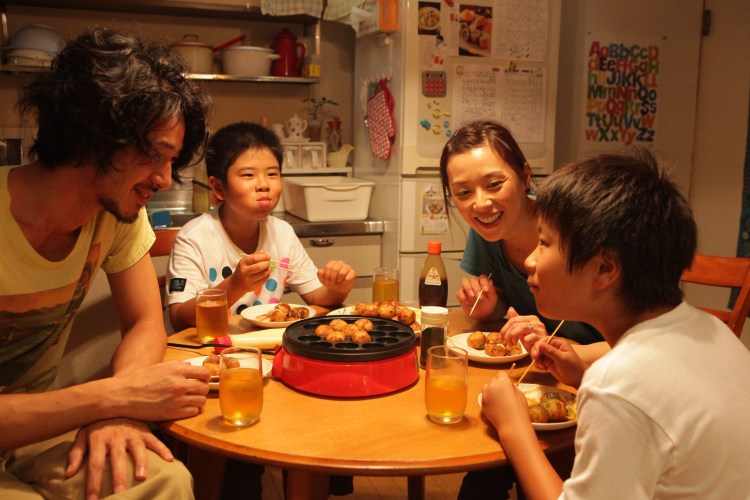
Review up over at UK-A for the latest Kore-eda  to fetch up on out shores. Well, actually, I reviewed this at the LFF in 2011 as well but I like to think I’ve come on as a writer since then (maybe not though, oh well, I still have a ways to go). If this is playing anywhere near you I very much urge you to go and see it even if just to show there is still an audience out there for seeing Asian films in the cinema. It’s a great movie though!

Dragon Head (ドラゴンヘッド, Joji Iida, 2013)

220992

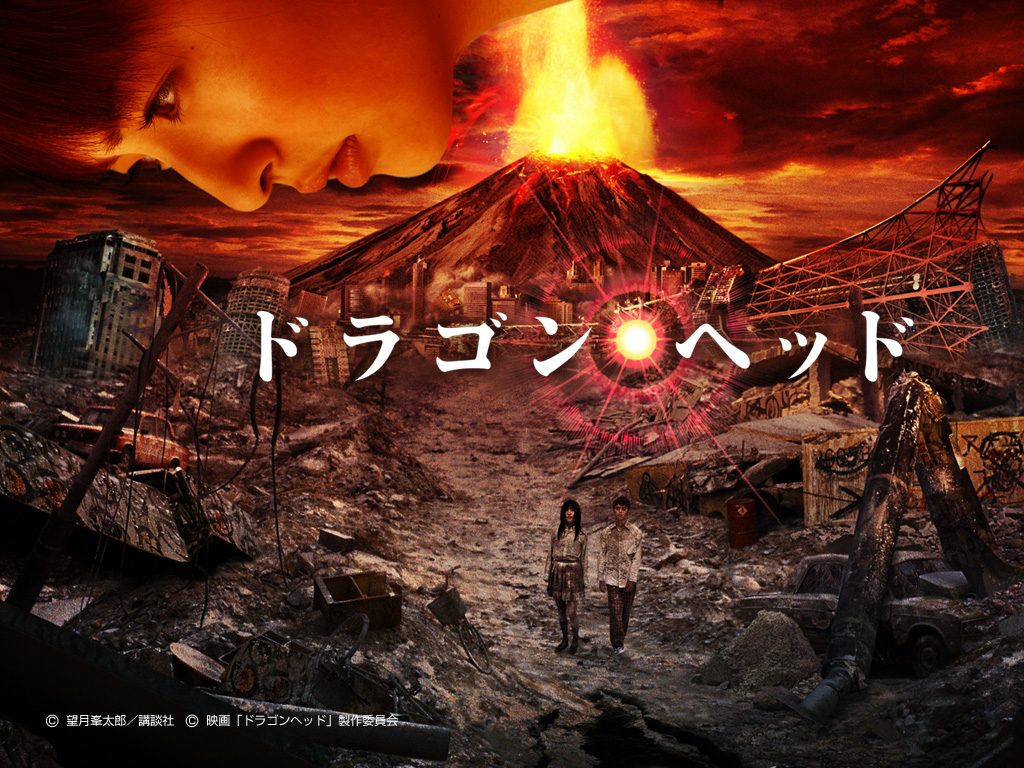
Judging from the scene that surrounds Teru (Satoshi Tsumabuki) as he struggles to open his eyes, he’s either just waking up after the best party ever or something truly awful must have occurred. Where is he? Feeling around it seems like there are a lot of seats – a plane, or a train? Yes, a train. He remembers being on some kind of trip with his school mates – they were all on the train together so where is everyone? Struggling to get up, stumbling against walls he finds them – dead, all dead. Seemingly the only survivor of some kind of accident, Teru tries to get off the train to find out what’s happened and look for other survivors. It seems the train is trapped in a tunnel, both ends blocked by fallen rubble. Beginning to fear he really is all alone he comes across another boy perched in the window of an adjacent carriage. Small relief however as Nobuo (Takayuki Yamada) seems to be acting very strangely and muttering on about red lights and embracing the darkness. Evading him leads Teru further along the train where he finds another survivor, a girl – Ako, desperately hiding from Nobuo after witnessing him completely losing control whilst looking for survivors.

You might think this is where our three plucky teenagers club together to figure out how to escape the train wreck and get home, but no this is not that type of film. Quicker than you can say Lord of the Flies, Nobuo has gone completely crazy – painting a strange grin on his face with some lipstick he found and dotting his his chest with it too, he even makes a makeshift spear go with with new tribal outfit as a sort of dedicatory effort to his new red light god. He’s very much of the opinion that this stretch of tunnel is the only safe space left on earth and its three inhabitants have inherited a new eden, if they’d just learn to accept it. Teru and Ako though, clearly terrified by Nobuo’s transformation, do little other than wait for help to arrive. When serious tremors start to shake the tunnel and they no longer have any choice but to act they finally manage to climb out through a supply tunnel. What they find on the other side though is a vast desert of ash – all visible signs of human civilisation have been destroyed and they seem to be alone in the world.

Dragon Head is a bleak, seventies style post-apocolyptic drama in which our ‘heroes’ discover that the threads that hold society together are incredibly weak and snap the moment the slightest pressure is placed upon them. Without spoiling too much, we never find out exactly what it is that has happened, only that whatever it was caused people to turn on each other in a terrible fashion and those few who have survived only want to forget. During in their travels our, frankly unbelievably clueless and incredibly lucky, duo come across a town full of men who’ve decided not to go on and don’t want anyone else to either; mercenary soldiers with dubious motivations; a pair of strange brothers who’ve been surgically altered to remove all trace of fear and sadness and myriad other examples of humanity’s darkest places.

In facing the successive crises, it has to be said that Teru and Ako are not exactly survival buffs. They react to each new situation in what might be termed a realistic fashion as far as two teenagers faced with seemingly impossible odds would do. Largely this means there is a fair amount of panic, crying, blind stumbling and a the recurrent idea of simply giving up. This realistic portrayal of ordinary people caught up in an extreme situation is quite refreshing and a direct contrast to the super smart, seemingly indestructible, level headed teens you often find in such movies. However, the vulnerability of the central couple may also be turn off those viewers who find them simply too whiny and wonder why they don’t get on with trying to find a better way to survive.

For what was seemingly quite a low budget picture shot on early digital, Dragon Head features some very impressive visuals. Making use of old school techniques like matte paintings alongside CG effects, the post apocalyptic landscape is rendered in an extremely convincing way and this is certainly one of those films that has made the best of what it had. In fact it benefits greatly from not relying on CGI to the extent other films of its era often did and so appears much less dated in comparison. Its real world effects and attention to detail mark it well above the some of the big budget disaster epics that began to appear around the turn of the century and help it become much more engaging as a result.

Dragon Head is not without its faults – it’s based on a manga which lends it an episodic structure which isn’t always conducive to good cinematic story storytelling. It’s also possible that some of the overarching mythology which isn’t really explored during the course of the film is more fully explained in the manga (not to mention the Seventies style ending) but really these are small problems. Dragon Head turns out to be much more impressive than you’d originally think it would be and offers a refreshing dose of bleakness that’s been absent from our screens for much too long.

Reviewed on R2 Japanese DVD release

The Foreign Duck, The Native Duck and God in a Coin Locker (アヒルと鴨のコインロッカー, Yoshihiro Nakamura, 2007)

YgoLt - ImgurReview of The Foreign Duck, The Native Duck and God in a Coin Locker over at uk-anime.net I really enjoyed this one – great movie!


Director Yoshihiro Nakamura once again returns with another adaptation of a Kotaro Isaka novel, The Foreign Duck, The Native Duck and God in a Coin Locker (アヒルと鴨のコインロッカー, Ahiru to Kamo no Coin Locker). Having previously adapted Fish Story (also available from Third Window in the UK and itself a very fine film) and Golden Slumber, Nakamura and Isaka seem to have formed a very effective working relationship and this latest effort is another very welcome instalment from the duo. Elliptical, melancholic and thought provoking The Foreign Duck, The Native Duck and God in a Coin Locker is a minor gem and every bit as whimsical as its name would suggest.

Shiina (Gaku Hamada) has just left the small town shoe shop his parents own to study law in Sendai. Moving into his new apartment he attracts the attention of his neighbour, Kawasaki (Eita), who overhears him signing Bob Dylan’s Blowing in the Wind. Kawasaki is himself a great admirer of Dylan remarking that his is ‘the voice of God’. Aloof, cold, at once dominating and indifferent the prospect of developing a friendship with the mild mannered, short and shy Shiina seems an odd one but nevertheless the two seem to develop a bond. Kawasaki therefore proposes Shiina help him with a rather peculiar problem.

Shiina’s other neighbour, who rudely rebuffed Shina’s introduction and moving in present, is apparently a foreigner – Bhutanese to be precise – and although speaks fluent Japanese cannot read. He’s particularly perplexed by the different between ‘ahiru’ – the native duck, and ‘kamo’ – the foreign duck, and is sure that if he had a good dictionary he’d be able to understand the two fully and thus perfect his Japanese. To this end Kawasaki has decided to steal a Kanji Garden Dictionary for him and wants Shiina to help. Understandably confused Shiina originally declines but is soon bamboozled into helping anyway. There’s a lot more to all of this than a simple semantic quandary though and the only thing that’s clear is that Shiina has gone and gotten himself embroiled in someone else’s story.

‘That sounds like something you just made up’ is one of the first things Shiina says to Kawasaki and indeed everything about him seems studied or affected in someway as if he were reciting someone else’s lines – essentially performing the role of himself. Half of the crazy stuff he comes up with, like his warning Shiina to avoid a particular pet shop owner completely out of the blue, sounds as if he’s just invented it on the spot for a laugh were it not for his distant and humourless manner. Without spoiling the plot too much, you start to get the feeling that there’s really something slightly off about everything you’re being told, that crazy as it seems it is the truth in one sense but perhaps not in another. This is where the mystery element of the film begins to kick in – who is Kawasaki really? What is he on about? Is any of this really happening?

Wistful in tone, The Foreign Duck, The Native Duck and God in a Coin Locker is only partly a mystery, it’s also a bittersweet coming of age tale and an, admittedly light, examination of the Japanese attitude to foreignness. Away from home for the first time Shiina is obviously keen to strike out on his own and be his own his own person but at the same time wants to fit in and be liked by his classmates. A particularly telling incident occurs when a confused Indian woman tries to get some information at a bus stop only to be ignored by those waiting. Shiina seems to feel as if he ought to help her but having just heard two of his classmates complaining about ‘stupid foreigners’ does nothing. Feeling guilty he tries to reach out to his Bhutanese neighbour but is again rebuffed. Kawasaki wants to know the difference between the foreign duck and the native one – is there such a fundamental difference? As one character says ‘you wouldn’t have talked to me if you’d known I was a foreigner’ ‘Of course I would’ Shiina replies ‘no, you wouldn’t have’ his friend responds with resignation. Isn’t it better to just help those who need it, whoever or whatever they happen to be?

The Foreign Duck, The Native Duck and God in a Coin Locker maybe a little darker than its title suggests but its tone is definitely to the wistful/whimsical side – this juxtaposition might irritate some who’d rather a more straightforward mystery or a lighter, more conventional comedy but its refusal to conform is precisely what makes it so charming. That it also manages to pack in a decent amount of social commentary in an interesting way is to its credit as is its ability to make the totally bizarre seem perfectly natural. The Foreign Duck, the Native Duck and God in a Coin locker is another impressive feature from the creators of Fish Story and fans of that earlier film will certainly not be disappointed by their latest work.


Original trailer (English subtitles)

For Love’s Sake (Ai to Makoto) – LFF 2012

Please click through to read my review of Ai to Makoto on uk-anime-net

I know, two links in a row, I’m so sorry! More original content coming soon, I promise (probably). The movie’s awesome though, a total delight!