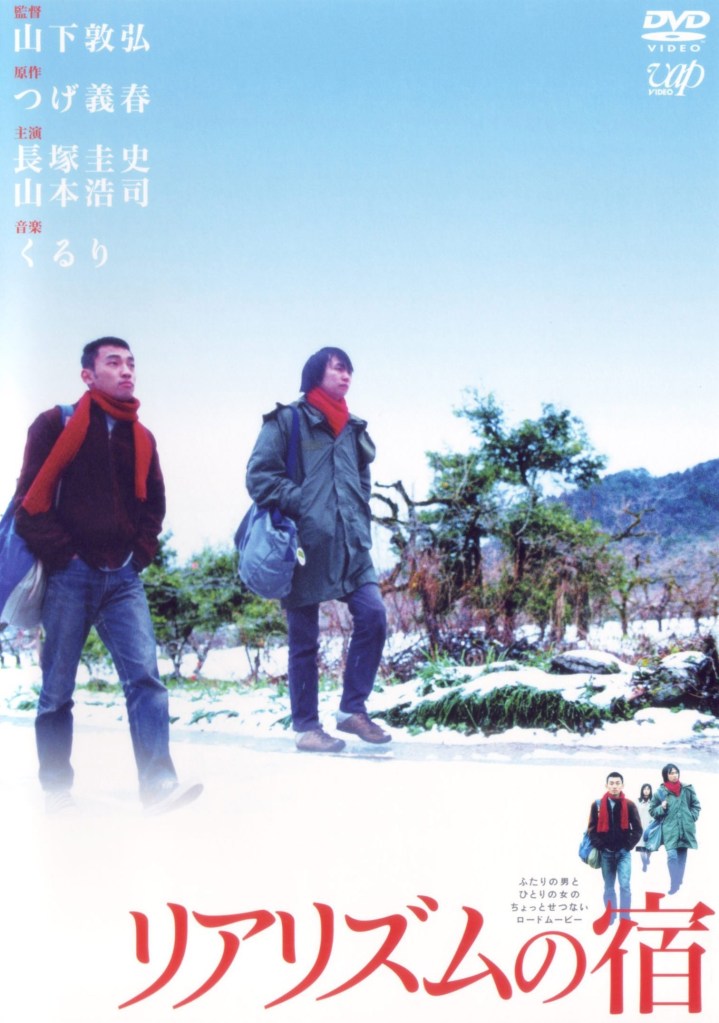
Nobuhiro Yamashita is well known for his low-key, naturalistic style often focusing on the everyday musings of youthful slackers. Ramblers (リアリズムの宿, Realism no Yado), his third feature film takes this idea and pushes it to the max as it follows two filmmakers wasting time in the mountains after their ultimate slacker actor friend lets them down at the last minute.
The two guys are Tsuboi, a screenwriter and the younger of the two, and Kinoshita – a director and a little bit older in his late twenties. The trip has been organised by a mutual acquaintance, Funaki, who’s an actor and the other two have met once or twice before but don’t exactly know each other. Funaki has overslept and will be late, or he might just come tomorrow or something. He tells the other two to go ahead without him. With nothing else to do the two guys wander off into the mountains to kill time while they wait for their Godot-like friend where they have various encounters with the strange mountain-folk all while a gentle friendship builds up in the background.
By far the most important episode occurs whilst the pair are sitting on the beach “rambling” on about nothing in particular when a scantily clad young woman, Atsuko, comes running towards them out of the sea. Hilariously, the pair try to run away as if she were some kind of terrifying sea monster but eventually decide to help her after she tells them that all of her belongings, including her wallet with her ID and money, have been washed away to sea. They end up adopting her for two or three days, paying for her new clothes, meals and board each a little taken with her but nothing untoward in mind. Suddenly this episode ends, leaving a curious hole in the young guys’ relationship.
Other than getting to know Atsuko, the guys waste time fishing, chatting with the interesting staff at the various inns they end up staying at and just generally hanging around wondering where the hell Funaki has got to. Having failed to arrange accommodation (slackers!) the pair decide to inn hop a little whilst roaming around the area though it’s definitely the off season. After their adventure with Atsuko the boys’ funds start to run down and they’re reduced to sharing meals which gets them noticed by a shady guy in cafe who insists they stay over with his friend – though it turns out to be not really his friend’s place at all and, feeling awkward, the pair attempt to find somewhere else last minute ending up at every traveller’s worst nightmare. The final “inn” is not even really a B&B, just a freezing room in someone’s house which is filled with children, a father who’s dying in the corner and a bathroom which would definitely not pass any kind of health and safety regulation. Getting a little fed up, the boys spend their final night laughing off the strange and sometimes rotten adventure they’ve been having – wondering first about Atsuko and then feeling annoyed about their “friend” who doesn’t seem to have been very invested in this particular enterprise.
As usual for a Yamashita movie, nothing really happens while quite a lot is happening. We get invested in Tsuboi and Kinoshita’s vacation as their friend pulls a Godot style stunt on them by repeatedly failing to appear but always promising to be there soon. Whilst travelling and killing time the two guys talk about various things and get to know one another better. Their time with Atsuko actually seems to bring them closer together rather forcing them into the roles of rivals, though a late stage revelation about Atsuko’s sudden disappearing act may also give them a collective sense of befuddlement mixed with mild guilt. The Ramblers ramble on for 83 minutes, though it never feels like an over extended stay. Once again Yamashita crafts a low-key, nuanced character piece that allows his naturalistic, humorous eye to shine through.
Suprisingly, you can actually buy this on UK iTunes with English subtitles!

 For arguably his most famous film, 1964’s Manji (卍), Masumura returns to the themes of destructive sexual obsession which recur throughout his career but this time from the slightly more unusual angle of a same sex “romance”. However, this is less a tale of lesbian true love frustrated by social mores than it is a critique of all romantic entanglements which are shown to be intensely selfish and easily manipulated. Based on Tanizaki’s 1930s novel Quicksand, Manji is the tale of four would be lovers who each vie to be sun in this complicated, desire filled galaxy.
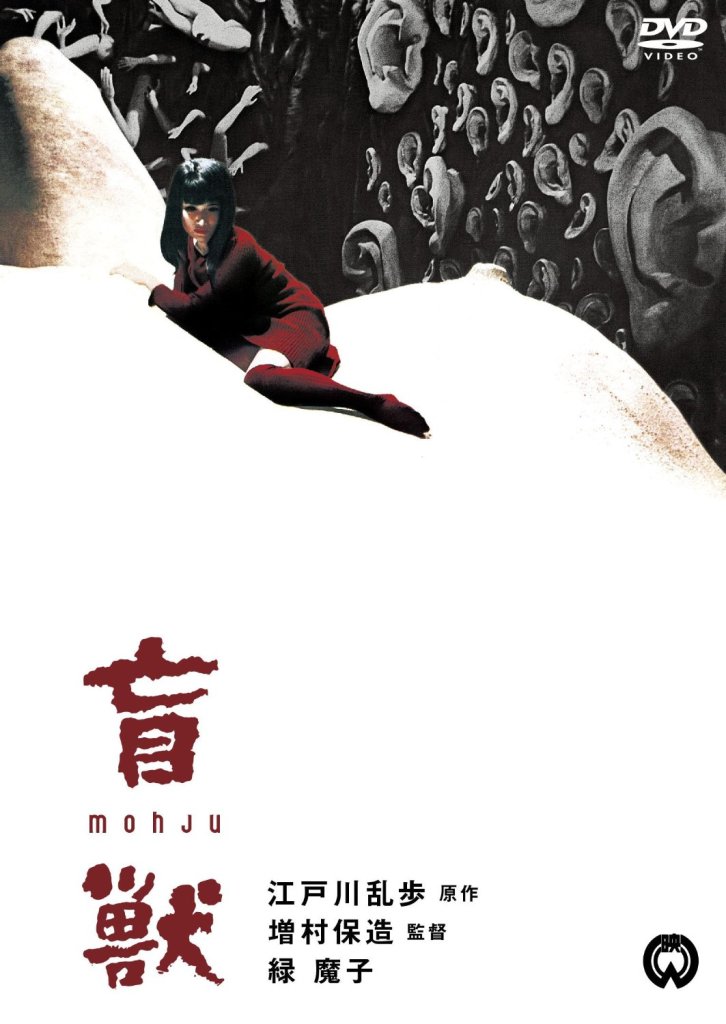 Never one to take his foot off the accelerator, Yazuso Masumura hurtles headlong into the realms of surreal horror with 1969’s Blind Beast (盲獣, Moju). Based on a 1930s serialised novel by Japan’s master of eerie horror, Edogawa Rampo, the film has much more in common with the wilfully overwrought, post gothic European arthouse “horror” movies of period than with the Japanese. Dark, surreal and disturbing, Blind Beast is ultimately much more than the sum of its parts.
 Irezumi (刺青) is one of three films completed by the always prolific Yasuzo Masumura in 1966 alone and, though it stars frequent collaborator Ayako Wakao, couldn’t be more different than the actresses’ other performance for the director that year, the wartime drama
  The debut film from Yasuzo Masumura, Kisses (くちづけ, Kuchizuke) takes your typical teen love story but strips it of the nihilism and desperation typical of its era. Much more hopeful in terms of tone than its precursor and genre setter Crazed Fruit, or the even grimmer The Warped Ones, Kisses harks back to the more to wistful French New Wave romance (though predating it ever so slightly) as the two youngsters bond through their mutual misfortunes.
 Belated review from the 2015 London Film Festival – Yakuza Apocalypse is released in UK cinemas for one day only on 6th January 2016 courtesy of Manga who will also be releasing on home video at a later date.
 Never one to be accused of clarity, Seijun Suzuki’s Capone Cries a Lot (カポネおおいになく, Capone Ooni Naku) is one of his most cheerfully bizarre movies coming fairly late in his career yet and neatly slotting itself in right after Suzuki’s first two Taisho era movies,
  Kabukicho Love Hotel (さよなら歌舞伎町, Sayonara Kabukicho), to go by its more prosaic English title, is a Runyonesque portrait of Tokyo’s red light district centered around the comings and goings of the Hotel Atlas – an establishment which rents by the hour and takes care not to ask too many questions of its clientele. The real aim of the collection of intersecting stories is more easily seen in the original Japanese title, Sayonara Kabukicho, as the vast majority of our protagonists decide to use today’s chaotic events to finally get out of this dead end town once and for all.
 When you learn someone has died, suddenly everything they have ever done becomes tragic. No matter how old they were, this fact remains. Ryuji is a film which is always going to be overshadowed by the fact that its leading actor and screenwriter sadly passed away at the extremely young age of 33 from a terminal illness only days after the film’s release. Well, in actuality, the film was only “released” in a very limited sense, perhaps no one really had the heart to go on with it. However, it left its mark on all who saw it and eventually became a cult hit and influential classic on VHS. On paper, its tale is conventional – an existential yakuza drama about a man torn between conflicting desires and his own nature but on film, it’s something else.
 Nobuhiro Yamashita has made something of a career out of championing the underdog and La La La at Rock Bottom (味園ユニバース, Misono Universe) provides yet another foray into the lives of the disposed and degraded. With a lighter touch than some of his previous work, the once again musically inflected film is another testament to the power of redemption and that you can still turn your life around if you only have the courage to take the chance.
