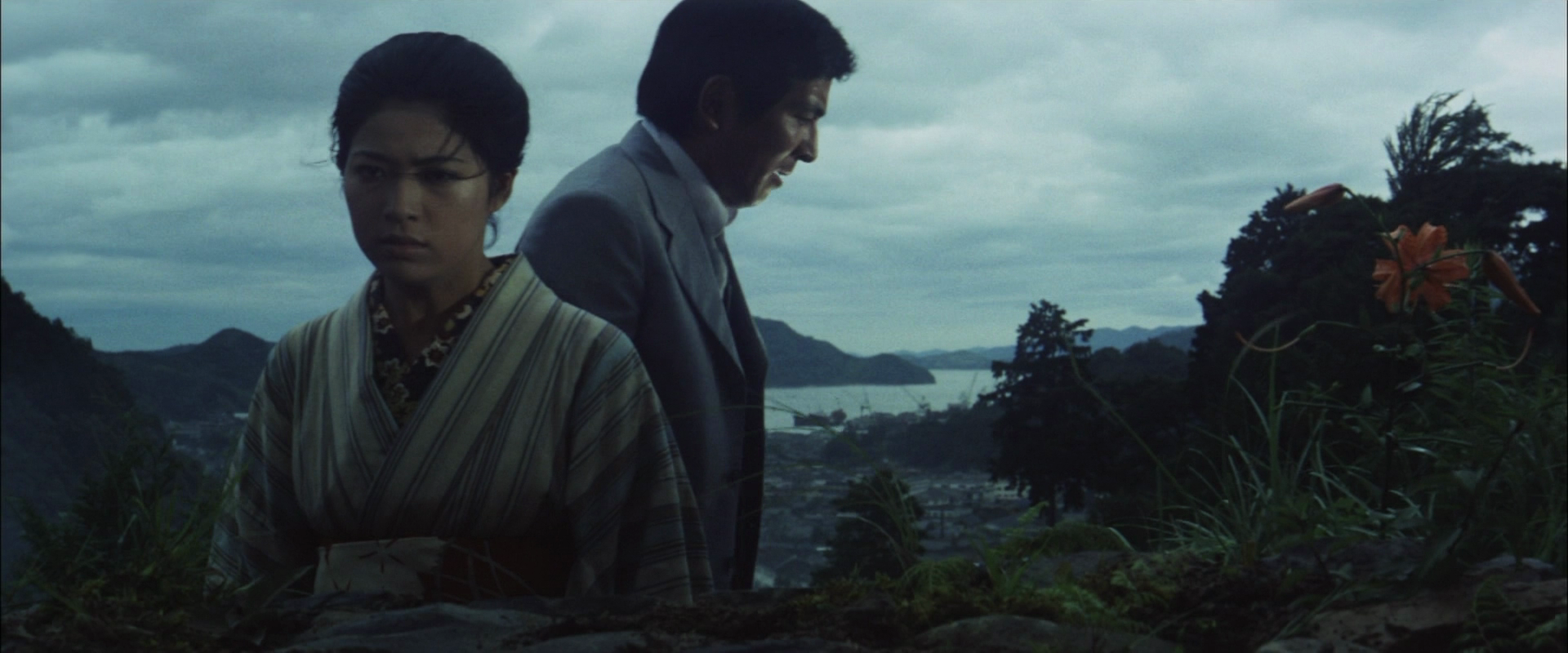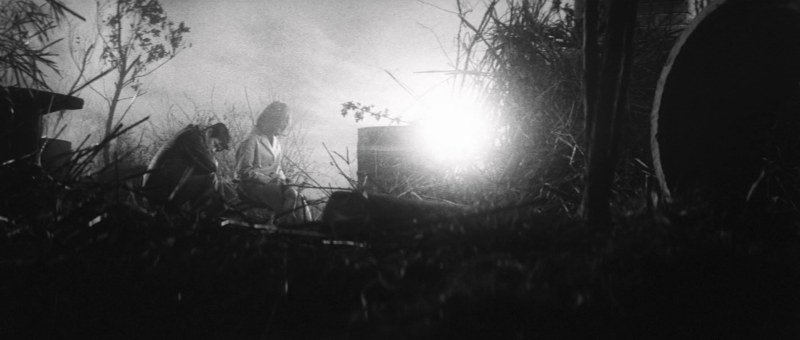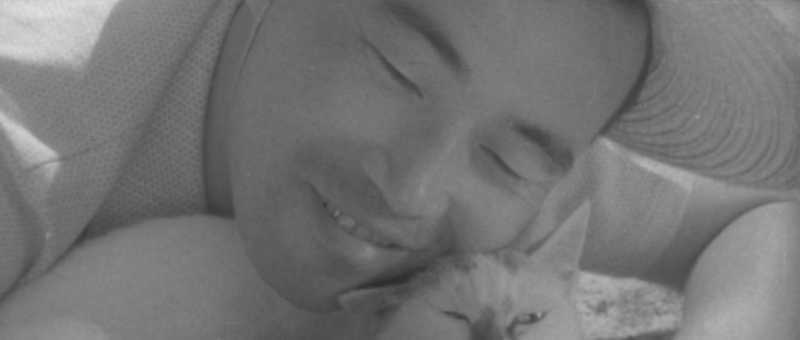
The Fort of Death (五人の賞金稼ぎ, Eiichi Kudo, 1969)

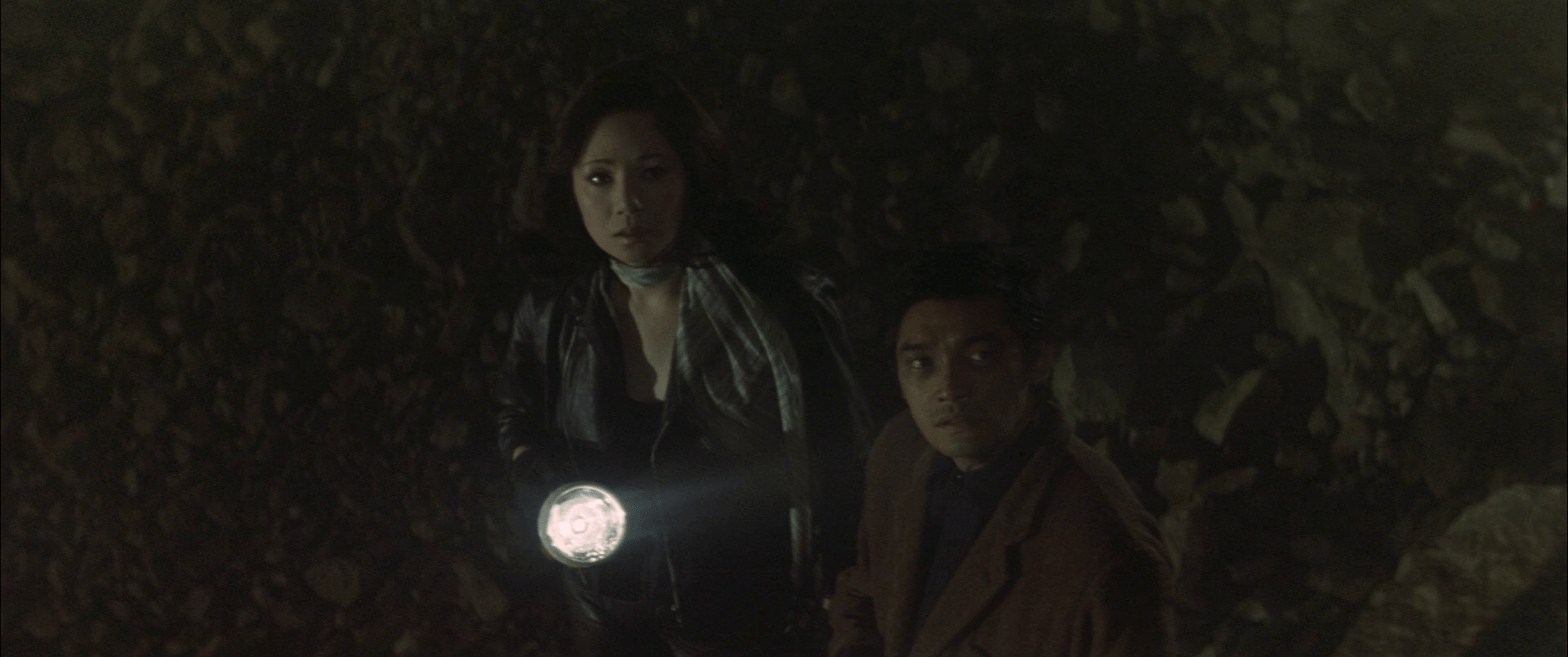
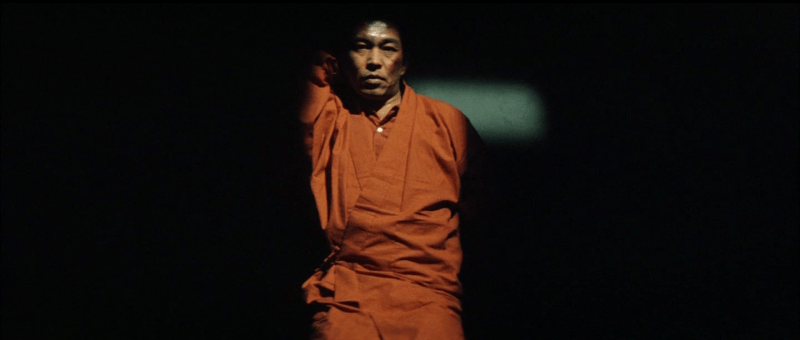
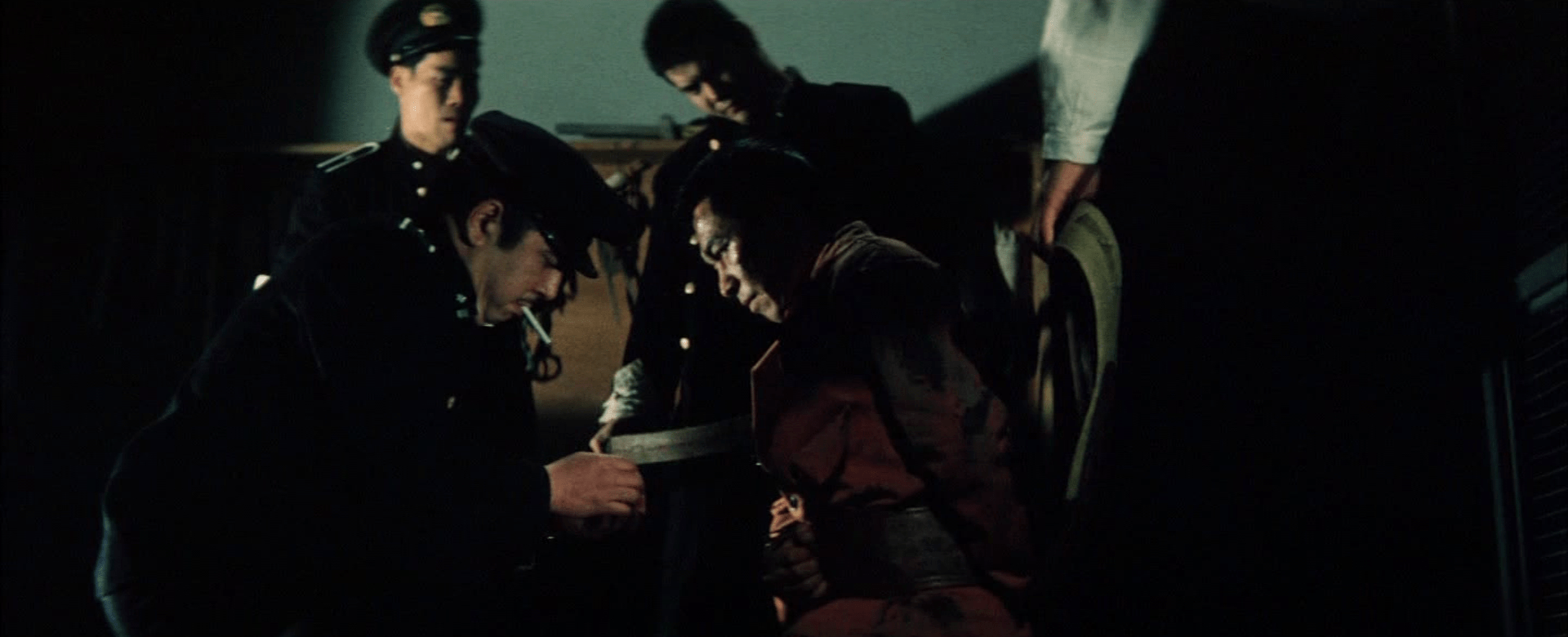
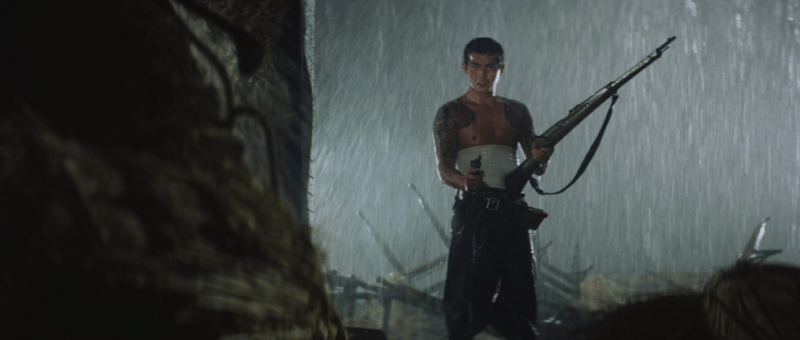
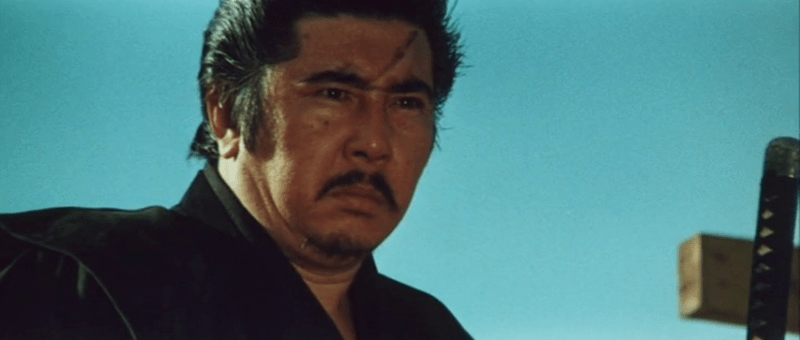
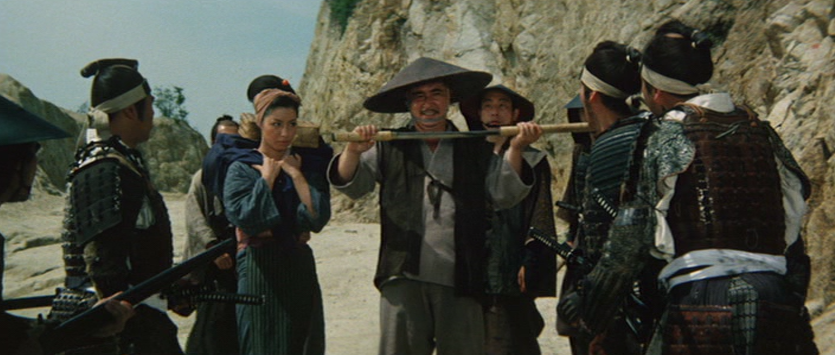
Shikoro Ichibei (Tomisaburo Wakayama) returns yet this time seemingly on the opposite side in the second in the Bounty Hunter series, The Fort of Death (五人の賞金稼ぎ, Gonin no Shokin Kasegi) this time directed by Eiichi Kudo. If the first film had been an Edo-era take on James Bond, the second is very much Spaghetti Western and feudal tragedy as Ichibei finds himself coming to, if not quite the rescue of the oppressed farmers, then at least moral support in taking stand against corrupt and self-interested lords.

This might be surprising in that in the first film Ichibei had been a shogunate spy and seemingly close friend of the man himself, yet this time around he’s working as a doctor while taking bounty hunter jobs to earn extra money to support the poor people who come to him for help. Like a true western hero, he has a small posse which includes the ninja lady, Kagero (Tomoko Mayama), from the first film only she’s being played by the actress who previously starred as his other love interest. In any case, he’s approached by a young man from a small village which is making a last-ditch appeal to the local lord to lower their tax burdens so they don’t all starve, though so far the lord’s response has been to add additional taxes and kill people for not paying them. 

On his arrival, Ichibei soon realises that the man who recommended him was actually the leader of the government forces during a previous peasant uprising at which Ichibei had also tried to help the farmers. In that case, Bessho (Shin Tokudaiji) had won, but it didn’t do him any good. His clan was dissolved and he became a wanderer, taken in by the village and now indebted to them, hoping Ichibei can help but fully aware of the brutality with which such challenges to the feudal order are put down. 

The lord later suggests it’s not really his fault. He has to curry favour with Edo to protect the domain, which is why he agreed to participate in a construction project that led him to confiscate all of his farmers’ rice and wheat. But then it’s also true that he is vain, and cruel. On realising the village has hired a man like Ichibei, some of the retainers suggest reopening negotiations but others complain that they must now crush the farmers or face ruin themselves while trying to ensure the strife in their domain does not come to the attention of the government in Edo. 

Part of their problem is that Ichibei simply has better technology in the form of gatling guns. Tying into the western themes, Ichibei is well versed in the use of firearms, while the samurai are mostly reliant on traditional weaponry such as arrows and swords. The lord later insists on using some canons, but is oblivious to the risk as the shogun has banned the use of gunpowder and using them may end up bringing him to his attention and thereby landing him in a lot of possible fatal trouble. 

In any case, it’s the villagers who suffer. Ichibei encounters a woman who has lost her mind, refusing to give up her baby who has died of malnutrition while her husband was executed for non payment of taxes. Meanwhile, some of the other ronin they hired attempt to rape a villager, and a young couple are prevented from marrying because the headman is worried that it would send the wrong message in a time so much strife. Then again, a woman basically attempts to rape Ichibei, descending on him while he’s still asleep which otherwise leads into a fairly comic sequence in which Ichibei must fight of a bunch of ninjas intent on stealing the gatling gun while dressed only his underwear.

Darkly comic it may be, but also surprisingly violent with a ninja at one point using a dead body as a Molotov cocktail not to mention the severed heads and limbs of the battle scenes. Ichibei is fully aware that the battle is a forlorn hope, but also that the villagers have no choice and perhaps this is better for them than simply accepting their fate and starving to death. Even so, he reserves his final words for the Edo inspector who arrives only when the battle is done to survey the scene, berating him that he ought to know what happened here from looking at the battlefield and deducing that this domain has not been run particularly well. It’s a tragedy of feudalism that provokes a tearful rage from the compassionate bounty hunter trying his best to heal the sickness in his society, though perhaps like the patient who visits him with a venereal complaint concluding the best solution is to cut it right off.
Killer’s Mission (賞金稼ぎ, Shigehiro Ozawa, 1969)

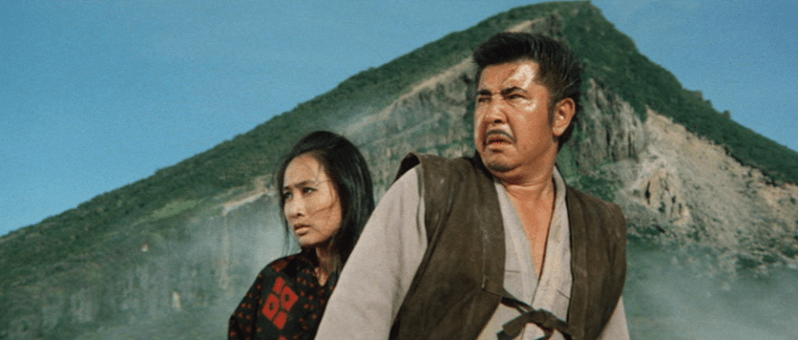
According to the title card at the beginning of Shigehiro Ozawa’s Killer’s Mission (賞金稼ぎ, Shokin Kasegi), none of the events it depicts have been recorded in history because the shogunate decided to erase them all in fear of the effect they may have on the nation’s geopolitical stability. Nevertheless, it gives some very concrete dates for its historical action, even if they may not make complete sense while foreshadowing the political turbulence of the following century. 

What it essentially attempts to do is tell a James Bond-style tale of political intrigue in a feudal Japan in which perpetual peace has begun to create its own problems. Here played in a cameo appearance from Koji Tsuruta, the Shogun Ieshige was weak in part because he was in poor health and had a speech impediment which led him to be rejected by his retainers. The problem here, however, is with Satsuma which has been on bad terms with the Tokugawa shogunate since the Battle of Sekigahara after which they took power. Satsuma will in fact be at the centre of the conspiracy to overthrow the government in the following century, but for the purposes of the film have fallen foul of a rumour that the plan to do an arms deal with some Dutch sailors who sailed South to Kyushu after being rebuffed in Edo. 

A civil war is feared and in the interests of maintaining peace, Ieshige sends his trusted spy Ichibei (Tomisaburo Wakayama) to protect Satsuma official Ijuin Ukiyo (Chiezo Kataoka) in the hope that he will be able to talk his young and naive lord out of doing the deal. Ostensibly a doctor by trade, Ichibei has a series of spy gadgets such as hidden blades and collapsible guns stored in a secret room at his surgery which he then carries in a black leather utility belt. He keeps the nature of his mission close to his chest, but often double bluffs by simply telling people he is a shogunate spy or otherwise adopting a disguise as he does in a moment of meta comedy impersonating the signature role of his brother Shintaro Katsu by posing as a Zatoichi-style blind masseur. 

As if to signal the cruelty of the feudal world, Ichibei comes across the corpses of suspected spies abandoned outside Satsuma territory while his enemies meditate on their ancient slight and consider taking the deal in the hope of avenging their defeat and overthrowing the Tokugawa. They are warned that creating unrest and sowing division may be exactly what foreign powers like the Dutch crave, but aren’t particularly bothered, preferring to take their chances with them rather than curry favour with the Shogun and possibly destabilising the entire society along with it. 

Of course, much of this is anachronistic with the Dutch sailors appearing in a distinctly 19th century fashion carrying weapons which are also too advanced for the era as are Ichibei’s folding pistols. Through his travels, he runs into a female Iga spy who too can do some nifty ninja tricks and has a gadget of her own in a comb which can shoot poison darts, though luckily it’s one of the poisons Ichibei has already developed an immunity to. Ichibei is fond of crying that you kill him he’ll simply come back to life, barrelling through the air with feats of improbable human agility and generally behaving like some kind of supernatural entity with a secondary talent for violent seduction. 

Though ironic and often darkly comic, there is an unavoidable poignancy in the inner conflict of Ijuin who knows his clan is about to do something very foolish but is torn between his duty to obey them and that to act in their best interests, eventually backed into a corner and left with no real way out of his predicament. As Ichibei points out, it’s difficult to keep the peace, especially when restless young samurai spot opportunities to cause chaos and the outside world knocks on the door of a closed community. Even so, Ozawa ends on a romantic image of a beach at sunset somehow undercutting the violence and tragedy with the restoration of an order that might itself be imperfect in its peacefulness.


Village of Eight Gravestones (八つ墓村, Yoshitaro Nomura, 1977)

Can a curse end up being “real” just because people believe in it? Unlike many of his other crime films which were adapted from the novels of Seicho Matsumoto, Yoshitaro Nomura’s The Village of the Eight Gravestones (八つ墓村, Yatsuhaka-mura) edges towards the idea that the curse at its centre is real in a more literal sense with grimly grinning samurai standing on their hilltop and rejoicing in the fulfilment of the 400-year campaign of vengeance, but also hints at a toxic legacy of enmity and warfare along with a karmic sensibility found in many of Seishi Yokomizo’s other mysteries in which a noble family must account for the way it gained its riches. 

In this case, the Tajimi family which now owns most of the village became prosperous after betraying a band of eight displaced samurai during the Sengoku era. Fleeing the battlefield in defeat, the samurai had originally frightened the villagers when they came down off the mountain but were in actuality non-threatening, simply settling down to a life of farming and peaceful co-existence. But some members of the community became greedy and accepted the promises of riches from a rival clan for the service of eliminating the eight samurai. Cruelly inviting them to the local festival in what seemed like a moment of acceptance as members of the village, they betrayed them killing some by poison and others by the sword. 

Now, hundreds of years later, the Tajimi family is on the verge of extinction with the eldest daughter unable to bear children and the oldest son bedridden and soon to die which explains why they’re keen to track down long lost grandson Tatsuya Terada (Kenichi Hagiwara) who was presumably adopted by his stepfather and bears his name after his now deceased mother Teruko left the family to escape her abusive relationship with half-mad husband Yozo (Tsutomu Yamazaki). Surprisingly, it’s his maternal grandfather Ushimatsu Igawa (Yoshi Kato), who comes looking for him only to drop dead as soon as they meet of apparently strychnine poisoning in the first of several murders that all echo the ancestral curse placed upon the Tajimi family by samurai leader Yoshitaka Amako (Isao Natsuyagi) as he died. 

Like many of Nomura’s films this too features a journey only this one is in a sense into the past as Tatsuya ventures to the rural heart of Japan hoping to see his mother’s birthplace and satiate his curiosity about his birth father. What he discovers there is obviously a lot of what seems like unfounded local superstition along with a degree of unpleasant stigmatisation as he’s immediately accosted by a shamaness who calls him a murderer to his face for his connections with the Tajimis to whom he feels himself a stranger, and then is later blamed for all the weird goings on which only began after he arrived. The film uproots itself from the original 1948 setting to the present day which perhaps lessens the impact of its central theme about the legacy of violence and betrayal that is stoked by war and enmity along with the destructive capacity of human greed that encourages some to betray others for their own advancement only to discover that success founded on human sacrifice will never get you very far. 

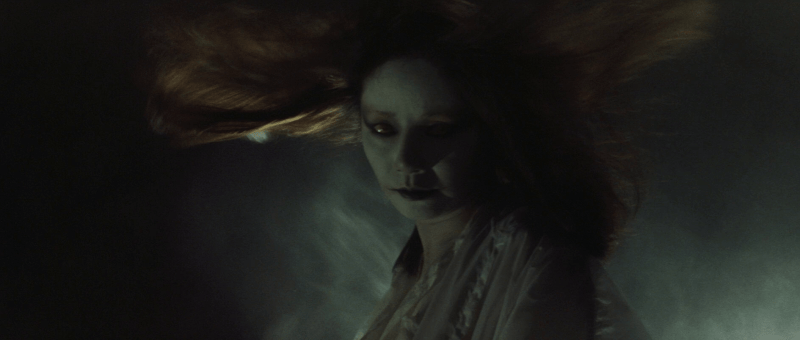
Ironically in a more real world sense, it turns out to be greed that motivates these present crimes with the villain hoping to usurp the Tajimi family fortune and utilising the curse as a means to do so. Much of the action takes place in a network of underground caves filled with glowing green lakes where the villain eventually takes on demonic proportions, face ghostly white with yellowish eyes and a crazed expression that echoes those of the samurai as they died. Nomura hints at the sense of ancient dread in this very old place while also surprisingly bloody in his flashbacks which feature scenes of shocking violence including severed heads one of which seems to lick its lips and stare intently even while on display. This being a Kindaichi (Kiyoshi Atsumi) mystery, the famous detective does indeed appear though remains a background presence quietly solving the crime behind the scenes while Tatsuya searches for the key to his own history and an escape from this legacy of violence and destruction in reclaiming his own identity.


Original trailer (no subtitles)

Eighteen Years in Prison (懲役十八年, Tai Kato, 1967)

Genre star Noburu Ando had a certain cachet in that he had been a yakuza prior to becoming an actor. He had in fact been the head of his own gang which at its high point had over 300 members and controlled much of the lucrative Shibuya nightlife scene. His first onscreen appearance was in a gangster movie in which he played himself. Rather than the jitsuroku epics he would later become associated with, Tai Kato’s Eighteen Years in Prison (懲役十八年, Choueki Juhachi Nen) essentially casts him in a ninkyo role as a noble if compromised former captain of the kamikaze squad who finds himself caught between the contradictions of post-war Japan and the American occupation. 

Indeed, in this as in many other yakuza movies set during the immediate post-war era, the Americans are really just the biggest gang. Suffering with survivor’s guilt, Captain Kawada (Noboru Ando) has set up an association together with former comrade Tsukada (Asao Koike) to look after he dependent relatives of men who fell in war. To do this, he has to resort to criminality raiding American boats for supplies such as sugar and rice which he redistributes to war widows and their families. His ultimate goal is amassing enough money to buy a patch of land in the town centre and do away with the black market which exploits the vulnerable replacing it with a legitimate market so the surviving family members can set up businesses to support themselves. 

Around this time, the association manages to track down the younger sister of one of their men who died as a kamikaze, Hisako (Hiroko Sakuramachi ), and discovers she is living in desperation having lost the family home to aerial bombing. As her mother is seriously ill and she needs money for food and medical treatment, Hisako contemplates turning to sex work and is almost assaulted by a gang of drunk and abusive American servicemen from whom she is rescued by a passing Kawada. This incident makes plain his resentment towards the occupation and sense that it is the American influence that is wilfully suppressing the efforts of the Japanese people to rebuild their society. It’s this resentment that lends a note of justification to Kawada’s decision to rob a nearby factory of valuable copper wire to get the money to save Hisako’s mother thereby saving her from falling into sex work and thereafter helping to achieve their ultimate goal of building the market. The raid, however, goes wrong. Kawada sends an injured Tsukada back to the association and is arrested.

In prison he discovers only more corrupt authority in which guards beat and torture prisoners, just another bigger gang. He finds out that block warden Hanya (Tomisaburo Wakayama) is actively accepting bribes and in cahoots with some of the inmates that attempt to terrorise newbies to the point that one attempts suicide by swallowing glass though Hanya refuses to call for help forcing Kawada and some of the other men to pull the alarm themselves. The sources of moral authority lie in the new college-educated deputy warden recently returned from five years as a POW in Manila, and a veteran yakuza with a grudge against Hanya who apparently had his girlfriend raped leading to her suicide. 

Though the film is titled eighteen years in prison, Kawada becomes eligible for parole in 1952 which is of course the year the occupation ends. By this point he discovers that Tsukada has abandoned their idealistic mission and turned full yakuza, building an immense red-light district on the land they bought for the market and making himself rich through the violent trafficking and exploitation of women. Eventually confronted, he tries to convince Kawada that the world has changed, that the post-war years of privation are over and that he sees only “the ghost of a nation that lost the war” rather than burgeoning new economy stimulated by the Korean War and an ironically a repositioned America now no longer occupiers but still somehow influential if leaving a vacuum a man like Tsukada may step into. It’s no coincidence that he threatens Hisako with deportation to a brothel in Okinawa he’s set up to service American servicemen in a place where the conditions of occupation are still largely in place. 

Tsukada clearly feels that he need have no more responsibility for his wartime conduct, roundly telling Kawada that the families of the fallen are not his responsibility and should “stop leeching off other people and start working for a living”. Hisako’s long lost younger brother Kenichi (Masaomi Kondo) who ended up alone on the streets after being conscripted as a student factory worker and returning to find his home in ashes, turns the blame back on the authorities reminding them that it’s their fault, they started the war the cost him his home and family and turned him into the half-crazed man of violence who immediately introduces himself as “King” on moving up from a juvie prison. Much of Kawada’s prison life is then given over to saving Kenichi, a representative of the next generation, from becoming mired in a life of nihilistic crime. 

In many ways, he remains a squad leader trying to atone for having sent so many young men to die by accepting the responsibility for their families while trying to protect those left behind from the vagaries of the post-war era including the amoral capitalism represented by the infinitely corrupt Tsukada. Dressed in a military uniform ironically pinched from an American soldier he goes on the rampage knowing that he has to deal with Tsukada himself in order to defend the post-war future from those like him who’ve apparently learned nothing much at all even from such recent history. Shooting from his characteristically low angles, Kato explores the seedy underbelly of the beginnings of the economic miracle while his noble hero does his best to offer a course correction to those who have already forgotten their responsibility not just to others but to those they left behind.


The Blossom and the Sword (日本侠花伝, Tai Kato, 1973)

After joining the studio in the mid-1950s, Tai Kato quickly made a reputation for himself with Toei’s key brand of ninkyo eiga yakuza movies set in the chivalrous world of pre-war gangsterdom. By the early 70s, however, the genre was already played out and Kato began to work more frequently with other studios and in various genres but 1973’s The Blossom and the Sword (日本侠花伝, Nihon kyoka den), produced for Toho the studio which he had first joined at the beginning of his career in 1937, takes him back to his ninkyo roots if less directly in a politicised tale revolving around the 1918 rice riots

The film opens, however, a few years earlier with the heroine, Mine (Hiroko Maki), attempting to sell children’s educational picture books aboard a train (an activity strictly prohibited). As she explains, they are in the middle of a recession and times are hard for everyone though as we discover the reason for Mine’s journey is that she is in the process of eloping with the mild-mannered Minoru (Kunio Murai), the son of a wealthy family with literary dreams, who is prevented from marrying her because of the class difference between them. The couple are doing well enough evading detection, but are caught out when accidentally implicated in the murder of a treacherous politician by left-wing agitator/noble gangster Seijiro (Tetsuya Watari) who fatefully locks eyes with Mine while trying to escape forever binding their fates together. 

Epic in length the film was originally released in two parts with an interval in-between, this first half focussing on Mine’s doomed romance which is thwarted in part by the outdated social codes of the early Taisho society and the moral cowardice of her lover who finds himself unable to resist them. The pair are thrown in prison as possible co-conspirators and beaten by the police, Mine striking up a friendship with a woman, Tsuru (Junko Toda), imprisoned for distributing pamphlets as a labour activist who later helps her to get a waitressing job and teaches her rudimentary writing while Minoru lounges around in their home sort of writing a novel. Tsuru seems to be touched by their cross-class romance, “where love is concerned to hell with social status!” she insists berating Minoru for giving in so easily when the pair are finally tracked down by his austere mother. Her socialist activism may not directly rub off on Mine but does perhaps inform her later actions after discovering the depths of Minoru’s spinelessness, rescued after a failed bid at double suicide by a truly good man, Kinzo (Meicho Soganoya), who also happens to be a traditional yakuza heading a harbour gang in Kobe. 

After becoming his wife, Mine comes to witness the persistent unfairness and exploitation all around her as mediated by the outcry surrounding the fluctuation of rice prices in the late 1910s caused by attempts at profiteering and the necessity of supplying the military forces then participating in the war in Europe. Meanwhile, would be local dictator and amoral yakuza Kishimoto (Toru Abe) is intent on squeezing the Osada gang out of the harbour further pushing up rice prices while in cahoots with corrupt local authorities. Seijiro re-enters her life when dispatched to assassinate Kinzo on the orders of Kishimoto but stabbing him as carefully as possible to make sure he doesn’t die, thereafter switching sides to fight for the rights of the poor who he warns face even greater oppression should a man like Kishimoto be allowed to dominate the harbour. 

With Kinzo out of action, Mine assumes her natural destiny as a local leader doing her best to stand up to Kishimoto and the corrupt authorities but still faces difficulty getting her voice heard without a man standing next to her. On taking Kinzo’s place at a meeting of local bosses, she is dismissed as “just a woman” before a sympathetic naval officer decides to hand her a lucrative job shifting rice intended for sailors overseas because of her knowledge of current affairs undercutting Kishimoto’s attempts to game the system. It’s the trust the navy have in her that later saves her again when she is arrested and brutally tortured by corrupt policemen working with Kishimoto intent on tracking down Seijiro for the murder on the train all those years previously. Mine’s rise is also in a sense Seijiro’s redemption as he atones for the attack on Kinzo, rejects his association with Kishimoto to re-embrace his socialist beliefs, and fulfils the romantic destiny sparked when their eyes met on the train. 

Drawing a direct line between burgeoning militarism and gangsterdom along with the amoral exploitations of an increasingly capitalist society, Kato makes his intentions clear by dropping a ninkyo eiga hero into a world of infinite corruptions in which he eventually becomes a defender of the poor. Kato’s striking composition and use of colour along with expressionistic imagery lend the air of legend implied by the title as Mine fights her way through the oppressions of her era as a figurehead for justice in an increasingly unjust society.


I, the Executioner (みな殺しの霊歌, Tai Kato, 1968)

Nephew of Sadao Yamanaka, Tai Kato joined Toho as an apprentice in 1937, returning after the war training under Daisuke Ito and Akira Kurosawa, but later moved to Toei where he became closely associated with ninkyo eiga yakuza movies and jidaigeki. From the mid-1960s, however, he made several movies at Shochiku which had, it has to be said, a house style that was almost the polar opposite with a clear focus on polite, family-friendly melodrama. 1968’s I, the Executioner (みな殺しの霊歌, Minagoroshi no Reika) meanwhile is a surprisingly dark affair even among the grittier examples of Shochiku’s similarly themed B-movie thrillers, an avant-garde noir and proto-giallo in which the fugitive, serial killer antihero sees himself as an agent of divine justice in a hellish and immoral post-war landscape. 

Kato opens with a shocking scene of sexualised violence in which a woman is knocked unconscious, stripped, bound with telephone cord, and finally revived, forced to write down the names of four other women before being brutally raped and murdered by a killer whose voice we have not yet heard nor face seen. The police are mystified, attributing the woman’s death to the fact that she had worked as a bar hostess and maybe things like this are an occupational hazard for women who are surrounded by too many men. Her landlord, however, laments that hers is the second death to occur recently after a laundry boy threw himself off the roof. All things considered, he wishes the boy had picked somewhere else. 

The police have no reason to connect the two unfortunate events and so remain largely clueless, but we gradually become aware that the killer, Kawashima (Makoto Sato), is targeting the women because he holds them directly responsible for the boy’s death. He is the inspector that calls, avenging the death of this young man who, he has learned, like him hailed from Hokkaido and had come to the city at only 16 years old to earn money to support his family, saving almost all of his wages in the hope of opening a shop. Kato shows us scenes of a city under construction, a land of girders casting shadows on the ground like prison bars trapping men like these who are building the new Japan but will be discarded as soon the job is done and their labour no longer so much in demand. Kawashima has another reason for living like this, but he perhaps admires something pure and innocent in the desire of a young man leaving home to seek his fortune so that he might take care of those he loves and that this world betrayed that desire is something he finds impossible to forgive.

The five women have apparently done quite well for themselves, despite the fact that more than one of them has worked on the fringes of the sex trade. Their treatment of the boy is attributed to their boredom in the relative ease of their lives as monied women with little to occupy their time other than getting their kicks abusing the less powerful. It’s an uncomfortable role reversal that places women in a position of power and then sees them abuse it in the exact same way that men do, slinging back the same pithy justifications that men offer for sexual violence while the police meditate on the relative connotations of rape when the word is applied to a man at the hands of women rather than the other way around. If it were their sister, they could understand the desire to kill the men who had done it but a part of them struggles to see that a teenage boy may still find unwanted sexual contact a traumatic enough experience to push him towards suicide. 

Yet Kawshima appears to have no real connection to the boy, and his “revenge” is also a product of his misogyny in that as we later learn he also has reason to feel betrayed by womanhood and is already on the run from previous crime. Nevertheless, he is drawn to the innocent Haruko (Chieko Baisho), a girl-next-door type who works in his favourite ramen restaurant, only to discover that she too has a dark and violent past which may be why she seems to be drawn to him. He struggles with himself, but believes that he is taking revenge on a brutalising society defined by violence and abuse while sublimating his sense of emasculation in the face of women’s growing social and sexual freedoms in the post-war era. It is perhaps the post-war era which is cast as the major villain, one of the women later escaping her protective custody to dance furiously a hip nightclub only to return to the scene of her crime while refusing to see that she has done anything so “wrong” as to merit this kind of persecution. 

“The cycle of divine punishment must be fulfilled” Kawashima finally laments, acknowledging his grim place within this series of post-war tragedies. Surprisingly avant-garde, Kato experiments with blown out negatives, extreme close up, and deep focus mixed with his characteristic low angle composition to add to the sense of noirish dread which paints the modern city as an inescapable hellscape while even the romantic place of refuge shared by Kawashima and Haruko is a gothic moorland lit by moonlight and filled with eerie mist. Lurid and sweaty, the film has a grim sense of humour even in its oppressive atmosphere with a running gag devoted to the lead investigator’s painful case of piles, but its overriding fatalism nevertheless offers the hero a sense of redemption if only in acceptance of his narrative destiny. 


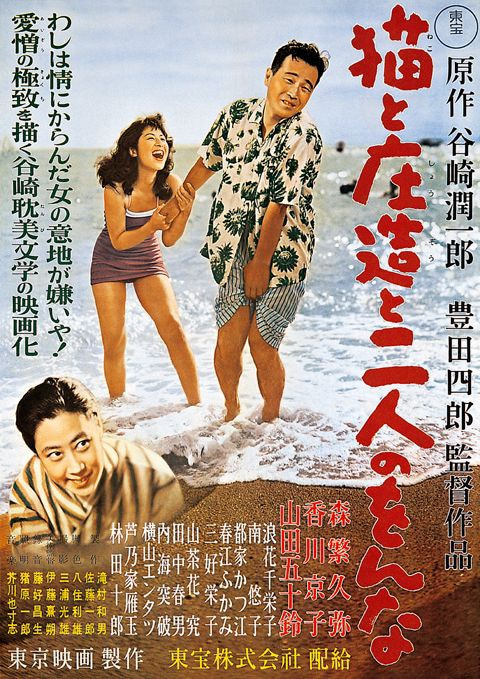
Shozo, a Cat and Two Women (猫と庄造と二人のをんな, Shiro Toyoda, 1956)

Post-war melodrama is largely concerned with the place of women, in particular, in a rapidly changing society, but given the centrality of domestic life, were men yearning for “independence” too? Shiro Toyoda was closely associated with comedic tales of strong women and weak men, and Shozo, a Cat and Two Women (猫と庄造と二人のをんな, Neko to Shozo to Futari no Onna) is as its title implies no exception. Adapting the novel by Tanizaki, Toyoda offers a subtle critique of the traditional family as its hapless hero finds himself caught between the conflicting demands of his feudalistic mother, stoic first wife, hedonistic second, and his much loved but perhaps mercenary feline, Lily. 

Shozo (Hisaya Morishige) is perhaps a typical spoiled only son, lazy, feckless, and essentially passive. Shinako (Isuzu Yamada) who agreed to an arranged marriage with him four years previously is walking out, thoroughly fed up with her mother-in-law Orin’s (Chieko Naniwa) constant complaints not least among them that the couple have no children. Unbeknownst to Shinako, however,  Shozo has been carrying on with his slightly younger cousin, Fukuko (Kyoko Kagawa), who is a free spirited modern woman. In fact, Fukuko has already run away from home three times in the company of various men so her wealthy father would be only too pleased to see her settle down and is so desperate to offload her that he’s even offering a huge dowry. All of this is complicated by the fact that Fukuko’s father already owns the mortgage on Shozo’s family store, which presents a serious challenge to typical family dynamics. 

Shozo, meanwhile, is only really interested in his pet cat, Lily, something which was a bone of contention in his failed marriage to Shinako (and perhaps a reason they have not been blessed with children). On learning that Orin has already moved Fukuko into the family home mere seconds after she vacated it, Shinako is suddenly struck by remorse and feels the need to vindicate her pride through revenge. Plotting how best to drive a wedge between Fukuko and her new husband, she settles on petitioning Shozo to give her custody of Lily, and then suggests the same thing to her rival knowing that whatever happens it will cause a series of problems in the Oyama household. 

The irony is, in a sense, that it’s Shozo who has been displaced from his own home. Perhaps surprisingly, he often tries to help out with household tasks but his mother always stops him, insisting that housework isn’t something a man should pay attention to. Orin is of course perpetuating outdated ideas of traditional gender roles, but there is also an obvious anxiety in her need to protect her territory from possible incursion. She doesn’t necessarily trust the idea that she and Shozo are connected by anything deeper than practicality and filial obligation and her only currency is her ability to provide the services that Shozo “cannot” provide for himself. His learning to take care of himself is an existential threat to her position as his caregiver even though he is a grown man in his 30s perfectly capable of doing his own laundry and preparing his own meals (as he already does for Lily who particularly enjoys grilled chicken). 

When they brought Shinako into the house, they did so apparently because she was known to be a “good worker” at her job as a maid for a wealthy family. Since then she has indeed worked hard, but is viewed as little more than a glorified servant by Orin who has delegated much of the feminine labour to the younger woman, while Shozo emotionally neglects her in favour of the cat and apparently satisfies his carnal urges outside the home. They accept Fukuko for her money, but take the opposite approach, treating her as the lady of the manor. Fukuko does no housework (a cupboard is later discovered where she’d thrown all the washing she couldn’t be bothered to do), but Orin simply picks up her share and more, becoming maid to her daughter-in-law who frequently reminds them that it’s her money paying for everything so she is the one who is really in charge. 

Shozo does not seem to react too closely to these assaults on his masculinity, but only wants to escape to be alone with Lily whom he believes is the only one who really loves him. In this he is perhaps the truly modern man who wanted his family relations to be “real” rather than defined by social obligation, but he’s also self-centred and childish, still seeing the women (even Lily) as providers of service rather than fellow human beings. His mother satisfied his hunger, Shinako kept him financially by managing the business, and Fukuko sated his passion, but he feels oppressed by all of them in different ways and in the end does not want the responsibility of dealing with human emotions. Lily may be capricious, but her needs are easily satisfied and to that extent she is dependent on him. His desire to be “independent” and find emotional fulfilment only with his cat is just as much of a challenge to the social order as a woman who rejects marriage or seeks to fulfil herself outside of the home. 

Shozo’s dilemma is however presented as comedic until its unexpectedly melancholy conclusion which reduces him to the status of a stray cat as the women come to literal blows, fighting not quite over him (he isn’t worth fighting over) but for their own self-esteem and particular brand of womanhood. Shinako sits at home and calculates all the back pay she’d be entitled to for the labour she performed at the Oyama household in recognition that being a wife is also a job and they treated her as a maid anyway (which is to say as an outsider with no intention of love or loyalty), while Fukuko begins to see the “emptiness” in her party girl lifestyle but prefers to be pampered and resents being “beaten” by a mere housemaid. This system traps everyone, forcing them to manipulate the desires of others while suppressing their own. Shozo and his cat are left out in the cold, trapped between tradition and modernity but no more free than they were before even in their mutual dependency.


Orgies of Edo (残酷異常虐待物語 元禄女系図, Teruo Ishii, 1969)

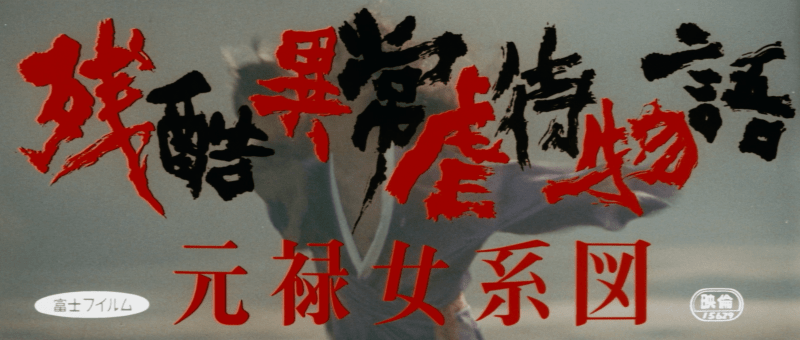
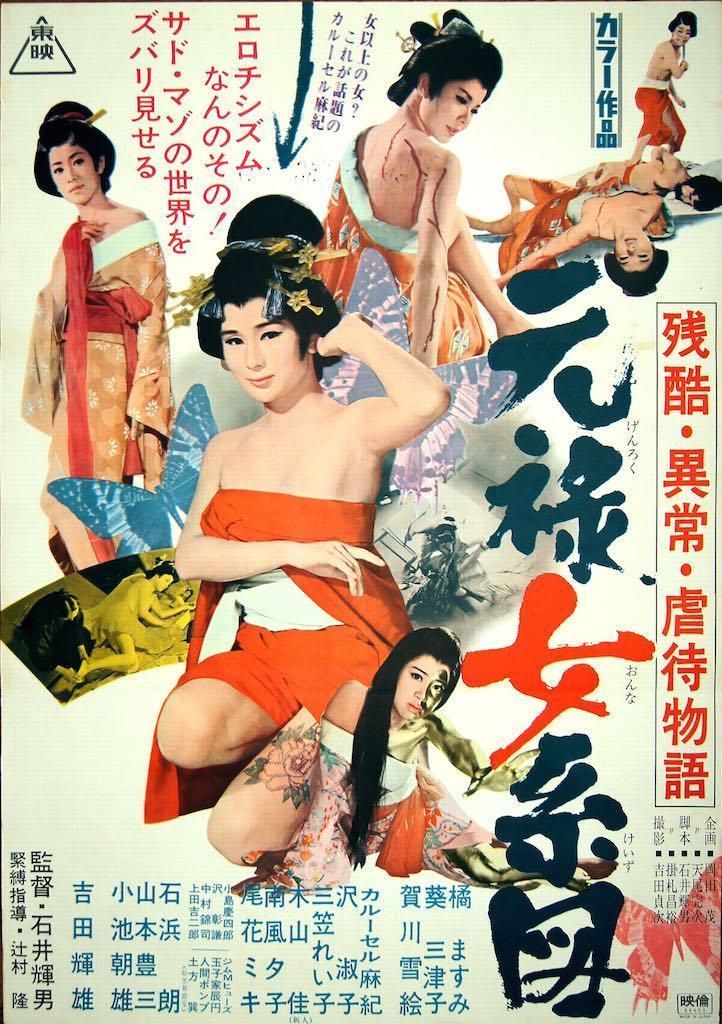
Orgies of Edo poster“Pinky Violence” is a strangely contrary genre, often held up both as intensely misogynistic but also proto-feminist in its vast selection of vengeful heroines who seemed to embody the rage of several centuries of inescapable oppression. Teruo Ishii, at the very forefront of Toei’s attempts to graft pink film sensibilities onto its house style of manly yakuza drama, had a definite love for the perverse but, perhaps unusually, a consciousness of the implications of his world of surrealist violence. The Japanese title of Orgies of Edo (残酷異常虐待物語 元禄女系図, Zankoku Ijo Gyakutai Monogatari: Genroku Onna Keizu) translates as something like “a genealogy of the women of the Genroku Era” and concerns itself with three tales of misused women each of whom meets a grim end at the hands of faithless men who seem to embody the decadence of their prosperous times.

Ishii’s three tales of increasing madness and brutality travel from the streets to the palace in locating each scene of mounting debauchery within the shifting circles of prosperous Genroku era Edo. Our guide, positioned to the side of each of the tales, is a conservative doctor (Teruo Yoshida) who diagnoses his society as morally sick and hovering on the edge of a decadent abyss. Tellingly, each of episodes with which he becomes involved is presaged by his inability to access foreign knowledge in the wilfully isolated nation, slowly stagnating even in the midst of unprecedented prosperity.

His first patient is a young woman in the middle of a painful miscarriage caused by a beating intended to end her pregnancy. Abroad they know of an operation to avoid this sort of misery, the doctor muses, but he has no way of helping her. The young woman, Oito (Masumi Tachibana), like many in the tales of old Edo, got into debt and then was seduced by a handsome young man who posed as a saviour but only ever meant to misuse her. Hanji (Toyozo Yamamoto), a gangster, presses her into prostitution and eventually betrays her by taking up with another woman but neither of them are free of their respective captors be they the Yoshiwara or the gangster underworld.

The doctor’s second case is more extreme and calls upon him to make use of his knowledge of the Western notion of psychiatry in trying to cure a young noblewoman of her perverse fetish for the physically deformed. Ochise’s (Mitsuko Aoi) tastes stem back to a traumatic teenage incident during which she was abducted, held prisoner, and repeatedly raped by a man with a ruined face. Her loyal servant, Chokichi (Akira Ishihama), has long been in love with her but the pair remain locked in a one sided sadomasochistic relationship in which he knows that she can never return his love not because of their class difference, but because of his “perfection”. Pinching an ending from Tanizaki’s Shunkinsho, Ishii sends the frustrated lovers in a less positive direction in which a woman’s defiant insistence on pursuing her own desires is met only by the violence of a male need for possession which eventually leads to mutual destruction.

Mutual destruction is a final destination of sorts. The doctor’s third unrealisable request is for an untimely caesarian section – another piece of Western medical knowledge he has only vague awareness of. This unusual situation unfolds at the court of a lascivious lord whose perverse proclivities are quickly becoming the talk of the town. Drawn to a young woman, Omitsu (Miki Obana), who greets his attempt to fire his arrows at her while angry bulls with flaming horns charge at his other concubines with excitement, the lord is dismayed to hear of another of his ladies, Okon (Yukie Kagawa), enjoying the attentions of her pet dog and therefore somehow sullying his own bedroom reputation. The lord has Okon painted gold and thrown in a hall of mirrors for a slow and painful death of multiplied suffocations but she wins a temporary reprieve by promising to introduce him to untold pleasure if only he lets her live. This will all end in flames and ashes, but the lord hardly cares because it is only the natural end for his hedonistic endeavours.

The doctor performs his miracle and emerges with a child in whom lies the legacy of this immoral time. Yet the doctor wants to “save” it. Even if it’s a “beast” the child is innocent, he intones, insisting that he must live despite this burden in order to resist the madness. Like the strange butoh inspired performance art which opens the film, these are times of madness and confusion in which women, most of all, suffer at the hands of men who care only for their own pleasure. The doctor tries to cure the “sickness of the soul” that he sees before him, but knows that cannot be excised so much as tempered. Still he walks forward, away from the wreckage, with the future in his arms and resolves to live whatever the cost may be.


Orgies of Edo is available on blu-ray courtesy of Arrow Films.

Original trailer (no subtitles)

Edogawa Rampo’s Beast in the Shadows ( 江戸川乱歩の陰獣, Tai Kato, 1977)

Edogawa Rampo (a clever allusion to master of the gothic and detective story pioneer Edgar Allan Poe) has provided ample inspiration for many Japanese films from Blind Beast to Horrors of Malformed Men. So synonymous with kinky terror is his name, that it finds itself appended into the title of this 1977 adaptation of his novel Beast in the Shadows (江戸川乱歩の陰獣, Edogawa Rampo no Inju) by veteran director Tai Kato best known for his work in the yakuza genre. Mixing classic European detective intrigue with a more typically Japanese obsession with method over motive, Beast in the Shadows, like much of Edogawa Rampo’s work twists and turns around the idea of atypical sexuality, one side cerebral and another physical as the “Westernised” sadomasochism of the heroine’s husband becomes the driving force of the narrative.

Our hero, Koichiro Samukawa (Teruhiko Aoi), is a best selling author who likes to describe himself as the creator of “serious” mystery novels. In this he contrasts himself favourably with the coming younger generation who rely on sensationalised tricks and twists rather than the intricately plotted, traditionally constructed crime stories which Samukawa prides himself on writing. The particular object of his rage is a recently successful rival, Shundei Oe, who is making quite a splash in literary circles in part due to his mysterious persona. Refusing all in-person contact, Oe’s whereabouts are completely unknown and though he supplies a “real name” at the back of each book, there is great speculation as to who he really is, how he lives, and where he might be.

Down south to supervise a movie shoot based on one of his novels, Samukawa is thrilled to run into a fan – particularly as she’s such a beautiful young woman. Shizuko (Yoshiko Kayama) is the wife of a wealthy businessman, Oyamada, who has recently returned from an extended spell abroad though he doesn’t share her passion for literature even if he brings home such luxuries as fancy European gloves. The relationship moves beyond mutual appreciation when Shizuko asks for Samukawa’s help in investigating a series of threatening letters she’s been receiving from an old boyfriend who may or may not also be stalking her. The real kicker is that the letters purport to be from Shundei Oe – apparently the pen name being used by a man who fell deeply in love with Shizuko when he was a student but couldn’t take no for an answer when his creepy behaviour became too much for the then school girl. Though Samukawa is sure the letters are all talk and commits himself unmasking Oe for the perverted cretin he is, Shizuko’s husband is eventually murdered just as the letters threatened.

Though the final twist is one which most seasoned mystery lovers will have seen coming, Kato keeps the audience on its toes with plenty of intrigue and red herrings as Samukawa attempts to discover the truth behind the death of Shizuko’s husband as well as taking the opportunity to indulge in a little intellectual vanity by unmasking his rival. The movie subplot quickly gets forgotten but Samukawa is also helped/hindered by his publisher, Honda (Tomisaburo Wakayama), who keeps reminding him about the looming deadline for his latest work. The case at hand provides ample distraction for the harried writer whose writer’s block is only made worse by thoughts of Shundei Oe’s growing success and his resentment of this new, sensationalised form of crime novel which seems to be eclipsing his own.

If the way he acts in “real life” is anything to go by, Samukawa’s detective novels owe much to the European tradition but still, there’s a persistent fear of the foreign underlining much of the proceedings despite the heavy presence of Westernised clothing, music and culture which seems to diffuse itself throughout daily life. Shizuko’s husband may have just returned from abroad but it seems he brought back much more with him than some fancy gloves and an elegant English mistress (pointedly named Helen Christie). The English style riding crop in Oyamada’s study is not mere affectation but the cause of the nasty looking wound on Shizuko’s shoulder which first caught Samukawa’s attention. Oyamada’s sadistic tendencies are posited as a credible reason he could himself be masquerading as Oe, getting off on driving his wife half crazy with fear, but his eventual murder would seem to rule that out.

Nevertheless the game is one of pleasure and pain as Samukawa comes to the realisation that he is integral to the plot. Challenged by his literary rival to a game of minds, Samukawa is putting his detective abilities to the test as his rival is writing their latest story in reality rather than on the page. Love, lust, betrayal, violence and tragedy all come together for a classic gothic detective story which looks ahead to noir with its melancholy fatalism yet remains resolutely within the dark and ghoulish world of the gothic potboiler. Kato shoots a prestige picture with the undercurrent of repressed eroticism in his strange low level angles and unusual compositions which bind, tie and constrain the elusive Shizuko within the window panes and doorways of her home. Light levels fluctuate wildly, isolating the haunted protagonists in their supernatural gloom until we hit the expressionism of the theatrical finale which takes place in an entirely red, almost glowing attic space. The atmosphere is one of profound unease as Oe is thought to be perpetually watching, hidden somewhere in the house, out of sight.

The Beast in the Shadows does not just refer to the unseen voyeur but to the repressed eroticism which his actions symbolise and is perhaps brought out in the various sadomasochistic relationships created between each of the protagonists. Then again, where are we in all this – sitting in the dark, watching, undetected, seeing things we had no right to see. Kato takes our own voyeuristic tendencies and serves them back to us with visual flair in a late career masterpiece which perfectly captures Edogawa Rampo’s gothic world of repressed desire and brings it to its cinematic climax as two detectives go head to head in a game so high stakes neither of them quite realised what it was they were playing.


Original trailer (no subtitles, NSFW)