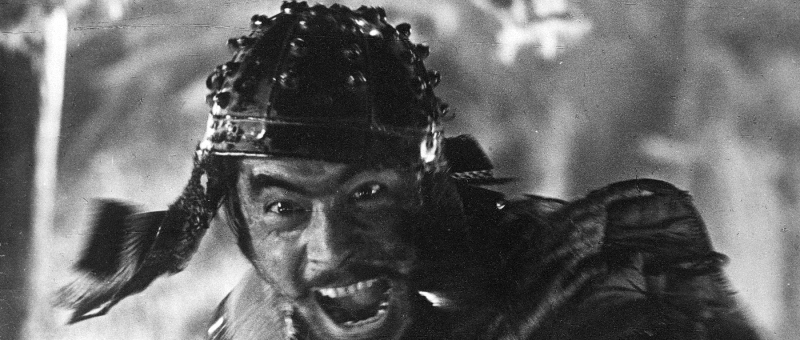
High and Low (天国と地獄, Akira Kurosawa, 1963)

A self-made man is landed with an unthinkable dilemma when his chauffeur’s son is kidnapped in place of his own just at the moment he’s staked his entire fortune on a manoeuvre to outsmart cynical executives set on taking over his company in Kurosawa’s post-war crime film, High and Low (天国と地獄, Tengoku to Jigoku). The movie’s Japanese title, Heaven and Hell, might hint more strongly at the growing economic disparities in the era of the economic miracle but also at the dualities embodied in the hero’s choices. “Success isn’t worth losing your humanity” his wife tells him, but he still struggles with the validity of choosing his heart over his head knowing that to pay anyway even though it’s another man’s son means financial ruin, the final question being if he is really prepared to allow a child to die simply to maintain his own wealth and status. 

The problem is that Gondo (Toshiro Mifune) has attempted to mount a rebellion against the evils of consumerism, incurring the ire of the cynical executives who attempt to get him on their side in their attempt to oust the boss whose outdated ideas are running the business into the ground. Though Gondo appears sympathetic, hinting that he might be interested if there’s a good enough promotion in it, he later tells them where to go on seeing that their business plan is to start producing poor quality disposable footwear. Gondo started on the factory floor and he doesn’t want to put the company’s name on such shoddy produce nor does he think that their admittedly fair point that if the shoes are well made and last a long time no one will need to buy any is a good way to do business. He doesn’t think the boss is right either and wants to make shoes his own way which is why he’s remortgaged the sizeable mansion he owns on top of a hill overlooking the city and has pretty much run through his wife’s dowry to buy a majority stake in the company.

On top of a hill is a good place to live if you want a good vantage point to oversee the land below, but while you’re looking down others look up and not all of them kindly. Gondo is as he says a self-made man, but also out of touch with contemporary society and not so far from an ambitious courtier always after a little more. He says it isn’t about getting the top job but getting shoes made right, but it seems he too had been bitten by the consumerist bug and is otherwise unable to affirm his status without material proof. When he thinks it’s his own son that’s been kidnapped, he’d have given it all away but when it’s the driver’s boy it’s a different question. Shinichi (Masahiko Shimazu) isn’t his responsibility and as he points out there are plenty of other wealthy men, why is he the only one to pay? While his wife (Kyoko Kagawa) tearfully urges him to do the right thing, his assistant (Tatsuya Mihashi) tries stop him, insisting he should take the sizeable cheque they’ve had drawn up to Osaka and the stakeholder he’s buying the shares from. 

While he vacillates, the driver, Aoki (Yutaka Sada), is humiliated and forced into servitude. Gondo seems to have the old-fashioned idea that the kidnappers would simply let Shinichi go on realising they’ve got the wrong boy and his father can’t pay, but Aoki knows there’s nothing he can do to save his son but throw himself on Gondo’s mercy. He falls to the ground and prostrates himself, but later retracts all telling Gondo it doesn’t matter, that he hadn’t realised what he was asking of him, and insisting that Shinichi is a bright boy who will look for a chance to escape on his own. Once the boy is returned he treats him harshly, interrogating him about anything he might have forgotten and later driving him around looking for the hideout where he was kept in an attempt to do something and repay the debt he now feels he owes to Gondo by helping the police retrieve the money Gondo eventually agreed to pay for him. 

In agreeing to give up the money, Gondo is in a sense unburdened knowing he has made the right choice and realising that he would never live a comfortable life in that house if cost a child’s life to keep it. Part of his rationale for not wanting to pay had been that though he had been poor before and might be again, his wife had not been and does not truly understand what it is to live in poverty much as she says her life of luxury means nothing to her. She has never wanted for anything, after all. As for the kidnapper, Ginjiro (Tsutomu Yamazaki), we know little of his motives save for his intense resentment living quite literally in the shadow of Gondo’s mansion and feeling as if it were mocking him. Then again, though his life is hard Ginjiro already had a path to success in that he would soon have completed his medical studies implying at least that he or someone else was able to cover his tuition and costs of living, that he was able to continue in education, and really had no need to take such drastic action in rebellion against the antagonistic capitalism of the post-war society. “Do you think we have to hate each other?” Gondo asks him, but Ginjiro has no answer only his intense resentment for everything he represents.

The “hell” that Gondo inhabits is a backstreet wasteland peopled by the hopeless. Tokura (Tatsuya Nakadai), the earnest policeman, follows him through thronging clubs and on into “dope alley” where Ginjiro picked up his accomplices so desperate to escape their suffering that they’d agree to help him kidnap a child. Though it costs him his job, Gondo decision to do the right thing makes him a national hero, the working class millionaire who mows his own lawn and can still knock up a pair of shoes should the occasion call while women across the country decide to boycott the company in protest at his treatment. Ginjiro can only howl like a caged animal while facing a death sentence for the coldblooded murder of his accomplices. The light bouncing off his mirrored sunshades gives him an eerie supernatural quality, a demon arising from depths of hell to wreak havoc in heaven but finding only infinite tragedy in the contradictions of the consumerist post-war society.


High and Low screens at the BFI Southbank, London on 19th January 2023 as part of the Kurosawa season.

Original trailer (English subtitles)
Dodes’ka-den (どですかでん, Akira Kurosawa, 1970)

By the late 1960s, Akira Kurosawa was in the midst of a creative crisis having spent two years working on the Japanese segments of the Hollywood war film Tora! Tora! Tora before he was eventually let go by the parsimonious US producers who feared he was spending too much money and making too little progress. Meanwhile, the studio system which had supported his career was collapsing and could no longer offer the kinds of budgets necessary for his personal brand of epic cinema. Teaming up with Masaki Kobayashi, Kon Ichikawa, and Keisuke Kinoshita, he formed the Club of the Four Knights production company but the first and only film they produced, Dodes’kaden (どですかでん), was not perhaps the kind of film many were expecting.

Inspired by a novel by Shugoro Yamamoto, the film like The Lower Depths focuses on a small community living in a slum only in this case on the edge of the modern city. Shot in classical 4:3, it was also Kurosawa’s first foray into colour and makes the most of his painterly eye with its surrealist backdrops and exaggerated sunsets. Once again there is the feeling that these people are already dead or trapped in a kind of purgatory unable to escape their desperate suffering, the slum as much of a mindset as a physical place. “Life is nothing but pain to me” one man claims, stating his hope that he die as quickly as possible while relating the sad story of his life: falling into depression when his sons were killed in the war and losing his wife, business, and finally home to the Tokyo air raids. Yet he is reminded that his family live on in him as long as he does and to kill himself is to kill them too, rediscovering a desire to survive even in his suffering. 

Another man, Hei (Hiroshi Akutagawa), dresses in a soldier’s uniform and wanders around like a zombie with, as one person puts it, the eyes of a dead man. Later a woman comes to find him, but he is seemingly unable to reawaken himself and move on from his trauma, now numbed to life, an already spent force. A young woman, Katsuko (Tomoko Yamazaki), is little different. Never speaking she has been raised by her uncle who begins sexually abusing her while her aunt is in hospital. She says that she wants to die, stabbing the only boy who showed her kindness because she feared he’d forget her. 

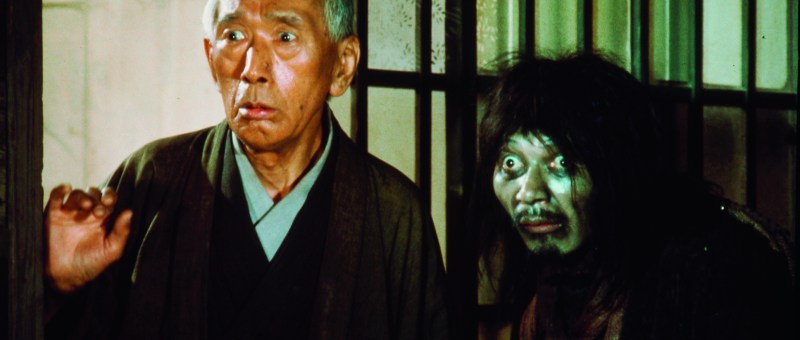
These people have largely been forgotten, living almost in another era and entirely cut off from mainstream society in a kind of etherial purgatory. Like the residents of The Lower Depths, a degree of fantasy is necessary for their survival a case in point being that of a beggar and his son who live an abandoned car and fantasise about the kind of house they’d build, a vast modernist building in white with a swimming pool. Like Katsuko, the boy is let down by his father who remains the car and sends him out to beg for food, telling him off when he lights a fire to boil fish as the man at the sushi shop had told him to do insisting, with disastrous results, that as it’s pickled it doesn’t need to be cooked. The furthest out of the residents, the pair have an almost grotesque appearance, their faces tinged with a morbid green. 

But then the couples living at the centre seemed to have found an antidote to despair in a surreal process of wife swapping now unable to remember whose husband is whose despite being neatly colour coded in matching outfits. A man with a nervous tic defends his grumpy yet fiercely loyal wife, and another man raises several children who may not be biologically his but are loved all the same. The old man who acts as a kind of confidant giving out advice and settling disputes through benevolent trickery has evidently learned how to live in this world and gets by as best he can while the son of the melancholy woman who runs the tempura stall drives an imaginary train through the slum the rhythm of which gives the film its name in its slow and certain progress towards nowhere at all. Heartbreakingly there are moments where the young man can hear the train in the distance, but it remains forever out of reach. Dodes’kaden didn’t do very well at the box office or with critics, its lack of success of cited as a factor in Kurosawa’s attempt to take his own life the following year, yet had perhaps set him on a new artistic course of colour and light which would define the further direction of his later career.


Dodes’ka-den screens at the BFI Southbank, London on 15th & 16th January 2023 as part of the Kurosawa season.

Kagemusha (影武者, Akira Kurosawa, 1980)

“The shadow of a man can never stand up and walk on its own” a shadow warrior laments, wondering what happens to the shadow once the man is gone. Set at the tail end of the Sengoku era, Akira Kurosawa’s Kagemusha (影武者) charts the transformation of a man reborn as someone else and discovers that he’s better at playing the role he’s been assigned than the man who was born to play it only to fall victim to his own hubris and self-delusion. 

The nameless hero (Tatsuya Nakadai) is a lowborn thief sentenced to death only to be reprieved thanks to his uncanny resemblance to the local lord, Takeda Shingen (also Tatsuya Nakadai), whose double he must play if he’s to keep his life. The shadow objects to this characterisation, outraged that a man who has killed hundreds and robbed whole domains dares to call him a scoundrel. Shingen agrees he too is morally compromised. He banished his father and killed his own son but justifies it as a necessary evil in his quest to conquer Japan hoping to unify it bringing an end to the Warring States period and ensuring peace throughout the land. 

The shadow goes along with it, but does not really realise the full implications of his decision. He tries to smash a giant urn hoping to find treasure to escape with, but is confronted by a corpse bearing his own face. Shingen has been killed by an enemy sniper in an act of hubris sneaking around a castle under siege hoping (not) to hear the sound of a flute. Before passing away, Shingen instructs his men to keep his death a secret for three years, retreating to defend their own domain rather than conquer others. But there are spies everywhere and news of his apparent demise soon travels to the allied Oda Nobunaga (Daisuke Ryu) and Tokugawa Ieyasu (Masayuki Yui), his rivals for the potential hegemony over a unified Japan. The shadow Shingen must keep up the pretence to keep the dream alive and protect the Takeda Clan from being swallowed whole by the advance of Nobunaga. 

Shingen had been the “immoveable mountain”, the solid force that anchors his troops from behind but also an implacable leader famed for his austerity. The shadow Shingen is almost caught out by the honest reaction of his grandson and heir Takemaru (Kota Yui) who immediately blurts out that this man is not his grandfather because he is no longer scary, while he’s also bucked by Shingen’s horse who in the end cannot be fooled. His retainers wisely come up with a ruse that he’s too ill to see his mistresses lest they realise the thief’s body does not bear the same scars even as everything about him from the way he talks and moves and laughs is different. Yet in his sudden conversion on witnessing Shingen’s funeral on lake Suwa and resolving that he wants to do something to serve the man who saved his life, the shadow proves an effective leader who earns the trust and affection of his immediate retainers but is equally struck by their sacrifice as they give their lives to protect him. 

Meanwhile, his illegitimate son Katsuyori (Kenichi Hagiwara), skipped over in the succession, complains that he can never emerge from his father’s shadow emphasising the ways in which the feudal order disrupts genuine relationships between people and bringing a note of poignancy to the connection that emerges between the shadow Shingen and little Takemaru otherwise raised to perpetuate that same emotional austerity. Hoping to eclipse his father, Katsuyori too experiences a moment of hubris, successful in his first campaign but then over ambitious, forgetting his father’s teachings and walking straight into a trap only to be defeated by Nobunaga’s superior technology. 

Nobukado (Tsutomu Yamazaki), Shingen’s brother and sometime shadow, remarks that he hardly knew who he was once his brother was gone, and wonders what will become of the shadow once the three years are up. In a sense, the thief is already dead. As Nobukado puts it, it’s as if Shingen has possessed him, his confidence in his alternate persona apparently solidified by the victory at Takatenjin castle. But the sight of so many dead seems to unnerve him in the hellish spectacle of death that is a Sengoku battlefield knowing that these men died if not quite for him than for his image. When he attempts to mount Shingen’s horse, it’s either born of hubristic self-delusion in wanting to prove that he truly has become him, or else a bid for freedom and to be relieved of his shadow persona. Either way, he becomes a kind of ghost, once again watching his men from behind but this time invisibly and powerless to do anything but watch as they are massacred by Nobunaga’s guns. 

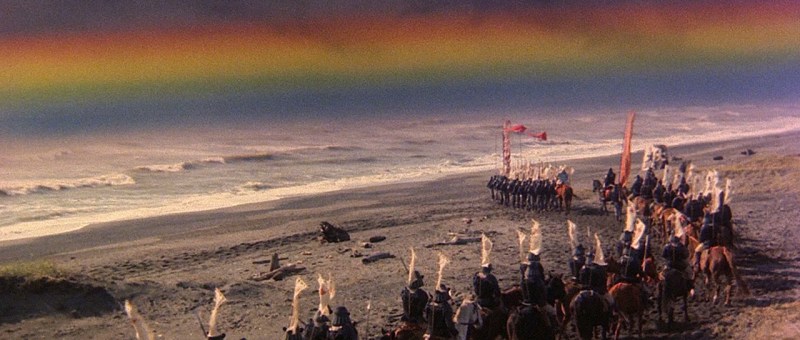
Earlier on he’d had a kind of nightmare, painted in surrealist hues by Kurosawa who conjures battlegrounds of angry reds and violent purples along with ominous rainbows, seeing himself dragged down into the water by Shingen’s ghost which he has now seemingly become. In the end all he can do is accept his fate in a final act of futility running defenceless towards the enemy line and reaching out to retrieve his banner from its watery fate only to be carried past it on a current of red. “I’m not a puppet, you can’t control me” the thief had said, but in the end just like everyone else he was powerless, another casualty of the casual cruelties and meaningless struggles of the feudal order. 


Kagemusha screens at the BFI Southbank, London on 11th & 31st January 2023 as part of the Kurosawa season.

Original trailer (English subtitles)

The Approach of Autumn (秋立ちぬ, Mikio Naruse, 1960)

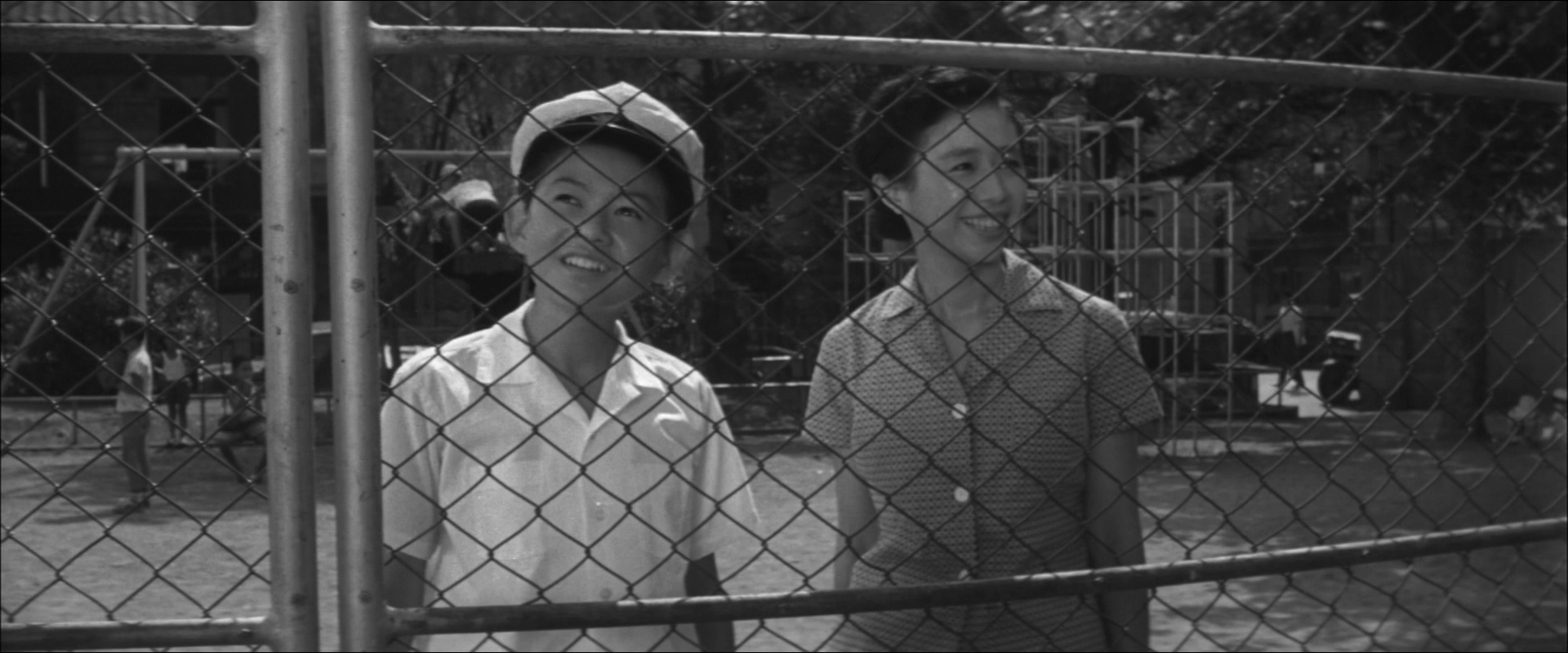
For a small boy in post-war Japan, childhood’s summer is already over in Mikio Naruse’s at times uncharacteristically cheerful The Approach of Autumn (秋立ちぬ, Aki Tachinu) . In truth, the Japanese title is the slightly more depressing “autumn has begun” echoing the dismal circumstances that the hero eventually finds himself in while working his way towards an understanding of the disappointments and loneliness of adulthood. Abandoned by his mother he remains alone, in a sense homeless, trapped between the new Japan and the old in a liminal space shrinking by the hour as the construction of modernity encroaches all around him. 

The amazement on Hideo’s (Kenzaburo Osawa) face is palpable as he exits a train station in the middle of Tokyo peering up at the high rise buildings amid busy city streets. He and his mother Shigeko (Nobuko Otowa) have travelled by train from rural Nagano following the death of his father intending to stay with his mother’s brother (Kamatari Fujiwara) who owns an old-fashioned grocery store in Ginza. What Shigeko has not really explained to her son is that they will not be living there together as she has taken a job as a live-in hostess at a nearby inn. 

Plunged into this unfamiliar world all alone, Hideo cannot help but feel awkward in the house of relatives he has never before met. His grown-up cousins playfully argue in front of him about having to share a room, while he makes a point of not eating too much at dinner though as Harue (Hisako Hara) jokes perhaps he doesn’t like the food seeing as his penny pinching uncle mainly feeds the family on fruit and veg from the store that’s gone past its best. Meanwhile, he struggles to make friends with the local children who mock his country bumpkin accent and use him as a scapegoat when it looks like they might get in trouble. His only companion is the precocious daughter of the owner of the inn where his mother works, Junko (Futaba Hitotsugi), who instantly takes to him and even goes so far as to beg her mother to adopt Hideo as an older brother. 

Junko is in a similarly liminal position herself as we later find out. Her mother (Murasaki Fujima) is the mistress of a wealthy businessman who only visits them every so often and appears to be well aware of the precarity of her position. Junko’s father, awkwardly inviting her out on a playdate with his other two children born to his legal wife who apparently knows everything and at least pretends to be alright with it, urges her mother to take advantage of rocketing Ginza land prices and sell the inn to buy a fancy new apartment but she is understandably wary. Running an inn is all she knows how to do and should he die or simply decide to drop her she’d be in trouble fairly quickly. Hideo’s cousins similarly nag their father to sell the shop, reminding him that with the increasing gentrification of the area there is no longer sufficient footfall to support it, and suggesting they use the money to buy larger premises in suburbia. Both Hideo and Junko are in a sense orphans of these liminal spaces, relics of a disappearing Japan soon to be eclipsed by endless office buildings symbols of the nation’s increasing economic prosperity. 

All of the sites on which the children play are earmarked for construction, Junko later explaining that the docks where they eventually head looking for the sea are built on reclaimed land big enough to build a baseball field. Like Hideo she longs for the country with clean air and unpolluted rivers though as Hideo points out it’s all the same to him, his mother isn’t in either place and so neither has any meaning for him. Her strange idea of adopting Hideo is in a way an attempt to anchor herself with family, assuring her mother that she’s old enough to understand but struggling to parse her family circumstances while deeply hurt on discovering she does have siblings after all only they don’t want to know her. She is looked down upon because of the choices her mother has made, as is Hideo especially after his mother leaves abruptly with a customer from the inn (Daisuke Kato) abandoning him with his uncle in search of romantic fulfilment which it seems she probably did not find considering a later telegram explaining she’s working as a maid at a hotel in the resort town of Atami. 

Shigeko is made out to be the villain, but she too is only chasing safety in a changing society hoping to find it in the arms of a reliable man be he a husband or not. Hideo may be an obstacle to that, but her anxiety is mostly maternal, unwilling to rely on her brother’s goodwill and knowing she will need to find a way to support her son even if she is not with him. Hideo’s cousins meanwhile are the youth of the new society. Harue has rejected the old-fashioned family grocers and now works in a department store while her former student protestor boyfriend is certain of getting a salaryman job seeing as there’s a massive labour shortage. Shotaro (Yosuke Natsuki), who is always kind to Hideo, runs around town on his scooter ferrying girls to the beach sometimes forgetting his melancholy cousin in favour of transitory pleasures. He envisages taking over the store and selling it to open up somewhere new, reassuring Hideo that there will always be a place for him there even while letting him down in the present. 

In the end, Hideo’s only friend is a beetle packaged in a box of apples from his grandma in the country which his uncle selfishly claims for the shop under the rationale that he can’t eat them all himself. A symbol of an older, rural Japan as well of the idyllic childhood for which Hideo’s longs, the beetle is as out of place in central Tokyo as he is the pair of them looking down on the sprawling city and out towards the barely visible sea from the roof of a department store which holds no sense of promise for them. Despite the bleakness of the ending, Naruse’s depiction of an ordinary childhood is deceptively cheerful perhaps implying that Hideo is merely enduring a period of adjustment only to leave him with the crushing weight of impossibility, trapped between the new society and the old with no home to go to. 


French release trailer (French subtitles only)

The Blossom and the Sword (日本侠花伝, Tai Kato, 1973)

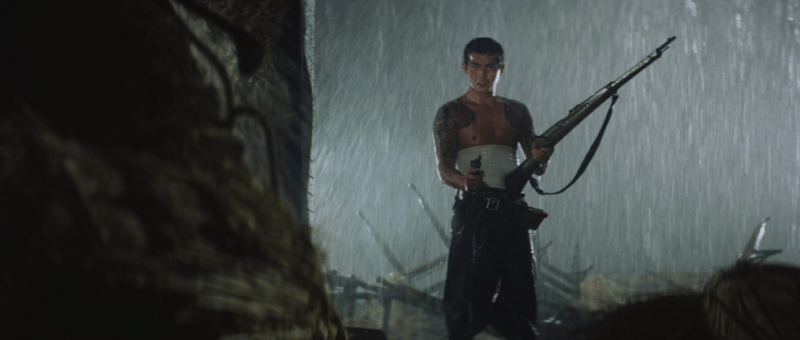
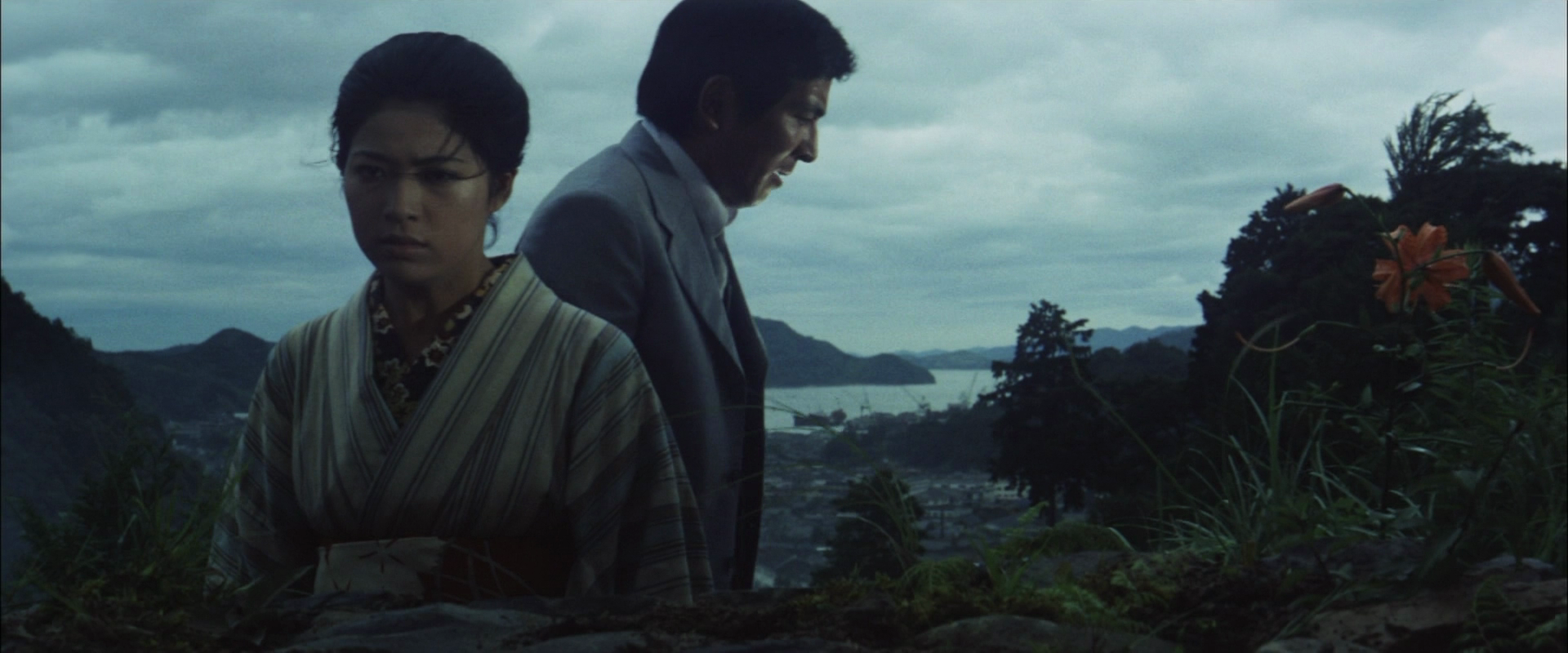
After joining the studio in the mid-1950s, Tai Kato quickly made a reputation for himself with Toei’s key brand of ninkyo eiga yakuza movies set in the chivalrous world of pre-war gangsterdom. By the early 70s, however, the genre was already played out and Kato began to work more frequently with other studios and in various genres but 1973’s The Blossom and the Sword (日本侠花伝, Nihon kyoka den), produced for Toho the studio which he had first joined at the beginning of his career in 1937, takes him back to his ninkyo roots if less directly in a politicised tale revolving around the 1918 rice riots

The film opens, however, a few years earlier with the heroine, Mine (Hiroko Maki), attempting to sell children’s educational picture books aboard a train (an activity strictly prohibited). As she explains, they are in the middle of a recession and times are hard for everyone though as we discover the reason for Mine’s journey is that she is in the process of eloping with the mild-mannered Minoru (Kunio Murai), the son of a wealthy family with literary dreams, who is prevented from marrying her because of the class difference between them. The couple are doing well enough evading detection, but are caught out when accidentally implicated in the murder of a treacherous politician by left-wing agitator/noble gangster Seijiro (Tetsuya Watari) who fatefully locks eyes with Mine while trying to escape forever binding their fates together. 

Epic in length the film was originally released in two parts with an interval in-between, this first half focussing on Mine’s doomed romance which is thwarted in part by the outdated social codes of the early Taisho society and the moral cowardice of her lover who finds himself unable to resist them. The pair are thrown in prison as possible co-conspirators and beaten by the police, Mine striking up a friendship with a woman, Tsuru (Junko Toda), imprisoned for distributing pamphlets as a labour activist who later helps her to get a waitressing job and teaches her rudimentary writing while Minoru lounges around in their home sort of writing a novel. Tsuru seems to be touched by their cross-class romance, “where love is concerned to hell with social status!” she insists berating Minoru for giving in so easily when the pair are finally tracked down by his austere mother. Her socialist activism may not directly rub off on Mine but does perhaps inform her later actions after discovering the depths of Minoru’s spinelessness, rescued after a failed bid at double suicide by a truly good man, Kinzo (Meicho Soganoya), who also happens to be a traditional yakuza heading a harbour gang in Kobe. 

After becoming his wife, Mine comes to witness the persistent unfairness and exploitation all around her as mediated by the outcry surrounding the fluctuation of rice prices in the late 1910s caused by attempts at profiteering and the necessity of supplying the military forces then participating in the war in Europe. Meanwhile, would be local dictator and amoral yakuza Kishimoto (Toru Abe) is intent on squeezing the Osada gang out of the harbour further pushing up rice prices while in cahoots with corrupt local authorities. Seijiro re-enters her life when dispatched to assassinate Kinzo on the orders of Kishimoto but stabbing him as carefully as possible to make sure he doesn’t die, thereafter switching sides to fight for the rights of the poor who he warns face even greater oppression should a man like Kishimoto be allowed to dominate the harbour. 

With Kinzo out of action, Mine assumes her natural destiny as a local leader doing her best to stand up to Kishimoto and the corrupt authorities but still faces difficulty getting her voice heard without a man standing next to her. On taking Kinzo’s place at a meeting of local bosses, she is dismissed as “just a woman” before a sympathetic naval officer decides to hand her a lucrative job shifting rice intended for sailors overseas because of her knowledge of current affairs undercutting Kishimoto’s attempts to game the system. It’s the trust the navy have in her that later saves her again when she is arrested and brutally tortured by corrupt policemen working with Kishimoto intent on tracking down Seijiro for the murder on the train all those years previously. Mine’s rise is also in a sense Seijiro’s redemption as he atones for the attack on Kinzo, rejects his association with Kishimoto to re-embrace his socialist beliefs, and fulfils the romantic destiny sparked when their eyes met on the train. 

Drawing a direct line between burgeoning militarism and gangsterdom along with the amoral exploitations of an increasingly capitalist society, Kato makes his intentions clear by dropping a ninkyo eiga hero into a world of infinite corruptions in which he eventually becomes a defender of the poor. Kato’s striking composition and use of colour along with expressionistic imagery lend the air of legend implied by the title as Mine fights her way through the oppressions of her era as a figurehead for justice in an increasingly unjust society.


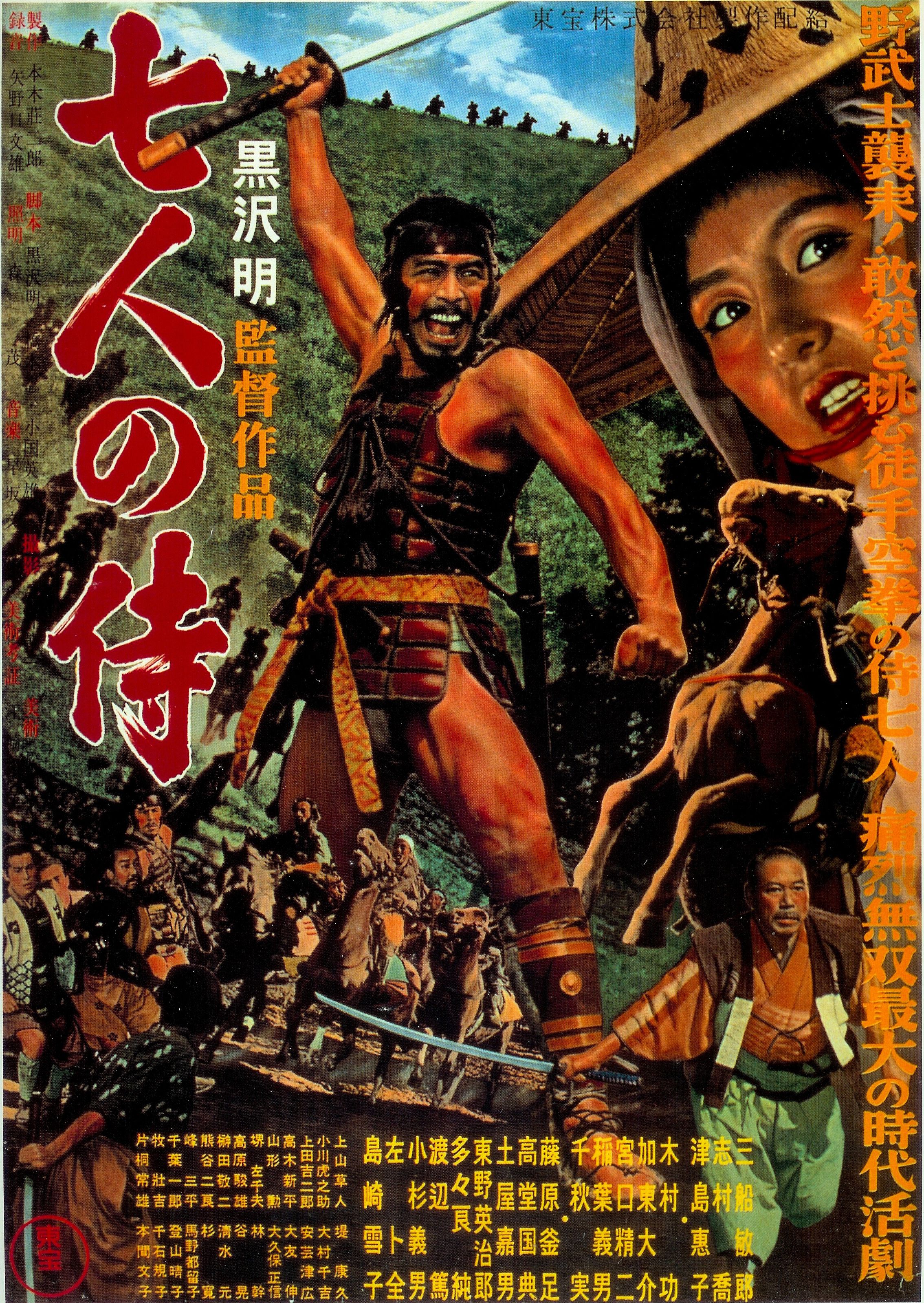
Seven Samurai (七人の侍, Akira Kurosawa, 1954)

An eclipse of the accepted order allows a temporary truce in the ongoing class conflict that defines feudal society in Akira Kurosawa’s seminal post-war historical epic, Seven Samurai (七人の侍, Shichinin no Samurai). Set in the late 16th century, the action takes place in a world on the brink of collapse. The Sengoku era is drawing to a close but is also in a moment of intense crisis which has left large numbers of highly skilled warriors essentially orphaned, wandering the land torn between their basic needs for food and shelter and their dignity as members of a theoretic aristocracy. 

Plagued by bandits, many of whom may be these orphaned swordsmen, a small village contemplates the unthinkable in hiring samurai, otherwise their oppressors and uniquely responsible for the chaos which surrounds them, for protection. “Land tax, forced labour, drought…and now bandits!” one woman exclaims shortly before suggesting they simply surrender all their grain and then hang themselves. As they can offer only expenses in the form of rice, the only samurai they can hope to recruit are already desperate, so hungry that they may be willing to deign to defending their social inferiors with whom they would not usually mix unwilling to accept that they are both victims of the inherently corrupt social order. This explains why the villagers’ early entreaties are met with such scorn and cynicism, either rudely rejected out of hand or ending only in deception. 

In this there is an echo of the world of 1954 which was beginning edge away from the chaos and privation of the immediate post-war society, bandits standing in for thieves and profiteers themselves a product of intense food insecurity. Yet here it’s desperation that allows a temporary merging of the world of lord and peasant, brokered finally by unexpected compassion on the part of a noble samurai who, in an act of extreme transgression, symbolically erases his elite status by shaving his head in order to save a child taken as a hostage by another desperate man. Kambei (Takashi Shimura) may be somewhat reduced in circumstances but refuses to give in to the immorality of the world around him, finally agreeing to help the villagers essentially out of a sense of pity willing to accept only the gift of sustenance moved by the villagers’ sacrifice in discovering that they give him the last of their white rice while subsisting only on millet. 

Yet having taken this step, the villagers remain uncertain they can really trust the men they’ve hired to protect them who are after all each trained in death. Later we discover that they have, like many of the time, occasionally finished off the odd lone samurai fleeing the battlefield in order to loot the bodies as a large stockpile of samurai armour later discovered by the samurai-pretender Kikuchiyo (Toshiro Mifune) testifies. On being confronted with this uncomfortable reality, the samurai fall silent knowing this armour was stripped from men much like themselves, but can ultimately offer little by way of defence when presented with an angry rant from Kikuchiyo who points out that they are themselves responsible in having created this world of chaos through their internecine quests for power. “In war you burn their villages, trample their fields, steal their food, work them like slaves, rape their women, and kill ‘em if they resist. What to you expect ‘em to do?”

When Kambei and the others first arrive in the village, there is no welcoming committee. The villagers all hide, frightened to leave their homes partly because of paranoia spread by widowed father Manzo (Kamatari Fujiwara) convinced that randy samurai are going ravish all of their daughters who will, doubtless, be overcome with awe by these sophisticated men of the elite. In an echo of Kambei’s transgression, Manzo forces something similar on his teenage daughter Shino (Keiko Tsushima), roughly cutting her hair while she cries and resists before dressing her up as a boy so that she’ll be safe from lusty samurai. The plan, however, backfires in that she later engages in a doomed romance with the young Katsuhiro (Isao Kimura). Their eventual union is the symbolic merging of the two worlds, a moment of eclipse in the usual hierarchy, but it’s born of the same impulses than brought Kambei and the others to the village. In fear and desperation, they behave as if there’s no tomorrow, only tomorrow must come and just as sun and moon must eventually move apart and resume their regular orbits so the relationship between Katsuhiro and Shino is an impossibility. 

Like Kambei, Katsuhiro had occupied a slightly liminal position because of his relative youth, neither boy nor man. He first encounters Shino while marvelling at the natural beauty of the forest, only to berate her for doing the same. “Is this any time for an able-bodied man to be picking flowers?”, he ironically asks her, yet he is repeatedly forced back towards conventional masculinity as marker of adulthood virtually ignoring her when tasked with carrying a dummy to the ridge, while she later returns the same gesture reassuming her femininity in joining the rice planting, a peasant woman once again. “What’s wrong with two people in love?” the wounded Rikichi (Yoshio Tsuchiya) asks Manzo, trying to smooth over this moment of cross-class crisis, only for Monzo to ask what he’s supposed to now his only daughter has become “damaged goods”, unfit for marriage in a fiercely patriarchal society in which it is impossible to survive without a husband. 

Katsuhiro cannot marry her, this sense of solidarity if not quite equality can be only temporary. Kambei himself admits as much as he reflects that the battle has been won but the victory belongs not to them but to the peasants, anticipating his a sense his own obsolescence the end of the Sengoku era bringing about a change in the nature of the samurai that two centuries later will lead to its abolition. Our sympathies might shift, witnessing Kambei’s obvious disapproval of the peasants’ relish in taking revenge on the bandits who have caused them so much misery in their own way perhaps perpetuating the cycle of violence and resentment that drives the feudal engine. One cannot help but pity him, displaced once again returning to a life of ceaseless wandering, his presence in the village now no longer necessary and in fact inappropriate. 

Returning to the world of 1954, there might be something a little uncomfortable in this lament for the death of the samurai who can have no place either in the modern society or in a peasant village in 1587, as there may be in the implication that the peasants are savage and vindictive while Kambei alone is good and kind even if the roots of his compassion lie in his willingness to literally sever himself from his elite status. The roles had in a sense been reversed, the samurai hired hands to peasant bosses, but the inversion can be only temporary. In insisting that only by protecting others can one hope to protect oneself, Kambei may be advocating for a more compassionate society but as much as he has attempted to remove himself from the class system he can not in the end overcome it. Nevertheless, in the gruelling battle scene that closes the film, all rain, mud, death and misery, Kurosawa himself deals the final blow to the samurai in the nihilistic futility of violence manifesting itself once again in the lingering feudalism of the mid-century society. 


Seven Samurai is re-released in UK cinemas in its recent 4K restoration as part of BFI Japan on 29th October.

BFI re-release trailer (English subtitles)
Five Men in a Circus (サーカス五人組, Mikio Naruse, 1935)

“Life is a journey” according to the melancholy heroine of Mikio Naruse’s Five Men in a Circus (サーカス五人組, Circus Goningumi), one of the director’s early anti-comedies in which a collection of itinerant performers find not so much hope for the future as accommodation with despair. Though the Japan of 1935 was not perhaps as straitened as the nation was to become, an all pervasive sense of hopelessness traps these travelling players in perpetual motion, burdened by the unattainability of their dreams as they find themselves continually moving forward while standing still. 

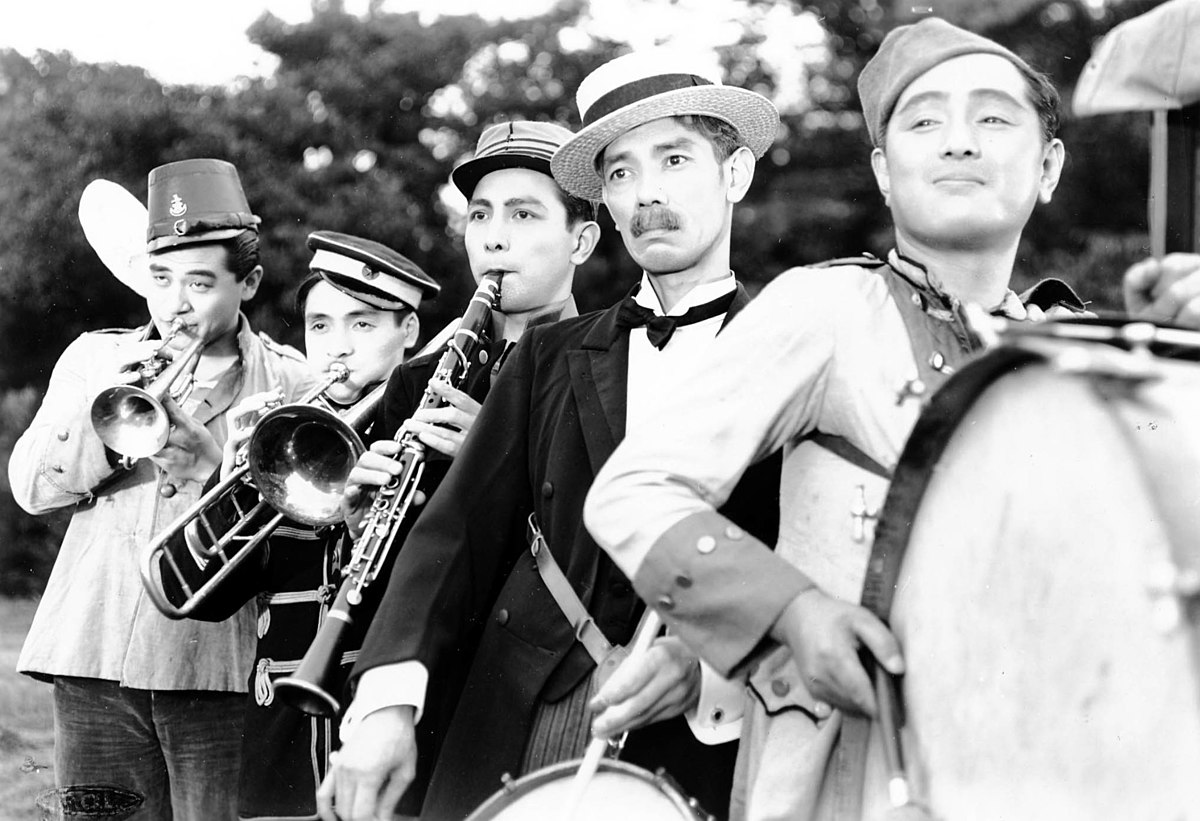
The five men of the title are an itinerant jinta brass band, though to tell the truth not a very good one. They were supposed to be on their way to play at a primary school sports day, only when they get there they’re told the event has been postponed to the following spring. After having wasted the afternoon killing time playing on the monkey bars and children’s slide, they decide to give a little concert anyway, not that anyone’s listening and there’s no real chance of getting paid. It’s in the next town, however, that they make a series of serendipitous meetings connected with a travelling circus which is currently undergoing a crisis as the entire male company has gone on strike against the boss’ tyrannical management style in a subversive dig at rising authoritarianism. 

All things considered, the circus seems to be doing pretty well for itself. It has a sizeable company with several accomplished performers and appears to be drawing good audiences. The boss (Sadao Maruyama) dresses in fancy outfits and there doesn’t seem to be much anxiety over hunger or any sign of the usual worries with which films about itinerant performers are usually concerned, all of which is in direct contrast to the jinta guys whose ragged appearance and habit of pinching yukata from the various inns on their route make plain their relative poverty. “None of us do jinta because we like it” the oldest of the players Seiroku (Ko Mihashi) points out, a woman behind in the bar him echoing that no one becomes a hostess because they like it either. None of these men had a burning desire to be in a band, they simply ended up there and now they can’t get out. Young orphan Kokichi (Heihachiro Okawa), however, dreams of going to Tokyo to study the violin carrying around a record of Western classical music to refresh his soul while worrying that his jinta life is corrupting him.  

Kokichi’s earnestness finds a fan and a mirror in Chiyoko (Masako Tsutsumi), the older daughter of the circus master who claims that she has long since given up hope of a better life even as she continues to dream her small dream of living in an ordinary house with a man she loves. Trapped by filial duty to her cruel father, Chiyoko actively encourages the escape of her younger sister Sumiko (Ryuko Umezono) who is in love with the ringmaster Kunio (Koji Kaga) though their father won’t let them marry. Kunio is also the instigator of the strike which is currently engulfing the circus, placing a strain on Sumiko’s conflicted loyalties as she struggles with her desire to leave the intinerant life behind. 

After the band is taken on as ringers to replace the striking musicians they also find themselves required to perform on stage, with varying degrees of success. Kokichi pleads to be given a chance to perform with a violin, even foregoing his pay as he’s warned the target audience is unlikely to find much to entertain them in a violin recital. His inexpert playing is roundly rejected by the baying mob who quickly begin throwing their rubbish at him until he’s forced to leave the stage in a moment of pure and crushing tragedy. Chiyoko tries to comfort him that she at least enjoyed the performance, but her words fail to cheer him more than superficially. He knows he’ll never go to Tokyo, or be anything more than a jinta player with only false hope to sustain him in the same way that Seiroku realises he’ll never never make peace with his past when he’s slyly conned by a 10-year-old girl he half suspected was the baby he abandoned out of economic desperation following the death of his wife. 

Yet it is in a sense romance that eventually eventually brokers resolution in the eventual implosion of Sumiko’s conflicted desires which cause her to “fall” from the trapeze, a moment of crisis daringly filmed through the use of double exposure superimposing Sumiko’s face over her POV of the men fighting in the ring. This narrowly averted tragedy apparently awakens something in her father who, she tells Kunio, only became cruel when their mother left, forcing him to relent and agree to be nicer to his employees while approving his daughter’s marriage. Yet romance cannot solve everything, and the only other romantic resolution we discover is in the roguish Torakichi (Hiroshi Uruki) who relents and accepts a woman he callously seduced and abandoned but who followed him because of the strength of a woman’s “passion”. Though we can see a connection has arisen between Chiyoko and Kokichi, it is not one which can be fulfilled, fate is pulling them in different directions. Forever a jinta player, he is pulled on to the next gig, the camera pulling back tragically from the bereaved Chiyoko, rooted to the spot as she watches her last hope walk away from her. “Life is a journey” she offers as a note of grim resignation, while knowing she’s going nowhere at all.


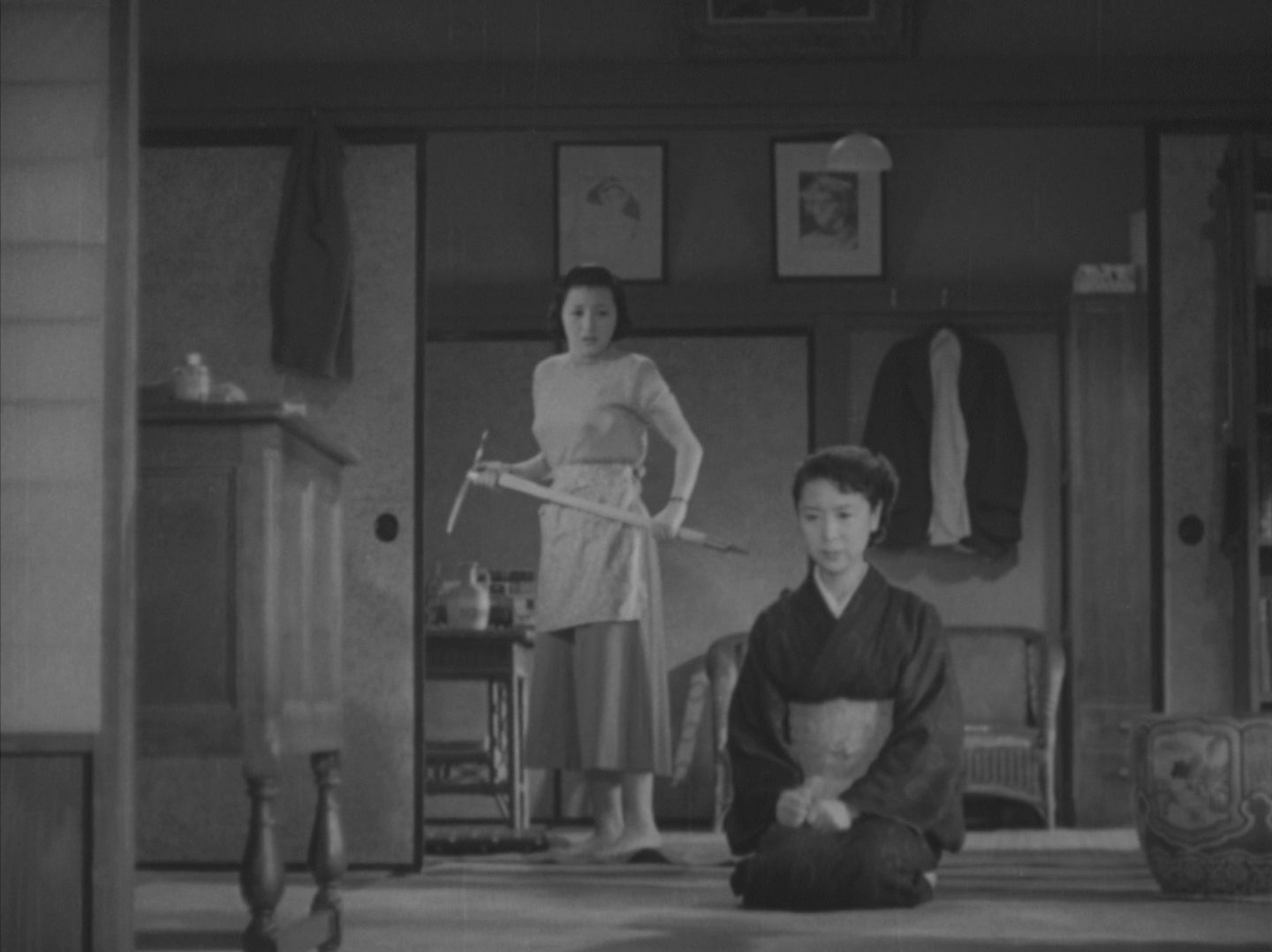
The Munekata Sisters (宗方姉妹, Yasujiro Ozu, 1950)

Though they may eventually turn melancholy, the films of Yasujiro Ozu are often cheerful affairs in which kindhearted people bear life’s troubles with stoic dignity. There are few villains, only those trying to live even while living is hard. The Munekata Sisters (宗方姉妹, Munekata Shimai) adapted from a story by Jiro Osaragi and produced for Shintoho rather than home studio Shochiku, however, strikes a much less happy tone, ambivalently condemning its heroine to unhappiness through her own adherence to the codes it otherwise insists are noble. 

The two titular sisters, Setsuko (Kinuyo Tanaka) and Mariko (Hideko Takamine), live in Tokyo where Setsuko runs a small bar which supports the family while her moody husband Mimura (So Yamamura) has long been out of work. Their father, Mr. Munekata (Chishu Ryu), has returned to Kyoto where, a doctor informs Setsuko in the opening scenes, he is suffering from terminal cancer but surprisingly healthy all things considered. Like his oldest daughter, Kyoto suits Mr. Munekata because as he puts it it is full of the beauty of old Japan, though Mariko has soon had enough of temples and palaces and longs to return to the modernity of the contemporary capital. Whilst in the city, however, they run into an old friend from Manchuria, Hiroshi (Ken Uehara), with whom Mariko soon realises her sister had been in love but he left for France before they could declare their feelings while she was already engaged to her present husband. 

Mariko, a youthful woman dressing exclusively in modern Western fashions, is quite taken with the idea of her sister’s failed romance and determines to get the pair back together. She has only resentment for her moody brother-in-law and has long been aware that Setsuko’s marriage is a failure. Within her seeming modernity, Mariko is surprisingly conservative when it comes to traditional gender roles, resenting Mimura for failing to provide for the family as a man is expected to do. Overcome with despair, he spends his days in a drunken stupor playing with stray cats rather than seriously looking for a job, defined by wounded male pride in his obvious discomfort with the fact that his wife is supporting him through the business that she operates herself. Mariko tells him to man up, tired of the way he leaves each of the women anxious in their own home, but Setsuko, more conservative still, reminds her younger sister that marriage isn’t all sunshine and rainbows and that sometimes all you can do endure. 

Mariko regards her sister’s way of thinking as “old-fashioned”, while Setsuko disapproves of her vacuous “modernity” which she sees as little more than social brainwashing that leads her to blindly follow only what is “fashionable” without thinking for herself. Mr. Munekata had said those who refused to see the beauty in old things were simply “ignorant”, but when asked to arbitrate between the sisters adopts a more equivocal position. You are you and your sister is your sister, he insists, you have your own ways of thinking and neither of you is wrong, you have simply to choose the path which suits you best. He does however caution against Mariko’s “fashionable” mindset, reminding her that it isn’t good to be mindlessly swayed by the prevailing trends, what’s important is to think deeply and value your own life. Those who only do what’s fashionable are boring, he tells her.

Later Mariko describes “modernity” as “not growing old despite the years” perhaps to counter Setsuko’s earlier dismissal that new things never become old because they don’t last. In any case, she is still in many ways a child with an underdeveloped appreciation for complex emotions which might explain why she suddenly proposes to Hiroshi herself as if she means to marry him on her sister’s behalf. She also unfairly takes against a wily widow, apparently a “friend” of Hiroshi’s from Paris who may or may not be in love with him but has obviously not replaced Setsuko in his heart. Setsuko however is conflicted, accepting financial help from Hiroshi to keep the bar open but resentful of her husband’s suggestion there is anything improper between them. She is an “old-fashioned” woman after all. Like What Did the Lady Forget?, Munekata Sisters also posits domestic violence as a reset button on a marriage as Mimura angrily slaps his wife across the face several times, but thankfully here it signals the death knell rather than rebirth of their relationship. Mimura has reasserted his manhood, but it has only shown him just how desperate and empty he has become. His wife no longer has respect for him, let alone love. 

Yet Mimura continues to control her feelings, implying that the failure of the relationship is her fault alone because she never loved him. He has slowly destroyed himself out of resentment and romantic disappointment. It seems that, though he was too cowardly to confess his feelings, Hiroshi has never forgotten his love for Setsuko and the possibility remains that she may be able to claim a happier future through abandoning her “traditional” way of thinking (“fashionable” in its own way), separating from her husband to marry for love. But in the end her code will not allow it. Guilt casts a shadow over her heart, leaving her feeling that she is no longer allowed happiness and must sacrifice her true desires to atone for the failure of her marriage. A glimmer of hope remains in Hiroshi’s determination to wait, trapping himself within the repression of patriarchal social codes, but in the end even Mariko is forced to recognise her sister’s nobility as she too tours the beauty of old Japan without complaint in new contemplation of its ambivalent charms.


Tokyo Twilight (東京暮色, Yasujiro Ozu, 1957)

Closely associated with the family drama, Yasujiro Ozu is perhaps the most socially conservative of golden age directors. Unlike Naruse or Mizoguchi, he cheerfully reinforces patriarchal social norms and foregrounds the paternal experience while upholding the primacy of the traditional family in a rapidly modernising society. In his later career he’d come to sympathise more strongly with the young, but 1957’s Tokyo Twilight (東京暮色, Tokyo Boshoku), perhaps his bleakest take on familial failure, is essentially a treatise on the legacy of corrupted motherhood and rebuke to growing post-war freedom in which a young woman is made to feel that her future is impossible because of maternal betrayal while her sister is forced back into an unhappy marriage to an abusive husband in order to avoid the same fate befalling her own daughter. 

Unlike most Ozu families, the Sugiyamas do not seem to be particularly happy in each other’s company, living in superficial politeness rather than true intimacy. This may partly be because the sisters had a brother who passed away young in a mountain climbing accident, but it also seems that Mr. Sugiyama (Chishu Ryu), though kind and polite, is a typically authoritarian, distant father. Oldest daughter Takako (Setsuko Hara) has returned home declaring herself unable to go on living with her professor husband Numata (Kinzo Shin) who, she says, has become increasingly erratic, taking out his petty professional disappointment on their small daughter Michiko whom he seems to resent. Younger sister Akiko (Ineko Arima) meanwhile is sullen and introverted. Unmarried, she lives at home and is studying to become a stenographer. 

As we later discover, the girls’ mother Kikuko (Isuzu Yamada) left the family during the war after falling in love with the junior officer Mr. Sugiyama enlisted to look in on the family while he was away in Seoul. Akiko was only three when their mother left and barely remembers her. Takako attributes her wayward behaviour to “loneliness”, that she has been forever corrupted through never knowing a mother’s love. Mr. Sugiyama admits he tried his best, but both agree that children need two parents and no matter how much he wants to a father cannot make up a mother’s share. 

This atmosphere of alienation is perhaps why Akiko feels as if she has no one to turn to in her own moment of maternal crisis. She has become pregnant by her college student boyfriend who has been avoiding her and even has the audacity to ask if the baby’s his when Akiko finally manages to pin him down. Trying to borrow money for an abortion, Akiko visits her aunt who declines to give it to her without knowing why, eventually turning to a family friend who apparently provides no questions asked. The woman at the clinic assumes she is a bar girl, as does a policeman who eventually “arrests” her for loitering in a sleazy cafe where her boyfriend has obviously stood her up which is quite openly being used as a place for men to pick up call girls. All of this contributes to Akiko’s increasing sense of shame and worthlessness. She sees herself as a fallen woman, convinced that she is all her mother’s child contaminated by her “bad blood” which makes a conventionally successful life as an ordinary wife and mother an impossibility. 

Akiko’s aunt wants to set her up with arranged marriage matches, but Akiko declares she has no intention of marrying or having children. Without knowing anything of Akiko’s circumstances, Takako assumes this is because of her obviously unhappy marriage, trying to convince her sister that there are plenty of happy couples she is merely unlucky. Mr. Sugiyama attempts to talk to his son-in-law but finds him strange and indifferent, offering treatises on familial love while implying that he has little of it. He regrets pressuring Takako to marry him when he knew that she preferred someone else while Takako is once again haunted by the spectre of corrupted maternity in her mother’s decision to leave the family for emotional fulfilment and is fearful of making the same mistake creating another troubled daughter just like Akiko in denying her a father’s love (which seems a moot point given that Numata does not care for the child). 

Neither woman is able to escape paying for their mother’s transgression. Akiko is punished firstly for embracing her sexuality and secondly for the rejection of motherhood in choosing to have an abortion. Alone and humiliated by her unreliable boyfriend, she is denied the opportunity to start over, while Takako meditates on female failure and believes that her only option is to live in misery with a cruel and narcissistic husband because that is the “proper” thing to do and the only way to bring her daughter up “right”. The absent mother, meanwhile, is denied reconciliation and left only with the painful separation from her daughter who finally rejects her in order to reclaim the image of the good wife and mother by returning to her unhappy home. Bleak as it is, all of this is presented as a kind of happy ending in that it restores the idea of the traditional family, increasingly threatened by post-war modernity, to its original primacy. We leave with Mr. Sugiyama rehiring his maid and heading cheerfully back to the male world of work, making the fresh start that his daughters have been so cruelly denied.  


Currently streaming in the UK via BFI Player as part of Japan 2020. Also available to stream in the US via Criterion Channel.

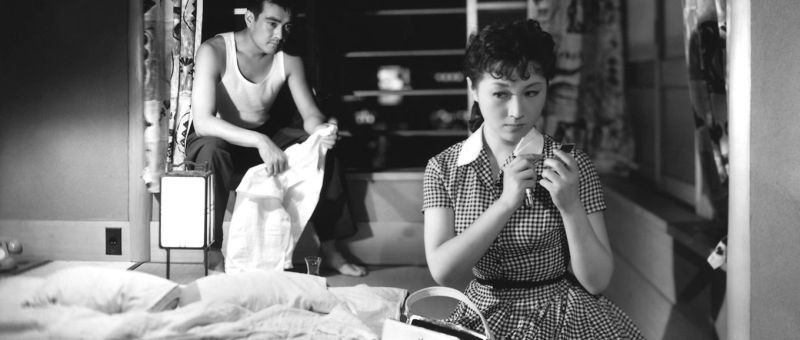
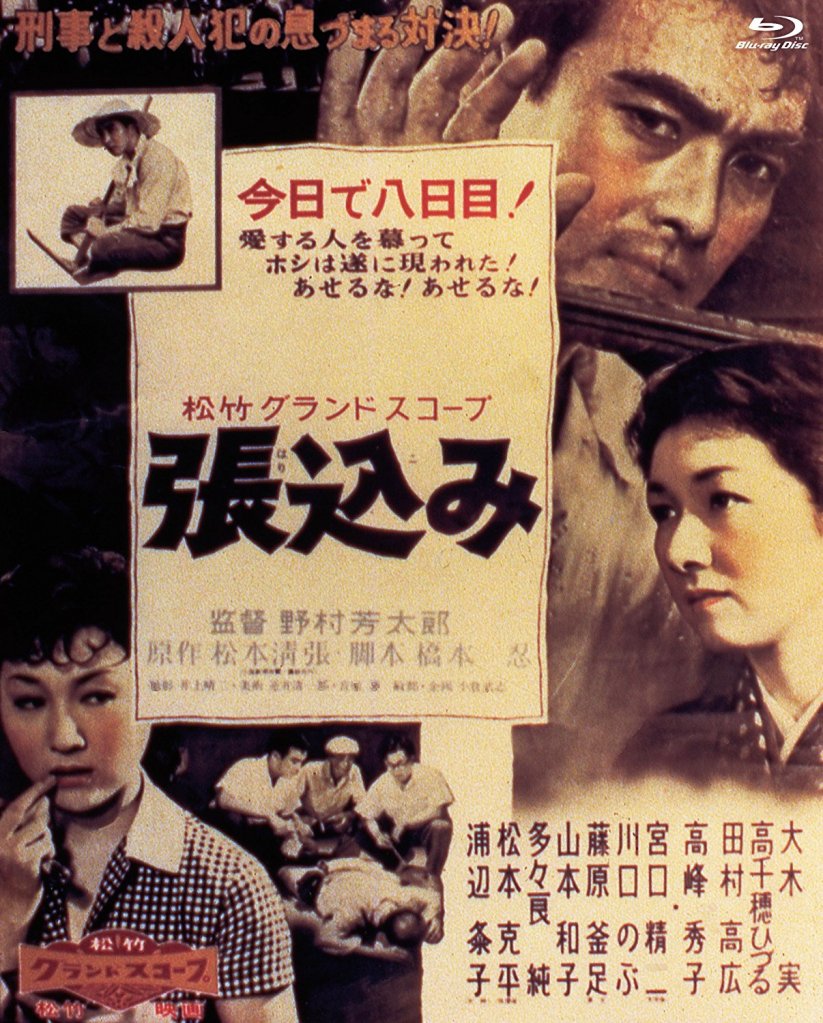
Stakeout (張込み, Yoshitaro Nomura, 1958)

Most closely associated with the crime genre, Yoshitaro Nomura was, like his frequent source of inspiration Seicho Matsumoto, also an insightful chronicler of the lives of ordinary people in the complicated post-war society. Stakeout (張込み, Harikomi), once again inspired by a Matsumoto short story, is on the surface a police procedural but underneath it’s not so much about the fugitive criminal as a policeman on the run, vacillating in his choice of bride, torn between the woman he loves who is afraid to marry him because her family is poor, and the pressure to accept an arranged marriage with the perfectly nice daughter of a local bathhouse. The stakeout becomes, in his eyes, a kind of illustrated parable, going against the socially conventional grain to convince him that making the “sensible” choice may only lead to long years of regret, misery, and loneliness. 

The film opens, as so many of Nomura’s films do, with a journey as two dogged Tokyo cops board a long distance train from Yokohoma travelling all the way down to provincial Kyushu which might as well be a world away from the bustling metropolis. Posing as motor salesmen, they take a room at a local inn overlooking the home of a melancholy housewife, Sadako (Hideko Takamine), the former girlfriend of a man on the run, Ishii (Takahiro Tamura), suspected of being in possession of a gun used to kill the owner of a pawn shop during a robbery. The younger of the policemen, Yuki (Minoru Oki), declares himself faintly disappointed with Sadako, complaining that she looks older than her years and is in fact quite boring, “the epitome of ordinary”. 

His older colleague, Shimooka (Seiji Miyaguchi), reminds him that most people are boring and ordinary, but as he watches her Yuki comes to feel a kind of sympathy for Sadako, seeing her less as a suspect than a fellow human being. Later we hear from Sadako that her marriage has left her feeling tired every day, aimless, and with nothing to live for, that her decision to marry was like a kind of suicide. “A married woman is miserable” Yuki laments on observing Sadako’s life as she earnestly tries to do her best as a model housewife, married to a miserly middle-aged banker who padlocks the rice, berates her for not starting the bath fire earlier to save on coal, and gives only 100 yen daily in housekeeping money while she cares for his three children from a previous marriage. Trying to coax him back towards the proper path, Shimooka admits that marriage is no picnic, but many are willing to endure hardship at the side of the right man. 

The “right man” gets Yuki thinking. Sadako has obviously not ended up with the right man which is why he sees no sign of life in her as if she simply sleepwalks through her existence. He is obviously keen that he wouldn’t want to make another woman feel like that, or perhaps that he would not like to be left feeling as she does at the side of the wrong woman. We discover that his dilemma is particularly acute because he finds himself at a crossroads dithering between two women, faced with a similar choice to the one he increasingly realises Sadako regrets. Shimooka’s wife is acting as a go-between, pressuring him to agree to an arranged marriage with a very nice girl whose family own the local bathhouse. She makes it clear that she’s not trying to force him into a marriage he doesn’t want, but would like an answer even if the answer is no so they can all move forward, but for some reason he hasn’t turned it down. Yuki is in love with Yumiko (Hizuru Takachiho), but Yumiko has turned him down once before because her family is desperately poor, so much so that they’re about to be evicted and all six of them will have to move into a tiny one room flat. She feels embarrassed to explain to her prospective husband that she will need to continue working after they marry but send almost all of her money to her parents rather than committing to their new family. 

Meditating on his romantic dilemma, Yuki begins to sympathise even more with Sadako, resenting their fugitive for having placed her in such a difficult position and repeatedly cautioning the other officers to make sure that the press don’t get hold of Sadako’s name and potentially mess up her comfortable middle class life with scandal when she is entirely blameless. The fugitive, Ishii, is not a bad man but a sorry and desperate one. He went to Tokyo to find work, but became one of many young men lost in the complicated post-war economy, shuffling from one poorly paid casual job to another. Now suffering with what seems to be incurable tuberculosis, he finds himself dreaming of his first love, the gentle tones of famous folksong Furusato wafting over the pair as they lament lost love at a picturesque hot springs while Yuki continues to spy on them from behind a nearby tree. 

They both bitterly regret their youthful decision to part, she not to go and he not to stay. The failure to fight for love is what has brought them here, to lives of desperate and incurable misery filled only with regret and lonliness. Sadako views her present life as a kind of punishment, finally resolving to leave her husband and runaway with Ishii who has told her that he plans to go to Okinawa to drive bulldozers for the next three years, though we can perhaps guess he has a different destination in mind. “That’s the way the world is, things don’t go the way you want” Ishii laments, but the truth is choices have already been made and your course is as set as a railway track. Sadako plots escape, but all Yuki can do is send her back to her husband with sympathy and train fare, leaving us worried that perhaps she won’t go back after all. Buying tickets for his own return journey, Yuki pauses to send a telegram. He’s made his choice. It’s not the same as Sadako’s, a lesson has been learnt. He goes back to Tokyo with marriage on his mind, but does so with lightness in his step in walking away from the socially rigid past towards a freer future, staking all on love as an anchor in an increasingly confusing world.


Original trailer (no subtitles)