Barren Illusion (大いなる幻影, Kiyoshi Kurosawa, 1999)

A listless young couple attempt to rebel against the world’s meaninglessness, but discover only further despair if tempered by their togetherness in Kiyoshi Kurosawa’s oblique drama, Barren Illusion (大いなる幻影, Oinaru Genei). The film’s title could refer to the world itself which has its own degree of unreality while offering little of consequence to either of the protagonists who might dream of escape but are incapable of effecting it. Instead, they exist like ghosts trapped within the perpetual limbo of the contemporary society.

Musician Haru (Shinji Takeda) literally fades in and out of his surroundings, captured in a slow dissolve as if somewhere else he were awakening from this dream only to blink back into existence. In the early stretches of the film, he’s repeatedly told to “disappear,” which in an odd way affirms his existence even while negating it. He appears to react to this instruction with violence, throwing rubbish bags around in the street, but also placing a bag under the head of a sleeping person in a small gesture of kindness.

Michi (Miako Tadano), meanwhile, seems to rebel against her monotonous life as a postoffice clerk by pilfering from the mail and dreaming of going abroad. To add to her sense of isolation, the customers at the postoffice are unable to see her face or she theirs. There is a vertical blind in front of her through which customers hand their packages or documents to be processed. This seems to be done wordlessly. Customers don’t even state which service they require, but simply pass whatever they’ve brought across and then leave. Michi’s job chiefly seems to consist of stamping things in triplicate, removing the top level to hand to the customer, and then filing the counterfoil. 

Tellingly, her stamp says that it is 2005, which is six years after the film was released. Yet a kind of inertia has set in even in this near future setting. Michi encounters a strange woman who complains that the photocopier has been broken since the year 2000, perhaps a casualty of the millennium bug, but no one has made any attempt to fix it. The woman seems strangely insistent about the broken photocopier while her face is ominously hidden in shadow. Michi meets the same woman later on the rooftop where she again throws papers around before trying to pull Michi over and then abruptly jumping herself just as Michi will later do.

It might be tempting to think of this woman as a ghost. Her actions have a looping quality as if she were stuck in a purgatorial cycle, but then this seems to be true of pretty much everyone. Someone ought to do something, people seem to say, but just as no one bothered to fix the photocopier, no one is really applying themselves to anything either or seriously trying to resist their despair-filled existence. The pollen that has begun to plague the young with allergies seems to be a metaphor for this sense of inertia as it saps their energies, causes them to wear masks that further isolate them from human connection, and eventually forces them into a binary choice between infertility and becoming a functioning member of society.

Both Haru and Michi later agree to try the new drug even if it prevents them from having children, but then in many ways they continue to behave like children themselves. They spend significant amounts of time playing with inflatable balls in the local park, and though they discuss getting a dog or cat, quickly tire of caring for it. A foreign woman attempts to hand out postcards in a bar which may hint at a desire for geographical escape, though she finds no takers. Michi, meanwhile, is fascinated by an inaccurate map she discovers in the home of a Chinese woman who for some reason barged in on her looking for escape from a persistent boyfriend. “You can go on your own,” the woman tells him in Mandarin, “I’m not going,” before he simply picks her up and takes her away all while ignoring the literal alarm bells that Michi later tries to warn her about. 

Michi trails her suitcase along while pursued by both a wandering band of percussionists that seems to follow her around, and a gang of black-clad, seemingly violent fascists who beat her with clubs as if they were either symbol of societal collapse or a cleanup tool trying to remove a bug from the system. She seems to come to the conclusion that leaving would be pointless without Haru, but the two of them remain trapped on either side of an external door until an attempt to take action seems to put them on the same side, albeit as passive observers amid the cacophony of the percussionist band. The low-level thrum of interior spaces hints at industrial corruption and a deadening effect on human communication, while it seems that togetherness is perhaps the only real path to enduring this looping existence in which everything is just an echo of something else and that remains is a vague desire to know what lies over the horizon.

Survive Style 5+ (Gen Sekiguchi, 2004)

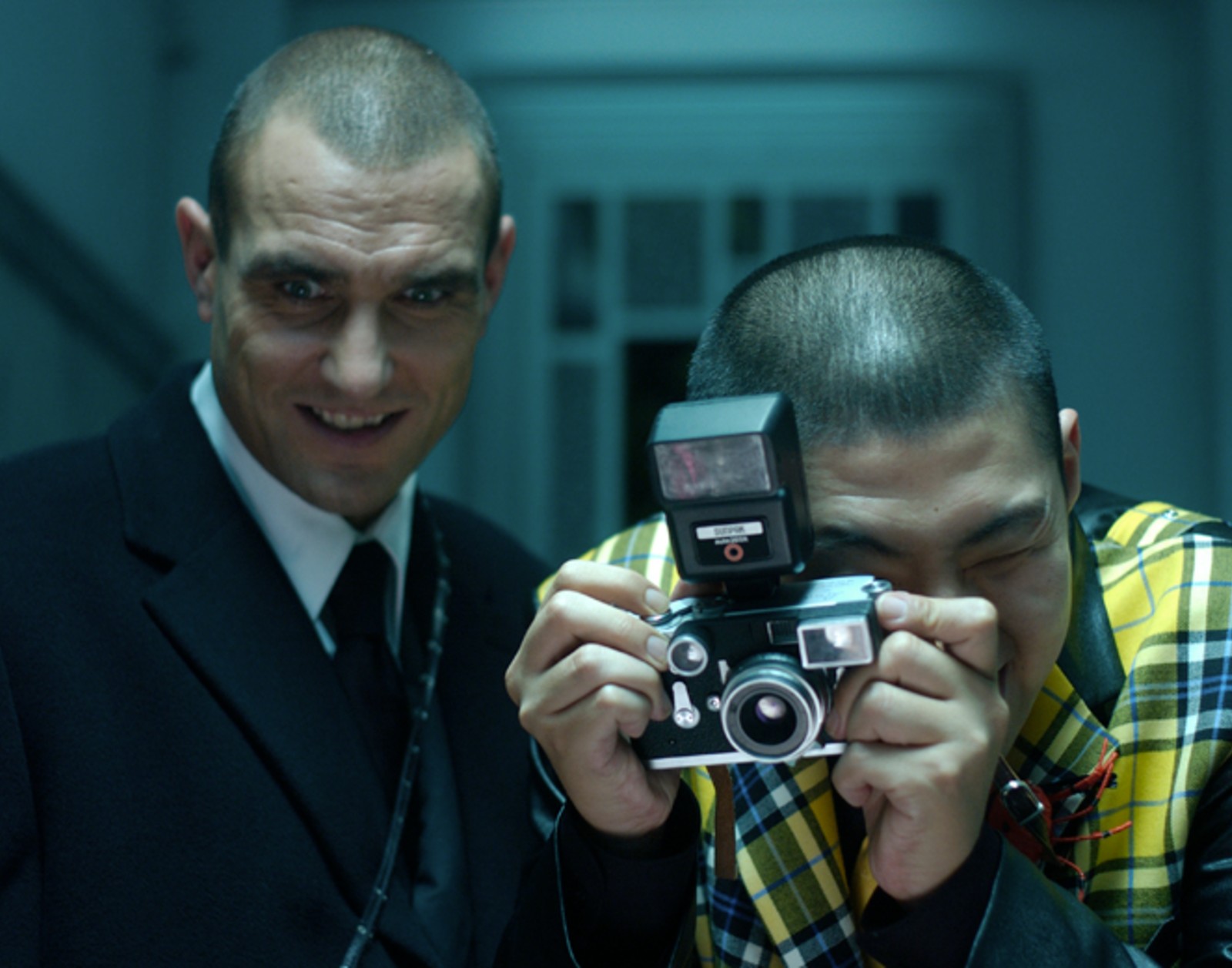
“What is your function in life?” It is, after all, quite a difficult question as an air stewardess (Tae Kimura) points out when interrogated by an irate British hitman (Vinnie Jones), and perhaps one that most people never really think about. Indeed, many of those questioned struggle with the meaning of “function”, replying with the most obvious answer of their occupation or job title without really considering any deeper implications or whether their existence is really meaningful. The hitman seems to have a secondary mission of eliminating those whom he deems “unnecessary”, while simultaneously giving his only sign of approval to a man who straightforwardly tells him that he doesn’t have one.

Gen Sekiguchi’s Survive Style 5+ is full of this kind of questioning but ultimately a tale of how one learns to survive in an often absurd world. Like many films from the mid-2000s, it cuts between several interwoven plot threads that at first seem nonsensical but finally coalesce into a complete whole. An artist (Tadanobu Asano) repeatedly kills his wife (Reika Hashimoto) who is forever trying to kill him in bizarre ways only for her to respawn back at their very weird Western-style country lodge in the woods. An ad executive (Kyoko Koizumi) becomes fed up with her vain hypnotist boyfriend (Hiroshi Abe) who mocks her career. A salaryman (Ittoku Kishibe) is hypnotised to think that he’s a chicken, and a trio of burglars (Kanji Tsuda, Yoshiyuki Morishita, Jai West) deal with repressed emotion and romantic longing. 

They are all to some extent trying to find some way to survive along with a sense of purpose in their lives. Ad executive Yoko is forever coming up with zany ideas for TV adverts that she records on her dictaphone, sniggering to herself at their surreal humour though she is the only one who finds them funny and her work is often dismissed by her corporate clients who complain that her ads don’t do anything to inform the prospective customer about the nature of the product. Sekiguchi was himself also a director of TV adverts which informs the film’s short and snappy style, and Yoko’s artistic frustrations perhaps echo his own as she tries to fulfil herself creatively while meeting the client’s demands. 

The CEO of the pharmaceuticals company she’s working with (Shinichi Chiba) is forever taking “emergency” calls from his wife about such important issues as the bulb having gone in the bathroom which he treats with the upmost seriousness while admitting that he really doesn’t know how to address any of these domestic issues. Similarly, the salaryman is prevented from living a full family life because of the demands of his job, but becomes a temporary hero after getting tickets to see the sold-out hypnotist. In someways, he might even be happier as a bird which after all offers more “freedom” if only he could learn to fly. While his wife and daughter are most interested in curing him so that he can become a stereotypical salaryman again and fulfil the roles of father and husband by providing for the family, only his son determines to accept his father’s new reality and love him for who he is now. 

The family’s home is designed with an artificial quality giving it the appearance of the set for a TV sitcom, bearing out the ersatz nature of conventional family life in which everyone is forced to bear out their particular “function” without imbuing it with much meaning. When the burglars break in, they too inhabit this space as if they were children who’ve come over to play by sitting down and playing cards rather than looting the place, though it turns out the family don’t actually have very much worth stealing. While Tsuda is forever taking calls from a girlfriend, Morishita and J exchange a series of longing looks but are otherwise unable to express their feelings for each other due to lingering societal homophobia and emotional vulnerability. Only when challenged by the hitman are they able to express their feelings after questioning their own “function in life”.

Jones was clearly hired for his hardman image which he’d successfully brought off the football pitch and into a series of gangster movies in the late 90s, imbuing each of his lines with an absurd intensity which is equally matched by Yoshiyoshi Arawakawa’s comical attempts to echo his intimidating speech patterns as his interpreter though without the physical presence to pull it off. The hitman is quite clearly a harbinger of death, but at the same time it’s his existential probing that points the way towards survival as his various targets are forced to consider what their “function in life” really is and if they’re living in ways that are meaningful and fulfilling. The film’s anarchic production design and deadpan humour add to the sense of surreality as Sekiguchi gleefully ricochets between one storyline and another looking for new modes of survival in an increasingly absurd world.


Survive Style 5+ is currently screening in select UK cinemas and released on UHD/Bluray on 19th October courtesy of Third Window Films.

Trailer (dialogue free)