The Twilight Years (恍惚の人, Shiro Toyoda, 1973)

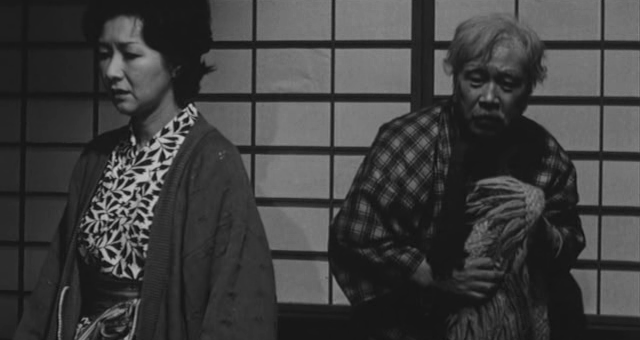
In the early 1970s Japanese society was not as concerned with population slowdown as it would come to be, but Shiro Toyoda’s sympathetic ageing drama The Twilight Years (恍惚の人, Kokotsu no Hito) is evidence of a growing consciousness that traditional ideas about how one cares for the elderly may now be becoming incompatible with the functioning of modern society. Based on a best-selling novel by Sawako Ariyoshi, the film has profound empathy both for the ageing patriarch once apparently a tyrant but now a meek and frightened child, and the daughter-in-law to whom his care largely falls.

In fact, it’s caring for Shigezo (Hisaya Morishige) that some believed shortened the lifespan of his late wife who passes away in the film’s opening scenes. Already somewhat detached from reality, Shigezo simply reports that his wife won’t wake up no matter how much he tries to wake her, much like a child who’s discovered someone no longer living. While his daughter-in-law Akiko (Hideko Takamine) rushes to her room with a sense of foreboding, Shigezo merely stays in the kitchen eating boiled potatoes straight out of the pan. It’s the odd behaviour that seems to irk his son Nobuyoshi (Takahiro Tamura) but it’s only now that the couple seem to be realising that there’s something wrong especially as Shigezo does not appear to understand that his wife has died. Pitiably, he chides her for lounging around so late in the day when she’s already been laid out for her funeral.

When his daughter, Kyoko (Nobuko Otowa), arrives having actually missed the funeral itself due to transport issues and a conflicting responsibility to act as a matchmaker at a wedding, Shigezo doesn’t recognise her. He continues to ask for Akiko and gradually forgets most of the other people in his life, screaming when encountering Nobuyoshi and instructing Akiko to call the police to report a burglar in their home. According to both women, Shigeyoshi had treated Akiko poorly ever since she joined their family, which makes caring for him so much harder. The reason he becomes so attached to Akiko is likely simply that she is the person who is always around him so he has less time to forget her. He may realise on some level that she may not wish to care for him given his previous behaviour which may be why he becomes preoccupied with the idea she may “disappear” and cries out in the night when he can no longer see her.

But Akiko also has other responsibilities including a job outside the home and a teenage son studying for his exams. Nobuyoshi expresses regret that he hasn’t been more help and voluntarily tries to pitch in, but lets himself off the hook given that his father doesn’t recognise him and becomes anxious in his presence. Satoshi (Izumi Ichikawa) meanwhile does try to do his bit but is young and a little resentful of the responsibility. As his dementia becomes more severe, Shigezo begins calling Satoshi “Dad” as if he were a child again. Which is all to say, Shigezo becomes Akiko’s responsibility and the strain of caring for him begins to affect her own mental and physical health leading her to fear that she too may die younger than she otherwise might have. 

Yet in exploring her options, Akiko finds little by way of support. Most nursing homes won’t accept patients with complex needs like Shigezo and conditions such dementia are often regarded as mental illnesses meaning her only option might be to put him in an asylum. Shigezo was attending an old person’s daycare centre, but later says he doesn’t want to go anymore because it’s full of old people and therefore no fun. While the film is sympathetic towards Akiko and the difficulties she is facing in caring for her father-in-law it also has profound empathy for Shigezo for though he has so many people who are doing their best to look after him, his increasing mental confusion quite obviously leaves him isolated and he must be incredibly lonely while trapped within his own reality. He develops a habit of saying “hello, hello,” as if he were answering the telephone which may be his attempt to communicate while he is also fascinated with a caged bird which may reflect his own sense of being constrained by his condition.

Later, the bird seems to symbolise Akiko too, trapped as she is within the domestic environment where all responsibility seemingly falls to her. Even so a young student couple she rents the annex to for a lower price in exchange for keeping an eye on Shigezo during the day remark that he may be in the ideal state for a human being having returned to early childhood in which there are no concerns or responsibilities and he is therefore unburdened by the weight of what is to live. Toyoda often uses handheld camera to symbolise the desperation and destabilisation of Shigezo’s existence in which Akiko has become his only fixed point. One of Nobuyoshi’s friends remarks that perhaps it was better when the average life expectancy was 50 and Nobuyoshi’s mother might have been lucky passing away peacefully while otherwise in good health. Still, as Nobuyoshi says, it comes for us all in the end and we should all try to be kinder to each other while we’re here.


Flowing (流れる, Mikio Naruse, 1956)

The denizens of a moribund geisha house contemplate visions of independence in post-war Japan Mikio Naruse’s thriving ensemble drama, Flowing (流れる, Nagareru). There is indeed a flowing through the geisha house, a tumble of comings and goings though mostly connected to money which is itself constantly flowing though the for geisha mainly in the wrong direction. Released in the year of Prostitution Prevention Law, the film casts a shadow over the lives of these women who are unwittingly living in their industry’s twilight but asks if it’s really possible for a woman to survive without a man while each of them is in one way or another badly let down by an inconstant lover. 

We’re constantly told that Tsutanoya is the most respectable geisha house in town yet despite its well appointed interiors, it’s clear that business is not good. As the film opens, a young geisha, Namie, is accusing the owner’s daughter Katsuyo (Hideko Takamine) of diddling her on her pay. Katsuyo acts indignant and tries to shift the blame back onto Namie but later admits that the house has indeed been skimming a little more off their wages than was agreed claiming all the geisha houses do it which is probably true but doesn’t make it right. In any case Namie will eventually quit and end up working at “some third rate place” while her uncle (Seiji Miyaguchi) causes problems for proprietress Tsuta (Isuzu Yamada) complaining that Namie was exploited and wanting both the backpay he feels she’s owed and compensation though it seems unlikely any of that money is finding its way back to Namie. Meanwhile the house is a geisha down with only former office worker Nanako (Mariko Okada) and 50-year-old veteran Someka (Haruko Sugimura) on the books.

Despite their financial situation, Tsuta hires a new maid, Rika (Kinuyo Tanaka) who is immediately renamed “Oharu” on her arrival. Oharu is a salt of the Earth type, infinitely capable, maternal, kind and loyal bringing a much needed sense of stability to the ever flowing geisha house while also fascinated by this exotic and arcane world. But then as Tsuta cautions her geisha houses may look glamorous from the outside but the life inside them isn’t always fun. Oharu runs into trouble on her first trip to the grocers when they inform her Tsuta hasn’t paid her tab and they can’t let her add to it until she does. A 45-year-old widow whose only child died a year previously, Oharu is also trying to live an independent life, a conflicted Tsuta struck with wonder at her ability to survive without a man, but may also have struggled, grateful to have been offered the job which others might have declined because of the stigma towards the sex trade as finding employment as a middle-aged woman is near impossible. 

At the film’s conclusion even she may imply it isn’t really possible to live as a woman without some kind of support or losing one’s humanity suggesting that she may return to her husband’s hometown and the family she claims not have gotten along with after learning of Tsuta’s betrayal at the hands of an old friend and former geisha, Ohama (Sumiko Kurishima), who at any rate seems to be living quite well as the proprietress of a restaurant. Traditionally, the profession of geisha was seen as a kind of independence in itself but it’s also one that by its nature is reliant on men. Tsuta is often described as someone who is not able to do anything else yet is highly skilled at music and dance having spent a lifetime in training. Without a patron she is stuck and as we learn she threw hers over to pursue a man she loved but he left her in the lurch having mortgaged the geisha house to invest in his business by taking a loan from her older sister who seems to have a nice sideline as a polite loan shark also having loaned money to Someka. 

The most outwardly cheerful, Someka is in other ways a dark vision of a geisha’s future surviving on nothing but nihilistic hedonism while apparently living with a much younger man who eventually leaves her to marry into another woman’s family. Katsuyo has rejected the geisha life explaining that she is unable to, as Nanaka puts it, say silly things to men in order to earn her keep and is essentially incapable of ingratiating herself with men she doesn’t like. She claims she has no desire to marry, unconvinced that any man would be interested in a geisha’s daughter while certain that for a man marrying into a woman’s family is humiliating while suggesting the same would be true for her. Putting her faith in industry, she buys a sewing machine and sets about figuring out how to use it less because she envisages being able to support herself and her mother through taking in needlework than she just wants to feel as if she’s doing something. 

Meanwhile, Tsuta’s niece Fujiko observes all the comings and goings of the geisha house learning the traditional arts in preparation for a future which will soon be obsolete. In a typically Narusean touch, Tsuta comes to a resolution about her future and envisages a new beginning for herself but is unaware the rug is soon to be pulled from under her by the underhanded capitalist Ohama who plans to turf her out to turn the geisha house into another restaurant. “My days of seeking favours from men are over,” Tsuta admits, not of her own volition but simply understanding that she no longer has access to that kind of independence though in essence surrendering her autonomy in leaving herself to the mercy of Ohama in order to escape her older sister’s control. Someka had laughed raucously at Katsuyo’s insistence that she need not be dependent on a man (and after everything she’s seen why would she want to be?) but the younger woman is undeterred even as we see her struggling, doubting that her efforts will in the end be enough to win her her freedom. Ever the optimist, Tsuta is perhaps doing something similar but even Oharu is considering giving up and going home, too good to survive in the dog eat dog world of the contemporary capital where the flow of currency is the lifeblood of the city implying that perhaps the answer to her question is no, a woman can’t survive alone, nor can she rely on female solidarity, but she’ll have to try anyway because there is no other choice. 


No Life King (ノーライフキング, Jun Ichikawa, 1989)

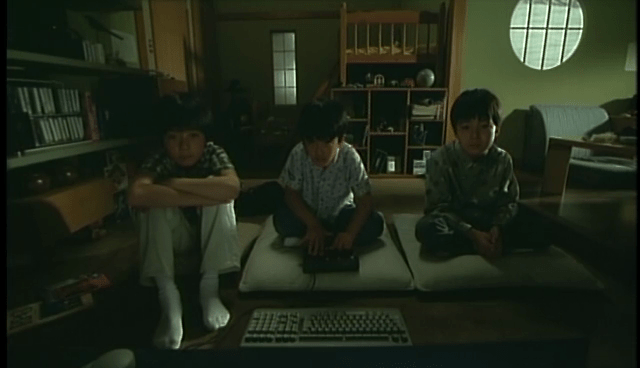
Taking place at the tail end of the Bubble era and on the eve of a technological revolution, Jun Ichikawa’s No Life King (ノーライフキング) in many ways anticipates the world we have today in which much of our communication has already become digitised. The cult-like speech of the next-gen guru who pops up towards the film’s conclusion may have eerie ring to it, but he has a kind of point in his talk of “new children” who will become “new adults” in a new digital world that was then only just becoming a reality. 

As someone later says, “the problem is not video games” though many seem to assume it is. The hero, Makoto (Ryo Takayama), whose name means “truth”, is one of a group of five boys obsessed with Nintendo console gaming. A game series known as Life King has become so popular that hundreds of youngsters camped out all night waiting for the release of the fourth instalment. The only problem is that the game seems to be unbeatable, and Makoto’s young friends begin to hear rumours that some of the cartridges are “cursed” with an alternate “No Life King” version that means death for players who cannot finish the game. 

The “curse” reflects a confusion that is beginning to emerge over what is “real” and what is “virtual” in an era of rapid technological development. The kids begin to worry that if you die in the game you die for real, while otherwise becoming obsessed with all kinds of urban legends relating to mysterious deaths and conspiracy theories such as that of the actor who plays tokusatsu hero Pris secretly being dead and that all the collectible Pris pencil erasers you can get from gachapon machines are cursed with the resentment he felt as he died. Some would be keen to dismiss this kind of thing as silly things kids say, but then Makoto’s mother also suggests that cakes from the bakery the family of his classmate Noriko owns are “cursed” as customers have been coming down with food poisoning after eating them. According to the guru’s assistant Mizuta (Neko Saito), the rumours are having a serious economic impact and have led to delays in product launches and construction projects in addition to provoking a politician’s resignation. 

Then again, the film seems to wonder if it’s the Bubble-era economy which is the enemy. While Makoto plays video games on his own but chats to his friends doing the same thing via telephone headset, his mother often works late into the night staring at a computer screen in their home. Makoto attends a summer cram school where all of the work is done via computers linked via a primitive version of the internet. The teacher is present but cannot actually see any of the children and they can’t see him. Questions are asked and answered via the interface rather than directly, though the computer network of cram school students does eventually allow Makoto to get in touch with other “new children” who are just as worried about the cursed game as he and his friends are while the adults respond by taking their consoles away which of course denies them the ability to lift the curse by beating the game. 

The “curse” itself may symbolise mortality, though obviously the children will still someday die regardless of whether they beat Life King IV because life itself is an unwinnable game. “The problem is…” the opening text crawl explains, “the battle has begun. It is unlikely to end until you die.” The same words are uttered by Makoto’s principle only he substitutes “video games” for the second part of the sentence before dramatically falling backwards just like the stricken king of the game while Makoto and the other kids are lined up almost identically to the ranks of soldiers amassed in front of him. This moment of symmetry links back to a line from the guru Akiyuki Mori who hints at a new world in which life and death exist simultaneously. It is this new world that “new children” must learn to adapt to as they grow with technology.

“It’s scary, but we’ll die if we can’t lift the curse” Makoto tells one of his online buddies and eventually becomes an accidental folk hero with the other kids looking to him to free them by beating the game. Graffiti tags go up all over the city reading, “hang in there, Makoto”, while he becomes preoccupied by the nature of the “real” as related to him by Mori and his assistant Mizuta who begin to view him as something like a prophet or at least the first of the “new children” to enter the “new real” in which the distinction between the “real” and “virtual” has disappeared. Fearing for his mortality, Makoto saves himself in the digital space by writing a bio and saving it to floppy disc much as a hero who died in the game was immortalised in stone so that no one would ever forget that he existed. 

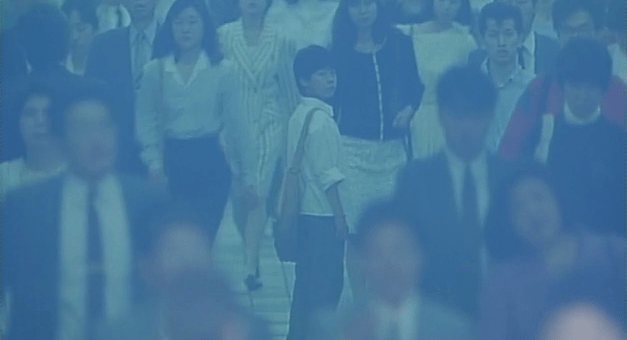
By the film’s conclusion, “real life” has become a kind of game as evidenced by the advice of Makoto’s cram school tutor that he try and raise his score by 20 points to increase his chances of getting into a higher level institution. The mysterious boy somewhere on another computer tells him to go and look around outside at which point he wanders through the contemporary city and sees it with new eyes. “It is all real” he concedes, catching sight of Mori and his assistants in the crowd just as we start to wonder if this really is “reality’ after all. Then again, perhaps the best lesson the boys learn is from one of their grandfathers who simply “kept living until he died”. Ichikawa captures a sense of technological anxiety in the uncanny eeriness of the “real” world around the boys but is perhaps less pessimistic about the new age that awaits them in the solidarity that exists between the “new children” despite the seeming indifference of the adults incapable of understanding the anxiety that engulfs them.


Throne of Blood (蜘蛛巣城, Akira Kurosawa, 1957)

In many ways, the underlying theme in Akira Kurosawa’s films of the 1950s is that we are incapable of knowing ourselves and are, as a forest spirit remarks in Throne of Blood (蜘蛛巣城, Kumonosu-jo), afraid to look into our own hearts and admit our darkest desires. In adapting Shakespeare’s Macbeth, Kurosawa is less interested in the pull of ambition than the insecurity that drives it along with the inability to transcend himself that precipitates the hero’s decline. 

Indeed, after Washizu (Toshiro Mifune) and his best friend Miki (Minoru Chiaki) ride into the misty forest domain of the witch-like seer who ominously turns her spinning while offering a moral lesson that neither of them heed, they sit on the ground and laugh about what they’ve heard. Yet as Washizu partly admits the old woman revealed something of himself to him in that she echoed a dream of which he was unwilling to speak. Miki asks what warrior would not want to be placed in charge of a castle, but for Washizu it’s almost a primal need to prove himself in surpassing other men. Miki, by contrast, is not so nakedly ambitious but he doesn’t really need to be because he has a son. Washizu has no heir, his line will end with him and so he has only this life to make something of his name. 

Having no heir also undermines his sense of masculinity, just as it undermines the femininity of his wife, Lady Asaji (Isuzu Yamada), who as a woman now likely too old to bear a child may fear for her position. Kurosawa styles Yamada’s face as a perfect noh mask while she delivers her lines with the intonation of noh theatre all of which lends her a fairly eerie presence which only deepens as she descends into the darkness and back out again hovering like a ghost. She is in a sense perhaps already dead if not otherwise possessed by some malignant spirit as she urges her husband on in their dark deeds like a demon on his shoulder even going so far as to present him with the spear he will use to murder his lord, the ultimate act of samurai transgression. 

Yet as Lady Asaji points out, the present lord killed the lord before him for the right to sit on the dais. When the lord comes to stay with them on a pretext of hunting while preparing to launch an attack on a potential rival, the couple are moved into a room previously inhabited by a retainer who’d tried to mount a rebellion but was defeated. He took his own life and the room is still stained with his blood which covers both walls and floor. Washizu ought to realise that this is his fate too, but deep down he wants the prophecy to be true, which it is if more in the letter than the spirit. Would he have done it if he had not met the forest spirit, or would he only idly have thought of it but never followed through? It’s not something that can be known, but his eventual failure is born more of his inability to accept this side of himself than it is the price of ambition in itself. “If you’re going to choose ambition choose it honestly with cruelty” the forest spirit later advises, and Washizu might have been more successful if had he done so earlier. 

Then again, the world he lives in is as Lady Asaji describes it a wicked one in which betrayal is an all but inevitable certainty. Washizu insists that Miki is his friend, and that making Miki’s son his heir satisfies the prophecy while binding him to him so that he cannot rebel even if he were minded to. But Lady Asaji assumes that Miki is ambitious too, suggesting that he may strike first or report his treachery in the hope of personal advancement. For the prophecy to come true, someone has to betray the lord though it need not have been either of them but there can be no trust or friendship in this world of fierce hierarchy and internecine violence. 

Both men should perhaps have realised that when they were trapped riding around the eerie lair of the forest spirit with its mists and cobwebs not to mention heaps of piled skeletons still in their armour all victims of ambition and the spirit’s false promises if also echoing the legacy of wartime folly. “Look upon the ruins of the castle of delusion” the noh chant that opens and closes the film intones, warning of illusionary riches and the price of deluding oneself along with the destruction wrought by those unable to break free of the spider’s web of human desire. 


Throne of Blood screens at the BFI Southbank, London on 21st February 2023 as part of the Kurosawa season.

Original trailer (no subtitles)

I Live in Fear (生きものの記録, Akira Kurosawa, 1955)

Which of us is “crazy”, the man who lives in fear or the rest of us who live in its denial? By 1955, a decade had passed since the bombs fell on Hiroshima and Nagasaki, but even if the world seemed “peaceful” it was only superficial. The Korean War had “ended” in an uneasy truce only two years earlier and the world was already mired in a cold war which daily threatened to turn hot with both sides in possession of a nuclear deterrent. Akira Kurosawa’s I Live in Fear (生きものの記録, Ikimono no Kiroku) asks us if we can really say a man is “insane” if his life is ruled by a rational anxiety and if it is our refusal to accept the threat he sees which eventually drives him out of his mind. 

Our guide is gentle dentist Harada (Takashi Shimura) who has a sideline as a mediator at the family court. The case he has been called in on one particular afternoon is that of the Nakajima family which is attempting to have the ageing patriarch, Kiichi (a near unrecognisable Toshiro Mifune), declared legally incompetent on account of his increasing paranoia about nuclear attack and latent radioactivity. A wealthy self-made man and foundry owner, Kiichi has frittered away vast sums on harebrained schemes to keep himself and his family safe but after a plan to build a bunker in a remote area had to be abandoned, he’s set his heart on moving everyone to Brazil where he believes they will be safer. 

The problem is partly one of changing times as Kiichi, “despotic and selfish” as his son describes him, attempts to railroad his family into a safety they do not want or need. His two legitimate sons now operate the foundry and their lives are dependent on it, which is not to say that they are dependent on Kiichi, but if he goes through with selling the the foundry to finance his new life it will leave them all high and dry. It would be, to a certain way of thinking, the ultimate paternal betrayal but in Kiichi’s mind all he’s trying to do is “save” his family from an invisible threat. 

That family, meanwhile, is one he’s already undermined through patriarchal selfishness in fathering a series of illegitimate children he is also supporting financially but has never legally acknowledged. The parents of the illegitimate kids are worried that if the family succeeds in having Kiichi declared legally incompetent, his wife will get her hands on the purse strings and they’ll be left out in the cold. Kiichi, meanwhile, has an old-fashioned view of filial relations and never considers that the other kids might not want to come with him either even if it’s unexpectedly nice of him to include them, or that inviting your two mistresses to live in the same house as your legal wife might be awkward for all concerned. 

On the face of it, the case is open and shut. If a man causes his family to suffer through frittering money away on drink or pachinko, they would approve the motion to give another family member legal control over his finances. So why is it taking them so long to decide if Kiichi is a liability to his family or not? The problem is, his fear is entirely rational. It’s only its extent which is the problem. It’s perfectly understandable to be afraid of the ebola virus or brain-eating amoeba, but we can’t afford to spend every minute of every day consumed by fear and so they retreat into the background anxiety of our lives while we try to go on living. Yet, could it be that Kiichi has it right and we’re merely living in denial, sleepwalking into a preventable disaster while he alone has a plan for survival? 

“No place is safe” Kiichi’s son-in-law exasperatedly explains to him after he has taken drastic and somewhat ironic action, a kind of scorched earth policy designed to force his sons to follow him into a new world of safety. Pushed over the edge, Kiichi gets a rude awakening, realising that it was perhaps selfish of him only to think of salvation for his immediate family when his actions will essentially throw his workforce under the bus. Belatedly, he promises to find a way to take them to Brazil too, never realising that people have their own lives that aren’t so easily uprooted. He thinks Brazil is safer because the currents of the world seem to blow ill winds over Japan, but there are already more than enough nuclear bombs lying in warehouses to destroy the planet several times over. 

In any case, Kiichi has already destroyed his family through his various transgressions. They don’t want to go in part because they don’t particularly like him, are sick of his gruff authoritarianism, and resent his tendency to make unilateral decisions on their behalf. Strapped for cash he tries asking the illegitimate kids to return some of the money he gave them, but they too are insecure in their positions and cannot trust that they will continue to be provided for if Kiichi is deposed. Meanwhile, when Kiichi falls ill the legitimate children are only too quick to start discussing the inheritance in the absence of a will. Perhaps Kiichi isn’t much more to them than a walking wallet, all of which lends a rather poignant quality to his continual attempts to protect his family from the nuclear apocalypse in fulfilment of his fatherly duty even as he wagers their economic security to do so. 

If Kiichi is a Cassandra prophesying the end of the world, we won’t be here to be sorry we didn’t listen, but Harada and other more rational minds are shaken by the intensity of his vision. They cannot say that he is “mad” even if his anxiety has consumed his life, but nor can they allow him free rein to pursue his plans because they do not concern only himself but greatly affect the lives of others. They are forced to wonder if it isn’t we who are “insane”, quietly living our lives while all these preventable threats hover in the background, ignored. Kiichi’s mistake was perhaps that he wanted only to be “safe” in an unsafe world, not to cure it of its dangers. Few us are actively trying to eliminate ebola or brain-eating amoebas, just as few actively opposed an increasingly nuclear society, powerless as we are and were in the face of a greater threat. Perhaps Kiichi was the sanest one of all, retreating into a world of madness and infinite safety in a delusional bubble of survival in an otherwise crazy world.


I Live in Fear screens at the BFI Southbank, London on 6th & 13th February 2023 as part of the Kurosawa season.

Ikiru (生きる, Akira Kurosawa, 1952)

The Japanese economy may have embarked on a path towards recovery thanks to the stimulus of the Korean War, but in the early 1950s many might have thought it too soon to ask if survival in itself was enough yet this is exactly what disillusioned civil servant Kenji Watanabe finds himself asking after receiving the devastating news that he has advanced stomach cancer and year at most to live. “To live” is apt translation of Akira Kurosawa’s intensely moving existential melodrama, Ikiru (生きる), which tackles the compromises of the salaryman dream head on along with those of the contradictions of the sometimes dehumanising post-war society. 

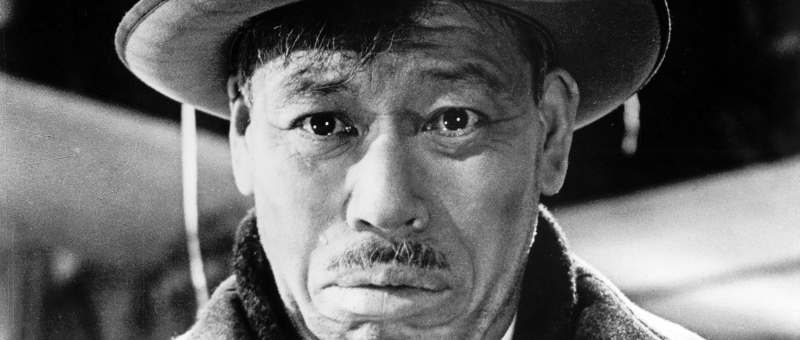
As the opening voice over reveals to to us, Watanabe (Takashi Shimura) is man who died long ago or perhaps has never truly been alive. In some senses, he is nothing more than an embodiment of the seal he uses to stamp documents day in day out, a mere piston in an ever turning machine of relentless bureaucracy. A young woman, Miss Odagiri (Miki Odagiri), working in the Public Affairs department loudly reads out a joke someone has written about their boss, Watanabe, who has taken not a single day’s holiday in 30 years suggesting that it’s less that he fears city hall will grind to a halt without him than they’ll suddenly figure out city hall has no need of him at all. The irony is city hall does indeed grind to a halt in Watanabe’s absence as he, unthinkably, fails to turn up for work for days on end as the papers pile ever higher on his desk. “Nothing moves here without his seal” one of the workers admits, bewildered by this sudden break with protocol while salivating over its implications in the possibility that Watanabe’s chair may soon be empty. 

Yet Watanabe’s crisis is that he’s realised he’s wasted his life on a pointless bureaucratic career that’s done little more than keep a roof over his head. Even the roof is a fairly modest one and it’s clear that his grown up son Mitsuo (Nobuo Kaneko) considers him to be a stingy old miser, unable to understand why he’s never spent so much as a penny on himself and lives in a kind of self-imposed austerity. Perhaps to Watanabe this is what constitutes properness. He’s done everything he was supposed to do, got a steady job at city hall and eventually became the head of department, but now he feels foolish and lonely. Mitsuo and his wife seem to resent him and talk openly about their plans to use their inheritance, along with Watanabe’s retirement bonus, for a downpayment on a “modern” home the polar opposite of the pre-war townhouse where the family continue to live. 

Mitsuo and Kazue (Kyoko Seki) are perhaps emblems of the increasingly empty consumerism of the post-war era, emotionally disconnected from Watanabe and seeking only the flashy and new. Miss Odagiri, the young woman from work, immediately says that she’d love to live in a home like Watanabe’s rather than the crowded multiple occupancy flat she currently inhabits with her family. Cheerful and outgoing, Odagiri is on the other hand a symbol of a new generation that wants something more out of life than simple material comfort and might even be willing to trade it for a small amount of happiness. Having worked at city hall for all of 18 months, she decides that she just can’t take it anymore and is quitting to get a job in a factory making toy rabbits that she says allow her to feel as if she’s making friends with all the babies in Japan. 

To that extent, Watanabe is himself also a baby craving Odagiri’s company admitting that he envies her youth and vitality in realising he squandered his own and will never get it back. How uncomfortable it must be for her, their final meeting in a restaurant sandwiched between a loving couple and teenage girl’s birthday party as Watanabe, gaunt and shrunken, claws at the air and begs her to help him live. Yet even within the grotesquery the tone is ironic, the strains of “Happy Birthday” accompanying Watanabe down the stairs as a the high school climbs up to meet her friends signalling his (re)birth as a man with purpose and determination. Just as Odagiri had found meaning in the rabbit, Watanabe finds it deciding to get a playground built over a post-war swamp in the slums filled with raw sewage and mosquitos that left the local children ill. 

Yet children’s parks aren’t particularly profitable which is presumably why the petition to build one had been kicked all round city hall in the infernal wheel of bureaucracy in which Watanabe too is trapped. “You call this democracy?” one of the women bringing the petition asks, taking the clerk to task complaining that all they do is fob them off insisting it’s someone else’s responsibility to help while determined only to guard their own turf. “You’re not supposed to do anything at city hall” someone ironically adds, “the best way to protect your place in this world is to do nothing at all”. Watanabe did nothing at all for 30 years and it got him nowhere, his dedication to his job disrupting his relationship with his son though Watanabe is ironically one of the most emotional men and engaged fathers seen on screen in the post-war era. 

After his death, in the park he helped build for which the deputy mayor has taken credit, his colleagues put him on trial at the wake trying to work out why he did it and whether or not he even knew he was dying seeing as he told no one close him not even the son whom he felt he could no longer trust. They deny his role while both praising and condemning his passion as somehow improper, disrupting the dispassionate rhythms of the bureaucratic machine with human emotion. It was only coincidence, they say. The deputy mayor wanted an election and the yakuza wanted to turn the swamp into a red light district. “Did he think he could just build a park?” someone adds, bemused by his effrontery as a man from Public Affairs straying into the Parks Department’s territory. You have to protect your turf after all. Finally moved by Watanabe’s last ditch bid to make his life mean something, to feel alive and know he has lived, the the drunken salarymen, all but one who retreats to look at Watanabe’s photo above the altar, swear to follow his example. 

But of course the bureaucratic wheel keeps turning, another dangerous sewage problem diverted to another department continuing the literal pollution of the capitalistic post-war society. A kind of ghost story, Kurosawa lights Shimura from below, shadows cast across his gaunt face even by his “rakish” new hat while his huge eyes have a somehow haunted, grotesque quality filled with hungry desperation. Yet it’s to childhood that Watanabe eventually returns, “perfectly happy” sitting on a swing singing a song from his youth about the price age while surrounded by snow and at last painfully, absurdly alive. 


Ikiru screens at the BFI Southbank, London on 4th & 15th February 2023 as part of the Kurosawa season.

Original trailer (English subtitles)

High and Low (天国と地獄, Akira Kurosawa, 1963)

A self-made man is landed with an unthinkable dilemma when his chauffeur’s son is kidnapped in place of his own just at the moment he’s staked his entire fortune on a manoeuvre to outsmart cynical executives set on taking over his company in Kurosawa’s post-war crime film, High and Low (天国と地獄, Tengoku to Jigoku). The movie’s Japanese title, Heaven and Hell, might hint more strongly at the growing economic disparities in the era of the economic miracle but also at the dualities embodied in the hero’s choices. “Success isn’t worth losing your humanity” his wife tells him, but he still struggles with the validity of choosing his heart over his head knowing that to pay anyway even though it’s another man’s son means financial ruin, the final question being if he is really prepared to allow a child to die simply to maintain his own wealth and status. 

The problem is that Gondo (Toshiro Mifune) has attempted to mount a rebellion against the evils of consumerism, incurring the ire of the cynical executives who attempt to get him on their side in their attempt to oust the boss whose outdated ideas are running the business into the ground. Though Gondo appears sympathetic, hinting that he might be interested if there’s a good enough promotion in it, he later tells them where to go on seeing that their business plan is to start producing poor quality disposable footwear. Gondo started on the factory floor and he doesn’t want to put the company’s name on such shoddy produce nor does he think that their admittedly fair point that if the shoes are well made and last a long time no one will need to buy any is a good way to do business. He doesn’t think the boss is right either and wants to make shoes his own way which is why he’s remortgaged the sizeable mansion he owns on top of a hill overlooking the city and has pretty much run through his wife’s dowry to buy a majority stake in the company.

On top of a hill is a good place to live if you want a good vantage point to oversee the land below, but while you’re looking down others look up and not all of them kindly. Gondo is as he says a self-made man, but also out of touch with contemporary society and not so far from an ambitious courtier always after a little more. He says it isn’t about getting the top job but getting shoes made right, but it seems he too had been bitten by the consumerist bug and is otherwise unable to affirm his status without material proof. When he thinks it’s his own son that’s been kidnapped, he’d have given it all away but when it’s the driver’s boy it’s a different question. Shinichi (Masahiko Shimazu) isn’t his responsibility and as he points out there are plenty of other wealthy men, why is he the only one to pay? While his wife (Kyoko Kagawa) tearfully urges him to do the right thing, his assistant (Tatsuya Mihashi) tries stop him, insisting he should take the sizeable cheque they’ve had drawn up to Osaka and the stakeholder he’s buying the shares from. 

While he vacillates, the driver, Aoki (Yutaka Sada), is humiliated and forced into servitude. Gondo seems to have the old-fashioned idea that the kidnappers would simply let Shinichi go on realising they’ve got the wrong boy and his father can’t pay, but Aoki knows there’s nothing he can do to save his son but throw himself on Gondo’s mercy. He falls to the ground and prostrates himself, but later retracts all telling Gondo it doesn’t matter, that he hadn’t realised what he was asking of him, and insisting that Shinichi is a bright boy who will look for a chance to escape on his own. Once the boy is returned he treats him harshly, interrogating him about anything he might have forgotten and later driving him around looking for the hideout where he was kept in an attempt to do something and repay the debt he now feels he owes to Gondo by helping the police retrieve the money Gondo eventually agreed to pay for him. 

In agreeing to give up the money, Gondo is in a sense unburdened knowing he has made the right choice and realising that he would never live a comfortable life in that house if cost a child’s life to keep it. Part of his rationale for not wanting to pay had been that though he had been poor before and might be again, his wife had not been and does not truly understand what it is to live in poverty much as she says her life of luxury means nothing to her. She has never wanted for anything, after all. As for the kidnapper, Ginjiro (Tsutomu Yamazaki), we know little of his motives save for his intense resentment living quite literally in the shadow of Gondo’s mansion and feeling as if it were mocking him. Then again, though his life is hard Ginjiro already had a path to success in that he would soon have completed his medical studies implying at least that he or someone else was able to cover his tuition and costs of living, that he was able to continue in education, and really had no need to take such drastic action in rebellion against the antagonistic capitalism of the post-war society. “Do you think we have to hate each other?” Gondo asks him, but Ginjiro has no answer only his intense resentment for everything he represents.

The “hell” that Gondo inhabits is a backstreet wasteland peopled by the hopeless. Tokura (Tatsuya Nakadai), the earnest policeman, follows him through thronging clubs and on into “dope alley” where Ginjiro picked up his accomplices so desperate to escape their suffering that they’d agree to help him kidnap a child. Though it costs him his job, Gondo decision to do the right thing makes him a national hero, the working class millionaire who mows his own lawn and can still knock up a pair of shoes should the occasion call while women across the country decide to boycott the company in protest at his treatment. Ginjiro can only howl like a caged animal while facing a death sentence for the coldblooded murder of his accomplices. The light bouncing off his mirrored sunshades gives him an eerie supernatural quality, a demon arising from depths of hell to wreak havoc in heaven but finding only infinite tragedy in the contradictions of the consumerist post-war society.


High and Low screens at the BFI Southbank, London on 19th January 2023 as part of the Kurosawa season.

Original trailer (English subtitles)

The Creature Called Man (豹は走った, Kiyoshi Nishimura, 1970)

By the late 1960s, Japan had more or less achieved its economic miracle yet there was still a degree of political tension manifesting itself in a second round of widespread protests towards the automatic renewal of the security treaty with the Americans in 1970. The third feature from Kiyoshi Nishimura, The Creature Called Man (豹は走った, Jaga wa Hashitta) anticipates the cinema of paranoia which was to take hold in the 1970s but as confused as its internal politics sometimes are, reflects the continuing sense of dissatisfaction in the wake of the student movement’s failure in its attempt to critique ongoing complicity with American foreign policy in Asia as well as Japan’s checkered geopolitical history. 

As such, Nishimura opens with hand-coloured stock footage of civil unrest in an Asian nation while the accompanying voiceover features protestors chanting “down with Jakar”, later revealed to be the ousted dictator of “Southnesia”, seemingly a stand-in for the recently assassinated Sukarno of Indonesia. As opposed to the rather pompous English title, the Japanese is simply “Jakar got away”, a phrase repeated during the opening titles and which appears as “Jaguar got away” on a typewriter sitting above the Japanese title in red which uses the character for leopard in place of Jakar’s name. In fact, animal codenames will later become something of an ironic motif with the hero referred to as a German shepherd while his rival brands himself a wolf and is referred to by his handlers as the black panther. 

This slightly tongue-in-cheek use of spy movie cliche is in keeping with the brand of humour often found in Toho’s ‘60s spy spoofs though this is largely a much more serious affair if one with an undercurrent of absurdity. The hero, Toda (Yuzo Kayama), is an Olympic sharpshooter working for the Tokyo police before he is abruptly asked to resign so that he can take part in a “special mission” which turns out to be as a backup bodyguard for Jakar who has been smuggled out of his home nation and intends to defect to America which has, it is implied, been backing his regime as a bulwark against communism in Asia while his rise to power was facilitated by Japanese soldiers who stayed in the country after the war. He’s supposed to be staying for a few days in a top hotel while the Americans figure out the paperwork for him to seek asylum at their embassy but the top brass are worried the revolutionaries might try to assassinate him on Japanese soil which would be very bad for diplomatic relations and potentially create political instability across the continent. 

As Toda later says, he’s just doing his job (even though he’s technically no longer a policeman), so he doesn’t give much thought to the wider political context of his actions only concentrating on preserving a man’s life no matter now steeped in blood that life might be. Meanwhile, a duplicitous corporation, Dainihonboeki (lit. Great Japan Trading) is attempting to cut some shady deals apparently having facilitated Jakar’s escape but now frustrated that the Revolutionary Government won’t honour their contracts for military equipment and so is offering to help assassinate him to prevent his forming an alternative government in exile and creating additional problems for the new regime. 

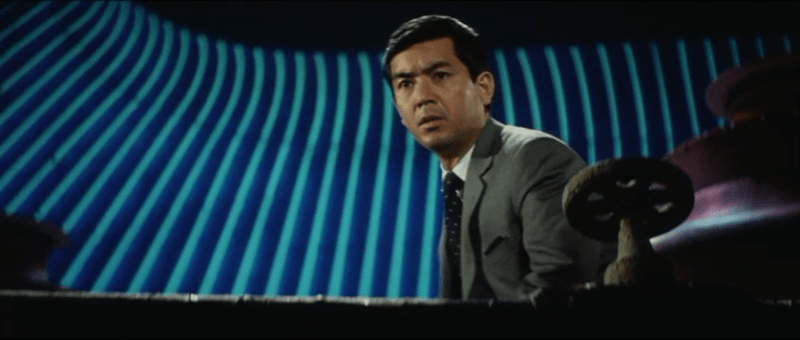
Kujo (Jiro Tamiya), the killer for hire, and the dutiful policeman Toda are exposed as two sides of the same coin, Toda later killing an innocent woman mistaking her for a member of the conspiracy against Jakar only to later learn she is in fact a war widow whose fiancé was an American GI killed in Vietnam. Her exaggerated death sequence filmed with expressionist flare in mimicking that of a soldier gunned down in battle. The two men face off against each other in what is essentially a battle of wits, Toda not taking aim at Kujo but anticipating his plan and foiling it before it takes effect. Leaning in to the Toho spoof, there is considerable absurdity in their machinations, waiters falling to the ground after the rope they were climbing to sneak in through a window is shot through, or sex workers brought in to shine a guiding light towards the target, but there’s a lot of blood and terror too not to mention some sleaze and a general sense of nastiness. Once the Jakar matter is concluded, the men still have a score to settle, facing off in a one-on-one duel in a disused aircraft hangar firing potshots at each other from behind various pieces of military equipment their life and death struggle shot in elegant slow motion until they each collapse into the swirling dust in a moment of nihilistic futility as another civil war quietly brews in Southnesia precipitated by their actions. 

Strikingly composed capturing the neon-lit nightscape of an increasingly prosperous Tokyo filled with the shining lights of new corporate entities and scored with noirish jazz and occasional flights into expressionism, Nishimura’s paranoid political thriller takes aim at a new world of geopolitical instability while making villains of amoral capitalists and indulging in a mild anti-Americanism but most of all is a tug of war between a hitman inconveniently regaining his humanity and a policeman temporarily abandoning his in questionable national service. 


Early Spring (早春, Yasujiro Ozu, 1956)

By the mid-1950s, Japan’s economy was beginning to improve but now that the desperation that went with hunger had dissipated it freed those who’d managed to climb out of post-war privation to wonder just what the point of their ceaseless toil was. Yasujiro Ozu’s primary subject matter remained the modern family, but 1956’s Early Spring (早春, Soshun) sees him heading in a darker direction as he weighs up the delusions of the salaryman dream and discovers that whichever way you swing it, life is disappointing. 

So it seems to be for salaryman Shoji (Ryo Ikebe). He and Masako (Chikage Awashima) married for love a long time ago, but it’s clear that there is distance in their relationship. They sleep in the same room but their futons are slightly too far apart, and the few words they exchange with each other in the morning are terse in the extreme. The truth is that for many a salaryman for whom long hours and interoffice bonding sessions are compulsory, work is the new family. Wives are welcome to join the Sunday hiking outings but it seems few do. Masako too declines, telling her mother she felt it to be too expensive, already irritated with her husband’s irresponsible spending on mahjong games and drinking with friends. 

Money is certainly a constant worry for her and as we learn from her mother they’re behind on the rent despite it being “very cheap”. Masako had made a visit home in part to ask for another loan, which her mother seems reluctant to give, offering her daughter a takeout of the oden her restaurant sells which is first declined but then accepted. Her mother also flags up the other problem in their marriage which is that they sadly lost a child in infancy and have had no more. Sorrow may have killed their love, but the fact her husband stays out all hours and wastes the little money he earns while failing to win promotions only makes the situation worse. 

As for Shoji, he is becoming very aware of the delusions of the “salaryman dream”. He is one of thousands of men identically dressed in white shirts and grey trousers that board the packed rush hour trains every day heading into the city. His life is one of pointless drudgery and its only victory is that keeps hunger from the door, not even quite stretching to a roof over his head. “All that’s waiting for us is disillusion and loneliness” according to a veteran salaryman growing close to his retirement and realising that he has little left to live on, his dream of buying a small stationary shop all but unobtainable. He was dead set against his own son joining the ranks of the salaryman, but in the end failed to prevent it.

It is perhaps this sense of frustration and impotence that draws Shoji into an affair with a younger woman, Chiyo (Keiko Kishi), who is admittedly very pretty but seems to hold little interest for him aside from her youth and beauty. Chiyo openly pursues her older colleague, declaring that she doesn’t care he has a wife but has come to hate her after the first time they slept together. Shoji meanwhile remains guilty and conflicted. He evidently continues seeing Chiyo, lying to Masako that he’s visiting a sick friend, but otherwise regards her as an irritation. When his co-workers figure out what’s going on they try to stage an intervention, but Shoji doesn’t show up and Chiyo angrily denies everything before arriving at Masako’s looking for Shoji only this time he really is out visiting a sick friend. 

Miura (Junji Masuda), the sick friend, is a true believer in the salaryman dream. Now that he’s ill, he misses the packed trains and elevators, not to mention his old workplace friends. All he wants is to be well enough to return to the office and his predicament perhaps has Shoji thinking that at least he has his health and things aren’t so bad for him after all. Masako, meanwhile, turns to other women for advice. The woman across the way recounts how she caught her husband out with his mistress and made a scene that’s rendered him docile and obedient ever since (a rare man in an Ozu film putting his socks neatly in the laundry basket and hanging up his own coat rather than throwing it on the floor for his wife to deal with). Her widowed friend is more sanguine, admitting that caution is necessary but it’s a little dark to envy the life of a widow for its “freedom”, while her mother thinks she’s overreacting because that’s just how men are in this generation or any other. 

Shoji’s old mentor agrees that “everyone’s disappointed” and all that remains is to try and make the most of it, but still he sees that Shoji has been reckless and inconsiderate in his treatment of both women. He avoids his wife because of the emotional distance between them born of grief, and only really has an affair with Chiyo because it was easier than refusing her. He didn’t even enjoy it, and doubtless it did not quite quell the sense of despair he feels with the utter pointlessness of the “salaryman dream”. Masako, in turn, is disappointed with married life, with her husband’s emotional cowardice, and with her own lack of options. Ultimately, Ozu sides with the mother, not quite condoning Shoji’s behaviour while perhaps excusing it as a direct consequence of dullness of his life while forcing Masako to accept complicity in her husband’s weakness. They may reunite, the stressors of their Tokyo life from the high cost of living to the lure of mahjong now absent, but there is a sense of futility in their eventual insistence that they will “make it work” through starting over in a new place while gazing at the train that, they assume, will eventually carry them back to the city and all of its false promises of a brighter future. 


Early Spring screens 19th/20th/21st October & 20th/23rd November at London’s BFI Southbank as part of BFI Japan. It is also available to stream in the UK via BFI Player and in the US via Criterion Channel.

The Beast Shall Die (野獣死すべし, Eizo Sugawa, 1959)

“He’s not a beast. No, he’s a robot. A machine created by a modern, twisted society” according to a frustrated policeman acknowledging that a sociopathic killer is going to get away with his crimes because when it comes right down to it he’s just that good. Eizo Sugawa’s The Beast Shall Die (野獣死すべし, Yaju Shisubeshi) is the first of several adaptations of the hardboiled novel by Haruhiko Oyabu, Sugawa would himself direct a “sequel” 15 years later while a better-known version would prove a hit for Toru Murakawa in 1980 with action star Yusaku Matsuda in the leading role, and a two-part V-cinema adaptation would follow in 1997. The 1959 edition however is very much an expression of the anxiety of its times, a slightly reactionary take on the post-Sun Tribe phenomenon hinting at a generational divide between the nihilistic, hyper individualist post-war generation and their confused though morally compromised forbears. 

As the film opens, three policemen meet in a pub one of whom proudly shows off a Robby the Robot toy he’s picked up for his young son and is intending to give him on returning home from work. Sadly, however, Okada (Akira Sera) will never make it home because, for largely unexplained reasons, he is shot dead by nihilistic American literature student Date (Tatsuya Nakadai) who bundles the body into the boot of a car which he then simply abandons. Date never reveals much of a motive for this first murder, but he does later use Okada’s warrant card and service weapon to facilitate later crimes. 

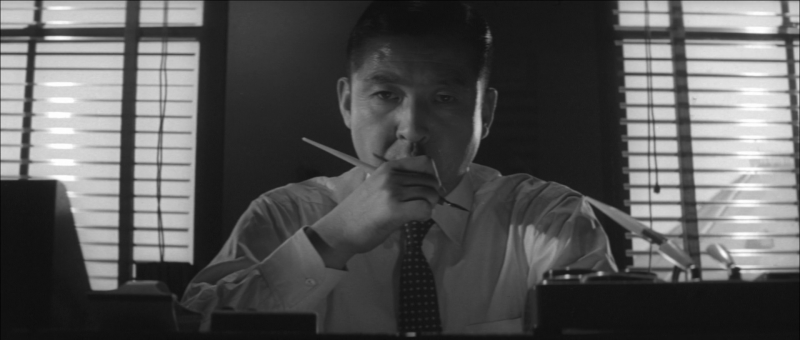
The problem, at least for earnest policemen Kawashima (Eijiro Tono), a veteran cop and father of seven, and idealistic rookie Masugi (Hiroshi Koizumi) who is engaged to barmaid Yoko (Yumi Shirakawa) but drags his feet over the marriage because of his precarious life as a law enforcement officer, is an ideological divide within the contemporary police force. “Investigations are about science. And science is the best” according to their boss, reflecting a new faith in forensics prioritising physical evidence from the crime scene over a policeman’s intuition. From a modern perspective, this seems to be the right call though Kawashima and Masugi appear to find it both restrictive and mildly insulting as if their experience on the job now counts for nothing. They also worry that such rigid thinking prevents thorough investigation, and they might have a point in the boss’ continued insistence that the crimes must be down to “gang activity” even though the evidence clearly points at someone connected to the university or perhaps a disgruntled salaryman with access to the uni gun club. 

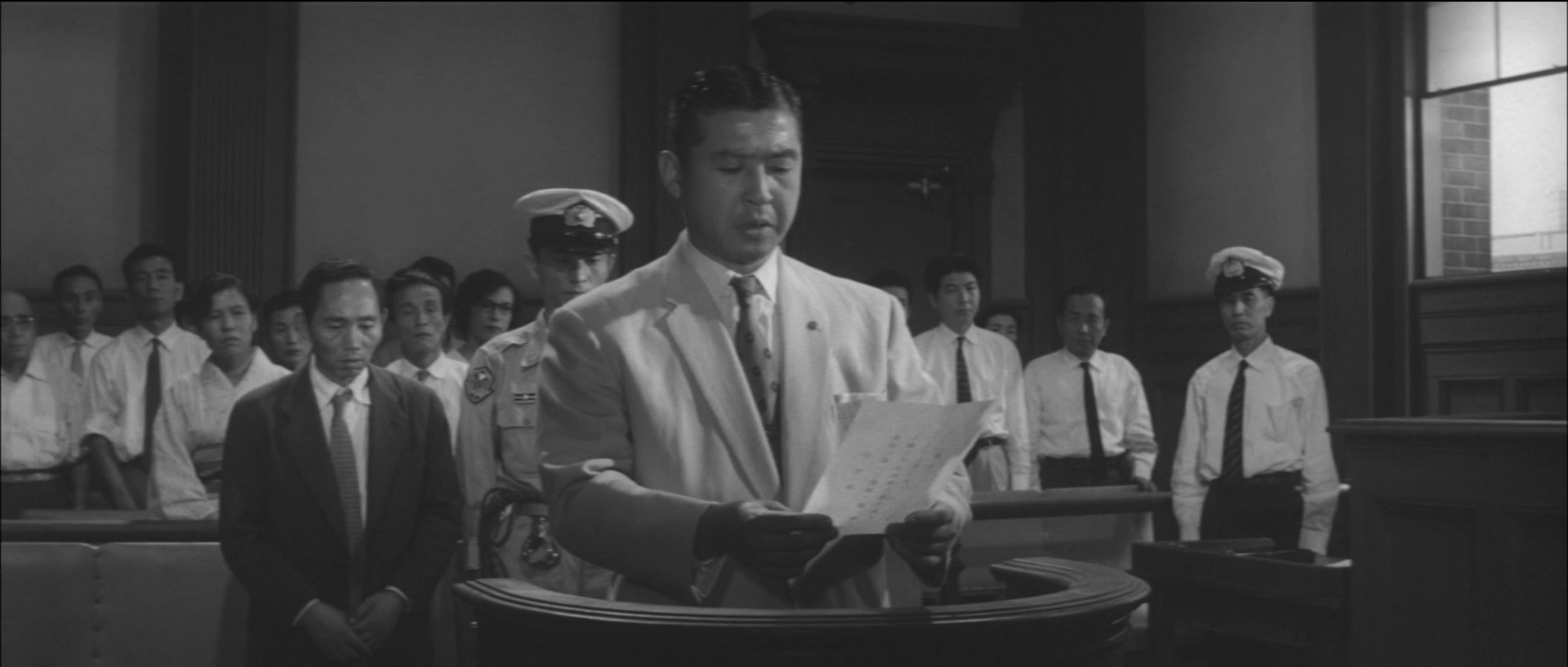
Kawashima and Masugi lament that they feel powerless to act because they don’t have the right to arrest someone on the basis of a “hunch”, and the film seems to agree with them as Date continues to commit his crimes unbothered by law enforcement though really who wants to live in such an authoritarian society that the police can haul you in solely because they think there’s something odd about you and “feel” you must be guilty of a crime even in the absence of conclusive evidence? Nevertheless it’s precisely these ideological divides that Date wilfully exploits while planning his hits, his second targets also reflecting the continuing Sinophobia of post-war cinema in impersonating a police officer to rob, but interestingly not kill, a pair of Chinese gangsters running an illegal gambling racket. 

Hearing Date’s back story, we realise that society has in a sense warped him in witnessing an injustice done to his father which later led to his suicide while his mother was apparently engaging in an affair with the man who framed him. He strongly argues that the only response to the “chaos, madness, and contradictions” of the modern society is to “show our beastly nature”, wilfully abandon humanistic morality and conventional civility in favour of an individualistic satisfaction of one’s personal desires above all other concerns. Date is certainly an amoral man who has no problem with sacrificing those he determines to be lesser beings for his own gain, but as even Masugi reveals his thinking may not be out of line with that of his generation. Many people are driven to murderous rage, he argues, but do not act on it because of a social taboo. 

As the film opens, a group of left-wing students is holding a rally in support of the anti-ANPO protests ahead of the treaty’s imminent renewal, though the professors mock them from inside insisting that their politics is not genuine only a reflection of the despair they feel in their society knowing that even if they graduate all that awaits them are low-level salaryman jobs with little promise of advancement. Those who can’t even manage that, they joke, turn to academia. Date’s professor (Nobuo Nakamura) affects sympathy with his poverty but also wilfully exploits him, getting him to do translations of novels which will later be published under his own name while it seems to be an open secret that he owes much of his success to the fact that he married into a prominent family which allowed him to spend five years studying abroad in America. 

Meanwhile, his students philosophise on the psychology of crime insisting that a “robotic, truly ruthless personality” can only come from a “mechanistic society like the US” while Japanese criminals are generally “emotional” in that crimes are committed because of “love affairs, resentment, finances”, “petty humanistic motives” which society can easily understand if not exactly condone. Date, admittedly a student of American literature with his eyes firmly set on going abroad, entirely disproves this theory. His crimes appear to be dispassionate and committed largely for practical reasons, the later ones at least with money as the motive even if he also derives a thrill from his amoral rebellion against the system. His poverty is offered as a justification yet we also see him abuse and manipulate those weaker than himself, humiliating an old lady trying to sell flowers in the bar where Yoko works while later talking a fellow student suffering with TB and unable to pay his tuition into helping him commit a robbery. 

Perhaps in someways uncomfortably in continuing a motif associating homosexuality with sadistic criminality, it’s also heavily implied that Date is bisexual, encountering an effeminate young man on the street with whom it is clear from their conversation he has previously been intimate to later use him as cannon fodder when engaging in a firefight with Chinese gangsters, while there is also an obvious homoerotic charge to his relationship to the student who later becomes a temporary accomplice. His relations with women are somewhat caddish and perfunctory, his sometime girlfriend Tae (Reiko Dan) telling the police that Date is a player who only sleeps with the same woman three times before becoming bored with her. Date’s attitude, though interestingly enough not his crimes, may reflect a societal misogyny, impoverished medical student Tae later refused access to the morgue because it’s not something a woman should see, though Tae herself later claims that it’s Date’s coldness and cruelty that draw her to him. Seemingly unable to feel genuine emotion for others, it nevertheless appears that Date is in a sense moved enough by Tae’s ability to embrace his inner darkness to eventually decide to alleviate her poverty on realising he no longer needs his ill-gotten gains because he’s secured his passage to America through more legitimate means. 

A reaction to the post-Sun Tribe sense of moral panic about disillusioned post-war youth, The Beast Shall Die suggests that for the moment at least those like Date are in an unassailable position thanks to an overly liberal justice system as the two policemen lament their inability to prevent his escape through judicial means while turning their attention to Tae though there’s no real way they can know that Date gave the stolen money to her rather than taking it with him or depositing it in some other location even if she’s walking around with an ugly handbag that might be full of cash. Alternating between an acceptance of Date’s nihilistic, crypto-fascist philosophy in implying that those who obey the rules of civility are doing so solely because they are too weak to break them, and advocating for a more authoritarian society in which policemen are free to act on their “hunches”, Sugawa’s take on Oyabu’s hard boiled tale of societal corruption and warped post-war morality has its reactionary qualities even as it ends on a note of ambiguity that implies order will eventually triumph though not, it seems, today. 


Original trailer (no subtitles)