Phantom of the Toilet (トイレの花子さん, Joji Matsuoka, 1995)

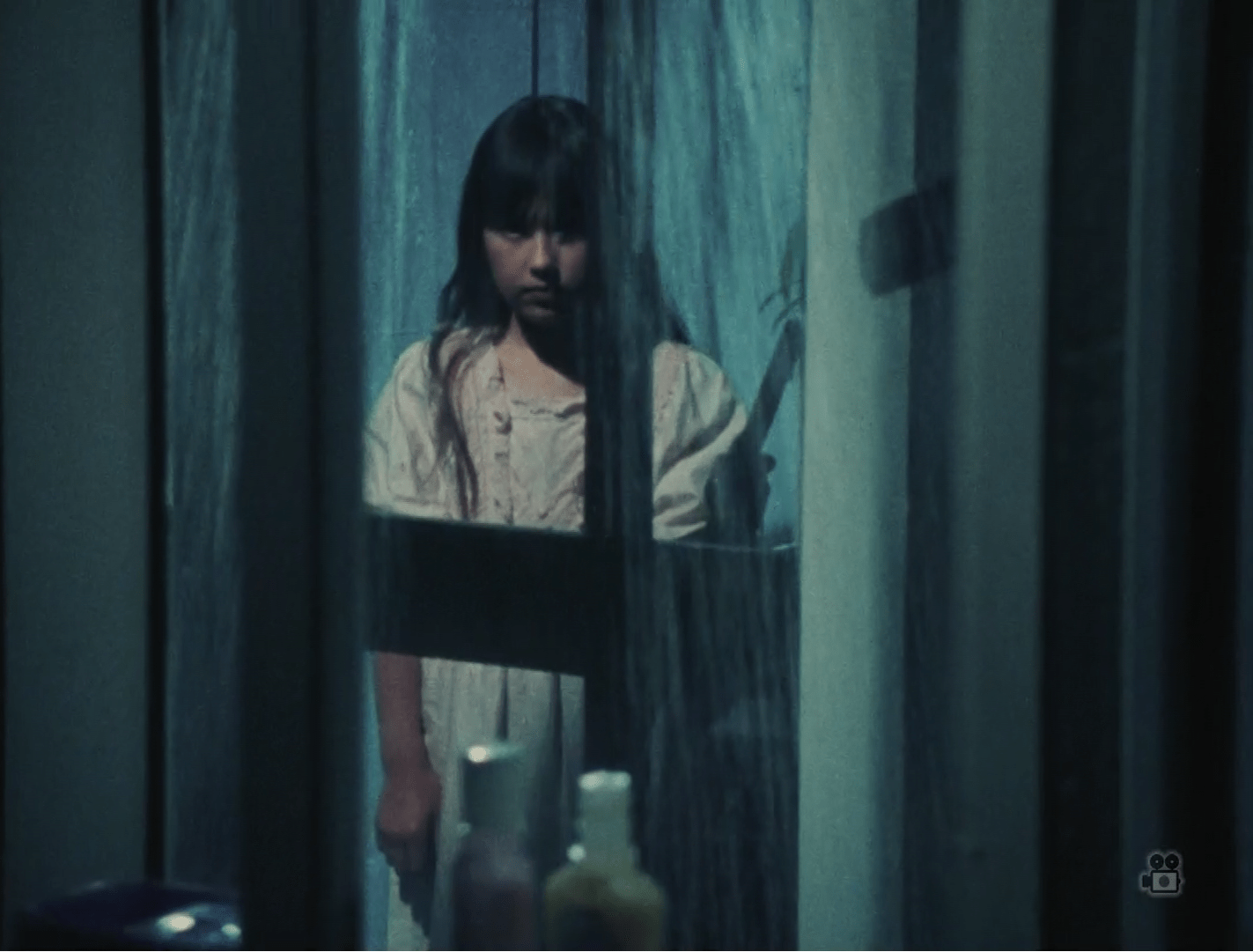
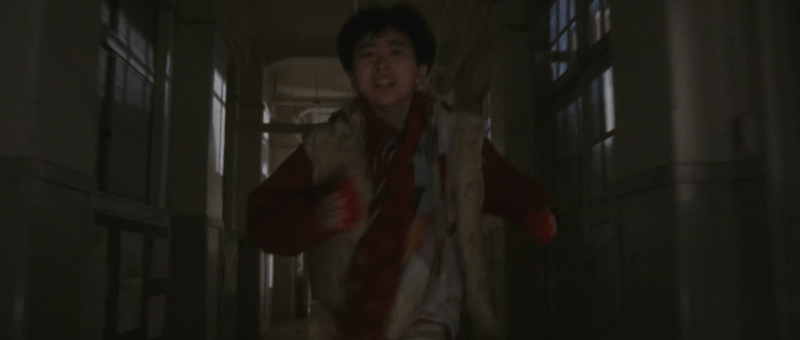
A transfer student quickly becomes the magnet for the anxieties of her classmates amid an ongoing spate of serial murders of primary school children in Joji Matsuoka’s kids adventure movie Phantom in the Toilet (トイレの花子さん, Toiret no Hanako-san). Loosely inspired by the classic urban legend about the ghost of a little girl who haunts school toilets, the film is less a horror movie than a tale of bullying, mass hysteria, and the ways in which childish emotions can spiral out of control.

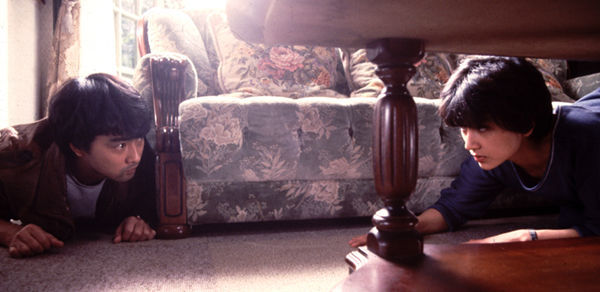
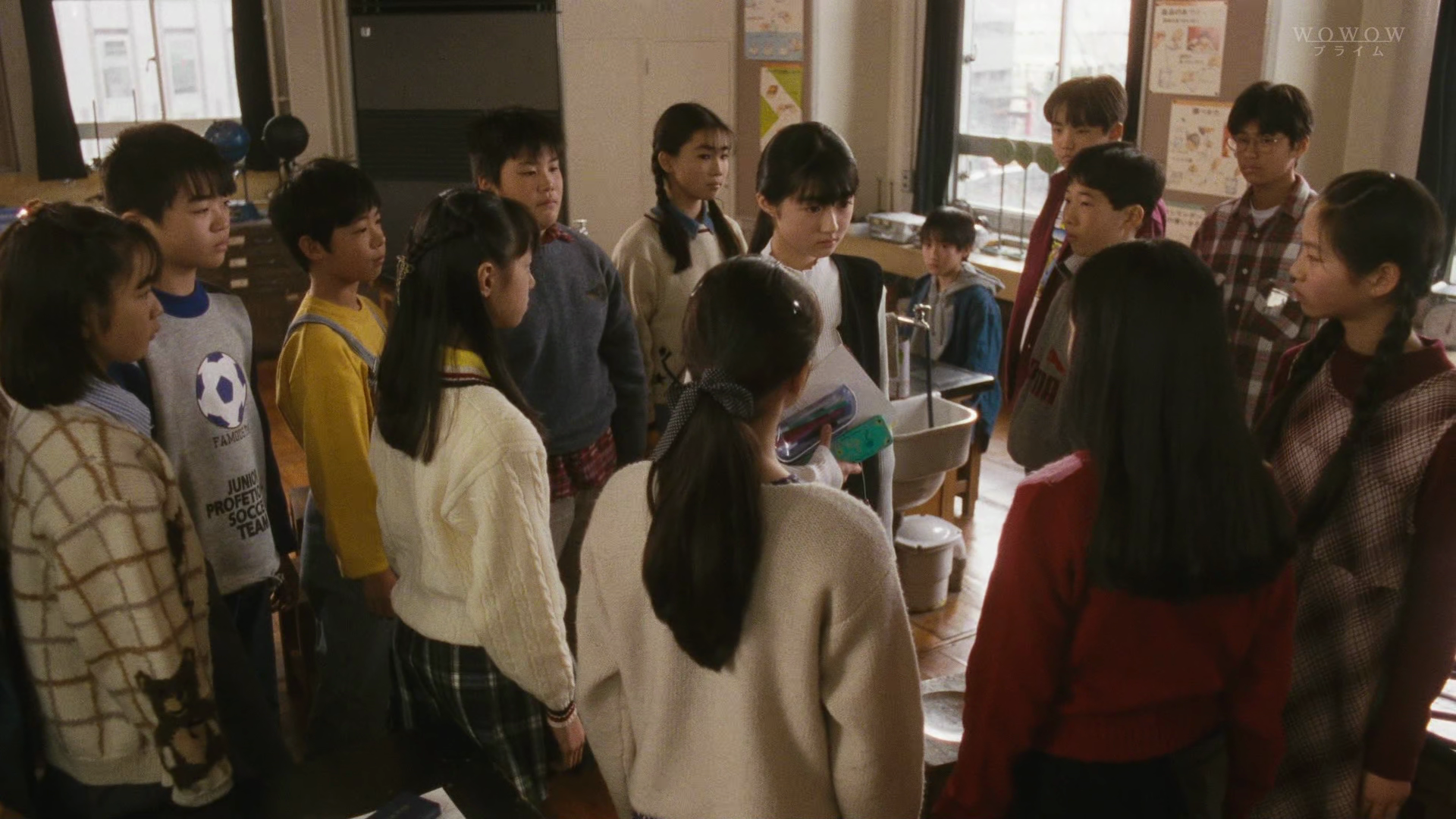
Natsumi’s (Ai Maeda) no stranger to that herself. A tomboy, she’s largely excluded from the group of popular girls at her school and exists in a rather liminal space. Her older brother Takuya (Takayuki Inoue) is in the year above, but predictably doesn’t like being bothered by his little sister at school and is for some reason embarrassed by the fact his widowed father is a milkman. Nevertheless, he’s incredibly earnest and righteous and volunteers for various things at the school like the student council. Natsumi’s problems begin when the popular girls insist on doing a Ouija board to find out the identity of a serial killer who’s already killed two children their age from different schools. Natsumi doesn’t realise that it’s a trick the other girls are playing on her, but the Ouija board says the killer is Hanako, the toilet ghost, and Natsumi is the next victim.

Meanwhile, a new girl joins their school in Takuya’s class and is immediately resented by the popular girls because she’s pretty and clever, so obviously they turn against her. Chief among the complaints against Saeko (Yuka Kono) is that she used the cubicle at the end of the girls’ toilets which supposedly belongs to Hanako, because obviously she doesn’t yet know this bit of school lore. After a series of odd things happen, including the murder of the school’s pet goat, everyone comes to the conclusion that Saeko must be possessed by Hanako and is planning to murder them all. Even Natsumi has her doubts, but eventually decides to defend Saeko while Takuya, who seems to have a crush on her, eventually gives in to peer pressure despite his promises to protect her and vision of himself as someone who does the right thing.

To that extent, it isn’t really Hanako that haunts the children so much as the idea of her is misused as a means of social control. A silly rumour soon gives way to mass hysteria as the popular girls bring more of the children over to their side to gang up on Saeko while the teachers are largely absent or oblivious. While in another film the kids might band together to look for the killer of the other children and thereby protect themselves and each other, instead they become ever more paranoid and the outsider figure of Saeko becomes the focus of all their negative emotions from the jealousy of the other girls to the uncertainness of Takuya who doesn’t know what to do with his confusing feelings for Saeko. In a touching moment, he replies via writing on the blackboard rather than speaking when Saeko uses it to communicate with him after losing her voice, but later ends up shouting at her to go away and leave him alone. “Silence means you agree,” one his classmates points out when Takuya attempts to abstain from an otherwise unanimous vote to subject Saeko to a kind of test akin to a ducking stool to prove whether or not she really is Hanako. Only Natsumi remains on her side.

Meanwhile, the real child killer hovers in the background like an abstract threat before finally invading the school like a refugee from a slasher movie. Swinging his scythe around, his crazed moaning may prove too prove frightening for younger audiences while not even Natsumi’s father and their teacher can stop him from murderous wandering. In the end, the “real” Hanako surfaces but as a more benevolent figure who calls the kids back to the school and creates a more positive sense of mob mentality as they all shine their torches on the killer as if confronting him with what he is and what he’s done. The curse itself is lifted as the other kids rally round to save Saeko and finally accept her as one of them. A charming exploration of a 90s childhood from Grandpa playing Nintendo shogi to the looming anxieties of stranger danger, the ultimate message is one of solidarity and friendship as Hanako helps the kids let go of their petty disagreements to confront the real monster and save each other.


Trailer (no subtitles)
The Man Without a Map (燃えつきた地図, Hiroshi Teshigahara, 1968)

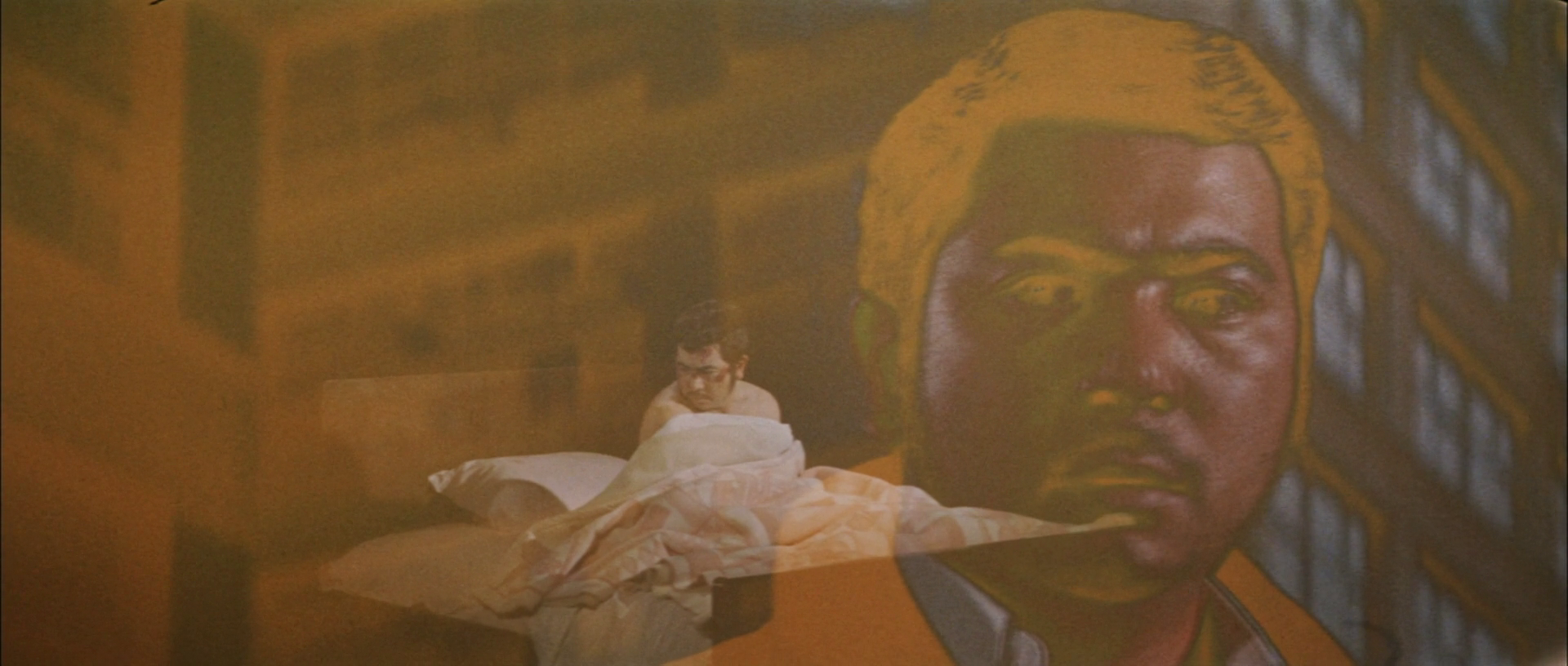
Hired to find a missing person no one really wants found, a detective begins to chase his own tail amid the impersonal vistas of the contemporary city in Hiroshi Teshigahara’s The Man Without a Map (燃えつきた地図, Moetsukita chizu). The fourth and final in his series of Kobo Abe adaptations and the only one in colour, the film’s Japanese title “burned-up map” may also, in its way, refer to the city of Tokyo which appears blurred out and indistinct in the sepia-tinted opening and is thereafter frequently shot from above as a depersonalised space where anonymous cars shuttle along highways like so many ants moving in rhythm with the momentum of the metropolis.

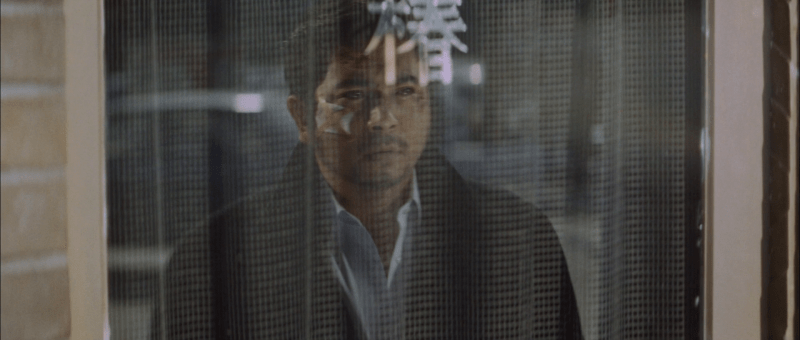
We follow a nameless detective (Shintaro Katsu) as he’s charged with investigating the disappearance of a 43-year-old salaryman, Hiroshi Nemuro, who turns out to have myriad other personalities and hasn’t been seen for six months. The man’s wife, Mrs Nemuro (Etsuko Ichihara), is not terribly helpful and the detective comes to wonder if the investigation itself is intended to further disguise the man’s whereabouts and prove that he really is a “missing person”. Yet this Tokyo is full of “missing people” including the detective who, we later learn, is a kind of fugitive himself. He apparently walked out on his wife (Tamao Nakamura), the owner of a successful boutique, because he couldn’t find his place there any more. He was once a salaryman too, and became a detective because it was the furthest thing he could think of from a regular job. 

It confuses him that no one really seems to be interested in where Nemuro is or if he’s alright, only in the reason behind his disappearance. The more he chases him, the more he begins to take on Nemuro’s characteristics as if he were intended to slide into the space Nemuro has vacated. Toru Takemitsu’s eerie harpsichord score only seems to add to the hauntingly gothic quality of this quest. The question is whether such a thing as identity even exists any more. The detective puts on Nemuro’’s jacket, though it’s too small, and is mistaken for him, while a colleague of Nemuro’s insists that he’s seen him in the street and is sure it was Nemuro simply because of the unusual colour of his suit without ever seeing his face. Tashiro (Kiyoshi Atsumi) tells the detective that Nemuro had a secret hobby taking nude photos at a specialist club that caters to such things. The two of them are confident they’ve identified the woman in the picture based on her haircut, but the girl they speaks laughs and takes off her wig explaining that she was merely asked to wear it, so the woman in the photo could be anyone, including Nemuro’s own wife.

Nemuro apparently had a series of hobbies for which he’d obtained certificates because he said that having them helped him to feel anchored in his life, though he’s apparently unmoored now. Like the detective, he may have been trying on different personalities from car mechanic to school teacher looking for the right fit and a place he felt he belonged in rebellion against the depersonalisation of the salaryman society in which one man in a suit is as good as another. The detective finds an opposite number in the missing man’s brother-in-law (Osamu Okawa), a very modern, apparently gay gangster connected with a network of male sex workers sold on to influential elites, and a commune of similarly displaced people working as casual labourers that is overcome with corporate thugs and eventually trashed.

The trashing of the commune may have something to do with a man named Maeda who is a councillor in a town no one’s heard of, but was possibly involved in some shady business over which Nemuro may have been intending to blackmail him or blow a whistle with the assistance of his brother-in-law who helped him land a big contract at work. The more the detective investigates, the more confused he becomes. It’s impossible to follow the case as we might expect in a conventional noir thriller, but we’re not supposed to be looking at Nemuro’s disappearance so much as the detective’s gradually fracturing sense of self as he becomes lost in the anonymous city. He sees himself bury Mrs Nemuro in leaves only for her body somehow reduce itself to its component parts and sink into the street. Later her face is superimposed on the buildings as if she were looking down on him while he is lost and alone. Nemuro’s face also appears on buildings, though more as a metaphor as if the salaryman and the office building were one and the same and the reason the detective can’t find him is because he doesn’t really exist as a concrete identity. The detective spots a dead cat in the road and laments that he never thought to ask its name, but will try to think up a good one later. He might as well be talking about himself, now displaced, unmoored, and pursued among the city streets, a man without a map lost amid the simulacrum of an imaginary city.


Hiroshima (ひろしま, Hideo Sekigawa, 1953)

During the post-war occupation of Japan which lasted until 1952, the censorship regulations which replaced those of the militarist era perhaps ironically made it more or less impossible to criticise the US presence or depict the extent of wartime devastation lest it raise hostility towards American forces or reinforce a feeling of victimisation. For this reason, images of the atomic bombings were tightly controlled and the events rarely referenced in mainstream media, Hiroshi Shimizu’s Children of the Beehive being a notable if brief exception. Once the occupation was over, however, many assumed it would become easier to broach such taboo subjects. 

Hiroshima native Kaneto Shindo’s comparatively better known Children of Hiroshima, inspired by the book Children of the A Bomb: Testament of the Boys and Girls of Hiroshima, was released in 1952 shortly after the censorship regulations were lifted and stars his later wife Nobuko Otowa as a teacher who returns to Hiroshima to visit the graves of her parents killed in the atomic bombing and thereafter several of the children from a nursery school she once taught at who have survived but continue to suffer in various ways due to their experiences. Despite Shindo’s well known leftist credentials, many including the Japan Teachers’ Union who apparently owned the rights to the book though there is some dispute as to their involvement in the production, were disappointed with the film which they felt to be an overly sentimental studio melodrama that was ultimately unhelpful in supporting the anti-war political movement or accurately representing the hibakusha community. 

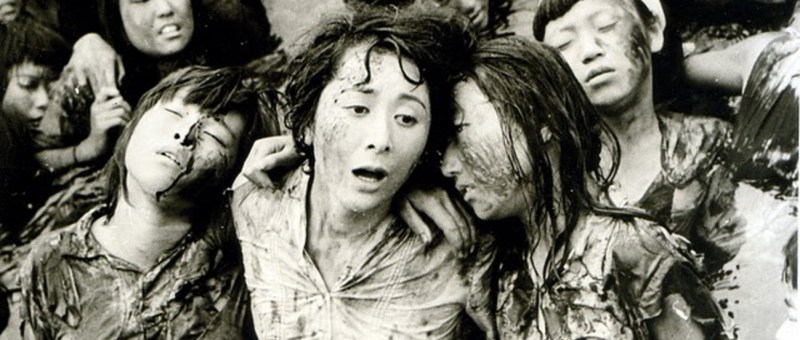
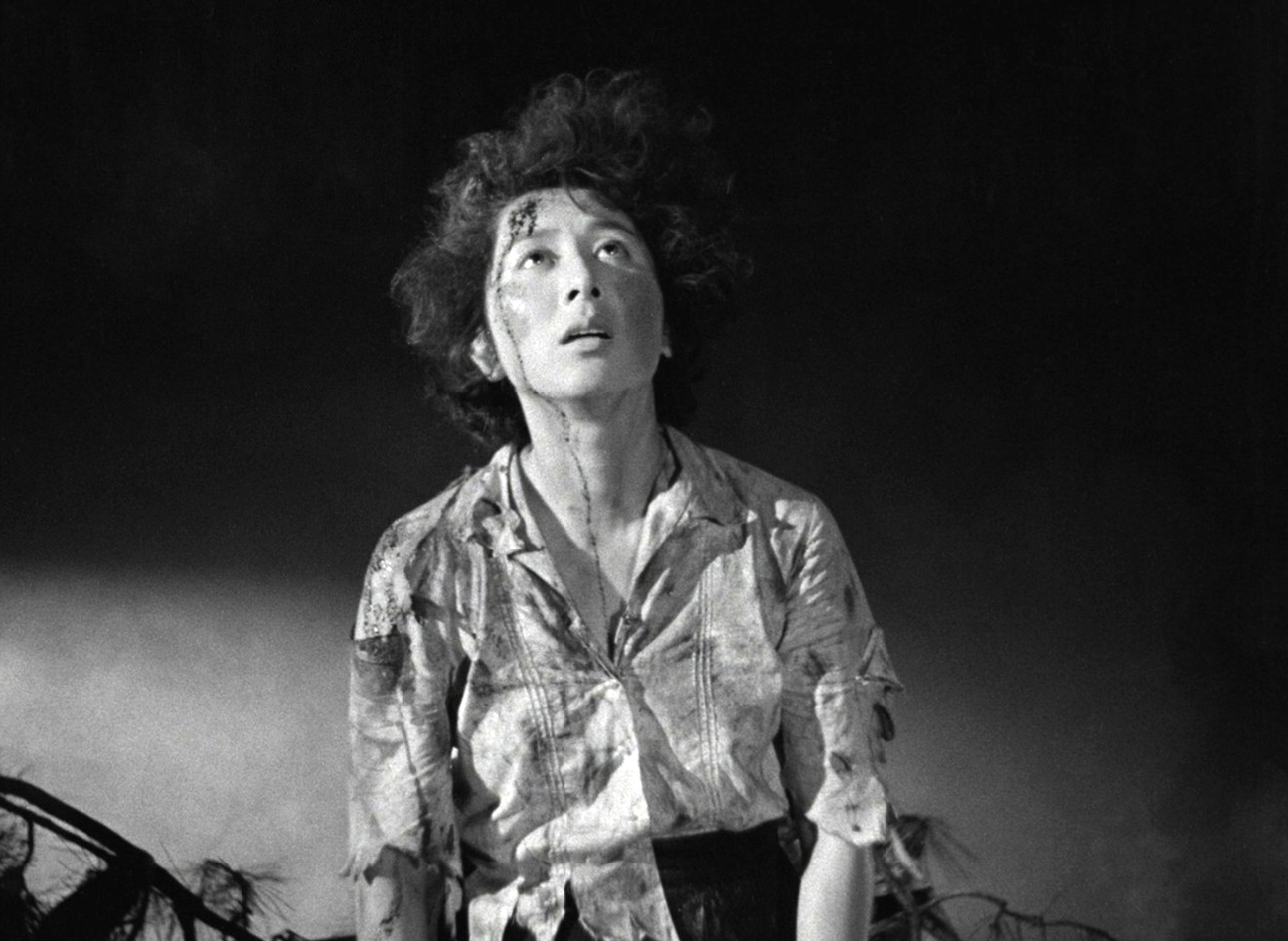
In response, the JTU commissioned a second version in order to better reflect their aims and ideals. Long unseen in either Japan or internationally prior to its recent restoration, Hideo Sekigawa’s Hiroshima (ひろしま) adopts a much more strident docudrama approach while, like Children of Hiroshima, maintaining a focus on the plight of children during the bombing and beyond though it seems somehow unlikely that teachers and parents would be wholeheartedly enthusiastic about showing such a deliberately harrowing piece to a sensitive younger audience. One criticism of Shindo’s film had been that he’d dodged dealing with the bombing itself by concerning himself only with the present-day aftermath. Sekigawa meanwhile focuses directly on the traumatic instant of the attack, utilising expressionistic techniques to recreate the living hell to which the city was reduced literally in flash. 

It’s clear however that the normal of that day was already far from normal. Rather than go about their studies, school children are working hard for the war effort helping to clear extensive bomb damage. A teacher and a class of school girls salvaging roof tiles from a ruined building pause to look at the sky. They can hear bombers but no sirens and it’s in that moment of stillness that everything changes. The world as it was implodes and is left in total collapse. Survivors search desperately for loved ones while stumbling through an unfamiliar landscape filled with crying children, charred bodies, rubble and fire. “This is hell” an injured man groans after managing to make his way to the field hospital, “hell”. 

Sekigawa bookends his tale with a contemporary framing sequence in which an idealistic teacher tries to instil compassionate values in his students some of whom are survivors of the bomb and still living with its effects including one suffering with radiation-related leukaemia who becomes very upset on listening to a radio lesson recounting the morning of the bombing from the point of view of the pilot flying the plane. Another of the students later comes to her defence, taking some of the others to task and lamenting that the suffering of those affected by the A Bomb is not taken seriously while victims still undergo a degree of social stigma even if they have no visible wounds. He is also very worried about his friend, Endo (Yoshi Kato), who later appears in the flashback to the aftermath of the bombing and has apparently gone off the rails, working in a cabaret bar and addicted to pachinko after losing his entire family. 

It’s through Endo that Sekigawa dramatises many of the secondary effects of the bombing in that he was not physically injured but is consumed by a sense of hopeless anxiety, intensely concerned about the prospect of another war and unable to envisage a successful future for himself in a world in which such horror can occur seemingly at random. It’s he who first introduces us to the parasitical disaster tourism that generates a grim trade in A-Bomb “souvenirs” as he passes a stall selling fake skulls as a child and then later attempts to sell actual human remains with inspirational stickers plastered on the top. The “better” future they have imagined for him is however in itself problematic, harking back to the traditional post-war solution of a factory job which directs aligns him with the nation’s push towards a capitalistic society, but is then undercut when he quits not because he is bored or lazy but because he discovered the factory was being used to produce artillery shells and he felt he could have nothing to do with it. 

Endo is also among a group of post-war street kids who learn to say the word “hungry” without knowing what it means to get bread and chocolate from passing Americans. A later more direct speech has them make a formal accusation that the Americans are responsible for the deaths of their parents and therefore bear a responsibility towards them which they should immediately repay with food. Some, including Shochiku who were originally set to distribute but later declined, described the film as overly anti-American, but Hiroshima largely refrains from mentioning the Americans other than a suggestion that the dropping of the bomb was itself a racist act in which they used the Japanese people as guinea pigs to test their new weapon, and focuses on the failure of the militarist authorities to respond in an appropriate fashion. We see a soldier read out a proclamation telling a ragged queue of survivors queuing up for food that the situation is “not unusual” in time of war and they should all return to their jobs despite the fact that there are no longer any buildings in which to work. Meanwhile, militarists talk of using the disaster to foment the war effort by marshalling hate and resentment towards the enemy while commanders refuse to take scientific advice that tells them Hiroshima may be uninhabitable for the next 70 years, obsessed only with continuing the war at all costs ironically insisting that their “fervent will” which “burns as brightly as a million stars” will bring them an assured victory.  

In the face of a second bombing, however, they are forced to accept that the war cannot continue, many of the victims left perplexed and defeated that despite their suffering the government has unconditionally surrendered and seemingly abandoned them. An abnegation of responsibility is also suggested by the presence of the street kids abandoned by their society and left to fend for themselves though Endo is eventually taken into a progressive care home from which he and other boys make numerous attempts to escape, in his case in the hope that he can find the sister from whom he became separated. Sekigawa does not make suggestions for the future, merely depict the difficult post-war reality while arguing for greater compassion in the contemporary era, one bomb survivor describing her despair in the knowledge that her disability is a barrier to marriage while finding work that can be done with her physical limitations is also difficult as is accessing government support. Sekigawa too may give in to a particular kind of sentimentality in the closing moments but it is indeed undoubtedly effective as a reminder of the human cost of war and our collective responsibility to ensure that it never happens again.


The Mosquito on the Tenth Floor (十階のモスキート, Yoichi Sai, 1983)

A beaten-down beat cop’s existential crisis progressively deepens after he throws himself into financial ruin to buy a computer in Yoichi Sai’s debut The Mosquito on the Tenth Floor (十階のモスキート, Jikkai no Mosquito). Like Pool Without Water, star Yuya Uchida conceived and co-scripted the film as a vehicle for himself and was apparently inspired by the sight of some blood, his own, on a wall where he’d squashed a mosquito though he also claimed the the 10 in the title is intended to reference the 10 commandments in addition to simply where the unnamed protagonist lives.

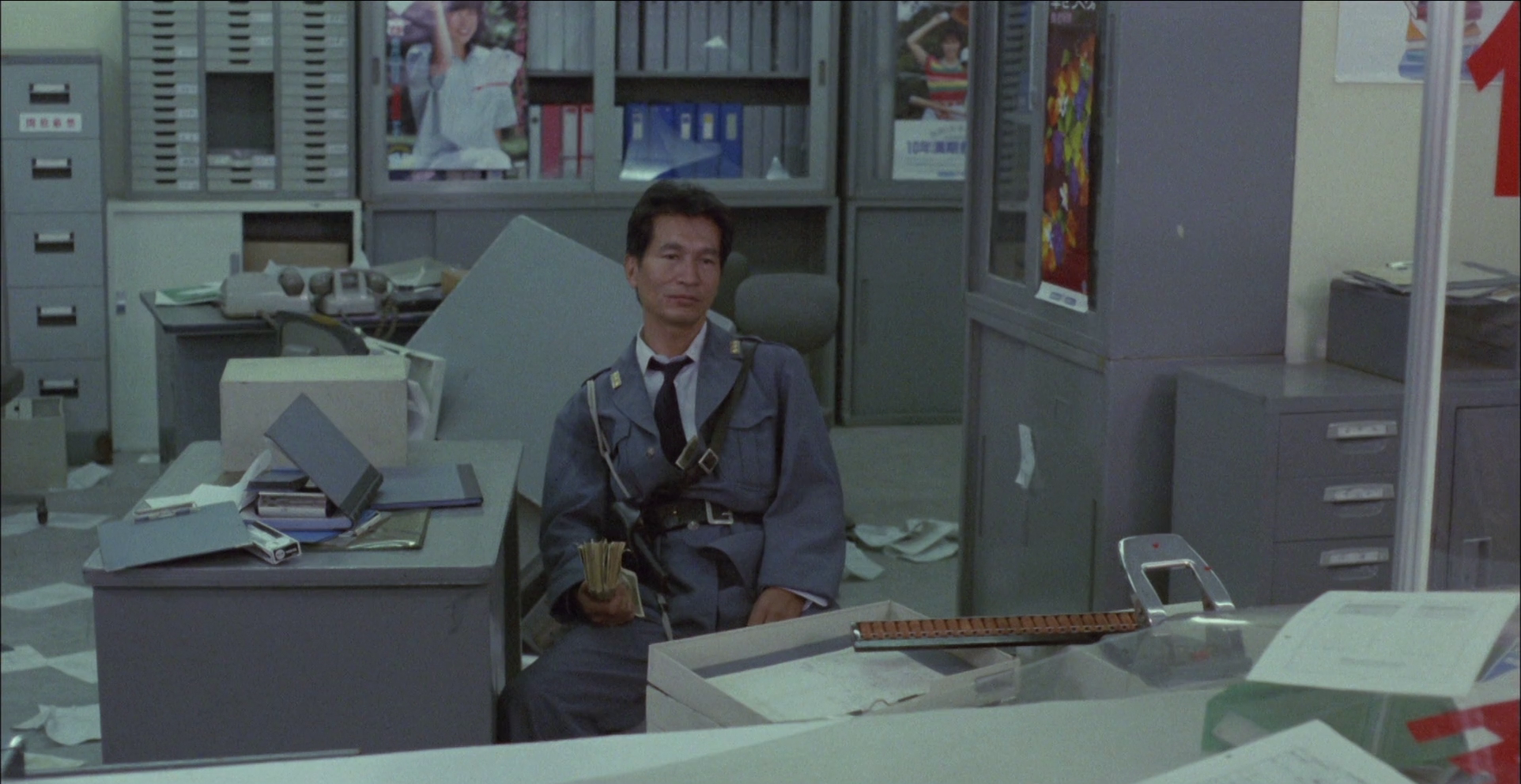
The fact that he lives on the 10th and top floor in a building with no lift is symbolic of his dismal circumstances. On the one hand he can rise no higher but on the other is stuck with an inconvenient living situation precisely because of his inability to rise socially. As it transpires the hero, a policeman, joined the force right out of high school with aspirations of rising to the rank of captain but has spent the entirety of his 20-year career manning a police box. He’s repeatedly failed the exam for promotion to lieutenant and realistically speaking is now simply too old to make much further progress. A man of few words, he listens as the other officers who took the exam with him outline the hierarchal structure of the police force while meditating that as a man on the wrong side of 40 his possibilities have decreased and it’s more than likely he’ll be stuck in the police box until he retires. 

His boss later says as much, sympathising with him but also pointing out that a policeman is also a public servant with a role to serve within the community. He is supposed to make people feel safe and contribute to the progress towards a crime-free society, but it’s clear that his life has spiralled out of control precisely because he cannot ally his career goals with the kind of life he wished to lead. His wife divorced him two years ago seemingly because she wanted a greater degree of material comfort and became resentful that he failed to progress in his career and could not move on from the low-salaried position of an ordinary street cop. She now makes a living selling golf club memberships, looking ahead to the oncoming Bubble-era and a society of affluent salarymen which is very much what her new boyfriend seems to be. Meanwhile, she lives in a very nice townhouse with their teenage daughter and constantly hassles the policeman for falling behind with his child support and alimony payments. He’s also racked up a healthy tab at a karaoke bar where he regularly hangs out and has a serious gambling problem with betting on boat races seemingly his only other form of social outlet.

As his daughter and others keep reminding him, the world is changing and his decision to buy a computer after unwisely taking out a payday loan is in part a symbol of his desire to progress into the modern society even if, somewhat ironically, others chastise him for spending what is then a huge amount of money on something they think of a child’s toy. Otherwise an upstanding policeman who irritatedly deflects a colleague’s joke about bribing someone to pass the exam, the policeman finds himself taking out one payday loan to pay another with loansharks constantly ringing him at the police box to remind him he’s behind on his payments. To overcome his sense of powerlessness, he begins by abusing his authority in catching a punk woman shoplifting and arresting her but then taking her back to his flat to play computer bowling and take advantage of her sexually. He later does something similar with a bar hostess, Keiko (Reiko Nakamura), who took him home when he was drunk. Though the encounter begins as rape, Keiko soon gives in and even comes back for more claiming that she’d never done it with a policeman before and it exceeded her expectations which is in many ways reflective social attitudes at the time. Emboldened, he invites danger by raping a female traffic cop, tearing her clothes as she fights back, screams, and cries though she presumably does not report him given the professional and social consequences that may adversely affect her life and career if she chose to. 

His ex-wife Toshie (Kazuko Yoshiyuki) says she’s not even sure if he’s human anymore, and his failed attempt to rape her after his boss reminds him that he advised against getting a divorce in the first place because it would negatively affect his chance of promotion may be a perverse way to prove he is though it obviously backfires. Having failed in every area of his life and with no prospect of ever getting back on track or starting again, he begins to go quietly insane typing rude words into his computer while the constant calls from loansharks take on a mosquito-like buzzing as does his own final wail of despair and powerlessness as he’s brought down by same authority he once served. His aloneness and confusion are palpable when he ventures into the city and discovers his teenage daughter Rie (Kyoko Koizumi) dancing in Harajuku staring at her intently but then walking away having invaded this space reserved for the young. “Police yourself!” one of the Rockabilly guys ironically instructs him on noticing that he’s dropped his ice cream cone, explaining that the police might shut them down if they’re discovered to be using the space irresponsibly by littering. Rie and her friends tell him to get a life, explaining that the world is changing while tapping him for cash he doesn’t have but is too embarrassed to refuse, laying bare the extent to which he and those like him have been left behind by the economic miracle, buzzing around maddeningly in mid-air with safe nowhere safe to land. 


Original trailer (no subtitles)

Lovely Devils (可愛い悪魔, Nobuhiko Obayashi, 1982)

Until fairly recently, the work of Nobuhiko Obayashi had been largely unappreciated in the Anglosphere where he is associated most closely with his debut film House which was itself somewhat grudgingly respected as a “crazy” midnight movie. He was however surprisingly prolific and especially so for a director working through the difficult 1980s in a 60-year career which ended only with his death after a protracted illness itself ironically announced on the day his final film, Labyrinth of Cinema, should have opened in Japanese cinemas had it not been postponed in light of the coronavirus pandemic. Produced for television in the same year as I am You You Are Me, Lovely Devils (可愛い悪魔, Kawaii Akuma) is among those which Obayashi did not script for himself but is penned by Machiko Nasu and apparently inspired by The Bad Seed though Obayashi later revised the script to remove traces of the original work unwilling to create a simple homage. 

Similar in tone to Obayashi’s later The Deserted City, Lovely Devils is at heart a twisted gothic romance cautioning against the dangers of an excessive thirst for love. In ‘70s Japan, a wedding takes place at small church during which 5-year-old Alice, niece to Koji (Hiroyuki Watanabe) the groom, becomes overly attached to the veil of the bride, Fuyuko (Nao Asuka), and in the manner of entitled small children everywhere demands to be given it. Fuyuko tries to explain that she plans to hang on to the veil for the rest of her life as a keepsake and is sure that Alice will have an even prettier one of her own someday, but Alice creepily asks if that means she can have it when Fuyuko dies and, wanting to bring an end to the matter, she unwisely agrees. While everyone is busy assembling for the wedding photos in the garden, Fuyuko violently tumbles out of an upstairs window, her broken body landing on the patio below only to be met by Alice excited about collecting her veil. 

Meanwhile, at the same time in Vienna, Fuyuko’s exchange student sister Ryoko (Kumiko Akiyoshi) is in the middle of a difficult breakup with her local boyfriend Johann in which she, perhaps understandably, tells him to go die only to see him get hit by a car on his way out of her apartment. Overcome with guilt and grief in believing that she somehow killed Johann by wishing for his death, Ryoko goes quietly mad until her landlady contacts Koji who comes to bring her home and places her into a mental institution run by a convent in which the resident psychologist, Dr. Tsukahara (Toru Minegishi), is also a priest. After three years, Ryoko seems to be sufficiently recovered and so Koji asks his sister Keiko (Miyoko Akaza) to take her in as a governess to the now eight-year-old Alice (Tina Jackson). 

The central irony is that Ryoko is almost certainly not guilty of psychically killing Johann just someone who bitterly regrets saying something unkind in anger and having fate ironically follow through, where as Alice is definitely “demonic” and, as is later pointed out, a child who cannot discern right from wrong. In the liner notes for a later release for the film, Obayashi likened the figure of Alice who commits a series of murders with no conceptual understanding that it’s morally wrong to kill to that of himself as a thoroughly militarist boy in wartime who thought that Japan was just and everything outside Japan “bad”. Alice sees something she wants and has to have it. If someone else has it and won’t give it to her, they have to go (sometimes in quite elaborate ways). Ryoko’s battle is against the commonly held belief that eight-year-old girls are innocent angels, no one in their right mind (Ryoko has just been released from a psychiatric institution following a breakdown after all) would believe Alice capable of violent murder and especially not on the grounds that she simply wanted something trivial like a veil or a doll and was unable to accept that she could not have it. 

Later, Alice’s fragile, chain-smoking, dipsomaniac mother Keiko who always suspected there was something not quite right with her little girl attributes this extreme possessiveness to having discovered the body of her father after he unexpectedly hanged himself in their family home (it does not seem to occur to Keiko that perhaps he is merely the first victim, his ornate quill pen one of Alice’s favourite trophies). She thinks that lack of paternal love has made her seek attachment and permanence in objects but also dangerously in her uncle Koji whom she sees both as a surrogate paternal figure and as an incestuous love interest. It is also somewhat unfortunate that the actress playing Alice and the character herself is half-Japanese playing into an uncomfortable stereotype in gothic horror that posits these demonic qualities and romantic perversions as essentially an extension of foreignness, but in any case Obayashi leans in deep with the wedding imagery as Koji returns to rescue Ryoko in the white suit from his wedding firstly on her release from the hospital on which she too wears a white lace dress, and then subsequently with the still eight-year-old Alice who is dressed much the same only with the addition of an Edwardian-style sun hat to complete the look.  

It’s this final juxtaposition which pushes Ryoko towards accepting her imprisonment as a “criminal of love”, seeing herself and Alice as two of the same as if she really had caused Johann’s death through an excessive desire for a love he had but refused to give her in the same way Alice kills “out of a longing and thirst for love” sublimated into the acquisition of objects. Conjuring an intense and heady atmosphere of gothic unease with the remote country mansion and wandering ghostly brides, Obayashi once again plays with psychedelic surrealism with his romantic painted backdrops and characteristic use of colourplay particularly in flashback as Keiko recalls a sepia-tinged memory of the time they were “almost too happy”. Boasting high production values despite its TV movie genesis, Lovely Devils is defiantly an Obayashi production filled with his wistful sense of loss and nostalgia but also a deep darkness in its mildly disturbing, unconventional conclusion. 


Fine, with Occasional Murders (晴れ、ときどき殺人, Kazuyuki Izutsu, 1984)

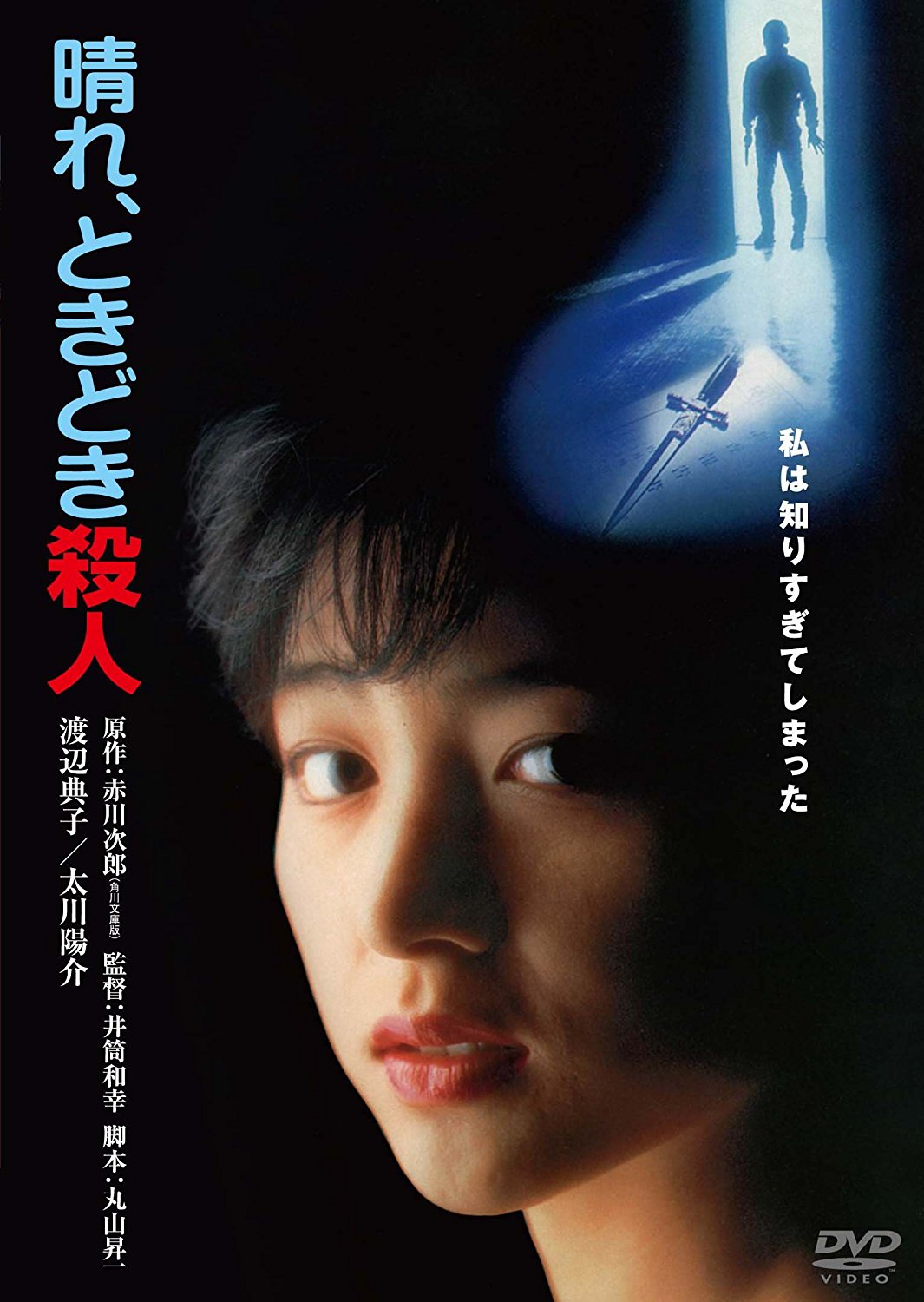
fine with occasional murders posterIn Japan’s ailing late ‘70s cinema market, studios were taking extreme decisions to get the public away from their TV sets and back into movie houses, yet one enterprising would-be media mogul had another idea. Haruki Kadokawa, a man with a publishing house and cinematic ambitions hit on a then innovative marketing strategy which amounted to a perfect storm for his own particular capabilities. Amassing a small stable of idols, he resurrected the studio system to produce a steady stream of youth movies adapting novels he also published and featuring title songs which his idols sang and he released on his record label. Hitting their heyday in the early to mid-1980s, Kadokawa’s idol films are a perfect time capsule of their pre-bubble setting in which, unlike the “seishun eiga” of twenty years before, upperclass young girls solved crimes and defied authority all whilst remaining prim, elegant and innocent. Fine, with Occasional Murders (晴れ、ときどき殺人, Hare, Tokidoki Satsujin) is a prime example of this gentle yet somehow dangerous world as its heroine returns home from studying abroad only to become embroiled in a conspiracy lodged firmly within her own home.

As the film opens, a middle-aged man and woman pay a nighttime visit to the site of a new factory, reminiscing about their youth and the small soap business they started thirty years ago which is now a full scale plastics film. The woman catches sight of someone leaving and stops to wish him goodnight only to suddenly wonder why he’s there in the first place. The reason becomes apparent when she steps forward a little and discovers the body of a young woman lying against her fence post. As if that weren’t worrying enough, factory owner Mrs. Kitazato (Mitsuyo Asaka) then starts getting threatening letters telling her she must go to the police and confirm that an innocent man is the killer or her daughter, Kanako (Noriko Watanabe), studying overseas, will be in danger. Mrs. Kitazato frets and worries but goes along with the killer’s demands to save her daughter only to be confronted with the dead body of the patsy as it lands right at her feet after being thrown from a police station window.

Suffering from a heart condition, Mrs. Kitazato remains unwell until Kanako comes home but then lasts only long enough to impart two important secrets – one being that the man Kanako assumed was her father may not have been, and secondly the whole story with the threatening letters and her belief that they were sent by someone in the family from whom she received a New Year card written in the same handwriting.

As usual Kanako is left to deal with all of this on her own, though slightly less usually remains within her own family home for the vast majority of the picture. Paid a visit by the police, Kanako comes into contact with their prime suspect in the first murder, Kamimura (Yosuke Tagawa) – a young man who had been a high school friend of the victim and had given her a place to stay while she was trying to escape her career as a hotel hooker. Kamimura becomes Kanako’s innocent love interest as she hides him in the secret room her mother had built behind a dresser in the dining room. Together the pair try to investigate the strange goings on in the Kitazato household whilst also exploring their very different backgrounds. 

Like many of Kadokawa’s idol movies (often adapted from the novels of Jiro Akagawa) the setting is both dark and hopefully innocent as Kanako is burdened with the knowledge that someone close to her is a murderer but faces her situation with cheerful resilience and determination. Whilst pursuing her spiky relationship with Kamimura, she’s also being haunted by the spectre of an arranged marriage to the dreadful son of a business associate, Masahiko (Akihiro Shimizu), who attempts to rape her with her mother’s body still still lying on the bed in the same room, and is also having an affair with their maid, Mari (Mariko Miike). Masahiko is also revealed as a prime suspect in the murders when another body is discovered in the living room with Masahiko standing red handed over it. The murder scenes (and there are more than you’d expect), are nasty, bloody and violent. Despite the innocence of Kanako’s wide open world, misogynistic killers lurk round every corner as do corrupt businessmen, untrustworthy servants, and enemies masquerading as friends.

As darks as it gets, the tone is always one of irony filled with bumbling policemen who form an odd double act in their humorous black and forth, running jokes about hard contact lenses and improbably large sandwiches, and the general whimsy of a young man’s dream of building a real flying bicycle. Despite being one of Kadokawa’s new “Sannin Musume” (alongside Hiroko Yakusushimaru and Tomoyo Harada), Noriko Watanabe played fewer leading roles than her two compatriots. Fine with Occasional Murders (released in the same year as Someday, Someone Will Be Killed), is her first big idol movie lead for which she also sings the theme song which has an almost identical title. She is, however, the archetypal Kadokawa heroine – steadfast, strong, confident, kind, and noble, calmly solving the mystery behind her own mother’s death mere days after losing her, figuring out that poor boys are probably OK, and that awful CEOs and their sons will always be awful. Valuable lessons indeed for increasingly wealthy 1980s teens. 


TV Commercial

And the song itself which has the same title as the movie only the last two characters are read differently – Hare, Tokidoki Kirumi

Panic High School (高校大パニック, Sogo Ishii, 1978)

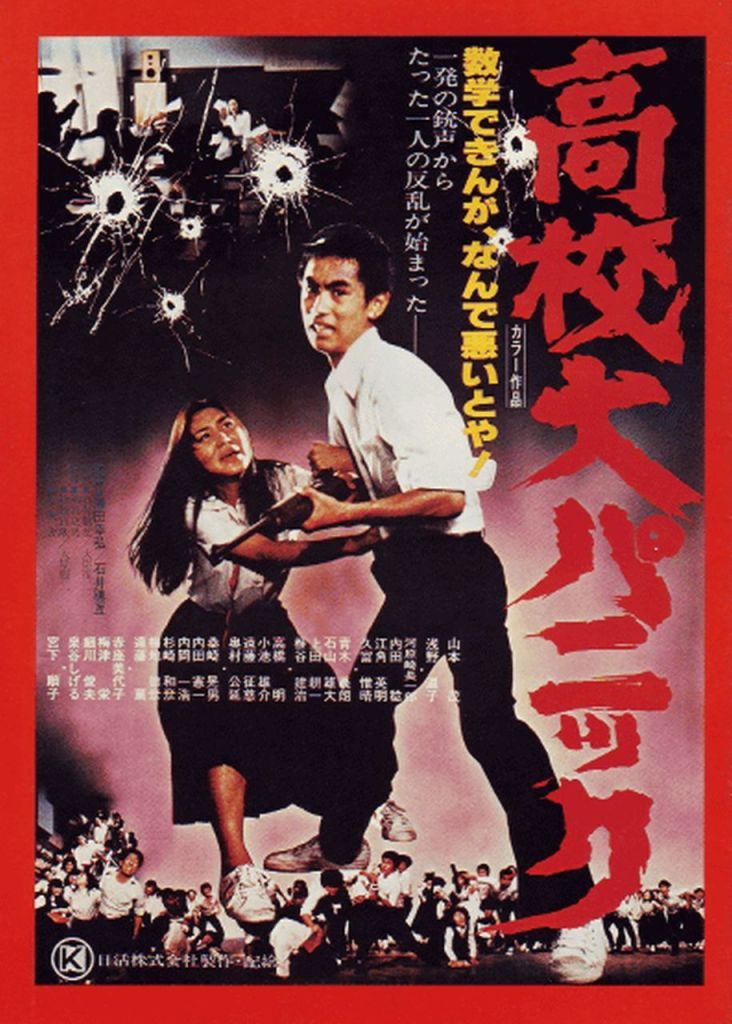
Panic High SchoolSogo (now Gakyruu) Ishii was only 20 years old when Nikkatsu commissioned him to turn his smash hit 8mm short into a full scale studio picture. Perhaps that’s why they partnered him with one of their steadiest hands in Yukihiro Sawada as a co-director though the youthful punk attitude that would become Ishii’s signature is very much in evidence here despite the otherwise mainstream studio production. That said, Nikkatsu in this period was a far less sophisticated operation than it had been a decade before and, surprisingly, Panic High School (高校大パニック, Koukou Dai Panic) neatly avoids the kind of exploitative schlock that its title might suggest.

Back in 1977, though sadly little has changed in the intervening 40 years, schools are little more than pressure cookers slowly squeezing out every inch of individuality from the young people trapped within them as they cram for tests in subjects they might not actually understand. When a pupil commits suicide, the head master offers a few words of condolence over the tannoy system which the form tutor later backs up by emphasising that no one knows why the boy did this and that it probably has nothing at all to do with the school, exam pressure, or his performance in the recent mock exams. The school expect a line to be drawn here and for everyone to forget about it and get back to work.

However, when the teacher, Ihara, starts going on about the league tables suffering if the kids don’t buckle down some of them have had enough. One young man, Jono, looses it completely and takes a swing at the teacher only to miss and run out of the school in a panic. Whilst wandering around town he passes a gun shop and swipes a rifle before returning to the classroom and assassinating the maths tyrant. Not knowing what to do next, Jono hides out in the school building taking some of his friends hostage and then all hell breaks loose.

At its core, Panic High School is satire laying bare the crisis in Japan’s educational system which places undue emphasis on one particular set of exams which will determine the entirety of a person’s life. The teachers are cruel and heartless, little more than cogs in a machine. They don’t care about the kids, they only care about the statistics and the prestige associated with being the top high school in the area. All of these kids are bright, they already passed the stressful middle school entrance exams to get here, and the school just expects them to succeed but offers no support if they can’t.

Indeed, Ihara isn’t even teaching them anything. At the beginning of the film he asks a female student to solve an equation on the board. When she can’t, not only does he not explain the solution to her, he sends her outside adding to her original humiliation in front of the entire class and preventing her from actually learning how to solve the problem. When the next boy can’t solve it either he simply berates him for not studying, saying a “student at this high school should be able to solve this problem”. When the boy points out he did study but just doesn’t understand all he gets is abuse, no actual teaching at all.

Even when the police have been called, all anyone cares about is the reputation of the school. The headmaster keeps harping on about their status as the top school in the area and how “unfortunate” it would be if a student is killed inside the school – which is completely ignoring the fact that a teacher has already been murdered by a shotgun toting teenager right in the classroom. The police bungle the entire affair, starting by tearing apart Jono’s desk for clues including going right through his lunchbox and pointlessly cutting a hole in the bottom of his schoolbag. Bringing even more guns and riot police into the school to deal with one frightened boy who doesn’t want to shoot anyone else but is only trying to effect his escape (so he can take his entrance exams next year) is far from a good idea.

The kids are mad as hell and they aren’t going to take this anymore. The pressure is extreme and in the face of adult hypocrisy, it’s unsurprising that Jono and the other young people like him find themselves lashing out in extreme ways. Their teachers see them only as products, or even as components in the building of a “future” but never as people. Even if some of them start out wanting to help Jono, by the end even a teacher is trying to grab a gun screaming “That kid! I hate him now – I’ll kill him, he’s abandoned the most important thing – his education! He should never have come here in the first place!” putting the blame firmly on the boy and not on the system. In fact, the other teachers are busy in a huddle talking about how this is going to raise questions about the educational establishment and how they intend to mitigate that (they do not intend to address the “problems” in themselves).

While not as loud or as dynamic as some of Ishii’s later work, Panic High School displays much of his punkish sensibility even if it takes a form closer to ‘70s youth drama complete with all the zooms, whips and pans associated with the exploitation era. However, perhaps because Ishii’s own age is so close that of his protagonists the film is firmly on the side of youth. Far from a “youth in crisis” film, Panic High School places the blame firmly at the feet of the system which forces its young people into extreme and absurd situations. Notably different from Ishii’s later work in terms of tone and style, Panic High School is nevertheless an impressive studio debut feature and a strong indicator of the director’s continuing preoccupations.


Climatic scene from towards the beginning of the film (unsubtitled)

http://www.youtube.com/watch?v=jyEIw85HBbI