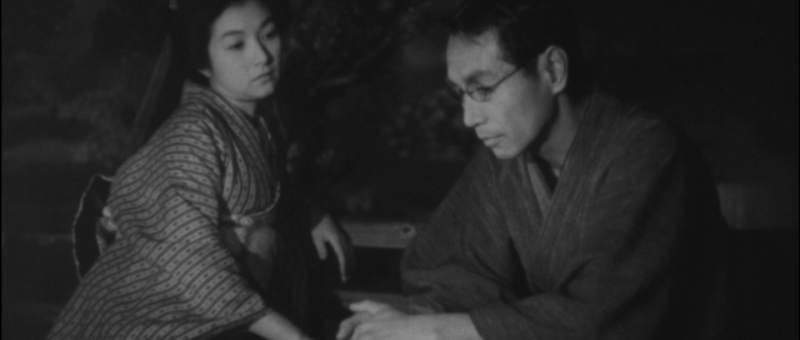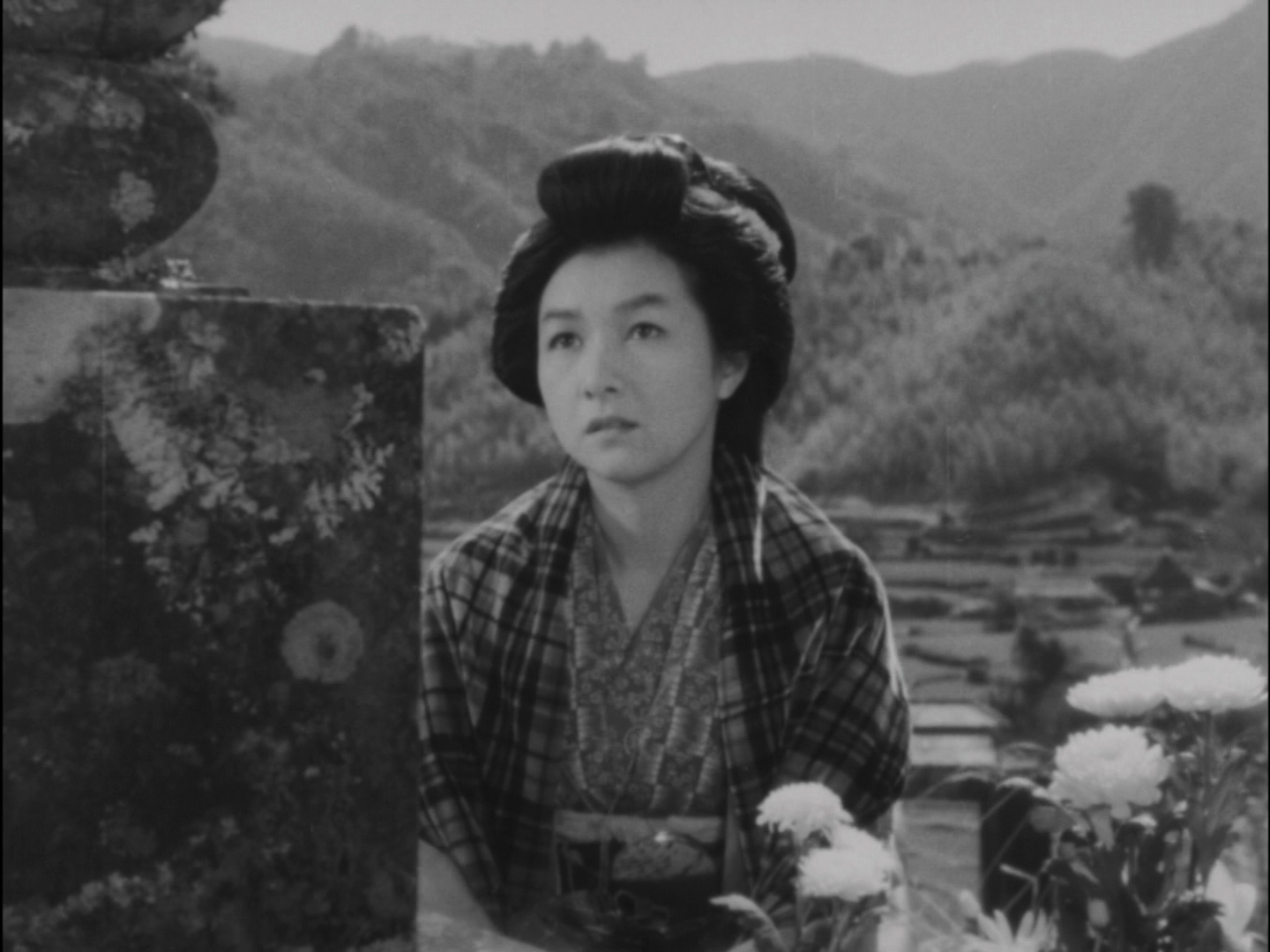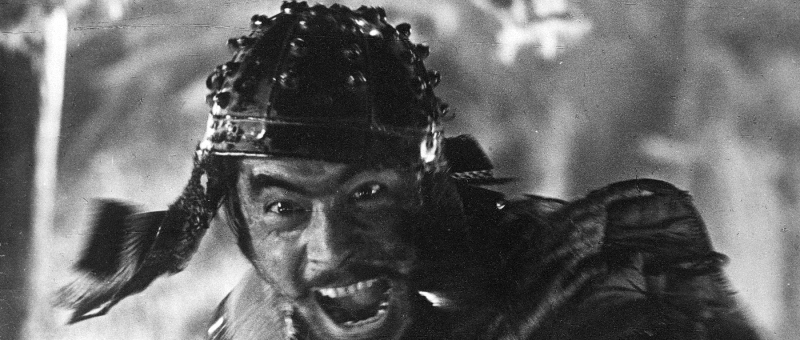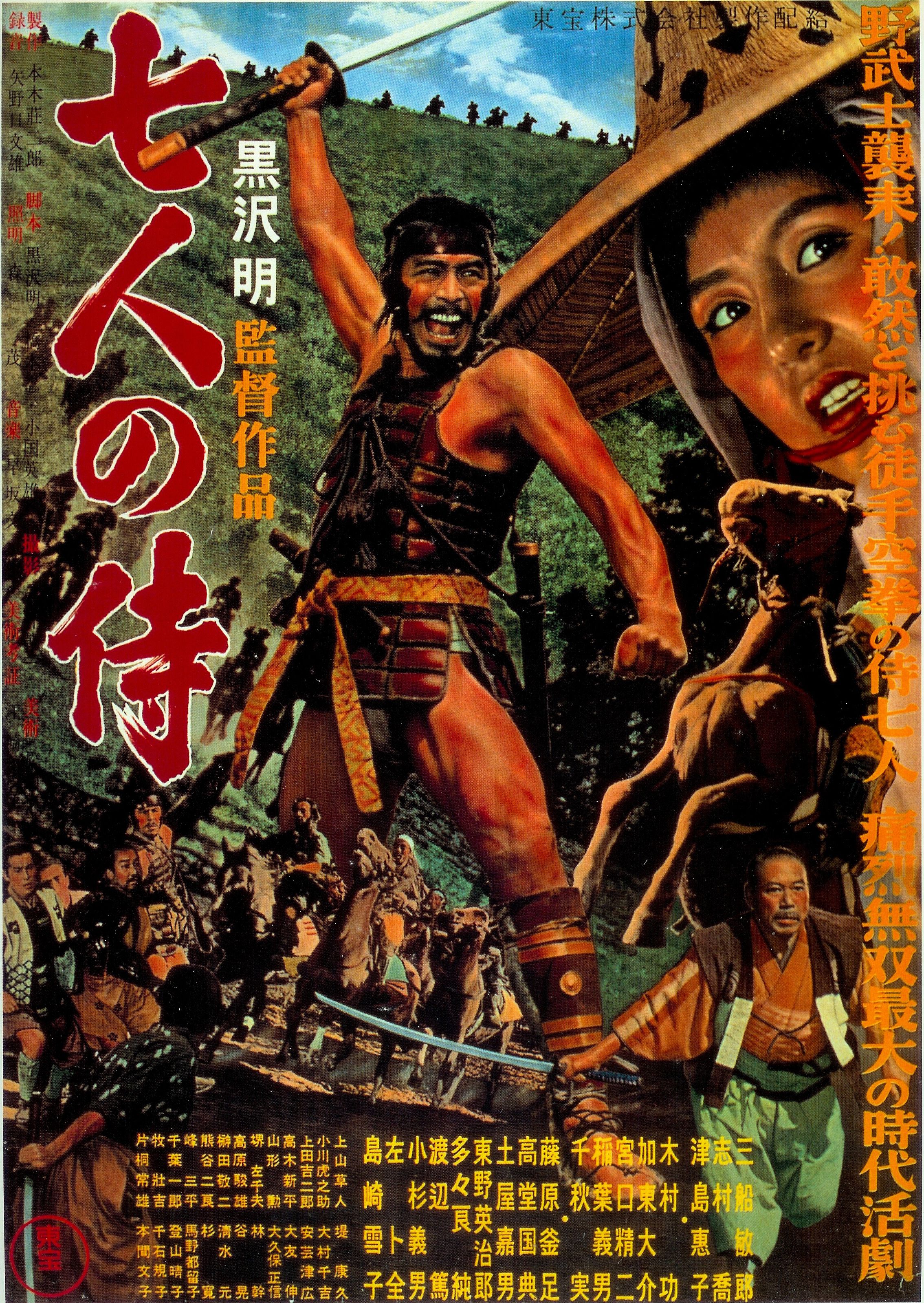
Sanshiro Sugata Part Two (續 姿三四郎, Akira Kurosawa, 1945)

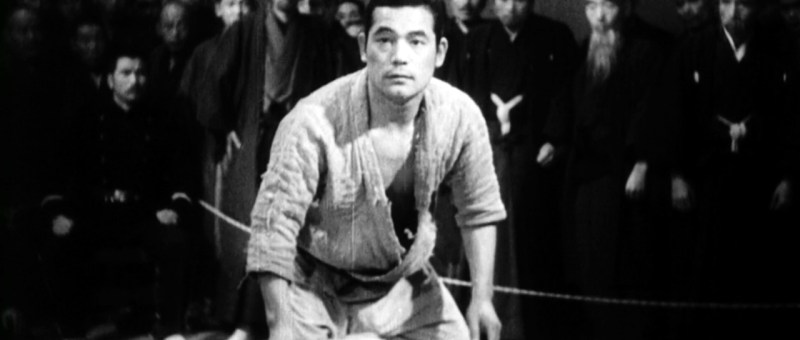
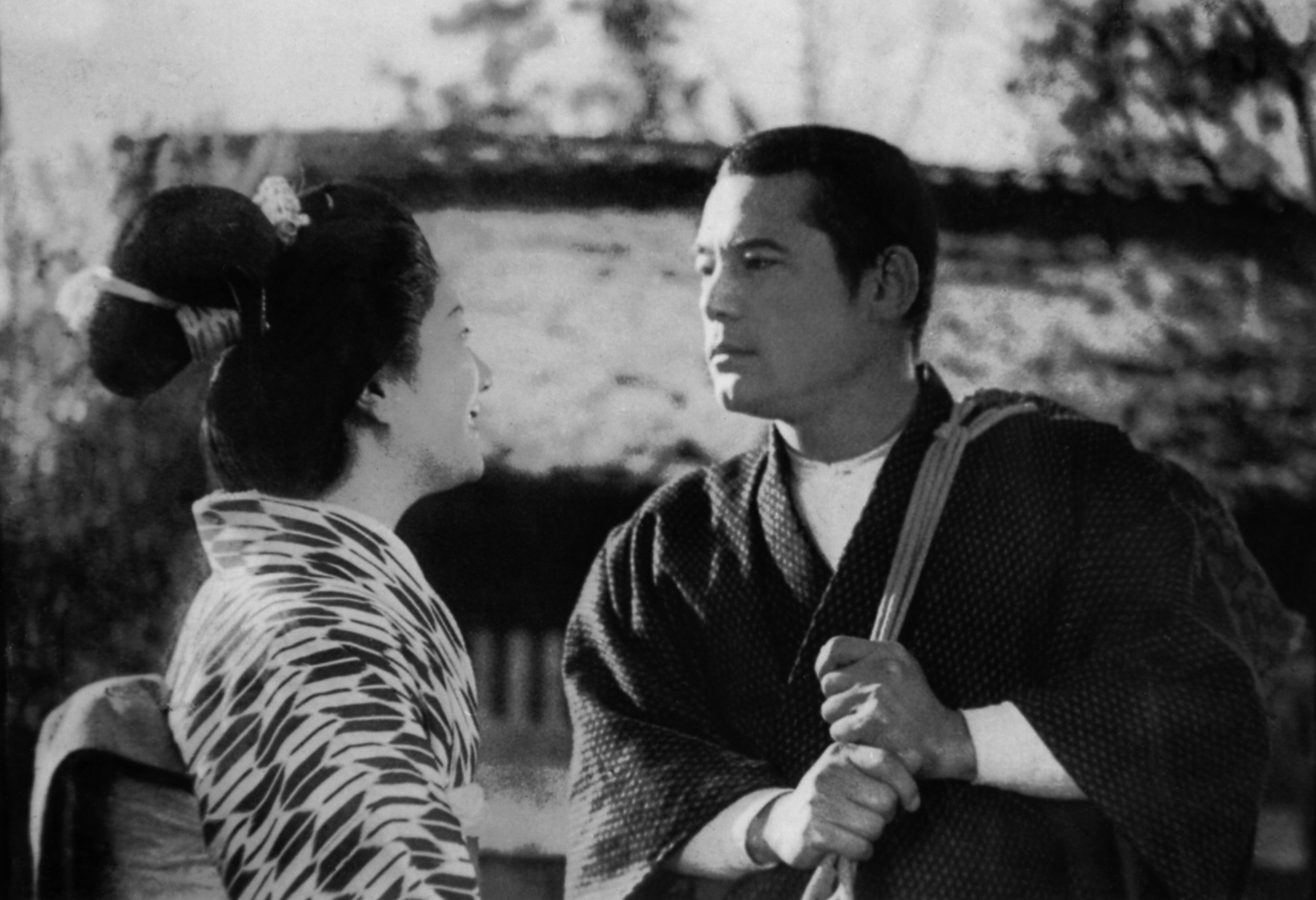
Sanshiro Sugata had not especially pleased the censors who took a scalpel to it, excising a few elements they found problematic, but the film proved popular enough with audiences for the government to commission a sequel. Apparently somewhat reluctantly, Akira Kurosawa returned to the world of Sanshiro Sugata picking up almost in real time two years later with a conflicted Sanshiro (Susumu Fujita) still wandering around Yokohama avoiding the woman he loves whose father may have died due to injuries inflicted on him during his fight with Sanshiro. Yet where the first film had essentially presented a spiritual odyssey through the medium of judo, part two is a much more nakedly propagandistic affair. 

It some ways it’s a little ironic that Sanshiro has almost become a folk hero who stands up for the oppressed Japanese against the looming threat of Western imperialism as mediated through the contest between Japanese martial arts and American boxing. The film opens with a drunken American sailor berating the teenage boy pulling his rickshaw and eventually attacking him only to run into Sanshiro and get a swift hiding. The thankful boy recognises his name and decides that he wants to learn judo too so he can defend himself against external threat, but Sanshiro isn’t sure he should be teaching anyone because he still has a lot to learn and is otherwise unable to escape his guilt over having contributed to the deaths of others through the practice of his art. His internalised shame is only deepened when he’s asked to participate in a spectacle match against a top American boxer and declines only to be told off by the guy who decided to accept. He used to be a jiujitsu champ, but ever since Sanshiro brought about the judo revolution no one cares about jiujitsu anymore and it’s ruined his livelihood. 

There is it seems a degree of shame in fighting for money, but more so in fighting for the entertainment of others. When Sanshiro visits the boxing ring, the sport is depicted as vulgar and primitive. The baying crowd are there largely for blood, riled up by the violent spectacle and eager to see a man in the extremities of a bodily struggle. For Sanshiro, it’s a depressing and offensive sight and to participate in it is to bring shame on Japanese martial arts. Meanwhile, the judo school is also threatened by two thuggish brothers keen to prove the superiority of karate over judo by defeating Sanshiro. They are also brothers of the first film’s villain Higaki who was reformed after his fight with Sanshiro but has since apparently fallen into ill health and listlessness, but so certain that Sanshiro is the only man who can save Japanese martial arts that he gives him the secrets of his brothers’ techniques. 

The final battle mimics that of the first film save taking place amid heavy snow and howling wind. Sanshiro once wins over his opponents through his kindness, taking them into the warm and looking after them until they begin to recover. One of the brothers briefly picks up a meat cleaver before thinking better of it as the two of them grin and admit defeat. Yet Sanshiro’s real battle is indeed against the American imperialists, wilfully breaking Yano’s cardinal rules by deciding to agree to the spectacle fight and easily defeating the American boxer who ends up just passing out from the force of Sanshiro’s aura. The jiujitsu practitioner who seemed to resent him before breaks down in tears and offers his sincere thanks to Sanshiro for standing up for Japan against the Americans.

The contemporary context is clear, this time around judo is much less about spirituality than it is about victory as much as Sanshiro likes to say that it isn’t winning and losing that’s important. Sanshiro becomes the saviour of Japanese martial arts, now endangered by the rising popularity of Western boxing, but also indirectly of the Japanese people in standing up against an encroaching external threat in direct contrast to the slimy Fubiki (Ichiro Sugai), a dandyish interpreter to the Americans forever dressed in foppish suits and seemingly content to do their bidding. “You haven’t changed at all,” Yano scoffs of Sanshiro’s two years of fruitless travelling and it’s clear he still has a lot to learn, putting his romance with the long-suffering Sayo once again “on the back burner”, while remaining true to himself even if not quite the monster the children sing of, a relentlessly honest man and seemingly the lone defender giving hope to an increasingly anxious Japan.

That Guy and I (あいつと私, Ko Nakahira, 1961)

Likely intended as a slightly silly student rom-com, Ko Nakahira’s That Guy and I (あいつと私, Aitsu to Watashi) captures a sense of the changing gender roles and sexual mores of the early 1960s, if through a very male and at times even middle-aged lens. Adapted from a serialised novel by Yojiro Ishizaka and set amid the ANPO protests of 1960, the film is narrated by its heroine, a very ordinary young woman from a typical, moderately wealthy middle-class family, as she struggles with her attraction to a fabulously wealthy young man who pretends to be a boor but is actually a nice guy and unexpected feminist.

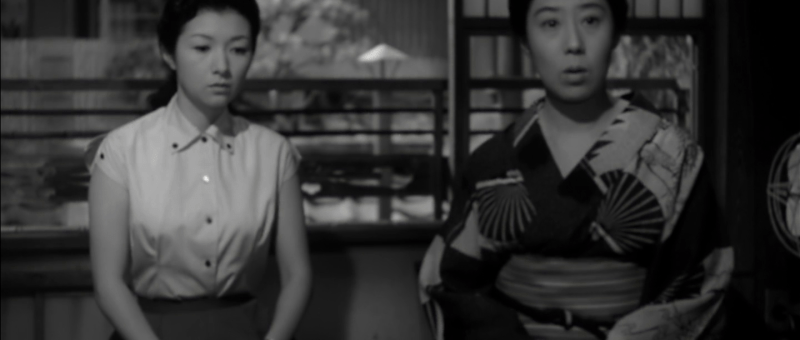
One of a new generation of women attending university with a prospect of independence, Keiko’s (Izumi Ashikawa) horizons seem to be broadening. She’s not exactly conservative and openly jokes about sex and dating with her friends, but is quite settled with her life, not particularly wanting anything more than she already has. Her psychology tutor highlights the problem of social inequality in their school that she had already raised in her opening voiceover in remarking that the rich kids all have cars and can drive themselves to school, while others are having to work to support themselves while they study. When he asks how much pocket money they all get, some are outraged and keen to stress they don’t get any help at all, but Keiko reveals that her parents actually give her a healthy allowance. It’s just that she has no real urge to spend it, so it’s been mounting up quietly in a desk drawer in her childhood bedroom while she still lives at home close to the university.

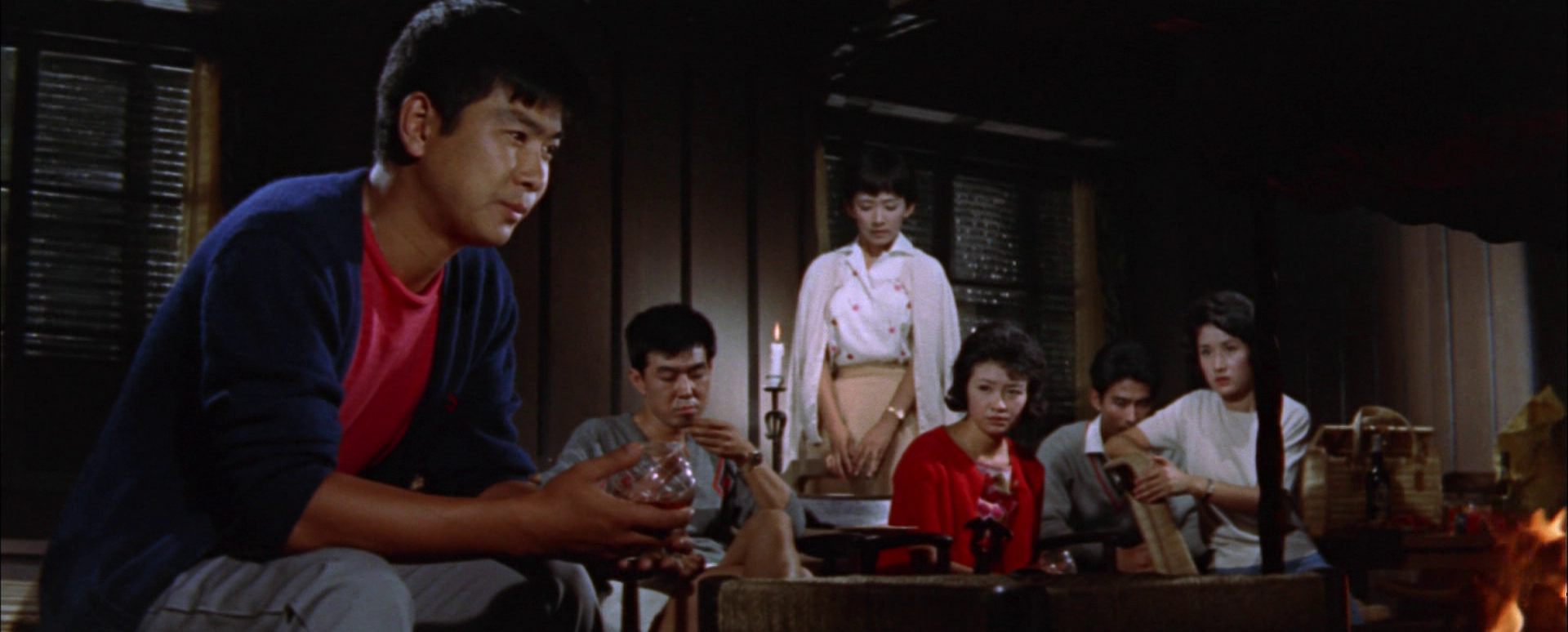
Saburo (Yujiro Ishihara), by contrast, boasts that he gets more than some people’s monthly wage as an allowance from his mother and blows it on drink, gambling, strip clubs and sex workers. It’s this last point that scandalises the female students who are all shocked and disapproving, even going so far as to ask the teacher to throw Saburo out because they don’t feel comfortable sharing a space with a man like that. The teacher also says he’s disappointed and wishes Saburo hadn’t added the last bit, only for Saburo to call him a hypocrite because sex work was legal in his day and he simply doesn’t believe that he’s never paid for sex. Most of the other boys join in on Saburo’s side, insisting that no man sees any problem with visiting sex workers which they regard as a natural right because the male sex drive is driven by “uncontrollable forces”.

But then there’s something unexpected that occurs among the female students in that some of them are obviously attracted by this very rough form of masculinity. “I’d rather have a wild beast than a meek sheep,” one intones, but nevertheless goes to join the group of girls confronting Saburo at the pool in the hope of gaining an apology for the offence he caused them. They’ve since found out that he probably made it up anyway, which is ironic because he claimed he’d only spoken the truth when they asked him to leave, but that’s somehow even worse because it means he said it deliberately to upset them. The upshot of it all is that Saburo ends up in the pool and is then forced to borrow some of the girls’ clothes while his dry off, signalling his awkward positioning between traditional masculinity and femininity in that he’s otherwise surprisingly sympathetic of women and makes sure to look out for them but in a way that encourages their independence and is never patronising. 

That might, in one way, be because of his unusual upbringing which is far more modern and bohemian than Keiko’s and in the beginning, at least, quite confusing for her. Saburo’s mother Motoko (Yukiko Todoroki) is a famous entrepreneur with a beauty shop empire. She writes her name in Western order and uses katakana for her first name which makes look foreign and therefore exciting and sophisticated even though it obviously isn’t. It was Saburo’s mild-mannered father who gave up his career in insurance to raise him, while his mother apparently blows off steam through numerous affairs. His father occasionally gets upset about this and the pair go through a charade of him leaving her while she professes her love for him, which seems to have a sexual dimension in itself. Perhaps this has given Saburo an alternative view of romantic relationships, though we also later discover that he was subject to what we’d now see as a form of sexual abuse as a teenager when his mother got a young but still adult woman, Michiko (Misako Watanabe), to essentially give him practical lessons in sex and satisfy his teenage urges, only he thought it was an organic romantic relationship and feels more than anything else emotionally betrayed. 

But then again, the film has a very of its time and defiantly male view of rape which is dealt with in a fairly flippant manner. Keiko rings her mother to tell her she’s realised that the reason she didn’t like the idea of her being at the ANPO protests was because she feared she’d be raped, which is at any rate an odd conversation to be having. Her mother asks her what her virginity has to do with ANPO, which is a fair question, but also implies that it’s not so much the physical and psychological harm of sexual assault that bothers her mother but the shame of premarital sex. One of the girls who goes to the protest, Ayako (Shigako Shimegi), is actually raped by the two boys she went with who deliberately plied her with alcohol and took her to a hotel knowing that she trusted them, but her roommate, who had a crush on one of the boys, immediately turns against her. Sadako (Kazuko Yoshiyuki), the most political of the students, calls her a slut who parades herself in front of men and says Ayako must have led them on. Only Keiko takes her side, walking her to the bath and waiting outside for her while admitting that she has conflicted thoughts about Saburo. She throws things at him to shoo him away, feeling that his presence as a man is inappropriate and not wanting him to see Ayako in this moment of vulnerability, but also she admits to herself because she’d be jealous and doesn’t want him to see a naked woman that isn’t her.

Something similar happens when she finds out about Saburo’s past and is jealous and resentful of Michiko, irrationally angry with Saburo, and on another level protective of him knowing that happened when he was a teenager was wrong. After she runs out into the rain and the pair argue about it, Saburo forces a kiss on her which, again, Keiko seems like in a show of robust manliness. Saburo is though also protective and sympathetic towards Ayako, insisting that that the way for her to move past her rape is to ensure she becomes financially independent and successful so that she can see it as just something unpleasant that happened to her rather than something that ruined her life or makes her unworthy of another man’s love. He even helps her to do that by getting her a job at his mother’s company. 

Saburo’s mother Motoko, meanwhile, gives Keiko some frank advice in disclosing the secrets of her life and Saburo’s birth. Even when Saburo suddenly announces their engagement without actually asking her, Keiko does not merely swoon but reflects that she’s got to have a proper think before actually agreeing which she is still free to do or not. Nevertheless, the film seems to have hit on a contradiction in redefining masculinity as both tough and soft. Keiko is despite herself attracted to Saburo’s forcefulness, but also his chivalrous nature and awkward kindness, his fair-mindedness and care, and recognition of women as actual human beings with interior lives and a right to independence. Nakahira may be a little less surreal than usual, but leans heavily into absurdity, on the one hand acknowledging the somewhat superficial quality of these privileged students’ lives in having them confront a band of angry rural workers and half-heartedly take part in the ANPO demonstrations without much thought to what they’re for or what they mean, but, in the end, characterises them as merely ordinary, slightly lost amid the rapid changes of the post-war society but otherwise cheerful and looking ahead to a bright future stretching out in front of them.


Trailer (no subtitles)

Flowing (流れる, Mikio Naruse, 1956)

The denizens of a moribund geisha house contemplate visions of independence in post-war Japan Mikio Naruse’s thriving ensemble drama, Flowing (流れる, Nagareru). There is indeed a flowing through the geisha house, a tumble of comings and goings though mostly connected to money which is itself constantly flowing though the for geisha mainly in the wrong direction. Released in the year of Prostitution Prevention Law, the film casts a shadow over the lives of these women who are unwittingly living in their industry’s twilight but asks if it’s really possible for a woman to survive without a man while each of them is in one way or another badly let down by an inconstant lover. 

We’re constantly told that Tsutanoya is the most respectable geisha house in town yet despite its well appointed interiors, it’s clear that business is not good. As the film opens, a young geisha, Namie, is accusing the owner’s daughter Katsuyo (Hideko Takamine) of diddling her on her pay. Katsuyo acts indignant and tries to shift the blame back onto Namie but later admits that the house has indeed been skimming a little more off their wages than was agreed claiming all the geisha houses do it which is probably true but doesn’t make it right. In any case Namie will eventually quit and end up working at “some third rate place” while her uncle (Seiji Miyaguchi) causes problems for proprietress Tsuta (Isuzu Yamada) complaining that Namie was exploited and wanting both the backpay he feels she’s owed and compensation though it seems unlikely any of that money is finding its way back to Namie. Meanwhile the house is a geisha down with only former office worker Nanako (Mariko Okada) and 50-year-old veteran Someka (Haruko Sugimura) on the books.

Despite their financial situation, Tsuta hires a new maid, Rika (Kinuyo Tanaka) who is immediately renamed “Oharu” on her arrival. Oharu is a salt of the Earth type, infinitely capable, maternal, kind and loyal bringing a much needed sense of stability to the ever flowing geisha house while also fascinated by this exotic and arcane world. But then as Tsuta cautions her geisha houses may look glamorous from the outside but the life inside them isn’t always fun. Oharu runs into trouble on her first trip to the grocers when they inform her Tsuta hasn’t paid her tab and they can’t let her add to it until she does. A 45-year-old widow whose only child died a year previously, Oharu is also trying to live an independent life, a conflicted Tsuta struck with wonder at her ability to survive without a man, but may also have struggled, grateful to have been offered the job which others might have declined because of the stigma towards the sex trade as finding employment as a middle-aged woman is near impossible. 

At the film’s conclusion even she may imply it isn’t really possible to live as a woman without some kind of support or losing one’s humanity suggesting that she may return to her husband’s hometown and the family she claims not have gotten along with after learning of Tsuta’s betrayal at the hands of an old friend and former geisha, Ohama (Sumiko Kurishima), who at any rate seems to be living quite well as the proprietress of a restaurant. Traditionally, the profession of geisha was seen as a kind of independence in itself but it’s also one that by its nature is reliant on men. Tsuta is often described as someone who is not able to do anything else yet is highly skilled at music and dance having spent a lifetime in training. Without a patron she is stuck and as we learn she threw hers over to pursue a man she loved but he left her in the lurch having mortgaged the geisha house to invest in his business by taking a loan from her older sister who seems to have a nice sideline as a polite loan shark also having loaned money to Someka. 

The most outwardly cheerful, Someka is in other ways a dark vision of a geisha’s future surviving on nothing but nihilistic hedonism while apparently living with a much younger man who eventually leaves her to marry into another woman’s family. Katsuyo has rejected the geisha life explaining that she is unable to, as Nanaka puts it, say silly things to men in order to earn her keep and is essentially incapable of ingratiating herself with men she doesn’t like. She claims she has no desire to marry, unconvinced that any man would be interested in a geisha’s daughter while certain that for a man marrying into a woman’s family is humiliating while suggesting the same would be true for her. Putting her faith in industry, she buys a sewing machine and sets about figuring out how to use it less because she envisages being able to support herself and her mother through taking in needlework than she just wants to feel as if she’s doing something. 

Meanwhile, Tsuta’s niece Fujiko observes all the comings and goings of the geisha house learning the traditional arts in preparation for a future which will soon be obsolete. In a typically Narusean touch, Tsuta comes to a resolution about her future and envisages a new beginning for herself but is unaware the rug is soon to be pulled from under her by the underhanded capitalist Ohama who plans to turf her out to turn the geisha house into another restaurant. “My days of seeking favours from men are over,” Tsuta admits, not of her own volition but simply understanding that she no longer has access to that kind of independence though in essence surrendering her autonomy in leaving herself to the mercy of Ohama in order to escape her older sister’s control. Someka had laughed raucously at Katsuyo’s insistence that she need not be dependent on a man (and after everything she’s seen why would she want to be?) but the younger woman is undeterred even as we see her struggling, doubting that her efforts will in the end be enough to win her her freedom. Ever the optimist, Tsuta is perhaps doing something similar but even Oharu is considering giving up and going home, too good to survive in the dog eat dog world of the contemporary capital where the flow of currency is the lifeblood of the city implying that perhaps the answer to her question is no, a woman can’t survive alone, nor can she rely on female solidarity, but she’ll have to try anyway because there is no other choice. 


Mermaid Legend (人魚伝説, Toshiharu Ikeda, 1984)

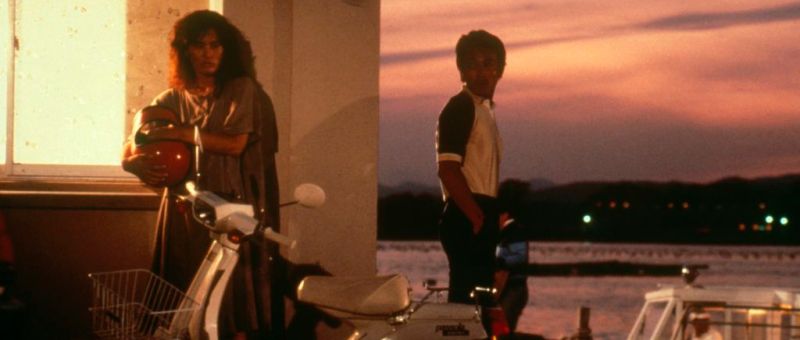
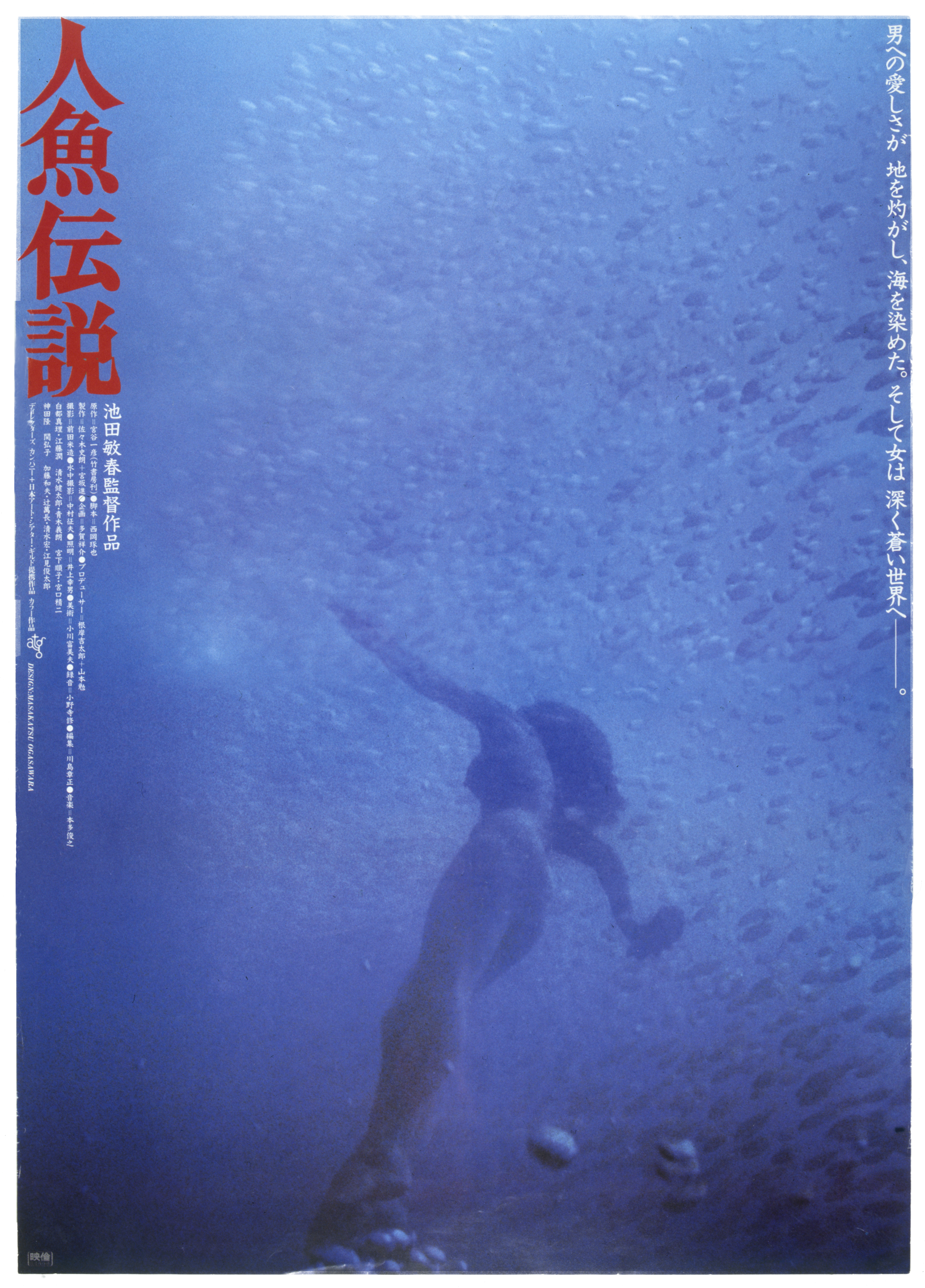
“Even if someone kills you, you wouldn’t die,” a drunken husband somewhat sarcastically replies having pledged to come back and haunt his wife if he died and she married a man who didn’t drink. His words take on a prophetic quality given that the heroine of Toshiharu Ikeda’s Mermaid Legend (人魚伝説, Ningyo Densetsu) takes on a quasi-supernatural quality as an embodiment of nature’s revenge after someone tries, and fails, to kill her having already killed her husband for witnessing their murder of another man who’d tried to resist their plans of buying up half the town to build a nuclear plant. 

By the mid-1980s, Japan’s economy had fully recovered from post-war privation and was heading into an era of unprecedented prosperity which is to say that the coming of a power plant was not welcomed with the same degree of hope and excitement as it may have been in the 1950s when it was sold not only as a new source of employment for moribund small towns but an engine that would fuel the new post-war society. Several industrial scandals such as the Minamata disease had indeed left those in rural areas fearful of the consequences of entering a faustian pact with big business, which is one reason why the guys from Kinki Electric Power sell it as an amusement park project though even this has the locals wary not just of the disruption it will bring to their lives and potential ruin of their livelihoods which are dependent on the protection of the natural environment but that what is promised simply won’t be delivered. Fisherman Keisuke (Jun Eto) says as much when lamenting a previous aquaculture programme which didn’t pan out and caused lasting damage to marine life. 

In any case, as others say there’s no money in going out to sea anymore and its clear that the old-fashioned, traditional way of life practiced by Keisuke and his newlywed wife Migiwa (Mari Shirato) is no longer sustainable. Migiwa is an abalone diver working without modern equipment but using heavy weights to dive deep enough to reach the shells. As such she’s dependent on her husband to pull her back up to the boat when she tugs the rope. She must put her life entirely in his hands though in truth, he does not seem to take his responsibility all that seriously. The couple bicker relentlessly and not even she really believes him when he says he witnessed a murder which might be understandable given the extent of his drinking. All of which is further evidence against her when she manages to escape from the assassination plot and runs straight to the nearest policeman who thanks her for turning herself in implying he believes she is responsible for Keisuke’s death. 

The possible collusion of the policeman hints as a further sense of distrust in authority which has become far too close to corporate interests. Shady industrialist Miyamoto (Yoshiro Aoki) ropes in both the mayor and the head of the fishing association in his talks with Kinki Electric Power along with Shimogawa from the local tourist board who evidently opposes the plans as he is the man Keisuke witnesses being murdered. As Miyamoto says “sometimes your hands get a little dirty” though he never “directly” involves himself matters such as these. The situation is complicated by an unresolved love triangle between Miyamoto’s spineless son Shohei (Kentaro Shimizu), a sometime photographer, who is resentful of Keisuke and in love with Migiwa complaining that Keisuke always outdrinks him and gets the girl too hinting at his sense of wounded masculinity. Isolated by his class difference, he appears not to approve of his father’s actions but later does little to stop them and eventually sides with corporate interest over his feelings for Migiwa who in any case seems to have become more attached to Keisuke following his death which she vows to avenge. 

There is there is something quite strange in the prophetical quality of Keisuke’s words also predicting the “black sweat” of the Jizo on the beach and the mystical storm which does eventually sweep everything clean destroying the signs for the new nuclear power plant already installed on the beach. In this way, Migiwa becomes a vengeful force of nature taking up arms against those who wilfully ravage and pollute the natural environment while damaging the lives of those who lived on its shores such as herself and Keisuke. She takes revenge not only for the murder of her husband by corrupt capitalists but against that corruption itself even as she laments that “no matter how many I kill, they just keep coming.” “Don’t worry, maybe all this was just a dream,” Keisuke once again prophetically intones though it’s difficult to know if it’s defeating the capitalist order that is a fantasy or the maintenance of the idealised rural life to which Migiwa seemingly finds her way back swimming into an unpolluted sea surrounded by the floating barrels of ama divers and clear blue skies, a creature of nature once again.


Mermaid Legend screened as part of this year’s JAPAN CUTS.

Throne of Blood (蜘蛛巣城, Akira Kurosawa, 1957)

In many ways, the underlying theme in Akira Kurosawa’s films of the 1950s is that we are incapable of knowing ourselves and are, as a forest spirit remarks in Throne of Blood (蜘蛛巣城, Kumonosu-jo), afraid to look into our own hearts and admit our darkest desires. In adapting Shakespeare’s Macbeth, Kurosawa is less interested in the pull of ambition than the insecurity that drives it along with the inability to transcend himself that precipitates the hero’s decline. 

Indeed, after Washizu (Toshiro Mifune) and his best friend Miki (Minoru Chiaki) ride into the misty forest domain of the witch-like seer who ominously turns her spinning while offering a moral lesson that neither of them heed, they sit on the ground and laugh about what they’ve heard. Yet as Washizu partly admits the old woman revealed something of himself to him in that she echoed a dream of which he was unwilling to speak. Miki asks what warrior would not want to be placed in charge of a castle, but for Washizu it’s almost a primal need to prove himself in surpassing other men. Miki, by contrast, is not so nakedly ambitious but he doesn’t really need to be because he has a son. Washizu has no heir, his line will end with him and so he has only this life to make something of his name. 

Having no heir also undermines his sense of masculinity, just as it undermines the femininity of his wife, Lady Asaji (Isuzu Yamada), who as a woman now likely too old to bear a child may fear for her position. Kurosawa styles Yamada’s face as a perfect noh mask while she delivers her lines with the intonation of noh theatre all of which lends her a fairly eerie presence which only deepens as she descends into the darkness and back out again hovering like a ghost. She is in a sense perhaps already dead if not otherwise possessed by some malignant spirit as she urges her husband on in their dark deeds like a demon on his shoulder even going so far as to present him with the spear he will use to murder his lord, the ultimate act of samurai transgression. 

Yet as Lady Asaji points out, the present lord killed the lord before him for the right to sit on the dais. When the lord comes to stay with them on a pretext of hunting while preparing to launch an attack on a potential rival, the couple are moved into a room previously inhabited by a retainer who’d tried to mount a rebellion but was defeated. He took his own life and the room is still stained with his blood which covers both walls and floor. Washizu ought to realise that this is his fate too, but deep down he wants the prophecy to be true, which it is if more in the letter than the spirit. Would he have done it if he had not met the forest spirit, or would he only idly have thought of it but never followed through? It’s not something that can be known, but his eventual failure is born more of his inability to accept this side of himself than it is the price of ambition in itself. “If you’re going to choose ambition choose it honestly with cruelty” the forest spirit later advises, and Washizu might have been more successful if had he done so earlier. 

Then again, the world he lives in is as Lady Asaji describes it a wicked one in which betrayal is an all but inevitable certainty. Washizu insists that Miki is his friend, and that making Miki’s son his heir satisfies the prophecy while binding him to him so that he cannot rebel even if he were minded to. But Lady Asaji assumes that Miki is ambitious too, suggesting that he may strike first or report his treachery in the hope of personal advancement. For the prophecy to come true, someone has to betray the lord though it need not have been either of them but there can be no trust or friendship in this world of fierce hierarchy and internecine violence. 

Both men should perhaps have realised that when they were trapped riding around the eerie lair of the forest spirit with its mists and cobwebs not to mention heaps of piled skeletons still in their armour all victims of ambition and the spirit’s false promises if also echoing the legacy of wartime folly. “Look upon the ruins of the castle of delusion” the noh chant that opens and closes the film intones, warning of illusionary riches and the price of deluding oneself along with the destruction wrought by those unable to break free of the spider’s web of human desire. 


Throne of Blood screens at the BFI Southbank, London on 21st February 2023 as part of the Kurosawa season.

Original trailer (no subtitles)

Ikiru (生きる, Akira Kurosawa, 1952)

The Japanese economy may have embarked on a path towards recovery thanks to the stimulus of the Korean War, but in the early 1950s many might have thought it too soon to ask if survival in itself was enough yet this is exactly what disillusioned civil servant Kenji Watanabe finds himself asking after receiving the devastating news that he has advanced stomach cancer and year at most to live. “To live” is apt translation of Akira Kurosawa’s intensely moving existential melodrama, Ikiru (生きる), which tackles the compromises of the salaryman dream head on along with those of the contradictions of the sometimes dehumanising post-war society. 

As the opening voice over reveals to to us, Watanabe (Takashi Shimura) is man who died long ago or perhaps has never truly been alive. In some senses, he is nothing more than an embodiment of the seal he uses to stamp documents day in day out, a mere piston in an ever turning machine of relentless bureaucracy. A young woman, Miss Odagiri (Miki Odagiri), working in the Public Affairs department loudly reads out a joke someone has written about their boss, Watanabe, who has taken not a single day’s holiday in 30 years suggesting that it’s less that he fears city hall will grind to a halt without him than they’ll suddenly figure out city hall has no need of him at all. The irony is city hall does indeed grind to a halt in Watanabe’s absence as he, unthinkably, fails to turn up for work for days on end as the papers pile ever higher on his desk. “Nothing moves here without his seal” one of the workers admits, bewildered by this sudden break with protocol while salivating over its implications in the possibility that Watanabe’s chair may soon be empty. 

Yet Watanabe’s crisis is that he’s realised he’s wasted his life on a pointless bureaucratic career that’s done little more than keep a roof over his head. Even the roof is a fairly modest one and it’s clear that his grown up son Mitsuo (Nobuo Kaneko) considers him to be a stingy old miser, unable to understand why he’s never spent so much as a penny on himself and lives in a kind of self-imposed austerity. Perhaps to Watanabe this is what constitutes properness. He’s done everything he was supposed to do, got a steady job at city hall and eventually became the head of department, but now he feels foolish and lonely. Mitsuo and his wife seem to resent him and talk openly about their plans to use their inheritance, along with Watanabe’s retirement bonus, for a downpayment on a “modern” home the polar opposite of the pre-war townhouse where the family continue to live. 

Mitsuo and Kazue (Kyoko Seki) are perhaps emblems of the increasingly empty consumerism of the post-war era, emotionally disconnected from Watanabe and seeking only the flashy and new. Miss Odagiri, the young woman from work, immediately says that she’d love to live in a home like Watanabe’s rather than the crowded multiple occupancy flat she currently inhabits with her family. Cheerful and outgoing, Odagiri is on the other hand a symbol of a new generation that wants something more out of life than simple material comfort and might even be willing to trade it for a small amount of happiness. Having worked at city hall for all of 18 months, she decides that she just can’t take it anymore and is quitting to get a job in a factory making toy rabbits that she says allow her to feel as if she’s making friends with all the babies in Japan. 

To that extent, Watanabe is himself also a baby craving Odagiri’s company admitting that he envies her youth and vitality in realising he squandered his own and will never get it back. How uncomfortable it must be for her, their final meeting in a restaurant sandwiched between a loving couple and teenage girl’s birthday party as Watanabe, gaunt and shrunken, claws at the air and begs her to help him live. Yet even within the grotesquery the tone is ironic, the strains of “Happy Birthday” accompanying Watanabe down the stairs as a the high school climbs up to meet her friends signalling his (re)birth as a man with purpose and determination. Just as Odagiri had found meaning in the rabbit, Watanabe finds it deciding to get a playground built over a post-war swamp in the slums filled with raw sewage and mosquitos that left the local children ill. 

Yet children’s parks aren’t particularly profitable which is presumably why the petition to build one had been kicked all round city hall in the infernal wheel of bureaucracy in which Watanabe too is trapped. “You call this democracy?” one of the women bringing the petition asks, taking the clerk to task complaining that all they do is fob them off insisting it’s someone else’s responsibility to help while determined only to guard their own turf. “You’re not supposed to do anything at city hall” someone ironically adds, “the best way to protect your place in this world is to do nothing at all”. Watanabe did nothing at all for 30 years and it got him nowhere, his dedication to his job disrupting his relationship with his son though Watanabe is ironically one of the most emotional men and engaged fathers seen on screen in the post-war era. 

After his death, in the park he helped build for which the deputy mayor has taken credit, his colleagues put him on trial at the wake trying to work out why he did it and whether or not he even knew he was dying seeing as he told no one close him not even the son whom he felt he could no longer trust. They deny his role while both praising and condemning his passion as somehow improper, disrupting the dispassionate rhythms of the bureaucratic machine with human emotion. It was only coincidence, they say. The deputy mayor wanted an election and the yakuza wanted to turn the swamp into a red light district. “Did he think he could just build a park?” someone adds, bemused by his effrontery as a man from Public Affairs straying into the Parks Department’s territory. You have to protect your turf after all. Finally moved by Watanabe’s last ditch bid to make his life mean something, to feel alive and know he has lived, the the drunken salarymen, all but one who retreats to look at Watanabe’s photo above the altar, swear to follow his example. 

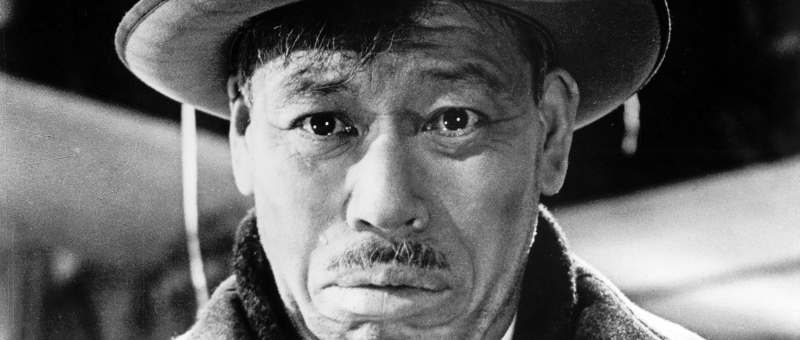
But of course the bureaucratic wheel keeps turning, another dangerous sewage problem diverted to another department continuing the literal pollution of the capitalistic post-war society. A kind of ghost story, Kurosawa lights Shimura from below, shadows cast across his gaunt face even by his “rakish” new hat while his huge eyes have a somehow haunted, grotesque quality filled with hungry desperation. Yet it’s to childhood that Watanabe eventually returns, “perfectly happy” sitting on a swing singing a song from his youth about the price age while surrounded by snow and at last painfully, absurdly alive. 


Ikiru screens at the BFI Southbank, London on 4th & 15th February 2023 as part of the Kurosawa season.

Original trailer (English subtitles)

Get ’em All (「みな殺しの歌」より 拳銃よさらば, Eizo Sugawa, 1960)

A recently released young man is forced onto a nihilistic path of meaningless violence when his bank robber brother is killed in a hit and run in Eizo Sugawa’s moody post-war noir, Get ‘em All (「みな殺しの歌」より 拳銃よさらば, ‘Minagoroshi no uta’ yori kenju yo saraba). Adapted from a novel from Japan’s hardboiled master Haruhiko Oyabu who also provided the source material for Sugawa’s The Beast Shall Die, the film is as much about defeated aspiration and personal despair as it is about the corrupting influence of money and the futility of vengeance.

After waiting a year to divide the loot from a bank robbery, a random syndicate of crooks is shocked to discover that it has gone missing from its hiding place in an ancestral tomb belonging to one of their members along with a gun connected to the crime which is presumably being kept for insurance purposes. Everyone is convinced someone else has taken it with Tanabe (Tetsuro Tanba), the owner of the tomb, most particular about getting his hands on his share as quickly as possible and directing his suspicion towards the heist’s mastermind, Koromogawa (Akihiko Hirata). 

Koromogawa is currently doing quite well for himself, having recently married and moved into a fancy new flat on a danchi. His brother Kyosuke (Hiroshi Mizuwara) has just been released from prison for an undisclosed juvenile crime and evidently has never met his sister-in-law Mamiko (Yukiko Shimazaki). Strangely buoyant and incredibly naive for someone who’s spent time inside, Kyosuke is determined to go straight and is intending to save money to buy a truck he can use to start his own business. He has no idea that his brother’s newfound wealth is down to robbing banks and is absolutely certain that he is a morally upright person who’d never have anything to do with criminality. When Koromogawa is killed in a hit and run after leaving to meet Tanabe, the suspicion is that he’s been murdered by one of the crooks in a dispute over the money though that would admittedly be quite a counterproductive move as if he really has taken it now that he’s dead no one knows where it is.   

Kyosuke is shocked by Mamiko’s apparently indifference to her husband’s death, even going so far as openly flirt with him. After discovering a receipt for a coin locker in his brother’s wallet, he opens it and finds a pistol first planting the seeds of doubt in his mind about Koromogawa’s life and death. The gun, however, begins to take him over. After reuniting with old girlfriend Yuriko (Akemi Kita), Kyosuke was beaten up by her new squeeze but when he tries the same thing again and notices the pistol tucked into Kyosuke’s waistband he immediately backs down. With the gun in his hand, Kyosuke is able to completely humiliate him, forcing the man to crawl on the floor like a pig and drink dirty water from a puddle in the road. This new sense of ultimate power fuels his desire for revenge setting him on a killing spree starting with Tanabe in an effort to figure out what happened to his brother, an exercise often frustrated by his killing those concerned before turning up any real information. 

Meanwhile, using the gun is also quite a stupid and naive thing to do as the police already have it on file from a shot that was fired during the robbery bringing the crime back into police consciousness and therefore making it impossible for any of the men to spend the money should they finally get their hands on it. Each has a different reason for wanting the loot, a clockmaker wanting to support a daughter left with disabilities after contracting polio, a former record producer realising that he’s aged out of his industry, a former boxer with a lame leg (Tatsuya Nakadai) dreaming of buying a small plot of land, and a couple of embezzlers looking for ways out along with in one case divorcing a wife to marry a bar hostess mistress. But then as in the last two cases and Koromogawa’s own it is perhaps the allure of rising consumerism that has already corrupted them. So much of the action revolves around big American cars, while we’re also told that the gun was one manufactured in Nazi Germany and was most likely bought or stolen from an American serviceman. 

So drunk is Kyosuke on the power of the gun that he doesn’t really take stock of what he’s doing until it’s already too late, realising he’s become an accidental serial killer and no longer has a possibility of leading a normal life. He had begun to feel that way before, especially in the wake of his brother’s death, as he finds each of his job applications failing when prospective employers learn of his criminal past. He’s repaid his debt to society, but if society refuses to give him a second chance then realistically he has no other avenue than heading deeper into crime. Kyosuke liked it that the gun made people fear him but is confronted by the illusionary quality of its power when a child suddenly grabs it in the middle of a game of cops and robbers, pointing the gun at him believing it to be a toy while passers-by laugh at the amusing sight of this little boy holding a grownup hostage. It seemed to confuse Kyosuke that Yuriko had not been afraid of him even with the gun in his hand, but her sudden terror on realising that he has killed and may yet kill her only shows him what he’s become. 

He wanted revenge for his brother’s death, but what if it really was just an accident? The gang begin to turn on each other after the money disappears, some believing Koromogawa took it for safekeeping to prevent them incriminating each other by spending it too early and others that he just took it for himself while each suspecting one another believing one of them is slowly killing the others to pocket the whole amount for themselves. But in the end it’s all for nothing, they couldn’t spend it anyway and several of them decide they’d rather not have the bother and are ready to live quiet lives in the country only it’s too late for that now. A final revelation confirming his brother’s criminality coupled with the betrayal of a friend’s well-meaning attempt to keep him in the dark lead only to an internecine confrontation with the futility of crime. With its noirish jazz score and photography reminiscent of contemporary American independent cinema Sugawa captures a sense of restless youth but also the latent desperation of those left languishing on the margins of an increasingly prosperous society.


Original trailer (English subtitles)

Untamed (あらくれ, Mikio Naruse, 1957)

“Don’t let guys control you. You have to make them men” the heroine of Mikio Naruse’s Taisho-era drama Untamed (あらくれ, Arakure, AKA Untamed Woman) advises a former rival, yet largely fails to do so herself in the fiercely patriarchal post-Meiji society. Based on a serialised novel by Shusei Tokuda published in 1915 but set in late Meiji rather than early Taisho, Naruse’s adaptation essentially drops a contemporary post-war woman into a by then almost unrecognisable Japan, but finds her hamstrung firstly by feckless and entitled men and then by complicit women who themselves cannot accept her transgressive femininity. 

As the film opens, a teenage Shima (Hideko Takamine) has just married wealthy grocery store owner Tsuru (Ken Uehara) but the marriage is already a failure. Though Shima is compared favourably with Tsuru’s previous wife who was apparently in poor health, presumably suffering with TB which required a sojourn by the sea, it soon becomes clear that Tsuru is as trapped by the archaic patriarchal social system as she is. He was apparently in love with a woman from a higher social class he was too afraid to pursue and despite still seeing her also has a mistress near their factory in Hokkaido whom he often visits under the guise of a business trip. Yet when Shima tells him she thinks she may be pregnant, he is unimpressed, immediately questioning the paternity of the child while harping on about her having been married before which it seems is not quite true. Perhaps the reason that she has ended up a second wife despite her youth and beauty, Shima ran out on a marriage to a childhood friend arranged for her by her adoptive parents the night before the wedding not realising they had already registered the union without her knowledge or consent. 

This transgressive act at once signals Shima’s total disregard for conventionality and insistence on her own autonomy, yet it is also indicative of the fact she married Tsuru in search of a better life, knowing that to marry her adoptive parents’ choice meant only a life of servitude on the family farm. She is not always a terribly likeable figure, coldly explaining that she didn’t mind being fostered out because the adoptive family were wealthier and could give her a better life than she had with her birth parents. Yet it’s this sense of familial dislocation and the liminal status it gives her that allow her to take agency over her life in the way other women might not, unwilling to lose the familial security Shima may not feel she ever had. Tsuru is also an adopted son, but the price for disobedience for him may be even higher and indeed as we later hear his inability to sort out his love life eventually sees him out on his ear. His pettiness in refusing to accept the child is his leads to an argument which causes Shima to slip on the stairs and miscarry, the implication being that she may not be able to bear more children leaving her unlikely to remarry and thereby spurring her desire for a tempered independence. 

The fall is the last straw. Tsuru divorces Shima citing her inability to play the role of the proper wife while her birth family, from whom she is emotionally estranged, refuse to take her back as do the adoptive parents because of the embarrassment she caused them with the marriage stunt. She is often described as “like a man”, unable to win as Tsuru at once insists she wear the frumpy kimonos left behind by his previous wife who was a decade older, complains she wears too much makeup, and tells her to loosen her kimono belt to de-emphasises her figure, while criticising her for being unfeminine in her refusal to simply put up with his bad behaviour as is expected for a wife in this era. Shima fulfils all her wifely duties and as we see is in fact running his business as the women of the family are often seen to do while their husbands spend the money they earn for them on other women whether drinking with geishas or supporting mistresses in second homes. When her husband hits her, she fights back rather than shrinking away chastened as intended. 

Yet she cannot overcome the sense that a man is necessary for her success which cannot be accomplished alone. Cast out from her family, her brother installs her in the mountains to work in a geisha house if only as kitchen staff but soon does a flit to reunite with his married lover who has left her husband for him. While there she falls for the quiet and sensitive inn owner Hamaya (Masayuki Mori), also an adopted heir, whose wife is again ill with TB. Hamaya may be treating his wife a little better than Tsuru did his, but quite clearly assumes she’ll die in starting an affair with Shima who is then sent away to an even more remote inn to avoid a potential scandal. As Tsuru did with the woman he apparently loved, Shima continues to see Hamaya until he too succumbs to TB as an ideal of an impossible love while simultaneously accepting that he failed her in being too weak and cowardly to fight for their romance, outright refusing to become his mistress. 

This may be one reason she is determined never again to be an employee but to own her own store which is why she ends up marrying tailor Onoda (Daisuke Kato) who introduces her to textiles and seamstressing at which she quickly proves adept having mastered the modern sewing machine. She marries Onoda in believing him “reliable”, but soon comes to regard him as lazy and feckless. The first shop fails because he can’t keep up with her. The male employees are always taking breaks to drink tea and play shogi, Onoda complaining that he’s tired while she does all his work for him and the housework too. Yet he also criticises her for a lack of femininity, snapping back that it must be her time of the month when she berates him in front of their employees while later after they’ve become successful complaining it’s “embarrassing” that his workhorse wife doesn’t know the things a sophisticated society woman would such as ikebana while flirting with the teacher he’s hired ostensibility to teach her. He even forces her to wear a frumpy and already somewhat dated classically Edwardian dress with a fancy bonnet which more resembles something a country girl might wear to church than the latest in Western fashions in an attempt to advertise their tailoring which seems primed to backfire. 

That she learns to ride a bicycle in this rather ridiculous outfit is again a symbol of her desire to seize and manipulate modernity even giving rise to a piece of innuendo from her much younger assistant Kimura (Tatsuya Nakadai) as to the pounding she’s been getting from the saddle. Kimura seems to think the problem with the business is that Onoda’s patterns are outdated, offering her a new modernity while she prepares to cut Onoda out on catching him with his mistress taking their best employee with her to ruin his business and start another of her own. Though once again she cannot leave alone only with a man the ending is perhaps more hopeful than might be expected from a Naruse film allowing Shima to commit herself fully to the sense of industry she embodies always ready to start again, work harder, and achieve her desires unwilling to be bound by conventional ideas of femininity or to simply put up with useless men who refuse to accept her for all she is. Yet she largely fails to make men of them, each of her various suitors failing to live up to her, ruined by an oppressive social system that encourages them to exploit female labour while taking it for granted in their intense sense of patriarchal entitlement. 


Seven Samurai (七人の侍, Akira Kurosawa, 1954)

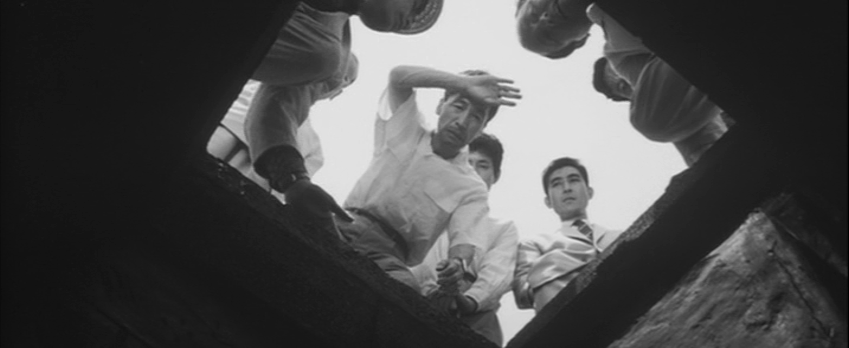
An eclipse of the accepted order allows a temporary truce in the ongoing class conflict that defines feudal society in Akira Kurosawa’s seminal post-war historical epic, Seven Samurai (七人の侍, Shichinin no Samurai). Set in the late 16th century, the action takes place in a world on the brink of collapse. The Sengoku era is drawing to a close but is also in a moment of intense crisis which has left large numbers of highly skilled warriors essentially orphaned, wandering the land torn between their basic needs for food and shelter and their dignity as members of a theoretic aristocracy. 

Plagued by bandits, many of whom may be these orphaned swordsmen, a small village contemplates the unthinkable in hiring samurai, otherwise their oppressors and uniquely responsible for the chaos which surrounds them, for protection. “Land tax, forced labour, drought…and now bandits!” one woman exclaims shortly before suggesting they simply surrender all their grain and then hang themselves. As they can offer only expenses in the form of rice, the only samurai they can hope to recruit are already desperate, so hungry that they may be willing to deign to defending their social inferiors with whom they would not usually mix unwilling to accept that they are both victims of the inherently corrupt social order. This explains why the villagers’ early entreaties are met with such scorn and cynicism, either rudely rejected out of hand or ending only in deception. 

In this there is an echo of the world of 1954 which was beginning edge away from the chaos and privation of the immediate post-war society, bandits standing in for thieves and profiteers themselves a product of intense food insecurity. Yet here it’s desperation that allows a temporary merging of the world of lord and peasant, brokered finally by unexpected compassion on the part of a noble samurai who, in an act of extreme transgression, symbolically erases his elite status by shaving his head in order to save a child taken as a hostage by another desperate man. Kambei (Takashi Shimura) may be somewhat reduced in circumstances but refuses to give in to the immorality of the world around him, finally agreeing to help the villagers essentially out of a sense of pity willing to accept only the gift of sustenance moved by the villagers’ sacrifice in discovering that they give him the last of their white rice while subsisting only on millet. 

Yet having taken this step, the villagers remain uncertain they can really trust the men they’ve hired to protect them who are after all each trained in death. Later we discover that they have, like many of the time, occasionally finished off the odd lone samurai fleeing the battlefield in order to loot the bodies as a large stockpile of samurai armour later discovered by the samurai-pretender Kikuchiyo (Toshiro Mifune) testifies. On being confronted with this uncomfortable reality, the samurai fall silent knowing this armour was stripped from men much like themselves, but can ultimately offer little by way of defence when presented with an angry rant from Kikuchiyo who points out that they are themselves responsible in having created this world of chaos through their internecine quests for power. “In war you burn their villages, trample their fields, steal their food, work them like slaves, rape their women, and kill ‘em if they resist. What to you expect ‘em to do?”

When Kambei and the others first arrive in the village, there is no welcoming committee. The villagers all hide, frightened to leave their homes partly because of paranoia spread by widowed father Manzo (Kamatari Fujiwara) convinced that randy samurai are going ravish all of their daughters who will, doubtless, be overcome with awe by these sophisticated men of the elite. In an echo of Kambei’s transgression, Manzo forces something similar on his teenage daughter Shino (Keiko Tsushima), roughly cutting her hair while she cries and resists before dressing her up as a boy so that she’ll be safe from lusty samurai. The plan, however, backfires in that she later engages in a doomed romance with the young Katsuhiro (Isao Kimura). Their eventual union is the symbolic merging of the two worlds, a moment of eclipse in the usual hierarchy, but it’s born of the same impulses than brought Kambei and the others to the village. In fear and desperation, they behave as if there’s no tomorrow, only tomorrow must come and just as sun and moon must eventually move apart and resume their regular orbits so the relationship between Katsuhiro and Shino is an impossibility. 

Like Kambei, Katsuhiro had occupied a slightly liminal position because of his relative youth, neither boy nor man. He first encounters Shino while marvelling at the natural beauty of the forest, only to berate her for doing the same. “Is this any time for an able-bodied man to be picking flowers?”, he ironically asks her, yet he is repeatedly forced back towards conventional masculinity as marker of adulthood virtually ignoring her when tasked with carrying a dummy to the ridge, while she later returns the same gesture reassuming her femininity in joining the rice planting, a peasant woman once again. “What’s wrong with two people in love?” the wounded Rikichi (Yoshio Tsuchiya) asks Manzo, trying to smooth over this moment of cross-class crisis, only for Monzo to ask what he’s supposed to now his only daughter has become “damaged goods”, unfit for marriage in a fiercely patriarchal society in which it is impossible to survive without a husband. 

Katsuhiro cannot marry her, this sense of solidarity if not quite equality can be only temporary. Kambei himself admits as much as he reflects that the battle has been won but the victory belongs not to them but to the peasants, anticipating his a sense his own obsolescence the end of the Sengoku era bringing about a change in the nature of the samurai that two centuries later will lead to its abolition. Our sympathies might shift, witnessing Kambei’s obvious disapproval of the peasants’ relish in taking revenge on the bandits who have caused them so much misery in their own way perhaps perpetuating the cycle of violence and resentment that drives the feudal engine. One cannot help but pity him, displaced once again returning to a life of ceaseless wandering, his presence in the village now no longer necessary and in fact inappropriate. 

Returning to the world of 1954, there might be something a little uncomfortable in this lament for the death of the samurai who can have no place either in the modern society or in a peasant village in 1587, as there may be in the implication that the peasants are savage and vindictive while Kambei alone is good and kind even if the roots of his compassion lie in his willingness to literally sever himself from his elite status. The roles had in a sense been reversed, the samurai hired hands to peasant bosses, but the inversion can be only temporary. In insisting that only by protecting others can one hope to protect oneself, Kambei may be advocating for a more compassionate society but as much as he has attempted to remove himself from the class system he can not in the end overcome it. Nevertheless, in the gruelling battle scene that closes the film, all rain, mud, death and misery, Kurosawa himself deals the final blow to the samurai in the nihilistic futility of violence manifesting itself once again in the lingering feudalism of the mid-century society. 


Seven Samurai is re-released in UK cinemas in its recent 4K restoration as part of BFI Japan on 29th October.

BFI re-release trailer (English subtitles)

Early Spring (早春, Yasujiro Ozu, 1956)

By the mid-1950s, Japan’s economy was beginning to improve but now that the desperation that went with hunger had dissipated it freed those who’d managed to climb out of post-war privation to wonder just what the point of their ceaseless toil was. Yasujiro Ozu’s primary subject matter remained the modern family, but 1956’s Early Spring (早春, Soshun) sees him heading in a darker direction as he weighs up the delusions of the salaryman dream and discovers that whichever way you swing it, life is disappointing. 

So it seems to be for salaryman Shoji (Ryo Ikebe). He and Masako (Chikage Awashima) married for love a long time ago, but it’s clear that there is distance in their relationship. They sleep in the same room but their futons are slightly too far apart, and the few words they exchange with each other in the morning are terse in the extreme. The truth is that for many a salaryman for whom long hours and interoffice bonding sessions are compulsory, work is the new family. Wives are welcome to join the Sunday hiking outings but it seems few do. Masako too declines, telling her mother she felt it to be too expensive, already irritated with her husband’s irresponsible spending on mahjong games and drinking with friends. 

Money is certainly a constant worry for her and as we learn from her mother they’re behind on the rent despite it being “very cheap”. Masako had made a visit home in part to ask for another loan, which her mother seems reluctant to give, offering her daughter a takeout of the oden her restaurant sells which is first declined but then accepted. Her mother also flags up the other problem in their marriage which is that they sadly lost a child in infancy and have had no more. Sorrow may have killed their love, but the fact her husband stays out all hours and wastes the little money he earns while failing to win promotions only makes the situation worse. 

As for Shoji, he is becoming very aware of the delusions of the “salaryman dream”. He is one of thousands of men identically dressed in white shirts and grey trousers that board the packed rush hour trains every day heading into the city. His life is one of pointless drudgery and its only victory is that keeps hunger from the door, not even quite stretching to a roof over his head. “All that’s waiting for us is disillusion and loneliness” according to a veteran salaryman growing close to his retirement and realising that he has little left to live on, his dream of buying a small stationary shop all but unobtainable. He was dead set against his own son joining the ranks of the salaryman, but in the end failed to prevent it.

It is perhaps this sense of frustration and impotence that draws Shoji into an affair with a younger woman, Chiyo (Keiko Kishi), who is admittedly very pretty but seems to hold little interest for him aside from her youth and beauty. Chiyo openly pursues her older colleague, declaring that she doesn’t care he has a wife but has come to hate her after the first time they slept together. Shoji meanwhile remains guilty and conflicted. He evidently continues seeing Chiyo, lying to Masako that he’s visiting a sick friend, but otherwise regards her as an irritation. When his co-workers figure out what’s going on they try to stage an intervention, but Shoji doesn’t show up and Chiyo angrily denies everything before arriving at Masako’s looking for Shoji only this time he really is out visiting a sick friend. 

Miura (Junji Masuda), the sick friend, is a true believer in the salaryman dream. Now that he’s ill, he misses the packed trains and elevators, not to mention his old workplace friends. All he wants is to be well enough to return to the office and his predicament perhaps has Shoji thinking that at least he has his health and things aren’t so bad for him after all. Masako, meanwhile, turns to other women for advice. The woman across the way recounts how she caught her husband out with his mistress and made a scene that’s rendered him docile and obedient ever since (a rare man in an Ozu film putting his socks neatly in the laundry basket and hanging up his own coat rather than throwing it on the floor for his wife to deal with). Her widowed friend is more sanguine, admitting that caution is necessary but it’s a little dark to envy the life of a widow for its “freedom”, while her mother thinks she’s overreacting because that’s just how men are in this generation or any other. 

Shoji’s old mentor agrees that “everyone’s disappointed” and all that remains is to try and make the most of it, but still he sees that Shoji has been reckless and inconsiderate in his treatment of both women. He avoids his wife because of the emotional distance between them born of grief, and only really has an affair with Chiyo because it was easier than refusing her. He didn’t even enjoy it, and doubtless it did not quite quell the sense of despair he feels with the utter pointlessness of the “salaryman dream”. Masako, in turn, is disappointed with married life, with her husband’s emotional cowardice, and with her own lack of options. Ultimately, Ozu sides with the mother, not quite condoning Shoji’s behaviour while perhaps excusing it as a direct consequence of dullness of his life while forcing Masako to accept complicity in her husband’s weakness. They may reunite, the stressors of their Tokyo life from the high cost of living to the lure of mahjong now absent, but there is a sense of futility in their eventual insistence that they will “make it work” through starting over in a new place while gazing at the train that, they assume, will eventually carry them back to the city and all of its false promises of a brighter future. 


Early Spring screens 19th/20th/21st October & 20th/23rd November at London’s BFI Southbank as part of BFI Japan. It is also available to stream in the UK via BFI Player and in the US via Criterion Channel.