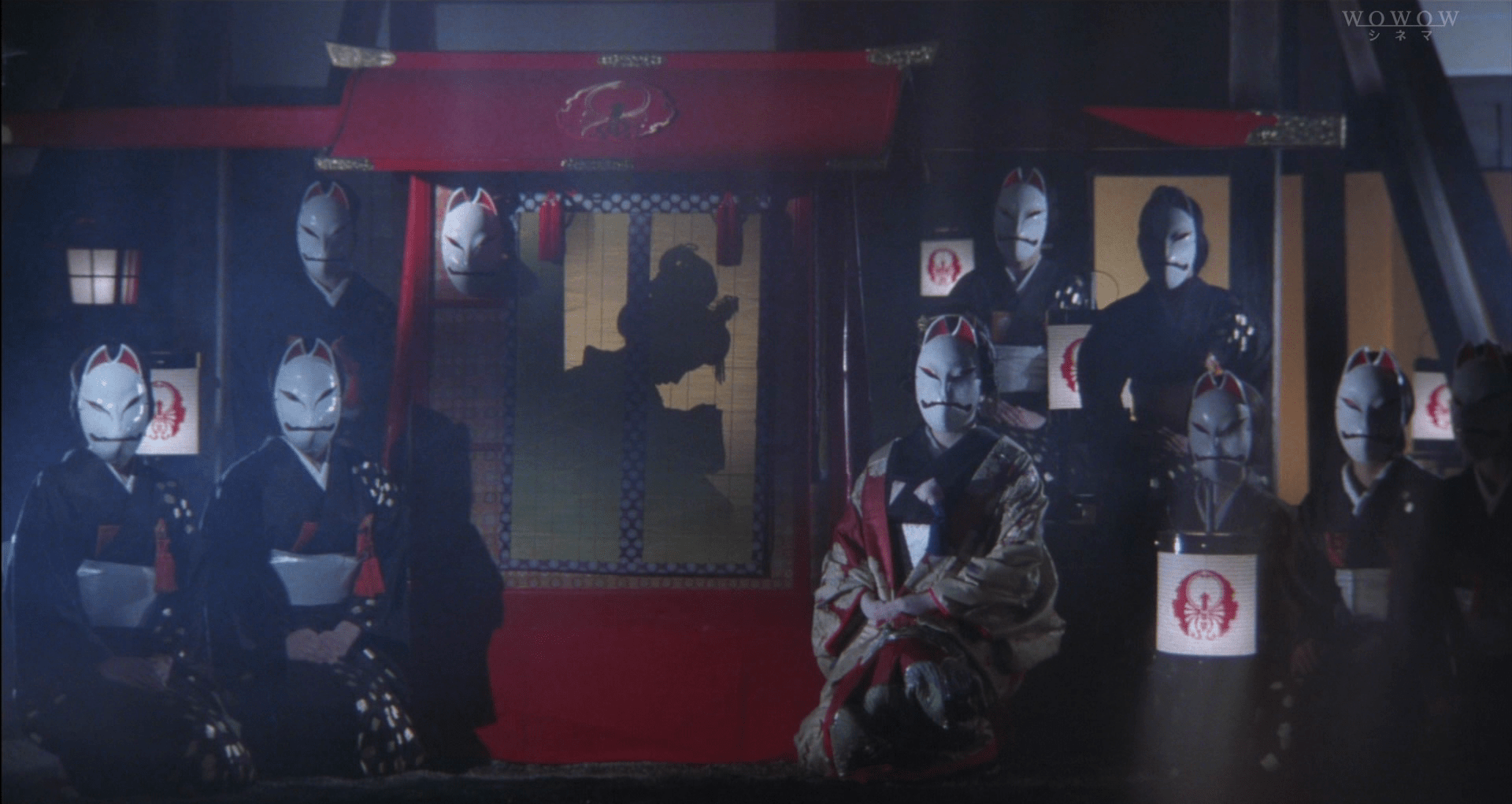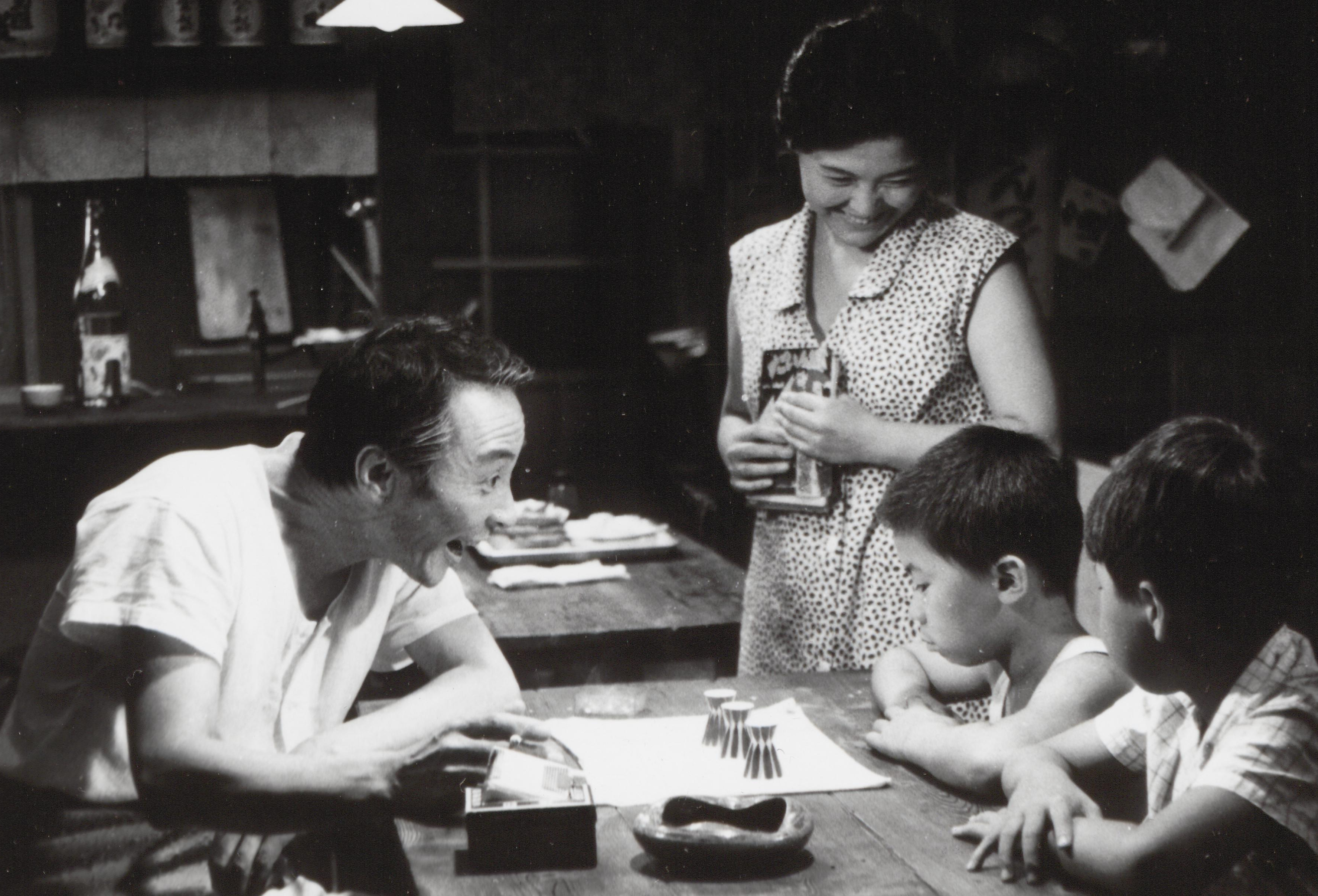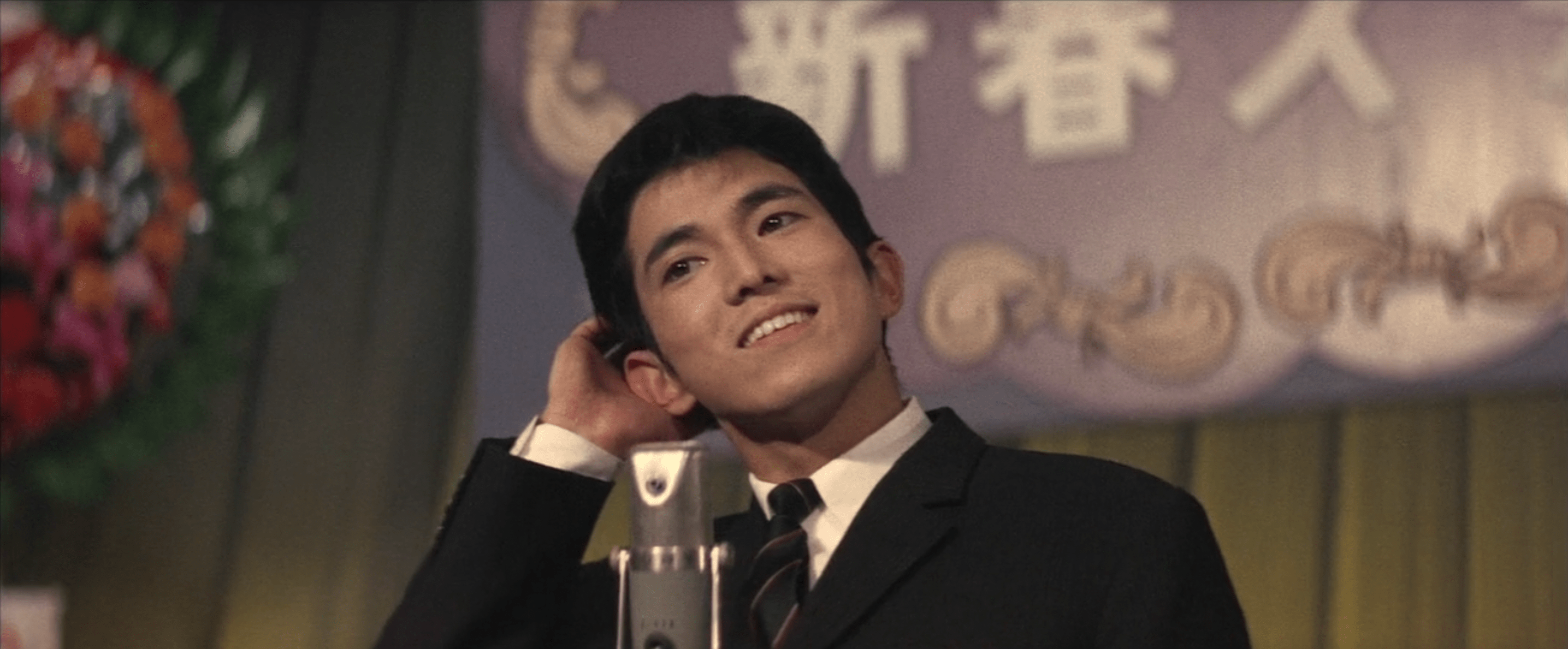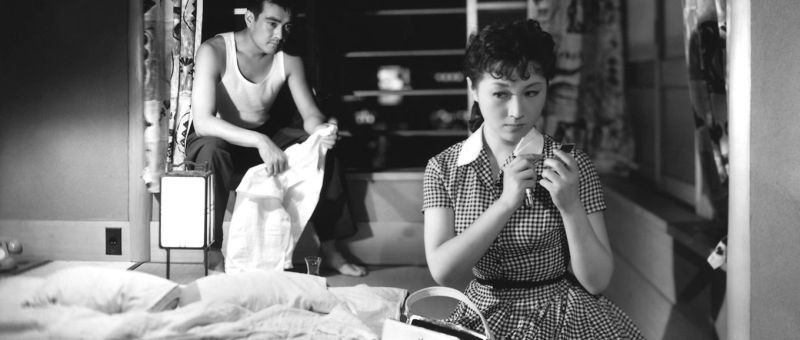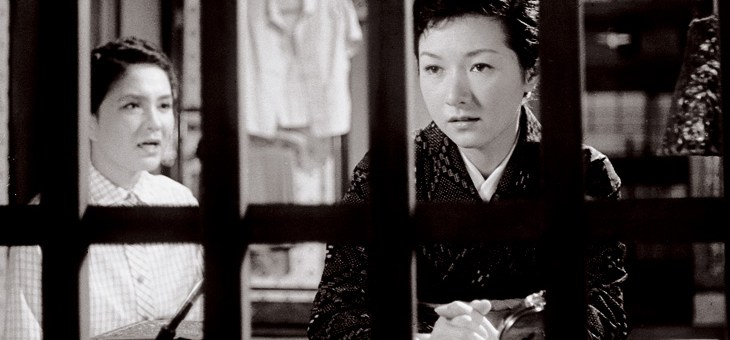
The Twilight Years (恍惚の人, Shiro Toyoda, 1973)

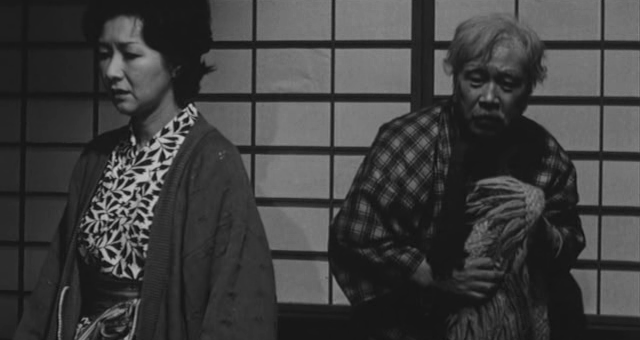
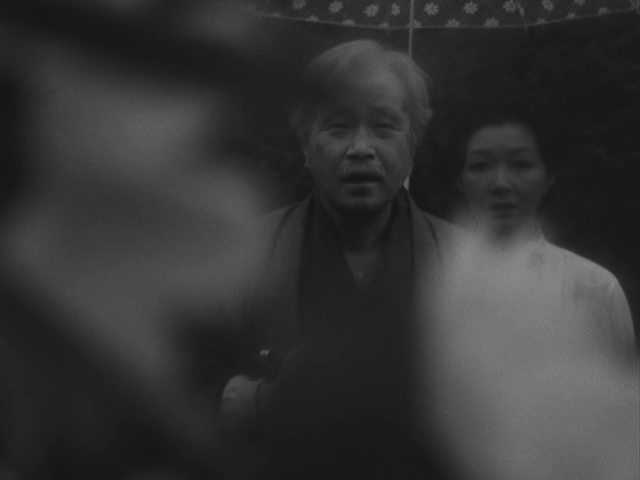
In the early 1970s Japanese society was not as concerned with population slowdown as it would come to be, but Shiro Toyoda’s sympathetic ageing drama The Twilight Years (恍惚の人, Kokotsu no Hito) is evidence of a growing consciousness that traditional ideas about how one cares for the elderly may now be becoming incompatible with the functioning of modern society. Based on a best-selling novel by Sawako Ariyoshi, the film has profound empathy both for the ageing patriarch once apparently a tyrant but now a meek and frightened child, and the daughter-in-law to whom his care largely falls.

In fact, it’s caring for Shigezo (Hisaya Morishige) that some believed shortened the lifespan of his late wife who passes away in the film’s opening scenes. Already somewhat detached from reality, Shigezo simply reports that his wife won’t wake up no matter how much he tries to wake her, much like a child who’s discovered someone no longer living. While his daughter-in-law Akiko (Hideko Takamine) rushes to her room with a sense of foreboding, Shigezo merely stays in the kitchen eating boiled potatoes straight out of the pan. It’s the odd behaviour that seems to irk his son Nobuyoshi (Takahiro Tamura) but it’s only now that the couple seem to be realising that there’s something wrong especially as Shigezo does not appear to understand that his wife has died. Pitiably, he chides her for lounging around so late in the day when she’s already been laid out for her funeral.

When his daughter, Kyoko (Nobuko Otowa), arrives having actually missed the funeral itself due to transport issues and a conflicting responsibility to act as a matchmaker at a wedding, Shigezo doesn’t recognise her. He continues to ask for Akiko and gradually forgets most of the other people in his life, screaming when encountering Nobuyoshi and instructing Akiko to call the police to report a burglar in their home. According to both women, Shigeyoshi had treated Akiko poorly ever since she joined their family, which makes caring for him so much harder. The reason he becomes so attached to Akiko is likely simply that she is the person who is always around him so he has less time to forget her. He may realise on some level that she may not wish to care for him given his previous behaviour which may be why he becomes preoccupied with the idea she may “disappear” and cries out in the night when he can no longer see her.

But Akiko also has other responsibilities including a job outside the home and a teenage son studying for his exams. Nobuyoshi expresses regret that he hasn’t been more help and voluntarily tries to pitch in, but lets himself off the hook given that his father doesn’t recognise him and becomes anxious in his presence. Satoshi (Izumi Ichikawa) meanwhile does try to do his bit but is young and a little resentful of the responsibility. As his dementia becomes more severe, Shigezo begins calling Satoshi “Dad” as if he were a child again. Which is all to say, Shigezo becomes Akiko’s responsibility and the strain of caring for him begins to affect her own mental and physical health leading her to fear that she too may die younger than she otherwise might have. 

Yet in exploring her options, Akiko finds little by way of support. Most nursing homes won’t accept patients with complex needs like Shigezo and conditions such dementia are often regarded as mental illnesses meaning her only option might be to put him in an asylum. Shigezo was attending an old person’s daycare centre, but later says he doesn’t want to go anymore because it’s full of old people and therefore no fun. While the film is sympathetic towards Akiko and the difficulties she is facing in caring for her father-in-law it also has profound empathy for Shigezo for though he has so many people who are doing their best to look after him, his increasing mental confusion quite obviously leaves him isolated and he must be incredibly lonely while trapped within his own reality. He develops a habit of saying “hello, hello,” as if he were answering the telephone which may be his attempt to communicate while he is also fascinated with a caged bird which may reflect his own sense of being constrained by his condition.

Later, the bird seems to symbolise Akiko too, trapped as she is within the domestic environment where all responsibility seemingly falls to her. Even so a young student couple she rents the annex to for a lower price in exchange for keeping an eye on Shigezo during the day remark that he may be in the ideal state for a human being having returned to early childhood in which there are no concerns or responsibilities and he is therefore unburdened by the weight of what is to live. Toyoda often uses handheld camera to symbolise the desperation and destabilisation of Shigezo’s existence in which Akiko has become his only fixed point. One of Nobuyoshi’s friends remarks that perhaps it was better when the average life expectancy was 50 and Nobuyoshi’s mother might have been lucky passing away peacefully while otherwise in good health. Still, as Nobuyoshi says, it comes for us all in the end and we should all try to be kinder to each other while we’re here.


Hoodlum Soldier (兵隊やくざ, Yasuzo Masumura, 1965)

The opening voiceover of Yasuzo Masumura’s Hoodlum Soldier (兵隊やくざ, Heitai Yakuza) explains to us that the settlement we’re looking at is effectively a huge prison in the desert inhabited only the Japanese military from which there is no escape. To ram the point home, the camera lingers on the decomposed skeleton of Japanese infantrymen half-buried in the mud only a short distance from the fort’s borders. This is the fate of the soldier, it seems to tell us with nihilistic futility as if in effect all of these men are already dead while imprisoned inside the death cult that is militarism. 

Yet, our heroes will eventually escape. At least that’s how it seems at the end of the film though there are a further eight instalments in this series. A mismatched pair who develop something akin to a sadomasochistic relationship, they each resist this system in opposing ways. “College boy” Arita (Takahiro Tamura) is just waiting out the end of his contract, continually refusing promotions so that he will be discharged at the end of his three-year term and allowed to return to Tokyo a free man. Omiya (Shintaro Katsu), by contrast, is a man who has no real concept of hierarchy or authority. As he later says, he doesn’t do anything he doesn’t want to do and it’s not so much that he resists authority but is simply indifferent to it.

As Arita explains, the the army is a hierarchy that’s founded on violence. The mildest infraction is dealt with through a process of slapping in which those of higher status assert their authority by inflicting violence on those below. We’re told that laws have recently been put in place to regulate the violence implemented as disciple with excessive force now apparently frowned upon leaving this culture of slapping as the only accepted form of judging an action right or wrong though it’s also clear that these rules are not always respected even by those who made them. The very system is then itself corrupt and unfair, which Arita knows and therefore contrives to live outside of it in so much as he does not participate in this chain of violence.

Neither does Omiya but in an opposing way. On joining the unit, he simply does not react to being slapped by his superior officer and in that way makes it clear that he cannot be controlled by violence. He does not fight back, but only uses to violence to oppose what he sees as injustice and it’s this refusal to just accept the unfairness of army life that makes him a thorn in the side to army command. They assign a reluctant Arita as his mentor, much to his chagrin because he fears that Omiya will get him into trouble and damage his chances of making it to his discharge without incident. But the funny thing is that Omiya does submit himself to Arita’s authority precisely because he does not brutalise him and never uses violence as a means of control. Omiya respects Arita, and therefore listens to him when he explains why a particular course of action is disadvantageous to himself and will only result in further violence. 

To Arita, Omiya at times seems like a bullheaded brawler who thinks a fight is over when someone is knocked out or surrenders and is unable to see the potential for reprisals, but he’s smarter than he gives him credit for and the bond between them is quite genuine even at times homoerotic as they each declare they don’t want to be parted from each other seemingly the only two sane men marooned amid the folly of war in Manchuria. Omiya respects Arita because he does not use violence against him, but in other senses perhaps craves it and is willing to inflict violence on himself in order to save Arita from being forced to do so by the system under which they live which would obviously cause him mental anguish. The power dynamics between them shift as the fortunes of the war decline with Arita eventually declaring that Omiya is now his superior and may issue him orders which he will then obey.

The statement may however be ironic in that they are in the process of escaping the hierarchal society by hijacking its most potent symbol, a train. Omiya declares themselves free of it in pointing out that China stretches to the borders of Russia and Europe as if the whole world were now open to them that they are no longer bound by the walls of the literal prison that is the army camp and the symbolic ones of the militarist society ruled by violence. As Arita had pointed out, the camp ran itself like a prison and was akin to a yakuza society with the different factions often at war with each other. Goverened by macho posturing, every transgression must be solved through violence to approve each man’s status with Omiya’s perpetually high in part because he doesn’t really care very much for the hierarchy only for what he sees as righteousness. 

The two men bond with a Japanese sex worker who they realise is just as trapped as they are by the force that underpins militarism, violent patriarchy. She also feels her situation to be futile, that even if she should return to Japan there will no future for her because of her past in sex work while she currently has no more control than they do and is simply pulled around by her employers to wherever the army goes now that the frontlines are in constant flux and the retreat south has begun. Arita and Omiya free themselves by decoupling from the train leaving the sleeping soldiers yet to awake from the cruel spell of militarism inside while they seek freer futures. Our heroes are men who in effect simply choose to remove themselves from an absurd and destructive social order which speaks just as well to the contemporary society of docile salarymen living in a different kind of prison but perhaps no more free than previous generations while tied to a feudalistic, patriarchal social hierarchy. 


Hoodlum Soldier screened as part of this year’s Camera Japan.

Original trailer (no subtitles)

The Great White Tower (白い巨塔, Satsuo Yamamoto, 1966)

“It’s about the right thing to do, it’s about conscience, and Prof. Zaizen lacks conscience” according to a star witness at the conclusion of a medical malpractice trial in Satsuo Yamamoto’s adaptation of the novel by Toyoko Yamasaki, The Great White Tower (白い巨塔, Shiroi Kyoto). One of a series of films heavily critical of the medical system in the midst of rising economic prosperity, Yamamoto’s tense political drama presents the succession intrigue at a university hospital as an allegory for the nation as a whole implying that lingering feudalistic and authoritarian thinking has poisoned the contemporary society. 

This is in part reflected in the way in which major hospitals are often run as large family businesses where succession is a dynastic matter. In this case, however, the scene is a prominent university hospital in Osaka at which the head of the surgical department, Azuma (Eijiro Tono), is about to retire. Generally, one of his assistant professors would simply move up after being approved by a board comprised of other department heads but the problem is no one, and especially not Azuma, is particularly happy with the most likely candidate, Zaizen (Jiro Tamiya). The issue between them seems to be one of ambition and authority. Zaizen is regarded by all as an excellent doctor with a stellar track record but he is also cold and arrogant with no regard for departmental protocol all of which of course offends Azuma as does his background and person. The son of a country teacher, Zaizen prospered through the dedicated labour of his widowed mother along with family connections before marrying into the extraordinarily wealthy and influential Zaizen family who run a large obstetrics clinic. Consequently, he is free to pursue his interests and lacks the economic anxiety that might make another employee wary of pushing his luck. 

His humble background might have placed a chip on Zaizen’s shoulder but it’s also clear he’s part of a new generation that does things differently from the last, apparently keen to build a public media brand appearing in a glossy magazine which brands him “the magic scalpel” thanks to his success in treating pancreatic cancer. While they might not be able to argue with his track record, other doctors worry that Zaizen has developed a god complex and is slapdash with his practice often timing his operations and smugly pleased with himself when hitting a new record. Azuma first picks him up on this in the case of elderly patient, questioning his treatment decisions in accusing him of neglecting to fully consider the patient’s post-op wellbeing. This then becomes something of a recurring theme as good doctor Satomi (Takahiro Tamura) is minded to bring Zaizen in on the tricky case of a man, Sasaki (Nobuo Minamikata), he suspects may have pancreatic cancer but has been repeatedly diagnosed with chronic gastritis. 

Though it’s political intrigue that in some senses leads him to Zaizen, Satomi is otherwise depicted as the responsible physician who deeply cares for his patients’ wellbeing and not much at all for interoffice politics. Thus he continues to investigate Sasaki’s case even when other doctors tell him he’s wasting too much time on one patient and should just leave it at gastritis. Zaizen, meanwhile, is the exact opposite taking one look at the X-rays and deciding it is pancreatic cancer after all but thereafter ignoring Satomi’s advice after taking over the case refusing to run a CT scan to verify that the cancer hasn’t spread to the lungs as Satomi fears it might have. 

For Zaizen Sasaki ceases to matter, to him the human body is no different to a machine and he perhaps more engineer than doctor even as he proclaims medicine more art than science in insisting that he just knows the early signs of pancreatic cancer while others are unable to detect them. After the first operation we see him perform, a grateful wife stops to thank him profusely for saving her husband’s life though he treats her coldly and implies it’s all part of the job before going outside to celebrate his private glory in his record-breaking feat. It’s then a minor irony that he finds himself later slapped with a malpractice suit by Sasaki’s wife upset that he was unavailable as her husband was dying because he was preoccupied with the ongoing elections for Azuma’s successor.

The implication is that the dehumanisation of the health industry has reduced it to the status of any other company, the head doctors no better than ambitious salarymen whose lives are defined by their job titles. The various department heads eventually descend into factions with Azuma plumping for an external candidate, Kikukawa (Eiji Funakoshi), while others line up behind Zaizen or his internal rival Kasai (Koichi Ito). Influence is brokered largely by outright bribery or industry manipulation by external influential players including Zaizen’s wealthy father-in-law and a professor in Tokyo who can offer monetary perks, access to funding, and potential promotions to those willing to vote for their chosen candidate. The main argument against Zaizen is his bad character, yet the fact he has been carrying on an affair with a bar hostess is never used against him even as they prepare to smear a rival candidate with his mistress even suggesting they hire a hitman to take him out completely. Zaizen’s minions meanwhile make an ill-advised visit to Kikukawa to ask him to withdraw bizarrely stating the importance of maintaining “democracy” even as they themselves deliberately undermine it for their own gain.  

It’s this sense of feudalistic, fascistic authoritarian chumminess that Azuma’s daughter Saeko (Shiho Fujimura) later decries in asking her father why he did nothing to change such a destructive system while he himself had the power to do so the implication being that he saw no need because he continued benefit from it. Only she and Satomi present any kind of challenge to the hypocrisy that pervades the medical system but eventually discover that there is no place for integrity in the contemporary society. Zaizen miraculously falls upwards every time because his success is more expedient that his failure. Even the Tokyo professor brought in as an expert witness during the malpractice suit declares that Zaizen is unfit to be a physician because of his arrogance and total lack of human feeling but pulls back from testifying that he caused the death of his patient through negligence later explaining to a colleague that if a university professor were to be found guilty of malpractice it would undermine public faith in the medical system. 

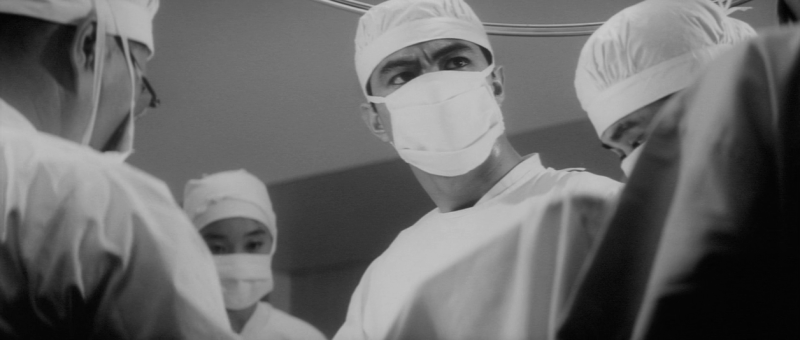
If can’t they can’t have faith in the medical system, the very people who are supposed to care for them when they are most in need, how can they have faith in anything else? As the rather bleak conclusion makes clear, the entire system is rotten to the core and no longer has any place for idealists like Satomi who are continually pushed to the margins by those jockeying for power in this infinitely corrupt society defined by hierarchy and cronyism while ordinary people, like Sasaki, continue to pay the price. Just as in his opening sequence, Yamamoto takes a scalpel to the operations of the medical industry to expose the messy viscera below but ultimately can offer no real cure in the face of such an overwhelming systemic failure. 


Original trailer (no subtitles)

Crest of Betrayal (忠臣蔵外伝 四谷怪談, Kinji Fukasaku, 1994)

“I was trying to reform our times!” cries a man about to abandon his revolution at the moment of its inception. “The times have reformed us” his friend retorts, rejecting him for his self-interested cowardice before seconds later deciding to follow his example. Largely remembered for his contemporary jitsuroku gangster pictures, Kinji Fukasaku’s tale of rising individualism amid political turbulence and economic instability Crest of Betrayal (忠臣蔵外伝 四谷怪談, Chushingura Gaiden: Yotsuya Kaidan) hints at a perceived moral collapse in contemporary post-Bubble Japan defined by a sense of nihilistic impossibility in marrying the classic ghost story Yotsuya Kaidan with the noble tragedy of the 47 Ronin. 

The action opens the very concrete date of 14th March 1702 which as an early title card reminds us is at the close of the Genroku era which had been regarded as a “golden age” but its appearance of affluence had in fact been semi-engineered by the shogunate’s unwise decision to continue debasing the currency which later led to an inflation crisis (sounding familiar?). Meanwhile, in the samurai world Tsunayoshi, the fifth Tokugawa shogun, has deposed 38 Daimyo creating 40,000 masterless samurai each vying either for new positions as retainers in other clans or some other way to survive in a manner which befits their station. 

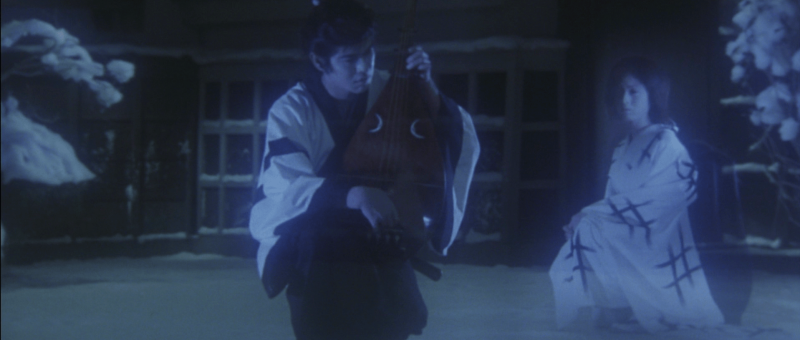
The 14th March, 1702 is a significant date in terms of the narrative in that it marks the first anniversary of the death of Lord Asano who was ordered to commit seppuku after offending another lord, Kira Kozuke-no-Suke Yoshinaka (Takahiro Tamura), leaving his house ruined and his retainers masterless. Samurai code dictates they seek revenge, but leader Oishi (Masahiko Tsugawa) suggests they bide their time leaving him and the clan open to accusations of cowardice or betrayal, mocked by peasants at the memorial service while Oishi decries their appetite for samurai drama. Enter Iemon Tamiya (Koichi Sato), antihero of the classic Yotsuya Kaidan, who had apparently joined the clan only two months before it was dissolved after years as a wandering ronin biwa player and alone has the courage to ask him if he truly has no appetite for vengeance moments after Oishi has scandalised his men by pointing out that it was Asano’s “short-temperedness” which destroyed their clan. His only answer is that it cannot be now, they must wait a year in order to prove their internal resolve. 

In marrying the two classic tales, Fukasaku directly contrasts the sublimation of the individual self into the samurai code as in the internecine nobility of the 47 ronin avenging the death of their lord knowing their own must shortly follow, and the self-serving individualism of (in this case) conflicted opportunist Iemon. Iemon has indeed been reformed by his times, becoming a thieving murderer out of desperation and misplaced filial piety after he and his father were forced into a life as itinerant biwa players on the dissolution of their clan. In most versions of the classic tale, Iemon is an ambitious sociopath who tricks his way into marrying up but loses interest in new wife Oiwa after she bears his child, later doing them both in to marry the daughter of a wealthy merchant who took a liking to him in a market square. Here, Oume (Keiko Oginome) is taken with him after he hacks the sword-bearing hand off an aggressor but unbeknownst to Iemon her father is a retainer of his sworn enemy leaving him with a double conflict, while Oiwa is a lowly bath house sex worker pregnant with a child he does not truly believe is his. 

The radical samurai had wanted to “reform our corrupt times”, but Iemon like his friend who drops out of the movement after being taken on as a successor to a hatamoto and becoming a direct retainer to the shogunate, comes to the conclusion that the times cannot be reformed and he must conform to them. If he chooses Oume, he betrays his loyalty to his lord by uniting with his rival to further his own prospects, a decision many will understand it is perhaps little more than leaving one firm for a better job at another, but it’s also an unforgivable subversion of the samurai code which drives him deeper even than the class conflict which sometimes informs his choices in Yotsuya Kaidan into a hellish spiral of greed and immorality. “The world hates your type” Oishi reminds him, “they’ll kill you, like a snake. Can you live fighting with the world for the rest of your life?” He asks, pitying Iemon for his self-destructive decision to turn away from “justice” for personal gain knowing that he will never reconcile himself to his choices nor will the world approve them. 

Yet as in Yotsuya Kaidan it’s not so much his latent sense of guilt that does for him as Oiwa’s curse, her ghost with its face ruined by his transgression taking its otherworldly revenge though interestingly only indirectly against him even as she provokes Iemon into destroying his chances for the secure, comfortable life he’d chosen for himself. The 47 ronin, meanwhile, continue with their righteous mission even if it’s a stretch to insist that their vengeance serves the cause of justice or is even intended to “reform these corrupt times”. Those corrupt times, Fukasaku seems to argue, forged a man like Iemon rather than the toxic masculinity, personal insecurity, or innate sociopathy which are generally ascribed to him to explain his dark deeds, and so these corrupt times of post-Bubble insecurity might create more like him. Finding the director in a noticeably expressionistic mood, opening with an ominous storm and climaxing in an unexpected, supernatural blizzard, Crest of Betrayal adopts a register of high theatricality and an etherial air of mystery culminating in a beautifully executed series of ghost effects overlaid with a watery filter but ends on a note of hopeful ambiguity in which Oiwa’s curse has perhaps been healed even if Iemon finds himself condemned, a wandering samurai for all eternity. 


Original trailer (no subtitles)

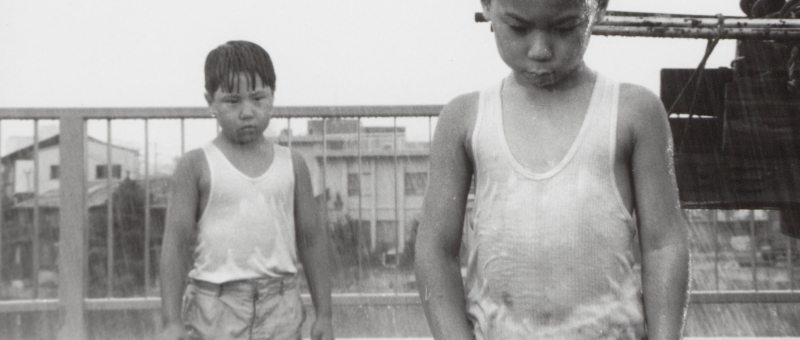
Muddy River (泥の河, Kohei Oguri, 1981)

The post-war era refuses to die in Kohei Oguri’s heartbreaking exploration of childhood friendship and the costs of experience, Muddy River (泥の河, Doro no Kawa). Adapted from the novel by Teru Miyamoto and situating itself in the Osaka of 1956, Oguri’s realist drama takes place at a moment of transition not only in the life of the young hero but also of the nation which was at long last beginning to leave post-war privation behind thanks to increasing economic prosperity. Yet for men like young Nobuo’s father Shinpei (Takahiro Tamura), the traumas not only of the war itself but its aftermath will not be so easy to escape. 

A shy child who often wets the bed, 9-year-old Nobuo (Nobutaka Asahara) lives with his parents Shinpei and Sadako (Yumiko Fujita) above a small riverside noodle bar mainly frequented by sailors and workmen such as Shioda (Gannosuke Ashiya), a regular who pulls a horse and cart for a living. Nobuo can’t stop staring at Shioda’s ruined ear, presumably a battlefield injury though the avuncular gentleman tries to raise his spirits with false cheerfulness explaining that he’s seen the writing on the wall and the days of cart pullers are coming to an end. He jokes about giving his horse to Nobuo as a pet though obviously he has no need for or ability to keep a horse, explaining that he’s going to buy a second-hand truck so he won’t be left behind in the race for modernity. Unfortunately, however, as Nobuo follows him out Shioda’s cart gets stuck in the mud. Somewhat bluntly he violently beats the horse to make him free it, but the cart ends up blocking the bridge and the horse is spooked by oncoming traffic. Crushed by his falling load, Shioda is pulled under the wheels and killed, his hopes for the future dashed while his wife and child are left without economic support. 

Emulating the visual imagery of silent cinema, Oguri frames this sequence perfectly with an inescapable anxiety that captures the inevitability of the moment. This is Nobuo’s first glimpse of death, running confused back to his father to tell him that the cart man’s dead, Shinpei at first not quite comprehending but later reflecting that he was like him another casualty of the post-war era as if his death were merely delayed remembering that he’d once said the war had already killed him and so he’d never die again. On an awkward train journey Shinpei opens a newspaper and reads that “the post-war period is over”, but of course for him it isn’t and perhaps never will be. Reflecting on the last 10 years of his life, he wonders if it was worth it, there must be many people who think it would have been better to die in the war than suffer as they did afterwards. Young Nobuo, born to him in his 40s, is his only achievement. Sadako meanwhile harbours her own guilt in feeling as if she wronged another woman with whom Shinpei had previously been involved after the war by stealing him away and building this life together in burned out Osaka which, while far from perfect, is comfortable enough and happier than most. 

That Nobuo learns for himself when he befriends another boy staring at the abandoned cart. 9-year-old Kiichi (Minoru Sakurai) and his sister Ginko (Makiko Shibata) live on a houseboat recently moored opposite, something which Nobuo finds unusual and mysterious but not itself bad. Still innocent and too young to have incorporated moral judgement, Nobuo simply befriends the other boy bonding over a strange tale of a monstrous carp in the river though perhaps also feeling sorry for him on noticing his ragged clothes and the holes in his shoes. On visiting their houseboat, he only hears only the voice of Kiichi’s mother Shoko (Mariko Kaga) a mysterious disembodied presence who lives in a separate area of the boat accessible only via a different entrance. When she instructs Kiichi to give him some raw sugar and tell him not to come back too often, he takes it that he’s unwanted later confused when his father tells him that it’s fine for his new friends to visit but he shouldn’t go near the boat after dark. 

Understanding people, neither Shinpei or Sadako, instantly grasping the situation, reject the family because of the stigma of sex work realising that people do what they have to to survive and in any case it isn’t the children’s fault or responsibility. On hearing Kiichi enthusiastically singing an old imperial song about losing friends in Manchuria, Shinpei begins to feel a kinship with his late father as another old soldier claimed by the muddy river of the post-war society. Like the cart man, and an old fisherman Nobuo witnessed “disappear” from his boat never to be seen again, he was simply a casualty of the times one of many unable to enter the new society promised by rising economic prosperity. Shinpei fears he may also be one of these men, left behind unable to break free of wartime survivor’s guilt and the traumas of what came afterwards. He also disappears from his son’s life abruptly and without warning if only temporarily, but accidentally deserts him at the time he needs him most allowing his fragile new friendship to fracture as the two boys fatefully return to the boat after dark and Nobuo encounters a loss of innocence on several levels Kiichi realising that something is now broken between them. 

Something is perhaps broken in the times, the end of Nobuo’s childhood coinciding with the the dawning of a new era free of post-war privation but one that also threatens to leave those who can’t catch up to it behind Kiichi’s boat bound for further down the river while Nobuo remains firmly on land his own foundation perhaps more secure now that his father has exorcised some of guilt over the recent past. Shot with a nostalgic realism in black and white and in academy ratio, Oguri’s quietly devastating drama sets one boy’s loss of innocence against the lingering affects of another as the adults all around him struggle to acclimatise themselves to a changing society but all he sees is the muddy river flowing past him taking his friend away because he saw something he shouldn’t have leaving him with nothing but sorrow and loneliness on the other side of an unbreachable divide. 


Muddy River screens at the BFI on 12/23 December as part of BFI Japan.

Opening sequence

The Scarlet Camellia (五瓣の椿, Yoshitaro Nomura, 1964)

Little known outside of Japan, Yoshitaro Nomura is most closely associated with post-war noir and particularly with adaptations of Seicho Matsumoto’s detective novels, yet he had a wide and varied filmography directing in several genres including musicals and period dramas. The son of silent movie director Hotei Nomura, he spent the bulk of his career at Shochiku which had and to some degree still has a strong studio brand which leans towards the wholesome even if his own work was often in someway controversial such as in the shocking child abuse drama The Demon or foregrounding of leprosy in Castle of Sand. Part of the studio’s series of double-length epics, 1964’s Scarlet Camellia (五瓣の椿, Goben no Tsubaki) is nevertheless an unusual entry in Nomura’s filmography, adapting a novel by Shugoro Yamamoto essentially setting a policier in feudal Japan and perhaps consequently shot largely on stage sets rather than on location. 

Nomura opens with artifice as Shino (Shima Iwashita) stares daggers at an actor on the stage but later returns to his rooms every inch the giggling fan before finally offing him with her ornate silver hairpin leaving behind only the blood red camellia of the title. The first in a series of killings later branded the Camellia Murders, we later realise that the actor had to die because of his illicit relationship with Shino’s mother whom he brands a “nympho” and as we later discover had several extra-marital lovers. Extremely close to her father who, as we’re told, perished in a fire while resting in the country due to his terminal tuberculosis, Shino is apparently on a quest for revenge against the faithless men who humiliated him though her feelings towards her mother seem far more complex. 

Indeed, Shino regards her mother’s carrying on as “dirty” and seems particularly prudish even as she wields her sex appeal as a weapon in her quest for vengeance. Yet it’s not so much the free expression of sexuality which seems to be at fault but excess and irresponsibility. Shino resents her mother primarily for the ways in which she made her father suffer, off having fun with random men while he shouldered the burden of her family business which, Shino might assume, has contributed to his illness. Aoki (Go Kato), the Edo-era policeman to whose narrative perspective the second half turns, advances a similar philosophy in that there’s nothing wrong with having fun, he has fun at times too, but people have or at least should have responsibilities towards each other which the caddish targets of the Camellia Killer have resolutely ignored. He can’t say that he condones the killer’s actions, but neither can he condemn them because her motivations are in a sense morally justifiable. 

Realising the end is near, Shino indulges in a very modern serial killer trope in leaving a note for Aoki alongside one of her camellias in which she claims that she is exacting vengeance for “crimes not punishable by law”. There was nothing legally wrong in the way these men treated her mother or any other woman, but it is in a sense a moral crime. “You’re a woman and I’m a woman too” she later tells another scorned lover, a mistress thrown over by her patron with two small children after he tired of her, as she hands over a large sum of money and encourages her to return to her family in the country. Shino’s quest is essentially feminist, directed against a cruel and patriarchal society in which the use and abuse of women is entirely normalised, yet it is also slightly problematic in her characterisation of her mother as monstrous in her corrupted femininity for daring to embrace her sexuality in exactly the same way as her male counterparts though they, ironically, mainly seem to have been after her money rather than her body. 

Shino’s mother’s death is indeed regarded as “punishment from heaven” presumably for her sexual transgressions and neglect of her family, rejecting both the roles of wife and mother in a ceaseless quest for pleasure. Yet even in her resentment, Shino’s ire is directed firmly at the men taking the last of her targets to task when he justifies himself that women enjoy sex too and are therefore equally complicit by reminding him that he gets his moment of pleasure for free but the woman may pay for it for the rest of her life. Just as Shino’s mother neglected her family, the men harm not only their wives in their illicit affairs but cause concurrent damage to the mistresses they may later disown and the illegitimate children they leave behind. Abandoning the naturalism of his contemporary crime dramas for something much more akin to a ghost film with his eerie lighting transitions and grim tableaux of the skewered victims, Nomura crafts a melancholy morality tale in which the wronged heroine turns the symbol of constrained femininity back on the forces of oppression but is eventually undone by the unintended consequences of her quest for vengeance even as she condemns the architect of her misfortune to madness and ruin. 


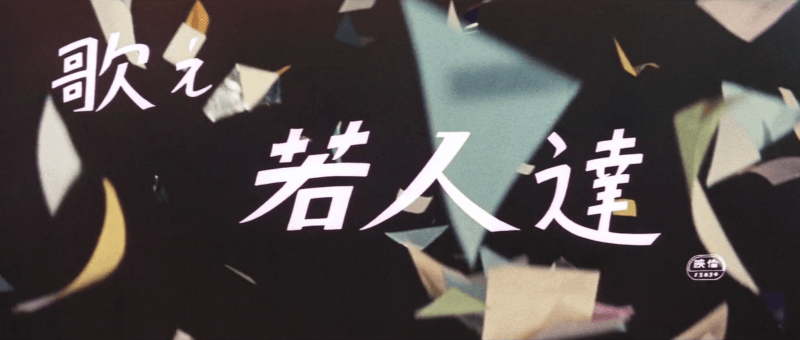
Sing, Young People (歌え若人達, Keisuke Kinoshita, 1963)

Keisuke Kinoshita has sometimes been dismissed by Western critics for his supposed sentimentality, but his mid-career comedies can be surprisingly cynical. Scripted not by Kinoshita but Taichi Yamada, 1963’s Sing, Young People (歌え若人達, Utae Wakodotachi) is in someways an exception to the rule, a breezy take on the student comedy updated for the present day, but underneath all the absurdist humour and jibs about youthful ennui is a real sense of adolescent hopelessness as these aimless young men ponder their “pitch-black” futures in a rapidly changing Japan where the best they can hope for is fulfilling the salaryman dream.  

Shooting in glorious colour, Kinoshita opens with a lengthly pan over contemporary Tokyo which the jaunty voice over describes as “the number-one city in the world” before homing in on the incongruous figure of a strangely dressed man holding a sign advertising “sensual massage beauties”. A relic of an earlier advertising age, the wandering sign man nevertheless catches sight of someone even “weirder” than he is, a student wearing a student’s cap! Kinoshita then takes us on a brief detour through Japan’s major universities demonstrating that no one is so uncool as to wear a student’s cap in the age of protest, drawing a direct contrast to the student comedies of old while showing us a series of scenes of students “playing” hard with part-time jobs in bands or as models, training hard in preparation for the upcoming Olympics, fomenting the revolution, or fighting in the streets. In the first of many meta touches, our hero, Mori, is eventually woken by the narrator after falling asleep in class, his eyes “gleaming with hopes for the future”. 

Or, perhaps not, he’s just tired. Mori (Tsutomu Matsukawa) is as he describes himself a man without hopes or dreams who believes that the road ahead of him is “pitch black”. Dropping a brush from the window washers’ platform at one of his part-time jobs, he asks himself if there shouldn’t be more to life than this. The only son of his widowed mother, he’s pinned everything on graduating from a top university but feels powerless and empty, adrift in the post-war landscape. Where his calculating friend Miyamoto (Yusuke Kawazu) fills the void with romance and a determination to “get lots of As” and then land a top job, his roommate Okada (Shinichiro Mikami) earnestly studies hard afraid to disappoint his austere family but also quietly resentful in his lack of autonomy, and the dopey Hirao (Kei Yamamoto) simply goes about being nice to people more or less forcing them to eat the traditional treats his loving mother is forever sending. 

Yet for all the bleakness Mori seems to see in his future, he only ever falls up. Luck follows him and he’s presented with ever more fantastic opportunities at every turn. In fact, it’s his slightly grumpy expression as he cleans the windows of an office building that leads to them snapping a picture and making him a cover star without ever bothering to ask his permission though they do eventually pay. Still Mori remains indifferent, telling a reporter who tries to interview him that he had nothing to do with the cover, he has no dreams or aspirations for the future but lives his life day by day. He describes himself only as “nervous”. His words run ironically over the magazine literally becoming tomorrow’s chip paper, used by a stall owner to wrap her croquettes, as a stand for a hot pot, and otherwise bundled up to be pulped. Nevertheless, the cover leads to great opportunities from a TV network looking for a fresh face to front their new youth-orientated drama serial. 

Despite all the promise, Mori remains indifferent, later irritating a new colleague and potential love interest (Shima Iwashita) when he idly suggests he might just give up acting and fall back on the salaryman dream. As she points out, she had to fight all the way to achieve her dreams of becoming an actress so hearing someone say they’re going to throw away a tremendous opportunity that came to them entirely by chance is mildly offensive. Miyamoto meanwhile is growing lowkey resentful, realising that maybe nothing matters after all it’s all just dumb luck. Mori deliberately didn’t do anything because he thought his life was pointless but everything has landed right at his feet while Miyamoto’s life is crumbling. He’s lost all his girlfriends and endured a lonely New Year alone in the dorm, coming to the conclusion that his future really is “pitch black”.

Nevertheless, it’s difficult to remain resentful about a friend’s accidental success and so each of the men eventually finds direction in even in directionlessness. Mori realises that he might as well ride his wave of fame for as long as it lasts, accepting in part at least his sense of powerlessness, while Okada does the reverse in deciding to rebel against his authoritarian family by marrying in secret. Miyamoto resolves to make a success of himself in his own way, and Hirao seemingly accepts the hand fate has dealt him with good humour. Kinoshita ramps up the meta comedy with Mori joining Shochiku, encouraged to try and work for that “excellent” director Keisuke Kinoshita, later referencing Garden of Women, while Mariko Okada and Keiji Sada turn up as onstage guests at an event launching him as a young actor. Playfully using outdated, quirky screen wipes and opening with an artsy title sequence featuring colourful confetti falling up, Kinoshita perhaps adopts a slightly ironic tone in satirising the all pervasive sense of confusion and hopelessness among the younger generation but does so with only sympathy for those coming of age in uncertain times. 


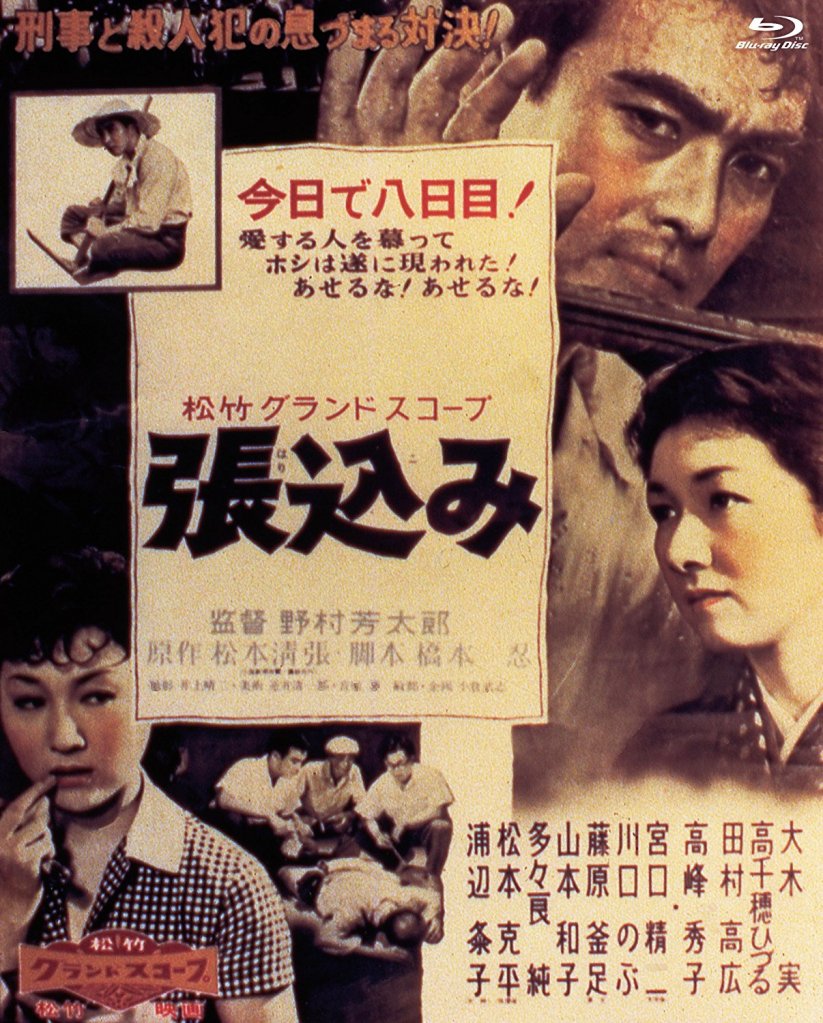
Stakeout (張込み, Yoshitaro Nomura, 1958)

Most closely associated with the crime genre, Yoshitaro Nomura was, like his frequent source of inspiration Seicho Matsumoto, also an insightful chronicler of the lives of ordinary people in the complicated post-war society. Stakeout (張込み, Harikomi), once again inspired by a Matsumoto short story, is on the surface a police procedural but underneath it’s not so much about the fugitive criminal as a policeman on the run, vacillating in his choice of bride, torn between the woman he loves who is afraid to marry him because her family is poor, and the pressure to accept an arranged marriage with the perfectly nice daughter of a local bathhouse. The stakeout becomes, in his eyes, a kind of illustrated parable, going against the socially conventional grain to convince him that making the “sensible” choice may only lead to long years of regret, misery, and loneliness. 

The film opens, as so many of Nomura’s films do, with a journey as two dogged Tokyo cops board a long distance train from Yokohoma travelling all the way down to provincial Kyushu which might as well be a world away from the bustling metropolis. Posing as motor salesmen, they take a room at a local inn overlooking the home of a melancholy housewife, Sadako (Hideko Takamine), the former girlfriend of a man on the run, Ishii (Takahiro Tamura), suspected of being in possession of a gun used to kill the owner of a pawn shop during a robbery. The younger of the policemen, Yuki (Minoru Oki), declares himself faintly disappointed with Sadako, complaining that she looks older than her years and is in fact quite boring, “the epitome of ordinary”. 

His older colleague, Shimooka (Seiji Miyaguchi), reminds him that most people are boring and ordinary, but as he watches her Yuki comes to feel a kind of sympathy for Sadako, seeing her less as a suspect than a fellow human being. Later we hear from Sadako that her marriage has left her feeling tired every day, aimless, and with nothing to live for, that her decision to marry was like a kind of suicide. “A married woman is miserable” Yuki laments on observing Sadako’s life as she earnestly tries to do her best as a model housewife, married to a miserly middle-aged banker who padlocks the rice, berates her for not starting the bath fire earlier to save on coal, and gives only 100 yen daily in housekeeping money while she cares for his three children from a previous marriage. Trying to coax him back towards the proper path, Shimooka admits that marriage is no picnic, but many are willing to endure hardship at the side of the right man. 

The “right man” gets Yuki thinking. Sadako has obviously not ended up with the right man which is why he sees no sign of life in her as if she simply sleepwalks through her existence. He is obviously keen that he wouldn’t want to make another woman feel like that, or perhaps that he would not like to be left feeling as she does at the side of the wrong woman. We discover that his dilemma is particularly acute because he finds himself at a crossroads dithering between two women, faced with a similar choice to the one he increasingly realises Sadako regrets. Shimooka’s wife is acting as a go-between, pressuring him to agree to an arranged marriage with a very nice girl whose family own the local bathhouse. She makes it clear that she’s not trying to force him into a marriage he doesn’t want, but would like an answer even if the answer is no so they can all move forward, but for some reason he hasn’t turned it down. Yuki is in love with Yumiko (Hizuru Takachiho), but Yumiko has turned him down once before because her family is desperately poor, so much so that they’re about to be evicted and all six of them will have to move into a tiny one room flat. She feels embarrassed to explain to her prospective husband that she will need to continue working after they marry but send almost all of her money to her parents rather than committing to their new family. 

Meditating on his romantic dilemma, Yuki begins to sympathise even more with Sadako, resenting their fugitive for having placed her in such a difficult position and repeatedly cautioning the other officers to make sure that the press don’t get hold of Sadako’s name and potentially mess up her comfortable middle class life with scandal when she is entirely blameless. The fugitive, Ishii, is not a bad man but a sorry and desperate one. He went to Tokyo to find work, but became one of many young men lost in the complicated post-war economy, shuffling from one poorly paid casual job to another. Now suffering with what seems to be incurable tuberculosis, he finds himself dreaming of his first love, the gentle tones of famous folksong Furusato wafting over the pair as they lament lost love at a picturesque hot springs while Yuki continues to spy on them from behind a nearby tree. 

They both bitterly regret their youthful decision to part, she not to go and he not to stay. The failure to fight for love is what has brought them here, to lives of desperate and incurable misery filled only with regret and lonliness. Sadako views her present life as a kind of punishment, finally resolving to leave her husband and runaway with Ishii who has told her that he plans to go to Okinawa to drive bulldozers for the next three years, though we can perhaps guess he has a different destination in mind. “That’s the way the world is, things don’t go the way you want” Ishii laments, but the truth is choices have already been made and your course is as set as a railway track. Sadako plots escape, but all Yuki can do is send her back to her husband with sympathy and train fare, leaving us worried that perhaps she won’t go back after all. Buying tickets for his own return journey, Yuki pauses to send a telegram. He’s made his choice. It’s not the same as Sadako’s, a lesson has been learnt. He goes back to Tokyo with marriage on his mind, but does so with lightness in his step in walking away from the socially rigid past towards a freer future, staking all on love as an anchor in an increasingly confusing world.


Original trailer (no subtitles)

The Tattered Wings (遠い雲, Keisuke Kinoshita, 1955)

“Why can’t a woman have the freedom to pursue her own happiness?” wails an extremely conflicted woman in Keisuke Kinoshita’s The Tattered Wings (遠い雲, Tooi Kumo), though it appears she may have completely misinterpreted the desires of the woman she is speaking to. By 1955, provincial Japan had perhaps returned to a kind of peaceful normality but times were changing here too, just in ways that seem slightly unexpected. In this case, the problem is not curtain twitching grannies keen to enforce the social order, but a pair of young punks hoping to stir up trouble through malicious gossip for motives which are entirely unclear save resentment and desire to rebel against their own lack of prospects in an otherwise rigid society. 

All the trouble starts when brooding intellectual Keizo (Takahiro Tamura) returns from Tokyo for a 10 day visit with his family before taking up a job transfer to Hokkaido after which he claims he will not be able to see them for several years. Before he left, Keizo had been sweet on Fuyuko (Hideko Takamine), but she eventually consented to an arranged marriage to support her parents’ failing business and is now a widow with a small daughter. Though the marriage was abusive, since her husband’s death Fuyuko has been happy in her married home, spending time with her husband’s sensitive younger brother Shunsuke (Keiji Sada) and there is some talk that they may later marry. 

Though this kind of quasi-incestuous union of a widow and her brother-in-law may have fuelled countless other melodramas, it is not the problem here so much as its potential solution. After running into him by chance at her husband’s grave, a strange place to reencounter an old lover, Fuyuko is seen in several places around the town walking and talking with Keizo. There is nothing more to their relationship than that, a man and a woman talking at a respectful distance in public, but the young toughs at the station who always carried a torch for the beautiful Fuyuko decide to start a nasty rumour that there is something improper going on. 

In real terms, of course, there isn’t, but there is a kind of silent pull between Keizo and the lonely Fuyuko that is much more difficult and ambiguous than one might expect it to be. Keizo clearly wants to pick up where they left off, but is intense and awkward, motivated to urgency by the briefness of his stay. He forgets that he’s been gone a long time and Fuyuko is no longer the carefree 19-year-old she was when he left, but the mother of a young girl who claims that she has long since lost the ability to dream. Brutalised by her abusive husband, she is unwilling to stake her hopes on new romance and is wary of becoming a middle-aged woman chasing a return to the past in embracing an idealised first love in flight from its complicated reality. She accuses Keizo of trying to project his own dream of the past onto her, wanting to return to the possibilities of his youth rather than really in love with a woman he now barely knows. 

Meanwhile, Fuyuko is pulled in two directions by her respective families. Her older sister is embittered, resentful of their mother who refused her permission to marry a man she loved because he wasn’t wealthy and they wanted a son to marry in, while her younger sister has herself long carried a torch for Keizo and is acting more out of jealousy than genuine concern. Faced with crisis, the families of both Fuyuko and Keizo affirm that they don’t care what anyone might say about it so long as their children are happy, but the problem is that Fuyuko no longer knows what she wants. Keizo accuses her of tearing off her wings rather than using them to fly, but perhaps what she wanted all along wasn’t an excuse to leave but one to stay. Maybe what she wants isn’t actually what everyone expects it to be, and the permission she’s trying to give herself is the right to be comfortable with a slow and steady kind of love at the side of a patient and compassionate sort of man who’d be content to let her choose and know he’d been her choice. Fuyuko’s wings may be tattered, but she is in a sense pursuing her own happiness in choosing the present over an unrealistic dream of adolescent romance.


Opening and titles (no subtitles)

Farewell to Dream (夕やけ雲, Keisuke Kinoshita, 1956)

Does adulthood mean the death of dreams, or simply accommodation with disappointment? Yoichi (Shinji Tanaka), the cheerfully romantic hero of Keisuke Kinoshita’s Farewell to Dream (夕やけ雲, Yuyake-gumo), has made his peace with “losing” out in the great game of life, comforting himself in working hard to provide for others while becoming good at what he does, but keeping one eye always on the past and the boy he once was whose horizons were boundless and future untethered. 

In his chipper yet somehow poetic opening monologue, 20-year-old Yoichi introduces us to the family fishmonger’s he runs with his mother. If he says so himself, standards have improved since his father’s day and he’s done quite well for himself. His mother even jokes about finding him a wife, but that’s a long way off. To show us how he got here, he picks up his binoculars, a present from an uncle who sailed away and never came back, to show us “the last chapter of his youth, full of innocent dreams”. At 16, Yoichi dreamed of becoming a sailor, staring out over the horizon and catching sight of a beautiful woman in a distant window far on the other side of town. He lives with his parents and three younger siblings, while his older sister Toyoko (Yoshiko Kuga) has an office job that supplements the family income seeing as there’s not much money in fishmongering. 

Yoichi describes his sister as beautiful yet cold. No one can quite believe such a fantastic beauty was born to a lowly family of fishmongers with a back alley shop in a small town, but her beauty has made her cruel and avaricious. She wants out of poverty and she doesn’t much care what she has to do to escape it. She knows the easiest way, and in real terms perhaps the only way, is to attach herself to a man of means, which is why she’s just agreed to marry a man named Sudo (Takahiro Tamura) who comes from a wealthy family and is head over heels in love with her. When he tells her that his family business has collapsed and he’s no more money, she abruptly calls the engagement off and begins courting her widowed boss, eventually marrying him despite the fact that it’s a second marriage and he’s more than twice her age. 

Toyoko may just be playing the only cards she’s been dealt, but she’s also a personification of selfish post-war individualism. She only cares about herself, has no real sense of morality, and a total disregard for the feelings of others. Sudo, who for some reason truly seems to have loved her, cannot let her go, turning up on her wedding day to punch her in the face. Toyoko is fully aware of the effect she has on men and skilled in manipulating it, drifting back into an affair with Sudo even after her marriage, leaving her irate husband forever ringing her parents with orders to return her to her new home as if they had any real influence over her. 

Despite himself, Yoichi is by contrast the “good son” who gives up the right to his individual future to take care of his family. At 16, he hates being a fishmonger’s boy because the other kids tease him that he always smells of fish, as if he can’t wash away the scent of poverty. He dreams of freedom as a sailor out on the wide ocean, forever staring at the horizon with his binoculars, and of the beautiful woman who, he decides rather romantically, must be suffering with some kind of illness which is why she’s always in her room. When his father becomes ill, suffering a heart attack brought on by Toyoko’s harsh words, Yoichi begins to realise that his dreams are dying. Like the fish in his shop, he’s trapped, no longer able to swim free but tethered to the ground. There can’t be anything more of life for him than becoming a fishmonger himself, whether he liked it or not. His fate was sealed before he was even born. 

Yet unlike the flighty Toyoko who seems unhappy in her marriage but doing her best to put up with it by continuing to do as she pleases, Yoichi has made peace with warmhearted practicality. At 16 he lost everything – his father, the image of Toyoko, his younger sister fostered out to a badgering uncle, his best friend, the beautiful woman in her lonely room, and finally the horizon and his dreams. “His dream was as fleeting and as beautiful as the clouds at sunset” the opening text tells us, echoing the film’s title with a poetic melancholy that makes plain that Yoichi has not so much abandoned his dream as made the memory of it a part of him, a relic of another time when all was possible. Still, in essence perhaps it’s only what it is to grow up, an acceptance of shrinking horizons and that dreams are by definition things destined not to be, but that’s it’s OK in the grand scheme of things because that’s just the way life is. Forced to become a fishmonger, Yoichi becomes the best fishmonger he could be, and even if he does so with a heavy heart, he has a lightness in his step in knowing he does it not for himself but for those he loves. 


Titles and opening (no subtitles)