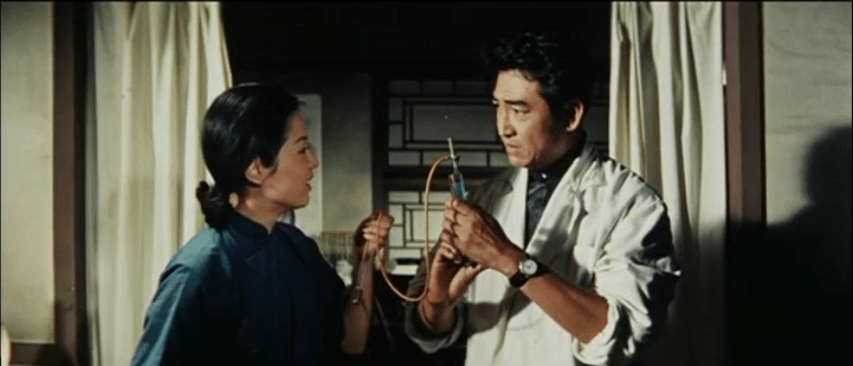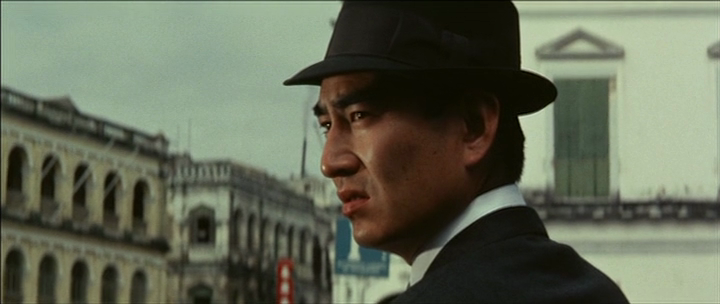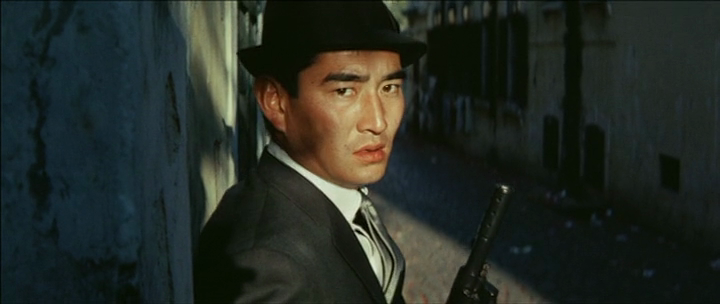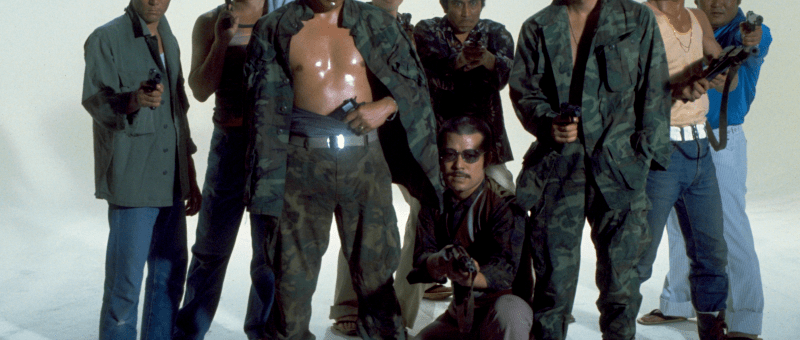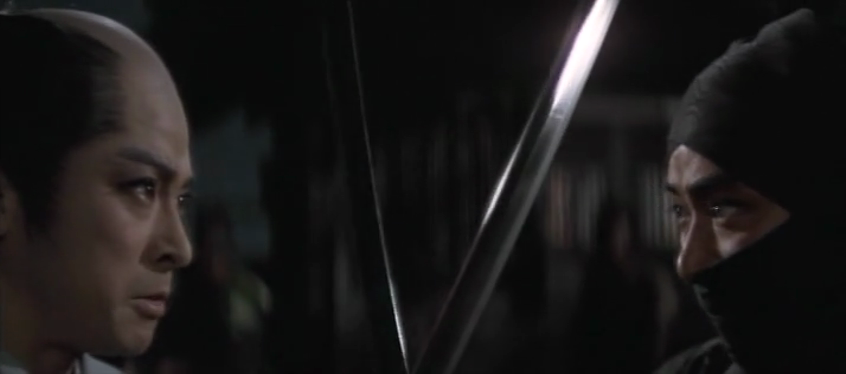
Violent Streets (暴力街, Hideo Gosha, 1974)

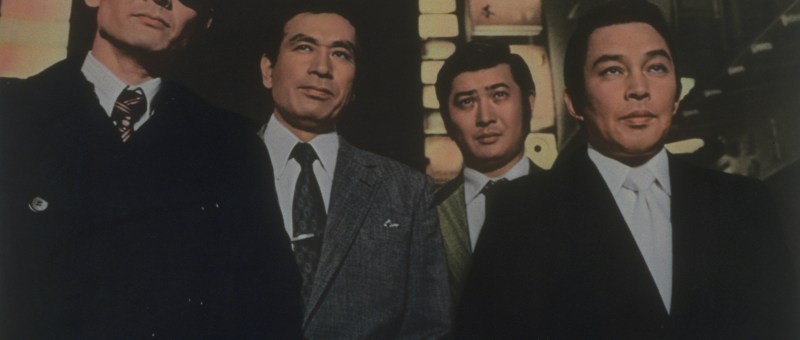
“Nothing’s like it used to be anymore” sighs a woman who’s had to betray herself but has tried to make break for it only to discover there is no way back. Hideo Gosha’s Violent Streets (暴力街, Boryoku Gai) is like many films of its era about the changing nature of the yakuza in an age of corporatised gangsterdom. Now “legitimate businessmen” who claim to no longer deal in thuggery, their crimes are of a more organised kind though a turf war’s still a turf war even if you’re fighting from the boardroom rather than simply getting petty street punks to fight it for you in the streets. 

In a touch of irony, former yakuza Noboru Ando stars as a man who’s tried to leave the life behind but is pulled back into underworld intrigue when his former foot soldiers mount an ill-advised bid for revenge against the clan they feel betrayed them. After serving eight years in prison for participating in the last turf war, Egawa was given flamenco bar Madrid on the condition that he dissolve his family and attempt to go straight as a legitimate businessman. The Togiku gang has since gone legit and distanced itself from most of its old school yakuza like Egawa. But now a yakuza conglomerate from Osaka is moving in on their old turf and the Togiku want the Madrid back as a bulwark against incursion from the west which is why they’ve been sending the boys round to cause trouble in the bar. 

Egawa is the classic ex-gangster who wants to turn himself around but is largely unable to adapt to life in a changing society. He is technically in a relationship with a bar hostess who has a severe drinking problem in part exacerbated by his inability to get over his former girlfriend who left him and married the boss, Gohara, while he was in prison. His former foot soldiers attempt to convince him to get the gang back together and take revenge, resentful of having been used and discarded, but he tells them to let it go, that they’ve all got “honest jobs” and that they should try to live as best they can. Like him, the guys are ill-equipped to make new lives in the consumerist society and cannot move on from the post-war past. Hoping to engineer a turf war between the Osaka guys and Togiku, they kidnap a popular TV personality/pop singer (Minami Nakatsugawa) attached to a station which Togiku controls and frame a rival affiliated with the Osakans for taking her. 

This just goes to show the various ways in which newly corporatised yakuza have expanded their business portfolio, heavily participating in the entertainment industry moving beyond bars, clubs, and the sex trade into mainstream television and idol stars. Egawa’s old friend Yazaki (Akira Kobayashi) is his opposing number, just as caged but trapped within the confines of the new gangsterdom, reprimanded by his boss for raiding the rival studio’s offices and undoing the gang’s attempt to rebrand themselves as legitimate businessmen rather than violent street thugs. “I can’t stand being humiliated” he explains as Gohara points out he’s stepped right into their trap now giving the Osakans an excuse for retaliation. “The Togiku group is a defanged, domesticated dog” Yazaki barks, “I can’t pretend to be an obedient company employee forever and do nothing”. 

Neither man is able to progress into the new era of rising prosperity, both little more than caged animals thrashing around trying to break free but continually crashing into the bars. Just as Egawa’s old guys had tried to engineer a turf war hoping that the two gangs would take each other out and leave a vacuum they could fill, arch boss Shimamura (Tetsuro Tanba) flies above the city in a helicopter as the “worms fight among themselves” and observes the chaos below as he completes his silent conquest of the contemporary economy like some modern day Nobunaga of corporatised gangsterdom. 

Taking over the Togiku through a process of corporate infiltration and gradually ridding themselves of all the old school yakuza ill-suited to the shady salaryman life, the contrast between the world of cabaret bars and back street dives and Shimamura’s smart suits and helicopters couldn’t be more stark. A slightly sour note is struck by the use of a transgender assassin (Madame Joy) who performs a lesbian floorshow by day and kills by night while working with a bald sidekick who carries a parrot on his shoulder, her coldness bearing out the tendency of yakuza movies to associate queerness with sadistic savagery. Gosha rams his point home with the otherwise surreal scene of a pile of abandoned mannequins by a swamp that becomes a popular yakuza kill site homing in on the emptiness of their eyes and the uncanniness of dismembered bodies, mere empty shells just like the men who die in this literal wasteland. Egawa perhaps feels himself to be a man already dead long before being pushed towards his act of futile rebellion, somewhere between sitting duck and caged dog fighting for his life between the chicken coops of a moribund small-town Japan. Marching to a frenetic flamenco beat of rising passions and barely contained rage, Violent Streets leaves its former foot soldiers with nowhere to go but down while their duplicitous masters continue to prosper riding the consumerist wave into a new and prosperous future.


Violent Streets opens at New York’s Metrograph on Dec. 16 as part of Hideo Gosha x 3

Trailer (English subtitles)

The Sand City in Manchuria (砂漠を渡る太陽, Kiyoshi Saeki, 1960)

A pure hearted doctor stands strong against the forces of imperialism if somewhat ambivalently in Kiyoshi Saeki’s wartime drama The Sand City in Manchuria (砂漠を渡る太陽, Sabaku wo Wataru Taiyo). “Why isn’t there just one country? I don’t want a country” a young Chinese woman exclaims towards the film’s conclusion in what is intended as an anti-war statement but also invites the inference that the one country should be Japan and that China is wrong to resist the kind of “co-existence” that the idealistic hero is fond of preaching. 

Dr. Soda (Koji Tsuruta), known as Soh, has been in Manchuria for two years running a poor clinic in a trading outpost on a smuggling route through the desert. He came, he later tells another Japanese transplant, after being talked into it by a pastor who told him about US missionaries who endured hardship in the Gobi desert and lamented that no Japanese people had been willing to take on such “thankless” work in the midst of the imperial expansion. There is a kind of awkwardness in Soda’s positioning as the good Japanese doctor which perhaps reflects the view from 1960 in that he objects to the way the Japanese military operates in Manchuria and most particularly to Japanese exceptionalism which causes them to look down on the local Chinese community as lesser beings, but within that all he preaches is equality and co-existence which suggests that he sees nothing particularly wrong in Japan being in Manchuria in the first place while implying that the Chinese are expected to simply co-exist with an occupying force to which they have in any case been given no choice but to consent. 

Nevertheless, it’s clear that the Japanese are in this case the bad guys. Soda is at one point accosted by a drunken soldier who takes against his choice to adopt Chinese dress while rudely refusing to pay his rickshaw driver. The animosity of some in the town is well justified as we hear that their mother was murdered by a Japanese soldier, or that they were raped by Japanese troops and now have nothing but hate for them to they extent that they would withhold vital medical treatment from a child rather than consider allowing Soda to treat them. Soda’s main paying job is working at an opium clinic hinting at the various ways imperialist powers have used the opium trade to bolster their control over the local population, while it later becomes clear that one of the Chinese doctors has been in cahoots with a corrupt Japanese intelligence officer to, ironically, syphon off opium meant for medical uses and sell it to addicts in a truly diabolical business plan. 

Though Soda is well respected in the town because he offers free medical treatment to those who could never otherwise afford it, he is sometimes naive about their real living conditions. Outraged that a young woman has been sold into sexual slavery, he marches off to the red light district to buy her back but is confused on his return realising her family aren’t all that happy about it because they cannot afford to feed her and were depending on the money she would send them because the father has become addicted to opium and can no longer work. The girl, Hoa (Yoshiko Sakuma), becomes somewhat attached to Soda but he is largely uninterested in her because she is only 17, while her affection for him causes tension with the daughter of an exiled Russian professor which is only repaired once they all start working together for the common good after the town after it comes under threat from infectious disease. 

In an echo of our present times, it seems not much has changed in the last 80 years or so, the townspeople quickly turn on Soda once it become clear that he’s putting the town on lockdown to prevent the spread of infectious meningitis after a Russian soldier stumbles in and dies of it. The disease firstly exposes the essential racism even among those Japanese people who have lived in Manchuria longterm such as the mysterious Ishida (So Yamamura) who remarks that diseases like that only affect the Manchurians and they’ll be fine because they are “more hygienic”, while simultaneously painting the infection as a symptom of foreign corruption delivered by the Russian incursion. Soda visits a larger hospital to get the samples confirmed but is told that the disease has not been seen in Manchuria before and so they have no vaccine stocks leaving him dependent on the smuggling network to get the supplies he needs. As the town is a trading outpost whose entire economy is dependent on the business of travellers just passing through, the townspeople are obviously opposed to the idea of keeping them out fearing that they will soon starve going so far as to tear down Soda’s quarantine signs while throwing stones at his house. 

In another irony, it’s Ishida’s pistol that wields ultimate control immediately silencing the mayor’s objections in a rude reminder of the local hierarchy. Many of the townspeople including inn owner Huang (Yunosuke Ito) and Hoa’s sister Shari (Naoko Kubo) are involved with the resistance to which Soda seems to remain quite oblivious and in any case adopts something of a neutral position but gains a grudging respect from Huang thanks to his humanitarianism that eventually saves him from brutal bandit Riyan (a rare villain role for a young Ken Takakura). In any case, as the corrupt Japanese officials pull out to escape the imminent Russian incursion, Soda decides to stay in part to atone for the sins of the Japanese in an acceptance of his responsibility as a Japanese person if one who has not (directly) participated in the imperialist project even if he was in a sense still underpinning it. Essentially a repurposed ninkyo eiga starring Koji Tsuruta as a morally upright man surrounded by corruption but trying to do the right thing to protect those who cannot protect themselves, there is an undeniable awkwardness in the film’s imperialist ambivalence but also a well intentioned desire to look back at the wartime past with clearer eyes and a humanitarian spirit. 


Rub Out the Past (日本暗黒街, Masaharu Segawa, 1966)

A former yakuza’s attempts to shed his old identity and start again as an upscale restaurateur are disrupted by the unwelcome appearance of an old acquaintance in Masaharu Segawa’s noirish drama, Rub Out the Past (日本暗黒街, Nihon Ankokugai). Another “akokugai” or “underworld” film, Segawa’s surprisingly subversive Toei crime story involves not only the drugs trade but hints of Manchurian transgression as the hero tries to forget his past while unable to realise his love for the daughter of a man he killed on the order of his boss. 

Now calling himself Yashiro, Kageyama (Koji Tsuruta) runs a swanky bar in Kobe and is in love with his pianist Yoko (Eiko Muramatsu) who is also, though she doesn’t know it, the daughter of a former associate back in his yakuza days whom he apparently killed for otherwise unclear reasons leaving Yoko and her mother alone and defenceless in Manchuria during the evacuation at the end of the war. When a mysterious man arrives and explains he’s from “Hayami Industries”, Kageyama is reluctant to listen but eventually forced to accompany him to Tokyo where he is led into Hayami’s rather swanky new office complete with electronic displays and workers positioned in tiny booths. Since the end of the war, Hayami has become a “respectable” businessman running some of Asia’s most prestigious hotels in addition to a chain of casinos. Yet his real business is of course in drug smuggling, which is a problem because the guy he put in charge of the Hong Kong route has drawn the attention of the police. He makes Kageyama an offer he can’t refuse ,much as he tries, to take it over. He accepts on the condition it’ll just be a one time thing. 

In any case, Kageyama’s involvement with Hayami soon costs him his relationship with Yoko, who is aware of Kageyama’s criminal past but blames Hayami for her father’s death, and with it a potential for redemption. Details are few, but there are constant references to the gang’s illegal and immoral dealings in Manchuria, a time that Kageyama is keen to leave in the past having made a new more honest life for himself in the post-war society while Hayami has shifted into the increasingly corporatised realms of contemporary organised crime. Yet despite himself Kageyama is good at being a gangster, effortlessly subduing the bumbling head of “Sekiya Industries” and realising that part of the problem is that too many of his men are getting high on their own supply. To streamline the business he lays off drug users telling them to come back when they’re clean and temporarily pauses the business while he reorganises it at street level. This however leaves a small vacuum in the underworld economy which is soon filled by “alternative” suppliers. 

More akin to one of Toho’s spy spoofs, Hayami Industries seems to be incredibly keen on zany gadgets like cigarette lighters that double as secret radios and guns which shoot listening devices not to mention the panel wall which hides Hayami’s secret control room or the knuckle dusters and belt swords sported by the Sekiya guys. All of which is slightly at odds with the seriousness of the constant reminders of abuses in Manchuria and on the Mainland, and the frankness with which drugs are treated onscreen with frequent shots of syringes and powder. As usual in these films, the main villain is from Hong Kong, an unhinged maniac who kidnaps Yoko and gets her hooked on drugs partly at the instigation of Hayami who seems to be making something of a strategic blunder in his attempts to manipulate Kageyama. Yet Kageyama can only get his redemption through reassuming his wartime persona to face Hayami if indirectly in trying to engineer a gang war between middlemen with Hong Konger Tei caught in the middle. 

Segawa adds to the noir feel through the melancholy jazz score reinforcing the fatalism and futility that seems to define Kageyama’s life as he tries but fails to escape from his violent past. A product of wartime misuse he finds himself at odds with the contemporary society, inconveniently falling in love with the daughter of a man he killed and therefore unable to move on from the shadow of his life of crime only granted a second chance after losing everything and paying his debt to society by destroying the system he himself helped to create. 


An Outlaw (ならず者, Teruo Ishii, 1964)

Outside of Japan, “king of cult” Teruo Ishii is most closely associated with a particular brand of transgressive ero-guro exploitation films such as Horrors of Malformed Men, yet his career was much more eclectic than many might assume. Starring Ken Takakura with whom Ishii was developing a professional relationship which would eventually lead to the hugely successful Abashiri Prison series, 1964’s An Outlaw (ならず者, Narazumono) is one of a string of noir thrillers from the earlier part of Ishii’s career this one taking place mainly in Hong Kong and Macao. 

China-based Japanese hitman Nanjo (Ken Takakura) runs into trouble after he offs a man he assumed to be “the biggest thug in the underworld” but actually turns out to have been a law enforcement official working against a people trafficking ring. To make matters worse when Nanjo returns to his hotel where he was supposed to get his pay off, he discovers the body of a young woman in his bed who is later identified as the official’s daughter. Understandably annoyed, Nanjo starts trying to track down the people who hired him to figure out what’s going but is accidentally dragged into underworld intrigue after being mistaken for a drug deal middle-man owing to the yellow flower he’s wearing on his lapel. 

Like any good noir hero and especially one played by Takakura, Nanjo is basically a good guy with a strong sense of justice and an acute moral compass. He doesn’t like having been manipulated into killing someone who wasn’t in the game nor does he approve of those who make their living by exploiting women such as arch villain Mao (Toru Abe) whom he discovers to have been running a nefarious international trafficking ring getting Japanese women hooked on drugs, shipping them to Hong Kong and Macao, and working them to death before abandoning them once they’ve served their purpose. Then again, he also has a strange problem with women who like to lie in bed in the middle of the day which seems slightly puritanical for a man who kills for a living yet you’d have to admit no one could call him lazy. 

Not much of Nanjo’s past is revealed save that he was born in prison to a woman who stabbed her former partner because he left her for another woman while she was pregnant with his child, raising her son to be anything but dishonest especially with women. In any case, he appears to have been based in China and Hong Kong for some time, claiming that he came down from Xiamen for the job and speaking fairly fluent Cantonese and Mandarin though in another strange coincidence many of the people he meets turn out to be Japanese. In this there’s a slightly ironic inversion of the normal patterning of post-war crime films which sees Japan exporting crime to China the big mcguffin revolving around a tin of drugs Nanjo was given by mistake intended for the local market while the secondary target becomes Mao’s people trafficking operation bringing sex workers who’ve gotten into his bad books to Hong Kong or to be used for the pleasure of wealthy men. Despite his apparent disapproval, Nanjo reveals he was given part payment for the job in the form of a girl who he could use for his “convenience” though it seems unlikely that he did so.

On the other hand, the secondary villain, the Japanese-speaking Minran (Yoko Mihara), is painted as something of a femme fatale playing off Nanjo and her boss while trying to get her hands on the drugs to split the proceeds with her Cantonese-speaking lover who accidentally kills a young girl Nanjo had befriended in Hong Kong. The girl’s death is in part Nanjo’s responsibility in that he placed her in danger without warning or an understanding of what he was asking her to do, yet he later proves no better when he kills the landlady of the hotel who had watched as she died and then blackmailed Minran for financial gain. Aside from the girl and her Japanese friend Aki (Yoko Minamida) who is dying of consumption after being worked to death as one of Mao’s trafficked women, and a detective with whom Nanjo later forms an unexpected alliance, Nanjo is the representative of humanist morality despite his morally compromised existence reminding Mao that his mistake was in thinking that there is nothing money could not buy in rejecting his efforts to pay him off. 

Shot largely on location in Hong Kong and Macao, Ishii adds to the noirish tone with frequent voice over and a melancholy jazz score while making full use of the atmospheric environment with its deserted alleyways and cobbled streets not to mention the naturally canted angles of the Victoria Peak funicular, while there is a fair amount of lowkey sleaze more typical of his later career along with a bizarre scene in which Nanjo sucks out blood from the mouth of a woman suffering a pulmonary haemorrhage. First and foremost a fatalistic noir thriller in which the hero, unfairly damned by a corrupt society, is unable to outrun his past transgressions, An Outlaw nevertheless suggests that true nobility is to be found only in those existing outside of its borders.


Original trailer (no subtitles)

Terror of Yakuza (沖縄やくざ戦争, AKA Okinawa Yakuza War, Sadao Nakajima, 1976)

An old-school yakuza finds himself cornered on every side while caught in the confusion of Okinawa’s reversion to Japan in Sadao Nakajima’s jitsuroku gangster movie Terror of the Yakuza (沖縄やくざ戦争, Okinawa Yakuza Senso, AKA Okinawa Yakuza War). Where similarly themed Okinawa-set gangster pictures such as Sympathy for the Underdog had largely presented the islands as an appealing place for mainland gangsters because the conditions of the occupation which had allowed them to prosper were still in place, Sadao reframes the debate in terms colonisation and conquest as the hero finds himself increasingly marginalised as an island boy contending with amoral city elitists. 

Nakazato (Hiroki Matsukata) has just been released from prison after serving seven years for the murders of two rival gang bosses that allowed his boss, Kunigami (Shinichi Chiba), to rule the roost in Koza. But now that Okinawa has reverted to Japan, everything has changed. Kunigami has formed a loose alliance with another regional gang to oppose the incursion of mainland yakuza but behind the scenes the higher-ups are intent on a mutually beneficial alliance with the Japanese perhaps seeing the writing on the wall and assuming that it’s better to work with the new regime that against it. For his part, Nakazato is more loyal to the clan than he is opposed to Japan but he’s also resentful towards to Kunigami for failing to live up to his side of the bargain now that he’s been released while fearing the influence of his new sidekick Ishikawa (Takeo Chii) whom he suspects of murdering one of his former associates while he was inside. 

As such, much of the drama unfolds as in any other yakuza picture with Nakazato, regarded by some of the other bosses as a loose cannon and potential liability, reluctant to move against Kunigami for reasons of loyalty even while Kunigami becomes increasing unhinged and dangerous, deliberately running over an Osakan foot soldier who was apparently just on holiday with no particular business in town. Kunigami’s recklessness in his hatred of the Japanese threatens to start a turf war the Okinawan gangs fear they couldn’t win, sending snivelling yakuza middleman Onaga (Mikio Narita) along with Nakazato to negotiate in Osaka only to be told the price of peace is Kunigami’s head. Inspired by the Fourth Okinawa War which was still going on at the time of the film’s completion (in fact, the release was blocked in Okinawa in fear that it would prove simply too incendiary), the conflict takes on political overtones as the mainland gangsters assume their conquest of Okinawa is a fait accompli while those like Onaga are only too quick to capitulate leaving Kunigami and Nakazato as two very different examples of resistance. 

Yet Nakazato finds himself doubly marginalised because he is from one of the smaller islands with most of his men also hailing from smaller rural communities (one uncomfortably wearing extensive makeup to ram the point home that he is from the southern reaches) with the result that they are often pushed around by the city gangsters who view them as idiot country bumpkins. On his trip to Osaka, Nakazato even describes himself as such in an attempt to curry favour apologising in advance should he make a mistake with proper gangster etiquette. Like a good platoon leader, Nakazato’s primary responsibilities are to his men which is one reason why he takes so strongly against Ishikawa, one of the new breed of entirely amoral yakuza who care nothing at all for the code and think nothing of knocking off his guys for no reason. Consequently he finds himself caught between the invading mainlanders, the unhinged chaos of Kunigami, the coldhearted greed of Ishikawa, and the spineless venality of turncoats like Onaga. 

It’s no wonder that he eventually loses his cool, going all out war and like Kunigami dressing in vests and combats in an internecine quest for vengeance precipitated in part by Kunigami’s attempt to discipline one of his men for encroaching on his territory by removing his manhood with a pair of pliers. “Someone will get to you someday too” Nakazato is reminded though having lost everything including his loyal wife who insisted on selling herself to a brothel to get the money to fund his war of revenge he may no longer care so long as he cleans house in Okinawa to the extent that he is really able to do so. “Okinawa is such a scary place” one of the Japanese guys admits, though showing no signs of backing off in this maddeningly chaotic world which turns stoic veterans and hotheaded farm boys alike into enraged killers fighting on a point of principle in a world which no longer has any. 


Terror of Yakuza screens at Japan Society New York May 20 at 7pm as part of Visions of Okinawa: Cinematic Reflections

Original trailer (no subtitles)

Images: Terror of Yakuza © 1976 Toei

The Thief in Black (黒の盗賊, Umetsugu Inoue, 1964)

Best known as a master of the musical, Umetsugu Inoue had a long and varied filmography embracing almost every genre imaginable. He began his career at Shintoho and later joined Nikkatsu where he quickly became an in demand director often working with top star Yujiro Ishihara, but took the somewhat unusual step of going freelance in 1960 thereafter working at various studios including Shaw Brothers in Hong Kong. 1964’s The Thief in Black (黒の盗賊, Kuro no Tozoku) is not a musical but is characteristically playful even within the confines of the lighter side of Toei’s jidaigeki adventures. 

Set between the Battle of Sekigahara and the Siege of Osaka, the samurai corruption in play is essentially the burgeoning Tokugawa dictatorship, the heroes eventually uncovering Ieyasu’s secret plan for making sure his line (well, more himself in essence) remains in power for perpetuity through an insidious plot to weaken the feudal lords and ensure their loyalty to him. Meanwhile, the still developing city of Edo is beginning to turn against the Tokugawa who seem to be intent on exploiting ordinary people to enrich themselves most obviously through forcing the local workforce to renovate Edo castle rather than cleaning up the town which is apparently rampant with crime. Faced with such lack of leadership, the townspeople have come to admire a Robin Hood-like vigilante known only as the Thief in Black who alone is resisting overreaching lords. 

Part of the problem is that Ieyasu’s rule is still insecure because of the potential threat of Hideyori Toyotomi in Osaka. Consequently, they are fearful that some of the men working on the castle may be Toyotomi spies or otherwise disclose information that might benefit him if he chose to attack which is why they’ve refused the workers permission to return home to their families during the pause before beginning the second phase of works leading to further unrest. Meanwhile, corrupt local lord Tadakatsu (Ryutaro Otomo) and his sleazy priest buddy Tenkai (Minoru Chiaki) have an even darker plan in mind, preparing to simply kill the five master craftsmen in charge to ensure they present no threat. Alerted to the situation on the ground by idealistic samurai Jiro (Hashizo Okawa), their boss instructs Tadakatsu in no uncertain terms that he must treat the workers fairly in order to prevent civil unrest and/or disillusionment with the Tokugawa regime but the pair are entirely unfazed and determined to go on with their nefarious plan getting rid of Jiro if the occasion arises. 

As we later discover and in a typical jidaigeki plot device, Jiro is one of a pair of twins with his brother Kotaro (also Hashizo Okawa) abandoned because of the superstitious belief that multiple births are inauspicious. Though both men unwittingly lay claim to the name, Kotaro turns out to be the masked vigilante, his primary cause to regain the lands of the family who raised him unfairly displaced from their estates on the Musashino plains because of Tokugawa greed. Though Jiro, raised as a member of the establishment, is originally loyal to the Tokugawa who have after all brought about an era of peace, he soon begins to see that their rule is no good for the people of Edo. In his more egalitarian worldview, only by enriching the poor can they secure their rule which means less castle building and more infrastructural development along with paying people fairly for their work and absolutely not killing them afterwards. Kotaro too claims that his rebellion is for the good of the common people though unlike Jiro is much more transgressive in his ideology prepared to shake off his samurai status to become a wandering outlaw rather than content himself with the restrictive life of the heir to a samurai clan. 

Such messages are perhaps common in Toei’s brand of jidaigeki but seem unusually pronounced as the peasant workers are often given voice to lament their fate and resist their oppression more directly, pointing the finger not just at a rogue rotten lord but at the entire system built on exploiting their labour. Nevertheless, Inoue injects a hearty dose of whimsical humour to the politically charged narrative even going so far as to include a bumbling ninja claiming to be the famous Hattori Hanzo along with a comic relief magistrate and former samurai brothel owner taking his own kind of ironic revenge in getting the cowardly lords hooked on modernity with a load of faulty rifles. Obviously, Ieyasu couldn’t be stopped, but perhaps they slowed him down and reminded him of the dangers of underestimating the people. Shot with Inoue’s characteristic flare if remaining largely within the Toei house style, Thief in Black is a surprisingly direct attack on corrupt and entitled government but also a righteous romp as its idealistic heroes shuffle themselves back into their ideal positions while fighting Tokugawa oppression all the way. 


Devotion to Railway (大いなる驀進, Hideo Sekigawa, 1960)

In the early 1960s, Japan’s rail network might have felt a little uneasy with the Shinkansen already on the horizon. Hideo Sekigawa’s Devotion to Railway (大いなる驀進, Oinaru Bakushin) is in part a celebration of this essential service, the conductor and steward ever fond of reminding us that most passengers probably don’t realise that the Sakura sleeper service on which they are travelling from Tokyo all the way to Nagasaki is operated by only seven or eight people (though they don’t seem to be counting the staff from the dining car which hints at a minor source of division among the crew). While the Japanese title which means something more like “the great dash” might hint at a little more excitement, the film is less thriller than gentle ensemble drama in which the passengers and crew must come together to solve the improbable number of crises arising on this otherwise ordinary journey. 

Even so considering the film is directed by the left-leaning Sekigawa best known for his anti-war films such as Hiroshima and Listen to the Voices of the Sea, not to mention scripted by Kaneto Shindo, it is a little ironic that the central thrust of the drama revolves around junior steward Yajima’s (Katsuo Nakamura) rediscovery of his own devotion to the railway after at the beginning of the film declaring this will be his final journey. Mimicking the dilemma at the centre of Yoshitaro Nomura’s Stakeout, Yajima’s problem is that he has been engaged for two years and is sick of waiting to get married but his girlfriend Kimie (Yoshiko Sakuma) is the main breadwinner in her family and though his salary could support them as a couple it won’t stretch much further. Kimie, however, is dead against him taking the counter-productive decision to quit the railways even with the suggestion of going into business with a friend who owns a cafe, partly because it’s better to stick with a steady job than take a chance on something less certain, and partly because she knows he likes his work and all his experience will be wasted if he suddenly opts to switch careers. 

Despite its positive warmhearted message of people pulling together to overcome crisis, the film does skew a little conservative in essentially turning Kimie into a minor villain as if she were in a sense responsible for making Yajima doubt his devotion to the railway. After jumping aboard to make sure he doesn’t suddenly quit before the end of the line, she eventually has a heart to heart with the sympathetic conductor Matsuzaki (Rentaro Mikuni) that forces to her to admit that perhaps she’s just nervous about the nature of married life and has been making trouble where there needn’t be any, now certain that it’s better to just get married as soon as possible and let the rest figure itself out. 

Meanwhile, there’s additional tension seeing as a waitress from the diner car has an obvious crush on Yajima and is quite resentful on being presented with his fiancée, but even this is eventually solved with the two women becoming accidental friends during the climatic crisis, a landslide caused by a typhoon, that grants each of the passengers an epiphany about what it is they really want out of life. While waiting for the maintenance crew from the next station to arrive, Yajima, still in a bad mood, stands around doing not much of anything until coaxed into action by Kimie and Matsuzaki, Kimie too eventually jumping off the train to solve this literal roadblock in their relationship followed by the dining car girls and a young woman only on the train to transport blood to a hospital needed urgently by 2pm the next day. This sense of collective endeavour opening the way gives everyone on board a new sense of positivity, allowing Kimie and Yajima to repair their relationship and a man who tried to take his own life in the night to gain a new sense of hope for future. 

Several times Yajima is reminded that he has the lives of the passengers in his hands which is undoubtedly true given that there is always the chance of disaster yet also perhaps going a little far seeing as most of his job is checking tickets and providing travel information. Nevertheless, there is a lot going on on this train from eloping couples to yakuza assassins, not to mention the twin sights of a newly wed couple and a pompous politician momentarily disembarking at each stop to be feted either by workers at their factory or the local members of their political party. The snooty politician even gets a minor comeuppance from a famous pickpocket who steals his watch as a joke and then gives it back only to dismissively ignore his thank you message while eating a giant apple. 

Surprisingly handsome for a Toei programmer, Sekigawa’s deft direction lends a claustrophobic sense of dread to the interior of the train stalked by a vengeful assassin, while simultaneously making it an essentially safe space guarded by the ever solicitous crew keen to help an anxious young woman with a long journey ahead of her arrive on time to get home to her chronically ill mother. An effective piece of advertising for the Sakura sleeper service (which ran until 2005 albeit in slightly different forms), Devotion to Railway may surprise in its insistence that the hero rededicate himself to his employer but is nevertheless a charming ensemble drama which finds a new sense of positivity in the solidarity between friends and strangers coming together to overcome crisis through common endeavour. 


Original trailer (no subtitles)

The Golden Bat (黄金バット, Hajime Sato, 1966)

Named after Japan’s oldest brand of cigarettes, Golden Bat is regarded by some as the nation’s first superhero created as a character for Kamishibai in 1931 by Takeo Nagamatsu and Suzuki Ichiro. Drawing inspiration from mythological illustrations, Nagamatsu and Ichiro had however intended Golden Bat to be rooted in science rather than legend which might seem ironic on viewing Hajime Sato’s 1966 piece of Toei tokusatsu titled simply The Golden Bat (黄金バット, Ogon Bat). 

Though Toho might be more closely associated with big screen tokusatsu adventures, Toei also had a small sideline in special effects movies as well as a series of hugely popular television franchises. Back in the 1960s, however, Golden Bat was something of an outlier in that it shifts away from the predominant messages that underlined many post-war tokusatsu in the importance of responsible science favouring instead a kind of throwback to the 1930s serial origins of the title character. As the film opens a factory worker with an obsessive though amateur interest in astronomy, Kazahaya (Wataru Yamakawa), tries to convince a professor that the planet Icarus has left its regular orbit and is on an imminent collision course with the Earth. The professor, however dismisses him, stating that his story might appeal to the tabloids but “it is essential that scientists examine any situation carefully” (which he doesn’t seem interested in doing). An assistant then arrives to back him up, adding that as they live in a world in which mankind has been to the moon “the universe no longer poses any terror for us” which sounds like quite an irresponsible statement for a scientist to make. 

In any case, according to Kazahaya Icarus is going to collide with the Earth in under 10 days so there isn’t much time for careful investigation anyway. On his way out of the building he’s accosted by two scary looking guys, but contrary to expectation they aren’t from some shady government organisation carting him off because he knows too much but from the super secretive Pearl Research Institute which has apparently been following him closely and wants to offer him a job because he’s right about Icarus. In another break with the usual tokusatsu anti-nuclear messages, Pearl has developed the “Hyper Annihilator Beam Cannon” which, using a special lens they haven’t developed yet, can turn a ray of atomic light into a heat beam with the power of a thousand H-bombs. They plan use this to blow up Icarus before it hits the Earth (no mention is ever made about whether or not Icarus is also inhabited). It’s about this time that their expeditionary force begins sending distress signals and then drops out of contact, the gang then discovering Icarus is part of a master plan operated by the evil inter galactic villain Nazo who thinks that only he deserves to exist so wants the Earth destroyed. 

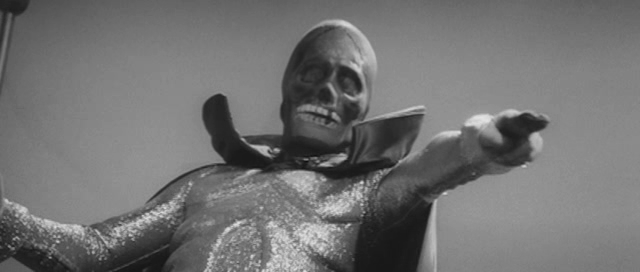
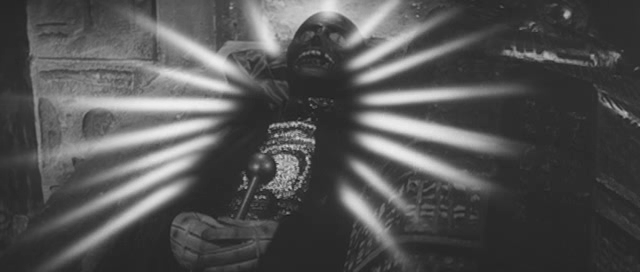
Nazo is Golden Bat’s arch enemy, here a man in a rat costume with four eyes and a large metal wrench for a hand. Travelling to find their fallen comrades, the gang discover Golden Bat in his sarcophagus hidden in what looks like an ancient temple with instructions to wake him up with a single drop of water should humanity be in crisis which he predicts will happen 10,000 years after he went into storage in Atlantis. Professor Pearl’s adorable 12-year-old granddaughter Emily (Emily Hatoyama) does just this and then becomes his point of contact, but in true tokusatsu fashion after simply gifting them the special lens and fighting off Nazo’s goons Golden Bat flies off into the sunset with important superhero business to attend to. Meanwhile, Captain Yamatone (Sonny Chiba) and the others attempt to save the Earth while battling Nazo’s three most dangerous henchmen: wolfman Jackal (Keiichi Kitagawa), fish woman Piranha (Keiko Kuni), and Keloid (Yoichi Numata) who has a large skin lesion on his face which honestly seems in poor taste. 

As in his other films, Sato appears to have his tongue very much in his cheek given that the performances of his cast are decidedly broad with a tendency towards evil glares and reaction shots, his camera often zooming in directly on villainy. Golden Bat meanwhile is often seen striking theatrical poses while uttering phrases such as “for justice alone do I fight!” and hitting people with his baton to make them behave. You might think children would find a skeleton man with an eyeless gold skull a little frightening, but Golden Bat seems to make it work while offering his own non-evil laugh as he cheerfully returns to save the day until finally forced to tap the sign he’s helpfully put up reading “those who attempt to subjugate the world through force by their own force shall perish”. Nazo meanwhile has a definite nautical theme, travelling by shark submarine/aeroplane and giant squid-shaped earth borer with laser eyes but is finally undone in surprisingly violent fashion by Golden Bat’s Baton of Justice. Defiantly irreverent and flying in the face of tokusatsu’s general responsible science stance, Golden Bat is exceptionally silly and makes little literal sense but is undeniably fantastic fun as the skeletal superhero does his best to ward off galactic imperialism. 


Original trailer (no subtitles)

The Swordsman and the Actress (大江戸千両囃子, Yasushi Sasaki, 1955)

Working mainly with Toei, singer Hibari Misora was able to carve out for herself a distinctive career as a tentpole movie star in the early post-war period. In contrast to other female stars of the day, Misora’s leading women are generally feisty and rebellious standing up against injustice in period films and contemporary dramas alike while she also made a point of subverting societal gender norms often crossdressing or playing with gender ambiguity. 1955’s The Swordsman and the Actress (大江戸千両囃子, Oedo Senryo Bayashi) meanwhile sees her taking a backseat to the main action but sowing the seeds for her later career as she stops a cruel samurai plot in its tracks and even gets to participate in the final showdown. 

The drama starts when young actress Koharu (Hibari Misora) misplaces her fan and is lent one by another performer which attracts the attention of bad samurai Shuzen Ogaki (Kyu Sazanaka) who recognises it as having once belonged to the Shogun. As it turns out, Koharu’s friend Hanji (Rentaro Kita) was gifted the fan by a childhood friend, a noble woman, Okyo (Keiko Yashioji), for whom he may have had feelings which would could never be returned seeing as he was the son of a maid. Having seen him in a play but feeling it would be inappropriate to meet, Okyo sent the fan in fondness but had not realised it to be valuable and is now in a difficult position as the Shogun will soon be visiting and if he does not see the fan will be offended. Shuzen wants the fan for himself to embarrass Okyo and her husband and advance his own position. Just as Okyo dispatches trusted retainer Gennojo (Chiyonosuke Azuma) to ask Hanji to return the fan, Shuzen sends in his goons killing Hanji but only after he manages to substitute a fake fan for the real one. 

What follows is a complicated game of find the lady as the fake fan and the real are swapped between Gennojo and Shuzen often via a pair of pickpockets, Oryu (Ayuko Saijo) and sidekick, who alternately help and hinder largely because Oryu develops a crush on the extremely disinterested Gennojo. As usual, Koharu is on the side of right trying to fulfil Hanji’s dying wish by returning the fan to Okyo before the Shogun’s New Year visit but is also on a side quest of her own in looking for her long lost sister. It would be tempting in a sense to view the fan as cursed as it indeed provokes nothing but trouble, not only getting Hanji killed and endangering the lives of Okyo and her son, but also provoking discord wherever it’s mentioned sending a pair of married shopkeepers into a blazing row when they realise their young son may have walked off with the priceless object (and later sold it so his mum can buy sake). 

In the quest for the fan, Koharu takes a backseat while Gennojo does most of the leg work played as he is by jidaigeki star Chiyonosuke Azuma with whom Misora would frequently co-star. Though there are hints of a romance it is not the main thrust of the drama considering Misora’s relative youth, though she does get to wistfully sing the title song several times over. Meanwhile the pair are finally joined by a late in the game appearance from veteran Ryutaro Otomo as a typically raucous ronin, Jubei, who steals the screen to such an extent it almost seems as if the film is part of a series revolving around his character who turns out to be another victim of Shuzen’s plot having been exiled from his clan supposedly for having turned down the advances of his now mistress Oren. “I, Fujisaki Jubei, may be unemployed but mine is still the sword of righteousness and it doesn’t like evil doers!” he snarls apparently quite fed up with samurai corruption. 

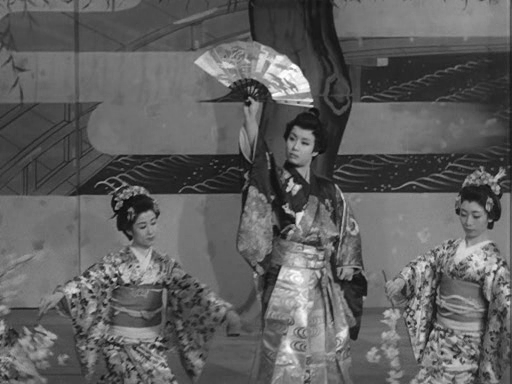
Sasaki certainly has a lot of fun with his fan swapping shenanigans, even going slightly experimental in an excuse to give Chiyonosuke Azuma a fan dance while throwing in additional comic relief from the bumbling pickpockets and some strangely comic death scenes but does not disappoint as the major heroes and villains reunite in the final showdown taking place as it does on stage and allowing Koharu’s troupe mistress to show off her sword skills while Oryu redeems herself and the evil samurai plot is finally defeated by the forces of righteousness. An anarchic affair, Swordsman and the Actress never takes itself too seriously but nevertheless sows the seeds for many of Misora’s subsequent adventures as she sets the world to rights again with the aid of her two complementary samurai sidekicks. 


Musical clip (no subtitles)

The Phantom Goblin (まぼろし天狗, Nobuo Nakagawa, 1962)

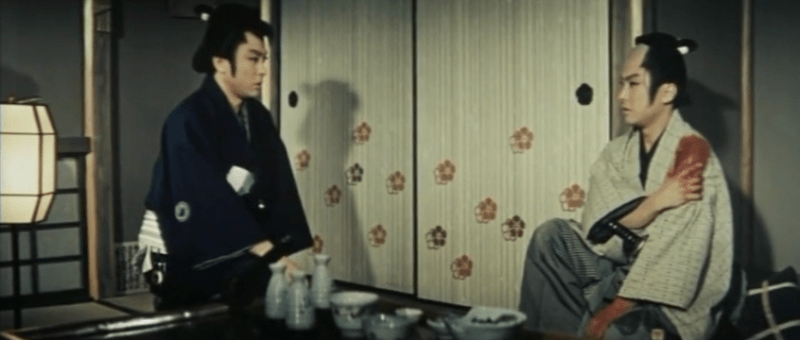
“Everything is money these days” as a pirate king cheerfully proclaims in Nobuo Nakagawa’s tale of Edo-era corruption, Phantom Goblin (まぼろし天狗, Maboroshi Tengu). Perhaps named to capitalise on Nakagawa’s reputation for spookiness, Phantom Goblin features no real ghosts and only metaphorical goblins in the bright red tengu masks sported by the hero’s mysterious clan while otherwise conforming to the Toei programmer house style and starring jidaigeki superstar Hashizo Okawa in a double role as brothers separated at birth and reunited by their resistance towards the inherently corrupt authority of Edo society. 

Drawing parallels with the present day, the film opens at a bawdy banquet at which corrupt councillor Tanuma (Isao Yamagata) is being entertained by a pair of local social climbers with a floor show of dancing girls. Shortly after the performance begins, however, one of the women collapses writhing in agony and loudly crying out for drugs. Embarrassed, the lords would rather this not get out deciding to finish the woman off and dump her body in a nearby well. Unfortunately for them, the plan is interrupted by local policeman Shuma Moriya (Hashizo Okawa) who arrives in time to hear the woman exclaim the words “drugs” and “mastermind” before she passes away. Determined to figure out the truth, Moriya heads to the not so secret hideout of a local gang but is shot in the arm and has to take refuge in an inn where he encounters a man who looks just like himself, Kyonosuke Asakawa (also Hashizo Okawa) of the Goblin clan, who eventually sends him to his estate to recover and assumes his position as policeman in order to root out the truth. 

A former hatamoto who apparently resigned his position after finding himself unable to support corrupt lords, Kyonosuke declares himself “frustrated with how things are run”, realising that the system is rotten beyond repair on hearing that Moriya has been fired by a corrupt magistrate apparently in league with the conspirators. While comparatively rare in Edo-era dramas, drugs are a controversial subject in any age but in keeping with the sensibilities of the early ‘60s Phantom Goblin eventually slips into the Sinophobia then rampant in contemporary crime dramas as it becomes clear the drugs trade in the feudal economy is being driven by Chinese pirates trafficking it in from overseas while weak willed lords enable their rise to power. 

There is however a touch of conservatism in Kyonosuke’s desire to see justice served in that he fears a world in which “if you can buy power and position with money, then one day we will have a chief counsellor who is a pirate”. While he’s undoubtedly got a point, it’s also true that he is in a sense protecting his own privilege conveyed by birth rather than worth in addition to rejecting the influence of the “foreign” as he raises his sword against a Chinese pirate in order to target the corrupt lords who’ve been collaborating with him in order to bolster their own power and position. Kyonosuke wanted to “clean out evil in Edo”, but eventually succeeds rather ironically in simply becoming a part of the system himself after having supposedly cleaned it out by getting rid of the “obviously” corrupt elites. 

Recovering from his shoulder injury and flirting with the adopted sister of Kyonosuke, Moriya is largely relegated to a secondary role though the secret brotherhood of the two never develops into much of a plot point even as they bond as men too honest for the world in which they live. Nor do the respective romantic dilemmas ever materialise even as the conflicted figure of a female bandit in love with the noble policeman is forced to pay for her crimes with her life, unable to progress into the purified world the brothers are about to create. Working in the Toei house style, Nakagawa abandons his taste for the strange or otherworldly contenting himself only with a few ironic tengu masks and the literal shadows surrounding the shady mastermind while indulging in genre staples such as the comic relief provided by Kyonosuke’s bumbling retainers and the double casting of Hashizo Okawa as two brothers alike in both appearance and sensibility who find themselves unable to accept the increasing corruption of their society and determine to oppose it.