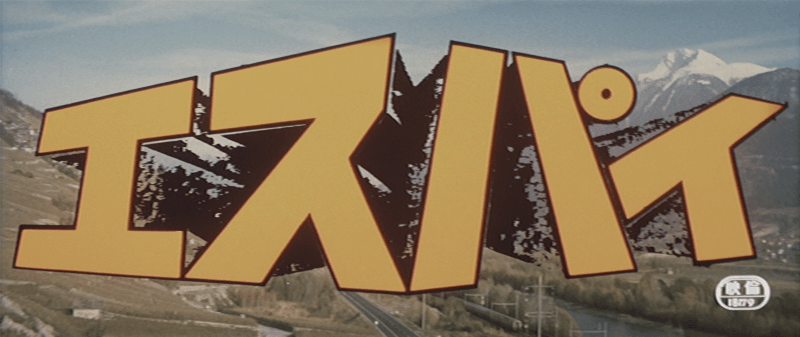
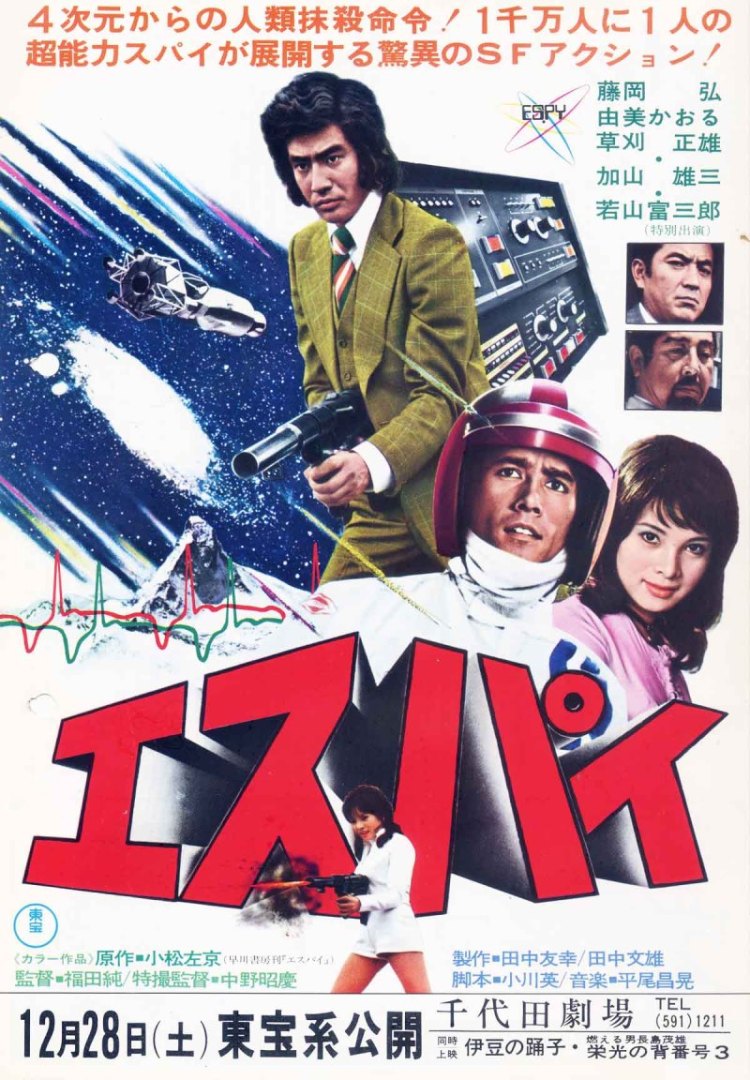
 By 1974 the Toho SFX movie was perhaps long past its heyday though Jun Fukuda’s Espy (エスパイ) was far from the last. Clearly influenced by popular spy franchises such as James Bond as well as more serious cold war spy dramas, Espy is a jet setting tale of superpowered assassins, international conspiracy, and love as an unexpected source of salvation, but as much as it embraces its hippyish message of total communication it also moves further into the realms of exploitation, skewing closer to Nikkatsu’s ’70s output than the more child friendly supernatural adventures of ages past.
The world is at breaking point. A small conflict in a tiny East European nation known as Baltonia threatens to spark a third world war. A UN delegation is currently en route to a conference in which they hope to settle the conflict in a peaceful way but all hope is lost when a sniper equipped with X-ray vision takes them all out with maximum precision.
Meanwhile, back in Japan, test driver Miki (Masao Kusakari) gets into trouble on the course when he swerves to avoid some pigeons. The car spins out of control but just at the last minute, Miki turns it around through his dormant psychic powers which brings him to the attention of the IPPG – the International Psychic Power Group. Following the assassination of the UN delegation, all eyes are on Japan where the prime minister of Baltonia is due to meet the US president in what is hoped will be a bold new development in international relations but the IPPG have reason to believe an attempt will be made on the prime minister’s life and only their ESP equipped team can stop it.
Espy takes the essential components of both the spy thriller in its international conspiracy set up, and the B-movie science fiction adventure in its presentation of the good and evil possibilities of advanced technologies or in this case innate superpowers. The Espy team are pitted against the Anti-Espy who have similar powers but are committed to using them to harm mankind. The leader of the Anti-Espy, Ulrov (Tomisaburo Wakayama), sees himself as a superior being to regular Earthlings and, believing that humans have overpopulated the planet which they continue to damage, is convinced the best solution is a mass cull. He plans to do this by helping the “lesser” humans destroy themselves by provoking a third world war or a hundred mini conflicts in which thousands will die.
Ulrov’s arguments tie in nicely with Toho’s trademark environmentalism and ambivalent attitude towards scientific development, but they go against the prevailing sense of humanism which is to be found in the studio’s genre output. In Ulrov’s fascistic view of the world, he and the other ESPers are a superior race whose existence is threatened by weaker humans and their reckless disregard for the planet as a whole. Due to a traumatic childhood incident, he believes that humans are cruel beasts who lust for blood and talk of peace with hearts filled with hate. He may have a point, but his message conflicts with the positive movement for peace which is advanced by the Baltonian PM who doesn’t want a world in which peace is brokered and balanced but one of true unity.
Espy is, however, of its time and fails to fully live out its peace and love ideals. Team member Maria (Kaoru Yumi) is kidnapped by Anti-Espy and taken to Ulrov’s lair where she is forced to dance lasciviously in front of fellow team member Tamura (Hiroshi Fujioka) with whom she shares an especially strong connection. Tamura’s arms and legs are cuffed as he communicates telepathically with Ulrov, semi-hypnotised by Maria’s strange dance. Maria is then approached by a large dark-skinned man wearing only a loincloth who proceeds to tear open her shirt at which point she snaps out of her trance, frees Tamura, and rips out the attacker’s tongue.
Meanwhile, new recruit Miki has failed in his mission and killed a man for the first time sending him into a kind of depression. Though Miki was introduced as the protagonist, he is in fact absent for most of the film though his journey is among the strangest as he reminisces about a foreign girl he was friends with as a child and enjoys an unusually strong bond with his intrepid dog, Caesar, who teaches the gang a few lessons about unconditional love. Maria is severely traumatised by her attack while Tamura reconsiders his sense of self worth having temporarily lost his powers, but eventually the team realise that their psychic abilities are nothing more than a manifestation of a great love. Ulrov later has the same epiphany but the team’s decision to consider him possessed by something “inhuman” is a worrying one. They don’t want to accept that it was humans who made him that way because it would be too sad, but not to do so is a failure to recognise humanity’s darkness as well as its light.
Espy bites off a little more than it can chew in failing to deal with some of the more interesting ideas it raises though it makes the most of its meagre budget to present an exciting spy thriller voyaging from Japan to Turkey and Switzerland. Skewing more towards Nikkatsu’s brand of exploitation action, Espy is definitely among the more adult orientated of Toho’s SFX adventures but its messages are broadly the same in its insistence on human interconnectedness as the ultimate superpower.
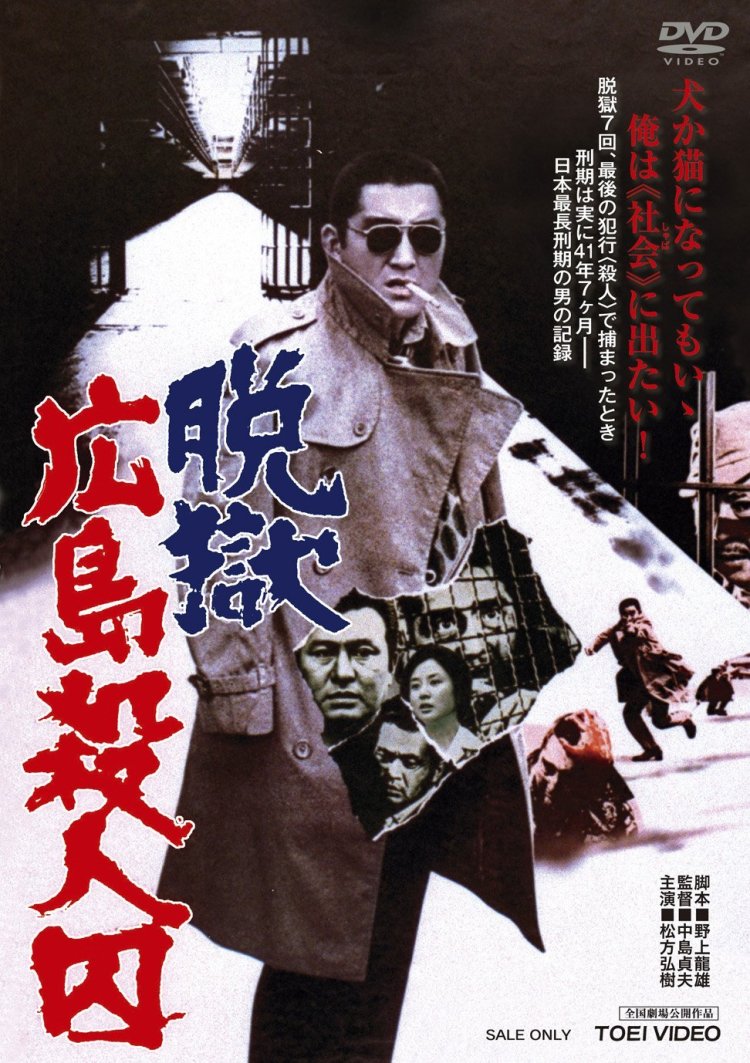 Sadao Nakajima had made his name with Toei’s particular brand of violent action movie, but by the early seventies, the classic yakuza flick was going out of fashion. Datsugoku Hiroshima Satsujinshu (脱獄広島殺人囚, AKA The Rapacious Jailbreaker) follows in the wake of seminal genre buster,
 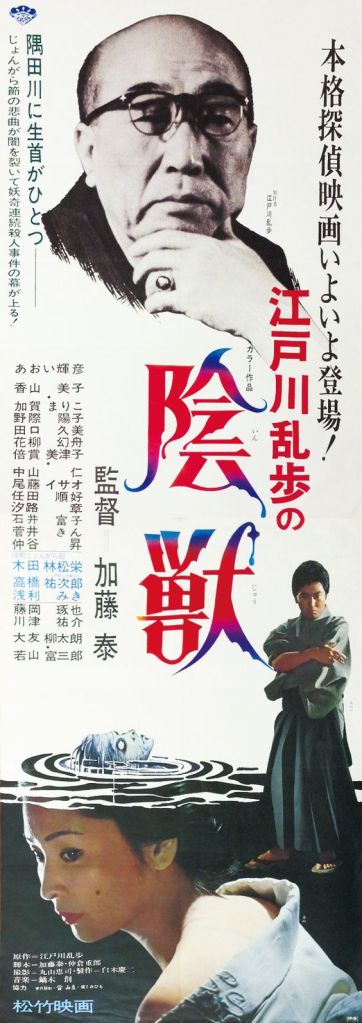 Edogawa Rampo (a clever allusion to master of the gothic and detective story pioneer Edgar Allan Poe) has provided ample inspiration for many Japanese films from
  Ogami (Tomisaburo Wakayama) and his son Daigoro (Akihiro Tomikawa) have been following the Demon Way for five films, chasing the elusive Lord Retsudo (Minoru Oki) of the villainous Yagyu clan who was responsible for the murder of Ogami’s wife and his subsequent framing for treason. The Demon Way is never easy, and Ogami has committed himself to following it to its conclusion, but recent encounters have broadened a conflict in his heart as innocents and seekers of justice have died alongside guilty men and cowards. Lone Wolf and Cub: White Heaven in Hell (子連れ狼 地獄へ行くぞ!大五郎, Kozure Okami: Jigoku e Ikuzo! Daigoro) moves him closer to his target but also further deepens his descent into the underworld as he’s forced to confront the wake of his ongoing quest for vengeance.
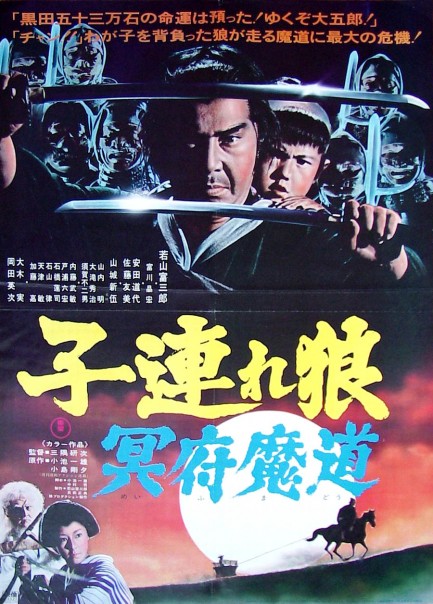 Ogami (Tomisaburo Wakayama), former Shogun executioner now a fugitive in search of justice after being framed for treason by the villainous Yagyu clan who are also responsible for the death of his wife, is still on the Demon’s Way with his young son Daigoro (Akihiro Tomikawa). Five films into this six film cycle, the pair are edging closer to their goal as the evil Lord Retsudo continues to make shadowy appearances at the corners of their world. However, the Demon’s Way carries a heavy toll, littered with corpses of unlucky challengers, the road has, of late, begun to claim the lives of the virtuous along with the venal. Conflicted as he was in his execution of a contract to assassinate the tragic Oyuki in the previous instalment,
 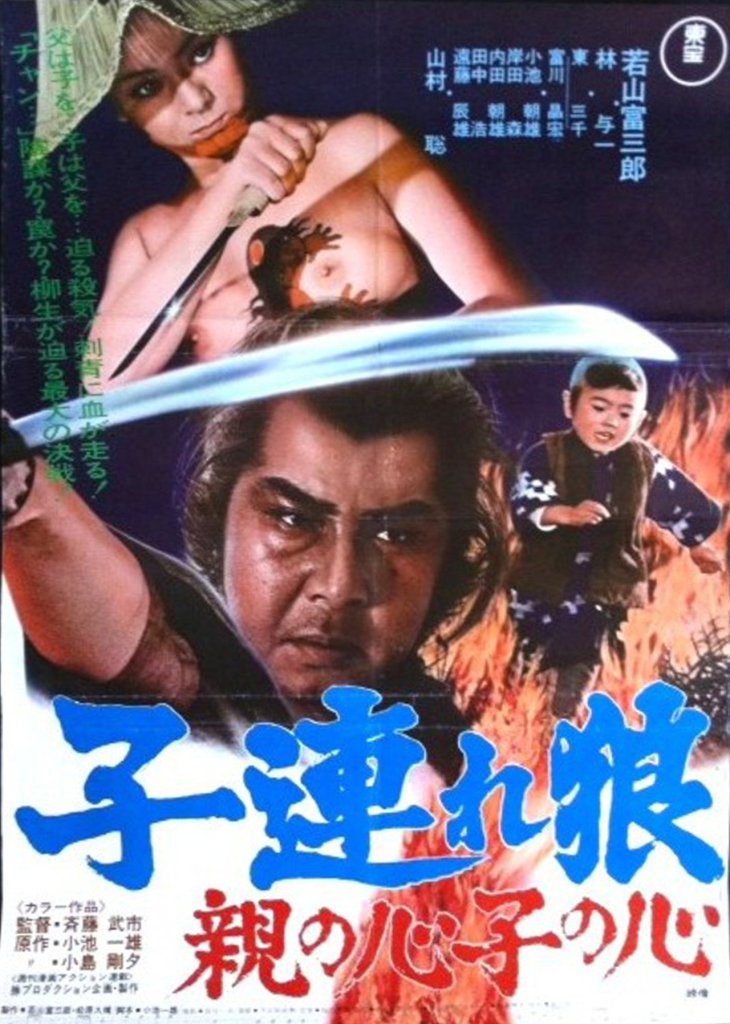 Now four instalments into the Lone Wolf and Cub series, Ogami (Tomisaburo Wakayama) and Daigoro (Akihiro Tomikawa) have been on the road for quite some time, seeking vengeance against the Yagyu clan who framed Ogami for treason, murdered his wife, and stole his prized position as the official Shogun executioner. Lone Wolf and Cub: Baby Cart in Peril (子連れ狼 親の心子の心, Kozure Okami: Oya no Kokoro Ko no Kokoro) is the first in the series not to be directed by Kenji Misumi (though he would return for the following chapter) and the change in approach is very much in evidence as veteran Nikkatsu director Buichi Saito picks up the reins and takes things in a much more active, full on ‘70s exploitation direction. Where
 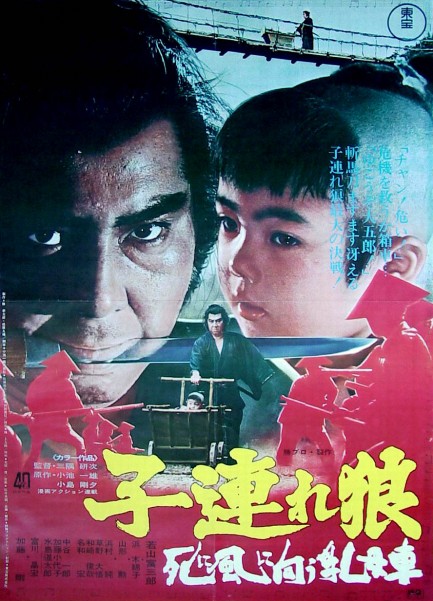 Ogami Itto (Tomisaburo Wakayama) and his (slightly less) young son Daigoro (Akihiro Tomikawa) are going to hell in a baby cart in this third instalment of the six film series, Lone Wolf and Cub: Baby Cart to Hades (子連れ狼 死に風に向う乳母車, Kozure Okami: Shinikazeni Mukau Ubaguruma). The former shogun executioner, framed for treason by the villainous Yagyu clan intent on assuming his position, is still on the “Demon’s Way”, seeking vengeance and the restoration of his clan’s honour with his toddler son safely ensconced within a bamboo cart which also holds its fair share of secrets. In the previous chapter,
 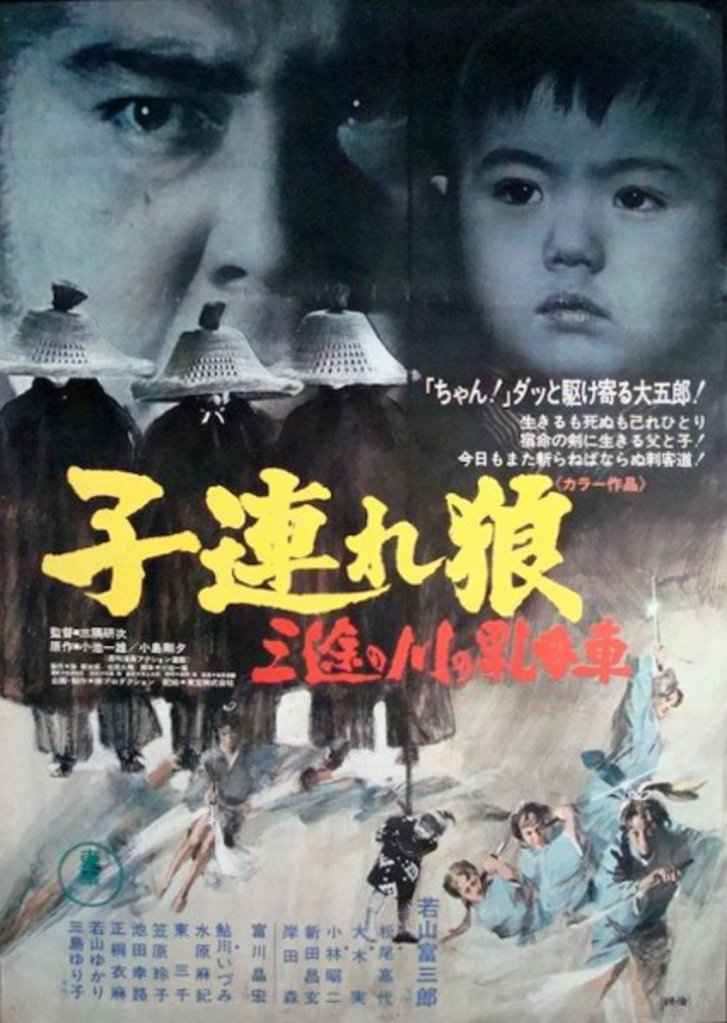 The first instalment of the
 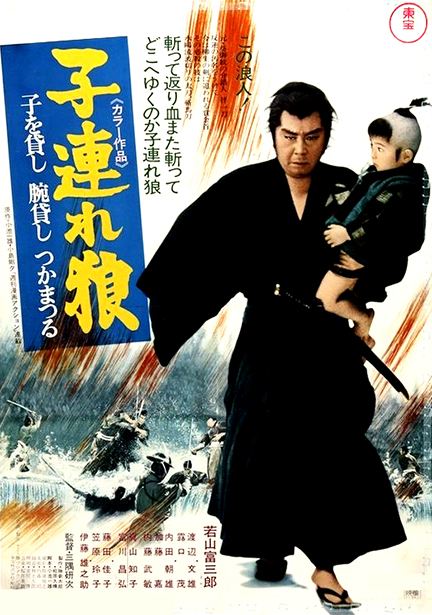 When it comes to period exploitation films of the 1970s, one name looms large – Kazuo Koike. A prolific mangaka, Koike also moved into writing screenplays for the various adaptations of his manga including the much loved Lady Snowblood and an original series in the form of Hanzo the Razor. Lone Wolf and Cub was one of his earliest successes, published between 1970 and 1976 the series spanned 28 volumes and was quickly turned into a movie franchise following the usual pattern of the time which saw six instalments released from 1972 to 1974. Martial arts specialist Tomisaburo Wakayama starred as the ill fated “Lone Wolf”, Ogami, in each of the theatrical movies as the former shogun executioner fights to clear his name and get revenge on the people who framed him for treason and murdered his wife, all with his adorable little son ensconced in a bamboo cart.
