My Wonderful Yellow Car (吹けよ春風, Senkichi Taniguchi, 1953)

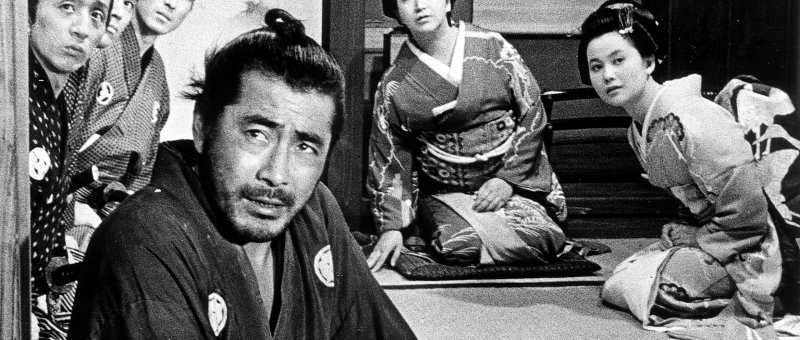
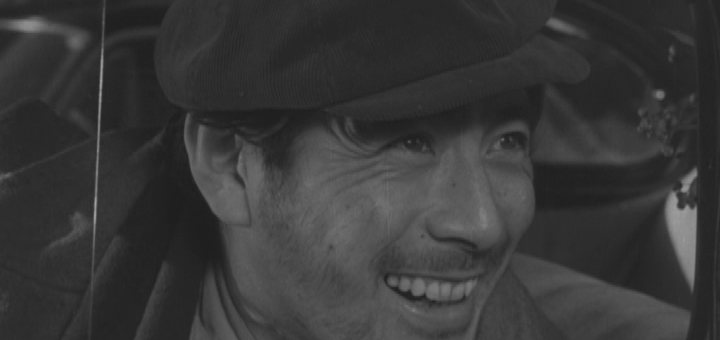
A kind-hearted taxi driver becomes our guide to the post-war society in a cheerful omnibus movie co-scripted by Akira Kurosawa and directed by Senkichi Taniguchi, My Wonderful Yellow Car (吹けよ春風, Fukeyo, Haru Kaze). Inspired by a Reader’s Digest column titled “human nature as seen in the rearview mirror”, the film follows cheerful cabbie Matsumura (Toshiro Mifune) as he drives around Tokyo in 1953 picking up various fares and sometimes adding commentary or trying to help with whatever kind of problem seems to be bothering them.

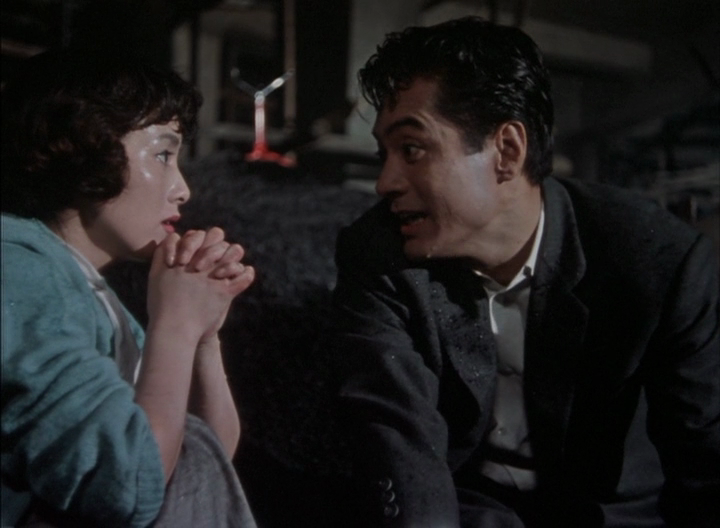
Then again, he stays well out of the first fare’s business as a young couple have obviously had some kind of falling out. Bursting into tears, the girl (Mariko Okada) announces that she wants to postpone the wedding and maybe even rethink this whole thing, while the boy reiterates with slight irritation that he’s said he’s sorry with the implication that that should be the end of it though we have no idea what (if anything) he’s actually done. In any case, they eventually patch things up over some canoodling in the back seat and ask to be dropped off so they can get something to eat. In some ways, the young couple represent a more hopeful vision of post-war youth who have no apparent worries besides their tiff and are financially comfortably enough not only to be getting married but can afford to travel by taxi and pay for a meal on the same occasion. 

Their situation is later contrasted with that of an older couple who’ve moved from Osaka to Tokyo in their old age and have bought a box of live lobsters to celebrate their silver wedding anniversary but as Matsumura notes though they appear to be quite well off they also seem somehow sad. That turns out to be because they lost their only son the previous summer and have moved into his old apartment. The old lady also cries in the back seat, but for a completely different reason. As they’ve only just moved here, they don’t have friends or anything to do and are completely lost in the wake of their son’s death. Matsumura’s kindness is demonstrated when he borrows three flowers from a bouquet delivered to a girl at the petrol station and presents them as an anniversary gift. The couple are so touched they invite him to enjoy their anniversary dinner with them and by the end of it have made the decision that they should go back to Osaka and restart their lives by re-opening their old business.

Throughout all this, Matsumura is very conscious of the meter. Every second he spent in the old couple’s apartment cost him money, but as he’s fond of saying you can’t always think of things like that. Even so, he reminds himself he has a wife and child so should be mindful of the clock but still turns down a fare to go back to the station and check on a young girl he’s pretty sure is trying to run away from home. A weird guy was sniffing around her and was in fact just about to lead her off when Matsumura gets back and announces he’s come to pick her up. Matsumura spends the rest of the ride trying to convince her to go home, repeatedly reminding her that most of the “panpans”, or streetwalking sex workers catering to US servicemen, were also once runaway girls. To more modern eyes we might wonder if sending her home is what’s best without knowing the reasons she wanted to leave. He goes so far as to buy her ramen which costs him more money on top of the lost fare which doesn’t collect from her either when he, a little less responsibly, abandons her when she refuses to tell him where she lives. Thankfully, it all seems to work out. The girl made a sensible decision to go home after all and is later seen happily doing her Christmas shopping with her mother who also thanks him for looking out for her.

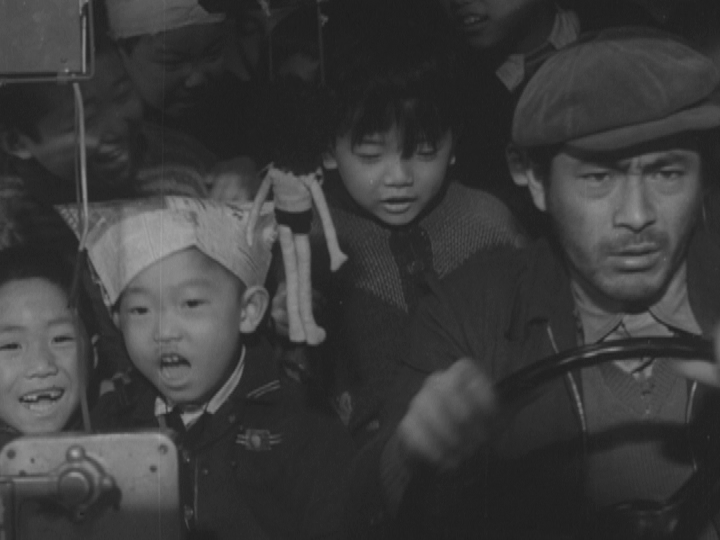
Perhaps these kinds of altruistic acts of kindness explain why Matsumura’s own clothes are quite ragged with a hole in his jumper and a tear to the shoulder of his jacket. He’s driving the cab in straw sandals which apart from anything else is probably quite cold in the winter. He spends another afternoon giving a free ride to some children, about 15 of them, who’ve crowdfunded 100 yen because they’ve never been in a car before and want to go as far it’ll take them having no idea that 100 yen is actually the initial charge so you can’t go anywhere on it all. Of course, Matsumura ends up taking them a bit further, and then realises he’ll have to take them back to where they were because they won’t have any other way of getting there or of knowing where they are now.

On the other hand, sometimes he ends up with nuisance fares such as two drunk guys who keep singing their university song. One of them even climbs out of the window and up onto the roof, causing Matsumura to assume he’s fallen off somewhere and he’ll have to go back and look for him to make sure he’s not hurt only to find him burbling in the footwell. He also ends up getting hijacked by a crook with a gun on his way back from Yokohama but getting a telling off from the police rather than a thank you for catching him after unwisely taking hold of the gun himself and messing up all the fingerprints. 

One might think the time he had a famous actress in the back of his cab who even sang along with the jingle he’d written for the cheerful yellow vehicle might make up for all that, but he says the story that best exemplifies why he loves driving a taxi is that of a middle-aged couple he picked up at the harbour shortly after a boat had docked repatriating people from China. Even in 1953, some had not yet returned after becoming trapped by the Chinese Civil War and eventual Communist victory. The man is dressed in military uniform and says he’s just been demobbed when Matsumura asks him, trying to lighten the mood while there’s obviously some degree of tension between the man and his wife. But as we gradually come to understand, it’s all just a ruse and he has in fact been in prison in Japan for the last seven years for an unspecified crime.

His wife asks Matsumura to drive around the city and attempts to show him how much things have recovered, suggesting that they can now put the past behind them and start over. But the man remains sullen and grumpy. He’s afraid to go home, afraid to face the neighbours worrying if they know what he did and that he’s been in prison. But most of all he’s afraid to face his children, the youngest of which he’s never met. The kids have been teaching themselves to say “Welcome home, Daddy,” in Mandarin believing he’s been in China all this time which the wife has to explain before they get there. The man tells his wife he understands if she doesn’t want him back, but she assures him that the children are excited as is she to start their new life together. Nevertheless, though they’ve been eagerly practicing, the older two children simply freeze when confronted by this anxious stranger who turns around to leave again feeling as if he doesn’t have the right to come back here after all only for the youngest one to suddenly pipe up with the phrase note perfect. It’s this kind of scene, getting people to where they need to be physically and emotionally, that seems to make Matsumura’s job worthwhile. In essence, he’s ferrying people towards the cheerful post-war future his cute yellow cab represents while driving round the rapidly changing city wondering who it is that’s going to end up in the rearview mirror today.


Title song (no subtitles)
Vendetta of a Samurai (荒木又右衛門 決闘鍵屋の辻, Kazuo Mori, 1952)

During the American Occupation, period dramas were frowned upon, the occupation forces apparently fearing that they might encourage the latent feudalism in Japanese society. Released immediately before the Occupation’s end, Kazuo Mori’s Vendetta of a Samurai (荒木又右衛門 決闘鍵屋の辻, Araki Mataemon: Ketto Kagiya no Tsuji), not to be confused with the director’s similarly titled Samurai Vendetta from a few years later, is a suitably revisionist piece interrogating the legacy not only of the samurai but the samurai movie in demonstrating, quite poignantly for the contemporary audience, that the rigid and austere codes of a warrior class did nothing but create sadness which forced good men to sacrifice true friendship in service not even of an ideal but simply an agreement. 

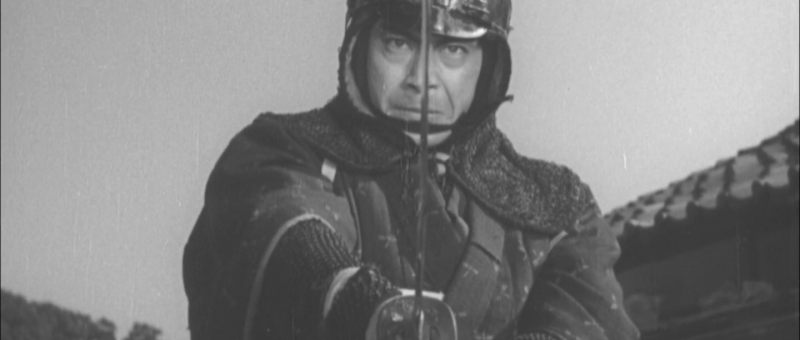
To signal his intent, Mori opens with a bombastic sequence shot in the fashion of pre-war jidaigeki, all booming speeches and clashing swords before a voiceover cuts in to tell us everything we know of the events in play is wrong. The legends surrounding the battle at Kagiya Corner tell us that Jinza (Takashi Shimura) was a bad man, and that Mataemon (Toshiro Mifune) killed 36 that day, but in reality Jinza was kind and noble and in fact the two men were good friends while Mataemon in reality struck down only two enemies which is in any case much more plausible if perhaps less exciting. As the classic chanbara scene fades, we return to the modern city of Ueno in Iga which in some respects remains unchanged further emphasising the “reality” of the brief 17th century conflict. As we learn, a man called Matagoro (Minoru Chiaki) has poked a hole through the samurai order in killing the brother of a young man called Kazuma (Akihiko Katayama), and so a lot of people have to die to eradicate the corruption of his transgression.

Boasting a script by Akira Kurosawa, the action flips between Mataemon, brother-in-law of Kazuma, and his men waiting for the arrival of Jinza and Matagoro inside a small inn, and the circumstances which brought them to this point. Mataemon is duty bound to support Kazuma who is really just a boy forced to seek revenge because they are family though there does not seem to be much heat in his desire for justice against Matagoro. Jinza, by contrast, is positioned on the opposite side solely because he is affiliated with a high ranking Hatamoto who is protecting Matagoro. Yet the two men are good friends each resigned to their fates and in full knowledge of how the samurai world works. The have no quarrel with each other, but are forced into mortal combat because of a complex network of loyalties and obligations that can only be satisfied with blood. 

“What is the meaning of this violence?” an imperious official asks, receiving no answer only a mild plea for a little more time. “Being a samurai, what a funny thing,” Mataemon laments to himself reflecting on the fact he must now kill or be killed by his friend for no real reason but simply because things are the way they are. Jinza meanwhile agrees, “Being warriors, what a misfortune,” as the pair calmly discuss the inherent hypocrisies which define their lives wherein all that really matters is one’s proximity to the shogun. That’s one reason the nervous Mago (Daisuke Kato) has joined the mission for revenge, his loyalist father a former tutor to the lord and keen to show their fealty but also hoping to advance their fortunes through a successful vendetta. 

Mago isn’t the only one who’s scared. The inn keeper is visibly shaking. He didn’t really want to be ground zero for a samurai duel today and is presumably worried not just for his safety but for the repercussions of offending his guests and damage to his property. A crowd gathering around the fighting, which includes the wealthy merchant brother-in-law of Matagoro who declared himself unafraid of a few rural bumpkin samurai, remarks on the smell of blood in the air seemingly both horrified and excited by the spectacle though even that is thin on the ground. No grand duel, Mataemon merely strikes his friend down before the battle begins, thereafter coaching the young Kazuma to overcome his fear and claim his revenge despite the bloody ugliness of the task. Yet in the end all there is is fear and futility, along with still more duty and the promise of more blood to come.  


Sanjuro (椿三十郎, Akira Kurosawa, 1962)

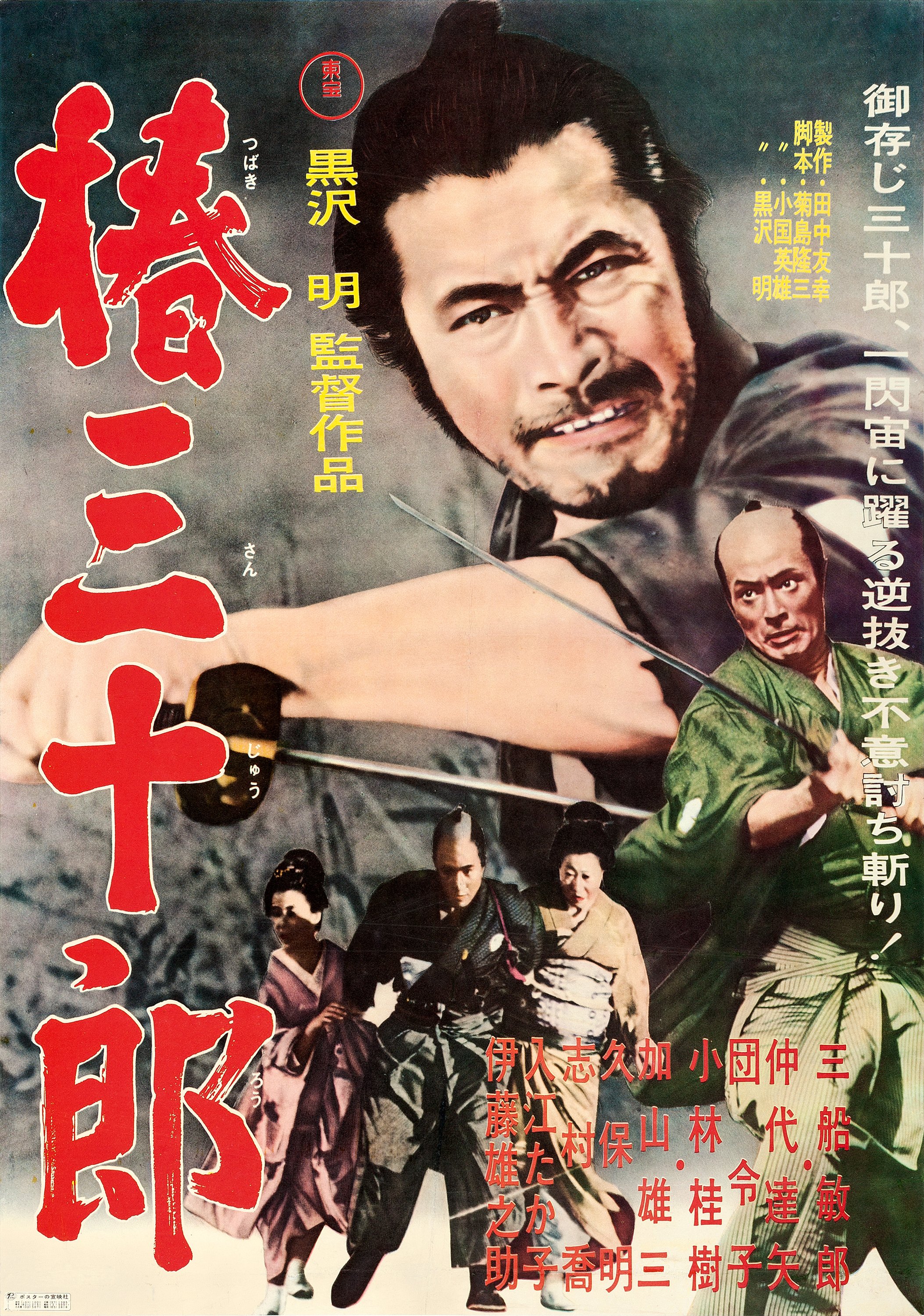
Adapted from a novel by Shugoro Yamamoto, Akira Kurosawa’s Yojimbo had taken place in a world of collapse in which the foundations of the feudal order had begun to crack while the disruptive allure of hard currency had left ordinary people at the mercy of gang intimidation in place of exploitative lords. A quasi-sequel or perhaps more accurately termed a companion piece, Sanjuro (椿三十郎, Tsubaki Sanjuro) by contrast, takes place in a world that should be peaceful and orderly but suggests that the corruption was there all along and tolerated to the extent of being coded into the system. 

The accused man, Mutsuta (Yunosuke Ito), says as much at the film’s conclusion explaining that he meant to deal with the matter “more discreetly” after amassing incontrovertible evidence he could he could offer to his superiors in the capital if only his hot-headed nephew and the idealistic young samurai with him hadn’t jumped the gun by naively thinking they could expose conspiracy by force of will. This time around, the wandering ronin who gives his name as Sanjuro (Toshiro Mifune) finds himself adopting a fatherly position trying to convince the youngsters to think before they act. Overhearing their conversation, he explains to them that they have mostly likely been misled, Mutsuta is innocent and his attempt to warn them off well-meaning while the superintendent Kikui (Masao Shimizu) is the real villain and almost certainly intends to have the lot of them bumped off before they figure out what’s really going on. 

Unlike Yojimbo, Sanjuro takes place entirely within samurai society which ought to be an orderly place where everyone follows the same code and does their best to act honourably. This sense of stability is reflected in Kurosawa’s composition which leans closer to the classicism of the historical drama than the windswept vistas of the lonely ghost town in Yojimbo, and by the contrast so often drawn between the wandering ronin and the young samurai who are shocked by his rough way of speaking and wilful rejection of the politeness with which they have been raised. As a captured prisoner points out, Sanjuro has a sarcastic manner and a tendency to insult where he means to praise which further fuels the doubt some have in him, unsure whether they can really trust this “outspoken and eccentric” drifter fearing he will simply sell himself to the highest bidder and betray them. Mutsuta sympathises with this to some degree, forgiving the boys for having thought him a villain but lamenting that his long face has often got him into trouble. They thought he was the bad guy because he looked like one and trusted Kikui because he looked honest, laying bare the childish superficiality soon corrected by the well honed instincts of the veteran Sanjuro. 

It’s this superficiality that also leads them to dismiss the advice of Lady Mutsuta (Takako Irie) as “hopelessly naive” while only Sanjuro can see that she has a full grasp of the situation at hand and accepts her admonishment that he has the “bad habit” of killing too easily when another solution may be available. When the boys catch one of Kikui’s henchmen they suggest killing him because he’s seen their faces, but Lady Mutsuta decides to invite him into their home, assuring him he won’t be harmed and even giving him one of their fancy kimonos to wear. The man seems to have been won over by their hospitality, sometimes emerging from the cupboard where he is (voluntarily) imprisoned to offer a word of advice along with a defence of Sanjuro having observed him and figured out that he is a good man with an admittedly gruff manner that makes him a bad fit for conventional samurai society. “He would find it too confining here,” Mutsuta agrees, “he wouldn’t wear these fine garments or be a docile servant of the clan.”

In any case, the film doesn’t particularly reject samurai society only suggest that if you’re going to live within it you should follow the rules and if you can’t you should follow your own path as Sanjuro has been doing in a sense “freed” by his ronin status serving no master but himself. Lady Mutsuta had a point when she said that he glistened like a drawn sword, something he too concedes after facing off against his final foe, Heibei (Tatsuya Nakadai), whom he describes as much like himself another drawn sword in a society in which direct violence is inappropriate as the explosive spray of blood on Heibei’s all too matter of fact defeat makes plain. “The sword is best kept in its sheath” she reminds him, she and her husband both suggesting that this world is ruled by intrigue which is why Mutsuta hoped to handle the corruption “discreetly” though he won’t condemn the young men for their desire to enforce the rules of their society and stand up against corruption and injustice. Their rebellion has accidentally led to unnecessary deaths because of their youthful hot-headedness and tendency towards the simplistic solution of violence, but all things considered it has worked out well enough for all concerned. And so, his work done, Sanjuro is left to wander telling the boys not to follow him because he too is a disruptive and dangerous a presence in this codified world of peace and order in which a sword loses its value the moment it is drawn.


Sanjuro screened at the BFI Southbank, London as part of the Kurosawa season.

Original trailer (English subtitles)

I Live in Fear (生きものの記録, Akira Kurosawa, 1955)

Which of us is “crazy”, the man who lives in fear or the rest of us who live in its denial? By 1955, a decade had passed since the bombs fell on Hiroshima and Nagasaki, but even if the world seemed “peaceful” it was only superficial. The Korean War had “ended” in an uneasy truce only two years earlier and the world was already mired in a cold war which daily threatened to turn hot with both sides in possession of a nuclear deterrent. Akira Kurosawa’s I Live in Fear (生きものの記録, Ikimono no Kiroku) asks us if we can really say a man is “insane” if his life is ruled by a rational anxiety and if it is our refusal to accept the threat he sees which eventually drives him out of his mind. 

Our guide is gentle dentist Harada (Takashi Shimura) who has a sideline as a mediator at the family court. The case he has been called in on one particular afternoon is that of the Nakajima family which is attempting to have the ageing patriarch, Kiichi (a near unrecognisable Toshiro Mifune), declared legally incompetent on account of his increasing paranoia about nuclear attack and latent radioactivity. A wealthy self-made man and foundry owner, Kiichi has frittered away vast sums on harebrained schemes to keep himself and his family safe but after a plan to build a bunker in a remote area had to be abandoned, he’s set his heart on moving everyone to Brazil where he believes they will be safer. 

The problem is partly one of changing times as Kiichi, “despotic and selfish” as his son describes him, attempts to railroad his family into a safety they do not want or need. His two legitimate sons now operate the foundry and their lives are dependent on it, which is not to say that they are dependent on Kiichi, but if he goes through with selling the the foundry to finance his new life it will leave them all high and dry. It would be, to a certain way of thinking, the ultimate paternal betrayal but in Kiichi’s mind all he’s trying to do is “save” his family from an invisible threat. 

That family, meanwhile, is one he’s already undermined through patriarchal selfishness in fathering a series of illegitimate children he is also supporting financially but has never legally acknowledged. The parents of the illegitimate kids are worried that if the family succeeds in having Kiichi declared legally incompetent, his wife will get her hands on the purse strings and they’ll be left out in the cold. Kiichi, meanwhile, has an old-fashioned view of filial relations and never considers that the other kids might not want to come with him either even if it’s unexpectedly nice of him to include them, or that inviting your two mistresses to live in the same house as your legal wife might be awkward for all concerned. 

On the face of it, the case is open and shut. If a man causes his family to suffer through frittering money away on drink or pachinko, they would approve the motion to give another family member legal control over his finances. So why is it taking them so long to decide if Kiichi is a liability to his family or not? The problem is, his fear is entirely rational. It’s only its extent which is the problem. It’s perfectly understandable to be afraid of the ebola virus or brain-eating amoeba, but we can’t afford to spend every minute of every day consumed by fear and so they retreat into the background anxiety of our lives while we try to go on living. Yet, could it be that Kiichi has it right and we’re merely living in denial, sleepwalking into a preventable disaster while he alone has a plan for survival? 

“No place is safe” Kiichi’s son-in-law exasperatedly explains to him after he has taken drastic and somewhat ironic action, a kind of scorched earth policy designed to force his sons to follow him into a new world of safety. Pushed over the edge, Kiichi gets a rude awakening, realising that it was perhaps selfish of him only to think of salvation for his immediate family when his actions will essentially throw his workforce under the bus. Belatedly, he promises to find a way to take them to Brazil too, never realising that people have their own lives that aren’t so easily uprooted. He thinks Brazil is safer because the currents of the world seem to blow ill winds over Japan, but there are already more than enough nuclear bombs lying in warehouses to destroy the planet several times over. 

In any case, Kiichi has already destroyed his family through his various transgressions. They don’t want to go in part because they don’t particularly like him, are sick of his gruff authoritarianism, and resent his tendency to make unilateral decisions on their behalf. Strapped for cash he tries asking the illegitimate kids to return some of the money he gave them, but they too are insecure in their positions and cannot trust that they will continue to be provided for if Kiichi is deposed. Meanwhile, when Kiichi falls ill the legitimate children are only too quick to start discussing the inheritance in the absence of a will. Perhaps Kiichi isn’t much more to them than a walking wallet, all of which lends a rather poignant quality to his continual attempts to protect his family from the nuclear apocalypse in fulfilment of his fatherly duty even as he wagers their economic security to do so. 

If Kiichi is a Cassandra prophesying the end of the world, we won’t be here to be sorry we didn’t listen, but Harada and other more rational minds are shaken by the intensity of his vision. They cannot say that he is “mad” even if his anxiety has consumed his life, but nor can they allow him free rein to pursue his plans because they do not concern only himself but greatly affect the lives of others. They are forced to wonder if it isn’t we who are “insane”, quietly living our lives while all these preventable threats hover in the background, ignored. Kiichi’s mistake was perhaps that he wanted only to be “safe” in an unsafe world, not to cure it of its dangers. Few us are actively trying to eliminate ebola or brain-eating amoebas, just as few actively opposed an increasingly nuclear society, powerless as we are and were in the face of a greater threat. Perhaps Kiichi was the sanest one of all, retreating into a world of madness and infinite safety in a delusional bubble of survival in an otherwise crazy world.


I Live in Fear screens at the BFI Southbank, London on 6th & 13th February 2023 as part of the Kurosawa season.

Ikiru (生きる, Akira Kurosawa, 1952)

The Japanese economy may have embarked on a path towards recovery thanks to the stimulus of the Korean War, but in the early 1950s many might have thought it too soon to ask if survival in itself was enough yet this is exactly what disillusioned civil servant Kenji Watanabe finds himself asking after receiving the devastating news that he has advanced stomach cancer and year at most to live. “To live” is apt translation of Akira Kurosawa’s intensely moving existential melodrama, Ikiru (生きる), which tackles the compromises of the salaryman dream head on along with those of the contradictions of the sometimes dehumanising post-war society. 

As the opening voice over reveals to to us, Watanabe (Takashi Shimura) is man who died long ago or perhaps has never truly been alive. In some senses, he is nothing more than an embodiment of the seal he uses to stamp documents day in day out, a mere piston in an ever turning machine of relentless bureaucracy. A young woman, Miss Odagiri (Miki Odagiri), working in the Public Affairs department loudly reads out a joke someone has written about their boss, Watanabe, who has taken not a single day’s holiday in 30 years suggesting that it’s less that he fears city hall will grind to a halt without him than they’ll suddenly figure out city hall has no need of him at all. The irony is city hall does indeed grind to a halt in Watanabe’s absence as he, unthinkably, fails to turn up for work for days on end as the papers pile ever higher on his desk. “Nothing moves here without his seal” one of the workers admits, bewildered by this sudden break with protocol while salivating over its implications in the possibility that Watanabe’s chair may soon be empty. 

Yet Watanabe’s crisis is that he’s realised he’s wasted his life on a pointless bureaucratic career that’s done little more than keep a roof over his head. Even the roof is a fairly modest one and it’s clear that his grown up son Mitsuo (Nobuo Kaneko) considers him to be a stingy old miser, unable to understand why he’s never spent so much as a penny on himself and lives in a kind of self-imposed austerity. Perhaps to Watanabe this is what constitutes properness. He’s done everything he was supposed to do, got a steady job at city hall and eventually became the head of department, but now he feels foolish and lonely. Mitsuo and his wife seem to resent him and talk openly about their plans to use their inheritance, along with Watanabe’s retirement bonus, for a downpayment on a “modern” home the polar opposite of the pre-war townhouse where the family continue to live. 

Mitsuo and Kazue (Kyoko Seki) are perhaps emblems of the increasingly empty consumerism of the post-war era, emotionally disconnected from Watanabe and seeking only the flashy and new. Miss Odagiri, the young woman from work, immediately says that she’d love to live in a home like Watanabe’s rather than the crowded multiple occupancy flat she currently inhabits with her family. Cheerful and outgoing, Odagiri is on the other hand a symbol of a new generation that wants something more out of life than simple material comfort and might even be willing to trade it for a small amount of happiness. Having worked at city hall for all of 18 months, she decides that she just can’t take it anymore and is quitting to get a job in a factory making toy rabbits that she says allow her to feel as if she’s making friends with all the babies in Japan. 

To that extent, Watanabe is himself also a baby craving Odagiri’s company admitting that he envies her youth and vitality in realising he squandered his own and will never get it back. How uncomfortable it must be for her, their final meeting in a restaurant sandwiched between a loving couple and teenage girl’s birthday party as Watanabe, gaunt and shrunken, claws at the air and begs her to help him live. Yet even within the grotesquery the tone is ironic, the strains of “Happy Birthday” accompanying Watanabe down the stairs as a the high school climbs up to meet her friends signalling his (re)birth as a man with purpose and determination. Just as Odagiri had found meaning in the rabbit, Watanabe finds it deciding to get a playground built over a post-war swamp in the slums filled with raw sewage and mosquitos that left the local children ill. 

Yet children’s parks aren’t particularly profitable which is presumably why the petition to build one had been kicked all round city hall in the infernal wheel of bureaucracy in which Watanabe too is trapped. “You call this democracy?” one of the women bringing the petition asks, taking the clerk to task complaining that all they do is fob them off insisting it’s someone else’s responsibility to help while determined only to guard their own turf. “You’re not supposed to do anything at city hall” someone ironically adds, “the best way to protect your place in this world is to do nothing at all”. Watanabe did nothing at all for 30 years and it got him nowhere, his dedication to his job disrupting his relationship with his son though Watanabe is ironically one of the most emotional men and engaged fathers seen on screen in the post-war era. 

After his death, in the park he helped build for which the deputy mayor has taken credit, his colleagues put him on trial at the wake trying to work out why he did it and whether or not he even knew he was dying seeing as he told no one close him not even the son whom he felt he could no longer trust. They deny his role while both praising and condemning his passion as somehow improper, disrupting the dispassionate rhythms of the bureaucratic machine with human emotion. It was only coincidence, they say. The deputy mayor wanted an election and the yakuza wanted to turn the swamp into a red light district. “Did he think he could just build a park?” someone adds, bemused by his effrontery as a man from Public Affairs straying into the Parks Department’s territory. You have to protect your turf after all. Finally moved by Watanabe’s last ditch bid to make his life mean something, to feel alive and know he has lived, the the drunken salarymen, all but one who retreats to look at Watanabe’s photo above the altar, swear to follow his example. 

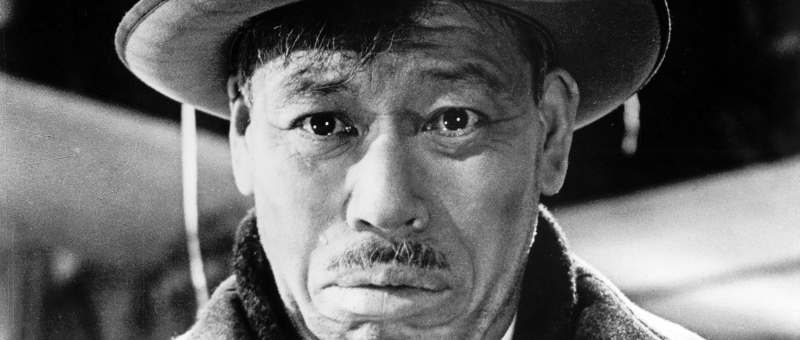
But of course the bureaucratic wheel keeps turning, another dangerous sewage problem diverted to another department continuing the literal pollution of the capitalistic post-war society. A kind of ghost story, Kurosawa lights Shimura from below, shadows cast across his gaunt face even by his “rakish” new hat while his huge eyes have a somehow haunted, grotesque quality filled with hungry desperation. Yet it’s to childhood that Watanabe eventually returns, “perfectly happy” sitting on a swing singing a song from his youth about the price age while surrounded by snow and at last painfully, absurdly alive. 


Ikiru screens at the BFI Southbank, London on 4th & 15th February 2023 as part of the Kurosawa season.

Original trailer (English subtitles)

The Hidden Fortress (隠し砦の三悪人, Akira Kurosawa, 1958)

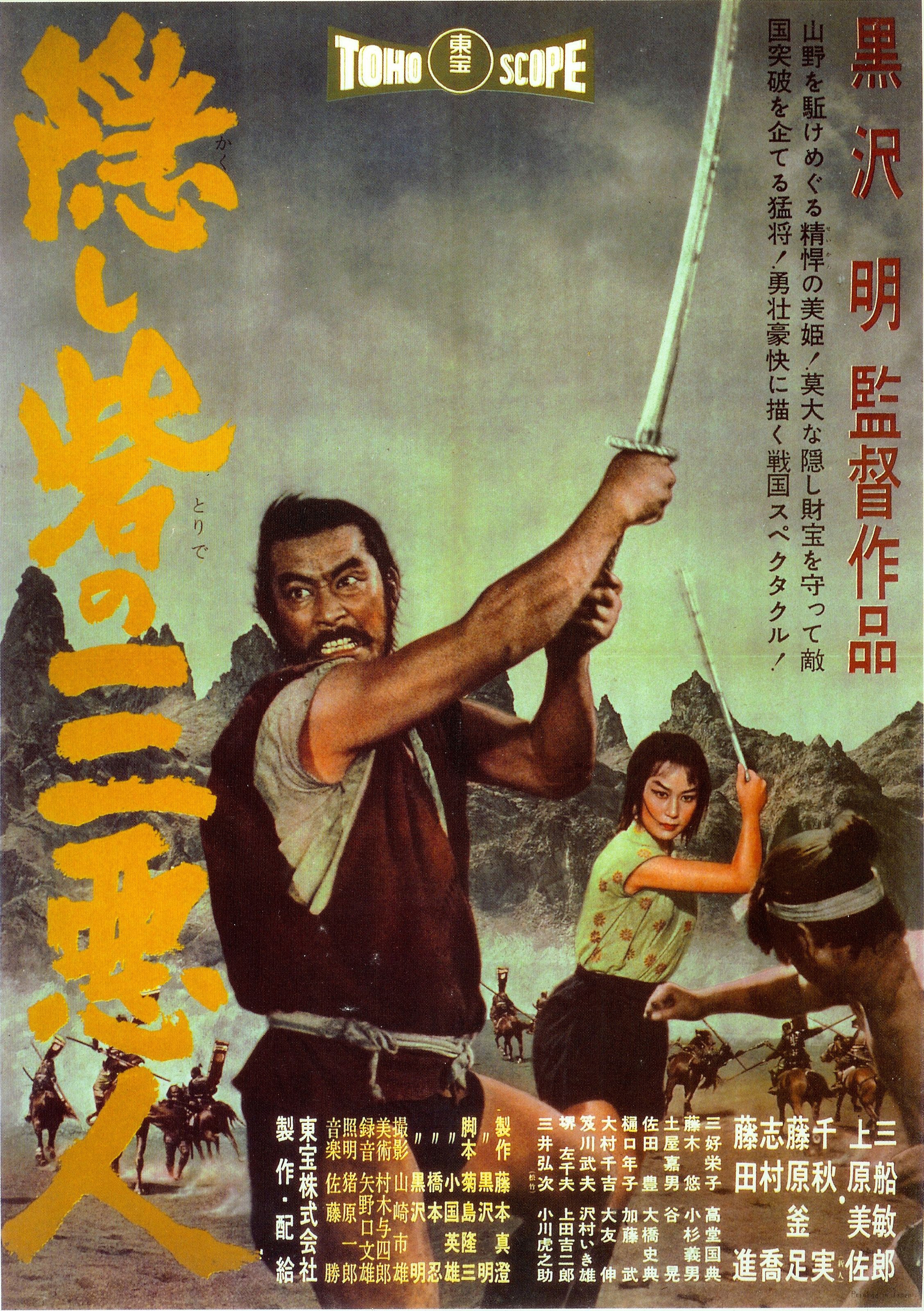
“Your kindness will harm you” a well-meaning retainer advises his charge, but in the end it is her kindness which saves her along with numerous others in Akira Kurosawa’s Sengoku-era epic, The Hidden Fortress (隠し砦の三悪人, Kakushi Toride no San Akunin). Largely told from the point of view of two bumbling peasants trying to get rich quick by exploiting the hierarchal fluidity of a time of war, the film nevertheless cuts against the grain of the democratic era in advocating not so much the destruction of the class-bound feudal order as benevolent authority. 

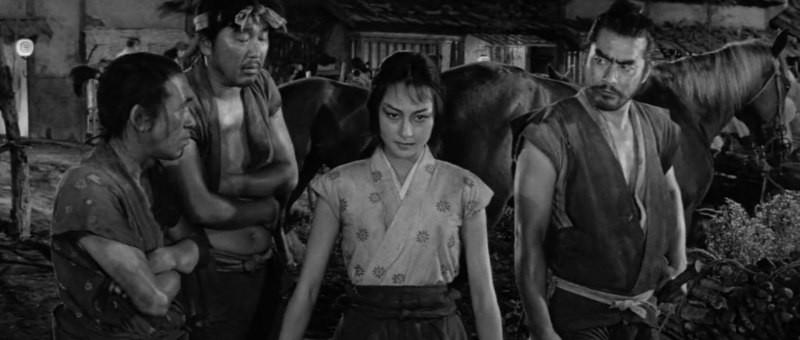
This can quite clearly be seen in the dynamic figure of displaced princess Yuki (Misa Uehara), the successor of her routed clan protected by a hidden fortress in the mountains which she must eventually leave. Her female servant laments that her father raised her as a boy which has given her a haughty and dominant manner at odds with the polite submissiveness usually expected of upperclass women. While often exerting her authority, she is otherwise uncomfortable with the uncritical servitude of her retainers, chief among them the talented general Makabe (Toshiro Mifune) who sacrificed the life of his own sister, allowing her to be executed in Yuki’s place buying them some time. “Kofuyu was 16. I am 16. What difference is there in our souls?” she asks, yet even if she believes their souls are equal she is not quite so egalitarian as to forget her position or the power and privilege that comes with it. 

Nevertheless, hers is an authority that is tempered by compassion and in the end chosen. Her salvation comes in speaking her mind to an enemy retainer, Tadokoro (Susumu Fujita), who has been savagely beaten by his own lord for losing a duel with Makabe who, to the mind of some, humiliated him with kindness in refusing to take his life leaving him to live in defeat. Yuki says she doesn’t know who is stupider, Tadokoro or his lord, for never would she punish a man in such a way simply for losing to an enemy. She tells him that there is another way, and that he need not serve a lord who does not serve him leading Tadokoro to defect and choose to follow her instead. 

She also inspires confidence in a young woman she insists on redeeming after discovering that she is a former member of the Akizuka clan sold into sexual slavery after being taken prisoner by the Yamane. Kurosawa presents the girl with a dilemma on realising that the mysterious woman who saved her is the fugitive princess, knowing that she could betray her and pocket the gold, but finds her resolving to serve Yuki all the more. In a moment of irony, we learn that the girl was bought for five silver coins, the same amount of money a wealthy traveller offers for Makabe’s horse, but displeases her master in refusing to speak or serve customers. For Yuki he offers gold, though withdraws on being told that she is mute. Knowing that she would be unable to disguise her speech or accent which would instantly give her away as a haughty princess, Makabe convinces her to stay silent though as she tells him he cannot make her heart mute too. 

Even the peasants, oblivious to her true identity, view Yuki as part of the spoils insisting that they should be entitled to a third of her too and at one point preparing to rape her only to be fought off by the rescued girl. “We can rely on their greed” Makabe had said, knowing that their material desires make them easy to manipulate and that their loyalties are otherwise fickle. Matashichi (Kamatari Fujiwara) and his friend Tahei (Minoru Chiaki) sold their houses in their village to buy armour in the hope of achieving social mobility through distinguishing themselves in war, but have largely been humiliated, robbed of their armour, mistaken for captured members of the enemy, and forced to dig the graves of others. They pledge eternal friendship but their bond is continually disrupted by the promise of monetary gain. They fall out over a moral quandary, one willing to plunder the body of a fallen soldier and the other not, while even on reuniting squabbling about how to divide the money first deciding it should be equal and immediately disagreeing as soon as they get their hands on it. At the film’s conclusion it rests on Yuki to play mother, telling them that they must be good and share the boon she’s given them equally without complaint each then too only quick to be generous insisting that the other can keep it. 

The implication is still, however, that Matashichi and Tahei should return to their village to live as peasants while Yuki assumes her place in a castle no longer hidden as its ruler. Order has returned and the old system remains in place, all that changes is that this is now a compassionate autocracy ruled by a benevolent lord who views her subjects lives as equal to her own yet not perhaps their status. Where it might prompt Tadokoro to conclude that he need serve no lord at all for there should be no leaders only equals, the film concludes that a leader should be just and if they are not they should not be followed. Then again, the disagreement between firm friends Matashichi and Tahei is ended when they each have enough and no longer find themselves fighting for a bigger slice of the pie content in the validation of their equality. As Makabe puts it, heavy is the head that wears the crown. Yuki’s suffering is in the responsibility of rebuilding her clan though she does so with compassion and empathy ruling with respect rather than fear or austerity. Kurosawa utilises the novel scope format to hint at the wide open vistas that extend ahead of the peasants as they make their way towards the castle in search of gold only to leave with something that while more valuable may also shine so brightly as to blind them to the inherent inequalities of the feudal order. 


The Hidden Fortress screens at the BFI Southbank, London on 20th & 27th January 2023 as part of the Kurosawa season.

Devotion to Railway (大いなる驀進, Hideo Sekigawa, 1960)

In the early 1960s, Japan’s rail network might have felt a little uneasy with the Shinkansen already on the horizon. Hideo Sekigawa’s Devotion to Railway (大いなる驀進, Oinaru Bakushin) is in part a celebration of this essential service, the conductor and steward ever fond of reminding us that most passengers probably don’t realise that the Sakura sleeper service on which they are travelling from Tokyo all the way to Nagasaki is operated by only seven or eight people (though they don’t seem to be counting the staff from the dining car which hints at a minor source of division among the crew). While the Japanese title which means something more like “the great dash” might hint at a little more excitement, the film is less thriller than gentle ensemble drama in which the passengers and crew must come together to solve the improbable number of crises arising on this otherwise ordinary journey. 

Even so considering the film is directed by the left-leaning Sekigawa best known for his anti-war films such as Hiroshima and Listen to the Voices of the Sea, not to mention scripted by Kaneto Shindo, it is a little ironic that the central thrust of the drama revolves around junior steward Yajima’s (Katsuo Nakamura) rediscovery of his own devotion to the railway after at the beginning of the film declaring this will be his final journey. Mimicking the dilemma at the centre of Yoshitaro Nomura’s Stakeout, Yajima’s problem is that he has been engaged for two years and is sick of waiting to get married but his girlfriend Kimie (Yoshiko Sakuma) is the main breadwinner in her family and though his salary could support them as a couple it won’t stretch much further. Kimie, however, is dead against him taking the counter-productive decision to quit the railways even with the suggestion of going into business with a friend who owns a cafe, partly because it’s better to stick with a steady job than take a chance on something less certain, and partly because she knows he likes his work and all his experience will be wasted if he suddenly opts to switch careers. 

Despite its positive warmhearted message of people pulling together to overcome crisis, the film does skew a little conservative in essentially turning Kimie into a minor villain as if she were in a sense responsible for making Yajima doubt his devotion to the railway. After jumping aboard to make sure he doesn’t suddenly quit before the end of the line, she eventually has a heart to heart with the sympathetic conductor Matsuzaki (Rentaro Mikuni) that forces to her to admit that perhaps she’s just nervous about the nature of married life and has been making trouble where there needn’t be any, now certain that it’s better to just get married as soon as possible and let the rest figure itself out. 

Meanwhile, there’s additional tension seeing as a waitress from the diner car has an obvious crush on Yajima and is quite resentful on being presented with his fiancée, but even this is eventually solved with the two women becoming accidental friends during the climatic crisis, a landslide caused by a typhoon, that grants each of the passengers an epiphany about what it is they really want out of life. While waiting for the maintenance crew from the next station to arrive, Yajima, still in a bad mood, stands around doing not much of anything until coaxed into action by Kimie and Matsuzaki, Kimie too eventually jumping off the train to solve this literal roadblock in their relationship followed by the dining car girls and a young woman only on the train to transport blood to a hospital needed urgently by 2pm the next day. This sense of collective endeavour opening the way gives everyone on board a new sense of positivity, allowing Kimie and Yajima to repair their relationship and a man who tried to take his own life in the night to gain a new sense of hope for future. 

Several times Yajima is reminded that he has the lives of the passengers in his hands which is undoubtedly true given that there is always the chance of disaster yet also perhaps going a little far seeing as most of his job is checking tickets and providing travel information. Nevertheless, there is a lot going on on this train from eloping couples to yakuza assassins, not to mention the twin sights of a newly wed couple and a pompous politician momentarily disembarking at each stop to be feted either by workers at their factory or the local members of their political party. The snooty politician even gets a minor comeuppance from a famous pickpocket who steals his watch as a joke and then gives it back only to dismissively ignore his thank you message while eating a giant apple. 

Surprisingly handsome for a Toei programmer, Sekigawa’s deft direction lends a claustrophobic sense of dread to the interior of the train stalked by a vengeful assassin, while simultaneously making it an essentially safe space guarded by the ever solicitous crew keen to help an anxious young woman with a long journey ahead of her arrive on time to get home to her chronically ill mother. An effective piece of advertising for the Sakura sleeper service (which ran until 2005 albeit in slightly different forms), Devotion to Railway may surprise in its insistence that the hero rededicate himself to his employer but is nevertheless a charming ensemble drama which finds a new sense of positivity in the solidarity between friends and strangers coming together to overcome crisis through common endeavour. 


Original trailer (no subtitles)

Seven Samurai (七人の侍, Akira Kurosawa, 1954)

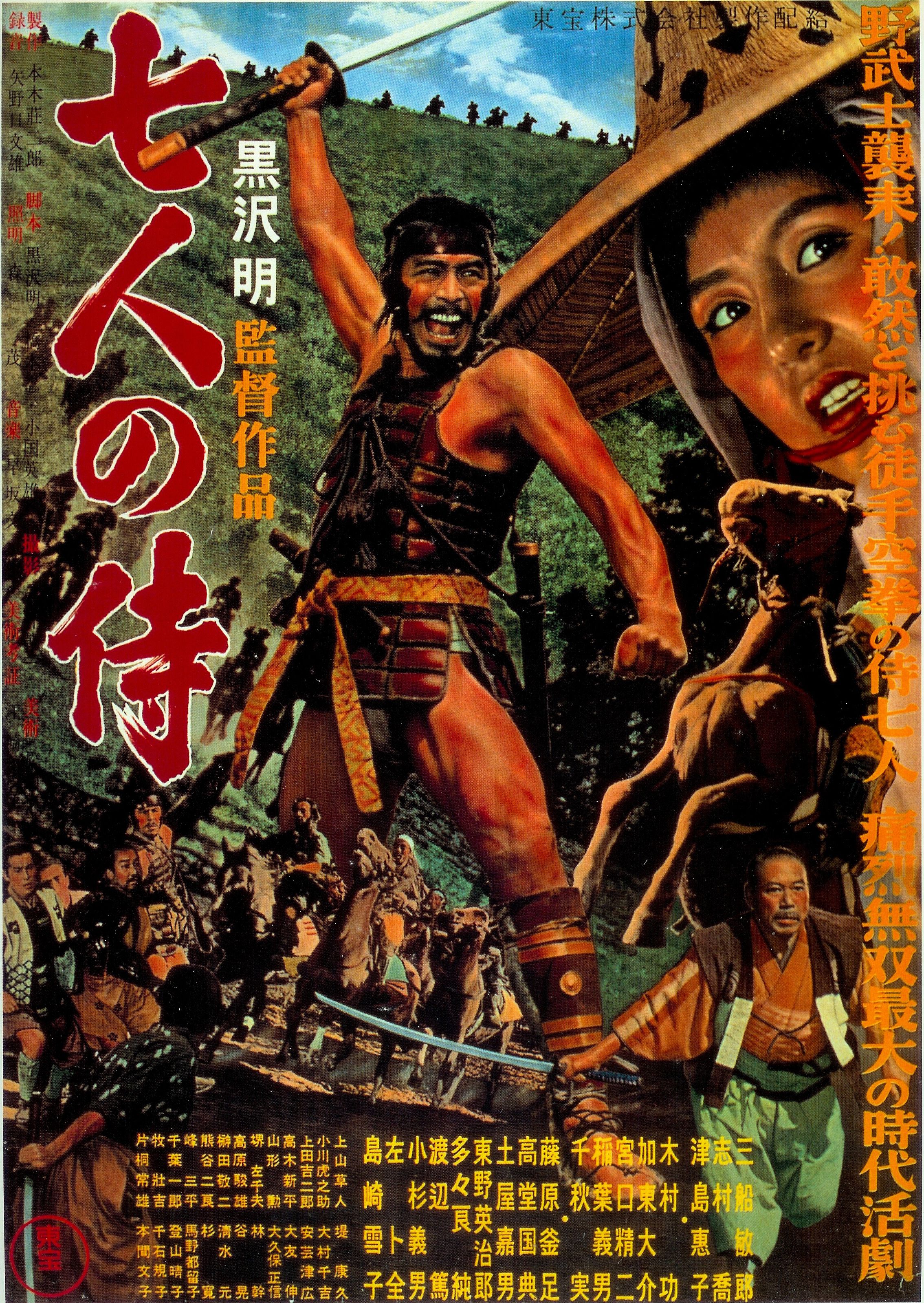
An eclipse of the accepted order allows a temporary truce in the ongoing class conflict that defines feudal society in Akira Kurosawa’s seminal post-war historical epic, Seven Samurai (七人の侍, Shichinin no Samurai). Set in the late 16th century, the action takes place in a world on the brink of collapse. The Sengoku era is drawing to a close but is also in a moment of intense crisis which has left large numbers of highly skilled warriors essentially orphaned, wandering the land torn between their basic needs for food and shelter and their dignity as members of a theoretic aristocracy. 

Plagued by bandits, many of whom may be these orphaned swordsmen, a small village contemplates the unthinkable in hiring samurai, otherwise their oppressors and uniquely responsible for the chaos which surrounds them, for protection. “Land tax, forced labour, drought…and now bandits!” one woman exclaims shortly before suggesting they simply surrender all their grain and then hang themselves. As they can offer only expenses in the form of rice, the only samurai they can hope to recruit are already desperate, so hungry that they may be willing to deign to defending their social inferiors with whom they would not usually mix unwilling to accept that they are both victims of the inherently corrupt social order. This explains why the villagers’ early entreaties are met with such scorn and cynicism, either rudely rejected out of hand or ending only in deception. 

In this there is an echo of the world of 1954 which was beginning edge away from the chaos and privation of the immediate post-war society, bandits standing in for thieves and profiteers themselves a product of intense food insecurity. Yet here it’s desperation that allows a temporary merging of the world of lord and peasant, brokered finally by unexpected compassion on the part of a noble samurai who, in an act of extreme transgression, symbolically erases his elite status by shaving his head in order to save a child taken as a hostage by another desperate man. Kambei (Takashi Shimura) may be somewhat reduced in circumstances but refuses to give in to the immorality of the world around him, finally agreeing to help the villagers essentially out of a sense of pity willing to accept only the gift of sustenance moved by the villagers’ sacrifice in discovering that they give him the last of their white rice while subsisting only on millet. 

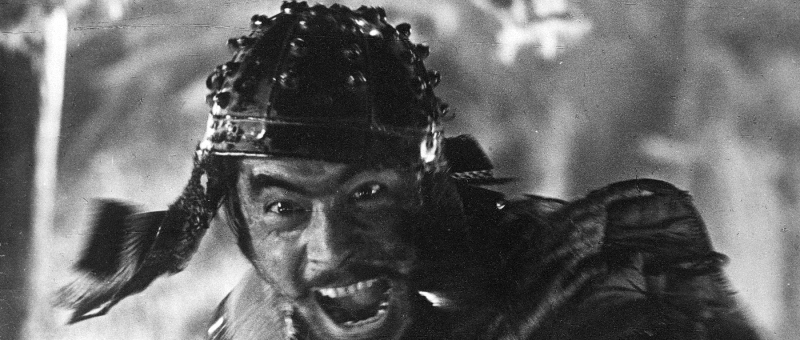
Yet having taken this step, the villagers remain uncertain they can really trust the men they’ve hired to protect them who are after all each trained in death. Later we discover that they have, like many of the time, occasionally finished off the odd lone samurai fleeing the battlefield in order to loot the bodies as a large stockpile of samurai armour later discovered by the samurai-pretender Kikuchiyo (Toshiro Mifune) testifies. On being confronted with this uncomfortable reality, the samurai fall silent knowing this armour was stripped from men much like themselves, but can ultimately offer little by way of defence when presented with an angry rant from Kikuchiyo who points out that they are themselves responsible in having created this world of chaos through their internecine quests for power. “In war you burn their villages, trample their fields, steal their food, work them like slaves, rape their women, and kill ‘em if they resist. What to you expect ‘em to do?”

When Kambei and the others first arrive in the village, there is no welcoming committee. The villagers all hide, frightened to leave their homes partly because of paranoia spread by widowed father Manzo (Kamatari Fujiwara) convinced that randy samurai are going ravish all of their daughters who will, doubtless, be overcome with awe by these sophisticated men of the elite. In an echo of Kambei’s transgression, Manzo forces something similar on his teenage daughter Shino (Keiko Tsushima), roughly cutting her hair while she cries and resists before dressing her up as a boy so that she’ll be safe from lusty samurai. The plan, however, backfires in that she later engages in a doomed romance with the young Katsuhiro (Isao Kimura). Their eventual union is the symbolic merging of the two worlds, a moment of eclipse in the usual hierarchy, but it’s born of the same impulses than brought Kambei and the others to the village. In fear and desperation, they behave as if there’s no tomorrow, only tomorrow must come and just as sun and moon must eventually move apart and resume their regular orbits so the relationship between Katsuhiro and Shino is an impossibility. 

Like Kambei, Katsuhiro had occupied a slightly liminal position because of his relative youth, neither boy nor man. He first encounters Shino while marvelling at the natural beauty of the forest, only to berate her for doing the same. “Is this any time for an able-bodied man to be picking flowers?”, he ironically asks her, yet he is repeatedly forced back towards conventional masculinity as marker of adulthood virtually ignoring her when tasked with carrying a dummy to the ridge, while she later returns the same gesture reassuming her femininity in joining the rice planting, a peasant woman once again. “What’s wrong with two people in love?” the wounded Rikichi (Yoshio Tsuchiya) asks Manzo, trying to smooth over this moment of cross-class crisis, only for Monzo to ask what he’s supposed to now his only daughter has become “damaged goods”, unfit for marriage in a fiercely patriarchal society in which it is impossible to survive without a husband. 

Katsuhiro cannot marry her, this sense of solidarity if not quite equality can be only temporary. Kambei himself admits as much as he reflects that the battle has been won but the victory belongs not to them but to the peasants, anticipating his a sense his own obsolescence the end of the Sengoku era bringing about a change in the nature of the samurai that two centuries later will lead to its abolition. Our sympathies might shift, witnessing Kambei’s obvious disapproval of the peasants’ relish in taking revenge on the bandits who have caused them so much misery in their own way perhaps perpetuating the cycle of violence and resentment that drives the feudal engine. One cannot help but pity him, displaced once again returning to a life of ceaseless wandering, his presence in the village now no longer necessary and in fact inappropriate. 

Returning to the world of 1954, there might be something a little uncomfortable in this lament for the death of the samurai who can have no place either in the modern society or in a peasant village in 1587, as there may be in the implication that the peasants are savage and vindictive while Kambei alone is good and kind even if the roots of his compassion lie in his willingness to literally sever himself from his elite status. The roles had in a sense been reversed, the samurai hired hands to peasant bosses, but the inversion can be only temporary. In insisting that only by protecting others can one hope to protect oneself, Kambei may be advocating for a more compassionate society but as much as he has attempted to remove himself from the class system he can not in the end overcome it. Nevertheless, in the gruelling battle scene that closes the film, all rain, mud, death and misery, Kurosawa himself deals the final blow to the samurai in the nihilistic futility of violence manifesting itself once again in the lingering feudalism of the mid-century society. 


Seven Samurai is re-released in UK cinemas in its recent 4K restoration as part of BFI Japan on 29th October.

BFI re-release trailer (English subtitles)

Warm Current (暖流, Yasuzo Masumura, 1957)

Never one to tread the beaten path, Yasuzo Masumura studied film abroad in Italy before, perhaps counter intuitively, entering the Japanese studio system apprenticing at Daiei where he’d remain until its bankruptcy in the early ‘70s forced him into freelancing. His 1957 debut Kisses was a response to the taiyozoku or sun tribe craze of nihilistic youth movies though it was in its own way quietly hopeful and even sweet, at least in contrast to some the more cynical views of romance which colour some of the director’s later work, but again despite being positioned as precursor to the New Wave is also very much in the classical tradition if owing something to contemporary European art house. Masumura’s second film Blue Sky Maiden continued in the same vein, an ostensibly cheerful take on Sirkian melodrama in which the plucky heroine finds self-actualisation while dealing with her difficult family history. Warm Current (暖流, Danryu), meanwhile, builds on the same Sirkian foundations, remaking a popular weepy which had proved a big hit for Kozaburo Yoshimura 20 years earlier, but further undercutting it with a sense of ironic inconsequentiality as the heroes engage in a background battle for the post-war future. 

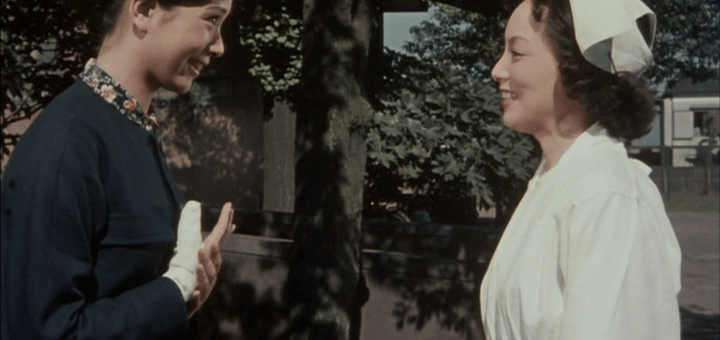
The film opens with a suicide, a nurse discovered dead on a bench after apparently having poisoned herself. She is, however, not the focus of the story and all too quickly forgotten in favour of the return of Keiko (Hitomi Nozoe), the daughter of the hospital’s director who has until recently been studying abroad. She’s come to the hospital because she has a piece of a sewing needle somehow embedded in her finger which needs rather more treatment than one might expect. Anyway, while there she attracts the attentions of handsome doctor Sasajima (Ryuji Shinagawa) and meets up with old schoolfriend Gin (Sachiko Hidari) who has since become a nurse. The problem is that the hospital is in big financial trouble and Keiko’s father Shima (Toranosuke Ogawa) is secretly terminally ill with cancer. He brings in Hibiki (Jun Negami), a pharmaceuticals executive he’s been supporting as a favour to his late father, as a consultant to streamline the business, while sidelining his rather feckless son Yasuhiko (Eiji Funakoshi), an orthopaedics doctor who might be assumed to take over were he not so entirely useless. 

Introduced rather late, Hibiki is positioned almost as a villain, a destabilising force within this very bourgeois world of the hospital determined to strip it of the corrupt entitlement of the surgical class. To that extent, he comes in like a new broom to apply modern business thinking to the ancient art of medicine but does so with rather old-fashioned ideas of gratitude and loyalty to Shima, always acting in the best interests of the family while positioning himself as a servant retainer. This the minor conflict that defines his complicated relationship with the equally confused Keiko who too has returned from abroad with taste for Western individualism but is uncertain how to live her life as a woman in still conservative Japan. All her friends ask her about blue-eyed boyfriends, and though it seems that she is immediately smitten with Hibiki she quite rudely dismisses him for his slightly condescending manner later remarking that she was turned off by a sense of his overconfidence. 

Keiko tells her father she’s no plans to marry and has come back to Japan intending to continue her studies. For his part, Shima is all for a woman working but not as he puts it if it causes her to become a “brainy spinster”. Eventually courted by Sasajima she finds herself torn, even as he tells her that, unexpectedly, he has no issue with her desire to work or study were she to become his wife, uncertain in her attraction to Hibiki while drawn back towards conservatism in knowing that her father favours marriage and that Sasajima is her class-appropriate match. Despite his own attraction to her, Hibiki says nothing even on hearing of her engagement precisely because of this increasingly outdated sense of social inferiority. Meanwhile, he remains seemingly oblivious to the fact that Gin, who like him is a war orphan, has fallen in love with him which is why she continues to help him as a “spy” within the hospital. 

In response to her war trauma, Gin has developed the habit of laughing loudly, an especially unusual trait in a generally reserved culture, and often remarks on her own “stupidity”, the childlike excitability which so clearly positions her as a mirror to the elegant Keiko. Yet the push and pull between the two women has little rancour in it, save that Gin is already aware that Sasajima was responsible for the suicide of the nurse on the rooftop but has chosen not to say anything hoping they’ll marry and Hibiki will be hers. As Keiko later discovers, Sasajima is fairly brazen in his “modernity”, having lived with an aspiring model who declines to marry him because it would adversely affect her career but has no problem with him marrying someone else confident that their physical relationship will continue. Sasajima turns up while Keiko is visiting her, but calmly sits down on the bed and explains that he essentially plans to have two wives, the model for the bedroom and Keiko to be his companion of the mind. He brands her vulgar and small-minded in her conservatism when she proves unconvinced, laying bare an essential misogyny when he echoes that brainy women are “boring”, which is why he “needs” the model to satisfy himself sexually. Nevertheless, Keiko is not that kind of “modern” and in any case not so in love with Sasajima nor deluded enough to think she needs him to agree to his arrangement. 

Gin meanwhile echoes something of the model’s passive resignation when she too declares that she doesn’t care if Keiko marries Hibiki because she’s certain he’s supposed to be with her in the end because they are “alike”. There is no class conflict between them, and as they are both war orphans they share a sense of displacement in the post-war society. Unlike Keiko Gin is open in her feelings, declaring her love for Hibiki even chasing after him at the station and calling out across the ticket barriers that she’ll wait forever even if she only becomes his mistress. Earlier on, Keiko had been reading a foreign romance about a woman courted by two men she was unable to choose between only making up her mind when one of the men’s accent slipped, but in essence it’s Hibiki who finds himself torn if earnestly, thinking himself in love with Keiko but prevented from pursuing her because of his class anxiety rather than attracted to her precisely because of her class standing and everything it represents which is in a sense the target of his “revolutionary” reforms at the hospital. Tempted, he is eventually pulled back towards the side of “passion”, won over by Gin’s slightly scary if unwavering love for him. 

Yet this is no grand weepy, just the romantic confusion of three young(ish) friends who eventually find direction in their lives as mediated through “love”. Keiko reassumes her stance as a thoroughly modern woman, explaining to her rather naive mother that Yasuhiko, who has wrested control of the estate away from Hibiki, is not capable of looking after them even if he had the desire and so she intends to work, apologising to her father for her intention to become a “brainy spinster” after all. Hibiki loses out in the hospital too which is quickly retaken by the same corrupt forces Shima brought him in to combat. “I understand a woman’s feelings” Hibiki somewhat patronisingly claims as a result of his experiences, immediately proving that he doesn’t in misreading Keiko’s intentions while she, ironically, claims that she is no longer afraid of being overwhelmed by male authority. Unable to change their respective futures, the only option that remains is to abandon them for new ones of their own making but this is far from a tragedy, merely the ironic fate of the post-war generation remaking itself in real time, letting the door close behind them as they walk away from the irredeemably corrupt. 


Original trailer (no subtitles)

Sasuke and His Comedians (真田風雲録, Tai Kato, 1963)

Criminally unknown in the Anglophone world, where Tai Kato is remembered at all it’s for his contribution to Toei’s ninkyo eiga series though his best known piece is likely to be post-war take on High Noon made at Shochiku, By a Man’s Face Shall You Know Him in which a jaded doctor finds himself caught in the middle of rising tensions between local Japanese gangsters and Zainichi Koreans. Kato’s distinctive visual style shooting from extreme low angles with a preference for long takes, closeups and deep focus already make him an unusual presence in the Toei roster, but there can be few more unusual entries in the studio’s back catalogue than the wilfully anarchic Sasuke and his Comedians (真田風雲録, Sanada Fuunroku), a bizarre mix of musical comedy, historical chanbara, and ninja movie, loosely satirising the present day student movement and the limits revolutionary idealism. 

An opening crawl introduces us to the scene at Sekigahara, a legendary battle of 1600 that brought an end to Japan’s warring states period and ushered in centuries of peace under the Tokugawa. Onscreen text explains that this is the story of the boys of who came of age in such a warlike era, giving way to a small gang of war orphans looting the bodies of fallen soldiers and later teaming up with a 19-year-old former samurai realising that the world as he knew it has come to an end. Soon the gang is introduced to the titular Sasuke who, as he explains, has special powers having been irradiated during a meteor strike as a baby. Recognising him as one of them, the war orphans offer to let Sasuke join their gang, but he declines because he’s convinced they’ll eventually reject him in fear of his awesome capabilities. Flashing forward 15 years, the kids are all grown up and the only girl, Okiri (Misako Watanabe), is still carrying a torch for Sasuke (Kinnosuke Nakamura) who dutifully reappears as the gang find themselves drawn into a revolutionary movement led by Sanada Yukimura (Minoru Chiaki) culminating in the Siege of Osaka in 1614. 

Don’t worry, this is not a history lesson though these are obviously extremely well known historical events the target audience will be well familiar with. A parallel is being drawn with the young people of early ‘60s Japan who too came of age in a warlike era and who are now also engaging in minor revolutionary thought most clearly expressed in the mass protests against the ANPO treaty in 1960 which in a sense failed because the treaty was indeed signed in spite of public opinion. Kato’s Sanada Yukimura is a slightly bumbling figure, first introduced banging his head on a low-hanging beam, wandering the land in search of talented ronin to join up with the Toyotomi rebellion against the already repressive Tokugawa regime. His underling sells this to the gang as they overlook a mile long parade of peasants headed to Osaka Castle as a means of bringing about a different future that they can’t quite define but imply will be less feudal and more egalitarian which is how they’ve caught the attention of so many exploited farmers. 

Of course, we all already know how the Siege of Osaka worked out (not particularly well for anyone other than the Tokugawa) so we know that this version of the 16th century better world did not come to pass the implication being that the 1960s one won’t either. The nobles are playing their own game, the Toyotomi trying to cut deals but ultimately being betrayed, while the gang fight bravely for their ideals naively believing in the possibility of victory. Sasuke, for his part, is a well known ahistorical figure popular in children’s literature and this post-modern adventure is in essence a kids’ serial aimed at a student audience, filled with humorous anachronisms and silliness while Kato actively mimics manga-style storytelling mixed with kabuki-esque effects. Boasting slightly higher production values than your average Toei programmer, location shooting gives way to obvious stage sets and fantastical set pieces of colour and light which are a far cry from the studio’s grittier fare with which Kato was most closely associated. That might be one reason that the studio was reportedly so unhappy with the film that it almost got Kato fired, but nevertheless its strange mix of musical satire and general craziness remain an enduring cult classic even in its ironic defeatism. 


Original trailer (no subtitles)