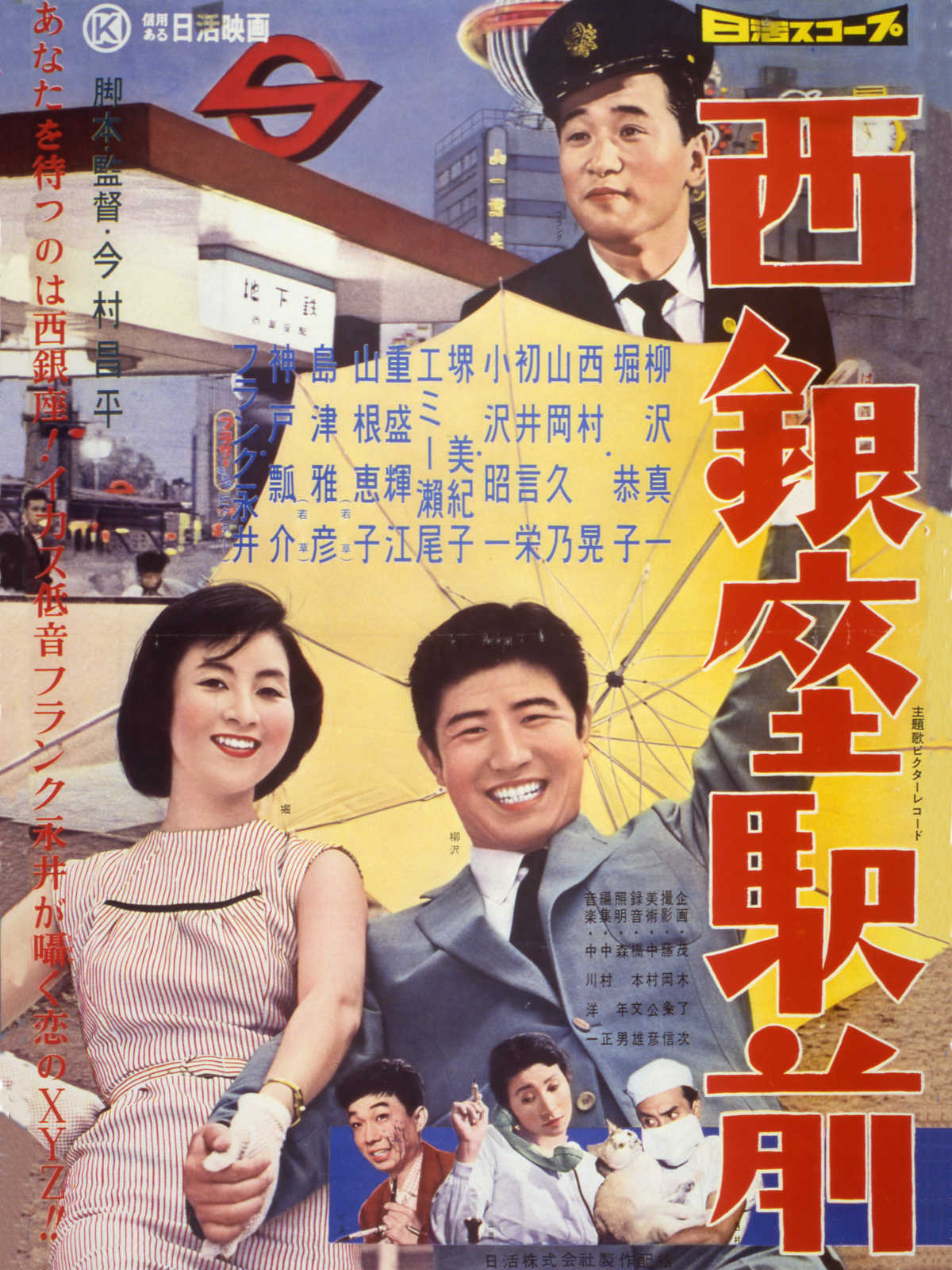
New directors at Nikkatsu were often expected to cut their teeth in the relatively safe realm of B-movie pop star vehicles. Usually running under an hour or so, the films were essentially feature-length advertisements for the artist’s latest song, which therefore had to feature prominently and be heard several times before the credits rolled. As one might expect, this was not a subject that especially interested Shohei Imamura when he was assigned a Frank Nagai movie as his second film, and he did, in fact, try to get out of it by insisting that he had no ear for music. These films were, however, to an extent considered fairly disposable, and as long as they featured the song, the studio didn’t much care what else a director decided to do with them.
That said, the studio was no particularly happy with Imamura’s version as he gives the song pretty short shrift. Much of time, the film the film follows a henpecked husband’s attempts to reassert his masculinity while his domineering wife takes the kids on holiday. Narrated by Nagai who becomes a kind of MC letting us in on this improbable Ginza story, the film both subverts and eventually embraces contemporary notions of gender roles and marital relations. Jutaro (Shinichi Yanagisawa) is a rather mild-mannered man who has been in a sense emasculated in that he technically “works” at his wife’s pharmacy, though apparently doesn’t really do anything there and his role is mainly to sit quietly where his Riko (Hisano Yamaoka) can keep an eye on him. As he lacks a career, Jutaro is not really fulfilling the criteria of contemporary masculinity and has no real identity when a man’s purpose in life is generally subsumed by his occupation. Neither, on the other hand, has he moved into the domestic sphere as he seems almost afraid of his boisterous children who remain his wife’s responsibility.
Irony, what Riko most fears is that Jutaro’s masculinity will reassert itself. A forthright woman, she micromanages most of his life including instructing the pharmacy staff to ensure he takes the medicine she’s prescribed for him and to call her if he refuses. It’s this that amuses Yuriko (Kyoko Hori) who works at the stationery store opposite and has, in fact, been bribed by Riko to spy on Jutaro and make sure he doesn’t stray during her time away. Jutaro’s friend Asada (Kotoe Hatsui), a vet who ironically mostly performs castrations, is also desperate to escape his domestic responsibilities by getting rid of his wife for a few days, only she only agreed to go on holiday if Riko went with her. Unlike Jutaro, Asada rebels against the constraints of marriage and fatherhood in a more general way by frequenting hostess bars behind his wife’s back. Jutaro, meanwhile, has a tendency to retreat into fantasy remembering his wartime youth and his time on tropical island with an idealised indigenous girlfriend for some reason named “Sally”.
The laid-back tropical island may in some respects represent of the antithesis of the high-pressured capitalism of the economic miracle that Riko in a way represents as a savvy, no-nonsense businesswoman, though in other ways, Jutaro’s problem is that he is not actually subject to these pressures because he lives in a kind liminal space engaging in neither the domestic or professional spheres. Nevertheless, it reflects a desire for freedom from the enforced conformity of Japanese society,. Asada, however, sees Jutaro’s fantasising as a dangerous displacement activity, suggesting that his frustrations may eventually provoke some kind of crisis. He tells him that he is emotionally constipated and needs to relieve the pressure by having an extramarital affair.
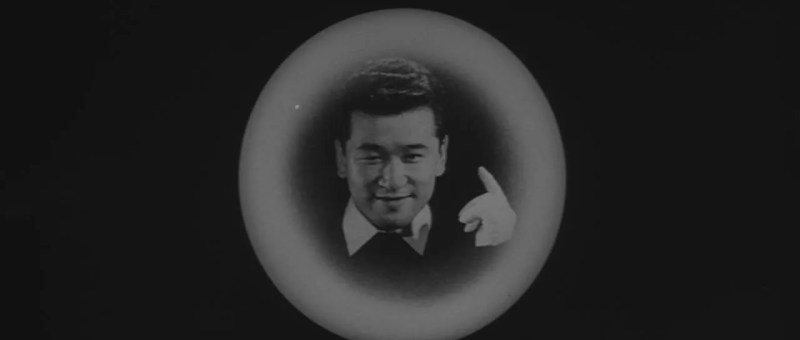
Though diffident, Jutaro eventually agrees and begins pursuing Yuriko but still continues to drift off to memories of the tropical island. In a way, he ends up venturing inside his fantasy after apparently becoming stranded while taking Yuriko on a boat trip and convincing himself he is no longer in Japan but has rediscovered a paradise of masculine freedom. Even so, he experiences a rather rude awakening that shatters his illusions and returns him to his original position as a man without a purpose or sense of identity. Riko maybe touched, reappraising her husband’s affection for his family, but remains in a dominant position. Jutaro can only bid his fantasy goodbye as the shutters of the pharmacy slam down over it. Nagai pops up in random roles throughout, such as a station master, shop owner, and in various other roles around town including the man in the moon and appearing as a mysterious figure carved into a cave, offering ironic comment on Jutaro’s antics and singing his signature song. The vision of Ginza Imamura presents maybe slightly at odds with that of the signature tune, though it does bear out something of the contradictions of Japanese society at a time of rising economic prosperity.

