That Guy and I (あいつと私, Ko Nakahira, 1961)

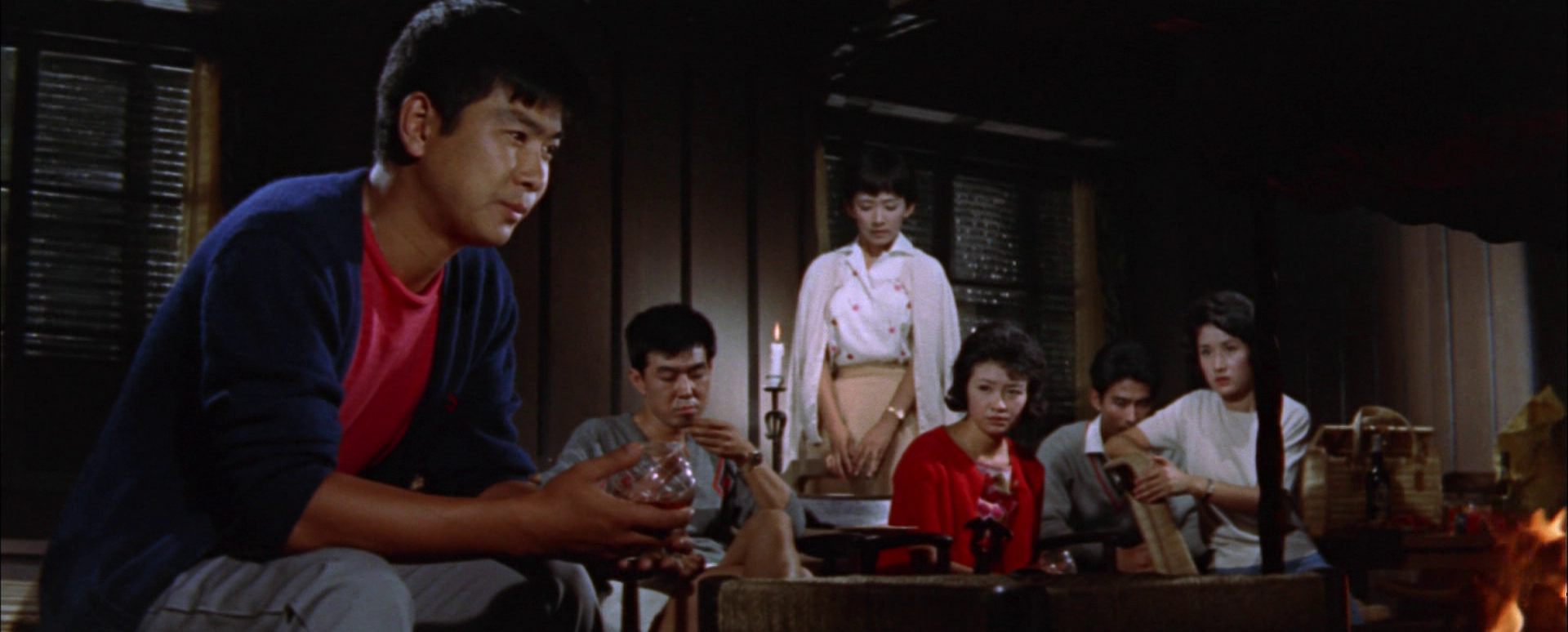
Likely intended as a slightly silly student rom-com, Ko Nakahira’s That Guy and I (あいつと私, Aitsu to Watashi) captures a sense of the changing gender roles and sexual mores of the early 1960s, if through a very male and at times even middle-aged lens. Adapted from a serialised novel by Yojiro Ishizaka and set amid the ANPO protests of 1960, the film is narrated by its heroine, a very ordinary young woman from a typical, moderately wealthy middle-class family, as she struggles with her attraction to a fabulously wealthy young man who pretends to be a boor but is actually a nice guy and unexpected feminist.

One of a new generation of women attending university with a prospect of independence, Keiko’s (Izumi Ashikawa) horizons seem to be broadening. She’s not exactly conservative and openly jokes about sex and dating with her friends, but is quite settled with her life, not particularly wanting anything more than she already has. Her psychology tutor highlights the problem of social inequality in their school that she had already raised in her opening voiceover in remarking that the rich kids all have cars and can drive themselves to school, while others are having to work to support themselves while they study. When he asks how much pocket money they all get, some are outraged and keen to stress they don’t get any help at all, but Keiko reveals that her parents actually give her a healthy allowance. It’s just that she has no real urge to spend it, so it’s been mounting up quietly in a desk drawer in her childhood bedroom while she still lives at home close to the university.

Saburo (Yujiro Ishihara), by contrast, boasts that he gets more than some people’s monthly wage as an allowance from his mother and blows it on drink, gambling, strip clubs and sex workers. It’s this last point that scandalises the female students who are all shocked and disapproving, even going so far as to ask the teacher to throw Saburo out because they don’t feel comfortable sharing a space with a man like that. The teacher also says he’s disappointed and wishes Saburo hadn’t added the last bit, only for Saburo to call him a hypocrite because sex work was legal in his day and he simply doesn’t believe that he’s never paid for sex. Most of the other boys join in on Saburo’s side, insisting that no man sees any problem with visiting sex workers which they regard as a natural right because the male sex drive is driven by “uncontrollable forces”.

But then there’s something unexpected that occurs among the female students in that some of them are obviously attracted by this very rough form of masculinity. “I’d rather have a wild beast than a meek sheep,” one intones, but nevertheless goes to join the group of girls confronting Saburo at the pool in the hope of gaining an apology for the offence he caused them. They’ve since found out that he probably made it up anyway, which is ironic because he claimed he’d only spoken the truth when they asked him to leave, but that’s somehow even worse because it means he said it deliberately to upset them. The upshot of it all is that Saburo ends up in the pool and is then forced to borrow some of the girls’ clothes while his dry off, signalling his awkward positioning between traditional masculinity and femininity in that he’s otherwise surprisingly sympathetic of women and makes sure to look out for them but in a way that encourages their independence and is never patronising. 

That might, in one way, be because of his unusual upbringing which is far more modern and bohemian than Keiko’s and in the beginning, at least, quite confusing for her. Saburo’s mother Motoko (Yukiko Todoroki) is a famous entrepreneur with a beauty shop empire. She writes her name in Western order and uses katakana for her first name which makes look foreign and therefore exciting and sophisticated even though it obviously isn’t. It was Saburo’s mild-mannered father who gave up his career in insurance to raise him, while his mother apparently blows off steam through numerous affairs. His father occasionally gets upset about this and the pair go through a charade of him leaving her while she professes her love for him, which seems to have a sexual dimension in itself. Perhaps this has given Saburo an alternative view of romantic relationships, though we also later discover that he was subject to what we’d now see as a form of sexual abuse as a teenager when his mother got a young but still adult woman, Michiko (Misako Watanabe), to essentially give him practical lessons in sex and satisfy his teenage urges, only he thought it was an organic romantic relationship and feels more than anything else emotionally betrayed. 

But then again, the film has a very of its time and defiantly male view of rape which is dealt with in a fairly flippant manner. Keiko rings her mother to tell her she’s realised that the reason she didn’t like the idea of her being at the ANPO protests was because she feared she’d be raped, which is at any rate an odd conversation to be having. Her mother asks her what her virginity has to do with ANPO, which is a fair question, but also implies that it’s not so much the physical and psychological harm of sexual assault that bothers her mother but the shame of premarital sex. One of the girls who goes to the protest, Ayako (Shigako Shimegi), is actually raped by the two boys she went with who deliberately plied her with alcohol and took her to a hotel knowing that she trusted them, but her roommate, who had a crush on one of the boys, immediately turns against her. Sadako (Kazuko Yoshiyuki), the most political of the students, calls her a slut who parades herself in front of men and says Ayako must have led them on. Only Keiko takes her side, walking her to the bath and waiting outside for her while admitting that she has conflicted thoughts about Saburo. She throws things at him to shoo him away, feeling that his presence as a man is inappropriate and not wanting him to see Ayako in this moment of vulnerability, but also she admits to herself because she’d be jealous and doesn’t want him to see a naked woman that isn’t her.

Something similar happens when she finds out about Saburo’s past and is jealous and resentful of Michiko, irrationally angry with Saburo, and on another level protective of him knowing that happened when he was a teenager was wrong. After she runs out into the rain and the pair argue about it, Saburo forces a kiss on her which, again, Keiko seems like in a show of robust manliness. Saburo is though also protective and sympathetic towards Ayako, insisting that that the way for her to move past her rape is to ensure she becomes financially independent and successful so that she can see it as just something unpleasant that happened to her rather than something that ruined her life or makes her unworthy of another man’s love. He even helps her to do that by getting her a job at his mother’s company. 

Saburo’s mother Motoko, meanwhile, gives Keiko some frank advice in disclosing the secrets of her life and Saburo’s birth. Even when Saburo suddenly announces their engagement without actually asking her, Keiko does not merely swoon but reflects that she’s got to have a proper think before actually agreeing which she is still free to do or not. Nevertheless, the film seems to have hit on a contradiction in redefining masculinity as both tough and soft. Keiko is despite herself attracted to Saburo’s forcefulness, but also his chivalrous nature and awkward kindness, his fair-mindedness and care, and recognition of women as actual human beings with interior lives and a right to independence. Nakahira may be a little less surreal than usual, but leans heavily into absurdity, on the one hand acknowledging the somewhat superficial quality of these privileged students’ lives in having them confront a band of angry rural workers and half-heartedly take part in the ANPO demonstrations without much thought to what they’re for or what they mean, but, in the end, characterises them as merely ordinary, slightly lost amid the rapid changes of the post-war society but otherwise cheerful and looking ahead to a bright future stretching out in front of them.


Trailer (no subtitles)
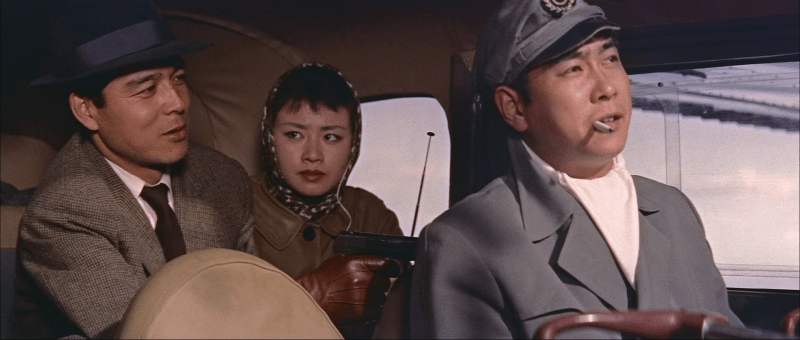
Crimson Wings (紅の翼, Ko Nakahira, 1958)

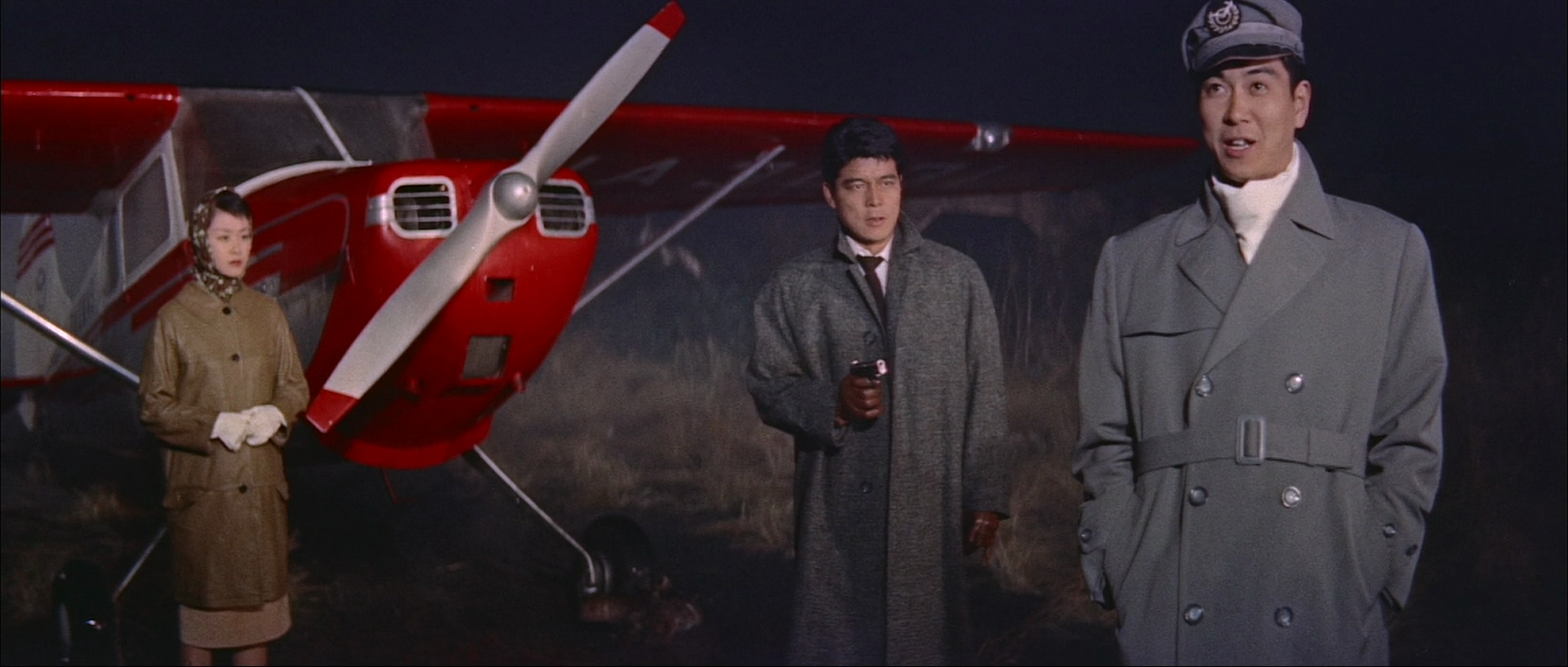
A heroic pilot on a mission to get life-saving medicine to a small boy on a remote island unexpectedly finds himself frustrated by a wanted man in Ko Nakahira’s aviation thriller, Crimson Wings (紅の翼, Kurenai no Tsubasa). This is of course a time in which air travel was still something new and exciting, but not only that, it also offered immense improvements to those living far flung areas making travel to the mainland far easier and much less time-consuming. 

Time is, however, of the essence as a little boy on Hachijojima has contracted tetanus and the only stocks of the antidote on the island are out of date. If they can’t get replacements in the next few hours, it will be too late. Hachijojima is a fairly remote island in the Philippine sea that was used as a base for suicide submarine missions during the war but was developed as a tourist destination in the years afterwards in which it was dubbed “The Hawaii of Japan”. It didn’t quite take off until the 1960s tourism boom, but this is perhaps the reason why there’s an air shuttle service to Tokyo three times a week that is described by the stewardess as their most popular route. It might also explain why part of her job is acting as a tour guide, pointing out important Tokyo landmarks passengers can see from their windows as they come in to land. In any case, it’s the most obvious way to get the serum to the island seeing as there’s a charter flight set to leave in a couple of hours’ time.

But that same day across town, a CEO, Iwami (Toru Abe), is assassinated by a yakuza hitman named Itagaki (Hideaki Nitani). Predictably, he’s the one who’s charted the flight as a speedy getaway and he’s not all that keen on hanging around waiting for the delivery of the tetanus serum. One of the pilots describes Iwami as “take over king” and the “richest tycoon in post-war Japan”, which is to say they don’t have tremendous sympathy for him as someone who’s almost certainly made his money through nefarious means. Itagaki even remarks that he was “one of us,” the only difference between them being that where yakuza use guns he used money though his killing him was a matter of purely business. He didn’t ask or care why Iwami had to die, but obviously thought he was fair game anyway. 

You can tell that Itagaki is not the sympathetic kind of gangster right away when he mows down a little girl while fleeing the scene, her little yellow balloon sadly flying off into the distance. His indifference to the girl’s death is ironic considering the rest of the film revolves around the struggle to save the life of a little boy, directly contrasting his callousness with the righteousness of the pilot, Ishida (Yujiro Ishihara), who is prepared to risk his own life to deliver the serum. Ishida hadn’t previously volunteered for the job because he was supposed to be going on a Christmas Eve date with stewardess Keiko (Shinako Mine), only she tells him she has to cancel because her father is on a surprise trip to town. Unbeknownst to him, however, she’s actually blown him off to go to a Christmas market with another man. In any case, with nothing else to do he accepted the job even though it involves going in a Cessna because of a malfunction on their regular plane that will take too long to repair. 

Aside from having to take Itagaki, who is pretending to be on an emergency trip to visit his mother’s grave, Ishida is also accompanied by pushy journalist Yumie (Sanae Nakahara) who was sent to the airport to interview Keiko as part of a series about “working girls” that she doesn’t seem particularly enthused by. In fact, she’s actually quite rude, elaborating that she’s already interviewed a TV producer and a continuity girl describing them all including stewardess as “glamour jobs” that don’t require very much in the way of brains as journalism obviously does. That might in a way reflect her own resentment in that it’s obvious she feels the paper’s not giving her a fair shake because she’s a woman which might be why she jumps so hard on the tetanus story sensing the potential for a heartwarming human interest article. She does however seem to genuinely care about the little boy on Hachijojima. Not only does she immediately arrange for a large amount of the serum to be delivered by police escort but insists on going to the island herself and after figuring out Itagaki is the fugitive thanks to her transistor radio sticks to the main mission rather than switching to the one about the CEO murder. 

Ishida meanwhile remains a cool-headed wisecracker brazening it out against Itagaki in the knowledge that he can’t actually kill him because he doesn’t know how to fly a plane so all his threats are meaningless. There’s also a rather awkward subplot about Ishida’s brother being a kamikaze pilot during in the war which is intended to further bear out Ishida’s righteousness while his sister (Izumi Ashikawa) also makes a long speech about how he said if he had to he’d like to die like him and is the sort of person who can’t stand by and watch someone suffer. A lengthy sequence switches between various branches of the Japanese government and self-defence forces, as well as the US military, who all swap messages between themsleves and immediately scramble to find this one Cessna when it inevitably gets into trouble and drops off radar. The message seems to be that the system works and the authorities are ready to handle events such as this. Using some impressive aeroplane footage along with a series of split screens and a memorable opening POV shot to disguise the assassin’s identity, Nakahira gives the otherwise lighthearted thriller a little more weight while still allowing its wholesome goodness to shrine through as a collection of determined people come together to save a little boy they don’t even know who lives on a remote island where the children work in soil-pits to make extra money which might as well be a million miles away from the modern capital with greedy fat cat CEO’s and nihilistic yakuza.


Trailer (no subtitles)

The Sands of Kurobe (黒部の太陽, Kei Kumai, 1968)

Kei Kumai’s three-hour epic of human engineering The Sands of Kurobe (黒部の太陽, Kurobe no Taiyo) opens with a titlecard to the effect that the film testifies to the courage of the Japanese people who brought the nation back to life after the war. Partly produced by Kansai Electric Power along with the production agencies of stars Toshiro Mifune and Yujiro Ishihara, the film is therefore somewhat conflicted, part bombastic celebration of Japanese engineering skill and ambivalent critique of the wilful decision to place success above all else including the welfare and safety of ordinary workers.

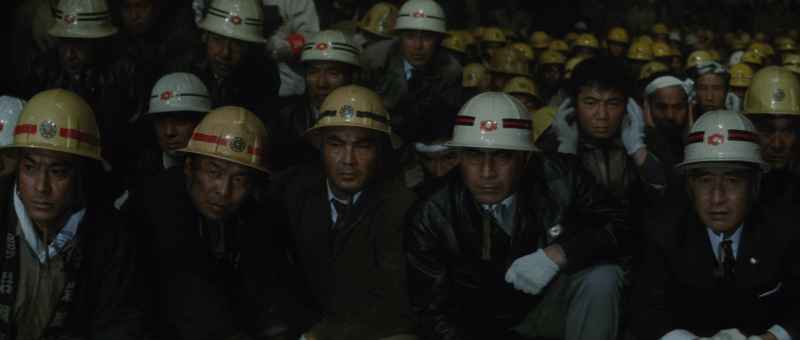
This critique is most evident to the flashbacks to the construction of Kuro 3 in 1938 which as many point out was conducted by the military under brutal and primitive conditions. The construction of the new Kurobe hydroelectric dam, by contrast, is a much more modern, enlightened affair in which workers have proper equipment and are not simply hacking at rocks with pickaxes wearing only a vest. But then as the conflicted Takeshi (Yujiro Ishihara) points out, it’s all effectively the same. Just because no one is pointing a gun at their heads, it doesn’t mean the men actually building the dam aren’t being exploited rather simply pressured by a vague notion of national good that they should be ready to lay down their lives. Could it be that “prosperity” is worse thing to die for than “patriotism”, especially when it appears as if your employer cares little for your physical wealth and economic wellbeing simply pledging that they will support the families of men killed during the dam’s construction. 

That there will be deaths seems inevitable. The man placed in charge of building a tunnel through the mountain, Kitagawa (Toshiro Mifune), is haunted by the vision of a man falling from a cliff that he witnessed when they first hiked to the dam site. He originally described the project as “crazy” and wanted to resign but was convinced to stay on. Kitagawa is himself fond of insisting on safety first where others are minded to cut corners, but also troubled by domestic issues in the film’s sometimes insensitive use of his daughter’s terminal leukaemia as a mirror for the dam project in considering what is and isn’t possible through human endeavour. The suggestion is that Kitagawa wants to believe the miracle of the dam is possible because needs to keep believing in a scientific miracle that can save his daughter, though obviously even if it is ultimately possible to build this dam that’s designed to fuel the post-war rocket to economic prosperity there are limits and unfortunately decades later we have still not found a cure for cancer though treatment may be more effective. 

Takeshi meanwhile has a similar battle with his hard-nosed father whose devotion to the dam project he describes almost like an addiction, suggesting that he values nothing outside of tunnelling and is willing to sacrifice everything in its name including the lives of himself and others. A flashback to to 1938 reveals that he asked his own teenage son to place dynamite and inadvertently caused his death though lax safety procedures which is the understandable reason why his wife eventually left him taking Takeshi with her. But the strange thing is for all his original opposition, Takeshi too is later captivated by the immensity of the challenge if also wary that the workers are falling victim to the same sickness as his father and are still being exploited by those like him who expect them to offer up their lives while paying them a pittance and complaining when the project does not proceed along their schedule. 

The almost nationalistic, bombastic quality of the film seems at odds with some of Kumai’s previous work save the discussion of the building of the 1938 tunnel though this largely serves as a contrast to imply that this time is different because they’re doing it for love of country rather the forced patriotism of the militarist past. Kitagawa justifies himself that if they don’t build the dam, economic prosperity will stall, companies will go bust, and people will lose their jobs but it seems somewhat hollow in the knowledge many men are certain to die while building this dam. Kumai undercuts the bombast with a series of scenes shot like a disaster movie in which supports collapse and the tunnel floods, or men are hit by falling rocks, eventually closing on an ironic Soviet-style statue dedicated to the labour of the workers that seems to question the immense loss of life along with the destruction of the natural beauty of Mount Kurobe but cannot in the end fully reconcile himself, torn between a celebration of human endeavour and its equally human costs. 


Original trailer (no subtitles)

The Eagle and the Hawk (鷲と鷹, Umetsugu Inoue, 1957)

Strapping sailors meditate on revenge and forgiveness while trapped aboard a moribund cargo ship in Umetsugu Inoue’s otherwise charming musical youth drama, The Eagle and the Hawk (鷲と鷹, Washi to Taka). One of several films Inoue released starring muse of the moment Ishihara, the film uses the boat as a kind of metaphor for a reluctance to deal with the unfinished past as several of its crew members are actively engaged in a self-imposed limbo wilfully remaining in a transient space floating between two harbours with no plans to disembark. 

This is most obviously true for the zombified Ken (Kinshiro Matsumoto) who wanders around the boat in a depressive daze unable to get over a girlfriend who left him for another man though as it turns out the bosun too is hiding out at sea waiting for the statue of limitations to run out on the murder of his lover 30 years previously. When two new recruits show up from the sailors union despite only one having been requested, many are under the assumption that they too are running from something on land though the boat itself is a confined environment from which there is no real escape so it’s also an ideal space for confrontation. 

The thing they may be running from is the murder of the boat’s chief engineer in the film’s noirish opening sequence in which a middle-aged man in a sailor’s cap is stalked by a youngster in jeans before being knifed with a ceremonial dagger. If they were running from that particular crime, it might be ironic that they chose this particular boat but then as the murdered man’s son, First Mate Goro (Hiroyuki Nagato), discovers the dagger was part of a set and the other one’s owned by the captain who seems very alarmed by the whole affair. Meanwhile, the captain’s daughter, Akiko (Ruriko Asaoka), has secretly stowed away along with Akemi (Yumeji Tsukioka), the heartbroken former girlfriend of one of the two new guys, Senkichi (Yujiro Ishihara). 

Women are regarded as unlucky on board, and it’s not difficult to guess why with Goro offering strict instructions to the new guys not to try anything with Akiko while one of the other sailors later attempts to rape Akemi with a palpable desperation existing within the crew. There is also a degree of homoerotic tension between the two new guys, the other being Sasaki (Rentaro Mikuni) who typically walks around shirtless in a pair of tight jeans and works hard to give the impression of having a mysterious past all of which leads Senkichi to suspect he’s an undercover cop possibly there after him or one of the other crew members though unbeknownst to (almost) everyone there is another crime in motion on board. 

As usual, it’s the past that’s come calling with Senkichi on the boat ironically running towards rather than away from a confrontation while others desperately try to cover up their crimes or deflect their responsibility for the dodgy dealings of their youth. Both Senkichi and Sasaki immediately remark that the boat’s a “junker” as soon as they get on board, implying that it too is on its way out, its disrepair a sign of its captain’s lack of respect and care for ship and crew alike. Then again, it seems the crew were intent on drinking half the cargo, most of them clearly happy in their work and enjoying a pleasant sense of camaraderie even on this crummy ship and its presumably not quite above board trip to Hong Kong which might hint at why Akemi shows up in cheongsam though for stowaways both women seem to have brought extensive wardrobes which in all honesty are not particularly well suited to life at sea. 

In any case, the boat becomes an unexpected place of healing and forgiveness largely brokered by manly magnanimity as Goro, on learning the truth behind his father’s murder, accepts that the killer’s motivations are “understandable” even while cautioning them against the fallacy of revenge which he insists will only create more hate and violence. He’s also fairly okay with Senkichi romancing his girl, Akiko, who sadly tells him she sees him more like a brother and isn’t interested in marrying him even if that’s what her father also expects neatly reflecting the dynamic which arises between Akemi and the lovelorn Ken who begins to cheer up and consider leaving the boat to open a transistor radio shop only for Akemi to describe him as a little brother while continuing to chase Senkichi despite his interest in Akiko. An expressionistic storm scene provides some divine justice, but also provokes a bittersweet romantic resolution which suggests it’s time to get off the boat and the face the past but with a kind of cheerfulness for the future otherwise at odds with the rage and violence of the original crime. Of course, this being a vehicle for Yujiro Ishihara, Inoue works in a few romantic scenes with his ukulele and a mournful song about the moon and ocean but finally sends him back to dry land a little more “grounded” for having found his sea legs.


Red Handkerchief (赤いハンカチ, Toshio Masuda, 1964)

The moral compromises of the post-war era are brought home to a trio of frustrated lovers in Toshio Masuda’s Nikkatsu “mood action”, Red Handkerchief (赤いハンカチ, Akai Handkerchief). Starring an ageing Yujiro Ishihara perhaps cast slightly against type as an ultra noble policeman choosing self-exile after accidentally shooting dead a key witness, who also happens to be the father of the woman he loved, in order to save his partner, Masuda’s noirish melodrama takes aim squarely at the radiating effects of social inequality and the moral bankruptcy of an increasingly prosperous society. 

Masuda opens, however, with an old-fashioned foot chase as cops Mikami (Yujiro Ishihara) and Ishizuka (Hideaki Nitani) attempt to run down a drug mule carrying a briefcase full of illicit substances. The suspect later gets hit by a truck and killed while the briefcase is nowhere to be found. Concluding the mule must have abandoned it at a ramen stand he ran past on the way, the cops haul in the old man running it, Hiraoka (Shin Morikawa), who seems to know more than he’s letting on but is too terrified of the gangsters to consider giving anything up. In an effort to get him to talk, Mikami pays a visit to his relentlessly cheerful factory worker daughter Reiko (Ruriko Asaoka), becoming instantly smitten with her as she quickly packs a bag of warm clothing and miso soup assuming her dad’s in for a bit of drunk and disorderly. Their romance is however not to be. Apparently feeling himself out of options, Hiraoka opts for suicide by proxy, grabbing Ishizuka’s gun and firing at police. An Olympic sharpshooter, Mikami draws his pistol to save his friend and the old man is killed. Guilty, the pair attempt to apologise to Reiko, but unsurprisingly she is not in the mood to accept it. 

Four years later, Mikami has left the force for a life of wandering doing odd jobs all over Japan while entertaining his co-workers with sad songs about lost love. Yokohama detective Tsuchiya (Nobuo Kaneko) eventually tracks him down in frosty Hokkaido, encouraging him to return with tales of Ishizuka’s wildly improbable success as a supermarket entrepreneur now apparently married to Mikami’s lost love Reiko. Tsuchiya thinks Mikami was set up and that Ishizuka is a dirty cop who’s been living the high life while Mikami has been slumming it in an unnecessary act of atonement for something that wasn’t really his fault. 

Though they were apparently good friends and loyal partners, Ishizuka flags up a potential source of tension early on in his solo interrogation of Hiraoka explaining that unlike Mikami he’s not an educated man and understands how difficult it is to be poor. Tsuchiya later posits this same sense of class conflict as one reason that Ishizuka may have betrayed him, that he felt inferior and that he would not be able to compete with his elite partner. Ishizuka later implies something similar in his dog eat dog view of the world, explaining to a newly conflicted Reiko that life is a matter of winning and losing and that Mikami is the very image of defeat. He views himself as a winner thanks to his burgeoning supermarket empire, taking full advantage of the rising consumerism of the post-war era and willing to do whatever it takes in order to achieve success even if that means crossing a line that Mikami would never cross. Yet he is also like Mikami hobbled by his love for the “beautiful”, “pure” Reiko, allowing his insecure acquisitiveness to turn violent in his determination to keep her or at least keep her from any other man. 

“Money rules everything!” Ishizuka insists, attempting to justify himself for his turn towards selfish individualism willing to sacrifice not only a “worthless” old man but even friendship in the conviction that he is “a man of great value, a winner!” and therefore entitled to move beyond conventional morality while using his ill-gotten gains to support needy orphans. Even he, however, is later undone by love, perhaps the one true form of “justice”, in realising that Reiko has chosen nobility in the form of Mikami and could never accept the man he is or the things he’s done. A romantic melodrama masquerading as a crime thriller, Red Handkerchief finds Masuda in expressionist mode, the pounding machinery at the foundry where Reiko works pulverising Mikami’s noble heart as his romantic dreams are crushed, the highway streetlights dancing across Reiko’s windscreen as she returns in confusion, and in the constant use of weather to indicate the mood, the sky suddenly brightening behind Ishizuka as his confidence returns. Echoing in The Third Man in its melancholy ending, however, even if slightly inverted, Masuda sets his battered hero adrift in the confusions of the post-war era striding into the mist guitar in hand a perpetual wanderer. 


Original trailer (no subtitles)

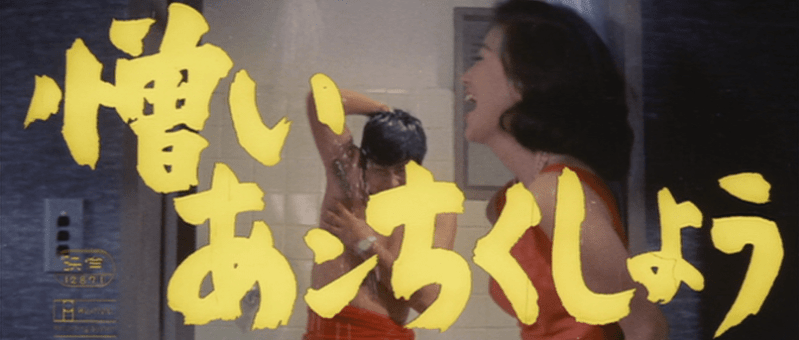
I Hate But Love (憎いあンちくしょう, Koreyoshi Kurahara, 1962)

I hate but love posterDoes “pure love” exist in the Japan of 1962, and if so what does it look like? Yujiro Ishihara, the poster boy for youthful rebellion, might not be the best person to ask but it’s his unfulfilled media superstar that ultimately determines to find out. In I Hate But Love (憎いあンちくしょう, Nikui Anchikusho) Koreyoshi Kurahara puts the jazz clubs and delinquency of The Warped Ones to one side for a Technicolor romp that owes more to Day/Hudson than it perhaps does to James Dean or Marlon Brando. Yet there is something mildly subversive in its low level criticism of Japan’s lurch towards the consumerist future, finding only emptiness in fame and success while the central couple’s deliberately repressed desires push them towards a point of both spiritual and physical exhaustion.

Daisaku (Yujiro Ishihara) and Noriko (Ruriko Asaoka) have been a couple for two years. Noriko is also Daisaku’s manager and has been with him since he was broke and an aspiring poet. Now he’s one of Japan’s top DJs and she looks after his schedule which is packed in the extreme – in fact it leaves him no time for sleeping between his radio show, TV appearances, and meetings in bars, not to mention a late night date starting at 2am! Raiding the local papers for a suitable human interest story they can flag up on the show, Noriko stumbles over the tale of a local woman who is looking for a “driver who understands humanism”. Intrigued, Daisaku and his producer Ichiro (Hiroyuki Nagato) set off to interview her but the woman doesn’t want to be involved with the media – she doesn’t want to sully her love! The fact of the matter is, Yoshiko (Izumi Ashikawa) has kept up a romance with a doctor in a rural town by letter alone and used all her savings to buy a jeep to help transport his patients more effectively. Yoshiko doesn’t need to see Toshio (Asao Koike) – her dashing doctor fiancé, she believes in their love and that’s good enough for her. She just needs someone to actually take the jeep to Kyushu where it is most needed.

Just at this point, Daisaku’s relationship with Noriko reaches a crisis point. Lovers for two years, they each feared the sparks would fade and so to keep them popping they’ve committed to a rule of no physical contact. Spark they do (though not always in a good way), but when trapped in Daisaku’s apartment one rainy afternoon and bored out of their minds they nearly give in – damaging the fragile balance they’ve managed to build through mutual rejection of their equally mutual attraction. Though Noriko remains committed to their plan for long term romance, the non-encounter pushes Daisaku into a profound state of crisis in pondering the nature of his relationship – does “pure love” exist, does he really “love” Noriko, what is the point and the purpose of their central bond of negation? Hoping to find all of that out, Daisaku makes a surprise on air announcement that he himself will drive Yoshiko’s truck to Kyushu and see what her Toshio does with that.   

Yoshiko and Noriko set themselves up as rivals – not for Daisaku’s heart but for the true nature of “love”. “Reclaiming” Daisaku’s Jaguar so she can chase after him, Noriko has a few words for Yoshiko, pointing out that she’s been patiently “building” her love with Daisaku for 737 days. Yoshiko looks at her pityingly – you don’t “build” love, she tells her, you just believe it. For Yoshiko her letters were enough, her love an act of faith, but for Noriko love is a process and an almost scientific endeavour filled with recordable and quantifiable data. Yet everything Noriko says about Daisaku is correct – she knows who he is and truly understands him, every part of him is welcome to her and so she is perfectly placed to find him off on his magic quest even if her desire to bring him back to the city is misplaced.

Daisaku’s journey puts them both through the ringer though their bond is never seriously in question. He runs and she follows, though neither of them can quite escape the net of the society in which they live. Daisaku’s flight is perhaps more from his micromanaged yet extremely comfortable life than it is just of a difficult romance. Taking to the road he wants to feel something, to know that there is something real out there. Unfortunately, even his attempt to embrace something “real” is subverted by his media buddies who secretly film him and air the footage like it’s all been a giant publicity stunt. Fearing that their cash cow is “drunk on humanism”, they ready a contingency plan to bring him back into the fold.

Ichiro tells Noriko that her desire to “tie Daisaku down” is not love but “female egotism”. What drives Noriko isn’t really a desire for control (Daisaku seemingly allows her enough of that), but a need to be needed and fear that Daisaku, now rich and famous, will eventually leave her. Paranoid their love will fail, she rejects its consummation. Yet faith alone is not enough, as Yoshiko painfully finds out on witnessing the disconnect between her imagined love created through her letters and the real flesh and blood man before her to whom she essentially has no real connection. Reaching the end of their journey, Daisaku and Noriko are forced together again, each abandoning some part of their Tokyo lives and personas to break through to something deeper and more essential. Their path takes them straight into a bizarre summer festival complete with giant floats and excited men in traditional Japanese underwear throwing water everywhere. When they finally reach their destination, their love transcends faith to become ritual, their ennui somehow transformed into an ironic celebration of life in fulfilled desire.   

Ichiro categorises Noriko and Daisaku as stingy children – defiantly saving the best for last. There is certainly something immature in their constant bickering and bargaining, the superstition that they can keep their love alive by continually rejecting it and repressing their desire for each other, but there’s also something faintly realistic in the messy grown-up commitment phobia of it all even if it joyfully strays into the absurd. Light and bright and breezy, Kurahara works in the darknesses of early ‘60s Japan from the destructive effects of celebrity and media manipulation to the emptiness of a life of excess but even if he doesn’t quite find “pure love” he does find something close to it in a perfect merger of faith and industry.


Bakumatsu Taiyoden (幕末太陽傳, Yuzo Kawashima, 1957)

bakumatsu taiyoden posterMany things were changing in the Japan of 1957. In terms of cinema, a short lived series of films known as the “Sun Tribe” movement had provoked widespread social panic about rowdy Westernised youth. Inspired by the novels of Shintaro Ishihara (later a right-leaning mayor of Tokyo), the movement proved so provocative that it had to be halted after three films such was the public outcry at the outrageous depictions of privileged young people indulging in promiscuous sex, drugs, alcohol, and above all total apathy – frivolous lives frittered away on self destructive pleasures. The Sun Tribe movies had perhaps gone too far becoming an easy source of parody, though the studio that engineered them, Nikkatsu, largely continued in a similar vein making stories of youth gone wild their stock in trade.

Yuzo Kawashima, a generation older than the Sun Tribe boys and girls, attempts to subvert the moral outrage by reframing the hysteria as a ribald rakugo story set in the last period of intense cultural crisis – the “Bakumatsu” era, which is to say the period between the great black ships which forcibly re-opened Japan to the outside world, and the fall of the Shogunate. The title, Bakumatsu Taiyoden (幕末太陽傳), literally means “legend of the sun (tribe) in the Bakumatsu era”, and, Kawashima seems to suggest, perhaps things now aren’t really so different from 100 years earlier. Kawashima deliberately casts Nikkatsu’s A-list matinee idols – in particular Yujiro Ishihara (the brother of Shintaro and the face of the movement), but also Akira Kobayashi and familiar supporting face Hideaki Nitani, all actors generally featured in contemporary dramas and rarely in kimono. Rather than the rather stately acting style of the period drama, Kawashima allows his youthful cast to act the way they usually would – post-war youth in the closing days of the shogunate.

They are, however, not quite the main draw. Well known comedian and rakugo performer Frankie Sakai anchors the tale as a genial chancer, a dishonest but kindly man whose roguish charm makes him an endearing (if sometimes infuriating) character. After a post-modern opening depicting contemporary Shinagawa – a faded red light district now on its way out following the introduction of anti-prostitution legislation enacted under the American occupation, Kawashima takes us back to the Shinagawa of 1862 when business was, if not exactly booming, at least ticking along.

Nicknamed “The Grifter”, Saiheiji (Frankie Sakai) has picked up a rare watch dropped by a samurai on his way to plot revolution and retired to a geisha house for a night of debauchery he has no intention of actually paying for. Though he keeps assuring the owners that he will pay “later” when other friends turn up with the money, he is eventually revealed to be a con-man and a charlatan but offers to work off his debt by doing odd jobs around the inn. Strangely enough Saiheiji is actually a cheerful little worker and busily gets on with the job, gradually endearing himself to all at the brothel with his ability for scheming which often gets them out of sticky situations ranging from fake ghosts to customers who won’t leave.

Saiheiji eventually gets himself involved with a shady group of samurai led by Shinshaku Takasugi (Yujiro Ishihara) – a real life figure of the Bakumatsu rebellion. Like their Sun Tribe equivalents these young men are angry about “the humiliating American treaty”, but their anger seems to be imbued with purpose albeit a destructive one as they commit to burning down the recently completed “Foreign Quarter” as an act of protest-cum-terrorism. The Bakumatsu rebels are torn over the best path for future – they’ve seen what happened in China, and they fear a weak Japan will soon be torn up and devoured by European empire builders. Some think rapid Westernisation is the answer – fight fire with fire, others think showing the foreigners who’s boss is a better option (or even just expelling them all so everything goes back to “normal”). America, just as in the contemporary world, is the existential threat to the Japanese notion of Japaneseness – these young samurai are opposed to cultural colonisation, but their great grandchildren have perhaps swung the other way, drunk on new freedoms and bopping away to rock n roll wearing denim and drinking Coca Cola. They too resent American imperialism (increasingly as history would prove), but their rebellions lack focus or intent, their anger without purpose or aim.

Kawashima’s opening crawl directly references the anti-prostitution law enacted by the American occupying forces – an imposition of Western notions of “morality” onto “traditional” Japanese culture. In a round about way, the film suggests that all of this youthful rebellion is perhaps provoked by the sexual frustration of young men now that the safe and legal sex trade is no longer available to them – echoing the often used defence of the sex trade that it keeps “decent” women, and society at large, safe. Then again, the sex trade of the Bakumatsu era is as unpleasant as it’s always been even if the familiar enough problems are played for laughs – the warring geisha, the prostitute driven in desperation to double suicide, the young woman about to be sold into prostitution against her will in payment of an irresponsible father’s debt, etc. One geisha has signed engagement promises with almost all her clients – it keeps the punters happy and most of them are meaningless anyway. As she says, deception is her business – whatever the men might say about it, it’s a game they are willingly playing, buying affection and then seeming hurt to realise that affection is necessarily false and conditional on payment of the bill.   

Playing it for laughs is, however, Kawashima’s main aim – asking small questions with a wry smile as Saiheiji goes about his shady schemes with a cleverness that’s more cheeky than malicious. He warns people they shouldn’t trust him, but in the end they always can because despite his shady surface his heart is in the right place. Warned he’ll go to hell if he keeps on lying his way though life, Saiheiji laughs, exclaims to hell with that – he’s his own life to live, and so he gleefully runs away from the Bakumatsu chaos into the unseen future.


Masters of Cinema release trailer (English subtitles)

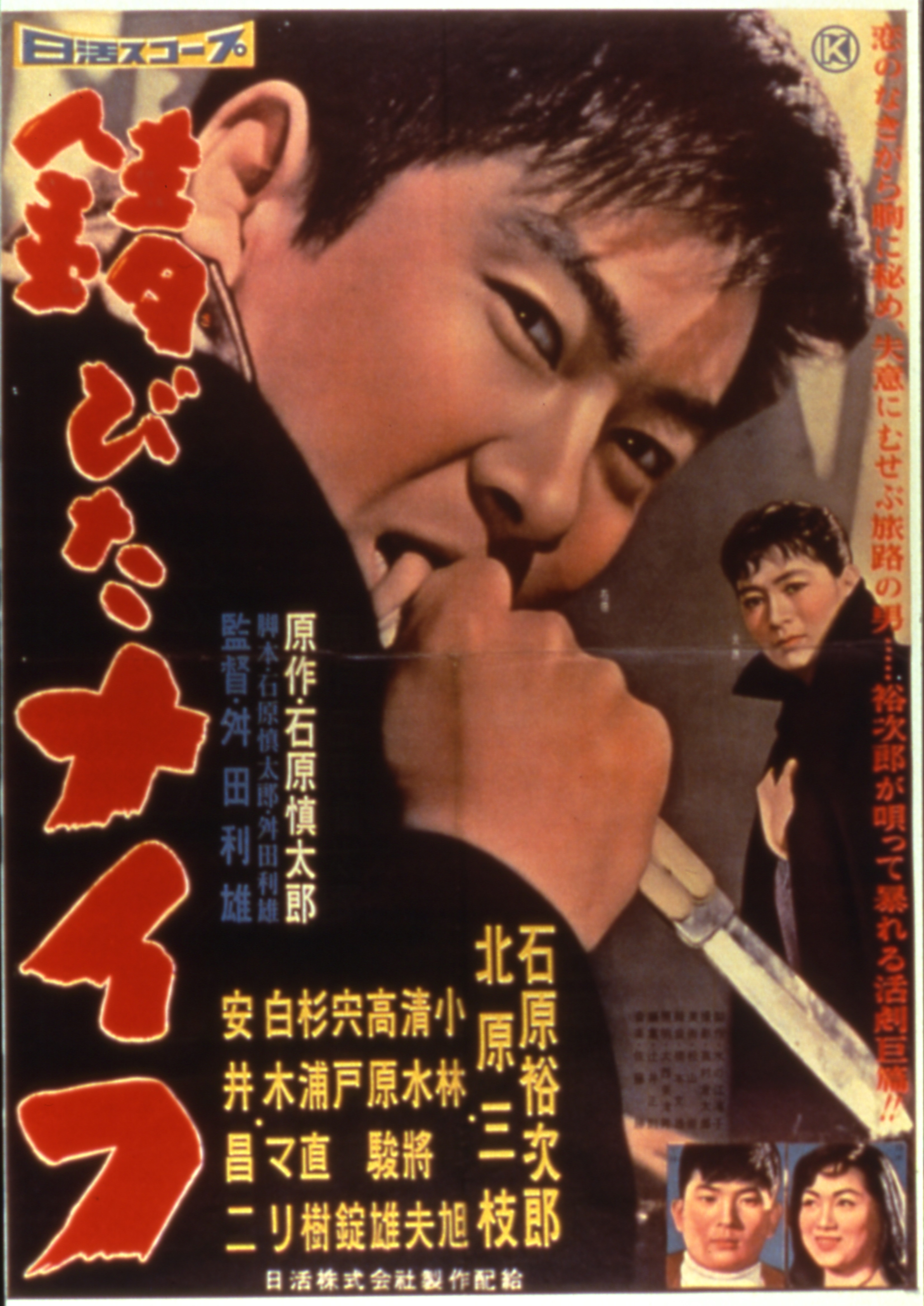
Rusty Knife (錆びたナイフ, Toshio Masuda, 1958)

rusty knife posterPost-war Japan was in a precarious place but by the mid-1950s, things were beginning to pick up. Unfortunately, this involved picking up a few bad habits too – namely, crime. The yakuza, as far as the movies went, were largely a pre-war affair – noble gangsters who had inherited the codes of samurai honour and were (nominally) committed to protecting the little guy. The first of many collaborations between up and coming director Toshio Masuda and the poster boy for alienated youth, Yujiro Ishihara, Rusty Knife (錆びたナイフ, Sabita Knife) shows us the other kind of movie mobster – the one that would stick for years to come. These petty thugs have no honour and are symptomatic parasites of Japan’s rapidly recovering economy, subverting the desperation of the immediate post-war era and turning it into a nihilistic struggle for total freedom from both laws and morals.
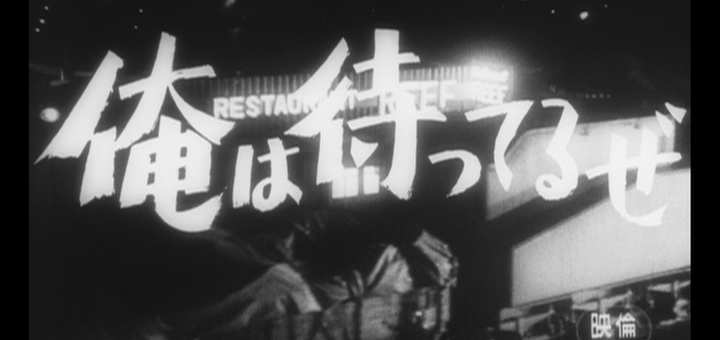
Public support is, largely, behind this new force of order as seen in the local uproar when top gangster Katsumata (Naoki Sugiura) is arrested in connection with an assault. Things being what they are, Katsumata is soon released to laugh at law enforcement from a safe distance but the past is coming for him. Some years ago Katsumata killed a local councillor, Nishida (Ikunosuke Koizumi), and made it look like suicide but three guys from a local gang saw him do it. He paid them to keep quiet, but now one of them feels like talking and thinks Katsumata might like to pay a little more to reseal the deal.

Chatty Tokyo thug Shima (Jo Shishido) gets pushed off a train for his pains but Katsumata is worried enough about the other two to send his guys out to make some enquires. He’s particularly worried about Tachibana (Yujiro Ishihara) – a “sleeping lion”, Tachibana is a hot head who’s now gone straight after coming out of jail for murdering a guy he thought was a direct cause of his girlfriend’s death. Luckily enough, Tachibana now runs a bar where he employs the other witness, Terada (Akira Kobayashi), to whom he acts as a stern big brother hoping to keep them both on the straight and narrow. Tachibana is unlikely to talk, he wants out of the gangster world for good, but Terada is young and ambitious with a girlfriend to impress. He takes more hush money from Katsumata, not realising what he’s getting himself into, and then lets it go to his head.

Tachibana is the rusty knife of the title. After letting his rage consume him in murdering a petty mobster in revenge for the rape of his girlfriend who later committed suicide, Tachibana has vowed to quell his anger and live a decent, peaceful life. Angry outbursts are, however, never far from the surface and following recent revelations, a rusty knife may find its cutting edge once again.

Keiko (Mie Kitahara), a customer at Tachibana’s bar, is making a documentary about violence in the city which coincidentally turns up a few clues as to Tachibana’s past, not to mention her own. The daughter of the murdered councilman, Nishida, and the niece of another powerful politician, Keiko is a figure of righteousness, charting her own course through the difficult post-war world and attempting to do so with dignity and elegance while refusing to abandon her sense of decency and compassion. Later a real life married couple, Kitahara and Ishihara were a frequent on screen romantic pairing though this time around the connection is more subtle as Keiko begins to sympathise with Tachibana’s plight and commits herself to saving him from destroying himself in becoming consumed by his barely suppressed rage.

Tachibana is indeed raging, though his rage is understandable. As someone later puts it “nothing in this city makes sense”. The systems are corrupt, the wartime generation continue to run the show and run it badly, or at least for their own ends, robbing youth of its rightful place at the forefront of economic recovery. Yet even if Ishihara is a symbol of youthful alienation, his rage is one which must be quelled. Even in this city where nothing makes sense, self control is one’s greatest weapon. If youth is to walk forward into the exciting post-war future, it will have to drop its rusty knives.


Original trailer (English subtitles)

I Am Waiting (俺は待ってるぜ, Koreyoshi Kurahara, 1957)

img_0Return to sender – address unknown. For the protagonists of I Am Waiting (俺は待ってるぜ, Ore wa Matteru ze), the debut feature from Koreyoshi Kurahara, all that’s left to them is to wait for uncertain answers, trapped in the limbo land of the desolate post-war landscape. With nothing to hope for and no clear direction out of their various predicaments, the pair bide their time until something, good or bad, comes for them but luckily enough what finds them is each other and suddenly a path towards resolution of their troubles. Reuniting newly minted matinee idol Yujiro Ishihara and future real life wife Mie Kitahara fresh off the red hot success of the youth on fire drama Crazed Fruit, I Am Waiting is an altogether more melancholy affair set in the down and out depression town of the American film noir.

One fateful night, Joji Shimaki (Yujiro Ishihara) steps out onto the Yokohama Harbour clutching a letter he nervously drops into a post-box, but is struck by the figure of a distressed young woman hanging around ominously close to the water’s edge. For reasons he doesn’t quite understand, Joji approaches the woman and convinces her to come back with him to the small cafe he runs right by the railway line. The girl, Saeko (Mie Kitahara), confesses to him that she thinks she may have killed a mobster who was making the moves on her and has no idea what to do now. Joji suggests she hide out with him, check the morning paper for news of a body, and then figure out the rest later. Left with no other options, Saeko agrees but it seems the past has a hold on them both which not even Joji’s powerful fists will be able to break.

Joji has been “waiting” for a letter from his older brother, supposedly in Brazil buying farmland. “Brazil” has become Joji’s main escape plan, but while he waits and waits his Japan life stagnates. A former prize fighter, Joji has been fighting his past self for the past couple of years ever since he lost his temper and killed a man in a bar brawl. Joji is afraid of his rage, convinced that he’s no good, a toxic influence to all around him, which explains why he’s so often abandoned by those he loves. When the letters he’d been sending to Brazil start coming back “no such person”, he fears the worst – that his brother has run off with their money and started a new life on his own without him.

In a noirish coincidence, Joji’s fate is bound up with that of melancholy nightclub singer Saeko. Once a respected opera singer, Saeko has been relegated to jazz cabaret in seedy harbour bars after losing her voice to illness and having her heart broken by her singing teacher whose affections were not as true as he claimed. “A canary that’s forgotten how to sing”, Saeko fears that her life is already over, there will be no escape from the gangsters who claim to own her and the only path left to her is the one she ruled out taking when she bopped the shady mobster on the head with a nearby vase. Saeko had no escape plan because she thought escape was impossible, but the unexpected nobility of a man like Joji has begun to change her mind, if only Joji’s heart weren’t already so battered and bruised.

Joji’s bar, the Reef Restaurant, is the gathering place for the battered and bruised. Located right on the railway line, it’s a literal waiting room through which pass all those who aren’t quite sure where they’re going. Everyone here is nursing the wounds of broken dreams – Joji’s chef used to be racing driver until he got injured, the doctor is a drunk, Joji’s an ex-boxer with anger issues, and Saeko’s a bird with a broken wing. This is not the departure lounge, it’s arrivals – the end of the line when there is no place else to go.

Still, a waiting room is a place you can choose to leave, no one has to wait forever. In meeting Saeko, Joji has already begun to move forward even if he doesn’t know it. Suddenly giving up on their melancholy passivity, the pair spur each other on towards a killer finale which offers them, if not exactly a way out, a possibility of a better life having resolved to leave the past in the past and reject its continuing hold over them. Kurahara co-opts the fatalism and lingering existential angst of the film noir with its rolling fog and permanent drizzle clouding the darkened horizons for our two pinned protagonists who relive their most fearful moments with the force of silent movie scored by the intense jazz soundtrack suddenly turned up to 11. An important missive to the post-war young, I Am Waiting offers the message that the past can be beaten, but only once one comes to believe in the existence of the future and makes a decision to walk towards it rather than waiting for it to arrive unbidden.   


Clip (English subtitles)

https://www.youtube.com/watch?v=7xHcW-4mZ1c

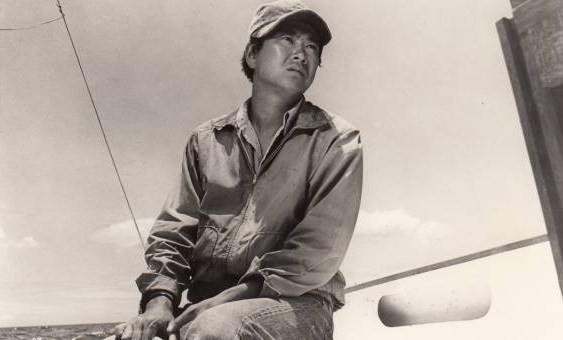
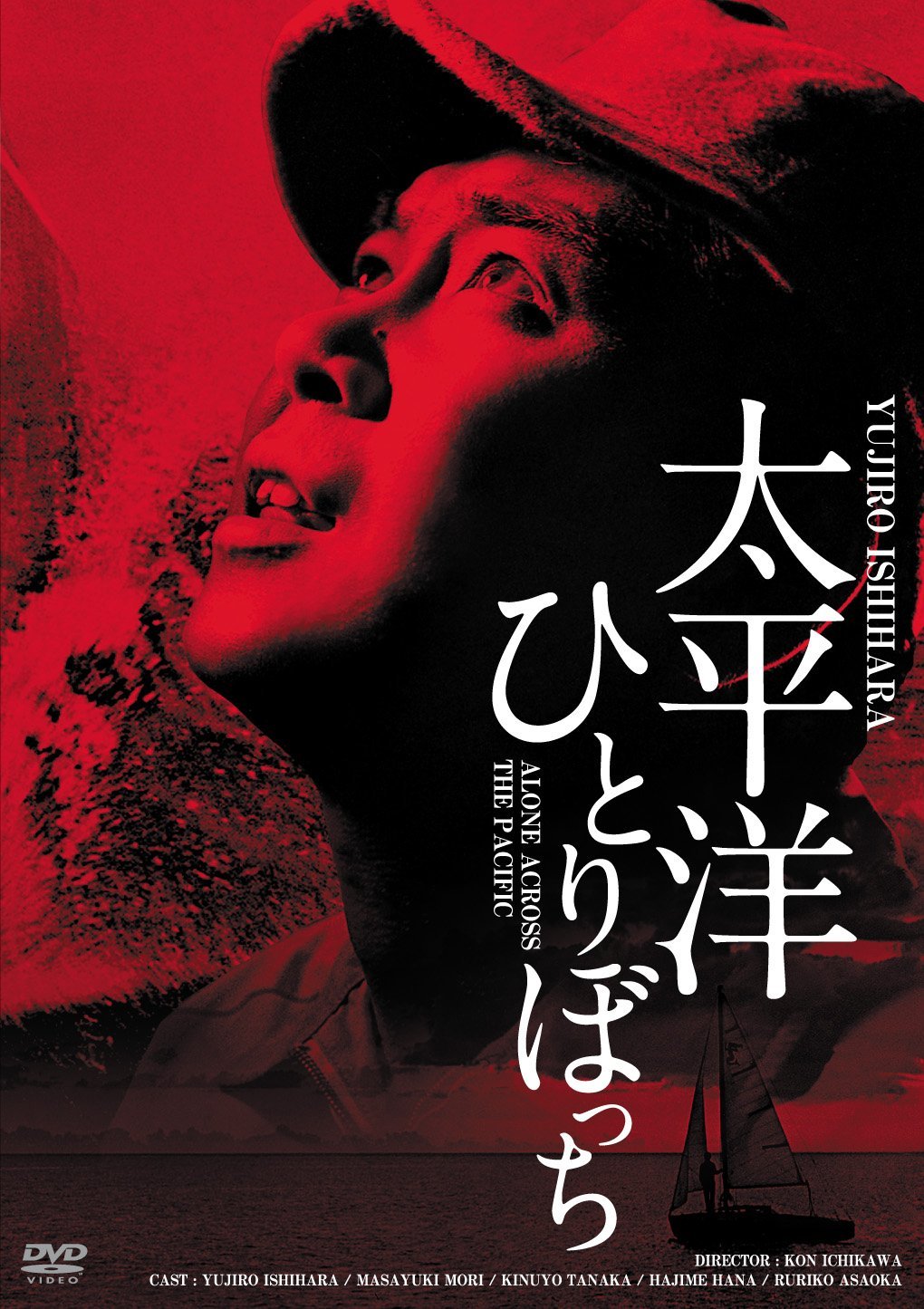
Alone Across the Pacific (太平洋ひとりぼっち, Kon Ichikawa, 1963)

Alone Across the PacficKon Ichikawa made two sorts of movies – the funny ones and the not so funny ones. Despite the seriousness of the title, Alone Across the Pacific (太平洋ひとりぼっち, Taiheiyo hitori-botchi) is one of the funny ones. Like many of Ichikawa’s heroes, Horie is a man who defies convention and longs for escape from the constraining forces of his society yet is unable to fully detach himself from its cultural norms. Based on the real life travelogue of solo sailor Kenichi Horie, Alone Across the Pacific is less the story of a man battling the elements, than a cheerful tale of a man battling himself in a floating isolation tank bound for the “land of the free”.

Kenichi (Yujiro Ishihara) is a strange man. He has few friends (aside from the family dog, Pearl) and is obsessed with the idea of running away to sea. Inspired by the tales of other intrepid sailors, his dream is to sail all alone across the Pacific Ocean from Osaka to San Fransisco. Despite the fact that it is illegal for small boats to leave Japanese waters (and that he is too impatient to wait for his passport to come through), Kenichi has custom made his own yacht, one without an engine, and has set off on his longed for voyage under the cover of darkness.

Rather than filming Kenichi’s journey naturalistically, Ichikawa opts for an adventurer’s tale as Kenichi provides an ironic voice over detailing some of his naive failings as a rookie sailor undertaking such a daunting mission. Each of Kenichi’s crises links back to a memory from his shore life, reminding us why he’s on this journey in the first place. Kenichi’s struggles are the same as many a young man in post-war Japan and, in fact, many of those previously played by the poster boy for youthful rebellion, Yujiro Ishihara.  Unwilling to live a life hemmed in by the predetermined path of a job for life, wife, children and total social conformity, Kenichi longs to be free of his cultural baggage by abandoning his civility during a long process of isolation therapy free of overbearing fathers, fretting mothers, indifferent sisters and a generally noisy world.

Kenichi’s father (Masayuki Mori) is the very personification of authority, berating his son for his fecklessness and pointless obsession with sailing – a sport a working class boy like Kenichi can barely afford. Kenichi’s determination to achieve his goal sees him leave school early, take a job in his father’s workshop only to quit suddenly for a more lucrative one delivering luggage for a travel agents, and quitting that too to work full time on his boat. While his father huffs and puffs his mother (Kinuyo Tanaka) worries, hoping her mad son won’t really go through with it but knowing that he will.

When Kenichi finally reaches San Fransisco, he’s assaulted by congratulatory voices from all directions. Towed into harbour by a motor boat, Kenichi first has to deal with mundane problems like the customs patrol wanting to know if he’s got any fruit left on the boat before a crowd gathers to shake his hand asking where he’s come from and why, what he wants to do now, and praising him for his daring feat of solo sailing glory. In Japan however, things are different. Dragged out for an interview by the press, Kenichi’s worried mother avows that she’s just happy to know her son is safe while his father bows deeply and reassures everyone that he will absolutely put a stop to any such random acts of individualism his wayward son may attempt in the future. 

Kenichi evades the twin pulls of his mother’s apron strings and his father’s handcuffs by taking off alone but even at sea he’s never free of his cultural programming, checking the wide empty ocean before removing his clothes and then stepping back down into the cabin to finish the job. Kenichi’s failure to acquire a passport is an ironic one seeing as part of what he’s running from is being Japanese but even as his quest is one for self determination it is also intensely selfish and self involved. In this Kenichi commits the ultimate act of individualism, caring nothing for the thoughts and feelings of others in the all encompassing need to achieve his goal. Kenichi may have found a home at sea, but on land he’s caged once again, a prisoner both of social conformity and his own need to defy it.


Available on R2 DVD from Eureka Masters of Cinema.

Original trailer (no subtitles)