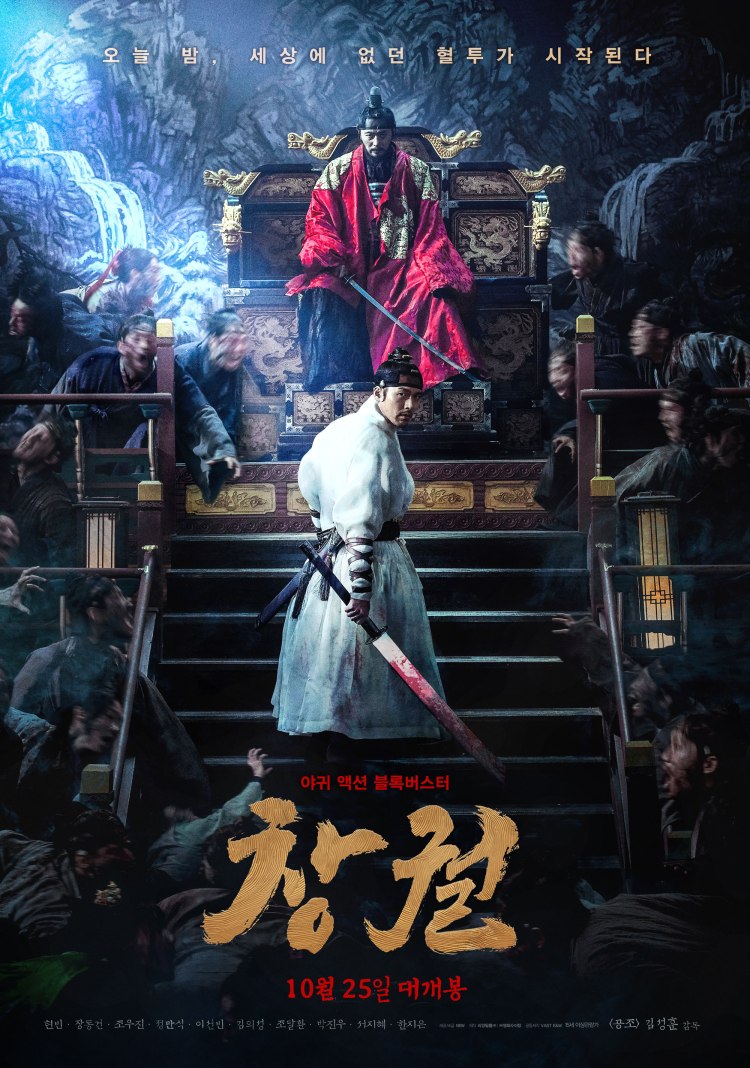
 Korean cinema has well and truly fallen in love with zombies. You might have heard of zombie kings lingering on while ambitious underlings run the show to ensure their own succession, but you’ve never seen one quite like this. Kim Sung-hoon’s Rampant (창궐, Changgwol), arriving mere months before similarly themed Netflix TV show Kingdom, sends the zombie apocalypse back to the Joseon-era. Incorporating the political intrigue and courtly machinations the genre is known for, Rampant is ultimately less a tale of battling undead threat than of fighting for a humane future ruled over by a good king who purifies the kingdom and commits himself to the service of his people.
Our hero, Ganglim (Hyun Bin), was raised among the Qing and feels himself to be more Chinese than Korean – he isn’t even very comfortable with the language and wants nothing more than to go “home” where all the pretty ladies are. The reason he’s come “back” to Korea is that his brother, the Crown Prince (Kim Tae-woo), feared for his safety and asked Ganglim to escort his pregnant wife to the Qing out of harm’s way. The major problem is that the elderly king is weak and many in his court believe he has failed to stand up to the Qing, damaging Korean sovereignty. Unbeknownst to Ganglim, the Crown Prince has already committed suicide to take responsibility for a treasonous plot to usurp the king using firepower purchased from the Dutch. Inconveniently, this also means that Ganglim is now heir to the throne which is very much not something he is particularly interested in. Romantic as he is, however, he can’t pass up the chance to avenge his brother’s death while fulfilling his dying wish of saving his wife and unborn child.
Meanwhile, that Dutch ship was carrying more than guns. Strange flesh eating “night demons” have overrun the harbour town of Jemulpo and are slowly staggering forward under the cover of darkness ravaging as they go. Wandering into the fray, Ganglim is eventually accosted by a band of “rebels” previously loyal to his brother who, alone, are busy defending the innocent townspeople by disposing of the zombie corpses before they can do more harm.
Ganglim too is originally unwilling to help, not quite believing the tale he’s been told and then affirming that it’s not much to do with him while he concentrates on concluding his mission so he can get back to Qing. Nevertheless he gradually begins to accept his responsibility through realising it affords him an opportunity to be dashing and heroic. Meanwhile, there is conspiracy afoot in the court. Evil defence minister Kim Ja-joon (Jang Dong-gun) is still intent on seizing the throne to create a new Korea free of Qing of influence and is not above using the zombie threat as a part of his plan.
The conflict is then the familiar one of good kings and bad, or the rightful heir and an unscrupulous usurper. Ganglim, a self-centred libertine who thinks of little else than beautiful women, is not looking for the kind of responsibility which comes with a crown which of course makes him the perfect person to inherit it. Little by little, beginning to care for his small band of rebels and the townspeople they help to save, Ganglim embraces his nobility and commits himself to the service of his people. The king, he discovers, is a servant of his subjects – not the other way around as Kim would have it. Watching the old world burn, he vows to build a better one founded on more egalitarian principles with fairness and accountability at its centre.
The zombies become a kind of metaphor for the corruption which is literally devouring the kingdom and must be purified by Ganglim’s righteous fire. Kim’s revolution has destabilised the nation through unexpected foreign influence which he, ironically, attempts to turn to his advantage little caring if it costs the lives of his fellow Koreans who are, after all, only peasants and therefore not really worth caring about. Kim Sung-hoon brings painterly aesthetics to the classically inspired tale of true kings and righteous hearts while letting the zombies do their thing in true genre fashion as Joseon prepares to save itself from the rot within by beheading the monster before before it has a chance to bite.
Rampant was screened as part of the 2019 Udine Far East Film Festival.
International trailer (English subtitles)