Monster Hunt (捉妖記, Raman Hui, 2015)

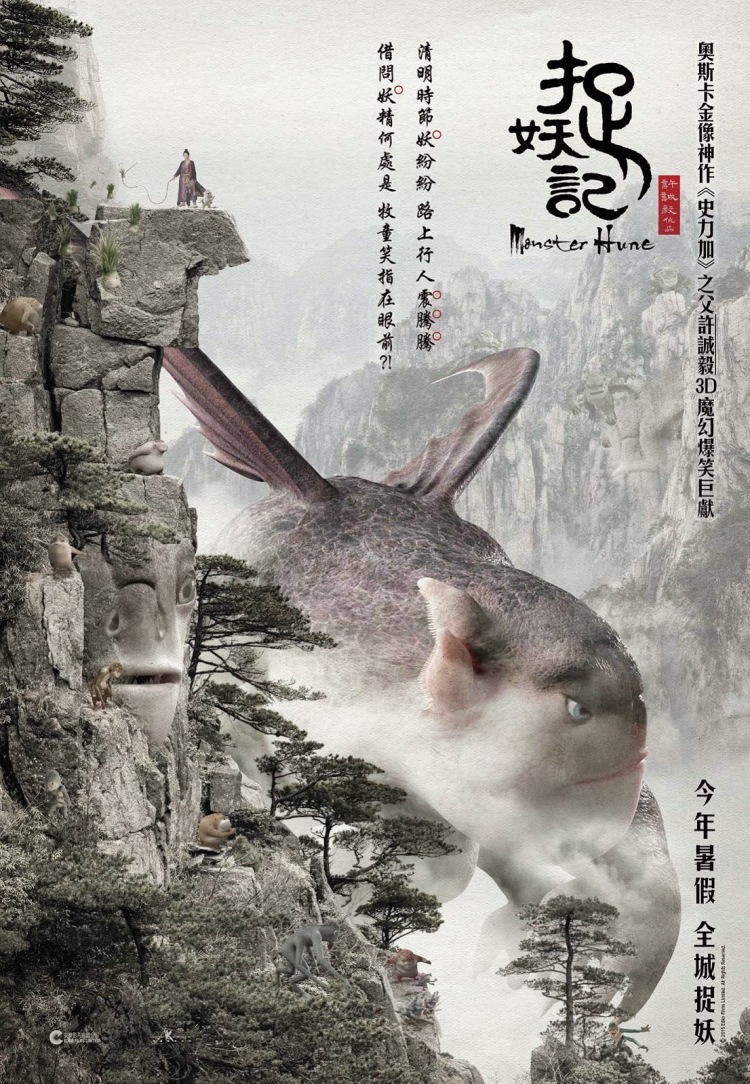
Monster Hunt posterA runaway box office hit and veritable pop culture phenomenon, you’d be forgiven for assuming that 2015’s Monster Hunt (捉妖記, Zhuō Yāo Jì) is nothing more than a slice of family friendly entertainment in the vein of a dozen other live-action/animation hybrid fantasy films. The monsters are cute, yes, and there is enough darkness here to rival Lord of the Rings, but there’s a little more going on under the surface of this otherwise heartwarming tale of a persecuted minority and its hidden princeling. A family drama of epic proportions, Monster Hunt speaks directly to China’s left behind children and to those who, perhaps, were worried their destiny had always been misplaced.

Set sometime in the distant fantasy past, Monster Hunt takes place in a universe in which men and Monsters co-exist but, owing to their defeat in a war, the Monsters have been forced back into the forests and mountains away from humankind many of whom no longer even believe they exist. However, there is fresh strife among the Monsters forcing a pregnant Queen to flee along with her retainers, straying into the human world in hope of saving her baby. Luckily she finds herself in a small village presided over by a kindly mayor with a limp, Tianyin (Jing Boran), who is also the son of a long missing Monster Hunter but much prefers domestic tasks such as cooking and sewing to hunting Monsters. The Queen manages to “transfer” her baby to Tianyin just before she dies, leaving him quite literally holding the baby assisted only by cynical bounty hunter Xiaolan (Bai Baihe).

Inspired by ancient folklore, Monster Hunt plays the chosen one trope to the max as Tianyin wrestles with his destiny while the baby, a true king displaced from his throne, awaits in ignorance. Like many contemporary fantasy tales, Monster Hunt also revels in subverting genre norms with its noticeably feminised hero. Tianyin is the son of a great warrior, but it’s his grandmother who practices kung fu and goes out looking for her long lost son, while Tianyin professes his love of domesticity, staying home cooking and sewing. His simplicity and softness is contrasted with the more masculine figure of the cynical Monster Hunter Xiaolan who becomes Tianyin’s casual love interest and the putative “father” in the loose family unit they form with the tiny baby radish-like figure they eventually christen Wuba.

The formation of a family unit in itself proves a problematic development for both Tianyin and Xiaolan who have both been abandoned by their own families and left to fend for themselves (with almost opposite results). Resentful at having been cast out by his apparently “heroic” father, Tianyin has definite views about the nature of fatherhood and the mistakes he does not wish to repeat with his own children while Xiaolan has grown wary of forming attachments altogether and strives to remind herself that she is only looking after Wuba until he’s big enough to sell on the Monster Hunter black market. Nevertheless, the pair cannot help becoming “accidental” parents even if they must first make a mistake they later need to rectify in trying to abandon their charge for financial gain. Tianyin “repeats” the “mistake” of his own father but finally comes to understand it for what it was – a father’s sacrifice of his paternal love to keep his child safe. Something that will certainly ring true for children who may be living apart from their own parents for reasons they don’t quite understand.

Yet a fairytale darkness is never far away as Tianyin and Xiaolan consider selling off little Wuba to a dodgy mahjong obsessed Monster fence (Tang Wei) who apparently knows how valuable he is but is planning to sell him to a local restaurant anyway. Despite the fact that everyone has forgotten Monsters exist, Monster meat is a delicacy reserved for the super rich (a subtle dig at China’s eat anything that can’t run faster than you philosophy ushered in by the sight of caged monkeys at the roadside) and little Wuba does look quite like a tasty daikon radish.

Cute monsters getting chopped up and eaten may be a horror too far for sensitive young children (if it weren’t for the fact the Monsters are all inspired by veggies Monster Hunt might be the greatest proselytising mechanism for vegetarianism the world has ever seen) but rest assured, little Wuba is quite the resourceful little tyke and he does after all have a grand destiny awaiting him. A tribute to unlikely heroes, gentle men, feisty women, and atypical families, Monster Hunt is an oddly subversive family friendly adventure and one which has clearly hit its mark in capturing the hearts of a whole generation who will doubtless be excited for the further adventures of Wuba as he moves closer towards his own Messianic destiny.


International trailer (English captions)
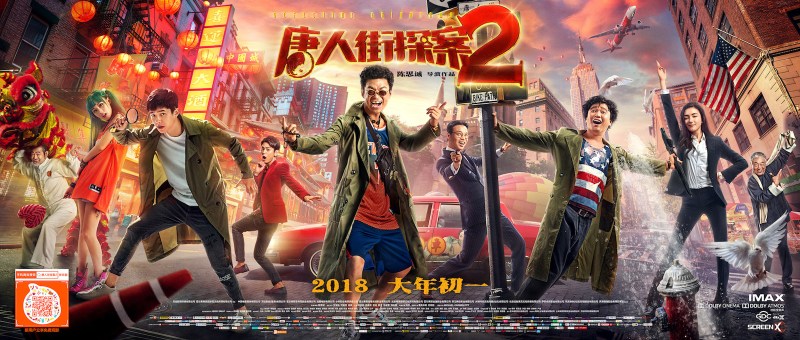
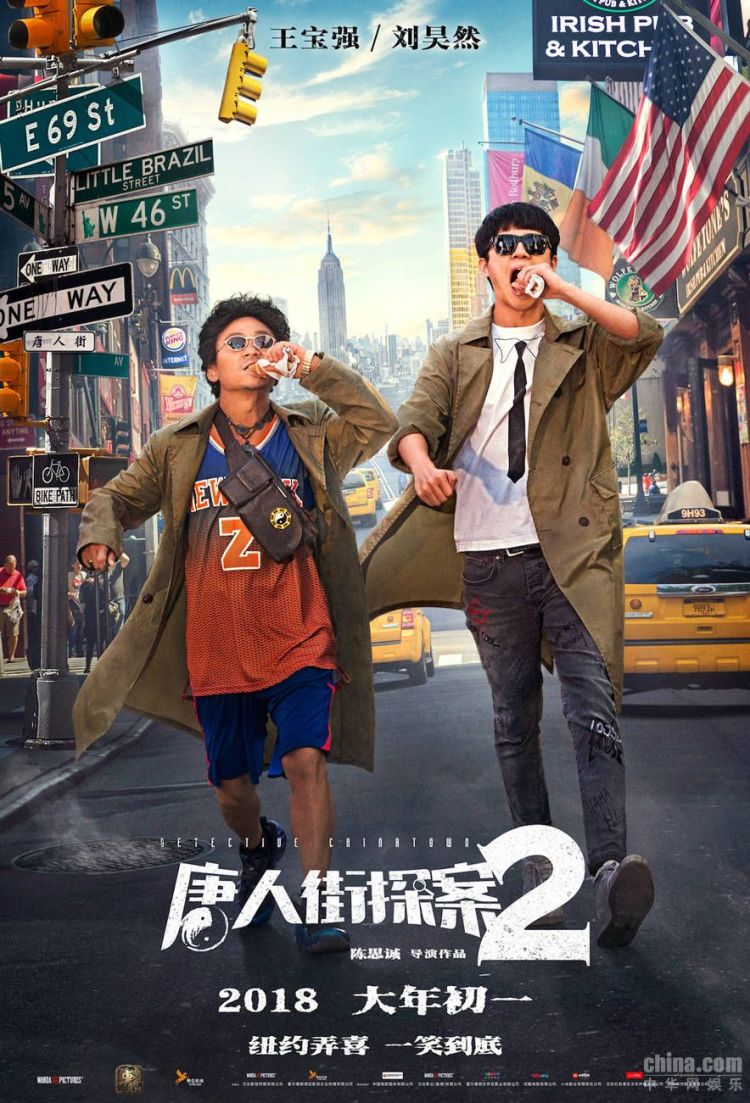
Detective Chinatown 2 (唐人街探案2, Chen Sicheng, 2018)

Detective Chinatown 2 posterBox office smash Detective Chinatown successfully pulled off the difficult feat of merging amusing buddy cop comedy with a holiday setting and intriguing cerebral mystery. Given the success of the first film it’s no surprise that the boys are back in town, or, as teased in the finale, in New York where another strange crime awaits their particular talents. Firmly a Chinese production taking place in an American city (though one using American crews), Detective Chinatown 2 (唐人街探案2, Tángrénj Tàn Àn 2) tries its best to maintain its unique character while shifting into American crime thriller territory, even if hampered by a stereotypical view of its target culture and some decidedly ropey English language dialogue.

Qin (Liu Haoran), now apparently a student at the police academy, has been tricked into coming to New York for Uncle Tang Ren’s (Wang Baoqiang) wedding to his love interest from the first film, Ah Xiang (Tong Liya). When he arrives, however, Qin quickly figures out that he’s in a room with some of the world’s best detectives – Ah Xiang left Tang Ren for someone with more money and so Tang Ren wants Qin to help him solve a mysterious New York murder for the reward promised by one of the victims’ grandfathers, a Chinatown gangster named Uncle Seven (Kenneth Tsang). Qin likes a good mystery so sticks around though the situation becomes decidedly more complicated after he finds and discounts the main suspect, Song Yi (Xiao Yang), leaving the trio on the run from the authorities, other detectives vying for the reward, and Uncle Seven’s guys some of whom have their own ulterior motives.

The most satisfying element of Detective Chinatown lay in the genuinely intricate nature of its locked room mystery and elegance of its resolution. Detective Chinatown 2 shifts away from the classical style of a European drawing room mystery for something altogether flashier and more American in keeping with its setting. It is, however, guilty of more than the faults of its genre in heavily signposting its solution from the midway point leaving any serious thriller fan twiddling their thumbs waiting for the penny to drop with ace detective Qin. Though a secondary twist offered after the killer has been unmasked helps to undercut the disappointment of such an anticlimax, it is not quite enough to compensate for the crushing obviousness of the central mystery.

Likewise, where Detective Chinatown existed firmly within a small Chinese enclave of Bangkok where everyone knew everyone, the move into the metropolis of Manhattan robs the film of its small-town charm. Despite the “Chinatown” tag, Chinatown itself is not a big player and as both of our guys are now full outsiders in another culture, we’re treated to a much less nuanced take on local stereotypes with several running gags likely to raise audience hackles with their tone-deaf approach to visualising the multicultural city. All of that aside, shooting in Central Manhattan with American crews also means much less creative freedom leaving the set pieces perhaps less impressive in terms of scale and ingenuity while the cinematography occasionally feels much more like standard American television than a big budget Chinese comedy.

Nevertheless the odd pairing of loudmouth Tang Ren and the comparatively subdued Qin, whose powers find even more impressive means of visualisation as he literally lifts buildings off a map and moves them round, remains the key selling point even though each half of the pair is also subjected to a bizarre round of sexual harassment from a biker boss with a tiny Chinaman fetish to a kung fu master with possible Alzheimer’s respectively. Though Chen generally relies on slapstick, the gags have a decidedly topical flavour – a police chief with terrible hair who makes off colour jokes and wants to build a wall to keep out all the annoying Chinese guys he can’t be bothered to deal with, for example, or the repeated references to immigration and the various dangers faced by those who’ve come from somewhere else and are trying to make a life for themselves. Yet the guys also keep running into people who unexpectedly speak Mandarin – perhaps a sign of the equally unexpected elevated status of Chinese visitors and their all important economic power. Detective Chinatown 2 is a mild disappointment after the duo’s impressive debut, but nevertheless does enough to spark interest in the teased Tokyo-set third instalment.


Currently on limited UK cinema release courtesy of Cine Asia. Screening details for UK, Germany, Australia, and New Zealand available via official website.

Original trailer (English subtitles)

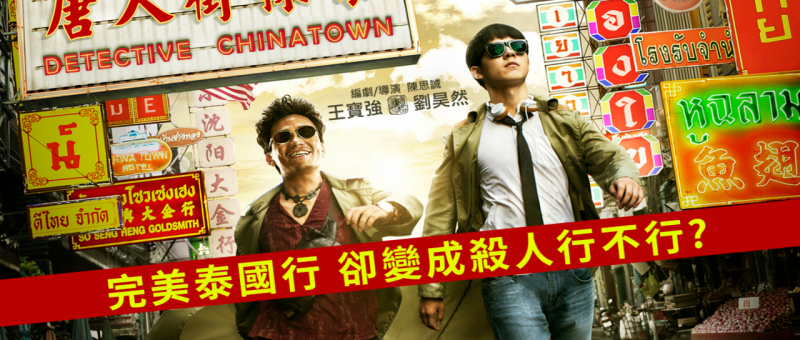
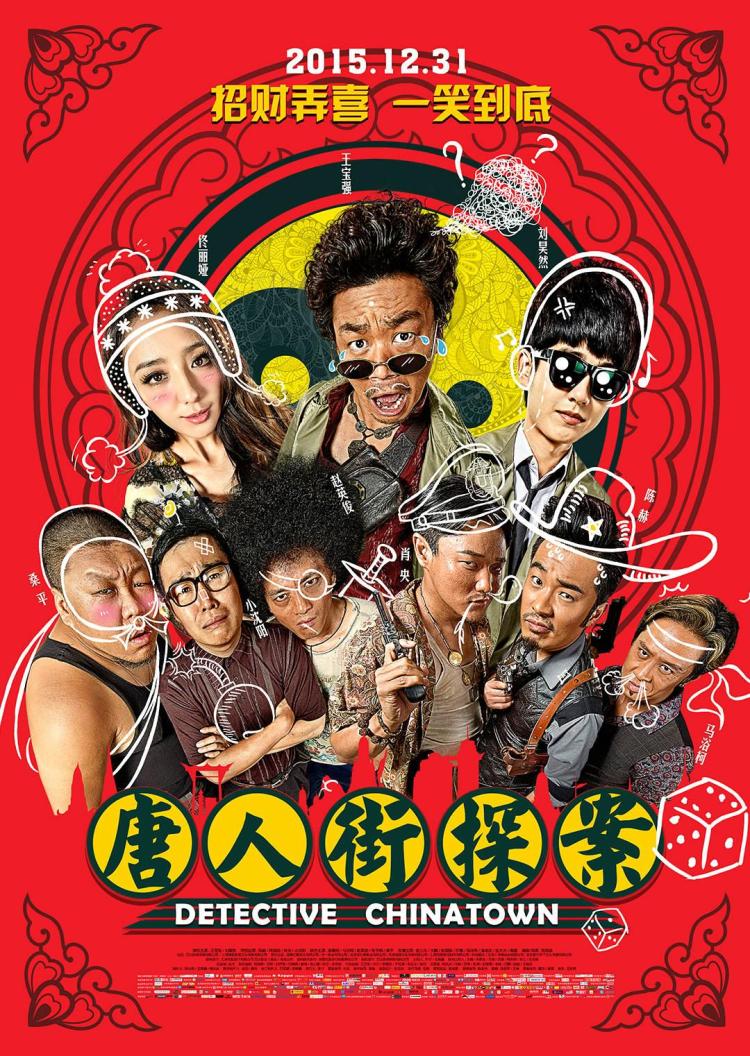
Detective Chinatown (唐人街探案, Chen Sicheng, 2015)

detective chinatown posterCrime exists everywhere, but so do detectives. When one young man fails his police exams because of an unfortunate impediment, he seeks refuge abroad only to find himself on a busman’s holiday when the relative he’s been sent to stay with turns out to be not quite so much of a big shot as he claimed and then gets himself named prime suspect in a murder. Detective Chinatown (唐人街探案, Tángrénj Tàn Àn) is one among many diaspora movies which find themselves shifting between a Chinese community existing to one side of mainland culture, and a mainland mentality. This time the setting is Bangkok but second time director Chen Sicheng is careful not to surrender to stereotype whilst also taking a subtle dig at men like uncle Tang Ren who can unironically refer to Thailand as a paradise while indulging in many of the aspects which might leave other residents with much more ambivalent emotions.

Qin (Liu Haoran), a young man with a fierce love of detective fiction, has his dreams shattered when his interview to get into the police academy is derailed by his stammer and an unwise tendency towards reckless honesty. His doting grandma who raised him suggests Qin take a holiday to take his mind off things by going to stay with his uncle who is, apparently, a hot shot detective in Bangkok – Qin might even get some valuable experience whilst thinking about a plan B. Sadly, uncle Tang Ren (Wang Baoqiang) has been sending big fish stories back home for years and though he claims to be the best PI in Chinatown, he’s really a petty marketplace fixer with a bad mahjong habit and a side hustle in “finding” lost dogs. When Tang Ren accepts an errand to transport a statue from a workshop, he accidentally finds himself the prime suspect in the murder of the sculptor who is himself the prime suspect in a heist of some now very missing gold. Qin, tainted by association, vows to use his awesome detective skills to find the real killer (and the gold) to clear his uncle’s name whilst generally serving justice and protecting the innocent.

Despite the fact his secret is clearly about to be exposed, Tang Ran greets his long lost relative with immense enthusiasm (which is, as it turns out, how he does everything). Wang Baoqiang commits absolutely to Tang Ren’s cynical good humour attacking his larger than life personality with gusto though one has to wonder why Qin’s poor unsuspecting grandma thought Tang Ren would be a good guardian for her teenage grandson, especially as his first act is to take him to a strip club and spike what might actually be the first real drink of his life. Qin, quiet (that stammer) and introspective, is not a good fit for the loud and brassy world of insincerity his uncle inhabits, but forced into some very challenging situations, the two men eventually manage to combine their respective strengths into a (hilariously) efficient crime fighting team.

Meanwhile, Qin and Tang Ren are also contending with some serious political shenanigans in the local police department. Two Chinese cops are currently vying for a promotion and the job has been promised to whichever of them manages to identify the murderer and locate the missing gold. Luckily or unluckily, cop 1 – Kuntai (Xiao Yang), is a good friend of Tang Ren’s and doesn’t want to believe he is secretly some kind of criminal genius (but could well believe he killed a guy by mistake). Cop 2 (Chen He) is a hard-nosed (!) type who, for some reason, dresses like a cowboy and has a crush on Tang Ren’s landlady (Tong Liya) with whom Tang Ren is also in love. What this all amounts to is that everyone is stuck running circles around each other, trapped inside the wheel of farce, while the gold and the killer remain ever elusive.

Qin, finally beginning to overcome his stammer, puts some of his hard won detective nouse to the test and eventually figures out what’s going on but, by that point, he’s also warmed to his uncle enough to let him do the big drawing room speech. Filled with slapstick and absurd humour as it is, Detective Chinatown is also a finely constructed mystery with an internally consistent solution that offers both poignancy and a degree of unexpected darkness when the final revelations roll around. It is, however, the odd couple partnership between the sullen Qin (secretly embittered) and larger than life Tang Ren (secretly melancholy) that gives the film its winning charm, ensuring there will surely be more overseas adventures for these Chinatown detectives in years in to come…


Currently available to stream in the UK & US via Amazon Prime Video.

Original trailer (English subtitles)

The Monkey King 3 (西遊記女兒國, Cheang Pou-soi, 2018)

the monkey king 3 posterSun Wu Kong and his band of merry scripture seekers will face many challenges on their journey to the West, but none so dangerous as the poison of love! Aaron Kwok reprises his role as the titular Monkey King in the third of the ongoing series directed by Cheang Pou-soi (here credited as Soi Cheang) but steps back a few paces into a supporting role while noble hearted monk Xuanzang (William Feng Shaofeng) takes centre stage to face the multifaceted dilemma of love and personal fulfilment vs the fulfilment of his quest to better the lives of all mankind. An age old problem, but one you can’t truly address until you have stake in the game.

Xuanzang, now returned and dressed in white, has a romantic destiny – something which makes him a little nervous as he happily sails along a picturesque river in the company of companions Wujing (Him Law) and Zhubajie (Xiaoshenyang) while Wu Kong (Aaron Kwok) flies along behind, apparently having mislaid his trousers somewhere along the way. All of a sudden the atmosphere darkens as the gang sail into a “demonic” area where they are attacked by a giant, whale-like river god and subsequently thrown into another dimension thanks to an intervention from the Goddess of Mercy (now played by Liu Tao in place of the series’ previous cameo from Kelly Chen).

The guys have inadvertently landed themselves in Womanland which is 100% man free. In fact men are illegal and to be executed on sight which is a bit of a problem seeing as it’s also impossible to leave. Not so much of a problem, however, as the strange moment which occurred between Xuanzang and the Queen of Womanland (Zhao Liying) as their eyes met during a near fatal fall from a cliff edge. Following the childish exuberance of the first film and the morbidly gothic horror of the second, it’s love which now threatens to derail our heroes’ quest and with it the possibility of salvation for all mankind.

Womanland was founded by a woman scorned who turned her back on faithless men forevermore, instructing her followers that men are selfish and duplicitous, that they lie to win the hearts of women which they later break in forsaking them for the next conquest. The holy scriptures of Womanland warn of the “poison of love” which is (usually, they say) spread from man to woman and leads to nothing but inescapable suffering. Foreswearing all romance (apparently there is no concept of romantic love in the all woman kingdom save the rumour that there was once a young woman who fell in love with a river she was never able to see) turns out not to be the best solution to the problem as we discover that all the ruckus in the world above is in someway caused by these repressed or denied emotions as well as by a failure to accept that sometimes feelings must be sacrificed in favour of greater responsibilities.

Whereas the second film pitted Wu Kong and Xuanzang against each other as advocates of compassion and rationality, this time Xuanzang must face a monk’s dilemma alone in deciding whether the love of one woman is equal to that of the whole of mankind. His choice is a forgone conclusion but serves to remind the monk that denying one’s true feelings is not the same as facing them and wilfully isolating oneself from possible suffering is not the same as overcoming it. The residents of Womanland discover something similar in the parallel journey of their embittered first minister (Gigi Leung) whose own unfulfilled romantic desires have made her cruel and vindictive only to be presented with another choice and find herself denying love for duty once again.

Duty, however, turns out to be warmer than it sounds – in Womanland, maternal love trumps the romantic, undercutting the otherwise progressive atmosphere of a society of women doing fine on their own with a return to maternity as central virtue of womanhood. Love is the force which threatens to undo carefully won civility (a “bourgeois affectation” as the more dogmatic definition would have it), but desire repressed rivals love scorned as a force to burn the world. Xuanzang has a choice to make, but the choice itself is not so important as the conscious act of choosing. Aside from a bizarre subplot featuring male pregnancy and forced abortion, Monkey King 3 makes a largely successful shift away from gung-ho adventuring into poignant romantic melodrama. With the gang en route to Fire Mountain, where will their journey take them next?


Currently on limited release in UK cinemas courtesy of China Lion Film.

International trailer (English subtitles)

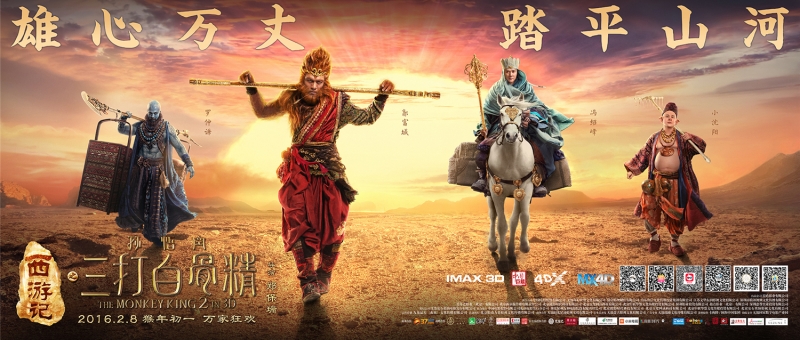
The Monkey King 2 (西遊記之孫悟空三打白骨精, Cheang Pou-soi, 2016)

Monkey King 2 posterThe Monkey King returns! Again! This time it’s Aaron Kwok (who, confusingly enough, played the villain in the first film) picking up the staff of the titular hero for Cheang Pou-soi in place of martial arts star Donnie Yen but otherwise it’s business as usual for the mischievous Sun Wu Kong as he finally sets off on his journey to the west with the preliminaries already well sorted out. After 500 years trapped under a mountain, you’d think Wu Kong might have had some time to reflect on his behaviour but alas, there is still a very long journey ahead of him

So, 500 years after the end of the first film which saw Wu Kong imprisoned under Five Finger Mountain by the Goddess of Mercy, a young monk, Xuanzang (William Feng Shaofeng), gets himself into a sticky situation with a giant white tiger. Crawling into a crevice to hide, he finds himself face to face with Wu Kong who urges him to remove the magic tag which keeps him imprisoned. Xuanzang, little understanding what he’s letting himself in for, tugs on the tag. Wu Kong busts right out of his rocky cage and valiantly defeats the “evil demonic” tiger. Of course this is all in the grand plan envisioned by the Goddess (Kelly Chen) who has a mission for Wu Kong – escort Xuanzang to the West where he will find a set of scriptures which will unlock the truths of the world.

Monkey King 2 (西遊記之孫悟空三打白骨精) focusses on Wu Kong’s battle with the White Lady (AKA White Boned Demon, played by Gong Li) who has been nursing a deep and incurable grudge for even longer than Wu Kong was trapped under that mountain. Like Wu Kong, the White Lady was rejected by her own kind, blamed for something that wasn’t her fault and cast out as a demon to be pecked to death by vultures all alone on a rocky outcrop. You can understand why she’d be upset, but rather than an end to her suffering the White Lady wants only immortality to indulge her grudge still further. Unfortunately for Wu Kong, she has taken a fancy to Xuanzang who she thinks would make quite the tasty snack and help her live forever as a demon rather than die as a hated human – one of those who has so badly wronged her.

Wu Kong serves the Goddess of Mercy but his primary motivation in accompanying Xuanzang is to get the metal tiara he’s wearing taken off so he can misbehave again. Nevertheless, through their journey Wu Kong develops deep respect for the goodhearted monk even if they do not always see eye to eye. Wu Kong whose fiery eyes see one kind truth can recognise a “demon” when he sees one and his hardheartedness means he has no trouble killing them on sight. Xuanzang by contrast sees with his heart and is constantly troubled by Wu Kong’s desire for violence even if it’s in his name. Wu Kong sees Xuanzang’s philosophy of love and forgiveness as naive and prefers to be proactive in the face of danger (his fiery eyes do, after all, ensure he is “right” when comes to identifying demons), but Xuanzang worries that Wu Kong’s unforgiving heart creates only more suffering in a world already overflowing with negative emotions and their unfortunate effects.

It is, however, the Monkey King who is on a journey here – away from selfish mischief and towards a more responsible use of his vast powers. Wu Kong is tempted by the White Lady, seductively played by Gong Li with a strangely alluring quality of malevolence. Yet for all that (when all that sometimes means eating innocent monks and being suspected of drinking the blood children), the White Lady is not completely unsympathetic and Xuanzang’s desire to save her admirable in his commitment to lifting those in pain out of their dark places even if it comes at great personal cost to himself.

Kwok makes for a less cartoonish Monkey King than Yen, embracing the impulsivity of the unpredictable Wu Kong but also capturing something of his complicated emotional landscape as he finds himself drawing closer to Xuanzang’s way of thinking only to rebel against himself. Learning from the mistakes of the first film, Cheang ends the headache inducing sugar rush in favour of a more normal Chinese fantasy aesthetic while also ensuring the (still frequent use of) CGI is of a much better (if imperfect) quality. All in all, the second venture of the Monkey King can be counted a success which is fortunate indeed because his journey is far from over.


Original trailer (English subtitles)

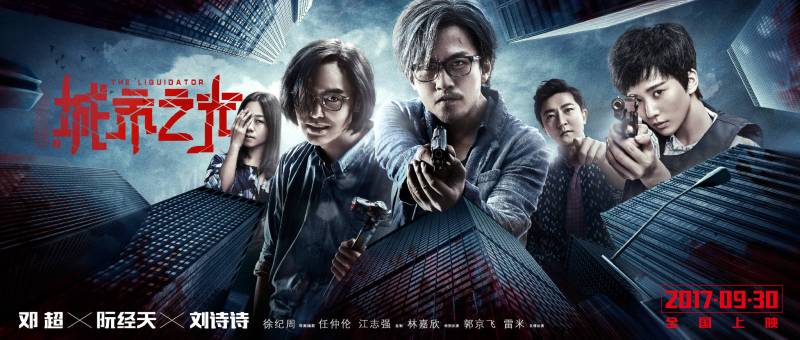
The Liquidator (心理罪:城市之光, Xu Jizhou, 2017)

The Liquidator posterGiven a strangely ‘80s nonsensical two word title, Xu Jizhou’s The Liquidator (心理罪:城市之光, Xīnlǐ Zuì: Chéngshì Zhī Guāng) is a retro throwback to the lurid macho pulp which has largely faded from the crime procedural since its ‘90s heyday. Adapted from a novel by Lei Mi, the film follows last year’s Guilty of Mind as the second in the Fang Mu series only this time the eccentric profiler is played by marquee star Deng Chao rather than Guilty Mind’s Li Yifeng or Chen Ruo Xuan who starred in the Fang Mu TV drama, Evil Minds. A pulpy battle of wits between a crazed vigilante and a world weary cop, The Liquidator is already treading on some overly familiar territory but its main target is the rule of law apparently under threat of mob justice now that China too has entered the social media age.

Fang Mu (Deng Chao) is no longer a police officer after becoming the prime suspect in the disappearance of a man who escaped justice through judicial corruption, but he’s pulled back into the law enforcement fold when young policewoman Mi Nan (Cecilia Liu) is dispatched to get his profiling opinion on a difficult murder case. Calling himself “The Light of the City”, a vigilante killer is already amassing a collection of dedicated online followers thanks to his choice of targets which, to put it bluntly, are not law breakers just terrible people that most would like to get revenge on for one reason or another.

Originally reluctant, Fang Mu is soon hooked on the case only to realise that the crime scenes are being created entirely for his benefit – the killer is attempting to pull him into a battle of wits and taking innocent lives to do it. As it transpires the killer’s name, Light of the City, is inspired by something Fang Mu said in his graduation speech to the effect that the police are the light that shines in the darkness. The killer thinks the law doesn’t go far enough – his targets are bullying teachers, impious sons, and greedy lawyers, the immoral rather than the criminal. He exposes their transgressions online and then allows “netizens” to have their say. Netizens, as they have often been in the “real” world, are not a particularly understanding bunch and are firmly behind the “entertainment” the killer is providing, even down to the decision to live stream a murder.

Fang Mu’s defining trait is his liminal status as a law enforcement officer often pulled towards the dark side – hence why many of his colleagues think it’s perfectly possible that he’s guilty of the crime that got him kicked off the force. The vigilante’s “plan” is to pull him over the line by forcing Fang Mu to execute The City of Light and thereby become the thing he most fears. The Liquidator posits that a robust judicial system free from interference from both government and people is a prerequisite of a well functioning society and the police must be the shining beacons of these laws – if not even law enforcement obeys the law, then all is lost.

What transpires is a battle of minds between the brainy Fang Mu and the psychotic killer, but it’s also a battle for the soul of “society” which ought to place compassion and rationality over the sensationalism of trial by media and arbitrary mob justice. The killer works out his frustrations by proxy through attacking those who committed the same “crimes” which have led to their feelings of frustration and humiliation – chief among them being Fang Mu who has, apparently, offended solely in his continued excellence, but the killer’s personal vengeance is harsh and unforgiving, handing down a death sentence simply for unpleasant or anti-social behaviour.

Beginning in a promising vein, Xu nevertheless introduces his dedicated female cop only to sideline her in favour of Fang Mu before turning her into a mild love interest, potential victim, and sometime comic relief. Filled with macho histrionics (including, at one point, a gun fired in the air followed by a manly wail of grief), The Liquidator is an old fashioned action drama filtered through pulp noir and ‘90s horror with its grimy walls and dingy basements, but it straddles a fine line between ridiculous slasher serial killer thriller and serious cerebral procedural, landing somewhere around heroic bloodshed without the bromance. Ridiculous and melodramatic, Xu’s debut feature boasts excellent production design and innovative photography, but its slick aesthetic cannot overcome the more outlandish elements of the otherwise generic script.


Currently on limited release in UK cinemas courtesy of Cine Asia

Original trailer (Mandarin with English subtitles)

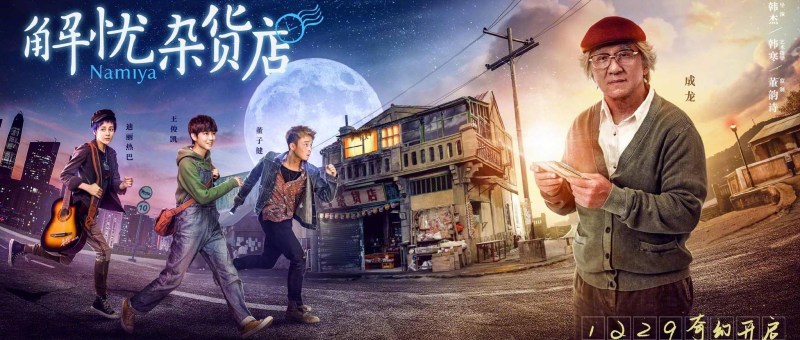
Namiya (解憂雜貨店, Han Jie, 2017)

Namiya posterKeigo Higashino is almost certainly best known for his crime novels and in particular his most famous detective, Galileo, whose exploits have spawned a successful TV drama series and a fair few cinematic adaptations including the international bestseller, The Devotion of Suspect X. One might expect a writer of mystery novels to be a fierce rationalist, but Higashino occasionally dabbles in the fantastic – The Miracles of the Namiya General Store is more or less a nostalgia fest praising the pre-bubble Japan, implying that the modern world is colder and less kind than the aspiring society of 1979. Adapted for the Chinese market by Han Jie, Namiya (解憂雜貨店, Jiě Yōu Zá Huò Diàn) retains the corner shop where time stands still but locates it in 1993, which is not so much a significant date save being 25 years in the past.

On New Year’s Eve 2017, three teens break into a woman’s home with the idea of causing some damage, but the event goes south when she comes home early and one of the three decides to tie her up and steal a bunch of her stuff. Having gone further than they meant to, the trio wind up in an unfamiliar part of town when the car they’ve stolen runs out of petrol. An improbably quaint, apparently disused corner shop attracts their attention but when they break in to shelter for the night they discover that this is no ordinary store. A ghostly miasma gradually creeps its way in and the three youngsters find themselves answering a collection of letters meant for the store’s owner written in 1993 but only dropping through the letter box now. They funny thing is, they get almost immediate replies.

As one of the teens points out, they weren’t even born in 1993 – this store might as well be from 1793 as far as they’re concerned. Though it drips with nostalgia for a simpler time, Namiya treads (understandably) more carefully in painting early ‘90s Beijing and its rural backwater setting, strenuously avoiding any mention of politics and characterising China’s economic development as an entirely good thing despite the troubles the three teens at the centre have been subject to throughout their apparently difficult lives.

The letter writers have various problems but each in someway relates to being a little lost, a little bit confused about how to move forward in life. A frustrated musician (Lee Hong-chi) whose career is not taking off wants to know whether he should give up and come home, a little boy has a bad relationship with his go-getter parents who have lost all their money and got into trouble with loan sharks, and a melancholy bar hostess (Hao Lei) wants to know if she should become the mistress of a gangster who promises to set her up in a shop that would get her out of her dead end life and still enable her to support her family. The kids are not really qualified to offer any kind of real life advice, with sensitive Xiaobo (Karry Wang) and plucky Tong Tong (Dilraba Dilmurat) reacting in broadly sympathetic terms while the sullen Jie takes a hardline moralist stance in which he just wants to write angry letters to everyone telling them they’re doing everything wrong.

Jie has his own reasons for being so angry, especially as one of the letters touches a nerve in his own personal history but his ambivalence was at one point shared by Papa Namiya (Jackie Chan) himself after he feared his treasured advice might have ended up having a negative effect on people’s lives. Papa Namiya tells the troubled little boy to stick with his parents no matter what because family is the most important thing in a person’s life which might be true much of the time, but not when the parents actively endanger their child. What he finally reassures himself with is that his advice was largely meaningless because most people have already made up their minds what they’re going to do, they just want someone to help them feel like they’re doing the right thing. In fact, no one really follows Papa Namiya’s advice anyway, but the kids are able to make a concrete change when they reveal the economic realities of modern China to a young hopeful who then uses the knowledge to build an international business empire (but makes sure to pay it forward whilst paying tribute to their roots by committing to sponsor an orphanage in need of renovation/expansion).

The slightly awkward message Namiya leaves behind is that dreams come true when people work hard to achieve them but that the young are also free to forge their own destinies, that the world is, for them, infinite and filled with boundless possibility. Optimistic and inspiring as it is, it isn’t terribly realistic and does rather imply that those who haven’t made it are either lazy or dishonest as echoed in the mildly moralistic tone taken with the bar hostess’ dilemma or the odiousness of the corrupt businessman and his failure to protect his family from his own mistakes. Moral judgements and naivety aside, Namiya is an otherwise heartwarming, deliberately uncynical New Year tale which does its best to engender hope for the future in an otherwise cold and unforgiving month.


Currently on limited release in UK cinemas.

Original trailer (Mandarin with English subtitles)

Youth (芳华, Feng Xiaogang, 2017)

youth posterOn the surface of things, one might be forgiven for thinking that Feng Xiaogang, “China’s Spielberg” – the director of such fluffy hits as If You Are the One and the prestige picture The Banquet, might not be the one to look to for nuanced takes on the state of his nation but, as he proved with the irony filled I am Not Madame Bovary, there has always been a persistent resistance in his superficially crowd-pleasing filmography. The exact nature and extent of that resistance is however harder to assess. Youth (芳华, Fāng huá), Feng’s latest historically probing epic, made headlines when its mainland release was blocked at short notice immediately before its international premiere at the Toronto International Film Festival and in some respects it’s easy to see why it may have raised an eyebrow or two at the censor’s board. A literal story of “youth” and the various ways that the concept becomes romanticised even when one’s own coming of age took place in otherwise difficult times, Feng’s film is also the story of modern China, baptised in the fire of the Cultural Revolution only to finally succumb to the consumerist one 15 years later.

Narrated by bystander Suizi (Zhong Chuxi), later a successful author apparently looking back on her own “youth” with a writerly eye, the tale begins in the early 1970s with two pillars of the arts division of the People’s Liberation Army. Suizi informs us the the protagonists of this story are Lui Feng (Huang Xuan) – a model soldier, and Xiaoping (Miao Miao) – a poor girl mercilessly tormented by everyone throughout her entire life. Xiaoping’s birth father has long been languishing in a re-education camp but as she’s taken her step-father’s name, Liu Feng assures her that he’s kept her bad class background off her record and will make sure no one else knows about it.

Performing propaganda ballets, the arts division is at its zenith at the height of the Cultural Revolution. The troop as a whole enjoys extreme privilege – they are well fed and cared for, evade the dangerous front line work many other members of the armed forces are subject to, and receive the respect due to them as the embodiment of a revolutionary ideal. They are, however, still guilty of the various hypocrisies coded into the system. Though many of the dancers have family members with “bad class backgrounds”, undergoing re-education or otherwise better not mentioned, the top guys and girls are the ones with parents high up in the party who use their untouchable status to paper over cracks in their own development with inherited superiority.

Lui Feng is perhaps an aberration. Nicknamed “Lei Feng” – a mythical figure created for propaganda purposes to embody the “ideal” revolutionary soldier in his selfless dedication to his comrades and communist virtues, Lui Feng is indeed a model party member whose goodness and kindness know no bounds. Unlike Lei Feng, however, he is a real man of flesh and blood not some far off and untouchable god. Having sanctified him in this way, the collective has effectively raised Lui Feng up to an unfair and unattainable ideal and is then “betrayed” on realising that Lui Feng is a man with a man’s hopes and desires. Lui Feng’s transgression is inappropriate to be sure but also somehow innocent in its naivety and his counter betrayal by the system to which he has dedicated his life all the more difficult to bear because of the unfair deification his better qualities have earned him.

Xiaoping meanwhile, who expected only betrayal, betrays the system through passive resistance in resentment of the way it has treated her friend. “Abandoned” by the collective which is the arts troop, Xiaoping exiles herself from a society she thinks has little need of her yet she then continues to serve it fully as a frontline nurse. The “youthful” idealism of Lui Feng and Xiaoping is tested as they find themselves caught up in a far off war while their former comrades dance around with wooden swords on a painted stage. Wounded in body and mind, the pair continue onwards even as their nation conspires to leave them behind.

Shifting into the ‘90s and then the 21st century, Feng’s messages become muddier and harder to grasp. In one sense what is celebrated is “youth” itself which, in this case, happened to take place against the backdrop of terrible events (albeit it ones from which many of the protagonists save Lui Feng and Xiaoping were largely shielded) enabling the growth of a generational family destroyed by a change in the political wind. It is however hard not to infer that everything was better during the turbulent ‘70s in which the delusion of innocence, if not its actual existence, was easier to bear than the soulless march into the future of Coca-Cola signs, Transformers toys and fathers who never come home because they’re too busy making money. Feng’s heroes are the ones who exiled themselves from the reality of China as a modern economic superpower, holding fast to their innate senses of honour and justice, yet in this Feng does to them exactly what he criticises his society for doing – he makes them martyrs, mythologises them as embodiments of revolutionary ideals, a pair of real life Lei Fengs all over again. In telling a story of how the revolution betrays and is betrayed, Feng makes the heroes emerge damaged but unbroken, chaste children trapped by the “innocence” of the pre-capitalist age, but whether their survival is victory or defeat remains unclear. 


Youth is currently screening at selected cinemas across the UK courtesy of CineAsia.

UK release trailer (English subtitles)

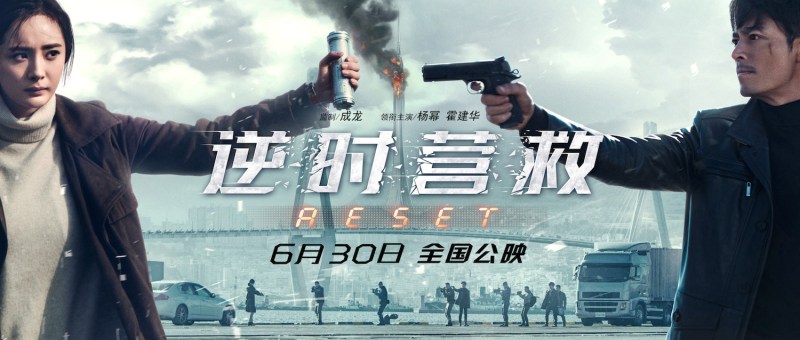
Reset (逆时营救, Chang, 2017)

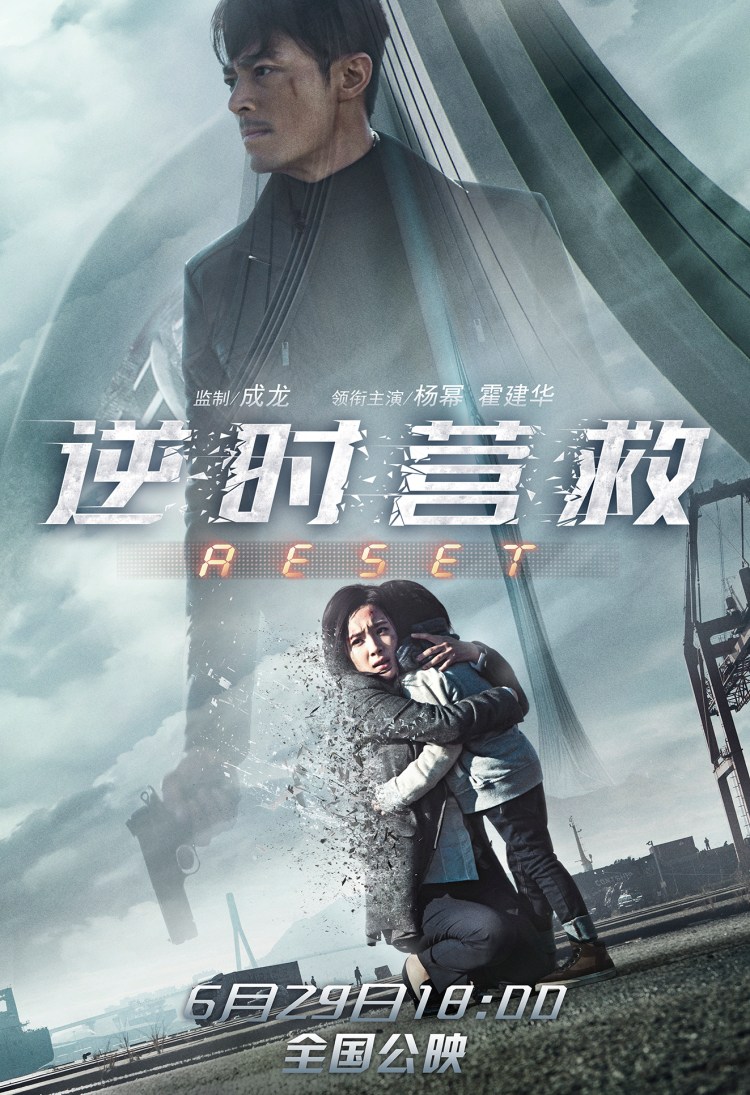
reset posterTime travel – the solution to all one’s problems. Or is it? Chinese thriller Reset (逆时营救, Nì shí yíngjiù) is helmed by Korean director Chang (AKA Yoon Hong-seung) but it’s also produced by Jackie Chan and is very much in the vein of his recent projects in its non-sensical sci-fi setup and troubling conservative messages. Reset casts a female scientist as its heroine but uses the crisis to explore her ongoing guilt as a single mother with an intense workload who has chosen to dedicate herself to both her work and her son without remarrying. Despite the action packed drama in which Xia Tian plots, shoots, and stabs her way back to her son, the message which is ultimately delivered is that you can’t go back in time and mothers should just give up everything to be with their kids 24/7.

In the near future, the existence of parallel worlds has been confirmed but early research into time travel has been derailed after test subjects transported between universes descended into mindless violence destroying each other and valuable data. Xia Tian (Yang Mi) works for one of the big companies still investigating parallel world theory and has just made a major breakthrough in “projecting” test subjects into the recent past. In order to steal her research for a rival company, Xia Tian’s young son Doudou is kidnapped by mysterious men who give her a limited amount of time to hand over the top secret documents. Xia Tian’s first attempt to rescue her son fails, leading her to make personal use of her findings and travel into the past to change the future.

Reset starts as it means to go on with Xia Tian having a heart to heart with her boss and mentor (King Shih-Chieh) who reminds her that it’s been ages since she broke up with Doudou’s dad and its high time she find someone new. Xia Tian, embarrassed, says she’s dedicating herself entirely to Doudou and doesn’t need anyone else. The bond between mother and son is the focus of the film (though Xia Tian’s clinginess may become an ongoing problem as Doudou grows up) as Xia Tian travels through time to ensure the survival of her little boy no matter how morally compromised she may eventually become.

Use of the time machine apparently has certain side effects, as the first experimenters discovered. The original Xia Tian was a sweet, innocent woman way out of her depth with these fearsome, amoral gangsters but Xia Tian 2 is much more savvy, chloroforming the “nice” version of herself and taking over with the power of hindsight to help her get out of the building before all hell breaks loose. Xia Tian 3, however, has taken things too far, acting without any kind of concession to morality and suddenly becoming some kind of major action star with special forces training for no given reason. There might be a clever point about Xia Tian’s various conflicting roles but Reset doesn’t want to make it so much as have Xia Tian help/hinder herself in a selfish tug of love to save little Doudou who just wants to go home to his mum.

Non-sensical as it is, Reset picks up when it hits its action heavy final third in which Yang Mi, more often seen in sweetly romantic roles, acquits herself well enough as a fiery action star filled with maternal rage. The various layers of the resets generally hang together as the three Xia Tians cross each other’s paths to get Doudou to safety, only to belatedly realise that only one of them can really stay with him forever.

Maternal love is the machine which drives the story forward but it’s also the most problematic element in its partial insistence than Doudou’s fate is somehow Xia Tian’s fault for daring to use her finely tuned brain for the common good rather than just staying home and reading comics with her little boy like a mother should. It’s difficult to escape the conclusion that the lesson is women shouldn’t work, rather than corporations are inherently untrustworthy and that time travel creates problems for everyone (not least editors and scriptwriters) and should generally be avoided. Despite high production values, interesting production design, and an impressive (or is that three impressive) performance(s) from Yang Mi, Reset’s strong action credentials cannot compensate for its unpalatable conservative message and non-sensical science fiction narrative.


Screened at the London East Asia Film Festival 2017.

International trailer (English subtitles)

Angels Wear White (嘉年华, Vivian Qu, 2017)

©22 HOURS FILMS

angels wear whiteChinese cinema has been preoccupied with stories of unfairness and systematic corruption for quite some time but they’ve rarely been as difficult to process and horribly universal as Vivian Qu’s Angels Wear White (嘉年华, Jiāniánhuá). A storm of conflicting social attitudes leaves young women open to the most terrible of manipulations while well placed men are infinitely protected by a system of deference and complicity. Women must be pure, angelic and draped in neutral white – a concept so deeply entrenched that it barely needs manipulating to be used as a tool of control.

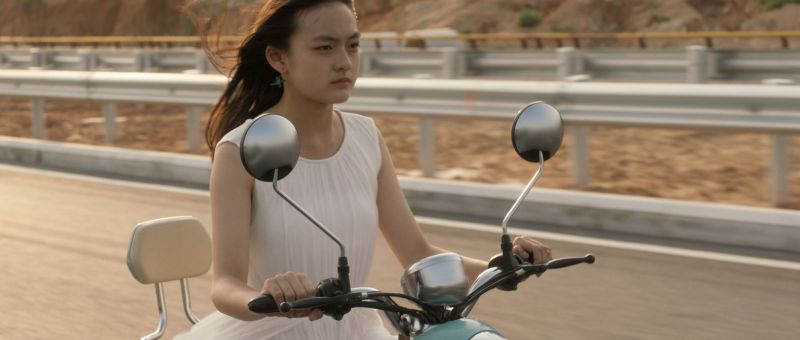
Teenage runaway Mia (Wen Qi) is working illegally at a seaside hotel. Wandering the beach before work, she’s rudely shoved out of the way by two hyperactive little girls who want to take a selfie underneath a colossal statue of Marilyn Monroe in her classic pose from the Seven Year Itch. Meanwhile, several sets of newlyweds are busy taking romantic photos in the picturesque though currently overcast coastal environment. Mia spots the girls again later when she is (illicitly) covering reception for a colleague and they’re brought in by a middle-aged man. Mia finds the man suspicious but seeing as he books two rooms lets it go. She pauses slightly when the still over excited girls order themselves a few beers, but delivers the drinks and leaves the girls to it. Remaining worried she keeps her eyes on the CCTV and eventually spots the man trying to enter the girls’ room but does nothing other than record it on her smartphone.

The two girls, Xiaowen (Zhou Meijou) and Xinxin (Jiang Xinyue), are so young they don’t even quite understand what’s happened to them except for a lingering feeling that they’ve been involved in something bad that will get them into trouble. Xiaowen, on the surface at least the more affected by the incident, has a difficult relationship with her parents which leaves her with no one to confide in and no one to defend her. Xinxin eventually tells her mother what happened and we realise the perpetrator is a police chief and the boss of Xinxin’s father who had made him a godparent as a way of currying favour at work leaving Xinxin’s mother to make the reasonable accusation that he has, in fact, sold his daughter to his boss for the prospect of career advancement. Where Xinxin’s mother is angry with her husband but apparently solicitous for her injured daughter, Xiaowen’s mother projects her own guilt for her neglectful parenting onto hers whom she slaps for apparently “slutty” behaviour, cutting her hair short like a boy’s and taking away her pretty dresses and makeup.

Sitting alone in the waiting room outside, Xinxin asks Xiaowen what a “hymen” is while her mother can be heard wailing loudly from inside the consultation room. The issue becomes less that a predatory man has caused irreparable harm to two innocent young girls, but that their honour has been destroyed along with prospects of future marriage now that they are no longer virgins. The problem is not that the girls are not believed or even that they are ignored. On the contrary, their story seems to be accepted to the point that it must be erased. The police chief himself remains unseen but his underling goes to great lengths to hush the case up, attempting to pay off Xinxin’s parents with the promise of healthy financial support on the condition that they drop the charges to avoid embarrassment to the chief but also, it is implied, to Xinxin who will avoid the social stigma of being the girl involved in the high profile rape case. Eventually reuniting with her father, Xiaowen finds a defender but even his outrage is not enough to see justice done as the full weight of a corrupt system comes together to crush his little girl for simply continuing to tell the truth.

It’s easy to ask why Mia did nothing to prevent such an obviously inappropriate situation but then again she is just a girl herself, not so much older than Xinxin and Xiaowen, and would not have been able to help beyond knocking the door to try and scare the man off. She should not have been manning reception in the first place, and is afraid of getting into trouble because she has no ID papers and is working illegally. Because of way the system works in China, Mia would need to go back to her home town get a genuine ID card which she seems reluctant to do leaving her open to multiple kinds of exploitation as she considers the best way to buy a fake one that will allow her to continue working in more legitimate businesses. Her life has been hard and she has come regard compassion as a weakness.

Mia also has to put up with the worrying advances from her friend and big sister figure Lily’s (Peng Jing) boyfriend, Jian (Wang Yuexin), who openly asks if she’s a virgin because he knows people who will pay good money for that kind of thing. Even Lily who seems more worldly wise is not immune to Jian’s heartlessness, later coming into work with rope burns on her wrists and dark glasses to hide a black eye. Before returning to her home village, Lily visits a clinic for painful surgery to reconstruct her hymen so that she can still get married in overly conservative China.

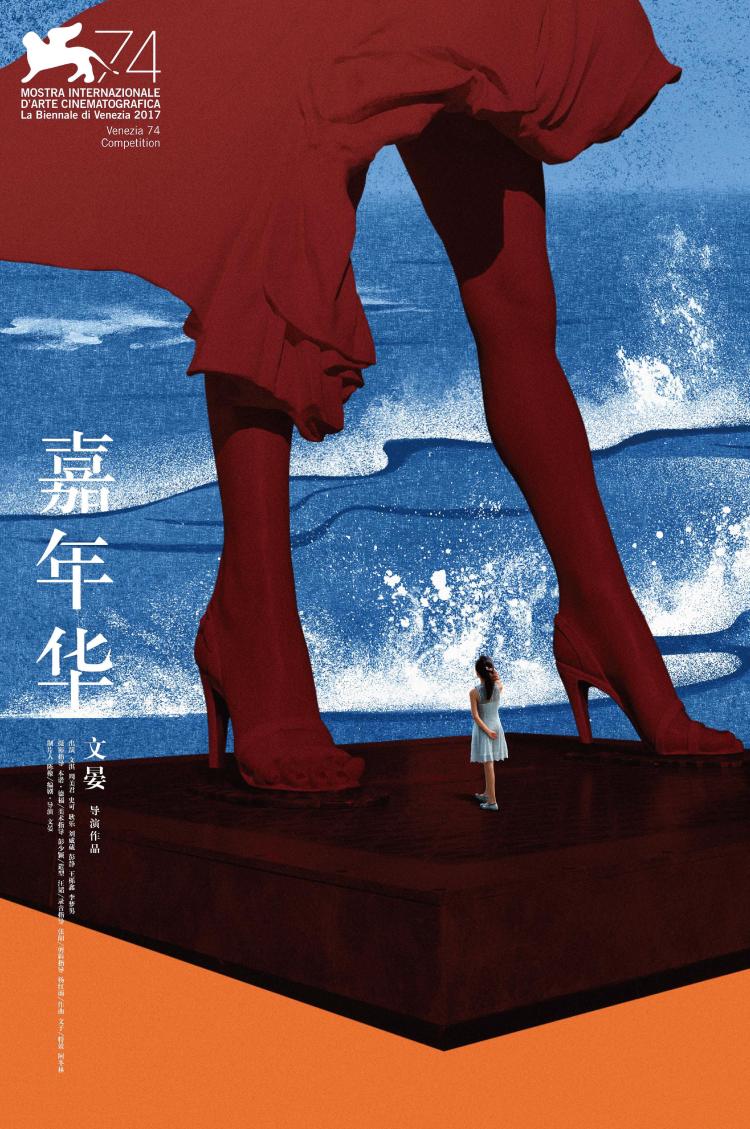
The statue of Marilyn Monroe seems incongruous enough but speaks to all of those same double standards which continue to disrupt the lives of these young women as she girlishly pushes down the skirt on her pure white dress, awkwardly posed on her matching bright white heels. Marilyn is sexualised innocence at its most uncomfortable. The only real defendant the girls have is a dogged lawyer who treats them with kindness, listening to their story with patience and respect in an attempt to uncover the real truth aside from what anyone may want to hear to think they are supposed to say.

Asked by an almost outsmarted policeman why she can’t find something more productive to do, the lawyer replies that there are simply “too many of these kinds of cases”. “Justice” remains a hollow ideal, an essentially fake construct designed to maintain the position of the powerful rather than protect the weak. Unrelentingly bleak but with the faintest glimmers of hope offered by Mia’s final decision, the female solidarity of the determined lawyer, and the newly rediscovered relationship of Xiaowen and her dad, Angels Wear White is a necessarily difficult and challenging piece but one which arrives at just the right time trailing a series of uncomfortable in its wake.


Screened at BFI London Film Festival 2017.

Clip (Mandarin with English subtitles)