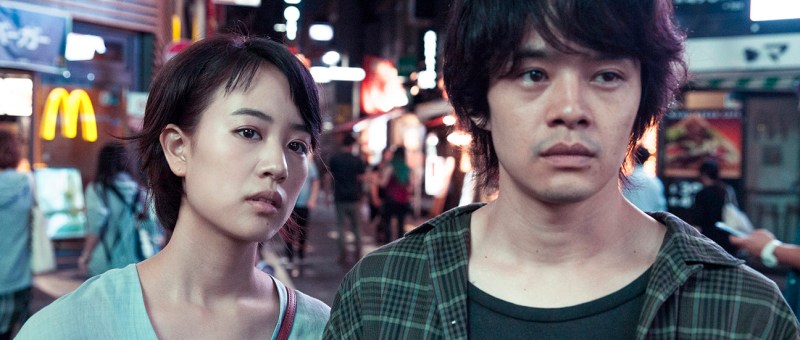
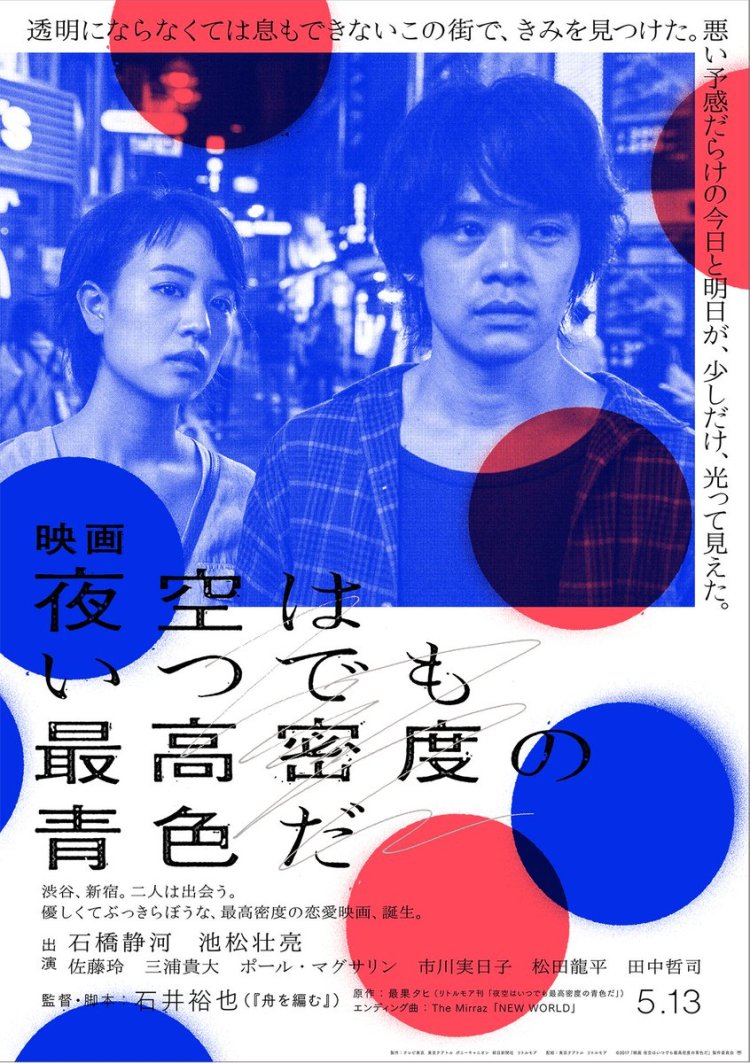
 Learning to love Tokyo is a kind of suicide, according to the heroine of Yuya Ishii’s love/hate letter to the Japanese capital, The Tokyo Night Sky is Always the Densest Shade of Blue (夜空はいつでも最高密度の青色だ, Yozora wa Itsudemo Saiko Mitsudo no Aoiro da). This city is a mess of contradictions, a huge sprawling metropolis filled with the anonymous masses and at the same time so tiny you can find yourself running into the same people over and over again. Inspired by the poems of Tahi Saihate, The Tokyo Night Sky is at once a meditative contemplation of city life and an awkward love story between two lost souls who somehow find each other in its crowded backstreets.
The heroine, Mika (Shizuka Ishibashi), works as a nurse by day and supplements her income by night as a bar tender in a “girls bar” (basically a normal bar where all the bartenders are female and you have to pay an entrance fee on top of your overpriced drinks). Depressed and anxious, she wanders the city with a poetic interior monologue expressing her constant loathing for its indifferent soullessness. Meanwhile, Shinji (Sosuke Ikematsu) is a casual day labourer working on various projects in the run up to the 2020 Olympics. He describes himself as odd and is over sensitive about being blind in one eye. Unlike his friends and colleagues, Shinji prefers literature to parties and solitude to company.
The two first catch sight of each other in a crowded bar where Mika is trying to buy time before having to head back to a dull double date with her drunken friend and the lewd guys she’s invited to come along, and Shinji is trying to read away from the noise and chaos of his lodging house. They meet again when one of Shinji’s colleagues suggests going to the girls bar, and then seem to be constantly running into one another for no particular reason.
Though romance would seem to be the natural outcome of the “pointless miracle” of their repeated meetings, the process is a slow one. It’s obvious the pair share a deep, innate understanding of each other but they each have various problems which conspire to keep them apart. Shinji, describing himself as odd and assuming he’s annoying, is prone to nervous babbling which Mika correctly guesses is less down to a love of his own voice than a fear of awkward silence. For her part Mika is anxious all the time, brittle and insecure she instinctively rejects attempts at intimacy but somehow warms to Shinji responding to his confession of oddness with a comforting “well then, you’re just like me.”
The pair advance and retreat as they wander around the city they both claim to hate but as much as they keep each other at a distance their lives begin to overlap and run in parallel. Mika receives a text from an ex (Takahiro Miura) with a confused declaration of love while Shinji receives one from an old high school classmate (Ryo Sato) with much the same effect. Mika insists that love makes you boring, that you’ll never find someone who is prepared to love the most pitiable part of you, and that there is no such thing as love on this planet, but her protestations point more towards a kind of soul-searching and buried hope than they do of active rejection.
Ishii marries the romantic undercurrent with an ambivalent portrait of the stratified city. Mika, a nurse by profession, needs to take a second job to make ends meet while the more traditionally working class Shinji is a sensitive intellectual relegated to dangerous and insecure employment. As a day labourer he gets no employment benefits like sick pay or insurance – hence when he’s injured on the job he avoids letting anyone know for as long as possible because it means both loss of wages and a doctor’s bill. An older friend (Tetsushi Tanaka) has ruined his back through long years of overwork and is now left with nothing while a Filipino migrant worker (Paul Magsign) pines for home and the wife and child waiting for him there.
Shinji’s anxieties are partly economic – trapped in insecure employment which may well, as his older friend points out, dry up once the Olympics rolls around but the greater problem is inertia. During their journeys around the city, Shinji and Mika run into the same busker (Yoshimi Nozaki) who is always singing the same strange song about her underarms sweating which seems to echo their shared anxiety. Yet the song she offers them also provides a note of hope as she enthusiastically reaches the “Ganbare!” chorus, cheering the pair of frightened lovers on and encouraging them to pursue their dreams and desires rather than waiting around for something to happen.
Waiting has been Mika’s problem. Saddled with intense abandonment issues stemming from childhood trauma, Mika is always sure something bad is about to happen. Shinji partly shares her anxiety often claiming that he has “a bad feeling” about something or other but conversely, he begins to believe that the “something” could be good as well as bad. Rather than try and argue with her, Shinji concedes most of Mika’s points, nobody knows what will happen in the future, nobody can make any promises, and everything ends someday but that’s OK – it’s only life.
Ishii’s Tokyo is a soulless place filled with the melancholy and the empty but there’s beauty here too, if only people would look up from their smartphones every now and then to see it. Mika is afraid of being swallowed by the city and becoming one of its faceless masses but her listlessness and depression stand for the city itself as she refuses and rejects the process of living with all of its attendant risks. Ishii paints the city in all the colours of the night, but for all of its beautiful sadness it’s also a place of noise and chaos where existence is exhausting and the price of living high. It is, however, also a place of ordinary miracles offering hope to the hopeless if only they are willing to accept it.
The Tokyo Night Sky Is Always the Densest Shade of Blue was screened at the 17th Nippon Connection Japanese Film Festival.
Original trailer (no subtitles)

 Generally speaking, murder mysteries progress along a clearly defined path at the end of which stands the killer. The path to reach him is his motive, a rational explanation for an irrational act. Yet, looking deeper there’s usually something else going on. It’s easy to blame society, or politics, or the economy but all of these things can be mitigating factors when it comes to considering the motives for a crime. Gukoroku – Traces of Sin (愚行録), the debut feature from Kei Ishikawa and an adaptation of a novel by Tokuro Nukui, shows us a world defined by unfairness and injustice, in which there are no good people, only the embittered, the jealous, and the hopelessly broken. Less about the murder of a family than the murder of the family, Gukoroku’s social prognosis is a bleak one which leaves little room for hope in an increasingly unfair society.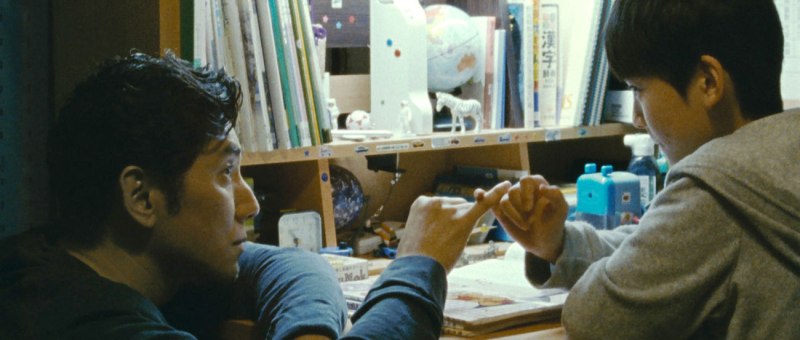
 Self disgust is self obsession as the old adage goes. It certainly seems to ring true for the “hero” of Miwa Nishikawa’s latest feature, The Long Excuse (永い言い訳, Nagai Iiwake) , in which she adapts her own Naoki Prize nominated novel. In part inspired by the devastating earthquake which struck Japan in March 2011, The Long Excuse is a tale of grief deferred but also one of redemption and self recognition as this same refusal to grieve forces a self-centred novelist to remember that other people also exist in the world and have their own lives, emotions, and broken futures to dwell on.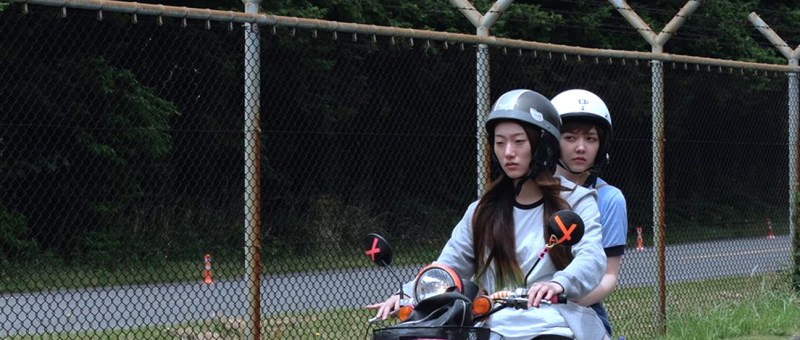
 When you think of the American military presence in Japan, your mind naturally turns to Okinawa but the largest mainland US base is actually located not so far from Tokyo in a small Japanese town called Yamato which is also the ancient name for the modern-day country. The US has been a constant presence since the end of the second world war prompting resistance of varying degrees from both left and right either in resentment at perceived complicity in American foreign policy, or the desire to reform the pacifist constitution and rebuild an independent army capable of defending Japan alone. Daisuke Miyazaki’s second feature, Yamato (California) (大和(カリフォルニア) dramatises this long-standing issue through exploring the life of hip-hop enthusiast and Yamato resident Sakura (Hanae Kan) who idolises an art form born of political oppression in a country which she also feels oppresses her as a Japanese citizen living on the other side of the fence from land which technically still belongs to the US government.
 “Memories are what warm you up from the inside. But they’re also what tear you apart” runs the often quoted aphorism from Haruki Murakami. SABU seems to see things the same way and indulges an equally surreal side of himself in the sci-fi tinged Happiness (ハピネス). Memory, as the film would have it, both sustains and ruins – there are terrible things which cannot be forgotten, no matter how hard one tries, while the happiest moments of one’s life get lost among the myriad everyday occurrences. Happiness is the one thing everyone craves even if they don’t quite know what it is, little knowing that they had it once if only for a few seconds, but if the desire to attain “happiness” is itself a reason for living could simply obtaining it by technological means do more harm than good?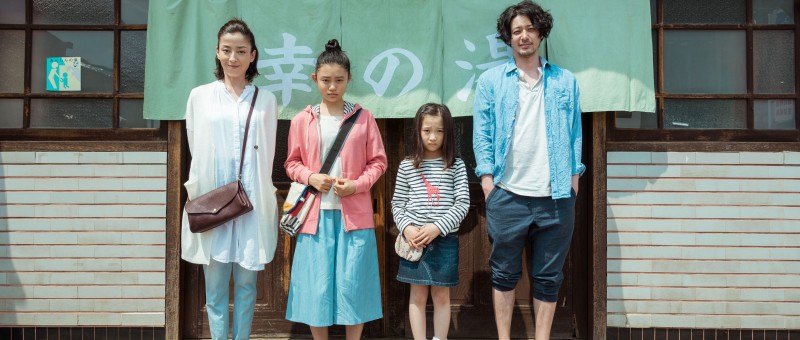

 It’s a strange paradox that in a land defined by corruption of the legal system, your only hope my lie in a new trial. So it is for the hero of Kim Tae-yun’s latest film. Inspired by a real life miscarriage of justice (a case which was in fact still continuing at the time of filming), New Trial (재심, Jaesim) takes aim at everything from social inequality to unscrupulous lawyers and abuse of police power. A teenager pays dearly for being in the wrong place at the wrong time, not only losing 10 years of his life but the entire possibility of his future now that he’s forever branded a criminal. That’s aside from leaving his ageing (now blind mother) alone with no means of support and the additional burden of trying to clear her son’s name.
 Each year the Nippon Connection film festival runs a retrospective programme alongside its collection of recent indie and mainstream hits. The subject for this year’s strand is Nikkatsu’s Roman Porno. Heading into the 1970s, Japanese cinema was in crisis mode as TV poached cinema audiences who largely stayed away from the successful genres of the 1960s including the previously popular youth, action, and yakuza movies which had been entertaining them for close to 20 years. Daiei, one of the larger studios known for glossy, big budget prestige fare alongside some lower budget genre offerings went bust in 1971, Shochiku kept up its steady stream of melodramas, but Nikkatsu found another solution. Taking inspiration from the “pink film” – a brand of soft core, mainstream pornography shown in specialised cinemas and made to exacting production standards, they created “Roman Porno” which made sex its selling point, but put big studio resources behind it, bringing in better actors and innovative directors to lend an air of legitimacy to its purely populist ethos.
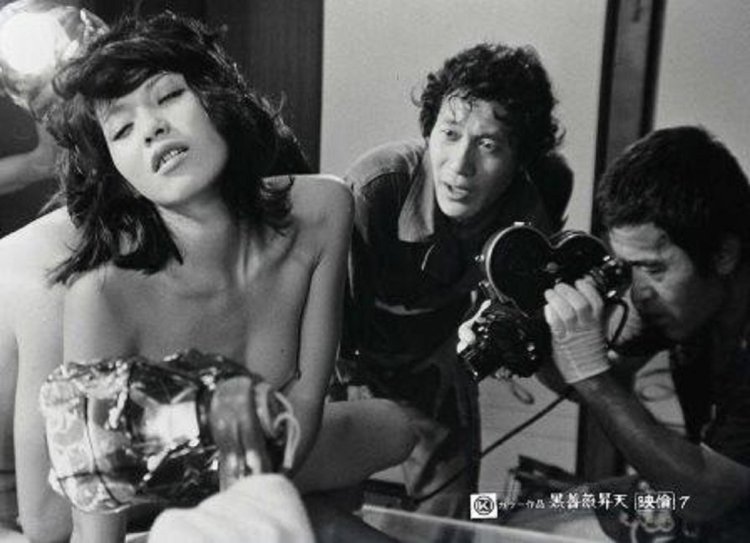 Ecstacy of the Black Rose is a more comedic effort than most of Kumashiro’s output and takes an ironic look at the genre as a put upon director gets fed up when his leading actress falls pregnant and becomes obsessed with finding a woman whose moans he overheard at the dentist’s.
 Following Desire received a Kinema Junpo award for best screenplay as well as the best actress prize for Hiroko Isayama who plays a stripper intent on taking down her rival for the top spot!
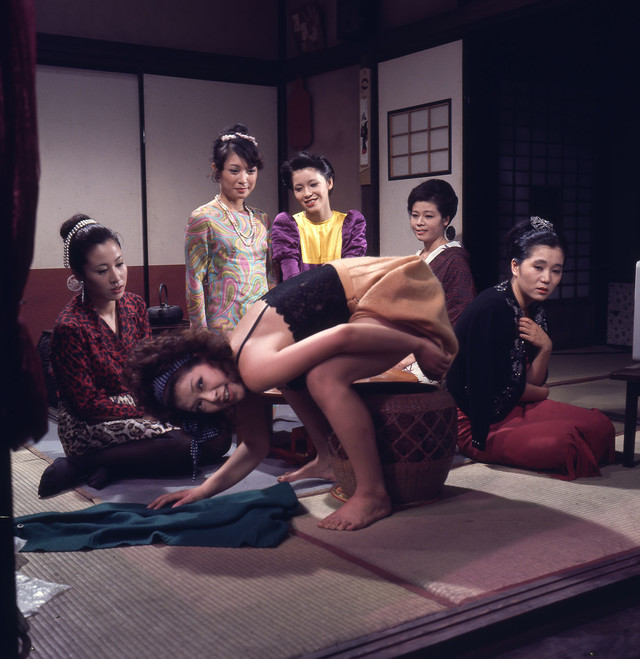 Kumashiro’s Tamanoi Street of Joy takes place on the last day of legal prostitution in 1958 and follows the girls as they mark the occasion in their own particular ways.
 Further proving Kumashiro’s critical stature, Twisted Path of Love was among Kinema Junpo’s 1999 list of the greatest Japanese films of the 20th century. The story of a young man who returns to his hometown but attempts to shed his identity, burning a hole in the conventional village life through sex and violence, Twisted Path of Love also displays Kumashiro’s interesting use of common censorship techniques for artistic effect.
 Often regarded as Kumashiro’s masterpiece, The Woman with the Red Hair picked up a Kinema Junpo best actress award for Junko Miyashita, as well as ranking fourth in their annual best of the year list. The story centres on construction worker Kozo who, along with friend Takao, rapes his boss’ daughter who subsequently becomes pregnant. While she asks Takao to marry her, Kozo embarks on an affair with the mysterious red-haired woman.
 Another of Kumashiro’s most well-regarded Roman Porno, The World of the Geisha takes place in a geisha house in 1918 and examines the various tensions which exist between the women themselves and their customers who have come to the house to escape external political concerns. The film again demonstrates Kumashiro’s tendency to ironic commentary as he tampers with intertitles to make a point about censorship.
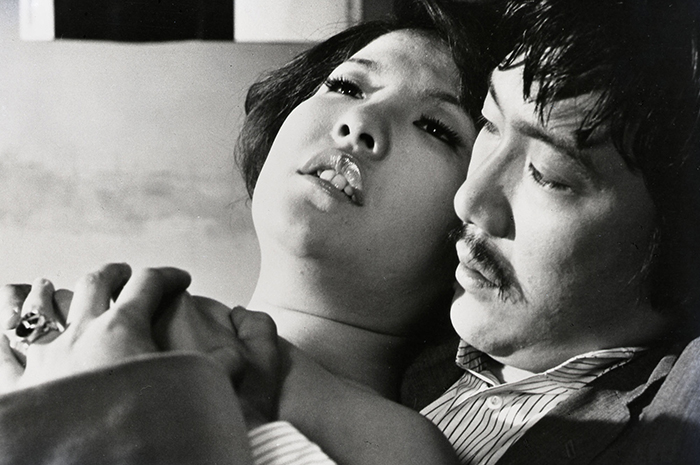 Night of the Felines provides the inspiration for Kazuya Shirashi’s reboot Dawn of the Felines and follows the comical adventures of three prostitutes.
 Stroller in the Attic is among the best known in the Roman Porno canon and adapts an Edogawa Rampo short story about a ’20s boarding house filled with eccentric guests.
 Inspired by the same real life case as In the Realm of the Senses, Noburu Tanaka’s Sada and Kichi takes a more lurid look at the strange case of Abe Sada who strangled her lover after a brief affair and then cut off his genitals to wear as a kind of talisman.
 Like the rest of the world, China, or a given generation at least, may be finding itself at something of a crossroads. The past few years have seen a flurry of coming of age dramas in which the melancholy and middle-aged revisit lost love from their youth but Derek Tsang’s Soul Mate (七月与安生, Qīyuè yǔ Anshēng) seems to be speaking to an older kind of melodrama in its examination of passionate friendship pulled apart by time, tragedy, and unspoken emotion. The story is an old one, but Tsang tells it well as its twin heroines maintain their intense, elemental connection even whilst cruelly separated.
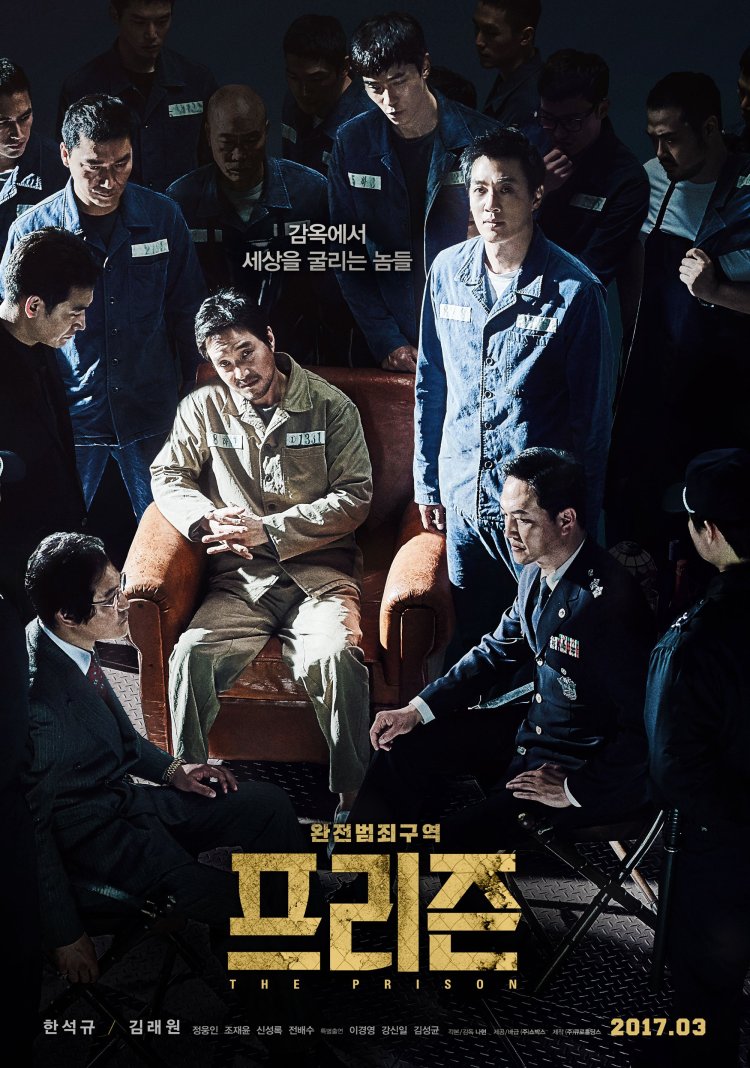 Prison can be a paradise if you’re doing it right, at least if you’re a top gangster in the movies. Na Hyun’s The Prison (프리즌) paints an interesting picture of incarceration and the way it links into his nation’s infinitely corrupt power structures. When investigators wonder why a crime spree suddenly came to an end, one of the frequently offered explanations is that the perpetrator was most likely arrested for another crime but what if you could turn this obviously solid alibi to your advantage and get those already behind bars to do your dirty work for you?
