
Review of Hideo Nakata’s Dark Water first published by UK Anime Network.
For good or ill, the J-horror boom came to dominate Japanese cinema at the turn of the century and if anyone can be said to have been instrumental in ushering it in, director Hideo Nakata and novelist Koji Suzuki, whose landmark collaboration on The Ring has become symbolic of the entire genre, must be at the head of the list. Dark Water (仄暗い水の底から, Honogurai Mizu no Soko Kara) finds the pair working together again on another supernaturally tinged, creepy psychological thriller. Neatly marrying the classic J-horror tropes of freaky children and dripping wet ghosts, Dark Water also embraces aspects of the uniquely Japanese “hahamono” or mother movie which prizes maternal sacrifice and suffering above all else.
Yoshimi (Hitomi Kuroki), a nervous middle aged woman, is in the middle of a messy divorce with her exceedingly smug salaryman husband. Despite having been less than present during the marriage, Yoshimi’s husband now wants full custody of the couple’s five year old daughter, Ikuko (Rio Kanno). In order to aid her case, Yoshimi quickly finds an apartment and starts looking for a job. All seems to be going well except for the mysterious dripping stain on the ceiling which the building manager doesn’t seem very interested in fixing. Before long, strange events begin unfolding including unexplained puddles, a mysterious red children’s shoulder bag which keeps reappearing after being thrown out, and brief sightings of a little girl in a yellow raincoat….
Nakata opens the film with what is in effect a flashback sequence as Yoshimi waits for her own mother to pick her up from primary school. It quickly becomes apparent that Yoshimi’s relationship with her birth mother was an imperfect one which later ended in neglect and abandonment. Yoshimi continues to have frequent flashbacks to her childhood and harbours and intense fear of inflicting the same kind of damage her mother inflicted on her onto her own daughter. Ikuko is also left waiting at school when Yoshimi is kept late at a job interview – something which is eventually used against her in the court case. Though Yoshimi’s aunt reassures her that she’s doing a much better job than her mother did for her, Yoshimi is filled with doubts as to her suitability as a mother which are only further compounded by her intense love for her daughter and fear of losing her.
On top of her maternal worries and residual abandonment issues, Yoshimi also has a history of mental distress which her ex-husband uses to discredit her. It’s open to debate exactly how much of what appears to be happening is actually happening and how much a manifestation of a possible nervous breakdown, but aside from the supernatural shenanigans there are also real world dangers to consider including the missing posters for a girl who was around Ikuko’s age when she disappeared two years previously. The primary school headmaster is convinced that the girl was abducted by a third party but it also transpires that Mitsuko, like Yoshimi and as Yoshimi fears for Ikuko, was abandoned by her mother.
When it comes right down to it, Dark Water lays the blame for its supernaturally tinged evil firmly at the feet of divorce and family breakdown. The supposedly progressive primary school in which the main aim is to allow children freedom of expression is quick to tell the already overwrought Yoshimi that the “strange behaviour” they’ve been witnessing in Ikuko is essentially all her fault because of the divorce and disruption to Ikuko’s home life. Similarly, the central supernatural threat is born of maternal neglect, a symptom of the selfish individualism of the mother who has chosen to leave her child behind. Yoshimi has been jettisoned by her controlling ex-husband and her only thought is to keep her daughter with her, yet she is being made to pay for a social prejudice against atypical families such as those resulting from a “selfish” decision to dissolve a marriage.
Dark Water cleverly recasts Yoshimi as an idealised mother willing to sacrifice all to protect her child. As the situation intensifies, Yoshimi begins to feel as if she’s becoming a toxic presence in her daughter’s life. Rather than risk the same fate befalling her own daughter as has befallen her, Yoshimi opts to make herself the last link in the chain of abuse, freeing her daughter from her own baggage. In contrast with both Yoshimi and Mitsuko, Ikuko will always know that her mother loved her and will always be with her even if protecting her from afar.
Nakata conjures up a supremely creepy atmosphere filled with everyday horrors. The run down apartment complex in which Yoshimi finds her (presumably very reasonably priced) apartment is an unsettling world of its own with its strangely moist, dripping walls, eccentric residents, and rapidly decaying exterior. One of the most effective and visually interesting entries in the J-horror genre, Dark Water perfectly mixes creepy, supernatural horror with psychological drama culminating in a final sequence which doesn’t stint on the scares but proves emotionally devastating in the process.
Original trailer (English subtitles)
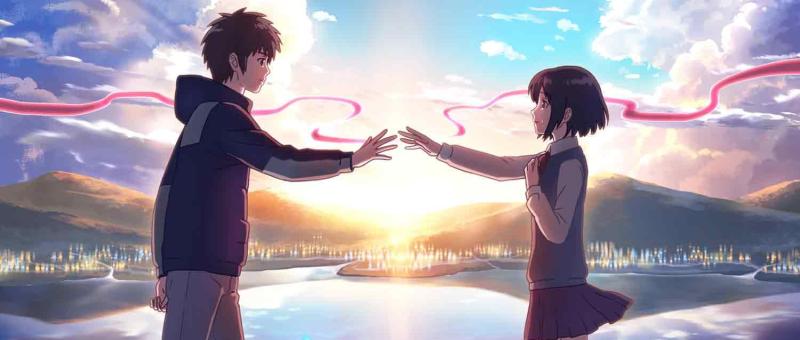
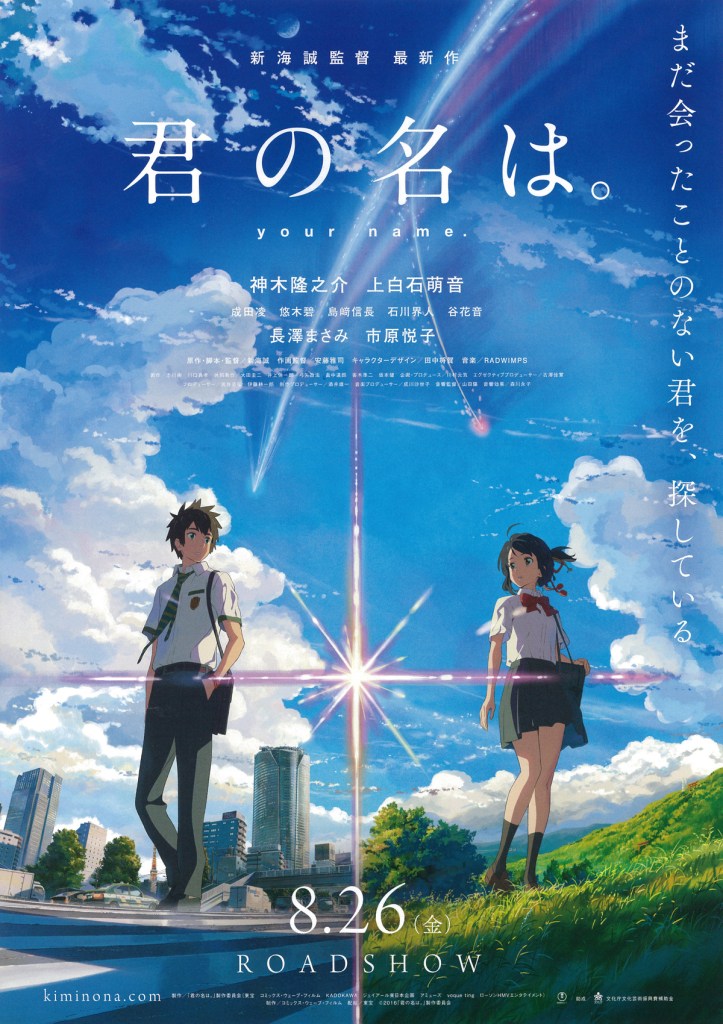 Indie animation talent Makoto Shinkai has been making an impact with his beautifully drawn tales of heartbreaking, unresolvable romance for well over a decade and now with Your Name (君の名は, Kimi no Na wa) he’s finally hit the mainstream with an increased budget and distribution from major Japanese studio Toho. Noticeably more upbeat than his previous work, Your Name takes on the star-crossed lovers motif as two teenagers from different worlds come to know each other intimately without ever meeting only to find their youthful romance frustrated by the vagaries of time and fate.
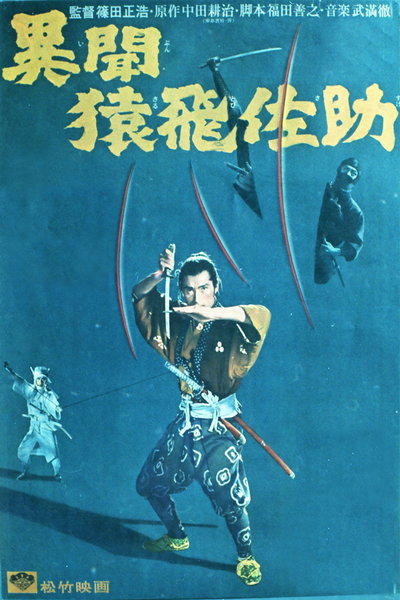 Nothing is certain these days, so say the protagonists at the centre of Masahiro Shinoda’s whirlwind of intrigue, Samurai Spy (異聞猿飛佐助, Ibun Sarutobi Sasuke). Set 14 years after the battle of Sekigahara which ushered in a long period of peace under the banner of the Tokugawa Shogunate, Samurai Spy effectively imports its contemporary cold war atmosphere to feudal Japan in which warring states continue to vie for power through the use of covert spy networks run from Edo and Osaka respectively. Sides are switched, friends are betrayed, innocents are murdered. The peace is fragile, but is it worth preserving even at such mounting cost?
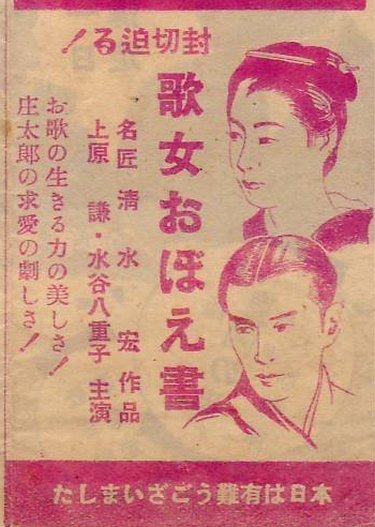 Filmed in 1941, Notes of an Itinerant Performer (歌女おぼえ書, Utajo Oboegaki ) is among the least politicised of Shimizu’s output though its odd, domestic violence fuelled, finally romantic resolution points to a hardening of his otherwise progressive social ideals. Neatly avoiding contemporary issues by setting his tale in 1901 at the mid-point of the Meiji era as Japanese society was caught in a transitionary phase, Shimizu similarly casts his heroine adrift as she decides to make a break with the hand fate dealt her and try her luck in a more “civilised” world.
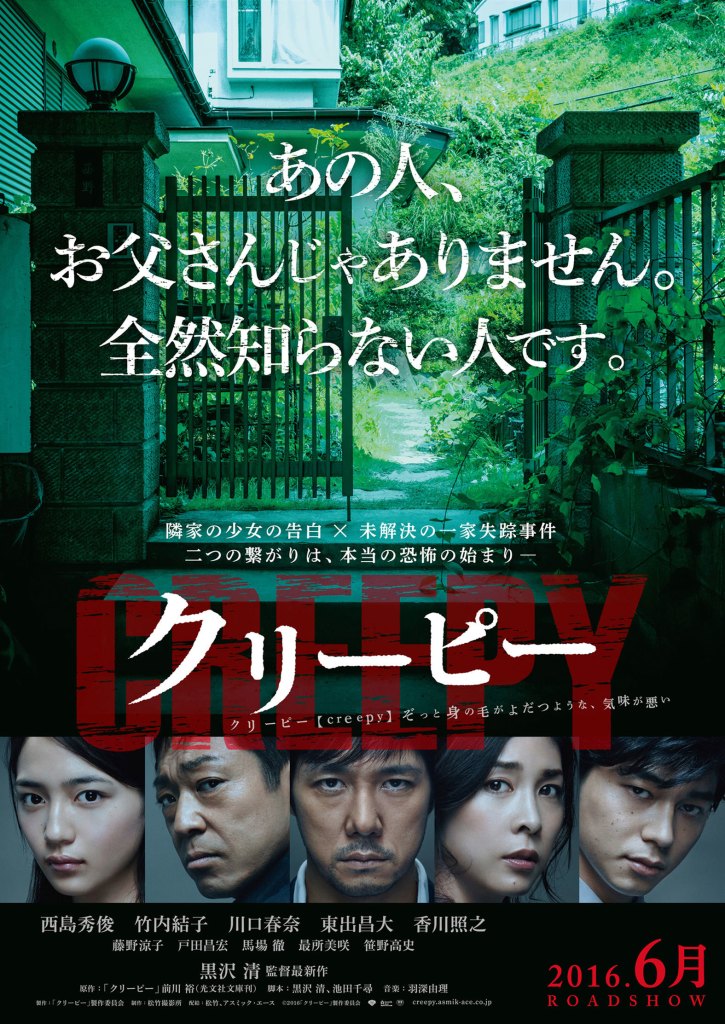 How well do you know your neighbours? Perhaps you have one that seems a little bit strange to you, “creepy”, even. Then again, everyone has their quirks, so you leave things at nodding at your “probably harmless” fellow suburbanites and walking away as quickly as possible. The central couple at the centre of Kiyoshi Kurosawa’s return to genre filmmaking Creepy (クリーピー 偽りの隣人, Creepy Itsuwari no Rinjin), based on the novel by Yutaka Maekawa, may have wished they’d better heeded their initial instincts when it comes to dealing with their decidedly odd new neighbours considering the extremely dark territory they’re about to move in to…

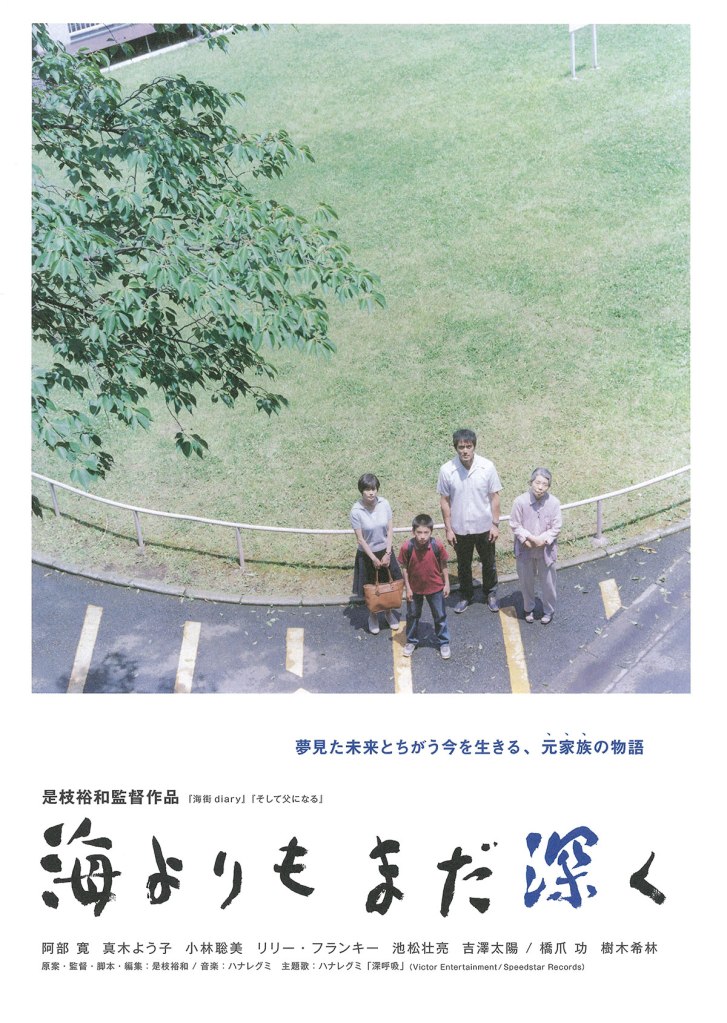 It’s never too late to be what you might have been – a statement attributed to George Eliot which may be as fake as one of the promises offered by the protagonist of Hirokazu Koreeda’s latest attempt to chart the course of his nation through its basic social unit, After the Storm (海よりもまだ深く, Umi yori mo Mada Fukaku). Reuniting Kirin Kiki and Hiroshi Abe as mother and son following their star turns in
 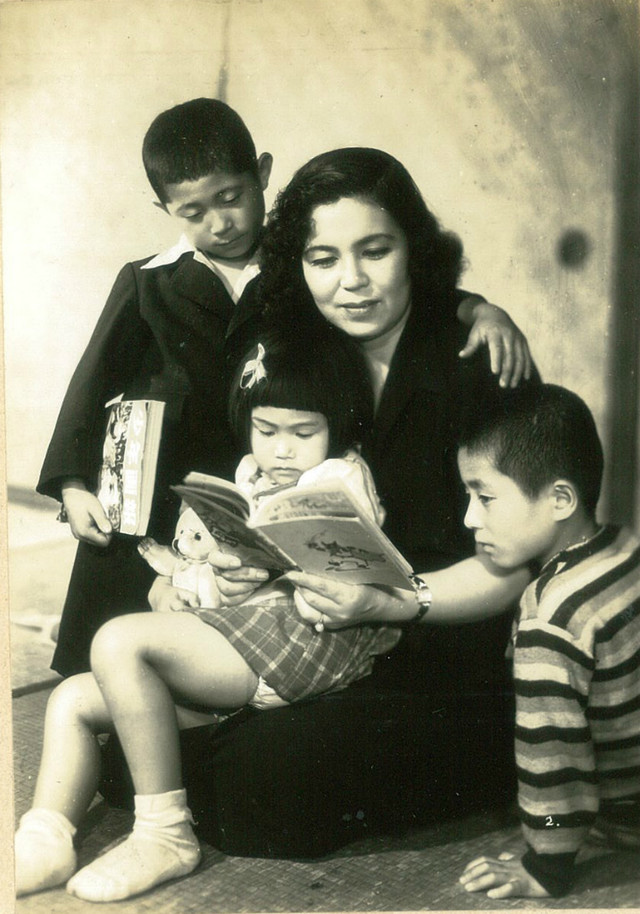 Shimizu’s depression era work was not lacking in down on their luck single mothers forced into difficult positions as they fiercely fought for their children’s future, but 1950’s A Mother’s Love (母情, Bojo) takes an entirely different approach to the problem. Once again Shimizu displays his customary sympathy for all but this particular mother, Toshiko, does not immediately seem to be the self sacrificing embodiment of maternal virtues that the genre usually favours.
 Nobuhiko Obayashi is no stranger to a ghost story whether literal or figural but never has his pre-occupation with being pre-occupied about the past been more delicately expressed than in his 1988 horror-tinged supernatural adventure, The Discarnates (異人たちとの夏, Ijintachi to no Natsu). Nostalgia is a central pillar of Obayashi’s world, as drenched in melancholy as it often is, but it can also be pernicious – an anchor which pins a person in a certain spot and forever impedes their progress.
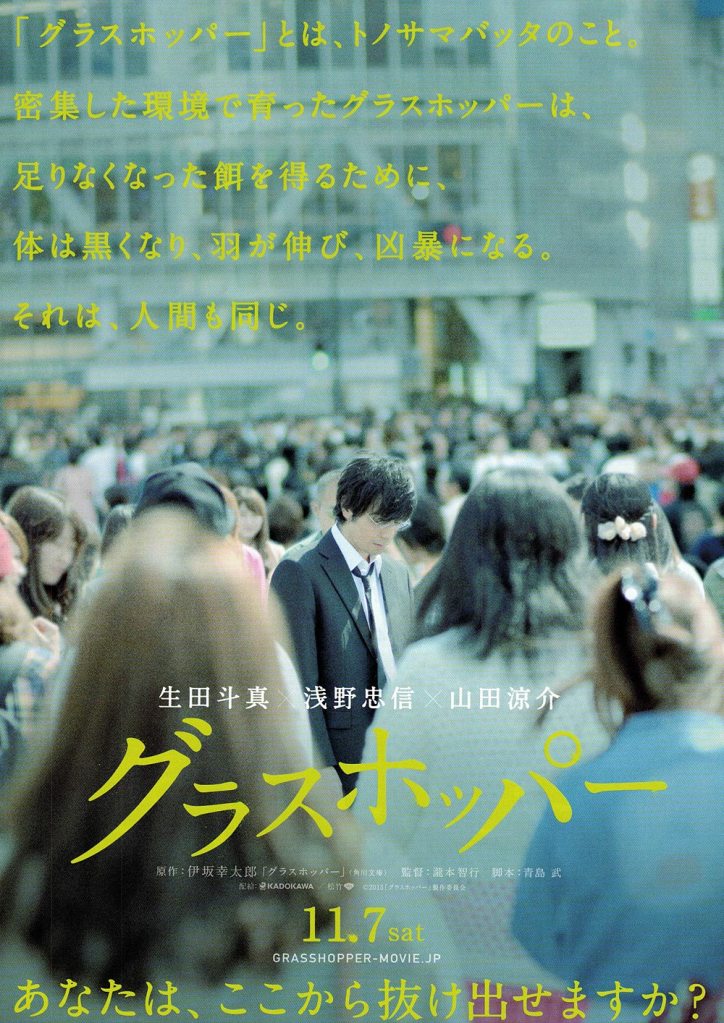 The best revenge is living well, but the three damaged individuals at the centre of Tomoyuki Takimoto’s Grasshopper (グラスホッパー) might need some space before they can figure that out. Reuniting with
