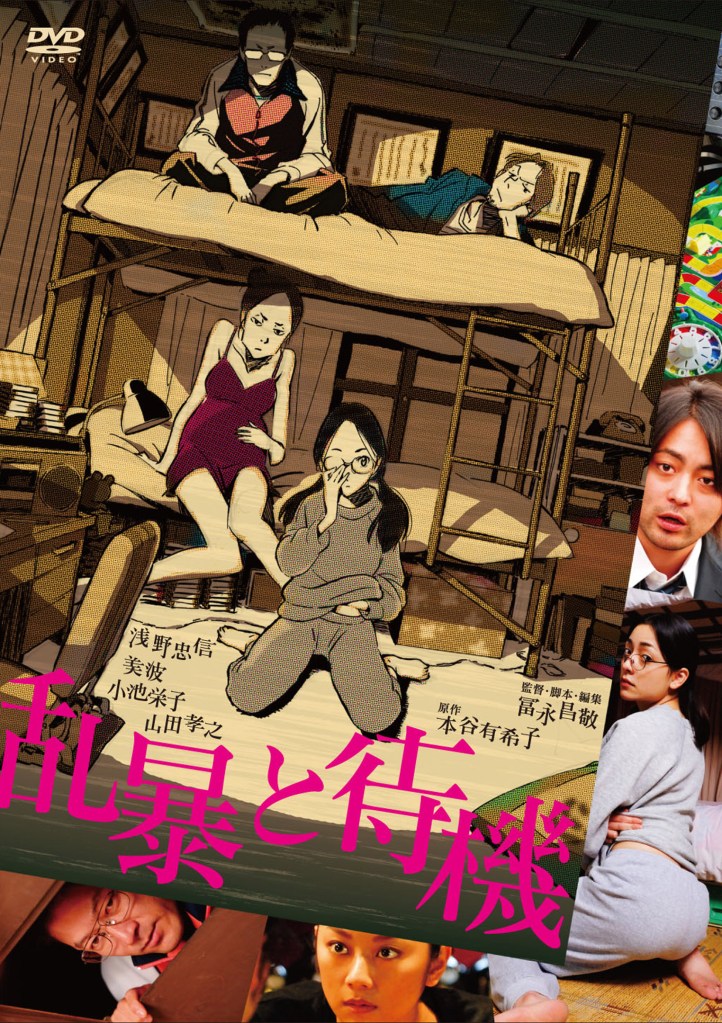
 Vengeance is a dish best served cold, but then if you’re going to wait a while perhaps you should make sure to add plenty of salt and spice to the mix to disguise its rather rancid odour. Adapted from a play by Yukiko Motoya, Masanori Tominaga’s Vengeance Can Wait (乱暴と待機, Ranbou to Taiki) is the strange tale of four interconnected people who each become ensnared in a bizarre circle of violent revenge!
Asuka (Eiko Koike) and Banjo (Takayuki Yamada) are currently expecting a baby and have moved back to Azusa’s hometown where she is working in a bar and he is currently seeking employment (somewhat half heartedly). Whilst Azusa heads off to work, Banjo goes to introduce himself to the neighbours and surprises Nanase (Minami) during a lengthy sutra reading session. Nanase is a very strange woman indeed – dressed in a grey tracksuit, glasses, and generally looking odd, she immediately jumps to the conclusion that she’s annoyed Banjo with her weirdness and tries to give him money to make up for it, such is her intense fear of being disliked. Things get even weirder when Azusa realises Nanase is an old high school classmate towards whom she’s still nursing an ancient grudge. This also means that Azusa knows the man Nanase is living with and addresses as “big brother” is not her actual brother at all…..
Nanase becomes the plot’s essential “object” in a sense with Azusa acting as its subject and the two men more or less relegated to the status of adverbs. Azusa’s personality changes dramatically in the presence of Nanase – seemingly perfectly pleasant and ordinary in other circumstances, her tone takes on an extremely harsh quality, almost yanki-ish in its coarseness. However, Nanase’s need to be liked, or at least not disliked, has her immediately acquiesce to whatever it is she thinks other people want of her. She’s completely incapable of saying what she might actually think or doing what she would like to do but only thinks about how others are viewing her which is both extraordinarily masochistic and actually a little bit selfish.
The relationship between Nanase and her “big brother” Mr. Yamane (Tadanobu Asano) is the perfect culmination of this strange dynamic. Nanase philosophises at one point about the certainty of hate and the mysterious quality of love – that it’s impossible to say exactly why you love someone but you can usually point to a concrete reason for hating them. She and Yamane are bound by a common event in their pasts and, she reasons, perhaps this is enough of a reason for fate to keep them together. Yamane keeps her around because he’s plotting an elaborate revenge plot for a grudge he holds against her but at five years and counting he still hasn’t figured it out yet. During this time, he’s also started pretending to go out “marathon running” but has really been crawling into the attic space to spy on Nanase while she gets on with normal household tasks throughout the day.
Things come to a head when the feckless Banjo develops an attraction for Nanase despite her deliberately slovenly appearance which she affects for the express purpose of avoiding male interest. Using her inability to say no against her, he convinces her to start an affair with him whilst also blackmailing her that if she doesn’t he’ll mistreat his wife, Azusa, whom Nananse is still keen on making up with despite the long held high school era hurt which continues to come between them.
It’s a fairly light and absurd if darkly comic set up which is more about the pointlessness of grudges, violence, and lying about yourself to please others, than it is about a grander mediation on the fruitlessness of revenge – the desire for which, strangely, does end up building an otherwise elusive connection between two people who seem to have been unable to form one in any other way. Tominaga opts for a fairly simple and straightforward approach but does a great job of avoiding the often overly theatrical feeling of many stage to screen adaptations. However, it has to be said that perhaps some of the more unusual elements play better in the enclosed, less “realistic” theatre environment than they do on screen.
That is to say, Vengeance Can Wait has the feeling of slightly throwaway fringe theatre which is partly based on the frisson of mocking supposedly bourgeois values with a series of comically absurd episodes. This approach feels much more fun over a claustrophobic 90 minutes trapped in a tiny performance space which ends up covered in the physical manifestation of a deteriorating situation, but fares a little less well when you open it up into a larger filmic world. However, the film’s odd comments on accidentally sado-masochistic relationships and its absurd black comedy provide enough quirky diversion to build an appropriately amusing atmosphere.
Interestingly enough, Vengeance Can Wait is one of the few Japanese plays which has been translated and performed in English (it’s also unusual because it seems to be a direct translation whereas most English adaptations of foreign plays are “rewritten” by an established playwright from a literal translation) – performance rights with Samuel French. There’s also a review of the run of the play in New York in 2008 from Village Voice.
unsubtitled trailer:
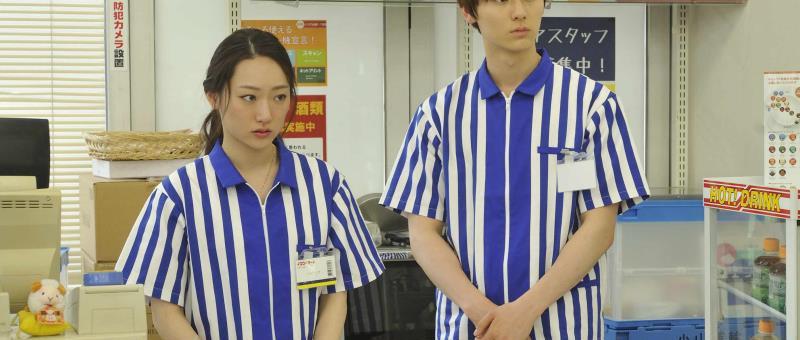
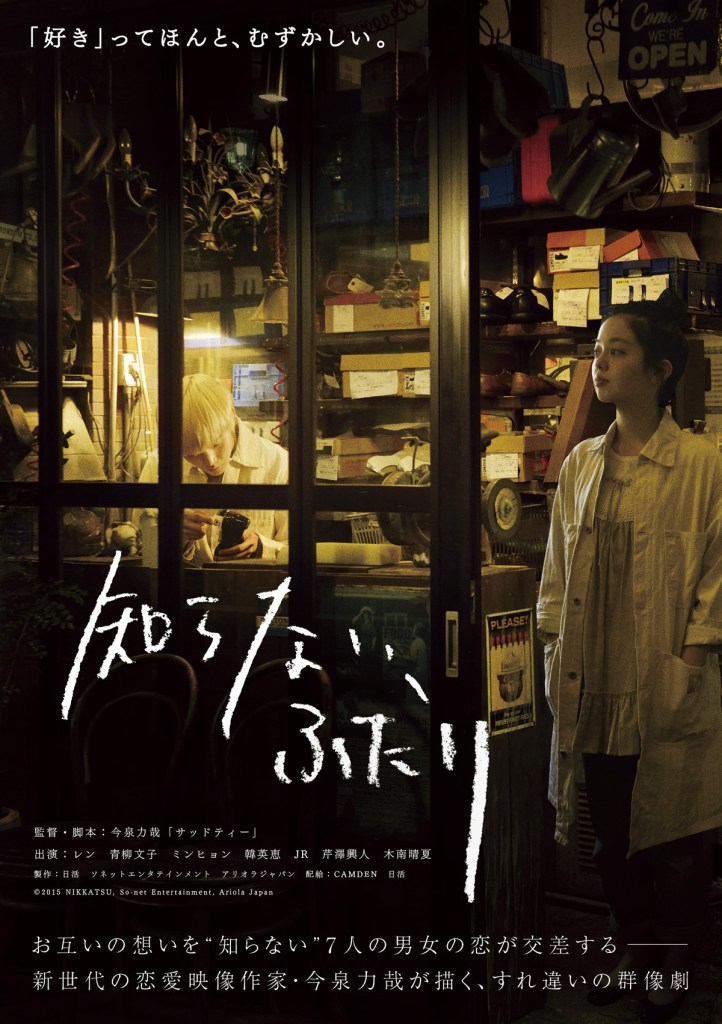 Ah young love! So beautiful, so complicated, so retrospectively trivial. Intrigue engulfs a group of young Koreans living in Japan, their co-workers, and even their English teacher and her fiancee in Rikiya Imaizumi’s indie youth meets boyband quirky romance movie, Their Distance (知らない、ふたり, Shiranai Futari). The aptly named picture paints a vista of misdirected love, miscommunication and misjudged honesty to show how messy romance can be even when it’s intent on being cute.
 Caesium is a chemical element which has the distinction of being one of the very few metals which remains liquid at room temperature. These days you’re most likely to hear about one of its isotopes which is produced as a result of nuclear fission and can pose a serious environmental problem following a nuclear related disaster. Caesium comes to be something of an obsessive concern for the 17 year old heroine of Ryo Saitani’s debut film, Cesium and a Tokyo Girl (セシウムと少女, Cesium to Shojo), as Mimi comes to connect the presence of caesium in the water with the constant soreness she’s been experiencing with her tongue since the disaster hit.
 Cyberpunk and Japan are a match made in heaven though, it has to be said, it’s often been much more an inherited influence in international pop culture than something which has originated directly in Japan. Yokna Hasegawa’s Dual City (デュアル・シティ) puts this to rights a little with a politically infused tale of Japan in 2034 – a nation divided and engaged in a wider information war with the little guy at the mercy of evil corporate giants.
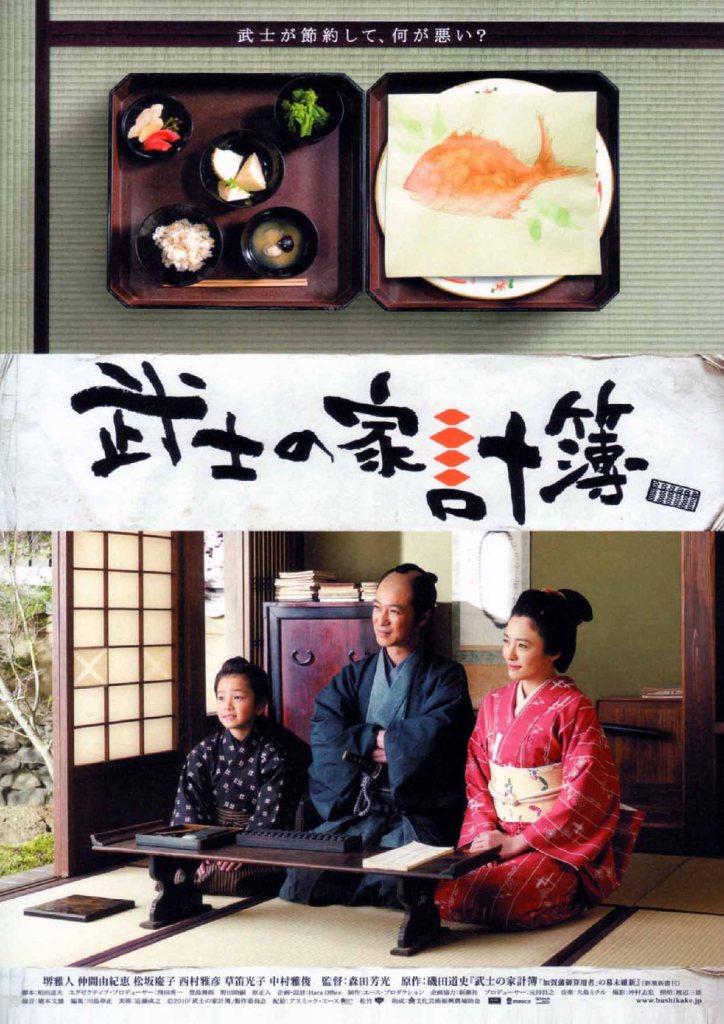 The stories of samurai whose soul is placed not in the sword but in another tool are quickly becoming a genre all of their own. Coming from the same screen writer as
 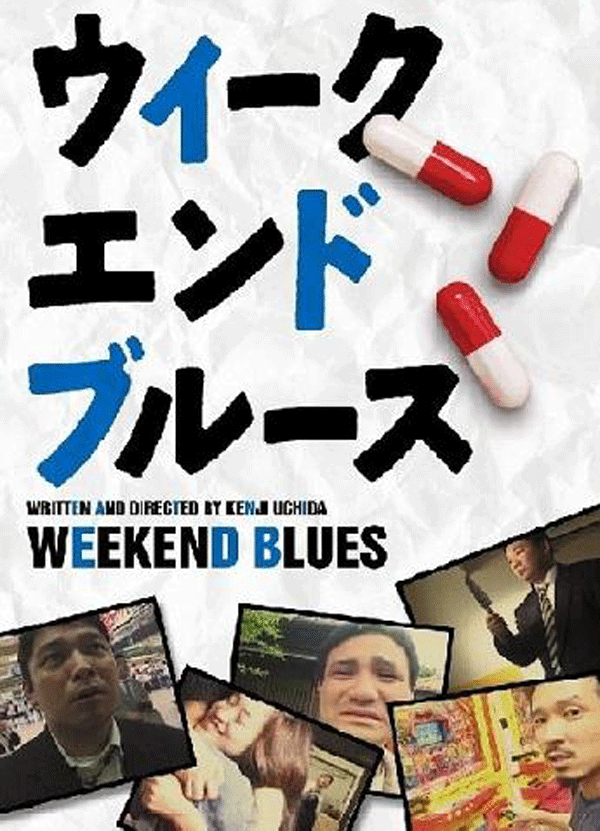 Kenji Uchida travelled to America’s San Fransisco State University to study filmmaking before returning to Japan and making this, his debut film, Weekend Blues (ウィーク エンド ブルース) which later went on to claim two awards at the prestigious Pia Film Festival for independent films earning him the scholarship which enabled his next film,
 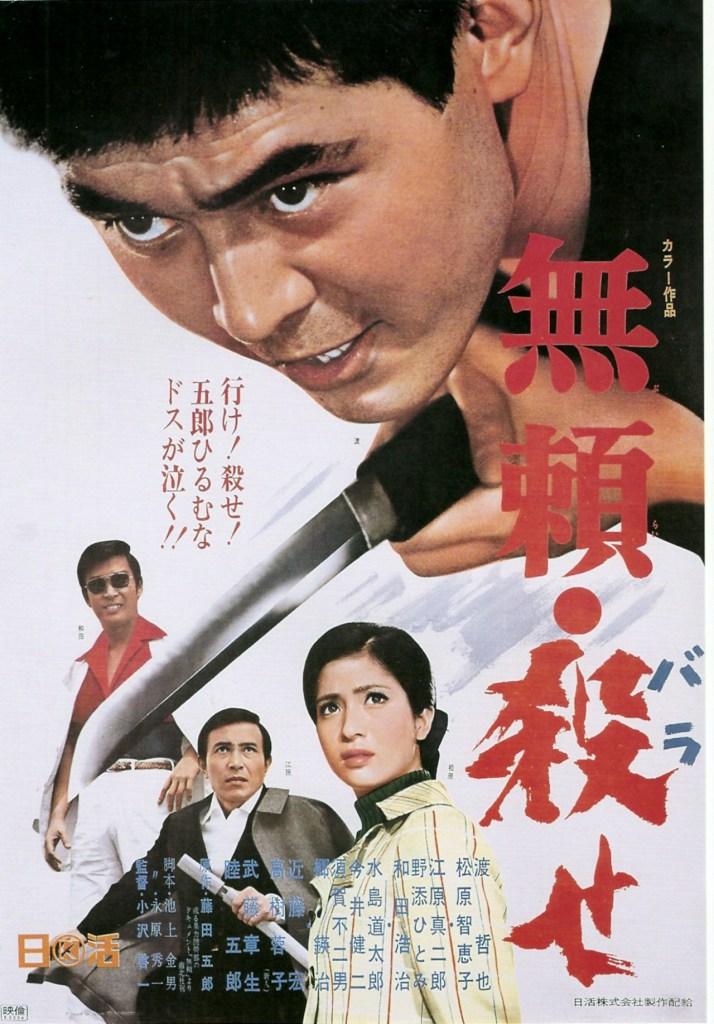 Goro, Goro, Goro – will you never learn? Maybe he will because this is the last film in the series! Appropriately titled Outlaw: Kill! (無頼 殺せ, Burai Barase), this sixth and final film in the Outlaw series sees Goro once again moving to a new town and trying to lead a more honest life but unfortunately he’s wandered in at just the wrong time because a local gang boss has just been sent to prison after defeating a group of assassins leaving a dangerous vacuum and leading, therefore, to the outbreak of a turf war.
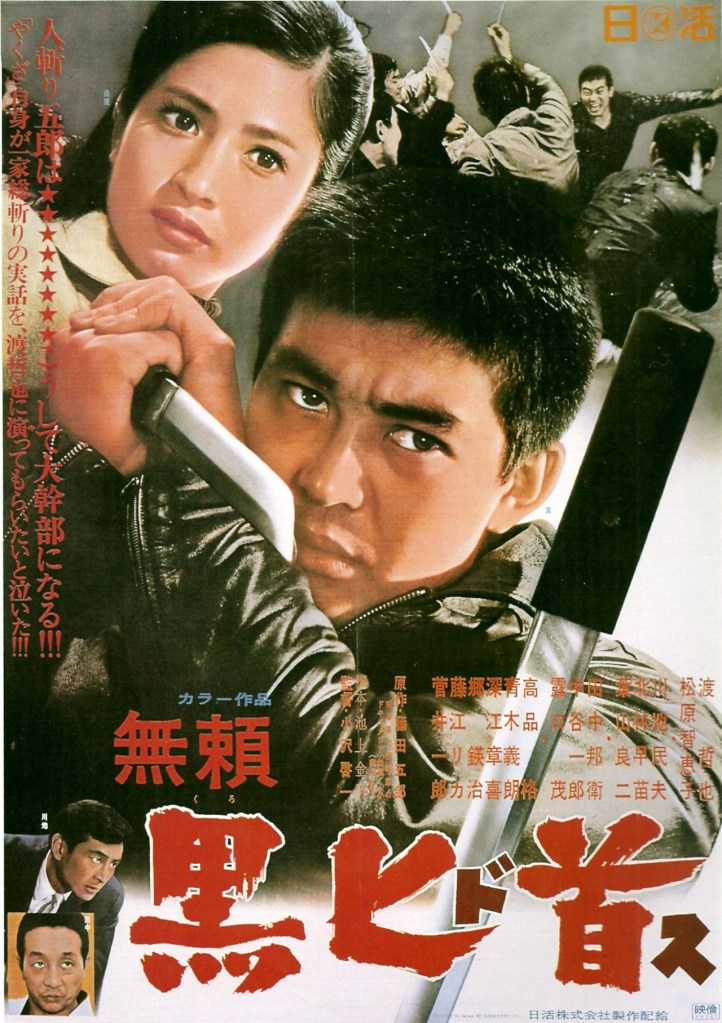 Goro (Tetsuya Watari) just can’t catch a break. He sends his one true love off on a train to safety only to see her dramatically return because she can’t bear to leave his side. Her devotion costs her her life as she places herself between Goro’s manly chest and an assassin’s knife. Heartbroken, Goro gets out of town only to run into another old flame who is now a mama-san and has apparently married another yakuza (despite the fact that Goro parted with her because of his chaotic yakuza lifestyle). As usual, the past won’t let him go – this time in a more literal sense as Goro encounters another woman who looks exactly like the girlfriend who died in his arms….
 So, once again Goro Goes Straight is sadly not the title of this fourth film in the tale of the noble hearted gangster “Goro the Assassin” (無頼 人斬り五郎, Burai Hitokiri Goro). After getting his friend out of a jam, the pair end up in prison. Goro is released three years later but his friend, Masa, is poor health and eventually dies a prisoner’s death with no one to collect his body meaning he’ll be buried in a lonely prison grave alongside the rest of society’s unwanted rubbish. On their final meeting, Masa asks Goro to find his sister for him and tell her that he’s doing alright. This message now well out of date, Goro decides to try finding Masa’s sister anyway if only to find out why she never came to see him even as he lay dying.
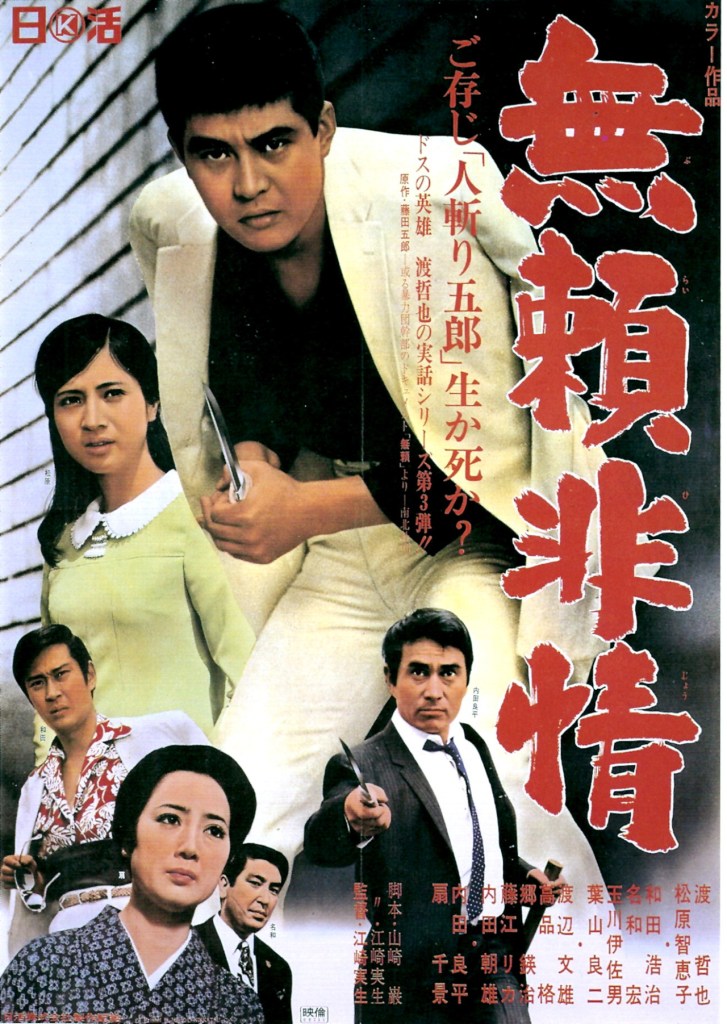 Things take a slight detour in the third of the Outlaw series this time titled “Heartless” (大幹部 無頼非情, Daikanbu Burai Hijo). Rather than picking up where we left Goro – collapsed on a high school volleyball court, it’s now 1956 and we’re with a guy called “Goro the Assassin” but it’s not exactly clear is this is a side story or perhaps an entirely different continuity for the story of the noble hearted gangster we’ve been following so far. The only constant is actor Tetsuya Watari who once again plays Goro Fujikawa but in an even more confusing touch the supporting characters are played by many of the actors who featured in the first two films but are actually playing entirely different people….
