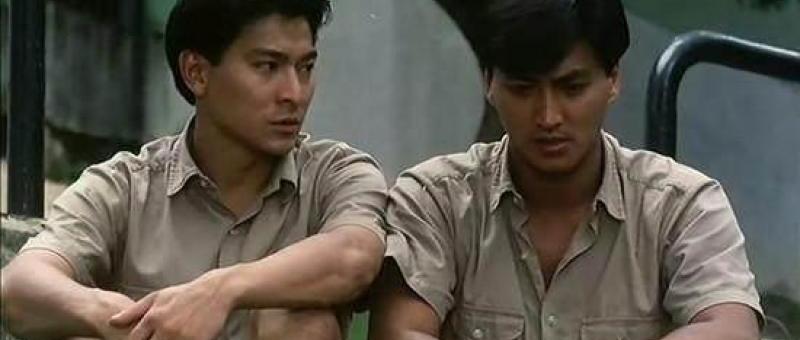
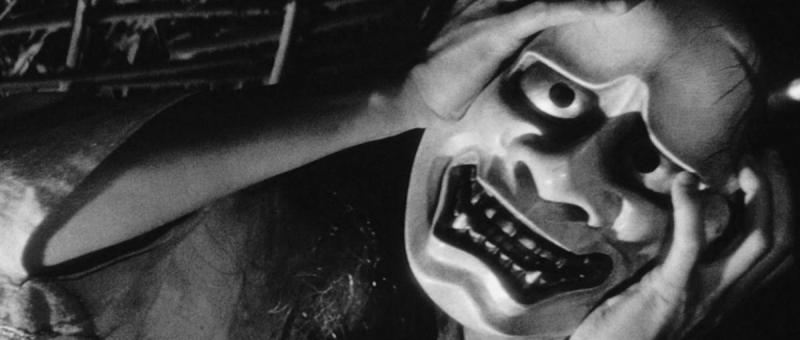
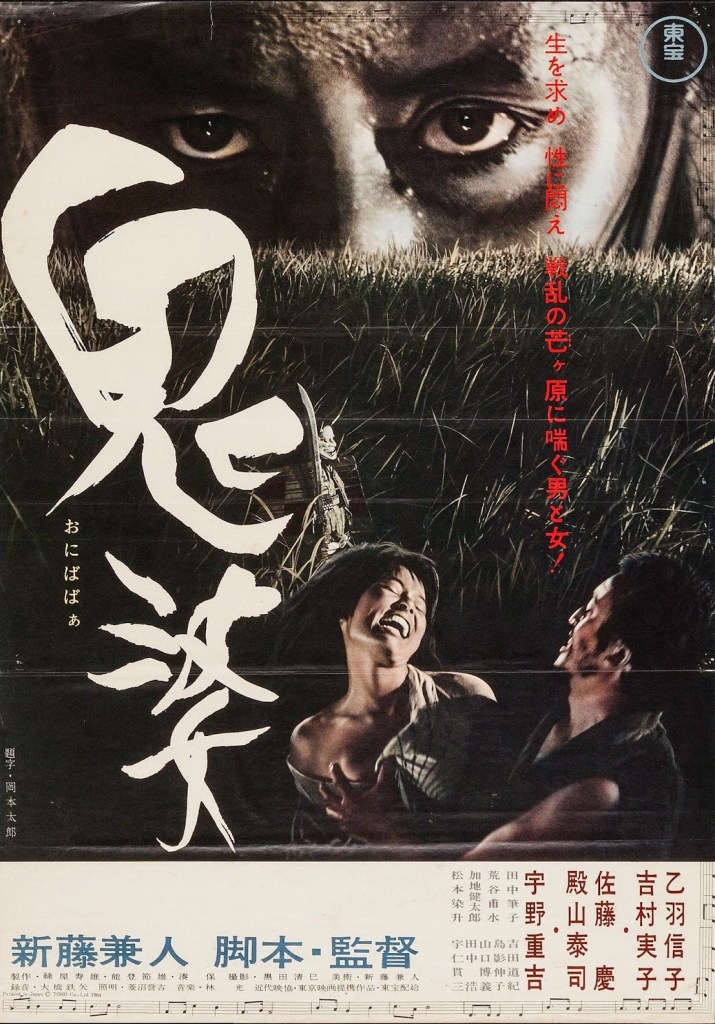
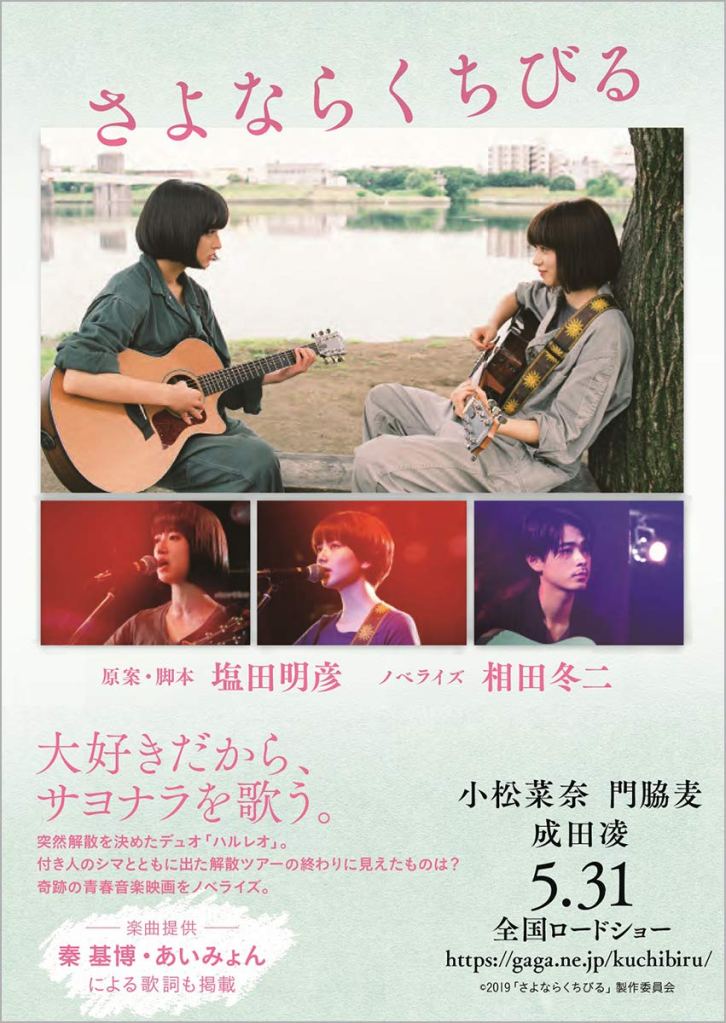
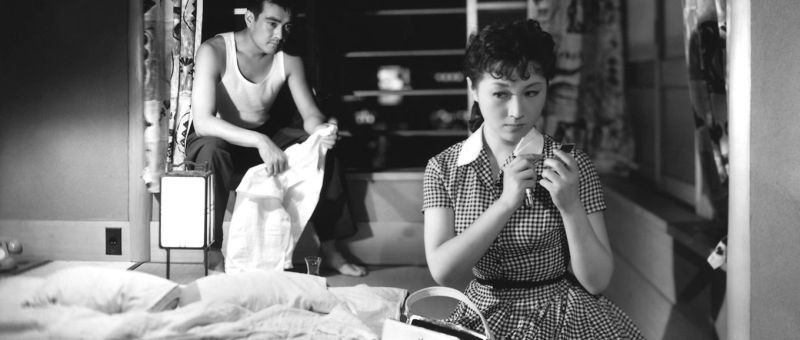
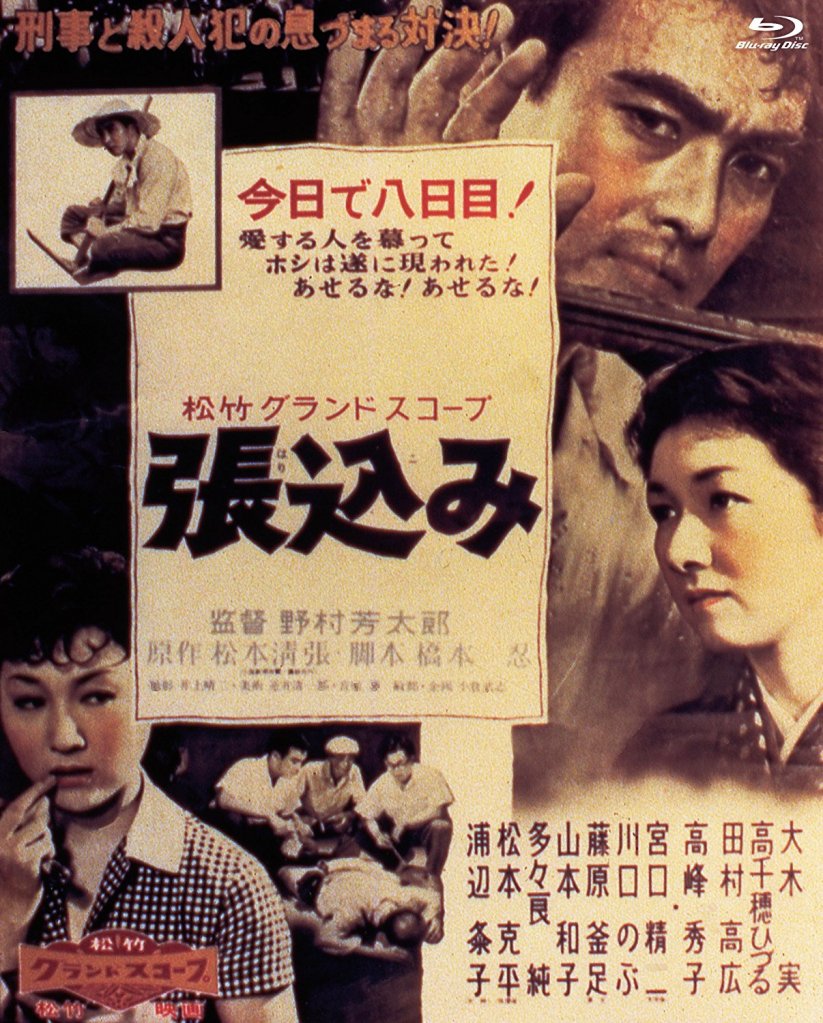
The Master Spearman (酒と女と槍, Tomu Uchida, 1960)

After the war during the American occupation, the samurai film encountered a de facto ban with the authorities worried that historical epics may encourage outdated fuedal and fascistic ideology. The period films of the post-war era, however, are often fiercely critical of the samurai order even as it stands in for the hypocrisies of the contemporary society. Two years before Masaki Kobayashi launched a similar assault on the notion of samurai honour in Harakiri, Tomu Uchida’s The Master Spearman (酒と女と槍, Sake to Onna to Yari) finds a loyal retainer similarly troubled when he is ordered to die only to be ordered not to and then finally told that yes he must commit suicide to serve a kind of honour in which he no longer believes. 

Takasada (Ryutaro Otomo) is a battlefield veteran with the Tomita clan much revered for his skill with the spear. As a retainer to the current regent, Hidetsugu (Yataro Kurokawa), he finds himself in trouble when the ageing Hideyoshi (Eijiro Tono) stages a coup to solidify his power, accusing his nephew of treason on abruptly “discovering” a stash of illegally obtained rifles. Takasada is outraged not to have been ordered to die with his master, but later resents being “strongly encouraged” to do so by his brother, the head of their clan. Storming out, he temporarily retreats into a drunken haze during which he convinces his favourite actress, Umeme (Hiromi Hanazono), to stay with him (just serving drinks, no funny business), before committing himself to public seppuku on a date of his own choosing. When the day arrives, Takasada is greeted by parades of “well wishers” keen to congratulate him for being such a fine samurai. Encouraging those in line to step out of it and stand horizontally without account of rank or status, he agrees to drink with them all, with the consequence that he becomes extremely drunk and passes out. 

Just as he’s about to cut his belly, a messenger arrives from Hideyoshi himself ruling Takasada’s suicide illegal. He if goes ahead and does it anyway, his clan will be disgraced. Takasada’s brother changes his tune and begs him not to proceed for the sake of the Tomita honour. Thoroughly fed up, Takasada has a sudden epiphany about the hypocrisies of the samurai code and decides to renounce his status, dropping out of court life to live simply in the country where he is eventually joined by Umeme who has fallen in love with him. 

Meanwhile, court intrigue intensifies. These are the quiet years leading up to the decisive battle of Sekigahara which in itself decided the course of Japanese history. While the elderly Hideyoshi attempts to hold on to power by ruling as a regent on behalf of his sickly son Hideyori, Tokugawa Ieyasu (Eitaro Ozawa) plots on the sidelines. Hideyoshi is advised by his steward Mitsunari (Isao Yamagata) to take a hard line with treachery, executing all 36 “spies” planted in his household by Ieyasu, including a number of women and children. Mitsunari is himself working with the other side, and the executions are nothing short of a PR disaster for Hideyoshi, provoking fear and resentment in the general populace who can’t accept the inherent cruelty of putting women and children to the sword. Sakon (Chikage Awashima), a kabuki actress and fiercely protective friend of Umeme, comes to a similar conclusion to Takasada, hating the samurai order for its merciless savagery. 

That’s perhaps why she’s originally wary of Takasada’s interest in Umeme, uncertain he will keep his promise to keep his hands off her and so staying over one night herself to make sure Umeme is safe. Umeme, meanwhile, may not have wanted him to be quite so honourable, leaving in the morning visibly irritated and exclaiming that Takasada is drunk on himself and understands nothing of women. That may be quite true, but it’s his sense of honour which eventually tells him that he must reject the samurai ideal. First they tell him honour dictates he must die, then that he must not, then when Hideyoshi dies and the prohibition is lifted, that he must die after all because his entire clan is embarrassed by his continuing existence. By this point, Takasada has decided to accept his “cowardice”. Sickened by the spectacle of his ritual suicide and the humiliation of its cancelation, he came to the conclusion that “loyalty and honour for world fame, glorious exploits etc” is all a big joke. He loves food, and wine, and his wife, and if that means others call him coward so be it because he’s finally happy and perhaps free. 

His spear, however still hangs over his hearth. He hasn’t truly let go of it or of the code with which he was raised. Sakon, perhaps on one level jealous and guarding her own feelings as she accepts that Umeme has chosen to leave the stage to retreat into an individual world with Takasada, warns her that her happiness will end if Takasada is convinced to accept a commission from the Tokugawa. He surprises her by once again renouncing his status as a samurai, choosing to stay a “coward” living a simple life of love and happiness. But as soon as he puts his hand on the spear intending to break it for good something in him is reawakened. He can’t do it. He finds himself at Sekigahara, confronted not only by samurai hypocrisy but by his own as Sakon does what he could not do to show him what he has betrayed. His rage explodes and he raises his spear once again but not for the Tokugawa, against the samurai order itself piercing the very banners which define it in an ironic assault on an empty ideology.  


Station (駅, Yasuo Furuhata, 1981)

The thing about trains is, you can get off and wander round for a bit, but sooner or later you’ll have to go where the rails take you. You never have as much control as you think you have. The hero of Yasuo Furuhata’s Station (駅, Eki) is beginning to come to that conclusion himself, addressing the various stations of his life, the choices he made and didn’t make that have led him into a dejected middle-age, defeated, and finding finally that any illusion he may have entertained of living differently will not come to pass. 

In 1968, police detective Eiji Mikami (Ken Takakura) sends his wife (Ayumi Ishida) and son away for reasons which aren’t entirely clear. At this point in his life, he’s an aspiring marksman on Japan’s shooting team intensively training for the Mexico Olympics, which is perhaps why he felt he could no longer be a husband and a father, or at least not while also being a policeman. All that changes, however, when his friend and mentor is gunned down during a routine job, shot in the chest at point blank range by a man in a white Corolla while operating a check point to catch a killer on the run. In 1976, he goes to see his sister (Yuko Kotegawa) marry a man she might not love to escape a violent boyfriend and investigates a serial killer of women who rapes and murders girls in red skirts. In 1979, he’s haunted by the serial killing case coupled with his cool execution of hostage takers during a siege. Holing up in a small fishing village waiting for a boat home for New Year, he strikes up a relationship with a barmaid who is just as sad, lonely, and defeated as he is. 

When Mikami’s friend is shot, his wife tells the reporters that she thinks shooting at targets, which her husband had been training others to do, is a different thing than shooting at living beings. “One shouldn’t shoot at people” she tearfully insists, accidentally forcing Mikami into a double dilemma, knowing that his marksmanship skills were on one level useless in that they couldn’t save his friend while paradoxically told that they shouldn’t be used for that purpose anyway. But what really is the point in shooting holes in paper targets just to test your skill? Wandering into the hostage situation while posing as a ramen deliveryman, he cooly shoots the two bad guys without even really thinking about it, as if they were nothing more than paper. 

The Olympics overshadow his life. He gave up his wife and son for them, but no matter how hard you train, the Olympics eventually pass. Mikami is told he’s supposed to bring honour to Japan, representing not only the nation but the police force. He’s not allowed to investigate his friend’s death because they want him to concentrate on his shooting, but he is and was a policeman who wants to serve justice. While he’s waiting for the funeral, he sees a report on the news about a former Olympic marathon runner who’s taken his own life because he got injured and fell into a depression feeling as if he’d let down an entire nation. Mikami perhaps feels something the same, drained by responsibility, by the feeling of inadequacy, and by the potential for disappointment. After the Olympics he feels deflated and useless, wondering what the point of police work is while quietly rueful in suspecting the committee is about to replace him on the team after all. 

When he wanders into the only bar open on a snowy December evening, that is perhaps why he bonds so immediately with its melancholy proprietress, Kiriko (Chieko Baisho). The conversation turns dark. Kiriko tells him that a friend of hers who worked in a bar in the red light district killed herself last New Year, that it’s the most dangerous time for those who do this sort of work, not for any poetical reason but simply because it’s when their men come home. She tells him that she’s a lone woman, no virginal spinster but weighed down by the failure of old love. Swept up in the New Year spirit, Mikami starts to fall for her, but is also called back to the past by an old colleague who passes him his wife’s phone number and tells him she’s now a bar hostess in Ikebukuro. He starts to think about leaving the police and getting a local job, but fate will not allow it. Kiriko too sees her dream of love destroyed precisely by her desire to escape the pull of toxic romance. Back in 1976, Mikami had been party to a similar dilemma as the sister of his suspect kept her brother’s secret but secretly longed to escape its burden. Suzuko (Setsuko Karasuma) too lost love in trying to claim it and now works as a waitress in a small cafe in this tiny town, only latterly making an impulsive decision to try to leave and make a new future somewhere else. 

Mikami tears up the letter of resignation that declared him too tired of life to be a good policeman, once again boarding a train back to his rightful destination, knowing that a policeman’s what he is and will always be. He watched his wife wave goodbye from a station platform, saw a man betrayed on the tracks, and finally boarded the train himself, letting go of any idea he might have had about going somewhere else. Stations are after all transitory places, you can’t stay there forever. 


Original trailers (no subtitles)

Aki Yashiro’s Funauta which plays frequently throughout the film

A Dog Barking at the Moon (再见 南屏晚钟, Xiang Zi, 2019)

“How come she doesn’t cry?” a mother anxiously asks, still on the table following a caesarean section, “don’t worry, it’s a matter of time”, the doctor reassures her. Representations of LGBTQ+ life in contemporary Chinese cinema are few and far between, which might be one reason why the famed dragon seal does not appear before A Dog Barking at the Moon (再见 南屏晚钟, Zàijiàn Nán Bīng Wǎn Zhōng), a Spanish co-production and the autobiographical first feature from Xiang Zi. A melancholy contemplation of the various ways a repressive social system can echo through generations, Xiang’s film quietly suggests that one form of authoritarianism breeds another and that if conformity comes at the cost of happiness then it’s a price not worth paying. 

Heavily pregnant Xiaoyu (Nan Ji) has returned to China from the US with her Western husband (Thomas Fiquet) to have the baby under better medical conditions, but it appears that an extended stay with her parents may not exactly be a cause for celebration. Though her mother Jiumei (Na Renhua) originally seems cheerful and happy to see her daughter, it’s clear that there is frostiness between the two women and distance within the marriage. Gradually we discover that the iciness which pervades the Huang home is born of a sense of resentment and betrayal which stems back (partly, at least) to Jiumei’s discovery that her husband, Tao (Wu Renyuan), is a closeted homosexual after discovering him with his male lover. 

That does not, however, quite explain Jiumei’s ambivalent attitudes to her daughter. “I haven’t had a happy day since you were born” she’s fond of saying, regretting that she didn’t strangle her at birth after hearing from a fortune teller that Xiaoyu would be her “nemesis”. The allegorical quality of Jiumei’s story about going off the dog because he came to love her husband more is certainly not lost on Xiaoyu, awkwardly asked to translate for her husband, swinging between pity and resentment, as bound by social norms as her mother in feeling obliged to take care of a woman who does nothing other than reject her. 

Xiaoyu has long thought her parents should separate, but it never seems to happen. Her father tells her that he worries what will happen if they do. Jiumei says she wants to go to the US and live with Xiaoyu who can hardly refuse, but Tao knows that his wife is not an easy woman and the effect of her constant presence could prove detrimental to the state of his daughter’s marriage. Even so, Xiaoyu thinks it would be the best thing for all of them, if only to escape the never-ending hell of their cycle of bitterness. 

Jiumei, meanwhile, has found refuge elsewhere – in the arms of a shady Buddhist cult. Jiumei believes that her husband is “mentally ill”, blaming his mother for some sort of past trauma that’s made him the way he is. The cult preaches filial piety, family values, and loyalty to the state, and is always ready to “help” in return for “support”. Hoping to buy her way into a more respectable life, Jiumei donates vast amounts of money in the hope of meeting the mysterious Master Zhao who, it is claimed, can “amend” her husband’s sexuality and therefore fix all of the other problems in her life. 

“Gossip can bury you alive” we later hear Jiumei exclaim in a flashback, talking about about something else and perhaps explaining why she’s so desperate that her marriage of convenience be a superficial success. From the outside the Huangs are an ideal couple, wealthy and successful, and so their society tells them they shouldn’t complain. Having suppressed her own desires, complaining that Tao has been “impotent” for most of their marriage, Jiumei is angry and resentful of those who are unable or choose not to do the same. Meeting Tao’s lover, Xiaoyu laments that what Jiumei most wants is never to separate from her father until the end of time, but does not quite know the essential truth of it until an unexpected and all too brief moment of candour from her distant mother. Xiaoyu’s hand wants to reach out to her, but there is a barrier between them which it seems cannot be breached. 

Moving between Jiumei and Tao’s early courtship and the present day, moments of elliptical symmetry present themselves. Fengxi (Chen Zhengyuan), Tao’s younger lover, is it seems himself about to be married and become a father. Xiaoyu meets with him and explains that she is not in any way against their relationship, but pleads with him not to enter a marriage of convenience and ruin a young woman’s life, as her father did, solely for the sake of passing on the family name. He is quick to correct her that he would never consider it, his fiancée is a lesbian who wanted a child with her lover, he is merely helping them out while getting everyone’s parents off their backs.

Fengxi refuses “to build happiness over someone else’s sorrow”. Meanwhile, a long time in the past, someone asked Jiumei what the point was in marrying and having children to live a life you don’t believe in, but she could only answer that marriage was a matter of finding someone who fit the role more than it was of love. Jiumei has been playing her role at the cost of her soul and it’s left her lonely and bitter. Internalised homophobia has ruined them all, forcing them to live lives of empty conformity with only the cold comfort of having fulfilled their duty to society. Jiumei resents Xiaoyu because she is the symbol of the price she paid to lead a conventional life, doubling down on her bet for normality, and passing on that same, misery inducing repression to her daughter. Xiaoyu seems to have escaped by going abroad, but even if her husband tries to convince her that her parents’ lives are not her responsibility, remains equally bound by a sense of obligation now given new weight by her impending motherhood. Xiang ends with a heartbreaking dream sequence in which all can dance together, joyfully embracing their true selves free of shame or anxiety, but as others retreat from the rain some choose to stay, sitting all alone in darkened rooms knowing it is they themselves who elected to turn out the light.


A Dog Barking at the Moon is available to stream via BFI Player until 4th April as part of this year’s BFI Flare.

Original trailer (English subtitles)

Underworld Beauty (暗黒街の美女, Seijun Suzuki, 1958)

“No one can be happy without money” the villain of Seijun Suzuki’s Underworld Beauty (暗黒街の美女, Ankokugai no Bijo) claims, vainly trying to justify his actions. He may indeed have a point, but you can’t buy happiness through selfish immorality. A noirish tale of changing times, Underworld Beauty pits a noble hearted gangster on the road towards reform against his amoral bosses as he tries to ensure a better future for the sister of a friend whose life was irreparably changed through proximity to crime. 

Miyamoto (Michitaro Mizushima) has just been released from three years in prison. His first stop is the sewers where he locates a loose brick he’d been using as a dead drop and retrieves a handgun and a small bag containing three diamonds stolen in the heist which got him sent away. Paying a visit to his old gang, Miyamoto makes it plain that he intends to keep the diamonds for himself so that he can sell them and give the money to Mihara (Toru Abe), the man who was crippled during the job and now lives an “honest” life running a small oden stall. To Miyamoto’s surprise, his boss, Oyane (Shinsuke Ashida), says OK and offers to set him up with a foreigner in Yokohama who is interested in buying blackmarket jewels. Unfortunately, the whole thing goes south in predictable fashion when a gang of masked heavies turns up to disrupt the deal. Mihara, who had come along with Miyamoto, swallows the diamonds and promptly falls off a nearby wall. He survives just long enough to tell the police that he “slipped” thanks to his unsteady legs, which makes his death “accidental” meaning he won’t have to undergo an autopsy. That’s both good and bad for the crooks. The cops won’t find the diamonds, but getting them back before the body is burned is going to be difficult. 

Arita (Hiroshi Kondo), a sculptor of mannequins, finds himself perfectly primed to find a solution because he’s been dating Mihara’s little sister, Akiko (Mari Shiraki), who’d been working as a nude model. Mihara had talked to Miyamoto about his sister and his fears for her in the big city. Feeling his debt even more since his friend’s death, Miyamoto decides to save Akiko from the evils of city life, but finds himself fighting an uphill battle. Meanwhile, Akiko is smitten with the intellectual yet cold Arita, who may perhaps be more interested in her for access to her brother’s body than to her own. 

The diamonds themselves become a kind of MacGuffin and symbol of amoral post-war greed. Having been away for three years, Miyamoto is the classically conflicted film noir hero, a noble yet compromised figure forced to operate in a murky moral universe that is at odds with his own sense of justice. That is perhaps why he tries so hard to “save” Akiko even if she resents his sometimes patronising paternalism that, well-meaning as it is, denies her the agency that is a mark of the age. Mihara warned his sister about hanging out with Arita, suspecting he was a no good guy likely to drag her further into the underworld which he had now escaped, but she sees him as “different” from the men around her, mistaking his coolness for sophistication rather than a possibly sociopathic superiority complex. 

Yet it’s perhaps a sense of inferiority which sends him so crazy about the diamonds. A tortured artist slumming it in a mannequin factory, he resents the way he’s chosen to “sell” his art while superficially laughing at those who buy it. There is something quite perverse in the various ways he is “using” Akiko, literally commodifying her body and turning it into a lifeless object, a simulacrum of “real” womanhood sans voice or agency, all the while planning to use her in order to get his hands on the diamonds. Figuring out Arita may have mutilated her brother’s body in order to dig them out, she wonders if he ever really loved her at all. His sudden declarations of affection and an impromptu proposal only further convince her that what he wants is money. She hides the diamonds inside the breast of a half-baked mannequin, just about where the heart ought to be. Later we spot the poor thing dismembered and abandoned, a gaping hole in its chest as it floats ominously in the sewer, discarded in just the way a woman like Akiko might be if she’d let a man like Arita get his hands on the loot. 

Kidnapped as leverage to force Miyamoto to hand the diamonds over, Akiko loses her fascination with underworld darkness in learning what the “yakuza code” really means. “What do you mean, the yakuza way?” She barks at Oyane, “it’s wrong to kill, you idiot!”. Literally steamed clean and making an ironic escape up a coal shoot, she edges towards a new dawn. “What a beautiful day!” She exclaims, declaring herself not bored in the least, freed from the false promises of the underworld and released from the diamonds’ corruption into the bright sunshine of a wide open future.


Mysteries of Edo (ふり袖捕物帖 若衆変化, Shoji Matsumura, 1956)

The voice of the post-war era, Hibari Misora was a major marquee star but in contrast to expectation, appears to have been fully in command of her contradictory brand, selling an image of herself not as docile and innocent in the manner of many a manufactured idol but feisty and true, refusing to backdown in the face of injustice. In her contemporary movies, she stood up to gangsters and corrupt corporations alike with salt of the earth charm, while her period roles saw her do much the same only against the inherently corrupt samurai order. An early outing for Toei, Mysteries of Edo (ふり袖捕物帖 若衆変化, Furisode Torimonocho: Wakashu Henge) sees her star in the first of a series of films as a princess in hiding turned feminist detective, investigating series of abductions in the rapidly changing bakumatsu society. 

A “newspaper” seller in the street informs us that 14 girls have recently gone missing in this area of town, and no one’s doing much about it. A dance teacher escorts her pupils home to be on the safe side while her apprentice, Oshichi (Hibari Misori), stays behind to teach cowardly samurai Kawashima (Hashizo Okawa) some moves. Local bobby Gorohachi (Shunji Sakai), himself a dance enthusiast, arrives to get some guidance from Oshichi but their lesson is interrupted by the news that the dance mistress and her daughter have become the latest two abduction victims. Oshichi springs into action but quickly falls under suspicion from a rival policeman, Gonroku (Haruhisa Kawada), who questions her background. All too soon, the body of a young woman is discovered at the local shrine and believed to be connected to the abduction cases. Gonroku accepts a bribe from a samurai to get rid of the body as quickly as possible, but Oshichi immediately notices the bruises on the woman’s neck and concludes it’s a murder. She and Gorohachi trace the samurai back to the red light district and discover some shady goings on in a “back house” behind a brothel belonging to a prominent merchant. 

During this era, Japan was still in its isolationist period during which consorting with foreigners was forbidden outside of a few explicitly designated trading spots. Oshichi figures out that the merchant, Nagasaki (Ryosuke Kagawa), is involved with smuggling and uses his second house as a place to entertain foreigners in collusion with local politicians. When he ran out of courtesans from the brothel next door, he started simply abducting random women off the street to entertain his guests with more authentic charms. Those who don’t comply are threatened with being sold off on slave ships, itself another evil of the age. 

Of course, a lowly dance teacher and a bumbling policeman aren’t much of a match for entrenched samurai corruption, but Oshichi has a trump card – she’s secretly a princess in hiding. Bored with the life of an upperclass noblewoman, she ran away from her brother’s home to live an independent life in Edo but can still rely on her class background when necessary. Stealing a pistol and a letter box, she rebrands herself as a man and gets a job in the ministry to try and spy on the corrupt lords while hoping to save her boss, keeping up the ruse well enough but eventually unmasked as a girl. 

As in many of her films, Misora plays on gender ambiguity. Rejecting the cosseted life of a lady, she takes to the streets and then takes charge. She’s technically Gorohachi’s subordinate, but in reality he follows her lead, and she gives as good as she gets in the frequent fight sequences. In the end, however, she’s “rescued” by a masked samurai dressed in white with whom she becomes instantly smitten. She dreams of meeting him in a deserted field where he mildly berates her for her lack of femininity, insisting that he liked “the Oshichi from before”, meanwhile she conjures up the figure of Kawashima who manfully wades in to save her. Previously, in refusing to help, Kawashima had told her that “a woman should know her place and act like a woman”. Oshichi tells him perhaps he should act like a man, practice kendo or something else more manly rather than prancing about learning to dance. His words have perhaps cut her because he tells her the same thing in her dream, insisting that he “could fall for the womanly Oshichi”.

Oshichi tries on womanliness for size, but it only seems to confuse the “real” Kawashima who describes her attempt at genial femininity as “creepy”. She quickly goes back to holding her own, pushing forward where the men hold back perhaps bashful in love but never in justice. Even if it’s true that the dashing samurai arrives to save the day, Oshichi is no damsel in distress watching passively from the sidelines but an active participant threatening bad guys with a gun cunningly smuggled in while she distracted them with a song, and grabbing a sword off the wall to wade into the fray. Rewarded for her good work and asked what she’d like in return, Oshichi chooses her freedom, intending to stay in the town a little longer, solving crimes in old Edo and ensuring that no one, even those who think they have a right to be, is truly above the law.


Masquerade Hotel (マスカレード・ホテル, Masayuki Suzuki, 2019)

The thing about hotels is, people often go to them when they want to be someone else, so how can you be on the look out for suspicious behaviour when everyone is to some degree acting out of character? Keigo Higashino is one of Japan’s best known authors particularly praised for his elaborately plotted mysteries. In contrast to some of his famous detective novels, Masquerade Hotel (マスカレード・ホテル) leans into his softer side, taking its cues from Agatha Christie in its ultimately cheerful exploration of the strange world of hotels while praising the detective acumen both of cynical policemen and eager to please hoteliers. 

The police are hot on the trail of a serial killer and, due to clues found at the previous crime scenes, have concluded the next killing will take place at the Hotel Cotesia Tokyo. To scout out the potential crime scene, the detectives have co-opted the hotel’s basement as an incident room and are preparing to go undercover to keep an eye on things upstairs. Dishevelled detective Nitta (Takuya Kimura) has been assigned to the front desk because of his English skills apparently honed while living abroad in his youth, and is to be paired with earnest hotelier Naomi Yamagishi (Masami Nagasawa) who will do her best to turn him into a first rate hotelman. 

As might be expected, Nitta and Naomi do not exactly hit it off. Gruff and given to giving everyone in 50m radius the hard stare, Nitta is a shaggy haired middle-aged man in creased suits and shiny shoes. The first thing Naomi makes him do is get a haircut which does wonders for his image, but also plays into the peculiar art of masquerade which defines hotel life. Nitta is in the habit of calling the guests “customers” which instantly irritates Naomi who has spent the entirety of her professional life learning to be deferent. She reminds him that in here the guests are in charge, they make the rules and therefore can never break them. Her job is to provide the best service, which means she often has to set her personal pride aside and allow the sometimes unpleasant clientele, the ones who like to come to posh hotels to throw their weight around and abuse the staff, to get away with being obtuse because that’s just part of her job. 

That’s a big ask from Nitta who is both a proud man and a justice loving policeman to whom the idea of letting people act badly is almost anathema. To do his job, however, he’ll have to learn to bear it or risk letting a potential serial killer slip through his fingers. What Naomi realises is that they’re more alike than they first seemed. Both of their jobs rely on an astute assessment of their targets, even if they come at it from opposite ends. Naomi knows that each of her guests is wearing a kind of mask, taking on a slightly different persona when they enter her hotel, but her job is to see past it without ever letting on. A good hotelier knows what the guest wants before they do and is always ready to provide it, that’s the nature of service. So Naomi trusts her guests and is careful not to judge them. Nitta, meanwhile, is a policeman so he’s trained to question everything and suspect everyone. His job is to unmask and confront his suspects with who they really are. 

They both, however got into this game essentially because they want to protect people even if she wants to protect them inside and he out. Which means of course that they can work together after all, learning a little something from each other along the way. Naomi, well versed in the liberties often taken by her guests, is nearly taken in by an obvious scam that only Nitta is quick enough to catch thanks to his cynical policeman’s logic. He’s also first to suspect that there’s something not quite right with a harmless little old lady, and though Naomi senses it too she’s minded to let it go and doubles down on being the perfect servant thanks to her animosity towards Nitta. That “not quite right”, however, proves to be a slight misreading of the guest who, like many Nitta encounters, is pretending to be something they’re not for reasons that prove perfectly understandable once revealed. 

But then, Higashino characteristically pulls the rug out from under us and asks if we haven’t been suckered in buying all those reasonable excuses. Thanks to his conversations with Naomi, Nitta begins to get a grip on the crime, while she struggles with her conscience after learning that her guests may be in much more danger than she thought. Staking all on justice, the pair of them vow to abandon their respective professions if a guest gets hurt, but fail to realise that the crime may hit far closer to home than they’d anticipated. Nevertheless, what we’re left with is a strangely whimsical admiration for the weird world of hotels where no one is quite the same person they were before they walked through the revolving doors.


Original trailer (no subtitles)

A Sister’s Garden (姉妹의 花園 / 자매의 화원, Shin Sang-ok, 1959)

In melodramas of the post-war era, the good suffer nobly but often find their goodness ill rewarded by an increasingly amoral society. Shin Sang-ok’s A Sister’s Garden (姉妹의 花園 / 자매의 화원, Jamaeui Hwawon) is, perhaps, a little different despite its rather mild critique of a society preparing to head into rampant capitalism, allowing a magnanimous entrepreneur to become the pure hearted saviour of an equally pure woman while her weak willed lover remains petulantly on the sidelines unable to defy outdated social codes to claim his right to happiness. 

In fact, this is in many ways Mr. Bang’s (Kim Seung-ho) story. It’s him we first meet getting off a swanky Korean Air plane signalling his position as a member of a new class of jet-setting elitists. He is, however, kindhearted which is why his first thought is to pay a visit to Dr. Nam (You Chun) who cured him of a serious illness. Unfortunately, Dr. Nam has now been laid low by the same illness himself. His business has suffered, he’s sold his clinic, taken a job at the hospital, and even mortgaged his house to a persistent loanshark. Unfortunately, all the stress has got to him and soon after Bang is able to meet with Dr. Nam he collapses and dies, breathing his last words to his assistant, Sun-cheol (Kim Seok-hun) who had been like a son to him, to the the effect that he has already arranged a marriage for eldest daughter Jeong-hui (Choi Eun-hee) to an artist named Dong-su (Nam Gung-won) and hopes that Sun-cheol will watch over his younger daughter Myeong-hui (Choe Ji-hui) and much younger son Chang-sik (Ahn Sung-ki). 

This last request will cause a series of problems among the young, the first of them being that it’s extraordinarily insensitive because Sun-cheol is himself in love with Jeong-hui who is also in love with him. Both of them are, however, good people which is why Sun-cheol wastes no time telling Jeong-hui about her father’s last words while she is minded to obey them even if her primary concern is the family finances seeing as she is now the sole provider for her siblings and there will be no more money coming in. With the loanshark still breathing down their necks, Jeong-hui is in danger of losing the family home. 

The other major problem is Myeong-hui who unlike her sister is a thoroughly modern woman, thoughtless and selfish in a childish sort of way. Unaware of the family’s financial situation, she hoped to use some of the money from selling the clinic to open a dress shop and is put out to realise there isn’t any because the clinic was only sold to pay off debts. Meanwhile, it’s also quite obvious that Dong-su, an equally naive son of a wealthy family, prefers Myeong-hui and almost certainly intends to marry her not her sister. Dong-su thinks he’s hot stuff in the art world and is going to make a lot of money selling paintings, which is optimistic whichever way you look at it. 

This awkward love square creates a series of problems of its own as Myeong-hui convinces herself that her sister is jealous of her relationship with Dong-su while also knowing that she has been silently in love with Sun-cheol for many years. Sun-cheol, for his part, feels himself indebted to the Nams and allows the debt to come between himself and true entrance to the family through marrying Jeong-hui. He saves their house through selling his own, but times being as they are Jeong-hui still needs to find a job which is another problem because she is an upper middle-class woman raised for marriage. She gave up school to keep house after her mother died and has no qualifications, even if qualifications could help a woman in need find a good job in 1950s Seoul. She asks Bang for help, and he offers her a frankly insulting opportunity as the head hostess at a sleazy bar he owns where businessmen go to have discreet fun without their wives. 

Jeong-hui wasn’t going to take it, but in the end she has little choice, allowing the married Myeong-hui and Dong-su to move into the house to look after Chang-sik while she lives at the bar. Sun-cheol, still afraid to speak his heart, is judgemental and filled with resentment, entirely unsupportive of Jeong-hui’s position or her proactive decision to try and change it even if changing it means hovering on the fringes of the sex trade. Myeong-hui also, perhaps because of her selfishness and naivety, fails to understand the sacrifices her sister has made on her behalf. Worried that Myeong-hui and Dong-su may have re-mortgaged the family home that she is actively debasing herself to save, Jeong-hui asks her sister to reassure her that the deed to the house is safe. Myeong-hui had been thinking of doing just that so she fires back cruelly that Jeong-hui has everything “easy” and can’t understand how hard it is for her, which is a strange thing to say given that Jeong-hui has become a bar girl solely to keep a roof over her sister’s head. 

Myeong-hui and Dong-su continue to make mistakes, Dong-su convincing his friend to embezzle money from his company to plough into the dress shop even though it’s a loan they can’t repay and threatens to get them all in hot water. Jeong-hui has to sort everything out again, but that puts her in further debt to Bang to whom she is already substantially indebted because he convinced her to take a loan to pay back Sun-cheol who didn’t even really want paying back. Uncharitably, Bang’s behaviour looks suspect. He makes a prim upperclass woman degrade herself by plunging her into the sleazy underbelly of a burgeoning economy and then burdens her with debt to be able to manipulate her better. Perhaps he gets a kick out of that, but soon feels guilty seeing someone who so obviously does not belong in one of his bars forced to drink with clients and play nice with the customers. On the other hand, perhaps there really were no better jobs available for a woman without qualifications and he only wanted to help. 

Ultimately, Bang turns out to be the good guy, falling in altruistic, selfless love with the innocent Jeong-hui who always does the right thing and acts with absolute integrity. Debt, once again messes everything up. Bang decides to propose to Jeong-hui, which practically speaking is a good option in the situation, but makes it clear that he is not forcing her and will continue to help and support her whatever she decides. But how is Jeong-hui to refuse someone who has been so “kind” to her without a sense of betrayal? Sun-cheol, meanwhile, is prevented from declaring his feelings because of the “debt” he feels he owes to the Nam family, not quite good enough for Jeong-hui but also the custodian of her father’s last words which were that she should marry Dong-su. Myeong-hui and Dong-su meanwhile think only of themselves, acting with selfish recklessness. Only when Jeong-hui comes through for Myeong-hui and tells her of Bang’s proposal does she begin to grow up and realise that her sister may throw away her own happiness for the sake of her family’s in marrying a rich old man out of a sense of hopelessness and obligation. 

Contrary to other melodramas, the solution is Bang’s and Bang’s alone. He makes the decision to release the youngsters from patriarchal control by essentially canceling out Dr. Nam’s last wishes by telling Jeong-hui that she should try to be happy with Sun-cheol while giving her the financial means to do so by gifting her the bar to run as her own, making her both business owner and career woman as well as wife. He absents himself in recognition that age has to give way to youth, pushing the youngsters to pursue personal happiness rather than serve outdated ideas of duty or filial obligation. Jeong-hui’s goodness wins out, but only because it was recognised by Bang who decides to set her free by cancelling not only her literal debt, but the entire idea of indebtedness in giving her permission to seek her own happiness rather than feeling obliged to prioritise that of others. 


A Sister’s Garden is the third of three films included in the Korean Film Archive’s Shin Sang-ok’s Melodramas from the 1950s box set. It is also available to stream via the Korean Film Archive’s YouTube Channel.

Dongsimcho (동심초, Shin Sang-ok, 1959)

The Korea of 1959 was one of change, but the hardest thing to change is oneself and oftentimes the biggest obstacle to personal happiness is the fear of pursuing it. The pure hearted heroine of Shin Sang-ok’s Dongsimcho (동심초) describes herself as “a woman who thirsts for love, yet foolishly gives in to fear first”. A war widow, she’s fed up with society’s constant prejudice but too afraid of what they might think if she chose to choose love, embrace her desire, and marry again for no other reason than personal happiness. Yet for all that she’s a mother with a grown up daughter, she’s a woman too, and young, only 38, but nevertheless consigned to a life of loneliness because of a series of outdated social codes. 

When we first meet Suk-hee (Choi Eun-hee) she’s rushing to the station but arrives too late and can only watch the man she loves board a train through an iron gate that perpetually divides them. Her husband having died in the Korean War, Suk-hee once had a dress shop but was conned out of all her money and the business failed. The kind hearted brother of a friend, Sang-gyu (Kim Jin-gyu), helped her out. Through the course of his managing her affairs, they became close and fell in love, but Sang-gyu is now engaged to the boss’ daughter, Ok-ju (Do Keum-bong), and their romance seems more impossible than ever. 

Suk-hee never quite dares to hope that Sang-gyu might break off his engagement, decide against a bright middle-class future, and start again with her. She’s an old fashioned kind of woman. Despite the fact she once owned a dress shop, she only ever wears hanbok and lives in an improbably spacious Korean-style house alone with her college student daughter, Kyeong-hee (Um Aing-ran), and a maid. The debt that exists between herself and Sang-gyu is the force that both binds them and keeps them apart. The money rots their relationship, but neither of them want it to be repaid because then they’d have no more excuse to continue meeting. They are both perfectly aware of each other’s feelings but entirely unable to acknowledge them because in some sense they already know that their future is impossible. 

On discovering her mother’s “secret”, Kyeong-hee is mildly scandalised, confronted by the realisation that a mother is also a woman just as she is now. She worries about the moral ambiguities of her mother’s position and of what people might say, but quickly reconsiders, deciding to be happy for her and actively support her chances of a happier future. As a younger woman coming of age in the post-war era, Kyeong-hee feels freer to shake off social convention and strike out for personal happiness rather than being content to be miserable while upholding a series of social codes which lead only to additional suffering. 

Only slightly younger than Suk-hee, Sang-gyu is beginning to feel the same. His widowed older sister, Suk-hee’s friend, has turned to religion to escape her loneliness while staking all of her hopes on Sang-gyu’s economic success. It’s she who’s set him up with the marriage to Ok-ju and is pressuring him to accept it because it will assure her own future seeing as she is obviously not planning to defy convention and remarry. Sang-gyu, however, is filled with doubts. Eventually he tells his associate, Gi-cheol (Kim Seok-hoon), that he cannot go through with the marriage, adding that he doesn’t want advice or a warning he merely needed to tell someone. In a strange coincidence, Gi-cheol was once Kyeong-hee’s tutor, and has a surprisingly conservative attitude. Questioned by Ok-ju, he tells her to “act more lovingly” to cure Sang-gyu’s obvious lack of enthusiasm for their relationship, explaining that love doesn’t just happen but is a result of concerted effort. He tells Sang-gyu that he’s being childish and irresponsible and should think about “social ethics and morality”. In short, he should forget about the past and marry Ok-ju like a good boy. But Sang-gyu quite reasonably asks him who’s going to be responsible for what happens after that. If he marries Ok-ju now, he will merely be condemning her to a cold and loveless marriage filled with intense resentment in which the spectre of the woman he loved and lost will always stand between them. 

Kyeong-hee unexpectedly arrives part way through the conversation having followed Gi-cheol with whom she has perhaps also begun to fall in love despite the difference in their attitudes. She jumps in to defend Suk-hee, taking Sang-gyu’s side in berating Gi-cheol for insulting her mother, asking if he thinks a woman like her has no worth. Her mother is a woman too, and though she was originally confused and scandalised, after getting to know Sang-gyu and giving it some thought she’d like to give them her blessing though of course they don’t need it. Kyeong-hee is still young enough to fight for love, and the world in which she lives gives her the courage to believe it might be possible. 

The generation gap between herself and her mother, who it has to be remembered is only 38, cold not be more obvious. Suk-hee struggles against herself. She loves Sang-gyu, but the world tells her that it’s wrong and she must deny her feelings for the sake of social propriety. She can’t stand the way people look down on war widows, and she’s too afraid to give them any more ammunition. Given the relative mildness of the sanction on their relationship, in moral terms at least, it would be easy enough to read it as a metaphor for something else, especially with the repeatedly pregnant dialogue about the pain of not being permitted to marry the person that you love, that no one has the right to judge others for their personal lives, Sangyu’s sister’s aside about being “one of those people”, and finally Sang-gyu’s rather strange confession to Ok-ju that he “may have a personality disorder” in being unable to give up on his love for Suk-hee. It is definitely the case, however, that the gate that stands between them is a rigid an unforgiving society which denies love in fear of disrupting the social order.  

Suk-hee feels guilty not only for her feelings, but feeling as if she’s getting in the way of Sang-gyu’s bright and rightful future. Meanwhile, no one seems to give much thought to poor Ok-ju, used as a pawn by all while pinning for Sang-gyu despite her conviction that he’s in love with someone else and will never truly be with her. Even Gi-cheol implies it’s her own fault not being “loving” enough, while she is left with nothing but sympathy for Suk-hee as another woman forever separated from Sang-gyu because of what other people think. This world is not, it seems, entirely ready for love. Suk-hee makes the “right” choice by many people’s reckoning, one filled with nobility and self sacrifice, yet it’s a choice that becomes increasingly impossible to accept and stands only in stark condemnation of the society which convinced her that misery was virtue. 


Dongsimcho is the second of three films included in the Korean Film Archive’s Shin Sang-ok’s Melodramas from the 1950s box set. It is also available to stream via the Korean Film Archive’s YouTube Channel.

A College Woman’s Confession (어느 女大生의 告白 / 어느 여대생의 고백, Shin Sang-ok, 1958)

Five years after the end of the Korean War, South Korean society was both economically unstable and battling the increasingly authoritarian government of Rhee Syngman. Nevertheless, there was perhaps an aspiration for a brighter democratic future which many hoped would materialise after the protests which eventually brought down Rhee’s regime in 1960 but unfortunately led only to the even more repressive Park Chung-hee era. Released in the same year as Flower in Hell, Shin Sang-ok’s A College Woman’s Confession (어느 女大生의 告白 / 어느 여대생의 고백, Eoneu Yeodaesaengui Gobaek) is perhaps a reflection of that aspiration in its broadly humanist condemnation of an inherently unfair, rigidly patriarchal society which forces good people to act in ways which offend their sense of justice solely in order to survive. 

From a poor family, law student So-young (Choi Eun-hee) finds herself in dire straits after her grandmother who’d been supporting her and paying her tuition fees suddenly dies. She tries to find a part-time job that will let her carry on with her studies, but is either turned away or placed in difficult situations with men who abuse her trust. A sleazy boss interviewing her for a secretarial position pauses after hearing she’s a student after part-time work to suggest a “night job”, crudely leaning over as he offers her money to become his mistress. So-young slaps him across the face and leaves, but faces something much the same from the husband of her landlady who promises to stop pressuring her for the back rent in return for sexual favours. She turns him down too, but even though he backs off in fear she’ll tell his wife that he tried it on, his suddenly relaxed attitude only makes her landlady suspicious. 

At her wits end and about to quit school, So-young turns to her comparatively better off friend Hee-sook (Kim Sook-il) who dreams of becoming a novelist. Hee-sook brings up a diary she’s been reading that was found in some old furniture sold to her family’s store which recounts the sad life story of a girl who was seduced and betrayed by a man who left her to marry a wealthy woman. With too much time on her hands, Hee-sook has identified the man in the diary as prominent politician Choi Rim (Kim Seung-ho) and taken it upon herself to send him a letter telling him that he has a daughter named So-young from the love of his youth. Despite the fact that the diary says the woman’s baby died, Hee-sook suggests So-young pose as Choi’s long lost daughter so he’ll support her through the rest of uni. So-young is not convinced, but finds herself heading over to visit Choi after exhausting all her other options and being reluctant to go back to the boarding house without money. Choi absentmindedly turns her away, only to think better of it and send his secretary after her, but she ends up getting hit by a car trying to avoid yet another creepy old man who sees her in distress in the street and offers her money for sex. 

Creepy men are indeed everywhere. Even the wily Hee-sook finds herself bothered by an unpleasant man in a cafe who repeatedly pesters her even after she makes a point of ignoring him and pointedly switches seats. He doesn’t give up even after So-young arrives, abruptly offering to buy both women dinner, after which Hee-sook ushers So-young out declaring that this cafe is too “weird” to stay in any longer. Men are, it seems, content to exploit the desperation of vulnerable women for their own satisfaction. As So-young puts it in trying to defend another woman after she’s successfully become a lawyer, “vulgar men see women only as objects to satisfy their sexual desires”. 

This feeds back in to the sin the otherwise kindhearted Choi is trying to expiate. He made a choice in his youth, sometime in the colonial era, to abandon a woman he claimed to love to make a dynastic match. Though it’s not clear whether or not he knew there was a child, he seems to harbour a deep sense of guilt over his decision to essentially use two women in different ways. Faced with the “resurfacing” of So-young, he immediately explains everything to his wife (Yoo Gye-seon) but tries to pass it off as “all in the past” while earnestly asking her to help him make amends by accepting So-young into their home in place of the daughter they apparently lost. She fires back at him that it must be very convenient for men who can forget about things that are “all in the past” while women have to live the rest of their lives with the harm that they cause. Choi doesn’t argue with her, but nor does he ask for forgiveness, only understanding. Mrs. Choi answers that she ought to tell him no in revenge for the all the wrongs he’s done her (this appears not to be a terribly happy marriage), but agrees that it’s not So-young’s fault and so of course she can come because “it’s the right thing to do as a human being”. 

Mrs. Choi, however, remains suspicious, unconvinced by So-young’s story but also by her distance from her. That could of course be explained by embarrassment in being the child of the “other woman”, but Mrs. Choi is right to sense guilt in her reserve as she becomes ever more conflicted about the necessity of deceiving people who have been nothing but kind to her. It’s this sense of guilt which is intensified after she becomes a lawyer and achieves her dream of helping other disadvantaged women by defending a single-mother, much like the woman from the diary, who was seduced and betrayed by a man whom she later killed in a crime of passion. In her passionate defence of the extremely repentant Soon-hee (Hwang Jung-seun) is who is around the same age as she is, So-young reflects on the relative similarities between them and that the only reason they are standing in their respective positions is circumstance. 

“The purpose of the law is not only punishment but to awaken goodness in all our hearts” So-young reminds the judges, determined to offer “an earnest plea on behalf of desperate women”. Soon-hee admits her guilt and asks for no leniency, but is brought to tears as So-young outlines the social factors which explain why she found herself stabbing the man who had caused her so much suffering and then got on with his life without giving her a second thought. Her only transgression being sex before marriage, Soon-hee did everything else right but was condemned to a life of poverty and forced to consider sex work in order to buy medicine for her sickly baby. As a pure hearted woman, she can’t go through with it and considers robbery instead (apparently a “lesser” crime) only to bump into an old friend but be too ashamed to ask her for help. 

Earlier on, after her graduation ceremony, So-young had explained her ambitions to help women and children in poverty to Choi’s kindly secretary Sang-ho (Choi Hyeon) who has obviously taken a liking to her. He’s broadly supportive, but reminds her that if she wants to improve society perhaps she should think about fostering greater social change through political action (as he is perhaps doing), but she shakes her head and points out that he’s never known what it is to be hungry or desperate and that there are people who need the kind of help that only she can give them, such as women like Soon-hee. Yet in defending another woman she’s reminded only of her own “sin” in having wilfully deceived Choi and his wife, burdened by the need to keep her secret and convinced the only thing she can do is to confess all. 

Yet Mrs. Choi proves unexpectedly supportive, explaining that she’s known all along that So-young lied and has come to love her as a daughter anyway. She can see how happy she makes Choi who is proud and excited to have such an amazing young woman in his life, and finding out the truth would only break his heart. So-young’s confession would be for herself alone, to ease her own conscience, while the burden of carrying this secret is perhaps the price of her happiness. In an odd way, So-young has repaired their marriage, and with her success in the courts has perhaps completed the integration of their family with the implication that Sang-ho may later join it too. Fiercely condemning the evils of a patriarchal society, A College Woman’s Confession suggests that the literal truth might not be as important as the emotional, and that a rigid morality serves no one, while offering the vision of a brighter, more equal society founded on compassion and understanding rather than cold authoritarian paternalism. 


A College Woman’s Confession is the first of three films included in the Korean Film Archive’s Shin Sang-ok’s Melodramas from the 1950s box set. It is also available to stream via the Korean Film Archive’s YouTube Channel.

Our Shining Days (闪光少女, Wang Ran, 2017)

Doesn’t everyone deserve their time to shine? For the students at the music conservatoire at the centre of Our Shining Days (闪光少女, Shǎnguāng Shàonǚ), a glittering future may be difficult to imagine. Another in the recent series of Chinese youth comedies, Wang Ran’s debut may clearly be inspired by Japanese anime, but adds a noticeably patriotic beat in making its heroes devotees of traditional music facing off against the “pretentious” threat of European classical. 

The academy is strictly divided along class lines with the snooty classical kids pretty much ruling the roost. When an actual fight breaks out between factions, the conservative headmaster sides with the classical club and erects a series of prison-style gates to confine the folkists to their own corridors while also banning them from staying too late or eating in their rooms. Airy fairy nerd Chen Jing (Xu Lu) hadn’t previously cared about the folk vs classical drama, but is pulled into it when she falls for handsome pianist Wang Wen (Luo Mingjie). That’s why she naively volunteers to be a page turner for him at a big concert, not quite understanding she’s being made fun of. Determined to prove herself to him, she decides to form a traditional folk ensemble but finds it difficult to get recruits, ending up with a group of four otaku girls everyone else is scared of who only agree on the condition that she buys them all plastic model kits every week. 

A true underdog story, Our Shining Days makes heroes of its “losers” whose uncool tastes have seen them roundly rejected not only by their fellow students but also by their families. Chen Jing is a talented Yangqin player, but conflicted in her ambivalence towards traditional Chinese music. Internalising a sense of shame about her niche interest, she half convinces herself that she’s only learned yangqin because her parents made her and is not truly invested in the instrument, which is why she immediately assumes they’ll dissolve the band as soon as her mission of winning Wang’s heart is over. 

The otaku students, however, rediscover a love of the admittedly fantastical music, giving it a cool modern edge inspired by their love of anime and games. The otaku live in the “second dimension” and have already more or less othered themselves, but begin to actively enjoy being part of the band along with the communal pleasure of making music together. Meanwhile, the scruffy Chen Jing begins learning a little about life from the sacred otaku texts of her new friends, only to take their shojo manga-style advice a little too seriously in deciding to make a public confession to Wang which brutally backfires. Wang is planning to go abroad to study classical music, he’s not interested in lowly yangqin players. 

The class drama reaches a crescendo when the conservative headmaster announces that as of the following year the school will cease admitting students playing traditional instruments altogether. Spurred on by Chen Jing and the otaku girls, the oppressed folkists finally find the strength to resist, rising to prove there is a viable ensemble for folk instruments to counter the “sophisticated” classicists. The classicists adopt the motto “let my music be the soundtrack of war”,  but the folkists are all about team effort and peaceful co-existence. When the local inspector reminds the headmaster there is no conflict in music and expresses disapproval of the school’s prison-like environment, the folk ensemble, rather than trying to defeat the classicists, come up with a “better” solution in which they can work together so that folk music can still be heard as part of the big end of year concert. 

A cheerful coming of age tale which ends in the message that there’s a place for everyone and that those who are generous of spirit are the likeliest to prosper and be happy as they do, Our Shining Days also has its share of high school drama as the scruffy Chen Jing gradually progresses to towards a more mature elegance while her best friend Li (Peng Yuchang) gets the courage to confess his feelings in a much less ostentatious manner. Subtly patriotic in its suggestion that traditional folk music is “better” than the false sophistication of pretentious Western classical, the central messages are of love, acceptance, and authenticity, insisting there’s a place for everyone who comes with an equally egalitarian spirit. 


Currently available to stream in the UK (and possibly other territories) via Netflix

Singapore release trailer (English subtitles)