Honey and Clover (ハチミツとクローバー, Masahiro Takada, 2006)

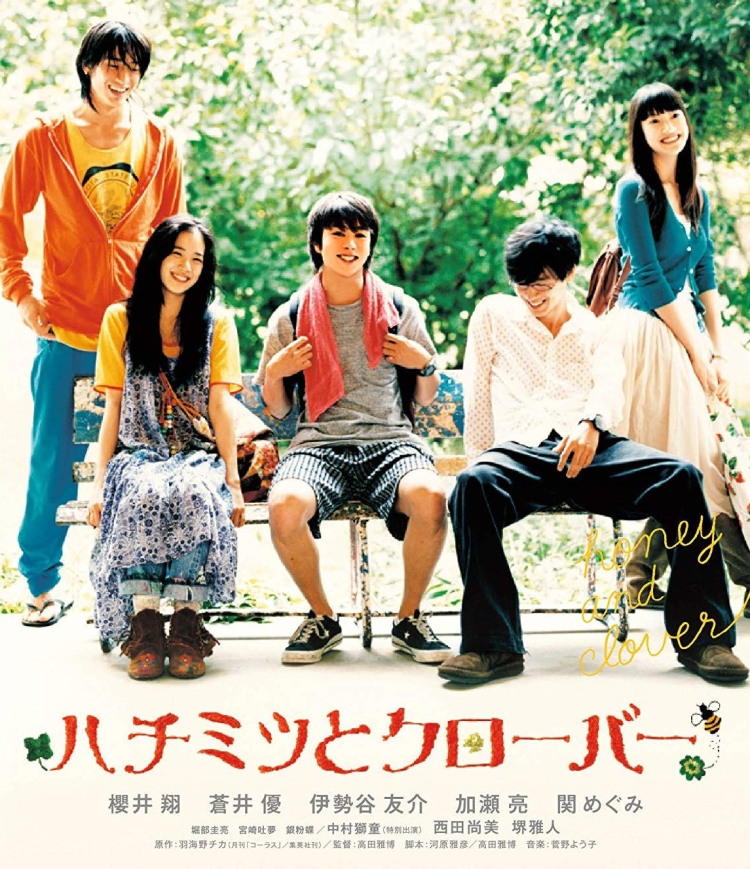
honey and clover blu-rayAh youth! Chica Umino’s phenomenally popular manga Honey and Clover (ハチミツとクローバー, Hachimitsu to Clover) is, essentially, a coming of age story in which love, requited and otherwise, plays a significant part. Masahiro Takada’s adaptation is no different in this respect as its central group of friends learn to come into themselves through various different kinds of heart break leading to soul searching and eventual self actualisation. The path to adulthood is rocky and strewn with anxieties, but has its own charms as our self branded Mr. Youth seems to have figured out, romanticising his own adolescence even while he lives it.

The action kicks off at an art college in Tokyo where a circle of friends is temporarily shaken by the arrival of a new student – a distant relative of a popular professor, Hanamoto (Masato Sakai). Our youth loving hero, Takemoto (Sho Sakurai), falls instantly in love with Hagu (Yu Aoi) – a genius self-taught painter with a dreamy, ethereal personality and negligible interpersonal skills. Hagu, however, seems to have developed a strange connection with conceited sculptor Morita (Yusuke Iseya) who continues to struggle with his conflicting interests in art and commerce. Meanwhile, geeky design student Mayama (Ryo Kase) has a problematic crush on his boss, Rika (Naomi Nishida), whose husband went missing some years ago, and has begun semi-stalking her. Unbeknownst to him, Mayama is also being semi-stalked by Yamada (Megumi Seki) – a spiky ceramicist who refuses to give up on her unrequited crush despite being fully aware of his one sided love for a brokenhearted middle-aged woman.

In actuality all of our protagonists are a little older than one might assume – all past the regular age for graduating college and either hanging around after being unable to complete their studies or pursuing additional training in the hope of furthering their art. They are all also hopelessly lost in terms of figuring out who they are – perhaps why they haven’t quite got a handle on their art, either. Hagu, younger than the others, seems to have an additional problem in existing outside of the mainstream, experiencing difficulties with communication and needing some additional help to get into the swing of college life. Perhaps for this reason, maverick professor Hanamoto palms her off on the “least arty” (read “most responsible”) of his students, Takemoto, who is tasked with accompanying her for meals – something for which he is quite grateful given his first brush with love on catching sight of her at her easel.

Hagu is also, however, the most sensitive and perceptive of the students even if she can only truly express herself through canvas. Her most instantaneous connection is with Morita, whose instinctive approach perhaps most closely mirrors her own though where Hagu is quiet and soulful, Morita is loud and impetuous. Watching him creating his centrepiece sculpture, Hagu is honest enough to tell Morita that he’s overdone it. Morita agrees but ends up exhibiting the piece anyway and not only that – he sells it for a serious amount of money despite knowing that it lacks artistic integrity. Hagu is unimpressed and her disapproval only adds to Morita’s sense of self loathing in his ambivalence towards to the fleeting rewards of superficial success versus the creation of artistic truth.

A similar sense of ambivalence imbues the romantic difficulties which neatly divide the group into a series of concentric love triangles. Takemoto, the selfless hero, realises the best thing he can do for Hagu is try to help Morita be less of a self-centred idiot while simultaneously dwelling on his fleeting youth and actively pursuing himself while debating whether or not to hit the road and leave his lovelorn friends to it. Mayama and Yamada, by contrast, are content to dance around each other, understanding the irony of their respective unreturned crushes while not quite bonding over them but both determined not to give up on their dreams (romantic and professional).

Despite the central positioning of our shy hero as he walks towards the end goal of being able to state his feelings plainly, the drama revolves around the enigmatic Hagu whose descent into an intense depression after an ill-advised moment on a beach is only eased by the careful attentions of her new friends finally realising that their artistic souls benefit from compassion for others rather than remaining solipsistically obsessed with their own romantic heartbreak. Despite its noble intentions, Honey and Clover misses the mark in charting the heady days of youth though our confused heroes do eventually manage to find themselves and each other along the road to adulthood as they chase down disappointments romantic and professional and discover what is they really want in the process.


Original trailer (no subtitles)
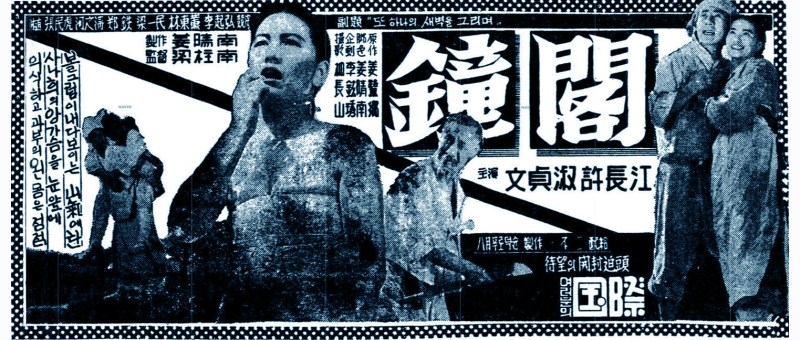
The Bell Tower (종각 / 鐘閣, Yang Ju-nam, 1958)

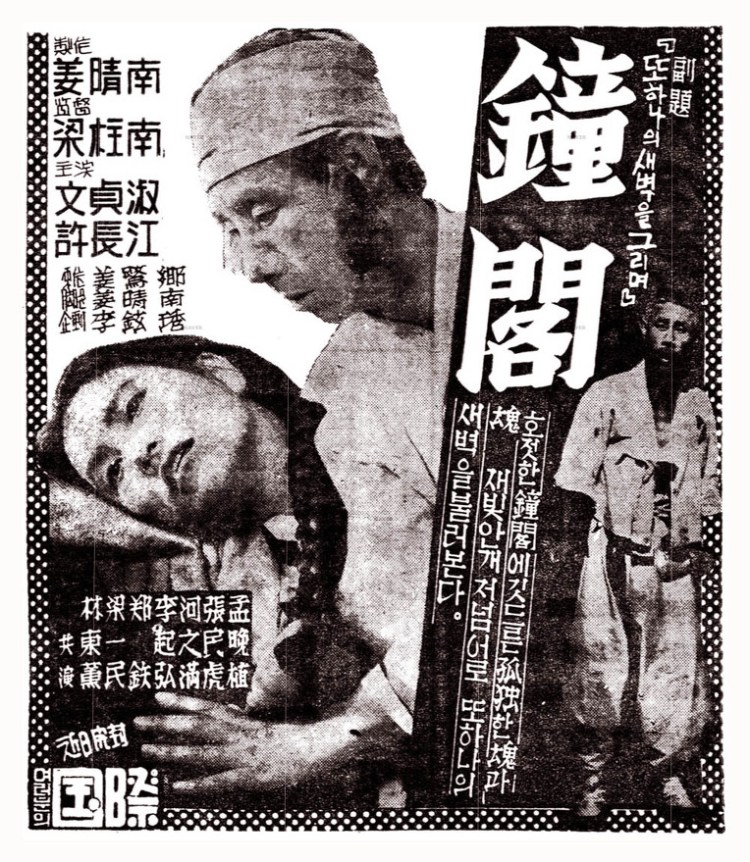
bell tower newspaper 1Yang Ju-nam directed only five films and spent the bulk of his career, which began in the mid-1930s, working as an editor. Making his directorial debut with Sweet Dream in 1936, Yang would not return to the director’s chair for 21 years, releasing Exorcism of Bae-Baeng-Yi in 1957. In 1958, however, he completed two more, The Bell Tower (종각 / 鐘閣, Jonggak, AKA The Bell Tower: Missing Another Dawn) following on from A Mother’s Love. Adapted from the novel by Kang Ro-hyang, The Bell Tower is a small scale affair starring two actors who would become giants of golden age cinema in a melancholy chamber piece charting the tragic history of mid-century Korea through the life stories of a bell maker and a lonely orphan.

The scene opens with a voice over from Yeong-sil (Moon Jeon-suk) who tells us that she has been staying in this temple for sentimental reasons seeing as she loves the sound of its bell and was once told that her father was a bell maker. Her story quickly gives way to that of the bell maker himself, Seok-sung (Heo Jang-gang), now very elderly and in poor health, who recounts his own sad life story in answer to her question about the bell. As a young man, Seok-sung had been in love with a young woman, Ok-bun, and planned to marry. After she died suddenly, he became a bell maker in honour of a promise he made her but met tragedy again when his mentor died, only latterly finding happiness with a widow who bore him a child only to lose them too.

Of course, we are conditioned to assume that Seok-sung must be Yeong-sil’s long lost father – after all, that’s how these stories go, but Yang keeps wrong footing us, not least through the triple casting of Moon Jeong-suk who plays each of the women Seok-sung meets throughout his life including the tragic Ok-bun, dead of appendicitis at only 19 and around 40 years previously. Then again, our perception of events is that of an old man’s memories – perhaps none of these women truly resembled Yeong-sil and Seok-sung has simply read her into his story as he leads her through the course of his life which eventually led him to creating his masterwork in the beautiful bell which now hangs in the temple.

Tellingly, Heo also turns up in Yeong-sil’s eventual flashback as we come to learn how it was she came to be staying in the temple. Her story and Seok-sung’s occupy differing temporal spaces, seemingly cleaved in two by historical circumstance. Seok-sung is man of Joseon whose long life story takes him into the age of occupation but his troubles are all those of an old world and not the new, until, that is the present day. Yeong-sil is a child of the colonial era whose life has been lived in the shadow of imperial violence though it is men of her own nation who seem to have betrayed her. A lonely orphan she made her way to the city but was tricked by a people trafficker who sold her to a mine as a sex slave. Falling in love with an indentured miner (Chan Min-ho), she managed to escape when the trafficker decided to sell her on a Japanese comfort woman station in China, but lives her life as a fugitive in fear of discovery, hiding from those who would misuse her but longing for her lover to return and a new life to start.

For Seok-sung the bell seems to toll mournfully as if in memory of things past, while for Yeong-sil it rings of determination, as if urging her not to give up rebelling against her fate. Yet the bell itself is doomed by the times of its creation. Now finding itself in the middle of a failing war, the bell is just hollow metal and soon to be melted down for military use. Having poured his heart, soul, suffering, and familial legacy into its creation, Seok-sung can hardly bear to see it put to such a sordid purpose. He would rather destroy his bell or take it with him than allow it to be sullied in such a way, but he is old and his gesture of rebellion futile.

Contrary to expectation, Yang ends on an ambivalent note as if anticipating a kind of limbo in which the present struggles to break free of the past but is, in essence, still waiting for something to begin rather than resolving to begin it. Beautifully framed and told almost entirely in flashback, The Bell Tower is a strangely melancholic meditation on post-war malaise and temporal dissonance as a dislocated father and daughter ponder on past and future while pulling at the threads of their miscommunication.


Available on DVD from the Korean Film Archive accompanied by a bilingual booklet featuring essays by film critics Kim Jong-won and Chung Sung-il, plus a documentary on the career of direct Yang Ju-nam. Also available to stream via the Korean Film Archive’s YouTube Channel.

Woman in Witness Protection (マルタイの女, Juzo Itami, 1997)

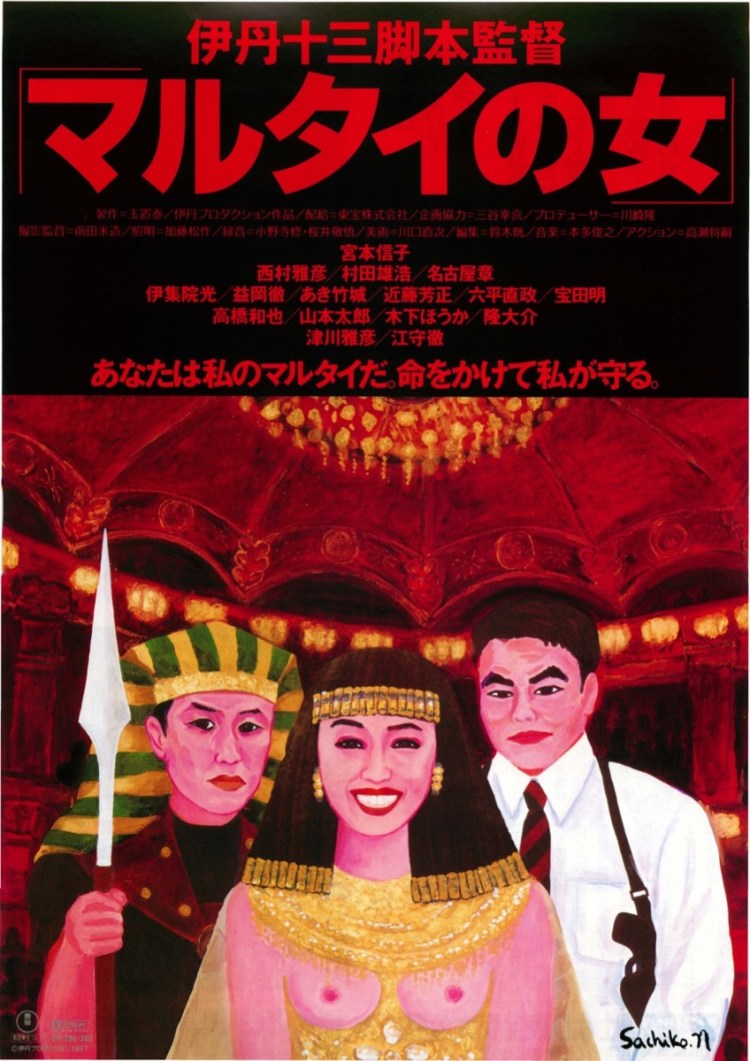
woman in witness protection posterJuzo Itami’s fearless taste for sending up the contradictions and hypocrisies of his home nation knew no bounds, eventually bringing him into conflict with the very forces he assumed so secure it was safe to mock – his 1992 film Minbo led to brutal attack by a gang of yakuza unhappy with how his film portrayed the world of organised crime. Woman in Witness Protection (マルタイの女, Marutai no Onna), continuing the “Woman” theme from previous hits A Taxing Woman and the more recent Supermarket Woman, would be Itami’s final feature as he died in mysterious circumstances not long after its completion and like Minbo it touched an open nerve. In 1997, crazy cult violence was perhaps no laughing matter nor as ridiculous as it might have seemed a few years earlier, yet Itami makes the actions of brainwashed conspirators the primary motivator of a self-centred actress’ gradual progress towards accepting the very thing his previous films might have satirised – her civic duty as a Japanese woman.

Itami breaks the film into a series of vignettes bookended by title cards beginning with the first which introduces us to our leading lady – Biwako Isono (Nobuko Miyamoto). Biwako is currently in rehearsals for an avant-garde play about giving birth (“a woman’s moment of glory”) during which she reduces her assistant to tears prompting her resignation, decrying Biwako’s self-centred bitchiness as she goes. Chastened, Biwako spends the evening doing vocal exercises outside her apartment which is how she comes to witness the botched murder of a lawyer by a crazed cultist (Kazuya Takahashi) during which she is almost murdered herself and only survives because the killer’s gun jams. As the only witness Biwako suddenly becomes important to the police which works well with her general need for attention but less so with her loathing for hassle. Seeing as Biwako is a famous actress, her involvement also precipitates increased press interest for the murder and accidentally threatens the ongoing police investigation not least because Biwako likes to play up for the camera and isn’t quite sure how best to deal with her divided responsibilities. With the killer still at large, the police decide to give Biwako protection in the form of two detectives – Chikamatsu (Yuji Murata), a cultured man who’s a big fan of Biwako’s stage career, and Tachibana (Masahiko Nishimura), a rather stiff gentleman who never watches films and rarely indulges in entertainment.

Bringing up cult violence in 1997 just two years after Japan’s only real terrorist incident perpetrated by a crazed cult, might be thought taboo but taboo was not something that Itami had ever run away from. Crazed cults had also popped up during A Taxing Woman’s Return though back then they mostly represented the hypocrisy of the new yakuza as a front for organised crime that thought nothing of bleeding vulnerable people dry while feeding them a lot of semi-religious claptrap to make them feel a part of something bigger while the bubble economy continued its puffed up attempts to make them feel inadequate. This time around our cultists are less well drawn but clearly a collection of unlucky people duped into believing the strange philosophies of the “Sheep of Truth” which teach that the world can only be saved by its followers dividing the world into white sheep and black sheep. Like the policeman and later Biwako, the killer believes he is only doing “that which must be done” in the best interests of the world. He is unaware of the cult’s shadiness and shocked when their lawyer threatens his family in an effort to convince him not to talk once the police have managed to break his programming, ironically through exactly the same methods – manipulating his feelings towards his wife and son.

The cult is however merely background to Biwako’s ongoing character drama. Despite experiencing emotional trauma from witnessing a murder and then being threatened herself, Biwako enjoys being the centre of the attention with the police as well as the warm glow she feels in being able to help them with their enquiries, but balks at the additional hassle of having to be involved in the trial (even if she would be given quite a sizeable platform as a witness in a high profile court case). She resents having the two policemen follow her around – especially as she has quite a busy schedule which includes an affair with her married manager. Nevertheless she gradually allows them into her life with Tachibana even making his stage debut as spear carrier in a production of Anthony and Cleopatra. Tachibana’s steadfast defence of her person even at the risk of his own life begins to teach Biwako a few things about civic responsibility and the importance of duty, even if her final moment of realisation is another of her staged set pieces in which she conjures a poignant monologue from the accidentally profound mutterings of Tachibana, a little of Cleopatra, and the earlier line from the maternity play repurposed as she affirms that testifying against the cultists will be her “moment of glory”.

Rather than end on Biwako’s sudden moment of enlightenment, Itami cuts to an ironic epilogue in which a police detective watching the movie we have just seen complains about its authenticity while emphasising that no one in protective custody has ever been attacked. A little tongue in cheek humour from Itami that is followed by the more usual disclaimer before the credits resume, but perhaps anticipating another dose of controversy from both law enforcement and cult devotees. Lighter in tone and noticeably less surreal than some of Itami’s earlier work, Woman in Witness Protection is the story of a vacuous actress learning the purpose of her stage as her particular brand of artifice meets that of the less innocently self-centred cultists head on and eventually becomes the best weapon against it.


Original trailer (no subtitles)

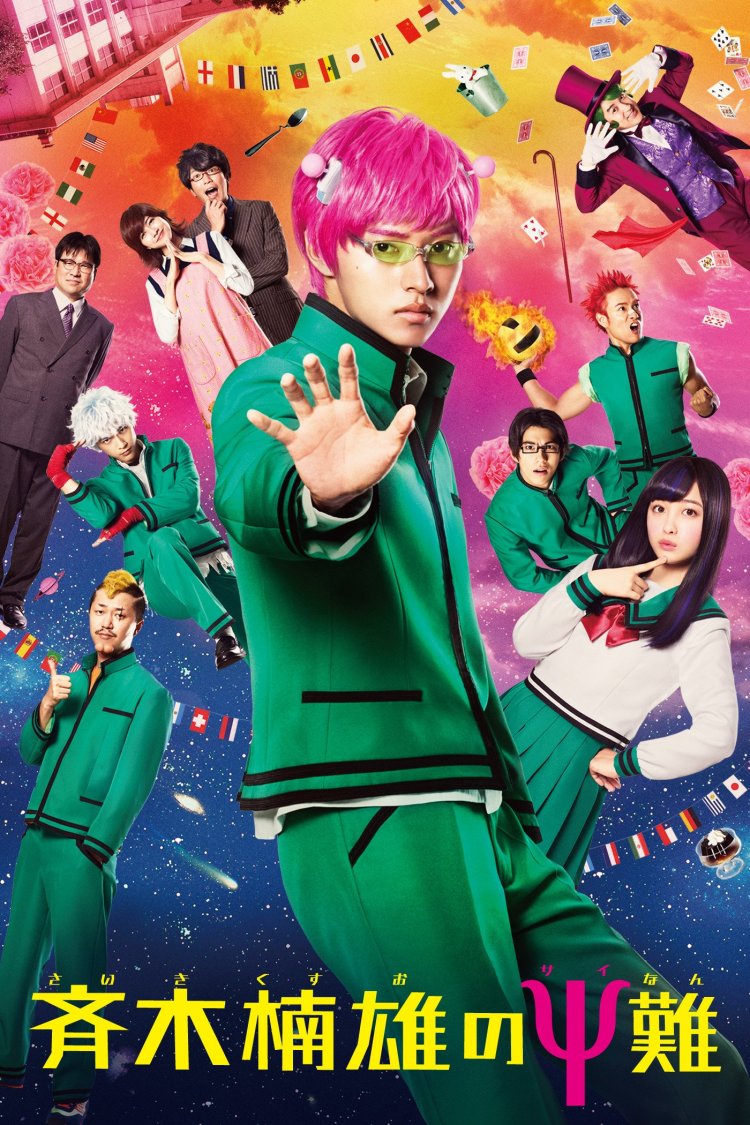
Psychic Kusuo (斉木楠雄のΨ難, Yuichi Fukuda, 2017)

psychic kusuo posterMany may bristle at an attempt to label director Yuichi Fukuda an auteur, but you can’t argue with the fact that he’s developed something of a house style. That house style may have just catapulted him to the top of the box office with two successful movies inspired by the gag filled Gintama, but outside of his big budget studio efforts he’s something of an acquired taste. Take Hentai Kamen, for example. For some a hilariously perverse super hero adventure comedy. For others one childish joke stretched out for 90 minutes. Psychic Kusuo (斉木楠雄のΨ難, Saiki Kusuo no Sainan), coming from the same general area as the phenomenally successful Gintama in adapting an absurdist gag manga only this time one by Shuichi Aso, undoubtedly belongs in the latter category.

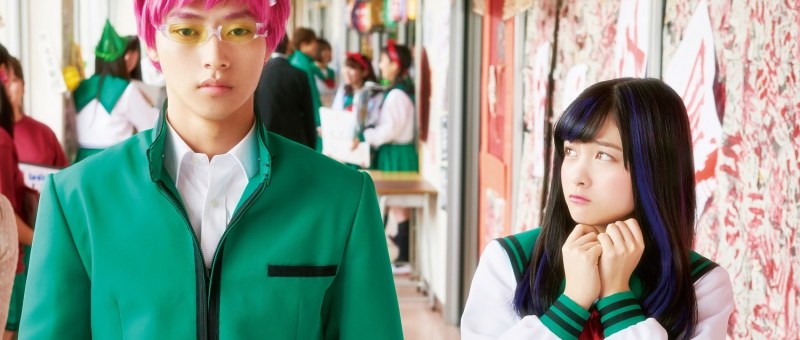
16-year-old Kusuo Saiki (Kento Yamazaki) is the most powerful esper on Earth. Seeing as he was born to a lovely, hippyish couple who didn’t mind that he was a bit strange, Saiki grew up appreciating his superpowers for what they are but also mindful that they could cause him a problem if they got out of hand. He uses his powers to hypnotise those around him so that they don’t notice his neon pink hair or the antennas in his head which keep his emotions in check and prevent him accidentally destroying all of Tokyo. Nevertheless, it is quite a bother to be burdened by unnatural abilities especially in that it makes life extremely dull not to mention a little stressful when you can hear everything everyone is thinking in every tiny detail.

The big problem is that Saiki is coming up on his first high school culture festival. Saiki is not big into celebrations and hanging out with other people so what he likes about festivals is that no one’s going to miss him so he can escape for a little me time. The last few festivals, however, have each descended into chaos and if it happens again this year they’re going to be cancelled for good. In order to save his precious haven of relaxation, Saiki will have to forgo it this time to make sure no one starts any trouble.

Fukuda began his career writing skits for TV variety shows and the humour in his films is indeed very specific and of the kind familiar to fans of Japanese television comedy, which is to say it is extremely broad and somewhat meta with frequent breaking of the fourth wall. The major antagonist of Psychic Kusuo is conceited high school classmate Kokomi (Kanna Hashimoto) who is accounted by all as the school’s number one beauty and knows it. As he’s able to read minds, Saiki knows she’s in no way as pretty on the inside and makes a point of ignoring her. Of course, this only ends up attracting her attention because she’s incapable of accepting that there’s a boy who doesn’t instantly sigh on catching sight of her. In keeping with Fukuda’s over the top approach, Kokomi becomes little more than a collection of preening looks alternating between calculated cuteness and outright bunny boiler villainy.

Meanwhile, Fukuda throws in a series of in jokes and random references to other franchises from Assassination Classroom to Dragon Ball, piling absurdity on top of absurdity through a series of possible crises as yankees from another school threaten to cause a ruckus and the Dark Reunion turn up to prosecute their conspiracy on school grounds. Meanwhile a creepy stage magician and his surprisingly sprightly mother/assistant take credit for all the strange goings on and Saiki accidentally ends up marooned in space.

Yet the problem is that it just isn’t very funny or particularly interesting. It comes to something when the most entertaining part of the movie is Saiki’s extremely nice parents and their unflappable acceptance of the strange goings on which often befall their family. Over reliant on reaction shots and schoolyard humour, Psychic Kusuo may play well to Fukuda’s many fans, those familiar with the anime or manga, and lovers of TV variety skits but anyone else may find themselves scratching their heads at its decidedly lowbrow, scattershot attempt at humour and longing for an end to its considerably dubious charms.


Original trailer (no subtitles)
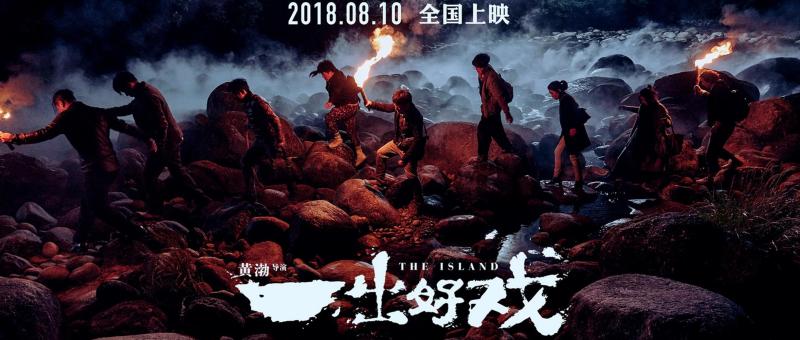
The Island (一出好戏, Huang Bo, 2018)

the island poster 1Comedy seems to have regained its bite of late. Filmmakers seeking to deliver pointed barbs at the modern China are pulling away from the traditionally safe areas of the period drama for a natural home in satire which for the time being at least is running rings around the censors’ board, albeit in a subdued fashion. The directorial debut from comedic actor Huang Bo, The Island (一出好戏, Yìchū Hăoxì) offers a mini lesson on the perils of untapped capitalism, tyranny, propaganda and “fake news” agendas in the form of a genial romcom in which a nice guy loser makes himself the king and wins the heart of his fair princess only for his empire to crumble under the weight of his own conflicted moralities.

On the day a meteor may or may not be on course to fall to Earth, dejected middle-aged office worker Ma Jin (Huang Bo) is off on a “team building” trip with his colleagues which involves a lengthy journey on an aquatic bus. Ma seems to owe money to just about everyone but swears he will soon pay them back, meanwhile he’s also hoping to get close to office beauty Shanshan (Shu Qi ) on whom he has a longstanding crush. At long last, it seems like Ma’s ship has finally come in – on checking his lottery numbers, Ma realises he’s the jackpot winner and can probably quit his boring job as soon as they dock, possibly even sweeping Shanshan off her feet as he does so. Alas it is not to be as seconds later the meteorite strikes engulfing the duck boat in a tsunami and eventually marooning the entire party on a deserted rocky island somewhere in the middle of the sea.

Huang wastes no time mocking modern consumerism. Ma Jin is now a millionaire but it couldn’t matter less. Likewise, slick boss Zhang (Yu Hewei) is at a similar impasse. He’s supposed to be in charge, an innovator and entrepreneur with all the ideas and a clear path to success but he is stunned and can only scream into the ocean while vowing to use his vast wealth to buy a new ship. The passengers look for leaders, some sticking with their social superior Zhang while others start to flock to the energetic bus driver Wang (Wang Baoqiang) who offers more practical solutions having discovered an abundant crop of fruit trees during an early exploration of the terrain. Wang used to be a monkey keeper and quickly assumes control with an authority born of strength and dominance as well as the withholding of the means to survive from those who do not submit to him.

It’s not long before some of the passengers long to be free of his oppressive yoke and the ideal opportunity arises when capitalist boss Zhang chances on a ready supply of capital in the form of a shipwrecked, upside-down boat which is laden with supplies. Ma Jin and his cousin Xing (Lay Zhang) follow Zhang who later institutes a market economy using playing cards for currency which offers the illusion of freedom but traps the employees in a system of capitalistic wage slavery while Zhang gets “rich” at the top of the pile. Ma Jin and Xing eventually grow disillusioned with their increased status at Zhang’s side when they realise he doesn’t have a plan for getting off the island and has given up on the idea of returning to civilisation.

Pitting two sides against the other, Ma Jin manages to create unity under a system of communism with capitalist characteristics (you see where he going with this?) in which he reigns as something like first among equals. Ma Jin’s “communist” utopia filled with laughter, song, and impromptu dance sequences is only born when he realises he’s missed the date to claim his lottery ticket and that there’s nothing worth going back for whether civilisation still exists or not. With his new found status, he’s finally able to get close the emotionally wounded Shanshan but becomes increasingly conflicted as the “fakery’ required to keep his regime in place begins to weigh on his mind, especially when a boat is spotted on the horizon and the entire system seems primed to crumble. Ma Jin gives in to his worst instincts at the instigation of his even more corrupted cousin who brands the boat visionary a false prophet, a madman who can’t accept the wonders of the new regime.

Only when confronted with Shanshan’s genuine emotion for the man he was pretending to be does Ma Jin wake up from his embittered fever dream to realise the dangers of the world he has created out of his own sense of inferiority, and particularly the harm done to his cousin who perhaps always felt a little oppressed just by him. The message is however compromised by Ma Jin’s otherwise positive realisation that lack of money was not as big a barrier to his success as lack of self confidence and avoidance of truthful emotional connections which of course undermines the central criticism of the increasing inequalities of modern Chinese society just as the ironic coda undoes the anti-consumerist message. Nevertheless, though overlong The Island successfully marries its romantic comedy core with its satirical aspirations thanks to the committed performances of the always radiant Shu Qi who invests the underwritten Shanshan with the necessary levels of wavering earnest while Huang Bo brings his usual hangdog charm to the role of the corrupted everyman.


International trailer (English subtitles)

Spring Dreams (春の夢, Keisuke Kinoshita, 1960)

vlcsnap-2019-01-10-00h23m29s867Let them eat sweet potato? The heartless bourgeoisie at the centre of Keisuke Kinoshita’s absurdist satire Spring Dreams (春の夢, Haru no yume) have found themselves accidentally engulfed by the revolution which seems to be attacking them on every front including from inside their palatial, Western-style mansion. Things are about to change in the Okudaira world, but then again maybe not all that much.

The Okudairas are the owners of a large scale pharmaceuticals firm. Widowed patriarch Shobei (Eitaro Ozawa) is the CEO, but he’s at the constant mercy of his mother-in-law (Chieko Higashiyama) who acts as the guardian of the family business’ legacy. Meanwhile, he has three problematic children – oldest daughter Tamiko (Yatsuko Tanami) who has become a promiscuous playgirl with a taste for “mothering” college students, Chizuko (Mariko Okada) who is the only “normal” one in the house and has fallen in love with an impoverished painter, and Mamoru (Yusuke Kawazu) who is a kind of melancholy Hamlet waxing on his existential angst while eating everything in sight.

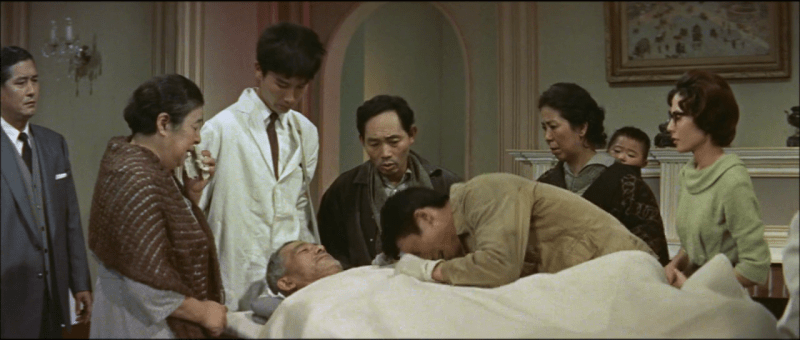
Into this already strained household comes the unexpected figure of sweet potato salesman, Atsumi (Chishu Ryu). With the house empty for a change, romantically conflicted maid Umeko (Yukiyo Toake) calls one of her boyfriends down at the fish shop to get the potato guy to come round. Kimiko (Meiko Nakamura), the other maid, goes out to pick some up but ends up flirting with a delivery boy so sends Atsumi inside where Umeko ropes him into helping shift some furniture which is how he ends up having a minor stroke in the Okudaira’s living room. Luckily for Atsumi, the person who finds him is Shobei’s compassionate spinster secretary, Kazuko (Yoshiko Kuga), who has some sad experience in this area as her father passed away after a stroke when she was a teenager, they say because someone moved him too early. A visit from the family doctor (Shuji Sano) backs up her advice and Atsumi will be staying put in the living room for the foreseeable future.

Of course, this doesn’t go down well with most of the Okudairas. Shobei wants him gone but what can you do? Atsumi stays because on balance it would be awkward if he ended up dying and staining the Okudaira name. Sadly, greed and indifference are not unique to the bourgeoisie as we discover when a parade of “well wishers” from Atsumi’s tenement house begin showing up to see how he is. Aside from the kindly, filial Eiichi (Shinji Tanaka) who has taken time off work to look after the old man, everyone else thinks Atsumi’s time has come. They know his tragic history, that he’s all alone now since both his sons were killed in the war and the rest of his family lost in the bombing. They want to get in with him to be remembered in the will, or even get their hands on his wallet for something like an advance. Poor old Atsumi is just an object fit for exploiting – a symbol of the Okudaira’s largesse, and of a potential windfall when the inevitable happens.

Meanwhile, the winds of change are blowing. Shobei is tied up with a labour dispute at the factory, obsessed with the idea of crushing the unions while the workers’ rousing chorus of the Internationale echoes ever more loudly in the distance. Grandma advises “just fire them all”, but things aren’t as easy as they were back in Meiji. Grandma thinks Shobei is a bit useless, especially since her daughter died and he’s been allowed to get off easy. She needs to find a successor seeing as Mamoru’s too weird to take over which means one of the girls needs to get married. Tamiko’s ruled herself out thanks to her eccentric love life, which leaves only Chizuko who wants to marry a painter and has no real interest in saving the family business. Chizuko is determined to oppose the idea of an arranged marriage, she’s a post-war girl after all, but grandma is firm. When she was a girl they made her give up on her first love, who happened also to be named “Atsumi”, to marry an Okudaira and so Chizuko is merely being unreasonable.

Nevertheless the presence of Atsumi begins to soften grandma’s heart with memories of her youth and the cruelty with which her youthful dreams were stripped away. Love blossoms in the cold Okudaira mansion, genuine bonds between people are recognised while the opportunist are rejected, and the young regain their freedom from the old who now recognise how destructive the old order could be. Will the house of the Okudaira’s fall? Probably not. Revolutions don’t take hold over night, but greed at least is on its way out paving the way for a better, kinder future for all.


Titles and opening (no subtitles)

Early Korean Cinema: Lost Films from the Japanese Colonial Period

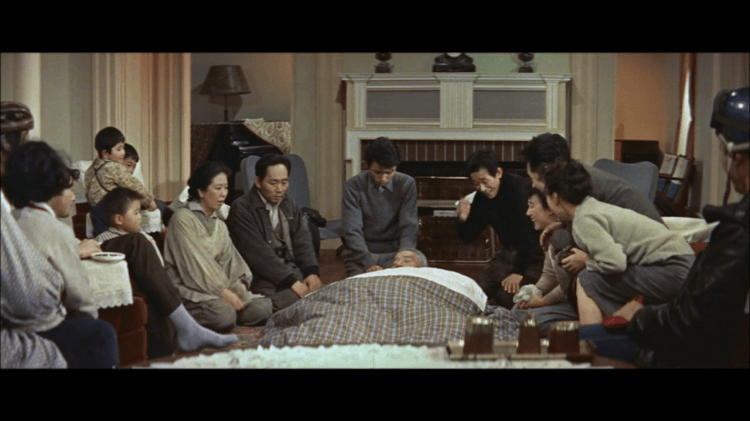
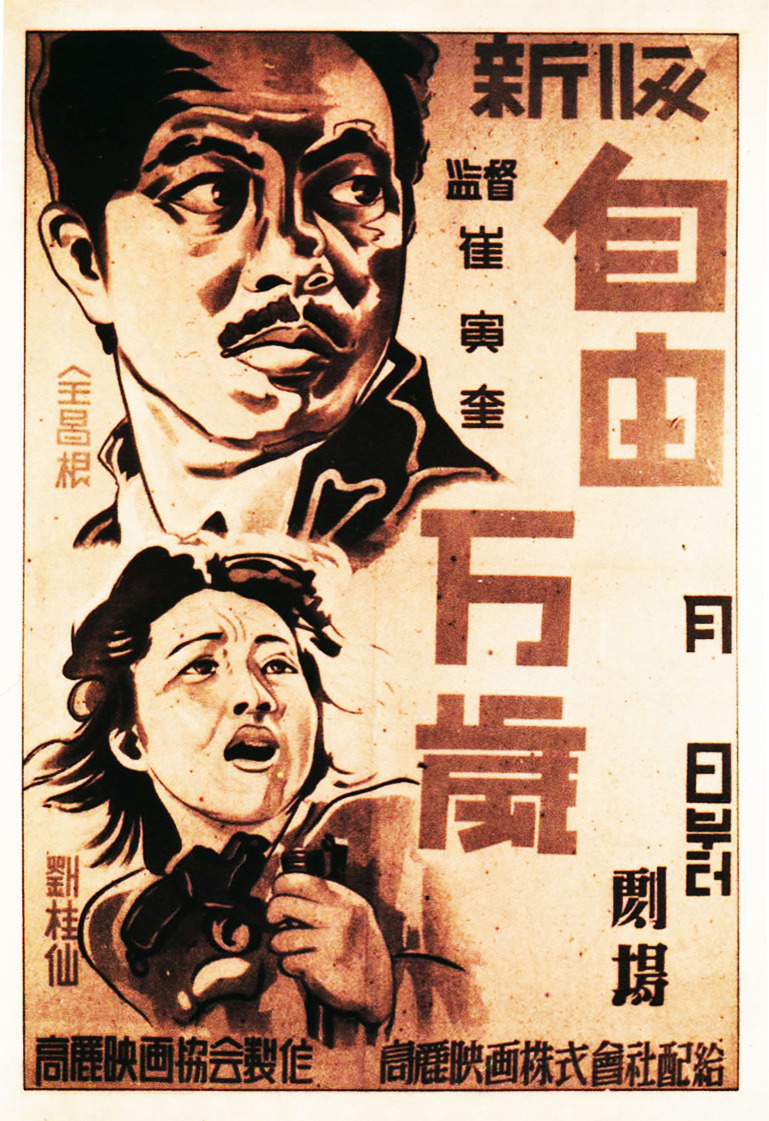
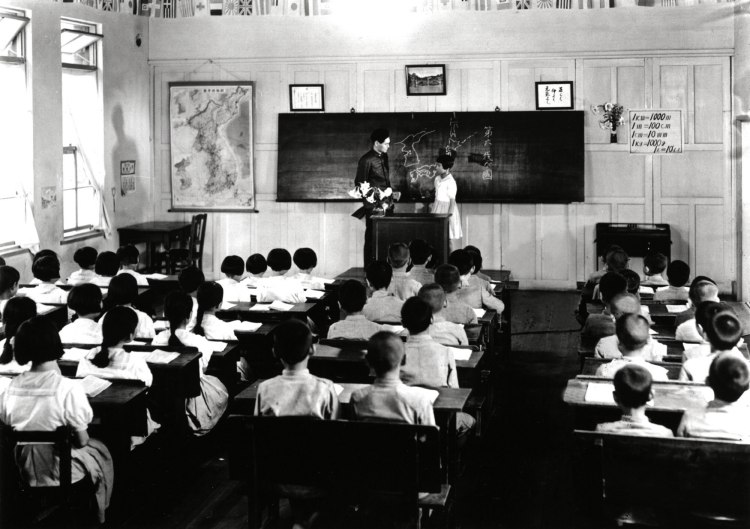
hurrah-for-freedom-poster.jpgClassic Korean cinema is making a long awaited return to the BFI this February with a fantastic season of rarely screened (and sadly just rare) films produced during the Japanese colonial period.

Crossroads of Youth + season introduction

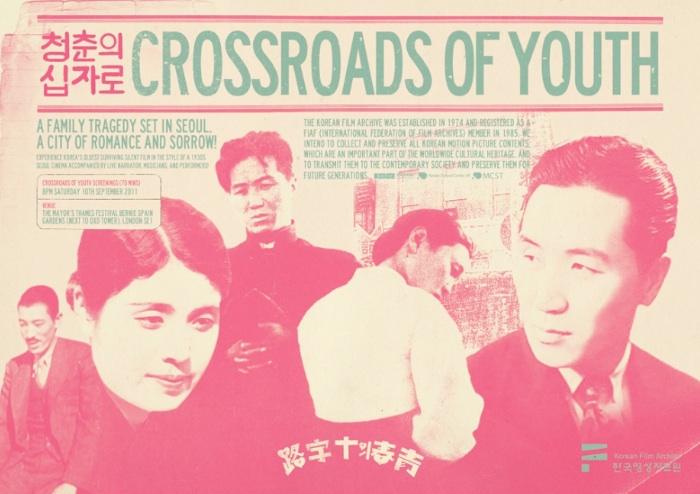
crossroads of youthThe oldest extant Korean film, Crossroads of Youth follows the adventures of a young man who travels to the city to find work after his arranged marriage falls through only to fall for a girl who is about to be sold to a money lender in payment for a debt.

The screening will be preceded by an illustrated lecture from the Korean Film Archive’s Chung Chong-hwa. As at the screening at the Barbican back in 2012, the silent film will be screened in the original fashion with live music and performances and narrated by a byeonsa.

Sweet Dream + Fisherman’s Fire

 The Korean Film Archive’s Chung Chong-hwa will introduce the films at the Friday 15th screening.

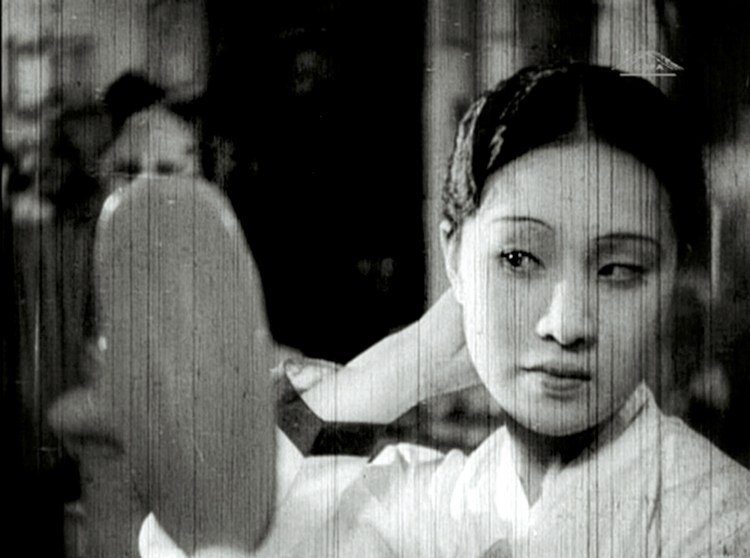
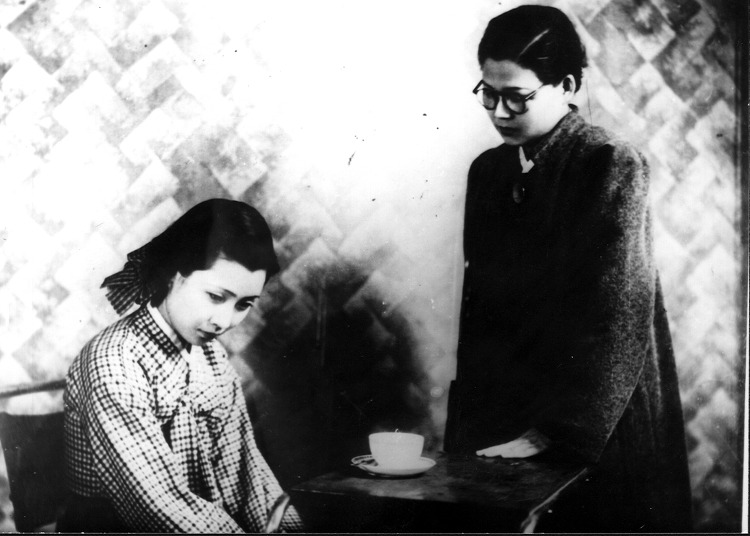
sweet dream still 1Acclaimed film editor Yang Ju-nam made his directorial debut with 1936’s Sweet Dream – a melodrama revolving around a vain housewife who abandons her daughter and moves in with a lover at a hotel after her husband throws her out.

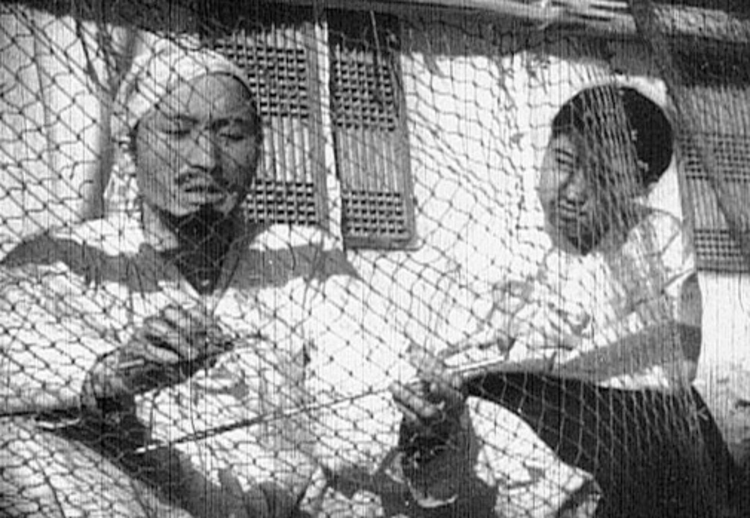
fisherman's fire still 1Co-produced by Shochiku and supervised by Yasujiro Shimazu, Ahn Cheol-young’s Fisherman’s Fire follows the melancholy fate of fisherman’s daughter In-soon who is faced with being sold in payment of a debt but escapes to Seoul only to wind up being forced to become bar girl.

Military Train + Volunteer + intro by Baek Moonim, Yonsei University

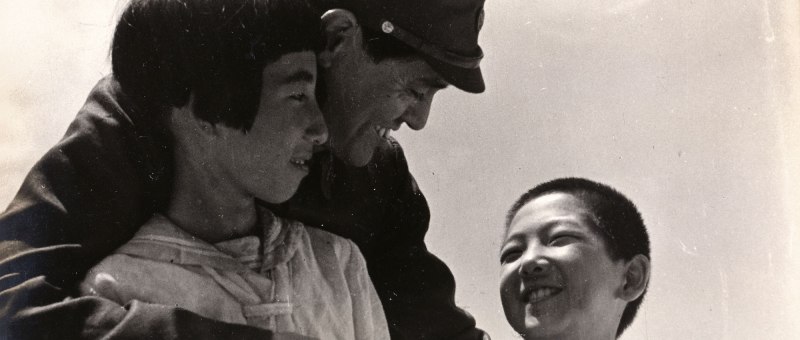
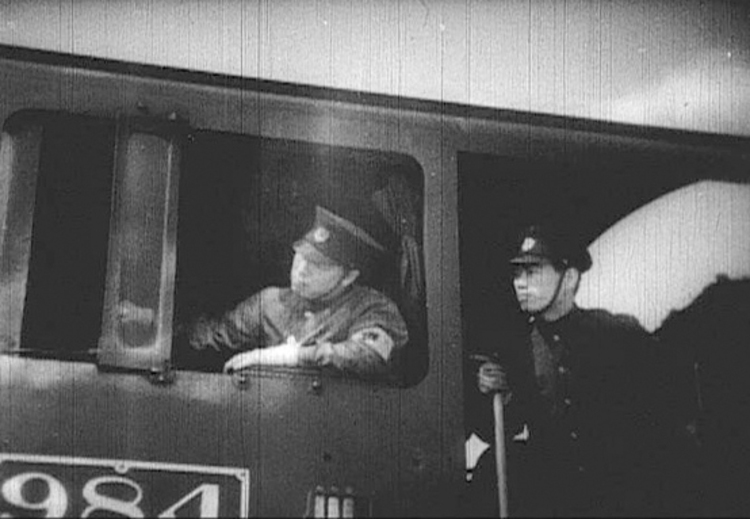
military train still 1The only film directed by Suh Kwang-je, Military Train is also accounted as the first pro-Japanese government film, which is a fairly unfortunate legacy whichever way you look at it. Intended to boost recruitment, the film follows two best friends and roommates whose lives are disrupted when one is approached by resistance agents seeking info about the military train.

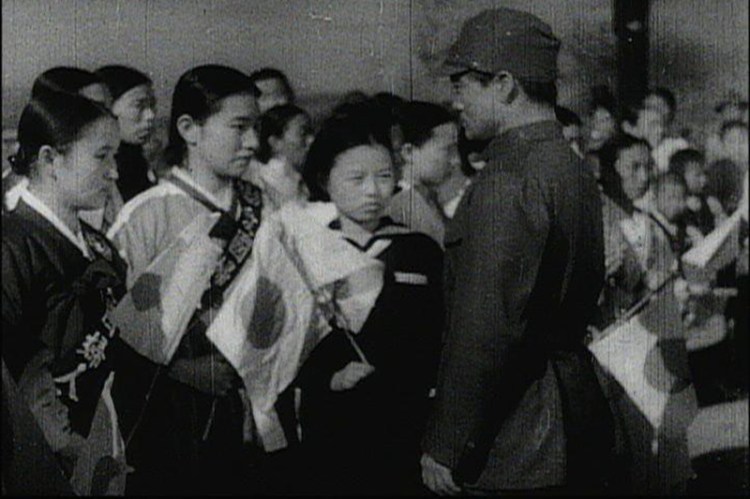
volunteer still 1Another recruiting film, Anh Seok-young’s Volunteer follows a poor farm boy who is thrown off his land and resents his meagre prospects. He sees entry to the Japanese army, which has recently relaxed regulations to allow Korean men to join, as a path to making something of himself…

Tuition

tuition largeOne of the many films inspired by a child’s essay Tuition is a mildly subversive propaganda melodrama about a little boy struggling to pay his school fees who goes on a perilous adventure when his grandma is taken ill. Full review.

Spring of the Korean Peninsula + discussion

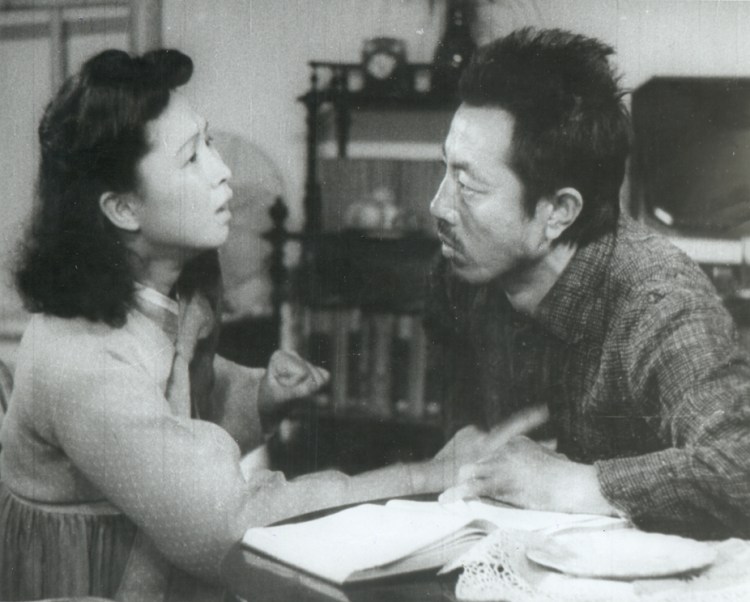
spring of the korean peninsula still 1The directorial debut of Lee Byung-il (The Love Marriage), Spring on the Korean Peninsula (adapted from Kim Seong-min’s award winning 1936 novel Artists of the Peninsula) follows a young film director struggling to film a new version of the Chun-hyang story. When he loses his lead actress, he hires his friend’s little sister but then makes a disastrous choice to facilitate his artistic dreams.

The screening will be followed by a panel discussion featuring Korean film scholars Baek Moonim (Yonsei University), Lee Hwa-jin (Inha University) and Chung Chong-hwa (Korean Film Archive), and chaired by season co-curator Kate Taylor-Jones.

Hurrah! For Freedom

hurrah freedom still 1Sadly incomplete and, ironically enough, a victim of censorship in the Park Chung-hee era, Hurrah! for Freedom (also known as Viva Freedom!) is the appropriately titled first film to have been released after the liberation and follows a betrayed resistance fighter who escapes from Japanese capture and hides out in a nurse’s apartment while covertly continuing his resistance activities.

Early Korean Cinema: Lost Films from the Japanese Colonial Period runs at the BFI Southbank from 7th February. Tickets are currently on sale to members with public sales beginning on 15th January.

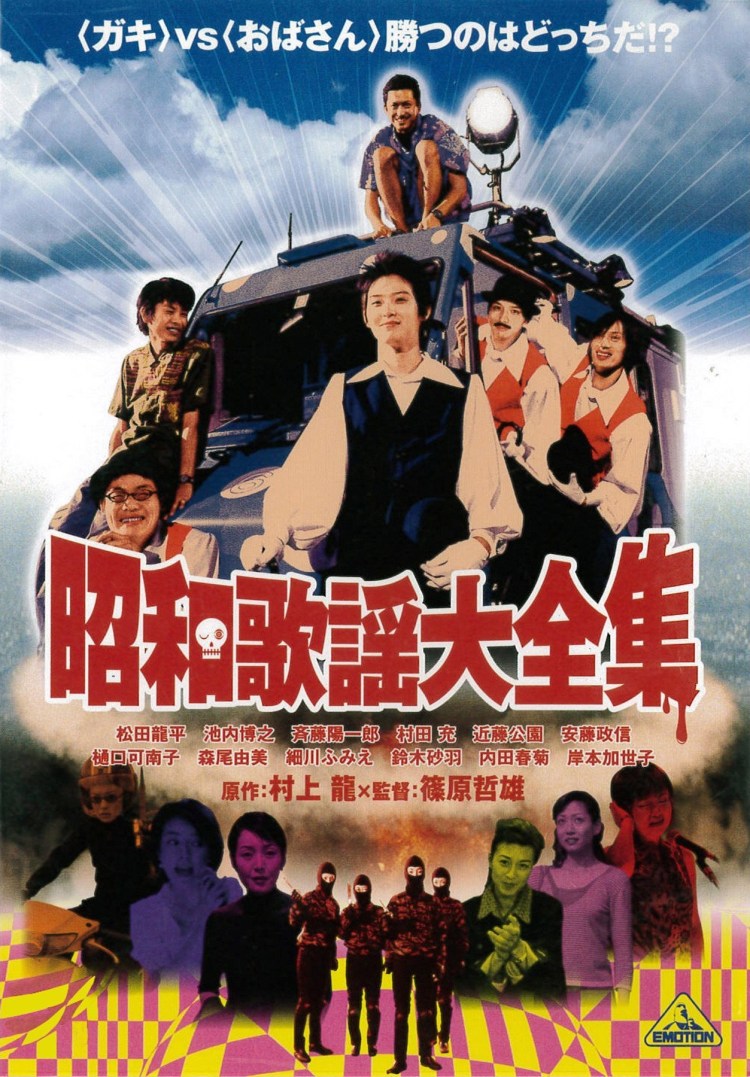
Karaoke Terror (昭和歌謡大全集, Tetsuo Shinohara, 2003)

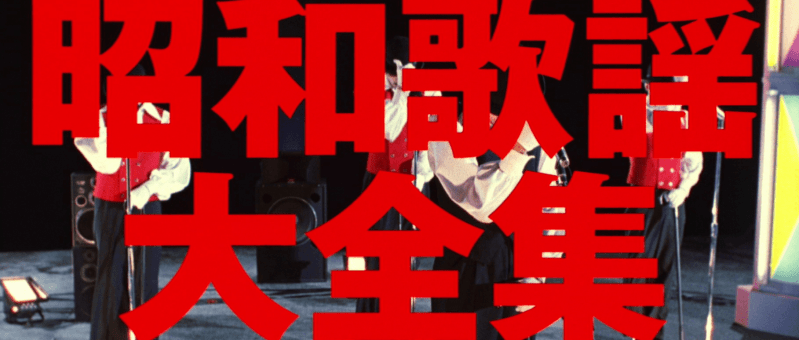
karaoke terror poster.jpgEver since its invention karaoke has provided the means for many a weary soul to ease their burdens, but there may be a case for wondering if escapism is a valid goal in a society which seems to be content in stagnation. The awkwardly titled Karaoke Terror (昭和歌謡大全集, Showa Kayo Daizenshu), adapted from the book Popular Hits of the Showa Era by Audition’s Ryu Murakami, pits two very different groups of karaoke enthusiasts against each other – aimless adolescent males, and jaded middle-aged women. Despite the differences in their ages and experiences, both enjoy singing the wistful bubblegum pop of an earlier generation as if drunk on national nostalgia and longing for the lost innocence of Japan’s hopeful post-war endeavour to rebuild itself better than it had been before.

We open with the slackers and a voice over from the presumed “hero” of the film, Ishihara (Ryuhei Matsuda), who informs us that he can’t really remember how he met most of the guys he hangs out with but that he always knew the one of them, Sugioka (Masanobu Ando), was a bit cracked in the head. In a motif that will be repeated, Sugioka catches sight of a middle-aged woman just on the way back from a shopping trip and decides he must have her but his attempts to pick her up fail spectacularly at which point he whips out his knife and slashes her throat.

Meanwhile, across town, a middle-aged woman, Hemmi (Kayoko Kishimoto), offers to let a co-worker share her umbrella but the co-worker misinterprets this small gesture of courtesy as romantic interest and crudely asks her “how about a fuck?” to which Hemmi is quite rightly outraged. Rather than apologise, the co-worker shrugs and says his “direct” approach works six times out of eight and some women even appreciate it. Once she manages to get away from her odious aggressor, Hemmi ends up stumbling over the body of the woman murdered by Sugioka and realises she knows her. The murdered woman was one of six all named Midori who were brought together for a newspaper article about the lives of middle-aged divorced women and have stayed “friends”. Outraged about this assault not just on their friend and their sex but directly against “women of a certain age” who continue to be the butt of a societal joke, the Midoris decide they want revenge and hatch a plan off Sugioka, but once they have, the slackers hit back by offing a Midori and so it continues with ever-increasing levels of violence.

Which ever way you slice it, you can’t deny the Midoris have a point and Hemmi’s continuing outrage is fully justified. When the boys rock up at a mysterious general goods store out in the country looking for a gun, the proprietor (Yoshio Harada) is only too happy to give it to them when they explain they need it for revenge and that their targets are middle-aged women. The proprietor has a lot to say about ladies of a certain age. In fact he hates them and thinks that bossy, embittered, unproductive women “too old” to fulfil their only reason for existence will be the only ones to survive a nuclear apocalypse that even the cockroaches cannot overcome. The boys appear timid and inexperienced but ironically enough can’t take their eyes off the middle-aged woman from across the way and her sexy dance routines. They feel entitled to female deference and cannot accept a woman’s right to decline. The Midoris are sick of being “humiliated”. They’ve fallen from Japan’s conformist path for female success in getting divorced or attempting to pursue careers. They’ve lost their children and endured constant ridicule as “sad” or “desperate”, made to feel as if their presence in the workplace past a certain age was “inappropriate” and the prices they have paid for their meagre successes were not worth the reward. They strike back not just at these psychotic boys but at a society which has persistently enacted other kinds of violence upon them.

Meanwhile, the boys remain boys, refusing adulthood and responsibility by wasting their time on idle pursuits. Truth be told, karaoke performances involving dance routines and elaborate costumes is not a particularly “cool” hobby by the standards of the time but it appears that none of these men have much else in their lives to invest themselves in. With the economy stagnating and the salaryman dream all but dead, you can’t blame them for their apathy or for the rejection of the values of their parents’ generation, but you can blame them for their persistent refusal to grow up and tendency to allow their insecurities to bubble over into violence.

As it turns out, adolescent males and middle-aged women have more in common than might be thought in their peripheral existences, exiled from the mainstream success which belongs exclusively to middle-aged and older men who’ve been careful to (superficially at least) adhere to all the rules of a conformist society. Neither group of friends is especially friendly, only latterly realising that “real” connections are forged through direct communication. Their mutual apathy is pierced only by violence which, ironically, allows their souls to sing and finally shows them just what all those cheerful songs were really about. Darkly comic and often surreal, Karaoke Terror is a sideways look at two diametrically opposed groups finding unexpected common ground in the catharsis of vengeance only for their internecine warfare to graduate into world ending pettiness.


Original trailer (English subtitles)

The greatest hits of the Showa era:

Koi no Kisetsu – Pinky & Killers

Hoshi no Nagare ni – Akiko Kikuchi

Chanchiki Okesa – Haruo Minami

Shiroi Cho no Samba – Kayoko Moriyama

Linda Linda – The Blue Hearts

Sweet Memories – Seiko Matsuda

Kaze Tachinu – Seiko Matsuda

Minato ga Mieru Oka – Aiko Hirano

Sabita Knife – Yujiro Ishihara

Hone Made Aishite – Jo Takuya

Kimi to Itsumademo – Yuzo Kayama

Mata Au Hi Made – Kiyohiko Ozaki

The Man Who Stole the Sun (太陽を盗んだ男, Kazuhiko Hasegawa, 1979)

(C) Toho 1979

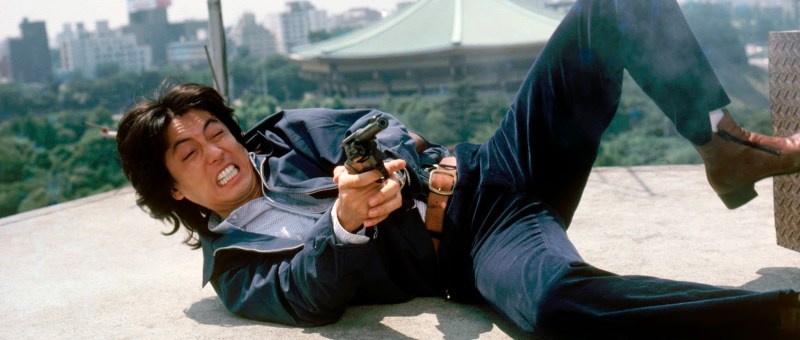
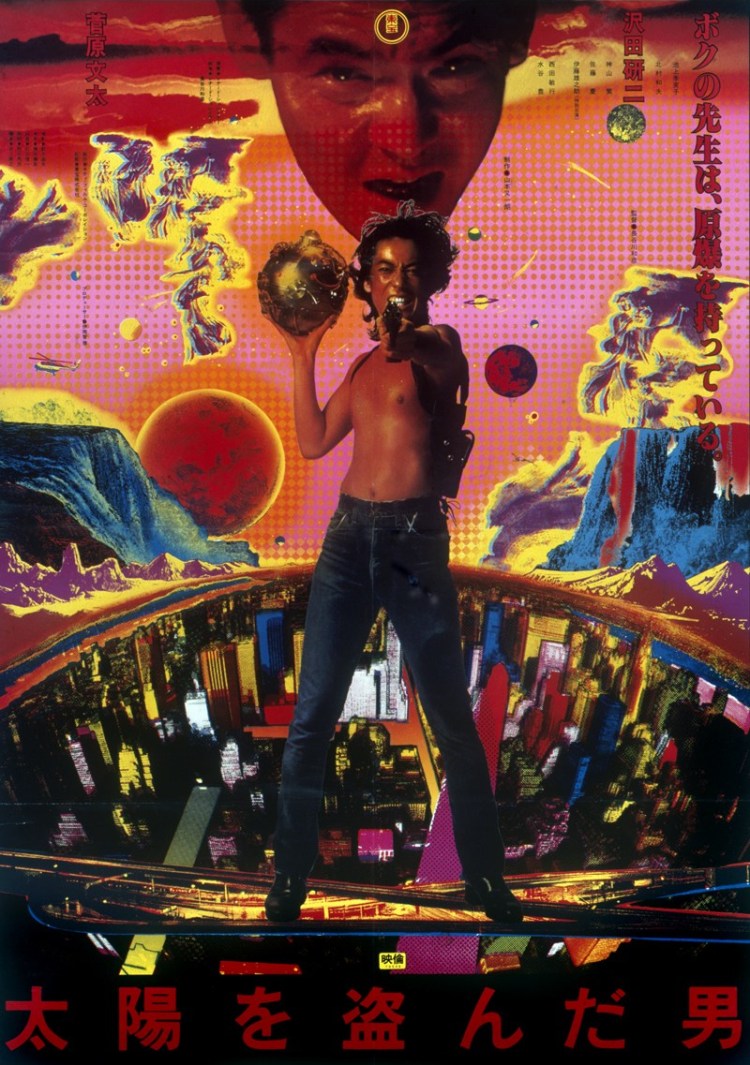
man who stole the sun posterIn the post-Asama-Sanso world, Japanese society had shifted into period of intense calm in which improving economic prosperity was in the process of delivering comfort rather than the creeping acquisitive anxiousness that began to overshadow the bubble era. Nevertheless, in cinematic terms at least anxiety was everywhere and not least among the young who, swept along by this irresistible economic current, were quietly doubtful about their place in a changing society. Co-scripted by an American screenwriter, Leonard Schrader (brother of Taxi Driver’s Paul), The Man Who Stole the Sun (太陽を盗んだ男, Taiyo wo Nusunda Otoko) provides a satirical snapshot of this confusing moment as an oppressed, belittled high school science teacher builds an atomic bomb in his apartment just to show he can but then realises he has absolutely no idea what to do with it.

Technically speaking, the science teacher’s name is Makoto Kido (Kenji Sawada) but no one really calls him that. The kids at school refer to him as “Bubble-gum” because he always seems to be chewing on the rather childish confectionary. Not the most conscientious of teachers, he tailors the curriculum to his own interests, teaching the kids all about atomic energy and the bomb, but the kids aren’t interested. They only want to know what’s going to be on the test. To them Kido’s information is irrelevant and so they ignore him, talking amongst themselves while he carries on, preaching to a seemingly empty room.

Meanwhile, Kido is building the bomb at home, for real. As he tells the kids, anyone can build an atomic bomb – you only need the plutonium which is, admittedly, tightly controlled for just this reason. He acquires his through a daring heist on a nuclear plant. Kido never elaborates on what prompted him to begin his bizarre masterplan, but there is certainly a degree of pent up rage inside him born of resentment with his reduced circumstances. “Just” a high school science teacher, who would really think he’d have the capability to build an atomic bomb, alone, using only household equipment (plus the plutonium and a custom furnace purchased after nearly exploding his oven)?

Kido’s problems are the same as many middle-aged men in ‘70s Japan in that he feels intensely oppressed from above and below. What he’s trying to tell the kids is that they have access to this power already – anyone can build a bomb, if you bother to learn how. The only thing that’s being kept from him is the plutonium (and for good reason), which he manages to acquire anyway. A chance encounter with the madness of the age seems to kickstart his plan into gear when he meets his opposing number in police inspector Yamashita (Bunta Sugawara).

Kido, having halfheartedly escorted a group of students on a school trip, finds himself rendered powerless once again when the bus is hijacked by a distressed older gentleman (Yunosuke Ito) armed with a rifle and grenade and wearing a World War II soldier’s uniform. He demands to be driven to see the emperor from whom he intends to demand the return of his son, presumably killed in the war 30 years earlier. Yamashita, clean cut and authoritative, is the gung-ho cop who masterfully brings the hostage crisis to a close by lying to the man that the emperor has consented to see him. During the evacuation the old man is killed by police snipers (despite Yamashita’s too late cries of “don’t shoot” after having dispatched the grenade and disarmed the suspect).

Like Kido, the old man likely didn’t really know what he intended to do, only that he was lonely and desperate. The emperor couldn’t give him back his son (whose uniform he seems to be wearing) and his gesture is one of futile defiance coupled with a suicide bid that has no real goal save making an elaborate protest against the world in which he lives. Kido makes the bomb, lets the authorities know he has it, but then realises he has no demands. He asks them to fix something minor that annoys him, to stop the TV networks pulling the plug on late running baseball games to make way for the news, and finds himself rewarded. He has taken back the power, they believe he has the bomb and they fear him, but he has no further goals or notion of how his society should change. There is no idealised future he is fighting for, all there is is futility and indifference.

Meanwhile, ironically enough, Kido’s desperation provokes a mini revolution in others. A talkshow radio host (Kimiko Ikegami) named “Zero” (in contrast to Kido’s adoption of the codename “No. 9” as the 9th owner of a nuclear device and the only individual), broadcasts his on-air request for ideas, believing it to be a kind of thought experiment. The ideas she gets from the public are of the usual kind – lonely men who want to bathe with naked women, nationalists who want to start a war with America, dreamers who think it might be better not to want anything and just embrace the dream, while she muses that she wants the Rolling Stones concert that was cancelled a few years ago after a band member’s narcotics conviction to be reinstated. That being as good as anything is what Kido goes for in an overture that passes as an odd kind of romance and a suitably ironic kick back against strait-laced authority.

Kido’s war is, in a sense, a war with the fathers of the world as symbolised by men like Yamashita with their suits and neatly trimmed haircuts. Their button-down existence has never offered anything to men like Kido who feel trapped and angry within it. Yet Yamashita is also reacting against his own generation of fathers as symbolised by the old man on the bus, the last remnant of wartime resistance offering a defeated cry against a world which got away from them. Yamashita let the old man die when he prioritised his own sense of heroism, and that annoyed Kido. He can’t help sympathising with his plight which is in a way also his own in being relentlessly silenced and ignored by austere authority figures.

Turning down Yamashita’s clumsy attempt at a pickup, Zero affirms that Kido has given her a dream, which no small thing and she feels bound to him because of it. It’s an ironic statement because Kido has no dreams and not only that, he has no future either – he is slowly dying of radiation poisoning despite his precautions during the building of the bomb. In their final confrontation, Yamashita, adopting a paternal authority, neatly summarises Kido’s dilemma. The only life he has the right to take is his own, and his own death is the only thing he really wants, but he’s embarked on this elaborate plan to make his presence felt all the while aware that he will remain totally anonymous. No one will ever see him. He will die, like thousands of others, faceless. A lowly high school science teacher, no terrorist mastermind or bomb building genius. His revenge is as absurd as it is futile. Male inferiority complexes threaten to drown us all in a sea of violent resentment, and as the Earth dies screaming all we will have to reflect on is that we ourselves brought this world into being through our own incurable apathy.


Original trailer (no subtitles)
Missing Johnny (強尼.凱克, Huang Xi, 2017)

missing johnny poster 2“When people are too close they forget how to love each other” – so claims a lonely soul at the centre of Huang Xi’s debut Missing Johnny (強尼.凱克, Qiáng ní. Kǎi kè). A Taipei tale of urban disconnection, Missing Johnny is defined by mysterious absences and dangling connections as its three melancholy protagonists try to break free of their various obstacles to move towards a more fulfilling future. Family becomes both tether and support, a source of friction for all but very much a part of a the vice-like grip the traditional society is wielding over their lives. Yet there is hope for genuine connection and new beginnings even if you have to get out and push.

Casual labourer Feng (Lawrence Ko) has returned to Taipei after a failed venture only to see his car repeatedly break down, forcing him to seek help from a childhood friend. Meanwhile, Hsu (Rima Zeidan), a young woman living alone, fills her life with colourful birds which attract the attention of her landlady’s son, Li (Sean Huang) – a mildly autistic young man who finds it difficult to manage his life but resents his mother’s attempts to manage it for him. When Hsu’s newest parrot makes a bid for freedom, she enlists Li and Feng who has taken a job working on a nearby apartment to help her “rescue” it, sparking a series of connected epiphanies among the otherwise disparate group.

Each of them is, in someway, trapped. Feng is trapped by his difficult familial circumstances and resultant lack of social standing. His parents divorced when he was young and he came to the city alone for high school, forming a close bond with his teacher, Chang (Chang Kuo-chu), and his son, Hao (Duan Chun-hao). Feng is now welcomed as a member of their family but the Changs are not a happy bunch. Mr and Mrs Chang argue endlessly, usually ending with one of them asking for a divorce and Mr. Chang certainly seems to be a “difficult” older gentleman who requires all around him to walk on egg shells lest they say the wrong thing and set him off. Most of his scorn is reserved for Hao whom he regards as a disappointment in not having repaid on his investment. Divorced with a son and boomeranged back home, Hao resents his father’s moodiness and longs to move back out again but with things as they are, possibilities seem slim.

Money becomes a bone of contention for all. Hsu is involved in a long distance relationship with a controlling salaryman who tolerates her love of birds but doesn’t really want to be involved with them. It’s obvious the relationship has all but run its course and Hsu probably wants to end things but doesn’t quite have the energy so just doesn’t make as much time for him as perhaps she once did. Eventually we discover the boyfriend is married to someone else – a wealthy woman he married for her money which he now uses to “support” Hsu, her birds, and her business. Hsu’s boyfriend thinks the money he’s “invested” in the relationship means he’s bought something concrete, throwing it back in Hsu’s face just as Mr. Chang did to Hao. All he can offer her is a mistress’ life but he resents her desire to be free and expects her to be available to him whenever he wants as part of a reciprocal relationship. Mistaking the passage of money for genuine connection may be an ancient failing, but it seems one unlikely to go away.

Feng wants to build a family, despite himself, just a happier one than those he’s known while Hsu and Li are trying to assert their independence in a world which doesn’t quite want to give it to them. Li is almost a grown man but he can’t deny his mother’s suggestion that he needs some help here and there just to get by and that his life really does become confusing when he fails to read the notes she leaves for him reminding him what it is he’s supposed to do today. Like any young man, however, he wants to be free of his mother’s control to pursue his own destiny even if it might mean he gets lost along the way. His mother understands this, but she worries. She doesn’t stop him going but is hurt by his selfish refusal to accept that he causes her pain by wandering off for days on end without sign or warning.

And then what of “Johnny”? Hsu keeps getting calls on her mobile from various people looking for “Johnny” – presumably the same Johnny but really there’s no way to tell. Someone is missing him, anyway. Li asks Feng a philosophical question. He wants to know if birds in flight are still or in motion. A bird, flying, seems to be moving but it occupies a fixed point and is therefore “still” from moment to moment. The same could be said of our three protagonists, each living lonely lives of spiritual inertia carried along only by the rhythms of city life. Thanks to a missing parrot, however, they might finally find the courage to take flight even if they seem to stall at the beginning of their journeys.


Missing Johnny was screened as part of the 2018 New York Asian Film Festival.

Promo video (English subtitles)