Detective Hibari 3: Hidden Coin (ひばり捕物帖 ふり袖小判, Kokichi Uchide, 1959)

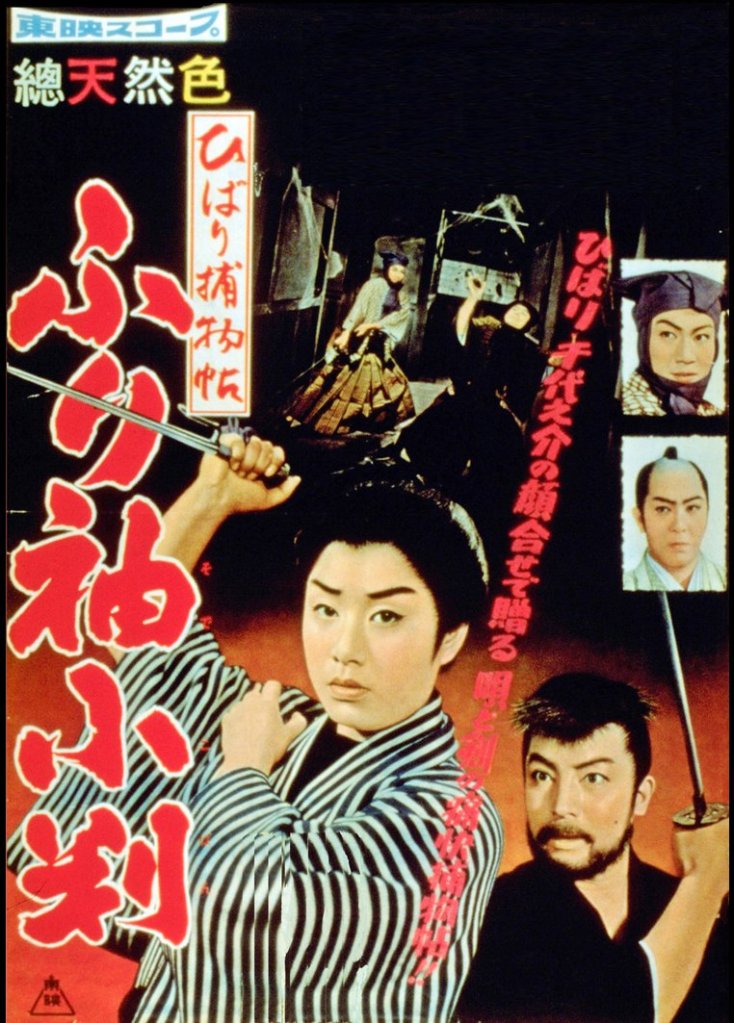
Hibari Misora returns as Oshichi in another adventure for the Edo detective, this time becoming embroiled in a conspiracy against the Shogunate which she continues to serve. By this third instalment in the Detective Hibari series, Hidden Coin (ひばり捕物帖 ふり袖小判, Hibari Torimonocho: Furisode Koban), Oshichi is no longer hiding her noble birth as an esteemed princess, but is living as a singer/law enforcement officer under her “common” name, and upholding the interests of “common” people suffering under “corrupt” samurai oppression but, paradoxically, very much upholding the system which enables it.

The conspiracy in which Oshichi becomes involved this time around is concerned with the plot to overthrow the Shogunate. Rebel forces manage to ambush a convoy carrying tax money to the government, hoping to use the money to buy guns from the Dutch to aid their revolution. As only one of the retainers survives, he will be held responsible for the loss of the money and almost certainly asked to commit ritual suicide, but the Ota clan and most particularly retainer Kennoshin (Kotaro Satomi), are worried about the man’s daughter, Misuzu (Atsuko Nakazato), to whom he was very close. Oshichi becomes involved when she hears of an entire household being murdered and their funds stolen, while a lone pickpocket is found dead with a precious gold coin lying nearby. 

Before discovering the crime, Oshichi and her trusty sidekick Gorohachi (Takehiko Kayama) are talking to a kabuki actor who is about to undergo a succession ceremony which will cost a significant amount of money – 1000 Ryo. Gorohachi is mystified, wondering how many years he’d have to work in order to find that kind of money, while the two pickpockets outside wonder something much the same. The older of the two, Oshima (Keiko Yukishiro), wants to make sure the actor gets his money and has been desperately trying to get in touch with him but he is too snooty to see her. Oshichi starts connecting the dots between the pickpockets and the conspiracy to find a vital clue, but once again is keen to stress that “the law can be merciful too” as she both ensures that Oshima faces justice and allows her to find emotional fulfilment in revealing her true identity and finally seeing the show. 

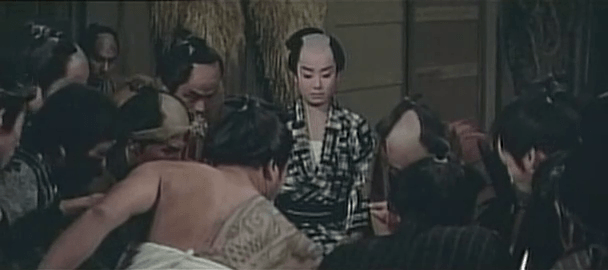
Meanwhile, despite outwardly dressing in manly, action friendly outfits, this Oshichi is one more romantically inclined, fretting over the fate of her brother’s retainer Hyoma (Chiyonosuke Azuma) who, she thinks, has left his employ and become a drunkard. The drunken downward spiral of his life turns out to be a kind of undercover assignment, but provokes a little jealousy in Oshichi as she sees him “protecting” other women at a nearby restaurant, one of whom turns out to be Misuzu who holds a few more pieces of the puzzle. Vowing to save Misuzu and stop the conspiracy, Oshichi adopts a male persona complete with top knotted wig and takes on an entire boatload of sailors who stupidly tell her that they’re shipping out that very night. 

Oshichi rescues Misuzu and gets the money back, saving her father and “restoring” the status quo, but it’s difficult to see which side she should be on in this fight. As Gorohachi perhaps implies, it’s not exactly fair or responsible for the samurai class to be hoarding all these vast amounts of money, or for it to be necessary to spend the annual salaries of several ordinary people on an extravagant celebration for an actor’s promotion. We’re told that the rebels are “evil” and villainous, and they do indeed seem to be cruel and self-interested, willing to sacrifice anyone and everyone to achieve their goal, but it’s difficult to argue with the desire to stand up to this inherently oppressive system in which samurai corruption is the expected norm. 

Insisting that “the law can be merciful”, Oshichi serves a kind of moral justice, rescuing the innocent Misuzu and saving her wrongfully abused father while unmasking samurai corruption, but she remains a loyal servant of the Shogunate and a part of the system into which she was born. Oshichi has been permitted escape from her own oppression thanks to her “compassionate” brother who has allowed her to live freely in the city rather than pressuring her to marry and conform to the feminine norm, but living outside it herself seemingly has no sympathy for those who wish to reform the system and seeks only to preserve it. Having successfully solved the mystery, she reassumes her femininity and retreats into the cheerful festival atmosphere arm in arm with a clean shaven Hyoma finally embracing her romantic dream in an Edo freed from immediate strife. 


Short clip (no subtitles)

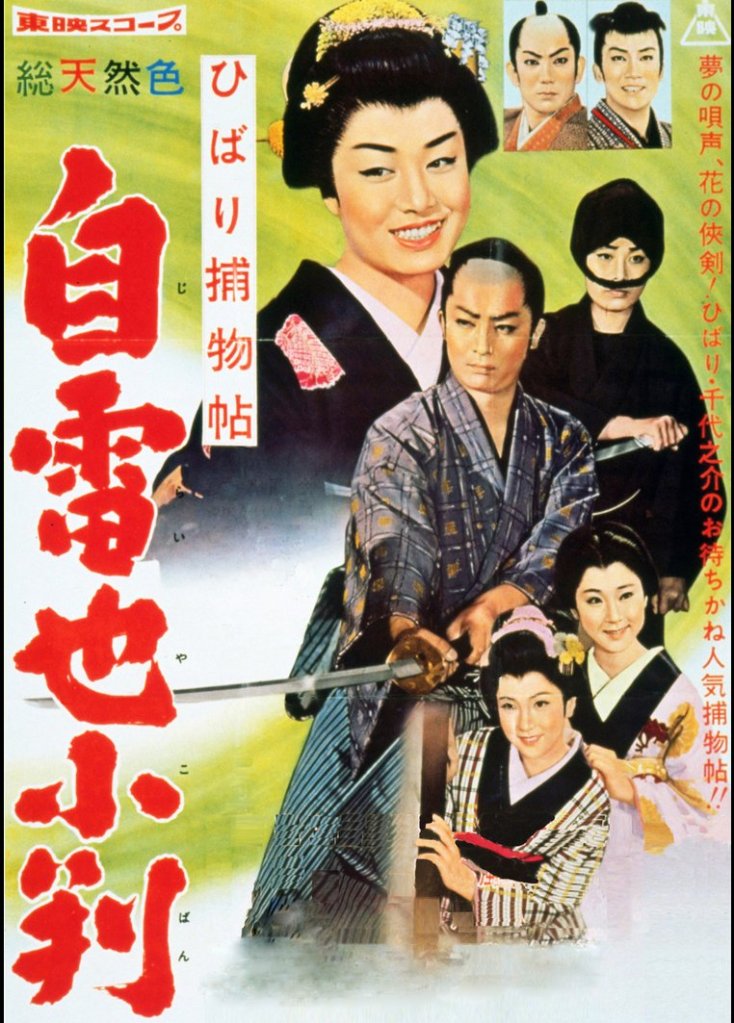
Detective Hibari 2: Secret of the Golden Coin (ひばり捕物帖 自雷也小判, Kinnosuke Fukada, 1958)

Oshichi returns! Two years after her first adventure, the princess in hiding has moved on, still living in the city hiding from the burdens of privilege but fiercely opposing injustice wherever she finds it as a detective in her own right. Unlike Mysteries of Edo and in keeping with Case of the Golden Hairpins, this Oshichi undergoes much less of a softening, remaining largely disinterested in the idea of romance, and cooly rebellious in her refusal to be cowed while strangely OK with Shogunate oppression as a quasi-agent of the state. 

As the film opens, a young woman impersonates Oshichi in order to gain entrance to a prison where her boyfriend is in jail for rebelling against the Shogunate. Meanwhile, Oshichi (Hibari Misora) is teaching a singing class as a favour to her boss who had to go out on an errand, after which she discovers that Hyoma (Chiyonosuke Azuma), currently a retainer of her brother’s, has been sent to bring her home. Once again she refuses because she likes her “ordinary” life. Shortly thereafter, a fire breaks out in the prison and the rebels escape. Oshichi becomes a prime suspect in the jailbreak, not only because the accomplice borrowed her name but because it’s advantageous to the plotters to blame her because they can use her guilt to tarnish her brother’s reputation and get him fired, usurping his position in the process. 

Oshichi, now working as a detective, is technically an agent of the Shogunate against which the rebels are rebelling for reasons which aren’t stated here but are probably easy to guess. They are, in many ways, the same sorts of reasons that Oshichi chose to become a detective, even if she’s coming at them from the other side. She doesn’t like bullies, or corruption, injustice or unfairness. Oshichi won’t stand for unkindness either, which is perhaps why she aligns so strongly behind the woman who blackened her name by impersonating her, knowing that she did it all for love and a little bit for justice, while also forgiving the rebel Seinosuke (Kotaro Satomi) who was preparing to kill the woman he loved because the corrupt samurai had kidnapped his dad and threatened to kill him if he didn’t. 

Despite all that however, Oshichi still insists that “the Shogunate can be compassionate too”, encouraging Seinosuke and his girlfriend Namiji (Hiromi Hanazono) to tell all so she can help them safe in the knowledge that they will be forgiven. It’s a slightly strange position for to her take, essentially authoritarian but arguing for a benevolent paternalism that is just and fair and kind, insisting that the corrupt samurai are bad apples which must be expelled rather than a product of an inherently oppressive social system as they are generally depicted in post-war jidaigeki. 

This insistence on the “compassion” of the Shogunate is perhaps the concession to Oshichi’s femininity which she has otherwise rejected in rejecting her life as a cosseted princess. As Kawashima had in Mysteries of Edo, Oshichi’s “protector” Hyoma asks her how she can take on all those men before challenging her to a contest of masculinity as mediated through a drinking competition which she does not exactly “win” but makes a minor victory all the same. Rather than rely on her brother or Hyoma, Oshichi vows to clear her name herself and starts investigating on her own dressing as a man and fighting bad guys while insisting on her independence. 

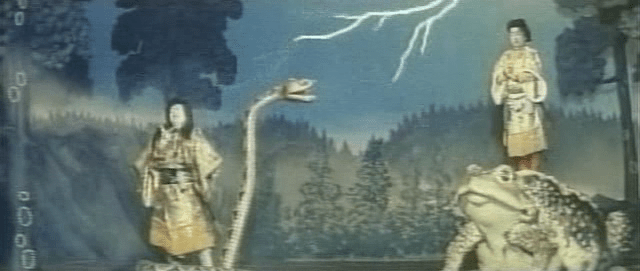
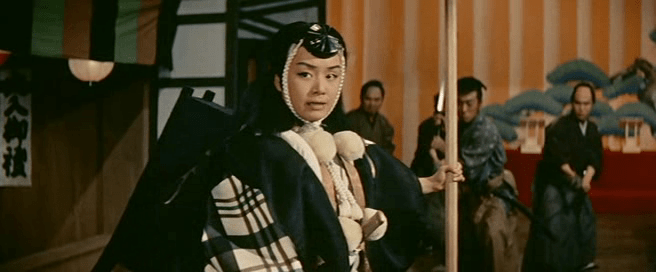
Nevertheless, she is but a pawn in a game of courtly intrigue, manipulated as a means of getting to her brother. The corrupt samurai think nothing of killing anyone who gets in their way, be they princesses or peasants, even going far as to mount an attack on the stage of a theatre mid-performance in front of a room full of spectators, many of whom join Oshichi by throwing projectiles as she tries to fend them off. Once again, she isn’t quite permitted to save herself but is “rescued” by the patriarchal forces representing the greater Shogunate including her protector Hyoma, and her brother, the embodiment of state authority. She is, however, the primary motivator in unmasking the corruption as she both clears her own name, and creates a better future for Namiji in which she can be with the man she loves, reminding her to always remember the compassion the Shogunate has shown her (in case she was minded to mount any more rebellions). As for herself, she manages to slip the loop once again, running off into the wild to claim her independence rather than be forced back into the golden cage of her princesshood while the loyal Hyoma contents himself with following her lead. 


Short clip (no subtitles)

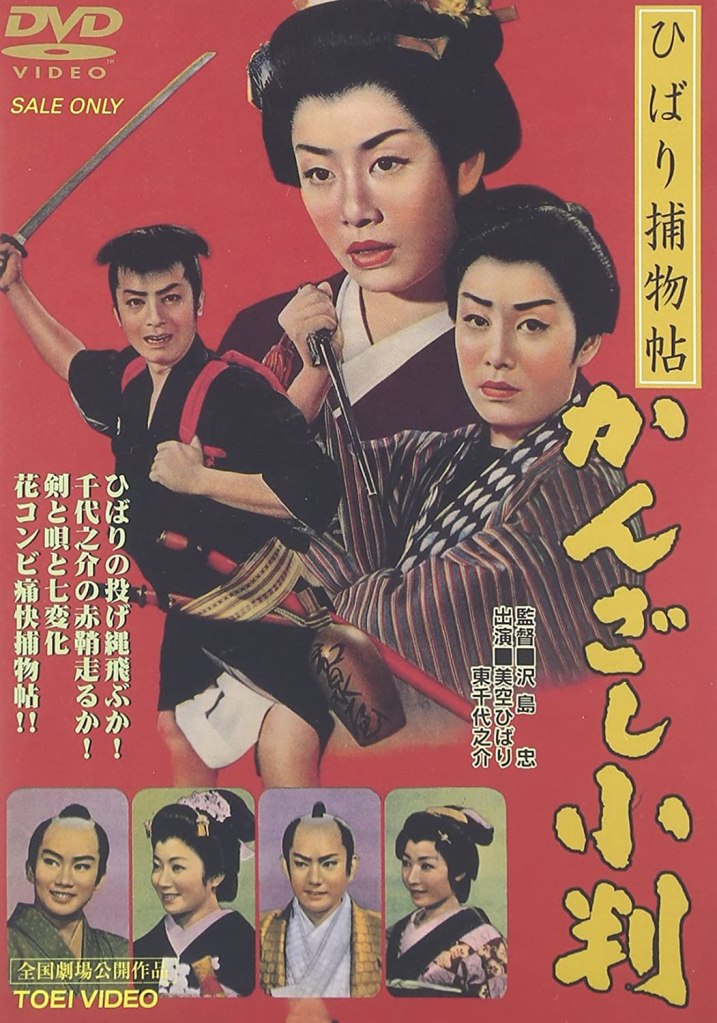
Detective Hibari 1: Case of the Golden Hairpins (ひばり捕物帖 かんざし小判, Tadashi Sawashima, 1958)

Two years after Mysteries of Edo and a year after its sequel, Hibari Misora returns as Oshichi in a new series of films, still living undercover in Edo solving crimes and living her best life as a singer and performer. Like Mysteries, Detective Hibari 1: Case of the Golden Hairpins (ひばり捕物帖 かんざし小判, Hibari Torimonocho: Kanzashi Koban, AKA Edo Girl Detective / Here Comes the Girl Detective) sees Oshichi investigating murders of women, though this time the crime is far less involved and much more typical of Toei’s period films in its venal samurai and their insatiable appetites for wealth and status. Oshichi is, essentially, an agent of the state but a much less ambiguous one than she’d become in the following pictures, fighting bravely against corruption and standing proudly for justice in the face of implacable samurai arrogance. 

Having escaped the cage of her noble birth, Princess Tae/Oshichi (Hibari Misora) is still living as an “ordinary” woman in Edo and has just won a singing competition to be named as Queen Beauty. The competition is marred however when one of the other contestants is offed on the way home. Still working with her trusty sidekick Gorohachi (Shunji Sakai), Oshichi quickly realises the woman seems to have been murdered with an ornate hairpin and starts an investigation.

What she discovers is that an unscrupulous gang of samurai is attempting to recover a set of three hairpins which were stolen in a robbery some years previously. The lord claims he’s doing it to satisfy his clan’s honour, but more likely has a less honorable goal in in mind. To put the plan in action, he’s mobilised his conflicted daughter, Sumie (Eiko Maruyama), who thinks this is all a bit much for set of shiny hair ornaments, and her boyfriend Tamiya (Kotaro Satomi) whose family originally owned the jewels which is why he sees it as his duty to get them back, even if that means murdering innocent women and sending the entire city into a panic in the process. Of course, Oshichi agrees with Sumie, and as usual immediately sympathises with her romantic dilemma which earns her a few sarcastic comments from sometime love interest Hyoma (Chiyonosuke Azuma) who will recur throughout the rest of the series.

Hyoma, posing as a drunken ronin but in reality shadowing Oshichi as a protector, like Kawashima in Mysteries, expresses consternation with Oshichi’s atypical feminity, echoing Kawashima’s words that “a woman should be feminine” while claiming not to find Oshichi’s manly fortitude very effective. Kawashima’s words may have wounded her, but Hyoma’s only irritate. She fires back that as a talented samurai he’s wasting his potential drowning himself in drink and he should “stop fighting and do something for society”. Meanwhile, she doubles down – dressing as a man and even joining a kendo dojo to spy on the corrupt lords, scrapping with the best of them and holding her own in a fight. 

Swinging the other way, another of her investigative tactics sees her posing as a geisha and then later as a noble lady, even getting dressed up in her formal princess clothes to beg a favour from her extremely understanding brother. Sympathy for Sumie and a few romantic songs may be the sole concessions to conventional femininity, but Oshichi remains proudly defiant and intent on maintaining her freedoms. It may be true that the unusual degree of freedom she has is permitted her because of her progressively minded brother who ignores “advice” from an elderly servant to exercise more control because he can see being of use to society makes his sister happy and that she’ll probably come home when she wants to, but it’s also freedom that she has actively chosen for herself and chooses to maintain. 

Oshichi gets drunk with Hyoma (apparently for the first time), fights bad guys, and gives orders that stop seasoned samurai in their tracks but not so much for herself as to help those like Sumie who have become victims of corrupt samurai ethics. She does this, however, as someone who largely believes in the righteousness of the system, that the Shogunate is kind and forgiving while local lords may be avaricious or cruel. When her brother arrives to save the day, he announces that the hairpins will be sent to the Shogun who will return them to the people, sharing the treasure with everyone rather than keeping it for himself. Oshichi, meanwhile has found something greater – a worthy sparring partner in the dashingly romantic Hyoma, and the confirmation of herself not as Tae the caged princess but Oshichi who owns the very ground she walks upon and allows no other to tell her where she may be permitted to go. 


Original trailer (no subtitles)

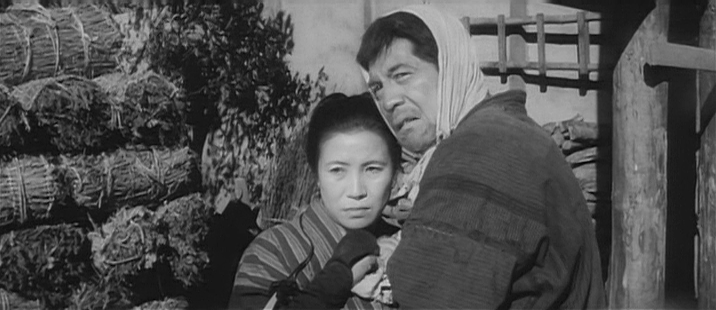
The Song of the Cart (荷車の歌, Satsuo Yamamoto, 1959)

“When all human beings acknowledge each other as human let the precious joy that results be universal. When this joy lives forever in the hearts of women and is handed down to daughters who become mothers then tomorrow will not just repeat today but be a new beginning” reads the opening title card/mission statement of Satsuo Yamamoto’s chronicle of early 20th century Japan. Told though the eyes of one very good woman wrestling against her baser instincts, Song of the Cart (荷車の歌, Niguruma no Uta) is a gentle plea for a little more empathy and understanding in which the heroine suffers greatly but is finally rewarded in managing to keep the darkness at bay. 

In late Meiji, Seki (Yuko Mochizuki) develops a fondness for the most eligible young man in town – the postman, Moichi (Rentaro Mikuni), who can read and write and isn’t bad looking either. To her surprise, Moichi admires her too and eventually proposes marriage, intending to give up his job as a postman which doesn’t pay as much as it used to now costs are rising because of the recently concluded Sino-Japanese war to buy a handcart with the longterm goal of building a small handcart empire with a warehouse of his own that will allow him to build a fancy house to live in. Seki hesitates, she’s an illiterate maid perhaps she isn’t good enough for the great Moichi but he replies that he couldn’t care less about that and only wants to know if she wants him. She does, but has to check with her parents first. They object to the marriage on the grounds that Moichi is penniless and disown her when she tells them she’s marrying him anyway. Disowned by her parents, she also loses her job as a maid and is forced to head to Moichi’s ahead of schedule where his extremely cold mother (Teruko Kishi) makes no secret of her resentment of her new daughter-in-law but is eventually forced to relent. 

Unlike Moichi and his mother, the other residents of the village and particularly its women are bright and cheerful despite the harshness of their lives. Swept off her feet by Moichi’s seeming sophistication, Seki is in for a rude awakening in realising that his work ethic is extreme and in many ways he’s just as cruel as his heartless mother. On her arrival, Seki’s mother-in-law complains that she brings “only a small bundle” while simultaneously suggesting that she somehow looks down on them because they are only poor people, insisting that she work alongside Moichi pulling carts to make their dreams of riches come true. Seki jumps at the chance to prove her love, but finds her mother-in-law unchanged. 

Pulling the cart through the village, Moichi and Seki pass another woman who seems put out by Seki’s presence, complaining that Moichi never bothered to reply to her own proposal. Moichi dismisses her complaints, avowing that he didn’t marry her because she wasn’t a worker, implying that he was only interested in someone who would work alongside him in pursuit of his goal of becoming a homeowner. Seki is indeed a worker, and a strong woman who bears her hardships with grace, but finds it increasingly difficult to put up with her mother-in-law’s heartlessness and adherence to old-fashioned feudal customs by which she claims her authority over the household while Moichi, as the dutiful son, always defers to his mother. When the first child arrives, Moichi declares that a daughter brings him no joy, while the mother-in-law who is supposed to be watching her, just lets her cry all day long and doesn’t even change her nappies. Out on the road, Seki comes across another couple in a similar situation who’ve brought their little one with them, riding in a bucket on the back of the cart. Seki wonders why they can’t do the same, then she’d at least know her daughter was alright and not crying her heart out in a dirty nappy, but Moichi won’t hear of it lest his mother be offended that Seki is suggesting she’s not looking after her granddaughter properly. 

Moichi works every hour god sends, but not so much to provide for his family as to improve his own status in the hope of owning a sizeable home, perhaps to “regain” the kind of position his mother thinks is theirs as descendents of the Heike. He exists on a kind of political fault line in his rigid austerity, believing that you really can make it just by working hard while also becoming the de facto spokesman for the other cartmen because he is the only one able to read and write. Yet faced with constant and obvious oppression of the eerily feudal kind in persistent rice profiteering he does nothing much to resist it and gives only grudging approval to his son’s intention of forming a train driver’s union. 

While Moichi has pinned all his hopes on handcarts, the future is fast approaching. A funeral procession of cartmen is greeted by the horse-drawn variety coming the other way as if to signal their imminent obsolescence. But the horsemen aren’t much better off. If Moichi couldn’t afford a horse, he’ll never afford a motor car and the mechanised age is on the horizon. The only work he manages to find ironically involves transporting lumber for the new railway line, but it’s a gamble that pays off and makes Moichi a wealthy man once again. 

Material comforts aren’t everything, however, and Seki struggles to reconcile herself to life with her increasing cruel mother-in-law and emotionally distant husband. She worries that she’s becoming what she hates, finding it difficult to find sympathy for Moichi’s mother now she’s ill in feeling that perhaps she’s getting what she deserves. Her friend advises her that that’s just “bugs” eating away at her heart and what she really needs to do is fly in the opposite direction, finally make a friend of her mother-in-law in trying to understand her. She has, after all, had a very hard life, starved of affection all these years as a young widow raising a son alone on little more than charcoal money. 

Seki meanwhile suffers numerous humiliations and heartbreaks, notably Moichi’s extremely unreasonable decision to bring his 50-year-old sex worker mistress to live with them in their home, but does her best to be generous and forgiving. As she points out, this house is half hers, she built it alongside Moichi and she won’t just vacate it so Moichi can do what he always does which is as he pleases (once his mother’s not around to tell him not to). Moichi perhaps pays for his feudalist follies and selfish authoritarianism in a fairly direct way which aligns him with his chastened nation waking up to the emotional costs of his mistakes, while Seki is finally rewarded. Unlike her mother-in-law she becomes a beloved neighbourhood granny giving rides to all the local kids while pulling her cart onwards towards the future like a reverse Mother Courage embracing her long absent son finally returned to her in recognition of her goodness. 


A Wicked Woman (毒婦高橋お伝, Nobuo Nakagawa, 1958)

The term “dokufu” or “poisonous woman” dates back to the Edo era, but rose to prominence once again in the turbulent society of late Meiji in which such women became fodder for the growing penny dreadful industry. Unlike the later “bad girl” or contemporary examples of “bad women” from elsewhere, the problem with “poisonous women” is that they pollute society as a whole, corrupting those around them through their unbridled transgressions. These notions are of course as much about contemporary notions of femininity and a desire to preserve the social order at all costs as they are about conventional morality and the rule of law, but there are reasons that tales of such independent women incited such a frenzy among both men and women who found themselves floundering in a confusing and rapidly changing society.

Nobuo Nakagawa’s A Wicked Woman (毒婦高橋お伝, Dokufu Takahashi Oden) is inspired by the real life tale one particular “dokufu”, Oden Takahashi, who was in fact the last woman to be beheaded in Japan after being convicted of murdering her lover while suspected of poisoning her husband. Nakagawa does not particularly pay attention to the “real” details of her life but to her pulp persona, somewhat reclaiming her image as an ultra cool revenger who refused to be bound by the restrictive mores of her times or suffer at the hands of the feckless men she nevertheless falls victim to. 

When we first meet Oden (Katsuko Wakasugi), she is being pursued by a large number of policemen whom she manages to outrun, eventually tricking them and escaping by getting a lift from a passing rickshaw driver. The ride is tense, and we worry that Oden will encounter an accident that will bring her to the attention of the police, but the crisis is something quite different. In a staggering coincidence, the rickshaw driver is none other than Oden’s estranged first husband, Jinjuro (Akira Nakamura), once a samurai but now reduced to pulling a cab after ruining himself through drink and debauchery (apparently why Oden eventually left him). Though it’s not exactly a happy reunion, the pair part on good terms while he laments that their small daughter Omitsu still misses her mother, managing to extract a few notes from Oden supposedly for her upkeep.  

Oden meanwhile goes home to husband no. 2, Ryosuke (Asao Matsumoto), who is bedridden with TB and increasingly paranoid about what Oden does outside the house to keep them fed. Operating out of a remote cottage, she puts on a ridiculously elaborate Western outfit and heads to a jewellers where she pretends to look at precious stones for a ring, dropping one on the floor while the salesman’s back is turned and spiking it with the point of her parasol knowing that no-one is going to think of looking there. The assistants aren’t stupid, they know a stone is missing and Oden must have pocketed it but all they can do is search her person, calling in the local bobby, Kazuma. (Juzaburo Akechi), who thinks they may be going too far in forcing this upperclass lady to strip off to prove she’s not a thief. The owner of the store, Osawa (Tetsuro Tanba), looks on knowingly but is intrigued more than anything else, eventually content to let Oden go despite knowing she has the jewel concealed somewhere about her person. 

Disaster strikes, however, when Oden runs into Kazuma in the street and he spots her parasol sparkling. He tries to arrest her, but she pleads with him to let her change out of her extremely silly outfit first, playing the poor widow card and eventually seducing the naive policeman. What Oden didn’t quite bank on was actually falling for him for real, drawn in a sense to order and goodness, longing to be caught and restored to the rightful condition of womanliness but fearing she has lost all right to conventional happiness. 

Oden’s relationship with Kazuma is an example of the effects of her “poison” on society at large. Kazuma as we first meet him is earnest and good, a naive young rookie with a strong sense of justice who leaps to defend Oden thinking she is a maligned noble woman unfairly accused of thievery. His superior Kakunosuke (Gen Funabashi), has set him up with his innocent little sister Kozue (Minako Yamada) and it seems the pair will soon marry, but Kazuma is apparently not so much interested in sweetness as he is in Oden’s complicated darkness. He falls obsessively in love with her, perhaps partly out of a desire to save her from her criminal life by bringing her to justice, but also in attraction to all of her transgressive qualities which contradict everything he stands for. 

Nakagawa reframes Oden’s poisonousness as a consequence of her frustrated maternity and a continual failure of masculinity. After re-encountering Jinjuro, Oden finds it increasingly difficult to justify the act of abandoning her child and leaving her with a man she knew to be a violent and feckless drunk. Though Jinjuro appears to have reformed himself through the time-honoured devices of humbleness and hard work, we later find him extorting money from Oden to pay for Omitsu’s medical care only to drink it all himself. Oden tries to visit her daughter, but is after all a stranger in her life. Her attempt to reclaim her maternity, escape the trap of criminality and leave the city with her little girl is the primary motivator for all of her subsequent actions which culminate in an intense desire for revenge against Jinjuro, the architect of all her misfortune. 

All of Oden’s earlier crimes were in some way permissible, taking from those who could afford to lose and doing it with a degree of style. The botched job at the jewellers, however, sees her fall into the hands of Osawa, who turns out to be a violent and sadistic gang boss. Osawa keeps women captive in his basement and whips them for his own enjoyment, forcing Oden to become a procurer tricking vulnerable women into becoming sex slaves. Oden thinks nothing of this, smirking that there must be good money in selling women, willingly complicit in the oppression of those just like her. To free herself from Osawa, she uses Jinjuro, attempting to kill two birds with one stone and finding partial success only for the plan to fall apart when confronted by the face of order in the reappearance of a ruined Kazuma. 

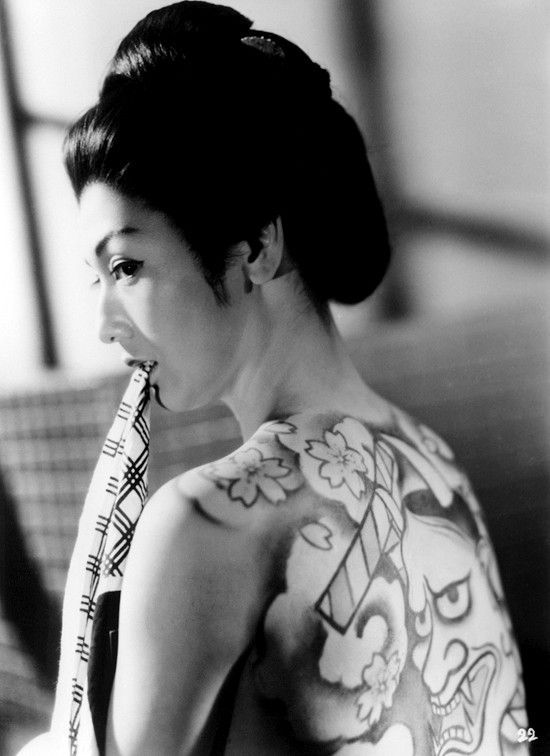
Oden ends her journey in Yokohama, a bustling international port, where she’s the tattooed madame of the Osawa’s Chinese bar and a familiar face at the gaming tables. The suggestion is that this corruption is foreign in origin, Osawa’s top hat and smart suit not to mention plush Western-style bed, suggesting that his savagery is a facet of his seduction by Chinese hedonism and Western individualism. Individualism is again painted as Oden’s sin when she leaves the women locked in a jail cell to escape a fire while cradling her ill-gotten gains, only to tell Kazuma to man up and that money is what she truly loves. But Oden is also victim of her times, betrayed by a failure of masculinity in a patriarchal system. Jinjuro the drunken samurai, Ryonosuke the impotent consumptive, and Kazuma the conflicted young man. The last of these she refuses to “ruin”, setting him free because she truly loves him and does not want to see him dragged into her life of crime, intent on reclaiming her goodness by reassuming the role of a conventional mother living an honest life with her daughter somewhere far away. Her “wickedness” is only really her desire to survive but an independent woman, good or bad, is always a threat to the social order and so she must be stopped lest her inconvenient desire to live a life free of male control become a “poisonous” example to those around her. 


Underworld Beauty (暗黒街の美女, Seijun Suzuki, 1958)

“No one can be happy without money” the villain of Seijun Suzuki’s Underworld Beauty (暗黒街の美女, Ankokugai no Bijo) claims, vainly trying to justify his actions. He may indeed have a point, but you can’t buy happiness through selfish immorality. A noirish tale of changing times, Underworld Beauty pits a noble hearted gangster on the road towards reform against his amoral bosses as he tries to ensure a better future for the sister of a friend whose life was irreparably changed through proximity to crime. 

Miyamoto (Michitaro Mizushima) has just been released from three years in prison. His first stop is the sewers where he locates a loose brick he’d been using as a dead drop and retrieves a handgun and a small bag containing three diamonds stolen in the heist which got him sent away. Paying a visit to his old gang, Miyamoto makes it plain that he intends to keep the diamonds for himself so that he can sell them and give the money to Mihara (Toru Abe), the man who was crippled during the job and now lives an “honest” life running a small oden stall. To Miyamoto’s surprise, his boss, Oyane (Shinsuke Ashida), says OK and offers to set him up with a foreigner in Yokohama who is interested in buying blackmarket jewels. Unfortunately, the whole thing goes south in predictable fashion when a gang of masked heavies turns up to disrupt the deal. Mihara, who had come along with Miyamoto, swallows the diamonds and promptly falls off a nearby wall. He survives just long enough to tell the police that he “slipped” thanks to his unsteady legs, which makes his death “accidental” meaning he won’t have to undergo an autopsy. That’s both good and bad for the crooks. The cops won’t find the diamonds, but getting them back before the body is burned is going to be difficult. 

Arita (Hiroshi Kondo), a sculptor of mannequins, finds himself perfectly primed to find a solution because he’s been dating Mihara’s little sister, Akiko (Mari Shiraki), who’d been working as a nude model. Mihara had talked to Miyamoto about his sister and his fears for her in the big city. Feeling his debt even more since his friend’s death, Miyamoto decides to save Akiko from the evils of city life, but finds himself fighting an uphill battle. Meanwhile, Akiko is smitten with the intellectual yet cold Arita, who may perhaps be more interested in her for access to her brother’s body than to her own. 

The diamonds themselves become a kind of MacGuffin and symbol of amoral post-war greed. Having been away for three years, Miyamoto is the classically conflicted film noir hero, a noble yet compromised figure forced to operate in a murky moral universe that is at odds with his own sense of justice. That is perhaps why he tries so hard to “save” Akiko even if she resents his sometimes patronising paternalism that, well-meaning as it is, denies her the agency that is a mark of the age. Mihara warned his sister about hanging out with Arita, suspecting he was a no good guy likely to drag her further into the underworld which he had now escaped, but she sees him as “different” from the men around her, mistaking his coolness for sophistication rather than a possibly sociopathic superiority complex. 

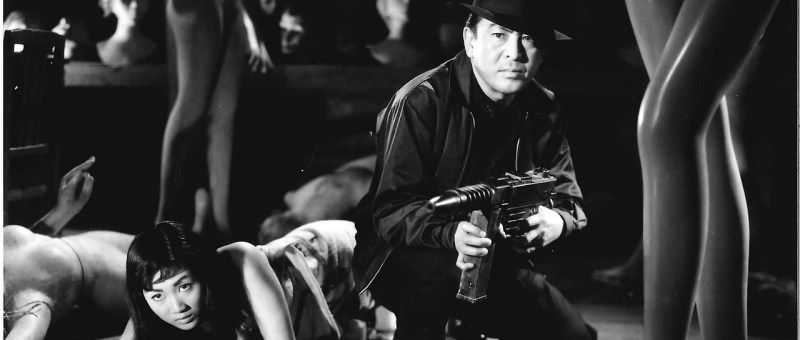
Yet it’s perhaps a sense of inferiority which sends him so crazy about the diamonds. A tortured artist slumming it in a mannequin factory, he resents the way he’s chosen to “sell” his art while superficially laughing at those who buy it. There is something quite perverse in the various ways he is “using” Akiko, literally commodifying her body and turning it into a lifeless object, a simulacrum of “real” womanhood sans voice or agency, all the while planning to use her in order to get his hands on the diamonds. Figuring out Arita may have mutilated her brother’s body in order to dig them out, she wonders if he ever really loved her at all. His sudden declarations of affection and an impromptu proposal only further convince her that what he wants is money. She hides the diamonds inside the breast of a half-baked mannequin, just about where the heart ought to be. Later we spot the poor thing dismembered and abandoned, a gaping hole in its chest as it floats ominously in the sewer, discarded in just the way a woman like Akiko might be if she’d let a man like Arita get his hands on the loot. 

Kidnapped as leverage to force Miyamoto to hand the diamonds over, Akiko loses her fascination with underworld darkness in learning what the “yakuza code” really means. “What do you mean, the yakuza way?” She barks at Oyane, “it’s wrong to kill, you idiot!”. Literally steamed clean and making an ironic escape up a coal shoot, she edges towards a new dawn. “What a beautiful day!” She exclaims, declaring herself not bored in the least, freed from the false promises of the underworld and released from the diamonds’ corruption into the bright sunshine of a wide open future.


Mysteries of Edo (ふり袖捕物帖 若衆変化, Shoji Matsumura, 1956)

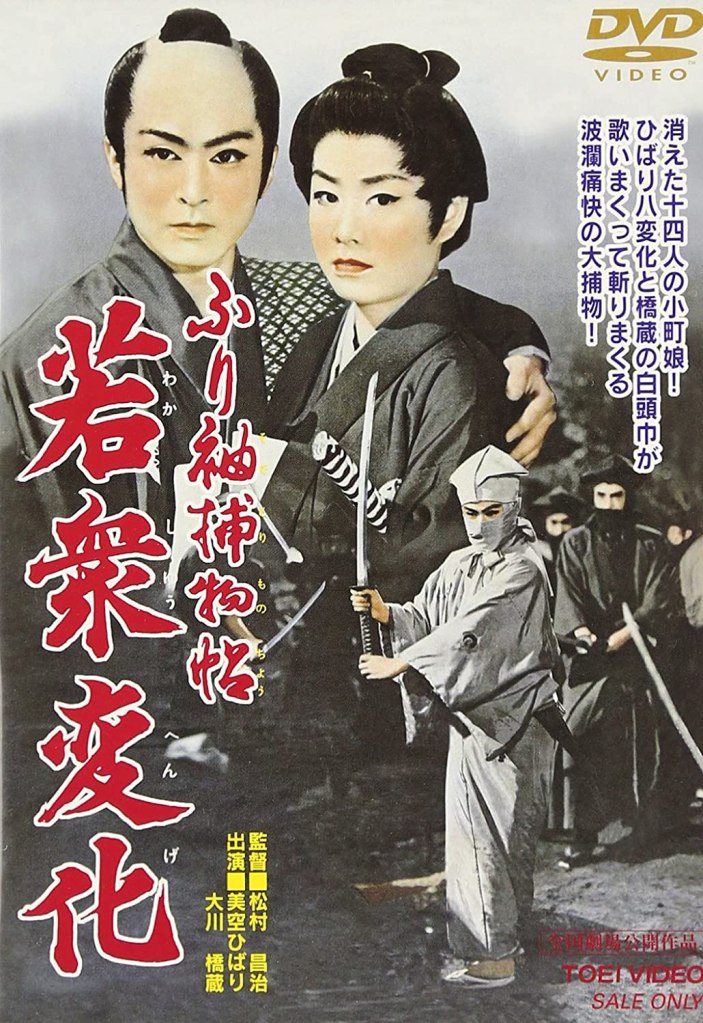
The voice of the post-war era, Hibari Misora was a major marquee star but in contrast to expectation, appears to have been fully in command of her contradictory brand, selling an image of herself not as docile and innocent in the manner of many a manufactured idol but feisty and true, refusing to backdown in the face of injustice. In her contemporary movies, she stood up to gangsters and corrupt corporations alike with salt of the earth charm, while her period roles saw her do much the same only against the inherently corrupt samurai order. An early outing for Toei, Mysteries of Edo (ふり袖捕物帖 若衆変化, Furisode Torimonocho: Wakashu Henge) sees her star in the first of a series of films as a princess in hiding turned feminist detective, investigating series of abductions in the rapidly changing bakumatsu society. 

A “newspaper” seller in the street informs us that 14 girls have recently gone missing in this area of town, and no one’s doing much about it. A dance teacher escorts her pupils home to be on the safe side while her apprentice, Oshichi (Hibari Misori), stays behind to teach cowardly samurai Kawashima (Hashizo Okawa) some moves. Local bobby Gorohachi (Shunji Sakai), himself a dance enthusiast, arrives to get some guidance from Oshichi but their lesson is interrupted by the news that the dance mistress and her daughter have become the latest two abduction victims. Oshichi springs into action but quickly falls under suspicion from a rival policeman, Gonroku (Haruhisa Kawada), who questions her background. All too soon, the body of a young woman is discovered at the local shrine and believed to be connected to the abduction cases. Gonroku accepts a bribe from a samurai to get rid of the body as quickly as possible, but Oshichi immediately notices the bruises on the woman’s neck and concludes it’s a murder. She and Gorohachi trace the samurai back to the red light district and discover some shady goings on in a “back house” behind a brothel belonging to a prominent merchant. 

During this era, Japan was still in its isolationist period during which consorting with foreigners was forbidden outside of a few explicitly designated trading spots. Oshichi figures out that the merchant, Nagasaki (Ryosuke Kagawa), is involved with smuggling and uses his second house as a place to entertain foreigners in collusion with local politicians. When he ran out of courtesans from the brothel next door, he started simply abducting random women off the street to entertain his guests with more authentic charms. Those who don’t comply are threatened with being sold off on slave ships, itself another evil of the age. 

Of course, a lowly dance teacher and a bumbling policeman aren’t much of a match for entrenched samurai corruption, but Oshichi has a trump card – she’s secretly a princess in hiding. Bored with the life of an upperclass noblewoman, she ran away from her brother’s home to live an independent life in Edo but can still rely on her class background when necessary. Stealing a pistol and a letter box, she rebrands herself as a man and gets a job in the ministry to try and spy on the corrupt lords while hoping to save her boss, keeping up the ruse well enough but eventually unmasked as a girl. 

As in many of her films, Misora plays on gender ambiguity. Rejecting the cosseted life of a lady, she takes to the streets and then takes charge. She’s technically Gorohachi’s subordinate, but in reality he follows her lead, and she gives as good as she gets in the frequent fight sequences. In the end, however, she’s “rescued” by a masked samurai dressed in white with whom she becomes instantly smitten. She dreams of meeting him in a deserted field where he mildly berates her for her lack of femininity, insisting that he liked “the Oshichi from before”, meanwhile she conjures up the figure of Kawashima who manfully wades in to save her. Previously, in refusing to help, Kawashima had told her that “a woman should know her place and act like a woman”. Oshichi tells him perhaps he should act like a man, practice kendo or something else more manly rather than prancing about learning to dance. His words have perhaps cut her because he tells her the same thing in her dream, insisting that he “could fall for the womanly Oshichi”.

Oshichi tries on womanliness for size, but it only seems to confuse the “real” Kawashima who describes her attempt at genial femininity as “creepy”. She quickly goes back to holding her own, pushing forward where the men hold back perhaps bashful in love but never in justice. Even if it’s true that the dashing samurai arrives to save the day, Oshichi is no damsel in distress watching passively from the sidelines but an active participant threatening bad guys with a gun cunningly smuggled in while she distracted them with a song, and grabbing a sword off the wall to wade into the fray. Rewarded for her good work and asked what she’d like in return, Oshichi chooses her freedom, intending to stay in the town a little longer, solving crimes in old Edo and ensuring that no one, even those who think they have a right to be, is truly above the law.


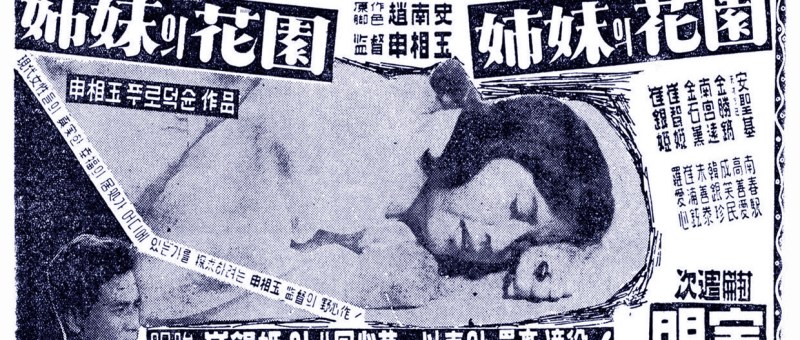
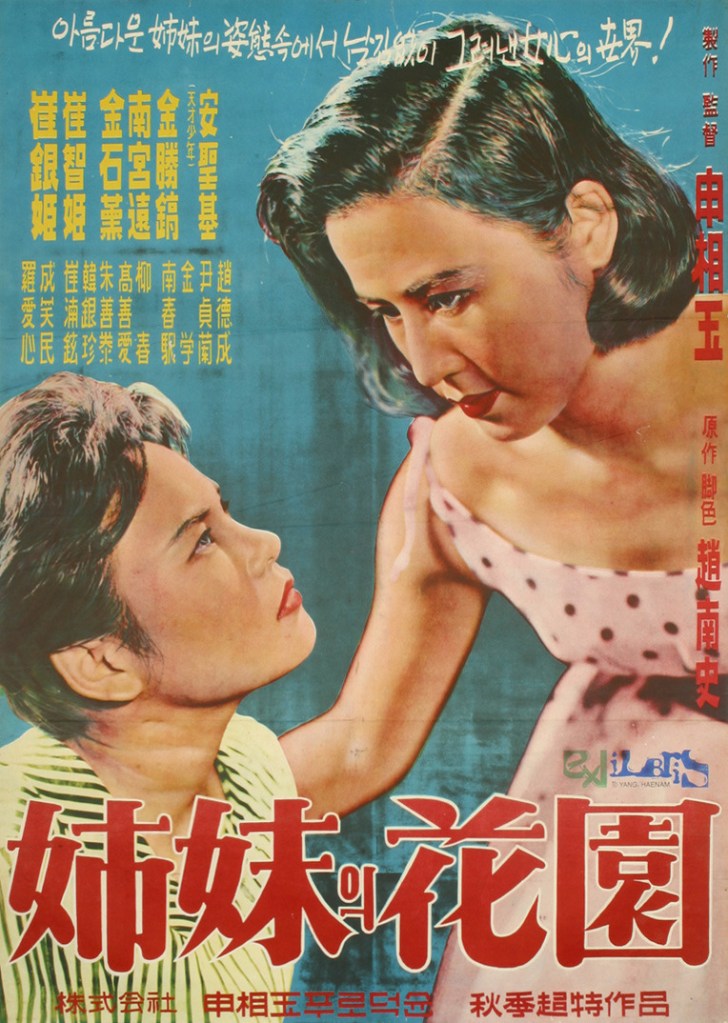
A Sister’s Garden (姉妹의 花園 / 자매의 화원, Shin Sang-ok, 1959)

In melodramas of the post-war era, the good suffer nobly but often find their goodness ill rewarded by an increasingly amoral society. Shin Sang-ok’s A Sister’s Garden (姉妹의 花園 / 자매의 화원, Jamaeui Hwawon) is, perhaps, a little different despite its rather mild critique of a society preparing to head into rampant capitalism, allowing a magnanimous entrepreneur to become the pure hearted saviour of an equally pure woman while her weak willed lover remains petulantly on the sidelines unable to defy outdated social codes to claim his right to happiness. 

In fact, this is in many ways Mr. Bang’s (Kim Seung-ho) story. It’s him we first meet getting off a swanky Korean Air plane signalling his position as a member of a new class of jet-setting elitists. He is, however, kindhearted which is why his first thought is to pay a visit to Dr. Nam (You Chun) who cured him of a serious illness. Unfortunately, Dr. Nam has now been laid low by the same illness himself. His business has suffered, he’s sold his clinic, taken a job at the hospital, and even mortgaged his house to a persistent loanshark. Unfortunately, all the stress has got to him and soon after Bang is able to meet with Dr. Nam he collapses and dies, breathing his last words to his assistant, Sun-cheol (Kim Seok-hun) who had been like a son to him, to the the effect that he has already arranged a marriage for eldest daughter Jeong-hui (Choi Eun-hee) to an artist named Dong-su (Nam Gung-won) and hopes that Sun-cheol will watch over his younger daughter Myeong-hui (Choe Ji-hui) and much younger son Chang-sik (Ahn Sung-ki). 

This last request will cause a series of problems among the young, the first of them being that it’s extraordinarily insensitive because Sun-cheol is himself in love with Jeong-hui who is also in love with him. Both of them are, however, good people which is why Sun-cheol wastes no time telling Jeong-hui about her father’s last words while she is minded to obey them even if her primary concern is the family finances seeing as she is now the sole provider for her siblings and there will be no more money coming in. With the loanshark still breathing down their necks, Jeong-hui is in danger of losing the family home. 

The other major problem is Myeong-hui who unlike her sister is a thoroughly modern woman, thoughtless and selfish in a childish sort of way. Unaware of the family’s financial situation, she hoped to use some of the money from selling the clinic to open a dress shop and is put out to realise there isn’t any because the clinic was only sold to pay off debts. Meanwhile, it’s also quite obvious that Dong-su, an equally naive son of a wealthy family, prefers Myeong-hui and almost certainly intends to marry her not her sister. Dong-su thinks he’s hot stuff in the art world and is going to make a lot of money selling paintings, which is optimistic whichever way you look at it. 

This awkward love square creates a series of problems of its own as Myeong-hui convinces herself that her sister is jealous of her relationship with Dong-su while also knowing that she has been silently in love with Sun-cheol for many years. Sun-cheol, for his part, feels himself indebted to the Nams and allows the debt to come between himself and true entrance to the family through marrying Jeong-hui. He saves their house through selling his own, but times being as they are Jeong-hui still needs to find a job which is another problem because she is an upper middle-class woman raised for marriage. She gave up school to keep house after her mother died and has no qualifications, even if qualifications could help a woman in need find a good job in 1950s Seoul. She asks Bang for help, and he offers her a frankly insulting opportunity as the head hostess at a sleazy bar he owns where businessmen go to have discreet fun without their wives. 

Jeong-hui wasn’t going to take it, but in the end she has little choice, allowing the married Myeong-hui and Dong-su to move into the house to look after Chang-sik while she lives at the bar. Sun-cheol, still afraid to speak his heart, is judgemental and filled with resentment, entirely unsupportive of Jeong-hui’s position or her proactive decision to try and change it even if changing it means hovering on the fringes of the sex trade. Myeong-hui also, perhaps because of her selfishness and naivety, fails to understand the sacrifices her sister has made on her behalf. Worried that Myeong-hui and Dong-su may have re-mortgaged the family home that she is actively debasing herself to save, Jeong-hui asks her sister to reassure her that the deed to the house is safe. Myeong-hui had been thinking of doing just that so she fires back cruelly that Jeong-hui has everything “easy” and can’t understand how hard it is for her, which is a strange thing to say given that Jeong-hui has become a bar girl solely to keep a roof over her sister’s head. 

Myeong-hui and Dong-su continue to make mistakes, Dong-su convincing his friend to embezzle money from his company to plough into the dress shop even though it’s a loan they can’t repay and threatens to get them all in hot water. Jeong-hui has to sort everything out again, but that puts her in further debt to Bang to whom she is already substantially indebted because he convinced her to take a loan to pay back Sun-cheol who didn’t even really want paying back. Uncharitably, Bang’s behaviour looks suspect. He makes a prim upperclass woman degrade herself by plunging her into the sleazy underbelly of a burgeoning economy and then burdens her with debt to be able to manipulate her better. Perhaps he gets a kick out of that, but soon feels guilty seeing someone who so obviously does not belong in one of his bars forced to drink with clients and play nice with the customers. On the other hand, perhaps there really were no better jobs available for a woman without qualifications and he only wanted to help. 

Ultimately, Bang turns out to be the good guy, falling in altruistic, selfless love with the innocent Jeong-hui who always does the right thing and acts with absolute integrity. Debt, once again messes everything up. Bang decides to propose to Jeong-hui, which practically speaking is a good option in the situation, but makes it clear that he is not forcing her and will continue to help and support her whatever she decides. But how is Jeong-hui to refuse someone who has been so “kind” to her without a sense of betrayal? Sun-cheol, meanwhile, is prevented from declaring his feelings because of the “debt” he feels he owes to the Nam family, not quite good enough for Jeong-hui but also the custodian of her father’s last words which were that she should marry Dong-su. Myeong-hui and Dong-su meanwhile think only of themselves, acting with selfish recklessness. Only when Jeong-hui comes through for Myeong-hui and tells her of Bang’s proposal does she begin to grow up and realise that her sister may throw away her own happiness for the sake of her family’s in marrying a rich old man out of a sense of hopelessness and obligation. 

Contrary to other melodramas, the solution is Bang’s and Bang’s alone. He makes the decision to release the youngsters from patriarchal control by essentially canceling out Dr. Nam’s last wishes by telling Jeong-hui that she should try to be happy with Sun-cheol while giving her the financial means to do so by gifting her the bar to run as her own, making her both business owner and career woman as well as wife. He absents himself in recognition that age has to give way to youth, pushing the youngsters to pursue personal happiness rather than serve outdated ideas of duty or filial obligation. Jeong-hui’s goodness wins out, but only because it was recognised by Bang who decides to set her free by cancelling not only her literal debt, but the entire idea of indebtedness in giving her permission to seek her own happiness rather than feeling obliged to prioritise that of others. 


A Sister’s Garden is the third of three films included in the Korean Film Archive’s Shin Sang-ok’s Melodramas from the 1950s box set. It is also available to stream via the Korean Film Archive’s YouTube Channel.

Dongsimcho (동심초, Shin Sang-ok, 1959)

The Korea of 1959 was one of change, but the hardest thing to change is oneself and oftentimes the biggest obstacle to personal happiness is the fear of pursuing it. The pure hearted heroine of Shin Sang-ok’s Dongsimcho (동심초) describes herself as “a woman who thirsts for love, yet foolishly gives in to fear first”. A war widow, she’s fed up with society’s constant prejudice but too afraid of what they might think if she chose to choose love, embrace her desire, and marry again for no other reason than personal happiness. Yet for all that she’s a mother with a grown up daughter, she’s a woman too, and young, only 38, but nevertheless consigned to a life of loneliness because of a series of outdated social codes. 

When we first meet Suk-hee (Choi Eun-hee) she’s rushing to the station but arrives too late and can only watch the man she loves board a train through an iron gate that perpetually divides them. Her husband having died in the Korean War, Suk-hee once had a dress shop but was conned out of all her money and the business failed. The kind hearted brother of a friend, Sang-gyu (Kim Jin-gyu), helped her out. Through the course of his managing her affairs, they became close and fell in love, but Sang-gyu is now engaged to the boss’ daughter, Ok-ju (Do Keum-bong), and their romance seems more impossible than ever. 

Suk-hee never quite dares to hope that Sang-gyu might break off his engagement, decide against a bright middle-class future, and start again with her. She’s an old fashioned kind of woman. Despite the fact she once owned a dress shop, she only ever wears hanbok and lives in an improbably spacious Korean-style house alone with her college student daughter, Kyeong-hee (Um Aing-ran), and a maid. The debt that exists between herself and Sang-gyu is the force that both binds them and keeps them apart. The money rots their relationship, but neither of them want it to be repaid because then they’d have no more excuse to continue meeting. They are both perfectly aware of each other’s feelings but entirely unable to acknowledge them because in some sense they already know that their future is impossible. 

On discovering her mother’s “secret”, Kyeong-hee is mildly scandalised, confronted by the realisation that a mother is also a woman just as she is now. She worries about the moral ambiguities of her mother’s position and of what people might say, but quickly reconsiders, deciding to be happy for her and actively support her chances of a happier future. As a younger woman coming of age in the post-war era, Kyeong-hee feels freer to shake off social convention and strike out for personal happiness rather than being content to be miserable while upholding a series of social codes which lead only to additional suffering. 

Only slightly younger than Suk-hee, Sang-gyu is beginning to feel the same. His widowed older sister, Suk-hee’s friend, has turned to religion to escape her loneliness while staking all of her hopes on Sang-gyu’s economic success. It’s she who’s set him up with the marriage to Ok-ju and is pressuring him to accept it because it will assure her own future seeing as she is obviously not planning to defy convention and remarry. Sang-gyu, however, is filled with doubts. Eventually he tells his associate, Gi-cheol (Kim Seok-hoon), that he cannot go through with the marriage, adding that he doesn’t want advice or a warning he merely needed to tell someone. In a strange coincidence, Gi-cheol was once Kyeong-hee’s tutor, and has a surprisingly conservative attitude. Questioned by Ok-ju, he tells her to “act more lovingly” to cure Sang-gyu’s obvious lack of enthusiasm for their relationship, explaining that love doesn’t just happen but is a result of concerted effort. He tells Sang-gyu that he’s being childish and irresponsible and should think about “social ethics and morality”. In short, he should forget about the past and marry Ok-ju like a good boy. But Sang-gyu quite reasonably asks him who’s going to be responsible for what happens after that. If he marries Ok-ju now, he will merely be condemning her to a cold and loveless marriage filled with intense resentment in which the spectre of the woman he loved and lost will always stand between them. 

Kyeong-hee unexpectedly arrives part way through the conversation having followed Gi-cheol with whom she has perhaps also begun to fall in love despite the difference in their attitudes. She jumps in to defend Suk-hee, taking Sang-gyu’s side in berating Gi-cheol for insulting her mother, asking if he thinks a woman like her has no worth. Her mother is a woman too, and though she was originally confused and scandalised, after getting to know Sang-gyu and giving it some thought she’d like to give them her blessing though of course they don’t need it. Kyeong-hee is still young enough to fight for love, and the world in which she lives gives her the courage to believe it might be possible. 

The generation gap between herself and her mother, who it has to be remembered is only 38, cold not be more obvious. Suk-hee struggles against herself. She loves Sang-gyu, but the world tells her that it’s wrong and she must deny her feelings for the sake of social propriety. She can’t stand the way people look down on war widows, and she’s too afraid to give them any more ammunition. Given the relative mildness of the sanction on their relationship, in moral terms at least, it would be easy enough to read it as a metaphor for something else, especially with the repeatedly pregnant dialogue about the pain of not being permitted to marry the person that you love, that no one has the right to judge others for their personal lives, Sangyu’s sister’s aside about being “one of those people”, and finally Sang-gyu’s rather strange confession to Ok-ju that he “may have a personality disorder” in being unable to give up on his love for Suk-hee. It is definitely the case, however, that the gate that stands between them is a rigid an unforgiving society which denies love in fear of disrupting the social order.  

Suk-hee feels guilty not only for her feelings, but feeling as if she’s getting in the way of Sang-gyu’s bright and rightful future. Meanwhile, no one seems to give much thought to poor Ok-ju, used as a pawn by all while pinning for Sang-gyu despite her conviction that he’s in love with someone else and will never truly be with her. Even Gi-cheol implies it’s her own fault not being “loving” enough, while she is left with nothing but sympathy for Suk-hee as another woman forever separated from Sang-gyu because of what other people think. This world is not, it seems, entirely ready for love. Suk-hee makes the “right” choice by many people’s reckoning, one filled with nobility and self sacrifice, yet it’s a choice that becomes increasingly impossible to accept and stands only in stark condemnation of the society which convinced her that misery was virtue. 


Dongsimcho is the second of three films included in the Korean Film Archive’s Shin Sang-ok’s Melodramas from the 1950s box set. It is also available to stream via the Korean Film Archive’s YouTube Channel.

A College Woman’s Confession (어느 女大生의 告白 / 어느 여대생의 고백, Shin Sang-ok, 1958)

Five years after the end of the Korean War, South Korean society was both economically unstable and battling the increasingly authoritarian government of Rhee Syngman. Nevertheless, there was perhaps an aspiration for a brighter democratic future which many hoped would materialise after the protests which eventually brought down Rhee’s regime in 1960 but unfortunately led only to the even more repressive Park Chung-hee era. Released in the same year as Flower in Hell, Shin Sang-ok’s A College Woman’s Confession (어느 女大生의 告白 / 어느 여대생의 고백, Eoneu Yeodaesaengui Gobaek) is perhaps a reflection of that aspiration in its broadly humanist condemnation of an inherently unfair, rigidly patriarchal society which forces good people to act in ways which offend their sense of justice solely in order to survive. 

From a poor family, law student So-young (Choi Eun-hee) finds herself in dire straits after her grandmother who’d been supporting her and paying her tuition fees suddenly dies. She tries to find a part-time job that will let her carry on with her studies, but is either turned away or placed in difficult situations with men who abuse her trust. A sleazy boss interviewing her for a secretarial position pauses after hearing she’s a student after part-time work to suggest a “night job”, crudely leaning over as he offers her money to become his mistress. So-young slaps him across the face and leaves, but faces something much the same from the husband of her landlady who promises to stop pressuring her for the back rent in return for sexual favours. She turns him down too, but even though he backs off in fear she’ll tell his wife that he tried it on, his suddenly relaxed attitude only makes her landlady suspicious. 

At her wits end and about to quit school, So-young turns to her comparatively better off friend Hee-sook (Kim Sook-il) who dreams of becoming a novelist. Hee-sook brings up a diary she’s been reading that was found in some old furniture sold to her family’s store which recounts the sad life story of a girl who was seduced and betrayed by a man who left her to marry a wealthy woman. With too much time on her hands, Hee-sook has identified the man in the diary as prominent politician Choi Rim (Kim Seung-ho) and taken it upon herself to send him a letter telling him that he has a daughter named So-young from the love of his youth. Despite the fact that the diary says the woman’s baby died, Hee-sook suggests So-young pose as Choi’s long lost daughter so he’ll support her through the rest of uni. So-young is not convinced, but finds herself heading over to visit Choi after exhausting all her other options and being reluctant to go back to the boarding house without money. Choi absentmindedly turns her away, only to think better of it and send his secretary after her, but she ends up getting hit by a car trying to avoid yet another creepy old man who sees her in distress in the street and offers her money for sex. 

Creepy men are indeed everywhere. Even the wily Hee-sook finds herself bothered by an unpleasant man in a cafe who repeatedly pesters her even after she makes a point of ignoring him and pointedly switches seats. He doesn’t give up even after So-young arrives, abruptly offering to buy both women dinner, after which Hee-sook ushers So-young out declaring that this cafe is too “weird” to stay in any longer. Men are, it seems, content to exploit the desperation of vulnerable women for their own satisfaction. As So-young puts it in trying to defend another woman after she’s successfully become a lawyer, “vulgar men see women only as objects to satisfy their sexual desires”. 

This feeds back in to the sin the otherwise kindhearted Choi is trying to expiate. He made a choice in his youth, sometime in the colonial era, to abandon a woman he claimed to love to make a dynastic match. Though it’s not clear whether or not he knew there was a child, he seems to harbour a deep sense of guilt over his decision to essentially use two women in different ways. Faced with the “resurfacing” of So-young, he immediately explains everything to his wife (Yoo Gye-seon) but tries to pass it off as “all in the past” while earnestly asking her to help him make amends by accepting So-young into their home in place of the daughter they apparently lost. She fires back at him that it must be very convenient for men who can forget about things that are “all in the past” while women have to live the rest of their lives with the harm that they cause. Choi doesn’t argue with her, but nor does he ask for forgiveness, only understanding. Mrs. Choi answers that she ought to tell him no in revenge for the all the wrongs he’s done her (this appears not to be a terribly happy marriage), but agrees that it’s not So-young’s fault and so of course she can come because “it’s the right thing to do as a human being”. 

Mrs. Choi, however, remains suspicious, unconvinced by So-young’s story but also by her distance from her. That could of course be explained by embarrassment in being the child of the “other woman”, but Mrs. Choi is right to sense guilt in her reserve as she becomes ever more conflicted about the necessity of deceiving people who have been nothing but kind to her. It’s this sense of guilt which is intensified after she becomes a lawyer and achieves her dream of helping other disadvantaged women by defending a single-mother, much like the woman from the diary, who was seduced and betrayed by a man whom she later killed in a crime of passion. In her passionate defence of the extremely repentant Soon-hee (Hwang Jung-seun) is who is around the same age as she is, So-young reflects on the relative similarities between them and that the only reason they are standing in their respective positions is circumstance. 

“The purpose of the law is not only punishment but to awaken goodness in all our hearts” So-young reminds the judges, determined to offer “an earnest plea on behalf of desperate women”. Soon-hee admits her guilt and asks for no leniency, but is brought to tears as So-young outlines the social factors which explain why she found herself stabbing the man who had caused her so much suffering and then got on with his life without giving her a second thought. Her only transgression being sex before marriage, Soon-hee did everything else right but was condemned to a life of poverty and forced to consider sex work in order to buy medicine for her sickly baby. As a pure hearted woman, she can’t go through with it and considers robbery instead (apparently a “lesser” crime) only to bump into an old friend but be too ashamed to ask her for help. 

Earlier on, after her graduation ceremony, So-young had explained her ambitions to help women and children in poverty to Choi’s kindly secretary Sang-ho (Choi Hyeon) who has obviously taken a liking to her. He’s broadly supportive, but reminds her that if she wants to improve society perhaps she should think about fostering greater social change through political action (as he is perhaps doing), but she shakes her head and points out that he’s never known what it is to be hungry or desperate and that there are people who need the kind of help that only she can give them, such as women like Soon-hee. Yet in defending another woman she’s reminded only of her own “sin” in having wilfully deceived Choi and his wife, burdened by the need to keep her secret and convinced the only thing she can do is to confess all. 

Yet Mrs. Choi proves unexpectedly supportive, explaining that she’s known all along that So-young lied and has come to love her as a daughter anyway. She can see how happy she makes Choi who is proud and excited to have such an amazing young woman in his life, and finding out the truth would only break his heart. So-young’s confession would be for herself alone, to ease her own conscience, while the burden of carrying this secret is perhaps the price of her happiness. In an odd way, So-young has repaired their marriage, and with her success in the courts has perhaps completed the integration of their family with the implication that Sang-ho may later join it too. Fiercely condemning the evils of a patriarchal society, A College Woman’s Confession suggests that the literal truth might not be as important as the emotional, and that a rigid morality serves no one, while offering the vision of a brighter, more equal society founded on compassion and understanding rather than cold authoritarian paternalism. 


A College Woman’s Confession is the first of three films included in the Korean Film Archive’s Shin Sang-ok’s Melodramas from the 1950s box set. It is also available to stream via the Korean Film Archive’s YouTube Channel.