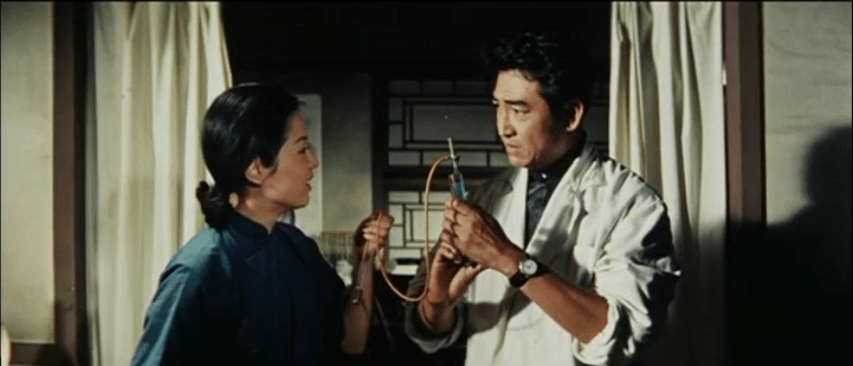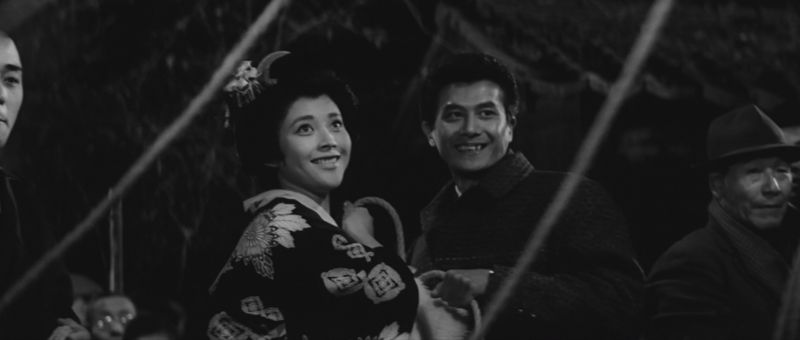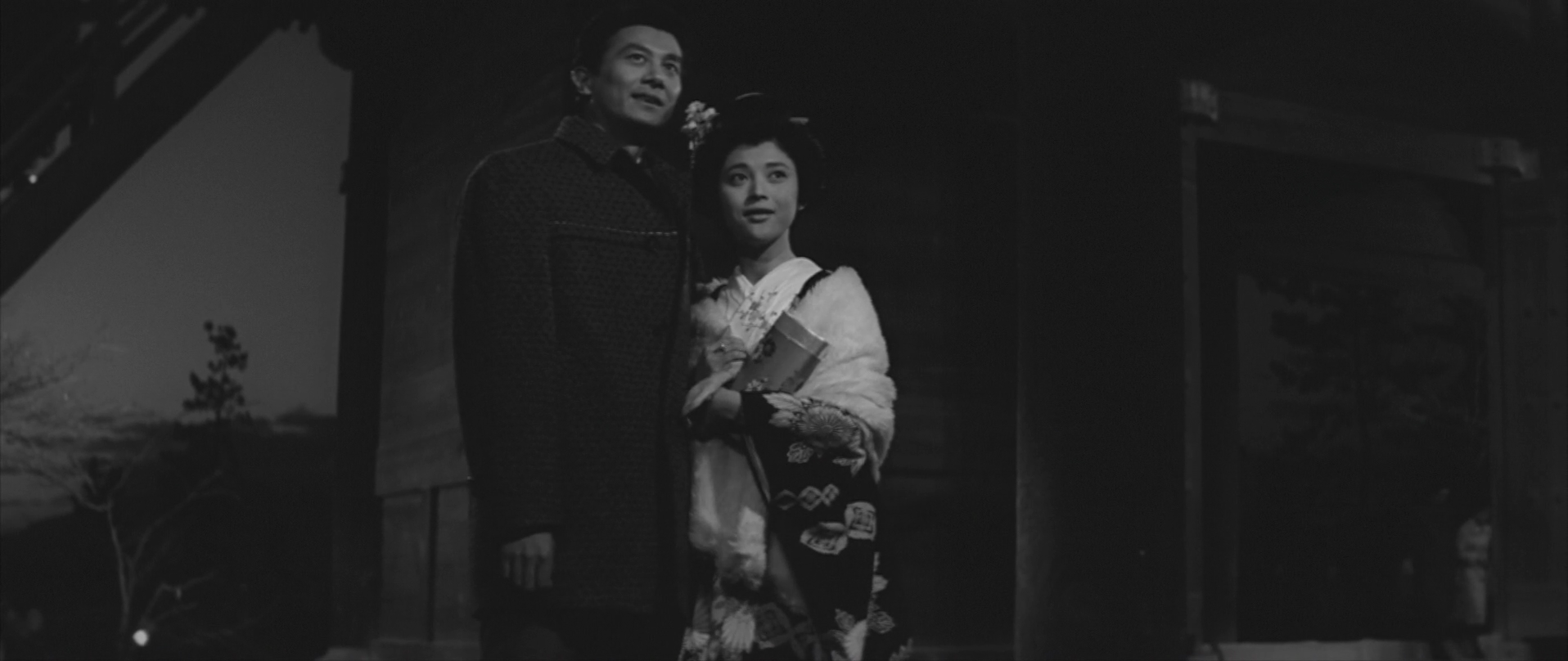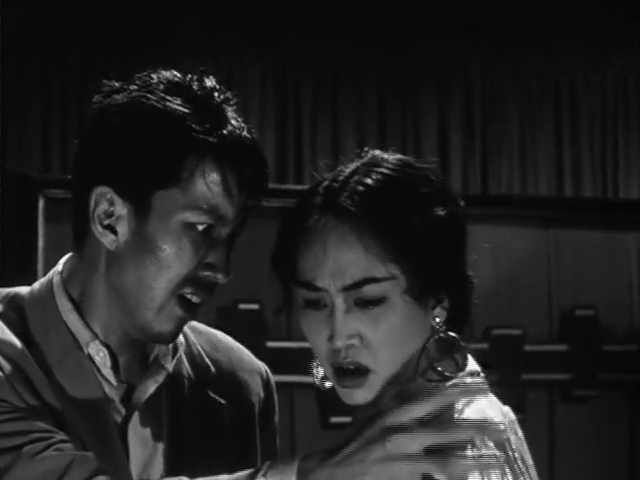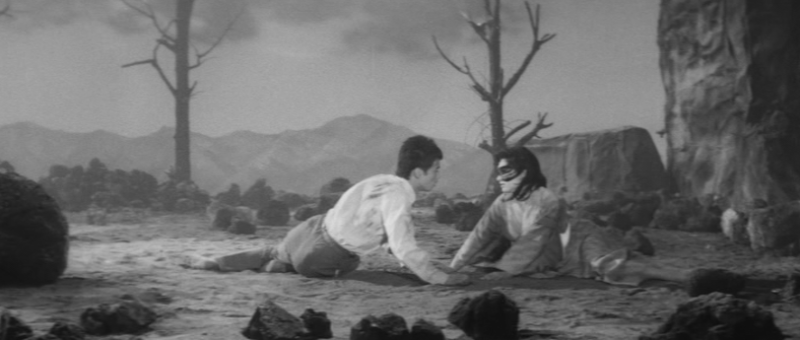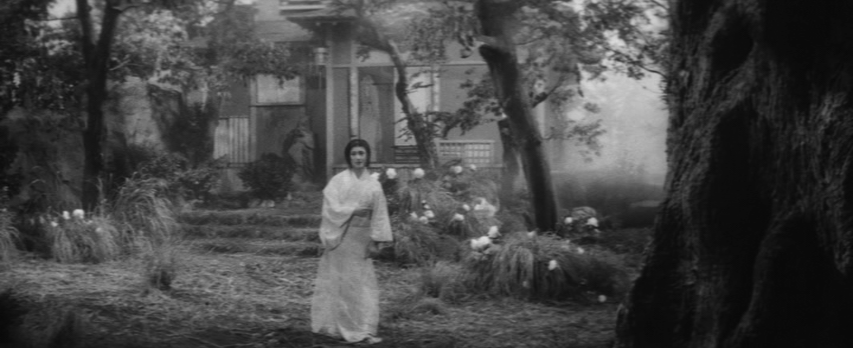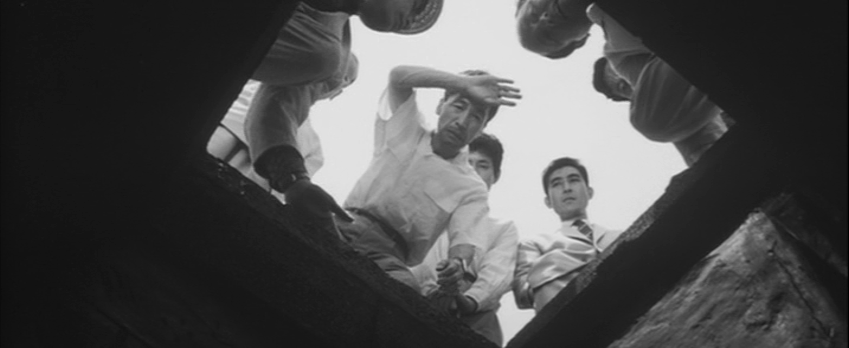
Get ’em All (「みな殺しの歌」より 拳銃よさらば, Eizo Sugawa, 1960)

A recently released young man is forced onto a nihilistic path of meaningless violence when his bank robber brother is killed in a hit and run in Eizo Sugawa’s moody post-war noir, Get ‘em All (「みな殺しの歌」より 拳銃よさらば, ‘Minagoroshi no uta’ yori kenju yo saraba). Adapted from a novel from Japan’s hardboiled master Haruhiko Oyabu who also provided the source material for Sugawa’s The Beast Shall Die, the film is as much about defeated aspiration and personal despair as it is about the corrupting influence of money and the futility of vengeance.

After waiting a year to divide the loot from a bank robbery, a random syndicate of crooks is shocked to discover that it has gone missing from its hiding place in an ancestral tomb belonging to one of their members along with a gun connected to the crime which is presumably being kept for insurance purposes. Everyone is convinced someone else has taken it with Tanabe (Tetsuro Tanba), the owner of the tomb, most particular about getting his hands on his share as quickly as possible and directing his suspicion towards the heist’s mastermind, Koromogawa (Akihiko Hirata). 

Koromogawa is currently doing quite well for himself, having recently married and moved into a fancy new flat on a danchi. His brother Kyosuke (Hiroshi Mizuwara) has just been released from prison for an undisclosed juvenile crime and evidently has never met his sister-in-law Mamiko (Yukiko Shimazaki). Strangely buoyant and incredibly naive for someone who’s spent time inside, Kyosuke is determined to go straight and is intending to save money to buy a truck he can use to start his own business. He has no idea that his brother’s newfound wealth is down to robbing banks and is absolutely certain that he is a morally upright person who’d never have anything to do with criminality. When Koromogawa is killed in a hit and run after leaving to meet Tanabe, the suspicion is that he’s been murdered by one of the crooks in a dispute over the money though that would admittedly be quite a counterproductive move as if he really has taken it now that he’s dead no one knows where it is.   

Kyosuke is shocked by Mamiko’s apparently indifference to her husband’s death, even going so far as openly flirt with him. After discovering a receipt for a coin locker in his brother’s wallet, he opens it and finds a pistol first planting the seeds of doubt in his mind about Koromogawa’s life and death. The gun, however, begins to take him over. After reuniting with old girlfriend Yuriko (Akemi Kita), Kyosuke was beaten up by her new squeeze but when he tries the same thing again and notices the pistol tucked into Kyosuke’s waistband he immediately backs down. With the gun in his hand, Kyosuke is able to completely humiliate him, forcing the man to crawl on the floor like a pig and drink dirty water from a puddle in the road. This new sense of ultimate power fuels his desire for revenge setting him on a killing spree starting with Tanabe in an effort to figure out what happened to his brother, an exercise often frustrated by his killing those concerned before turning up any real information. 

Meanwhile, using the gun is also quite a stupid and naive thing to do as the police already have it on file from a shot that was fired during the robbery bringing the crime back into police consciousness and therefore making it impossible for any of the men to spend the money should they finally get their hands on it. Each has a different reason for wanting the loot, a clockmaker wanting to support a daughter left with disabilities after contracting polio, a former record producer realising that he’s aged out of his industry, a former boxer with a lame leg (Tatsuya Nakadai) dreaming of buying a small plot of land, and a couple of embezzlers looking for ways out along with in one case divorcing a wife to marry a bar hostess mistress. But then as in the last two cases and Koromogawa’s own it is perhaps the allure of rising consumerism that has already corrupted them. So much of the action revolves around big American cars, while we’re also told that the gun was one manufactured in Nazi Germany and was most likely bought or stolen from an American serviceman. 

So drunk is Kyosuke on the power of the gun that he doesn’t really take stock of what he’s doing until it’s already too late, realising he’s become an accidental serial killer and no longer has a possibility of leading a normal life. He had begun to feel that way before, especially in the wake of his brother’s death, as he finds each of his job applications failing when prospective employers learn of his criminal past. He’s repaid his debt to society, but if society refuses to give him a second chance then realistically he has no other avenue than heading deeper into crime. Kyosuke liked it that the gun made people fear him but is confronted by the illusionary quality of its power when a child suddenly grabs it in the middle of a game of cops and robbers, pointing the gun at him believing it to be a toy while passers-by laugh at the amusing sight of this little boy holding a grownup hostage. It seemed to confuse Kyosuke that Yuriko had not been afraid of him even with the gun in his hand, but her sudden terror on realising that he has killed and may yet kill her only shows him what he’s become. 

He wanted revenge for his brother’s death, but what if it really was just an accident? The gang begin to turn on each other after the money disappears, some believing Koromogawa took it for safekeeping to prevent them incriminating each other by spending it too early and others that he just took it for himself while each suspecting one another believing one of them is slowly killing the others to pocket the whole amount for themselves. But in the end it’s all for nothing, they couldn’t spend it anyway and several of them decide they’d rather not have the bother and are ready to live quiet lives in the country only it’s too late for that now. A final revelation confirming his brother’s criminality coupled with the betrayal of a friend’s well-meaning attempt to keep him in the dark lead only to an internecine confrontation with the futility of crime. With its noirish jazz score and photography reminiscent of contemporary American independent cinema Sugawa captures a sense of restless youth but also the latent desperation of those left languishing on the margins of an increasingly prosperous society.


Original trailer (English subtitles)

High and Low (天国と地獄, Akira Kurosawa, 1963)

A self-made man is landed with an unthinkable dilemma when his chauffeur’s son is kidnapped in place of his own just at the moment he’s staked his entire fortune on a manoeuvre to outsmart cynical executives set on taking over his company in Kurosawa’s post-war crime film, High and Low (天国と地獄, Tengoku to Jigoku). The movie’s Japanese title, Heaven and Hell, might hint more strongly at the growing economic disparities in the era of the economic miracle but also at the dualities embodied in the hero’s choices. “Success isn’t worth losing your humanity” his wife tells him, but he still struggles with the validity of choosing his heart over his head knowing that to pay anyway even though it’s another man’s son means financial ruin, the final question being if he is really prepared to allow a child to die simply to maintain his own wealth and status. 

The problem is that Gondo (Toshiro Mifune) has attempted to mount a rebellion against the evils of consumerism, incurring the ire of the cynical executives who attempt to get him on their side in their attempt to oust the boss whose outdated ideas are running the business into the ground. Though Gondo appears sympathetic, hinting that he might be interested if there’s a good enough promotion in it, he later tells them where to go on seeing that their business plan is to start producing poor quality disposable footwear. Gondo started on the factory floor and he doesn’t want to put the company’s name on such shoddy produce nor does he think that their admittedly fair point that if the shoes are well made and last a long time no one will need to buy any is a good way to do business. He doesn’t think the boss is right either and wants to make shoes his own way which is why he’s remortgaged the sizeable mansion he owns on top of a hill overlooking the city and has pretty much run through his wife’s dowry to buy a majority stake in the company.

On top of a hill is a good place to live if you want a good vantage point to oversee the land below, but while you’re looking down others look up and not all of them kindly. Gondo is as he says a self-made man, but also out of touch with contemporary society and not so far from an ambitious courtier always after a little more. He says it isn’t about getting the top job but getting shoes made right, but it seems he too had been bitten by the consumerist bug and is otherwise unable to affirm his status without material proof. When he thinks it’s his own son that’s been kidnapped, he’d have given it all away but when it’s the driver’s boy it’s a different question. Shinichi (Masahiko Shimazu) isn’t his responsibility and as he points out there are plenty of other wealthy men, why is he the only one to pay? While his wife (Kyoko Kagawa) tearfully urges him to do the right thing, his assistant (Tatsuya Mihashi) tries stop him, insisting he should take the sizeable cheque they’ve had drawn up to Osaka and the stakeholder he’s buying the shares from. 

While he vacillates, the driver, Aoki (Yutaka Sada), is humiliated and forced into servitude. Gondo seems to have the old-fashioned idea that the kidnappers would simply let Shinichi go on realising they’ve got the wrong boy and his father can’t pay, but Aoki knows there’s nothing he can do to save his son but throw himself on Gondo’s mercy. He falls to the ground and prostrates himself, but later retracts all telling Gondo it doesn’t matter, that he hadn’t realised what he was asking of him, and insisting that Shinichi is a bright boy who will look for a chance to escape on his own. Once the boy is returned he treats him harshly, interrogating him about anything he might have forgotten and later driving him around looking for the hideout where he was kept in an attempt to do something and repay the debt he now feels he owes to Gondo by helping the police retrieve the money Gondo eventually agreed to pay for him. 

In agreeing to give up the money, Gondo is in a sense unburdened knowing he has made the right choice and realising that he would never live a comfortable life in that house if cost a child’s life to keep it. Part of his rationale for not wanting to pay had been that though he had been poor before and might be again, his wife had not been and does not truly understand what it is to live in poverty much as she says her life of luxury means nothing to her. She has never wanted for anything, after all. As for the kidnapper, Ginjiro (Tsutomu Yamazaki), we know little of his motives save for his intense resentment living quite literally in the shadow of Gondo’s mansion and feeling as if it were mocking him. Then again, though his life is hard Ginjiro already had a path to success in that he would soon have completed his medical studies implying at least that he or someone else was able to cover his tuition and costs of living, that he was able to continue in education, and really had no need to take such drastic action in rebellion against the antagonistic capitalism of the post-war society. “Do you think we have to hate each other?” Gondo asks him, but Ginjiro has no answer only his intense resentment for everything he represents.

The “hell” that Gondo inhabits is a backstreet wasteland peopled by the hopeless. Tokura (Tatsuya Nakadai), the earnest policeman, follows him through thronging clubs and on into “dope alley” where Ginjiro picked up his accomplices so desperate to escape their suffering that they’d agree to help him kidnap a child. Though it costs him his job, Gondo decision to do the right thing makes him a national hero, the working class millionaire who mows his own lawn and can still knock up a pair of shoes should the occasion call while women across the country decide to boycott the company in protest at his treatment. Ginjiro can only howl like a caged animal while facing a death sentence for the coldblooded murder of his accomplices. The light bouncing off his mirrored sunshades gives him an eerie supernatural quality, a demon arising from depths of hell to wreak havoc in heaven but finding only infinite tragedy in the contradictions of the consumerist post-war society.


High and Low screens at the BFI Southbank, London on 19th January 2023 as part of the Kurosawa season.

Original trailer (English subtitles)

Bullet Wound (弾痕, Shiro Moritani, 1969)

“Your love for your country can’t change anything now” the conflicted hero of Shiro Moritani’s conspiracy thriller Bullet Wound (弾痕, Dankon) is advised as a villainous chaos agent attempts to convince him to switch sides. Like many of Toho’s gunman dramas of the late ‘60s, Bullet Wound anticipates the cinema of paranoia which would take hold in the following decade set against the constant anxiety of the ANPO protests while the Japanese-American CIA agent hero struggles with his uncertain place in a world of geopolitical instability. 

Takimura (Yuzo Kayama) is a man with two countries, born in the US to Japanese parents but later orphaned, now working for the CIA in Japan. Perhaps tellingly, we can’t initially tell what side he’s on even as he tries to prevent an assignation attempt on some kind of dignitary connected to the US. The main crisis occurs when Takamura helps a Chinese man, Yang (Shin Kishida), escape a trade summit in order to defect and chase freedom in America. The Americans, however, then torture him until he finally admits that he’s a stooge, the defection was merely a means of getting him into the US as a spy while the trade delegation is only a front for an upcoming arms deal with a international smuggler known as “Tony Rose” (Andy Seams). Takimura and his team are obviously keen the transaction not take place, but are unable to take Rose out because as Takimura’s boss points out they’ve used him too and he’s too well connected. If they move against him, someone will move against them. 

The Chinese arms deal is linked back to a sense of cold war paranoia which spreads to the young students protesting the ANPO treaty. Takimura’s boss calls them “terrorists” unable to understand how there can be Japanese people who could do this to their own country seemingly unaware of the minor irony in his statement. Meanwhile, he prepares to sacrifice Takimura as need be, callously remarking that a man with two countries who can’t choose between them can be dangerous while admitting that his services have been useful to the Americans but they may not always be so. The Americans meanwhile make crass racist remarks while chasing down the Chinese spies, taking altogether too much pleasure in eradicating them while the hitherto stoical Takimura looks on with disapproval mixed with hurt and shame beginning to wonder if he’s really on the right side. “You and the US will never defeat us” his rivals insist, revealing a mind-blowing piece of info that sets Takimura on a collision course with fate. 

Meanwhile, a strange young artist crafts horrifying statues displaying the “agony of loneliness” and longs to escape Japan for South America where they apparently have the best stone. But as someone later tells her, the desire to go to a new land is not born of hope, and expectations are almost always betrayed. Only love can change everything into hope he tells her, as she pins hers on running away with Takimura while he tries to tie up a few loose ends. Yet there’s also a kind of fatalism that defines their relationship, Takimura reflecting on watching a man die up close and haunted by the searching look in his eyes as if he were trying to understand the meaning not of life but of death. An ironic street singer sings a sad song about those who die and what they leave behind, the soldier apparently leaving not a trace of peace. 

The implication is perhaps that Takimura’s dual nationalities are not viable, that a man with two countries cannot escape by choosing a third nor can he survive without sacrificing one or the other. Meanwhile, Moritani slides into anti-Americanism painting the CIA as duplicitous and exploitative as they simultaneously demonise the Japanese and position men like Tony Rose as international chaos agents destabilising the global order. Handheld photography adds to the sense of anxious immediacy and confusion as Takimura attempts to define his own identity only to discover perhaps that he no longer has one caught as he is between two nations as two selves at the heart of a silent war. 


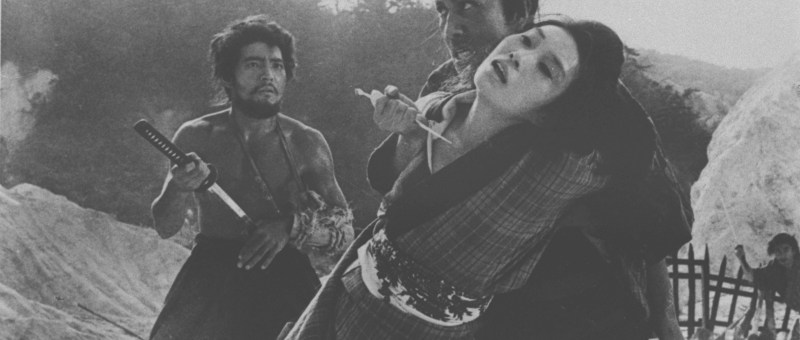
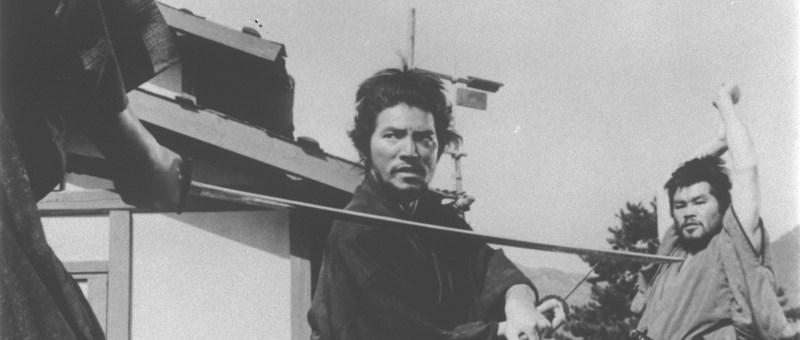
Samurai Wolf 2: Hell Cut (牙狼之介 地獄斬り, Hideo Gosha, 1967)

“We ronin must live without mercy” insists a fugitive on a quest for vengeance and riches only to meet his match in the justice-loving wanderer Kiba (Isao Natsuyagi) making his return for Samurai Wolf II: Hell Cut (牙狼之介 地獄斬り, Kiba Okaminosuke: Jigoku Giri). Like the second instalment in many series, Gosha’s avant-garde chambara largely follows the same formula picking up several familiar elements from the first film if giving them a new spin as Kiba once again finds himself caught up in intrigue provoked by the amoral venality of late Meiji society. 

In this case, he makes a rod for his own back by humiliating some swordsmen after catching them harassing a young woman, mocking them when they try to claim that their treatment of her is part of their “training”. Kiba saves the girl, Oteru (Rumiko Fuji), who has some kind of etherial quality and doesn’t quite seem to know what’s going on immediately throwing herself at Kiba who turns her down in gentlemanly fashion. Sometime later, he runs into a convoy of officials transporting criminals to the nearest judicial centre and stops to give the prisoners some of his own water explaining that that from the stream is polluted thanks to leaks from a nearby goldmine. In any case, Kiba is struck by the appearance of one of the men, Magobei (Ko Nishimura), who reminds him of the father who was killed by swordsmen he’d humiliated with his skill. 

Magobei is in chains for murdering the manager of the mine which previously belonged to the shogun but has now been shut down, its seam apparently exhausted. But like the toxins that poured into the river, the mine is a poison to society and in more ways than one. Magobei tells Kiba that he’s been set up. He was hired to kill the manager by a duplicitous gang leader named Jinroku (Bin Amatsu) who has found a new seam and has been operating the mine illegally taking all the gold for himself so obviously Magobei wants revenge. After seeing off an ambush, Kiba agrees to act as a bodyguard delivering both Magobei and the other prisoner, Kihachi (Out Yokoyama) who claims to be a big time bandit in trouble for robbing a samurai family, to the nearest city but secretly seems to sympathise with the injustice dealt to Magobei and the female prisoner who later joins them, Oren the Thistle (Yuko Kusunoki), who murdered a judge who killed her lover. 

Yet Kiba’s memories of his father cloud his judgment about Magobei who is definitely not a man worthy of his faith in him. “What good would pity do?’ Magobei asks, certain that compassion is a weakness and that if he were to give in to human feeling he would immediately be betrayed. The men misunderstand each other, assuming they are alike when in reality they are opposites. Kiba bets on Magobei’s humanity and loses, while Magobei assumes that Kiba will easily be won over by the riches to be found in the goldmine and help to wipe out Jinroku’s gang which is also a family of which Oteru is a member. “Life’s tough that’s how it is” he justifies, but Kiba cannot forgive him not least for his callous murder of a man who was only a frightened braggart and could not have harmed him and a woman who was otherwise blameless. Just as Sanai had in the first film, Magobei tells him that “one day you will be like me” a future that Kiba once again violently rejects. 

But then again he can never escape the world where goldmines pollute the rivers and money can buy anything, even the hearts of men. Just like his father, he’s pursued by the swordsmen he’s unwittingly insulted while discovering his desire to serve justice backfiring, eventually robbing him of the only thing he actually wanted just as it had at the end of the previous film. Even so, Kiba retains his sense of humanity and unlike so many jidaigeki (anti-)heroes refuses to give in to nihilism or despair. A little less avantgarde than the previous instalment, Gosha nevertheless conjures a world of dazzling violence in freeze-frame and silence while once again leaving Kiba the furious wolf to wander, a lonely figure in an unforgiving landscape.


Samurai Wolf 2: Hell Cut opens at New York’s Metrograph on Dec. 26 as part of Hideo Gosha x 3

Original trailer (English subtitles)
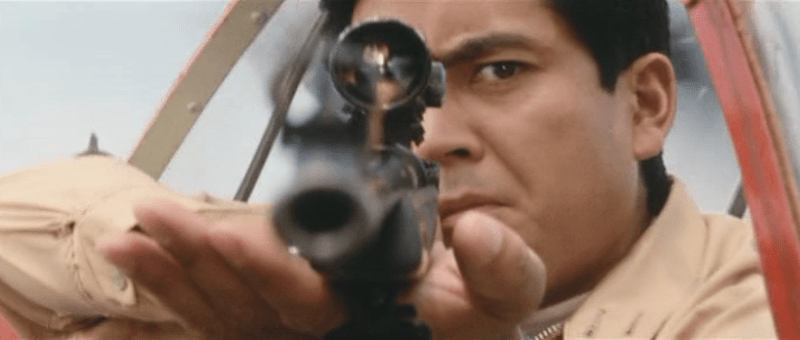
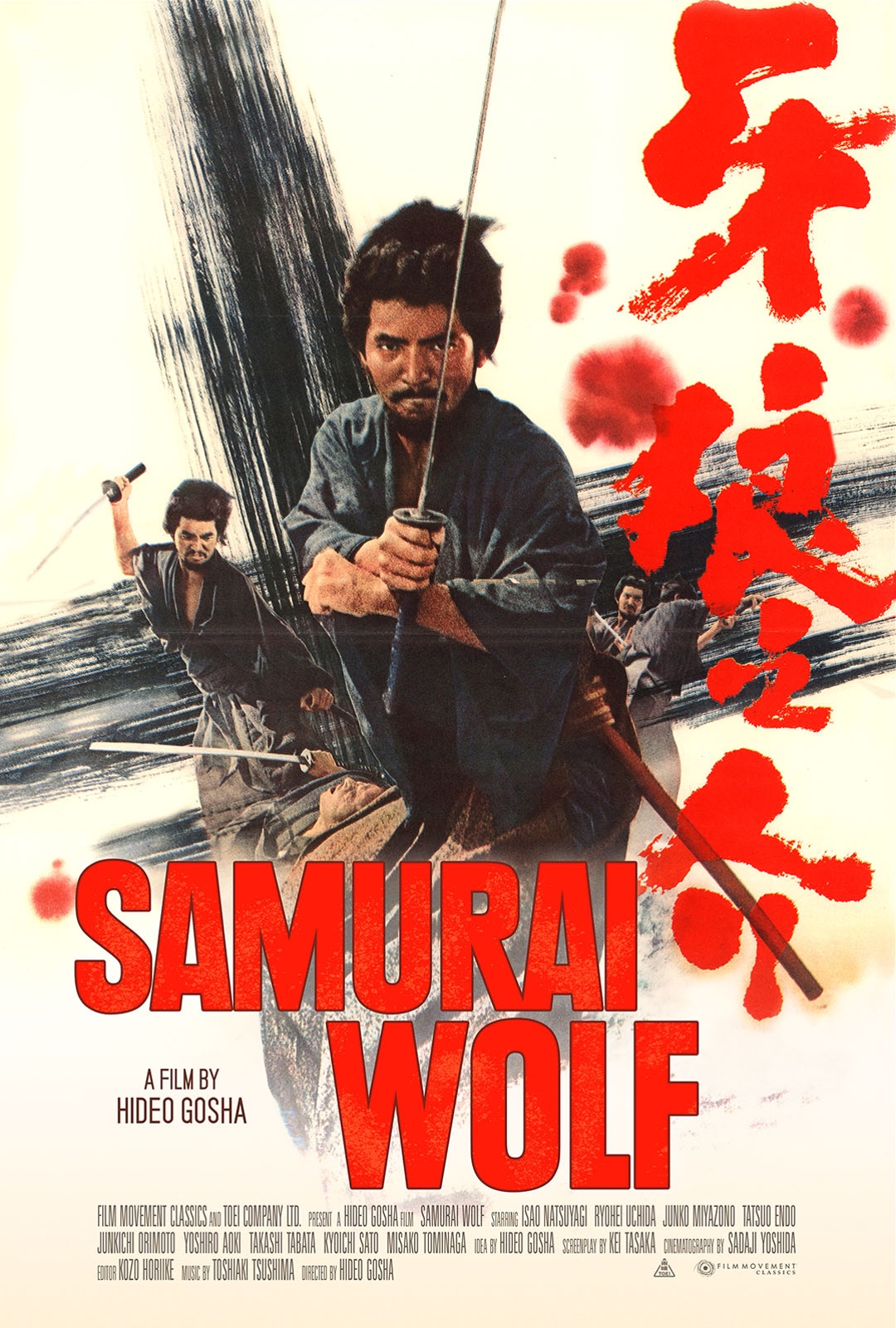
Samurai Wolf (牙狼之介, Hideo Gosha, 1966)

A cheerful ronin with strong moral fibre finds himself squaring off against a nihilistic assassin and a corrupt retainer/postmaster in Hideo Gosha’s new wave chambara Samurai Wolf (牙狼之介, Kiba Okaminosuke). Where many jidaigeki of the age would follow the antagonist Sanai (Ryohei Uchida), Gosha’s focusses on the figure of a man with wolfish appetites who is otherwise unaffected by the infinite corruption of the world around him and in that at least unwilling to submit himself to the dog-eat-dog mentality of late Edo-era society. 

Wandering samurai Kiba Okaminosuke (Isao Natsuyagi) explains that he got his name because often he bares his fangs and is known as the Furious Wolf, yet as much as the ferocity of the opening titles might bear that image out he is not cruel or avaricious but measured and honest. After wolfing down an exorbitant amount of food prepared by an old woman at a way station, he announces that he can’t pay. The old woman panics and we wonder if he might become violent or even kill her, but Kiba simply offers to pay in kind fixing the old lady’s leaky roof and chopping a supply of wood much to her surprise and gratitude. It seems, the wolf always pays his way. While there, he witnesses a trio of bandits attack a postal cart and kill the men who were pulling it. He retrieves the bodies along with a runaway horse and takes them back to the outpost they came from but the guard there is disinterested claiming that, as they died on the road and not in the town, it’s not his business. As Kiba soon discovers, the guard is in league with a corrupt lord, Nizaemon (Tatsuo Endo), who is an official messenger for the shogun but wants to take over the public postal service which is why he’s terrorising the postmistress, Chise (Hiroko Sakuramachi), with the intention of getting his hands on the relay outpost. 

There is something a little ironic in the fact that Ochise is blind while Nizaemon’s chief assassin is deaf and mute, both of them excluded from mainstream society and looking for support but finding it in opposing directions. Formerly a samurai woman, Ochise wants to hang on to the outpost because it has become her place to belong while resenting the incursion by corrupt lord Nizaemon who only wants it for the potential to control the cargo route along with raising the rates to use it to exorbitant heights. Shortly after Kiba tries to take out the assassins, a bunch of government inspectors turn up to complain about the missing merchandise while backing Chise into a corner by forcing her to accept the liability for transporting a large sum of gold coins. Kiba originally says he won’t help because he doesn’t want to risk his life for people he doesn’t even know, but of course later agrees in part on the promise of a significant return but also because he likes Chise and resents the kind of corruption men like Nizaemon represent.

On the other hand, his humanity is mirrored in his antagonist, hired gun Sanai who fetches up to help Nizaemon stop Kiba and take over the outpost. Sanai cynically tells him, that in five years’ time Kiba will be no better than he is, if he doesn’t kill him first. Kiba rejects the claim but it’s easy enough to see how someone could be corrupted by the realities of Edo-era society. Sanai later reveals that he fell in love with a samurai woman and eloped with her, a fierce taboo given the class difference between them, and later fell into his present state of nihilistic despair when she was taken from him quite literally betrayed by the social order. But Kiba seems different. He is not naive and has no expectations of human goodness yet remains cheerful and in his own way honest. When a young woman comes to him with her life savings and tells him that Sanai is the man whom she’s been waiting for to gain her revenge, he tells her to keep her money because he’s going to end up fighting him anyway. Likewise, when he realises someone he trusted has betrayed him, he tells them that he understands why they did it and bears them no ill will it’s simply the way things are only he suspects they will regret that others have died because of it. Even in his final confrontation with Sanai, he notices that his opponent is injured and ties one of his own hands to his belt to ensure it will be a fair fight. 

In any case, it seems that Sanai’s morally compromised existence is about to catch up to him with several other players intent on taking his life aside from the sex worker who longed to avenge the deaths of her family murdered during a massacre of peasants killed for standing up to a cruel landowner. A female gang leader also wants revenge for the death for her boss, while the cynical madam at the local brothel offers to team up with him to steal the gold from under Nizaemon’s nose. It seems that Sanai is a man already dead, having long abandoned the lovelorn boy he was for the nihilistic existence of a wandering assassin only to be confronted with the ghosts of the unattainable past. This world is indeed rotten, but Kiba has somehow managed to rise above it embracing his wolfish appetites in more positive ways while opposing injustice wherever he finds it. Much more avant-garde than much of his later work would be, Gosha makes great use of slow motion and silence broken only by the reverberating sound of clashing swords and hints at the meaninglessness of a life of violence in an agonisingly haunting death scene in which a bloodstained man turns and falls as if the air were suddenly leaving his body. In the end all Kiba can do is turn and walk away, on to the next crisis on the highways of a lawless society.


Samurai Wolf opens at New York’s Metrograph on Dec. 26 as part of Hideo Gosha x 3

Original trailer (English subtitles)
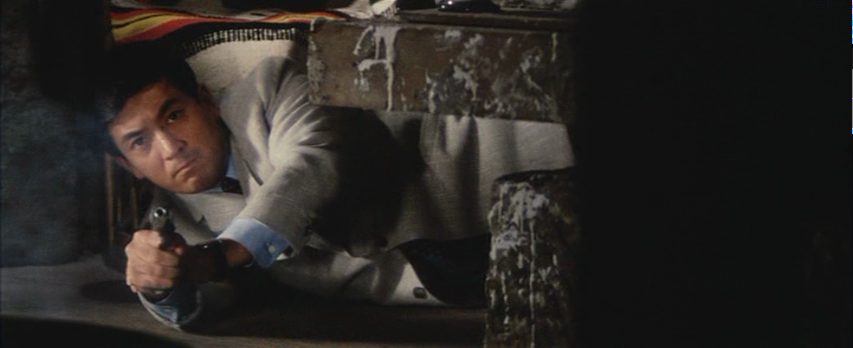
In Search of Mother (瞼の母, Tai Kato, 1962)

The toxic hyper-masculinity of the yakuza world conspires against a sensitive young man who longs to reclaim his place in society through reuniting with the mother who was forced to abandon him at five years old in Tai Kato’s hugely moving jidaigeki, In Search of Mother (瞼の母, Mabuta no Haha). Adapted from a kabuki play by Shin Hasegawa, Kato’s wandering tale is perfectly tailored for post-war concerns situating itself in a world of mass displacement, economic inequality, and lonely regret in which the secrets of the immediate past have become a threat to the promise of the near future which may then in itself prove unrealisable. 

As the film opens, 25-year-old Chutaro (Kinnosuke Nakamura) is trying to stop his hot-headed friend Hanji (Hiroki Matsukata) from taking revenge on a rival gang on behalf of their boss who is to them something like a father figure. Chutaro reminds Hanji that he has other ties and should think about the mother and sister who wait for him in his hometown to whom he should return and attempt to live an honest life, the possibility of which Chutaro is deprived because he is an orphan with no home or family to turn to. His pleas fall on deaf ears, Hanji reminding him of the code by which they live. “What’s going to happen to my pride as a man?” he exclaims, later telling his mother “I’m not a man if I don’t accept their challenge”. “If that’s the case then don’t be a man” she counters, physically preventing him from leaving as if Hanji were a still a child but to him it seems life is not worth living if you are not accounted a proper “man” by the values of the society in which he lives. When Hanji’s sister Onui (Hitomi Nakahara) attempts to plead for him, the gangsters explain to her that they are trapped too, they cannot return without fulfilling this debt of honour. “That’s not how it works miss, if we let him go after he attacked our boss we won’t be able to survive in our world.” 

Just as Chutaro searches for his long lost mother in order to reclaim his place in mainstream society, he is pursued by the gangsters desperate to redeem themselves through revenge. Eventually arriving in Edo by winter, he adopts the rather unscientific tactic of stopping every middle-aged woman he comes across and asking her if she might once have had a son. The first of these is a blind shamisen player whom he witnesses being cheated by man who makes a point of dropping the coin he was to give her back in his own pouch to make it sound like he paid when he didn’t and then getting indignant when he she calls him on it. The woman gives her age as 50 though looks 20 years older and relates her own sad story of widowhood and a son she had to give up but is not Chutaro’s mother. In any case he gives her a large amount of money out of a kindness he might hope someone would show to his own mother were they in his position. 

He does something similar with the next woman, Otora (Sadako Sawamura), a sex worker, like him ostracised by the world around her, who had a son who died in infancy and is now rejected by a judgemental society for doing the only thing she can to survive. Kato films each of these poignant moments in long unbroken takes tinged with the desperation and loneliness of two people looking for something from the other which in the end they are not able to give each other only find relief in their shared sorrow. Nevertheless the encounters also expose the difficulties faced by women in this era in which they must be dependent on men, the shamisen player suffering in her widowhood and Otora left with no choice than to engage in sex work which then exiles her from society at large just as Chutaro is rendered an outcast because of his yakuza past yet as he later explains what else could a child without parents have done?

This is something which might press heavily on the minds of a post-war audience in which the plight of war orphans and otherwise displaced children was all too familiar. In terms of cinema, the yakuza is often presented as a surrogate family in which orphaned boys can replace unconditional love with the mutual solidarity of a brotherhood defined by highly codified existence. Yet Chutaro longs to repair his connection to mainstream society by finding his mother, carrying around money he has saved in order to help her should he discover that she, like Otora and the shamisen player, is living in poverty. What he did not consider, however, is that she may reject him. Acting from a tip off from Otora he pays a visit to a local store run by Ohama (Michiyo Kogure) who unlike the other women has been able to build an independent life for herself and is preparing to marry off her daughter Otose (Keiko Okawa) to a wealthy merchant’s son. When Chutaro first appears, she assumes he is a conman fed information by Otora, admitting that she once had a son by his name but was told he had died in an epidemic when he was nine. Just as we’d seen her reject Otora lest she expose her sex worker past, she rejects Chutaro in fear that his yakuza ties will ruin her reputation, wreck her daughter’s marriage, and disrupt the comfortable life which she worked so hard to create just at the moment of its fruition. 

“You are suspicious of people because you have wealth” Chutaro points out, making plain the various ways in which economic inequality continues to disrupt the bonds between people. As we discover, Ohama was forced to abandon him because his father was abusive. In that era it would not have been possible to take her son with her and so she made her peace with leaving him but despite herself is now conflicted on witnessing him crying in front of her like a child while afraid to acknowledge him lest it disadvantage her daughter. The problem here is not that her past is shameful or a secret, Otose knows she had an older brother, but the fact that Chutaro has become a yakuza with judgment unfairly placed upon him for simply doing what he could to survive without parents to care for or guide him. Too late, Ohama realises she has made a terrible mistake. She and Otose go out to look for Chutaro but either too hurt by the rejection or having come to believe that he cannot escape his yakuza past, he lets them pass him by resigning himself to the fate of a lonely wanderer. Shot entirely on stage sets more often from mid-height rather than his characteristically low perspective and with additional fluidity mimicing Chutaro’s restless sense of displacement, Kato’s take on this classic tale is a profoundly moving examination of the effects of oppressive social codes on even the most essential of connections. 


The Sand City in Manchuria (砂漠を渡る太陽, Kiyoshi Saeki, 1960)

A pure hearted doctor stands strong against the forces of imperialism if somewhat ambivalently in Kiyoshi Saeki’s wartime drama The Sand City in Manchuria (砂漠を渡る太陽, Sabaku wo Wataru Taiyo). “Why isn’t there just one country? I don’t want a country” a young Chinese woman exclaims towards the film’s conclusion in what is intended as an anti-war statement but also invites the inference that the one country should be Japan and that China is wrong to resist the kind of “co-existence” that the idealistic hero is fond of preaching. 

Dr. Soda (Koji Tsuruta), known as Soh, has been in Manchuria for two years running a poor clinic in a trading outpost on a smuggling route through the desert. He came, he later tells another Japanese transplant, after being talked into it by a pastor who told him about US missionaries who endured hardship in the Gobi desert and lamented that no Japanese people had been willing to take on such “thankless” work in the midst of the imperial expansion. There is a kind of awkwardness in Soda’s positioning as the good Japanese doctor which perhaps reflects the view from 1960 in that he objects to the way the Japanese military operates in Manchuria and most particularly to Japanese exceptionalism which causes them to look down on the local Chinese community as lesser beings, but within that all he preaches is equality and co-existence which suggests that he sees nothing particularly wrong in Japan being in Manchuria in the first place while implying that the Chinese are expected to simply co-exist with an occupying force to which they have in any case been given no choice but to consent. 

Nevertheless, it’s clear that the Japanese are in this case the bad guys. Soda is at one point accosted by a drunken soldier who takes against his choice to adopt Chinese dress while rudely refusing to pay his rickshaw driver. The animosity of some in the town is well justified as we hear that their mother was murdered by a Japanese soldier, or that they were raped by Japanese troops and now have nothing but hate for them to they extent that they would withhold vital medical treatment from a child rather than consider allowing Soda to treat them. Soda’s main paying job is working at an opium clinic hinting at the various ways imperialist powers have used the opium trade to bolster their control over the local population, while it later becomes clear that one of the Chinese doctors has been in cahoots with a corrupt Japanese intelligence officer to, ironically, syphon off opium meant for medical uses and sell it to addicts in a truly diabolical business plan. 

Though Soda is well respected in the town because he offers free medical treatment to those who could never otherwise afford it, he is sometimes naive about their real living conditions. Outraged that a young woman has been sold into sexual slavery, he marches off to the red light district to buy her back but is confused on his return realising her family aren’t all that happy about it because they cannot afford to feed her and were depending on the money she would send them because the father has become addicted to opium and can no longer work. The girl, Hoa (Yoshiko Sakuma), becomes somewhat attached to Soda but he is largely uninterested in her because she is only 17, while her affection for him causes tension with the daughter of an exiled Russian professor which is only repaired once they all start working together for the common good after the town after it comes under threat from infectious disease. 

In an echo of our present times, it seems not much has changed in the last 80 years or so, the townspeople quickly turn on Soda once it become clear that he’s putting the town on lockdown to prevent the spread of infectious meningitis after a Russian soldier stumbles in and dies of it. The disease firstly exposes the essential racism even among those Japanese people who have lived in Manchuria longterm such as the mysterious Ishida (So Yamamura) who remarks that diseases like that only affect the Manchurians and they’ll be fine because they are “more hygienic”, while simultaneously painting the infection as a symptom of foreign corruption delivered by the Russian incursion. Soda visits a larger hospital to get the samples confirmed but is told that the disease has not been seen in Manchuria before and so they have no vaccine stocks leaving him dependent on the smuggling network to get the supplies he needs. As the town is a trading outpost whose entire economy is dependent on the business of travellers just passing through, the townspeople are obviously opposed to the idea of keeping them out fearing that they will soon starve going so far as to tear down Soda’s quarantine signs while throwing stones at his house. 

In another irony, it’s Ishida’s pistol that wields ultimate control immediately silencing the mayor’s objections in a rude reminder of the local hierarchy. Many of the townspeople including inn owner Huang (Yunosuke Ito) and Hoa’s sister Shari (Naoko Kubo) are involved with the resistance to which Soda seems to remain quite oblivious and in any case adopts something of a neutral position but gains a grudging respect from Huang thanks to his humanitarianism that eventually saves him from brutal bandit Riyan (a rare villain role for a young Ken Takakura). In any case, as the corrupt Japanese officials pull out to escape the imminent Russian incursion, Soda decides to stay in part to atone for the sins of the Japanese in an acceptance of his responsibility as a Japanese person if one who has not (directly) participated in the imperialist project even if he was in a sense still underpinning it. Essentially a repurposed ninkyo eiga starring Koji Tsuruta as a morally upright man surrounded by corruption but trying to do the right thing to protect those who cannot protect themselves, there is an undeniable awkwardness in the film’s imperialist ambivalence but also a well intentioned desire to look back at the wartime past with clearer eyes and a humanitarian spirit. 


This Year’s Love (今年の恋, Keisuke Kinoshita, 1962)

The friendship between two underachieving teenage boys hints a series of conflicts in a changing society while accidentally bringing their respective siblings together in Keisuke Kinoshita’s cheerful romantic comedy, This Year’s Love (今年の恋, Kotoshi no Koi). In many ways, it’s the older siblings who appear to be stuck while the parents are largely content to let life be and the boys rejecting the conventional paths laid out for them while attempting to overcome their loneliness and sense of despair through the sincerity of their interclass friendship. 

As the film opens, high school boys Hikaru (Masakazu Tamura) and Ichiro (Ryuji Ishikawa) have been lured to a patch of grass above the city where they’re assaulted by an older bully who for some reason resents the fact that they weren’t wearing their traditional students caps even though such things are perhaps already outdated in the rapidly changing society of 1962. In any case, Hikaru vows revenge, deciding to give up golf club and a series of other things to take up boxing, instructing Ichiro to abandon the “girly” sport of basketball and join him. Neither boy is currently doing very well at their studies, with Ichiro’s prim and proper sister Mikako (Mariko Okada) convinced that Hikaru is a bad influence on her brother assuming that he is another spoilt rich kid set on leading him astray. 

In fact, she’s not entirely wrong. Hikaru does seem to be somewhat aimless probably because his family is wealthy and he doesn’t see much urgency in the situation nor hold that kind of anxiety for his future though is fond of telling people that he feels quite depressed. While Ichiro lives in Ginza where his family run a successful restaurant, Hikaru lives in a large townhouse in nearby Yokohama cared for largely by their kindhearted housekeeper (Chieko Higashiyama) and a live-in maid while his older brother Tadashi (Teruo Yoshida) is currently a graduate student heading towards a regular salaryman job. Their mother having died some time ago and their father always away on business, care for Hikaru has largely fallen to Tadashi who is nevertheless a young man himself with his own life to be getting on with. Similarly Mikako has largely taken on a maternal role when it comes to caring for Ichiro because her parents are always busy with the restaurant. Part of the reason she’s resentful of Hikaru is that she’s the one the school keeps calling in about her brother’s poor academic performance while Ichiro is always off messing around with his rich kid friend. 

Mikako seems to take against Hikaru in part because he is rich, assuming that wealthy people are necessarily decadent and lazy while concerned that Ichiro’s head is being turned by seeing the way the other half live without understanding what it takes to live that way. The Aikawas aren’t exactly poor, they also have a live-in maid and their quarters behind the restaurant are spacious enough, though they couldn’t quite claim to be middle class because they work in the hospitality sector which is still somewhat looked down upon. In any case, dressing exclusively in kimono Mikako is extremely uptight and obsessed with properness. She further takes against the Yamadas after an awkward first meeting with Tadashi who is dumped by his fed up girlfriend in her restaurant and ends up getting beer thrown in his face, while his father later turns up with his secret longterm mistress, a maid from an inn in Atami, leaving Mikako scandalised and embarrassed. 

Ironically enough, Tadashi’s name quite literally means “correct” though even if he isn’t quite as hardline as Mikako he also wants the best for his brother. Because of the realities of life in post-war Japan, both boys explain that they find it hard to study in part because they are lonely often left home alone with no one to talk to which is one reason they value their friendship so deeply. Hikaru’s mother has passed away and his father is largely absent, while Ichiro’s parents are always working in the restaurant as is Mikako even if she’s largely been delegated other maternal duties. Tadashi and the housekeeper attempt to set Hikaru straight that he needs to do well in school because he’ll have to be able to get a good job to support himself, but Hikaru is part of a new generation that doesn’t the see point in the emptiness of the salaryman lifestyle. Tadashi might not either, but he’s going along with it anyway whereas as Mikako is completely wedded to the idea of aspirational respectability intent that Ichiro should do his best to get into college and catapult himself into the middle classes.

Her cheerfully laidback parents meanwhile barely finished school and have done alright for themselves with restaurant. They aren’t that bothered if Ichiro isn’t academically inclined because they can train him up as a chef even if that isn’t quite the future Mikako had envisaged for him in her upwardly mobile worldview. Nevertheless, she’s not quite as prim as she makes out, sneaking the odd cigarette here and there, and despite herself begins to fall for Tadashi’s goofy charms while bonding in shared love for their siblings. In the end she’s the one who has to learn that it’s alright to have a little fun now and then and if longtime widower Mr Yamada has a girlfriend that’s probably alright too. The boys’ teacher hints that he finds it strange they aren’t more into girls, Hikaru apparently so popular that the phone at his house never stops ringing but he turns them all down because he’s too consumed with ennui to date, introducing an additional transgressive element to their friendship along with their bid for manliness with their new obsession with boxing which as Mikako’s maid points out does feature a series of shirtless musclebound men. Perhaps Mikako’s newfound appreciation for romantic freedom wouldn’t stretch that far, but it does seem to have opened her up to new possibilities in a less judgemental future as she rings in the new year in the old capital of Kyoto. 


The Wild, Wild Rose (野玫瑰之戀, Wong Tin-lam, 1960)

A free-spirited nightclub singer’s dreams of love are shattered by fragile masculinity and an unforgiving society in Wong Tin-lam’s take on the classic opera Carmen, The Wild, Wild Rose (野玫瑰之戀, yě méiguī zhī liàn). Where similar films of the era may paint the heroine’s plight as punishment for her subversion of societal norms, Wong’s musical noir implies that perhaps she was too good, too pure-hearted for the increasingly selfish and judgemental society around her while the man she loves is simply too weak to accept her transgressive femininity. 

It’s with the man, Hanhua (Chang Yang), that we first enter the world of the EW Ritz cabaret bar. An “elite” English graduate, Hanhua has fallen on hard times and unable to find teaching work has been forced to take a job he sees as sordid and degrading as a pianist in a nightclub. He and his teacher fiancée Suxin (So Fung), literally the girl next-door, joke about it outside, Hanhua asking her if she’s worried about all the “pretty bad women” in such establishments and pointing at his engagement ring as an amulet of protection against predatory femme fatales. Once inside, however, he’s instantly captivated by the alluring singer, Sijia (Grace Chang), who nevertheless takes against Hanhua because unbeknownst to him he’s displacing her regular piano player, Old Wang (Lui Tat), who’s being let go by the greedy boss for showing up late because his wife is seriously ill. 

Unable to accept such callous behaviour, Sijia tries to use her position to speak up on Wang’s behalf and almost loses her own job in the process while irritating her stage rival and the boss’ squeeze Meimei (Shen Yun). While Meimei sings a quiet romantic ballad on the dance floor, Sijia embarks on a crowd-pleasing, gender-bending routine in the bar which proves both that she is the star in this establishment and that she can bend the crowd to her will turning them on whoever she sees fit. After a fight breaks out, Hanhua finds himself physically restraining Sijia to prevent her from stabbing Meimei with an icepick. Though this originally annoys her, Sijia is quite clearly turned on watching Hanhua fight off all of the other men who rose up to defend her honour. Once he is wounded, she again asserts her authority by calling them off and proceeding to flirt with Hanhua who leaves with Suxin vowing never to return. 

But as Old Wang had said, it’s tough to find a job these days and faced with his mother’s excitement about his new career prospects Hanhua has no choice but continue working at the Ritz. We can perhaps tell something of Hanhua’s background from the interior of his home which though modest has a large classical portrait on one wall and is otherwise neat and well organised. He evidently envisaged a conventional middle-class life for himself and is humiliated to have been reduced to a mere piano player in a backstreet bar, the kind of place that he sees as sordid and dangerous and would not ordinarily think of himself visiting. He sees Sijia in much the same way but perhaps stops short of admitting her danger, refusing to look at her or only with contempt while furiously denying his barely controlled desires of the kind which were perhaps unleashed by the fight at the bar. 

Yet all the qualities which attract her to him are the ones he eventually wants to destroy in her rebellious goodness and refusal to follow the unjust rules of her society. She tells him point blank not only in her song but repeatedly to his face that she is a fickle woman who believes there are no good men and is essentially in this only for a good time for as long as it lasts. In fact, her interest in him largely stemmed from a bet with a guy at the bar that she couldn’t seduce him in 10 days, stung by his rough rejection of her after the fight. But Hanhua is too conventional a man to understand or accept her. He gives in to his desires after discovering that she slept with a rich man only to get the money for a life saving operation for Old Wang’s wife, witnessing her self-sacrificing goodness and therefore deciding that she is “worthy” of him after all. Ultimately he expects her to play the role of a conventional housewife, refusing to allow her to continue singing in nightclubs even while he is unable to find another job having served time in prison for bludgeoning her abusive ex. His fragile masculinity had also caused him to blow up at Suxin when she went to the headmaster at her school and asked him to give Hanhua a less degrading job, humiliated to have a woman beg for him just he is humiliated to be supported by Sijia and especially by her doing a job he thinks is somehow improper. 

It is not Sijia who ruins Hanhua, but Hanhua himself and the toxicity of conventional social codes that feed into his sense of resentment. His obsessive desire to possess Sijia, to dominate and tame her, drives him to drink and uselessness to the point he completely degrades himself, pathetically pleading with Sijia not to leave, prepared to allow her to return to work or even take other lovers if only she does not abandon him. Sijia meanwhile is in a sense tamed by her love for Hanhua in that she decides that love is sacrifice, that she must live a more conventionally proper life as Hanhua’s wife and eventually that she must separate from him in order to preserve his future. In this she is redeemed in the eyes of Suxin and Hanhua’s mother who realise that she is a good woman who genuinely cared for Hanhua, but is finally done in by her goodness. Her morality cares nothing for properness and all for humanity, her kindness to Old Wang and her best friend eventually repaid while all Hanhua can think of is a redemption of his masculinity through violence driven just like Don José to the peak of madness in obsessive love. But there’s more than just inevitable tragedy in Sijia’s fate, there is a deep sense of injustice and that Hanhua’s actions were as much about stifling her transgressive goodness as they were about vindicating himself as a man which in any case is only pathetic in its unrighteousness. Masterful in its musicality, Wong’s romantic noir positions its heroine as dangerous but only because she is better than the world around her and the world around her knows but does not want to see. 


The Wild, Wild Rose screens in Amsterdam on 27th/29th/31st October as part of this year’s Imagine Fantastic Film Festival.

Lust of the White Serpent (蛇精の淫, Morihei Magatani, 1960)

The lingering inequalities of the feudal society are manifested in a snake woman’s thwarted desire for love in Morihei Magatani’s Shintoho horror Lust of the White Serpent (蛇精の淫, Jasei no In). Not quite as salacious as its title may imply, Magatani’s film takes a sympathetic view of the classic snake lady painting her as a tragic heroine betrayed by the codes of the mortal world with its persistent classism and misogyny while offering the conflicted hero caught between the old and the new only a compromised escape in spirituality. 

In what the opening voiceover describes as a local legend that has been passed on “since ancient days” though seemingly taking place in the relatively recent past, village boy Minokichi (Hiroshi Asami) hears a woman’s screams while walking along a mountain path and investigates to find her writhing around in the long grass. Having been attacked by a snake, the woman, Kinu (Kinuko Obata), seems confused though Minokichi recognises her as the daughter of the village headman and offers to carry her home. Unfortunately Kinu’s retinue immediately jump to the conclusion that filthy peasant boy Minokichi must have abducted her, roundly beating him for having dared to lay his hands on such a fine lady. “Even if you try to interact with them, they won’t treat you as an equal. This our fate” his mother reminds him cautioning him against any further attempts at interclass friendship. 

The problem is that the half-crazed Kinu has apparently imprinted on Minokichi and insists that she will marry only him or else die. This is unwelcome news for her father who had been considering marrying her off to the son of a local businessman who has learning difficulties on the promise of a seat on the prefectural council. As for Minokichi, he is technically betrothed to childhood friend Kiyo (Yumiko Matsubara) but is growing resentful having fallen for Kinu but knowing that their romance is impossible because of the barrier of social class. In a surprising move, Kinu’s father chooses his daughter’s happiness over both the current social order and his own financial gain in formally offering Kinu to Minokichi who is then conflicted, at first reassuring Kiyo that he cannot accept only for her to tell him that he must on hearing the rather naive conviction of the local policeman that this taboo-breaking interclass union will liberate the villagers from their subjugation by the townspeople and they’ll never be looked down again. 

As it turns out, Kinu has been possessed by the spirit of a snake woman, Sakurako, who fell in love with Minokichi after he saved her when she became trapped on a rock. The pair had had a brief affair a year earlier which Minokichi’s mother had put a stop to fearful that Minokichi was falling victim to a curse and that Sakurako meant to drain him of his energy and move on. “My background doesn’t matter, does it?” Sakurako had ironically asked having explained to Minokichi that she was just “a poor girl with no one to turn to” echoing the forbidden quality of Minokichi’s romance with Kinu. Yet their relationship is also transgressive in spanning two worlds. “Intimacy with an animal is non-Buddhistic behaviour” Minokichi is later scolded by an intense priest though still finding himself drawn to Sakurako despite the entreaties of his mother and Kiyo trying to drag him back to the village and his “proper” place in the contemporary social order. 

As for Kinu little thought is given to this reckless usurpation of her body, Sakurako seemingly having chosen her to appeal to Minokichi’s desire for social advancement. Once everyone knows she is possessed by a snake spirit things get even stranger with some of the men in the village believing that the only way to tell is to sleep with her. Having tried a shinto shamaness who confirmed a diagnosis of possession by a white snake, Kinu’s father tries a Western doctor branded a “horny weirdo” by the villagers. Despite everyone knowing this and that he is clearly drunk, the doctor is left alone in a room with Kinu and proceeds to rape her while the servant Sakuzo who had beaten Minokichi merely for touching his mistress watches silently from outside. When Sakurako strangles the doctor, winding her snake body around his chest, it is read as an expression of the snake’s curse, everyone instantly understanding what the doctor had done but merely covering up the crime while later petitioning Kinu’s father to have her sent away to save them from the havoc she is wreaking with storms, droughts, and floods in protest at her unhappy fate. 

Minokichi who was supposed to unite two worlds and dissolve barriers finds himself in a liminal state no longer a member of either, Kiyo’s father refusing to welcome him back into the village while having separated from Kinu on realising she is a snake woman denies him a place in the town. While he tells himself that he should know his place, reintegrate himself into the village and accept his proper social role by settling down and marrying Kiyo as he was supposed to do he cannot let go of his desire for Sakurako/Kinu and in the end cannot resist following her even if or perhaps precisely because it may lead to his death. When the “curse” is broken he is led away once again only this time by the priest as a new devotee of Buddhism reinforcing a spiritual message but ironically also implying that Minokichi’s fault was in trying to help others, firstly the snake and secondly Kinu, when he should like his mother advised have minded his own business and refrained from interacting with those outside of his immediate community be they beautiful noblewomen or alluring snake spirits. Though light on effects, Magatani ups the atmosphere with copious fog while employing a series of dissolves for the snake women’s transformations and some superimposition for their wrathful curses. The message may be know your place or you’ll end up nowhere, but the film nevertheless has unexpected sympathy for the lonely Sakurako beaten into submission by a cruel and misogynistic society. 


Original trailer (no subtitles)