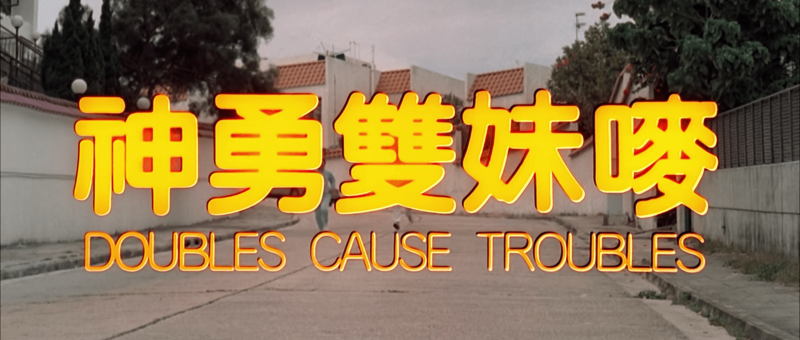
 Would you be willing to live with someone you hate for a whole year just to get a share in an apartment? According to the sheer prevalence of this plot device in comedies throughout the ages, the chances are most people would, especially in a city like Hong Kong where competition is fierce. In any case the duelling cousins at the centre of Wong Jing’s disappointingly normal farce Doubles Cause Troubles (神勇雙妹嘜) find themselves doing just that, only the situation turns out to be much more complicated than one might imagine.
When self-centred nurse Liang Shanbo (Carol “Do Do” Cheng Yu-Ling) receives a visit from a lawyer informing her that her grandmother has passed away she’s a little put out because the old lady owed her money. She’s comforted with the news that she’s been left an apartment, but less so when she learns there’s a catch. Shanbo’s grandma really wanted her to patch things up with her cousin, actress Zhu Yingtai (Maggie Cheung Man-Yuk), and has left the apartment to both of them with the caveat that they have to live there together for a period of one year after which they can sell it and inherit 50% of the proceeds each or else it’ll all go to charity. Neither Yingtai or Shanbo is very happy about the idea but it’s too good an opportunity to pass up and after all, it’s only for a year. When they arrive, however, they discover there’s another tenant – Ben (Poon Chun-Wai), a suave businessman who leaves them both smitten. Ben, it turns out, is not quite what he seems and staggers home on the first night to die in Yingtai’s arms after muttering something about a code.
Unlike most Hong Kong comedies of the era, Wong plays things disappointingly straight while remaining as broad as it’s possible to be. Odd couple Shanbo and Yingtai bicker and trade childish insults while throwing themselves first at the handsome Ben and then at his equally good-looking “brother” Sam (Wilson Lam Jun-Yin) without really giving too much thought to anything else that’s going on until they find themselves well and truly embroiled in a conspiracy. It turns out that Ben had been involved in a smuggling operation in which he betrayed his team and made off with a priceless Taiwanese “national treasure” that the rest of the gang would like to recover which is why Shanbo and Yingtai are being followed around by a “flamboyant” rollerskating henchman and a butch female foot-soldier.
The political realities of 1989 were perhaps very different, but there is an unavoidable subtext in the fact that the dodgy gangsters are all from the Mainland and are desperate to get their hands on a precious Taiwanese national treasure (which they intend to sell for a significant amount of money). The girls find themselves with ever shifting loyalties as they reassess Ben, come to doubt Sam, and fall under the influence of mysterious “inspector” Xu (Kwan Ming-Yuk) whose warrant card is “in the wash”. Completely clueless, they are helped/hindered by useless petty gangster Handsome (Nat Chan Pak-Cheung) and his henchman Fly (Charlie Cho Cha-Lee) who’ve been chasing Shanbo all along while Yingtai falls victim to Wong himself in one of his characteristically sleazy cameos as a lecherous businessman who has toilets instead of furniture in his living room and a boxes full of date rape drugs behind the bar (poor taste even for a Wong Jing movie).
Of course the real message is that blood ties and immediate proximity to danger can do wonders for a “difficult” friendship and so granny gets her wish after all even if not quite in the way she might have planned. Then again, why was Ben staying in her luxury apartment in the first place? Who can say. Setting a low bar it may be, but Doubles Cause Troubles is not even among Wong Jing’s funniest comedies though it does have its moments mostly born of sheer absurdity and enlivened by the presence of a young Maggie Cheung alongside a defiantly committed cast desperately trying to make the best of the often “risible” material.
Currently streaming via Netflix in the UK and possibly other territories too.
Celestial pictures trailer (English/traditional Chinese subtitles)


 Looking at the poster and its “A Most “Oshare” Movie” tagline, you’d assume Cats in Park Avenue (公園通りの猫たち, Koendori no Nekotachi) to be a very stylish story about some fashionable felines living on an uptown street comparable to the famous New York landmark but the title is entirely coincidental as it’s a literal translation of the Japanese and just means the cats live on a street near the park. These cats are full on alley cats, scrappy and free, roaming the rooftops of Shibuya and not giving a damn about whatever it is cats are supposed to do. Ostensibly a throw away young adult movie about a group of dance students and their obsession with a gang of local street cats, Cats in Park Avenue takes on a surprisingly individualist message as the virtues of freedom and validity of life outside the mainstream are resolutely reinforced through cute animation and nonsensical musical sequences.
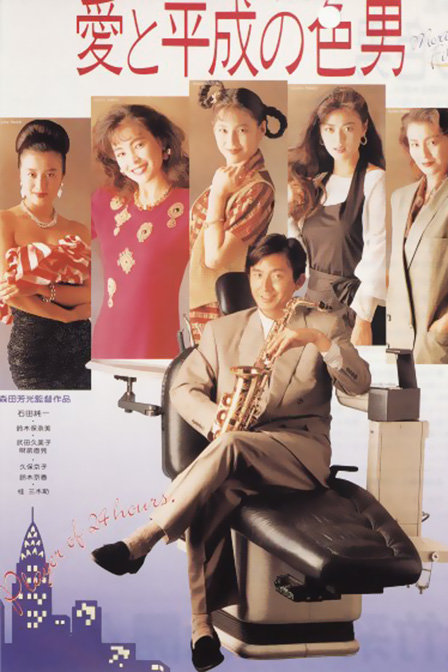 Yoshimitsu Morita is an enigma. While directing some of the most acclaimed Japanese films of the 80s including
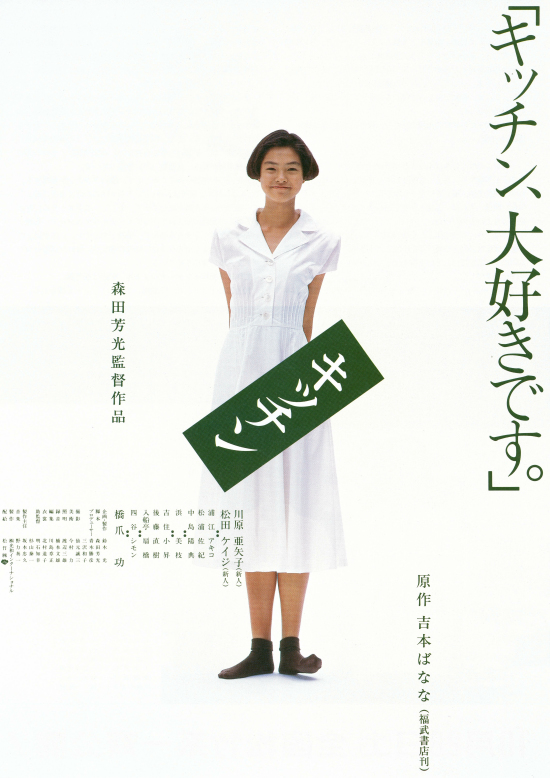 Banana Yoshimoto’s debut novel Kitchen was first published in 1988 and instantly became a publishing phenomenon. The first film adaptation came not long after with the identically titled Kitchen (キッチン) directed by Yoshimitsu Morita in 1989. Like most of Yoshimoto’s work, Kitchen deals with people learning to live with grief and cope with the aftermath of tragedy. However, though Morita’s script sticks closely to the novel for the first half of its running time, he later deviates into a conventional romantic youth drama much like his more populist offerings of the time.
 These days we think of Sion Sono as the recently prolific, slightly mellowed former enfant terrible of the Japanese indie cinema scene. Hitting the big time with his four hour tale of religion and rebellion Love Exposure before more recently making a case for ruined youth in the aftermath of a disaster in Himizu or lamenting the state of his nation in Land of Hope what we expect of him is an energetic, sometimes ironic assault on contemporary culture. However, his beginnings were equally as varied as his modern output and his first feature length film, Bicycle Sighs (自転車吐息, Jidensha Toiki), owes much more to new wave malaise than to post-punk rage.
