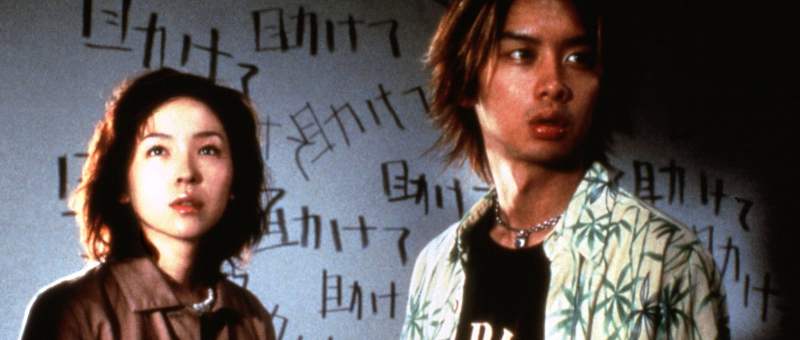
Some situations are destined to end in tears. Kaze Shindo’s Love Juice adopts the popular theme of unrequited love but complicates it with the peculiar circumstances of Tokyo at the turn of the century which requires two young women to be not just housemates but bedmates and workmates too. One is straight, one is gay and in love with her friend who seems to get off on manipulating her emotions and is overly dependent on her more responsible approach to life, but both are trapped in a low rent world of grungy nightclubs and sleazy hostess bars.
Chinatsu (Mika Okuno) and Kyoko (Chika Fujimura) are roommates sharing not just a house but a bed and almost everything else too. Best friends, their relationship is necessarily close and broadly supportive save for a persistent level of tension when it comes to romance. Chinatsu, openly gay, is in love with Kyoko who isn’t interested but somehow keeps stringing her along and makes a point of flirting with every guy she meets. The back and fore continues until the girls are forced to take degrading work as bunny suited hostesses and Kyoko becomes obsessed with the boy working in the local tropical fish shop (Hidetoshi Nishijima).
Though living openly as a gay woman, Chinatsu is far from happy with her life as her constant complaints of “why was I born a girl” bear out. Attending clubs with her live-in non-lover, Chinatsu picks up dates but it never gets anywhere. Her heart belongs to Kyoko and so she tortures herself by continuing to pine after her emotionally manipulative roommate before adopting an unpleasant forcefulness as she tries to persuade her friend to acquiesce. Snapping away at her with her camera (which she refuses to be turned on herself), Chinatsu becomes jealous and possessive, irritated by Kyoko’s various suitors and wishing she and Kyoko could remain cooped up alone together like the two goldfish sitting in their makeshift bowl.
Where Chinatsu is down to earth and restrained, Kyoko is a lively free spirit adrift for reasons of aimlessness rather than the anxious wandering her friend. Living on the fringes of mainstream society, the women are forced into their inconvenient living arrangements thanks to ongoing poverty. This same poverty eventually forces them both into taking a humiliating job as waitresses at a bunny girl themed hostess bar. Much to Chinatsu’s consternation, Kyoko revels in the constant male attention, flirting awkwardly with the owner who seems to prefer her friend. Uncomfortable with the job and more particularly with the uniform, Chinatsu experiences yet more degrading treatment when she’s brutally assaulted by a colleague after work and can’t even turn to her friend and roommate for help and comfort.
Eventually matters come to a head, the situation can’t endure, suicide is considered, choices are made, sadness and regret litter the scene. Shindo creates a claustrophobic world for two into which the outside occasionally pokes its unwelcome nose. The whimsical score lends a quirky, romantic air to the less destructive side of the two women’s relationship even as it progresses further and further towards its inevitable conclusion. Painting an authentic picture of Tokyo as seen by the disillusioned and desperate turn of the century youth, Shindo’s tale of ordinary heartbreak in unusually difficult circumstances is a nuanced look at a toxic (non)relationship in all of its destructive glory.
When you spent your youth screaming phrases like “no future” and “fumigate the human race”, how are you supposed to go about being 50-something? A&R girl Kanna is about to find out in Kankuro Kudo’s generation gap comedy The Shonen Merikensack (少年メリケンサック) as she accidentally finds herself needing to sign a gang of ageing never were rockers. A nostalgia trip in more ways than one, Kudo is on a journey to find the true spirit of punk in a still conservative world.
25 year old Kanna (Aoi Miyazaki) is an unsuccessful scout at a major Japanese label which mainly deals with commercial bands and folk guitar outfits. As she’s about to quit any way, Kanna makes a last minute pitch for a punk band she’s found on YouTube, fully expecting to be shown the door for the last time. However, what she didn’t know is that her boss, Tokita (Yusuke Santamaria), is a former punk rocker still dreaming of his glory days of youthful rebellion. With her leaving do mere hours away, Kanna’s contract is extended so that she can bring in these new internet stars whose retro punk style looks set to capture the charts.
Unfortunately, the reason Tokita was so impressed with the band’s authentically ‘80s style is because the video was shot in 1983. The Brass Knuckle Boys hit their heyday 25 years ago and are now middle aged men who’ve done different kinds of inconsequential things with their lives since their musical careers ended. Kanna needs to get the band back together, but she may end up wishing she’d never bothered.
Mixing documentary-style talking heads footage with the contemporary narrative, Kudo points towards an examination of tempestuous youth and rueful middle age as he slips back and fore between the early days of the Brass Knuckle Boys and their attempts to patch up old differences and make an improbable comeback. Kanna, only 25, can’t quite understand all of this shared history but becomes responsible for trying to help them all put it behind them. Her job is complicated by the fact that estranged brothers Akio (Koichi Sato) and Haruo (Yuichi Kimura) made their on stage fighting a part of the act until a stupid accident left the band’s vocalist, Jimmy (Tomorowo Taguchi), in wheelchair.
The spirit of punk burns within them, even if their contemporaries are apt to point and laugh. The Brass Knuckle Boys, when it comes down to it, were successful bandwagon jumpers on the punk gravy train. Craving fame, the guys started out marketing themselves as a very early kind of boy band complete with silly outfits and cute personal branding full of jumpsuits, rainbows, and coordinated dance routines. Yet if the punk movement attracted them merely as the next cool thing, it also caught on to some of their youthful anger and teenage resentment. In the end unrestrained passion destroyed what they had as the ongoing war between the brothers escalated from petty sibling bickering to something less kind.
Twenty-five years later the wounds have not yet healed. Akio is a lousy drunk with a bad attitude, Haruo is an angry cow farmer, drummer Young has a range of health problems, and Jimmy’s barely present. Tokita has become a corporate suit, a symbol of everything he once fought against and his former bandmate is his biggest selling artist – eccentric, glam, and very high concept.
The men are looking back (even those of them who aren’t even really that old), whereas Kanna can only look forwards. Before the Brass Knuckle Boys, she was about to be kicked out of her A&R job and planned to go home with her tail between her legs to help her confused father with his very unsuccessful conveyor belt sushi restaurant. Apparently in a solid relationship with a coffee shop guitarist who keeps urging her to put in a good word for him at the record label with his sappy demo tapes, Kanna’s life is the definition of middle of the road. Neither she not her boyfriend could be any less “punk” if they tried but if they truly want to follow their dreams they will have to find it somewhere within themselves.
At over two hours The Shonen Merikensack is pushing the limit for a comedy and does not quite manage to maintain momentum even as its ending is, appropriately enough, an unexpected anticlimax. Kudo’s generally absurd sense of humour occasionally takes a backseat to a more juvenile kind which is much less satisfying than the madcap action of his previous films but still provides enough off beat laughs to compensate for an otherwise inconsequential narrative.
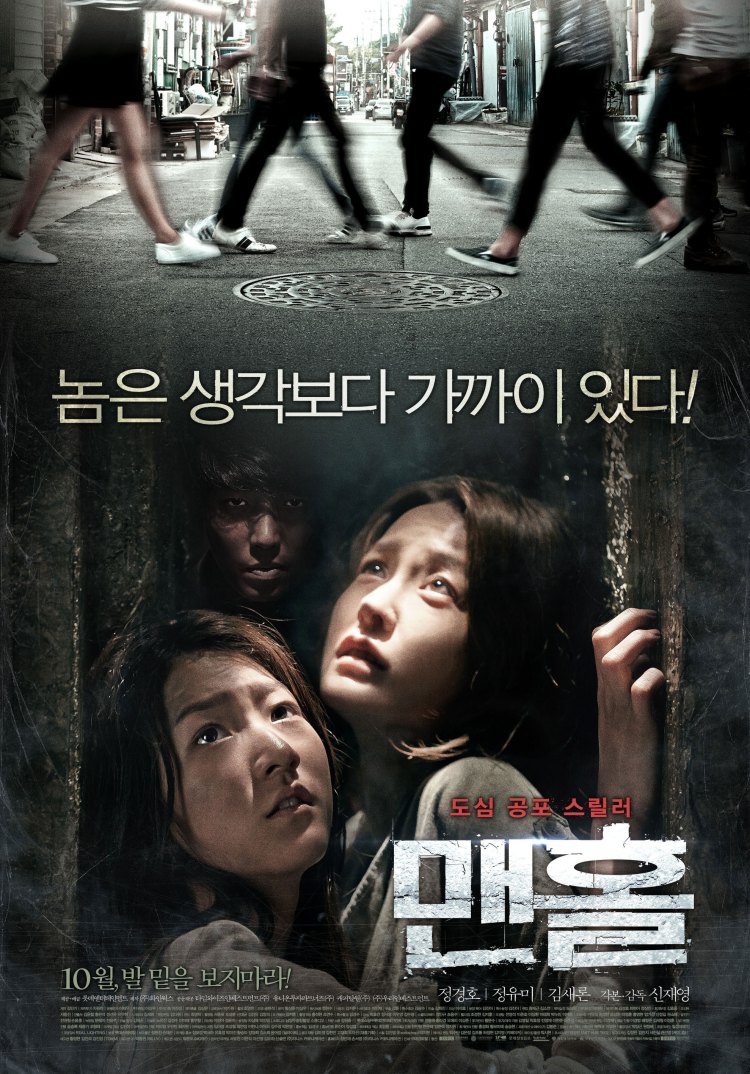
Finding the sinister in the commonplace is the key to creating a chilling horror experience, but “finding” it is the key. Attempting to graft something untoward onto a place it can’t take hold is more likely to raise eyebrows than hair or goosebumps. The creators of Korean horror exercise Manhole (맨홀) have decided to make those ubiquitous round discs the subject of their enquiries. They are kind of worrying really aren’t they? Where do they go, what are they for? Only the municipal authorities really know. In this case they go to the lair of a weird serial killer who lives in the shadows and occasionally pulls in pretty girls from above like one of those itazura bank cats after your loose change.
Of course, it’s sort of our first victim’s fault because she’s dared to go out late at night on her own and committed the cardinal sin of shouting at her over protective father on the phone shortly before realising she’s wandered into a horror movie by mistake. The lights start flickering, everything goes wavy and then you’re being pulled down a manhole. Not cool.
Anyway, the real story is about two sisters. Yeon-seo (Jung Yu-Mi) is now the sole guardian of Soo-jeong (Kim Sae-Ron) following the death of their parents and also seems to be harbouring some kind of guilt over an accident that left Soo-jeong permanently deaf. Perhaps a little over protective as a consequence, Yeon-seo instructs Soo-jeong to stay in their apartment and wait for her to get back. Soo-jeong, however, is old enough to push the boundaries and ventures out alone to meet her sister on her way home with an umbrella. Unfortunately, she catches sight of the killer along the way and is soon trapped in the sewer like everyone else, apparently. Yeon-soo tries to call the police but they aren’t interested so she has little choice but to track her sister’s phone and journey underground herself. She’s joined (well, they’re there at the same time) by the father of the first victim (Choi Duk-Moon) who happens to be a former policeman, now in possession of a gun stolen from a friend also set to make a fateful descent at a later point.
Manhole is a very confused film. Unable to decide who its protagonist(s) is (are), it meanders freely between its disparate plot strands without ever managing to build coherent connections between them. Though the sisters are posited as the main element of the story, they take quite a long time to arrive and are then frequently sidelined in favour of other ongoing developments. Their story is undoubtedly the most interesting as it presents an unusual plot device in which they remain unable to communicate verbally during their attempts to escape from the sewers and it’s nice to see sign language used so ordinarily in a genre film, yet even their meagre backstory is painted in broad strokes and through flashbacks once again making it difficult to fully connect with them as they battle the threat in the shadows.
The role of the killer, Soo-chul (Jung Kyoung-Ho), is also a difficult one as he is neither protagonist nor generic threat but given a small amount of flashback backstory delivered in monologue to his victims which only serves to make him a frustrating presence. Manhole seems as if it has a point to make about families in that Soo-chul is a damaged child of a broken home, both trying to avenge himself and regain what he’s lost by, in a sense, “recreating” a family through his kidnappings. Frequent glances towards the prominently displayed portrait of the ideal family contrast with the other relationships in the film – Jong-ho and his hunt for his missing daughter, and the bond between the two sisters. Both of these family units are also missing elements – the sisters who’ve lost their parents and Jong-ho as a lone father. Neither of the parental figures in the film is fully able to protect their charges despite appearing controlling and over protective prior to the incident though no particular reason seems to be offered for this other than praising parental sacrifice in allowing both to fight all out to protect those closest to them.
What Manhole tries to be is a chase film, confining itself to the sewer environment as its crazed killer crawls around it like the literal beast in the shadows, cocooning victims in clingfilm and wearing bug-like bright red night vision goggles. Though exciting enough the frequent cutaways and over reliance on shaky cam disrupt the claustrophobic atmosphere as do the stereotypical jump scares and framing which feel as predictable as the final sequence of a video game in which the idea is to dodge the falling axes. Muddled and inexpertly photographed, Manhole is a disappointing genre exercise which even the generally strong performances of its cast can’t mask. Still, hardcore genre fans may find more to admire in the gore stained darkness of the oddly accessible sewer network and its lizard-like psycho killer.
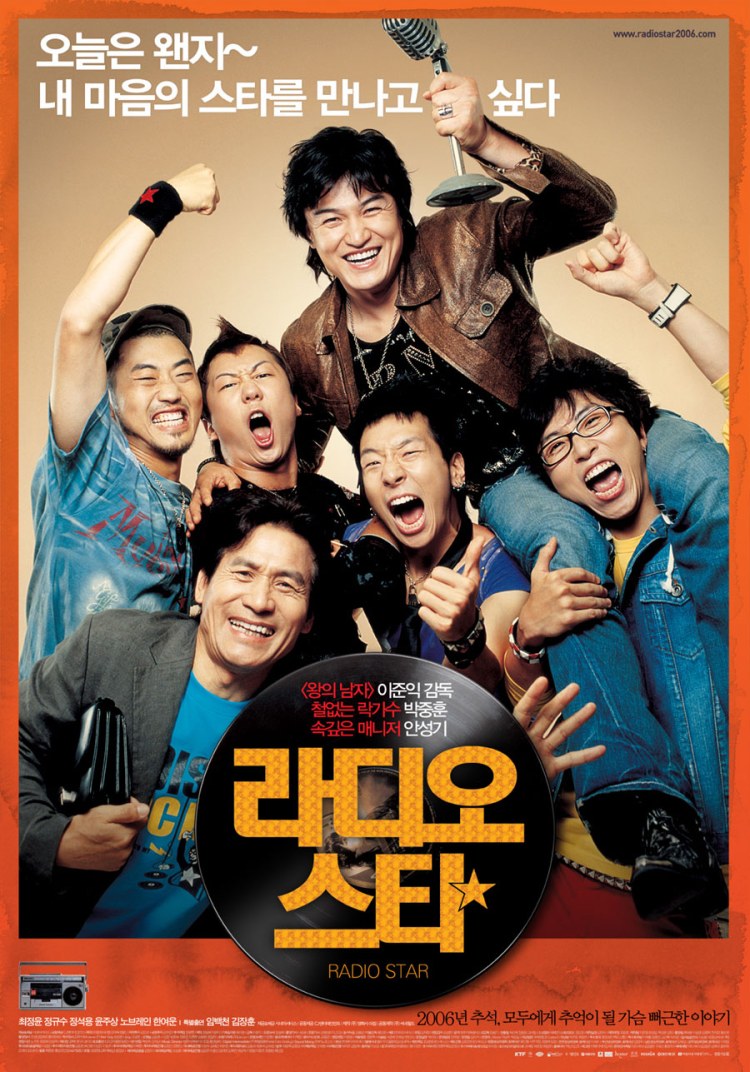
What do you do if you’ve just directed a box office smashing, taboo busting, giant mega hit? Well, you could direct Star Wars, but if you’re Lee Joon-ik you go back to basics with a low budget, heartwarming tale of friendship and failure. Radio Star (라디오 스타) reunites frequent costars Ahn Sung-ki and Park Joong-hoon whose shared history runs all the way back to ‘80s movies Chilsu and Mansu, Two Cops, and Nowhere to Hide. ‘80s nostalgia plays not a small part in Lee’s film as it takes a washed up one hit wonder from 20 years back and gives him a new opportunity to shine…if only he can get over himself first.
1988 was something of a banner year for Korea, a newly minted democracy the country put itself on the international map with that year’s Olympic Games taking place in Seoul. It was also a big year for rock star Choi Gon (Joong-hoon) who scored a chart topping mega hit with his song The Rain and You which won him a prestigious musical prize. However, it all went to his head and despite the best efforts of his best friend and manager Park Min-soo (Ahn Sung-ki), 18 years later in 2006 Gon is a cafe singer with a habit of getting into fights which land him in jail. After yet another “incident”, Min-soo is having trouble finding the money to bail his friend out, until, that is he hits on the opportunity of selling Gon’s name as a radio host in an isolated rural town.
Of course, this doesn’t go down well with Gon who’s still every inch the edgy rockstar despite his reduced circumstances. Eventually Min-soo talks him into taking the gig but he’s anything but enthusiastic about his new life as a disembodied voice talking to a handful of country bumpkins who still have transistor radios. Gradually, through learning to appreciate his surroundings Gon begins to understand exactly what it is that’s important in his life.
Playing off its central dynamic, Radio Star undoubtedly brings a lot with it in the casting of Ahn and Park whose similar trajectories add to the film’s otherwise straightforward narrative. Min-soo appears to have only the one client to whom he remains completely devoted (even neglecting his wife and daughter in the process) though it’s true Gon’s career has not gone in the hoped for direction. Still dressing like an ‘80s rock god with sunglasses, torn jeans and a leather jacket, Gon is his own worst enemy as he plays the rockstar game all the way into a jail cell he fully expects Min-soo will get him out of. His new assignment as a local radio DJ is one he finds beneath his dignity and only takes because he thinks it’s a favour to a friend (rather than a friend doing a favour for him), but when it brings him unexpected success he finds that it’s all worth nothing if Min-soo isn’t there to enjoy it with him.
Though many in the small town barely remember Choi Gon or his iconic, prize winning song, he still has a few fans in the form of local garage band East River (played by real life punk band No Brain) who become devoted supporters of the show even helping to spread the word and putting on a special celebratory tribute concert. Ironically enough, the show starts to take off with Gon’s nonchalant approach to hosting which often sees him abandoning the mike to a random local either by phone or getting a guest into the studio. Sliding into talk radio territory, Gon begins taking calls and offering (to begin with) flippant advice on such topics as jobs for the unemployed and the proper rules for card games but he’s soon involved in a campaign to help a shy florist declare his love to a bank cashier and eventually makes a heartfelt personal appeal in support of a little boy who’s father has run off, encouraging him to come back home if only to apologise for making the kid think it’s all his fault that his dad went away.
It’s undoubtably small scale stuff, which of course means that it’s infinite in scope as Gon’s growing sense of interconnectedness takes the show out of the local area and eventually all the way to Seoul after the East River boys’ internet fan site gives him a potentially global (well, to anyone who can speak Korean) reach. As Min-soo points out, stars don’t shine alone – they reflect the light they’re given, and therefore Gon’s only rises because of his friendship with Min-soo and the support he begins to win from the local people once he drops the aloof rockstar persona and begins to engage. Necessarily sentimental and drenched in the dust of broken dreams, Radio Star is a sometimes melancholic though warm tribute to the power of friendship and redemptive possibilities offered by unlikely second chances.
Original trailer (English subtitles)
Gon’s prizewinning song – Rain and You as sung by Park Joong-hoon
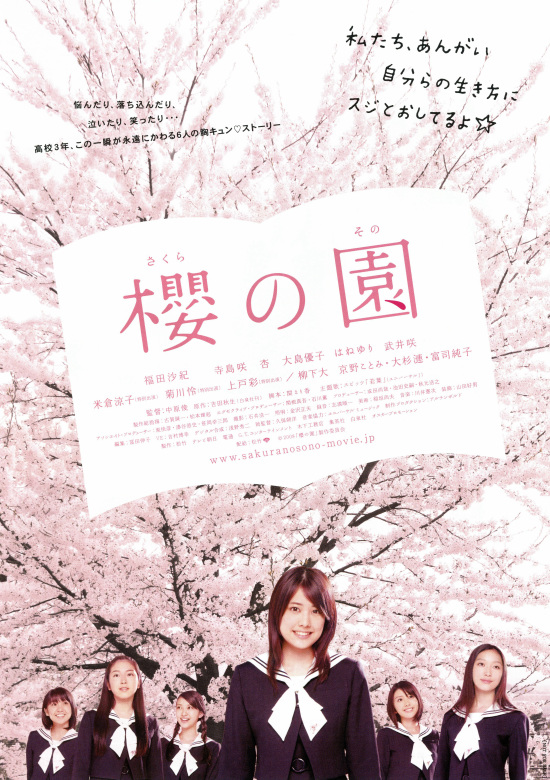
In 1990, Shun Nakahara adapted Akimi Yoshida’s manga Sakura no Sono and created a perfectly observed capsule of late ‘80s teenage life at an elite girls school where the encroaching future is both terrifying and oddly exciting. Revisiting the same material 28 years later, one can’t help feeling that the times have rolled back rather than forwards. Starring a collection of appropriately aged teenage starlets The Cherry Orchard: Blossoming (櫻の園 -さくらのその- Sakura no Sono), dispenses with the arty overtones for a far more straightforward tale of melancholy schoolgirls finding release in art but, crucially, only to a point.
Less an attempt to remake the original, Blossoming acts as an odd kind of sequel in which the leading lady, Momo (Saki Fukuda), becomes fed up with her rigid life at a music conservatoire and rebelliously storms out. Already in her last year of high school, Momo is lucky enough to get a transfer to Oka Academy solely because her mother and (much) older sister are old girls. However, transfer students are rare at Oka and the other girls aren’t exactly happy to see her – they worked hard to get here but she’s just waltzed straight in without any kind of effort at all.
Gradually the situation improves. Wandering around the old school building (a European style country house) which was the setting for the first film and has now been replaced with a modern, purpose built high school complex, Momo finds the script for The Cherry Orchard and becomes fixated on the idea of putting the play on with some of the other students. However, though The Cherry Orchard used to be an annual fixture it hasn’t been performed in 11 years after being abruptly cancelled when one of the stars disgraced the school by falling pregnant.
Whereas Nakahara’s 1990 Cherry Orchard was a tightly controlled affair, penning the girls inside the school and staying with them through several crises across the two hours before their big performance, Blossoming has no such conceits and adopts a formula much more like the classic sports movie as the underdog girls fight to put the play on and then undergo physical training (complete with montages) rather than rehearsals.
Momo’s rebellion is (in a sense) a positive one as she abandons something she was beginning to find no longer worked for her to look for something else and also gains a need to see things through rather than give up when times get hard. The drama of the 1990 version is kickstarted when a student is caught smoking in a cafe with delinquents from another school, aside from being told that students are expected to go straight home, Momo feels little danger in hanging out in an underground bar where her music school friend plays in a avant-garde pop band.
Though this reflects a change in eras it also points to a slight sanitisation of the source material. Gone are the illicit boyfriends (though there is one we don’t see) and barely repressed crushes, these teens are still in the land of shojo – dreaming of romance but innocently. Teenage pregnancy becomes a recurrent theme but lost opportunities hover in the background as the girls are seen from their own perspective rather than the wistful melancholy of those looking back on their youth.
Such commentary is left to the “old girls” represented by Momo’s soon to be married sister and the girls’ teacher, each of whom is still left hanging thanks to the cancellation of the play during their high school years. Despite her impending marriage, Momo’s sister does not seem to be able to put the past behind her and may be nursing a long term unrequited crush on a high school classmate. Blossoming echoes some of the concerns of Cherry Orchard, notably in its central pairing as lanky high jumper Aoi (Anne Watanabe) worries over a perceived lack of femininity while the more refined Mayuko (Saki Terashima) silently pines for her, unable to make her feelings plain. The 1990 version presented a painful triangle of possibly unrequited loves and general romantic confusion but it did at least allow a space for overt discussion rather than the half hearted subtly of a mainstream idol film in a supposedly more progressive era.
Nevertheless, Nakahara’s second pass at teenage drama does fulfil on the plucky high school girls promise as the gang get together to put the show on right here. Much less nuanced than the earlier version, Blossoming’s teens are just as real even if somehow more naive than their ‘80s counterparts. Team building, friendship, and perseverance are the name of the day as the passing of time takes a back seat, relegated to Momo’s sad smile as she alone witnesses the painful love drama of her melancholy friend.
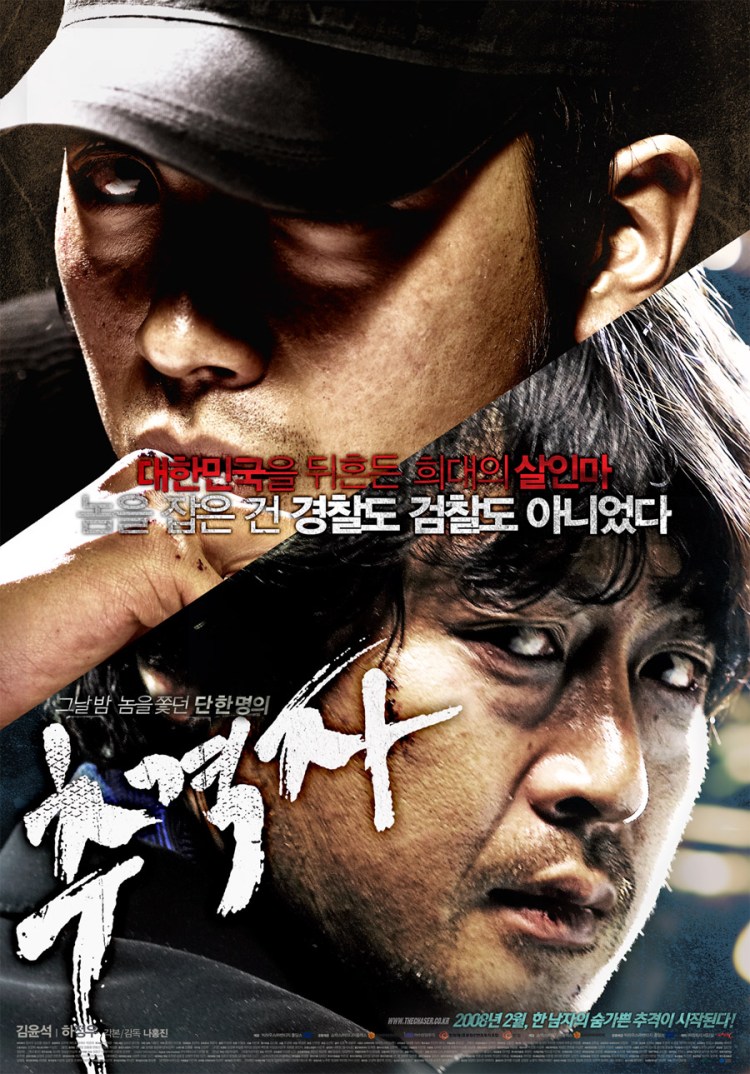
When it comes to law enforcement in Korea (at least in the movies), your best bet may actually be other criminals or “concerned citizens” as the police are mostly to be found napping or busy trying to cover up for a previous mistake. The Chaser (추격자, Chugyeogja) continues this grand tradition in taking inspiration from the real life serial murder crime spree of Yoo Young-chul , eventually brought to justice in 2005 after pimps came together and got suspicious enough to make contact with a friendly police officer.
Former cop turned petty pimp Joong-ho (Kim Yun-seok) has a problem. His girls keep skipping out on their debts. Or so he thinks – rousing one of his last remaining “employees”, Mi-jin (Seo Young-hee), from her sickbed (and unbeknownst to him calling her away from her seven year old daughter), Joong-ho finds a phone belonging to a missing girl and realises the last number called is the same as the one he’s about to send Mi-jin off to. Suspicious, Joong-ho rediscovers his detective skills and notices this particular number all over his books. Thinking the john is kidnapping his girls to sell them on, Joong-ho hatches a plan to track Mi-jin and have a word with this bozo but unsurprisingly nothing goes to plan. Mi-jin has fallen into the grip of a vicious serial killer, Young-min (Ha Jung-woo), but may still be alive if only Joong-ho can find her in time.
Joong-ho is not a good guy. Maybe he’s not the worst of his kind but as a former law enforcement official turned unsentimental exploiter of women, Joong-ho is an unlikely saviour. His primary motivation is, unsurprisingly, commercial as the look of concern he gives to one of his ladies encountering a dangerous client betrays, the kind of irritation a taxi driver might display on noticing a large scratch on his expensive car rather than a recognition of the pain and suffering those cuts and bruises bear witness to. He never stops to consider that something untoward has befallen the missing women and is, in one sense, relieved when he thinks they’ve been sold on rather than just skipping out on him. Throughout his quest to find Mi-jin which sees him forming an unexpected paternal bond with her young daughter, Joong-ho begins to rediscover his humanity as he’s forced to confront the similarities between himself and this deranged psycho killer.
Like his real life counterpart, Young-min, is a sexually frustrated misogynist who begins his social revenge through killing off the wealthy before moving on to the less easily missed including local prostitutes which is what ultimately proves his downfall when the various area pimps begin to connect the dots. In actuality it turns out Young-min has previously been questioned in connection with a murder but was released due to lack of evidence. Likewise, this time around the police are not very interested in capturing him and Young-min is once again returned to society due to some political concerns which result in pressure from above. As if having charmed luck with the police weren’t enough, Young-min also exploits the other cornerstone of South Korean society – the church, through which he recruits his victims, subverting their trusting religiosity with his violent perversion.
For a film which largely lives on the chase, winding through the darkened, rain drenched backstreets of downtown Seoul, Na adds in plenty of twists and turns as the case proceeds down one dingy alleyway after another. Joong-ho’s gradual reawakening as a human being rather than cold blooded human trafficker is accompanied by the gradual reveal of his counterpart’s dangerous need for validation through violence but also by the realisation of his total powerlessness in the face of such a nebulous and faceless threat. The police won’t help (perhaps if they’d investigated those parking violations a little more assiduously all of this could have been avoided), the Church is just an ironic distraction, and the politicians are busy squabbling amongst themselves. Joong-ho is an unlikely figure of salvation, but he remains the last best hope for justice so long as he can avoid becoming that which he seeks.
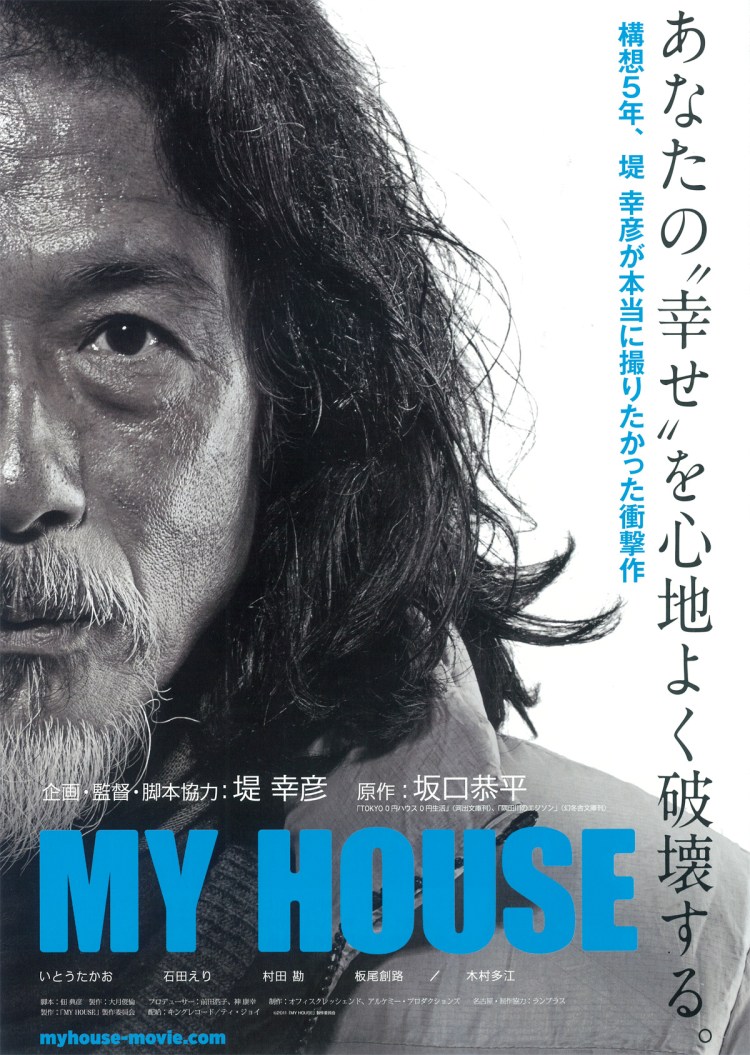
Yukihiko Tsutsumi has made some of the most popular films at the Japanese box office yet his name might not be one that’s instantly familiar to filmgoers. Tsutsumi has become a top level creator of mainstream blockbusters, often inspired by established franchises such as TV drama or manga. Skilled in many genres from the epic sci-fi of Twentieth Century Boys to the mysterious comedy of Trick and the action of SPEC, Tsutsumi’s consumate abilities have taken on an anonymous quality as the franchise takes centre stage which makes this indie leaning black and white exploration of the lives of a group of homeless people in Nagoya all the more surprising.
The film begins with its hero, Suzumoto, pulling a cart followed by his friends with other supplies and equipment. Arriving at their appointed destination, the men and women embark on a process they’ve obviously enacted a thousand times before. Dismantling their cart, they arrange the components for a kind of prefab house made out of found materials and propped up on crates.
Though the life may seem impossible to those from the outside – as it does to the well meaning men from the council eager to get the mini commune to move on by dangling a promise of sheltered accommodation or assistance, but thanks to Suzumoto’s innovations they have access to many of the benefits of the modern world from television to laptops. The main source of income comes from recycling – collecting tin cans, bottles, cardboard etc to be sold back to scrap merchants and recycling plants. It’s not easy money to make and there isn’t much of it but Suzumoto has his routine well worked out and is able to maximise his takings by cutting deals with householders and businesses for handiwork in return for what is essentially rubbish.
Getting into a discussion with a hotelier, Suzumoto is offered a regular job and a place in company accommodation but turns it down. He likes his life. It might seem hard to others and it is annoying to be continually dismantling and rebuilding your house, but the innovation appeals to him. He likes to work and to make things work. He wouldn’t want to be cooped up and constrained by the world of contracts and salaries and taxes.
The freedom and simplicity of Suzumoto’s life is contrasted with a seemingly ordinary middle class household which is defined by its tension and sterility. School boy Shota is an ace student but his austere father pushes him hard, allowing him little freedom or responsibility. Nursing a mild addiction to Pepsi, Shota’s only friend is the pet turtle he keeps in a tank in his wardrobe. While his father returns home only to shout at everyone and then go to bed, Shota’s mother is as obsessed with cleaning as he is with Pepsi and rarely leaves the house. Talking to almost no one, Shota’s mother’s existence is one of cold rigidity, living in fear of her domineering husband and accidentally neglecting her stressed out son in the process.
Through a series of inevitable coincidences the two worlds will clash with tragic consequences on each side. Tsutsumi doesn’t seek to glamorise life on the streets or paint it as some kind of hippyish quest for better living, but he does dare to suggest that Suzumoto’s self reliance and inner calm are much more healthy than the fear and repression which make Shota’s home as much of a prison as the tank he traps his turtle in. Suzumoto and his friends are looked down on, hassled by the authorities, and accused of crimes they did not commit but they are the victims and not the instigators of violence. Tension bubbles over and misses its target as rage against authority and society at large is redirected towards its most vulnerable citizens.
Suzumoto takes all of this in his stride, as he always does, dismantling his house only to rebuild somewhere else hoping only to continue the cycle while Shota is left to ruminate on the consequences of his actions still trapped inside the empty pressure cooker of his family home. Tsutsumi’s elegantly composed black and white aesthetic adds to the contemplative edge as two worlds are thrown into stark contrast but the one central tenet is the enabling factor for both – the intense pressures and total indifference of the mainstream world towards those attempting to live within in it.
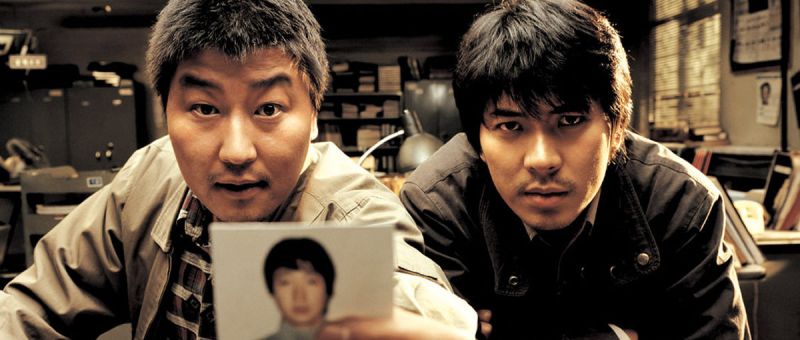
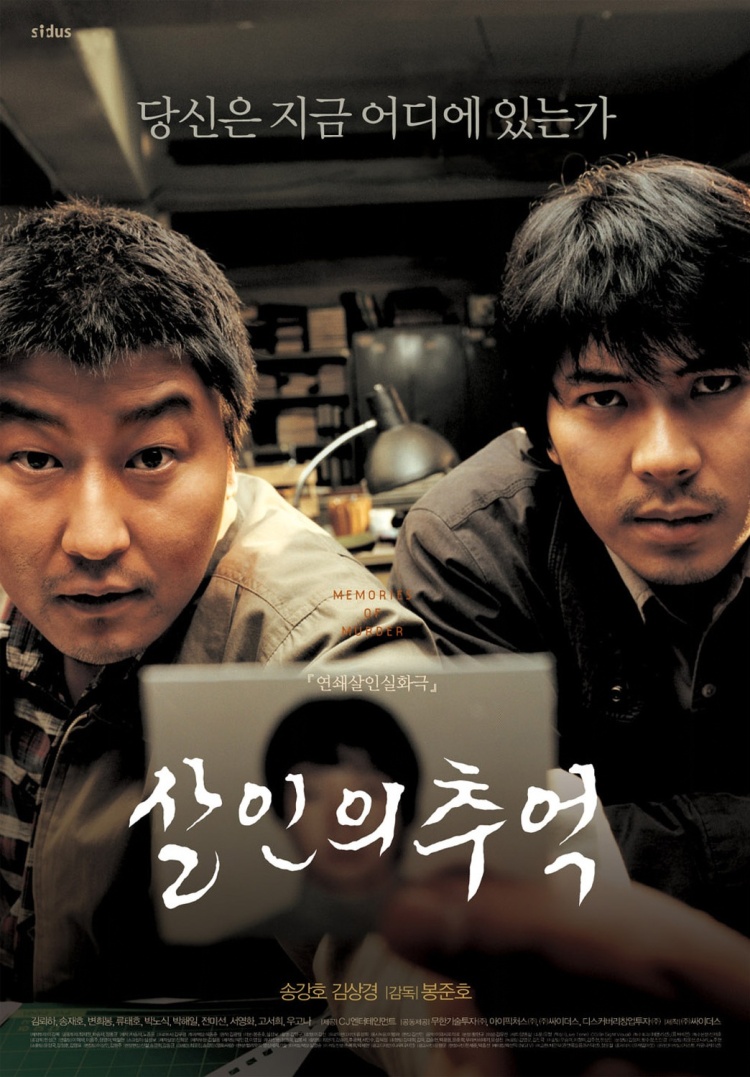
The Korea of the mid-1980s was a society in flux though you might not know it looking at the sleepy small town about to be rocked by the country’s very first publicised spate of serial killings. Between 1986 and 1991, at least ten women ranging in age from schoolgirls to grandmothers were murdered while the killer seemingly got away with his crimes, either dying, fleeing or perhaps getting arrested on other charges explaining the abrupt end to his crime spree. Bong Joon-ho’s fictionalised take on the case, Memories of Murder (살인의 추억, Salinui Chueok), is not so much interested in the killer’s identity, but wants to ask a few hard questions about why the crimes took place and why they were never solved.
In October of 1986, Inspector Park (Song Kang-ho) rides a junk cart out to a paddy field where a farmer has found the decomposing body of a woman blocking a drainage ditch at the edge of his land. Park quickly confirms that it is, in fact, the body of a murdered woman and tries to look unphased while a strange little boy distracted from his bug catching neatly echoes everything he says, playing policeman while the other children run roughshod over the crime scene trailing their butterfly nets behind them.
Needless to say Park and his bruiser partner, Cho (Kim Roe-ha), are ill equipped to handle a case of this magnitude, especially when it becomes clear that the murder is not an isolated episode. They are later joined by a more experienced officer from Seoul, Seo (Kim Sang-kyung), who is not used to country ways and finds it hard to adjust to their distinctly old fashioned and unscientific approach to law enforcement. Park, resentful at being saddled with a babysitter from the city and made to feel as if his small town skills aren’t good enough is determined to prove that he knows his stuff even as he begins to realise that perhaps policing really isn’t for him.
Park is the kind of policeman every small town has. Placing great faith in his detective’s instinct, Park is sure that he “just knows” who is naughty and who is nice. He asks suspects to look directly into his eyes so that he can assess whether they’re telling him the truth but it’s more of a party trick than anything else, looking into Park’s earnest gaze most suspects will crack. Early on Park’s boss gives him a test – two boys have been brought in and are patiently filling out forms. One caught the other in the middle of raping his sister, stopped him, and dragged him to the police station. Which one is the brother and which the rapist? Park feels sure he knows, and one could certainly make an educated guess based on the number and positioning of bruises on the suspects’ faces, but attempting to identify criminality based solely on perceived shiftiness or not liking the look of someone is crossing the line from professional instinct to ignorant prejudice.
The truth is that Park knows he’s no great shakes as a law enforcer. He was never meant to be – small town cops don’t generally do a lot of crime solving, they maintain order through the visible presence of authority. Thus he takes against city boy Seo because he instantly feels threatened by his urban sophistication and big city ways. Seo is perhaps not the best cop Seoul had to offer, but he is trained investigative techniques entirely alien to Park and Cho. The extent to which they’re out of their depth is obvious when they seem to know they’re supposed to secure the crime scene, but can’t, allowing valuable evidence to be carelessly destroyed.
Park’s investigative techniques involve making scrapbooks of shady local guys and browbeating suspects, eventually trying to railroad a young man with learning difficulties into confessing to the crime through a process of physical violence and mental attrition. Put out by Seo’s more concrete leads, Park’s only other contribution is to suggest they start looking for guys with no pubic hair which sees him waste more time hanging out in public baths and doing a lot of inappropriate staring. Wasting time is Park’s biggest crime though, amusingly enough, he and Seo end up in exactly the same place when Park consults a Shaman and Seo pursues a more rational line of enquiry lending credence to the idea that neither of them is really much better than the other.
What gets lost is that a woman, and then several more women, are dead and there is a man out there preying on wives, sisters, and mothers yet nothing much is being to protect them save reminding them to take care of themselves. Park wants the kudos of catching a killer but he barely thinks about the consequences of arresting the wrong man, it doesn’t seem to occur to him that the real killer would still be out there posing a threat to every woman in the town. Despite the fact that this is a small place where the victims are known to most people, there is little in the way of public grief or even sadness. The only sign of public feeling is in the small protest held outside the police station when a member of a local church is arrested.
The protest may be the key. In this strained era, Korea was reaching the end of its period under the control of a military dictatorship with the Olympics still a few years away and democracy the bright dream of brave radicals. Park and co. are the “friendly” face of the ruling regime, one of their secondary roles is doing the government’s dirty work. Hence when they really need extra manpower to chase a suspect they are denied it because everyone in the local area has been sent to suppress a protest in a nearby town. This is a scant few years after the Gwanju massacre, “suppression” means more than just standing around with riot shields designed to intimidate. Yes, there’s a crazed killer on the loose, but he is only a symptom and manifestation of a social order which has long since abandoned the idea of protecting its citizens in order to more effectively oppress them.
A woman can walk down a street in broad daylight and be terrified by a man trying to ask for directions because she has been taught to be afraid and knows the threat is real. A television news report on the trial of a policeman accused of violence and sexual assault reminds us why she can’t trust Park. Her government does not care about her. It could make more of an effort to solve these crimes, but it won’t, because the appearance of order is always preferential to its reality. The memories of murder run deep, they speak of all the stifled impulses of a life under a dictatorial regime. No one does anything because there is nothing to be done.
The identity of the killer is, in this sense, irrelevant – it is the society which is ultimately responsible for creating him and then for failing to put an end to his crimes. Park and Seo, eventually working together through a kind of cross pollination, think they’ve found their man but can’t prove it because Korea doesn’t have DNA testing facilities and they need to wait for results from an American lab. The evidence is circumstantial yet convincing, and one can’t be sure. The face of evil is “plain” and “ordinary”, much like your own. If you want to find the answer, start looking closer to home.
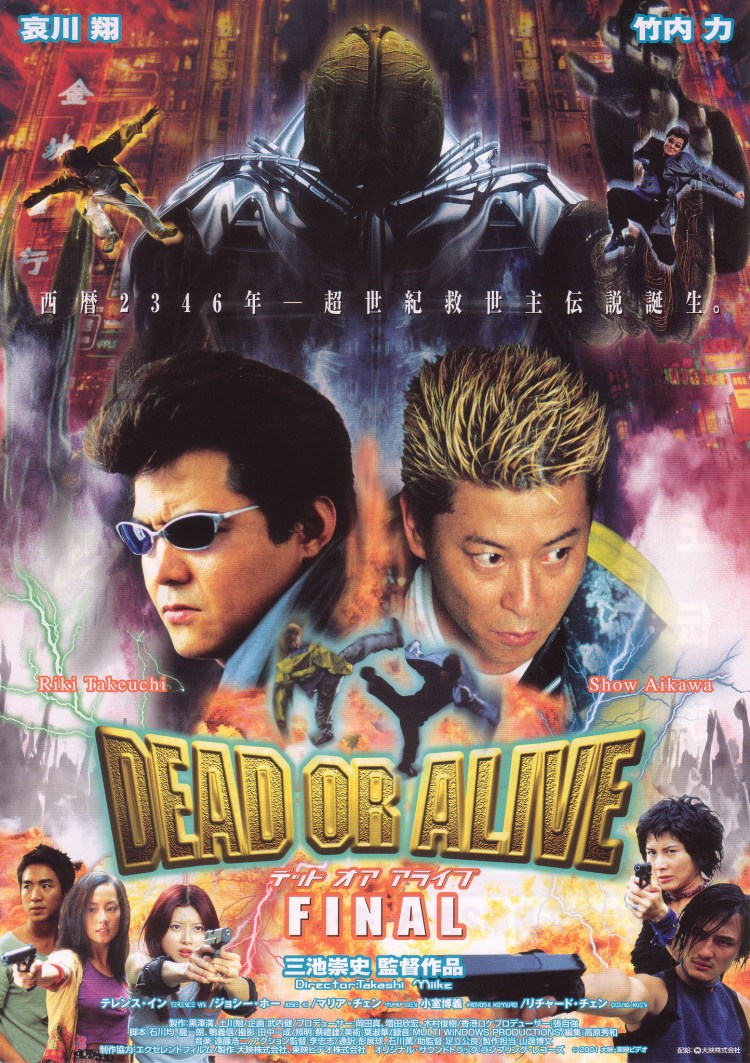
The Dead or Alive Trilogy began in a furious, drug fuelled hymn to violence in which a petty vendetta between the opposing forces of good and evil (mingled and bloody) eventually destroyed the entire world. Dead or Alive 2: Birds was an altogether more contemplative affair in which two orphaned boys rediscover each other as jaded hitmen and decide to put their talents to “good” use by donating the hit money to pay for medicinal drugs for impoverished children around the world. Strange and surreal, Birds moved beyond the first film’s absurd ending for an altogether more abstract approach to universe building but Final pushes the idea to its limit in a cyberpunk infused far future tale of rogue robots and sexual dictatorship.
Yokohama, 2346. A new society is being forged, a new social order has been created. All powerful Mayor Wu (Richard Chen) has decreed that the only true love is gay love and made heterosexuality taboo. Births are strictly controlled to maintain population numbers with contraception ruled mandatory. The heterosexual resistance has gone into hiding in a ruined part of the city, living in a free love commune in which the birth of children is a primary goal. Lead by Fong and his first lady Jun, the resistance aims to liberate the people from the yoke of the crazed dictator and create a better, freer world for the as yet unborn children of the future. Teaming up with a rogue “Replicant”, Ryo, (Sho Aikawa) the gang attempt to further their cause by kidnapping the young son of Wu’s chief of police, Honda (Riki Takeuchi), who later discovers some uncomfortable truths about his own existence.
The use of the world “Replicant” is a pointed one and an overt reference to Final’s key text – Blade Runner, though its intentions amount much more to a pastiche than an examination of the existential questions so central to the seminal cyberpunk classic. Online captions state the action is taking place in Yokohama – an industrial harbour town close to Tokyo, but is in reality a thinly disguised Hong Kong with a green tint. Nevertheless, Miike makes the most of rundown industrial complexes now overrun by nature and the symbols of historical hubris. Aside from the flying cars and other CGI touches, the dystopianism is all too real in its sense of economic and social failures which have allowed a man like Wu to run a strange fascist police state even in the absence of the necessary infrastructure.
In keeping with the Hong Kong setting the Yokohama of 2346 is largely Chinese with broad mix of intermingled languages. Once again the nature of family is called into question but this time more through a large scale change in the social order which sees birth strictly controlled through medical and cultural enforcement. The largely Cantonese speaking resistance movement want to create a world where children can be born and then grow up freely, neatly echoing the previous films’ preoccupation with the fates of children as considered by orphans. Aside from their idealism, the Resistance turns out not to be so far removed from the petty gangsters of the previous instalments as they ultimately turn on each other with deadly consequences.
Sho Aikawa and Riki Takeuchi face off once again with Aikawa playing a Rutger Hauer-esque android who proves his “humanity” through his affiliation with children. A “Replicant” from a long forgotten war, Ryo has superpowers which allow him to stop bullets in mid-air or send out sparks of energy but is also at home playing the clown as he brushes his teeth nonchalantly in the middle a fist fight or plays dead to entertain a little boy. Takeuchi’s Honda, by contrast, is the stereotypical gestapo inspired secret police chief whose family life is a hollow one devoid of genuine feeling and maintained solely for professional expectation.
If Miike has been playing Blade Runner all along, his finale jumps ship for Tetsuo: The Iron Man as the trilogy’s leading men relive the totality of their experiences across three different plains of existence before merging into one as a kind of angel of destruction. The cycle of violence has reached its apotheosis as the twin angels are sent to wreak revenge on those who have misused their authority. Shot on high grade video, Final makes the most of its more modest production values but can’t help suffering in comparison to its predecessors. The B-movie opening is a helpful clue to Miike’s intentions as he creates his own kind of sci-fi dystopia inspired by pop culture memories, but even if the overarching themes lack integrity, Final provides the perfect ending for this often frustratingly absurd series, defying rational explanations until the end of time.
How do you make a sequel to a film which ended with the apocalypse? Takashi Miike is no stranger to strange logic, but he gets around this obvious problem by neatly sidestepping it. Dead or Alive 2: Birds (DEAD OR ALIVE 2 逃亡者, Dead or Alive 2: Tobosha) is, in many ways, entirely unconnected with its predecessor, sharing only its title and lead actors yet there’s something in its sensibility which ties it in very strongly with the overarching universe of the trilogy. If Dead or Alive was the story of humanity gradually eroded by internecine vendetta, Dead or Alive 2 is one of humanity restored through a return to childhood innocence though its prognosis for its pair of altruistic hitmen is just as bleak as it was for the policeman who’d crossed the line and the petty Triad who came to meet him.
Signalling the continuous notions of unreality, we’re introduced to this strange world by a magician (Shinya Tsukamoto) who uses packets of cigarettes to explain the true purpose of a hit ordered on a local gangster which just happens to be not so different from the plot of the first film. Because the gangster world has its own kind of proportional representation, neither the yakuza nor the Triads can rule the roost alone – they need to enter a “coalition” with a smaller outfit no doubt desperate to carve out a little more power for themselves. The free agents, however, have decided on a way to even the power share – hire a hitman to knock off a high ranking Chinese gangster and engineer a turf war in which a proportion of either side will die, leaving the third gang a much more credible player.
Mizuki (Sho Aikawa), bleach blond and fond of Hawaiian shirts, is an odd choice for a secret mission but his sniper rifle is rendered redundant when a man in a dark suit does the job for him – loudly and publicly. So much the better, thinks Mizuki, but the memory of the strangely familiar figure haunts him. Finding himself needing to get out of town, Mizuki has a sudden urge to go home where he encounters the suited man again and confirms that he is indeed who he thinks he is – childhood friend, Shuichi (Riki Takeuchi).
Revisiting an old theme, Mizuki and Shuichi are orphans but rather than being taken directly into the yakuza world they each spent a part of their childhood in a village orphanage on an idyllic island. Miike frequently cuts back between the violent, nihilistic lives of the grown men and the innocent boyhood of long hot summers spent at the beach. The island almost represents childhood in its perpetual safety, bathed in a warm and golden light at once unchanging and eternal. Reconnecting with fellow orphan Kohei (Kenichi Endo) who has married another childhood friend, Chi (Noriko Aota), the three men regress to their pre-adolescent states playing on the climbing bars and kicking a football around just like old times.
Returning to this more innocent age, Mizuki hatches on an ingenious idea – reclaim their dark trade by knocking off those the world would be better off without and use their ill gotten gains to buy vaccines for the impoverished children of the world. In their innocent naivety, neither Mizuki nor Shuichi has considered the effect of their decision on local gangland politics (not to mention Big Pharma) and their desire to kill two “birds” with one stone will ultimately boomerang right back at them.
Innocence is the film’s biggest casualty as Miike juxtaposes a children’s play in which Mizuki and Shuichi have ended up playing a prominent role, with violent rape and murder going on in the city. Whether suggesting that the posturing of a gang war is another kind of playacting, though one with far more destructive consequences, or merely contrasting the island’s pure hearted fantasy with the cold, hard, gangland reality, Miike indulges in a nostalgic longing for the simplicity of childhood with its straightforward goodness filled with friendship and brotherhood rather than the constant betrayals and changing alliances of the criminal fraternity.
The question “Where are you going?” appears several times throughout the film and perhaps occurred to Mizuki and Shuichi at several points during their journeys from abandoned children to outcast men. Neither had much choice in their eventual destination and if they asked themselves that same question the answer was probably that they did not know or chose not to think about it. All of these hopes and ruined dreams linger somewhere around the island’s shore. Kohei is about to become a father but the birth of a child now takes on a melancholy air, the shadow of despair already hanging over him. There is no way out, no path back to a time before the compromises of adulthood but for two angelic hitmen, the road ends with meeting themselves again and, in a sense, regaining lost innocence in shedding their city-based skins.