Hiroshima (ひろしま, Hideo Sekigawa, 1953)

During the post-war occupation of Japan which lasted until 1952, the censorship regulations which replaced those of the militarist era perhaps ironically made it more or less impossible to criticise the US presence or depict the extent of wartime devastation lest it raise hostility towards American forces or reinforce a feeling of victimisation. For this reason, images of the atomic bombings were tightly controlled and the events rarely referenced in mainstream media, Hiroshi Shimizu’s Children of the Beehive being a notable if brief exception. Once the occupation was over, however, many assumed it would become easier to broach such taboo subjects. 

Hiroshima native Kaneto Shindo’s comparatively better known Children of Hiroshima, inspired by the book Children of the A Bomb: Testament of the Boys and Girls of Hiroshima, was released in 1952 shortly after the censorship regulations were lifted and stars his later wife Nobuko Otowa as a teacher who returns to Hiroshima to visit the graves of her parents killed in the atomic bombing and thereafter several of the children from a nursery school she once taught at who have survived but continue to suffer in various ways due to their experiences. Despite Shindo’s well known leftist credentials, many including the Japan Teachers’ Union who apparently owned the rights to the book though there is some dispute as to their involvement in the production, were disappointed with the film which they felt to be an overly sentimental studio melodrama that was ultimately unhelpful in supporting the anti-war political movement or accurately representing the hibakusha community. 

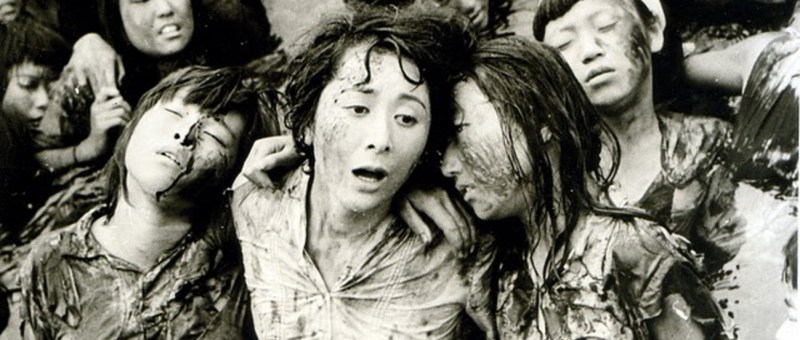
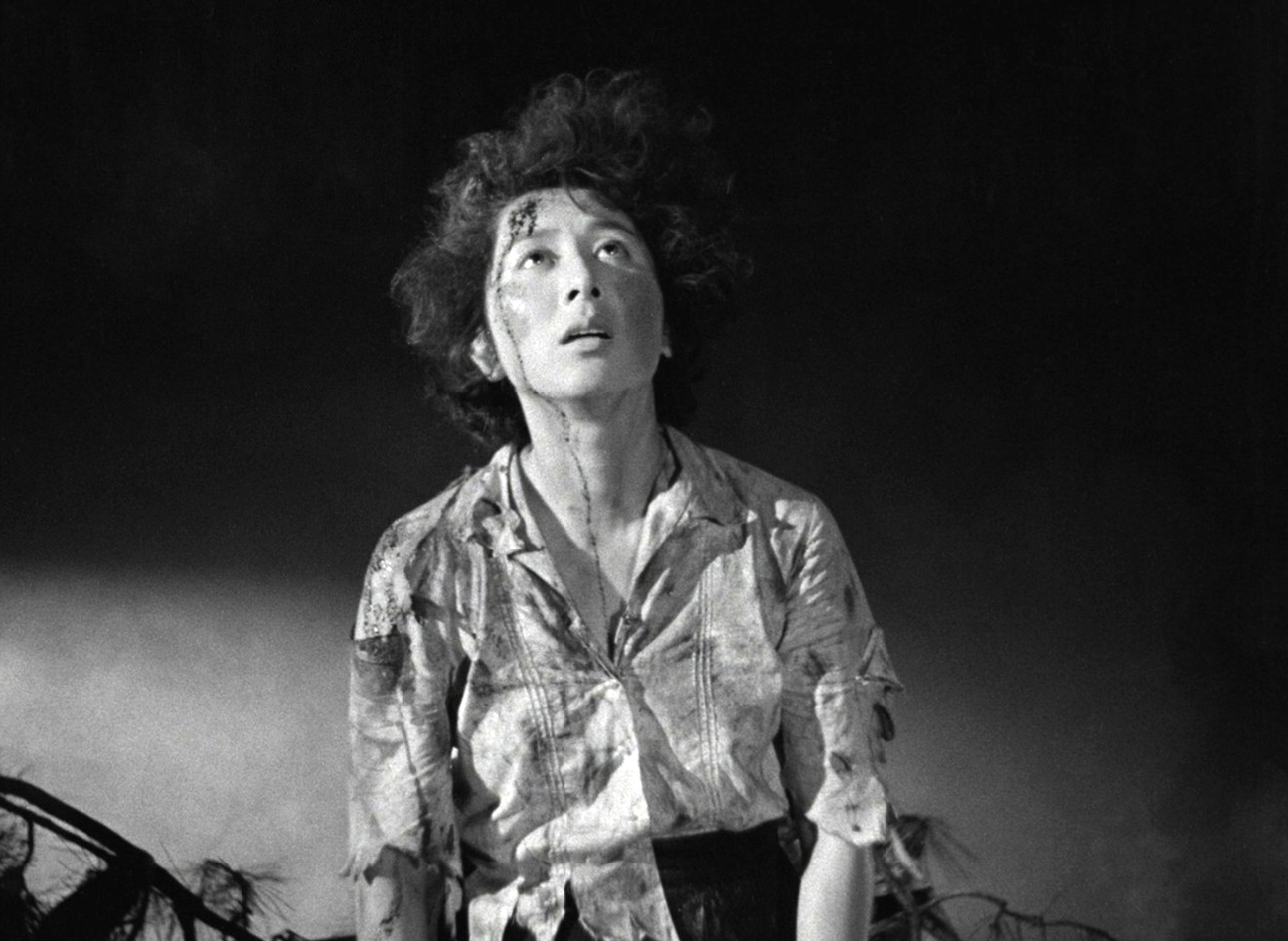
In response, the JTU commissioned a second version in order to better reflect their aims and ideals. Long unseen in either Japan or internationally prior to its recent restoration, Hideo Sekigawa’s Hiroshima (ひろしま) adopts a much more strident docudrama approach while, like Children of Hiroshima, maintaining a focus on the plight of children during the bombing and beyond though it seems somehow unlikely that teachers and parents would be wholeheartedly enthusiastic about showing such a deliberately harrowing piece to a sensitive younger audience. One criticism of Shindo’s film had been that he’d dodged dealing with the bombing itself by concerning himself only with the present-day aftermath. Sekigawa meanwhile focuses directly on the traumatic instant of the attack, utilising expressionistic techniques to recreate the living hell to which the city was reduced literally in flash. 

It’s clear however that the normal of that day was already far from normal. Rather than go about their studies, school children are working hard for the war effort helping to clear extensive bomb damage. A teacher and a class of school girls salvaging roof tiles from a ruined building pause to look at the sky. They can hear bombers but no sirens and it’s in that moment of stillness that everything changes. The world as it was implodes and is left in total collapse. Survivors search desperately for loved ones while stumbling through an unfamiliar landscape filled with crying children, charred bodies, rubble and fire. “This is hell” an injured man groans after managing to make his way to the field hospital, “hell”. 

Sekigawa bookends his tale with a contemporary framing sequence in which an idealistic teacher tries to instil compassionate values in his students some of whom are survivors of the bomb and still living with its effects including one suffering with radiation-related leukaemia who becomes very upset on listening to a radio lesson recounting the morning of the bombing from the point of view of the pilot flying the plane. Another of the students later comes to her defence, taking some of the others to task and lamenting that the suffering of those affected by the A Bomb is not taken seriously while victims still undergo a degree of social stigma even if they have no visible wounds. He is also very worried about his friend, Endo (Yoshi Kato), who later appears in the flashback to the aftermath of the bombing and has apparently gone off the rails, working in a cabaret bar and addicted to pachinko after losing his entire family. 

It’s through Endo that Sekigawa dramatises many of the secondary effects of the bombing in that he was not physically injured but is consumed by a sense of hopeless anxiety, intensely concerned about the prospect of another war and unable to envisage a successful future for himself in a world in which such horror can occur seemingly at random. It’s he who first introduces us to the parasitical disaster tourism that generates a grim trade in A-Bomb “souvenirs” as he passes a stall selling fake skulls as a child and then later attempts to sell actual human remains with inspirational stickers plastered on the top. The “better” future they have imagined for him is however in itself problematic, harking back to the traditional post-war solution of a factory job which directs aligns him with the nation’s push towards a capitalistic society, but is then undercut when he quits not because he is bored or lazy but because he discovered the factory was being used to produce artillery shells and he felt he could have nothing to do with it. 

Endo is also among a group of post-war street kids who learn to say the word “hungry” without knowing what it means to get bread and chocolate from passing Americans. A later more direct speech has them make a formal accusation that the Americans are responsible for the deaths of their parents and therefore bear a responsibility towards them which they should immediately repay with food. Some, including Shochiku who were originally set to distribute but later declined, described the film as overly anti-American, but Hiroshima largely refrains from mentioning the Americans other than a suggestion that the dropping of the bomb was itself a racist act in which they used the Japanese people as guinea pigs to test their new weapon, and focuses on the failure of the militarist authorities to respond in an appropriate fashion. We see a soldier read out a proclamation telling a ragged queue of survivors queuing up for food that the situation is “not unusual” in time of war and they should all return to their jobs despite the fact that there are no longer any buildings in which to work. Meanwhile, militarists talk of using the disaster to foment the war effort by marshalling hate and resentment towards the enemy while commanders refuse to take scientific advice that tells them Hiroshima may be uninhabitable for the next 70 years, obsessed only with continuing the war at all costs ironically insisting that their “fervent will” which “burns as brightly as a million stars” will bring them an assured victory.  

In the face of a second bombing, however, they are forced to accept that the war cannot continue, many of the victims left perplexed and defeated that despite their suffering the government has unconditionally surrendered and seemingly abandoned them. An abnegation of responsibility is also suggested by the presence of the street kids abandoned by their society and left to fend for themselves though Endo is eventually taken into a progressive care home from which he and other boys make numerous attempts to escape, in his case in the hope that he can find the sister from whom he became separated. Sekigawa does not make suggestions for the future, merely depict the difficult post-war reality while arguing for greater compassion in the contemporary era, one bomb survivor describing her despair in the knowledge that her disability is a barrier to marriage while finding work that can be done with her physical limitations is also difficult as is accessing government support. Sekigawa too may give in to a particular kind of sentimentality in the closing moments but it is indeed undoubtedly effective as a reminder of the human cost of war and our collective responsibility to ensure that it never happens again.

The Stairway to the Distant Past (遙かな時代の階段を, Kaizo Hayashi, 1995)

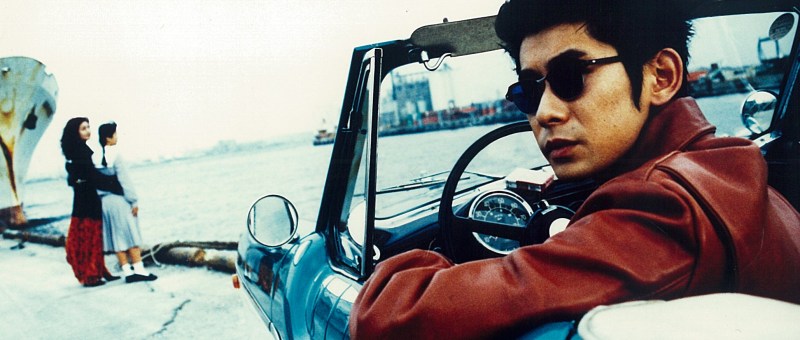
If The Most Terrible Time in My Life was channeling Nikkatsu Noir, Stairway to the Distant Past (遙かな時代の階段を, Harukana Jidai no Kaidan wo) sees Hayashi channel Fukasaku for a full-on confrontation with the legacies of the post-war era just as PI Maiku (Masatoshi Nagase) is forced to confront and attempt to cure the corrupted legacies of his own origins all while trying to save the city of Yokohama from drifting off to “another hell.” This time shooting in colour, Hayashi conjures a sense of mythic dread in the purple haze that hangs over a hidden city and the eerie blue of the path to get there.

But before all that, Maiku has fallen on such hard times his beloved car’s been repossessed and he’s stuck finding lost dogs for wealthy yet eccentric clients. Meanwhile, leader of New Japs gang Kanno (Shiro Sano) is running for political office while two of his underlings decide to freelance in order to take over the lucrative river trade which no one, not even the Taiwanese gang otherwise apparently in the ascendent, has ever dared to touch in fear of the mythic “White Man” who’s controlled the area since the post-war era with a ruthless efficiency that has seen any man challenge him not live to tell the tale. In the midst of it all is bigoted, and apparently pretty corrupt, policeman Nakayama (Akaji Maro) who first blackmails Maiku into helping him investigate a theft and smuggling ring on the river then apparently makes a deal with the White Man’s underlings who in turn blackmail him over his gambling debts but also claim they can make him chief of police if he chooses to play along.

Nakayama is a symbol of the rot in the contemporary city though he is in fact merely spineless, greedy, unpleasant and prejudiced. He asks Maiku for help because he’s hamstrung by the rules of policing which prevent him from doing the nefarious things he asks Maiku to do all of which leads to some pretty tragic consequences and a pair of orphaned children. The New Japs are perhaps a sign of further corruption still to come as Kanno tries to go legit as a politician but only as a means of increasing his influence and earnings. 

The river becomes a kind of nexus, the shore line between contemporary Japan and the “distant past” of the post-war era. Nakayama discovers that no one is technically policing it because it’s outside of everyone’s jurisdiction, while the White Man seems to have been in a position of unassailed power for half a century. As he later says, he’s the only one “living in the past” and perhaps quite literally so as Maiku has to transcend a literal stairway while guided by some kind of local prophet in order to travel to his world and finally risk his life to confront him. At the same time, Maiku is threatened by his own point of origin in the unexpected return of his mother, a now middle-aged stripper known as Dynamite Sexy Lily (Haruko Wanibuchi), who abandoned him and his sister and when he was just a child. 

Her name, along Maiku’s own, are perhaps hangovers from the Occupation era now even more out of place in a changed Japan. Making full use of the colour palate, Hayashi repeatedly flashes back to a pair of Lily’s red shoes as if signalling the unreality of the hidden city and the superimposition of past and present. His flashbacks to the late 1940s echo the cinematography of Fukasaku’s jitsuroku epics with their frenetic chases through black markets, but towards the conclusion the canted angles make it through to our era too and most particularly in the White Man’s lair, a blue-tinged industrial labyrinth that recalls the post-apocalyptic visions of a city still in ruins.

“Yokohama’s changed a lot,” Lily is told on her return and in fact several times after that. She likes it a little better now, the White Man no so much complaining that this city no longer has a place for him as if foreseeing his own eclipse and the oncoming end of an era. But then again, perhaps only the names have changed. All we’re left with is new gangsters with no code, and the White Man did at least stick to the rules even if he did so with ruthless authority. As for Maiku, his passage to the underworld seems to have brought him new clarity. His outfit now a little more sophisticated and mature, less an affectation borne of watching too many movies than an expression of himself. Nevertheless, Yokohama remains a small-town city, a cosy place with a generally friendly and easy going population albeit one with darkness hovering around the edges.


The Stairway to the Distant Past screens 18th/19th October at Japan Society New York.

Original trailer (no subtitles)

The Sands of Kurobe (黒部の太陽, Kei Kumai, 1968)

Kei Kumai’s three-hour epic of human engineering The Sands of Kurobe (黒部の太陽, Kurobe no Taiyo) opens with a titlecard to the effect that the film testifies to the courage of the Japanese people who brought the nation back to life after the war. Partly produced by Kansai Electric Power along with the production agencies of stars Toshiro Mifune and Yujiro Ishihara, the film is therefore somewhat conflicted, part bombastic celebration of Japanese engineering skill and ambivalent critique of the wilful decision to place success above all else including the welfare and safety of ordinary workers.

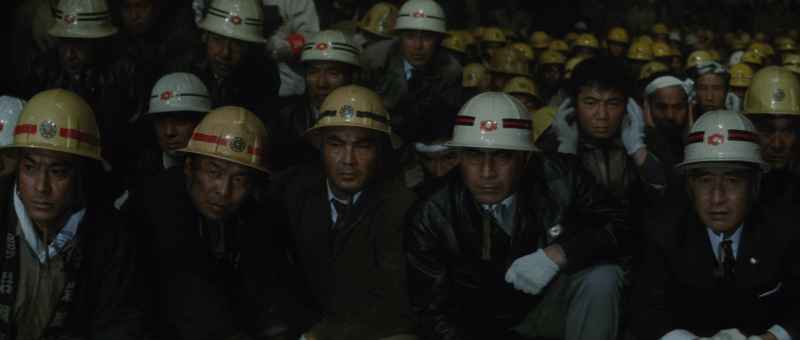
This critique is most evident to the flashbacks to the construction of Kuro 3 in 1938 which as many point out was conducted by the military under brutal and primitive conditions. The construction of the new Kurobe hydroelectric dam, by contrast, is a much more modern, enlightened affair in which workers have proper equipment and are not simply hacking at rocks with pickaxes wearing only a vest. But then as the conflicted Takeshi (Yujiro Ishihara) points out, it’s all effectively the same. Just because no one is pointing a gun at their heads, it doesn’t mean the men actually building the dam aren’t being exploited rather simply pressured by a vague notion of national good that they should be ready to lay down their lives. Could it be that “prosperity” is worse thing to die for than “patriotism”, especially when it appears as if your employer cares little for your physical wealth and economic wellbeing simply pledging that they will support the families of men killed during the dam’s construction. 

That there will be deaths seems inevitable. The man placed in charge of building a tunnel through the mountain, Kitagawa (Toshiro Mifune), is haunted by the vision of a man falling from a cliff that he witnessed when they first hiked to the dam site. He originally described the project as “crazy” and wanted to resign but was convinced to stay on. Kitagawa is himself fond of insisting on safety first where others are minded to cut corners, but also troubled by domestic issues in the film’s sometimes insensitive use of his daughter’s terminal leukaemia as a mirror for the dam project in considering what is and isn’t possible through human endeavour. The suggestion is that Kitagawa wants to believe the miracle of the dam is possible because needs to keep believing in a scientific miracle that can save his daughter, though obviously even if it is ultimately possible to build this dam that’s designed to fuel the post-war rocket to economic prosperity there are limits and unfortunately decades later we have still not found a cure for cancer though treatment may be more effective. 

Takeshi meanwhile has a similar battle with his hard-nosed father whose devotion to the dam project he describes almost like an addiction, suggesting that he values nothing outside of tunnelling and is willing to sacrifice everything in its name including the lives of himself and others. A flashback to to 1938 reveals that he asked his own teenage son to place dynamite and inadvertently caused his death though lax safety procedures which is the understandable reason why his wife eventually left him taking Takeshi with her. But the strange thing is for all his original opposition, Takeshi too is later captivated by the immensity of the challenge if also wary that the workers are falling victim to the same sickness as his father and are still being exploited by those like him who expect them to offer up their lives while paying them a pittance and complaining when the project does not proceed along their schedule. 

The almost nationalistic, bombastic quality of the film seems at odds with some of Kumai’s previous work save the discussion of the building of the 1938 tunnel though this largely serves as a contrast to imply that this time is different because they’re doing it for love of country rather the forced patriotism of the militarist past. Kitagawa justifies himself that if they don’t build the dam, economic prosperity will stall, companies will go bust, and people will lose their jobs but it seems somewhat hollow in the knowledge many men are certain to die while building this dam. Kumai undercuts the bombast with a series of scenes shot like a disaster movie in which supports collapse and the tunnel floods, or men are hit by falling rocks, eventually closing on an ironic Soviet-style statue dedicated to the labour of the workers that seems to question the immense loss of life along with the destruction of the natural beauty of Mount Kurobe but cannot in the end fully reconcile himself, torn between a celebration of human endeavour and its equally human costs. 


Original trailer (no subtitles)

The Target of Roses (薔薇の標的, Kiyoshi Nishimura, 1972)

One of a series of internationalist conspiracy thrillers arriving in the early 1970s, Kiyoshi Nishimura’s Target of Roses (薔薇の標的, Bara no Hyoteki, AKA Red Target) finds itself at a particular moment of paranoid anxiety. In the immediate wake of Asama-Sanso, its villains are a band of revolutionaries hiding out in the mountains behind the shield of “New Religion” as they plot the over throw of the state. Yet these villains are not left-wing former student protestors but Nazi holdovers branding themselves as the “Fourth Reich” while insisting that they are not “fascists” but merely trying to create a new world order free of “corrupt governments”. 

The hero, Akira, in keeping with similar roles Yuzo Kayama played in this period, is a former Olympic sharpshooter who fled to America after being implicated in the death of a teammate. You can tell that things haven’t been going well for him by the terrible mutton chops haircut he is forced to wear throughout the film, but his problem seems to be that he has lost all interest in living. That’s one reason he’s recruited by the Fourth Reich’s local leader Tachibana who theorises that Akira is a man who lives for the gun and is good as dead without one. He and his one-eyed associate Nomura (Toby Kadoguchi), a former sharpshooter himself, begin training him with various strange exercises never revealing their true purpose until asking him to shoot a prisoner they’ve tricked into trying to escape from their secret base. Realising the target is human Akira refuses but then changes his mind shooting the man at much closer range as he runs through a forest. 

Meanwhile, foreign photographer Robert (Ralph Jesser) and his assistant Ling Ling (Taiwanese actress Chen Chen) accidentally end up finding the secret camp after becoming lost in the forest, Robert returning later to investigate and take more photos. Akira is then sent to Hong Kong where the pair have travelled to visit the grave of Ling Ling’s brother, a war photographer killed by a landmine in Laos, in order to take out Robert before he exposes their operation in the newspapers. Never asking any questions of his new job, Akira is unexpectedly moved on seeing Ling Ling’s distress over Robert’s body, later striking up a relationship with her when she too becomes a target for the Fourth Reich. 

In a surprising contrast to similar contemporary crime thrillers, Hong Konger Ling Ling represents a kind of innocent beauty as symbolised in her interest in photographing flowers rather than the war zones covered by her brother. At one point she and Akira are even seen tiptoeing on the railway tracks just like innocent lovers only for Akira to then reflect on the sight of an obsolete steam train likening it to himself, abandoned and destined to be torn to pieces. His love for Ling Ling gives him new reason to live, breaking the nihilistic spell which he claims had led him to want to destroy everything. To that extent Tachibana is correct when he says that Akira has no interest in the future of mankind, but he has become determined to preserve the world of two which exists between himself and Ling Ling which leads him to oppose The Fourth Reich, of whose activities he had been previously ignorant. 

It has to be said that Nishimura’s repurposing of Holocaust imagery, the failed “trainees” of the Fourth Reich’s re-education programme driven to vacant madness and piled up on wooden bunk beds later to be gassed and burned on mass funeral pyres, may be a little inappropriate in its accidental flippancy. Nomura’s claim that the Fourth Reich is not a resurrection of fascism is somewhat disingenuous even if they seem to have no other ideology than their weird super soldier brainwashing programme designed to create some kind of new society, later suggesting that the conspiracy already has assets within the Japanese government. Yet Akira is indifferent to fascism, as Tachibana had framed him a man of the gun born only to pull a trigger a function he later uses in order to convince him to destroy himself. Often marred by overly theatrical dialogue rendered in sometimes awkward English which plays much less well than it might in Japanese, Target of Roses remains a little on the pretentious side despite Nishimura’s characteristic artistry but nevertheless embraces its nihilistic philosophy in the vast emptiness of its internecine conclusion. 


The Eleventh Hour (どたんば, Tomu Uchida, 1957)

The problematic working practices of a post-war coal mine are thrown into stark relief when five men are trapped underground during a collapse in Tomu Uchida’s tense rescue drama, The Eleventh Hour (どたんば, Dotanba). Based on a TV play which was itself inspired by real events, the title alone tells us that we can expect a happy ending even if it’s somewhat undercut by the cynical quality of the fanfare with which it is greeted. Nevertheless, it’s clear that the mine itself reflects a dark side of the contemporary society even as it rocketed towards an economic miracle at least on one level fuelled by coal. 

The Towa mine is a small concern run by the owner, Sunaga (Yoshi Kato), who was a miner himself in his younger days, and the chief engineer Kusaka (Shin Tonomura). In the opening scenes it becomes apparent that they are having difficulty running the business effectively while chasing lucrative large-scale contracts. Kusaka pulls Sunaga aside and attempts to warn him that recent attempts to fit a replacement support beam have caused the structure to shift with the effect that it has begun leaking water. The implication is that Sunaga has attempted to cut corners and endangered the miners’ safety. He barely listens to Kusaka’s complaint before barking at him that it’s his responsibility to take care of, and he must be aware of the cost implications involved seeing as he more than anyone knows how hard it is to run this kind of business. 

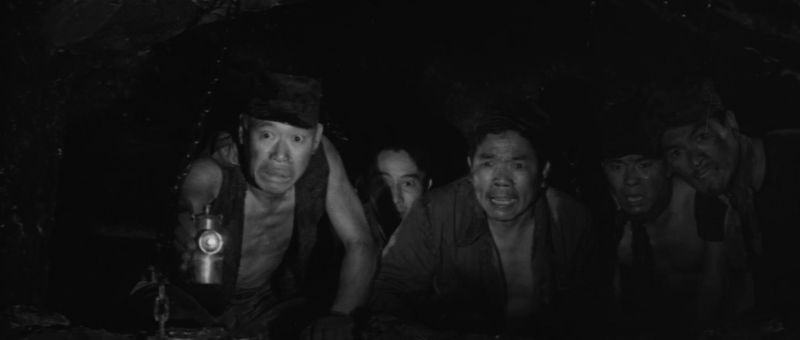
Unfortunately for him, a sudden rainstorm spells disaster when the mine begins to flood. Some workers still underground are able to escape thorough a support tunnel that connects to another mine, but five are trapped at the other end having managed to climb to a higher shelf above the water. In the rain-soaked soil, some of the above ground structure also begins to collapse, while to his credit a distraught Sunaga calls in the police and miners’ union as soon as possible rather than trying to cover up the disaster to hide his mismanagement. 

For all that, Sunaga is not a stereotypically exploitative mine owner so much as a bad businessman possibly in over his head though as a former miner he should have known better. On the one hand, he had only just found out about the unstable support arch and could not have fixed it before the disaster but as he himself agrees he bears the ultimately responsibility for the way the mine was run which includes skimping on repairs and inspections. More than anyone else, he wants the men to be rescued alive and later tearfully tells his wife that he has considered suicide but is now resolved to sell the mine and his own home to compensate the families should the worst happen. Kusaka later does try to take his own life after witnessing the rescue effort flounder, a Buddhist priest later suggesting that his act may have been intended as a kind of human sacrifice as if he could save the men’s lives by offering up his own. 

Then again, the way some of the men put it it seems like some mine owners view the compensation money for workers killed on the job as a kind of fine they’re prepared to pay to maximise profits. The film briefly introduces the circumstances of the some of the men and their families, one a husband and father who asks for an advance on his pay because his wife and daughter are ill with something that could turn out to be measles. The amount of the compensation money isn’t clear, but may not be enough for a widow to raise a five-year-old daughter to adulthood. If these men die, their families may die with them. Other relatives waiting for news include an elderly man anxious for his only son, and a grandmother waiting for her grandson who only went to the mine to have a look around before potentially starting to work there. 

In the case of the young Yamaguchi (Shinjiro Ebara), the film hints at the way the industrialisation presented by the mine has disrupted local communities as farmers’ sons leave the land for the promise of better pay for working underground. Yamaguchi is taking the job because his father is ill with some kind of neurological complaint, possibly caused by industrial pollution, and he has argued with his brother presumably about money and the responsibility of earning his keep. While underground, he runs into a friend of his father’s, Banno (Takashi Shimura), who tells him that mining is not a job you can do for life and he himself seems far too old to be doing such physically strenuous work though he is the only one almost able to stand when the men are eventually lifted from the mine. 

A veteran miner, Banno too is perhaps complacent. He smokes underground and blows the cigarette out after every puff but only to avoid carbon monoxide rather than a potential explosion. Trapped underground twice before, he does his best to comfort the other men while reassuring them that their colleagues are working to rescue them as they speak. Most of the mine workers from the surrounding area have indeed come to help, along with a specialist rescue team from Tokyo, though they make little progress with the tools available to them. As a journalist puts it, small enterprises don’t have access to the same resources as large corporations and cannot simply order in larger pumps or better diggers. Many of the workers want want to give up with the main support coming from the korean miners from a neighbouring town though they get little thanks for the efforts. After overhearing a frustrated member of the rescue team employ a racist stereotype to describe them as lazy drunks only after money, they withdraw their labour. 

Sunaga is later forced to go back to the Koreans cap in hand with a personal apology, but though some of them are personally sympathetic they remark on the level of discrimination they’ve faced for the entirety of their careers and aren’t sure why they should help Sunaga now considering the way they’ve been treated. On a side note, standard workers protections would not apply if they were killed or injured during a rescue attempt meaning they’d be risking their families’ lives as well as their own for men who are almost certainly already dead. It’s not surprising that they overwhelmingly vote not to help leaving a dejected Sunaga devoid of all hope. 

Nevertheless, they eventually reconsider reflecting that if they were trapped underground they’d want to believe someone was coming and if they don’t come now then they won’t have any right to expect them to. It is workers’ solidarity that eventually saves the miners, from winch operator Michi (Masako Nakamura) who refuses to leave her post so that the men won’t feel “abandoned” to those who arrive to rejoin the rescue effort just when it seems the most hopeless. The solution to cracking the mine is found only by listening to a former employee who hints at its dark history in reminding them of a secret support tunnel sealed up after the war once military equipment had removed.

It might be tempting to read an allegorical message into the solution being the need to blast through the buried wartime past to rescue the men trapped on the other side though it may be a bit of a stretch. In any case the action outside is also somewhat ironic. As the mine collapse becomes national news and attracts rubbernecking crowds, a man turns up to sell ice cream, while journalists also report on the event from the close by. They seem broadly hopeful, but are also looking for a good story and all too quick to report on Kusaka’s suicide attempt. When the men are eventually rescued, they order a helicopter to drop confetti over the surrounding area (possibly unhelpful to local farmers) along with a bouquet for each of the men. Uchida had some experience of working in a mine during his time in Manchuria which had permanently ruined his health and had first hand knowledge of how a mine works and what happens when something goes wrong which explains the otherwise naturalistic opening sequence laying out the conveyor belt design of the complex as the coal is picked and transferred into pick up trucks that will take it to its new owners. It is however “dark and wet like hell” underground, a place that ideally no one should have to go and that all should eventually be rescued from. 


Bullet Wound (弾痕, Shiro Moritani, 1969)

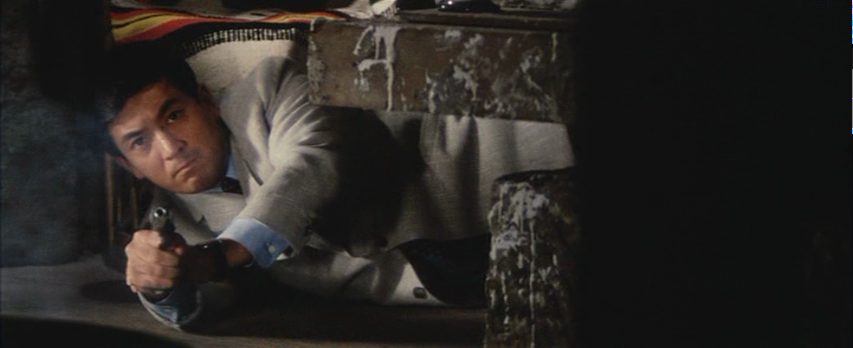
“Your love for your country can’t change anything now” the conflicted hero of Shiro Moritani’s conspiracy thriller Bullet Wound (弾痕, Dankon) is advised as a villainous chaos agent attempts to convince him to switch sides. Like many of Toho’s gunman dramas of the late ‘60s, Bullet Wound anticipates the cinema of paranoia which would take hold in the following decade set against the constant anxiety of the ANPO protests while the Japanese-American CIA agent hero struggles with his uncertain place in a world of geopolitical instability. 

Takimura (Yuzo Kayama) is a man with two countries, born in the US to Japanese parents but later orphaned, now working for the CIA in Japan. Perhaps tellingly, we can’t initially tell what side he’s on even as he tries to prevent an assignation attempt on some kind of dignitary connected to the US. The main crisis occurs when Takamura helps a Chinese man, Yang (Shin Kishida), escape a trade summit in order to defect and chase freedom in America. The Americans, however, then torture him until he finally admits that he’s a stooge, the defection was merely a means of getting him into the US as a spy while the trade delegation is only a front for an upcoming arms deal with a international smuggler known as “Tony Rose” (Andy Seams). Takimura and his team are obviously keen the transaction not take place, but are unable to take Rose out because as Takimura’s boss points out they’ve used him too and he’s too well connected. If they move against him, someone will move against them. 

The Chinese arms deal is linked back to a sense of cold war paranoia which spreads to the young students protesting the ANPO treaty. Takimura’s boss calls them “terrorists” unable to understand how there can be Japanese people who could do this to their own country seemingly unaware of the minor irony in his statement. Meanwhile, he prepares to sacrifice Takimura as need be, callously remarking that a man with two countries who can’t choose between them can be dangerous while admitting that his services have been useful to the Americans but they may not always be so. The Americans meanwhile make crass racist remarks while chasing down the Chinese spies, taking altogether too much pleasure in eradicating them while the hitherto stoical Takimura looks on with disapproval mixed with hurt and shame beginning to wonder if he’s really on the right side. “You and the US will never defeat us” his rivals insist, revealing a mind-blowing piece of info that sets Takimura on a collision course with fate. 

Meanwhile, a strange young artist crafts horrifying statues displaying the “agony of loneliness” and longs to escape Japan for South America where they apparently have the best stone. But as someone later tells her, the desire to go to a new land is not born of hope, and expectations are almost always betrayed. Only love can change everything into hope he tells her, as she pins hers on running away with Takimura while he tries to tie up a few loose ends. Yet there’s also a kind of fatalism that defines their relationship, Takimura reflecting on watching a man die up close and haunted by the searching look in his eyes as if he were trying to understand the meaning not of life but of death. An ironic street singer sings a sad song about those who die and what they leave behind, the soldier apparently leaving not a trace of peace. 

The implication is perhaps that Takimura’s dual nationalities are not viable, that a man with two countries cannot escape by choosing a third nor can he survive without sacrificing one or the other. Meanwhile, Moritani slides into anti-Americanism painting the CIA as duplicitous and exploitative as they simultaneously demonise the Japanese and position men like Tony Rose as international chaos agents destabilising the global order. Handheld photography adds to the sense of anxious immediacy and confusion as Takimura attempts to define his own identity only to discover perhaps that he no longer has one caught as he is between two nations as two selves at the heart of a silent war. 


Mother (おかあさん, Mikio Naruse, 1952)

The hahamono or mother movie is a mainstay of post-war cinema, obsessed as it is with self-sacrificing maternity. Mikio Naruse, however, is not a name you’d expect to see associating itself with the genre and his 1952 film Mother (おかあさん, Okaasan), adapted from a child’s essay, is indeed subtly subversive, transgressively questioning the institution of motherhood itself while ostensibly remaining faithful to genre norms even as it makes an accidental villain of its teenage heroine who closes the film plaintively praying for her mother’s happiness having not so long ago shut down perhaps her only real hope of achieving it. 

The Fukuhara family ran a successful laundry before the war, but these days father Ryosuke (Masao Mishima) works at a factory and is nicknamed Papa Popeye by his kids because of his finely tuned muscles born of a lifetime training the iron. Matriarch Masako (Kinuyo Tanaka) and 18-year-old daughter Toshiko (Kyoko Kagawa), our narrator, help the family finances by running street food stalls, while oldest son Susumu (Akihiko Katayama) has become ill with a lung complaint caused by poor conditions at the wool factory where he was working. In addition to youngest daughter Chako who is still in school, the family has also taken in little Tetsu (Takashi Ito) the son of Masako’s sister Noriko (Chieko Nakakita) who is now a widow recently repatriated from Manchuria. 

Like many films of the occupation period, the family at the centre of Mother is determined to rebuild, pinning all their hopes on being able to renovate their home in order to be able to reopen the laundry. The war is very much a background presence but its influence is still deeply felt not least in the ruins and devastation glimpsed around the house and the constant references to loss and widowhood which seem to plague Masako, so many women having lost sons and husbands in the conflict. The tragedy is that Masako will eventually in one sense or another lose all her children by the end of the picture, Susumu succumbing to his illness after having discharged himself from hospital out of guilt and loneliness missing his mother, Chako eventually taken in by wealthier relatives who lost their son in the war, Tetsu soon to be retrieved by his mother, and Toshiko herself clearly heading towards marriage with the cheerful and surprisingly progressive baker Shinjiro (Eiji Okada) with whom she has become close. 

Perhaps surprisingly Toshiko seems remarkably immature for her age, her voiceover taken as it is from a child’s essay has a slightly stilted quality that nevertheless makes plain her poor grasp of the adult world and most particularly the reality of her mother’s life. Masako later tells us that she started working at 14 and continued until she married at not so much older than Toshiko is now despite later stating that Toshiko is too young to marry only to find her self shocked when confronted by the sight of her in a wedding dress stifling a brief wave of despair that her daughter may soon be a wife. Originally complaining about not being able to take dressmaking classes like some of the other girls, Toshiko belatedly swears to help support the family firstly to prevent Chako going to stay with relatives and secondly because her boyfriend inadvertently gives her the impression there’s truth in a local rumour that her mother plans to remarry following her husband’s death from overwork and poverty with a friend of their father’s who’s been helping them out in the shop, “Uncle POW” Mr. Kimura (Daisuke Kato). 

Shinjiro is quick to tell her that she’s being unreasonable. In the modern world parents shouldn’t be expected to sacrifice their personal desires for their children, her mother is also a woman and has the right to pursue happiness in marrying again if she chooses. On the other hand, there is nothing particularly concrete between Masako and Mr. Kimura besides a genial domesticity, the rumour is partly local wishful thinking in knowing that remarriage is sensible economic choice and the pair seem well suited. Toshiko objects strongly to the idea out of fear, jealousy, and outdated moralising resenting her mother for betraying her father’s memory but also fearing further changes in her familial relationships in an already uncertain world. 

In this her otherwise saccharine closing monologue in which she looks on as her mother plays with Tetsu and wonders if she’s really “happy” achieves its final irony, transgressively undercutting the primacy of the self-sacrificing mother to question the ideology of motherhood itself when it requires women to sacrifice their lives and desires in service of an ideal of “family”. Nevertheless, Mother is among the most ostensibly cheerful of Narusean dramas in the gentle comedy and naturalistic depiction of a warm and loving family committed to compassion, kindness, and mutual support as pathways towards a better post-war future.  


Mother is currently available to stream in the US via Criterion Channel

The Scarlet Camellia (五瓣の椿, Yoshitaro Nomura, 1964)

Little known outside of Japan, Yoshitaro Nomura is most closely associated with post-war noir and particularly with adaptations of Seicho Matsumoto’s detective novels, yet he had a wide and varied filmography directing in several genres including musicals and period dramas. The son of silent movie director Hotei Nomura, he spent the bulk of his career at Shochiku which had and to some degree still has a strong studio brand which leans towards the wholesome even if his own work was often in someway controversial such as in the shocking child abuse drama The Demon or foregrounding of leprosy in Castle of Sand. Part of the studio’s series of double-length epics, 1964’s Scarlet Camellia (五瓣の椿, Goben no Tsubaki) is nevertheless an unusual entry in Nomura’s filmography, adapting a novel by Shugoro Yamamoto essentially setting a policier in feudal Japan and perhaps consequently shot largely on stage sets rather than on location. 

Nomura opens with artifice as Shino (Shima Iwashita) stares daggers at an actor on the stage but later returns to his rooms every inch the giggling fan before finally offing him with her ornate silver hairpin leaving behind only the blood red camellia of the title. The first in a series of killings later branded the Camellia Murders, we later realise that the actor had to die because of his illicit relationship with Shino’s mother whom he brands a “nympho” and as we later discover had several extra-marital lovers. Extremely close to her father who, as we’re told, perished in a fire while resting in the country due to his terminal tuberculosis, Shino is apparently on a quest for revenge against the faithless men who humiliated him though her feelings towards her mother seem far more complex. 

Indeed, Shino regards her mother’s carrying on as “dirty” and seems particularly prudish even as she wields her sex appeal as a weapon in her quest for vengeance. Yet it’s not so much the free expression of sexuality which seems to be at fault but excess and irresponsibility. Shino resents her mother primarily for the ways in which she made her father suffer, off having fun with random men while he shouldered the burden of her family business which, Shino might assume, has contributed to his illness. Aoki (Go Kato), the Edo-era policeman to whose narrative perspective the second half turns, advances a similar philosophy in that there’s nothing wrong with having fun, he has fun at times too, but people have or at least should have responsibilities towards each other which the caddish targets of the Camellia Killer have resolutely ignored. He can’t say that he condones the killer’s actions, but neither can he condemn them because her motivations are in a sense morally justifiable. 

Realising the end is near, Shino indulges in a very modern serial killer trope in leaving a note for Aoki alongside one of her camellias in which she claims that she is exacting vengeance for “crimes not punishable by law”. There was nothing legally wrong in the way these men treated her mother or any other woman, but it is in a sense a moral crime. “You’re a woman and I’m a woman too” she later tells another scorned lover, a mistress thrown over by her patron with two small children after he tired of her, as she hands over a large sum of money and encourages her to return to her family in the country. Shino’s quest is essentially feminist, directed against a cruel and patriarchal society in which the use and abuse of women is entirely normalised, yet it is also slightly problematic in her characterisation of her mother as monstrous in her corrupted femininity for daring to embrace her sexuality in exactly the same way as her male counterparts though they, ironically, mainly seem to have been after her money rather than her body. 

Shino’s mother’s death is indeed regarded as “punishment from heaven” presumably for her sexual transgressions and neglect of her family, rejecting both the roles of wife and mother in a ceaseless quest for pleasure. Yet even in her resentment, Shino’s ire is directed firmly at the men taking the last of her targets to task when he justifies himself that women enjoy sex too and are therefore equally complicit by reminding him that he gets his moment of pleasure for free but the woman may pay for it for the rest of her life. Just as Shino’s mother neglected her family, the men harm not only their wives in their illicit affairs but cause concurrent damage to the mistresses they may later disown and the illegitimate children they leave behind. Abandoning the naturalism of his contemporary crime dramas for something much more akin to a ghost film with his eerie lighting transitions and grim tableaux of the skewered victims, Nomura crafts a melancholy morality tale in which the wronged heroine turns the symbol of constrained femininity back on the forces of oppression but is eventually undone by the unintended consequences of her quest for vengeance even as she condemns the architect of her misfortune to madness and ruin. 


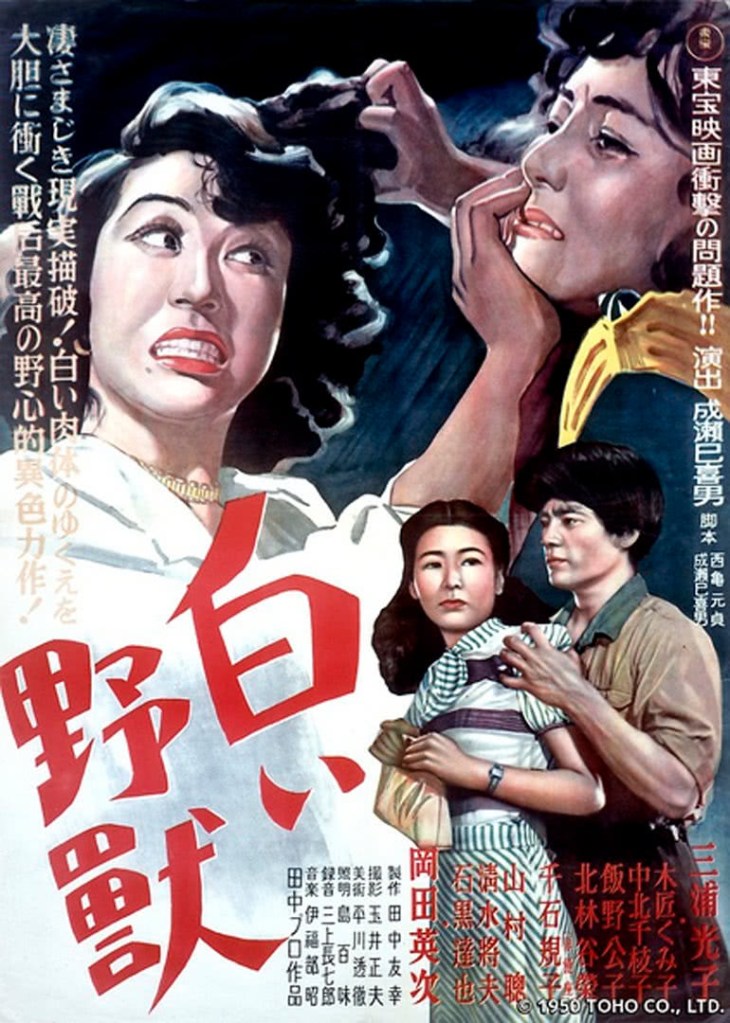
White Beast (白い野獣, Mikio Naruse, 1950)

Though motions were made towards criminalising sex work under the American occupation from as early as 1946, not that much changed until the passing of the Prostitution Prevention Law 10 years later. In the desperation of the later war years and their immediate aftermath, many women who’d lost husbands, families, and their homes, found themselves with no other way to survive than to engage in sex work, but the existence of these women who were only doing something that though not exactly well respected was fairly normalised five years previously became an acute source of embarrassment most especially given the views of the morally conservative Occupation forces. 

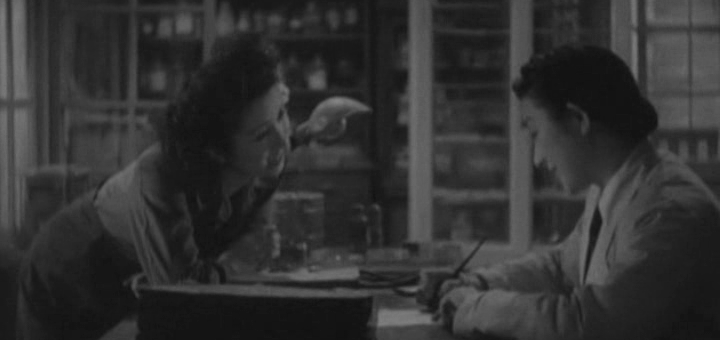
Slotting in right next to the pro-democracy films of the era, Mikio Naruse’s White Beast (白い野獣, Shiroi Yaju) is a surprisingly progressive effort which locates itself in a “home for wayward women”. The White Lily Residence is run with love and compassion and even if the older female warden is stern in a practical sort of way she is never unkind or uncaring, while the male governor Izumi (So Yamamura) is patient and supportive, always keen to tell the women in his care that they are not spoiled or dirty and are fully deserving of the bright new futures he is certain are waiting for them. Rather than lecturing the women, the home makes a point of teaching them new skills such seamstressing so that they will be able to find honest jobs on the outside, though the conviction that those jobs exist may be a little optimistic in itself. 

Our first introduction to the White Lily is through the eyes of Yukawa (Mitsuko Miura), an educated woman who claims she engaged in sex work simply because she enjoyed it and doesn’t see why she’s been arrested. She tries to leave and is told that she is technically free to do so, but they will have to call the police if she does. Yukawa decides to stay, especially once she locks eyes with cheerful female doctor Nakahara (Kimiko Iino). Perhaps surprisingly, the central drama revolves around an awkward love triangle between Yukawa who becomes fixated on the doctor who to be fair is unambiguously flirting back, and the bashful Izumi who has designs on Nakahara himself. 

Refreshingly direct and professional, Nakahara nevertheless has an engaging warmth that has made her a real asset to Izumi’s team as she deals with the sometimes quite difficult medical circumstances of the women at the centre, many of whom are understandably suffering with various STIs including syphilis. Never judging them she remains sympathetic and egalitarian, even joining in when Yukawa cheekily invites her to dance while some of the other women are listening to records. Appearing to understand what Yukawa is asking her, she tells her that she has remained single by choice and has no intention to marry because she’s prioritising her career. Yukawa’s confidence is, however, shaken when she hears a rumour that Nakahara and Izumi may be romantically involved. 

Yukawa looks to Nakahara to try and understand why she’s ended up at White Lily. She asks her what it means to have a “dirty” body and gets a diplomatic medical answer which nevertheless coyly places the blame on sexual repression. Nakahara admits that marital relationships can also be “dirty”, not because of infidelity but because of patriarchal inequalities – marriages in which the wife is treated as a “doll” or a “maid” for example. The answer seems to satisfy Yukawa, but Nakahara has also cut to the quick of her psychological trauma in asking her if she is not also internalising a sense of shame in secretly battling with the idea that she is somehow “dirty” because of the way she’s lived her life. 

Given her fixation with Nakahara, we might wonder what it is that Yukawa so struggles to accept about herself despite her outwardly liberated persona. Beginning to reflect on her past life, she sees the faces of the men she slept with looming over her but seems confused. Was she deflecting desire rather than embracing it, trying to prove or perhaps overwrite something? In any case, her time at the centre begins to soften her but, crucially, not towards accepting a social definition of herself as dirty but emerging with new degrees of self knowledge and acceptance. 

The one sour note in Izumi’s otherwise progressive philosophy sees him encourage one of his star pupils, Ono (Chieko Nakakita), to reunite with a man she was engaged to before the war who has just been repatriated and claims his feelings haven’t changed despite finding her at White Lily. Ono is reluctant, partly because she feels a sense of unworthiness, but also because she suspects that whatever Iwasaki (Eiji Okada) says now, he will someday hold her past against her. She’s proved right when she gets a day pass to visit him in his flat where he eventually rapes and then tries to strangle her. Ono vows not to see him again, but Izumi convinces her otherwise, as if this is all her fault, telling her that two people who love each other can work through anything, implying that it’s her job to fix his wartime trauma (if perhaps mildly implying the reverse is also true for him). For an otherwise compassionate man, telling a vulnerable woman to return to a violent partner because “love is enough” seems an oddly patriarchal gesture. 

Nevertheless, despite the late in the game swerve towards conservatism, White Beast presents a surprisingly progressive critique of an inherently misogynistic, hypocritically puritanical society. At one point, a wealthy big wig arrives to lecture the women, berating them for “bringing down Japanese womanhood” while insisting that women who justify sex work as a means of avoiding starvation are being disingenuous because most women are just “decadent” and wanting handbags etc. Yukawa, unable to control herself, fires back, asking him who it is he thinks buys their services in the first place. It’s very valid point, and one it seems few are willing to consider. 


Short clip (English subtitles)

The Scent of Incense (香華, Keisuke Kinoshita, 1964)

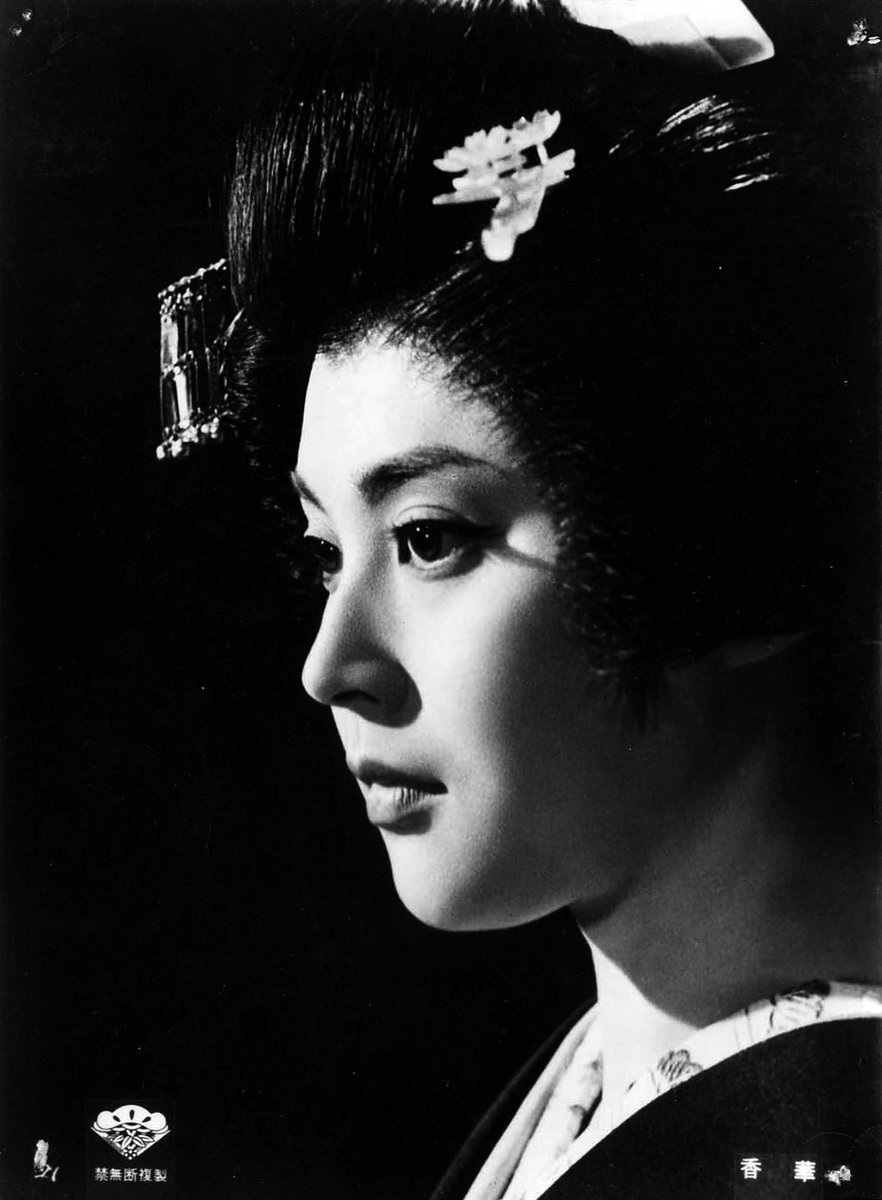
Scent of Incense still 1Sometimes regarded as overly sentimental, Keisuke Kinoshita’s later career grew progressively harder around the edges, as if he began to lose faith in the efficacy of human goodness but never it seems in its capacity for endurance. Spanning more than 50 years in the turbulent history of mid-20th century Japan, The Scent of Incense (香華, Koge) reverses the path of the hahamono in dramatising the complicated relationship of two women – a “selfish” mother and her “self-sacrificing” daughter who finds herself unable to give up on maternal approval despite the many disappointments of her life.

We open in late Meiji with a funeral interrupted by news from the Russo-Japanese war. Shortly after, young widow Ikuyo (Nobuko Otowa) argues with her mother, Tsuna (Kinuyo Tanaka), over custody of her five-year-old daughter Tomoko. Ikuyo is planning to remarry and her new husband has three children of his own. Fearing Tomoko would be an inconvenience, Ikuyo proposes to make her heir to her mother’s family, leaving her behind in her grandmother’s care. Though Tsuna loves Tomoko dearly, she resents her daughter’s intention to abandon them just because she’s got a better offer, and perhaps privately wonders how long she’ll actually stick it out for seeing as, as we later see, she has a strong tendency to give up when the going gets tough.

The prediction proves accurate. Ikuyo persuades her new husband to abandon his existing children and family home for the bright lights of Tokyo, while Tomoko and her grandmother live on alone in the country. Ikuyo has another daughter, Yasuko, but the couple quickly become impoverished without access to her husband’s family money. When Tsuna dies, Ikuyo decides to fetch Tomoko from the family residence, but then sells her to a geisha house. A few years later, she too falls into the sex trade but as a less exulted “oiran”, embarrassingly re-encountering her daughter from the other side of a brothel. Despite her abandonment and shame over her mother’s profession, Tomoko (Mariko Okada) continues to try to help her, maintaining an awkward familial relationship with a woman who only pays attention to her when she needs something.

Perhaps ironically, in one sense, Tomoko ends up becoming a successful, independent woman in pre-war Japan but is forever denied the kind of familial life she craves as a conventionally respectable wife and mother of the kind her own was not. In the course of her work, she meets dashing military cadet Ezaki (Go Kato) and, despite the warnings of her madam (Haruko Sugimura) who cautions her that she’s the type to fall in love too deeply, embarks on a longterm affair with him. Though he is obviously aware that she is a geisha, he is confident that his family would accept a marriage, but Tomoko’s hopes are later dashed when his pre-marital investigations turn up the fact that Ikuyo has worked as a “common prostitute”. Heartbroken, she resents once again paying the price for her mother’s transgressions, but does not break with her completely.

Tomoko’s liminal status is further brought home to her when her elderly patron, who has set her up with a geisha house of her own, suddenly dies and not only is she informed some days later by the madam at another house, but she’s not even permitted to attend the funeral. Another man, Nozawa (Eiji Okada), who’d had his eye on her but honestly admits that men of his class do not engage in “serious” relationships with geisha, asks her to become his mistress but she has had enough of the shadow life, vowing both that she doesn’t want to be “owned” anymore, and that her next man (if there is one) will have to marry her.

Loneliness renders that particular vow void as she finds herself embarking on a casual affair with Nozawa while Ikuyo considers getting married for the third time – this time, rather transgressively, with the family’s recently widowed former servant, Hachiran (Norihei Miki), who married into a wealthy family and apparently made something of himself. Hachiran, however, finds it difficult to shake off the old class attitudes, treating Ikuyo like a goddess while she bosses him around and makes a pretence of leaving every time she gets fed up.

Later we might wonder if Ikuyo’s sudden exit from Hachiran’s distant home is more that she missed her daughter than it was boredom with her husband. “I don’t think of her as a mother” each woman says, Ikuyo on learning that Tsuna is dangerously ill, and Tomoko when Nozawa suggests making a detour to visit Ikuyo and Hachiran. Ikuyo, it is true, is a cold woman who abandoned her daughter only to reclaim her in order to sell, later giving up two more children one of whom apparently disappears without trace. The proof of her love is found only in its end, while Tomoko suffers on all the long years otherwise alone, until in an immense act of circularity she at last becomes a kind of mother to another woman’s son.

Forever haunted by the spectre of soldiers, Tomoko loses everything in the Great Kanto Earthquake of 1923, but perseveres and rebuilds. She loses everything again in the firebombing of Tokyo, only later remembering her foresight in burying a large collection of crockery in the cellar which might allow her to open a restaurant. She resents her mother but keeps her close, while Ikuyo’s affections seem to ebb and flow as she disappears off to greener pastures only to resurface again when they’ve been thoroughly grazed. A flighty, perhaps selfish woman, Ikuyo too proves unable to sever connection from her daughter. Tomoko disapproves of her mother’s gaudiness, her unbridled lust for life and disregard of social conventions, but the two women are more alike than they first seem – each in their own way fiercely independent and unwilling to allow their desires to be defined or defeated by the world around them.


Original trailer (no subtitles)