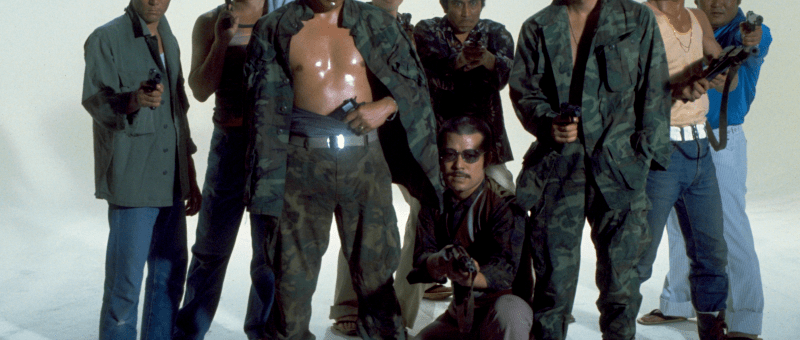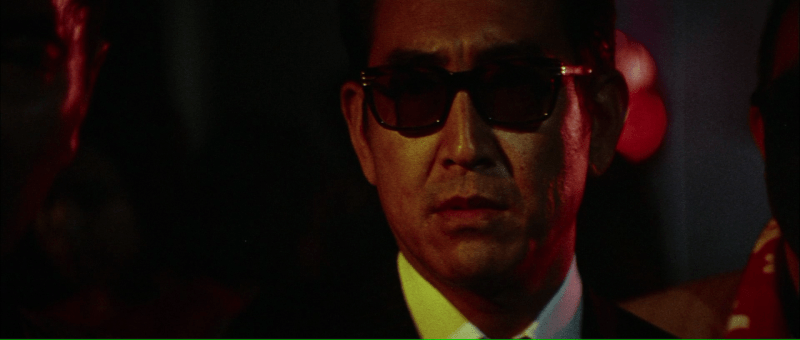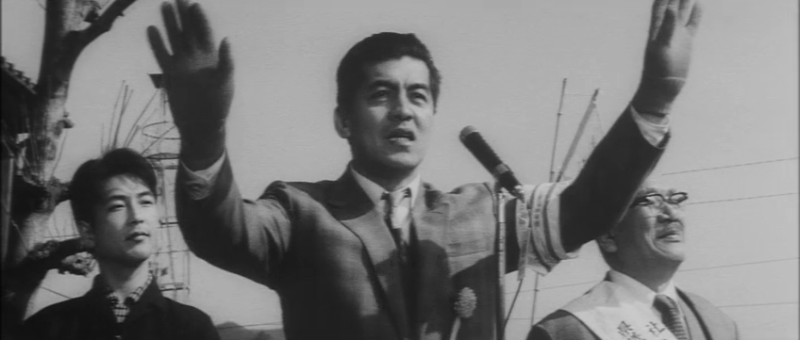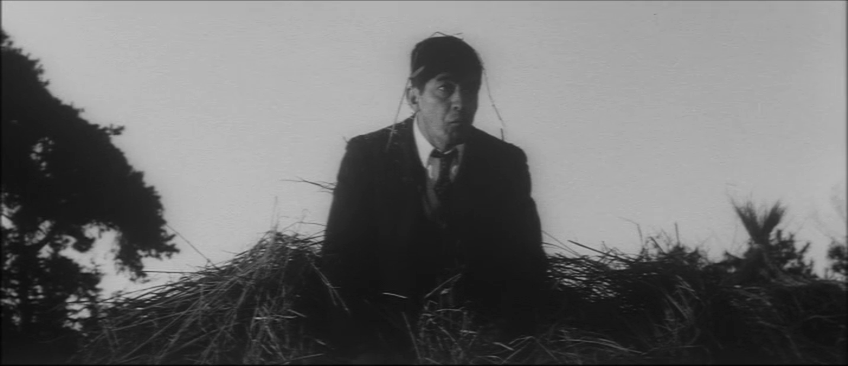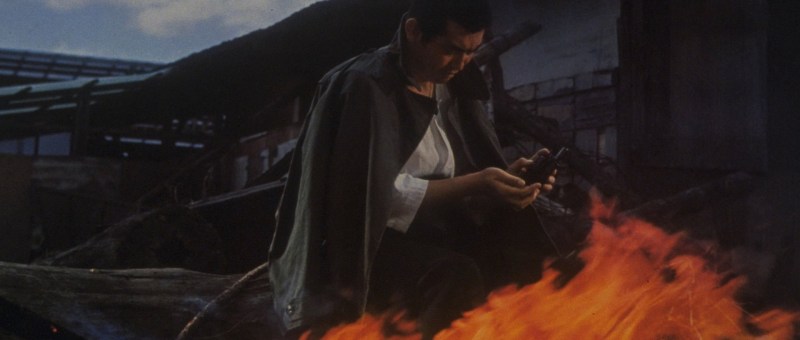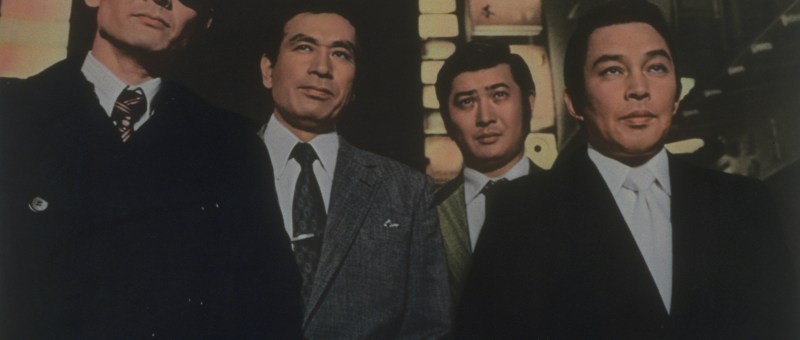
Violent Streets (暴力街, Hideo Gosha, 1974)

“Nothing’s like it used to be anymore” sighs a woman who’s had to betray herself but has tried to make break for it only to discover there is no way back. Hideo Gosha’s Violent Streets (暴力街, Boryoku Gai) is like many films of its era about the changing nature of the yakuza in an age of corporatised gangsterdom. Now “legitimate businessmen” who claim to no longer deal in thuggery, their crimes are of a more organised kind though a turf war’s still a turf war even if you’re fighting from the boardroom rather than simply getting petty street punks to fight it for you in the streets. 

In a touch of irony, former yakuza Noboru Ando stars as a man who’s tried to leave the life behind but is pulled back into underworld intrigue when his former foot soldiers mount an ill-advised bid for revenge against the clan they feel betrayed them. After serving eight years in prison for participating in the last turf war, Egawa was given flamenco bar Madrid on the condition that he dissolve his family and attempt to go straight as a legitimate businessman. The Togiku gang has since gone legit and distanced itself from most of its old school yakuza like Egawa. But now a yakuza conglomerate from Osaka is moving in on their old turf and the Togiku want the Madrid back as a bulwark against incursion from the west which is why they’ve been sending the boys round to cause trouble in the bar. 

Egawa is the classic ex-gangster who wants to turn himself around but is largely unable to adapt to life in a changing society. He is technically in a relationship with a bar hostess who has a severe drinking problem in part exacerbated by his inability to get over his former girlfriend who left him and married the boss, Gohara, while he was in prison. His former foot soldiers attempt to convince him to get the gang back together and take revenge, resentful of having been used and discarded, but he tells them to let it go, that they’ve all got “honest jobs” and that they should try to live as best they can. Like him, the guys are ill-equipped to make new lives in the consumerist society and cannot move on from the post-war past. Hoping to engineer a turf war between the Osaka guys and Togiku, they kidnap a popular TV personality/pop singer (Minami Nakatsugawa) attached to a station which Togiku controls and frame a rival affiliated with the Osakans for taking her. 

This just goes to show the various ways in which newly corporatised yakuza have expanded their business portfolio, heavily participating in the entertainment industry moving beyond bars, clubs, and the sex trade into mainstream television and idol stars. Egawa’s old friend Yazaki (Akira Kobayashi) is his opposing number, just as caged but trapped within the confines of the new gangsterdom, reprimanded by his boss for raiding the rival studio’s offices and undoing the gang’s attempt to rebrand themselves as legitimate businessmen rather than violent street thugs. “I can’t stand being humiliated” he explains as Gohara points out he’s stepped right into their trap now giving the Osakans an excuse for retaliation. “The Togiku group is a defanged, domesticated dog” Yazaki barks, “I can’t pretend to be an obedient company employee forever and do nothing”. 

Neither man is able to progress into the new era of rising prosperity, both little more than caged animals thrashing around trying to break free but continually crashing into the bars. Just as Egawa’s old guys had tried to engineer a turf war hoping that the two gangs would take each other out and leave a vacuum they could fill, arch boss Shimamura (Tetsuro Tanba) flies above the city in a helicopter as the “worms fight among themselves” and observes the chaos below as he completes his silent conquest of the contemporary economy like some modern day Nobunaga of corporatised gangsterdom. 

Taking over the Togiku through a process of corporate infiltration and gradually ridding themselves of all the old school yakuza ill-suited to the shady salaryman life, the contrast between the world of cabaret bars and back street dives and Shimamura’s smart suits and helicopters couldn’t be more stark. A slightly sour note is struck by the use of a transgender assassin (Madame Joy) who performs a lesbian floorshow by day and kills by night while working with a bald sidekick who carries a parrot on his shoulder, her coldness bearing out the tendency of yakuza movies to associate queerness with sadistic savagery. Gosha rams his point home with the otherwise surreal scene of a pile of abandoned mannequins by a swamp that becomes a popular yakuza kill site homing in on the emptiness of their eyes and the uncanniness of dismembered bodies, mere empty shells just like the men who die in this literal wasteland. Egawa perhaps feels himself to be a man already dead long before being pushed towards his act of futile rebellion, somewhere between sitting duck and caged dog fighting for his life between the chicken coops of a moribund small-town Japan. Marching to a frenetic flamenco beat of rising passions and barely contained rage, Violent Streets leaves its former foot soldiers with nowhere to go but down while their duplicitous masters continue to prosper riding the consumerist wave into a new and prosperous future.


Violent Streets opens at New York’s Metrograph on Dec. 16 as part of Hideo Gosha x 3

Trailer (English subtitles)

The Island Closest to Heaven (天国にいちばん近い島, Nobuhiko Obayashi, 1984)

On its publication in the mid-1960s, Katsura Morimura’s autobiographical travelogue The Island Closest to Heaven (天国にいちばん近い島, Tengoku ni Ichiban Chikai Shima) became something of a publishing phenomenon and is credited with creating a romanticised image of the Pacific islands in the post-war Japanese imagination. Nobuhiko Obayashi’s 1984 film adaptation in fact prominently features adverts for the UTA New Caledonia tour and acts as something like a tourist information video showcasing the idyllic island scenery and well appointed resort accommodation if also later featuring the decidedly less well appointed establishments on the other side of town where the locals live and and work. 

It is however first and foremost a vehicle for Kadokawa idol star Tomoyo Harada who had made her debut in Obayashi’s The Little Girl Who Conquered Time and was now onto her third lead having starred in Curtain Call earlier in the year which Haruki Kadokawa had directed himself. As such, the film is only loosely based on Morimura’s novel, recasting the heroine as a recently bereaved 16-year-old embarking on a coming-of-age adventure while travelling overseas looking for herself and a sense of the safety and stability she experienced before her father’s death. 

In the prologue sequence which opens the film, shot with a muted, pink-tinted colour filter, a younger Mari sits on the edge of a bridge with her father holding her from behind. As both she and her father are dressed in yukata, as are others who pass them on the bridge, we can assume that it is summer and possibly around the time of Bon festival which adds an extra degree of poignancy to their conversation in which her father quietly clearly anticipates his own death. He tells her about a distant island far to the south and close enough to Heaven for God to call on where it is always warm and sunny and the people always happy. Mari asks for the name of the place and is told it is called New Caledonia, possibly a name her father picked out of the air without thinking but becomes to her a symbol of the bond that existed between them and place she must visit now that her father is no longer physically present in her life. 

What she’s looking for is in a sense a path back to her father or at least a means a coming to terms with his absence. Her mother (Kayo Matsuo) may appear somewhat indifferent, but it’s clear that it’s a kind of pride she feels in her daughter’s first steps into adulthood knowing that she has raised a determined young woman if one with her head in the clouds like her father. Her sentiment is later echoed by an older woman (Nobuko Otowa) who has come to New Caledonia in order to make peace with the death of her husband 39 years previously when his submarine was sunk during the war, stating that all these years later her abiding memory is pride that she fell in love with someone she could be proud of. “Love is the story of your whole life” she tells Mari, who is herself just beginning to understand that life is a process of love and loss as she searches for her island and eventually finds it in the eyes of a local boy who yearns for an island far to the north where it’s always bright and sunny and the people are always happy. 

Mari’s interactions on the island are torn between two men, the young Taro (Ryoichi Takayanagi) who is fascinated by the idea of Japan where his grandfather first came from to dig nickel, and a much older man, Yuichi (Toru Minegishi), who seems to be arrested, stuck on the island and unable to move forward with his life because of a youthful broken heart. Mari reminds him of the young woman he loved and lost, trying to recapture the magic with a moment that seems to reference Jules Verne’s The Green Ray, but of course failing to do so. There is something uncomfortable in their relationship given that Mari is only 16 and this man is perhaps already in his 40s, yet her decision to leave the safety of the tour group and venture astray with him to find what she is looking for rather than what the tour guide wants to show her demonstrates her independent spirt and impending adulthood in taking an active control over her life and future. 

In this way the island is a liminal space in more ways than one, symbolically connecting the mortal world and the other while allowing Mari to transition into adulthood as symbolised by her return home now no longer wearing her glasses in having opened her eyes to a fuller reality. Nevertheless, the film does follow the line of the book which is very of its time in its presentation of the indigenous community which is bound up with the idea of a smiling island people lazing in the sun of a tropical paradise while possessing profound spiritual knowledge. Mari’s literal coming of age is symbolised by a fever she endures after being stung by a sting ray, coming to during a tribal dance and then collapsing again to awaken as if reborn into adulthood.  

After this transition it’s implied that her relationship with Taro will have to end, that this brief summer adventure like so many in Obayashi’s films was just about making memories to carry forward in the further course of life. But then as her seemingly unburdened tour group friend had pointed out, Mari found Taro by chance twice before and so may someday find him again just as Mari’s intervention has earned Yuichi and his first love a second chance no longer so enthral to the illusionary power of the green ray but making choices informed by the realities of love that may still be “romantic” if no longer quite so naive. Shifting into a more contemplative register than other similarly themed Kadokawa idol movies, The Island Closest to Heaven is one of Obayashi’s most straightforward features save for its brief use of colour filters in the opening and closing scenes and the lengthy title sequence which draws inspiration from classic Hollywood melodrama, but engages with some of his key themes in the romantic nostalgia of love and loss as his heroine comes to a new understanding of herself while bidding goodbye to the past. 


The Island Closest to Heaven is released on blu-ray on 17th October courtesy of Third Window Films as part of the Nobuhiko Obayashi’s 80s Kadokawa Years box set alongside School in the Crosshairs, The Girl Who Leapt Through Time, and His Motorbike, Her Island.

Original trailer (English subtitles)

Theme song performed by Tomoyo Harada

Terror of Yakuza (沖縄やくざ戦争, AKA Okinawa Yakuza War, Sadao Nakajima, 1976)

An old-school yakuza finds himself cornered on every side while caught in the confusion of Okinawa’s reversion to Japan in Sadao Nakajima’s jitsuroku gangster movie Terror of the Yakuza (沖縄やくざ戦争, Okinawa Yakuza Senso, AKA Okinawa Yakuza War). Where similarly themed Okinawa-set gangster pictures such as Sympathy for the Underdog had largely presented the islands as an appealing place for mainland gangsters because the conditions of the occupation which had allowed them to prosper were still in place, Sadao reframes the debate in terms colonisation and conquest as the hero finds himself increasingly marginalised as an island boy contending with amoral city elitists. 

Nakazato (Hiroki Matsukata) has just been released from prison after serving seven years for the murders of two rival gang bosses that allowed his boss, Kunigami (Shinichi Chiba), to rule the roost in Koza. But now that Okinawa has reverted to Japan, everything has changed. Kunigami has formed a loose alliance with another regional gang to oppose the incursion of mainland yakuza but behind the scenes the higher-ups are intent on a mutually beneficial alliance with the Japanese perhaps seeing the writing on the wall and assuming that it’s better to work with the new regime that against it. For his part, Nakazato is more loyal to the clan than he is opposed to Japan but he’s also resentful towards to Kunigami for failing to live up to his side of the bargain now that he’s been released while fearing the influence of his new sidekick Ishikawa (Takeo Chii) whom he suspects of murdering one of his former associates while he was inside. 

As such, much of the drama unfolds as in any other yakuza picture with Nakazato, regarded by some of the other bosses as a loose cannon and potential liability, reluctant to move against Kunigami for reasons of loyalty even while Kunigami becomes increasing unhinged and dangerous, deliberately running over an Osakan foot soldier who was apparently just on holiday with no particular business in town. Kunigami’s recklessness in his hatred of the Japanese threatens to start a turf war the Okinawan gangs fear they couldn’t win, sending snivelling yakuza middleman Onaga (Mikio Narita) along with Nakazato to negotiate in Osaka only to be told the price of peace is Kunigami’s head. Inspired by the Fourth Okinawa War which was still going on at the time of the film’s completion (in fact, the release was blocked in Okinawa in fear that it would prove simply too incendiary), the conflict takes on political overtones as the mainland gangsters assume their conquest of Okinawa is a fait accompli while those like Onaga are only too quick to capitulate leaving Kunigami and Nakazato as two very different examples of resistance. 

Yet Nakazato finds himself doubly marginalised because he is from one of the smaller islands with most of his men also hailing from smaller rural communities (one uncomfortably wearing extensive makeup to ram the point home that he is from the southern reaches) with the result that they are often pushed around by the city gangsters who view them as idiot country bumpkins. On his trip to Osaka, Nakazato even describes himself as such in an attempt to curry favour apologising in advance should he make a mistake with proper gangster etiquette. Like a good platoon leader, Nakazato’s primary responsibilities are to his men which is one reason why he takes so strongly against Ishikawa, one of the new breed of entirely amoral yakuza who care nothing at all for the code and think nothing of knocking off his guys for no reason. Consequently he finds himself caught between the invading mainlanders, the unhinged chaos of Kunigami, the coldhearted greed of Ishikawa, and the spineless venality of turncoats like Onaga. 

It’s no wonder that he eventually loses his cool, going all out war and like Kunigami dressing in vests and combats in an internecine quest for vengeance precipitated in part by Kunigami’s attempt to discipline one of his men for encroaching on his territory by removing his manhood with a pair of pliers. “Someone will get to you someday too” Nakazato is reminded though having lost everything including his loyal wife who insisted on selling herself to a brothel to get the money to fund his war of revenge he may no longer care so long as he cleans house in Okinawa to the extent that he is really able to do so. “Okinawa is such a scary place” one of the Japanese guys admits, though showing no signs of backing off in this maddeningly chaotic world which turns stoic veterans and hotheaded farm boys alike into enraged killers fighting on a point of principle in a world which no longer has any. 


Terror of Yakuza screens at Japan Society New York May 20 at 7pm as part of Visions of Okinawa: Cinematic Reflections

Original trailer (no subtitles)

Images: Terror of Yakuza © 1976 Toei

Hiruko the Goblin (ヒルコ/妖怪ハンター, Shinya Tsukamoto, 1991)

Shinya Tsukamoto burst onto the scene with indie cyberpunk classic Tetsuo: The Iron Man, an avant-garde body horror exploration of dehumanising industrialisation. After performing as a virtual one man band, however, Tsukamoto’s second film, Hiruko the Goblin (ヒルコ/妖怪ハンター, Hiruko / Yokai Hunter), was his studio first accepting the opportunity to direct a feature adaptation of Daijiro Morohoshi’s Yokai Hunter manga. Some have seen this as a huge stylistic departure, shifting from the punk aesthetics of Tetsuo towards warmly nostalgic summer adventure, but it is in fact perfectly in keeping with Tsukamoto’s earlier 8mm work such as Adventures of Electric Rodboy while also reminiscent of the kind of wistful teen adventures Nobuhiko Obayashi among others had been making throughout the Bubble era. 

Nevertheless, Hiruko’s main lessons seem to relate to the dangers of buried history and its corrupted parental legacy. The franchise protagonist, Reijiro Hieda (Kenji Sawada), is a once promising archeologist ostracised by his peers for his determination to prove the existence of yokai or “goblins”. Still grieving the death of his wife Akane (Chika Asamoto), Reijiro is summoned to her hometown by his brother-in-law, high school teacher Mr. Yabe (Naoto Takenaka), who informs him that he’s found something in a burial mound which he believes was built “by the ancients to appease evil spirts”. Yabe insists that he doesn’t believe in yokai, but thinks it might be a good opportunity for Reijiro to further investigate his theory. By the time Reijiro arrives, however, Yabe has already disappeared along with high school girl Tsukishima (Megumi Ueno) after exploring the tomb alone. 

Though set in the present day, Tsukamoto plays with horror serial gothic motifs such as the creepy tombs, suspicious janitor, and the continually befuddled Reijiro dressed in his old-fashioned white suit while armed with an arsenal of yokai fighting gadgets all contained in the Mary Poppins-like suitcase he continually carries around though at one point he seems to try catching escaped yokai with fly paper and is generally found wielding bug spray. Despite constantly working with dirt, an early joke sees him undone by spotting a creepy crawly in his room. This does not bode well for him, because Hiruko’s end game is convincing its victims to decapitate themselves before attaching their severed heads to weird, spider-like bodies. 

It does this seemingly by locating a pleasant, poignant memory and promising to prolong it forever. Reijiro’s nephew Masao (Masaki Kudou) is almost seduced on seeing an idyllic scene of missing high school girl Tsukishima dressed in white and enjoying a picnic on a summer’s day only to be suddenly brought back by his uncle. The inheritor of a curse, Masao is often struck by fits of furious burning in which his clothes seem to steam while he later displays strange scars on his back which take on the appearance of human faces. His predicament is largely his grandfather’s fault in having kept from his father the truth about the mound, leading him towards an over curious investigation during which it appears he accidentally released a bunch of demons from their eternal imprisonment. Now all Hiruko wants is to find the spell to open the door so they can all escape for good. 

Having been in a sense betrayed by a corrupted parental legacy, Masao nevertheless finds salvation in his history by way of his uncle who has of course memorised the entirety of the “Kojiki”, an ancient chronicle of myth and folklore, and recognises the two passages necessary for opening and closing the stone enclosure one found on a broken stele and the other hidden inside an ancient helmet appropriated by Yabe. Masao can only save himself and lift the curse by learning the truth which had been hidden from him, ironically putting on the helmet while others lose their heads. 

Yet Hiruko itself is also perhaps a manifestation of grief, something which cannot be eliminated but must in a sense be contained. Reijiro is almost tricked by Hiruko on being shown a vision of his late wife, unwittingly revealing the opening spell in return for being able to remain within the memory. Masao is similarly seduced by his vision of Tsukishima, but must then deal with the loss of his father who sacrificed himself trying to save others having realised his mistake in unearthing truths intended to stay buried. The fault lies however with Yabe’s own father whose attempt to keep him safe only endangered him. 

In keeping with much of Tsukamoto’s work, Hiruko’s threat lies in the loss of bodily autonomy and corporeal destruction forcing the victim into an act of mortal self-harm and thereafter repurposing and remaking the physical form in its own image. Tsukamoto’s characteristically elaborate practical effects and use of creepy stop motion add to the sense of the uncanny, horror lurking in dark corners everywhere waiting for the opportunity to strike. Even so, Hiruko is not without its sense of silliness, Tsukamoto playing gleefully with genre archetypes while conforming fully to the summer adventure movie necessarily filled with a sense of wistful nostalgia. Having contained their demons, Masao and Reijiro emerge at summer’s end, but are greeted with another hazy goodbye if each a little more secure in having learned to accommodate their corrupted legacies. 


Hiruko the Goblin streamed as part of this year’s Japan Cuts.

Original trailer (English subtitles)

Sympathy for the Underdog (博徒外人部隊, Kinji Fukasaku, 1971)

Toei’s stock in trade through the 1960s had been the ninkyo eiga, chivalrous tales of noble gangsters set before the war and implicitly in a less corrupt Japan in which jingi could still triumph over the giri/ninjo conflict if at great personal cost to the idealistic hero. By the end of the decade, however, audiences were growing tired of yakuza romanticism particularly in the wake of grittier youth dramas produced by Nikkatsu. Originally conceived as a kind of sequel to Japan Organised Crime Boss, Kinji Fukasaku’s Sympathy for the Underdog (博徒外人部隊,  Bakuto Gaijin Butai) marks a shift towards the jitsuroku or “true account” trend of the 1970s which would come to dominate the genre following the success of his Battles Without Honour and Humanity cycle two years later, employing many of the same techniques from onscreen text to shaky handheld photography but doing so within the confines of moody noir as the hero emerges from a 10-year prison sentence into a very different Japan. 

When Gunji (Koji Tsuruta) gets out, he steps into an empty, windswept street his incongruous zori sandals clashing with his smart suit and sunshades and marking him out as a relic of a bygone era. He’s met only two loyal underlings, his gang apparently now disbanded following the death of his boss who refused to take his advice as regards the big name gang from Tokyo attempting to muscle in to their Yokohama territory. Part of the missing post-war generation, Gunji has no illusions about going straight, wandering into their former HQ now a derelict building and calling the guys, who’ve since moved on to more legitimate occupations, back together. He knows he can’t take on Daitokai with his meagre forces and so settles for extracting from them some compensation money to get out of town, later teaming up with Kudo (Noboru Ando) a similarly orphaned former member of a rival Yokohama gang wiped out by Daitokai, and resolving to relocate to Okinawa where he is convinced the post-war gangster paradise is still very much in existence. 

Okinawa was only “returned” to Japanese sovereignty in 1972, having been governed by the Americans since the end of the war, and of course maintains a large American military presence up to the present day. As such to Gunji, and in a yakuza movie trope which persists right into Takeshi Kitano’s Boiling Point, it exists in a permanent post-war present in which the conditions of the occupation are still very much in play. Gunji knows that he and his guys are products of the post-war era, they cannot adapt to the “new” world of corporatising yakuza in which street brawls and petty thuggery have given way to more sophisticated kinds of organised crime, and so they retreat into an Okinawan time warp, determining to steal turf from under two rival gangs who control between them the ports and the red light district mediated by black market booze from the American military.  

Fukasaku was apparently inspired by Pontecorvo’s The Battle of Algiers, intending to make a comment on resistance to American imperialism on the mainland though it has to be said that this is extremely ironic given that Japan is itself a coloniser of the Okinawan islands where there has long been a demand for self-determination and recognition of a distinct identity which has often been subject to oppression in the face of conformist Japanese culture. Nevertheless, the film continues the persistent theme that the chaotic post-war era which has come to a close thanks to rising economic prosperity in the time Gunji was inside is inextricable from the American occupation, implying that Okinawa is in a sense the last frontier and the only viable territory for men like Gunji who, like the melancholy ronin of the Edo era, lack the skills to live in time of peace.  

Nevertheless, modernity is also on its way to Okinawa and where there’s money there are gangsters so as expected Daitokai eventually rear their heads on the island pushing Gunji towards the revenge he didn’t want to take. The Okinawa he inhabits is one of loss and nostalgia, taking up with a sex worker who reminds him of the Okinawan woman who left him when he went to prison and perhaps playing into the slightly complicated political dialogue which positions Gunji as an ironic “migrant worker” salmoning back to Okinawa as many Okinawan youngsters are forced to travel to the mainland for work while the islands themselves remain, it’s implied, mired in poverty and crime economically dependent on the American military. Indeed, the head of the dock gang brokers a deal with Daitokai predicated on the fact that there is plenty of cheap labour available at the harbour. “Good place for a long life” he ironically adds, shortly before all hell breaks loose. Shot with typical Fukasaku immediacy, Sympathy for the Underdog looks forward to jitsuroku nihilism but does so through the prism of film noir cool as its fatalistic hero submits himself to his inexorable destiny.


Original trailer (English subtitles)

Tale of Japanese Burglars (にっぽん泥棒物語, Satsuo Yamamoto, 1965)

“Even the cops wouldn’t keep innocent people in prison” a prisoner ironically exclaims in Satsuo Yamamoto’s farcical crime drama Tale of Japanese Burglars (にっぽん泥棒物語, Nippon Dorobo Monogatari), displaying a strange sense of faith in the system for one who’s already been caught out by it. It is in many ways the system at which Yamamoto takes aim, refusing to blame even the guilty for their crimes while condemning the society that forever tars not only them but their entire families with the criminal brush, similarly defaming the innocent while the mechanisms of the State actively abuse their power to ensure they continue to maintain it. 

Set in 1948, the action takes place as the opening voiceover explains in an exaggerated accent which at times lends itself to lowkey comedy, at a moment of societal collapse in which cash has become almost worthless and the only items of value are clothing and rice. Yet Gisuke (Rentaro Mikuni) it seems was living a life of crime even before the war, the youngest of five brothers left to look after his mother and sister after his father’s death. While operating as an amateur unlicensed dentist having picked up the basics from his dad, Gisuke makes his living peddling black market kimonos stolen from local warehouses. After bungling one particular job he finds himself spotting a strange site on the railway tracks, overwhelmed by shadowy figures of nine men he first fears have come to tackle him but in the end simply pass by even calmly returning his call of good evening as they discuss among themselves the best way to the local hot spring. Taking refuge in a haystack, it’s not until the next morning that Gisuke learns of a train derailment that took the lives of the engineer and two crew members. He realises that the men he saw must have been the ones who sabotaged the track but he’s not a snitch and it’s none of his business so he decides to keep quiet. 

That is until he gets arrested for the botched burglary and ends up incarcerated alongside a member of the accused, Kimura (Mizuho Suzuki), who quickly befriends him and in fact becomes something of a labour activist even inside the prison negotiating better conditions for prisoners. Indebted, Gisuke maintains his silence strangely certain that Kimura and the others will soon be released because they are innocent despite already knowing that the judicial system is infinitely corrupt. The case at hand takes inspiration from the Matsukawa Derailment, a real life incident which Yamamoto had already dramatised in 1961’s Matsukawa Incident, in which suspicion had fallen on the Railway Union who, in the film, are seen leading a protest agitating for better working conditions. Kimura, a prominent unioniser, is picked up along with other members of the rail workers union and left-wing activists on largely spurious grounds solely to discredit their movement at the behest of an overly authoritarian police force. 

The irony is that Gisuke ends up in prison for a crime that he technically is not quite guilty of in that he’s arrested after his wife, a geisha he redeemed with his ill-gotten gains, unwittingly sells some stolen kimonos which he was storing for a friend on the run. Kimura by contrast is in prison for something of which he is entirely innocent, in effect a political prisoner. Yet the force that imprisons both of them is not so much the law as social censure in the stigmatisation of crime. Gisuke feels acutely guilty knowing that his family members continue to suffer because of his criminality, his sister unable to marry as each of her engagements is eventually broken off when they find out her brother’s been in jail. After getting out and vowing to go straight, Gisuke marries again and has a child but is perpetually worried that someone will find out about his past and that his son will forever be stigmatised as a “burglar’s kid”. It’s for this reason that he finds himself torn, refusing to help Kimura by testifying as to what he saw that night even after hearing that he’s been sentenced to death, unwilling to risk his newfound happiness even at the expense of another man’s life. 

Strangely, it’s the injustice of the situation which later changes his mind though in an unexpected way when he realises that his own son has escaped being tainted with his father’s criminal legacy while Kimura’s is bullied at school because his dad’s in jail even though he’s innocent. Pursued by authoritarian police officer Ando (Yunosuke Ito) who attempts to blackmail him into changing his story to incriminate Kimura he eventually decides to free himself by telling the truth despite realising that another witness was most likely murdered for signalling an intention to do the same. “But how is it that the police who are charged to catch us are even bigger liars than the thieves?” Gisuke asks the judge during his improbably humorous testimony, earning rapturous applause from the court in a touch of the absurd with even his wife, hitherto stoney faced despite the laughter all around her, cracking a smile seemingly warming up to his decision to play the hero even if it has taken him rather a long time to decide to do the right thing. 

Yamamoto doesn’t hang around to hear the verdict, perhaps because it’s Gisuke who’s really on trial and the judge appears to be his wife whose forgiveness is the only acquittal necessary. His crimes are in a sense not really his fault, Yamamoto seems to argue, but the fault of an indifferent society which left him with no other choice in order to support himself, the same society which then frustrates his attempts to live an “honest” life by forever tainting him as a “burglar” and tarring his entire extended family with the same brush. Only by owning his stigmatisation can he free himself of it, rejecting the illusionary power corrupt authority has over him while refusing to be complicit in their constant battle to hang on to it by levelling his marginalisation against him. Extremely ironic in terms of tone, often employing archaic screen wipes for comic effect, Yamamoto’s strangely hopeful tale implies that justice can in fact prevail but only when imperfect men commit to it even at the expense of their personal happiness. 


Graveyard of Honor (仁義の墓場, Kinji Fukasaku, 1975)

“Like hell you’re free” the “hero” of Kinji Fukasaku’s Graveyard of Honor (仁義の墓場, Jingi no Hakaba) coolly snaps back in squaring off against a rival gang in a crowded marketplace. Perhaps a familiar scene in the jitsuroku eiga, a genre Fukasaku had helped usher into being and later solidified in the hugely influential Battles Without Honour and Humanity series. A reaction against the increasingly outdated ninkyo eiga and their tales of noble pre-war gangsterdom, the jitsuroku or “true account” movie claimed a higher level of authenticity, inspired by the real lives of notorious gangsters and depicting the chaotic post-war period as it really was, a Graveyard of Honor. 

Based on another true crime novel by Battles Without Honour and Humanity’s Goro Fujita, Graveyard of Honour charts the slow self-implosion of reckless gangster Rikio Ishikawa (Tetsuya Watari). In keeping with the jitsuroku mould, Fukasaku opens in documentary mode, onscreen text giving us Rikio’s pregnant birthdate of 6th August, 1924 before giving way to the voices of, we assume, real people who actually knew him when he was child. They describe him alternately as shy, an oversensitive crybaby, and an evil genius in waiting who was always different from the others and had a lifelong ambition to become a yakuza. They wonder if it was the chaos of the post-war world which turned him into a “rabid dog” but note that he was in fact just as crazy before the war and after.

A cellmate during his time in juvenile detention recalls that Rikio would often liken himself to a balloon, intending to rise and rise until he burst but his trajectory will be quite the opposite. A mess of contradictions, he repeatedly tells his remarkably understanding boss Kawada (Hajime Hana) that whatever it is he’s done this time it was all for the gang but all he ever does is cause trouble, picking fights with the rival area gangs in an obsessive need for masculine dominance over his surroundings. His trip to juvie was apparently down to getting into a fight defending Kawada’s honour, implying that he was “the sort of kid who genuinely respected his godfather”, yet it’s in transgressing this most important of unwritten yakuza rules that he damns himself. Beaten up as punishment for setting fire to the car of a gang boss he felt slighted him, Rikio is asked for his finger but gets so drunk psyching himself up that he eventually turns on his own side and is exiled from the capital for a decade. 

That gang boss, meanwhile, Nozu (Noboru Ando), is currently running for political office in Japan’s new push towards democracy. He eventually loses but only by a small margin, bearing out that in this extremely difficult post-war environment, the yakuza is still a respected, if perhaps also feared, force providing services which ordinary people are sometimes grateful for in that they provide a buffer against other kinds of threat. Meanwhile, the first of Rikio’s gang raids is undertaken against so called “third country nationals” a dogwhistle euphemism for Zainichi Koreans, Chinese, Taiwanese, and other citizens from nations colonised by Japan during in its imperialist expansion who entered the country as Japanese citizens but have now been “liberated” only to face further oppression while those like Rikio accuse them of looking down on and taking revenge against the Japanese for the abuse they suffered as imperial subjects. When both sides are arrested a racist policeman allows the yakuza to escape, thanking them for helping him round up all the Chinese businessmen who will now go to jail for illegal gambling allowing the local gangs to seize their turf. 

The greatest irony is, however, that the American occupation forces may be the biggest gang of all, willingly collaborating with Kawada in peddling blackmarket whiskey (amongst other things) from the local base. The yakuza is also in collaboration with the local sex workers who use their connections with American servicemen to facilitate yakuza business. When Rikio starts a fight with a rival gang in a local bar that threatens to spark a war, it’s the Americans who are called in as neutral third party mediator, Nozu being unable to fulfil that role in having an affiliation with Kawada. The Americans, however, merely issue a loudspeaker announcement for the gang members to disperse or face possible arrest, keeping the peace if somewhat hypocritically. 

Rikio, meanwhile, continues to flounder. Exiled from his gang, he becomes addicted to hard drugs and gets a problematic minion of his own, Ozaki (Kunie Tanaka), not to mention contracting tuberculosis. In a particularly morbid moment, he has his own gravestone carved, perhaps detecting that the end is near or at least that an ending is coming for him. In another somewhat inexplicable turn of his life, though a common trope in jitsuroku, he eventually marries the sex worker who fell in love with him after he raped her, presumably touched by his concern after he burned a hole in her tatami mat floor. Wearied by grief and already out of his mind, a final act of nihilistic craziness sees him approach his former boss for the turf and capital to form his own gang, crunching his late wife’s bones as hardened gang members look on in utter disbelief. 

Rikio’s desire for freedom, to be his own boss, is elusive as the red balloon we often see floating away away from him, free in a way he’ll never be. “Don’t these young people respect the code anymore?” Kawada exasperatedly asks on hearing that Rikio has broken the terms of his exile and returned only a year into his sentence. But Rikio’s tragedy may in a sense be that he understood the code too well. On the side of his tombstone he writes the word “jingi”, honour and humanity, full in the knowledge that such concepts in which he seems to have believed no longer exist in the cruel and chaotic post-war world which forces even true believers to betray themselves in a desperate bid for survival. “We all live by a code” his friend echoes, “there’s just no way around the rules”. 

A case of printing the legend, Fukasaku’s take on the life of Rikio Ishikawa may not quite be the “true account” it claims but is in its own strange way a tale of frustrated gangster nobility, a cry baby’s failure to become the man he wanted to be in the complicated post-war landscape. Capturing the confusion of the era through frantic, handheld camera Fukasaku nevertheless takes a turn for the melancholy and mediative in his shifts to sepia, the listless vacant look of a drugged up Rikio somehow standing in for the nihilistic emptiness of a life lived in honour’s graveyard. 


Original trailer (English subtitles)

A True Story of the Private Ginza Police (実録・私設銀座警察, Junya Sato, 1973)

By the early 1970s the ninkyo eiga (pre-war tales of noble yakuza) had begun to fall from favour. Modern audiences were perhaps unconvinced by the romanticism of the honourable gangster caught between personal loyalty and his inner humanity, real life thugs are rarely so high minded after all. The cinema industry may have been in decline, but the consumerist revolution was well underway, the economic miracle was nearing completion, and there was perhaps a readiness to reckon with the recent past from a position of relative safety. The jitsuroku eiga did just that, providing a more “realistic” depiction of the yakuza life based on the recollections of real life gangsters and incorporating the aesthetics of reportage with the use of stock footage, newspaper montage, narratorial voiceover, and high impact text recording the names of characters along with the times of their deaths. 

Released in the same year as Kinji Fukasaku’s Battles Without Honour and Humanity which has perhaps become the jitsuroku archetype, Junya Sato’s A True Story of The Private Ginza Police (実録・私設銀座警察, Jitsuroku: Shisetsu Ginza Keisatsu) paints an even bleaker picture of the immediate post-war era as one in which chaos and inhumanity rule. The pre-credits sequence follows demobbed soldier Watarai (Tsunehiko Watase) who finds himself in a bombed out warehouse where a woman is drinking around an open fire with a US serviceman. Standing motionless he stares at an upper balcony where another woman is having sex with a black GI. It seems this woman is known to him, perhaps his wife or in any case a woman he thought he was coming back to. She is not overjoyed to see him, breaking down in tears while he spots a baby girl crying in the corner who also happens to be black. Unthinkably he takes the child and throws her into a flooded area of the floor below, chasing the mother when she goes after the baby, strangling and then bludgeoning her to death with a rock. 

All of this has happened in the first five minutes. There will be no heroism here, no noble act of resistance only shame and desperation. These are men brutalised by war who’ve come home to a land in ruins where the enemy is now in charge, ruling their streets and sleeping with their women. They are humiliated and resentful, many of them still in uniform likely because they simply have no other clothes. Sato introduces us to the later gang members in turn beginning with a scene which echoes those of the Battles Without Honour series as Iketani (Noboru Ando) is chased and beaten by an angry mob in the chaos of the marketplace after being accused of stealing. Masaru (Tatsuo Umemiya) meanwhile is beaten by GIs who come to the rescue of a sex worker he tries to rape, offended when she tells him she doesn’t go with Japanese customers dismissing him as “just another defeated soldier”. Iwashita (Hideo Murota) uses his service revolver to commit an armed robbery to get money to gamble. Only the gang’s later leader, Usami (Ryoji Hayama), is introduced without a wartime record, named only as a pre-war gangster. The gang is forged when they meet by chance in a gambling den and bond over a grenade, mounting a military operation against the Korean street gang who hassled Iketani by bombing their HQ. 

A few months later they’ve become the “Private Ginza Police Force” of the title, now all in smart suits, loud shirts, and sunshades. They have their eyes set on ruling the area, taking down rival gangsters the Nakane brothers through cunning and trickery, turning an underling by threatening his family. But there is no honour among thieves and the gang is only a temporary arrangement intended to last only as long it’s useful. Iketani goes his own way, starting a small business running black market goods from China, bribing the police to turn a blind eye while Usami runs a conventional protection scam targeting the Chinese owner of a cabaret bar, Fukuyama (Asao Uchida), run as a front for black market smuggling. The problems start when Iketani learns that Fukuyama has been colluding with a government accountant to misappropriate money intended to be used for subsidies. 

This world is infinitely corrupt, from the easily bribed policemen to the civil servants out for all they can get and those who merely make use of them like Fukuyama and Iketani. While the guys get rich opening gambling clubs in Ginza, a wide scale famine creates a shantytown of starving poor at Ueno station where six die per day from hunger. Iketani is in someways the “noble” thug, he looks after his guys and pays attention to their lives, perhaps even claiming that his black market activities are a public service but it’s still every man for himself and if he’s assuming post-war chaos is on its way out he is sadly mistaken. Having got him hopped up on heroine and used him as a ghostly assassin, the gang jokingly refer to Watarai as a zombie, somehow surviving every bizarre death experience that comes his way including being buried alive, but they are walking dead too, soulless men who left their humanity on the battlefield. Fearing the game may be up, Masaru suggests one last hurrah blowing their ill-gotten gains on sake and women. “I’ll show you how rape is done,” Usami deliriously exclaims”, “how we used to do it on the continental front.” Meanwhile, Masaru throws notes all around the room screaming “Rejoice! There will be no tomorrow” sending all into a Bacchanalian frenzy as they cram as much cash as they can grab inside what little clothing they still have on.

All moody, anarchic jazz score and canted angles, Sato’s post-war Tokyo is a world of constant anxiety, a maddening no man’s land of fire and rubble inhabited by ghosts of men who died long ago for whom the war never ended. In true jitsuroku fashion, the picture ends on a note of fatalistic nihilism, the screen filled with red as the narrator cooly informs us what became of our heroes as they find themselves consumed by the futility of their lives of violence.


Original trailer (no subtitles)

Snake Woman’s Curse (怪談蛇女, Nobuo Nakagawa, 1968)

The landed gentry find themselves haunted by the feudal legacy in Nobuo Nakagawa’s Meiji-era ghost story, Snake Woman’s Curse (怪談蛇女, Kaidan Hebi-onna). Though the figure of the vengeful ghost is rightly feared, they are rarely directly dangerous pushing their targets to damn themselves as they rail against the manifestation of their deeply buried guilt, yet the guilt here is perhaps buried deeper still as those who once had power find themselves floundering in the death throws of feudalism. 

As the opening voice over explains, the screen oppressively letterboxed to an extreme degree, the tale takes place in Onuma, a small village yet to be Westernised where the ruling family brutally exploit the tenant farmers still regarded as part of their fief. Old Yasuke (Ko Nishimura) chases after the local lord Onuma (Seizaburo Kawazu) and begs him not to kick him off his land, vowing that even if he has to eat dirt he will repay his debts. Onuma pays him no attention and Yasuke is soon thrown by the wayside after trying to catch hold of his cart. Concussed, all he can do is repeat his pleas not to lose the farm, and though he seems to recover passes away some days later leaving his wife Sue (Chiaki Tsukioka) and daughter Asa (Yukiko Kuwahara) alone. Heartless, Onuma evicts the women and knocks the house down to plant mulberry trees in its place while offering them “jobs” in his household for which they will not be paid for at least 10 years while they work off Yasuke’s debts. 

In addition to terrorising the peasants on the land, we discover that the Onumas are also running a sweatshop, a sign on the wall of Asa’s new place of employment reading that she must rise at 4am and be at work by 5 where she must stay until 9pm. There is to be no talking between the women in the workplace. Sue meanwhile is enlisted as a maid, but Onuma’s wife Masae (Akemi Negishi) immediately takes against her while she is continually sexually harassed by Onuma. Like father like son, the young master Takeo (Shingo Yamashiro) has also taken a fancy to Asa, though he is soon to be married to the daughter of the local mayor (Yukie Kagawa), a match all seem to regard as auspicious. 

Immediately after his soul vacates his body, Yasuke fetches up to haunt Onuma who is perhaps more affected by his guilt than his feudal upbringing would allow him to admit. Questioned later, he likens the peasants on his land to worms in the earth claiming that the deaths of one or two are no real matter and in any case nothing at all to do with him. “You people can survive drinking water and eating anything” he cruelly snaps back seconds after exclaiming he will fire the entire weaving staff as if that would put an end to the curse, paying little consideration to the fact he’s likely just condemned them to starvation. An exploitative landlord, he cares nothing for his feudal responsibility and all for his privileges. He and his son reserve the right to do as they please, regarding peasant women as theirs to be taken and having no real right to refuse. They do not believe there are any consequences for their actions because they are in a sense above the law of the land. 

Yet modernity is coming. We see our first uniformed policemen descend on the village after Sutematsu (Kunio Murai), Asa’s intended before her virtual enslavement through debt bondage, creates a scene at Takeo’s wedding in protest of the family’s treatment of Asa. Onuma’s attempts to reject the authority of the police in refusing their summons, describing it as “rude”, roundly fail, as do his attempts to leverage his feudal privilege in threatening to have the police chief fired in order to avoid answering his questions. His grip on authority is weakening as power necessarily reverts to the mechanisms of the state rendering him in some senses equal with those who till the soil. 

Even so, it’s spiritual rather than Earthly justice which will eventually do for him. The ghosts, such as they are, are mere echoes of time repeating the essential messages of the moments in which they died. Yasuke pleads for his land, he does not harm Onuma directly but causes Onuma to harm himself as he thrashes around trying in vain to vanquish a ghost with his gentleman’s cane. The family is, essentially, crushed under the weight of their feudal injustices as their noble house collapses all around them with modernity knocking on the door. Shooting in unusually lush colour, Nakagawa makes the most of his famously effective ghostly apparitions, finally drenching the screen itself in blood, but closes with an image of serenity in which justice of a kind at least has been served leaving the wronged to walk peacefully towards salvation while their tormentors will perhaps be travelling in another direction condemned not only for their own heartless venality but for that of the system that allowed them so ruthlessly to exploit those they ought to have protected. 


Original trailer (no subtitles)

Prison Boss (獄中の顔役, Yasuo Furuhata, 1968)

“Both you and I must do what a man must do and live this life to the very end” according to the melancholy theme song of Yasuo Furuhata’s fatalistic tale of gangster nobility, Prison Boss (獄中の顔役, Gokuchu no Kaoyaku). Another vehicle for tough guy star Ken Takakura, this post-war drama despite the name spends less time in a cell than one might imagine but casts its melancholy hero as a man imprisoned by the times in which he lives, too good to survive in an ignoble society and eventually brought down by his self-destructive need for retributive justice. 

As the film opens, Hayami (Ken Takakura) is goaded into a knife fight with a foot soldier from the evil Honma gang, Tetsu the Viper, and eventually kills him. Stumbling into a nearby bar, his only intention is to do the right thing and turn himself in filled with remorse as he is that he’s offed Tetsu in territory which belongs to “good” mob boss Tajima (Ichiro Ryuzaki). Tajima lives up to his name when some of his guys rescue Hayami and take him to their HQ where the old man insists that he rest and recover from his wounds. Whilst there, Hayami is cared for by Tajima’s teenage daughter Toshiko (Junko Fuji) who falls in love with him and vows to wait while he honours his word and spends seven years in jail for the killing of Tetsu. 

Meanwhile, awkward small-town politics is destabilising the precarious post-war environment as the Honma, embodiments of the new, venal and violent yakuza who care nothing for honour or humanity, are intent on squeezing Tajima’s influence mostly through muscling in on the running of the local bike races for which Tajima currently runs security. Though the Tajima gang is presented as an unambiguous good, the old style noble yakuza who live by a code and care about protecting the little guy, you can’t deny the levels of nepotistic corruption on display at the local council meetings given that the mayor and Tajima are apparently childhood friends while his rival shouts about allowing yakuza too much sway in politics while in the pay of Honma. 

Nevertheless, the central drama exists solely in the soul of Hayami who emerges from seven years in prison into this already destabilised environment owing a debt of honour to Tajima. Not quite a yakuza, he feels himself a perpetual other forever tainted by his crime having lost the right to live as other men live. Thus he struggles with discovering that Toshiko has also remained true to her word, having waited for him all this time running a small coffee bar rather than getting married. Even so, he finds himself dragged back into yakuza drama avenging the death of a Tajima man gunned down by Honma and thereby ending up back inside where he’s reunited with another childhood friend, Kurosaki (Ryo Ikebe), who’s been far less fortunate and is now affiliated with Honma.  

Kurosaki and veteran prisoner Pops (Shogo Shimada) are perhaps both mirrors of Hayami’s internal conflict, Kurosaki like him bound by a code but forced to act in ways which betray his own sense of honour and humanity and eventually paying a heavy price for doing so. Pops meanwhile as a man nearing the end of his life tries to talk him down from the road of destructive nobility, reminding him that he has a choice and ought to choose himself rather continuing to suffer for an outdated ideal. Hayami’s selflessness, his oft remarked tendency to disregard his own interest to protect others (the true mark of the noble gangster), is his weakness and fatal flaw. A yakuza’s daughter, Toshiko understands the code of manliness well enough and even she eventually tells him to run, to abandon his revenge and live free rather than becoming just another sacrifice on the altar of yakuza honour, but of course a man has to do what a man has to do. 

Though Hayami himself becomes a big man in prison, it’s Honma to whom the film’s title primarily refers hinting at the corruption involved in a society in which it is perfectly possible (and in some ways advantageous) to continue running a yakuza gang from behind bars, while the central crisis also turns on post-war desperation in betting all on controlling the lucrative bicycle races. In such a world as this, there’s precious little room for the noble gangster who must in the end damn himself if only to redeem it.