The Tattered Wings (遠い雲, Keisuke Kinoshita, 1955)

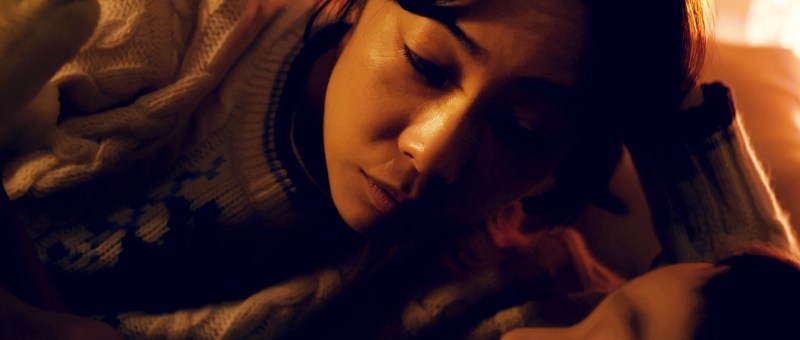
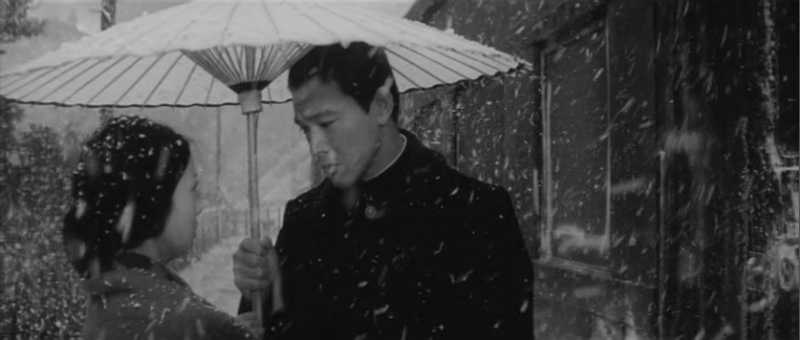
“Why can’t a woman have the freedom to pursue her own happiness?” wails an extremely conflicted woman in Keisuke Kinoshita’s The Tattered Wings (遠い雲, Tooi Kumo), though it appears she may have completely misinterpreted the desires of the woman she is speaking to. By 1955, provincial Japan had perhaps returned to a kind of peaceful normality but times were changing here too, just in ways that seem slightly unexpected. In this case, the problem is not curtain twitching grannies keen to enforce the social order, but a pair of young punks hoping to stir up trouble through malicious gossip for motives which are entirely unclear save resentment and desire to rebel against their own lack of prospects in an otherwise rigid society. 

All the trouble starts when brooding intellectual Keizo (Takahiro Tamura) returns from Tokyo for a 10 day visit with his family before taking up a job transfer to Hokkaido after which he claims he will not be able to see them for several years. Before he left, Keizo had been sweet on Fuyuko (Hideko Takamine), but she eventually consented to an arranged marriage to support her parents’ failing business and is now a widow with a small daughter. Though the marriage was abusive, since her husband’s death Fuyuko has been happy in her married home, spending time with her husband’s sensitive younger brother Shunsuke (Keiji Sada) and there is some talk that they may later marry. 

Though this kind of quasi-incestuous union of a widow and her brother-in-law may have fuelled countless other melodramas, it is not the problem here so much as its potential solution. After running into him by chance at her husband’s grave, a strange place to reencounter an old lover, Fuyuko is seen in several places around the town walking and talking with Keizo. There is nothing more to their relationship than that, a man and a woman talking at a respectful distance in public, but the young toughs at the station who always carried a torch for the beautiful Fuyuko decide to start a nasty rumour that there is something improper going on. 

In real terms, of course, there isn’t, but there is a kind of silent pull between Keizo and the lonely Fuyuko that is much more difficult and ambiguous than one might expect it to be. Keizo clearly wants to pick up where they left off, but is intense and awkward, motivated to urgency by the briefness of his stay. He forgets that he’s been gone a long time and Fuyuko is no longer the carefree 19-year-old she was when he left, but the mother of a young girl who claims that she has long since lost the ability to dream. Brutalised by her abusive husband, she is unwilling to stake her hopes on new romance and is wary of becoming a middle-aged woman chasing a return to the past in embracing an idealised first love in flight from its complicated reality. She accuses Keizo of trying to project his own dream of the past onto her, wanting to return to the possibilities of his youth rather than really in love with a woman he now barely knows. 

Meanwhile, Fuyuko is pulled in two directions by her respective families. Her older sister is embittered, resentful of their mother who refused her permission to marry a man she loved because he wasn’t wealthy and they wanted a son to marry in, while her younger sister has herself long carried a torch for Keizo and is acting more out of jealousy than genuine concern. Faced with crisis, the families of both Fuyuko and Keizo affirm that they don’t care what anyone might say about it so long as their children are happy, but the problem is that Fuyuko no longer knows what she wants. Keizo accuses her of tearing off her wings rather than using them to fly, but perhaps what she wanted all along wasn’t an excuse to leave but one to stay. Maybe what she wants isn’t actually what everyone expects it to be, and the permission she’s trying to give herself is the right to be comfortable with a slow and steady kind of love at the side of a patient and compassionate sort of man who’d be content to let her choose and know he’d been her choice. Fuyuko’s wings may be tattered, but she is in a sense pursuing her own happiness in choosing the present over an unrealistic dream of adolescent romance.


Opening and titles (no subtitles)

Snow Trail (銀嶺の果て, Senkichi Taniguchi, 1947)

The cinema of the immediate post-war era might in a sense be aspirational, but it rarely shies away from hardship or from the sometimes difficult choices which had to be made both in terms of individual survival and the future direction of a society. Remembered chiefly for featuring the debut of screen legend Toshiro Mifune, Senkichi Taniguchi’s Snow Trail (銀嶺の果て, Ginrei no Hate) is less a crime doesn’t pay story than it is an affirmation that it’s never too late to turn back and that people who do “bad” things aren’t always “bad”, only troubled and desperate, but can be guided back towards the right path by the power of simple human goodness. 

As the film opens, a trio of thieves commits a daring bank robbery and then heads off on the run intending to hideout in the mountains posing as tourists on a skiing trip. To facilitate their ruse, they’ve cut off communication by fiddling with radios and disabling telephones but two young men with too much time on their hands have already heard about the robbery and figured out the three suspicious gentlemen might be the fugitive criminals. In another picture, the two young guys would be the bumbling heroes, mistaken in their assumption that their world has been invaded by crime and probably finding romantic disappointment before heading home. This time however their guess is correct and their investigation has placed them in danger. The leader, Nojiri (Takashi Shimura), whips out a gun on a collection of drunken labourers and forces them out of their clothes and into the hot spring so the gang can make their escape further up the mountain, eventually taking refuge in a tiny lodge run by a philosophical grandpa (Kokuten Kōdo) and his cheerful teenage granddaughter (Setsuko Wakayama).

The police are in hot pursuit, but it is by nature which we will be judged. After leaving the hotel, the trio stop briefly in a ranger’s hut where hotheaded youngster Eijima (Toshiro Mifune) suggests splitting up. Nojiri divides the loot, giving each their promised share, but the other guy, Takasugi (Yoshio Kosugi), objects. He doesn’t want to go it alone and resents being forced to make his own way, even wondering out loud how long they’d get if they gave themselves up now. After a fight knocks Takasugi out, Eijima is keen to leave him behind, but he ends up spelling his own doom when he fires his gun at the police and provokes an avalanche.  

Later the patient grandfather tells us that the “mighty mountain punishes the bad”, and Takasugi is presumably its first victim, paying the price for panic and cowardice. Meanwhile, Nojiri and Eijima find themselves playing tourists once again in the mountain lodge where Nojiri is touched by the simple innocence of the young girl and her grandfather and Eijima paces around impatiently like a caged animal, cruelly killing the little girl’s prized carrier pigeon in case it takes it upon itself to signal the authorities. Threatening the girl’s life, Eijima convinces another guest, Honda (Akitake Kono), to guide them safely over the mountains to escape, but becomes increasingly paranoid that he will be betrayed, knowing he does not have the skills to survive alone in this environment. 

Nojiri meanwhile is drawn back towards humanity. Already softened by Harue, the cheerful young woman at the lodge who innocently offers him honey tea and reminds him of his own daughter who passed away at a similar age, he remains conflicted in their coercion of Honda and even more chastened after Honda saves both of their lives when Nojiri slips breaking own his arm in the process. Later, Nojiri asks him why he helped them rather than just cutting the rope and escaping. He replies that all he did was respect the code of the mountains. “The rope that ties one life to another must never be touched” he tells him. 

In an unexpected twist, Nojiri’s humanity is reawakened by a song filled with nostalgia but it isn’t Furusato or Akatombo, it’s “My Old Kentucky Home” played in an instrumental version on Harue’s portable record player, previously used by Honda who performed a silly dance to tune of Oh Suzannah. The choice of music perhaps echoes the movie’s Hollywood inspiration, but otherwise follows the pattern of other similarly themed contemporary crime movies in which the hero is eventually redeemed by connecting with his own childhood innocence through the “furusato” spirit. Still able to find this essential goodness within himself, the mountain has judged Nojiri favourably, proving that as grandpa says he isn’t a “bad” person even if he’s made “bad” choices. Filled with a new respect for the ropes that bind one human to another, he is allowed to return to the world presumably to live a more connected existence cheerfully helping others rather than remaining selfishly alone.


Haze (ヘイズ, Shinya Tsukamoto, 2005)

“Nothing spectacular is waiting for us even if we get out of here anyway” according to the imprisoned hero at the centre of Shinya Tsukamoto’s Haze (ヘイズ). Tsukamoto began his career with a series of tales of urban anxiety, a fear of increasing mechanisation which rendered a man mere slave to his physicality. Created as part of Jeonju International Film Festival’s digital project and later expanded to its current length, Haze skews in a slightly different direction, repurposing the director’s trademark body horror as a kind of depression metaphor as the unnamed hero, played by Tsukamoto himself, attempts to climb out of a pit of despair while experiencing momentary echoes of the traumatic event which has trapped him there. 

As the film opens, a man (Shinya Tsukamoto) wakes up in a confined space with no knowledge of how he got there or memories of his previous life. He convinces himself this must be a dream but believes if it were he would’t feel pain, which he later does not least from the gaping and unexplained wound near his hip. Left with no other choice, he crawls forward in search of an exit, gripping on literally by the skin of his teeth as he climbs through barbwire, beaten on the head by a strange contraption attacking him from what looks like an arrowslit in a castle. He glimpses other figures writhing in pain through a gap in the wall, some of whom are then torn apart while he later comes across great machines of human butchery and finds himself wading through severed limbs until he finally encounters another survivor, a woman (Kaori Fujii), who is minded to escape the way she believes she came in while the man is already beginning to give up on the idea of survival. 

The man meditates on what might have brought him here, as if it makes a difference or would help him to escape. He wonders if a war has broken out and he’s been taken prisoner, has been abducted by a weird cult, or is a plaything of a “rich pervert” enacting his own version of The Most Dangerous Game. He is perhaps crawling through hell, only one that may be of his making as a kind of metaphor for life’s battering as he pushes forward blindly, lacerating himself in pursuit of freedom while strangely indifferent to the suffering of others who appear not to have been so lucky. 

The woman is unable to provide any more explanation, lamenting that this may be their finally resting place but insisting that she is getting out. The man isn’t so sure, listening to her plan with scepticism, but once again wondering how he got here. Asked who is behind this the woman can only reply that it seems to be “a really big and dark thing, neither a human being nor a beast. You find yourself in total darkness being dismembered and floating in the water”. “If you see nothing ahead you eventually end up here” the man replies. After drifting off, the woman tells the man that she had a sensation of waking up alone somewhere dark and feeling lonely, “like falling into a place like this”. 

Later she remembers that she wanted to go somewhere, but was imprisoned here before she could run away. The man harps back on his theories again, wondering if it was a rich pervert after all, though this seems like a lot of bother to go to for sadistic kicks. He doesn’t stop to wonder what it was the woman wanted to escape, life itself or an intolerable situation and what the motives might be of the person who tried to stop her leaving. In fact, his own “sweet memory” is a bright and cheerful one of watching fireworks which he remembers liking a lot, though fireworks are perhaps also tiny sparks of life which blink out far too soon. Questioned about the motives of the hypothetical rich pervert, the woman suggests he might have done something like this to make her “go back” to wherever it was that she was desperate to leave. In any case, even if it’s back “there”, she is determined to escape and, perhaps paradoxically, gives the man the courage to follow though it’s he who eventually vows to “save” her. 

The path towards escape is itself a kind of rebirth, pushing through blood and viscera towards the light, the hazy dawn of the title. Something has perhaps been overcome if only in the brief moments of unconsciousness between life and death and perhaps because of that single “sweet memory”, unreliable and hazy as it might eventually prove.


Haze is available on blu-ray as part of Third Window Films’ Tsukamoto box set which also includes his latest film Killing and a new restoration of Adventures of Electric Rod Boy all of which are accompanied by audio commentaries by Tom Mes.

Let Him Rest in Peace (友よ、静かに瞑れ, Yoichi Sai, 1985)

“There are times when you need to stand for something” according to an ultra masculine avenger giving a few lessons in manliness to the already defeated teenage son of a friend. A noirish, stranger in town affair, Yoichi Sai’s Let Him Rest in Peace (友よ、静かに瞑れ, Tomo yo, Shizukani Nemure) locates itself in an awkward frontier landscape, moribund small-town Okinawa seemingly devoid of life now that the Americans have pulled out and moved on. The Americans have, however, been “replaced” by beefed up corporate thugs backed by yakuza muscle and corrupt police. Sometimes you have to take a stand, if only to show them that you won’t be pushed around because if you give in once you’ll never be free. 

Disgraced doctor Shindo (Tatsuya Fuji) has come to Okinawa in search of the Freein, but every time he tries to ask someone for directions, he is met with intense hostility, the last man even telling him “You shouldn’t go there, that place is no good”. This is not because the Freein is mostly home to a collection of brassy sex workers, but because its owner and Shindo’s old friend whom he has come to help has become a local pariah. Sakaguchi (Ryuzo Hayashi) is currently in jail because he apparently went crazy and started waving a knife around at construction magnate Shimoyama (Kei Sato). As Shindo quickly finds out, Shimoyama is in the process of buying up the whole town and Sakaguchi is the last remaining hold out. As such, he is hated by most of the other residents and the subject of persistent harassment by Shimoyama goons who have not only thrown bricks through the windows but gone so far as to kill his son’s dog, later kidnapping the boy to put pressure on the pair of them. 

What’s not lost on Shindo is the extent to which Shimoyama’s corruption has already seeped into the town. Meeting Sakaguchi’s son Ryuta (Makoto Mutsuura) by chance, Shindo takes the boy to see his dad but is again met with hostility by the local bobby, Tokuda (Hideo Murota), who tells him that “Shimoyama Construction is the savour of this town”. “There’s no other company that is so giving”, he goes on, “to have the employees of a company like that working here, I can’t have a wild man like Sakaguchi running about”. According to Tokuda, Sakaguchi is the odd man out, an inconvenience to all those around him who believe in Shimoyama and are trying to save the town. Tokuda looks sheepish when Shindo asks him why he’s so into Shimoyama, confirming the mild suspicion aroused by his improbably fancy watch. 

Tokuda’s warning is however borne out by the townspeople who continue to shun and ignore Shindo while the other kids mercilessly bully Ryuta, calling him the “craziest kid in Japan” and calling for his dad to get the death penalty despite the fact that all he seems to have done is aggressively wave a fruit knife at the wrong person. The local cafe owner describes him as an embarrassment and accuses him of holding out to get more money. After all there’s no future in this tinpot town which seems to exist in the ruins of the post-war era and Shimoyama is already offering triple the going rate so Sakaguchi is only being greedy and selfish. Komiya (Ryoichi Takayanagi), the bellboy, if you could call him that, at Freein, spins it slightly differently, explaining that no one supported Shimoyama in the beginning but they’ve all been harassed themselves and have long since given in. Shindo convinces Ryuta to talk about his kidnapping, but Ryuta tells him that on his return he told his father they should leave, that it was pointless to resist. Shindo asks him if he’s ever been in a fight, but the boy asks what the point is if you know you’re going to lose, “the strong are always strong”. 

That kind of defeatist thinking is anathema to Shindo’s conception of manhood. Despite his father’s incarceration, Ryuta is too afraid of being kidnapped again to go to school. Trying to be nice about it, Shindo calls him a coward for telling his father to leave even though he wants to stay because he allowed himself to be threatened into sumbmission. He tells him that he has to stand up for himself, report his kidnapping to the police. Ryuta tells him he’s crazy, the police are in on it, but Shindo counters that it’s worth trying to get his father out of jail because if they don’t they’ll never know. Ryuta snaps back that he knows already, and indeed bottles his chance when Shindo manipulates Tokuda into “helping” him oppose Shimoyama’s cult-like hold over the town.  

Shindo might not be that much better, he’s prepared to fight dirty, getting hard evidence of Tokuda’s corruption and trying to use it against him but even these methods prove ineffective against such a vast and entrenched mechanism of control. Shindo also realises that Shimoyama’s minion Takahata (Yoshio Harada) is another old university classmate, a member of the boxing club, bringing this widening drama down to the level of three men who went to the same prestigious university but all ended up here, pretty much at rock bottom. Though ironically enough Shindo’s broody silence and dedication to his friend have a few of the women wondering if he might be gay, his preoccupation is with a failure of masculinity. He doesn’t think Shindo was actually capable of threatening anyone, and knows that he had reasons that he might have wanted to try and sort this out sooner rather than later. His son’s words pushed him over the edge. He used his body as a weapon, tried to make Shimoyama damn himself, but his efforts were frustrated. Shindo acknowledges that “saving” his friend might look quite different than one might think, inadvertently teaching young Ryuta a few problematic lessons about what it means to be a man. Still, the town might have been “saved” in one sense at least in being freed of this particular oppressor. A stand has been taken, and a man’s self worth restored, but as Sakaguchi’s wife (Mitsuko Baisho) points out even while fully understanding the codes by which the men around her live, what is to become of those left behind?


TV spots (no subtitles)

Living by Karate (無鉄砲大将, Seijun Suzuki, 1961)

Nikkatsu’s brand of youth cinema could often have a nasty edge, its damaged heroes caught up in complicated rebellion but necessarily outsiders in a changing world which they feared held no real place for them. For each of those, however, there are others filled with life and possibility, not to mention a cartoonish sense of fun and infinite safety which perhaps largely disappeared from the films of the 1960s only to be found again in Kadokawa’s similarly aspirational teen movies of the bubble era. 

Living by Karate (無鉄砲大将, Muteppo Daisho, AKA Reckless Boss / A Hell of a Guy) once again stars Koji Wada as an earnest young man kicking back against the corrupt wartime generation. Still in high school, Eiji has a part-time job at an ice rink which he doesn’t treat quite as seriously as he ought to but his boss lets him get away with it because his handsome face is a hit with the local ladies. Eiji and two of his friends are keen members of a karate club and have decided to use their skills to fight for justice in their lawless town by going on “patrol”, clearing up the kinds of crimes the police might not make it to in time. Their plan backfires, however, when they come across the body of a recently deceased union leader and are arrested by a local bobby after getting caught with a joke knife one of the boys made for fun at his job on the family scrap yard. 

It comes as no surprise that Eiji’s arch enemy, sleazy mob boss Shinkai (Nakajiro Tomita), is behind the murder, apparently hired by a corrupt corporate CEO trying to stop his workforce exercising their legal rights. Eiji hates Shinkai because he bankrolled his widowed mother’s (Kotoe Hatsui) bar business but did so perhaps in return for being able to control her and by extension him by wielding his economic power against them. His loathing intensifies once he realises that the slightly older young woman he’s carrying a torch for, Yukiyo (Izumi Ashikawa), has fallen for one of Shinkai’s men, Goro (Ryoji Hayama). 

Goro is the classically “good” gangster who feels indebted to Shinkai because he took him in after the war, but wants to leave the underworld behind, going straight in Kobe where he intends to live a settled married life with Yukiyo. The modern yakuza is in many ways a Showa era phenomenon, a mechanism for men without families to protect themselves in the desperate post-war environment. By 1961, however, its existence was perhaps becoming harder to justify. The war orphans had grown up and had families of their own, the economy had significantly improved, and there was no need anymore to live a life of crime and heartlessness – a conclusion Goro has come to on his own after meeting the earnest Yukiyo who has similar problems with her goodhearted yet permanently drunk doctor father. 

Knowing he might have messed things up for his mother in interfering with her relationship with Shinkai, Eiji confesses that doesn’t “know what to do with the grownup world”. For him, everything is still very black and white. He hates yakuza because they prey on the vulnerable and Shinkai in particular because he does it so insidiously, forcing desperate people to accept loans on bad terms so that he can in fact “own” them and use them as he wishes. Eiji and his peer group kick back against what they see as the selfish corruption of the wartime generation, agitating for a fairer, more just world. The wealthy daughter of a corrupt CEO (Mayumi Shimizu) who has a crush on Eiji though he only has eyes for Yukiyo comes up with the idea of selling her fancy car to get money to help Eiji’s mother escape Shinkai’s control, but her father snaps at her that other people aren’t her responsibility and that she doesn’t understand how the real world works. 

Somewhat chastened by the youngsters’ pure hearted love of justice, he eventually comes up with a compromise in buying the car off her himself, but before that Eiji and his friends have to think carefully about the form they want their revolution to take. Taking him to task, Yukiyo points out that if all you do is fight with yakuza then maybe you’re a yakuza yourself, which shifts Eiji’s perspective towards ensuring that his rebellion is fully legal and involves the justice systems already in place. He comes to recognise that Goro is much like himself, and if he’s going to take down a sleazy brute like Shinkai it will take more than some fancy karate. Their resistance starts at home, giving others courage to stand up to yakuza oppression while living right themselves in the hope of creating a better, fairer world free of heartless organised crime.


Parallel World Love Story (パラレルワールド・ラブストーリー, Yoshitaka Mori, 2019)

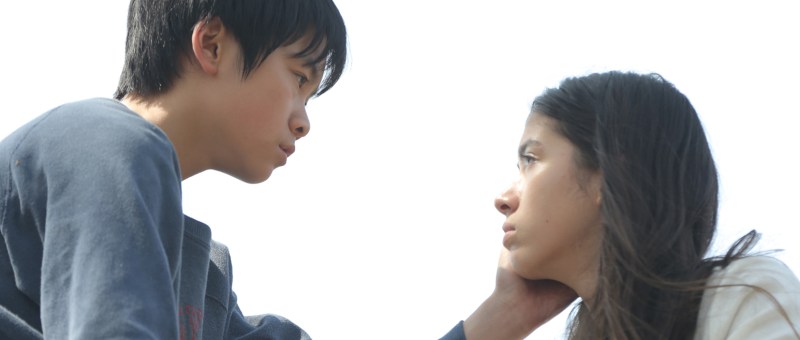
Have you ever had the feeling that you’re going out of your mind? Something just doesn’t feel right, your sense of perception and memory of the past don’t match the “reality” you’re currently experiencing but you have no way of knowing what’s at fault, you or the world. The hero of Parallel World Love Story (パラレルワールド・ラブストーリー) finds himself in just this situation as he begins to experience two very different states of being, one in which he’s living happily with the love of his life, and another where she’s dating his childhood friend. Is he a love crazed fool, or is someone messing with his head?

Travelling the same train into college every day, Takashi (Yuta Tamamori) fell in deep silent love with a young woman whose train crossed his every Tuesday morning. On his very last Tuesday, he decided he’d switch trains and try to find her, but she did exactly the same thing and so they missed each other, leaving Takashi feeling as if his fated romance was matter for another universe. He is then shocked when an old friend from middle school, Tomohiko (Shota Sometani), introduces that same young woman, Mayuko (Riho Yoshioka), as his girlfriend some time later. A little resentful at this twist of fate, Takashi tries his best to keep his feelings hidden. Meanwhile we see him “wake up” in his own apartment where Mayuko, who lives with him, is lovingly making him breakfast. He has a vague recollection of Tomohiko turning up in his dream, but can’t seem to remember what it is he’s doing these days. In this “reality”, Tomohiko introduced Mayuko to Takashi, and has abruptly moved to LA without even saying a proper goodbye, apparently working on a top secret research operation which keeps him entirely out of contact. 

Both men are involved with the research of perception and memory. Talking to another friend before “meeting” Mayuko, Takashi points out that it’s your brain which constructs the current reality from your sense perception. He grasps her hand and her brain tells her she feels it, but she’d feel the same thing if he isolated and activated the relevant sectors of her brain which tell her her hand is being grasped. Tomohiko, meanwhile, has gone one step further. He’s discovered that it’s neural networks rather than the brain which store memories and that, by stimulating those neural receptors in a particular way, memory can be rewritten or fake memories introduced. He proves this by illegally experimenting on a friend, making him think he’s from Tokyo when he’s really from Hiroshima, and reconstructing the image of an old teacher so that she’s now a pretty young woman and not a portly old man. 

The gap between what you want to be true and the “reality” is shrinking. It turns out that it’s easy enough to trick yourself into thinking something is true when it isn’t when you really want it to be. According to Tomohiko, once your brain has decided to approve the “fake” reality, cognitive dissonance is overcome by everything else being forced to fit into your new conception of the world. Takashi, however, is struggling to integrate his two parallel lives, one bleeding inconveniently into the other leaving him wondering which one is the “reality” and which the “dream”. 

Takashi’s less palatable qualities, however, exist firmly in the recent past of reality A in which romantic jealousy appears to have driven him half out of his mind, causing him to semi-stalk the innocent Mayuko and consider betraying his childhood friend by stealing the woman he loves. Takashi’s sole justification for his behaviour is the unspoken romantic connection which brought them together on the train, a connection he is “certain” she remembers without being given any particular encouragement from her side. Reality B Takashi, who lives with Mayuko, similarly becomes obsessed with the idea that Mayuko in some way belongs to Tomohiko, awakening an unpleasant sense of misogyny in his desire to prove that Mayuko is his because he saw her first on the train. 

Meanwhile back in Reality A, he starts to suspect that Tomohiko is up to no good pursuing unethical research practices and working towards a sinister goal. It’s unfortunate that Tomohiko also has a prominent limp from a lame leg, playing into the unpleasant association of villainy and disability. Even Takashi, having turned dark, accuses Mayuko of dating him out of pity, while Tomohiko describes him as a “hero” for having rescued him from childhood bullies. Takashi starts to suspect him, not only of being a mad scientist, but perhaps actively hostile and plotting revenge against him for stealing Mayuko. In a particularly Higashino-esque touch, Tomohiko’s motives turn out to be kinder than they might at first seem even if they’re a little on the extreme side, leaving Takashi pushed to make a similarly extreme yet strangely counterproductive move by his infinitely shady boss who is also exploiting the increasingly conflicted Mayuko. Yet, aside from all the philosophical musings on the nature of reality, the interplay of desire and memory, and the ethics of manipulating the perception of others, this is in essence a love story between two people who gazed at each other from passing trains. If you find each other once, you can find each other twice, and, in love, reality might not be so important.


Original trailer (hit subtitle button for English subs)

Detective Hibari 3: Hidden Coin (ひばり捕物帖 ふり袖小判, Kokichi Uchide, 1959)

Hibari Misora returns as Oshichi in another adventure for the Edo detective, this time becoming embroiled in a conspiracy against the Shogunate which she continues to serve. By this third instalment in the Detective Hibari series, Hidden Coin (ひばり捕物帖 ふり袖小判, Hibari Torimonocho: Furisode Koban), Oshichi is no longer hiding her noble birth as an esteemed princess, but is living as a singer/law enforcement officer under her “common” name, and upholding the interests of “common” people suffering under “corrupt” samurai oppression but, paradoxically, very much upholding the system which enables it.

The conspiracy in which Oshichi becomes involved this time around is concerned with the plot to overthrow the Shogunate. Rebel forces manage to ambush a convoy carrying tax money to the government, hoping to use the money to buy guns from the Dutch to aid their revolution. As only one of the retainers survives, he will be held responsible for the loss of the money and almost certainly asked to commit ritual suicide, but the Ota clan and most particularly retainer Kennoshin (Kotaro Satomi), are worried about the man’s daughter, Misuzu (Atsuko Nakazato), to whom he was very close. Oshichi becomes involved when she hears of an entire household being murdered and their funds stolen, while a lone pickpocket is found dead with a precious gold coin lying nearby. 

Before discovering the crime, Oshichi and her trusty sidekick Gorohachi (Takehiko Kayama) are talking to a kabuki actor who is about to undergo a succession ceremony which will cost a significant amount of money – 1000 Ryo. Gorohachi is mystified, wondering how many years he’d have to work in order to find that kind of money, while the two pickpockets outside wonder something much the same. The older of the two, Oshima (Keiko Yukishiro), wants to make sure the actor gets his money and has been desperately trying to get in touch with him but he is too snooty to see her. Oshichi starts connecting the dots between the pickpockets and the conspiracy to find a vital clue, but once again is keen to stress that “the law can be merciful too” as she both ensures that Oshima faces justice and allows her to find emotional fulfilment in revealing her true identity and finally seeing the show. 

Meanwhile, despite outwardly dressing in manly, action friendly outfits, this Oshichi is one more romantically inclined, fretting over the fate of her brother’s retainer Hyoma (Chiyonosuke Azuma) who, she thinks, has left his employ and become a drunkard. The drunken downward spiral of his life turns out to be a kind of undercover assignment, but provokes a little jealousy in Oshichi as she sees him “protecting” other women at a nearby restaurant, one of whom turns out to be Misuzu who holds a few more pieces of the puzzle. Vowing to save Misuzu and stop the conspiracy, Oshichi adopts a male persona complete with top knotted wig and takes on an entire boatload of sailors who stupidly tell her that they’re shipping out that very night. 

Oshichi rescues Misuzu and gets the money back, saving her father and “restoring” the status quo, but it’s difficult to see which side she should be on in this fight. As Gorohachi perhaps implies, it’s not exactly fair or responsible for the samurai class to be hoarding all these vast amounts of money, or for it to be necessary to spend the annual salaries of several ordinary people on an extravagant celebration for an actor’s promotion. We’re told that the rebels are “evil” and villainous, and they do indeed seem to be cruel and self-interested, willing to sacrifice anyone and everyone to achieve their goal, but it’s difficult to argue with the desire to stand up to this inherently oppressive system in which samurai corruption is the expected norm. 

Insisting that “the law can be merciful”, Oshichi serves a kind of moral justice, rescuing the innocent Misuzu and saving her wrongfully abused father while unmasking samurai corruption, but she remains a loyal servant of the Shogunate and a part of the system into which she was born. Oshichi has been permitted escape from her own oppression thanks to her “compassionate” brother who has allowed her to live freely in the city rather than pressuring her to marry and conform to the feminine norm, but living outside it herself seemingly has no sympathy for those who wish to reform the system and seeks only to preserve it. Having successfully solved the mystery, she reassumes her femininity and retreats into the cheerful festival atmosphere arm in arm with a clean shaven Hyoma finally embracing her romantic dream in an Edo freed from immediate strife. 


Short clip (no subtitles)

Detective Hibari 2: Secret of the Golden Coin (ひばり捕物帖 自雷也小判, Kinnosuke Fukada, 1958)

Oshichi returns! Two years after her first adventure, the princess in hiding has moved on, still living in the city hiding from the burdens of privilege but fiercely opposing injustice wherever she finds it as a detective in her own right. Unlike Mysteries of Edo and in keeping with Case of the Golden Hairpins, this Oshichi undergoes much less of a softening, remaining largely disinterested in the idea of romance, and cooly rebellious in her refusal to be cowed while strangely OK with Shogunate oppression as a quasi-agent of the state. 

As the film opens, a young woman impersonates Oshichi in order to gain entrance to a prison where her boyfriend is in jail for rebelling against the Shogunate. Meanwhile, Oshichi (Hibari Misora) is teaching a singing class as a favour to her boss who had to go out on an errand, after which she discovers that Hyoma (Chiyonosuke Azuma), currently a retainer of her brother’s, has been sent to bring her home. Once again she refuses because she likes her “ordinary” life. Shortly thereafter, a fire breaks out in the prison and the rebels escape. Oshichi becomes a prime suspect in the jailbreak, not only because the accomplice borrowed her name but because it’s advantageous to the plotters to blame her because they can use her guilt to tarnish her brother’s reputation and get him fired, usurping his position in the process. 

Oshichi, now working as a detective, is technically an agent of the Shogunate against which the rebels are rebelling for reasons which aren’t stated here but are probably easy to guess. They are, in many ways, the same sorts of reasons that Oshichi chose to become a detective, even if she’s coming at them from the other side. She doesn’t like bullies, or corruption, injustice or unfairness. Oshichi won’t stand for unkindness either, which is perhaps why she aligns so strongly behind the woman who blackened her name by impersonating her, knowing that she did it all for love and a little bit for justice, while also forgiving the rebel Seinosuke (Kotaro Satomi) who was preparing to kill the woman he loved because the corrupt samurai had kidnapped his dad and threatened to kill him if he didn’t. 

Despite all that however, Oshichi still insists that “the Shogunate can be compassionate too”, encouraging Seinosuke and his girlfriend Namiji (Hiromi Hanazono) to tell all so she can help them safe in the knowledge that they will be forgiven. It’s a slightly strange position for to her take, essentially authoritarian but arguing for a benevolent paternalism that is just and fair and kind, insisting that the corrupt samurai are bad apples which must be expelled rather than a product of an inherently oppressive social system as they are generally depicted in post-war jidaigeki. 

This insistence on the “compassion” of the Shogunate is perhaps the concession to Oshichi’s femininity which she has otherwise rejected in rejecting her life as a cosseted princess. As Kawashima had in Mysteries of Edo, Oshichi’s “protector” Hyoma asks her how she can take on all those men before challenging her to a contest of masculinity as mediated through a drinking competition which she does not exactly “win” but makes a minor victory all the same. Rather than rely on her brother or Hyoma, Oshichi vows to clear her name herself and starts investigating on her own dressing as a man and fighting bad guys while insisting on her independence. 

Nevertheless, she is but a pawn in a game of courtly intrigue, manipulated as a means of getting to her brother. The corrupt samurai think nothing of killing anyone who gets in their way, be they princesses or peasants, even going far as to mount an attack on the stage of a theatre mid-performance in front of a room full of spectators, many of whom join Oshichi by throwing projectiles as she tries to fend them off. Once again, she isn’t quite permitted to save herself but is “rescued” by the patriarchal forces representing the greater Shogunate including her protector Hyoma, and her brother, the embodiment of state authority. She is, however, the primary motivator in unmasking the corruption as she both clears her own name, and creates a better future for Namiji in which she can be with the man she loves, reminding her to always remember the compassion the Shogunate has shown her (in case she was minded to mount any more rebellions). As for herself, she manages to slip the loop once again, running off into the wild to claim her independence rather than be forced back into the golden cage of her princesshood while the loyal Hyoma contents himself with following her lead. 


Short clip (no subtitles)

Detective Hibari 1: Case of the Golden Hairpins (ひばり捕物帖 かんざし小判, Tadashi Sawashima, 1958)

Two years after Mysteries of Edo and a year after its sequel, Hibari Misora returns as Oshichi in a new series of films, still living undercover in Edo solving crimes and living her best life as a singer and performer. Like Mysteries, Detective Hibari 1: Case of the Golden Hairpins (ひばり捕物帖 かんざし小判, Hibari Torimonocho: Kanzashi Koban, AKA Edo Girl Detective / Here Comes the Girl Detective) sees Oshichi investigating murders of women, though this time the crime is far less involved and much more typical of Toei’s period films in its venal samurai and their insatiable appetites for wealth and status. Oshichi is, essentially, an agent of the state but a much less ambiguous one than she’d become in the following pictures, fighting bravely against corruption and standing proudly for justice in the face of implacable samurai arrogance. 

Having escaped the cage of her noble birth, Princess Tae/Oshichi (Hibari Misora) is still living as an “ordinary” woman in Edo and has just won a singing competition to be named as Queen Beauty. The competition is marred however when one of the other contestants is offed on the way home. Still working with her trusty sidekick Gorohachi (Shunji Sakai), Oshichi quickly realises the woman seems to have been murdered with an ornate hairpin and starts an investigation.

What she discovers is that an unscrupulous gang of samurai is attempting to recover a set of three hairpins which were stolen in a robbery some years previously. The lord claims he’s doing it to satisfy his clan’s honour, but more likely has a less honorable goal in in mind. To put the plan in action, he’s mobilised his conflicted daughter, Sumie (Eiko Maruyama), who thinks this is all a bit much for set of shiny hair ornaments, and her boyfriend Tamiya (Kotaro Satomi) whose family originally owned the jewels which is why he sees it as his duty to get them back, even if that means murdering innocent women and sending the entire city into a panic in the process. Of course, Oshichi agrees with Sumie, and as usual immediately sympathises with her romantic dilemma which earns her a few sarcastic comments from sometime love interest Hyoma (Chiyonosuke Azuma) who will recur throughout the rest of the series.

Hyoma, posing as a drunken ronin but in reality shadowing Oshichi as a protector, like Kawashima in Mysteries, expresses consternation with Oshichi’s atypical feminity, echoing Kawashima’s words that “a woman should be feminine” while claiming not to find Oshichi’s manly fortitude very effective. Kawashima’s words may have wounded her, but Hyoma’s only irritate. She fires back that as a talented samurai he’s wasting his potential drowning himself in drink and he should “stop fighting and do something for society”. Meanwhile, she doubles down – dressing as a man and even joining a kendo dojo to spy on the corrupt lords, scrapping with the best of them and holding her own in a fight. 

Swinging the other way, another of her investigative tactics sees her posing as a geisha and then later as a noble lady, even getting dressed up in her formal princess clothes to beg a favour from her extremely understanding brother. Sympathy for Sumie and a few romantic songs may be the sole concessions to conventional femininity, but Oshichi remains proudly defiant and intent on maintaining her freedoms. It may be true that the unusual degree of freedom she has is permitted her because of her progressively minded brother who ignores “advice” from an elderly servant to exercise more control because he can see being of use to society makes his sister happy and that she’ll probably come home when she wants to, but it’s also freedom that she has actively chosen for herself and chooses to maintain. 

Oshichi gets drunk with Hyoma (apparently for the first time), fights bad guys, and gives orders that stop seasoned samurai in their tracks but not so much for herself as to help those like Sumie who have become victims of corrupt samurai ethics. She does this, however, as someone who largely believes in the righteousness of the system, that the Shogunate is kind and forgiving while local lords may be avaricious or cruel. When her brother arrives to save the day, he announces that the hairpins will be sent to the Shogun who will return them to the people, sharing the treasure with everyone rather than keeping it for himself. Oshichi, meanwhile has found something greater – a worthy sparring partner in the dashingly romantic Hyoma, and the confirmation of herself not as Tae the caged princess but Oshichi who owns the very ground she walks upon and allows no other to tell her where she may be permitted to go. 


Original trailer (no subtitles)

The Song of the Cart (荷車の歌, Satsuo Yamamoto, 1959)

“When all human beings acknowledge each other as human let the precious joy that results be universal. When this joy lives forever in the hearts of women and is handed down to daughters who become mothers then tomorrow will not just repeat today but be a new beginning” reads the opening title card/mission statement of Satsuo Yamamoto’s chronicle of early 20th century Japan. Told though the eyes of one very good woman wrestling against her baser instincts, Song of the Cart (荷車の歌, Niguruma no Uta) is a gentle plea for a little more empathy and understanding in which the heroine suffers greatly but is finally rewarded in managing to keep the darkness at bay. 

In late Meiji, Seki (Yuko Mochizuki) develops a fondness for the most eligible young man in town – the postman, Moichi (Rentaro Mikuni), who can read and write and isn’t bad looking either. To her surprise, Moichi admires her too and eventually proposes marriage, intending to give up his job as a postman which doesn’t pay as much as it used to now costs are rising because of the recently concluded Sino-Japanese war to buy a handcart with the longterm goal of building a small handcart empire with a warehouse of his own that will allow him to build a fancy house to live in. Seki hesitates, she’s an illiterate maid perhaps she isn’t good enough for the great Moichi but he replies that he couldn’t care less about that and only wants to know if she wants him. She does, but has to check with her parents first. They object to the marriage on the grounds that Moichi is penniless and disown her when she tells them she’s marrying him anyway. Disowned by her parents, she also loses her job as a maid and is forced to head to Moichi’s ahead of schedule where his extremely cold mother (Teruko Kishi) makes no secret of her resentment of her new daughter-in-law but is eventually forced to relent. 

Unlike Moichi and his mother, the other residents of the village and particularly its women are bright and cheerful despite the harshness of their lives. Swept off her feet by Moichi’s seeming sophistication, Seki is in for a rude awakening in realising that his work ethic is extreme and in many ways he’s just as cruel as his heartless mother. On her arrival, Seki’s mother-in-law complains that she brings “only a small bundle” while simultaneously suggesting that she somehow looks down on them because they are only poor people, insisting that she work alongside Moichi pulling carts to make their dreams of riches come true. Seki jumps at the chance to prove her love, but finds her mother-in-law unchanged. 

Pulling the cart through the village, Moichi and Seki pass another woman who seems put out by Seki’s presence, complaining that Moichi never bothered to reply to her own proposal. Moichi dismisses her complaints, avowing that he didn’t marry her because she wasn’t a worker, implying that he was only interested in someone who would work alongside him in pursuit of his goal of becoming a homeowner. Seki is indeed a worker, and a strong woman who bears her hardships with grace, but finds it increasingly difficult to put up with her mother-in-law’s heartlessness and adherence to old-fashioned feudal customs by which she claims her authority over the household while Moichi, as the dutiful son, always defers to his mother. When the first child arrives, Moichi declares that a daughter brings him no joy, while the mother-in-law who is supposed to be watching her, just lets her cry all day long and doesn’t even change her nappies. Out on the road, Seki comes across another couple in a similar situation who’ve brought their little one with them, riding in a bucket on the back of the cart. Seki wonders why they can’t do the same, then she’d at least know her daughter was alright and not crying her heart out in a dirty nappy, but Moichi won’t hear of it lest his mother be offended that Seki is suggesting she’s not looking after her granddaughter properly. 

Moichi works every hour god sends, but not so much to provide for his family as to improve his own status in the hope of owning a sizeable home, perhaps to “regain” the kind of position his mother thinks is theirs as descendents of the Heike. He exists on a kind of political fault line in his rigid austerity, believing that you really can make it just by working hard while also becoming the de facto spokesman for the other cartmen because he is the only one able to read and write. Yet faced with constant and obvious oppression of the eerily feudal kind in persistent rice profiteering he does nothing much to resist it and gives only grudging approval to his son’s intention of forming a train driver’s union. 

While Moichi has pinned all his hopes on handcarts, the future is fast approaching. A funeral procession of cartmen is greeted by the horse-drawn variety coming the other way as if to signal their imminent obsolescence. But the horsemen aren’t much better off. If Moichi couldn’t afford a horse, he’ll never afford a motor car and the mechanised age is on the horizon. The only work he manages to find ironically involves transporting lumber for the new railway line, but it’s a gamble that pays off and makes Moichi a wealthy man once again. 

Material comforts aren’t everything, however, and Seki struggles to reconcile herself to life with her increasing cruel mother-in-law and emotionally distant husband. She worries that she’s becoming what she hates, finding it difficult to find sympathy for Moichi’s mother now she’s ill in feeling that perhaps she’s getting what she deserves. Her friend advises her that that’s just “bugs” eating away at her heart and what she really needs to do is fly in the opposite direction, finally make a friend of her mother-in-law in trying to understand her. She has, after all, had a very hard life, starved of affection all these years as a young widow raising a son alone on little more than charcoal money. 

Seki meanwhile suffers numerous humiliations and heartbreaks, notably Moichi’s extremely unreasonable decision to bring his 50-year-old sex worker mistress to live with them in their home, but does her best to be generous and forgiving. As she points out, this house is half hers, she built it alongside Moichi and she won’t just vacate it so Moichi can do what he always does which is as he pleases (once his mother’s not around to tell him not to). Moichi perhaps pays for his feudalist follies and selfish authoritarianism in a fairly direct way which aligns him with his chastened nation waking up to the emotional costs of his mistakes, while Seki is finally rewarded. Unlike her mother-in-law she becomes a beloved neighbourhood granny giving rides to all the local kids while pulling her cart onwards towards the future like a reverse Mother Courage embracing her long absent son finally returned to her in recognition of her goodness.