Casting Blossoms to the Sky (この空の花 長岡花火物語, Nobuhiko Obayashi, 2012)

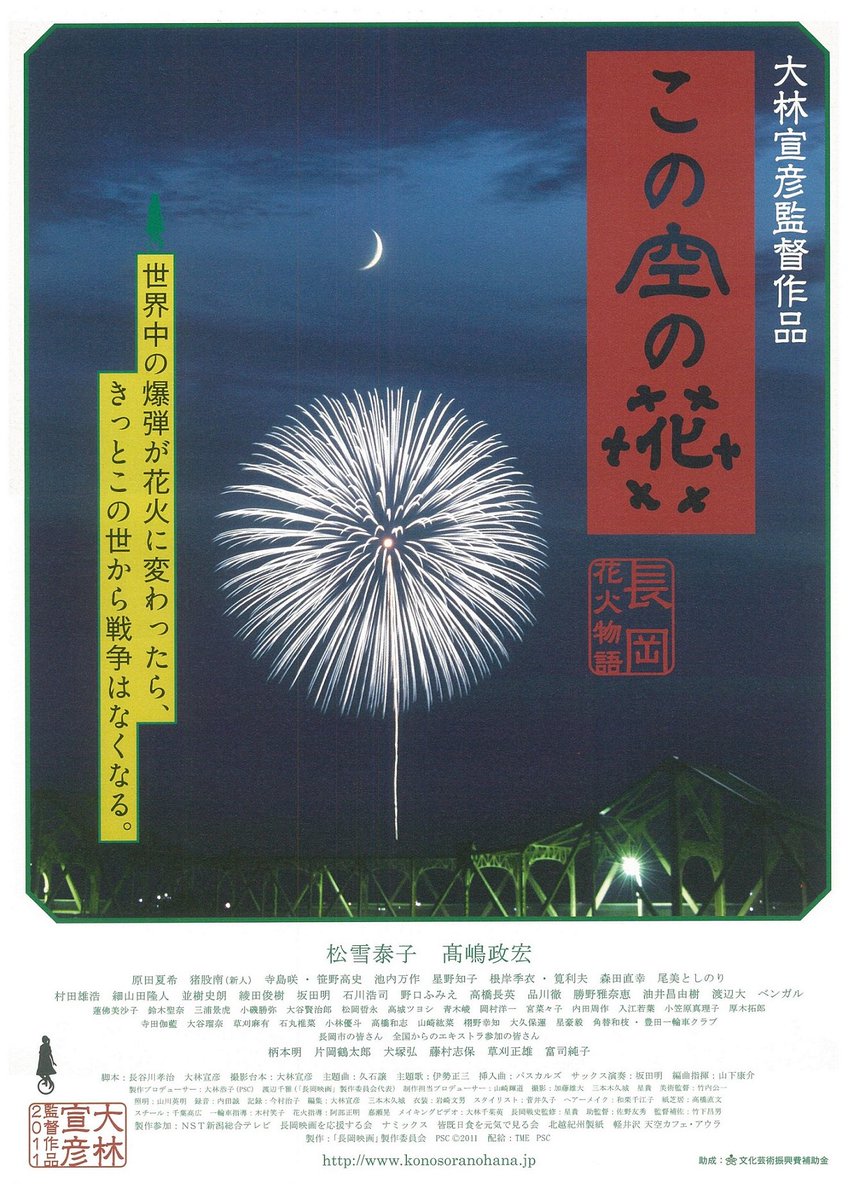
“There’s still time until a war” runs the title of a play for voices at the centre of Nobuhiko Obayashi’s oscillating docudrama, Casting Blossoms to the Sky (この空の花 長岡花火物語, Kono Sora no Hana: Nagaoka Hanabi Monogatari). Asking why when presented with the opportunity to create something beautiful that gives joy and hope to all who witness it mankind chooses death and destruction, Obayashi considers responses to disasters manmade and natural and finds largely kindness and resilience among those determined to avoid the mistakes of the past while building a better tomorrow. 

Set in the immediate wake of the 2011 earthquake and tsunami and inspired by verbatim interviews with local people, Obayashi’s elliptical drama sends an emotionally arrested newspaper reporter to Nagoka having received a letter from an old lover that calls her back into the past. Reiko (Yasuko Matsuyuki) broke up with Katayama (Masahiro Takashima) 18 years previously uttering only the cryptic phrase “we have nothing to do with war”, but travelling through her “wonderland” begins to realise that she and everyone else is in that sense wrong. No one is really entirely unconnected or untouched by the destructive effects of conflict and pretending that it’s nothing to do with you will not in the end protect against it. 

“To the children of the future, from the adults who lived the past” runs the opening title card, making plain a fervent hope to connect the often unknowing younger generations who assume war is nothing to do with them with the traumatic past through the voices of those who directly experienced it. The play to which Reiko is invited is in itself a play for voices, an avant-garde theatre piece inspired by the verbatim speeches of residents of Nagaoka recounting their often harrowing experiences of the war apparently penned by a strange high school girl (Minami Inomata) who rides everywhere on a unicycle. The performance is set to take place in conjunction with the local summer festivals which include a series of fireworks displays commemorating lives lost in the bombing raids and symbolising a spirit of recovery following a destructive local earthquake some years earlier. 

Obayashi draws direct comparison between the natural disasters of earthquake and tsunami, and the manmade disaster of war but discovers that ordinary people often react to them in the same way with a furusato spirit of mutual solidarity and kindness. One of Katayama’s students is a displaced young man from Fukushima who remarks on the kindness he experienced having been taken in by the town of Nagaoka, a kindness he hopes to repay someday when he is finally allowed to return to his own hometown just as the people of Nagaoka have done following kindness shown to them after the earthquake. The discrimination he faces as someone from a town affected by radiation calls back to that experienced by Reiko’s parents who were survivors of the atomic bomb that fell on Nagasaki, a location chosen by pure chance on a whim when poor weather made the primary target unavailable. Among all the horror of the wartime stories Reiko uncovers, there is also selfless heroism such as that of the young man bravely throwing water over those trapped in a burning air raid shelter. 

“If only people made pretty fireworks instead of bombs, there wouldn’t have been any wars” a poet laments drawing a direct line between these two very different uses of the same material, a connection further rammed home by twin visits to a fireworks factory and atomic bomb museum. The “phoenix fireworks” become a fervent prayer, blossoms cast to the sky, in hope of a better, kinder future without the folly of war. “There are adults who think war is necessary” Katayama explains, “but not the children, of course. That’s why it’s up to the children to make peace”. Some may complain that in the rapid economic development of the post-war society something has been lost, but in times of need people are still there for each other forging the furusato spirit in contemporary Japan. Opening with a series of silent-style title cards, Obayashi’s overtly theatrical aesthetics may be comparatively retrained even while incorporating frequent use of animation and surrealist backdrops, but lend an ever poignant quality to this humanist plea for a more compassionate world in which the only explosions in the sky are made of flowers and hope not hate or destruction. 


Casting Blossoms to the Sky streams in the US July 9 – Aug. 6 as part of Japan Society New York’s Tragedies of Youth: Nobuhiko Obayashi’s War Trilogy season in collaboration with KimStim.

Original trailer (English subtitles)

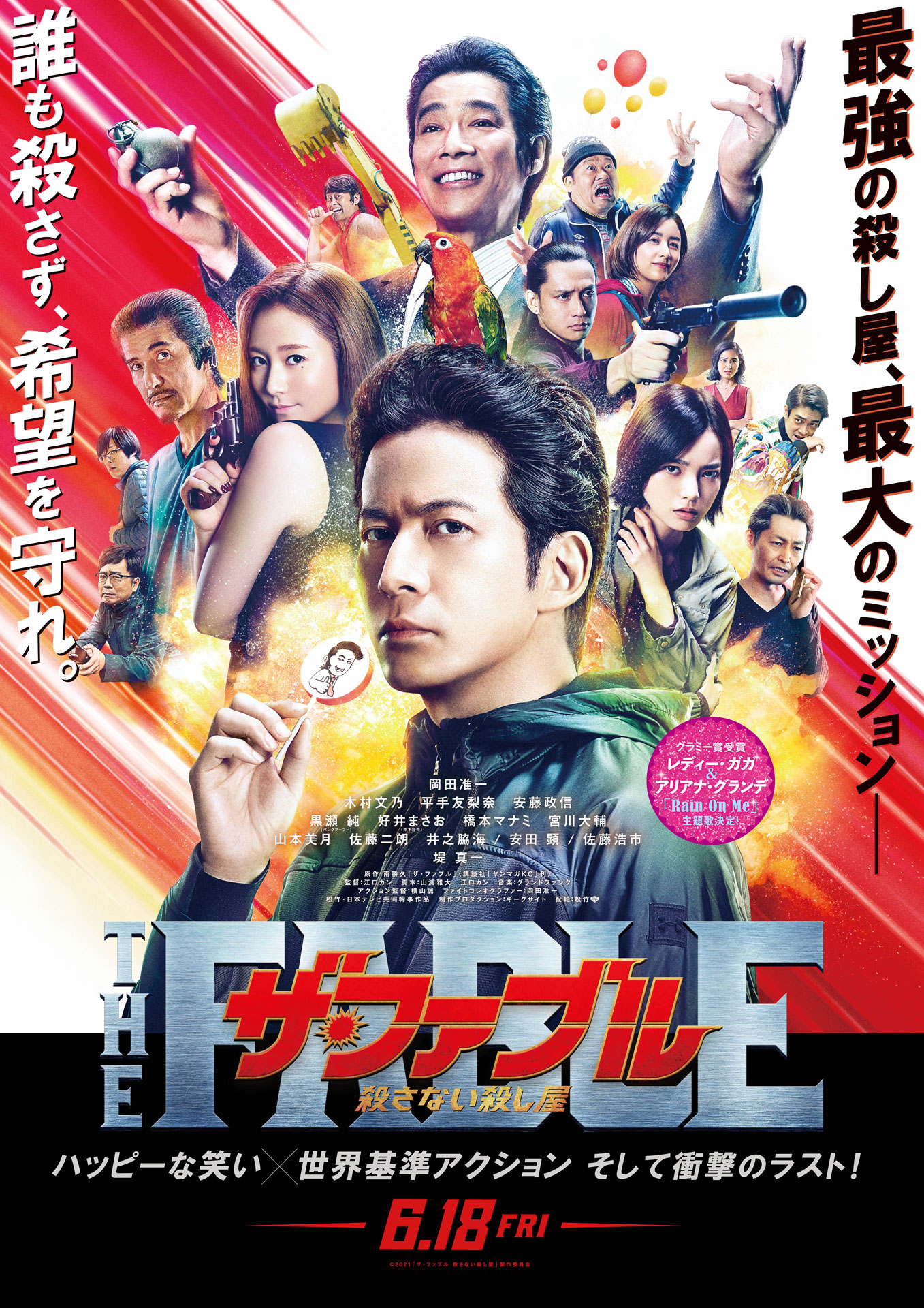
The Fable: A Contract Killer Who Doesn’t Kill (ザ・ファブル 殺さない殺し屋, Kan Eguchi, 2021)

Appearances can be deceptive. A case could be made that everyone is in a sense living undercover, pretending to be something they’re not in order to survive in a conformist society and most do indeed have their secrets even if they’re relatively benign. Others, meanwhile, are on a kind of sabbatical from a life of meticulous violence such as the hero of Kan Eguchi’s sequel to smash hit action comedy The Fable, The Fable: A Contract Killer Who Doesn’t Kill (ザ・ファブル 殺さない殺し屋, The Fable: Korosanai Koroshiya) or like his antagonist living a double life with his apparently genuine concern for the lives of disabled and disadvantaged children balanced by his business of targeting wayward youngsters for the purposes of extortion. 

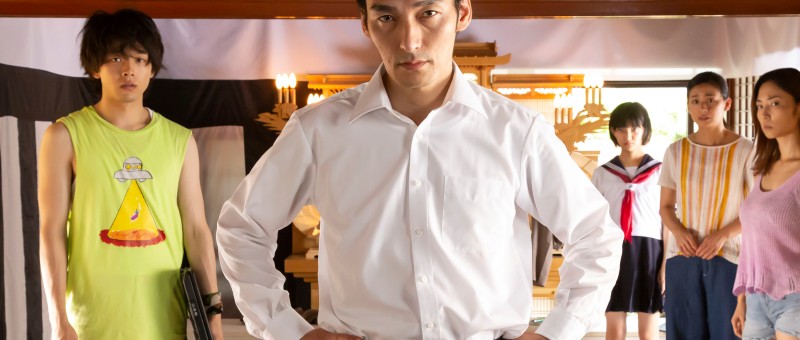
Some months on from the previous action, “Sato” (Junichi Okada), formerly a top Tokyo assassin known as The Fable, is successfully maintaining his cover hiding out in Osaka as an “ordinary” person with a part-time job in a print and design shop. His cover is almost blown, however, when his colleague Etsuji (Masao Yoshii) is targeted by Utsubo (Shinichi Tsutsumi), ostensibly the leader of a local organisation advocating for the rights of children but also a shady gangster who finances his “philanthropy” by extorting the parents of young people who’ve in someway gone off the rails. Etsuji’s crime is, as was exposed in the previous film, his spy cam habit and in particular his planting of hidden cameras in the home of colleague Misaki (Mizuki Yamamoto) with whom he has an unhealthy obsession stemming from her time as an aspiring idol star. Blaming Misaki for his misfortune, Etsuji turns to violence but is shut down by Sato who risks blowing his cover in order to protect her. Realising he has a previous connection with Utsubo, Sato makes the gang an offer they can’t refuse in order to get Etsuji back but quickly finds himself drawn into another deadly battle with bad guys endangering his still in progress no kill mission. 

Focussed this time much more on action than the fish out of water comedy of Sato’s attempts learn the rules of polite society having been raised in the mountains as a super efficient killing machine, The Fable 2 nevertheless wastes no time in exposing the murkiness of the “normal” world Sato is intended to inhabit. Utsubo is a hit with the local mothers, taken with his smart suit and professionalism as he gives “inspirational” speeches about park safety while making time to converse in sign language with a deaf little girl explaining to another mother that it’s important to “listen to every voice”. As part of his patter he implies his assistant, Hinako (Yurina Hirate), who uses a wheelchair, was injured in a freak park-related accident as a child when in reality she sustained the injury while trapped in the back of a car which veered off a roof after The Fable took out its driver. Vaguely recognising her in the local park, Sato takes an interest out of guilt as the young woman attempts to rebuild her strength in the hope of walking again though that might in itself be contrary to Utsubo’s desires. 

As in the first film, Sato may be a ruthlessly efficient killing machine but at heart he’s still childishly innocent, hoping to help the young woman he unwittingly hurt but also keen not interfere with her ability to help herself. Misunderstanding the situation, Hinako asks Utsubo to lay off Sato, explaining that he gives her confidence as she begins to realise that she can stand alone, as the sometimes uncomfortably ablest metaphor would have it, and no longer needs to be complicit in Utsubo’s nefarious schemes nor need she continue to punish herself in guilt over her traumatic past. While Sato and his handler Yoko (Fumino Kimura) pose as a pair of siblings watched over by their benevolent if absent boss (Koichi Sato), Hinako and underling Suzuki (Masanobu Ando) similarly pose as brother and sister only with the comparatively dubious guidance of Utsubo who affects kindness and generosity while burying problematic youngsters alive in the forest in order to extort money from their “protective” parents. “It’s always the villain who tells the truth” Utsubo explains, insisting that it’s shame and humiliation which build self-esteem in direct contrast to the gently invisible support which seems to have re-activated Hinako’s desire for life.

Sato has at least discovered the benefits of a well functioning and supportive “family” network thanks to the, as we discover, equally handy Yoko, and his still largely oblivious workplace friends. Amping up the action value, Eguchi careers from set piece to set piece culminating in a high octane chase through an apartment block and its eventually unstable scaffolding while making space for slapstick comedy such as two guys trying to move a piano at a very inconvenient moment. A gently wholesome tale of a pure-hearted hitman kicking back against societal hypocrisy while figuring out how to be “normal” in a confusing society, The Fable 2 more than builds on the promise of its predecessor while allowing its hero the space to grow as he begins to adjust to his new and very “ordinary” life.


The Fable: A Contract Killer Who Doesn’t Kill screens on July 7 as part of this year’s Neuchâtel International Fantastic Film Festival (NIFFF)

Original trailer (English subtitles)

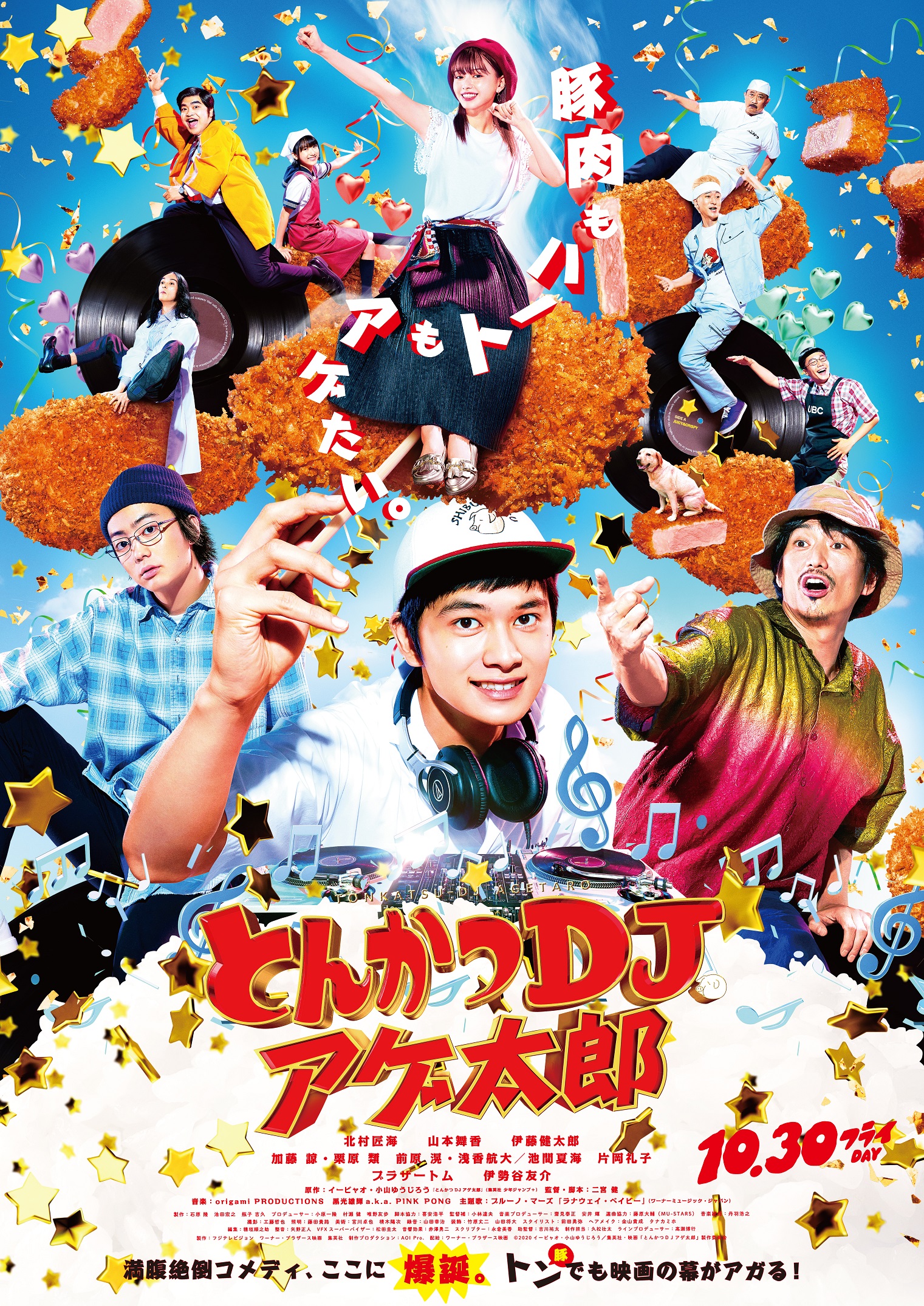
Tonkatsu DJ Agetaro (とんかつDJアゲ太郎, Ken Ninomiya, 2020)

Among the more prolific of young indie talents currently emerging in Japan with five features released since his 2015 debut Slum-Polis, Ken Ninomiya is fast becoming the go to chronicler of Tokyo’s contemporary club scene but unlike The Limit of Sleeping Beauty or Chiwawa, Tonkatsu DJ Agetaro (とんかつDJアゲ太郎) is a surprisingly wholesome take on the same phenomenon as an otherwise clueless young man begins to step into himself after accidentally falling love with the live house vibe. 

As his slightly amusing name implies, Agetaro (Takumi Kitamura) is the third generation heir to a tonkatsu (deep fried pork cutlet) restaurant. It’s not that he doesn’t want to take over the family business, but admits that he’d largely be doing it because he doesn’t know what else to do. His rather nerdy friends, all sons of small business owners in an area of Shibuya with a distinctly small-town vibe, are in much the same position. Ironically remarking that Agetaro always loses at The Game of Life as they hang out playing boardgames, the guys eventually find him with a pair of binoculars staring at a girl in an apartment opposite they are convinced inhabits a different word where people eat prosciutto and cheese and drink fancy wine. Agetaro gets an unexpected chance to meet his unobtainable crush, Sonoko (Maika Yamamoto), when he’s summoned to deliver a bento to a dance club after hours for a moody DJ, Oily (Yusuke Iseya), who describes tonkatsu as the area’s “soul food” and rates Agetaro’s dad’s as the very best. Allowed to step onto the dance floor, he finds himself blown away by Oily’s set and determines to become the very first tonkatsu chef/DJ partly in the hope of impressing Sonoko. 

Though set very much in the present day, there’s a pleasingly retro quality to Tonkatsu DJ Agetaro that recalls old school Showa-era musical youth movies in which young guys from humble backgrounds make something of themselves by working hard and staying true to their roots. Agetaro’s problem is that he’s caught in a moment of adolescent anxiety, resentful of his father (Brother Tom) whom he feels looks down on him, refusing to let his son anywhere near the fryer while making him chop cabbage all day and reminding him he doesn’t have to take over the shop if he doesn’t want to. Agetaro’s dad won’t teach him to fry because he thinks he doesn’t take anything seriously, and he might be right, but as his sister (Natsumi Ikema) says he’s worried about him too secretly trying to be supportive by standing at the back of the room when Agetaro gets his big break at the local club. 

Despite being mentored by Oily, however, Agetaro blows his first opportunity failing to get the crowd moving with a rather naff set designed to entertain his equally nerdy friends. But failure, crucially, only endears him to Sonoko who had previously been put off by his cheesy attempts to become a viral YouTube star with a series of gimmicky videos featuring himself and his friends wearing novelty “tonkatsu” outfits. Where he thought of giving up, Sonoko’s reminder that everyone makes a mess of things once in a while and no one should expect success right out of the gate helps Agetaro realise that what he needs to do is bring all of himself to his set which in this case means understanding that the thing is learning do something well and in that there’s no difference between frying the perfect cutlet and finding the perfect beat. Simply put, he needs to become the Tonkatsu DJ for real. 

Attracted to DJing because of the freedom it offers, Agetaro eventually finds his “heaven” on the dance floor marrying both sides of himself as he accepts his tonkatsu legacy and claims his space within the club scene which here is unproblematically joyful, a warm and welcoming space in which young people come together to enjoy good music, dance, and have wholesome fun. Simply put, it’s hard not to fall in love with a film which makes space for an unironic and unapologetically joyful moment of catharsis featuring Belinda Carlisle’s Heaven is Place on Earth. Shifting away from the slick music video aesthetic of his earlier work, Ninomiya hits lowkey charm in his tale of minor slacker success as his feckless hero finally figures himself out and learns how to cook up a storm in the store and on the floor. 


Tonkatsu DJ Agetaro screens on July 4/6/9 as part of this year’s Neuchâtel International Fantastic Film Festival (NIFFF)

Original trailer (English subtitles)

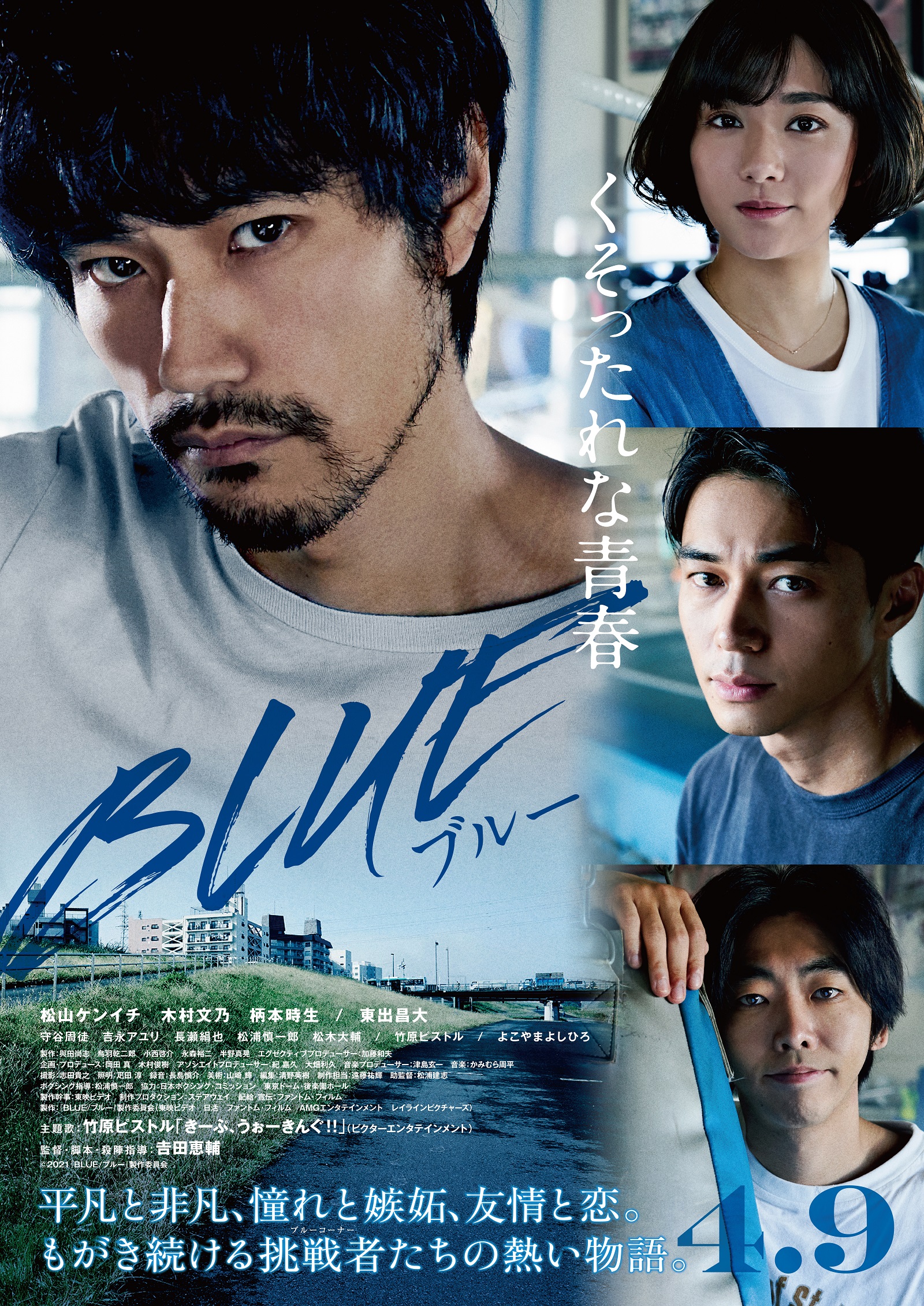
Blue (BLUE/ブルー, Keisuke Yoshida, 2021)

“Let me walk on my own feet” a defeated boxer insists, reminding us that his victory is in getting up even if he always loses. The heroes of Keisuke Yoshida’s Blue (BLUE/ブルー) are by and large “losers”, though the act of winning lies not so much in knocking out your opponent as in continuing to show up for the fight. Blue is not only a state of mind, but also the colour of the challenger’s corner, the spiritual home of these dejected underdogs who refuse to lie down even when seemingly defeated. 

Urita (Kenichi Matsuyama), for example, stays in boxing because there’s nothing else he wants to do though in truth he’s not much good at the sport. What he is good at is encouraging others and even if he’s a bust in the ring he’s an excellent coach and warmhearted mentor. His friend, Ogawa (Masahiro Higashide), meanwhile, is on track to take the national title but is also in denial about a medical condition that could end his career in the ring. And then there’s Narasaki (Tokio Emoto) who only took up boxing because of an offhand comment from a girl he fancied at the pachinko parlour where he works after he got beaten up by a teenager while feeling his masculinity challenged by a handsome coworker. 

Narasaki rocks up at the gym and refuses to do anything very strenuous because he only wants to look like someone who boxes, not actually box. Nevertheless, he discovers a genuine aptitude for the sport, gradually overcoming his fear of getting of hurt as he begins to enjoy the discipline of training. His journey directly contrasts with that of one of the other young hopefuls at the club who originally knocks him out during their first sparring match but later falls victim to his own egotism, insisting that he doesn’t need to take advice from a “loser” like Urita and has his own way of doing things. In his characteristic way, Urita just smiles and reminds him it’s important to master the basics but the hotheaded youngster won’t listen, blaming his lack of success on everyone else before getting himself seriously injured trying to prove his own way is superior. 

It’s the basic moves which later prove valuable to Narasaki as he attempts to take on a powerful rival, a reminder that there’s no substitute for nailing the fundamentals. Talking over their respective differences, Ogawa wonders if he really loves boxing as much as Urita does but has then to accept that “passion and talent are different” which is why he’s succeeding where Urita failed. In any case, it’s less about winning in the ring than it is about hard work and mastery of a craft. Smarting from his own early defeat, Narasaki also snaps back that he doesn’t want a loser’s advice only to bitterly regret it afterwards, realising that Urita’s strengths lie at the side of the ring rather than inside it. 

While Ogawa battles his illness, Narasaki also finds himself conflicted caring for his elderly grandmother and feeling guilty that his newfound love for boxing has led him to neglect her. Urita battles a sense of resentment and despair he covers with good humour in being fully aware that he doesn’t have what takes while attempting to encourage others only latterly confessing that a part of him always hoped Ogawa would lose. The demands of a sporting life may have endangered familial and romantic relationships but the guys do at least have each other and the familial camaraderie of the gym.

The important thing, the film seems to say, is to keep fighting, win or lose. Experiencing various setbacks, the guys each find themselves inhabiting their own internal rings, unable to let go of boxing glory no matter how elusive it may prove to be. Yoshida plays with genre norms such as training montages and ring-set climaxes, but also undercuts them in his frequent allusions to defeat allowing the heroes to lose and sometimes repeatedly solely so that they can get right back up again, on their own feet, ready to fight for something be that mastering the art of boxing or simply gaining a new sense of personal empowerment born of determination and self belief as they recommit to learning the “basics” of a fulfilling life. 


Blue streams in Europe (excl. Spain/Andorra) until 2nd July as part of this year’s hybrid edition Udine Far East Film Festival.

Original trailer (English subtitles)
Woman of Design (その場所に女ありて, Hideo Suzuki, 1962)

“This job poisons you and deprives you of your youth” according to conflicted ad-exec Ritsuko (Yoko Tsukasa) trying her best to make it in the still very male world of adverting. A snapshot of the city in the early ‘60s, Hideo Suzuki’s workplace melodrama Woman of Design (その場所に女ありて, Sono Basho ni Onna Arite) considers the changing position of women through the eyes of four friends working at the same company, each facing challenges mainly at the hands of useless men while trying to claim a space for themselves as individuals but discovering that they are still subject to a binary choice when it comes to deciding their romantic futures. 

A woman of around 30, Ritsuko has worked her way up to a fairly senior position at Nishigin Advertising which at least appears to be a fairly progressive company run by a compassionate boss who treats his employees equally with respect for all. Nevertheless, Nishigin is very interested in its bottom line especially as the company is apparently not doing so well to the extent that they’ve unfortunately had to cut back on their “entertainment” budget which is apparently how they win and keep clients. A new opportunity has presented itself in the chance to win a contract with a pharmaceuticals company to market their brand new drug aimed at “revitalising” the lives of the over 40s. Unfortunately, they have a rival in the form of Daitsu and suave adman Sakai (Akira Takarada) who appears to have pipped Ritsuko to the post in “seducing” their sleazy PR guy.

Though focussed on her career and somewhat resistant to romance, Ritsuko finds herself attracted to Sakai if eventually wondering if he’s only using her for inside info on Nishigin which she doesn’t directly give him but their relationship does perhaps soften her attitude. Sakai’s minor betrayal in poaching the head of their art department will eventually destroy any genuine feelings they may have had for each other while leaving Ritusko painfully aware of her vulnerabilities as a female employee and of the costs of her momentary decision to break with her long-held determination to keep her professional and private lives entirely separate, admitting that her relationship with Sakai may have been a mistake but refusing to resign because of it. Meanwhile, the boss of the pharmaceuticals company with whom she seems to be on good terms tries to blackmail her into attending an omiai meeting implying he’ll be much more likely to give them the contract if she goes. Not that they necessarily mean she should give up her career, but even Ritsuko’s colleagues seem to be keen that she get married, shocked that she might determine to remain single for the rest of her life. 

That’s exactly the decision her friend Yuko (Akemi Kita) has made, dedicating herself to her career but also moody and embittered. In fact though it is no way explicit, Yuko is strongly coded as a lesbian with a possible crush on friend and colleague Mitsuko (Kumi Mizuno), herself in a difficult position apparently pushed into debt because of an attachment to a no good man whose hospitals bill she has been paying. Ritsuko’s deskmate Hisae (Chisako Hara), meanwhile, is a divorcee wondering what she’s going to do when her ex, whom she’s still hung up on, stops paying alimony, and her sister is forever badgering her for money because her brother-in-law is an irresponsible layabout who can’t hold down a steady job and has no real intention of doing so. “Men who live off women are the worst” Yuko exasperatedly exclaims thoroughly fed up with the bunch of two bit louses who seem to have ruined the lives of all her friends. 

It’s not difficult to understand why Ritsuko may be ambivalent about marriage, but even at work she’s not free of selfish, entitled men who routinely take credit for her work. Sleazy college Kura (Tsutomu Yamazaki) from the art department is forever sucking up to her only to attempt rape while discussing work at her apartment, later brushing the affair off while talking to a female colleague by affirming that older women aren’t his thing anyway. He also undercuts her by visiting the client himself to discuss ideas and changes. Kura later wins a big design prize in part thanks to the slogan Ritsuko came up with only to annoy his colleagues by implying he handled the whole campaign single-handedly. Meanwhile, though in some ways progressive her bosses are conservative when it comes to the business, shutting down the art director’s suggestion of running with an out of the box campaign (the sexier ad featuring a muscular man in his briefs which he later sells to Sakai is the one which ends up winning). Tsuboichi (Jun Hamamura) and Kura perhaps too feel constrained by a top down hierarchal structure which frustrates innovation and in their own ways rebel, but as Ritsuko later makes plain in her speech to the boss if she wants to keep her position she has to play by the rules. “Life’s short. Especially for a woman. We have no room for mistakes” as Yuko cheerfully agrees.

Yet even within that, Ritsuko manages to redefine her boundaries, making it clear that she won’t be doing the omiai. She does not, however, reject marriage entirely only state that “I will get married only when I feel the time is right”, for the moment at least entirely focused on her career. Though the future may have looked gloomy, the crisis passes and the mood brightens significantly with the news that another company is about to officially announce the launch of a long-rumoured anti-ageing cream which provides another potentially lucrative campaign opportunity for Nishigin and of course for Ritsuko should she win it. Having opened with a series of still frames followed by hazy footage of a sea of workers wandering towards their offices on an overcast morning, Suzuki closes in the twilight with the three ladies leaving the office, their friendship solidified as they head off to celebrate renewed hope for the future bolstered by a sense of female solidarity.


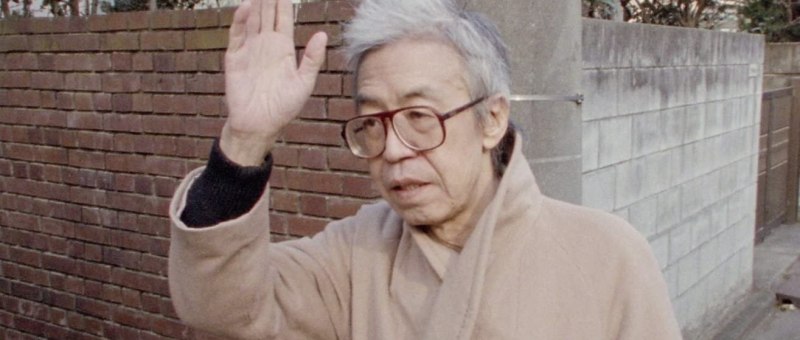
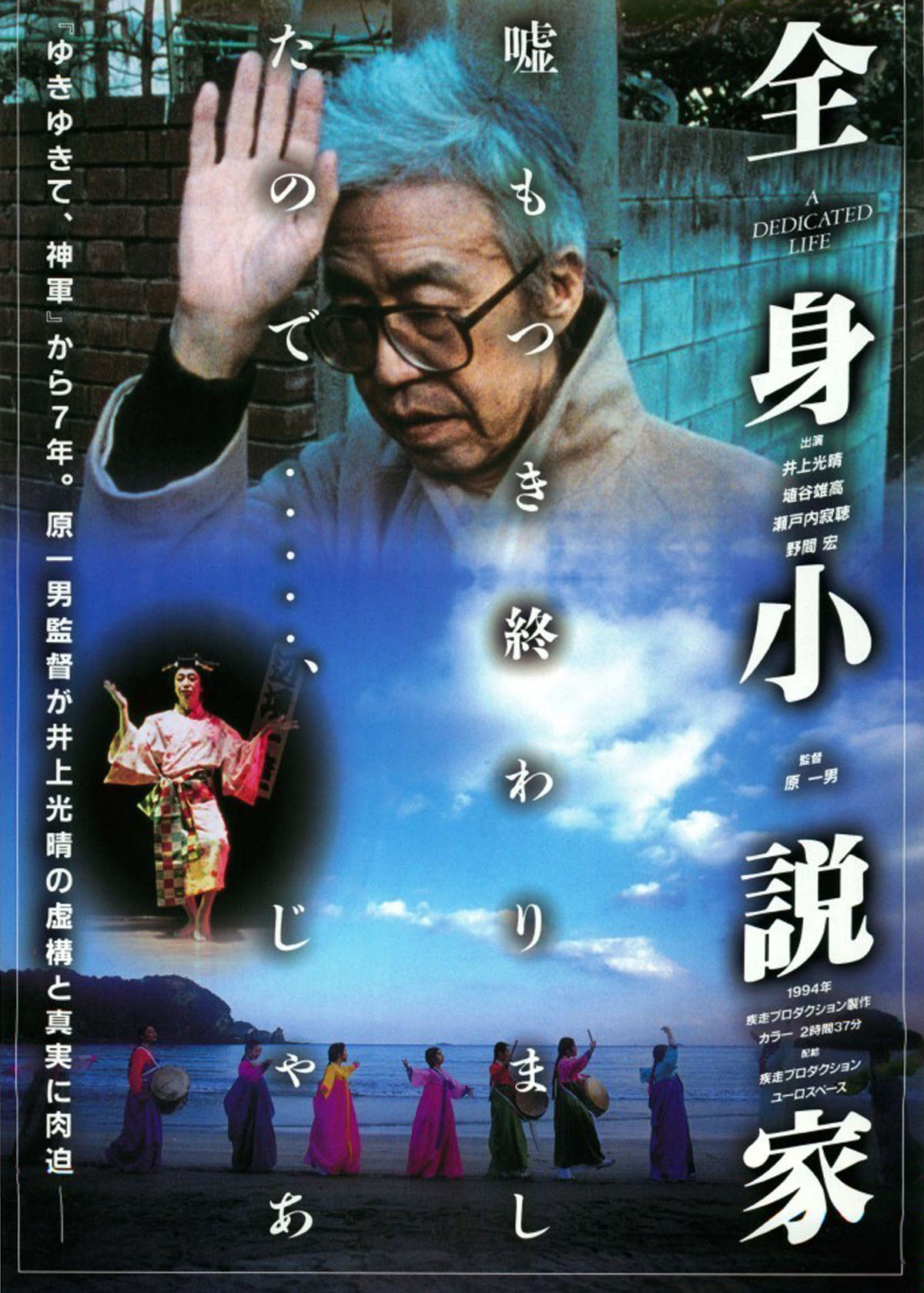
A Dedicated Life (全身小説家, Kazuo Hara, 1994)

“Human beings have things they don’t want to share with others. This is the truth, but what we choose to tell from the truth is fiction” according to the elusive subject of Kazuo Hara’s probing personality doc, A Dedicated Life (全身小説家, Zenshin Shosetsuka). “Full of lies and contradictions” as a friend later describes him, Hara had apparently planned to follow controversial author Mitsuharu Inoue for a number of years only for his subject to be diagnosed with terminal liver cancer shortly after filming began. 

Even as the film opens, however, we can intuit that much of the life of Mitsuharu Inoue is performance, an adoring audience of his students and followers screaming in pleasure as he performs a striptease while dressed as a geisha to the classic enka hit Tsugaru Kaikyo Fuyugeshiki. Seconds earlier he’d told them that he longed to belong to a theatre troupe and that his grandfather had been a famous kabuki actor, a claim that later seems to be entirely untrue. Nevertheless, Inoue commands almost cult-like adoration from the mainly middle-aged women who surround him, one after another confessing their undying love for the genius author in successive to camera interviews and only occasionally hurt or frustrated in the often callous way he seems to have treated each of them. As we later realise, somewhat casually, Inoue is also married to patient and presumably very understanding wife who tenderly cares for him throughout his illness. 

To begin with, Hara presents us with a vision of Inoue at face value as a fun loving libertine living it up with his students/disciples who can also be cuttingly cruel in his criticism, humiliating one of his female followers at the podium by tearing apart her assignment in front of the class, later doing the same thing to a male author at a dinner party. After making a good recovery from his first battle with cancer he vows to go in harder with his students, reminding them that he can be friendly and charming one minute and unceremoniously cut them off the next should they disappoint him. Nevertheless, they apparently remain devoted to their mentor or at least the image of himself he seeks to project. 

Those who’ve known him many years appear to know that Inoue is a habitual liar and that even his much praised autobiography is largely an act of autofiction. An author friend and Buddhist nun later suggests that Inoue perhaps had something deep inside him he didn’t want to share and lying was his way of taking control over his life, his cultivated persona an avant-garde literary act. Having presented him as he is or claims to be, Hara eventually begins to undercut Inoue’s image by interviewing friends, relatives, and acquaintances who frequently debunk his sometimes outlandish claims while also hinting at the half-truths and mysteries at the centre of his family history. Following Inoue’s sister Tazuko who remains as clueless as her brother realising they’ve either misremembered her grandmother’s name or it was wrong on the family register, Hara uncovers a melancholy tale of marital failure and maternal abandonment once again embellished by Inoue who alternately gives differing accounts of his youthful attempt to reconnect with the mother who left him behind which are themselves disputed by the recollections of others. 

His grandiose claims go seemingly unexamined by his followers, eating up his tales of how he founded the first Communist Party in Japan only to become disillusioned by the movement and be kicked out after writing a story criticising the Party (a friend from the time describes him as more of an errand boy who was never really “serious” in his politics), or the tragedy of his first love which ended with a Korean classmate sold to a brothel where he later lost his virginity in a not quite consensual chain of events he claims left him feeling violated while she laughed from an upper window witnessing his defeated retreat. In a break from his usual observational shooting style, Hara adds a series of dramatic reconstructions tinted in a pre-war blue the unreality of which stands in stark contrast to the almost too intimate scenes of Inoue’s cancer diagnosis and subsequent operation as his liver is lifted from his belly and taken away as if presented for the camera. In a revealing moment, Inoue remarks that an alternative medical practitioner he’s just consulted going by the name “Redbeard” just like the movie is not convincing, lacking credibility because he failed to fill the gap between his words perhaps hinting at the techniques he himself uses to convince himself and others of his self-created image. Hara does not so much try to dissect it as to look quizzically at its contradictions, admiring the beauty of the enigma if in reflection of its intrinsic sadness. 


A Dedicated Life streams in the US & Canada until July 2 as part of Japan Society New York’s Cinema as Struggle: The Films of Kazuo Hara & Sachiko Kobayashi

DVD rerelease trailer (no subtitles)

Sayuri Ishikawa’s Tsugaru Kaikyo Fuyugeshiki

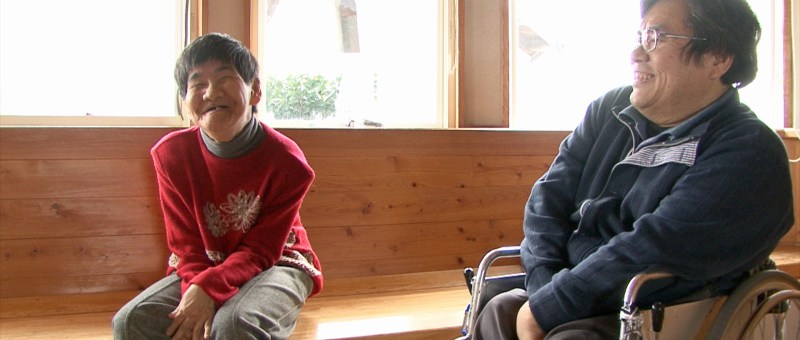
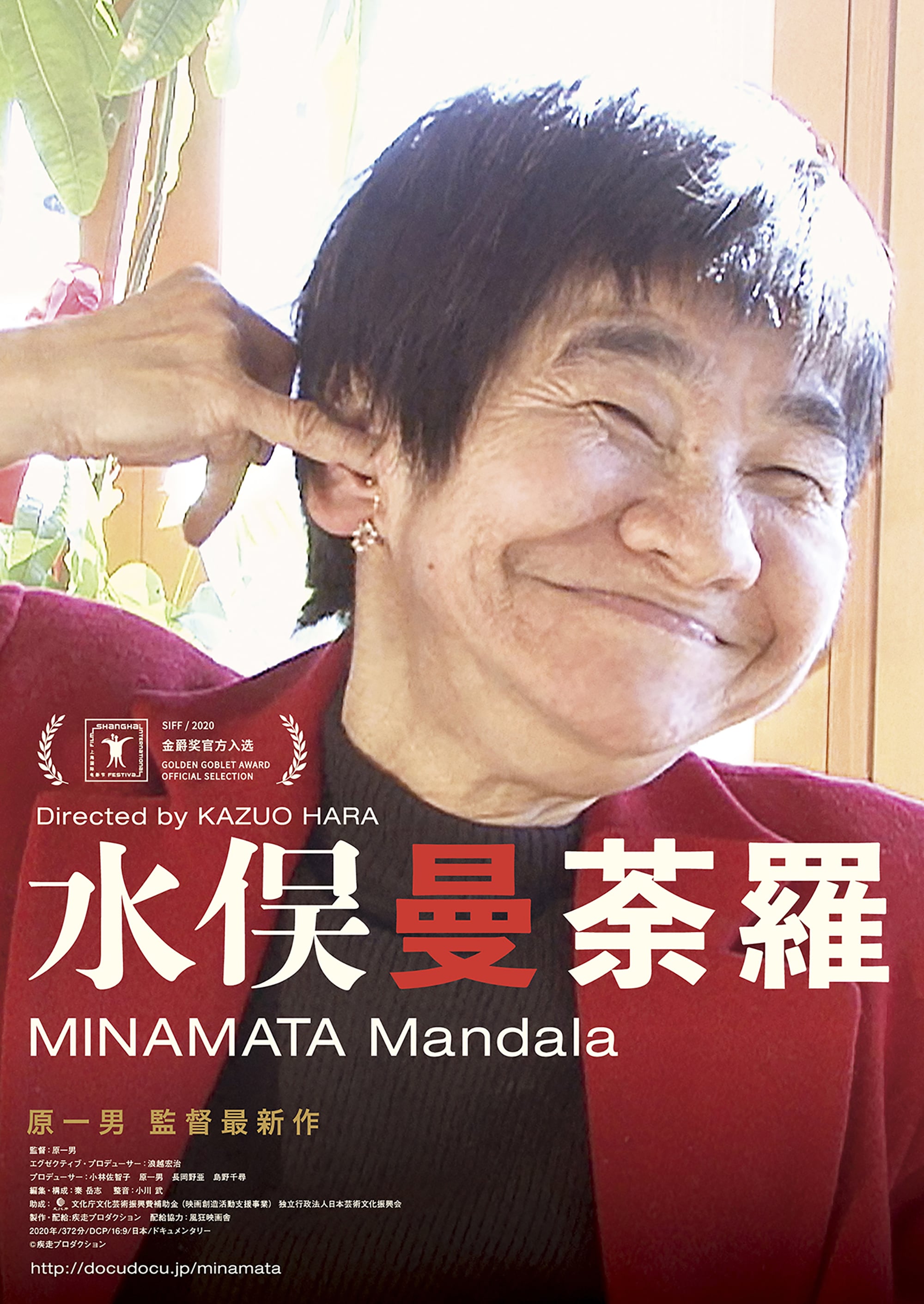
Minamata Mandala (水俣曼荼羅, Kazuo Hara, 2020)

“An Individual can never win against the government” according to a man seeking justice, “Challenging the government means risking your life”, yet he continues to fight. In his 2017 documentary Sennan Asbestos Disaster, Kazuo Hara had charted the protracted efforts of workers from the factories in Sennan to get justice from the government that failed to protect them. 15 years in the making, Minamata Mandala (水俣曼荼羅) addresses another of post-war Japan’s great industrial scandals as victims of the “Minamata disease” struggle for recognition in the face of continued governmental intransigence. 

Opened in 1908, the Chisso chemical plant was among the most technologically advanced in Japan yet it routinely expelled wastewater directly into Minamata bay. The factory had already paid compensation in 1926 and 1943 for damage done to local fisheries before a change in its production process led to the release of methylmercury into the local water system from 1951 onwards. Though some had noticed unusual behaviour in animals, it wasn’t until 1956 when a little girl fell ill with strange symptoms including difficulty walking and speaking that a widespread “”epidemic of an unknown disease of the central nervous system” was discovered in the local community and subsequently came to be known as the “Minamata Disease”. In order to cover their tracks, Chisso began discharging wastewater directly into Minamata River spreading the pollution further along the coast with additional cases arising in other villages on the Shiranui Sea. 

Hara’s justice seekers, however, take aim not directly at Chisso which still exists and is a dominant economic force in the area, but local and national governments whose continued failure to protect them has greatly exacerbated their suffering. The greatest source of their discomfort is the unfairness of criteria set down in 1977 for legal certification of Minamata Disease in order to gain access to compensation. According to contemporary researchers, the criteria, inspired by Hunter-Russell syndrome discovered after an industrial accident in the UK in the 1940s, were simply wrong leading to the vast majority of applicants being rejected. Hara shifts between the stories of various victims and a pair of scientists determined to prove that the root of the disease lies not in peripheral nerve but brain damage and that the criteria is therefore useless in certifying cases of Minamata Disease. The applicants, meanwhile, intensely resent the implication that they are not genuine, that they are undergoing a collective delusion, faking their symptoms, or suffering from an unrelated illness not the responsibility of Chisso or the government. 

One campaigner whose hair was found to contain high levels of mercury at two years old recounts his ill treatment at the hands of the legal system which implied application of the criteria could be affected by “personality” factors while passive aggressively listing his occupation as “time waster”. Though his case may at first seem mild, it’s also true that as he’s suffered from Minamata Disease his entire life it’s difficult for him to assess how severely it affects him as evidenced by the accidental severing of the top of his thumb which he barely noticed because of his reduced sensitivity to pain. Like other sufferers, he is often privy to the usual hollow apologies from politicians (including one from then Minister of the Environment Yuriko Koike), though another source of frustration is that those in power often refuse to attend meetings with Minamata patients sending underprepared underlings in their stead. One particularly heated meeting quickly goes south when a rookie civil servant allows his handwritten memo reading “no apologies” to be seen by a woman recording the proceedings from the front row while his embarrassed colleagues are able to offer little other than the standard platitudes insisting the Minamata issue has already been dealt with through the previous settlements. 

Rather than focus on the court cases and medical investigations, however, Hara is keen to remind us of the costs to the victims of industrial poisoning, one of the scientists later breaking down as he explains that the main effect of the disease is sensory deprivation leaving even those mildly affected unable to enjoy their lives fully. A rather poignant song written by a congenital sufferer reflects on her tendency to fall in love too easily and be forever disappointed while longing for a freedom and independence denied her because of her disability. For the campaigners, meanwhile, Minamata Disease has robbed them of their right to a personal life as they devote all of themselves to fighting for justice while acknowledging that even when they win it brings little improvement into the lives of those forever affected by industrial pollution. Just as Hara had expressed frustration with the Sennen campaigners he felt were overly feudal in their deference to authority, some find it difficult to support those who ultimately opted to accept a paltry settlement while simultaneously understanding the desire not to have to fight anymore especially as even those born with the disease are now approaching late middle-age. Ending on a poignant freeze-frame, however, Hara reminds us that the damage can never be undone nor can there be adequate compensation for the tremendous loss of potential even as the government continues to vacillate in the abdication of its responsibility. 


Minamata Mandala streams in the US until July 2 as part of Japan Society New York’s Cinema as Struggle: The Films of Kazuo Hara & Sachiko Kobayashi

Clip (English subtitles)

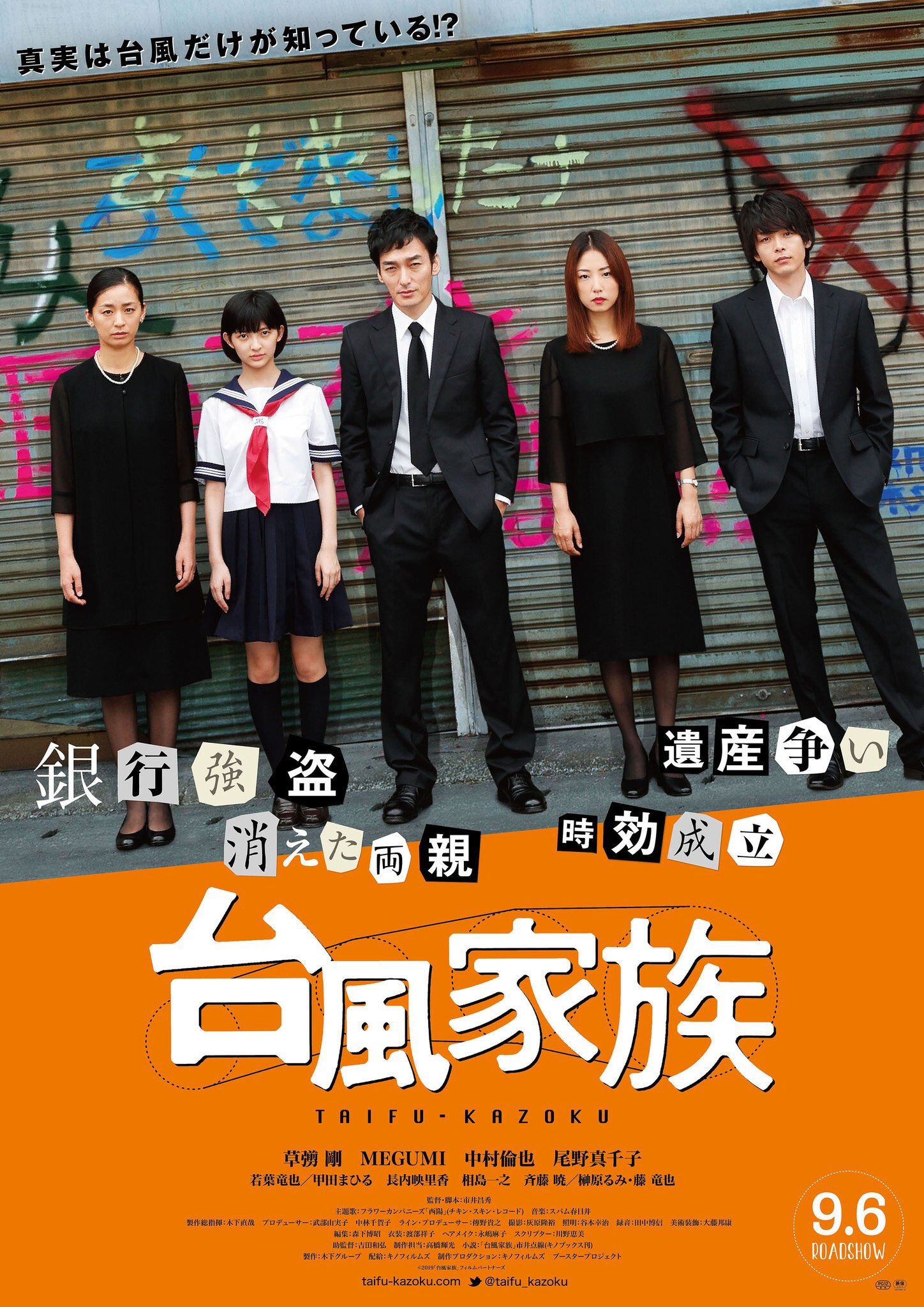
The Stormy Family (台風家族, Masahide Ichii, 2019)

A disparate group of now middle-aged children orphaned by the storm of their parents’ abandonment struggle to find solidarity on reuniting to put the past to rest, but eventually come to an understanding in letting go in Masahide Ichii’s darkly comic tale of familial resentments, The Stormy Family (台風家族, Taifu Kazoku, AKA Typhoon Family). Battling not just a sense of betrayal, but intense resentment in being left to deal with the fallout of a corrupted parental legacy the kids squabble over their “inheritance” but later perhaps regain a sense of mutual connection in reclaiming their shared history. 

10 years previously, Ittetsu (Tatsuya Fuji) and his wife Mitsuko (Rumi Sakakibara) robbed a local bank and then apparently made a run for it in the family hearse. With the statute of limitations now expired, the children decide to hold a funeral having had their parents declared dead so they can divide the estate and presumably draw a line under their shared trauma. The problem is, partly, that they’re hurt believing that their parents committed a crime and then simply abandoned them, but they have each also had to deal with the stigma of being the children of the elderly bandits who robbed a bank with a hearse. Oldest son Kotetsu (Tsuyoshi Kusanagi) lost his job, daughter Rena’s (Megumi) marriage broke down, and while middle son Kyo (Hirofumi Arai) does not particularly mention how the crisis affected him, youngest brother Chihiro (Tomoya Nakamura) who was a teenager at the time remains resentful that as he only had a part-time job anyway no one from the media was very much interested in hassling him. 

Rather than finding siblings’ solidarity in their shared trauma, the crisis only seems to have driven them further apart. If perhaps slightly ashamed, they freely admit that they’ve only come to sort out the inheritance but even this leads to another argument as Kotetsu tries to use his oldest son privileges to claim he’s entitled to an unequal share because the others all went to uni on the parents’ dime, complaining that he needs the money more because he’s been unable to hold down a steady job and has to pay for his teenage daughter Yuzuki’s (Mahiru Coda) education, hoping to send her to music conservatoire in Vienna. As expected, that doesn’t go down very well with everyone else, while even Yuzuki expresses disdain and exasperation for her father’s amoral venality, telling him to get back on his feet with honest work rather than trying to cheat his siblings out of their birthright. In this, however, the family largely agree he might not be so different from patriarch Ittetsu who despite his motto of “don’t bother others” often penny pinched to an extreme degree and even seemed inappropriately happy to receive new business considering he ran a funeral parlour. 

On closer investigation of their parents’ home, what the kids learn is that there were things they didn’t understand perhaps because Ittetsu didn’t want to “bother” them with an explanation, though as someone else points out family aren’t “others” and probably it should be alright to bother them. Having argued with his father when he left to pursue his dream of being an actor, Kotetsu eventually sacrificed his desires recommitting himself to making his daughter’s dreams come true instead but like Ittetsu struggles to find a way to support her emotionally. Ittetsu may have been a difficult, perhaps less than honest, man but in learning the truth the family begin to realise that his actions came from a deep place of love even if it was a love he was unable to show on the surface. 

In an extremely ironic twist, the funeral and a climactic storm eventually allow the siblings to let their parents go, forgiving them for the fallout from their crime but also for their abandonment and all the petty resentments of their childhood. The world may be a pretty dishonest place, filled with greedy monks, telephone fraudsters, schemers and thieves, and perhaps you can’t even really trust your family but a father’s love is apparently the one true thing though it might not always be easy to understand. A darkly comic take on dysfunctional family bonds and the radiating legacy of crime, The Stormy Family gradually creeps towards its macabre but surprisingly moving finale allowing the family to rediscover itself in letting go only to set them at odds once again with the corrupting influence of greed. 


The Stormy Family streamed as part of this year’s Nippon Connection.

Original trailer (no subtitles)

Images: ©2019 “The Stormy Family” FILM PARTNERS

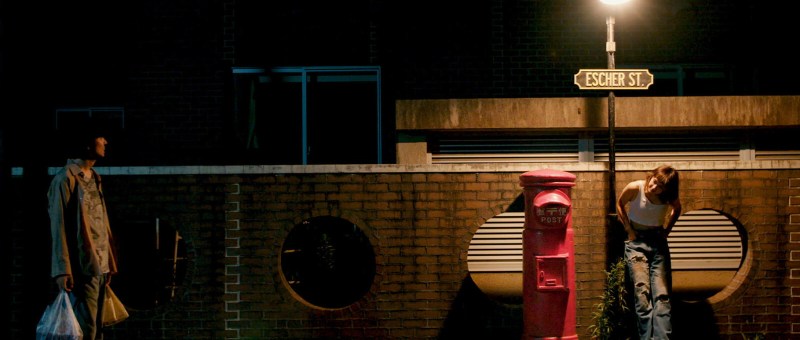
Red Post on Escher Street (エッシャー通りの赤いポスト, Sion Sono, 2020)

“Freedom is disappearing from our world. Everyone rise up!” screams an accidental revolutionary having achieved a kind of self-actualisation in wresting the leading role not only in the film within the film but in the film itself in an act of characteristically meta Sion Sono playfulness. Harking back to the earlier days of his more recently prolific career, Red Post on Escher Street (エッシャー通りの赤いポスト, Escher dori no akai post) is perhaps a thinly veiled though affectionate attack on the mainstream Japanese cinema industry, a defence not only of “jishu eiga” but a “jishu” life in the meditation that a crowd is composed of many faces in which we are all simultanteously extra and protagonist.

In a sense perhaps Sono’s stand-in, the director at the film’s centre, Tadashi Kobayashi (Tatsuhiro Yamaoka), is a festival darling who made his name with a series of critically acclaimed independent films but has since been dragged towards the mainstream while forced into a moment of reconsideration following the sudden death of his muse and lover. Kobayashi’s ambition is to produce another DIY film of the kind that first sparked his creative awakening, but it’s clear from the get go that his desires and those of his backers to not exactly match. Middle man producer Muto (Taro Suwa), sporting a sling and broken leg after being beaten up by the jealous boyfriend of a starlet he’d been “seeing”, is under strict instructions to ensure Kobayashi casts names and most particularly the series of names the studio want. To convince him, they go so far as to have the established “stars” (seemingly more personalities than actresses) join the open auditions at which the director hoped to find fresh faces, hoping he can be persuaded to cast them instead. The irony is that the studio want Kobayashi’s festival kudos, but at the same time deny him the freedom to make the kind of films that will appeal to the international circuit, the director frequently complaining the producers keep mangling his script with their unhelpful notes. 

A handsome young man, Kobayashi has also inspired cult-like devotion among fans including a decidedly strange group of devotees branding themselves the “Kobayashi True Love Club” who each wear Edwardian-style white lace dresses and straw hats while singing a folksong everywhere they go. Nevertheless, most of the hopefuls are ordinary young women with an interest in performing or merely for becoming famous. Their stories are the story, a series of universes spinning off from the central spine from a troupe kimono’d actresses performing a play about female gamblers, to a young widow taking on the mission of making her late husband’s acting dreams come true, and a very intense woman with an extremely traumatic past. The audition speech finds each of the hopefuls vowing to drag their true love back from “the crowd” into which he fears he is dissolving, only for them later to save themselves by removing their “masks” to reclaim their individual identity and agency as protagonists in their own lives rather than passively accept their relegation to the role of extra.

Then again, there are those who wilfully embrace the label such as a faintly ridiculous old man who commands near cult-like adoration from his disciples of professional supernumeraries for his ability to hog the screen even if his less than naturalistic acting is at best a distraction from the main action. Without extras, he points out, the screen would become a lonely place, lacking in life and energy though he at least seems to be content to occupy a liminal space never desiring the leading role but seizing his 15 seconds of fame as a prominent bystander. Others however are not, determined to elbow aside the vacuous leading players and reclaim their space. Subtly critiquing the seamier ends of the industry from the lecherous producers who always seem to be draped with a young woman eager for fame and fortune, to the machinations of star makers and manipulations of talentless celebrities, the film makes an argument for sidestepping an infinitely corrupt system in suggesting the jishu way is inherently purer but nevertheless ends on a note of irony as its defiant act of guerrilla filmmaking is abruptly shutdown by the gloved hand of state authority. 


Red Post on Escher Street streamed as part of this year’s Nippon Connection.

Original trailer (English subtitles)

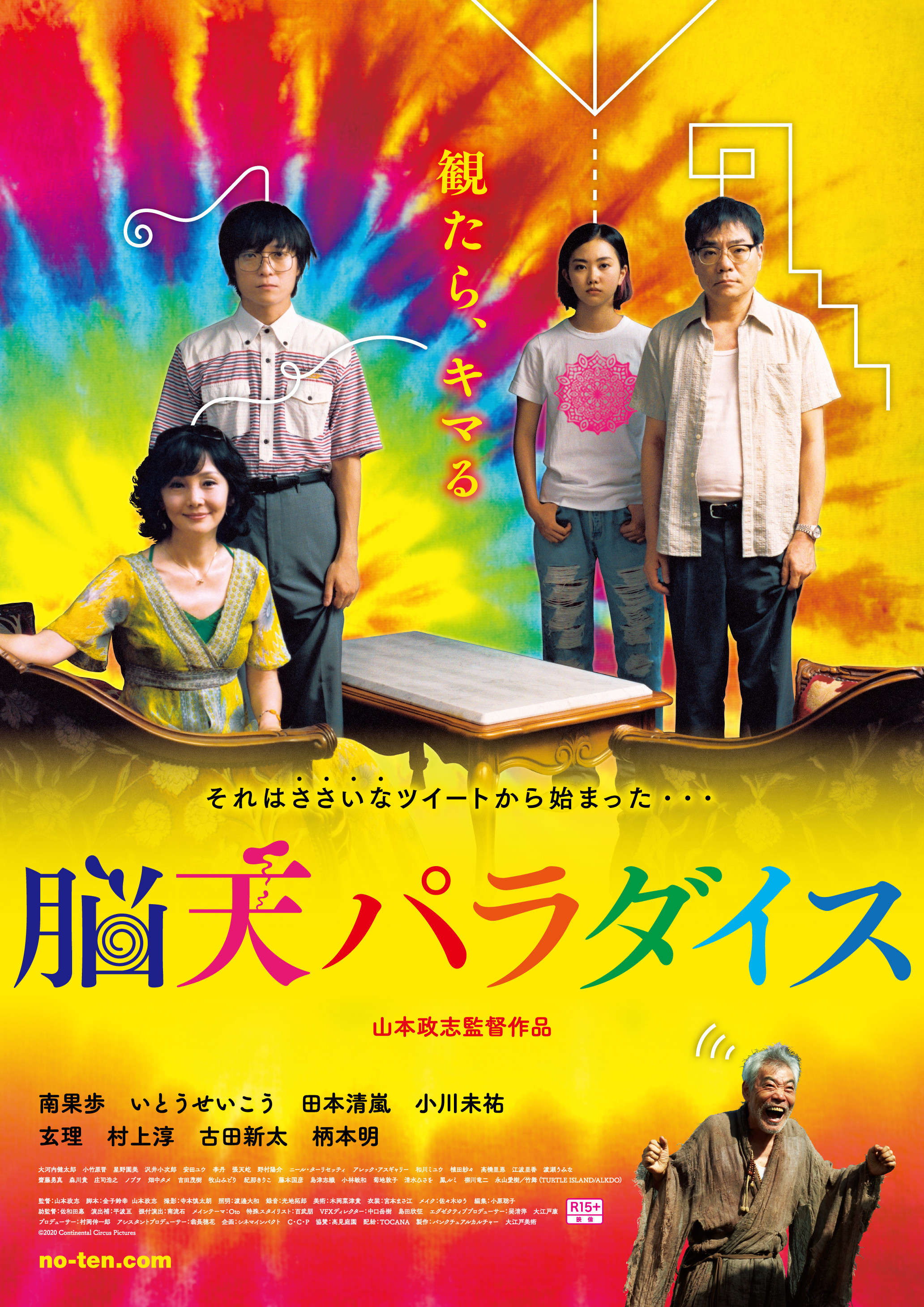
Wonderful Paradise (脳天パラダイス, Masashi Yamamoto, 2020)

A moribund Tokyo mansion becomes the scene for an orgy of life, death, love, and rebirth in Masashi Yamamoto’s surrealist party movie Wonderful Paradise (脳天パラダイス, Noten Paradise). Sometimes you have to learn to say goodbye and move on, other times you have to learn to forgive and let go of past resentment. Of course, sometimes you have to do both of those things at the same time, which is perhaps appropriate for the former home of the Sasayas which seems to exist between the realms of life and death, a perpetual Bon festival where departed spirits and lost souls congregate for one almighty party. 

Dad Shuji (Seiko Ito) has had a run of bad luck and unfortunately lost the family home he inherited from his parents meaning he and his two adult children, son Yuta (Soran Tamoto) and daughter Akane (Mayu Ozawa), are having to move on though who knows where to. Resentful that she’s having her life uprooted by her father’s fecklessness, Akane takes to social media and Tweets that there’s a party at hers and everyone’s invited as kind of goodbye to the house. Meanwhile, a series of strange events occur from a weird old monk (Akira Emoto) who keeps trying to pray to the various neoclassical statues on the property going nuts at a belligerent removal man and then apparently dropping dead, to the resurfacing of mother Akiko (Kaho Minami) who apparently left the family some years previously for a man who ran a coffee shop but has since passed away. 

The first people to arrive for the party are a gay couple looking for somewhere to celebrate their marriage, a minor irony in that the event will later descend into an elaborate funeral for two people who may or may not be dead. As more and more guests arrive, along with a series of opportunistic commercial food stands and other businesses, the party begins to get out of hand becoming ever stranger as the night wears on. 

At the heart of it all are the tensions in the family, an unresolved resentment directed at son Yuta who is, according to his brash aunt Yuka (Sonomi Hoshino), overly preoccupied with his family circumstances to the extent that it prevents him from getting a regular job and moving on with his life. Shuji has quite clearly failed both as a son and as a father, eventually betting one of his dad’s precious antiques in a card game run by yakuza loansharks setting up shop in the house. Akane appears exasperated, but is also harbouring an intense resentment towards Akiko for her abandonment that prevents her being able to “move on” from her former family home. 

Moving on is also a problem for a few of the ghosts, the line between the living and the dead becoming increasingly blurred. One random surreal moment to the next, Yamamoto careers between absurdist episodes culminating in a fight between a murderous sentient coffee bean and a statue come to life. What began as a lowkey wedding eventually becomes a bizarre funeral enacted through the medium of Bollywood song and dance transitioning into a traditional enka festival number all of which happens before a couple of hapless crooks who’ve been operating a drug factory on the family’s property for the last two years without them ever knowing turn up with their “super mandala drug of paradise” to send the evening in a psychedelic direction. 

Yet for all the surreality of death, violence, sex, and rebirth when dawn arrives it brings with it a kind of calm brokering a new peace between friends and family members as they learn to accept each other and the past in an unburdened sense of openness. Possibly deceased monks, talking cats, kids who can’t figure out how to stop swinging and mysteriously turn themselves into sticks or dissolve in bath water, scorned lovers, unrepentant thieves, ghosts and family secrets descend on this weird gothic mansion in the middle of a city, creating a “wonderful paradise” for one night only filled with surrealist magic and unforgettable strangeness that nevertheless pushes the family back together through dream logic and a taste of the absurd. A weird, sometimes incomprehensible, journey into an etherial, psychedelic twilight psychodrama rave, Yamamoto’s charmingly bizarre nighttime odyssey is a law unto itself but one filled with wonder for the uncanniness of the everyday. 


Wonderful Paradise streamed as part of this year’s Nippon Connection.

Original trailer (English subtitles)