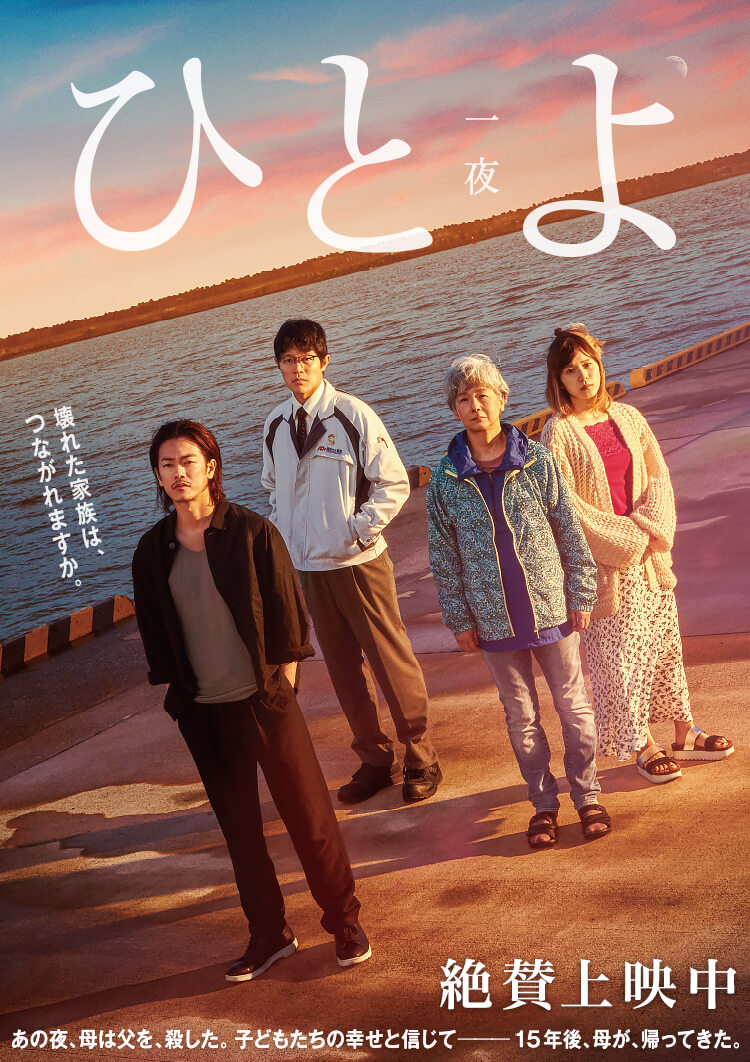
The Rickshaw Man (無法松の一生, Hiroshi Inagaki, 1958)

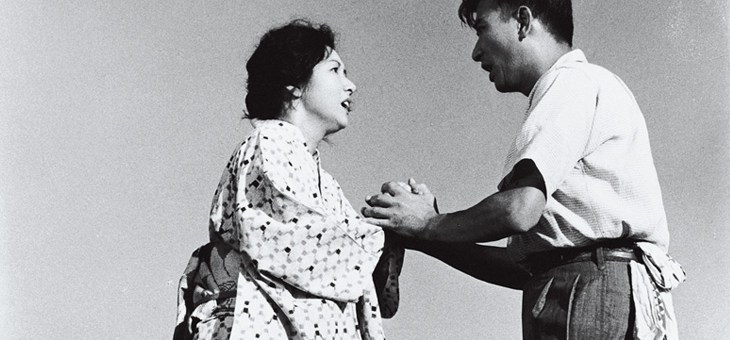
Japanese cinema has a special affinity with loveable rogues. We forgive their mischief and inconvenient troublemaking because deep down we know they’re kindhearted and even when they act impulsively it’s only out of an abundance of misplaced emotion. The wild Matsu is a case in point, brought to life by the great Toshiro Mifune in Hiroshi Inagaki’s remake of a story he first adapted 15 years previously but was apparently unhappy with because of the censorship demands of the time. What is surprising, therefore, is that despite his otherwise liberal outlook Inagaki largely echoes those problematic pre-war views, opting to focus on the tragic comic figure of Matsugoro rather than engage with the destructive visions of toxic masculinity that his well-meaning paternalism represents or with the latent feudalism which continues to inform the later course of his life. 

Beginning in 1897, Inakagaki introduces us to “The Wild Matsu” (Toshiro Mifune) on his “illegal” return to Kokura from which he had apparently been “banished” because of an “incident” the previous year. This time, Matsugoro has crawled back home apparently ill in bed and nursing his head after getting into an argument with a man who turned out to be the kendo instructor for the local police. Unafraid to embarrass himself, Matsugoro later relates the tale as a funny anecdote, admitting that the kendo master put an end to their fight in record time by striking him on the head and knocking him out. Typical Matsugoro, seems to be the reaction from all around him. Later he takes offence with a ticket seller who refuses him a comp to the show when free tickets are usually available to rickshaw drivers (publicity tools haven’t changed as much as you’d think), returning later in the evening and buying a ticket with a friend but setting up a mini stove to bake garlic and stink the place out as his revenge. A calm and rational mediator later explains to him that though he can understand why he was upset because it causes confusion when people refuse to abide by longstanding traditions, his stunt has ruined the evening of a lot of people who weren’t really involved in his vendetta. Immediately seeing the error of his ways, Matsugoro determines to make a full and complete apology to the spectators whom he’d so thoughtlessly inconvenienced. 

This incident demonstrates Matsugoro’s essential goodness. He may be impulsive and easily offended, but he means no harm and even his “revenge” is an amusing, petty affair rather than something dark or violent. The main thrust of the narrative, however, kicks in when he spots a lonely little boy being made fun of by his friends because he’s too scared to climb a tree. Matsugoro pauses to tell him that he needs to man up, but on his way back finds the other kids running away and the boy on the floor crying after having fallen and broken a leg. Finding out where he lives, Matsugoro picks the boy up and takes him home to his mother (Hideko Takamine) who further enlists him to take the child to a doctor. 

The boy, Toshio, lives in the old “samurai district” and is the son of army officer Kotaro Yoshioka (Hiroshi Akutagawa), a cheerful man who though holding similar views on manliness to Matsugoro, finds the incident faintly amusing. In fact, Kotaro had heard of “The Wild Matsu” because he was once very rude to an army general he was charged with conveying from place to place during a series of official events. He decides to invite Matsugoro to dinner and the two men hit it off, but Kotaro suddenly dies of a fever leaving his wife Yoshiko alone with their son, worrying that she won’t be able to cure his sensitivity and turn him into a “strong” young man now that he lacks a male role model. 

Matsugoro is perfectly happy to fill that role, bonding with the little boy but always encouraging him to be “manly” which, in this age, largely means strong and athletic, rational and obedient while manfully repressing his feelings, and finally a willingness and ability to fight. While all of this is going on, we see the tides of militarism rising even in the early years of the century. The Russo-Japanese war giving way to the taking of Qingdao while flags go up everywhere and patriotic celebrations of martial glory become ever more frequent, but the problematic quality of this age of hypermasculinty is never questioned even as it leads the nation towards a decidedly dark destiny. 

Meanwhile, Matsugoro seems to have fallen in deep yet impossible love with Yoshiko but is prevented from voicing his feelings because of a deep seated sense of social inferiority. Matsugoro’s life has been limited not only because he was born poor, but because of a traumatic childhood with a cruel step-mother. Denied a proper education, he is largely illiterate and rickshaw driving, which depends only on his physical strength and stamina (the most highly praised qualities of the age), is all that he can expect out of life. We never have any inkling of how Yoshiko views Matsugoro, if there are any romantic feelings on her part or she simply admires him as a robust and good hearted friend, but the futility of Matsugoro’s unresolvable longing eventually drives him to drink which he had previously given up, along with his “wild” nature, in the need to provide a more respectable example to the young Toshio. 

Similarly, we aren’t privy to the parallel tragedy which will inevitably leave Yoshiko lonely as comparatively young widow whose only son will naturally become distant from his mother, grow-up, and find a wife to start a family of his own. Her anxiety over her son’s participation in a group fight is dismissed as hysterical womanliness, destructive maternity that may prevent Toshio from becoming a “proper” man. Something which is perhaps borne out when Matsugoro, who’d gone to watch over him just in case, has to wade in to defend Toshio who is too frightened to participate.

Nevertheless, Matsugoro is a big hearted man despite his intense masculinity, always acting with selfless kindness but also meekly accepting the fate his cards have dealt him rather than railing against the systems which have caged him all his life from his poverty to the perceived class differences which demand he keep his distance from the beautiful Yoshiko. The wheels of his rickshaw turn on ceaselessly as if relentlessly pulling him on towards his inescapable destiny, but shouldn’t we be asking more for men like Matsugoro whose hearts are good than being resigned to loneliness because of a few outdated social codes?


Original trailer (no subtitles)

Love’s Twisting Path (多十郎殉愛記, Sadao Nakajima, 2019)

Sadao Nakajima joined Toei in 1959 and worked for the studio throughout its golden age, mostly associated with jidaigeki and gangster movies which were Toei’s stock in trade well into the 1970s and perhaps beyond. Now in his 80s, Nakajima’s last narrative feature was released over 20 years ago. A kind of last hurrah, Love’s Twisting Path (多十郎殉愛記, Tajuro Junai-ki) is a willing throwback to the glory days of chanbara, even bearing a dedication title card to genre giant Daisuke Ito, and doing its best to resurrect the classic Toei programmer magic. 

Appropriately enough, the action takes place at a moment of intense change. As the film opens, the men of Choshu who have left their clan to foster their own brand of revolution in opposing the shogunate in favour of the emperor and a desire to reject Western influence, are hiding out in a shack while bad mouthing soon-to-be-allies Satsuma and the man who seeks to unite them, Sakamoto Ryoma. They are soon discovered by Kyoto’s elite Shogunate police, the Mimawarigumi, and ambushed. Their leader, the famed Katsura Kogoro (Masatoshi Nagase), signals that times have indeed changed by pulling out a pistol and defending himself at distance. 

Meanwhile, Choshu fugitive in hiding Tajuro (Kengo Kora) is trying to make ends meet with his painting, designing patterns for ladies kimonos but seemingly with little success. He has the sunken cheeks, vacant eyes, and slight slowness of someone who drinks too much and hasn’t had a decent meal in a very long time. We learn that he left Choshu with the others on the pretext of revolution, but his real purpose was escape from a restrictive samurai existence and most pertinently from his miserable poverty. Having long since given up the idea of a being a samurai, he’s already sold his sword and is attempting to live under the radar, unaware that similarly troubled bar hostess Otoyo (Mikako Tabe) has fallen in love with him. Otoyo was adopted by the bar’s owner, Omitsu (Yuriko Mishima), a former geisha, who intended to sell her to a geisha house. She eloped with a man she loved instead, but it turned out that he was minded to sell her too so she came back and now runs the bar while taking care of the ageing Omitsu. 

The crisis occurs when men of Choshu arrive in search of Tajuro in the hope that he will rejoin their cause. He doesn’t want to, showing off his samurai skills (and neatly disguising the fact that he has no blade through advanced technique) but pointedly asking for a hefty payment from his former mentor Sanzaemon (Asahi Kurizuka) in belief that it would not be paid. Sanzaemon, however, comes through and leaves a message for Tajuro to meet him behind a nearby shrine. He however spends the entirety of his money getting blind drunk in Otoyo’s bar, during which time Sanzaemon is caught by the Mimawarigumi, breathing his last words to Tajuro’s younger half-brother Kazuma (Ryo Kimura) to the effect that he must reunite with Tajuro and fight for the good of the country. 

On the run and holed up with a patient priest and his beloved wife, Tajuro is asked why it is he’s decided to pick up his sword once again despite his reluctance. Asked if was for country or for money Tajuro shakes his head, leaving the priest to correctly guess that it was for love. Tajuro has fallen in love with Otoyo, the only person who either doesn’t believe he is a failed samurai and drunken fool, or doesn’t care. The world however is still too chaotic for romance, and so their pure love will have to wait. 

Tajuro’s fate is in many ways the direct result of his attempt reject his responsibility as a samurai, daring to live as a common man with all of the freedoms and burdens that entails. The force which constrains him in both worlds is poverty. Whatever else he is, he is too poor for love, unable to feed himself let alone a wife either as a low wage samurai or a ronin. The price he pays is in his desire to cross borders. The samurai world is not done with him yet and while the denizens of this small backwater worry about paying their rent paying little mind to what’s going on in the capital, political intrigue is not something that he can go on ignoring. After all, not picking a side is in a sense also picking a side. The Mimawarigumi pride themselves on not being as savage as the Shinsengumi (which largely consists of ronin, lower ranked samurai, and commoners whereas the Mimawarigumi are elite samurai and direct retainers to the Shogunate), but their job is still to bring in fugitive rebels like Tajuro and his bid for “freedom” may be doomed to failure in a world still constrained by the law of the samurai. 


Original trailer (no subtitles)
Inn of the Floating Weeds (浮草の宿, Seijun Suzuki, 1957)

Another of Nikkatsu’s crime inflected pop song movies, Inn of the Floating Weeds (浮草の宿, Ukigusa no Yado) makes space for the singer of the song which gives the film its name, Hachiro Kasuga, but only in a minor role as a supportive friend. Directed by Seijun Suzuki under his birth name Seitaro (he’d change it to Seijun for Underworld Beauty the following year), the film is in some ways typical of his early work as a B-movie director at the studio but nevertheless displays flashes of his later brilliance in its unconventional composition and wistful sense of irony. 

Company man Shunji (Hideaki Nitani) gets into a fight during which Shida, a high ranking executive at Marubishi construction, is stabbed to death. Shunji is kicked into the water and left for dead, while his fiancée, Kozue (Hisano Yamaoka), pines for him at a nearby bar. Five years later Shunji resurfaces hoping to reunite with Kozue after having fled to Hong Kong and taken a job at a shipping company. At the bar, however, he discovers a woman that looks exactly like his lost love but turns out to be her younger sister, Mio (also played by Hisano Yamaoka), the bar’s madam and apparently the mistress of Murayama (Toru Abe), the current head of Marubishi. 

Shunji’s survival and subsequent reappearance is inconvenient for everyone so it’s no surprise that Murayama wants to have him bumped off, but Shunji is determined to stay and find out what’s happened to Kozue who, according to her sister, went missing in suspicious circumstances three years earlier while desperately searching for Shunji. 

Haunted by memories of lost love, Shunji finds himself drawn to the mysterious Mio who closely resembles her sister, while pulled towards a nexus of criminal activity unwittingly positioned between Murayama’s Marubishi and the avaricious interests of his American colleagues operating out of Hong Kong. Indeed, Shunji has himself it seems taken on an alternate identity as Hong Konger Kang Ho-chun, interpreter to the mysterious Mr. Green (Harold Conway). Perhaps still naive, Shunji appears to be unaware of his boss’ shadiness, warned off by good Samaritan Haruo (Hachiro Kasuga) who rescues him after he’s beaten up by Marubishi goons and allows him to rest in his apartment where he’s nursed back to health by his cheerful kid sister Yuri (Ikuko Kimuro). 

The strange goings on on the Saganmaru perhaps testify to an ambivalence with Japan’s new globalising presence which echoes through Nikkatsu’s “borderless” action dramas. Mr. Green is certainly not on the level, later revealed to be involved with drug smuggling through Marubishi and employing a large number of Chinese stewards (he operates out of Hong Kong after all) which plays into a sense of Sinophobia common across the series. The major problem, however, is Murayama whom Shunji later learns tried to assault Kozue after he left and may be connected with her disappearance. Perhaps trying to warn him off, Mio fires back at Shunji that this all his own fault, that Kozue couldn’t live with the knowledge he was a murderer and in the end he broke her heart, while he meekly protests his innocence and vows revenge on Murayama.

Meanwhile, he’s pulled back towards innocence by Haruo and his relentlessly cheerful sister who has obviously taken a liking to him. Mio, echoing the femme fatale, remains enigmatic, concealing key information about her sister, later confessing that she too has been desperate for vengeance but fears that Murayama has grown too powerful. Haruo, singing the mournful song about past regrets and lost love, observes from the sidelines trying to decide if Shunji is rotten inside or merely in danger of being swallowed by a vortex of crime and violence. 

Yet, as it so often is, the gangster world is in danger of collapse, destroying itself through internecine power struggles and petty betrayals. Murayama thinks he’s the top dog but there’s always someone agitating from below. Shunji, didn’t kill Shida, and maybe he’s close enough to finding out who did, clearing his name while figuring out what happened to Kozue, but in someways it hardly matters because the true battle is for the future, not the past. Like the singer of the song, he reflects on what a fool he’s been, resolving to put the past aside as he walks towards a less complicated future and an eventual return to a compassionate and forgiving society.


Title song by Hachiro Kasuga

The Sound of Waves (潮騒, Kenjiro Morinaga, 1964)

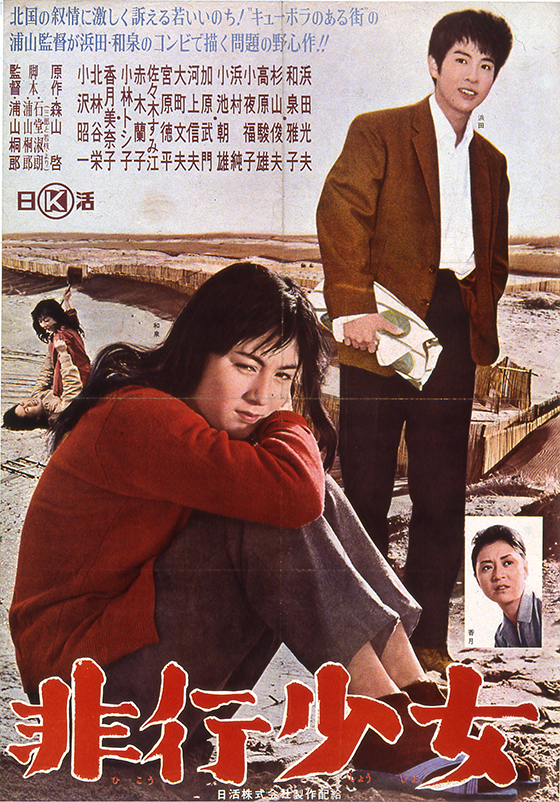
Still a major marquee name well into her 70s, Sayuri Yoshinaga began her career as one of Nikkatsu’s young starlets in the early 1960s. Based on the well known novel by Yukio Mishima, The Sound of Waves (潮騒, Shiosai) finds her starring alongside regular co-star Mitsuo Hamada in another tale of love across the class divide. Usually, such forbidden love would be fodder for romantic tragedy, but Sound of the Waves is a cheerful exploration of tranquil island life where the people are simple and honest and the good will always triumph. 

Shinji (Mitsuo Hamada) is indeed good. Though still only a teenager, he’s become the man of the house following his father’s death, working hard as a fisherman to support his family and saving most of his salary to pay for his little brother’s education. The trouble starts when the beautiful Hatsue (Sayuri Yoshinaga) who had been living as a pearl diver on another island is called back to live with her father, island big man Terukichi (Kenjiro Ishiyama), after her brother dies. There have long been rumours that, as what Terukichi wants is a son to take over his business, he will soon be marrying Hatsue off and probably to the slick and handsome Yasuo (Daizaburo Hirata) who seems to be his favoured choice of son-in-law. 

When Shinji lays eyes on Hatsue helping out with the boats it’s love at first sight, and even more so when he foolishly drops his pay packet while delivering a fish to an elderly couple and Hatsue takes the trouble of finding out where he lives and delivering it to his mother safely. Though everyone in Shinji’s household is quite taken with the beautiful, kind, and responsible newcomer, they are also aware that she is far out of Shinji’s reach. Terukichi is mean and arrogant, there’s no way he’d let his daughter marry a regular fisherman, and Shinji knows he can’t compete with an eligible young man like Yasuo. Hatsue, however, seems to like him too, especially after she gets bitten by a snake and his quick thinking, immediately sucking out the poison, probably saves her life. 

This being an innocent story of pure love, the couple have the opportunity to consummate their relationship after stripping off during a rainstorm but collectively decide to wait for marriage. That doesn’t stop the rumours starting, however, when they are spotted in the forest by Chiyoko (Kayo Matsuo), a young woman sweet on Shinji who’d gone away to study at university in Tokyo. She tells Yasuo who is immediately threatened, not only feeling unjustly betrayed, but acutely aware that the bright future he’d been so proudly boosting of as Terukichi’s future son-in-law might be in jeopardy. 

Where Shinji is kind and responsible, working hard to look after his family and always supporting the other villagers, Yasuo is, like Terukichi, arrogant and self-centred. He’s perfectly aware that he’s the island’s most eligible bachelor and makes a point of swaggering around like a little prince in waiting. Perhaps for that reason he’s also a snivelling coward and intensely insecure, angrily confronting Hatsue and even attempting to rape her while she collects water at the local spring. She manages to fend him off when he’s stung by hornets coming to her defence, and all he can do is plead with her not to tell her father so he won’t mess up his bright future any further. 

Hatsue seems not to have very much say in her future, romantic or otherwise. Having heard the rumours, Terukichi keeps her prisoner in her own home, insisting that she will marry his choice of son-in-law. The islanders, however, who seem to have grown used to ignoring Terukichi as much as it is possible to do so, are fully behind the youngsters’ romance. After all, what could be more natural than two young people falling in love? Eventually the island women launch a small petition to Terukichi to convince him to end his pettiness, but the contest, it seems, comes down to a test of manliness, Terukichi embarking on a young people today speech in complaining that his boat’s come loose in a storm but no one is man enough to retrieve it. Yasuo is found wanting once again, shrinking back from real risk while Shinji puts himself in harm’s way not only to prove himself a man and win Terukichi’s approval, but simply to serve the community. Manliness is redefined not only as strength and bravery, but kindness and patience too. Shinji’s goodness is indeed rewarded allowing him to dream of a brighter future, building a life for himself alongside a woman who loves him on their idyllic island home. 


Original trailer (no subtitles)

The Tattered Wings (遠い雲, Keisuke Kinoshita, 1955)

“Why can’t a woman have the freedom to pursue her own happiness?” wails an extremely conflicted woman in Keisuke Kinoshita’s The Tattered Wings (遠い雲, Tooi Kumo), though it appears she may have completely misinterpreted the desires of the woman she is speaking to. By 1955, provincial Japan had perhaps returned to a kind of peaceful normality but times were changing here too, just in ways that seem slightly unexpected. In this case, the problem is not curtain twitching grannies keen to enforce the social order, but a pair of young punks hoping to stir up trouble through malicious gossip for motives which are entirely unclear save resentment and desire to rebel against their own lack of prospects in an otherwise rigid society. 

All the trouble starts when brooding intellectual Keizo (Takahiro Tamura) returns from Tokyo for a 10 day visit with his family before taking up a job transfer to Hokkaido after which he claims he will not be able to see them for several years. Before he left, Keizo had been sweet on Fuyuko (Hideko Takamine), but she eventually consented to an arranged marriage to support her parents’ failing business and is now a widow with a small daughter. Though the marriage was abusive, since her husband’s death Fuyuko has been happy in her married home, spending time with her husband’s sensitive younger brother Shunsuke (Keiji Sada) and there is some talk that they may later marry. 

Though this kind of quasi-incestuous union of a widow and her brother-in-law may have fuelled countless other melodramas, it is not the problem here so much as its potential solution. After running into him by chance at her husband’s grave, a strange place to reencounter an old lover, Fuyuko is seen in several places around the town walking and talking with Keizo. There is nothing more to their relationship than that, a man and a woman talking at a respectful distance in public, but the young toughs at the station who always carried a torch for the beautiful Fuyuko decide to start a nasty rumour that there is something improper going on. 

In real terms, of course, there isn’t, but there is a kind of silent pull between Keizo and the lonely Fuyuko that is much more difficult and ambiguous than one might expect it to be. Keizo clearly wants to pick up where they left off, but is intense and awkward, motivated to urgency by the briefness of his stay. He forgets that he’s been gone a long time and Fuyuko is no longer the carefree 19-year-old she was when he left, but the mother of a young girl who claims that she has long since lost the ability to dream. Brutalised by her abusive husband, she is unwilling to stake her hopes on new romance and is wary of becoming a middle-aged woman chasing a return to the past in embracing an idealised first love in flight from its complicated reality. She accuses Keizo of trying to project his own dream of the past onto her, wanting to return to the possibilities of his youth rather than really in love with a woman he now barely knows. 

Meanwhile, Fuyuko is pulled in two directions by her respective families. Her older sister is embittered, resentful of their mother who refused her permission to marry a man she loved because he wasn’t wealthy and they wanted a son to marry in, while her younger sister has herself long carried a torch for Keizo and is acting more out of jealousy than genuine concern. Faced with crisis, the families of both Fuyuko and Keizo affirm that they don’t care what anyone might say about it so long as their children are happy, but the problem is that Fuyuko no longer knows what she wants. Keizo accuses her of tearing off her wings rather than using them to fly, but perhaps what she wanted all along wasn’t an excuse to leave but one to stay. Maybe what she wants isn’t actually what everyone expects it to be, and the permission she’s trying to give herself is the right to be comfortable with a slow and steady kind of love at the side of a patient and compassionate sort of man who’d be content to let her choose and know he’d been her choice. Fuyuko’s wings may be tattered, but she is in a sense pursuing her own happiness in choosing the present over an unrealistic dream of adolescent romance.


Opening and titles (no subtitles)

Snow Trail (銀嶺の果て, Senkichi Taniguchi, 1947)

The cinema of the immediate post-war era might in a sense be aspirational, but it rarely shies away from hardship or from the sometimes difficult choices which had to be made both in terms of individual survival and the future direction of a society. Remembered chiefly for featuring the debut of screen legend Toshiro Mifune, Senkichi Taniguchi’s Snow Trail (銀嶺の果て, Ginrei no Hate) is less a crime doesn’t pay story than it is an affirmation that it’s never too late to turn back and that people who do “bad” things aren’t always “bad”, only troubled and desperate, but can be guided back towards the right path by the power of simple human goodness. 

As the film opens, a trio of thieves commits a daring bank robbery and then heads off on the run intending to hideout in the mountains posing as tourists on a skiing trip. To facilitate their ruse, they’ve cut off communication by fiddling with radios and disabling telephones but two young men with too much time on their hands have already heard about the robbery and figured out the three suspicious gentlemen might be the fugitive criminals. In another picture, the two young guys would be the bumbling heroes, mistaken in their assumption that their world has been invaded by crime and probably finding romantic disappointment before heading home. This time however their guess is correct and their investigation has placed them in danger. The leader, Nojiri (Takashi Shimura), whips out a gun on a collection of drunken labourers and forces them out of their clothes and into the hot spring so the gang can make their escape further up the mountain, eventually taking refuge in a tiny lodge run by a philosophical grandpa (Kokuten Kōdo) and his cheerful teenage granddaughter (Setsuko Wakayama).

The police are in hot pursuit, but it is by nature which we will be judged. After leaving the hotel, the trio stop briefly in a ranger’s hut where hotheaded youngster Eijima (Toshiro Mifune) suggests splitting up. Nojiri divides the loot, giving each their promised share, but the other guy, Takasugi (Yoshio Kosugi), objects. He doesn’t want to go it alone and resents being forced to make his own way, even wondering out loud how long they’d get if they gave themselves up now. After a fight knocks Takasugi out, Eijima is keen to leave him behind, but he ends up spelling his own doom when he fires his gun at the police and provokes an avalanche.  

Later the patient grandfather tells us that the “mighty mountain punishes the bad”, and Takasugi is presumably its first victim, paying the price for panic and cowardice. Meanwhile, Nojiri and Eijima find themselves playing tourists once again in the mountain lodge where Nojiri is touched by the simple innocence of the young girl and her grandfather and Eijima paces around impatiently like a caged animal, cruelly killing the little girl’s prized carrier pigeon in case it takes it upon itself to signal the authorities. Threatening the girl’s life, Eijima convinces another guest, Honda (Akitake Kono), to guide them safely over the mountains to escape, but becomes increasingly paranoid that he will be betrayed, knowing he does not have the skills to survive alone in this environment. 

Nojiri meanwhile is drawn back towards humanity. Already softened by Harue, the cheerful young woman at the lodge who innocently offers him honey tea and reminds him of his own daughter who passed away at a similar age, he remains conflicted in their coercion of Honda and even more chastened after Honda saves both of their lives when Nojiri slips breaking own his arm in the process. Later, Nojiri asks him why he helped them rather than just cutting the rope and escaping. He replies that all he did was respect the code of the mountains. “The rope that ties one life to another must never be touched” he tells him. 

In an unexpected twist, Nojiri’s humanity is reawakened by a song filled with nostalgia but it isn’t Furusato or Akatombo, it’s “My Old Kentucky Home” played in an instrumental version on Harue’s portable record player, previously used by Honda who performed a silly dance to tune of Oh Suzannah. The choice of music perhaps echoes the movie’s Hollywood inspiration, but otherwise follows the pattern of other similarly themed contemporary crime movies in which the hero is eventually redeemed by connecting with his own childhood innocence through the “furusato” spirit. Still able to find this essential goodness within himself, the mountain has judged Nojiri favourably, proving that as grandpa says he isn’t a “bad” person even if he’s made “bad” choices. Filled with a new respect for the ropes that bind one human to another, he is allowed to return to the world presumably to live a more connected existence cheerfully helping others rather than remaining selfishly alone.


Haze (ヘイズ, Shinya Tsukamoto, 2005)

“Nothing spectacular is waiting for us even if we get out of here anyway” according to the imprisoned hero at the centre of Shinya Tsukamoto’s Haze (ヘイズ). Tsukamoto began his career with a series of tales of urban anxiety, a fear of increasing mechanisation which rendered a man mere slave to his physicality. Created as part of Jeonju International Film Festival’s digital project and later expanded to its current length, Haze skews in a slightly different direction, repurposing the director’s trademark body horror as a kind of depression metaphor as the unnamed hero, played by Tsukamoto himself, attempts to climb out of a pit of despair while experiencing momentary echoes of the traumatic event which has trapped him there. 

As the film opens, a man (Shinya Tsukamoto) wakes up in a confined space with no knowledge of how he got there or memories of his previous life. He convinces himself this must be a dream but believes if it were he would’t feel pain, which he later does not least from the gaping and unexplained wound near his hip. Left with no other choice, he crawls forward in search of an exit, gripping on literally by the skin of his teeth as he climbs through barbwire, beaten on the head by a strange contraption attacking him from what looks like an arrowslit in a castle. He glimpses other figures writhing in pain through a gap in the wall, some of whom are then torn apart while he later comes across great machines of human butchery and finds himself wading through severed limbs until he finally encounters another survivor, a woman (Kaori Fujii), who is minded to escape the way she believes she came in while the man is already beginning to give up on the idea of survival. 

The man meditates on what might have brought him here, as if it makes a difference or would help him to escape. He wonders if a war has broken out and he’s been taken prisoner, has been abducted by a weird cult, or is a plaything of a “rich pervert” enacting his own version of The Most Dangerous Game. He is perhaps crawling through hell, only one that may be of his making as a kind of metaphor for life’s battering as he pushes forward blindly, lacerating himself in pursuit of freedom while strangely indifferent to the suffering of others who appear not to have been so lucky. 

The woman is unable to provide any more explanation, lamenting that this may be their finally resting place but insisting that she is getting out. The man isn’t so sure, listening to her plan with scepticism, but once again wondering how he got here. Asked who is behind this the woman can only reply that it seems to be “a really big and dark thing, neither a human being nor a beast. You find yourself in total darkness being dismembered and floating in the water”. “If you see nothing ahead you eventually end up here” the man replies. After drifting off, the woman tells the man that she had a sensation of waking up alone somewhere dark and feeling lonely, “like falling into a place like this”. 

Later she remembers that she wanted to go somewhere, but was imprisoned here before she could run away. The man harps back on his theories again, wondering if it was a rich pervert after all, though this seems like a lot of bother to go to for sadistic kicks. He doesn’t stop to wonder what it was the woman wanted to escape, life itself or an intolerable situation and what the motives might be of the person who tried to stop her leaving. In fact, his own “sweet memory” is a bright and cheerful one of watching fireworks which he remembers liking a lot, though fireworks are perhaps also tiny sparks of life which blink out far too soon. Questioned about the motives of the hypothetical rich pervert, the woman suggests he might have done something like this to make her “go back” to wherever it was that she was desperate to leave. In any case, even if it’s back “there”, she is determined to escape and, perhaps paradoxically, gives the man the courage to follow though it’s he who eventually vows to “save” her. 

The path towards escape is itself a kind of rebirth, pushing through blood and viscera towards the light, the hazy dawn of the title. Something has perhaps been overcome if only in the brief moments of unconsciousness between life and death and perhaps because of that single “sweet memory”, unreliable and hazy as it might eventually prove.


Haze is available on blu-ray as part of Third Window Films’ Tsukamoto box set which also includes his latest film Killing and a new restoration of Adventures of Electric Rod Boy all of which are accompanied by audio commentaries by Tom Mes.

Let Him Rest in Peace (友よ、静かに瞑れ, Yoichi Sai, 1985)

“There are times when you need to stand for something” according to an ultra masculine avenger giving a few lessons in manliness to the already defeated teenage son of a friend. A noirish, stranger in town affair, Yoichi Sai’s Let Him Rest in Peace (友よ、静かに瞑れ, Tomo yo, Shizukani Nemure) locates itself in an awkward frontier landscape, moribund small-town Okinawa seemingly devoid of life now that the Americans have pulled out and moved on. The Americans have, however, been “replaced” by beefed up corporate thugs backed by yakuza muscle and corrupt police. Sometimes you have to take a stand, if only to show them that you won’t be pushed around because if you give in once you’ll never be free. 

Disgraced doctor Shindo (Tatsuya Fuji) has come to Okinawa in search of the Freein, but every time he tries to ask someone for directions, he is met with intense hostility, the last man even telling him “You shouldn’t go there, that place is no good”. This is not because the Freein is mostly home to a collection of brassy sex workers, but because its owner and Shindo’s old friend whom he has come to help has become a local pariah. Sakaguchi (Ryuzo Hayashi) is currently in jail because he apparently went crazy and started waving a knife around at construction magnate Shimoyama (Kei Sato). As Shindo quickly finds out, Shimoyama is in the process of buying up the whole town and Sakaguchi is the last remaining hold out. As such, he is hated by most of the other residents and the subject of persistent harassment by Shimoyama goons who have not only thrown bricks through the windows but gone so far as to kill his son’s dog, later kidnapping the boy to put pressure on the pair of them. 

What’s not lost on Shindo is the extent to which Shimoyama’s corruption has already seeped into the town. Meeting Sakaguchi’s son Ryuta (Makoto Mutsuura) by chance, Shindo takes the boy to see his dad but is again met with hostility by the local bobby, Tokuda (Hideo Murota), who tells him that “Shimoyama Construction is the savour of this town”. “There’s no other company that is so giving”, he goes on, “to have the employees of a company like that working here, I can’t have a wild man like Sakaguchi running about”. According to Tokuda, Sakaguchi is the odd man out, an inconvenience to all those around him who believe in Shimoyama and are trying to save the town. Tokuda looks sheepish when Shindo asks him why he’s so into Shimoyama, confirming the mild suspicion aroused by his improbably fancy watch. 

Tokuda’s warning is however borne out by the townspeople who continue to shun and ignore Shindo while the other kids mercilessly bully Ryuta, calling him the “craziest kid in Japan” and calling for his dad to get the death penalty despite the fact that all he seems to have done is aggressively wave a fruit knife at the wrong person. The local cafe owner describes him as an embarrassment and accuses him of holding out to get more money. After all there’s no future in this tinpot town which seems to exist in the ruins of the post-war era and Shimoyama is already offering triple the going rate so Sakaguchi is only being greedy and selfish. Komiya (Ryoichi Takayanagi), the bellboy, if you could call him that, at Freein, spins it slightly differently, explaining that no one supported Shimoyama in the beginning but they’ve all been harassed themselves and have long since given in. Shindo convinces Ryuta to talk about his kidnapping, but Ryuta tells him that on his return he told his father they should leave, that it was pointless to resist. Shindo asks him if he’s ever been in a fight, but the boy asks what the point is if you know you’re going to lose, “the strong are always strong”. 

That kind of defeatist thinking is anathema to Shindo’s conception of manhood. Despite his father’s incarceration, Ryuta is too afraid of being kidnapped again to go to school. Trying to be nice about it, Shindo calls him a coward for telling his father to leave even though he wants to stay because he allowed himself to be threatened into sumbmission. He tells him that he has to stand up for himself, report his kidnapping to the police. Ryuta tells him he’s crazy, the police are in on it, but Shindo counters that it’s worth trying to get his father out of jail because if they don’t they’ll never know. Ryuta snaps back that he knows already, and indeed bottles his chance when Shindo manipulates Tokuda into “helping” him oppose Shimoyama’s cult-like hold over the town.  

Shindo might not be that much better, he’s prepared to fight dirty, getting hard evidence of Tokuda’s corruption and trying to use it against him but even these methods prove ineffective against such a vast and entrenched mechanism of control. Shindo also realises that Shimoyama’s minion Takahata (Yoshio Harada) is another old university classmate, a member of the boxing club, bringing this widening drama down to the level of three men who went to the same prestigious university but all ended up here, pretty much at rock bottom. Though ironically enough Shindo’s broody silence and dedication to his friend have a few of the women wondering if he might be gay, his preoccupation is with a failure of masculinity. He doesn’t think Shindo was actually capable of threatening anyone, and knows that he had reasons that he might have wanted to try and sort this out sooner rather than later. His son’s words pushed him over the edge. He used his body as a weapon, tried to make Shimoyama damn himself, but his efforts were frustrated. Shindo acknowledges that “saving” his friend might look quite different than one might think, inadvertently teaching young Ryuta a few problematic lessons about what it means to be a man. Still, the town might have been “saved” in one sense at least in being freed of this particular oppressor. A stand has been taken, and a man’s self worth restored, but as Sakaguchi’s wife (Mitsuko Baisho) points out even while fully understanding the codes by which the men around her live, what is to become of those left behind?


TV spots (no subtitles)

Living by Karate (無鉄砲大将, Seijun Suzuki, 1961)

Nikkatsu’s brand of youth cinema could often have a nasty edge, its damaged heroes caught up in complicated rebellion but necessarily outsiders in a changing world which they feared held no real place for them. For each of those, however, there are others filled with life and possibility, not to mention a cartoonish sense of fun and infinite safety which perhaps largely disappeared from the films of the 1960s only to be found again in Kadokawa’s similarly aspirational teen movies of the bubble era. 

Living by Karate (無鉄砲大将, Muteppo Daisho, AKA Reckless Boss / A Hell of a Guy) once again stars Koji Wada as an earnest young man kicking back against the corrupt wartime generation. Still in high school, Eiji has a part-time job at an ice rink which he doesn’t treat quite as seriously as he ought to but his boss lets him get away with it because his handsome face is a hit with the local ladies. Eiji and two of his friends are keen members of a karate club and have decided to use their skills to fight for justice in their lawless town by going on “patrol”, clearing up the kinds of crimes the police might not make it to in time. Their plan backfires, however, when they come across the body of a recently deceased union leader and are arrested by a local bobby after getting caught with a joke knife one of the boys made for fun at his job on the family scrap yard. 

It comes as no surprise that Eiji’s arch enemy, sleazy mob boss Shinkai (Nakajiro Tomita), is behind the murder, apparently hired by a corrupt corporate CEO trying to stop his workforce exercising their legal rights. Eiji hates Shinkai because he bankrolled his widowed mother’s (Kotoe Hatsui) bar business but did so perhaps in return for being able to control her and by extension him by wielding his economic power against them. His loathing intensifies once he realises that the slightly older young woman he’s carrying a torch for, Yukiyo (Izumi Ashikawa), has fallen for one of Shinkai’s men, Goro (Ryoji Hayama). 

Goro is the classically “good” gangster who feels indebted to Shinkai because he took him in after the war, but wants to leave the underworld behind, going straight in Kobe where he intends to live a settled married life with Yukiyo. The modern yakuza is in many ways a Showa era phenomenon, a mechanism for men without families to protect themselves in the desperate post-war environment. By 1961, however, its existence was perhaps becoming harder to justify. The war orphans had grown up and had families of their own, the economy had significantly improved, and there was no need anymore to live a life of crime and heartlessness – a conclusion Goro has come to on his own after meeting the earnest Yukiyo who has similar problems with her goodhearted yet permanently drunk doctor father. 

Knowing he might have messed things up for his mother in interfering with her relationship with Shinkai, Eiji confesses that doesn’t “know what to do with the grownup world”. For him, everything is still very black and white. He hates yakuza because they prey on the vulnerable and Shinkai in particular because he does it so insidiously, forcing desperate people to accept loans on bad terms so that he can in fact “own” them and use them as he wishes. Eiji and his peer group kick back against what they see as the selfish corruption of the wartime generation, agitating for a fairer, more just world. The wealthy daughter of a corrupt CEO (Mayumi Shimizu) who has a crush on Eiji though he only has eyes for Yukiyo comes up with the idea of selling her fancy car to get money to help Eiji’s mother escape Shinkai’s control, but her father snaps at her that other people aren’t her responsibility and that she doesn’t understand how the real world works. 

Somewhat chastened by the youngsters’ pure hearted love of justice, he eventually comes up with a compromise in buying the car off her himself, but before that Eiji and his friends have to think carefully about the form they want their revolution to take. Taking him to task, Yukiyo points out that if all you do is fight with yakuza then maybe you’re a yakuza yourself, which shifts Eiji’s perspective towards ensuring that his rebellion is fully legal and involves the justice systems already in place. He comes to recognise that Goro is much like himself, and if he’s going to take down a sleazy brute like Shinkai it will take more than some fancy karate. Their resistance starts at home, giving others courage to stand up to yakuza oppression while living right themselves in the hope of creating a better, fairer world free of heartless organised crime.


Parallel World Love Story (パラレルワールド・ラブストーリー, Yoshitaka Mori, 2019)

Have you ever had the feeling that you’re going out of your mind? Something just doesn’t feel right, your sense of perception and memory of the past don’t match the “reality” you’re currently experiencing but you have no way of knowing what’s at fault, you or the world. The hero of Parallel World Love Story (パラレルワールド・ラブストーリー) finds himself in just this situation as he begins to experience two very different states of being, one in which he’s living happily with the love of his life, and another where she’s dating his childhood friend. Is he a love crazed fool, or is someone messing with his head?

Travelling the same train into college every day, Takashi (Yuta Tamamori) fell in deep silent love with a young woman whose train crossed his every Tuesday morning. On his very last Tuesday, he decided he’d switch trains and try to find her, but she did exactly the same thing and so they missed each other, leaving Takashi feeling as if his fated romance was matter for another universe. He is then shocked when an old friend from middle school, Tomohiko (Shota Sometani), introduces that same young woman, Mayuko (Riho Yoshioka), as his girlfriend some time later. A little resentful at this twist of fate, Takashi tries his best to keep his feelings hidden. Meanwhile we see him “wake up” in his own apartment where Mayuko, who lives with him, is lovingly making him breakfast. He has a vague recollection of Tomohiko turning up in his dream, but can’t seem to remember what it is he’s doing these days. In this “reality”, Tomohiko introduced Mayuko to Takashi, and has abruptly moved to LA without even saying a proper goodbye, apparently working on a top secret research operation which keeps him entirely out of contact. 

Both men are involved with the research of perception and memory. Talking to another friend before “meeting” Mayuko, Takashi points out that it’s your brain which constructs the current reality from your sense perception. He grasps her hand and her brain tells her she feels it, but she’d feel the same thing if he isolated and activated the relevant sectors of her brain which tell her her hand is being grasped. Tomohiko, meanwhile, has gone one step further. He’s discovered that it’s neural networks rather than the brain which store memories and that, by stimulating those neural receptors in a particular way, memory can be rewritten or fake memories introduced. He proves this by illegally experimenting on a friend, making him think he’s from Tokyo when he’s really from Hiroshima, and reconstructing the image of an old teacher so that she’s now a pretty young woman and not a portly old man. 

The gap between what you want to be true and the “reality” is shrinking. It turns out that it’s easy enough to trick yourself into thinking something is true when it isn’t when you really want it to be. According to Tomohiko, once your brain has decided to approve the “fake” reality, cognitive dissonance is overcome by everything else being forced to fit into your new conception of the world. Takashi, however, is struggling to integrate his two parallel lives, one bleeding inconveniently into the other leaving him wondering which one is the “reality” and which the “dream”. 

Takashi’s less palatable qualities, however, exist firmly in the recent past of reality A in which romantic jealousy appears to have driven him half out of his mind, causing him to semi-stalk the innocent Mayuko and consider betraying his childhood friend by stealing the woman he loves. Takashi’s sole justification for his behaviour is the unspoken romantic connection which brought them together on the train, a connection he is “certain” she remembers without being given any particular encouragement from her side. Reality B Takashi, who lives with Mayuko, similarly becomes obsessed with the idea that Mayuko in some way belongs to Tomohiko, awakening an unpleasant sense of misogyny in his desire to prove that Mayuko is his because he saw her first on the train. 

Meanwhile back in Reality A, he starts to suspect that Tomohiko is up to no good pursuing unethical research practices and working towards a sinister goal. It’s unfortunate that Tomohiko also has a prominent limp from a lame leg, playing into the unpleasant association of villainy and disability. Even Takashi, having turned dark, accuses Mayuko of dating him out of pity, while Tomohiko describes him as a “hero” for having rescued him from childhood bullies. Takashi starts to suspect him, not only of being a mad scientist, but perhaps actively hostile and plotting revenge against him for stealing Mayuko. In a particularly Higashino-esque touch, Tomohiko’s motives turn out to be kinder than they might at first seem even if they’re a little on the extreme side, leaving Takashi pushed to make a similarly extreme yet strangely counterproductive move by his infinitely shady boss who is also exploiting the increasingly conflicted Mayuko. Yet, aside from all the philosophical musings on the nature of reality, the interplay of desire and memory, and the ethics of manipulating the perception of others, this is in essence a love story between two people who gazed at each other from passing trains. If you find each other once, you can find each other twice, and, in love, reality might not be so important.


Original trailer (hit subtitle button for English subs)