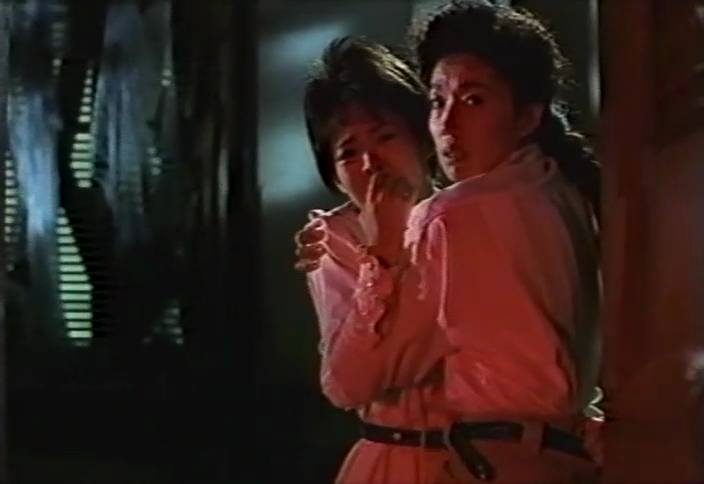
Sweet Home (スウィートホーム, Kiyoshi Kurosawa, 1989)

A documentary film crew hoping to discover long-hidden frescos by an artist with a tragic history find themselves on a quest to resurrect the traditional family in unlikely horror comedy Sweet Home (スウィートホーム). Written and directed by Kiyoshi Kurosawa, the film shares many of the hallmarks of his later career in his preoccupation with what lurks in the shadows, yet produced by Juzo Itami who also stars and apparently reshot some scenes himself it also mines a deep seam of ironic humour harking back to classic serials and contemporary kids adventures in the same way as Hiruko the Goblin among others would do just a few years later. 

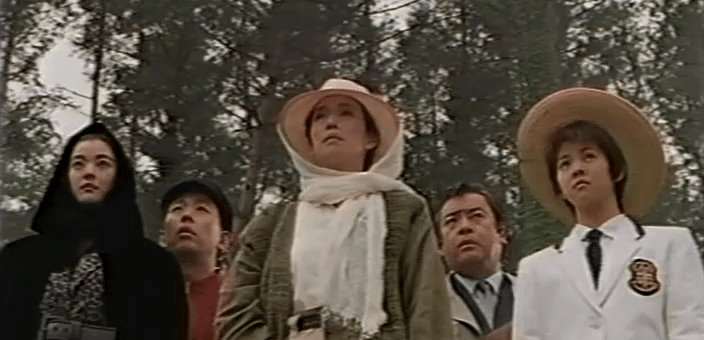
This strain of irony is perceptible in the opening scenes in which producer Akiko (Nobuko Miyamoto) appears in an elegant ’40s-style outfit more in keeping with an archeological dig than a haunted house adventure, her later attire strongly recalling that seen in Indiana Jones. The gang are waiting by their military-style jeep seemingly in the middle of a sandstorm while chief producer Kazuo (Shingo Yamashiro) is busy at the municipal office trying to get permission to enter the Mamiya Mansion which has been shut up for the last 30 years since the death of legendary artist Ichiro Mamiya who is the subject of their documentary. A diffident man as his daughter jokes, Kazuo finds it difficult to make headway until a slightly more cynical employee takes over the negotiations and hands over the key with the rationale that they’ll either find out the house isn’t haunted after all in which case they can turn it into a museum, or that they’ll get some tidy publicity out of the horrifying deaths of all concerned. 

A western-style gothic mansion, the house is itself as imposing as it is ominous even without swirling mists or hovering gloom. Once inside the crew find what they’re looking for, a beautiful fresco with the title “home sweet home” painted in a corner. All we’re told about Ichiro is that he died in the house, but when all is said and done he, like Kazuo, is not terribly important and it is not his death which has cursed the mansion but that of his wife. The sweet home the couple had dreamed of was coming to fruition with the long-awaited birth of a child whose life was to inspire frescos on the remaining walls only tragedy struck. As a toddler the child somehow climbed into the furnace and was burnt alive when his unknowing mother ignited it. She then went mad, kidnapping other children and apparently burning them so her child would not be lonely before eventually throwing herself in too.

Perhaps uncomfortably, Sweet Home leans in to the kind of maternal questioning common to the genre as it considers the formation of a new family in the awkward romance between the shy widower Kazuo who has brought his teenage daughter Emi (Nokko) along on the job, and capable producer Akiko who is repeatedly questioned about marriage, children, and the reasons she currently has neither of them. Keying in to the terror of the house, Emi reveals that as she grows older the memories of her birth mother begin to fade to the extent that she can barely make out her outline, envisioning her merely as an indistinct light. She is prepared to accept Akiko as second mother, offering her the dress which her own mother used to wear only for Akiko to diffidently refuse on the grounds that the dress should be worn by Emi as her mother would have wanted perhaps hinting at the way Emi often treats her father as a clueless child in need of mothering himself. 

Nevertheless, it’s the dress of maternity that Akiko must finally put on in order to claim the maternal space in venturing back into the haunted house in order to save Emi from becoming another playmate for Mrs Mamiya’s child. Rather than Kazuo, who proves rather ineffectual, she is guided by a weird old man, Yamamura (Juzo Itami), from the petrol station who apparently knows all about fighting ghosts but bluntly tells her she has no chance of success because she is not a mother herself and cannot understand the pain of a mother who has lost a child nor the magnetic pull between a childless mother and motherless child. In order to defeat the vengeful spirit, Akiko must fully embrace the role of the mother, easing the spirit’s pain with maternal compassion in returning to her what was lost. Her child restored to her, the spirit takes on the appearance of the Holy Mother ascending to Heaven bathed in golden light lifting the shadowy gloom that cursed the house. 

Even so there is something insidious in the fact that as Yamamura says if you attempt to fight shadow with light all you get is more of the same, the crew trapped in the house with no means of defence against the encroaching darkness. This unknown, shadowy sense of threat, of being swallowed by darkness, is a key harbinger of a Kurosawa’s signature style as well as a clear evocation of the gothic dread focused on the house with the ironic failure of the “sweet home” dream which is in essence what Akiko, Kazuo, and an Emi are chasing as they try to escape the haunted mansion. Ironically enough, Sweet Home has become best remembered for fathering a video game which eventually led to the Resident Evil series while Kurosawa himself has all but rejected the film claiming Itami’s later interventions undercut his directorial vision. Featuring effects work by Dick Smith, the horror is visceral and disturbing at one point a man’s face melting, his skin slipping from his bones, while the score is cheerfully whimsical in keeping with the absurd lightness of tone that recalls classic teen adventures before heading into the fable-like conclusion in which Akiko must wrest her surrogate child from a vengeful spirit through maternal exchange. Having served its purpose the mansion implodes, freeing not only the spirits trapped inside but the new family now freed of the weight of traditional mores to embrace their new connection founded on love and empathy rather than duty or convention.


Original trailer (no subtitles)

Ribbon (Non, 2022)

What is the place of art amid a global crisis? A young student finds herself wrestling with her sense of purpose uncertain if art is more necessary than ever before or a completely worthless waste of time that could be better used dealing with the situation on a more practical level. Written, directed, and edited by actress/singer Non, Ribbon is a response to pandemic anxiety but also a meta drama about an artist reclaiming a sense of confidence in their work along with their right to make it even if not widely understood. 

As the film opens, art student Itsuka (Non) is lugging a series of paintings and art equipment back to her university for the upcoming graduation exhibition, only the exhibition has just been cancelled because the university will be closing its doors the following day due to the COVID-19 pandemic. Itsuka has to cart all her stuff home again, but she’s luckier than some she witnesses who are left with no choice other than to destroy the precious works of art into which they’ve poured four years of their lives because they can’t store them and neither can the university. 

Watching her fellow students in tears as they crush, tear, and bludgeon their projects Itsuka can’t help but wonder what separates her painting from “trash”, seeing these precious pieces dismembered and left out for the binmen. The feeling is compounded when her mother (Misayo Haruki) pays her a visit, clad in a homemade hazmat suit, and throws the painting out justifying herself that as it had stuff stuck on it she thought it was just something she’d made messing around, more like a child’s collage than a serious piece of “art”. Unable to accept her mistake, Itsuka’s mother defensively doubles down leading to a climactic argument and the visits of other family members including her father (Daikichi Sugawara) who arrives with a social distancing pole and her sister (Karin Ono) who now dresses like an assassin each armed with passive aggressive peace offerings but ultimately seeking validations that her mother was right to dismiss her incomprehensible art. 

While her friend Hirai (Rio Yamashita) is later caught sneaking into uni to work on her much more conventional piece, a large canvas painting featuring a young girl in a forest with giraffes and leopards, Itsuka has been unable to find the desire to paint. The painting, a mixed media portrait of a young woman surrounded by ribbons, sits looking down on her taped to the wall but she can’t get away from the idea that perhaps her work really is “trash” and she’s just been wasting her time on something meaningless that other people don’t understand or care about. The feeling is compounded when she’s informed that the job offer she had from a design firm for after graduation has been rescinded due to COVID uncertainty. Only when she accidentally reconnects with a middle-school classmate (Daichi Watanabe) who had praised her work does she begin to rediscover its value not least in allowing her to vent her frustrations not only with the pandemic-era society and its isolating anxieties, but the conservative ideas embodied by her mother’s constant complaints about her “attitude” reminding her she’ll never get married if she carries on as she is.  

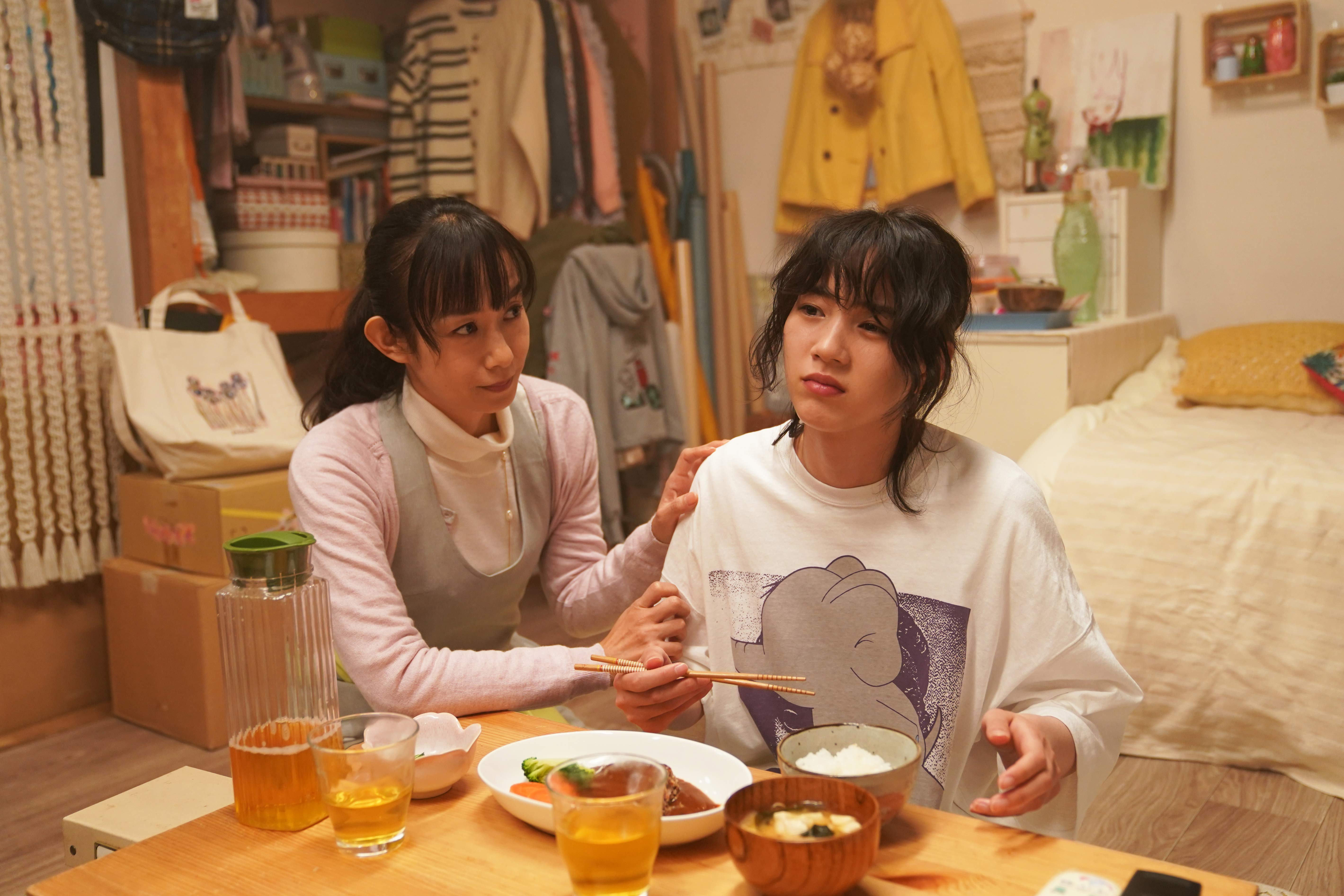
“This is what our frustration looks like” she explains incorporating her friend’s fractured painting to turn her formerly chaotic apartment into an installation covered in the ribbons which had previously swarmed around her. Opening with scenes of the deserted university peopled with broken statues, headless mannequins, and crude drawings on walls, Non captures a sense of the lonely despair of the early days of the pandemic allowing these now empty places to seem almost haunted by an eerie sense of absence. There is an unavoidable absurdity in the constant masking, obsession with social distance, and spraying anything and everything with sanitiser but also a care beneath the anxiety in the concern for others’ safety as well as one’s own. “Heavy” is how Itsuka frequently describes her situation not only the physical weight of her work but its spiritual burden along with her despair and anxiety for her uncertain future, but learning to bear it allows her to rediscover a purpose and value in art not despite but because of the times in which she lives. Quirky and heartwarming, Non’s accomplished directorial debut is not only a snapshot of ordinary life in a pandemic, but a meta tale of a young woman reclaiming her right to create and vent her frustrations towards a sometimes restrictive society. 


Ribbon screened as part of this year’s New York Asian Film Festival.

Original trailer (English subtitles)

Images: ©︎”Ribbon” Film Partners

Stepbrothers (異母兄弟, Miyoji Ieki, 1957)

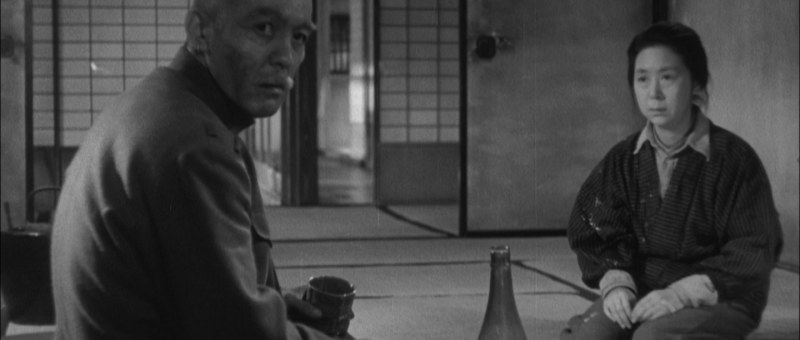
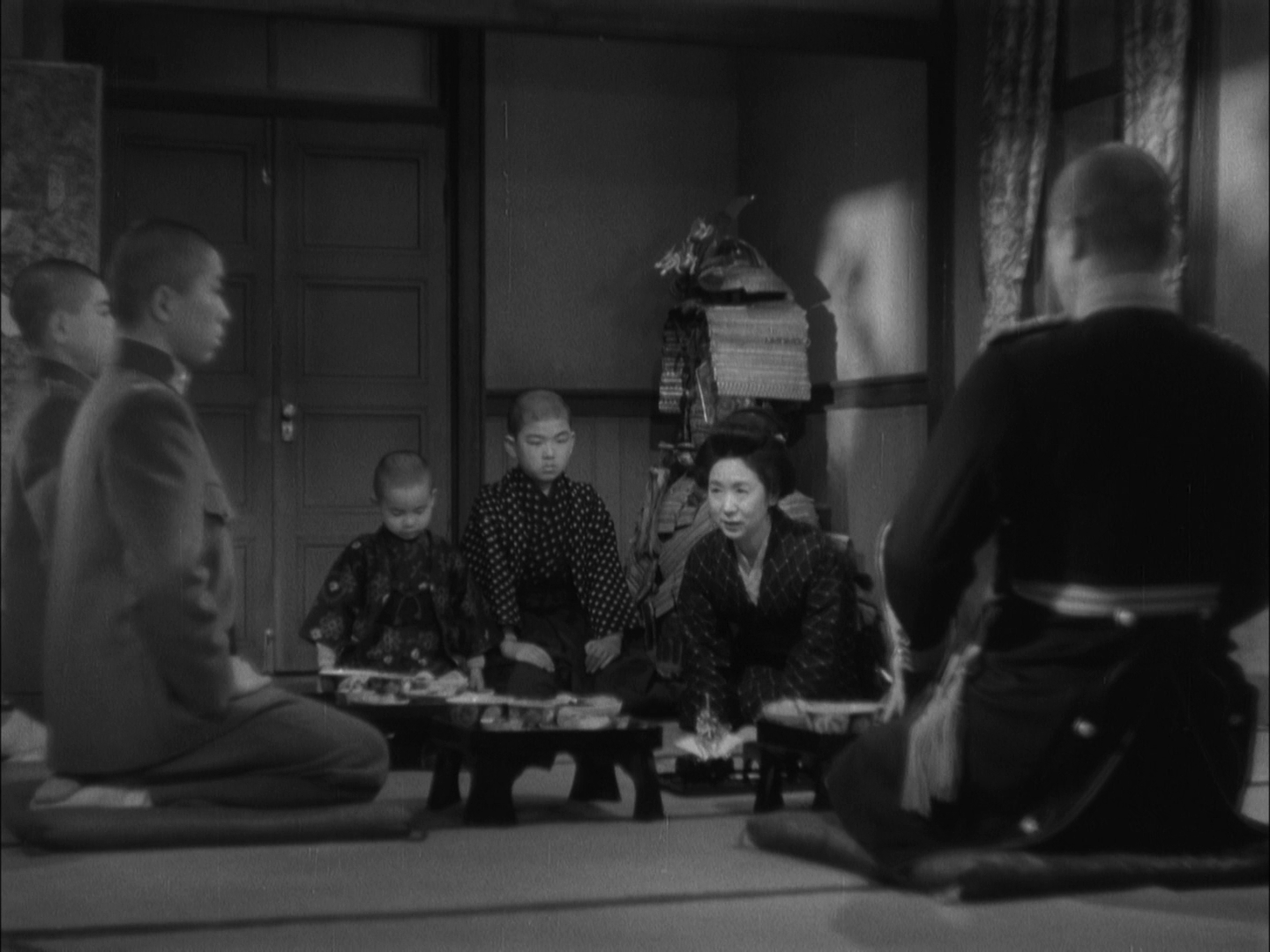
The destructive effects of militarist folly are borne out in the fortunes of one bifurcated family in Miyoji Ieki’s impassioned social drama, Stepbrothers (異母兄弟, Ibou Kyodai). Ieki had joined Shochiku in 1940 and served as an assistant director to Minoru Shibuya making his directorial debut in 1944 taking over a project Shibuya had begun before being drafted, Torrent. After the war he became the head of the studio’s union and was subsequently dismissed during the Red Purge of 1950. Adapted from the novel by Torahiko Tamiya, Stepbrothers was produced by Dokuritsu Eiga which became a kind of refuge for left-leaning directors and makes a direct attack on lingering feudalism and the militarist past. 

Spanning 25 years, the film opens in 1921 with pompous military officer Hantaro Kido (Rentaro Mikuni) riding his horse before immediately slapping his stableboy on dismounting apparently dissatisfied with his service in insisting there is something wrong with one of the horse’s shoes. This fear is later confirmed by the new maid he has just hied, Rie (Kinuyo Tanaka), who is the daughter of a recently deceased carriage driver. She has been hired because Hantaro’s wife is chronically ill and bedridden, no longer able to care for their two brattish sons Ichiro and Gojiro who imitate their father by pointing swords and guns at people while ordering them around. After asking Rie to check on the horse and observing her treating it with tenderness before pointing out the problem with its shoe unprompted, Hantaro loses control of himself, pushes her into the straw, and rapes her. With nowhere to turn Rie goes to the family friend who got her the job who discourages her from having an abortion and tries to make Hantaro take responsibility but he refuses to compensate her finally scoffing that there’s no way he would marry the mere daughter of a carriage driver. 

Challenged by his superior officer, however, he pledges to do just that in order to save the honour of the Kido family along with that of the regiment but is soon sent off to a less prestigious provincial position. In appointing Rie as a maid, Hantaro had expounded at length on his family lineage as guardians of a particular style of kendo, but there’s no denying that he has acted dishonourably while Rie is forced to marry the man who raped her and is then rendered little more than an unpaid servant in his home who is essentially raped every night for the remainder of her married life. After giving birth to the baby, a son Yoshitoshi, she has another some years later, Tomohide, but she and her children are not regarded as members of the family and are forced to sleep in the kitchen. Ichiro and Gojiro still call her Rie rather than mother and order her around like a servant while Hantaro simultaneously rejects her sons and insists they follow the family tradition by becoming fine soldiers. 

A poignant scene sees Gojiro looking on at Rie as Yoshitoshi and Tomohide cheerfully play cards with some of the servants one New Year implying he may in fact miss maternal closeness but is unable to express it because of his father’s code of manliness later tearfully asking his brother for memories of their mother when they are both grown men. The difference between the boys can seen in their names, those of Hantaro’s sons from his first marriage meaning something like “first son boss” and “strong second son” while those of Rie’s sons are much warmer, Yoshitoshi using the characters for good and benefit, and Tomohide’s wisdom and excellence. Ichiro and Gojiro continue to mercilessly bully Yoshitoshi and Tomohide, insulting them as sons of mistresses a term which Yoshitoshi does not fully understand but instantly associates with the way his family has been treated as other and inferior, confined to the parts of the house otherwise occupied by servants. When he says he’s no desire to become a soldier, Hantaro locks him in the cupboard under the stairs and seemingly never talks to him again. 

Rie tells him that he will understand her actions when he’s older but he continues to blame her for them, angry that could not reject Hantaro’s authority to protect him nor would she escape the situation by simply leaving it. His criticism is unfair and ignores her continued suffering given the reality that as a young woman with no family or fortune she is left with no means of supporting herself that would make it possible to escape. But he may also have a point in that she is also the product of a feudal and patriarchal society and is spiritually unable to refuse Hantaro’s corrupt authority over her even as he dismisses her as a carriage driver’s daughter and her sons as unworthy by his name. She suffers and placates him to protect them but Yoshitoshi sees only her complicity. 

Yet Hantaro’s pompous austerity which is also the code of the age later destroys him. He prattles on about his supposed military prowess while telling one of his sons that soldiers should be thought of as pawns to be sacrificed for the emperor only to lose both of them to the inevitable defeat. Portraits of his two sons sit proudly under a map of the Japanese empire now shorn of the flags he’d pinned to mark their victories, while Rie’s are hidden away on the shelf of a cupboard itself one of the few pieces of furniture they had not sold to survive in the difficult post-war period. Hantaro had rejected Tomohide (Katsuo Nakamura) who craved his approval because he was in poor physical health and therefore unable to fulfil his vision of manliness but it is he who alone survives having rejected his name after his father beat him for singing and sent Haru (Hizuru Takachiho), the cheerful servant girl he loved, away to be sold off to a brothel by her impoverished family. 

When Tomohide returns home after some years of wandering to a mother who thought him dead only for Hantaro to reject him, his only living son, Rie finally finds the strength to reject his authority. This time she refuses to leave, insisting that the house is rightfully Tomohide’s and he should not surrender it to a Hantaro who is now beaten and defeated, a pitiful old man who can barely walk and is perhaps consumed by the humiliation of his life’s folly. It’s his hypocrisy and moral cowardice along with the cold austerity of mindless militarism that have ruined all their lives, yet in Tomohide who truly crossed the barriers of class in continuing to help Haru with her chores there is a hope for a new future as his mother and he fill the bath together and assume ownership in equality of the home which has always been their own. 


Intimate Stranger (親密な他人, Mayu Nakamura, 2022)

“This society pampers men too much, no matter their age” according to a middle-aged woman searching for her missing son, yet in many ways it’s the primacy of the mother and maternal neglect that drive Mayu Nakamura’s eerie psychological chiller, Intimate Stranger (親密な他人, Shinmitsuna Tanin). Perhaps in some ways, that’s what a mother and a son should become, of course close and loving yet each with their own lives unknown to one another but for Mrs Ishikawa those boundaries have perhaps become corrupt in her overwhelming need to embody the maternal ideal. 

Mrs Ishikawa (Asuka Kurosawa) lives alone and is searching for her grown-up son, Shinpei, who went missing a year ago. She has a job in shop selling baby clothes and accessories but is described by other staff members as a bit strange though they continue to invite her to afterwork gatherings knowing she won’t come. One day she gets a call from a young man, Yuji (Fuju Kamio), who says he has information about Shinpei but in reality is part of a gang running “ore ore” scams who are also looking for him because he previously worked with them. Yuji’s purpose in approaching Mrs Ishikawa is to get info out of her, but she’s a little bit ahead of him and manages to plant the seeds of a dark seduction. 

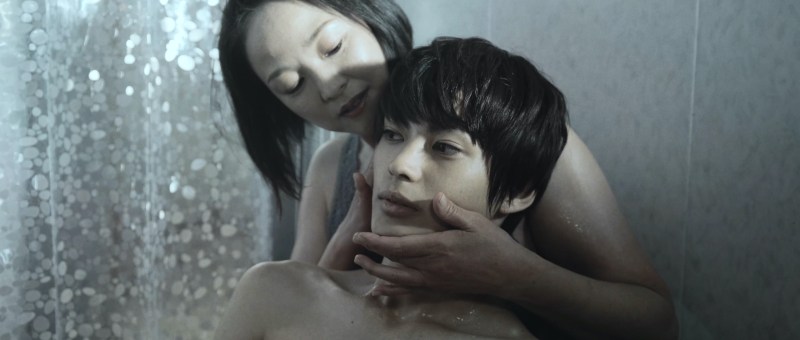
Seduced is what Yuji eventually is in a discomforting mix of the erotic and the maternal. Casting shades of Vertigo, Mrs Ishikawa persuades him to move into her apartment, sleep in Shinpei’s room, and wear his clothes keeping him a virtual prisoner while forcing him into the role of her surrogate son. As we later discover, Yuji was a teenage runaway seemingly abandoned by his mother and craves maternal affection but is ashamed of admitting and fearful of accepting it all of which would make him ideal prey for a woman like Mrs Ishikawa who at all rates seems to need a son to feel herself complete. 

At the shop where she works, Mrs Ishikawa transgressively sniffs and fondles clothes for newborn infants while at one point driven to distraction by a crying child temporarily separated from its mother to the point that she inappropriately picks it up. She appears to be totally consumed by the maternal image and to that extent or else because of some previous trauma becomes extremely hostile when confronted with her sexuality. Her horror on being picked up by a gigalo when expecting to meet a man with info about Shinpei might be understandable, but the glee on her face after slashing a man with a straight razor when he attempted to attack her is less so while Yuji’s eventual confusion about the nature of their connection highlights the discomforting intersection of the maternal and the erotic. 

We have to wonder if Shinpei simply decided to escape the grasp of an overbearing mother who could not bear to accept that her son was now a man, or if Yuji’s suspicions that he may have met a darker fate are more than mere reflections of his own fear of maternal connection. Yet like story of the bluebird of happiness that Shinpei was apparently fond of telling, perhaps each of them for a time found what they needed in the other only to lose it again on identifying the darkness that underlines their relationship. 

Listening to a report on the news, Mrs Ishikawa explains that “ore ore” scams only happen in Japan because nowhere else would a parent drop everything and run cash in hand when told a grownup son is in financial trouble which might in a sense be unfair save for the urgency, similar scams circulate via text and messaging apps in many countries. Yet the scam hints at this same level of disconnection, that the often elderly targets cannot tell that it is not their son or grandson’s voice on the phone nor realise that the information they’re being given does not make sense so estranged have families become. The coronavirus pandemic meanwhile only makes the scammers’ job easier given the loneliness of enforced isolation coupled with generalised masking which decreases the level of intimacy on both sides dehumanising the target while allowing the scammer to further conceal their identity. 

Mrs Ishikawa is in a sense wearing a permanent mask, consumed by the maternal ideal and unable to conceive of herself as anything outside of a mother. There is something unsettling and vampiric in her need as she at one point sucks blood from her finger and wields her razor with dangerous affection when offering Yuji the closest shave he’ll ever have but also a deep sadness that like the bluebird of happiness that which she most wants is always going to fly away from her one way or another. The uncanniness of the desaturated colour palate adds a further note of dread to the noirish tale of a young man seduced by Oedipal desire and drawn as much towards death as love.


Intimate Stranger screened as part of this year’s New York Asian Film Festival.

Original trailer (no subtitles)

Images: © Siglo/Omphalos Pictures

Labyrinth of Dreams (ユメノ銀河, Sogo Ishii, 1997)

“If both held their courses they would collide in nine seconds, and catastrophe would be inevitable” according to the voiceover which opens Sogo Ishii’s ethereal psychodrama Labyrinth of Dreams (ユメノ銀河, Yume no Ginga) though his words might as easily apply to the protagonist and her opposing number as a bus and a train locked as they are into a fateful cycle of love and death. Ishii had made his name in the ‘80s for a series of frenetic punk films such as Burst City and The Crazy Family yet adapted from the novel by Kyusaku Yumeno, Labyrinth of Dreams adopts the language of golden age cinema to tell a punk story as a young woman searching for freedom, independence, and a more exciting life finds herself drawn towards death in her inexorable desire. 

Set sometime in the 1930s, the film opens with a taste of the gothic on a stormy night all mists and confusion as a bus heads towards and then unwisely across a level crossing in front of an oncoming train. “Double suicide or accident?” a newspaper headline asks, as we’ll discover on more than one occasion as this is not an isolated incident either bizarre cosmic coincidence or the work of a mysterious serial killer. The heroine, Tomoko (Rena Komine), had always wanted to become a bus conductress, explaining that they looked so “heroic” in their uniforms but has discovered the reality to be not quite so satisfying. “The female bus conductor only looks good on the surface. We must obey the driver’s orders, put up with all displeasure and work like a slave” she writes in a letter to a friend, Chieko (Kotomi Kyono), telling her in no uncertain terms that she must never become a bus conductress. 

To a young woman from the country in the 1930s, such a job must have seemed exciting promising a way out of stultifying small-town life and a path to an independent urban future. It’s this sense of self-possession that Tomoko seems to have been seeking hoping that wearing a uniform even that of a bus conductress would grant her a level of authority she does not really have realising that she is a mere subordinate to the male bus driver and quite literally has no real control over the direction of her life. When she receives a letter from a friend who had also become a bus conductress only to die in a tragic accident explaining that she thinks her fiancé is a bus-based bluebeard rumoured to have seduced and murdered his previous conductresses Tomoko smells not danger but excitement in realising the new handsome driver with a flashy Tokyo haircut who’s just transferred to their station is none other than her friend’s possibly sociopathic former boyfriend. 

Fully embracing a sense of the gothic, neither we nor Tomoko can ever be sure if Niitaka (Tadanobu Asano) is a coldblooded killer or merely the projection of a fantasy created by Tomoko’s repressed desires and yearning for a more exciting life. Having encountered him once before sleeping on the railway tracks as a train approached, he becomes to her something like an angel of death and though she believes him to be dangerous she cannot help falling in love with him anyway. Ishii constantly flashes back to deathly images, a pair of shoes abandoned on the rocks or a bunch of drooping lilies while a literal funeral procession eventually boards the bus just before the climactic moments on which Tomoko is in effect staking her life as she and Niitaka each refuse to deviate from their course, a set of railway points and a trapped butterfly added to the film’s rich symbolic imagery. 

A policeman at the film’s conclusion makes a point of asking Chieko if Tomoko is known to be a habitual liar having found no evidence that Niitaka deliberately caused the deaths of his previous conductresses even if it seems unlikely that he is simply the victim of unhappy coincidence. “My life was miserable and lonely,” Tomoko writes, “but remember me as the one who wrestled her fate at the end”, staking her life on a “fatal romance” and in a sense overcoming existential dread by staring it down, a deathly desire leading finally to new life. Beautifully lensed in a golden age black and white with occasional onscreen text in the ornate font of the silent movies, Ishii’s ethereal drama freewheels between dreams and reality amid gothic mists and expressionist thunderstorms as it reels towards an inevitable collision. “They haven’t a clue about the truth” Tomoko sighs, perhaps all too aware. 


Soup and Ideology (수프와 이데올로기, Yang Yonghi, 2021)

In her 2006 documentary Dear Pyongyang, documentarian Yang Yonghi explored her sometimes strained relationship with her parents whose devotion to the North Korean state she struggled to understand. Her father having passed away in 2009, Yang returns to the subject of her family with Soup and Ideology (수프와 이데올로기) which is as much about division and how to overcome it as it is about her complicated relationship with her mother along with the buried traumas of mother’s youth as a teenage girl fleeing massacre and political oppression for a life in Japan marked by poverty and discrimination. 

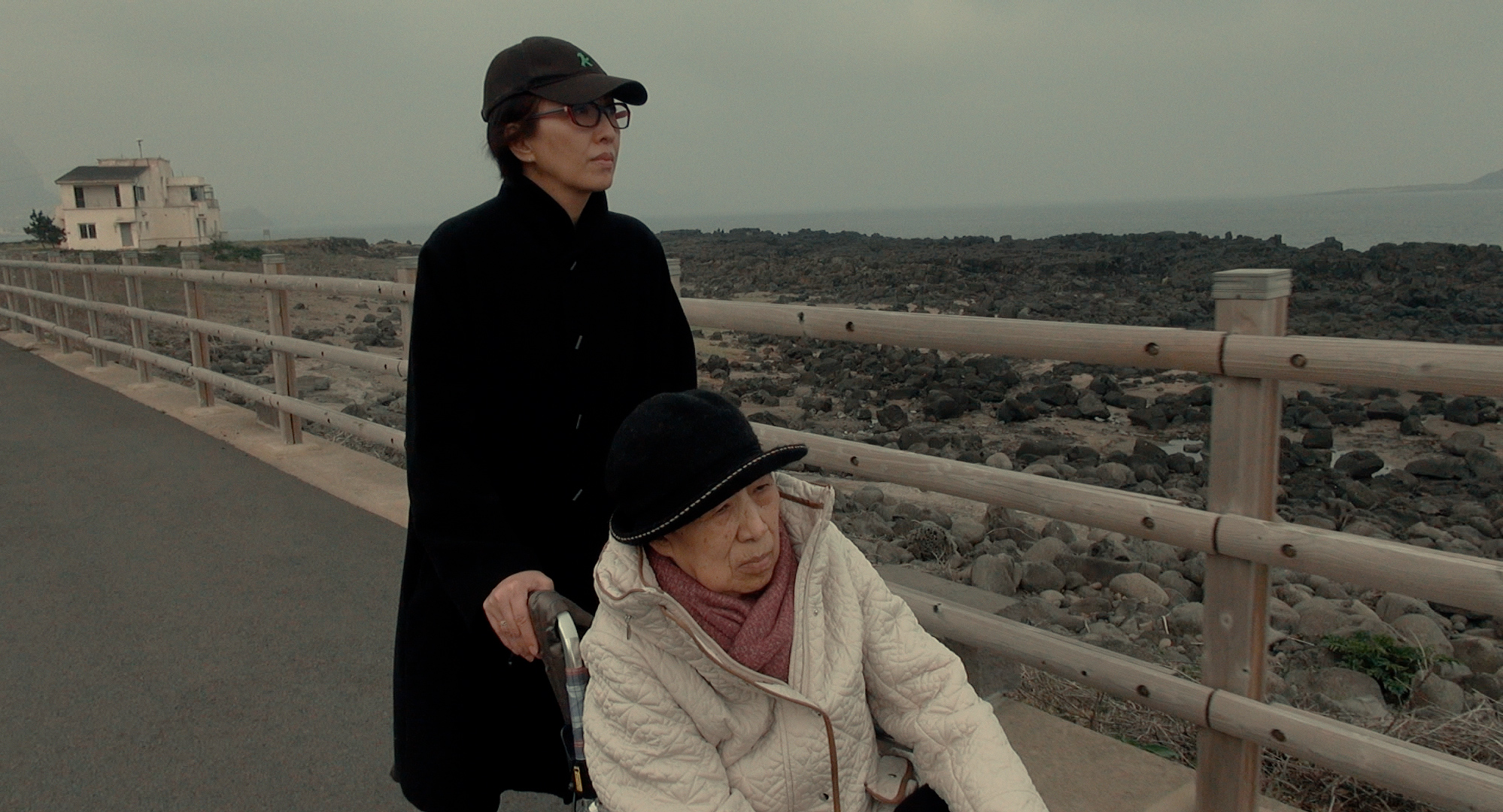
In animated sequence towards the film’s conclusion, Yang outlines the political history which led to the Jeju Uprising of 1948. Her mother Kang Junghi was born and raised in Osaka but when the city was all but destroyed in the aerial bombing of 1945, her parents decided to return to their hometown in Jeju. After the war, Korea was occupied by America and Russia and in 1948 an election was due to be held to ratify the upcoming divide. Ironically enough, the Jeju Uprising was a protest against division but brutally crushed by South Korean government forces resulting in a massacre in which over 14,000 people were killed. Then 18, Junghi lost her fiancé, a local doctor who went to fight in the mountains, and barely escaped herself walking 35km with her younger siblings in tow towards a boat which brought her back to Japan. 

There are a series of ironic parallels in the lives of Yonghi and her mother, Yonghi forced to undergo a North Korean education with which she became increasingly disillusioned while her mother was educated in Japanese and obliged to take a Japanese name while living in a Zainichi community in Osaka. Near the film’s conclusion after Junghi has begun to succumb to dementia, she struggles to write her name in hangul on a visa needed to travel to South Korea but is able to recall it in Chinese characters, which also hang outside her home, perfectly. Meanwhile, Junghi was also parted from her family in tragic circumstances and left with a continual sense of absence and displacement. There is something incredibly poignant in seeing her at the end of her life surrounded by the ghosts family members who had long been absent, continually looking for her brother who moved to North Korea where he passed away, and asking for her late husband and eldest son who took his own life unable to adjust to the isolated Communist state where he was denied access to the classical music he loved. 

Resolutely honest, Yonghi admits that she had little patience with her mother and saw her as a burden she cared for more out of obligation than love consumed with frustration and resentment towards Junghi’s devotion to North Korea and decision to send her three sons away leaving Yonghi a lonely child at home. An early scene sees her trying to confront her mother over her financial recklessness, pointing out that she is now retired and living on a pension. She can no longer afford to send the expansive care packages she prepared in Dear Pyeongyang which supported not only her sons and their families but whole communities in North Korea, while as Yonghi points out no one is going to be sending them after she passes away. Denied contact and company, these care packages were perhaps the best and only demonstration of maternal love available to her and the inability to send them is in its own way crushing. 

Sending her brothers away, as she emphasises against their will, was the source of Yonghi’s resentment towards her mother yet on discovering the depth of her traumatic history as a survivor of the Uprising, Yonghi begins to understand, even if she does not condone, the various decisions her mother made throughout her life. Distrustful of the South Korean government having witnessed their treatment of ordinary citizens in Jeju while experiencing a hostile environment in Japan and forced to pick a side in the politicised environment of the Zainichi community, she sent her sons to North Korea ironically believing they would be safe from the kinds of horrors she encountered as a young woman. It is the literal, geographical and psychological division of Korea that lies at the heart of the divisions in Yonghi’s family dividing her ideologically from her parents and physically from her brothers while leaving Junghi orphaned in Japan

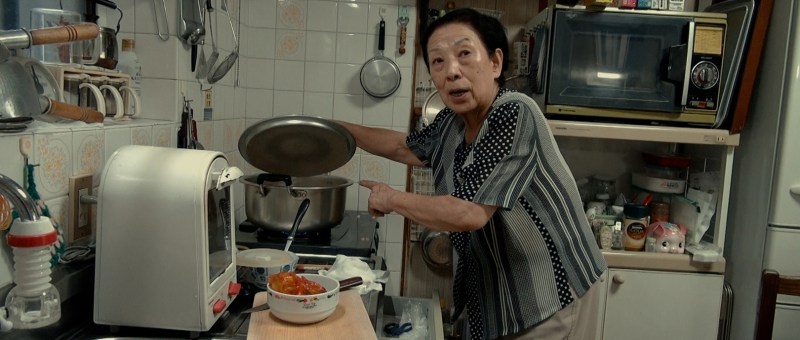
Banned from travelling to North Korea because of her previous films, Yonghi wonders how she will one day manage to deliver her mother’s ashes to their resting place next to her father in Pyongyang, but otherwise suggests that bridging the divide is possible not least in her marriage to a Japanese man, Kaoru, who adopts her mother almost as his own patiently taking care of her and learning the recipe for the traditional chicken soup she often makes stuffed with garlic from Aomori and generous quantities of ginseng. Touched by the sight of Junghi surrounded by photos of relatives she is unable to see, Kaoru tells Yonghi that even if they disagree politically they should make time to eat together peacefully as a family. A touching portrait of a difficult mother daughter relationship, Yang’s poignant documentary suggests there’s room for both soup and ideology and that divisions can be healed but only through a process of compassion and mutual understanding. 


Soup and Ideology screens at the Korean Cultural Centre, London on 11th August as part of Korean Film Nights 2022: Living Memories.

Original trailer (English subtitles)

Hit and Run (ひき逃げ, Mikio Naruse, 1966)

The contradictions of the contemporary society drive two women out of their minds in Mikio Naruse’s dark psychological drama, Hit and Run (ひき逃げ, Hikinige, AKA A Moment of Terror). Scripted by Zenzo Matsuyama and starring his wife Hideko Takamine in her final collaboration with the director, Naruse’s penultimate film takes aim at the persistent unfairness of a post-war society already corrupted by increasing corporatisation while caught at a moment of transition that leaves neither woman free to escape the outdated patriarchal social codes of the feudal era. 

The two women, both mothers to five-year-old boys, are mirror images of each other. Kuniko (Hideko Takamine), the heroine, is a widow working in a noodle bar and continually exasperated by her energetic son Takeshi who keeps escaping kindergarten to play pachinko which is not a suitable environment for a small child. Kinuko (Yoko Tsukasa), meanwhile, is mother to Kenichi and married to a high ranking executive at Yamano Motors, Kakinuma (Eitaro Ozawa). These two worlds quite literally collide when Kinuko, emotionally distressed and driving a little too fast, knocks over little Takeshi while he is out playing with some of the other neighbourhood boys. As she is with her lover, Susumu (Jin Nakayama), she decides to drive on abandoning Takeshi to his fate but discovers blood on the bumper of her shiny white convertible on returning home and thereafter decides to tell her husband everything aside from revealing her affair. Kakinuma covers the whole thing up by forcing their driver to take the rap to protect not his wife but the company along with his own status and success fearing that a scandal concerning his wife driving carelessly may have adverse consequences seeing as Yamano Motors is about to launch a new super fast engine that will make them worldwide industry leaders. 

Perhaps in a way the true villain, Kakinuma cares about nothing other than his corporate success. Kinuko states as much in complaining that he’s never once considered her feelings only his own and that their marriage was a failure from the start, little more than an act of exploitation in which she was traded by her father for money in return for political connections. For these reasons she seeks escape through her extra-marital affair but is unable to leave partly in the psychological conflict of breaking with tradition and partly because she has a son whom she would likely not be permitted to take with her even if it were practical to do so. Another woman says something similar in disparaging Kuniko, implying that her life is in some ways over as few men would be interested in marrying a widow with a child. 

Takeshi’s loss is therefore additionally devastating in severing Kuniko’s only lifeline. A brief flashback reveals that Kuniko was once a post-war sex worker, she and her yakuza brother Koji war orphans who lost their parents in the aerial bombing. When she married and had a child she thought the gods had smiled on her but in true Narusean fashion they gave only to take away leaving her a widow and finally robbing her even of her child. To add insult to injury, they try to put a price on her son’s life, a mere 500,000 yen for a boy of five hit by a car. When the driver stands in the dock, he gets off with only a 30,000 yen fine for the death of a child. Then again on visiting his home, there appears to be a boy of around five there too, perhaps you can’t blame him for taking the money having been robbed of his youth in wartime service. 

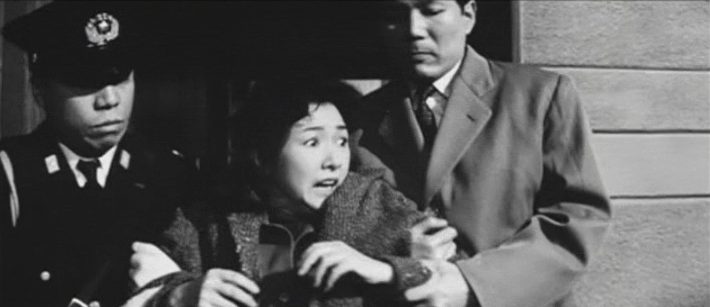
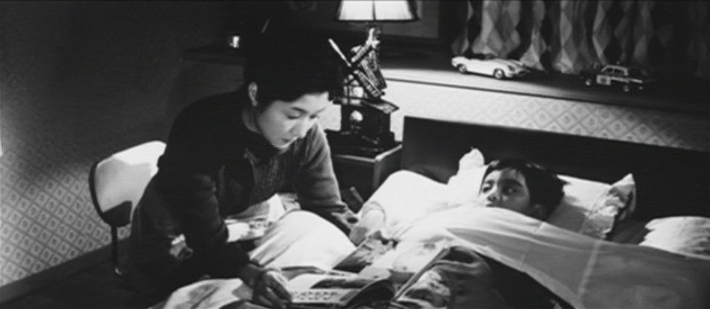
Still, on hearing from an eye witness that it was a woman who was driving, Kuniko quickly realises that Kinuko must have been responsible. Quitting her job she joins a maid agency in order to infiltrate the house and gain revenge later settling on the idea of killing little Kenichi, who takes an instant liking to her, to hurt his mother in the way she has been hurt only to be torn by her unexpected maternal connection with the boy. The conflict between the two women is emotional, but also tinged with class resentment that a wealthy woman like Kinuko should be allowed to escape justice with so little thought to those around her while Kuniko is tormented not only by her grief but the persistent injustice of the cover up. 

As in all things, it’s the lie that does the most damage in ironically exposing the truth of all it touches. Kinuko’s escape route is closed when her lover reveals that he’s lost faith in her, unable to trust a woman who’d run away from the scene of a crime and allow someone else to take the blame, while Kakinuma’s emotional abandonment of his social family for the corporate is thrown into stark relief by his immediate decision to further exploit their driver just as he will later their maid. Driven out of her mind, Kuniko has white hot flashes of lustful vengeance as she imagines herself engineering an accident for Kenichi, throwing him off a rollercoaster or coaxing him into traffic, only to regain her senses unable to go through with it so pushed to the brink of madness is she that no other action makes sense. 

Even so the conclusion is brutally ironic, Kuniko accused of a crime she did not commit but half believing that she must have done it because she wanted to so very much. Kakinuma gets a minor comeuppance, encouraged by his servant to make clear what actually happened and exonerate Kuniko thereby walking back his total commitment to the corporate (then again it seems his dream project was itself under threat from a potential plagiarism scandal) though the damage may already have been done. This societal violence of an unequal, increasingly corporatised and unfeeling society, eventually comes full circle bringing with it only death and madness as the two women seek escape from their internal torment. Naruse experiments with handheld camera and canted angles to emphasise the destabilisation of the women’s sense of reality along with blow out and solarisation in the visions that plague them, but curiously ends with a set of motor vehicle accident stats as if this had been a roundabout public information film to encourage careful driving. Then again perhaps in a way it is, a cautionary tale about the dangerous curves of untapped modernity and the cruelties of the nakedly consumerist era.  


What to Do With the Dead Kaiju? (大怪獣のあとしまつ, Satoshi Miki, 2022) [Fantasia 2022]

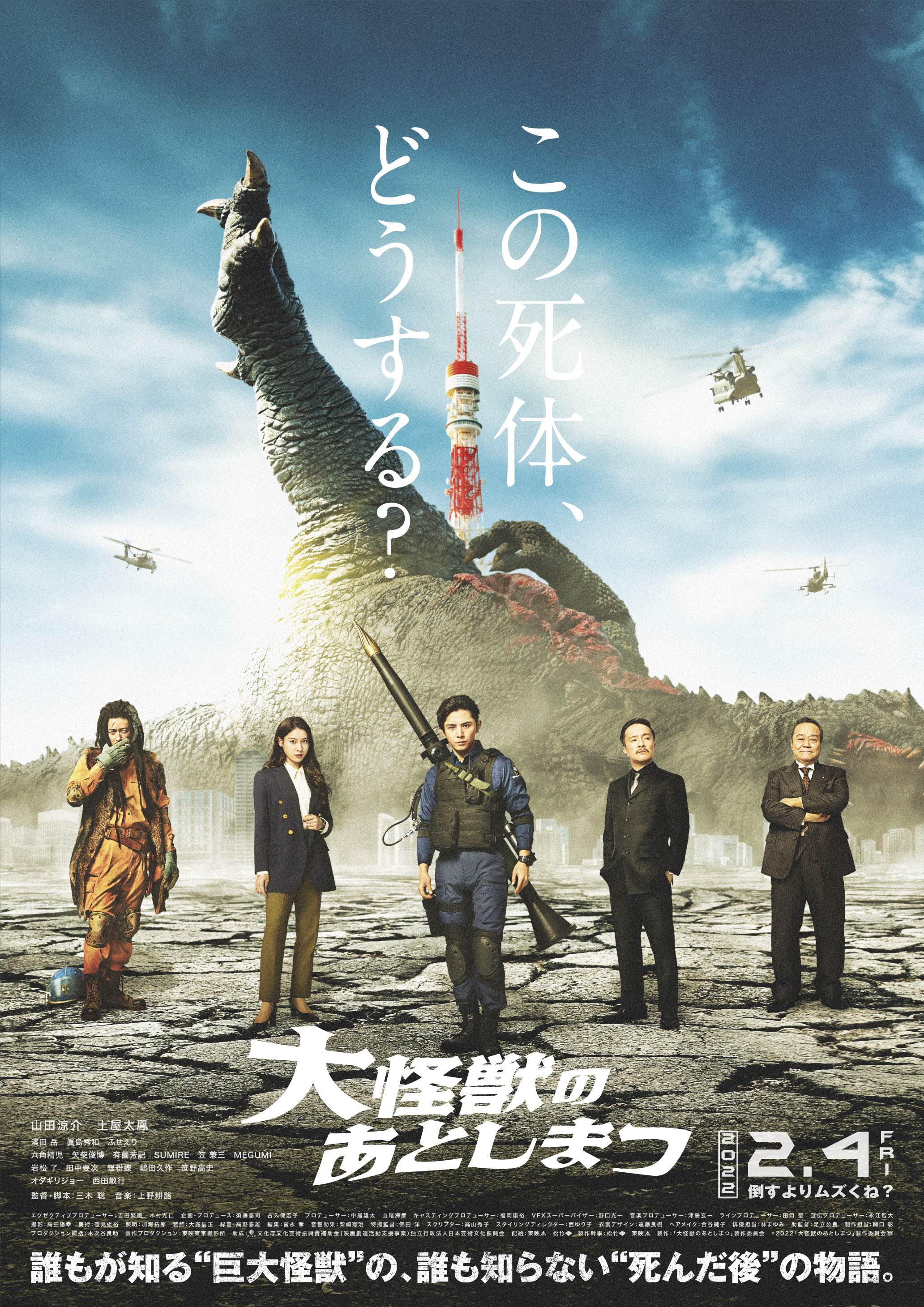
The sudden appearance of a deus ex machina is usually where a story ends. After all, that’s the point. Whatever crisis is in play is suddenly ended without explanation. But what happens then? Satoshi Miki’s What to Do With the Dead Kaiju? (大怪獣のあとしまつ, Daikaiju no Atoshimatsu) steps in to wonder what it is that comes next after a giant monster has been defeated. Someone’s going to have to clean all that up, and in a surprising twist a fair few people are keen to take on the burden. Like Hideaki Anno & Shinji Higuchi’s Shin Godzilla, which the film is on one level at least attempting to parody, Miki’s kaiju comedy is a government satire this time casting shade on the nation’s pandemic response, though with considerably less nuance. 

As the opening onscreen text, a nod to Shin Godzilla, and accompanying voiceover tell us Japan had been plagued by a kaiju but it suddenly died after being engulfed by a mysterious ball of light. While attempting to comedown from the constant state of anxiety under which they’d been living, the prime minister (Toshiyuki Nishida) is at a loss for what to do next especially as no-one really knows if the kaiju corpse is safe. While trying to ascertain whether or not the fallen kaiju might explode, spread dangerous radiation, or present some other kind of threat, government departments start fighting amongst themselves about whose responsibility the clean up effort must be all of them wanting the glory but not the work or expense. 

Some suggest turning the kaiju’s body into a massive tourist attraction and are therefore less keen on anything that involves destroying it while others think it should be preserved and put in a museum. The government has placed the SJF, a militarised science force set up after a terrorist incident, in charge but isn’t listening to much of what they’re saying. Meanwhile, evil moustachioed staffer Amane (Gaku Hamada) is playing his own game behind the scenes which also involves his wife, Yukino (Tao Tsuchiya), who was previously engaged to the leader of the SJF Taskforce, Arata (Ryosuke Yamada), before he abruptly disappeared after being swallowed by a mysterious ball of light three years previously. 

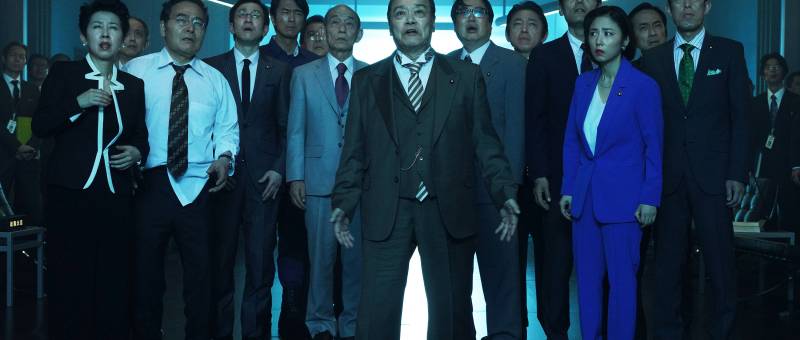
The political satire largely revolves around the indecisive PM, who at one point says he has no control or responsibility for what the other ministers do, and his anarchic cabinet meetings in which politicians run round in circles and insult each other like children. Not exactly subtle, much of the humour is indeed childish and scatological while one minister’s running gag is making sleazy sexist remarks even at one point accidentally playing a saucy video instead of displaying the latest kaiju data on the communal screen. The government experiences a public backlash in deciding to name the kaiju “Hope” which lends an ironic air to its rampage not to mention the necessity of its destruction, while the decision to declare the body safe for political reasons despite knowing it probably isn’t (“protecting the people’s right not to know”) casts shade on the pandemic response among other crises as do the constant refrains about getting back to normal now the crisis is over. 

Then again, there’s something a little uncomfortable going on with the film’s geopolitical perspectives, throwing up an angry politician on the screen with a mangled name who insists that the kaiju originated on their territory and must be returned to them in what seems to be an awkward allusion to Japan’s ongoing territorial disputes with Korea even while it’s suggested that the Americans wouldn’t mind getting their hands on the corpse either for purposes of experimentation and research. On the other hand it also becomes apparent that the Japanese military have deliberately destroyed civilian homes and cost lives in a reckless attempt to stop the kaiju which obviously failed. 

The closing scenes hint we may have been in a slightly different franchise than the one we thought we were dealing with, another deus ex machina suddenly arriving to save the day after the villains almost cause accidental mass destruction. The film’s problem may be that it’s the wrong kind of silly, relying on lowbrow humour while otherwise trying to conform to a blockbuster formula in which the kaiju corpse becomes the new kaiju but the battleground is bureaucracy. Ultimately the film’s prognosis is bleak. Even when the PM has achieved sufficient growth to realise he should make some kind of decision he makes the wrong call leaving everything up to a lone hero while fundamentally failing to come to any conclusion on what to do with a dead kaiju save trying to ensure it does not blow up in his face. 


What to Do With the Dead Kaiju? screened as part of this year’s Fantasia International Film Festival.

Original trailer (English subtitles)

Convenience Story (コンビニエンス・ストーリー, Satoshi Miki, 2022) [Fantasia 2022]

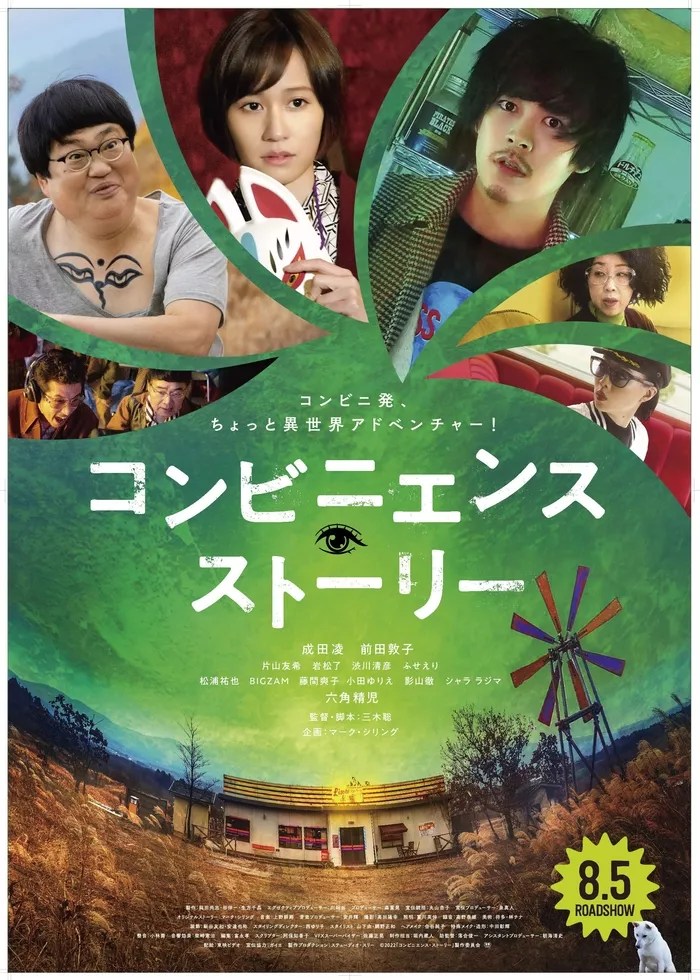
“This is unreal, but it’s real” a blocked screenwriter exclaims in finding himself in an uncanny world only slightly divorced from his previous reality but perhaps excellent fodder for his art. Quite clearly influenced by David Lynch in its Twin Peaks-esque setting, jaunty jazz score, and overt references to Mulholland Drive, Fire Walk with Me, and Blue Velvet, Convenience Story draws inspiration from a short story by veteran Japan Times critic Mark Schilling to spin an elliptical tale of otherworldly adventure and inexorable fate. 

Down on his luck screenwriter Kato (Ryo Narita) can’t seem to get an idea off the ground and is in an increasingly volatile relationship with aspiring actress Zigag (Yuki Katayama) whose dog Cerberus he barely tolerates. When he has to venture out in search of Cerberus’ favourite brand of dog food, Weredog, the adorable pooch accidentally deletes the screenplay Kato has been working on leading him to decide to abandon him in the remote countryside. However, after damaging a Buddhist statue, he stops at a random petrol station convenience store which looks like it hasn’t been touched since the 1980s. Sucked through some kind of portal, he finds himself in an alternate combini reality in the company of pretty damsel in distress Keiko (Atsuko Maeda) and her decidedly weird husband Nagumo (Seiji Rokkaku). 

As the film begins to head into The Postman Always Rings Twice territory, Kato begins to rejuvenate his creative mojo while Zigzag, who is about to get her big break working with an incredibly insecure director (Kiyohiko Shibukawa) and sleazy producer, wonders what’s happened to her dog and takes drastic steps to find out. “Life’s big chances come in an instant” the director insists, though for Kato time seems to have stopped while he contemplates the combini existence. After all, it’s called a convenience store for a reason. They have everything you’ll ever need so there’s no real reason to leave. Smarting from his creative block, Kato asks if convenience stores sell interesting stories and in a way they do, or at least this one and the one in his neighbourhood which may or may not be connected by some kind of cosmic combini network, conspire to feed his imagination so he can deliver a promising script to his eccentric editor (Eri Fuse). 

Then again, Keiko asks him if he writes about an ideal world or his personal reality and it’s a question that he can’t quite answer hinting that this strange alternate universe may be some kind of fever dream conjured up by his latent imagination. “A screenwriter’s job is to fantasise”, Keiko seductively tells him, though his editor and a producer with whom he had also exchanged a flirtatious email had previously giggled over his non-starter of a screenplay which they described as an embarrassingly chauvinistic male fantasy. That’s certainly one way you could describe his otherworldly combini adventure in the foxy damsel in distress characterisation of Keiko who quite obviously just wants him to take her away from all this, sick of the oppressive convenience of the combini life and of her incredibly strange, seemingly controlling husband. 

Then again on their attempt to escape, the couple end up in an endless three-day ceremony of eternity during which the souls of the dead are supposed to journey to the afterlife. Everyone is keen on travelling to another world, except perhaps for Kato who is already in one, yet struggles to escape the uncanny uniformity of the combini society. “Another world exists in here” Kato is creepily told on a visit to his local, much more contemporary though not all that different, convenience store beginning to realise that perhaps there is no real escape from this maddening world of convenience at least not for him. Shades of Orpheus and Eurydice guide him out of his purgatorial existence yet ironically only into more of the same until the inevitable, karmic conclusion. Fantastic production design adds to the sense of retro absurdity strongly recalling Twin Peaks in its use of ‘50s-style diners and the frozen in time petrol station road stop existing for some reason the middle of nowhere with no road in sight, while casting a note of fatalistic dread over the life of a blocked screenwriter who eventually comes to realise that convenience isn’t always quite what it’s cracked up to be.


Convenience Story screened as part of this year’s Fantasia International Film Festival.

Original trailer (English subtitles)

The Girl From the Other Side (とつくにの少女, Yutaro Kubo & Satomi Maiya, 2022) [Fantasia 2022]

A kindly exile and lonely little girl find mutual salvation in Yutaro Kubo & Satomi Maiya’s gorgeously animated fairytale, The Girl from the Other Side (とつくにの少女, Totsukuni no Shojo). A poetic mood piece, the film has a painterly feel reminiscent of classic children’s picture books and essentially tells a very simple story about the redemptive power of kindness and acceptance in which two exiles find the strength to begin again taking care of the other in a world of warmth and safety.

Set in an indistinct time period, the film opens with a cohort of soldiers from the Inside dumping bodies in the forest, apparently victims of some kind of curse. Hearing a noise, one turns round explaining that they have to kill them all or their efforts will be meaningless, while mysterious man with goat horns on his head discovers the angelic figure of a little girl, Shiva (Rie Takahashi), fast asleep. Evading the soldier, who is later himself “cursed”, the man takes her home with him but explains that he cannot ever touch her, not even to treat her wounds, lest he infect her with the “curse” though he is not like the other “Outsiders” who spread it deliberately. 

The curse has robbed the man, whom Shiva calls “Teacher” (Jun Fukuyama), of his humanity. He is certain that he was once human and lived a normal life with a wife and child behind the walls of the Inside, but is now a lonely exile who no longer knows his name. He worries that Shiva will be frightened by his appearance and may choose to leave putting herself in danger in the process but Shiva accepts him instantly and quickly settles in to his cottage-style home while experiencing brief nightmares in which she is eventually rescued from her loneliness by the Teacher. But the closer they get, the more Teacher feels guilty convinced that Shiva would be better off in a community with other humans rather than living with him under the danger of inheriting his curse. 

Shiva and Teacher are each in their ways exiles, though there is also something dark in the constant references to Insiders and Outsiders along with the looming threat of the military and their determination to wipe out anything “suspicious” fearful of any kind of contamoination. The Outsiders are those in some way rejected by the mainstream society, many of whom have become dark and marauding, feeding on the souls of others who live outside the walls. Teacher wants to save Shiva from the unbearable loneliness he feels as a cursed man who no longer knows his past and is forbidden from human touch yet in the need to protect her he also discovers a purpose and begins to recover something of his humanity. “She is my light” he later explains to a supernatural force, himself stunned by the realisation that even he could be a light for someone else and discovering in it a new possibility for life. 

There is of course a sadness for the world that’s been lost and can never be regained, but also warmth and tenderness in the simple life of Teacher and the girl as symbolised by smoke rising from their chimney as if the house itself were breathing. As Teacher had said, all things must end in time, but the time is not necessarily now and there is much to be done before it runs out. In Teacher, Shiva finds a place of safety and protection. In her dreams she is rescued by the hands which on waking cannot touch her, while Teacher finds in her a path towards reclaiming his humanity. They may never find their way back to those they’ve lost, but they can now begin again as a new family overcoming their loneliness and despair through mutual compassion. 

Beautifully illustrated with a retro flickering effect and water colour-esque backgrounds, Girl From the Other Side situates itself in a melancholy world in which some are consumed by the curse of their inner darkness and suddenly sprout into huge burnt trees, yet as Shiva says there’s a poignancy even in their destruction noticing that whole communities sprouted together rather than wandering apart. Moving and tender, it reaches a kind of serenity in its final moments in the simple act of living with warmth and possibility. 


The Girl From the Other Side screened as part of this year’s Fantasia International Film Festival.

Original trailer (no subtitles)