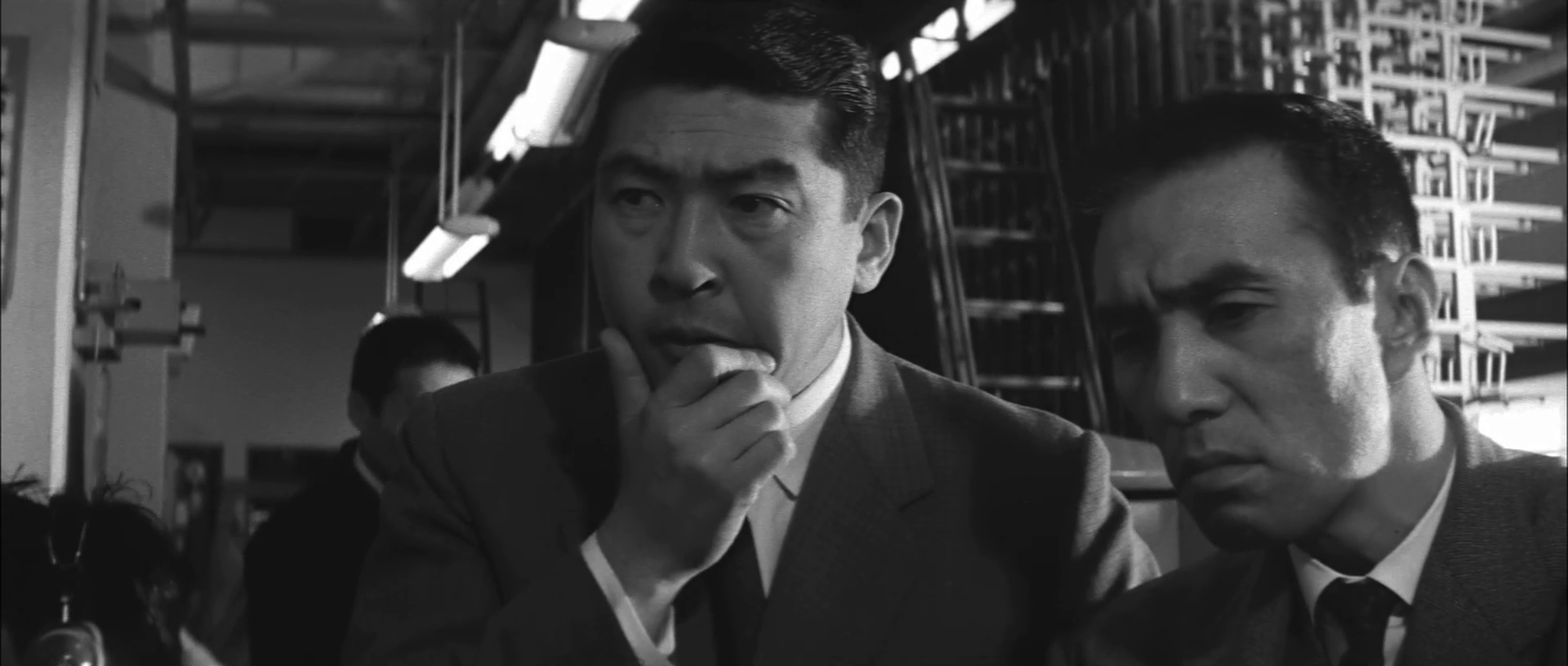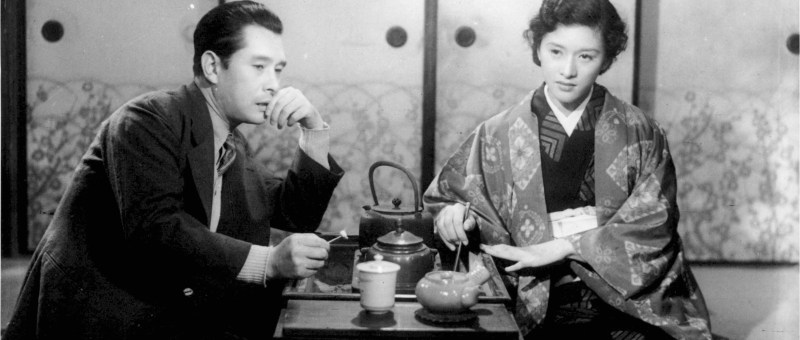
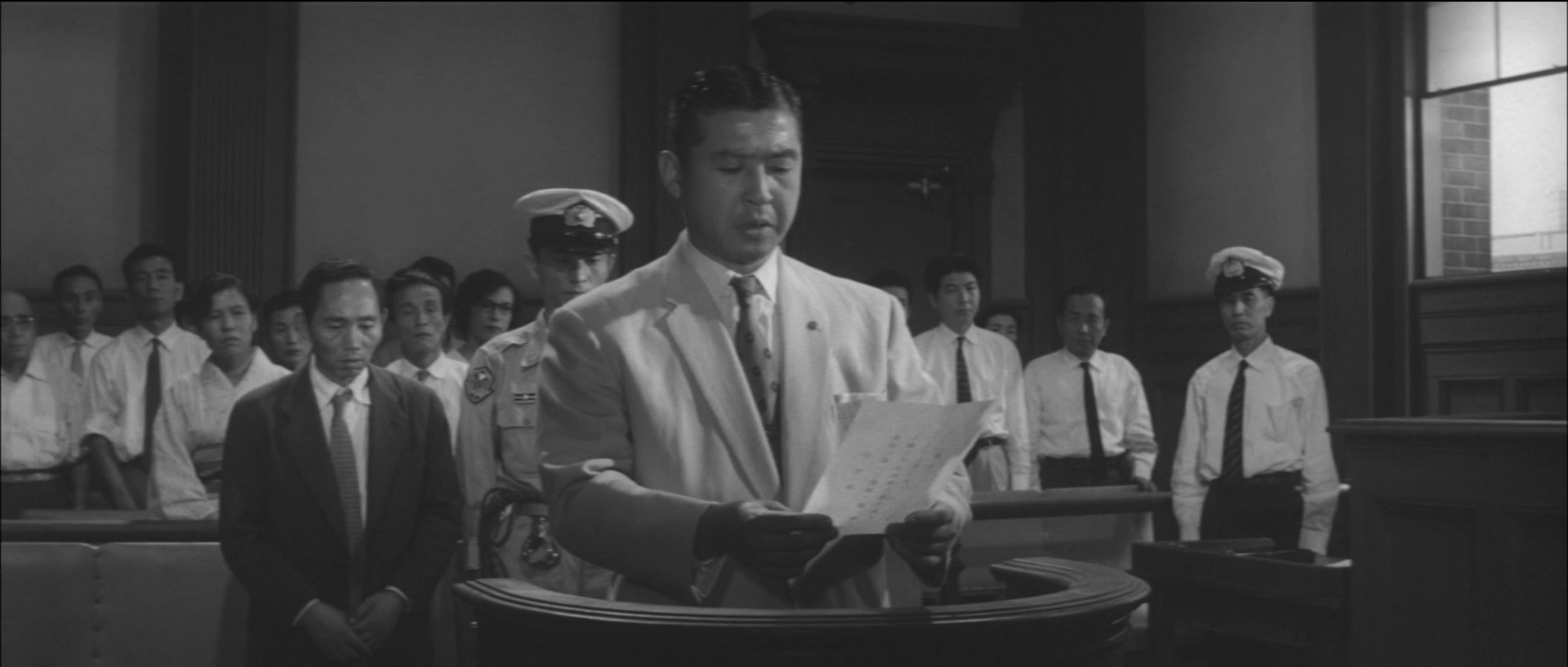
Husband and Wife (夫婦, Mikio Naruse, 1953)

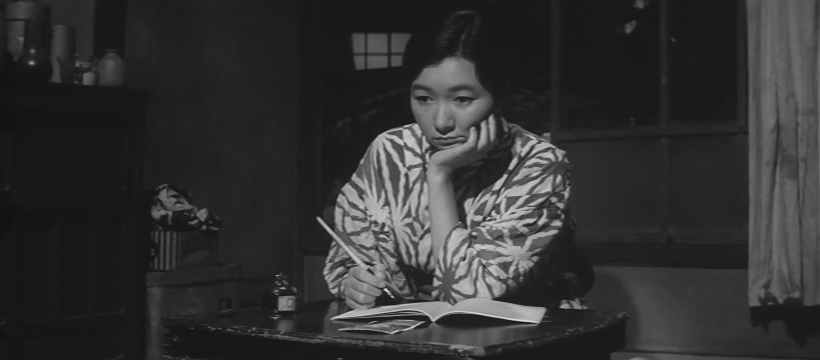
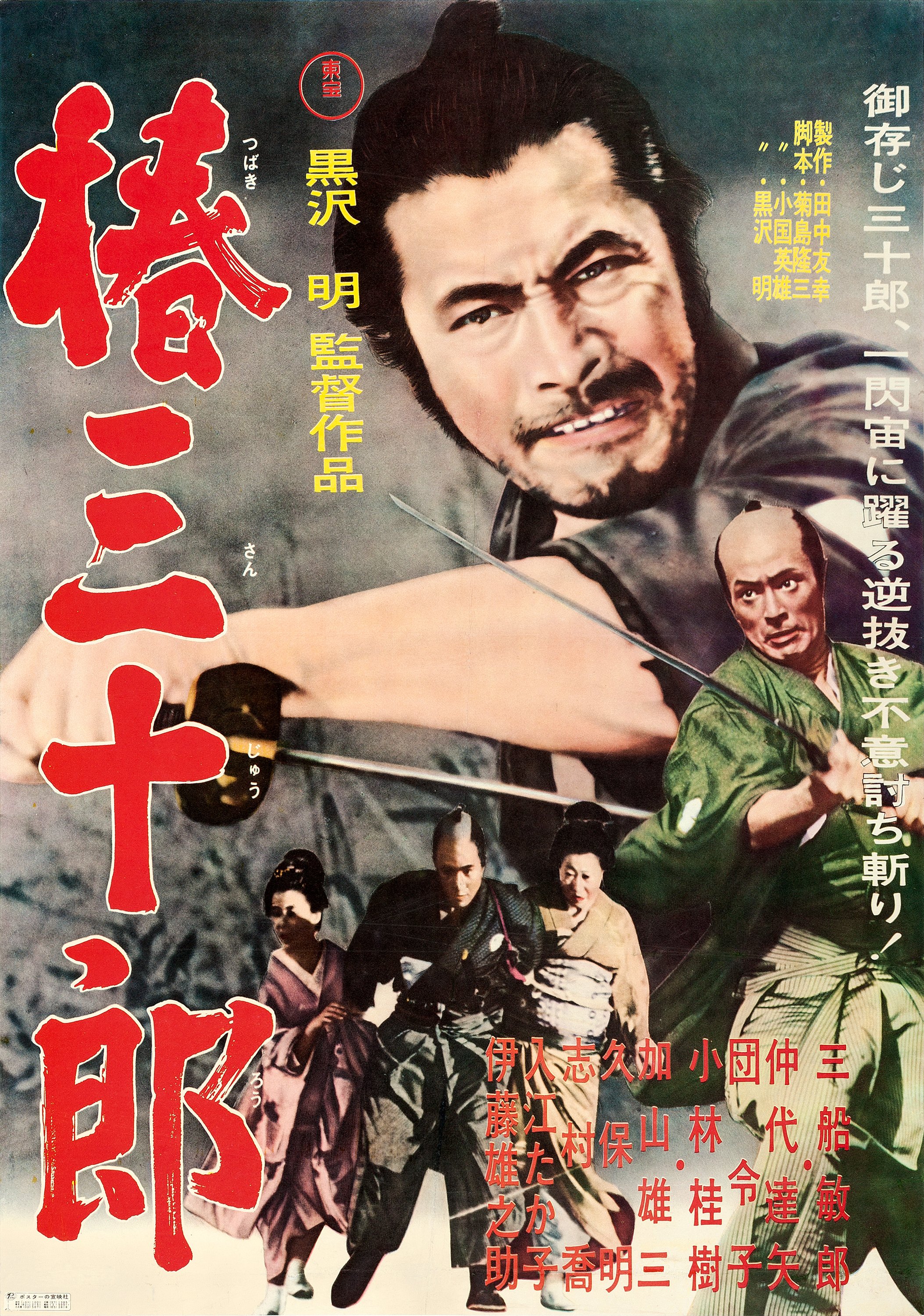
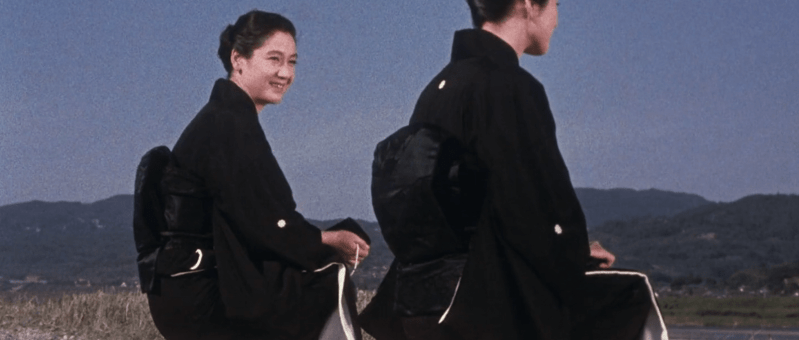
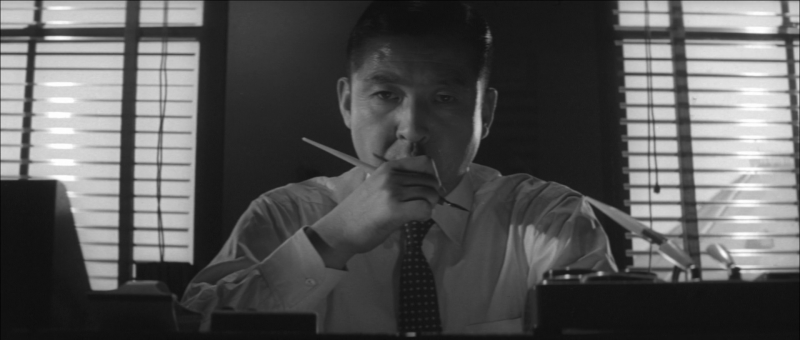
Kikuko (Yoko Sugi) climbs the stairs to the roof of a department store and pauses at the top looking down on her friends below, but they appear to be looking down on her. They’re disappointed. She looks so “provincial”, even though she has no children and therefore more time to spend on herself. They’re envious of her “freedom” to return home late while they have to get back to their husbands or in-laws, but Kikuno isn’t really free at all while trapped in a stifling marriage to the incredibly dull and petulant Isaku (Ken Uehara). 

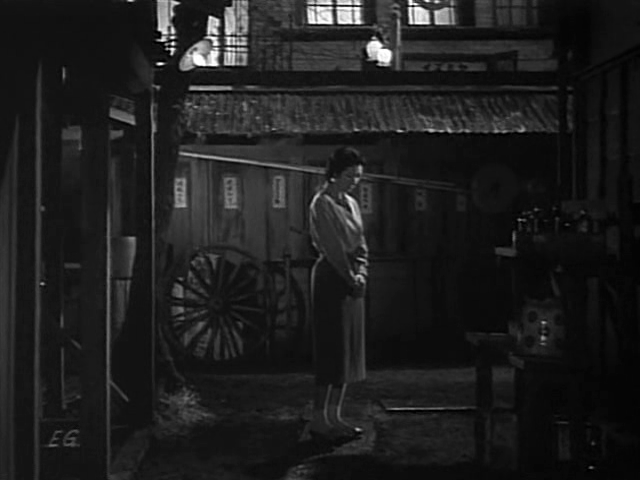
One of a series of films about marriage and originally envisaged as a sequel to Repast until Setsuko Hara fell ill, Husband and Wife (夫婦, Fufu) paints a rather bleak picture of married life even by Naruse’s standards. The couple are quite literally but also spiritually “homeless” in that they cannot find a home to share, while the absence of a domestic space to call their own prevents them from solidifying their marriage. They’re pushed out of Kikuko’s parents’ home because her brother’s getting married and they need the space, but Isaku drags his feet over finding somewhere else and leaves much of the legwork to Kikuko alone. The main problem seems to be that Isaku can’t afford anything decent, which places a strain on his male pride, but in a repeated motif, rather than confront the situation, he ignores it completely and then crassly presses his recently widowed colleague to let them rent a room in his now much emptier house. 

It’s a mystery why Isaku has so many financial problems when he and Takemura (Rentaro Mikuni) work for the same company, save that Isaku had evidently spent some time working in the provinces, and his colleague had already bought a home with no apparent money worries, but it further sets the two men apart and fuels Isaku’s sense of inadequacy. Having returned from a leave of absence following his wife’s death, Takemura is grief-stricken and apparently uxorious. He complains that he’ll never find another woman like his late wife, all while Isaku won’t shut up about the house and others relentlessly encourage him to remarry. Nevertheless, after the couple move in with him, a natural connection arises between Kikuko and Takemura who is Isaku’s total opposite, both in his treatment of Kikuko and general personality. Where Isaku is sullen and resentful, Takemura is cheerful despite his grief and generous of spirit. Kikuko effectively becomes a wife to both men, taking care of each of them by cooking and cleaning, but while Takemura goes out of his way to thank her, all Isaku does is run her down and humiliate her in front of company.

Then again, having fallen in love with Kikuko precisely because she is a “proper wife,” Takemura then runs his own late wife down by complaining that she wasn’t very pretty and couldn’t cook. The only thing she had going for her was her health, and then she died. He says got a bum deal, and that Kikuko has shown him a different side of womanhood. When two colleagues come to the house and compliment Kikuko’s cooking but are surprised when she eats nothing herself (because they have no money), Isaku responds to their assertion that it’s difficult to be a housewife by replying that men work hard all day while women “only” have to look after the house. For her part, Kikuko says that she was happier when she was working. Men can fall in love several times, but once a woman’s married her romantic life is over. As her friend tells her, men soon get bored of their wives and hers has already taken a mistress at work. 

At several points and with the women in earshot, the men warn each other about the pitfalls of marriage. Irritated that Kikuko has returned to their home on New Year’s Eve after becoming fed up with Isaku, her father advises her brother that women show their true faces after six or seven years and it’s going to horrify him. Isaku tells him not to be too nice or obedient during the early days because his wife will get used to it, while Kikuko counters that men are overgrown children and as long as you make sure to cradle them like babies everything will be fine. Neither of them seem to have a very positive idea of what marriage should be and frame it almost in terms of a war in which they are continually at odds with each other. Isaku describes a husband and wife as a pair of scissors, intending it as a positive metaphor about how one half can’t cut alone, before reframing it as two knives coming together. He becomes unpleasant and chauvinistic, blaming Kikuko for everything by complaining that it’s her fault that he wears a torn up old coat that causes him some embarrassment in front of his boss and a tactless geisha, while criticising her for not having the bath ready when he comes home tired from working all day. Kikuko points out that men seem to assume they’re the only ones who get tired while her loved up brother swears he’ll be different and even if they’re in the honeymoon phase, they do seem much happier and more suited than the already resentful Kikuko and Isaku.

It’s the sister-in-law who throws them a lifeline by introducing them to a relative looking to rent a vacant room, allowing them a means to save their marriage by leaving Takemura’s house. Increasingly resentful of the growing attachment between Kikuko and Takemura, Isaku starts avoiding coming home and hanging out with a young woman at the office with, at least, the danger of a burgeoning affair for which he’s taken to task by Takemura. As Takemura says, it’s not much of a marriage if Isaku can’t trust his wife while Kikuko is eventually so sick of the cold shoulder and constant denigration that she considers leaving him. The new apartment finally gives them a domestic space they can call their own, but it comes with the caveat. The landlady doesn’t allow children because the tenant next door is an ikebana teacher who demands peace and quiet, but Kikuko is in fact already pregnant which might present another means of saving their marriage by becoming a family but Isaku immediately rejects it. He complains he doesn’t have any more money to move again and tells Kikuko to get an abortion, strong-arming her when she refuses. Kikuko can’t go through with it and the nicest thing Isaku says to her in the entire picture is that they can go home, he’s giving in and will raise the child even if it’s difficult. But even this bittersweet moment seems more like condemning them to marriage rather than repairing their relationship with Isaku only grudgingly accepting, most likely because he realises that his marriage is dead anyway if he forces Kikuko to give up their child against her wishes. Despite the changing season, the air between them remains frosty, and marriage is exposed for the prison that it is trapping each of them in loneliness and resentment rather than bringing them together in joy as they prepare to become a family rather than just husband and wife.


Husband and Wife  screened at Japan Society New York as part of Mikio Naruse: The World Betrays Us – Part I.

My Wonderful Yellow Car (吹けよ春風, Senkichi Taniguchi, 1953)

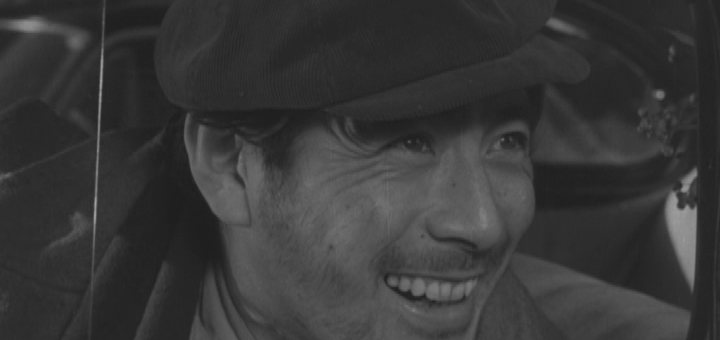
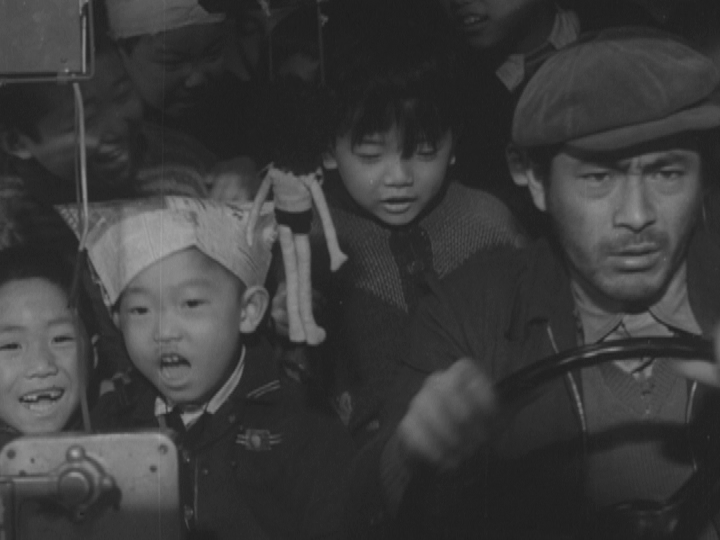
A kind-hearted taxi driver becomes our guide to the post-war society in a cheerful omnibus movie co-scripted by Akira Kurosawa and directed by Senkichi Taniguchi, My Wonderful Yellow Car (吹けよ春風, Fukeyo, Haru Kaze). Inspired by a Reader’s Digest column titled “human nature as seen in the rearview mirror”, the film follows cheerful cabbie Matsumura (Toshiro Mifune) as he drives around Tokyo in 1953 picking up various fares and sometimes adding commentary or trying to help with whatever kind of problem seems to be bothering them.

Then again, he stays well out of the first fare’s business as a young couple have obviously had some kind of falling out. Bursting into tears, the girl (Mariko Okada) announces that she wants to postpone the wedding and maybe even rethink this whole thing, while the boy reiterates with slight irritation that he’s said he’s sorry with the implication that that should be the end of it though we have no idea what (if anything) he’s actually done. In any case, they eventually patch things up over some canoodling in the back seat and ask to be dropped off so they can get something to eat. In some ways, the young couple represent a more hopeful vision of post-war youth who have no apparent worries besides their tiff and are financially comfortably enough not only to be getting married but can afford to travel by taxi and pay for a meal on the same occasion. 

Their situation is later contrasted with that of an older couple who’ve moved from Osaka to Tokyo in their old age and have bought a box of live lobsters to celebrate their silver wedding anniversary but as Matsumura notes though they appear to be quite well off they also seem somehow sad. That turns out to be because they lost their only son the previous summer and have moved into his old apartment. The old lady also cries in the back seat, but for a completely different reason. As they’ve only just moved here, they don’t have friends or anything to do and are completely lost in the wake of their son’s death. Matsumura’s kindness is demonstrated when he borrows three flowers from a bouquet delivered to a girl at the petrol station and presents them as an anniversary gift. The couple are so touched they invite him to enjoy their anniversary dinner with them and by the end of it have made the decision that they should go back to Osaka and restart their lives by re-opening their old business.

Throughout all this, Matsumura is very conscious of the meter. Every second he spent in the old couple’s apartment cost him money, but as he’s fond of saying you can’t always think of things like that. Even so, he reminds himself he has a wife and child so should be mindful of the clock but still turns down a fare to go back to the station and check on a young girl he’s pretty sure is trying to run away from home. A weird guy was sniffing around her and was in fact just about to lead her off when Matsumura gets back and announces he’s come to pick her up. Matsumura spends the rest of the ride trying to convince her to go home, repeatedly reminding her that most of the “panpans”, or streetwalking sex workers catering to US servicemen, were also once runaway girls. To more modern eyes we might wonder if sending her home is what’s best without knowing the reasons she wanted to leave. He goes so far as to buy her ramen which costs him more money on top of the lost fare which doesn’t collect from her either when he, a little less responsibly, abandons her when she refuses to tell him where she lives. Thankfully, it all seems to work out. The girl made a sensible decision to go home after all and is later seen happily doing her Christmas shopping with her mother who also thanks him for looking out for her.

Perhaps these kinds of altruistic acts of kindness explain why Matsumura’s own clothes are quite ragged with a hole in his jumper and a tear to the shoulder of his jacket. He’s driving the cab in straw sandals which apart from anything else is probably quite cold in the winter. He spends another afternoon giving a free ride to some children, about 15 of them, who’ve crowdfunded 100 yen because they’ve never been in a car before and want to go as far it’ll take them having no idea that 100 yen is actually the initial charge so you can’t go anywhere on it all. Of course, Matsumura ends up taking them a bit further, and then realises he’ll have to take them back to where they were because they won’t have any other way of getting there or of knowing where they are now.

On the other hand, sometimes he ends up with nuisance fares such as two drunk guys who keep singing their university song. One of them even climbs out of the window and up onto the roof, causing Matsumura to assume he’s fallen off somewhere and he’ll have to go back and look for him to make sure he’s not hurt only to find him burbling in the footwell. He also ends up getting hijacked by a crook with a gun on his way back from Yokohama but getting a telling off from the police rather than a thank you for catching him after unwisely taking hold of the gun himself and messing up all the fingerprints. 

One might think the time he had a famous actress in the back of his cab who even sang along with the jingle he’d written for the cheerful yellow vehicle might make up for all that, but he says the story that best exemplifies why he loves driving a taxi is that of a middle-aged couple he picked up at the harbour shortly after a boat had docked repatriating people from China. Even in 1953, some had not yet returned after becoming trapped by the Chinese Civil War and eventual Communist victory. The man is dressed in military uniform and says he’s just been demobbed when Matsumura asks him, trying to lighten the mood while there’s obviously some degree of tension between the man and his wife. But as we gradually come to understand, it’s all just a ruse and he has in fact been in prison in Japan for the last seven years for an unspecified crime.

His wife asks Matsumura to drive around the city and attempts to show him how much things have recovered, suggesting that they can now put the past behind them and start over. But the man remains sullen and grumpy. He’s afraid to go home, afraid to face the neighbours worrying if they know what he did and that he’s been in prison. But most of all he’s afraid to face his children, the youngest of which he’s never met. The kids have been teaching themselves to say “Welcome home, Daddy,” in Mandarin believing he’s been in China all this time which the wife has to explain before they get there. The man tells his wife he understands if she doesn’t want him back, but she assures him that the children are excited as is she to start their new life together. Nevertheless, though they’ve been eagerly practicing, the older two children simply freeze when confronted by this anxious stranger who turns around to leave again feeling as if he doesn’t have the right to come back here after all only for the youngest one to suddenly pipe up with the phrase note perfect. It’s this kind of scene, getting people to where they need to be physically and emotionally, that seems to make Matsumura’s job worthwhile. In essence, he’s ferrying people towards the cheerful post-war future his cute yellow cab represents while driving round the rapidly changing city wondering who it is that’s going to end up in the rearview mirror today.


Title song (no subtitles)

Tokyo Sweetheart (東京の恋人, Yasuki Chiba, 1952)

It appears that even as early as 1952, some people were doing “very well, thank you” despite the suffering going on all around them. Then again, the heroes of Yasuki Chiba’s charming ensemble rom-com Tokyo Sweetheart (東京の恋人, Tokyo no Koibito) are relentlessly cheerful and likely wouldn’t use the word “suffering” to describe themselves, preferring instead to laugh at the foolishness of wealthy men and their petty squabbles while continuing to value what is honest and genuine above greed and insincerity.

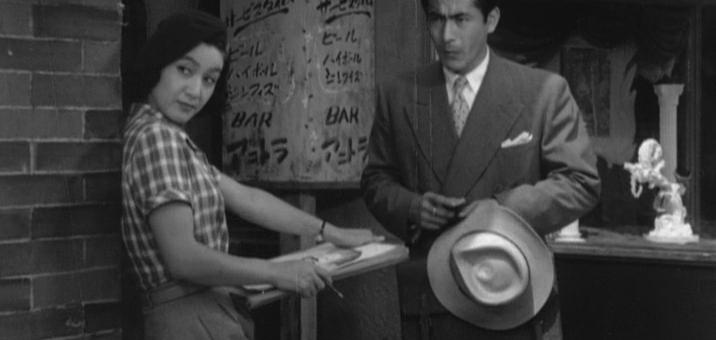
At least, there’s a minor irony in the fact that Akazawa (Hisaya Morishige) makes his living selling pachinko balls, a a source of elusive hope that’s brought ruin to millions. His mistress, Konatsu (Murasaki Fujima), exclaims that when you’re doing well a ring or two is nothing, trying to manipulate Akazawa into buying a 500,000 yen diamond from the jewellers’ downstairs. Akazawa can afford to buy it, but he doesn’t really want to because he’s cheap and greedy. Later we’re introduced to a friend of portrait artist Yuki (Setsuko Hara) who does caricatures on the street corner below the office and hangs out with the three shoeshine boys opposite. Harumi (Yoko Sugi), a sex worker, has fallen ill presumably from tuberculosis. They only need 500 yen daily for her living expenses and medicine, but the only way they can hope to come up with it is by getting a large amount of people to part with a small amount of money which they are all willing to do as an act of solidarity. 

In rather farcical turn of events, the jeweller’s has commissioned a fake ring to display in the window for security purposes while they keep the real one in the safe. Konatsu suggests a complex plan to the jewellers of getting Akazawa to buy the diamond but giving him the fake which she will then return and pocket difference. Only Akazawa has the same idea, or rather he only wants to buy the fake one because Konatsu won’t know the difference and he doesn’t think she’s worth the expense of the real one. When he ends up with both rings, Akazawa’s wife, Tsuruko (Nijiko Kiyokawa), makes him give the fake one, which is actually real, to the tea girl, Tama, who wants to sell it, even if it is fake, to help Harumi not only with her illness but to escape sex work. The boys tell her she’s being selfish and naive. If Harumi had any way of escaping sex work she would have done so years ago, there’s no real hope for her now. “A shoe can be repaired,” one of the boys sighs, “but I’m not so sure about her.”

In some ways, it seems as if the genuineness of the ring is unimportant. The two are often mistaken for each other and few can tell the difference. After all, if you like it, what does its supposed authenticity matter and what does that really mean anyway? It does, however, seem to matter to Yuki who later says that she thought the film’s most genuine person, Kurokawa (Toshiro Mifune), was “gaudy and slick” when they first met because he was wearing a tacky tie pin and ring which stand out a mile to her as “fake”. Kurokawa in fact makes the replica jewellery displayed in front windows and dresses in that way as a kind lived brand though he does not necessarily approve of his own occupation. He exceeds expectations when he tracks the gang down in order to pay back some money Yuki had lent him when the conductor couldn’t give him change for his bus fare, as well as treating the shoeshine kids to ice creams and warning off the creepy yakuza type who keeps trying to bother Yuki for dates.

But the contradictions are brought to the fore when Harumi’s health declines and Yuki decides she ought to call the estranged mother to whom Harumi had written a comforting letter stating that she’d married and was living happily in Tokyo, enclosing a photo of herself and Kurokawa one of the shoeshine boys had taken on his toy camera. Yuki wants Kurokawa to pose as the husband so the mother won’t be so upset, only for him to point out that she now asks him adopt a fake persona after taking him to task for confusing people with his “fakes”. Again, this false comfort does seem to bring genuine relief to the mother even if as Kurokawa suspects she’s seen right through their ruse suggesting that authenticity of feeling is the only kind that matters.

Akazawa and his wife, meanwhile, bankrupt themselves trawling the river looking for the lost “genuine” ring sinking to all new depths of absurdity as even Tsuruko dons a diving suit and goes in to look herself. Unfortunately, all they find is a single pachinko ball. There is something quite abrupt about the sudden tonal shift from Harumi’s death bed to the gang laughing away at the foolishness of Akazawa and his wife, the boys convinced that Yuki and Kurokawa are now a couple though they never really enjoy much of a romantic resolution. Kurokawa lives a long way out of town and his home is surrounded by rubble and empty lots, signs of post-war devastation still not fully cleared away though Yuki and the boys, presumably war orphans, remain endlessly cheerful even as the extreme irony of Kurokawa’s rendition of Moon Over Ruined Castle washes over them. They do at least have each other and the strength of their community, living honest and genuine lives every day in contrast to men like Akazawa chasing pointless yet shiny trinkets and falling straight down the plughole themselves.


A Wanderer’s Notebook (放浪記, Mikio Naruse, 1962)

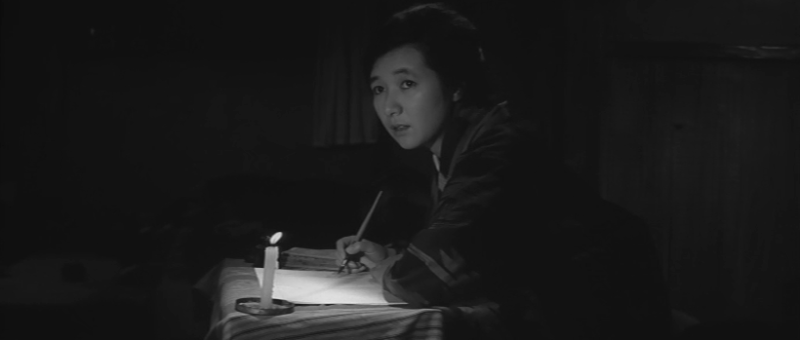
Many of Mikio Naruse’s most famous films are adapted from the work of Fumiko Hayashi, a pioneering female author who chronicled the life of a working class woman with startling frankness. Yet his dramatisation of her life, A Wanderer’s Notebook (放浪記, Horo-ki), is both a little more reactionary than one might have expected and surprisingly unflattering even in the heroine’s eventual triumph in escaping her poverty through artistry. Even so if perhaps sentimentalising the economically difficult society of the 1920s in emphasising the suffering which gave rise to Hayashi’s art, the film does lay bare the divisions of class and gender that she did to some extent transgress in pursuit of her literary destiny. 

Naruse and his screenwriters Toshiro Ide and Sumie Tanaka bookend the the film with a literal “lonely lane” which the young Fumiko walks with her itinerant salespeople parents. As a small child, she sees her father arrested for a snake oil scam peddling some kind of wondrous lotion, setting up both her disdain for men in general and her determination not to be deceived by them at least unwittingly. She has no formal education but is a voracious reader well versed in the literary culture of the time and intensely resentful of if resigned to her poverty. In the frequent sections of text which litter the screen taken directly from her novels, she details her purchases, wages, and longing for the small luxuries she can in no way afford. 

As an uneducated woman in the 1920s her working opportunities are few. She exasperatedly relates standing in a queue with hundreds of other women waiting for an interview for a company job only to be told they’ll let her know, while her other opportunity involves meeting a theatre director at a station who later takes her to his hotel/office and makes it plain he’s not really interested in her CV. She gets a job at the office of a stockbroker, but lies about being able to do accounts and is flummoxed by double entry bookkeeping getting herself fired on day one. After a brief stint in factory painting toys, she leaves with a friend to become a hostess but is also fired on her first day for getting drunk and being unwilling to ingratiate herself with the boorish men who frequent such establishments. 

Despite her animosity, she is drawn towards men who are callous and self-involved, firstly taking up with a poet and actor who praises her work but turns out to have several “wives” on the go, and then begins living with a broody writer, Fukuchi, who is insecure and violent, resentful at her success in wake of his failure. Perhaps because of her experiences, she seems to resent any hint of kindness though sometimes kind herself, lending money to her friend whose mother is in need and often ready to stand up for others whom she feels are being mistreated. A kindly widower in the boarding house where she lives with her mother, Yasuoka, falls in love with her but she repeatedly rejects him partly as someone suggests because he is not handsome, but mainly because of his goodness and kindness towards her. Nevertheless, he continues to support always ready in her time of need though having accepted that she will never return his feelings or accept his proposal. 

Perhaps her might have liked to have been kinder, but was too wounded by her experiences to permit herself. In any case at the film’s conclusion in which she has achieved success and in fact become wealthy it appears to have made her cold and judgemental. She instructs her maid to send a man away believing he is from a charity set up to help the poor, insisting that the poor must work for industry is the only path out of poverty implying that as she managed it herself those who cannot are simply not applying themselves when she of all people should know how fallacious the sentiment is. As if to bear out the chip on her shoulder, she forces her mother to wear a ridiculous kimono from a bygone era that is heavy for an old woman and makes her feel foolish because of her own mental image of the finery she dreamed of providing her on escaping the persistent hardship of their lives. 

As she says, she’s no interest in the socialist politics espoused by the literary circles in which she later comes to move, pointing out that the poor have no time for waving flags. One of her greatest supporters is himself from a noble family despite his progressive politics and in truth can never really understand the lives of women like Fumiko. He describes her work as like upending a rubbish bin and poking through it with a stick, at once fascinated and repulsed by a frankness he may see as vulgar. At one point he accuses her of writing poverty porn, playing on her humble origins for copy and becoming something of a one note writer. 

In truth, the film is not really based on the novel from which it takes its title but on the play that was adapted from it, while the novel itself was apparently reworked and republished several times in response to reader taste giving rise to a series of questions both about its essential authenticity and what it was that it was attempting to convey. In the film at least, moments after her literary success, Fumiko is challenged by a fellow female writer, Kyoko, who was once her love rival, that she cheated in a contest by failing to submit Kyoko’s entry until after the deadline had passed, though as it seems she would have won anyway. She is occasionally underhanded, perhaps because she feels she has no other choice, but then as we can see there is no particular solidarity between women save the kindly landladies who often let her delay her rent payments. Fumiko feels herself to be alone and her quest is not really for literary success but simply for her next meal, though she feels the slights of the bitchy women and arrogant men who mock her commonness while simultaneously exploiting it as entertainment. 

On the one hand, her success seems to signal a triumph of independence having freed herself from the need to depend on terrible men though she also she seems to have met and married a warmhearted painter who cares for her and supports her work while she has also been able to give her mother the level of comfort they both once dreamed of. Even so, the unavoidable fact that she dies at such a young age implies she’s worked herself into an early grave in a sense punishing her for her rejection of contemporary social norms undercutting her achievements with some regressive moralising while the one thing she still desires, rest, is given to her only in death. In Takamine’s highly stylised performance, as some have implied perhaps intended to mimic the silent screen, Fumiko is at once a carefree young woman who dances and sings and a melancholy fatalist with a self-destructive talent for choosing insecure and self-involved men, but above all else a woman walking a lonely road towards her own fulfilment while searching for a way out of poverty that need not transgress her particular sense of righteousness. 


Original trailer (no subtitles)

A Wife’s Heart (妻の心, Mikio Naruse, 1956)

“We’re too late for everything these days,” mutters an overly cheerful geisha whose behaviour is becoming ever more erratic. A sense of fatalism, that everything has already been decided and there is no real escape from the misery of life, hangs over much of Naruse’s filmmaking even if his heroines often do their best to rail against it and on occasion succeed. Kiyoko (Hideko Takamine), the heroine of A Wife’s Heart (妻の心, Tsuma no Kokoro), finds herself faced with just this dilemma while considering which side of a generational divide she might be on and whether she has the power to escape from her disappointing life to chase emotional fulfilment. 

We can see the literal distance between herself and her husband Shinji (Keiju Kobayashi) in the opening sequence as he stands in a vacant lot at the back of their property and she firmly within the domestic space hanging washing. Yet for all that she seems excited, perhaps even a little giddy as they plot their escape together through planning to turn that vacant space into a cafe in an attempt to fend off the economic changes ravaging their town and wider society of Japan in the mid-1950s. Out and about on his bike, Shinji looks anxiously at the construction of a new pharmacy much larger than his own and with flashy modern signage. Their business is failing and they don’t know how to save it so the cafe is their way out and also a break with the depressing past represented by Shinji’s grumpy mother, Ko (Eiko Miyoshi), who is predictably dead against the cafe idea. 

The new business, in its way, is also a stand-in for the child they don’t have and a means for Kiyoko to find domestic fulfilment in a society ruled by motherhood. This one reason that the sudden arrival of her sister-in-law Kaoru (Chieko Nakakita) with her small daughter Rumiko causes so much disruption. Kaoru has fulfilled the social obligations which Kiyoko has not and quickly insinuates herself within the house, taking over the domestic space as symbolised by her otherwise trivial action of putting back a pair of nail clippers in the place she sees fit rather than their usual home. Yet she does this in part because her husband, Zenichi (Minoru Chiaki) who left the family to become a salaryman in Tokyo, is so obviously unreliable and appears to have not for the first time lost his job while employed at a company possibly involved in something untoward. On getting wind of Shinji’s plans to open a cafe, Zenichi announces he’s thinking of opening one himself and gets his mother to put pressure on the couple to give him the money they borrowed for their dream project.

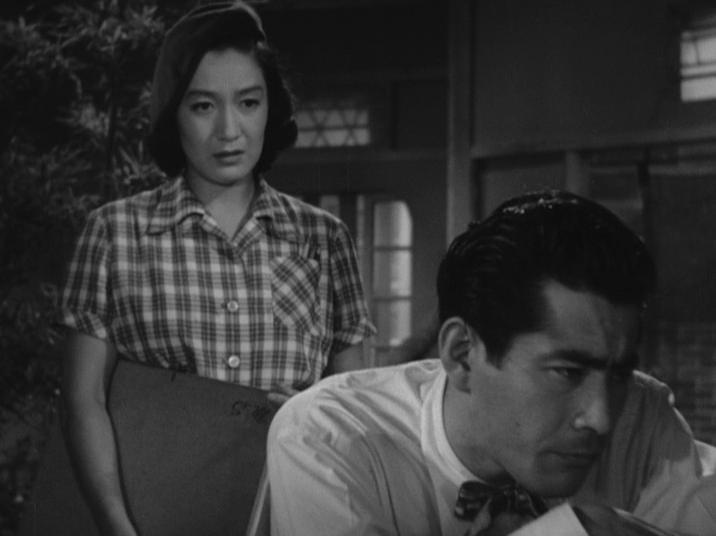
It’s the loan that in part allowed Kiyoko to consider life beyond her marriage in reuniting with the still unmarried brother of her best friend Yumiko (Yoko Sugi). Kenkichi (Toshiro Mifune) is everything Shinji is not, handsome, well dressed, and with a good, middle-class job working at a bank. On a visit to her relatives, Kiyoko’s aunt remarks that everyone wanted to marry her provoking a slight twinge of pain in Kiyoko’s face. Mother-in-law Ko arranges marriages and it’s likely she arranged the one between Kiyoko and her son and that Kiyoko likely agreed out to of social obligation under the rationale that Shinji was a good catch as the proprietor of a successful business. The implication is that if, like Yumiko, she had held out a little longer she probably would have fallen in love and married Kenkichi. As the atmosphere in the family home grows ever more toxic, she grows closer to him yet at least in part as a symbol of the path not taken, what her life may have been like if only she had resisted and claimed a little more freedom for herself. 

Ko has also arranged a marriage for youngest daughter Sumiko (Akemi Negishi) who asks her if all of her matches were happy. An indignant Ko replies that only one or two have split up, but as Sumiko points out just because a couple stays together does not mean they are happy. “Women don’t have the courage, they just give up,” she remarks implying that she, as a representative of the younger generation, might be less minded to simply accept a disappointing situation in the same way as someone of Kiyoko’s age may feel she had to. For these reasons Kiyoko is torn. Yumiko remarks that she and Shinji didn’t even particularly like each other when they married and perhaps remain indifferent to each other now. The cafe may have brought them closer as a couple, but now it’s causing a rift in the wider family while also offering Kiyoko the faintest glimmer of an escape route. When she returns to the cafe where she was learning the ropes as a part-time employee, much to Ko’s chagrin at losing a domestic helper, it’s clear that she’s doing so in part to have a means of supporting herself as she leans closer to the idea of leaving Shinji. 

But for all that it seems unlikely that she has the courage, as Sumiko put it, to break with the traditional social codes of feminity by leaving a husband who was not really bad but that she did not love and made her unhappy. In rebellion, Shinji has an indiscretion with a local geisha who goes missing on the way home from a hot springs and is later found dead having taken her own life because she was trapped in a bad relationship with her husband. The implication is that this is the only way many women find to escape from their dismal circumstances and may soon present itself to Kiyoko if she cannot find a way to reconcile herself to her life with Shinji or find the confidence to leave it. The enemy is the increasingly outdated institution of arranged marriages as advocated by the austere Ko who refuses to hire maids while believing herself entitled to the free labour of her daughters-in-law, and the patriarchal social codes of a modernising nation in which Shinji can have his dalliance with a geisha and his wife is expected to put up with it, but merely being seen walking with a man not one’s husband provokes gossip and jealousy. 

When Shinji implies he suspects her of having an affair with Kenkichi, he tells her that she’s free to follow her heart and he understands if she chooses to leave him but of course by telling her this he seals her fate by making it almost impossible for her to do so. The couple repairs itself, but the resolution is far from comfortable as it becomes clear that each is essentially resigning themselves to misery because of social convention vowing that they’ll build their cafe in the next season though it seems like a dream destined to go unfulfilled while the institution of Rumiko left behind in the family superficially fills the void it was designed to fill. The fades to black between scenes seem to echo an exhalation of bleakness as the interrupted thought of Kenkichi’s dangerous “Kiyoko…” as an admission that the prospect of escape is only ever a torturous fantasy and a heart is something that must be sacrificed in the name of conventional success. 


Beast Alley (けものみち, Eizo Sugawa, 1965)

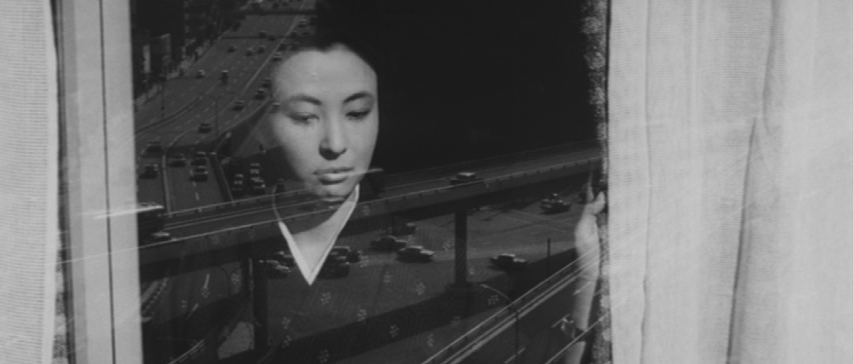
In the opening title sequence of Eizo Sugawa’s Beast Alley (けものみち, Kemonomichi), a thick blob of inky blackness gradually expands over an aerial view of the city until it obscures it entirely. The title card which then appears is written in plain white, but will reappear at the film’s conclusion this time ashen as if it too had been singed by the deeply ironic flames with which the film ends. Based on a novel Seicho Matsumoto and scripted by The Beast Shall Die’s Yoshio Shirasaka, the film similarly takes an incredibly cynical view of the modern post-war society in which it is revealed the militarists are still basically in charge and presiding over a deeply corrupt social order. 

The big bad, Kito (Eitaro Ozawa), says as much when he states the need for reforming the nation’s “rotten political system” by which he means post-war democracy. Kito made his made his money doing deeply dodgy things in Manchuria in addition to running an exploitative coal mine in Japan. Now mainly bedridden, he basically runs the country as a far-right political fixer working in tandem with big business and the yakuza who have traditionally been big supporters of conservative and nationalist forces. Early on we see one of his underlings negotiating with politicians to ensure that Taiyo Roads will be hired be hired for a large scale construction project planning to put highways all the way through Tokyo. As we later discover, he’s prepared to go to great lengths in order to achieve his goal, going so far as to have a sex worker murdered to implicate the uncooperative CEO of a rival construction film into resigning by threatening to frame him for the crime so they can install their stooge in his position. 

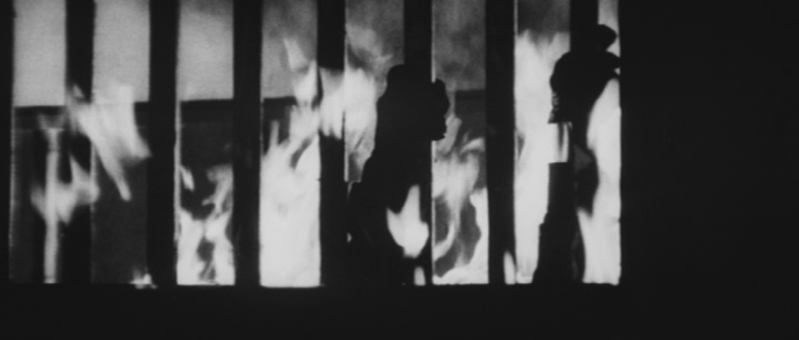
It’s into this world that everywoman Tamiko (Junko Ikeuchi) is drawn while working as a hotel maid at a traditional Japanese inn. Trapped in a bad marriage to a man who is also bedridden yet still attempts to rape her when she returns home to find him in bed with the housekeeper, Tamiko longs for escape and is therefore ripe for the picking when approached by Kotaki (Ryo Ikebe), the manager of an upscale Western hotel, to join him in an unspecified enterprise which will apparently make her very rich. The only catch is that she will have to “get rid” of her “dependent”, which she probably wanted to do anyway, by burning down her house with him inside it. Once she’s done this, there is no turning back for her even if she had not developed complicated feelings for Kotaki who is both her salvation and damnation. 

Tamiko’s husband had failed to give her the comfortable life that he had promised, something which she thinks Kotaki can deliver even if it requires her to become the plaything of Kito whom does she actually seem to like even if aware of the precarity of her position and still in thrall to Kotaki. Leaving the hotel so abruptly was however a strategic error as it arouses the suspicious of (originally) earnest cop Hisatsune (Keiju Kobayashi) who quickly realises that Tamiko set the fire to kill her husband. Though he seemed to be motivated by justice, Hisatsune too is soon corrupted explaining to Tamiko that he has become cynical and jaded. Years of police work have shown him that true criminals know how to break the law and get away with it so he can’t do anything about them, but “good” people, like he implies Tamiko, are pushed into crime by desperation and are easily caught. Tamiko wields her sexuality against him by agreeing to a tryst, though when it doesn’t go to plan he tries blackmail and then rape before she, ironically, manages to escape from his bungled crime. 

Hisatsune’s corruption is gradual and self serving. He starts with suspicion, tailing Tamiko in the interests of justice but also because he desires her, before stumbling on the conspiracy, putting the pieces together, attempting to use them for his own gain and trying to blow a whistle mostly out of resentment. Kito’s reach is all encompassing. Hisatsune is warned off investigating certain aspects of the crime by his senior officers and is then fired on Kito’s instructions for fiddling his expenses after harassing Tamiko. He tries to give his findings to his boss but it goes nowhere and then tries the press but is given the brush off, the editor his reporter friend refers him to gently implying he’s just a crank with an axe to grind. Of course, it turns out that the reporter is already in league with dodgy lawyer Hatano (Yunosuke Ito) who is Kito’s right-hand man. 

The connections between the three men, Kotaki who was once a communist, Hatano, and Kito go back to Manchuria and the corruptions of militarist era which it becomes clear has never really ended. Kito has only one rival and it’s another faction of the conservative ruling party who are probably just waiting for him die. Attempts are made on his life and they don’t go well for those who make them. Even if Hatano hoped to simply inherit an empire he, as he points out, put in much of the work to build he is sorely mistaken while Tamiko may intellectually understand that Kito’s death would place her in a precarious position but carries on regardless. “You never know who will betray you in this world” Kotaki laments, echoing Kito’s later claim that his Buddhist statues are the only ones will never betray him even as sleeps next to a statue of Aizen Myo whom he ironically claims protects mankind from their lust and desire. 

It could be said that desire is Tamiko’s undoing, but as Hisatsune had suggested perhaps you couldn’t blame her for longing to be free of the bedridden husband who had not delivered what he promised her. As she said, she was doing what could to survive even if you’d think she’d know putting on a ring taken from the finger of a murdered woman is akin sealing your own fate. Sugawa shoots with a noirish sense of dread, tracking Tamiko with her coat drawn up around her face as she tries to leave the scene of her crime, and makes the most of his fiery imagery before ending on a note of cynical laughter amid the inescapable hell the of post-war society. 


Original trailer (English subtitles)

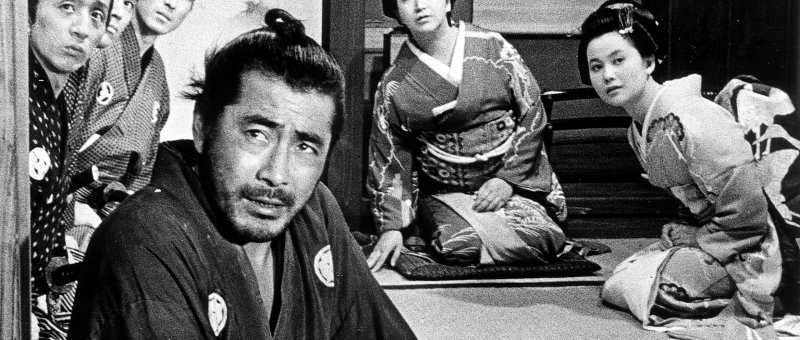
Sanjuro (椿三十郎, Akira Kurosawa, 1962)

Adapted from a novel by Shugoro Yamamoto, Akira Kurosawa’s Yojimbo had taken place in a world of collapse in which the foundations of the feudal order had begun to crack while the disruptive allure of hard currency had left ordinary people at the mercy of gang intimidation in place of exploitative lords. A quasi-sequel or perhaps more accurately termed a companion piece, Sanjuro (椿三十郎, Tsubaki Sanjuro) by contrast, takes place in a world that should be peaceful and orderly but suggests that the corruption was there all along and tolerated to the extent of being coded into the system. 

The accused man, Mutsuta (Yunosuke Ito), says as much at the film’s conclusion explaining that he meant to deal with the matter “more discreetly” after amassing incontrovertible evidence he could he could offer to his superiors in the capital if only his hot-headed nephew and the idealistic young samurai with him hadn’t jumped the gun by naively thinking they could expose conspiracy by force of will. This time around, the wandering ronin who gives his name as Sanjuro (Toshiro Mifune) finds himself adopting a fatherly position trying to convince the youngsters to think before they act. Overhearing their conversation, he explains to them that they have mostly likely been misled, Mutsuta is innocent and his attempt to warn them off well-meaning while the superintendent Kikui (Masao Shimizu) is the real villain and almost certainly intends to have the lot of them bumped off before they figure out what’s really going on. 

Unlike Yojimbo, Sanjuro takes place entirely within samurai society which ought to be an orderly place where everyone follows the same code and does their best to act honourably. This sense of stability is reflected in Kurosawa’s composition which leans closer to the classicism of the historical drama than the windswept vistas of the lonely ghost town in Yojimbo, and by the contrast so often drawn between the wandering ronin and the young samurai who are shocked by his rough way of speaking and wilful rejection of the politeness with which they have been raised. As a captured prisoner points out, Sanjuro has a sarcastic manner and a tendency to insult where he means to praise which further fuels the doubt some have in him, unsure whether they can really trust this “outspoken and eccentric” drifter fearing he will simply sell himself to the highest bidder and betray them. Mutsuta sympathises with this to some degree, forgiving the boys for having thought him a villain but lamenting that his long face has often got him into trouble. They thought he was the bad guy because he looked like one and trusted Kikui because he looked honest, laying bare the childish superficiality soon corrected by the well honed instincts of the veteran Sanjuro. 

It’s this superficiality that also leads them to dismiss the advice of Lady Mutsuta (Takako Irie) as “hopelessly naive” while only Sanjuro can see that she has a full grasp of the situation at hand and accepts her admonishment that he has the “bad habit” of killing too easily when another solution may be available. When the boys catch one of Kikui’s henchmen they suggest killing him because he’s seen their faces, but Lady Mutsuta decides to invite him into their home, assuring him he won’t be harmed and even giving him one of their fancy kimonos to wear. The man seems to have been won over by their hospitality, sometimes emerging from the cupboard where he is (voluntarily) imprisoned to offer a word of advice along with a defence of Sanjuro having observed him and figured out that he is a good man with an admittedly gruff manner that makes him a bad fit for conventional samurai society. “He would find it too confining here,” Mutsuta agrees, “he wouldn’t wear these fine garments or be a docile servant of the clan.”

In any case, the film doesn’t particularly reject samurai society only suggest that if you’re going to live within it you should follow the rules and if you can’t you should follow your own path as Sanjuro has been doing in a sense “freed” by his ronin status serving no master but himself. Lady Mutsuta had a point when she said that he glistened like a drawn sword, something he too concedes after facing off against his final foe, Heibei (Tatsuya Nakadai), whom he describes as much like himself another drawn sword in a society in which direct violence is inappropriate as the explosive spray of blood on Heibei’s all too matter of fact defeat makes plain. “The sword is best kept in its sheath” she reminds him, she and her husband both suggesting that this world is ruled by intrigue which is why Mutsuta hoped to handle the corruption “discreetly” though he won’t condemn the young men for their desire to enforce the rules of their society and stand up against corruption and injustice. Their rebellion has accidentally led to unnecessary deaths because of their youthful hot-headedness and tendency towards the simplistic solution of violence, but all things considered it has worked out well enough for all concerned. And so, his work done, Sanjuro is left to wander telling the boys not to follow him because he too is a disruptive and dangerous a presence in this codified world of peace and order in which a sword loses its value the moment it is drawn.


Sanjuro screened at the BFI Southbank, London as part of the Kurosawa season.

Original trailer (English subtitles)

The End of Summer (小早川家の秋, Yasujiro Ozu, 1961)

Fathers in Ozu are usually sentimental and doting, sometimes insensitive or austere, but by and large responsible. The crises the family faces are generally emotional more than they are practical, few Ozu fathers fail in a duty of care towards their wives and children. And then, there’s Manbei (Ganjiro Nakamura). The hero of Ozu’s penultimate film, The End of Summer (小早川家の秋, Kohayagawa-ke no Aki), is quite the opposite. He does as he pleases and enjoys his life to the fullest without really noticing the effect his behaviour has those around him. But then, as his sister later puts it, he was a very happy man which is rare thing in this society so perhaps he had something right after all. 

Produced for Toho and set in Osaka rather than the usual Shochiku and Tokyo, the film opens not with Manbei but with his brother-in-law Kitagawa (Daisuke Kato) trying to set up Manbei’s widowed daughter-in-law Akiko (Setsuko Hara) with a widowed industrialist obsessed with cows. Meanwhile, the family is also trying to find a match for his youngest daughter, Noriko (Yoko Tsukasa), who is put off by the whole idea of an arranged marriage and worried that Manbei and her older sister Fumiko (Michiyo Aratama) may try to pressure her into accepting because their family sake brewery is trouble. Fumiko’s husband Hisao (Keiju Kobayashi) is technically running the brewery and favours a merger to save the business but Manbei is resistant. Manbei himself is largely absent and his increasing habit of skipping out during the day is beginning to worry the family, especially when they discover he’s been visiting an old mistress with a 21-year-old daughter he thinks is his. 

Followed to a cafe, Manbei exclaims that summer refuses to end in an accidental metaphor for his life. For him everything is sunshine and rainbows, scuttling away from the family home like a little boy sneaking out after dark while the now grownup kids are left behind to clean up his messes. Manbei is a widower, and aside from the financial dimension, perhaps it’s not a huge problem if he wants to go and hang out with an old flame, but Fumiko in particular is scandalised remembering the various humiliations he put her late mother through when she was just a child. Hisao advises her that perhaps it’s best not to bring it up. Manbei isn’t going to change his behaviour and it’s only going to create more drama whereas it might be more manageable if they all pretend not know. Fumiko, however, can’t stay silent even if she knows her father isn’t going to listen to her and in fact lies quite baldly about what he’s been doing in Kyoto. 

Fumiko is on the side of marrying Noriko off, but unlike her husband, father, and uncle, is keen to emphasise that they should move slowly and be sure to take her feelings into account. Rather than her sister, Noriko turns to Akiko for support. Originally in favour of meeting the prospective husband, after all you can always turn it down if you don’t like him, she cautions Noriko that the most important thing is character rather than behaviour and that it’s essential to marry without regret. Noriko feels as if she’s obliged to do as everyone says, but is secretly in love with a young man she met on a skiing holiday who has just been transferred to Sapporo. Akiko, meanwhile, was not altogether taken with the cow-loving widower, but in any case would prefer to maintain her present way of life as a single mother even while others pressure her to remarry. 

The conclusion Noriko comes to is, perhaps strangely, inspired by her carefree father in that she decides it’s best to do what will make her the most happy rather than simply going along with what everyone else wants her to do which may or may not be in her best interest. Fumiko grudgingly admits that though her father was often exasperating perhaps he was the only thing holding the family together. Ozu broadly lends the irresponsible but never malicious Manbei tacit approval in celebrating the fact that he lived the life he wanted to live and he was at least defiantly happy in his own eternal summer, but then ends on an uncharacteristically morbid note as two farmers wash vegetables in the river opposite a crematorium remarking on the increasing number of crows while resigning themselves to the cycle of life. Smoke and crows await us all, perhaps Manbei had it right and the thing is to be happy while you can without taking much notice of what others might have to say about it. 


Repast (めし, Mikio Naruse, 1951)

“Must every woman grow old and die feeling empty?” asks the unhappy heroine of Naruse’s 1951 melodrama Repast (めし, Meshi) only to conclude that yes, she must, but that this in fact constitutes “happiness” as a woman. The first of Naruse’s Fumiko Hayashi adaptations Repast arrived in the year of the author’s death and is inspired by a short story left unfinished at the time of her passing. Screenwriter Sumie Tanaka was apparently convinced that the film should end with a divorce, as Sound of the Mountain would two years later, and consequently left the project after the studio mandated a more “sympathetic” ending. Superficially happy as it might seem, however, the conclusion is as bleak as one might expect from Naruse in which the heroine simply accepts that she must recalibrate her idea of happiness to that which is available to her and learn to find fulfilment in shared endeavour with her husband. 

As she explains in her opening voiceover, Michiyo (Setsuko Hara) married her husband Hatsunosuke (Ken Uehara) five years ago in Tokyo against her family’s wishes and has been living on the outskirts of Osaka for the past three. Marital bliss has quite clearly worn off. As we see from the repeated morning scenes of the local community sending their sons off to school and husbands to the office, every day is the same and all Michiyo ever seems to do is cook and clean. The only words Hatsunosuke says to her are “I’m hungry”, and the only source of solace in her life is her cat, Yuri. Yet even this constant state of unhappy frustration is disrupted by the unexpected arrival of Hatsunosuke’s spoilt and immature niece Satoko (Yukiko Shimazaki) who has apparently run away from home in rebellion against an arranged marriage. 

There is obviously a blood relation between Hatsunosuke and Satoko, but Michiyo’s jealously is not exactly unreasonable given the young woman’s childish flirtation with her uncle, perhaps an adolescent extension of her propensity to pout and preen to get her own way. Aside from all that, finances weigh heavily on Michiyo’s mind. Other than her drudgery, the constant source of friction in the relationship is Hatsunosuke’s low salary and lack of career success. Satoko’s family are a little wealthier and having been brought up in relative comfort she has little idea of the real world and is often tactless, remarking on Hatsunosuke’s worn out tie much to Michiyo’s chagrin. Hatsunosuke is happy enough to have her, but Michiyo is wondering if there’s enough rice in the jar to see them through and Satoko never stops to consider that they’re feeding her for free even falling asleep when Michiyo enjoys her one and only day off reuniting with old friends rather than preparing dinner as she’d been asked. Perhaps aware of the disruptive effect of her presence, Satoko pours salt on the wound by constantly asking her uncle if Michiyo doesn’t like her or is angry, further placing a wedge between husband and wife. 

For all that, however, Hatsunosuke would not be accounted a “bad” husband for the time save perhaps for his lack of career success. He is not cruel or violent, merely insensitive and distant, taking his wife for granted and unable to see that she is deeply unhappy while otherwise internalising a sense of guilt and failure in his inability to adequately provide for her. She meanwhile sometimes takes her dissatisfaction out on him in barbed comments about his low salary, her barely hidden contempt never far from the surface. Yet as her mother later points out in encouraging her go back to him he is “reliable, discreet, and honest”, qualities borne out by his later refusal to go along with a dodgy scheme organised by the old elite along with his nervous rebuttal of the attentions of the “mistress” from across the way. 

At heart a conservative woman, Michiyo too looks down on Ms Kanazawa (Kumeko Otowa) for her taboo status as the illicit lover of a wealthy man which is only in a sense her way of seizing her future as an independent woman running her own bar. Satoko, a woman of the modern era, sees less of a problem with it and is far less judgemental, though her own attempts are destined to end in failure thanks to her inability to work out that her present lifestyle is far above her current reach. Retreating to her Tokyo home, Michiyo looks for other options, admiring the apparently happier relationship between her younger sister and brother-in-law who now run the family shop. She asks a sympathetic cousin, Kazuo (Hiroshi Nihonyanagi) who provides an alternate love interest, to help her find work but encounters the brutalising line outside the local employment office and then an old friend now a war widow desperate for employment because her benefits are about to run out and she has a young son to support. Later she spots the same woman handing out flyers, suddenly realising the fallacy of her fantasy of starting again as an independent woman. She pens a letter to her husband admitting that she’s realised how vulnerable she is without his protection, but remains undecided enough to avoid sending it. 

Hearing that Satoko, still childish but perhaps not quite as naive as she assumed her to be, has been laying her claws into Kazuo the final nail seems to have been struck. Michiyo knows she will return to Osaka, but does so not because she has rekindled her love for her husband but because she has accepted there are no better options. Hatsunosuke is dull, but he is in a sense reliable, and honest to the extent that he may be about to be rewarded for his moral unshakability. He cares enough about her to show up in Tokyo hoping, but not insisting, she will return with him which is perhaps as close to a declaration of love that one could hope for. On reflection she decides that a woman’s happiness is found in sharing the journey with her husband, accepting that she must subsume her own desires into his and cannot hope to expect emotional fulfilment other than that found in his satisfaction. Even for a Naruse film, and one as peppered with moments of slapstick humour as this one is, it’s an extraordinarily bleak conclusion subtly hinting at the iniquities of life in a patriarchal society in which the best a woman can hope for is a life of unrewarded drudgery. 


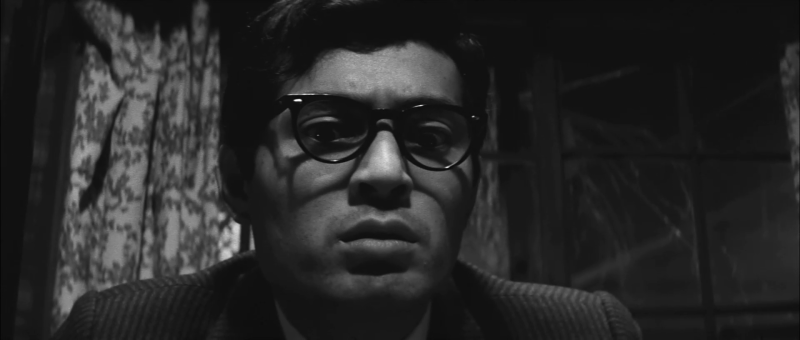
Ken (剣, Kenji Misumi, 1964)

Most closely associated with jidaigeki, Kenji Misumi’s only film to be set in the contemporary era, Ken (剣), shifts his persistent concerns into the modern day in the clash of the warrior ideal and the emotional costs of living, but also takes a sideways look at conflicted post-war masculinity as two young men vicariously lock horns in a quest for mastery over their desires. Adapting a short story by Yukio Mishima, Misumi dials back on the tragic romance of militarism painting the hero’s ultimate acceptance of nihilistic futility less as a noble sacrifice than a humanist failure of the society that failed to save him from his absolutist fallacy. 

Obsessed with strength and honour, Kokubun (Raizo Ichikawa) has convinced himself that he can capture “this spark of pure life” he saw in the sun through perfecting the art of kendo. An aloof and austere figure, he has foregone all else and dedicated himself to his skill alone. For this reason he is appointed captain of his university kendo club over his jealous rival, Kagawa (Yusuke Kawazu), who loses out because his sword is “sentimental” and there is a concern that he draws his power from “arrogance”. There is indeed something in that, and it’s Kagawa’s sense of male pride that partly sets him on a quest for vengeance and vindication in a obsessive desire to dominate Kokubun but there’s also an unspoken attraction as he later admits to a female acquaintance in remarking that he finds Kokubun’s way of life “infuriating” but despite himself also “refreshing”. 

Literal sword play, Kagawa’s obsession with Kokubun results in a vicarious seduction in which he attempts to corrupt him by enlisting the help of a female student to expose him as a fraud by rupturing his asceticism and thereby destroying his source of strength if not his sense of self. The quasi-sadomasochistic relationship between the two men is further borne out by the implication that Kokubun is in fact finding his sexual release in the intense act of repression, satisfying himself through physical exhaustion in the company of other men, Misumi’s roving camera fully capturing the homoeroticism of this intensely homosocial society. Humiliated by Kokubun who forces him into a public act of contrition through physical endurance after disappointing the club by breaking the rules smoking on the job at their part-time gig at a supermarket, Kagawa goes to the chairman to complain that Kokubun’s leadership style is far too intense, “feudalistic” as another member puts it shortly before quitting, claiming that all he wants is for his rival to wake up from his militarist dream and live in the real world though his final act of mutiny will engender consequences unforeseen in his conviction that Kokubun’s ideology is largely performative self-delusion. 

The team manager perhaps thinks something similar, reminding Kagawa that he is merely “more grown up” as if Kokubun is in a sense maintaining his childlike innocence in refusing to enter an adult world he regards as “ugly” and “corrupt”. His ideal is simplicity and he finds it in the primacy of the sword. There is in this something of an uncomfortable militarist throwback that finds a disciple in the ever loyal Mibu (Akio Hasegawa) who dutifully parrots back the quasi-facist philosophy to his quietly horrified mother and sisters who probably don’t help the situation by mocking his lack of masculinity in his inability to grow a proper beard while insisting on shaving every day anyway. Attracted by Kokubun’s dynamism and energy, he longs for strength through self denial. “We must move away from those empty desires” Kokubun instructs him while discussing the suicide of a young man who was discovered next to a selection of half eaten fruit. Rather than sympathy the man is largely mocked by his male peers, Kokubun dismissing him as “weak in mind and body” for having taken his own life apparently in fear of failure, but also stressing that suicide is a choice taken by the very strong as well as the very weak. 

In this brief exchange he opens the door to a notion of nobility in the choice to take one’s own life which leads straight back into the death cult of militarism, perhaps something that only Mibu as a fellow devotee is able to see. Yet Misumi perhaps undercuts this sense of nobility with a return to collective shame, eulogising Kokubun’s determination to preserve his “uprightness and strength” as Kagawa admits defeat in the face of Kokubun’s unbreakable purity, while placing the burden of failed responsibility on the kendo troupe not for their inability to live up to his ideal but for their lack of understanding in failing to free him of his moral absolutism. The way of the sword once again leads only to death and while there may be an uncomfortable beauty in such moral purity, in the end all there is is futility. 


Original trailer (no subtitles)