Stranger (夜のストレンジャー 恐怖, Shunichi Nagasaki, 1991)

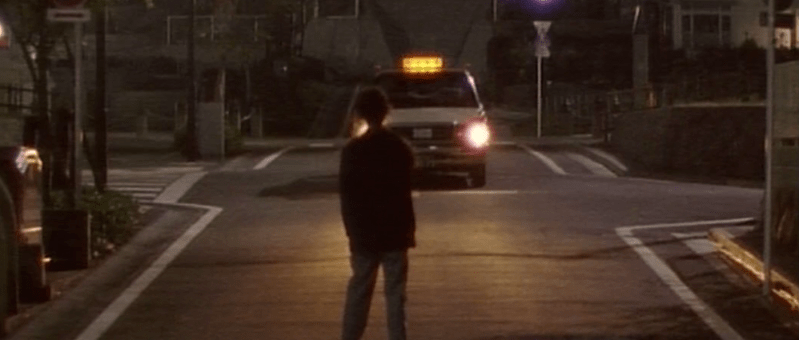
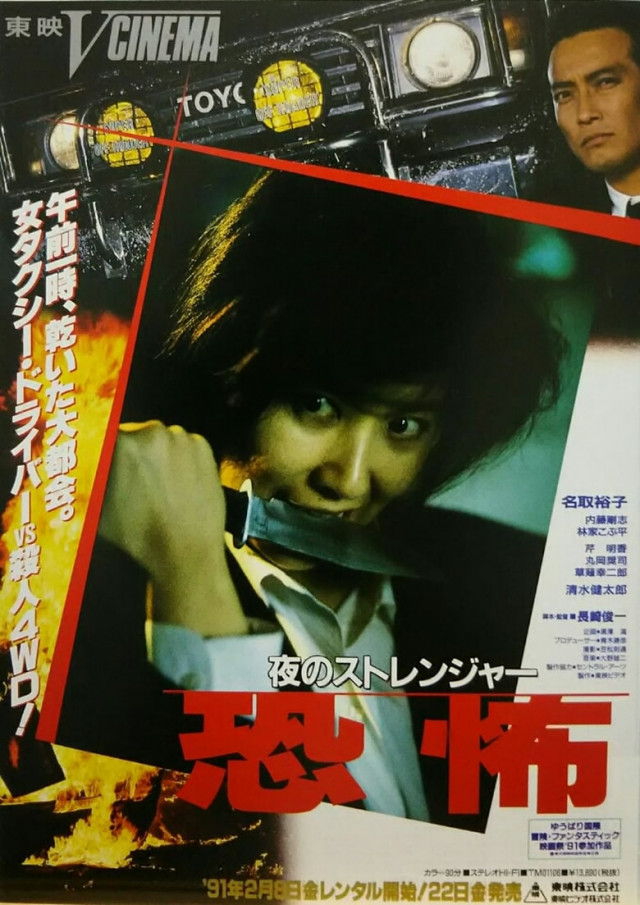
Driving through the city by night, a young woman finds herself plagued by a mysterious force while struggling to break out of her self-imposed inertia in Shunichi Nagasaki’s moody thriller, Stranger (夜のストレンジャー 恐怖). The film’s Japanese title, “night stranger terror”, perhaps more clearly hints at a sense of urban threat while surrounded by so many unfamiliar people, yet it is in many ways Kiriko’s (Yuko Natori) mistrust and suspicion that isolates her from the surrounding society and keeps her trapped in a kind of limbo unable to escape her past.

It might be tempting to read her aloofness as a direct consequence of her experiences, but in an early scene when she was still a bank employee we hear a colleague criticise her for being “anti-social” while Kiriko’s rejection of her seems born more of contempt than shyness or a preference for solitude. Working as a cashier at the bank at the tail end of the bubble is a pretty good job, especially given the still prevailing sexism of the working environment, that positions Kiriko firmly within an aspirant middle-class. She still lives at home surrounded by her family, but is in a relationship with a man who pressures her for money to invest in the stock market. She begins embezzling and lives as if there’s no tomorrow, splashing out on fancy sunglasses before meeting her boyfriend having left work early feigning illness. Unfortunately for her, she gets caught and her boyfriend predictably abandons her.

Just like the asset bubble, her life implodes and plunges her into a lower social stratum as a woman with a criminal conviction for financial impropriety and a hefty debt in needing to pay back the money she stole from the bank for her ex’s harebrained stock speculation schemes. All in all, you could say she’s been betrayed by economic forces, but also as she later admits, but her own uncertain desires in being wilfully deceived by Akiyama (Takashi Naito) and making a clear choice to defraud the bank. She realises that it might not have been a desire to please Akiyama that led her to do it, but the illicit thrill she felt in tapping away on her keyboard stealing the money and otherwise being in a position of economic power over a man, buying him things and taking him out for fancy food. Her sense of malaise is only deepened when she meets Akiyama by chance and tries to tell him all this, but he isn’t really interested. He seems to have moved on and planning to marry another woman. 

Kiriko tries to look at his hands to see if he has burn scars like the man who attacked her in her taxi, but he doesn’t. Perhaps there was a small part of her that wanted it to be him. At least if it was, it would mean he still felt something for her, which would also prove that he ever did. And it would make sense, which is less frightening than her stalker just being a nutty fare, another irate man with a nondescript grudge wandering the city. Taxi driver is one of the few jobs open to her with a criminal record, but it’s also an unusual profession for a woman which further isolates her in her working environment. Her boss keeps calling her “little lady,” while patronisingly offering to put her on the day shift because it’s less dangerous. Kijima (Kentaro Shimizu), an obnoxious colleague, picks at Kiriko for thinking everyone who strikes up a conversation must be sexually interested in her. But the truth is that they are and like Kijima demand her attention. When they don’t get it they’re pissed off. The cab is perhaps the place she feels the most safe, though she faces her fair share of weird fares from drunk men trying to flirt to religious maniacs proselytising from the back seat. 

Now living alone in an apartment, her aloofness is both a personal preference and means of punishing herself. When her brother calls, he encourages her to come home but she says she can’t even though she wants to because she hasn’t yet dealt with her past or taken steps towards being able to forgive herself. She tells Kijima, who in truth behaves in an incredibly creepy way that suggests she’s right to avoid him, that she wonders if she isn’t the only one who can see the mysterious Land Cruiser, as if she were really imagining it. The Land Cruiser does indeed come to stand in for the buried past by which Kiriko is haunted and her eventual besting of it is a symbolic act that suggests she’s finally managed to overcome her guilt and shame to be able to leave the past behind.

As she told Kijima, this was something only she could do by her own hand or none. Akiyama’s dismissiveness of her reflects the fact that he couldn’t give her this absolution either, she needed to find it for herself. Kijima accused her of still being hung up on the guy that scammed her, but that wasn’t quite it. The resolution might hint at his being right when he told her that she needed to learn to trust people more in that it seems to lead to a greater willingness to open herself up to the world. Once again, her sunglasses get broken as a new truth becomes visible to her. A lonely little boy she meets who, like her, enjoys driving in circles and going nowhere, probes her lack of human connection by suggesting that she doesn’t know what it’s like to love someone which is why she can’t understand his obviously inappropriate love for her, though it’s a fact that Kiriko has to acknowledge is truth in interrogating the reality of her relationship with Akiyama.

Nevertheless, in the end, she saves herself and embraces her solitude and independence looking out at the peaceful bay in a city that no longer seems so threatening even if the unseen threat in this case did turn out to be random and have no rational explanation. Nagasaki never again worked in the realms of V-Cinema and his entry is fairly atypical in starring an older, established actress as an action lead while requiring no nudity or sexual content, instead quite literally allowing her to grab the wheel and take control of her life to claim freedom and independence rather than solely romantic fulfilment.
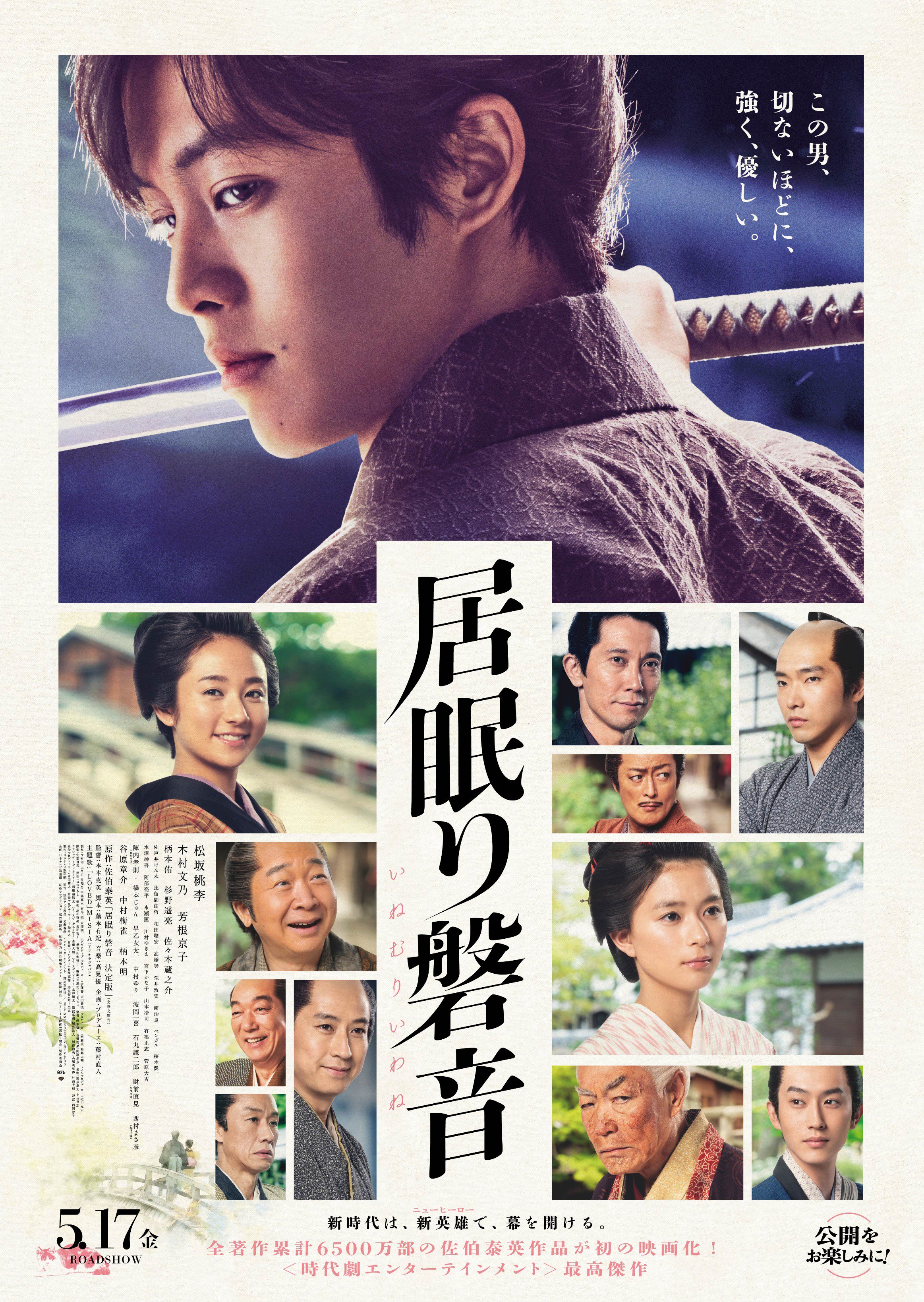
Iwane: Sword of Serenity (居眠り磐音, Katsuhide Motoki, 2019)

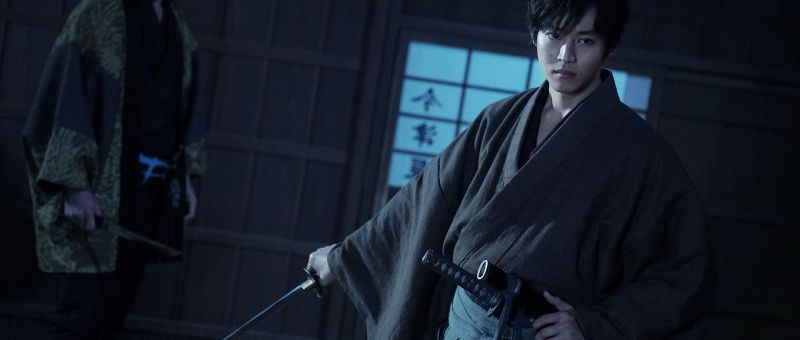
The contradictions of the samurai code conspire against one noble-hearted young man in Katsuhide Motoki’s adaptation of the long running series of historical novels by Saeki Yasuhide, Iwane: Sword of Serenity (居眠り磐音, Inemuri Iwane). Yet this truly serene samurai is a stoical sort, learning to bear his pain with fortitude while standing up for justice in an increasingly corrupt Edo where money rules all while an ascendent merchant class continues to challenge the fiercely hierarchical social order. 

Beginning in 1772 which turned out to be a disastrous year, the tale opens as hero Iwane (Tori Matsuzaka) prepares to return home after completing his three year rotation in Edo in the company of childhood friends Kinpei (Tasuku Emoto) and Shinnosuke (Yosuke Sugino). Shinnosuke is in fact married to Kinpei’s sister Mai, while Iwane will himself be married to Kinpei’s other sister Nao immediately on his return so close are they. As Iwane’s father tells him, there are great hopes for these young men that they can “turn our outdated clan around”, but events will conspire against them. Spoiling the happy homecoming, Shinnosuke is accosted by a drunken uncle who convinces him Mai has been unfaithful in his absence with the consequence that he kills her immediately on his return home. Unable to understand this turn of events, Kinpei confronts his friend but eventually kills him, while Iwane is then forced to kill Kinpei after he goes on murderous rampage in revenge for the wrong done to his sister. 

In trying to mediate the case, the argument is put forward that Shinnosuke acted rashly and should have brought his suspicion to the authorities rather than opting for summary execution. The lord however disagrees, condoning Shinnosuke’s actions under the rationale that to do so would have been considered “weak minded” while as Shinnosuke himself had claimed he acted in accordance with the samurai code in which female adultery is illegal and punishable by death. By contrast, he finds Kinpei’s rashness offensive, insisting that he also should have recognised the legitimacy of his sister’s murder and simply left quietly with her body. Having learned the truth in which his childhood friends became victims of clan intrigue, romantic jealousy, and tragic misunderstandings in this Othello-like plot, Shinnosuke and childhood sweetheart Nao are also consumed by the rashness of samurai law each exiled from their clan and cast adrift in Edo-era society. 

Edo-era society is however also itself corrupt. Some months later, Iwane has returned to Edo as a lowly ronin lodging with a kindly old man, Kinbei, who helps him find a job firstly gutting eel then as a bodyguard at a money exchange which has been receiving anonymous threats they assume are from rival broker Awaya who has hatched a nefarious plan to manipulate the currency market to stop the current Shogun introducing a new unit which can be used in both Edo and Kyoto which would understandably cut into his already corrupt business model. Luckily, Imazuya is an honourable man who backs the new currency plan and wants to do the right thing which makes him a perfect fit for Iwane’s innate sense of justice. “You don’t know the way of the merchant” Awaya snaps at him, suggesting both that the samurai are already on their way down as the merchants rise and that his unwillingness to play dirty will be his downfall. Nevertheless, Iwane is the type to adapt quickly, instantly coming up with a way to play Awaya at his own game and kick his destructive amoral capitalism to the curb. 

Meanwhile, he continues to pine for Nao while drawing closer to Kinbei’s earnest daughter Okon (Fumino Kimura). As we discover Nao is also a victim of an intensely patriarchal social order but through the tragedy that befalls them also finds strength and agency making a life changing decision that allows her to become independent while looking after her family if in the knowledge that the childhood romance she shared with Iwane is a thing of the past. Iwane too agrees that he is trapped in a living hell of guilt and grief, yet choosing to go on living anyway as calm and cheerful as he’d ever been while standing up to Edo-era corruption though uncomfortably enough this time against the destabilising influence of the rising merchant class and therefore in contrast to most jidaigeki reinforcing the legitimacy of the samurai order which has paradoxically also ruined his life with its rigid and implacable social codes. In any case, Motoki’s classic chanbara melodrama has a serenity of its own as the cheerfully laidback hero resolves to live his life by a code of his own free of samurai constraint. 


Trailer (no subtitles)

Baian the Assassin, M.D. (Part 1) (仕掛人・藤枝梅安, Shunsaku Kawake, 2023)

A traumatised assassin takes it upon himself to get rid of a few villains on realising there’s something not quite right with his latest contract in Shunsaku Kawake’s classic jidaigeki homage, Baian the Assassin, MD: (Part 1) (仕掛人・藤枝梅安, Shikakenin Fujieda Baian). The titular hero is the protagonist of a series of novels by Shotaro Ikenami which have spawned several previous adaptations on the big and small screens. Produced in celebration of Ikenami’s centenary the film, one of two, harks back to the golden age of period drama if with a more contemporary sensibility. 

Baian (Etsushi Toyokawa) is ostensibly an acupuncturist though by night he uses his needles to kill rather than to heal. Hired to take out the second wife an inn owner, Omino (Yuki Amami), his suspicions are raised on realising that he had also been the assassin who killed the man’s first wife two years earlier. He blames himself in part for having agreed to assassinate a woman in the first place, and remains conflicted even after accepting the job wondering if Omino is next in the firing line or if she was actually the one who had the other woman killed in order to usurp her place. 

The film makes clear from the outset what a difficult place Edo could be for a woman as Baian carries out an assassination on a boatman who had raped a samurai’s wife and then blackmailed her into further sexual favours only for her to hire an assassin and then kill herself confessing all. Omino had apparently been the stepdaughter of a gang leader who sexually abused her and then died leaving her with no support and nowhere to turn except to sex work. Maybe no one could blame her for taking advantage of a besotted client to escape her terrible circumstances though getting rid of his wife would obviously be a different matter. Omon (Miho Kanno), a maid Baian takes a liking to while investigating, admits something similar that as a widow with a young son realistically speaking there is nowhere else that could she work to support him except on the fringes of the sex trade. Then again, as she says the previous mistress was strict but it was because she cared, whereas Omino is just mean and self-interested. She’s fired all the old staff and brought in pretty young women who are quite obviously being expected to entertain their male customers in more direct ways. 

In any case, Baian soon finds himself drawn into a wider series of plots when his friend Hiko (Ainosuke Kataoka), a skewer maker who assassinates people with poison darts, is tasked with taking out first a lascivious carpenter and then a rogue samurai who has supposedly raped and kidnapped the daughter of his lord which obviously turns out not quite to be the case. Rape and kidnap are depressingly common in Edo-era society where it is largely women who suffer under a patriarchal society with intensely oppressive social codes that demand female purity. In a post-credits sequence, we come to understand that Hiko too is seeking vengeance for the death of a woman who killed herself and her child after being raped by bandits. Meanwhile, Baian reveals that he had a mild hatred of women himself born of pain in having been abandoned by his mother who left with another man and took only his sister with her after his father’s death. He had to overcome that resentment in order to fulfil himself as a doctor treating women’s bodies but struggles when he realises that someone involved in the case is closely linked with his own traumatic past and death may be the only way to save them. 

Both he and Hiko end up breaking the assassin’s code but only in defence of justice, which might sound odd considering the nature of their work. Nevertheless, they each have their scruples and don’t like to think of themselves as having been used or inadvertently killed someone who didn’t really deserve it. As Baian puts it, the greatest villains may really be “well-meaning weak cowards” though perhaps corrupt lords can’t really complain about falling victim to their own tactics. With noticeably polished production values and atmospheric cinematography, Kawake pays tribute to classic jidaigeki and eventually sets his heroes back on the road awaiting the next battle for justice in the distinctly unjust feudal era. 


Baian the Assassin, M.D. (Part 1) screened as part of this year’s Camera Japan.

Original trailer (English subtitles)

Black Rain (黒い雨, Shohei Imamura, 1989)

Caught in a moment of transition, post-war Japan struggles to free itself from the lingering feudal legacy and the trauma of the immediate past in Shohei Imamura’s contemplative adaptation of the novel by Masuji Ibuse, Black Rain (黒い雨, Kuroi Ame). As many things change others stay the same, the Shizuma family burdened not only by the anxiety of a ghostly illness symptomless until it isn’t and the unfair prejudice of a wounded society, but the pressure of outdated patriarchal social codes along with a sense of filial failure in the inability to protect their ancestral estate. 

Imamura opens on the fateful morning the atomic bomb struck Hiroshima, voiceovers from 20-year-old niece Yasuko (Yoshiko Tanaka) and her uncle Shigematsu (Kazuo Kitamura), a soldier severing at a factory in the city, detailing what they were doing on that very ordinary day. What unfolds is a scene of hell, the train Shigematsu is riding on blown apart while he crawls free and tries to look for his wife, Shigeko (Kazuo Kitamura), packing up their house preparing for evacuation, eventually reuniting with Yasuko who had come into town to find them. Hoping to get to the factory, they make their way past charred and hideously warped bodies, a woman cradling her carbonised infant, a little boy overjoyed to have found his big brother only to go unrecognised because his face is melted away while skin hangs painfully from his forearms and fingertips. The brother only accepts him after checking his belt which has somehow miraculously survived. The trio eventually make it to comparative safety at the factory with relatively few injuries, only later learning of the implications of having been in such close proximity to the blast. 

Jumping ahead five years, the Shizumas are living quite comfortably in their ancestral home on a mountain estate largely spared the post-war agricultural land reforms because of its location, though Shigematsu attributes his mother’s dementia to an inability to accept the changing times not only their loss of a semi-aristocratic status but the essential failure of having proved unable to protect their ancestral lands. His immediate problem is however the marriage of the now 25-year-old Yasuko. We see him triumphantly leave a doctor’s office with a certificate stating that Yasuko is in good health he hopes will reassure her current suitor’s family in the face of persistent rumours that she too was a direct victim of the “flash”, rather than an indirect victim simply of the rain which Shigematsu mistakenly believes to have been less dangerous. 

At 25 this is Yasuko’s last chance, she’s aged out of the arranged marriage market. She has also had a promising job offer from the local post office but is minded to turn it down in the hopes of being married. Taking the post office job may be the most sensible option, but it also seems like defeat, an acceptance that she is unfit for marriage and a clear sign that Shigematsu and Shigeko have failed in their patriarchal duties to ensure that Yasuko finds a good husband and will be well looked after for the rest of her life. In this age, it is difficult for a woman to support herself alone even leaving aside the social stigma of being an unmarried woman. A marriage is therefore also a job, and the families fear one Yasuko may not be able to perform if as the rumours suggest her exposure to radiation may have left her unable to bear children. The situation is further complicated seeing as Shigematsu and Shigeko were not able to have children of their own, and with Yasuko’s mother Kiyoko having died young Yasuko is the last of the Shizuma line even if she technically may not bear their name. 

Lost in old memories and mistaking Yasuko for her mother, grandma (Hisako Hara) may have it right when she tells her not to marry for marriage only leads to death. Yet in an odd way, Yasuko’s liminal status perhaps grants her the right to turn away from these old-fashioned patriarchal expectations in making her own decision not marry even if she orients herself back towards the filial in requesting to stay with the aunt and uncle who raised her in order to care for them should they suddenly begin to experience symptoms of their exposure to “the flash”. Shigematsu continues to treat the notion of radiation sickness with an almost supernatural mentality, convinced that having seen the light or not is all that matters constantly trying to provide evidence that Yasuko was not there when the bomb went off while ignoring her exposure to the black rain which fell afterwards even while himself filled with the anxiety of not knowing if he may someday become ill even if he and Shigeko are in otherwise good health. 

He watches friends with secondary exposure become ill and die before him, recalling being asked to read sutras for the dead in the aftermath of the bomb though feeling himself unqualified, while some in the village perhaps jokingly accuse them of playing on their status as bomb victims as if they are merely lazy rather than actively sick. Meanwhile, across the way a young man with intense PTSD suffers flashbacks every time he hears an engine running and is compelled to throw himself in front of it as if it were an enemy tank. Yuichi (Keisuke Ishida) is ironically enough “a veteran of the suicide squad”, otherwise alright if fragile spending his days carving Buddhist Jizo statues may of which have grotesque, anguished expressions in contrast to the comforting, almost cute faces such statues usually bear. Just as the wider society distances itself from the survivors of the bomb, so they reject men like Yuichi. When Yuichi’s mother comes to propose an unlikely marriage between the two lonely youngsters who have become close after bonding through their shared anxieties, Shigematsu is offended, resenting the implication that they must believe Yasuko is a poor catch if daring to suggest she marry a man of a lower social class who is also in need of assistance in living with his mental illness. 

Yet her marriage continues to weigh heavily on Shigeko’s mind, feeling as if she has failed the Shizuma family in being unable to provide an heir and subsequently failing to secure a match for Yasuko. It is perhaps this anxiety that finally makes her ill, taking strange medicines provided by a dubious Shinto priestess who tells her it’s all her own fault for not being able to visit Kiyoko’s grave because someone has to stay at home to look after grandma. Only Shigematsu sees the writing on the wall, advising Yasuko that after grandma dies she should sell the estate and take the money as her dowry freeing her from the feudal and familial legacy and giving her permission to move into the modern post-war future even as she begins to doubt that the future has a place for her. 

Shooting in black and white and in a much more classical style than that which is found in his other work, Imamura adopts the aesthetics of Golden Age cinema to comment on the contemporary era now perhaps feeling itself sufficiently distanced from the toxicity of wartime trauma, suggesting that the entire society is in a sense soaked in black rain its inability to confront the recent past a poison slowly eating away at its foundations. “An unjust peace is better than a just war” Shigematsu is fond of saying, quoting Cicero dismayed by the heated geopolitical debates he hears on the radio he uses to set the clock, his friend dying without ever really understanding why the bomb was dropped, why on Hiroshima, why at that particular moment. Imamura denies us closure too, leaving on a note of anxiety if tempered with an all but forlorn hope for signs of a miracle on the horizon that the sickness can be healed and a better world will someday arrive.


Black Rain screens at the BFI on 28th December as part of BFI Japan and is also available on blu-ray as part of Arrow’s Imamura boxset or to stream in the UK via Arrow Player

Harmful Insect (害虫, Akihiko Shiota, 2001)

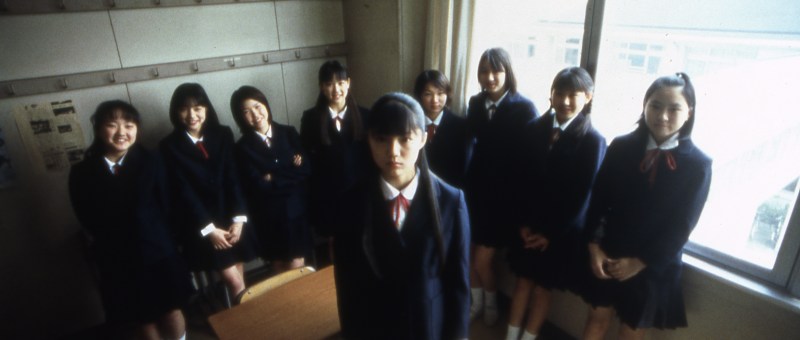
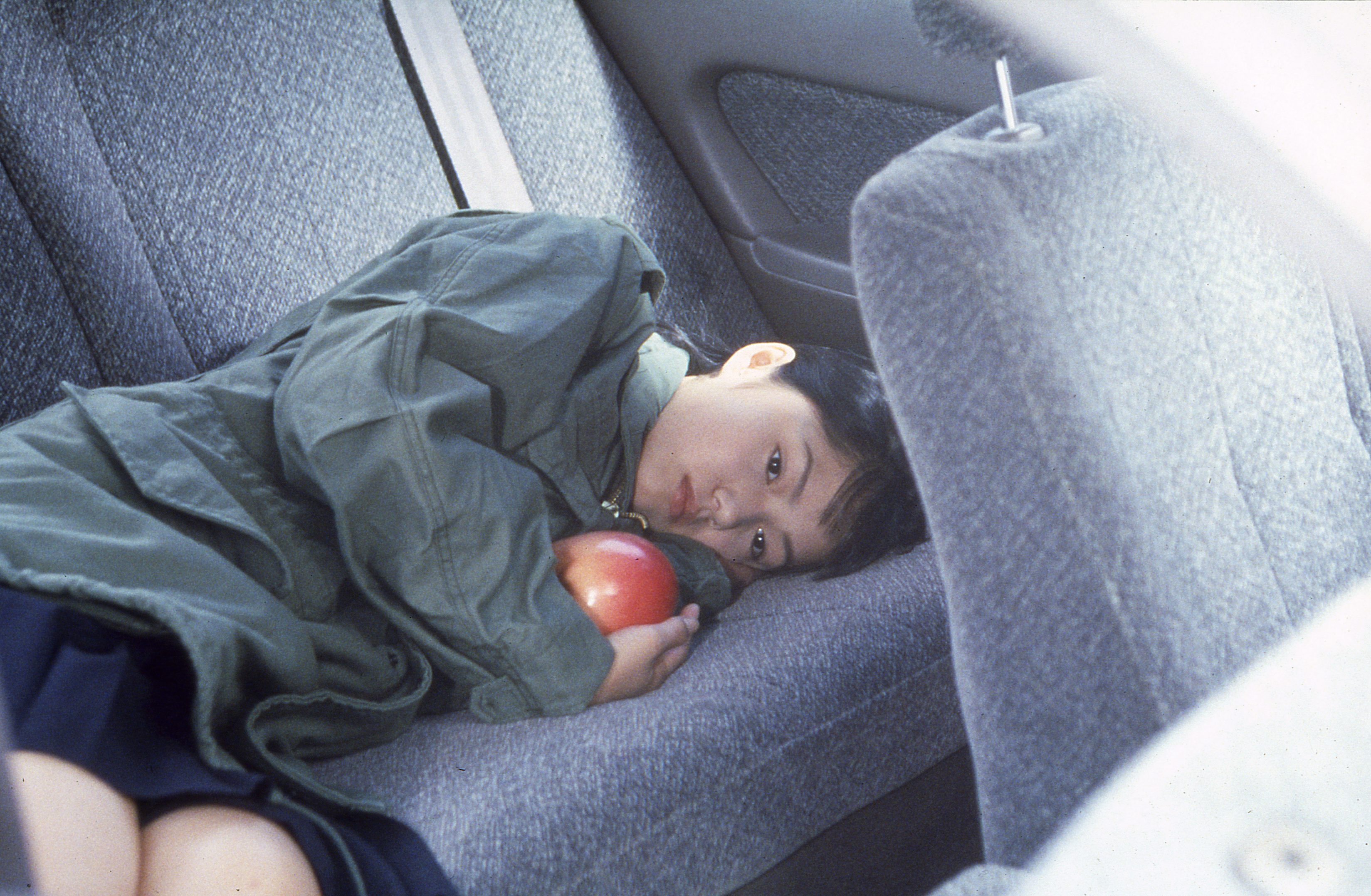
“We’re only in seventh grade, why does Sachi have to suffer so much?” a well-meaning friend eventually asks as she comforts the heroine of Akihiko Shiota’s Harmful Insect (害虫, Gaichu), even as her mother turns away from her too fragile herself to be of much use. Sachiko (Aoi Miyazaki) does indeed suffer, continually victimised by the world in which she lives and having that victimisation used against her, rejected by her peers and almost blamed for the misfortunes which befall her as if she were the one at fault simply for existing. 

Shortly after the opening scene in which 13-year-old Sachiko’s mother (Ryo) attempts to take her own life, we see the girls at school gossiping about her while she’s still in earshot not entirely sympathetic as they remark on the fact her father left the family while implying that her mother is some kind of broken-hearted love fool driven to suicide over the loss of a man. Sachiko quickly becomes the woman of rumour, but in a motif which will be repeated the teens talk but never listen swapping stories between themselves and embellishing them as they go. It’s uncertain how much truth there is in the legend of Sachiko but it’s clear that they disapprove of her, adopting a puritanical moralising mindset in which they simply shun her for being something other. Only Natsuko (Yu Aoi) tries to stop them, reaching out to Sachiko even as Sachiko rejects her but is ultimately able to offer little help when even Sachiko’s mother is ill-equipped to protect her. 

The truth is that Sachiko is never safe anywhere. Everywhere she goes, she becomes a target for predatory men of all ages. A schoolboy on a bike harasses her by asking childish questions about her period, while sleazy salarymen repeatedly proposition her for sex, and even her mother’s new boyfriend in a doubly destructive act of betrayal cannot be trusted. She says little and keeps to herself, her silence and her isolation a kind of defiance and defence mechanism. After dropping out of school, she starts hanging around with a drop out 20-something (Tetsu Sawaki) and his homeless friend (Koji Ishikawa) who seems to have learning difficulties, discovering that they support themselves through staging accidents for compensation money. She considers doing the same thing, not for the money but craving the thrill of a near death experience only to find herself unable to go through with it. 

Meanwhile, she continues a letter-based correspondence with her former teacher with whom she is rumoured to have had an affair. Mr. Ogata (Seiichi Tanabe) later resigned for obvious reasons and now has a low-grade job at a nuclear plant. He answers her letters when he can, mostly offering paternalistic platitudes but like her absent parents is unable to provide her with the guidance she is seeking. What she seems to be looking for is the kind of parental input that would allow her to feel protected, safe, but no one is really there for her. She resents her mother’s emotional dependency and tendency to involve herself with unsuitable men, but worries she’s becoming the same striking out for an early independence but discovering only danger and futility. 

She asks herself if vice is the essence of human existence, then is goodness only the quality of not being entirely bad? Her view of the world already coloured with nihilistic despair. The men who misuse her feel they have no real need to justify their actions, but simultaneously blame her for tempting them though she does nothing other than exist remaining silent in order to avoid attracting attention. Then again even she doesn’t quite understand, asking her teacher why it is he can’t forgive himself simultaneously accepting that what happened between them, whatever that was, was wrong enough to warrant forgiveness but unable to grasp why he cannot let go of his guilt, continuing with this half-hearted correspondence unable to grant her the care that she is seeking. Wandering between flashbacks and brief vignettes of her life, Shiota captures Sachiko’s sense of total aloneness as even her sole source of sanctuary is taken from her leading to an explosive act of partially self-destructive violence that sends her forever on the run. The choice she makes at the film’s conclusion, be it in submission or defiance, is hers alone but in its own way a tragedy dragging her deeper into dangerous despair with escape an ever distant possibility.


Harmful Insect streams in the US until Dec. 23 as part of Japan Society New York’s Flash Forward series.

Original trailer (no subtitles)

Images: ©2002 NIKKATSU / TBS / SONY PCL

Fish Story (フィッシュストーリー, Yoshihiro Nakamura, 2009)

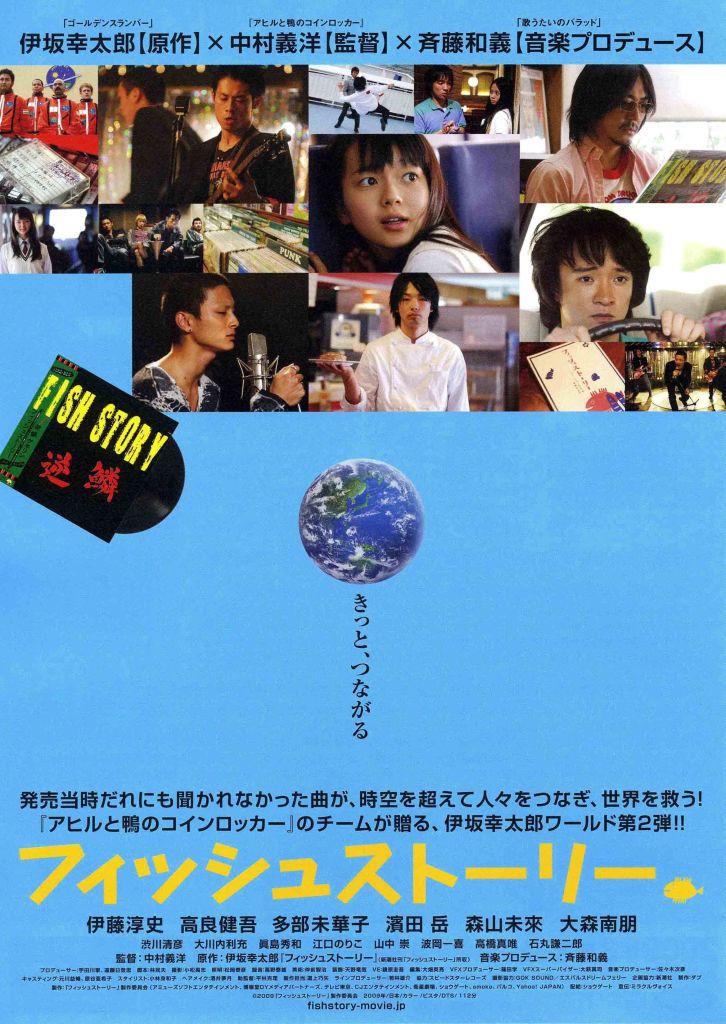
“Music saves the world” according to a hold out record store owner keeping the doors open in the wake of coming disaster. In one way or another and most particularly at the present time, perhaps it always feels as if the world is ending but somehow we seem to carry on. Yoshihiro Nakamura’s Fish Story (フィッシュストーリー) is, as it says, a story of how music saves the world, but also of how personal acts of quiet integrity echo through time while art finds its audience and its purpose in the proper moment even if the message is not immediately understood. 

The film opens in the “future” of 2012 during which a fiery comet is headed directly for the Earth resulting in a deadly tsunami set to engulf Mount Fuji, drowning humanity rendered unexpectedly powerless in the face of cosmic destiny. A man in a wheelchair dressed oddly like a cult leader trundles along empty arcades strewn with rubbish, pausing to poke at some trolleys with his walking stick. Eventually he stops outside a record store which is to his surprise open for business despite the coming apocalypse and jumps up, apparently able to walk after all, and heads inside where he takes the boss (Nao Omori) to task for his strange decision to go to work on this day of all days. The shopkeeper however calmly engages in conversation with a customer, sure that “music saves the world”, “this song will save the day”, introducing him to the music of little-known ‘70s punk band Gekirin whose music was too far ahead of its time for the conservative post-war society. 

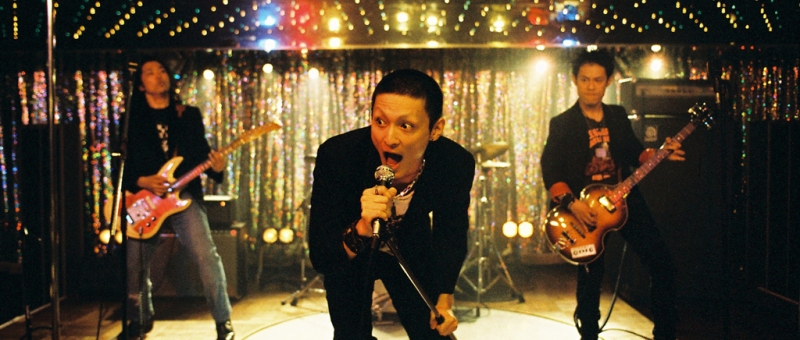
Their forgotten song, Fish Story, however as we will see does indeed change the world if in small and unexpected ways not least because it’s remembered for an unexpected pause in the middle of a guitar solo, a temporary suspension of living time in which small miracles could occur. “It has a meaning” the shopkeeper insists, though refusing to elaborate. As we discover, it does and it doesn’t, but stays true to the spirit of song, a “fish story” of its own embellished in the telling as curious listeners attempt to explain its existence. For three college students in 1982 who enjoy listening to paranormal tapes, it’s something of a let down seeing as they’d been told that the missing section contained a woman’s scream which is apparently still audible to those with a sixth sense but predictably not to them. Nevertheless, a moment of silence and a woman’s scream eventually result in a timid young man (Gaku Hamada) assuming his destiny, learning to stand up to bullies even if in eventual need of rescue himself. 

Like the young man of 1982, the shopkeeper and his customer are largely passive, sure that someone is coming to save them, idly talking of superheroes in teams of five like classic tokusatsu serial Go-rangers or else Bruce Willis saving the day by heroically sacrificing himself to blow up the asteroid. But the Americans’ “Armageddon” plan soon proves a bust, hinting perhaps at the fallacies of the disaster movie model in which the nation of production saves the world all on its own. The only possible hope now lies in cross-cultural cooperation. “Just as music knows no border, we’ve come together in this emergency” says the team of international experts boarding an Indian rocket as they pursue the only option left for the salvation of humanity no matter that there’s only a one in a million chance it works, because that’s what you do at the end of world, only what you can. 

The old man scoffs at the shopkeeper and his customer, sure the world is going to end even though he previously predicted it would do so 13 years previously in line with Nostradamus. Others concluded it would end in 2009 and took action accordingly, action which almost assures the present destruction in accidentally destroying the mind capable of preventing it. It is all connected, in a cosmic sense, but it’s also all small coincidences that lead to a greater whole. In the post-war chaos of 1953, a struggling father lies about his English skills to get a job as a “translator” only to engage in an avant-garde act of language violence bludgeoning one text into another with the aid of a dictionary. The incomprehensible novel which results is pulped, but survives as a curiosity and eventually finds its way home, inspiring another work of art and becoming a kind of fish story of its own. Gekirin chose to disband rather than compromise their artistic integrity, knowing that no one was going to hear their song. “Does that make everything we’ve done meaningless?” dejected bassist Shigeki (Atsushi Ito) asks, and perhaps it seems that way, but the word is heard in the end. It all matters, we all matter, no matter how insignificant it seems in the moment. 

Adapted from the novel by Kotaro Isaka, Nakamura’s anarchic voyage through a comfortable and nostalgic post-war Japan albeit one in the shadow of coming disaster is imbued with a quiet sense of hope even as it leaves its protagonists passive participants in a history they are unaware of making. Two teams of five do in their way save the world, and all because of a song that no one heard which was inspired by a book that no one read. Life, it’s all a big fish story, but it makes sense in the end so long as you stick around long enough. 


Fish Story is released on blu-ray & VOD in the UK on 10th August courtesy of Third Window Films. On disc extras are presented in standard definition and include: making of featurette, Gekirin live performances, Gekirin talk show, director and cast Q&A, and deleted scenes.

Original trailer (English subtitles)

Fullmetal Alchemist (鋼の錬金術師, Fumihiko Sori, 2017)

Fullmetal Alchemist posterEvery so often a film comes along which makes you question everything you thought you knew. Fullmetal Alchemist (鋼の錬金術師, Hagane no Renkinjutsushi) is just such as film but less for the philosophical questions fans of the source manga may have been expecting, than for the frankly incomprehensible fact that it exists at all. Produced not by a major studio but by Square Enix – best known as a video game studio but also the publisher of manga magazine Monthly Shonen Gangan in which the series was originally serialised, and effects studio Oxybot Inc., Fullmetal Alchemist is not the big budget extravaganza a franchise of this size might be expected to generate but a cut price blockbuster attempting to pack a much loved, long running saga into just over two hours.

For the uninitiated, the movie begins with the little Elric Brothers – Ed and Al, who live in the countryside with their doting mother while their father is away. When their mother is struck down by a sudden illness and dies, the boys raid their dad’s Alchemy library for clues as to how to bring her back. There is, however, a taboo surrounding human transmutation and when the brothers cast their spell they pay a heavy price – Al loses his entire body though Ed manages to save his soul and bind it to a suit of armour by sacrificing his own right arm.

Many years later, Ed (Ryosuke Yamada) and Al (Atomu Mizuishi) are still looking for the mythical “Philosopher’s Stone” which they believe will allow them to cast another spell and get their fleshy bodies fully restored. This takes them to a small town where they encounter a dodgy priest and their old commander, Captain Roy Mustang (Dean Fujioka), who wants to bring them back into the State Alchemist fold. The priest’s stone turns out to be a fake though his connections to the film’s shady antagonists are all too real, and the brothers are soon faced with another dilemma in their quest to restore all they’ve lost.

Sori shifts away from the frozen Northern European atmosphere of the manga for something sunnier and less austere, shooting in Italy’s Volterra with its narrow medieval streets and iconic Tuscan red roofs. He is, however, working on a budget and it shows as his cast are costumed at cosplay level with awkward blond wigs attempting to recreate the manga’s European aesthetics. Al, rendered entirely (and expensively) in CGI, is deliberately kept off screen while the quality of the effects often leaves much to be desired.

Al’s frequent absence is a major problem seeing as the series’ major theme is brotherhood and Ed’s tremendous sense of guilt over his brother’s condition coupled with his recklessness in his need to put things right is only explained in a piece of bald exposition following a fight between the pair after Al’s mind has been corrupted by a mad scientist who implied that he may not really be “real” after all. While Al’s false memory paranoia may be among the more interesting issues the film attempts to raise, it’s quickly pushed into the background, eclipsed by the ongoing conspiracy narrative which places the Elric Brothers in a difficult position regarding their need to get their body parts back. 

A symptom of the attempt to condense such a much loved and well known manga into a two hour movie, there is rather a lot of plot going on and numerous side characters on hand to enact it. Though fans of the original manga may be pleased to see their favourite characters have made it into the movie, they maybe less pleased about how one note they often are or the various ways their personalities have needed to shift in order to fit into the new narrative arcs the film employs. Aside from the young and pretty cast, Fullmetal Alchemist also finds room for a host of veteran talent from the ubiquitous Jun Kunimura in a small role to Yo Oizumi turning villainous and Fumiyo Kohinata at his most Machiavellian.

Extremely silly, poorly put together and burdened with some very unfortunate wigs, the Fullmetal Alchemist live action adaptation is as much of a misfire as it’s possible to be but viewers hoping for a continuation to the tale would do well to stay tuned for a post-credits sting strongly hinting at a part two.


Streaming worldwide on Netflix.

Original trailer (English subtitles)

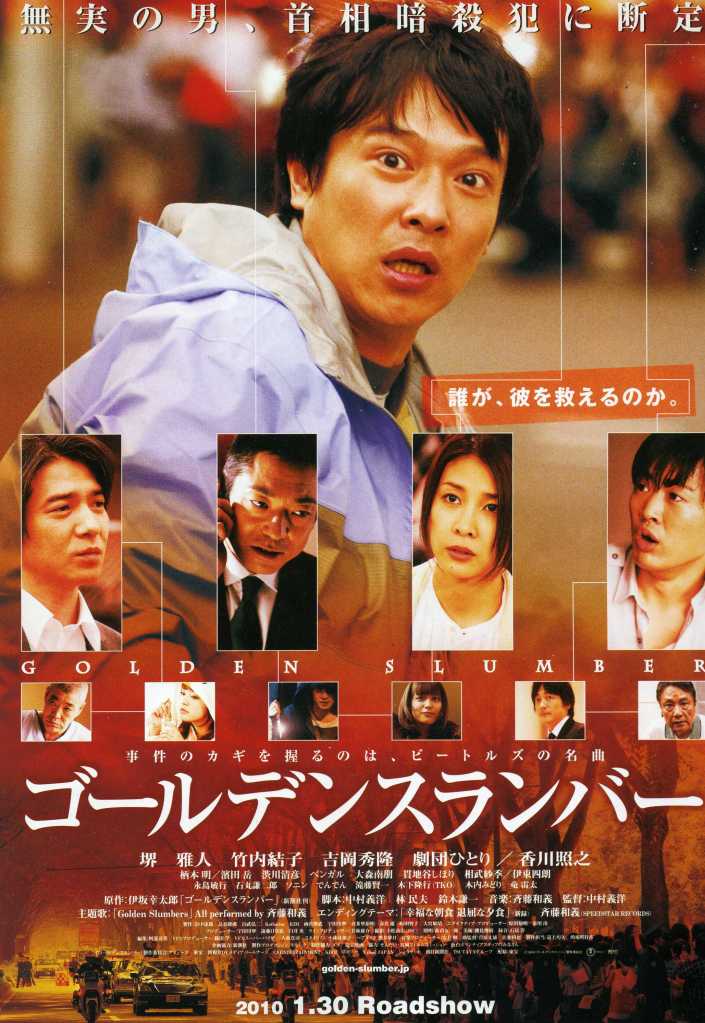
Golden Slumber (ゴールデンスランバー, Yoshihiro Nakamura, 2010)

golden-slumberYoshihiro Nakamura has made a name for himself as a master of fiendishly intricate, warm and quirky mysteries in which seemingly random events each radiate out from a single interconnected focus point. Golden Slumber (ゴールデンスランバー), like The Foreign Duck, the Native Duck and God in a Coin Locker, and Fish Story, is based on a novel by Kotaro Isaka and shares something of the same structure but is far less interested in the mystery itself rather than the man who finds himself caught up in it.
30 year old delivery driver Aoyagi (Masato Sakai) is all set for a nice day out fishing with an old college buddy, Morita (Hidetaka Yoshioka), but he’s about to discover that it’s he’s been hooked and reeled in as the patsy in someone else’s elaborate assassination plot. After grabbing some fast food, Morita takes Aoyagi to a parked car near the closed off area through which the Prime Minster is due to be paraded in an open topped car. Waking up after a brief period of drug induced sedation, Aoyagi is made aware that this has all been a trick – badly in debt thanks to his wife’s pachinko addiction, Morita has betrayed him to a set of undisclosed bad guys with unclear motives and is taking this brief opportunity to give him as much warning as he can. Sure enough, a bomb goes off at the parade and Aoyagi just manages to escape before Morita too is the victim of an explosion.

Aoyagi is now very confused and on the run. Inexplicably, the police seem to have CCTV footage of him in places he’s never been and doing things he’s never done. If he’s going to survive any of this, he’s going to need some help but caught between old friends and new, trust has just become his most valuable commodity.

At heart, Golden Slumber is a classic Wrong Man narrative yet it refuses to follow the well trodden formula in that it isn’t so much interested in restoring the protagonist to his former life unblemished as it is in giving him a new one. The well known Beatles song Golden Slumber which runs throughout the film plays into its neatly nostalgic atmosphere as each of the now 30 year old college friends find themselves looking back into those care free, joyous days before of the enormity of their adult responsibilities took hold. That is to say, aside from Aoyagi himself who seems to have been muddling along amiably before all of this happened to him, unmarried and working a dead end delivery job.

As Morita tells him in the car, it’s all about image. The nature of the conspiracy and the identity of the perpetrators is not the main the main thrust of the film, but the only possible motive suggested for why Aoyagi has been chosen stems back to his unexpected fifteen minutes of fame two years previously when he saved a pop idol from an intruder with a nifty judo move (taught to him by Morita in uni) after fortuitously arriving with a delivery. Those behind the conspiracy intend to harness his still vaguely current profile to grab even more media attention with a local hero turned national villain spin. The Prime Minister, it seems, was a constantly controversial, extreme right wing demagogue with a tendency for making off the cuff offensive statements so there are those who’d rather congratulate Aoyagi than bring him to justice, but anyone who’s ever met him knows none of this can really be true despite the overwhelming video evidence.

Throughout his long odyssey looking for “the way back home” as the song puts it, Aoyagi begins to remember relevant episodes from his life which may feed back into his current circumstances. Although it seems as if Aoyagi had not seen Morita in some time (he knew nothing of his family circumstances, for example) his college friends with whom he wasted time “reviewing” junk food restaurants and chatting about conspiracy theories are still the most important people in his life. Not least among them is former girlfriend Haruko (Yuko Takeuchi), now married and the mother of a little daughter, who seems to still be carrying a torch for her old flame and is willing to go to great lengths to help him in his current predicament.

The film seems mixed on whether these hazy college days are the “golden slumber”, a beautiful dream time enhanced by memory to which it is not possible to return, or whether it refers to Aoyagi’s post college life which impinges on the narrative only slightly when he asks an unreliable colleague for help, aside from an accidental moment of heroic celebrity. It could even refer to the film’s conclusion which, departing from the genre norms, resolves almost nothing save for the hero’s neat evasion of the trap (aided by the vexed conspirators who eventually opt for a plan B). Once there might have been a road home – a way back to the past and the renewing of old friendships, but this road seems closed now, severed by the new beginning promised to Aoyagi who has been robbed of his entire identity and all but the memory of his past. Whether this means that the golden slumber has ended and Aoyagi, along with each of the other nostalgia bound protagonists, must now wake up and start living the life he’s been given, or that the old Aoyagi has been consigned to the realm of golden slumbers, may be a matter for debate.

Though the resolution may appear ultimately unsatisfying, the preceding events provide just enough interconnected absurdity to guide it through. During his long journey, Aoyagi is aided not just by his old friends but new ones too including a very strange young serial killer (Gaku Hamada) and a hospital malingerer with one foot in the “underworld” (Akira Emoto). It speaks to Aoyagi’s character that all of those who know him trust him implicitly and are ready to help without even being asked (even if they occasionally waver under pressure), and even those who are meeting him for the first time are compelled to come to his defence.  An elliptical, roundabout tale of the weight of nostalgia and inescapability of regret, Golden Slumber is the story of a man on the run from his future which eventually becomes a net he cannot escape.


Original trailer (English subtitles – select via menu)

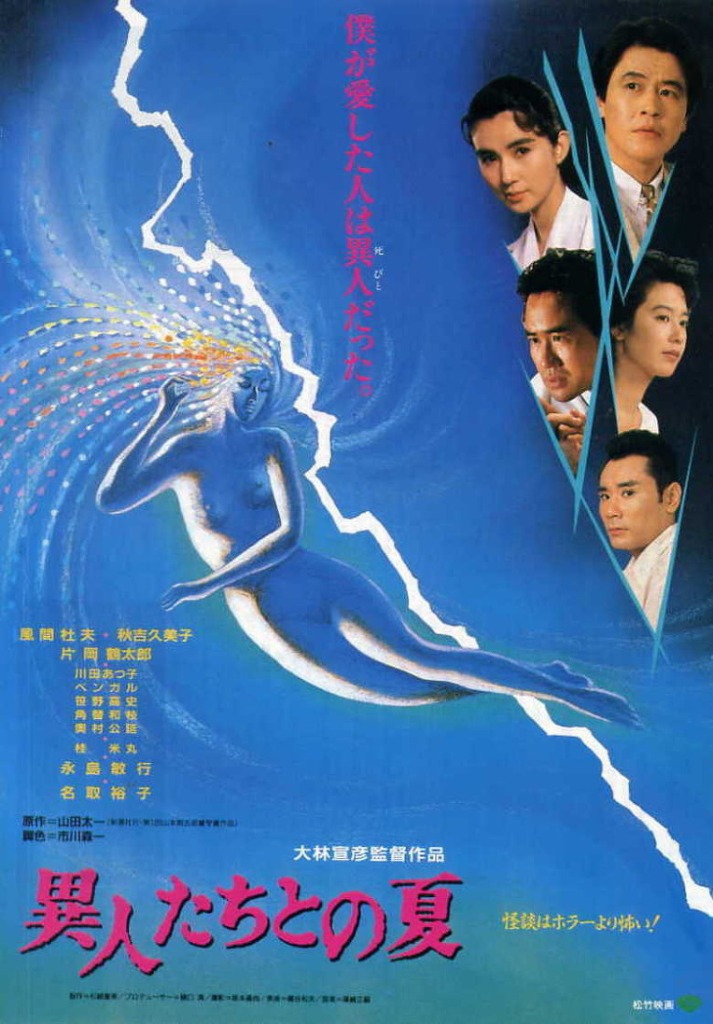
The Discarnates (異人たちとの夏, Nobuhiko Obayashi, 1988)

discarnatesNobuhiko Obayashi is no stranger to a ghost story whether literal or figural but never has his pre-occupation with being pre-occupied about the past been more delicately expressed than in his 1988 horror-tinged supernatural adventure, The Discarnates (異人たちとの夏, Ijintachi to no Natsu). Nostalgia is a central pillar of Obayashi’s world, as drenched in melancholy as it often is, but it can also be pernicious – an anchor which pins a person in a certain spot and forever impedes their progress.

Hidemi Harada (Morio Kazama) is a successful TV scriptwriter whose career is on the slide. He’s just gotten a divorce and seems to be conflicted about the nature of his new found bachelordom. As if he didn’t have enough despair in his life, the closest thing he has to a friend – his boss at the TV station, tells him he thinks it’s better if they end their professional relationship because he plans to start dating Harada’s ex-wife and it would all get very awkward.

Feeling unloved, Harada takes a trip to his hometown on a location scout for another project and takes in a few familiar sights along the way. It’s here that he runs into a youngish man who looks just like Harada’s father did when he was a boy. Not only that, accompanying his new found friend home, the man’s wife looks just like his mother, but Harada’s parents died when he was just twelve years old. The mysterious couple are glad to have him in their house and treat him with the warmth and kindness that seemed to have been missing in his life, leaving him the happiest and most cheerful he’s been in years.

Now in a much better mood, Harada feels guilty about rudely dismissing the woman from upstairs who’d come to visit him the day before. Apologising, Harada strikes up a friendship and then a romance with the equally damaged Kei (Yuko Natori) but even if his mental health is improving, his physical strength begins to deteriorate. Looking pale and old, Harada’s teeth rot and fall out while his hair loses its color. Even so, Harada cannot bear to pull himself away from the warmth and security that was so cruelly taken away from him when he was just a child.

Harada doesn’t start off believing that the mysterious couple really are his late parents, but if even if they weren’t these two people who are actually younger than him take him in as a son, feeding and entertaining him. When Harada returns a little while later confused by what exactly has happened, his mother immediately treats him as a mother would – physically taking off his polo shirt and urging him to remove his trousers lest they get wrinkled from sitting on the floor. Having lost his parents at such a young age, Harada has been a adrift all his life, unable to form true, lasting emotional bonds with other people. Lamenting his failure as a husband and a father, this very ordinary kindness provides the kind of warmth that he’s been craving.

However, there is always a price to be paid. Harada’s visits become increasing tiring, taking a physical toll on his ageing body. Each hour spent in the past is an hour lost to the dead. His parents are both dead and alive, existing in a strange, golden hued bubble filled with the comforting innocence of childhood free from the concerns of the adult world. Yet each time Harada succumbs to his weakness and goes to visit them, he is doing so as a way of avoiding all of his real world problems. According to one of Harada’s scripts, the past becomes a part of you and is never lost, but memory can be an overly seductive drug and an overdose can prove fatal.

Contrasted with the warm glow of the post-war world of Harada’s childhood home, his life in bubble era Tokyo is one filled with blues and a constant sense of the sinister. Harada believes himself to mostly be alone in the apartment block save for a mysterious third floor light that hints at another resident who also favours late nights over early mornings. The light turns out to belong to a lonely middle-aged woman, Kei, who is also a fan of Harada’s work. Kei has her own set of problems including a wound on her chest that she is too ashamed to let anyone see. Ultimately, Harada’s self-centred inability to lay the past to rest and fully take other people’s feelings into account will deal Kei a cruel blow.

Harada sees everything with a writer’s eye. His childhood world is a dream, but his life is a film noir filled with shadows and misery. His environments appear too perfectly composed, like a TV stage set and, as if to underline the fact, at the end of each “scene” the colour drains from the screen to leave a blue tinted black and white image shrinking into a rectangle and disappearing like the dot going out in the days when television really did close down overnight. Whether any of this happened outside of Harada’s mind or reflects a constructed reality he wrote for himself in the midst of a mental breakdown, his dilemma is an existential one – return to childhood and the side of his parents by accepting the death of his present self, or say goodbye to remnants of the abandoned child inside him and start living an adult, fully “fleshed” life by killing off this unattainable dream of a long forgotten past which never took place.

Filled with melancholy, longing and regret, The Discarnates is the story of a hollow man made whole by coming to terms with his traumatic past and all of the ways it’s influenced the way in which he’s lived his life. Harada’s parents treat him as their twelve year old son, barely acknowledging that he’s a middle aged man with a teenage son of his own. They feel regret for all of the thousand things they were never able to teach him though they are unable to see the full depths of his inability to escape his interior bubble for the wider world. Unsettling, though not as obviously surreal as some of Obayashi’s other efforts, The Discarnates is one of his most melancholic works speaking of the danger of nostalgia and all of its false promises whilst also acknowledging its seductive appeal.


Original trailer (no subtitles)

Lost Paradise (失楽園, Yoshimitsu Morita, 1997)

lost paradiseYoshitmitsu Morita tackled many different genres during his extremely varied career taking in everything from absurd social satire to teen idol vehicles and high art films. 1997’s Lost Paradise (失楽園, Shitsurakuen) again finds him in the art house realm as he prepares a tastefully erotic exploration of middle aged amour fou. Based on the bestselling novel by Junichi Watanabe, Lost Paradise also became a breakout box office hit as audiences were drawn by the tragic tale of doomed late love frustrated by societal expectations.

We meet Kuki (Koji Yakusho) and Rinko (Hitomi Kuroki) about to bid each other goodbye for the day, playfully in love though perhaps self conscious. It’s not until later that we realise they are both already married – just not to each other. Kuki, 50 years old, has reached an impasse in his life. Effectively demoted and sidelined at work, his homelife is not exactly unhappy but has long since lost his interest. His daughter is grown up and married herself, his wife has a career of her own, his mortgage is already paid off. There is really nothing left for him to do. That is until he meets calligraphy teacher Rinko and falls passionately in love for the first time in his life.

Rinko, 38, entered into an arranged marriage at 25 though the kindest way of describing it would be “unfulfilling”. Haruhiko (Toshio Shiba), her husband, is a doctor by profession and cuts a cold and distant figure. Prone to violent outbursts and pettiness, he treats Rinko more as a house keeper than a wife ordering her to buy his favourite kind of cheese (even urging her to travel to a different shop if the first one doesn’t have it) but then not even looking up when she brings it into his study for him. Lasciviously poking a spoon into the soupy mess, he pauses only briefly after savouring his first taste to give Rinko her next set of orders with no word of thanks or even acknowledgement of her success in obtaining this oddly specific cheese related request.

Finally in each other Rinko and Kuki find completeness long after they’d stopped seeking it. Rinko is unhappy in an arranged marriage which offers scant comfort, though Kuki’s problems are more akin to a mid life crisis as he finds himself an unnecessary presence at home whilst also realising that he’s already passed the high point of his career. Though there are no real barriers to Rinko and Kuki simply leaving their spouses and starting again together, it’s never quite that simple as the social stigma of an extra-marital affair continues to undermine their new found romance.

As in many of Morita’s films, the overall tone is one of pessimism as Rinko and Kuki face opposition from all sides whilst falling ever deeper into a whirlwind of self destructive passion. Rinko confides in a recently divorced friend who has guessed her secret and urges her to try and be happy, but Kuki keeps matters to himself whilst listening to the romantic problems of his workmates many of whom state that they too would like to fall madly in love, just once. When one of Kuki’s most valued colleagues falls ill, he laments having lived his life in the straightforward way expected by society. He’s done everything right – spent all his time working hard, built a career which was about to go south anyway. If all that happens is that you get old and die what was it all for – perhaps you’re better off just doing as you please, social expectations be damned.

Eventually the pair get an apartment and indulge in some part-time domesticity though an ill thought out blackmail plot soon changes things for both of them. Haruhiko refuses to divorce Rinko but Kuki’s wife is more sympathetic and open to the idea of sorting things out as quickly as possible. Though he suffers in other ways, Kuki finds it easier to accept the idea of moving on than Rinko who also faces opposition from her own mother who brands her as immoral and someone to be pitied for having given in to weakness and allowed her baser instincts to take over. Soon the couple find themselves thinking about a way to be together for eternity even if it lies in another world than this one.

Likened to the famous case of Sada Abe (also the inspiration for Oshima’s In the Realm of the Senses), Rinko and Kuki are consumed by their own passion and ultimately unable to continue living outside it. Morita opts for an artful aesthetic and keeps his eroticism on the classy side rather than descending into exploitation or salaciousness. Making use of frequent handheld camera and odd angles to bring out the giddy, unbalanced mindset of the central couple Morita also experiments with colour often cutting to black and white or sepia mid-scene. The tragedy of this love story is that it occurs at a societally inconvenient time – there is nothing wrong in Rinko and Kuki’s romance save that it started after they were already married to other people. This may not seem such a great problem but in a society which demands conformity and adherence to its rules, those who break them must be prepared to pay a heavy price. Perhaps the last words ought to belong to Kuki’s poetic friend who points out that life if short and rarely rewards those who play by the rules, it may be better to burn out brightly rather than flicker away for an eternity.


Original trailer (no subs)