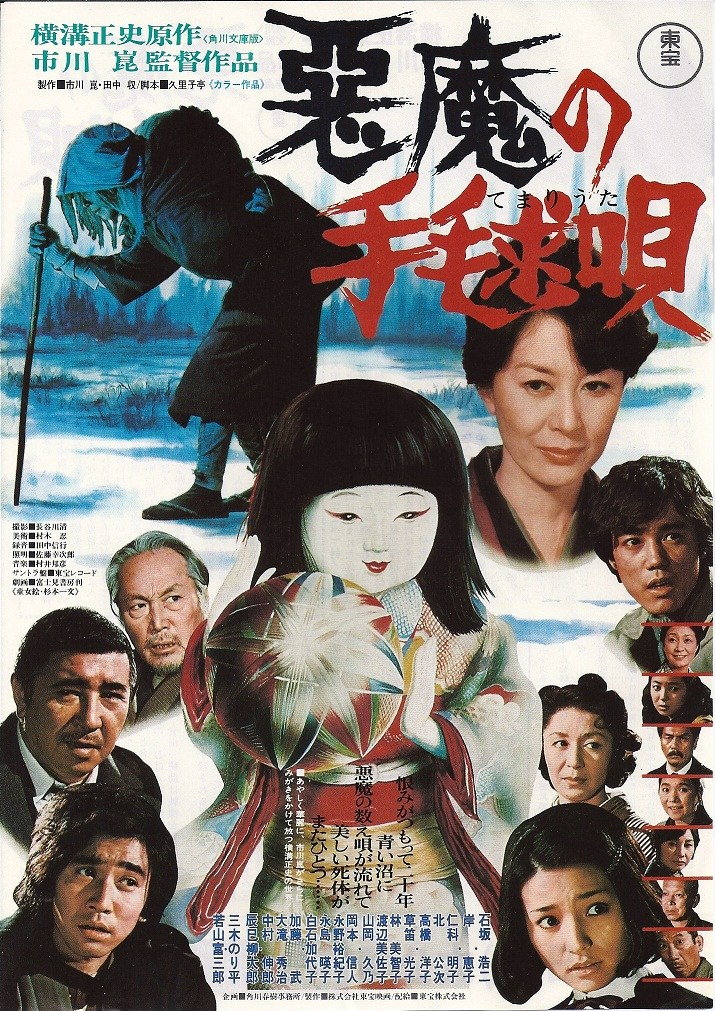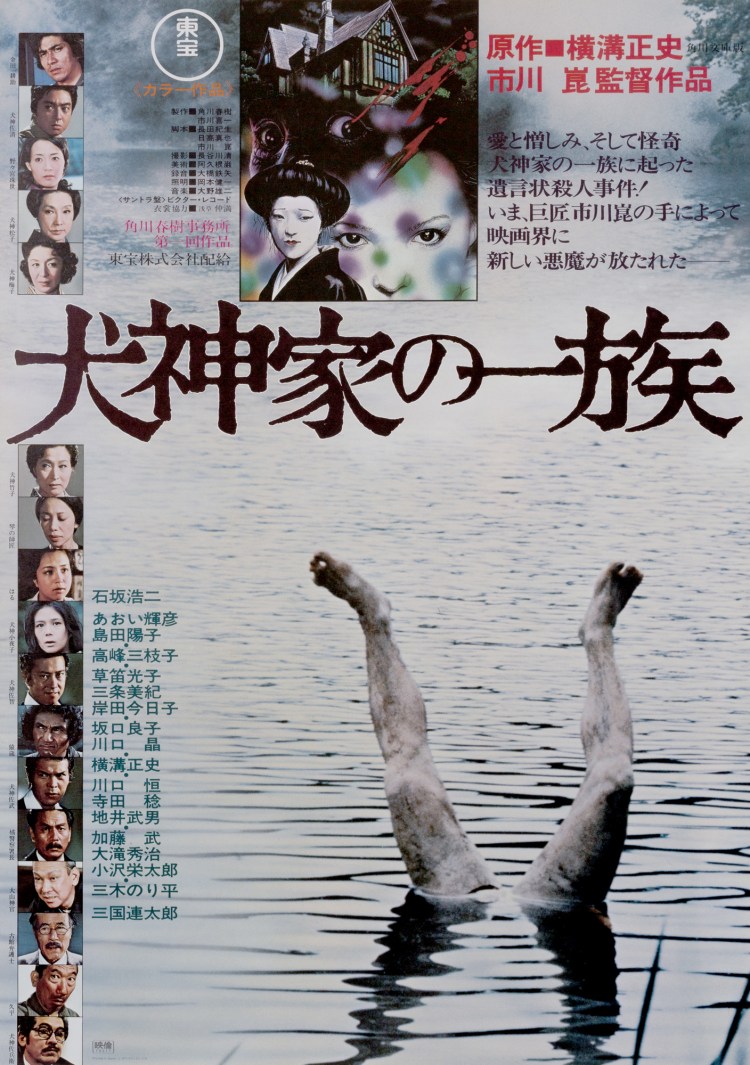
The Devil’s Ballad (悪魔の手毬唄, Kon Ichikawa, 1977)

Devil's Ballad posterA year after his box office smash The Inugami Family, Kon Ichikawa returns to the world of eccentric detective Kosuke Kindaichi with The Devil’s Ballad (悪魔の手毬唄, Akuma no Temari Uta). Like many a Kindaichi mystery, Devil’s Ballad finds him called upon to delve back into the past to satisfy an ageing detective’s anxiety about an old case, only to be faced with a series of new ones as a consequence. This time, however, the mystery leans less on buried secrets than deeply held grudges, betrayals, and lingering feudal feuds as the post-war society tries and fails to free itself from ancient oppressions.

The film opens with a tryst between two adolescent lovers in the ominously named “Devil’s Skull Village” in 1950. Yasu (Yoko Takahashi), the girl, is at pains to let her boyfriend, Kanao (Koji Kita), know that she is keen to take the relationship to the next level but he is old fashioned and wants to wait until their union is formalised. The pair are interrupted by some of their friends who are in the middle of planning a celebration for a visit from a girl who moved to the city, Chie (Akiko Nishina). Meanwhile, Kindaichi (Koji Ishizaka) has arrived at the inn owned by Kanao’s mother Rika (Keiko Kishi) on invitation from a retired policeman, Isokawa (Tomisaburo Wakayama), who wants Kindaichi to look into the murder of Rika’s husband twenty years ago. Isokawa, then a young rookie, is convinced that Rika’s husband was not the victim but the murderer and the corpse actually belonged to another man entirely – Onda, a drifter who defrauded half the village with a wreath making scam.

Rika and her children – 20-year-old Kanao and his younger sister Satoko (Eiko Nagashima) who has prominent facial birthmarks and rarely leaves the house, came to the village with her husband and are therefore slightly divorced from the longstanding social rivalries. The village has two noble families – the Yuras and the Nires. Feeling the need to modernise, the Nires bet everything on vineyards and it paid off. The Yuras, by contrast, were defrauded by Onda’s wreath scam and lost their fortune and social standing. Yasu, Kanao’s girlfriend, is a daughter of the Yuras, but the Nire’s have been petitioning Rika for quite some time to have her son marry their daughter, Fumiko (Yukiko Nagano), who also has a crush on him (though this is largely irrelevant to her father’s dynastic ambitions). When the younger generation start getting bumped off in ways eerily similar to a local folk song, Kindaichi and Isokawa are on the case, wondering if these new murders have anything to do with their old one.

Despite its 1950 setting, Devil’s Ballad is unusual in resolutely making an irrelevance of the war which only receives a brief mention as an explanation for why some of the case files have been destroyed and for why marriage is such a hot button issue given the lack of men and abundance of women. Nevertheless, the crimes span a turbulent 20 years of Japanese history with the original murder taking place in the early ‘30s during a period of economic instability following the Manchurian Incident. In the socially conservative pre-war era, it seems Onda also got around and may have fathered several illegitimate children with women in the village, some of them noble, some not. These buried secrets seem primed to bubble to the surface now that the children are coming of age and marriage again becomes an issue as worried parents try to think of acceptable ways to block potentially “inappropriate” matches without sending their children off into ruinous elopements or tipping off the wrong people that their kids may not be their kids.

The crimes themselves, old fashioned as they are, are partly reactions to a changing society. We discover that the reason Rika and her husband were forced to come back to the village was that their showbiz careers were stalling – she was a vaudeville performer specialising in shamisen, and he a “benshi” (narrator of silent films) who became convinced his job was obsolete after witnessing a subtitled print of Morocco. Likewise, the two rival families cannot let go of their petty provincial privileges, and as Kanao angrily snaps back at his mother, Japan is now a democratic country and he is free to choose his own wife at a time of his own choosing with or without parental blessing. This remote village is perhaps isolated from the privations of the post-war world but it’s also stuck in the past, hung up on past transgressions and unable to move forward into the new era. However, the primary motivations for murder are as old as time – guilt, humiliation, and self preservation.

Ichikawa keeps things simple but splices in a few strange, avant-garde sequences of kokeshi dolls menacingly bouncing balls coupled with shifts to black and white, fast-paced reaction shots, and stuttering still frame sequences all while Kindaichi showers innocent passersby with his famous dandruff, the idiot police officer continues to offer ridiculous theories while his sergeant dutifully follows him around, and the local bobby perfects a line in hilarious pratfalls. Overlong at two and a half hours and falling prey to the curse of the prestige crime drama in spoiling its mystery through casting, the Devil’s Ballad may not be the best of the Kindaichi mysteries but offers enough of a satisfying twist to prove worthy of the Kindaichi name.


Original trailer (no subtitles)

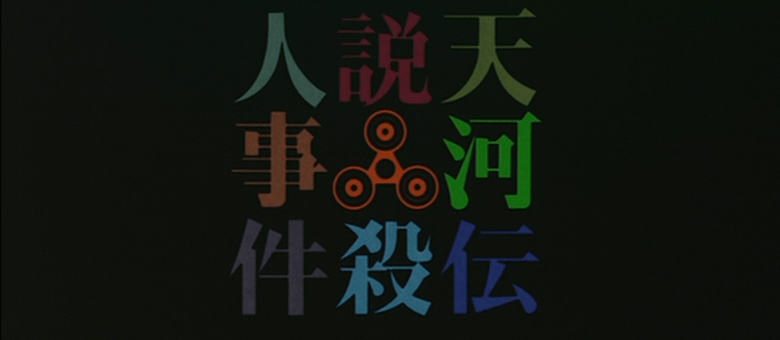
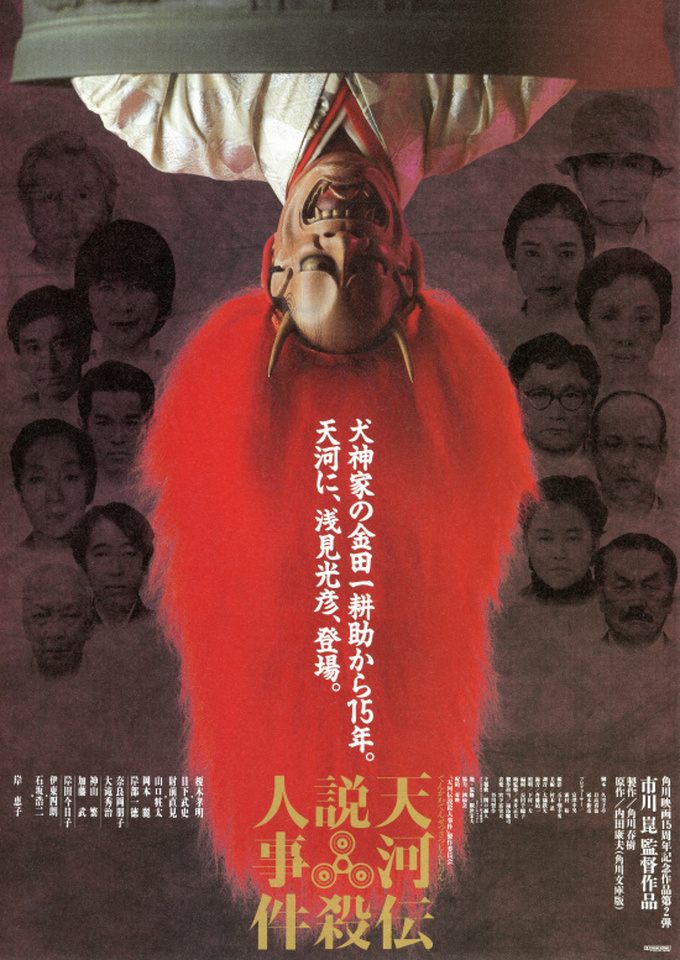
Noh Mask Murders (天河伝説殺人事件, Kon Ichikawa, 1991)

noh mask murders posterFor one reason or another, Japanese mystery novels have yet to achieve the impact recently afforded to their Scandinavian brethren. Japan does however have a long and distinguished history of detective fiction and a number of distinctive, eccentric sleuths echoing the European classics. Mitsuhiko Asami is just one among many of Japan’s not quite normal investigators, and though Noh Mask Murders (天河伝説殺人事件, Tenkawa Densetsu Satsujin Jiken) is technically the 23rd in the Asami series, Kon Ichikawa’s adaptation sets itself up as the very first Asami case file and as something close to an origin story.

Ichikawa, though he may be best remembered for his ‘60s arthouse masterpieces, was able to go on filmmaking where others perhaps were not precisely because of his forays into the populist with a series of mystery thrillers including several featuring top Japanese detective Kindaichi (who receives brief name check in Noh Mask Murders). Published by Kadokawa, Noh Mask Murders is produced by Haruki Kadokawa towards the end of his populist heyday and features many of the hallmarks of a “Kadokawa” film but Ichikawa also takes the opportunity for a little formal experimentation to supplement what is perhaps a weaker locked room mystery.

Asami (Takaaki Enoki) begins with a voice over as four plot strands occur at the same temporal moment at different spaces across the city. In Shinjuku, a salaryman drops dead on the street, while a young couple enjoy a secret tryst in a secluded forest, a troupe of actors rehearse a noh play, and Asami himself is arrested by an officious policeman who notices him walking around with a dead bird in his hand and accuses him of poaching. As he will later prove, all of these moments are connected either by fate or coincidence but setting in motion a series of events which will eventually claim a few more lives before its sorry conclusion.

To begin with Asami, he is a slightly strange and ethereal man from an elite background who has been content to drift aimlessly through life to the consternation of his conservative family which includes a police chief brother. He harbours no particular desire to become a detective and is originally irritated by a family friend’s attempts to foist a job on him but gives in when he learns he will have the opportunity to visit Tenkawa which is where, he’s been told, the mysterious woman who helped him out with the policeman in the opening sequence keeps an inn. Hoping to learn more about her, he agrees to write a book about the history of Noh and then becomes embroiled in a second murder which links back to the Mizugami Noh Family which is currently facing a succession crisis as the grandfather finds himself torn over choosing his heir – he wants to choose his granddaughter Hidemi (Naomi Zaizen) who is the better performer but the troupe has never had a female leader and there are other reasons which push him towards picking his grandson, Kazutaka (Shota Yamaguchi).

As with almost all Japanese mysteries, the solution depends on a secret and the possibilities of blackmail and/or potential scandal. The mechanics of murders themselves (save perhaps the first one) are not particularly difficult to figure out and the identity of the killer almost certainly obvious to those who count themselves mystery fans though there are a few red herrings thrown in including a very “obvious” suspect presented early on who turns out to be entirely incidental.

Ichikawa attempts to reinforce the everything is connected moral of the story through an innovative and deliberately disorientating cross cutting technique which begins in the prologue as Ichikawa allows the conversations between the grandchildren to bleed into those of Asami and his friend as if they were in direct dialogue with each other. He foregrounds a sad story of persistent female subjugation and undue reliance on superstition and tradition which is indirectly to blame for the events which come to pass. Everyone regrets the past, and after a little murder begins to see things more clearly in acknowledging the wickedness of their own actions as well as their own sense of guilt and complicity. Noh is, apparently, like a marriage, a matter of mutual responsibility, fostering understanding between people and so, apparently is murder, and one way or another Asami seems to have found his calling.


Alone Across the Pacific (太平洋ひとりぼっち, Kon Ichikawa, 1963)

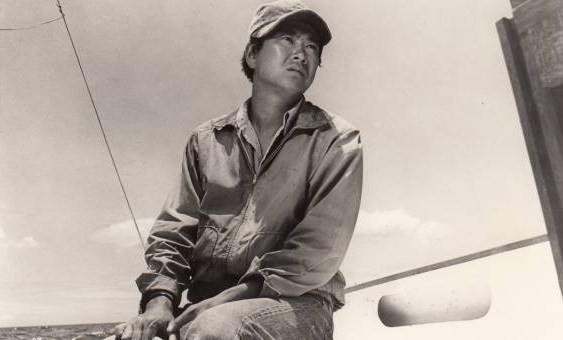
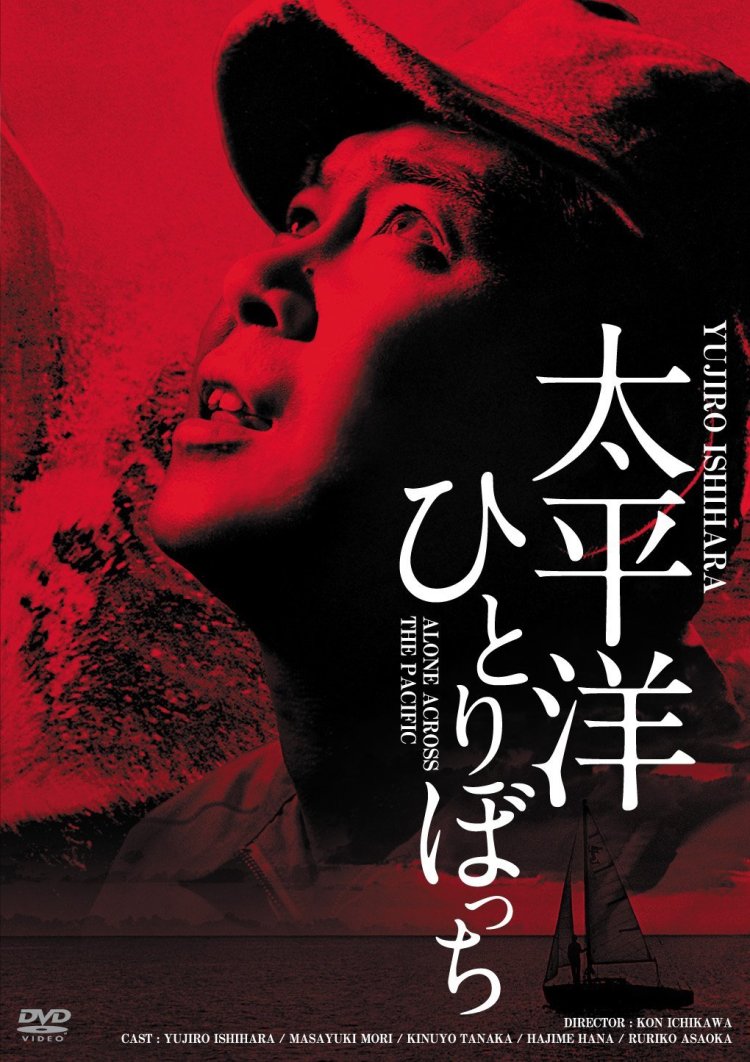
Alone Across the PacficKon Ichikawa made two sorts of movies – the funny ones and the not so funny ones. Despite the seriousness of the title, Alone Across the Pacific (太平洋ひとりぼっち, Taiheiyo hitori-botchi) is one of the funny ones. Like many of Ichikawa’s heroes, Horie is a man who defies convention and longs for escape from the constraining forces of his society yet is unable to fully detach himself from its cultural norms. Based on the real life travelogue of solo sailor Kenichi Horie, Alone Across the Pacific is less the story of a man battling the elements, than a cheerful tale of a man battling himself in a floating isolation tank bound for the “land of the free”.

Kenichi (Yujiro Ishihara) is a strange man. He has few friends (aside from the family dog, Pearl) and is obsessed with the idea of running away to sea. Inspired by the tales of other intrepid sailors, his dream is to sail all alone across the Pacific Ocean from Osaka to San Fransisco. Despite the fact that it is illegal for small boats to leave Japanese waters (and that he is too impatient to wait for his passport to come through), Kenichi has custom made his own yacht, one without an engine, and has set off on his longed for voyage under the cover of darkness.

Rather than filming Kenichi’s journey naturalistically, Ichikawa opts for an adventurer’s tale as Kenichi provides an ironic voice over detailing some of his naive failings as a rookie sailor undertaking such a daunting mission. Each of Kenichi’s crises links back to a memory from his shore life, reminding us why he’s on this journey in the first place. Kenichi’s struggles are the same as many a young man in post-war Japan and, in fact, many of those previously played by the poster boy for youthful rebellion, Yujiro Ishihara.  Unwilling to live a life hemmed in by the predetermined path of a job for life, wife, children and total social conformity, Kenichi longs to be free of his cultural baggage by abandoning his civility during a long process of isolation therapy free of overbearing fathers, fretting mothers, indifferent sisters and a generally noisy world.

Kenichi’s father (Masayuki Mori) is the very personification of authority, berating his son for his fecklessness and pointless obsession with sailing – a sport a working class boy like Kenichi can barely afford. Kenichi’s determination to achieve his goal sees him leave school early, take a job in his father’s workshop only to quit suddenly for a more lucrative one delivering luggage for a travel agents, and quitting that too to work full time on his boat. While his father huffs and puffs his mother (Kinuyo Tanaka) worries, hoping her mad son won’t really go through with it but knowing that he will.

When Kenichi finally reaches San Fransisco, he’s assaulted by congratulatory voices from all directions. Towed into harbour by a motor boat, Kenichi first has to deal with mundane problems like the customs patrol wanting to know if he’s got any fruit left on the boat before a crowd gathers to shake his hand asking where he’s come from and why, what he wants to do now, and praising him for his daring feat of solo sailing glory. In Japan however, things are different. Dragged out for an interview by the press, Kenichi’s worried mother avows that she’s just happy to know her son is safe while his father bows deeply and reassures everyone that he will absolutely put a stop to any such random acts of individualism his wayward son may attempt in the future. 

Kenichi evades the twin pulls of his mother’s apron strings and his father’s handcuffs by taking off alone but even at sea he’s never free of his cultural programming, checking the wide empty ocean before removing his clothes and then stepping back down into the cabin to finish the job. Kenichi’s failure to acquire a passport is an ironic one seeing as part of what he’s running from is being Japanese but even as his quest is one for self determination it is also intensely selfish and self involved. In this Kenichi commits the ultimate act of individualism, caring nothing for the thoughts and feelings of others in the all encompassing need to achieve his goal. Kenichi may have found a home at sea, but on land he’s caged once again, a prisoner both of social conformity and his own need to defy it.


Available on R2 DVD from Eureka Masters of Cinema.

Original trailer (no subtitles)

Kokoro (こころ, Kon Ichikawa, 1955)

kokoro coverAmong the most well-regarded of his works, Natsume Soseki’s Kokoro (こころ) is a deeply felt mediation on guilt, repression, atonement, and despair as well as an examination of life on a temporal threshold. Kon Ichikawa’s long career would be marked by literary adaptations both of classics and genre fiction but even among these Kokoro is something of an exception, marshalling all of his skills bar his trademark irony in a melancholy tale of loneliness, self loathing, and the destructive effects self-destruction on those caught in the cross fire.

Ichikawa opens in media res as Nobuchi (Masayuki Mori) and his wife, Shizu (Michiyo Aratama), appear to have had an argument. She darns angrily while he paces and eventually seems to relent on his decision not to let her accompany him to the grave of a mutual friend, Kaji (Tatsuya Mihashi), who died when Nobuchi was still a student. Eventually Nobuchi goes alone but is disturbed in the graveyard by the approach of an enthusiastic young university student, Hioki (Shoji Yasui), who has been redirected by Shizu after turning up to ask to borrow some books. Nobuchi is not really in the mood to talk but the two men chat, eventually sharing a drink together in the local bar before Nobuchi abruptly returns home, pausing only to invite Hioki to visit another time for the books he wanted to borrow.

Though the marriage of Nobuchi and Shizu may seem to be a model one, their lives together are mostly performance. Nobuchi is a melancholy, gloomy man who does not work and lives the life of a scholar, living off family money. The household is not wealthy but they are able to afford one maid and live in reasonable comfort. They have no children and, it seems, the marriage may be one of companionship rather than passion.

On their first meeting Nobuchi refuses to tell Hioki the reason why he is the way he is, but decides he must explain and that Hioki is the only person he can unburden himself to. Badly let down by those who should have had his best interests at heart at a young age, Nobuchi has learned not to trust, believes that love is a “sin”, and that he is unworthy of any kind of personal happiness or fulfilment. As a young man, Nobuchi did something completely unforgivable for the most selfish (and fiendishly complicated) of reasons and his best friend, Kaji, later died as a direct result.

Where Nobuchi is cynical, Kaji is ascetic and closed off but sincere in his Buddhist practice. Nobuchi’s actions are not only hurtful in their deliberate betrayal, but amount to a slow implosion of Kaji’s entire spiritual universe. Having been tempted away from his religious beliefs by irrepressible desire, Kaji’s path to spiritual fulfilment has been severed and his path to other kinds of happiness blocked by Nobuchi’s own panicked act of personal betrayal. Unable to reconcile his cowardly, cruel actions which have, in a sense, broken Kaji’s “heart”, Nobuchi resolves to deny himself the life he stole from his friend, committing himself to a living death defined by the absence of physical love, desire, or success.

Hioki first meets Nobuchi when he sees him attempt to walk into the sea and saves him from drowning. Immediately drawn to him, Hioki believes he and the man he calls “sensei” share the same kind of existential loneliness. His eagerness to forge a friendship with the older, aloof scholar may seem strange but Ichikawa is keen to build on a much disputed subtext of the original novel in Nobuchi’s possible repressed homosexuality. Hioki steps into the space vacated by Kaji which has been empty the last 15 years as the sort of man who might understand Nobuchi’s “heart”.

Shizu attempts to ask the question directly, both about Nobuchi’s relationship with Kaji whose name she is forbidden to mention and to new friend Hioki whom she fears maybe taking Kaji’s place in her husband’s affections. Pleading that she just wants to understand his “heart”, Shizu tries to get some clarification on the empty hell that is her married life, but Nobuchi’s heart is firmly closed to her and she’s shut out once again.

On hearing of the death of the Emperor Meiji, Nobuchi’s gloom descends still further as he feels himself to be a man who’s outlived his age. At one point, long before, he pushes Kaji on his spiritual weaknesses prompting him to admit he doesn’t know whether to go forward or back. Nobuchi, cynical and perceptive, points out that there likely is no back even if you wanted to go there. Taking the teacher/student relationship to its natural conclusion, Nobuchi’s final testament in which he confesses the circumstances which have led to his spiritual death is intended only for Hioki in the hope that the younger man can learn from his mistakes and prepare himself to step forward into the bright new age where Nobuchi fears to tread. Once again his actions are selfish in the extreme, but there is something universally understood in Nobuchi’s particular pain and the steps he takes to ease it.


Previously available on DVD from Eureka, now sadly OOP.

Scene from midway through the film

https://www.youtube.com/watch?v=9piqtmNzFZY

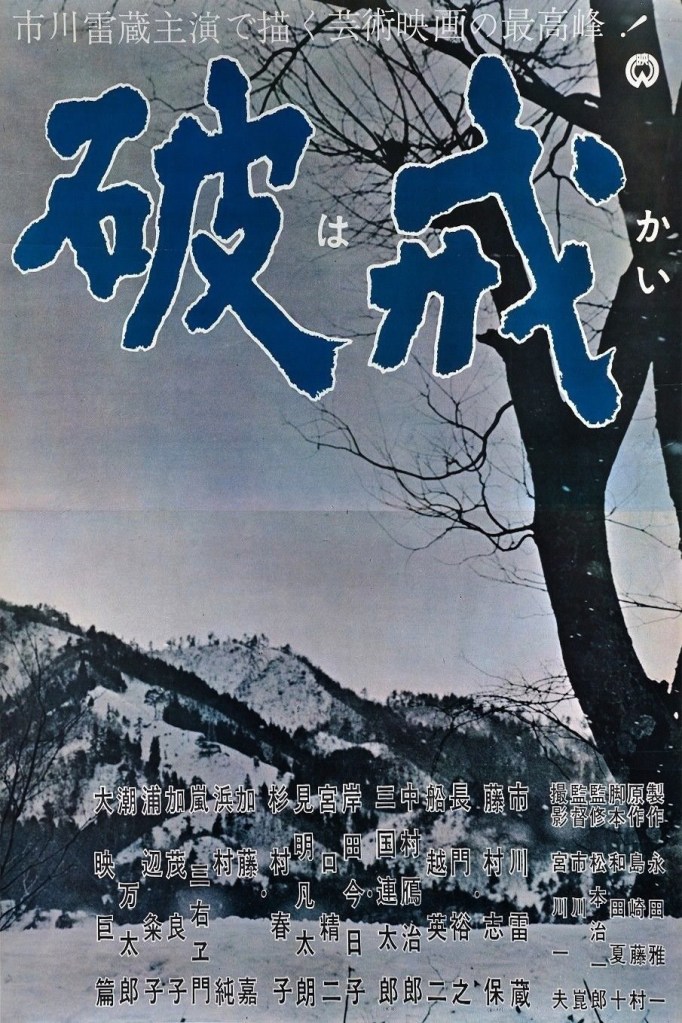
The Outcast (破戒, AKA The Broken Commandment, Kon Ichikawa, 1962)

Kon Ichikawa’s approach to critiquing his society was often laced with a delicious slice of biting irony but he puts sarcasm to one side for this all too rare attempt to address the uncomfortable subject of Japan’s hidden underclass – the burakumin. The term itself simply means “people who live in hamlets” but from feudal times onwards it came to denote the kinds of people with whom others did not want to associate – notably those whose occupations dealt in some way with death from executioners and undertakers, to butchers and leatherworkers. Though outright discrimination against such people was outlawed during the Meiji restoration, social stigma and informal harassment remained common with some lingering tendency remaining even today.

The Outcast (破戒, Hakai), adapted from the book by Toson Shimazaki (known as The Broken Commandment in English) is the story of a young man of burakumin lineage who has to hide his true identity in order to live a normal life in the Japan of 1904. Segawa’s father, formerly a village elder, sent his son away to live with his brother and his wife in a distant town where they could better hide their burakumin status to enjoy a better standard of life. Sadly, Segawa’s father dies after being trampled by a recalcitrant bull never seeing his son again and leaving him with the solemn commandment to live as a regular person, never revealing his connection with the burakumin world.

This debt to his father’s sacrifice creates a conflict in the heart of the young and idealistic Segawa (Raizo Ichikawa). Forced to listen to the casual racism all around him and unable to offer any kind of resistance, Segawa has become interested in the writings of a polemical political figure, Rentaro Inoko (Rentaro Mikuni), who has begun to write passionate political treatises advocating for burakumin rights. When Inoko turns up in Segawa’s town, he finds himself a new father figure and political mentor but continues to feel constrained by the debt of honour to his father’s sacrifice and is unable to confess his own burakumin heritage even to Inoko.

The world Segawa lives in is a conservative and stratified one in which old superstitions hold true even whilst hypocritical authorities use and abuse the trust placed in them. Inoko falls foul of local politics after he discovers a politician has married a wealthy burakumin woman solely for her money and is planning to expose him at a political rally. This same politician has already threatened to blackmail Segawa who continues to deny all knowledge of any burakumin related activities whilst failing to quell the eventual gossip surrounding Segawa’s lineage. The gossip causes problems at the school where Segawa had held a prestigious teaching position as the headmaster and school board fear the reaction of the parents. Though the people at the temple where Segawa takes refuge after growing tired of the racist inn owners in town are broadly supportive of the burakumin, the priest there has his own problems after having made a clumsy pass at his adopted daughter, Shio (Shiho Fujimura) – the daughter of a drunken teacher sacked by the school in order to avoid paying him a proper pension. At every turn the forces of authority are universally corrupt, selfish and venal, leaving no safe direction for a possible revolution of social justice to begin.

This is Segawa’s central conflict. After his experiences with Inoko, Segawa begins to want to follow in his footsteps, living out and proud as a burakumin and full time activist for burakumin rights. However, this would be undoing everything for which his father sacrificed so much. Talking things over with Inoko’s non-burakumin wife, Segawa is also presented with a third way – reveal his burakumin heritage and attempt to live honestly as an ordinary person, changing hearts and minds simply through leading a life among many other lives. This option seems attractive, especially as Segawa has fallen in love and would like to lead an ordinary life with a wife and family, but his youthful idealism is hungry for a greater, faster change than the one which will be born through simple integration. Despite the warnings of Inoko’s wife who believes change will occur not through activism but through the passage of time, Segawa decides his future lies in advancing the burakumin cause in the wider world.

When Segawa does choose to reveal himself, he finds that there is far more sympathy and support than he would ever have expected. A woman he has come to love wants to stay by his side, his previously hostile friend rethinks his entire approach to life and apologises, and even the children in his class convince their parents that their teacher is a good and a kind man regardless of whatever arbitrary social distinction may have been passed to him through an accident of birth. Segawa’s conflicted soul speaks not only for the burakumin but for all hidden and oppressed peoples who have been forced to keep a side of themselves entirely secret, faced with either living a lie in the mainstream world or being confined to life within their own community. His choice is one of either capitulation and collaboration, or resistance which amounts to a sacrifice of his own potential happiness in the hope that it will bring about liberation for other similarly oppressed people.

Scripted again by Natto Wada, The Outcast takes a slightly clumsy, didactic approach filled with long, theatrical speeches but does ultimately prove moving and inspiring in advocating for the fair treatment of these long maligned people as well as others facing similar discrimination in an unforgiving world. As a treatise on identity and rigid social attitudes, the film has lost none of its power or urgency even forty years later in a world in which progress has undoubtedly been made even if there are still distances to go.


Odd Obsession (鍵, Kon Ichikawa, 1959)

odd-obsessionJunichiro Tanizaki is widely regarded as one of the major Japanese literary figures of the twentieth century with his work frequently adapted for the cinema screen. Those most familiar with Kon Ichikawa’s art house leaning pictures such as war films The Burmese Harp or Fires on the Plain might find it quite an odd proposition but in many ways, there could be no finer match for Tanizaki’s subversive, darkly comic critiques of the baser elements of human nature than the otherwise wry director. Odd Obsession (鍵, Kagi) may be a strange title for this adaptation of Tanizaki’s well known later work The Key, but then again “odd obsessions” is good way of describing the majority of Tanizaki’s career. A tale of destructive sexuality, the odd obsession here is not so much pleasure or even dominance but a misplaced hope of sexuality as salvation, that the sheer force of stimulation arising from desire can in some way be harnessed to stave off the inevitable even if it entails a kind of personal abstinence.

Our narrator for this sardonic tale is an ambitious young doctor, Kimura (Tatsuya Nakadai), who opens the film in an unusually meta fashion with a direct to camera address taking the form of a brief lecture on the decline of the human body (which begins at age ten and then gets progressively worse). Kimura reminds us that we too will grow old, but his warning is intended less to engender sympathy for the elderly patriarch who will become our secondary protagonist than it is to raise a grim spectre of the inescapability of death.

The story Kimura wants to tell us of a man who fought against senility centres on antiques expert and respected cultural critic Kenmochi (Ganjiro Nakamura). Advanced in years, Kenmochi is beginning to feel the darkness encroaching along with the desire to resist it through restored virility. For this reason, he’s been making regular appointments at Kimura’s clinic which he keeps secret from his wife who would be unhappy to know he’s been getting mysterious injections to help with his sex drive but which also come with a number of side effects including dangerously raising his blood pressure.

Eventually Ikuko (Machiko Kyo), Kenmochi’s slightly younger wife and mother of his grown up daughter Toshiko (Junko Kano), does indeed find out though what she does not appear to know is that Kenmochi has also been drugging her so that he can take photos of her naked body and enjoy his rights as her husband without her needing to be 100% present at the time. Kenmochi’s plan is to lure Kimura into having an affair with his wife so that the resultant jealousy will stimulate his system, staving off senility and other unwelcome effects of ageing. This would be strange enough on its own were it not that Kenmochi has also been trying to set up a marriage between Toshiko and Kimura who are already engaged in a discreet affair.

In contrast with the source material which takes the form of a number of diary entries providing differing perspectives on events, the film takes the point of view of the cynical and morally bankrupt doctor Kimura who feels himself above this “pathetic” old man with his sexual preoccupations and diminished prospects. As the narrator, Kimura evidently believes himself in control but Ichikawa is keen to play with our sense of the rules of storytelling to show him just how wrong he could be. Intrigue is everywhere. Kenmochi may think he’s using all around him in a clever game to prolong his own life but he’s entirely blind to a series of counter games which may be taking place behind his back.

Sex is quite literally a weapon – aimed at the heart of death. Kimura recounts a dream he sometimes has in which he is shot through the heart in an arid desert, only for this same scene to invade the mind of a paralysed Kenmochi on gazing at the naked body of his wife. The marriage of Kenmochi and Ikuko has apparently been a cold (and perhaps unhappy) one with Kenmochi berating his wife for remaining “priest’s daughter” all these years later, prudish and conventional. Nevertheless, Ikuko – the kimonoed figure of the traditional Japanese wife, subservient yet mysterious and melancholy, becomes the central pivot around which all the men turn, eclipsing her own daughter – a Westernised, sexually liberated young woman rendered undesirable in her very availability. Kimura is not quite the destructive interloper of Pasolini’s Theorem so much as he is a “key” used by Kenmochi to “unlock” a hidden capacity within himself but one which, as it turns out, opens many doors not all of them leading to intended, or expected, destinations.

Ichikawa continues with a more experimental approach than was his norm following the bold opening scene in which Kimura directly addresses the audience with a straight to camera monologue. A pointed symbolic sequence of a train coupling, freeze frames, dissolves and montages add to his alienated perspective as he adopts Kimura’s arch commentary on the ongoing disaster which is the extremely dysfunctional Kenmochi family home. Middle class and well to do, the Kenmochis’ lives are nevertheless empty – the house is mortgaged and the beautiful statues which taunt Kenmochi with their physical perfection have all already been sold though Kenmochi refuses to let the buyer take them home. Old age should burn and rave at close of day, but as the beautifully ironic ending makes plain it will be of little use, death is in the house wearing an all too familiar face which you will always fail to recognise.


Screened as part of the Japan Foundation Touring Film Programme 2017.

Opening scene (no subtitles)

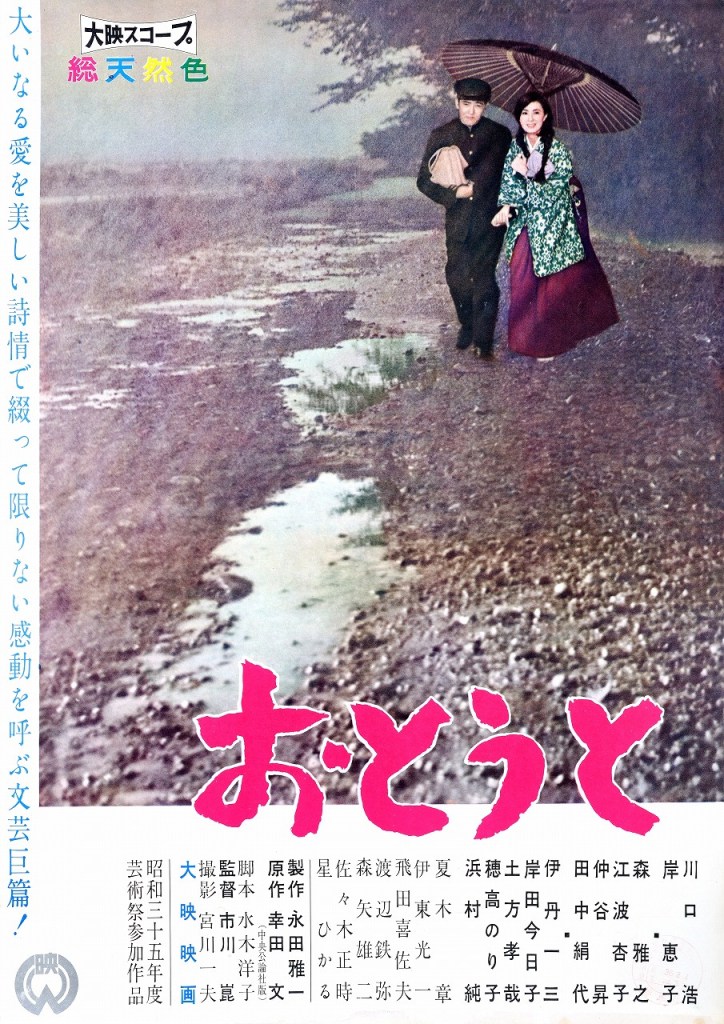
Her Brother (おとうと, Kon Ichikawa, 1960)

ototoPerhaps oddly for a director of his generation, Kon Ichikawa is not particularly known for family drama yet his 1960 effort, Her Brother (おとうと, Ototo), draws strongly on this genre albeit with Ichikawa’s trademark irony. A Taisho era tale based on an autobiographically inspired novel by Aya Koda, Her Brother is the story of a sister’s unconditional love but also of a woman who is, in some ways, forced to sacrifice herself for her family precisely because of their ongoing emotional neglect.

Oldest daughter Gen (Keiko Kishi) is still in school though she’s more or less running the household seeing as her invalid step-mother (Kinuyo Tanaka) spends most of her time bedridden with rheumatism and the rest of it pontificating about religion and listening to her poisonous friend (Kyoko Kishida) who likes to stir up trouble in this already difficult family environment. Gen’s father (Masayuki Mori) is a well known writer who needs a lot of quiet time for his work. As fathers go he’s very laid back and content to think his kids will be OK because they’re his kids, which isn’t to say he doesn’t care but he’s not exactly present most of the time. It’s no surprise then that care of the family’s youngest, Hekiro (Hiroshi Kawaguchi), has largely fallen to his sister. Where Gen is naturally responsible and practically minded, Hekiro is reckless and always in search of adventure. Eventually this lands him in trouble when he gets involved with a bad crowd but whatever his family might have been feeling towards him, everything changes once they discover that he’s facing a serious illness.

Because of the family’s odd arrangement, Gen has become almost a maternal figure towards Hekiro despite only being a couple of years older than he is. In fact, the pair have an almost comically childish physical fight at one point which is quite undignified considering their ages, especially when it involves staining their tatami mat floor with a puddle of bright red ink. Gen does her best but like her father she more often than not lets Hekiro off the hook by bailing him out, much of the time with her own rather than her father’s money. Not having the kind of authority a parent, uncle, or aunt might have all she can really do is ask him to think about behaving better, but Hekiro constantly pushes the boundaries to get a more concrete form of attention than his sister’s well meaning attempts to help are able to provide.

Hekiro’s stunts  eventually threaten to pull his sister into his darkening world, especially when a man claiming to be a detective starts more or less stalking Gen before pulling her into a shrine on the pretext of talking about her brother’s case before trying to have his wicked way with her. Luckily Gen is saved by a flock of geese cunningly released by some of her brother’s friends which gives her enough time to escape and finally get rid of the odious little man.

Similarly, Hekiro deliberately introduces his sister to the local pool hall. Though Gen seems to enjoy the game and is even good at it, she quickly realises she’s been brought as a sort of guarantor for her brother’s mounting debts. Add in other expensive and dangerous hobbies like his boat habit (he can’t swim) and it’s not surprising everyone’s had enough of Hekiro before he’s even left school. When he has an accident which results in the death of a horse (again, very expensive), it does at least lead him to reflect on the negative effect his actions can have on those around him, even if all he wanted and continues to want is an escape from his boring and miserable family life.

Even Hekiro’s illness fails to arouse very much in the way of concern from his well meaning father and grumpy step-mother who is hellbent on marrying Gen off against her wishes. Gen is, again, the only one to nurse Hekiro in hospital, managing the household as well as looking after her brother on his sickbed. When the illness becomes more serious it provides a last opportunity for the family members to bond and make amends for the various ways they’ve failed each other. The step-mother’s visit is not as altruistic as it seems when it transpires she’s only really come to “convert” Hekiro to her religion, but she begins to feel something more for him on believing that Jesus has already saved him thanks to his outwardly calm and polite manner. The final irony is that the idealised family is only born as it is destroyed, Gen puts her pinny back on and takes the reins from her stepmother who is presumably headed straight back to bed.

Gen’s devotion can’t save her brother either from himself or his fate and it may even be the end of her too. Vowing never to marry and rising from her own sickbed stopping only to instruct her stepmother to rest, she’s very clearly chosen her path even if Ichikawa’s camera and musical cues seem to find the ironic comedy of the situation rather than the sadness of her possibly tragic plight. Ichikawa and his cinematographer invented a whole new technique for this picture – the bleach bypass, which appropriately robs the environment of its vibrancy, dulling even bright colours with a sort of heavy leaded effect perfectly reflecting Hekiro’s increasingly depressed mindset as he reflects on being someone who has no firm anchor or place to feel at home. A strange, comically melancholic piece, Her Brother is a characteristically sideways swipe at the family drama from the master of irony though one which does not altogether escape his taste for the sentimental.


Original trailer (not subtitles)

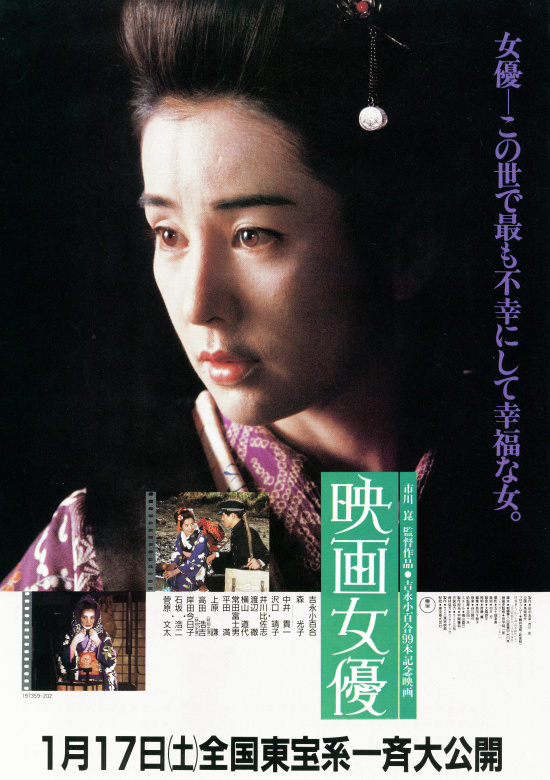
Actress (映画女優, Kon Ichikawa, 1987)

actressKon Ichikawa was born in 1915, just four years later than the subject of his 1989 film Actress (映画女優, Eiga Joyu) which uses the pre-directorial career of one of Japanese cinema’s most respected actresses, Kinuyo Tanaka, to explore the development of Japanese cinema itself. Tanaka was born in poverty in 1909 and worked as a jobbing film actress before being “discovered” by Hiroshi Shimizu and becoming one of Shochiku’s most bankable stars. The script is co-written by Kaneto Shindo who was fairly close to the action as an assistant under Kenji Mizoguchi at Shochiku in the ‘40s before being drafted into the war. A commemorative exercise marking the tenth anniversary of Tanaka’s death from a brain tumour in 1977, Ichikawa’s film never quite escapes from the biopic straightjacket and only gives a superficial picture of its star but seems content to revel in the nostalgia of a, by then, forgotten golden age.

The film begins with the young Tanaka awaiting a visit from her mentor, Hiroshi Shimizu (Toru Watanabe), whom her family are keen to thank for bringing them all to Tokyo away from their life of hardship. Although everyone is very happy for Tanaka’s success, there is shadow hanging over the party in the form of missing oldest brother Ryosuke who went on the run to avoid the draft and has not been heard of since.

Shimizu gives Tanaka (Sayuri Yoshinaga) her first roles at Shochiku where she becomes a contract player but is put out when another director, Heinosuke Gosho (Kiichi Nakai), wants to give her a leading role. Overruled by studio bosses, Shimizu becomes increasingly jealous of Tanaka’s career – a situation which is further complicated by the couple’s growing romantic entanglement which sees them living together in an unofficial marriage allowing Tanaka to continue acting. However, Shimizu continues to meddle in Tanaka’s professional life whilst also continuing his hard drinking, womanising playboy lifestyle. The couple eventually divorce but reunite from time to time on the film set.

Vowing never to marry again, the rest of Tanaka’s life is dedicated to acting and sees her working with some of the best directors of the age including Ozu (Shigemitsu Ogi) and later Mizoguchi (Bunta Sugawara). It is Tanaka’s professional and personal relationship with Mizoguchi which occupies the second half of the film. Judging by the first experience on the now lost Woman of Osaka in 1940, you wouldn’t think the two would ever wish to work together again though they eventually completed fifteen films together over the next fifteen years.

Mizoguchi’s process is completely different from any other Tanaka had worked with. Rather than meeting to rehearse and discuss the work, Mizoguchi abruptly sends her a lifetime’s supply of books about bunraku and changes the script that she has painstakingly committed to memory with on set rewrites communicated via a large blackboard he expects the actors to read from. Exasperated, Tanaka finally asks him for actual direction but he coldly states that she’s the actress and her acting is not part of his job description. Mizoguchi and Tanaka are very different people but each driven and ambitious so their frequent locking of horns produces a fiercely creative collaboration in which each was able to find worth even if it was frequently difficult.

The film ends around the time of Life of Oharu which would mark the final time the pair would work together. In terms of the film’s narrative, this unspoken development is foreshadowed by the idea that the two artists are heading in different directions but in the real world the reasons are a little less clear. Tanaka became the second woman to direct a feature film with Love Letters in 1953 which was even featured at Cannes, but for reasons unknown Mizoguchi attempted to block her access to the Director’s Guild of Japan, effectively ending both their friendship and any professional relationship. Ironically enough, Actress seems to imply that Tanaka’s desire to direct may have been inspired by Mizoguchi and his all powerful on set status prompting her to wonder how he does it, and, perhaps how she could do it too.

Ichikawa weaves the history of Japan through its cinema into the narrative to recount the changing tastes of the eras as naturalism came in and out of fashion and Japanese films began to experience international as well as domestic acclaim. Skipping huge portions of time to focus on the two directors – Shimizu and Mizoguchi, Ichikawa avoids mentioning Tanaka’s post-war visit to America which had a profound impact on her later career, not only in what she learned there but also in the extremely hostile reception she received on returning home. The main takeaway from his depiction of Tanaka is a woman ahead of her time, independent and headstrong, willing to work hard to achieve the things she wanted to achieve even if flying in the face of social convention though it makes no particular judgement on her character other than in her success as an actress.

Taking on the conceit of being a film about film, Ichikawa’s sets are theatrical, creating a deliberately artificial, half unreal world. This also extends into the scriptwriting which is extremely talky and more like a stage play than film, offering pointed, long stretches of monologuing which are already far away from the more naturalistic approach of early talking cinema. Characters have improbable, exposition filled conversations in which they each tell each other things they already know for the audience’s benefit – an effect which enhances the overall theatricality, but does draw attention to itself and eventually becomes wearing. Ichikawa’s picture of Tanaka is one of steely determination and of a woman ahead of her time, but even if Actress proves less than enlightening regarding its subject it does help to shed some light on both classic Japanese cinema and that of the late 1980s.


Original trailer (traditional Chinese subs only)

Ten Dark Women (黒い十人の女, Kon Ichikawa, 1961)

Ten Women in BlackKon Ichikawa, wry commenter of his times, turns his ironic eyes to the inherent sexism of the 1960s with a farcical tale of a philandering husband suddenly confronted with the betrayed disappointment of his many mistresses who’ve come together with one aim in mind – his death! Scripted by Natto Wada (Ichikawa’s wife and frequent screenwriter until her retirement in 1965), Ten Dark Women (黒い十人の女, Kuroi Junin no Onna) is an absurd noir-tinged comedy about 10 women who love one man so much that they all want him dead, or at any rate just not alive with one of the others.

Kaze (Eiji Funakoshi) is a TV producer by profession, though it might be better to think of him as a professional ladies’ man. He’s married to a woman who owns a bar, but is also carrying on affairs with nine (!) other women plus occasional one night stands with 30-50 others he meets through his work. His wife knows about his affairs and, while not happy about it, is putting up with things like decent wives are supposed to do. However, many of Kaze’s “mistresses” have inconveniently discovered each other’s existences and bonded in their mutual frustration with him. Strangely they all think he’s a great guy and remain very much in love with him but the situation being what it is the entirety of the betrayed wife and mistress support club eventually comes to the same conclusion – Kaze must die!

However, the women are all so devoted to Kaze, they don’t quite want him to disappear so much as for him to pick them and only them to live with happily ever after. One of the women foolishly warns Kaze about their plot as leverage for her marriage proposal but unfortunately for her he still turns her down and returns home to ask his wife what’s going on. She doesn’t deny her murderous intentions and in fact tells him in great detail how they intend to do him in. Kaze, to his credit, says he doesn’t mind very much and only worries about his wife’s future life as a murderess. Together they hatch a plan to fool the other women involving a pistol loaded with blanks and a tomato but nothing quite goes to plan.

An absurdist satire about the intense vanity of the womanising male, Ten Dark Women looks forward to Fellini’s similarly themed 8 1/2 or City of Women though here the idiotic husband at the centre becomes both prey and foil for the group of plotting women seeking revenge against his disloyal ways. Kaze, as he himself admits, is not particularly appealing to women though his position at the TV studio undoubtedly proves useful to some of them. He’s a curiously passive presence, not so much seeking out female company as acquiescing to it. It’s not quite clear if his concern for his wife should she decide to kill him is genuine or a means of manipulative self preservation but at any rate he takes the threat to his life extremely calmly.

Each of the women has their own claims on Kaze but the other thing they all have in common is being the prisoner of an extremely sexist society. Some of the women are with Kaze for careerist reasons, but it’s clear that there is a definite limit placed on a woman’s potential both inside and out of the creative industries. The commercial model makes a play for a more official relationship by bringing up the fact that Kaze’s wife has a job and therefore cannot devote herself entirely to Kaze’s wellbeing as proper wife should (as by implication would she after marrying and retiring from the modelling world). Kaze helped his wife set up her bar which she runs herself though constantly plays hostess to her husband’s industry friends. It appears what Kaze wants is less a devoted wife than an indifferent one who will permit his frequent “indiscretions” whilst also providing him with a conventional “home”.

Another of the women tries to get herself a promotion but her boss, though broadly sympathetic and dangling the idea of a raise, brings up the oft repeated notion that there’s no sense in giving her the job because a woman should leave at some point to marry and have children. When the woman criticises the behaviour of her male colleagues, her boss simply shrugs and admits men in TV aren’t “serious”, yet when she points out that she is serious and works hard she is told that women are better off at home. Women, he says, express themselves through their children whereas men make their mark through a career. The woman says that she believes everyone should try to reach their own potential in whatever way they can but her pleas fall on deaf ears. This notion is repeated later on when the women try to take revenge on Kaze by tricking him into resigning from his job – a man is his work, he claims. A man without a job is nothing at all and a man who is kept by a woman is less than nothing – Kaze is suddenly panicked, losing his occupation and social position is much more frightening to him than losing his life.

The women couldn’t kill the system or the TV, but they could kill Kaze so who can blame them for trying. Another of the women states that the imposed isolation of a man’s working life has cost him the ability to connect with other people on a human level and so his erasure is simply the end of a long process of social death. If some of the women triumph, others retreat as one does in suicide only to return as a ghost longing for the murder plot to succeed so that she and Kaze can be alone together at last. Kaze thinks he’s using each of them, but they have all been using him in one way or another and his only way out lies either in death or becoming a trophy for the most needy of his paramours.

Cynical in tone, Ten Dark Women is an amusingly absurd look at gender roles in early 1960s Japan as each of our women attempts to usurp male power for their own ends, some with more success than others. Ichikawa employs beautiful noir lighting in his elegantly composed black and white photography which, along with its jazzy score, gives the film a familiar feeling of crime laced modernity. An early instance of the feminist revenge film, Ten Dark Women is very much a comedy which avoids making its group of frustrated, resentful women mistreated by a buffoon of a TV exec the butt of its own joke, neatly highlighting the precarious nature of their existence which obliges them to rely on so hollow a support.


Original trailer (no subtitles)
Queen Bee (女王蜂, Kon Ichikawa, 1978)

queen beeKon Ichikawa may be best remembered for his mid career work, particularly his war films The Burmese Harp and Fires on the Plain as well as his melodramas Ototo and Bonchi, but he was one of the few directors who was prepared to keep one foot in the commercial arena as well as making more personal, “artistic” efforts. For this reason he was able to go on working through the creatively dry ‘80s when other big name directors, in particular Akira Kurosawa, found themselves locked out of the cinematic arena in their native country. Ichikawa’s biggest box office success was in fact the literary adaptation of a popular mystery novel The Inugamis (which he actually remade in 1999 as his final feature film). 1978’s Queen Bee (女王蜂, Jooubachi) is one of five films that Ichikawa made based on the work of popular mystery writer Seishi Yokomizo which feature the eccentric detective Kousuke Kindaichi.

In many ways, Queen Bee is the perfect synthesis of European and Japanese mystery styles as it technically plays host to its strange detective but places him off centre, more as an onlooker to events than the protagonist. Though it follows something like a classical Agatha Christie approach, it also brings in the Japanese love of puzzles and the importance of long buried secrets bubbling to the surface and coming back to haunt everyone involved in the original incident. It’s also important to note that Ichikawa is deliberately playing up the camp comedy of the situation too as he makes his bumbling policeman a definite figure of fun as well as sending Kindaichi tumbling into a pond among other oddly comic elements for this multiple murder mystery.

The story itself begins in 1932 as two students, Hitoshi and Ginzo, leave a small town where they’ve been learning all about the local folklore. Hitoshi later returns under less than pleasant circumstances as he’s come to get his grandmother’s ring back after giving it to a local girl, Kotoe, whom he’d agreed to marry, only his mother objects so now he wants to hold off a bit. Unfortunately this is not a good idea as Kotoe is already pregnant with his child. Sometime later Hitoshi dies in mysterious circumstances and we flash forward to 1936 when the daughter, Tomoko, is three years old and Ginzo comes back to propose to Kotoe.

Now we fast forward to 1952 when Tomoko is about to turn 19. Kotoe has died, Tomoko has been adopted by Ginzo, and three folklore loving students have set their eyes on her as a bride. Unfortunately, one of these suitors also winds up getting killed with Tomoko the prime suspect and it looks like history may be about to repeat itself.

Queen Bee may be a more mainstream effort, but Ichikawa films in a noticeably anarchic fashion with extremely strange cuts and juxtapositions, not to mention the almost parodic tone of the film. He adopts a fairly perverse approach to the entire enterprise even allowing his veteran star Tatsuya Nakadai to play the 20 year old version of himself in the brief 1930s scenes which is, it has to be said, something of a mistake. As fine an actor as Nakadai is, playing a 20 year old at 50 is a stretch and one which serves as a point of alienation during the deepest historical layer of the film.

As is usual with Japanese mysteries, the plot relies on the solution of various puzzles, riddles and the mechanics of crime much more so than the human psychology and importance placed on motive that dominate Western detective tales. As well as the long buried secrets, Queen Bee brings in some commentary on the place of social class in the post-war world, the folly of misplaced love, and how the failure to act honestly and in the best interests of others by putting your own feelings aside can cause extreme repercussions not only in your own future but those of generations to come. Once again, only by exposing previously unexpressed emotions and lies both accidental and deliberate can the trauma be resolved and crises come to an end.

Queen Bee is a strange film which plays up its European detective novel atmosphere complete with the drawing room lecture that has become a hallmark of the genre but also adds in a layer of irony and an almost winking jokiness that make for an oddly amusing tone. The mystery element itself is satisfying enough to keep even the most seasoned crime fan guessing with plenty of red herrings and misinformation along the way. That said, Queen Bee is also very much of its time and perhaps fails to offer much more than an enjoyably old fashioned detective story, albeit one which is anchored by strong performances from its veteran cast.


Unsubtitled trailer:

https://www.youtube.com/watch?v=TPZ64PbVOio