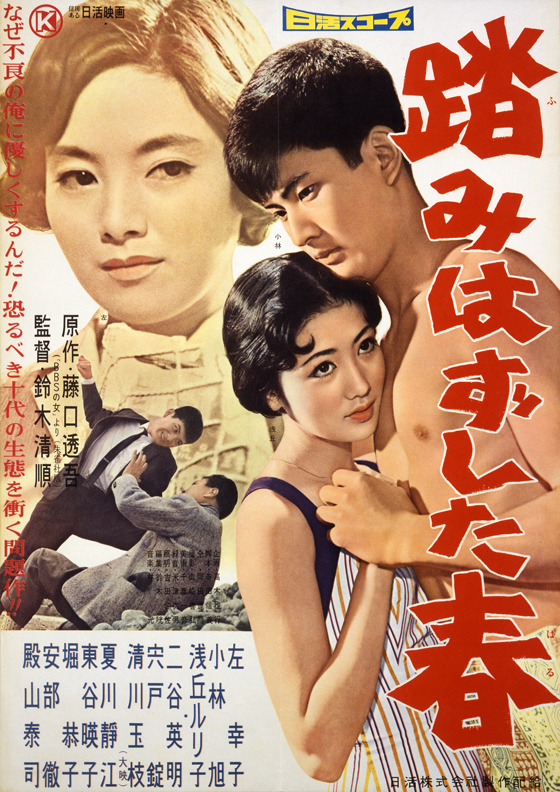
The Boy Who Came Back (踏みはずした春, Seijun Suzuki, 1958)

the boy who came back posterSeijun Suzuki may have been fired for making films that made no sense and no money, but he had to start somewhere before getting the opportunity to push the boat out. Suzuki’s early career was much like that of any low ranking director at Nikkatsu in that he was handed a number of program pictures often intended to push a pop song or starring one of the up and coming stars in the studio’s expanding youth output. The Boy Who Came Back (踏みはずした春, Fumihazushita Haru, AKA The Spring that Never Came) is among these early efforts and marks an early leading role for later pinup star Akira Kobayashi paired with his soon to be frequent leading lady, Ruriko Asaoka. A reform school tale, the film is a restrained affair for Suzuki who keeps the rage quelled for the most part while his hero struggles ever onward in a world which just won’t let him be.

Keiko (Sachiko Hidari) is a conductress on a tour bus, but she has aspirations towards doing good in the world and is also a member of the volunteer organisation, Big Brothers and Sisters. While the other girls are busy gossiping about one of their number who has just got engaged (but doesn’t look too happy about it), Keiko gets a message to call in to “BBS” and is excited to learn she’s earned her first assignment. Keiko will be mentoring Nobuo (Akira Kobayashi) – a young man getting out of reform school after his second offence (assault & battery + trying to throttle his father with a necktie, time added for plotting a mass escape). Nobuo, however, is an angry young man who’s done all this before, he’s not much interested in being reformed and just wants to be left alone to get back to being the cool as ice lone wolf that he’s convinced himself he really is.

Made to appeal to young men, The Boy Who Came Back has a strong social justice theme with Keiko’s well meaning desire to help held up as a public service even if her friends and family worry for her safety and think she’s wasting her time on a load of ne’er do wells. Apparently an extra-governmental organisation, BBS has no religious agenda but is committed to working with troubled young people to help them overcome their problems and reintegrate into society.

Reintegration is Nobuo’s biggest problem. He’s committed to going straight but he’s proud and unwilling to accept the help of others. He turns down Keiko’s offer to help him find work because he assumes it will be easy enough to find a job, but there are no jobs to be had in the economically straightened world of 1958 – one of the reasons Keiko’s mother thinks the BBS is pointless is because no matter how many you save there will always be more tempted by crime because of the “difficult times”. When he calms down and comes back, agreeing to an interview for work at his mother’s factory Nobuo leaves in a rage after an employee gives him a funny look. There are few jobs for young men, but there are none for “punks” who’ve been in juvie. Every time things are looking up for Nobuo, his delinquent past comes back to haunt him.

This is more literally true when an old enemy re-enters Nobuo’s life with the express intention of derailing it. His punk buddies don’t like it that he’s gone straight, and his arch rival is still after Nobuo’s girl, Kazue (Ruriko Asaoka). If Nobuo is going to get “reformed” he’ll have to solve the problem with Kajita (Jo Shishido) and his guys, but if he does it in the usual way, he’ll land up right in the slammer. Keiko’s dilemma is one of getting too involved or not involved enough – she needs to teach Nobuo to fix his self image issues (which are largely social issues too seeing as they relate to familial dysfunction – a violent father and emotionally distant mother creating an angry, fragile young man who thinks he’s worthless and no one will ever really love him) for himself, rather than try to fix them for him.

A typical program picture of the time, The Boy Who Came Back does not provide much scope for Suzuki’s rampant imagination, but it does feature his gift for unusual framing and editing techniques as well as his comparatively more liberal use of song and dance sequences in the (not quite so sleazy) bars and cabarets that Nobuo and his ilk frequent. Unlike many a Nikkatsu youth movie, The Boy Who Came Back has a happy ending as everyone, including the earnest Keiko, learns to sort out their various difficulties and walks cheerfully out into the suddenly brighter future with a much more certain footing.


The Boy Who Came Back is the first of five films included in Arrow’s Seijun Suzuki: The Early Years. Vol. 1 Seijun Rising: The Youth Movies box set.

Original trailer (English subtitles)

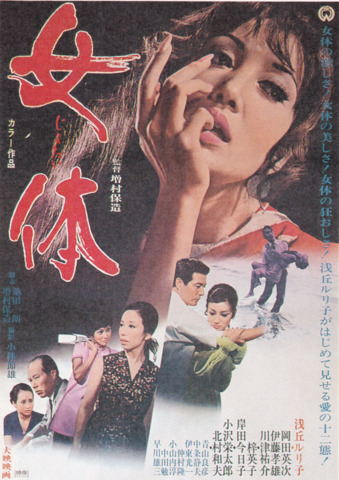
Vixen (女体, Yasuzo Masumura, 1969)

Vixen poster“Freedom for the masses!” cry the student protestors outside the claustrophobic environment of a corrupt educational institution at the heart of Yasuzo Masumura’s Vixen (女体, Jotai – lit. “a woman’s body”). While they cry for freedom, one young “liberated” woman finds she’s anything but free even in the throws of her liberation. Possessed of little power, she has a need to find herself a white knight but no sooner has she got him than she begins to long for new conquests, trapped in a destructive cycle of sex and violence. Subverting his own ideas of sex as liberation, Masumura reconfigures lust as a trap in the form of a siren song sung by a lonely young woman unable to find her place in the complicated post-war landscape.

Michi (Ruriko Asaoka), a modern young woman, has a brief episode of fondling an office chair while waiting to see the chairman of a university. Proudly showing off the bruises on her thighs, she accuses the chairman’s son of rape. Despite the evidence, Michi’s accusation is undermined by her mercenary behaviour which does not tally with that expected in such difficult situations. She’s come alone, flirts with the chairman’s secretary Nobuyuki (Eiji Okada), and is quick to talk money. Questioned at home the chairman’s son admits everything but thinks it’s no big deal because that’s just “how it’s done these days”. The chairman, worried more for his reputation which is already under strain given the widespread student protest movement, thinks paying Michi off is the best thing to do but there’s a disagreement over the amount. Nobuyuki’s wife Akie (Kyoko Kishida), sister of the accused and daughter of the chairman, only wants to give Michi half of the two million she’s asked for. Nobuyuki gives her the full amount anyway behind his wife’s back, winning Michi’s eternal admiration for his considerate treatment. Unwisely visiting her hotel room, Nobuyuki develops a dangerous fascination with the alluring young woman and embarks on a passionate, ill-advised affair.

Michi is, in many ways, the archetypal post-war woman. Orphaned at a young age she was raised by a grandmother in a small fishing village and has been living with another relative whilst working as a waitress in his ramen restaurant after coming to the city. She’s grown up in a more liberal era, has a “positive” attitude to sex, and lives outside of the “traditional” path for “respectable” young women of early marriage and continued monogamy. As someone later puts it, women like Michi are two a penny now that the economy is getting back on its feet – they live alone in the city, aren’t interested in marriage and value their independence. Michi, however, is more or less the opposite of this “new” kind of woman. Independence is something that frightens her beyond all else. She cannot survive without a man, does not want or know how to live alone as a “single” woman and uses her sex appeal in order to manipulate men into staying by her side to look after her. Sex is not what she craves so much as security, but security also frightens her and so each time she’s made one conquest she latches on to the next gallant young man who shows her any sign of kindness or courtesy.

Indeed, all Michi thinks she has to offer is her body – the “Jotai” of the title. Perhaps hinting at some past trauma in speaking of the roughneck fishermen that frequented her grandmother’s ramen shop, fatherless Michi says she’s chased men in her dreams since childhood, seeking new tastes and new sensations. She wishes she could find one man and stick with him because the chase and the longing cause her nothing but pain, but her need will not let her be. Asked what she will do when her appeal fades (as it inevitably will), Michi has no other plan than drinking herself into oblivion. “I’m a woman,” she says, “what is there for me to do but love?”. Quite far from the idea of the “liberated”, independent woman spoken of before who has learned to make her own way in the new “freedoms” promised by increased economic prosperity.

This false idea of liberality is one which originally attracts Nobuyuki. A straight laced salaryman working for his corrupt father-in-law and often doing his dirty work for him against his batter judgement, Nobuyuki has sacrificed his individual freedom for the rewards his society offers those who play by the rules. Also a war orphan, Nobuyuki sacrificed his youth to raise his younger sister (now preparing to marry herself), and has a comfortable, middle-class life with an austere if loving wife. Having worked his way into their upperclass world, Nobuyuki feels he doesn’t quite belong, something always nagging at him prevents Nobuyuki from fully committing to his drone-like life of pleasant conformity. A mad infatuation with Michi, an irritating child woman at the best of times, is an excuse to go all out in escaping the oppression of his conventional life but it’s not one with long term stability and his life with Michi is unlikely to offer him the freedom he had originally envisaged.

Later, Michi makes a play for the man Nobuyuki’s sister is set to marry. Akizuki (Takao Ito) is not like Nobuyuki – he’s a post-war man but one with definite ambitions and goals, each element of his life is a product of considered choices. As anyone would who took the time to really think about it, he’s turning Michi down, but for some reason he continues to help her placing a wedge between himself and his fiancée. This way of living – the considered, ordered, boring but pleasant life is directly contrasted with the chaotic, destructive, and perhaps exciting one that is offered by Michi, and the dull life is winning. Michi is miserable, and her self destruction is primed to drag any “nice” young man into her wake along with any other woman associated with him. Nobuyuki is left with a choice but it turns out not to be so binary as might be assumed. Personal freedom, if it is to be found, is not found in abandonment either to another person or to a job or way of life, but in the realisation that choice exists and can be exercised, freely, by all.


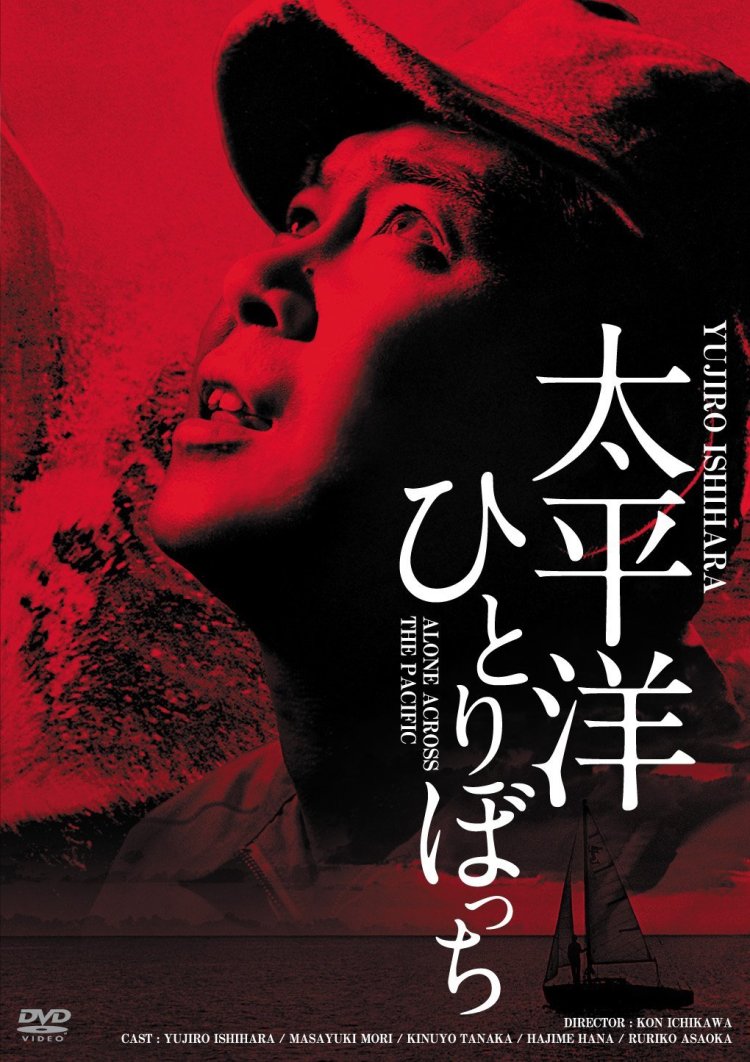
Alone Across the Pacific (太平洋ひとりぼっち, Kon Ichikawa, 1963)

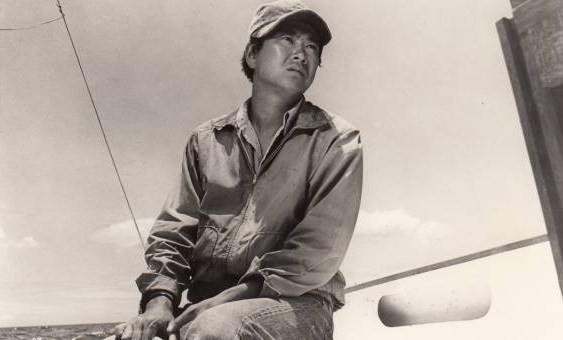
Alone Across the PacficKon Ichikawa made two sorts of movies – the funny ones and the not so funny ones. Despite the seriousness of the title, Alone Across the Pacific (太平洋ひとりぼっち, Taiheiyo hitori-botchi) is one of the funny ones. Like many of Ichikawa’s heroes, Horie is a man who defies convention and longs for escape from the constraining forces of his society yet is unable to fully detach himself from its cultural norms. Based on the real life travelogue of solo sailor Kenichi Horie, Alone Across the Pacific is less the story of a man battling the elements, than a cheerful tale of a man battling himself in a floating isolation tank bound for the “land of the free”.

Kenichi (Yujiro Ishihara) is a strange man. He has few friends (aside from the family dog, Pearl) and is obsessed with the idea of running away to sea. Inspired by the tales of other intrepid sailors, his dream is to sail all alone across the Pacific Ocean from Osaka to San Fransisco. Despite the fact that it is illegal for small boats to leave Japanese waters (and that he is too impatient to wait for his passport to come through), Kenichi has custom made his own yacht, one without an engine, and has set off on his longed for voyage under the cover of darkness.

Rather than filming Kenichi’s journey naturalistically, Ichikawa opts for an adventurer’s tale as Kenichi provides an ironic voice over detailing some of his naive failings as a rookie sailor undertaking such a daunting mission. Each of Kenichi’s crises links back to a memory from his shore life, reminding us why he’s on this journey in the first place. Kenichi’s struggles are the same as many a young man in post-war Japan and, in fact, many of those previously played by the poster boy for youthful rebellion, Yujiro Ishihara.  Unwilling to live a life hemmed in by the predetermined path of a job for life, wife, children and total social conformity, Kenichi longs to be free of his cultural baggage by abandoning his civility during a long process of isolation therapy free of overbearing fathers, fretting mothers, indifferent sisters and a generally noisy world.

Kenichi’s father (Masayuki Mori) is the very personification of authority, berating his son for his fecklessness and pointless obsession with sailing – a sport a working class boy like Kenichi can barely afford. Kenichi’s determination to achieve his goal sees him leave school early, take a job in his father’s workshop only to quit suddenly for a more lucrative one delivering luggage for a travel agents, and quitting that too to work full time on his boat. While his father huffs and puffs his mother (Kinuyo Tanaka) worries, hoping her mad son won’t really go through with it but knowing that he will.

When Kenichi finally reaches San Fransisco, he’s assaulted by congratulatory voices from all directions. Towed into harbour by a motor boat, Kenichi first has to deal with mundane problems like the customs patrol wanting to know if he’s got any fruit left on the boat before a crowd gathers to shake his hand asking where he’s come from and why, what he wants to do now, and praising him for his daring feat of solo sailing glory. In Japan however, things are different. Dragged out for an interview by the press, Kenichi’s worried mother avows that she’s just happy to know her son is safe while his father bows deeply and reassures everyone that he will absolutely put a stop to any such random acts of individualism his wayward son may attempt in the future. 

Kenichi evades the twin pulls of his mother’s apron strings and his father’s handcuffs by taking off alone but even at sea he’s never free of his cultural programming, checking the wide empty ocean before removing his clothes and then stepping back down into the cabin to finish the job. Kenichi’s failure to acquire a passport is an ironic one seeing as part of what he’s running from is being Japanese but even as his quest is one for self determination it is also intensely selfish and self involved. In this Kenichi commits the ultimate act of individualism, caring nothing for the thoughts and feelings of others in the all encompassing need to achieve his goal. Kenichi may have found a home at sea, but on land he’s caged once again, a prisoner both of social conformity and his own need to defy it.


Available on R2 DVD from Eureka Masters of Cinema.

Original trailer (no subtitles)

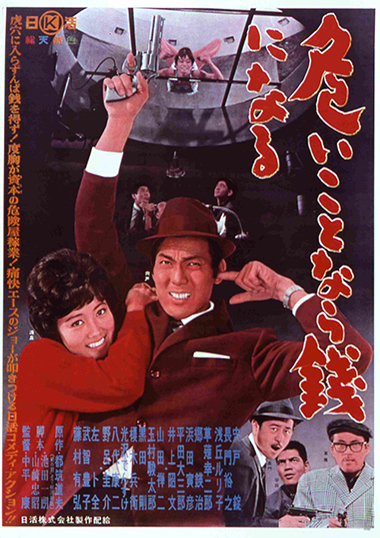
Danger Pays (危いことなら銭になる, Ko Nakahira, 1962)

Danger PaysWhere there’s danger, there’s money! Or, maybe just danger, who knows but whatever it is, it certainly doesn’t lack for excitement. Ko Nakahira is best known for his first feature, Crazed Fruit, the youthful romantic drama ending in speed boat murder which ushered in the Sun Tribe era. Though he later tried to make a return to more artistic efforts, it’s Nakahira’s freewheeling Nikkatsu crime movies that have continued to capture the hearts of audience members. Danger Pays (AKA Danger Paws, 危いことなら銭になる, Yabai Koto Nara Zeni ni Naru) is among the best of them with its cartoon-like, absurd crime caper world filled with bumbling crooks and ridiculous setups.
The central plot gets going when a truck carrying watermarked paper destined for the mint is hijacked with force by armed thugs. They need a master forger though so they set out to recruit one of the best counterfeiters currently working on his way back from a business trip to Hong Kong. However, three petty crooks have also gotten wind of the scam and are trying to head off their rivals by kidnapping the old grandpa first.

The three guys are “Glass Hearted Joe” – a purple suited dandy with an aversion to the sound of scraping glass, Slide Rule Tetsu who walks with a cane and is a whizz with the abacus, and Dump-Truck Ken who’s a geeky sort of guy who also owns a dumper truck. Sakamoto, the forger, eludes their grasp when the better equipped professionals turn up, but none of them is willing to give up on the prize. A little later, Joe teams up with a female ally – Tomoko, who is keen martial artist and smarter than the other three put together. Eventually the four end up becoming an accidental team though it remains to be seen if they can really turn this increasingly desperate situation to their advantage.

Danger Pays is in no way “serious” though this is far from a criticism. Armed with a killer script filled with amazing one liners which are performed with excellent comic timing by the A-list cast, Danger Pays is the kind of effortlessly cool, often hilarious crime caper which is near impossible to pull-off but absolutely sublime when it works – which Danger Pays most definitely does. Though there is a large amount of death and bloodiness in the final third, the atmosphere remains cartoonish as our intrepid team of four simply step over the bodies to go claim their prize with only one of them left feeling a little queasy.

Nakahira maintains the high octane, almost breathless pace right through to the end. The finale kicks in with our heroes trying to escape from a locked room which is about to be filled with gas only to be trapped like rats in an elevator shaft where they engage in an improbable shootout whilst bodies rain down on them from above bathed in the red emergency light of the escape vaults. This is a hardboiled world but one cycled through cigar munching wise guys and tommy guns, it’s all fun and games until you’re trapped in a lift knee deep in corpses while blood drips from a couple more dead guys on the ceiling.

Ridiculous slapstick humour and broad comedy are the cornerstones of Danger Pays though it also makes its central crime conceit work on its own only to overturn it with a final revelation even as the credits roll. Excellently played by its four leads, this comic tale of “victimless crime” in the improbably colourful underworld of ‘60s Tokyo is one which is filled with absurd humour, cartoon stunts, and ridiculous characters but proves absolutely irresistible! If only modern day crime capers were this much fun.


Danger Pays is the second of three films included in the second volume of Arrow’s Nikkatsu Diamond Guys box set.

Tokyo Mighty Guy (東京の暴れん坊, Buichi Saito, 1960)

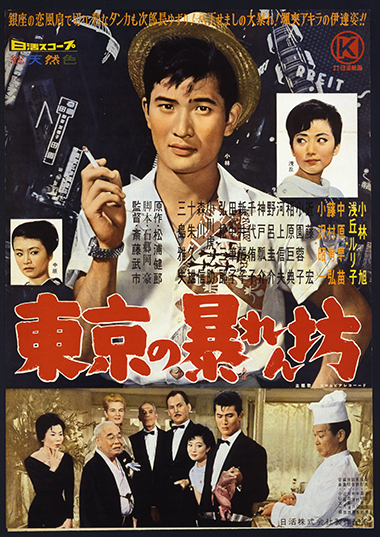
Tokyo Mighty GuyThe bright and shining post-war world – it’s a grand place to be young and fancy free! Or so movies like Tokyo Mighty Guy (東京の暴れん坊, Tokyo no Abarembo) would have you believe. Casting one of Nikkatsu’s tentpole stars, Akira Kobayshi, in the lead, Buichi Saito’s Tokyo Mighty Guy is, like previous Kobayashi/Saito collaboration The Rambling Guitarist, the start of a franchise featuring the much loved neighbourhood big dog, Jiro-cho.
In this first instalment, Jiro (Akira Kobayashi) has just returned from some overseas study in Paris where, rather than the intellectual pursuits that he planned, Jiro mostly wound up with a love of French cuisine. His parents have just opened a small French restaurant in fashionable Ginza and Jiro is now working there too despite the more lucrative paths that might be open for someone with a college education, language skills and overseas experience.

Jiro is also a hit with the ladies, and the daughter of the family that run a nearby bathhouse, Hideko (Ruriko Asaoka), has quite a crush on him though Jiro seems fairly oblivious to this fact despite her revealing to him that her family have received an offer of arranged marriage. After a high ranking official crashes his car into the family restaurant, Jiro becomes embroiled in a series of complicated local political and shady business plots which conflict strongly with his righteous and individual nature.

Tokyo Mighty Guy begins with a cute musical title sequence that would be much more at home in a glossy musical of the time than in a smalltime gangster flick which is what lurks around the edges of this feel good, youthful tale. Indeed, Kobayashi gets ample opportunity to show off those pipes as he sings to himself alone in the male side of the bathhouse and later repeats snatches of the song throughout the film. There’s a single being peddled here, but it’s being done in a fun, if unsubtle, way.

Jiro is very much a man of his age. He’s the big man in the neighbourhood – middle class, educated, studied abroad, likes the finer things such as foreign food and sharp suits, but he’s got the words social justice engraved on his heart so you know you can go to him with your troubles and he’ll help you figure them out. He doesn’t take any nonsense from anyone; he sends the yakuza protection mob packing and even convinces one of them to go straight with a trainee chef job in his restaurant. No wonder the animal loving former politician has taken such a liking to him – he’s the kind of man it’s hard not to like.

That’s not to say Jiro’s a saint, he’s out for himself just like everyone else. We can see how much distress there is for others when we venture into a rundown tenement filled with the genuine poor who have too many children and not enough resources. Actually, the film isn’t terribly kind about these people and treats them more or less as an embarrassing joke but it does demonstrate how the bigwigs have exploited the needs of the lower orders in more ways than one. Jiro, at least, won’t stand for this kind of deception and misuse of traditional social bonds but he will still use it as leverage to bring things to a fittingly ironic solution that is to the benefit of everyone aside from those that were originally in the wrong.

Cute and quirky is definitely the theme and even where there are darker elements, the cheerful atmosphere is tailor made to eclipse them. Saito doesn’t roll out any particularly impressive directorial tricks but allows the absurd humour of the script to do his work for him, highlighting it with surreal touches such as the face of an absent lover appearing in the moon or the celebratory feeling of hundreds of advertising leaflets dropping from the sky like confetti. Light and fluffy as it is, Tokyo Mighty Guy is time capsule from the socially mobile youth of Tokyo in 1960 who don’t want arranged marriages or to take over the family business. The world has opened up for them with a new vista of foreign culture and multicultural cool. The message is clear, the future belongs to guys like Jiro, and by extension to the Jiro wannabes lining up to watch him prosper from their cinema seats.


Tokyo Mighty Guy is the first of three films included in the second volume of Arrow’s Nikkatsu Diamond Guys box set.

The Rambling Guitarist (ギターを持った渡り鳥, Buichi Saito, 1959)

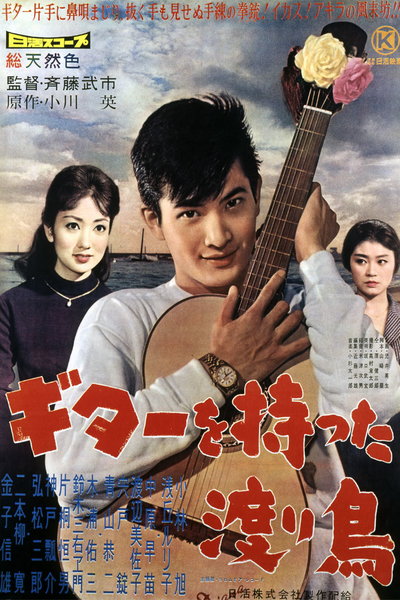
60030340Sometimes, just like an aimless drifter wandering into town, you feel as if you’ve come in during the second reel and missed some vital piece of information leaving you feeling a little at odds with the current situation. So it is with Buichi Saito’s The Rambling Guitarist (ギターを持った渡り鳥, Guitar wo Motta Wataridori) which is, apparently, the first film in a series though feels a little more like the second.

The film begins with a scene straight out of a classic western as the titular guitar toting wanderer, Taki (played by rising Nikkatsu star of the time Akira Kobayashi looking very fresh faced indeed), is fast asleep on the back of a cart travelling through an arid landscape with a mountain looming in the background before being woken by the driver who points him towards the nearest town. Having left the dry expanses on foot, Taki hasn’t been in Hakodate for long before he’s wrecked a local drinking establishment in a two on one bar brawl with a couple of drunken foreign sailors who were hassling the other musicians. This brings him to the notice of the crime kingpin Akitsu who offers him a job but Taki doesn’t like to linger and this kind of work’s not his thing so he passes. That is until a chance encounter with Akitsu’s pretty young daughter leads to a change of heart…

Akira Kobayashi went on to become one of the studio’s biggest action stars but here he’s every inch the pretty boy in a Brando-esque leather jacket and with a cooler than cool devil may care approach to life. The very epitome of the kind of pin-up star these films were created to sell, Taki is a noble, broken hearted drifter mournfully strumming along on his ever present guitar whenever the opportunity presents itself. Appealing to the rebellious side of post-war youth but still possessing a moral centre which places him on the side of right, Taki is the kind of youth hero you can still take home to mama.

Post set-up, The Rambling Guitarist drops most of its western tropes pretty quickly and falls back into a standard youth crime drama mould as Taki ends up joining the Akitsu gang who have a plan to build an amusement park on the quiet edge of the island to pull in a bit more tourist money. The snag is, there’s a small house and fishing company based there that they need to take out – the owners have a loan and are already in debt so it shouldn’t be too hard but Akitsu has neglected to mention that the house belongs to his sister (and her husband whom he doesn’t like very much).

Just when you thought everything was about to settle down, an old “friend” emerges from underneath a raincoat in the form of “Killer George” played by fellow Nikkatsu rising star, Jo Shishido. It’s from here on that we start to piece together some of Taki’s previous life and the reason he’s on this seemingly endless path of wandering from to place to place with no clear aim in sight. Things start to take a more generic turn as Taki and George dance around each other a little bit with Akitsu fuelling the fire by plotting behind both of their backs from the shadows. It’s a conventional narrative but acquits itself well enough.

Like the other films of the period, The Rambling Guitarist is built of bright, colourful and above all youthful fun. Consequently it has an energetic, freewheeling atmosphere coupled with a mildly nihilistic bent designed to appeal to the youth of the time. Aside from having some of the least realistic fight choreography ever committed to celluloid (that first bar brawl scene has some real howlers), The Rambling Guitarist proves an enjoyable embodiment of its genre but ultimately fails to build up the kind of emotional investment that would earn it a higher place on the list. A little bit disposable, perhaps, but nevertheless fun The Rambling Guitarist does at least leave you wanting to wander off and find your way to The Rambling Guitarist 2.


The Rambling Guitarist is the third (and final 😦 ) film included in Arrow’s Nikkatsu Diamond Guys Vol. 1 collection.

http://www.youtube.com/watch?v=ve8wNBGl4cE