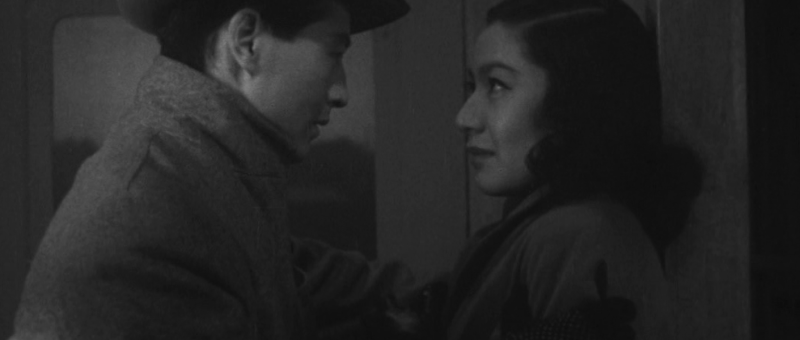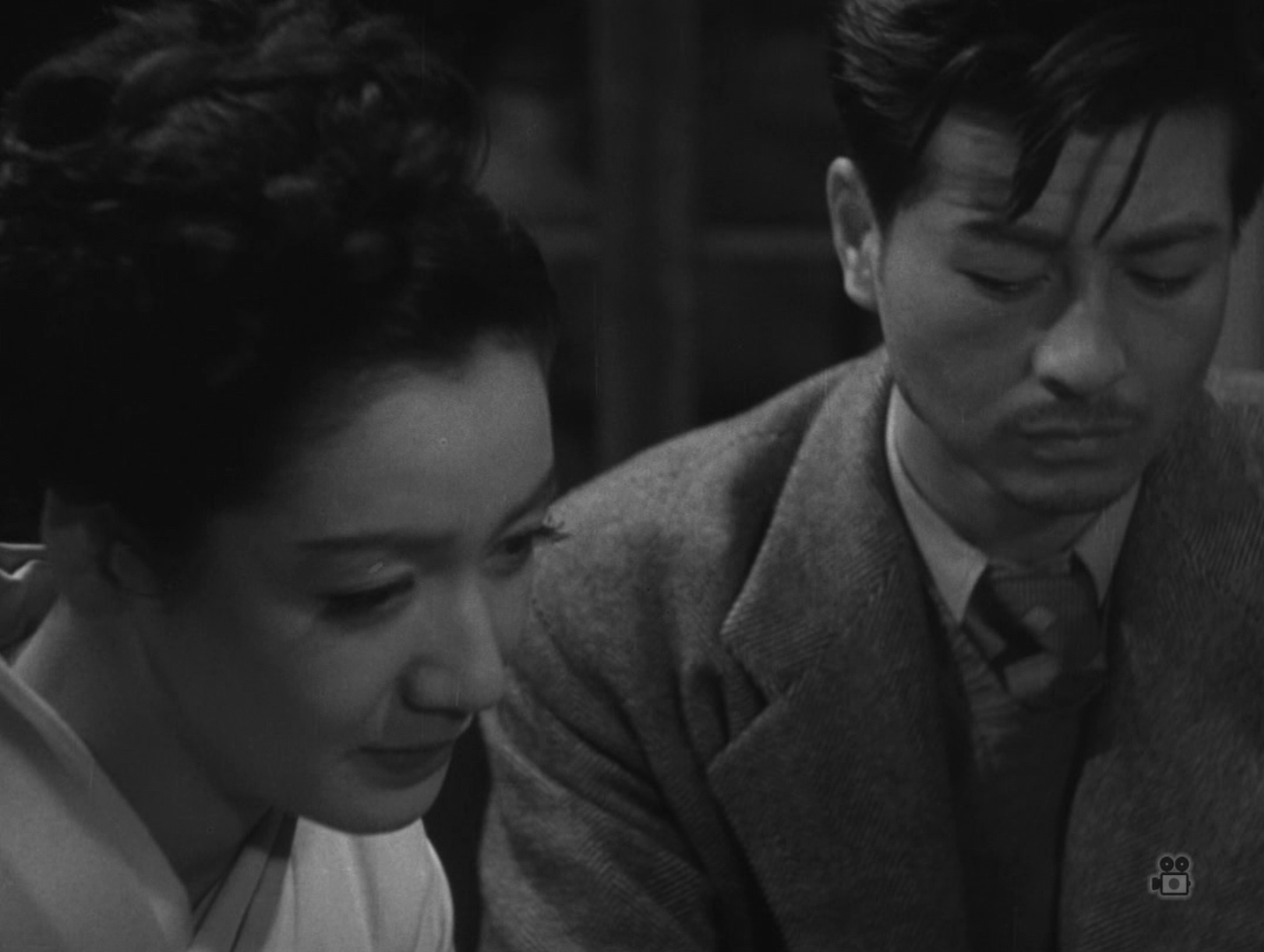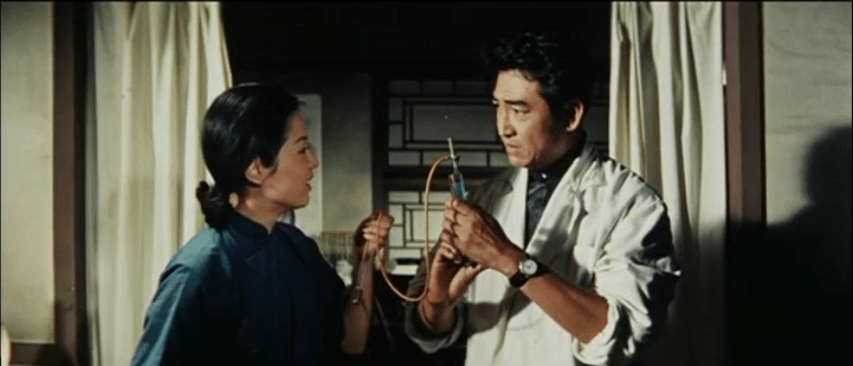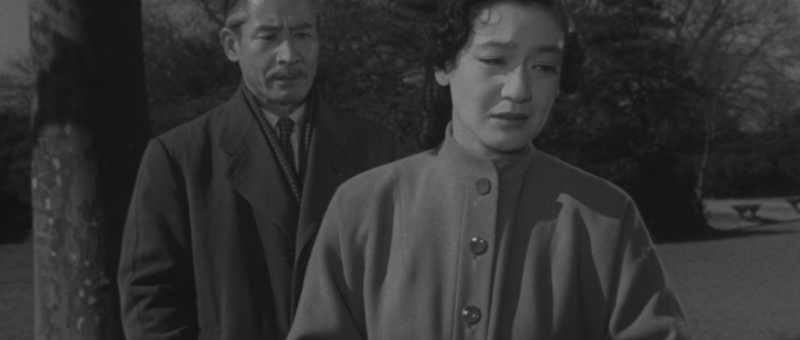
Okuni and Gohei (お國と五平, Mikio Naruse, 1952)

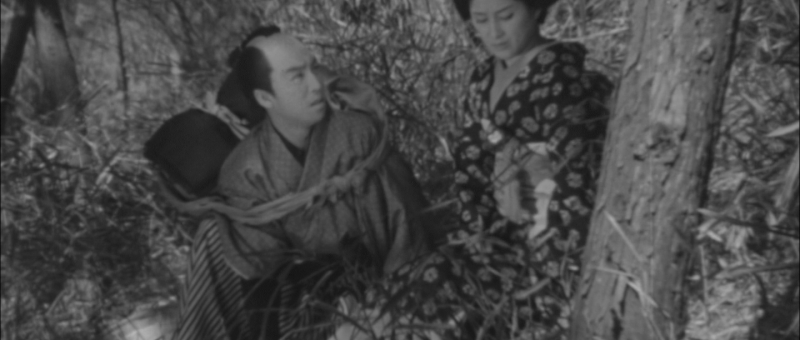
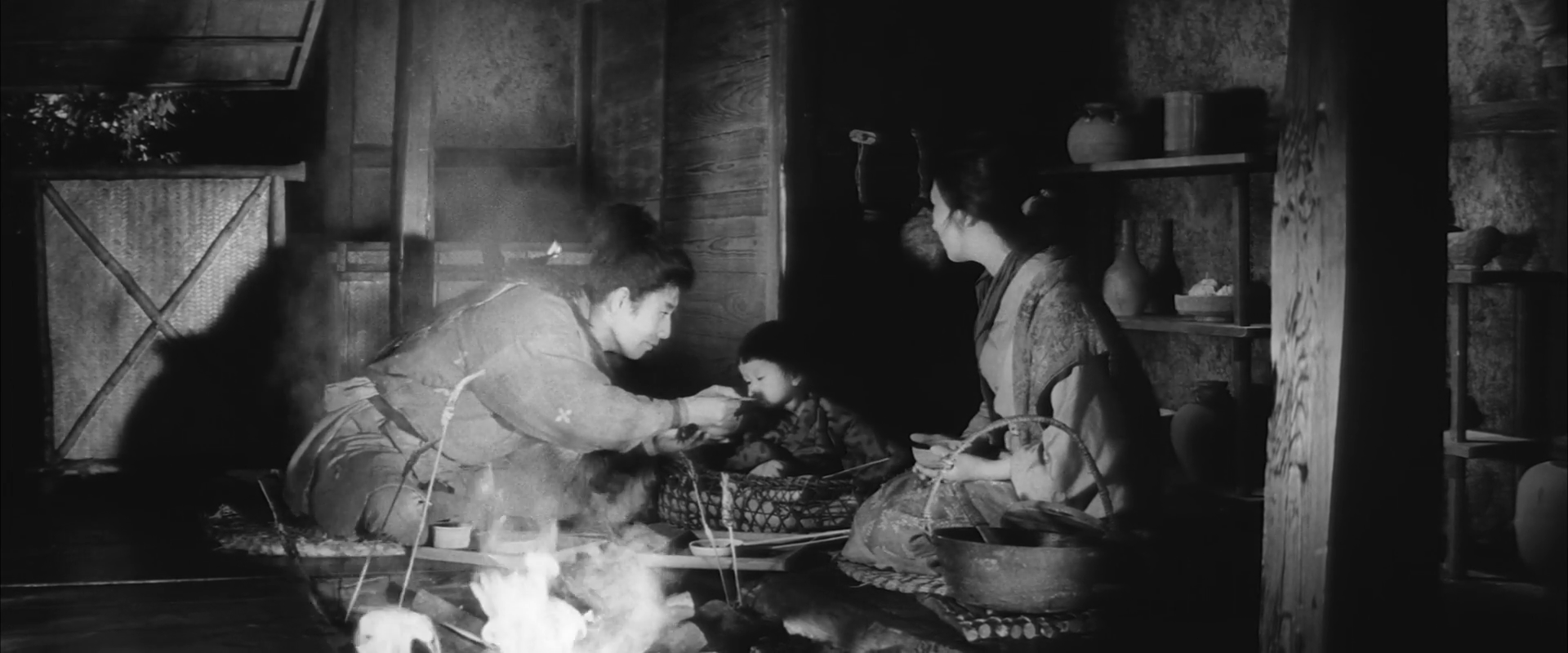
“It’s a rough and difficult road.” The heroes of Mikio Naruse’s Okuni and Gohei (お國と五平, Okuni to Gohei), adapted from a kabuki play by Junichiro Tanizaki, are two displaced between the old world and the possibility of a new one if only they were brave enough to step away from the beaten path. Unbeknownst to them, they are being followed by the man they are seeking whose shakuhachi playing haunts them wherever they go as if taunting them with its presence. 

In this iteration of the tale, Tomonojo (So Yamamura) takes on a slippery quality almost if he were some supernatural devil sent to torment Okuni (Michiyo Kogure) and Gohei (Tomoemon Otani) leading them either towards or away from their salvation or damnation. In Okuni’s flashback, which is obviously coloured with her own nostalgia and regret, he’s a sensitive young man who promised himself in marriage to Okuni. But she is forced to refuse him. Her father rejects Tomonojo because he is without standing or prospects, and instead demands she marry a wellborn man of his choosing, Iori (Jun Tazaki). Iori is then killed in the street, uttering only Tomonojo’s name before he dies. It could then be that this is Tomonojo’s revenge on a society that has rejected him and robbed him of his love, yet the Tomonojo we later meet is much different than this idealised version in Okuni’s memory. He never denies killing Iori and offers no justification for it, but corners Okuni when she’s alone to tell her to free herself by dropping her quest for revenge. He’s also subtly blackmailing her, implying he heard her having sex with her manservant Gohei the previous night and in reality wheedling away pleading for his life.

For her part, Okuni seems torn in her motivations, uncertain whether she’s looking for Tomonojo to reunite with him or kill him, or perhaps is deliberately avoiding finding him at all. She was not married to Iori for very long and he was at the very least an insensitive and emotionally distant husband who spent most of his time at his friend’s house, claiming that it was “boring” to stay home with her. She has no great emotional desire for revenge, but has been told she must accomplish it in order to return to the samurai world, having been condemned to a kind of limbo as the widow of a murdered man. Even so, she has tired of her quest and asks herself what’s to become of them if Tomonojo is already dead. She repeatedly hints to Gohei that they should give up on finding him and on returning home, instead contenting themselves with their life on the road or else find somewhere to settle together in a new world in which a lady and her retainer could live as man and wife.

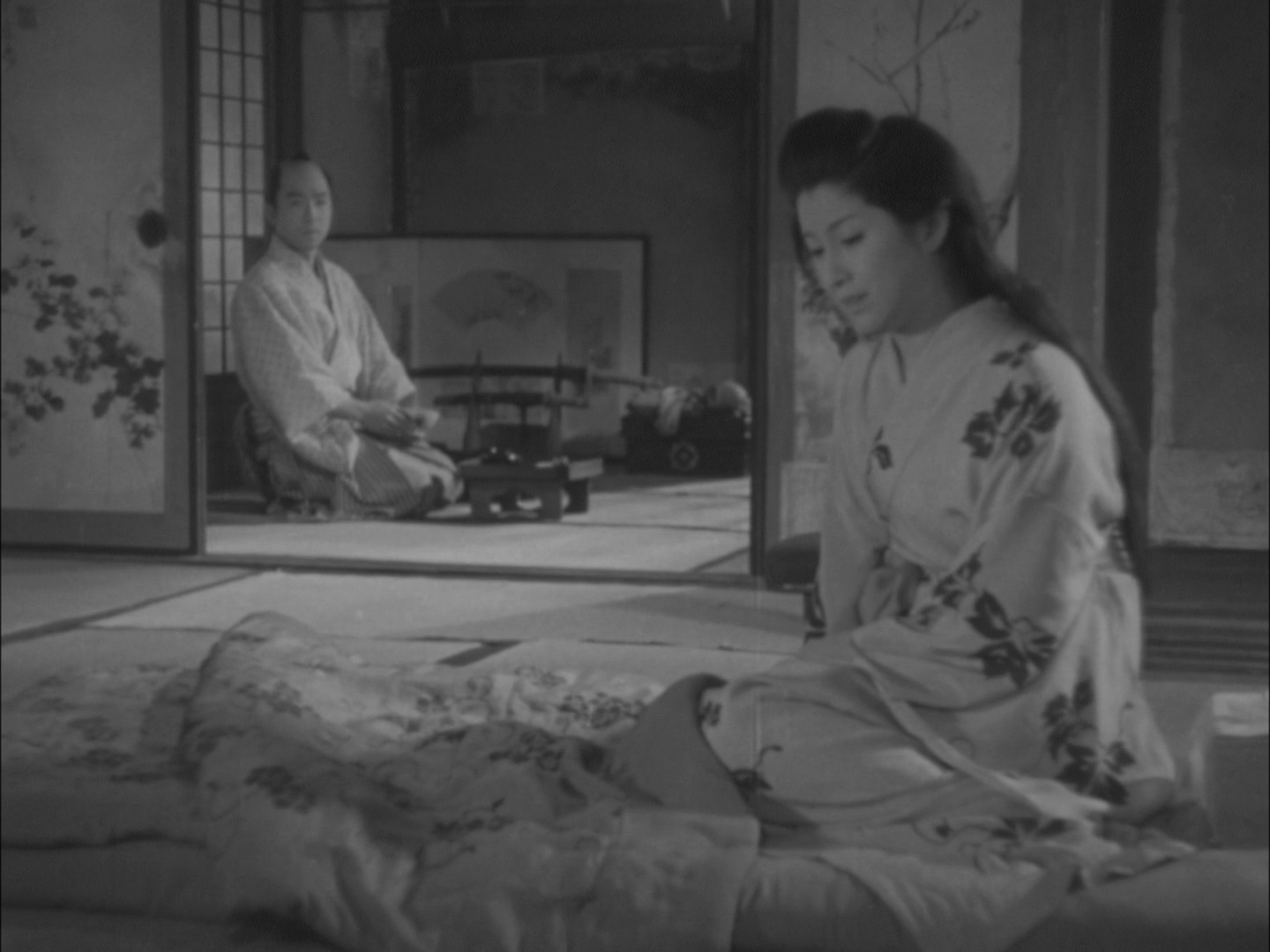
The film is both coy and somewhat transgressive in its depiction of the growing sexual tension between Okuni and Gohei from his taking hold of her injured foot and tender care for her when she falls ill, to the way they draw closer and then instinctively move apart. Passion later gets the better of them and it’s heavily implied that they sleep together, but Gohei instantly regrets it and cannot accept his class transgression. Given this development in their relationship, Okuni asks him to stop calling her “madam” but as she does so she is on one side of the fusuma and he on the other, so they remain in separate rooms divided by the ridge in the tatami. Gohei cannot let go of the old ways and is desperate to complete their quest so that his debt to Iori will be repaid and he can return in glory to be rewarded with position and the esteem of being a true samurai. Even if he tells Okuni that this quest has been his happiness in being on the road with her and knows that killing Tomonojo will end it, he does not turn back.

But the implication is that they can never escape Tomonojo who will, in fact, forever be following them. He taunts the pair with his shakuhachi and visits them in disguise. When they catch up to him, he tries again to convince them to give up their quest and live quietly together in a place free from the constraints of the samurai world, but Gohei cannot do it. Okuni first picks up her dagger and one wonders whether she about to use it on herself, but then turns on Tomonojo though it’s uncertain whether she now does so out of resentment or as revenge of herself for the way Tomonojo has again ruined her life. Just as she was a pawn of her father married off against her will to an indifferent man, she is further imprisoned by patriarchal social codes as Tomonojo needles Gohei that he had slept with her before her marriage. She has in fact already confessed to this to Gohei who transgressed by asking her what exactly Tomonojo was doing with his “shakuhachi” when they were courting, though she did so obliquely in telling him to remember his place and that he should “forget about the past.” Nevertheless she denies it now, but Gohei continues to see her as a “loose” woman with Tomonojo’s words ringing in his ears as a final revenge on the morally compromised lovers.

Their inability to let go of the quest, to do as Okuni suggests and continue on as they are along the rough and difficult path to a more egalitarian future spells their damnation. You can’t go back again. Their “home” is already lost to them. As a pedlar tells the pair along the way, they’ve already been forgotten and the village is filled with other gossip, but now they really have nowhere to go. The message may be for the coming post-occupation era that they shouldn’t try to turn back but keep moving forward into the new Japan or else risk becoming lost in a purgatorial world of confusion like Okuni and Gohei haunted by the choice to betray love for the outdated ideal of samurai honour. Haunted alternately by Tomonojo’s shakuhachi and the words of the villagers who told them they couldn’t be accepted until they fulfilled this quest, they find themselves displaced, unbalanced and uncertain amid the shifting power dynamics of class and gender, their duty and their feelings, but ultimately trapped by their cowardice in their unwillingness to cross the threshold to claim their freedom and happiness.


My Wonderful Yellow Car (吹けよ春風, Senkichi Taniguchi, 1953)

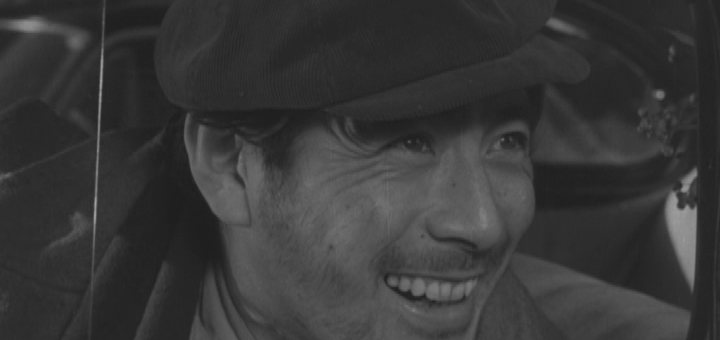
A kind-hearted taxi driver becomes our guide to the post-war society in a cheerful omnibus movie co-scripted by Akira Kurosawa and directed by Senkichi Taniguchi, My Wonderful Yellow Car (吹けよ春風, Fukeyo, Haru Kaze). Inspired by a Reader’s Digest column titled “human nature as seen in the rearview mirror”, the film follows cheerful cabbie Matsumura (Toshiro Mifune) as he drives around Tokyo in 1953 picking up various fares and sometimes adding commentary or trying to help with whatever kind of problem seems to be bothering them.

Then again, he stays well out of the first fare’s business as a young couple have obviously had some kind of falling out. Bursting into tears, the girl (Mariko Okada) announces that she wants to postpone the wedding and maybe even rethink this whole thing, while the boy reiterates with slight irritation that he’s said he’s sorry with the implication that that should be the end of it though we have no idea what (if anything) he’s actually done. In any case, they eventually patch things up over some canoodling in the back seat and ask to be dropped off so they can get something to eat. In some ways, the young couple represent a more hopeful vision of post-war youth who have no apparent worries besides their tiff and are financially comfortably enough not only to be getting married but can afford to travel by taxi and pay for a meal on the same occasion. 

Their situation is later contrasted with that of an older couple who’ve moved from Osaka to Tokyo in their old age and have bought a box of live lobsters to celebrate their silver wedding anniversary but as Matsumura notes though they appear to be quite well off they also seem somehow sad. That turns out to be because they lost their only son the previous summer and have moved into his old apartment. The old lady also cries in the back seat, but for a completely different reason. As they’ve only just moved here, they don’t have friends or anything to do and are completely lost in the wake of their son’s death. Matsumura’s kindness is demonstrated when he borrows three flowers from a bouquet delivered to a girl at the petrol station and presents them as an anniversary gift. The couple are so touched they invite him to enjoy their anniversary dinner with them and by the end of it have made the decision that they should go back to Osaka and restart their lives by re-opening their old business.

Throughout all this, Matsumura is very conscious of the meter. Every second he spent in the old couple’s apartment cost him money, but as he’s fond of saying you can’t always think of things like that. Even so, he reminds himself he has a wife and child so should be mindful of the clock but still turns down a fare to go back to the station and check on a young girl he’s pretty sure is trying to run away from home. A weird guy was sniffing around her and was in fact just about to lead her off when Matsumura gets back and announces he’s come to pick her up. Matsumura spends the rest of the ride trying to convince her to go home, repeatedly reminding her that most of the “panpans”, or streetwalking sex workers catering to US servicemen, were also once runaway girls. To more modern eyes we might wonder if sending her home is what’s best without knowing the reasons she wanted to leave. He goes so far as to buy her ramen which costs him more money on top of the lost fare which doesn’t collect from her either when he, a little less responsibly, abandons her when she refuses to tell him where she lives. Thankfully, it all seems to work out. The girl made a sensible decision to go home after all and is later seen happily doing her Christmas shopping with her mother who also thanks him for looking out for her.

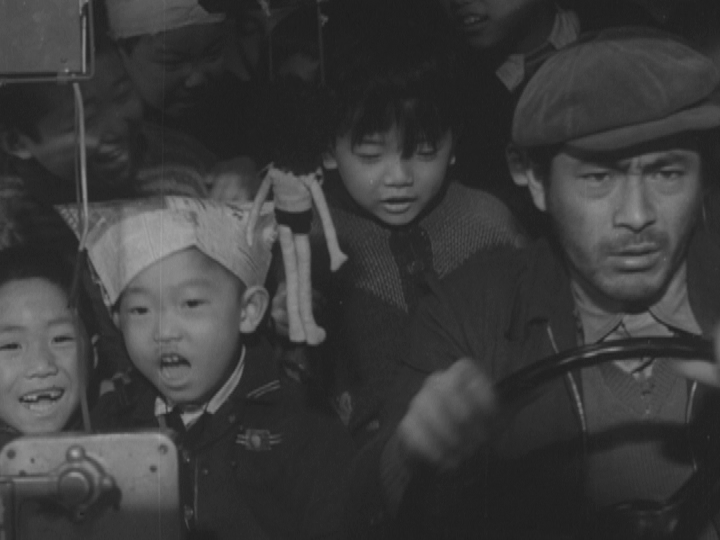
Perhaps these kinds of altruistic acts of kindness explain why Matsumura’s own clothes are quite ragged with a hole in his jumper and a tear to the shoulder of his jacket. He’s driving the cab in straw sandals which apart from anything else is probably quite cold in the winter. He spends another afternoon giving a free ride to some children, about 15 of them, who’ve crowdfunded 100 yen because they’ve never been in a car before and want to go as far it’ll take them having no idea that 100 yen is actually the initial charge so you can’t go anywhere on it all. Of course, Matsumura ends up taking them a bit further, and then realises he’ll have to take them back to where they were because they won’t have any other way of getting there or of knowing where they are now.

On the other hand, sometimes he ends up with nuisance fares such as two drunk guys who keep singing their university song. One of them even climbs out of the window and up onto the roof, causing Matsumura to assume he’s fallen off somewhere and he’ll have to go back and look for him to make sure he’s not hurt only to find him burbling in the footwell. He also ends up getting hijacked by a crook with a gun on his way back from Yokohama but getting a telling off from the police rather than a thank you for catching him after unwisely taking hold of the gun himself and messing up all the fingerprints. 

One might think the time he had a famous actress in the back of his cab who even sang along with the jingle he’d written for the cheerful yellow vehicle might make up for all that, but he says the story that best exemplifies why he loves driving a taxi is that of a middle-aged couple he picked up at the harbour shortly after a boat had docked repatriating people from China. Even in 1953, some had not yet returned after becoming trapped by the Chinese Civil War and eventual Communist victory. The man is dressed in military uniform and says he’s just been demobbed when Matsumura asks him, trying to lighten the mood while there’s obviously some degree of tension between the man and his wife. But as we gradually come to understand, it’s all just a ruse and he has in fact been in prison in Japan for the last seven years for an unspecified crime.

His wife asks Matsumura to drive around the city and attempts to show him how much things have recovered, suggesting that they can now put the past behind them and start over. But the man remains sullen and grumpy. He’s afraid to go home, afraid to face the neighbours worrying if they know what he did and that he’s been in prison. But most of all he’s afraid to face his children, the youngest of which he’s never met. The kids have been teaching themselves to say “Welcome home, Daddy,” in Mandarin believing he’s been in China all this time which the wife has to explain before they get there. The man tells his wife he understands if she doesn’t want him back, but she assures him that the children are excited as is she to start their new life together. Nevertheless, though they’ve been eagerly practicing, the older two children simply freeze when confronted by this anxious stranger who turns around to leave again feeling as if he doesn’t have the right to come back here after all only for the youngest one to suddenly pipe up with the phrase note perfect. It’s this kind of scene, getting people to where they need to be physically and emotionally, that seems to make Matsumura’s job worthwhile. In essence, he’s ferrying people towards the cheerful post-war future his cute yellow cab represents while driving round the rapidly changing city wondering who it is that’s going to end up in the rearview mirror today.


Title song (no subtitles)

The Wind Blows Twice (風ふたゝび, Shiro Toyoda, 1952)

Struggling with the end of her marriage, a young woman finds herself listless yet considering new possibilities in Shiro Toyoda’s The Wind Blows Twice (風ふたゝび, Kaze Futatabi). Adapted from a serialised novel by Tatsuo Nagai, the title is echoed in a remark from one of two potential suitors that youth is something that can come two or even three times so as long as you remain young at heart. They are each, however, each currently frozen and unable to move forward in the wake of their personal traumas. 

Kanae (Setsuko Hara), it seems, married for love but her husband has apparently been arrested for some kind of corruption. She has severed all ties with him and returned to the house of the uncle and aunt who raised her after her mother’s death where she helps out in their shop. Meanwhile, she learns that her semi-estranged father Seijiro (Ken Mitsuda), a university professor who lives in Sendai and hasn’t been in contact despite his daughter’s difficult circumstances, collapsed on the steps of the local station and is being cared for by a former student, Miyashita (Ryo Ikebe). She travels to look after him and becomes closer to Miyashita, who currently works as an auctioneer and has dreams of becoming a greengrocer, but is perturbed to learn that her father is a suspect in the theft of 10,000 yen from the wallet of a wealthy man, Michihara (So Yamamura), who carelessly left in the toilet and discovered the money missing when he went back to pick it up. Worried that the rumour may damage her father’s career, Kanae goes to apologise and find out what’s going on but Michihara tells her not to worry and it was his own fault anyway but his sudden magnanimity seems suspicious. In any case, Kanae later tells her friend Yoko that Michihara frightened her, also remarking to Miyashita that she felt as if she managed to slip away from him as she made her escape.

Though he later turns out to be sympathetic, Michihara appears as the villain of the piece. He thinks Kanae reminds him of his late wife and intends to ask her to marry him one the seventh anniversary memorial service is concluded. He starts using his wealth and power to gently interfere in her life, setting up a job for her on hearing that she’d been looking for employment and later approaching her father with the idea of investing in his research into the use of fluorides in the production of resin. Despite her initial dislike of him, Kanae goes along with everything and is soon sucked into Michihara’s world while otherwise wilfully oblivious of his feelings for her (which she does not share) and hoping he’ll help her convince Miyashita that he ought to return to science and help her father with his research which would obviously pave the way for them be together romantically.

The problem is that like Kanae Miyashita has become frozen inside, scarred by his wartime experiences and soured on science. Yet just as staying with him restores Kanae’s spirit and encourages her to want to look for work and find purpose in her life, her influence on him reawakens his passion for scientific research only he is less happy about it than she was. The interest that’s sparked in him ironically lies in the frozen north, travelling to Hokkaido to see an old friend and researching how to prevent potatoes from freezing in order to improve people’s quality of life. In essence it seems as if the futures they may want are too different. Now much more cheerful and energetic, Kanae genuinely enjoys her work in broadcasting and is less than keen to give it up and move to rural Hokkaido to help Miyashita study potatoes while secretly hoping she can convince him, with Michihara’s help, to become a respectable academic like her father and live a nice middle class life researching things that are more useful to industry and big business than to regular people.

Miyashita is disinclined to do so. He bounds straight off a train to see her with three day stubble from the journey, only to be disappointed witnessing in her in an elaborate kimono with her hair constrained in traditional style while Michihara is there waiting to see him to discuss a job offer from Seijiro. It’s at this point that he seems to decide his romantic desire for Kanae is most likely futile and she has chosen the rarified world of Michihara rather a rustic and homely life with a man like himself. Of course, this makes it sound as if Kanae doesn’t have much choice at all herself and to an extent she doesn’t or at least she feels backed into a corner while her aunt pressures her to remarry, unbothered to which man but excited about the proposal from Michihara because it means she will enjoy a life of uninterrupted financial comfort.

Having chosen her own suitor and seen things go drastically wrong also increases her aunt’s conviction that she shouldn’t make the same mistake again while she too is perhaps wary of remarrying. In any case. Kanae seems to want work and enjoys her job in broadcasting as much as she’s naturally drawn to Miyashita who brings out in her a greater desire to live while Michihara only seems to want her to be a shadow of his late wife suggesting that to marry a man like that may itself be a kind of death sentence. To that extent, the choice Kanae makes involves a predicable sacrifice, but still in any case it is a choice that she makes for herself to strike out for happiness and fulfilment of her own choosing rather than allow herself to be railroaded by conventionality unable to express her own desires.


The Sand City in Manchuria (砂漠を渡る太陽, Kiyoshi Saeki, 1960)

A pure hearted doctor stands strong against the forces of imperialism if somewhat ambivalently in Kiyoshi Saeki’s wartime drama The Sand City in Manchuria (砂漠を渡る太陽, Sabaku wo Wataru Taiyo). “Why isn’t there just one country? I don’t want a country” a young Chinese woman exclaims towards the film’s conclusion in what is intended as an anti-war statement but also invites the inference that the one country should be Japan and that China is wrong to resist the kind of “co-existence” that the idealistic hero is fond of preaching. 

Dr. Soda (Koji Tsuruta), known as Soh, has been in Manchuria for two years running a poor clinic in a trading outpost on a smuggling route through the desert. He came, he later tells another Japanese transplant, after being talked into it by a pastor who told him about US missionaries who endured hardship in the Gobi desert and lamented that no Japanese people had been willing to take on such “thankless” work in the midst of the imperial expansion. There is a kind of awkwardness in Soda’s positioning as the good Japanese doctor which perhaps reflects the view from 1960 in that he objects to the way the Japanese military operates in Manchuria and most particularly to Japanese exceptionalism which causes them to look down on the local Chinese community as lesser beings, but within that all he preaches is equality and co-existence which suggests that he sees nothing particularly wrong in Japan being in Manchuria in the first place while implying that the Chinese are expected to simply co-exist with an occupying force to which they have in any case been given no choice but to consent. 

Nevertheless, it’s clear that the Japanese are in this case the bad guys. Soda is at one point accosted by a drunken soldier who takes against his choice to adopt Chinese dress while rudely refusing to pay his rickshaw driver. The animosity of some in the town is well justified as we hear that their mother was murdered by a Japanese soldier, or that they were raped by Japanese troops and now have nothing but hate for them to they extent that they would withhold vital medical treatment from a child rather than consider allowing Soda to treat them. Soda’s main paying job is working at an opium clinic hinting at the various ways imperialist powers have used the opium trade to bolster their control over the local population, while it later becomes clear that one of the Chinese doctors has been in cahoots with a corrupt Japanese intelligence officer to, ironically, syphon off opium meant for medical uses and sell it to addicts in a truly diabolical business plan. 

Though Soda is well respected in the town because he offers free medical treatment to those who could never otherwise afford it, he is sometimes naive about their real living conditions. Outraged that a young woman has been sold into sexual slavery, he marches off to the red light district to buy her back but is confused on his return realising her family aren’t all that happy about it because they cannot afford to feed her and were depending on the money she would send them because the father has become addicted to opium and can no longer work. The girl, Hoa (Yoshiko Sakuma), becomes somewhat attached to Soda but he is largely uninterested in her because she is only 17, while her affection for him causes tension with the daughter of an exiled Russian professor which is only repaired once they all start working together for the common good after the town after it comes under threat from infectious disease. 

In an echo of our present times, it seems not much has changed in the last 80 years or so, the townspeople quickly turn on Soda once it become clear that he’s putting the town on lockdown to prevent the spread of infectious meningitis after a Russian soldier stumbles in and dies of it. The disease firstly exposes the essential racism even among those Japanese people who have lived in Manchuria longterm such as the mysterious Ishida (So Yamamura) who remarks that diseases like that only affect the Manchurians and they’ll be fine because they are “more hygienic”, while simultaneously painting the infection as a symptom of foreign corruption delivered by the Russian incursion. Soda visits a larger hospital to get the samples confirmed but is told that the disease has not been seen in Manchuria before and so they have no vaccine stocks leaving him dependent on the smuggling network to get the supplies he needs. As the town is a trading outpost whose entire economy is dependent on the business of travellers just passing through, the townspeople are obviously opposed to the idea of keeping them out fearing that they will soon starve going so far as to tear down Soda’s quarantine signs while throwing stones at his house. 

In another irony, it’s Ishida’s pistol that wields ultimate control immediately silencing the mayor’s objections in a rude reminder of the local hierarchy. Many of the townspeople including inn owner Huang (Yunosuke Ito) and Hoa’s sister Shari (Naoko Kubo) are involved with the resistance to which Soda seems to remain quite oblivious and in any case adopts something of a neutral position but gains a grudging respect from Huang thanks to his humanitarianism that eventually saves him from brutal bandit Riyan (a rare villain role for a young Ken Takakura). In any case, as the corrupt Japanese officials pull out to escape the imminent Russian incursion, Soda decides to stay in part to atone for the sins of the Japanese in an acceptance of his responsibility as a Japanese person if one who has not (directly) participated in the imperialist project even if he was in a sense still underpinning it. Essentially a repurposed ninkyo eiga starring Koji Tsuruta as a morally upright man surrounded by corruption but trying to do the right thing to protect those who cannot protect themselves, there is an undeniable awkwardness in the film’s imperialist ambivalence but also a well intentioned desire to look back at the wartime past with clearer eyes and a humanitarian spirit. 


Sound of the Mountain (山の音, Mikio Naruse, 1954)

“All I can do for you now is set you free”, a failed father laments. Mikio Naruse is renowned as a pessimist according to whom we are always betrayed by the world in which we live, yet bleak as it sometimes is 1954’s Sound of the Mountain (山の音, Yama no Oto) offers us what in Narusean terms at least might be considered a happy ending. Adapting a novel by Yasunari Kawabata, Naruse and his screenwriter Yoko Mizuki stop their story a little before the original’s conclusion offering an “open prospect” in which the chastened patriarch is forced into retreat, setting the young ones free while reflecting on paternal failures both national and personal. 

Now in late middle age, CEO Shingo (So Yamamura) is beginning to notice things he perhaps hadn’t before or had merely brushed aside such as the various ways the women around him continue to suffer because of inherently unfair patriarchal social codes. He dotes on his cheerful daughter-in-law Kikuko (Setsuko Hara) but is also aware his son/employee Shuichi (Ken Uehara) is having an affair. Confronted, Shuichi pledges to end the relationship but asks his father if he has honestly remained faithful all his life. Shingo doesn’t exactly deny anything, but remarks that it justifies nothing and his son ought to know better. 

According to Shingo, a man’s success is affirmed if he lives out his life unharmed but one’s success as a parent depends solely on that of the marriages of one’s children and on that front at least Shingo appears to be a failure. Shuichi offers barbed comments about his wife that sound like jokes but clearly aren’t, responding to query as to why they have no children with an excuse that his wife is a child herself, Kikuko’s face contorting momentarily in pain and shame at her husband’s cutting remark yet the only sign of childishness that we see in her is oft remarked cheerfulness. The Ogata household is currently down a maid and it’s Kikuko who’s been picking up the slack as perhaps a daughter-in-law is expected to do, taking care of the household and ensuring her in-laws are well cared for. Ironically enough, the Ogatas love her like a daughter, in part because of her ability to conform to what is expected of a wife despite their son’s indifference, though Shingo is perhaps learning to see past Kikuko’s placid expression, so like the impassive noh mask passed to him by a deceased friend, in the brief flickers of her discomfort. The old couple discuss a double suicide of a couple their age who have decided to leave quietly of their own volition with bleak humour, a look of such total and abject despair passing over Kikuko’s face as she replies to Shingo’s question if she too would write a note if she planned to die with her husband that she might leave one for him. 

The ill-defined relationship between Kikuko and her father-in-law is in essence paternal but profoundly felt, founded on a shared sense of connection and a deep respect. It stands in contrast, however, to that with his own daughter, Fusako (Chieko Nakakita), who returns home to her parents having discovered that her husband is also having an affair. In a sense, this reaction is a facet of post-war freedom, Shingo’s wife Yasuko (Teruko Nagaoka) may suspect her husband had other women but would have pretended not to and in any case would never leave an otherwise successful marriage over such a “trivial” matter. Fusako, meanwhile, has the freedom to demand better and to leave if she doesn’t get it but continues to hesitate blaming her father’s indifference towards her for her husband’s lack of respect something which she believes also fed into his poor choice of match. 

Cheerful, stoical Kikuko meanwhile finds herself caught between tradition and modernity unhappy in her marriage but uncertain if she has the right to escape it. Despite his parents’ niceness, Shuichi has grown into a cruel and selfish man, running down his wife and neglecting his work to romance his father’s secretary, who is not the mistress (not that she wouldn’t like to be), and apparently a violent drunk who routinely beats his girlfriend, a war widow and independent woman who sees nothing wrong in dating a married man because his wife is only waiting for one certain to return. Mirroring Kikuko, Kinuko (Rieko Sumi) is also pregnant but transgressively plans to have the child and raise it alone (supported by her friend and roommate). Telling no one, Kikuko learns that she is expecting but unilaterally opts for an abortion telling her husband that she cannot in good conscience give birth to his child knowing the kind of man he is. Confronting Shuichi, Shingo describes it as a kind of suicide and he is at least right in that she kills the image of herself as the good wife but does so by choosing her own integrity, seizing her agency in rejecting a dissatisfying present to seek a happier future. 

By contrast, we get the impression that Fusako, who has two children already, will likely return to her husband. Shuichi has the talk with his brother-in-law his mother hoped he would, but bonds with him in male solidarity, excusing his affair while advancing that Fusako doesn’t understand that he is merely working hard for their family laying bare a fundamental disconnect in the thinking of men and women further borne out by Yasuko’s assertion that men and women deal with sorrow differently. It’s this series of disconnects, between men and women, parents and children, that Shingo is beginning to bridge only to be confronted with his own patriarchal failures. While he and his wife are seemingly happy enough, he brushing off her self-deprecating remark that he was “unlucky” in marrying her only because her prettier sister died, his children’s marriages have each failed. His failure stands in for that of his generation, realising that he all he can do for them now is set them free. Meeting Kikuko in a park with wide open vistas, oddly like the final meeting of doomed lovers aware they must now part, Shingo vows retreat, planning to retire and move to the country with his wife as if liberating the youth of Japan from the oppressive social codes of the past in ceding the “open prospects” of the post-war society to his surrogate daughter in order that she might at least seize her freedom to chase her own happiness. 


Early Spring (早春, Yasujiro Ozu, 1956)

By the mid-1950s, Japan’s economy was beginning to improve but now that the desperation that went with hunger had dissipated it freed those who’d managed to climb out of post-war privation to wonder just what the point of their ceaseless toil was. Yasujiro Ozu’s primary subject matter remained the modern family, but 1956’s Early Spring (早春, Soshun) sees him heading in a darker direction as he weighs up the delusions of the salaryman dream and discovers that whichever way you swing it, life is disappointing. 

So it seems to be for salaryman Shoji (Ryo Ikebe). He and Masako (Chikage Awashima) married for love a long time ago, but it’s clear that there is distance in their relationship. They sleep in the same room but their futons are slightly too far apart, and the few words they exchange with each other in the morning are terse in the extreme. The truth is that for many a salaryman for whom long hours and interoffice bonding sessions are compulsory, work is the new family. Wives are welcome to join the Sunday hiking outings but it seems few do. Masako too declines, telling her mother she felt it to be too expensive, already irritated with her husband’s irresponsible spending on mahjong games and drinking with friends. 

Money is certainly a constant worry for her and as we learn from her mother they’re behind on the rent despite it being “very cheap”. Masako had made a visit home in part to ask for another loan, which her mother seems reluctant to give, offering her daughter a takeout of the oden her restaurant sells which is first declined but then accepted. Her mother also flags up the other problem in their marriage which is that they sadly lost a child in infancy and have had no more. Sorrow may have killed their love, but the fact her husband stays out all hours and wastes the little money he earns while failing to win promotions only makes the situation worse. 

As for Shoji, he is becoming very aware of the delusions of the “salaryman dream”. He is one of thousands of men identically dressed in white shirts and grey trousers that board the packed rush hour trains every day heading into the city. His life is one of pointless drudgery and its only victory is that keeps hunger from the door, not even quite stretching to a roof over his head. “All that’s waiting for us is disillusion and loneliness” according to a veteran salaryman growing close to his retirement and realising that he has little left to live on, his dream of buying a small stationary shop all but unobtainable. He was dead set against his own son joining the ranks of the salaryman, but in the end failed to prevent it.

It is perhaps this sense of frustration and impotence that draws Shoji into an affair with a younger woman, Chiyo (Keiko Kishi), who is admittedly very pretty but seems to hold little interest for him aside from her youth and beauty. Chiyo openly pursues her older colleague, declaring that she doesn’t care he has a wife but has come to hate her after the first time they slept together. Shoji meanwhile remains guilty and conflicted. He evidently continues seeing Chiyo, lying to Masako that he’s visiting a sick friend, but otherwise regards her as an irritation. When his co-workers figure out what’s going on they try to stage an intervention, but Shoji doesn’t show up and Chiyo angrily denies everything before arriving at Masako’s looking for Shoji only this time he really is out visiting a sick friend. 

Miura (Junji Masuda), the sick friend, is a true believer in the salaryman dream. Now that he’s ill, he misses the packed trains and elevators, not to mention his old workplace friends. All he wants is to be well enough to return to the office and his predicament perhaps has Shoji thinking that at least he has his health and things aren’t so bad for him after all. Masako, meanwhile, turns to other women for advice. The woman across the way recounts how she caught her husband out with his mistress and made a scene that’s rendered him docile and obedient ever since (a rare man in an Ozu film putting his socks neatly in the laundry basket and hanging up his own coat rather than throwing it on the floor for his wife to deal with). Her widowed friend is more sanguine, admitting that caution is necessary but it’s a little dark to envy the life of a widow for its “freedom”, while her mother thinks she’s overreacting because that’s just how men are in this generation or any other. 

Shoji’s old mentor agrees that “everyone’s disappointed” and all that remains is to try and make the most of it, but still he sees that Shoji has been reckless and inconsiderate in his treatment of both women. He avoids his wife because of the emotional distance between them born of grief, and only really has an affair with Chiyo because it was easier than refusing her. He didn’t even enjoy it, and doubtless it did not quite quell the sense of despair he feels with the utter pointlessness of the “salaryman dream”. Masako, in turn, is disappointed with married life, with her husband’s emotional cowardice, and with her own lack of options. Ultimately, Ozu sides with the mother, not quite condoning Shoji’s behaviour while perhaps excusing it as a direct consequence of dullness of his life while forcing Masako to accept complicity in her husband’s weakness. They may reunite, the stressors of their Tokyo life from the high cost of living to the lure of mahjong now absent, but there is a sense of futility in their eventual insistence that they will “make it work” through starting over in a new place while gazing at the train that, they assume, will eventually carry them back to the city and all of its false promises of a brighter future. 


Early Spring screens 19th/20th/21st October & 20th/23rd November at London’s BFI Southbank as part of BFI Japan. It is also available to stream in the UK via BFI Player and in the US via Criterion Channel.

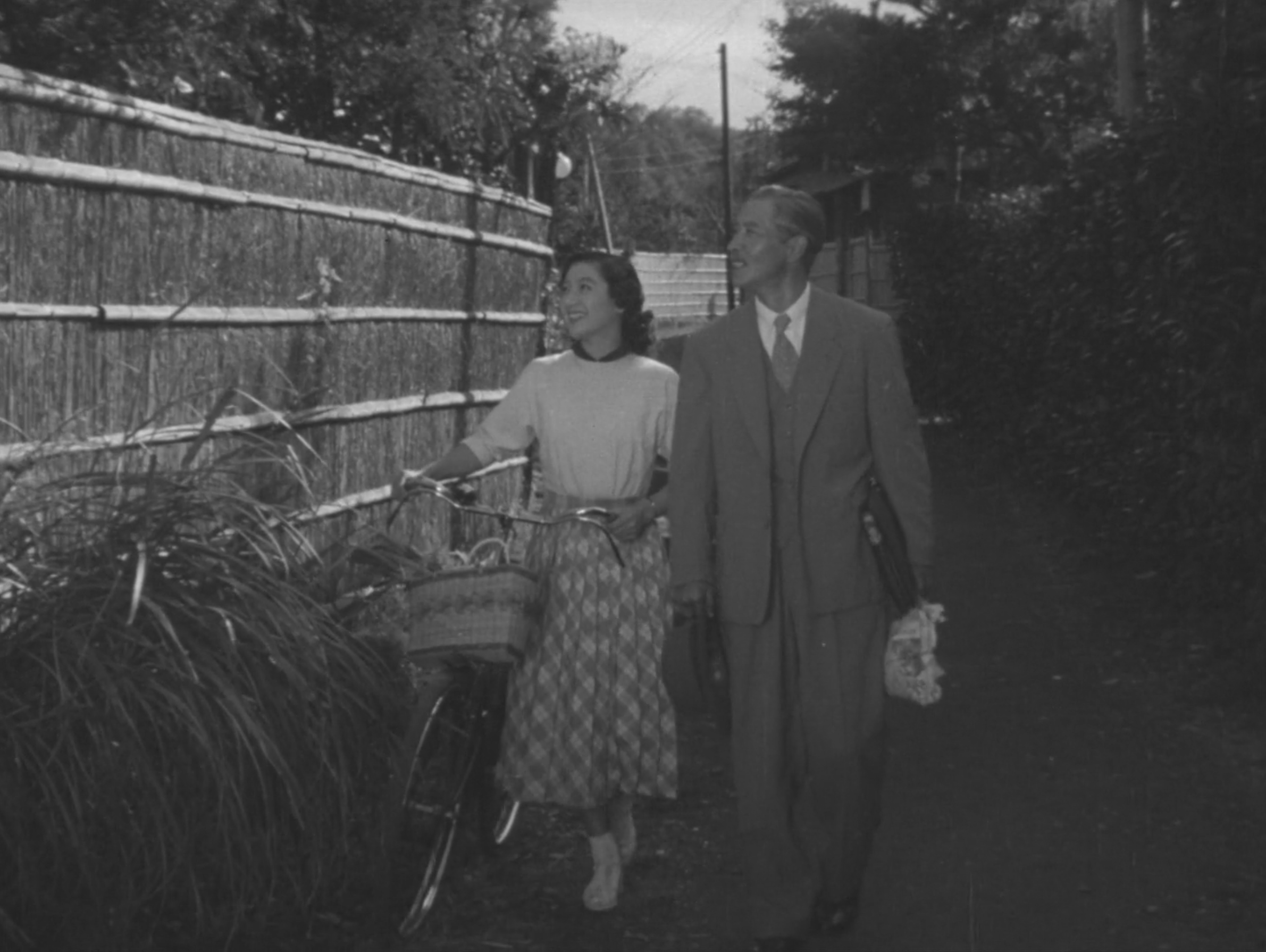
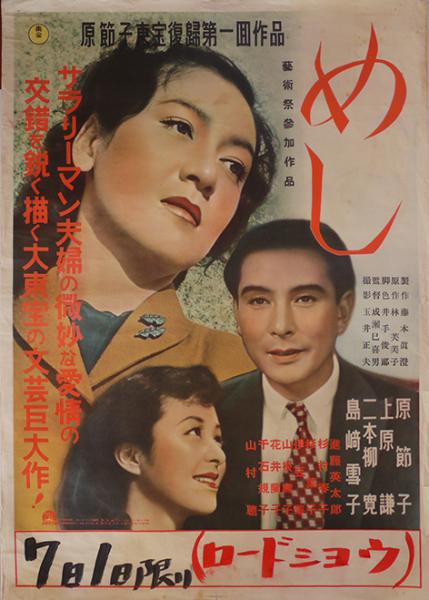
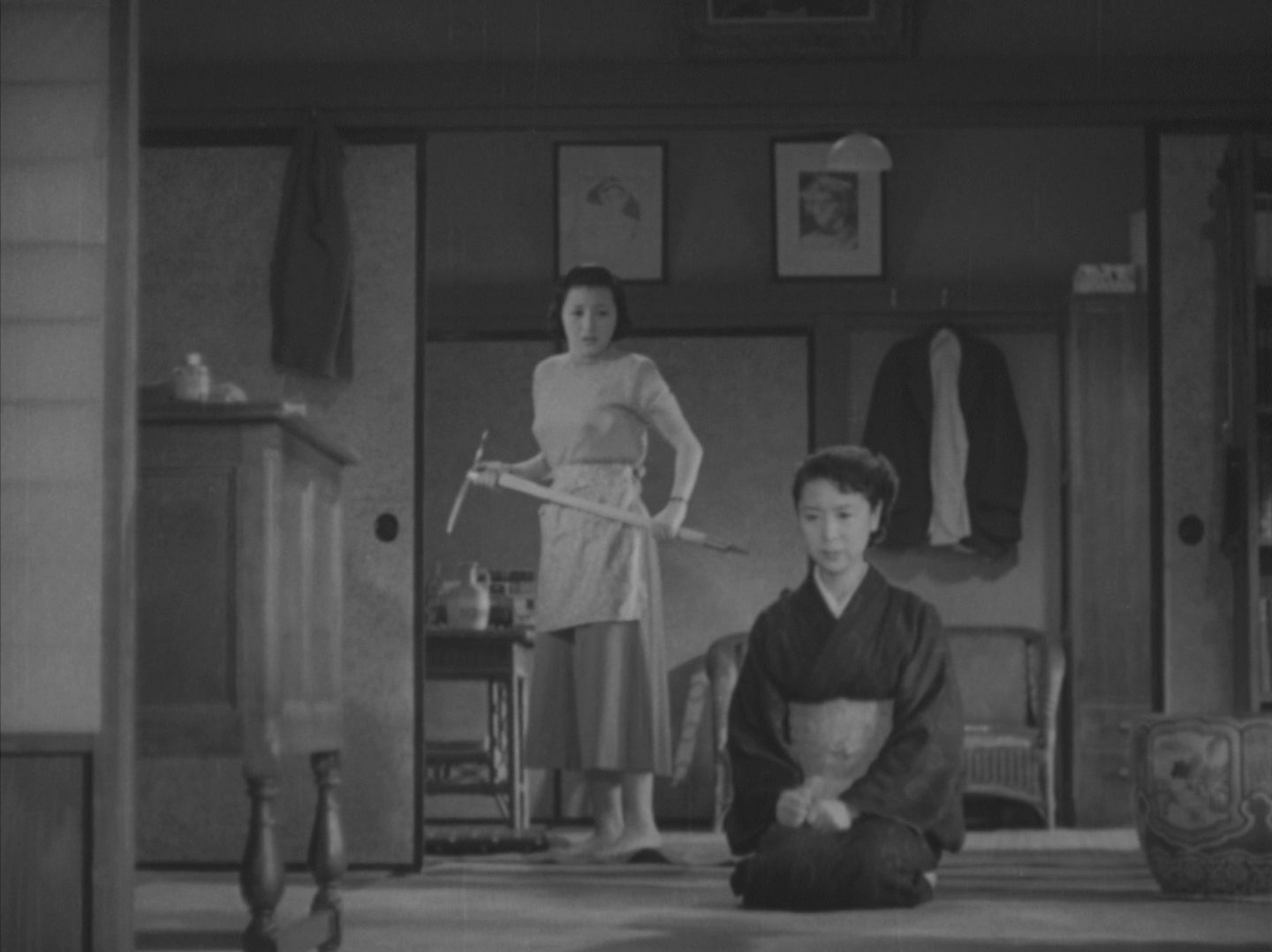
Repast (めし, Mikio Naruse, 1951)

“Must every woman grow old and die feeling empty?” asks the unhappy heroine of Naruse’s 1951 melodrama Repast (めし, Meshi) only to conclude that yes, she must, but that this in fact constitutes “happiness” as a woman. The first of Naruse’s Fumiko Hayashi adaptations Repast arrived in the year of the author’s death and is inspired by a short story left unfinished at the time of her passing. Screenwriter Sumie Tanaka was apparently convinced that the film should end with a divorce, as Sound of the Mountain would two years later, and consequently left the project after the studio mandated a more “sympathetic” ending. Superficially happy as it might seem, however, the conclusion is as bleak as one might expect from Naruse in which the heroine simply accepts that she must recalibrate her idea of happiness to that which is available to her and learn to find fulfilment in shared endeavour with her husband. 

As she explains in her opening voiceover, Michiyo (Setsuko Hara) married her husband Hatsunosuke (Ken Uehara) five years ago in Tokyo against her family’s wishes and has been living on the outskirts of Osaka for the past three. Marital bliss has quite clearly worn off. As we see from the repeated morning scenes of the local community sending their sons off to school and husbands to the office, every day is the same and all Michiyo ever seems to do is cook and clean. The only words Hatsunosuke says to her are “I’m hungry”, and the only source of solace in her life is her cat, Yuri. Yet even this constant state of unhappy frustration is disrupted by the unexpected arrival of Hatsunosuke’s spoilt and immature niece Satoko (Yukiko Shimazaki) who has apparently run away from home in rebellion against an arranged marriage. 

There is obviously a blood relation between Hatsunosuke and Satoko, but Michiyo’s jealously is not exactly unreasonable given the young woman’s childish flirtation with her uncle, perhaps an adolescent extension of her propensity to pout and preen to get her own way. Aside from all that, finances weigh heavily on Michiyo’s mind. Other than her drudgery, the constant source of friction in the relationship is Hatsunosuke’s low salary and lack of career success. Satoko’s family are a little wealthier and having been brought up in relative comfort she has little idea of the real world and is often tactless, remarking on Hatsunosuke’s worn out tie much to Michiyo’s chagrin. Hatsunosuke is happy enough to have her, but Michiyo is wondering if there’s enough rice in the jar to see them through and Satoko never stops to consider that they’re feeding her for free even falling asleep when Michiyo enjoys her one and only day off reuniting with old friends rather than preparing dinner as she’d been asked. Perhaps aware of the disruptive effect of her presence, Satoko pours salt on the wound by constantly asking her uncle if Michiyo doesn’t like her or is angry, further placing a wedge between husband and wife. 

For all that, however, Hatsunosuke would not be accounted a “bad” husband for the time save perhaps for his lack of career success. He is not cruel or violent, merely insensitive and distant, taking his wife for granted and unable to see that she is deeply unhappy while otherwise internalising a sense of guilt and failure in his inability to adequately provide for her. She meanwhile sometimes takes her dissatisfaction out on him in barbed comments about his low salary, her barely hidden contempt never far from the surface. Yet as her mother later points out in encouraging her go back to him he is “reliable, discreet, and honest”, qualities borne out by his later refusal to go along with a dodgy scheme organised by the old elite along with his nervous rebuttal of the attentions of the “mistress” from across the way. 

At heart a conservative woman, Michiyo too looks down on Ms Kanazawa (Kumeko Otowa) for her taboo status as the illicit lover of a wealthy man which is only in a sense her way of seizing her future as an independent woman running her own bar. Satoko, a woman of the modern era, sees less of a problem with it and is far less judgemental, though her own attempts are destined to end in failure thanks to her inability to work out that her present lifestyle is far above her current reach. Retreating to her Tokyo home, Michiyo looks for other options, admiring the apparently happier relationship between her younger sister and brother-in-law who now run the family shop. She asks a sympathetic cousin, Kazuo (Hiroshi Nihonyanagi) who provides an alternate love interest, to help her find work but encounters the brutalising line outside the local employment office and then an old friend now a war widow desperate for employment because her benefits are about to run out and she has a young son to support. Later she spots the same woman handing out flyers, suddenly realising the fallacy of her fantasy of starting again as an independent woman. She pens a letter to her husband admitting that she’s realised how vulnerable she is without his protection, but remains undecided enough to avoid sending it. 

Hearing that Satoko, still childish but perhaps not quite as naive as she assumed her to be, has been laying her claws into Kazuo the final nail seems to have been struck. Michiyo knows she will return to Osaka, but does so not because she has rekindled her love for her husband but because she has accepted there are no better options. Hatsunosuke is dull, but he is in a sense reliable, and honest to the extent that he may be about to be rewarded for his moral unshakability. He cares enough about her to show up in Tokyo hoping, but not insisting, she will return with him which is perhaps as close to a declaration of love that one could hope for. On reflection she decides that a woman’s happiness is found in sharing the journey with her husband, accepting that she must subsume her own desires into his and cannot hope to expect emotional fulfilment other than that found in his satisfaction. Even for a Naruse film, and one as peppered with moments of slapstick humour as this one is, it’s an extraordinarily bleak conclusion subtly hinting at the iniquities of life in a patriarchal society in which the best a woman can hope for is a life of unrewarded drudgery. 


The Munekata Sisters (宗方姉妹, Yasujiro Ozu, 1950)

Though they may eventually turn melancholy, the films of Yasujiro Ozu are often cheerful affairs in which kindhearted people bear life’s troubles with stoic dignity. There are few villains, only those trying to live even while living is hard. The Munekata Sisters (宗方姉妹, Munekata Shimai) adapted from a story by Jiro Osaragi and produced for Shintoho rather than home studio Shochiku, however, strikes a much less happy tone, ambivalently condemning its heroine to unhappiness through her own adherence to the codes it otherwise insists are noble. 

The two titular sisters, Setsuko (Kinuyo Tanaka) and Mariko (Hideko Takamine), live in Tokyo where Setsuko runs a small bar which supports the family while her moody husband Mimura (So Yamamura) has long been out of work. Their father, Mr. Munekata (Chishu Ryu), has returned to Kyoto where, a doctor informs Setsuko in the opening scenes, he is suffering from terminal cancer but surprisingly healthy all things considered. Like his oldest daughter, Kyoto suits Mr. Munekata because as he puts it it is full of the beauty of old Japan, though Mariko has soon had enough of temples and palaces and longs to return to the modernity of the contemporary capital. Whilst in the city, however, they run into an old friend from Manchuria, Hiroshi (Ken Uehara), with whom Mariko soon realises her sister had been in love but he left for France before they could declare their feelings while she was already engaged to her present husband. 

Mariko, a youthful woman dressing exclusively in modern Western fashions, is quite taken with the idea of her sister’s failed romance and determines to get the pair back together. She has only resentment for her moody brother-in-law and has long been aware that Setsuko’s marriage is a failure. Within her seeming modernity, Mariko is surprisingly conservative when it comes to traditional gender roles, resenting Mimura for failing to provide for the family as a man is expected to do. Overcome with despair, he spends his days in a drunken stupor playing with stray cats rather than seriously looking for a job, defined by wounded male pride in his obvious discomfort with the fact that his wife is supporting him through the business that she operates herself. Mariko tells him to man up, tired of the way he leaves each of the women anxious in their own home, but Setsuko, more conservative still, reminds her younger sister that marriage isn’t all sunshine and rainbows and that sometimes all you can do endure. 

Mariko regards her sister’s way of thinking as “old-fashioned”, while Setsuko disapproves of her vacuous “modernity” which she sees as little more than social brainwashing that leads her to blindly follow only what is “fashionable” without thinking for herself. Mr. Munekata had said those who refused to see the beauty in old things were simply “ignorant”, but when asked to arbitrate between the sisters adopts a more equivocal position. You are you and your sister is your sister, he insists, you have your own ways of thinking and neither of you is wrong, you have simply to choose the path which suits you best. He does however caution against Mariko’s “fashionable” mindset, reminding her that it isn’t good to be mindlessly swayed by the prevailing trends, what’s important is to think deeply and value your own life. Those who only do what’s fashionable are boring, he tells her.

Later Mariko describes “modernity” as “not growing old despite the years” perhaps to counter Setsuko’s earlier dismissal that new things never become old because they don’t last. In any case, she is still in many ways a child with an underdeveloped appreciation for complex emotions which might explain why she suddenly proposes to Hiroshi herself as if she means to marry him on her sister’s behalf. She also unfairly takes against a wily widow, apparently a “friend” of Hiroshi’s from Paris who may or may not be in love with him but has obviously not replaced Setsuko in his heart. Setsuko however is conflicted, accepting financial help from Hiroshi to keep the bar open but resentful of her husband’s suggestion there is anything improper between them. She is an “old-fashioned” woman after all. Like What Did the Lady Forget?, Munekata Sisters also posits domestic violence as a reset button on a marriage as Mimura angrily slaps his wife across the face several times, but thankfully here it signals the death knell rather than rebirth of their relationship. Mimura has reasserted his manhood, but it has only shown him just how desperate and empty he has become. His wife no longer has respect for him, let alone love. 

Yet Mimura continues to control her feelings, implying that the failure of the relationship is her fault alone because she never loved him. He has slowly destroyed himself out of resentment and romantic disappointment. It seems that, though he was too cowardly to confess his feelings, Hiroshi has never forgotten his love for Setsuko and the possibility remains that she may be able to claim a happier future through abandoning her “traditional” way of thinking (“fashionable” in its own way), separating from her husband to marry for love. But in the end her code will not allow it. Guilt casts a shadow over her heart, leaving her feeling that she is no longer allowed happiness and must sacrifice her true desires to atone for the failure of her marriage. A glimmer of hope remains in Hiroshi’s determination to wait, trapping himself within the repression of patriarchal social codes, but in the end even Mariko is forced to recognise her sister’s nobility as she too tours the beauty of old Japan without complaint in new contemplation of its ambivalent charms.


Tokyo Twilight (東京暮色, Yasujiro Ozu, 1957)

Closely associated with the family drama, Yasujiro Ozu is perhaps the most socially conservative of golden age directors. Unlike Naruse or Mizoguchi, he cheerfully reinforces patriarchal social norms and foregrounds the paternal experience while upholding the primacy of the traditional family in a rapidly modernising society. In his later career he’d come to sympathise more strongly with the young, but 1957’s Tokyo Twilight (東京暮色, Tokyo Boshoku), perhaps his bleakest take on familial failure, is essentially a treatise on the legacy of corrupted motherhood and rebuke to growing post-war freedom in which a young woman is made to feel that her future is impossible because of maternal betrayal while her sister is forced back into an unhappy marriage to an abusive husband in order to avoid the same fate befalling her own daughter. 

Unlike most Ozu families, the Sugiyamas do not seem to be particularly happy in each other’s company, living in superficial politeness rather than true intimacy. This may partly be because the sisters had a brother who passed away young in a mountain climbing accident, but it also seems that Mr. Sugiyama (Chishu Ryu), though kind and polite, is a typically authoritarian, distant father. Oldest daughter Takako (Setsuko Hara) has returned home declaring herself unable to go on living with her professor husband Numata (Kinzo Shin) who, she says, has become increasingly erratic, taking out his petty professional disappointment on their small daughter Michiko whom he seems to resent. Younger sister Akiko (Ineko Arima) meanwhile is sullen and introverted. Unmarried, she lives at home and is studying to become a stenographer. 

As we later discover, the girls’ mother Kikuko (Isuzu Yamada) left the family during the war after falling in love with the junior officer Mr. Sugiyama enlisted to look in on the family while he was away in Seoul. Akiko was only three when their mother left and barely remembers her. Takako attributes her wayward behaviour to “loneliness”, that she has been forever corrupted through never knowing a mother’s love. Mr. Sugiyama admits he tried his best, but both agree that children need two parents and no matter how much he wants to a father cannot make up a mother’s share. 

This atmosphere of alienation is perhaps why Akiko feels as if she has no one to turn to in her own moment of maternal crisis. She has become pregnant by her college student boyfriend who has been avoiding her and even has the audacity to ask if the baby’s his when Akiko finally manages to pin him down. Trying to borrow money for an abortion, Akiko visits her aunt who declines to give it to her without knowing why, eventually turning to a family friend who apparently provides no questions asked. The woman at the clinic assumes she is a bar girl, as does a policeman who eventually “arrests” her for loitering in a sleazy cafe where her boyfriend has obviously stood her up which is quite openly being used as a place for men to pick up call girls. All of this contributes to Akiko’s increasing sense of shame and worthlessness. She sees herself as a fallen woman, convinced that she is all her mother’s child contaminated by her “bad blood” which makes a conventionally successful life as an ordinary wife and mother an impossibility. 

Akiko’s aunt wants to set her up with arranged marriage matches, but Akiko declares she has no intention of marrying or having children. Without knowing anything of Akiko’s circumstances, Takako assumes this is because of her obviously unhappy marriage, trying to convince her sister that there are plenty of happy couples she is merely unlucky. Mr. Sugiyama attempts to talk to his son-in-law but finds him strange and indifferent, offering treatises on familial love while implying that he has little of it. He regrets pressuring Takako to marry him when he knew that she preferred someone else while Takako is once again haunted by the spectre of corrupted maternity in her mother’s decision to leave the family for emotional fulfilment and is fearful of making the same mistake creating another troubled daughter just like Akiko in denying her a father’s love (which seems a moot point given that Numata does not care for the child). 

Neither woman is able to escape paying for their mother’s transgression. Akiko is punished firstly for embracing her sexuality and secondly for the rejection of motherhood in choosing to have an abortion. Alone and humiliated by her unreliable boyfriend, she is denied the opportunity to start over, while Takako meditates on female failure and believes that her only option is to live in misery with a cruel and narcissistic husband because that is the “proper” thing to do and the only way to bring her daughter up “right”. The absent mother, meanwhile, is denied reconciliation and left only with the painful separation from her daughter who finally rejects her in order to reclaim the image of the good wife and mother by returning to her unhappy home. Bleak as it is, all of this is presented as a kind of happy ending in that it restores the idea of the traditional family, increasingly threatened by post-war modernity, to its original primacy. We leave with Mr. Sugiyama rehiring his maid and heading cheerfully back to the male world of work, making the fresh start that his daughters have been so cruelly denied.  


Currently streaming in the UK via BFI Player as part of Japan 2020. Also available to stream in the US via Criterion Channel.

The Last War (世界大戦争, Shue Matsubayashi, 1961)

As The Last War (世界大戦争, Sekai Daisenso) points out, by 1961 16 years had passed since the end of World War Two during which Japan had begun to rebuild itself, heading into a period of unprecedented economic prosperity with the Olympics already on the horizon. But the early 1960s were also a time of increased international tension as the Cold War mounted and many in Japan feared being pulled into another conflict especially with the Korean War not quite so much in the distant past. Toho had become the home of special effects cinema and such films were often coloured with strong messages of peace and social responsibility as humanity banded together to combat an existential threat be it a giant monster or mad scientist. The Last War is no different in that regard, but sadder in showing us that the end of the world may come suddenly and without warning and that if we for a second become complacent it could already be too late to stop it. 

Patriarch Mokichi (Frankie Sakai) has made a decent life for himself after the war working as a driver. His wife, Oyoshi (Nobuko Otowa), is in poor health and he dreams of buying a house by the sea where she can live in comfort. Meanwhile, they have a grownup daughter, Saeko (Yuriko Hoshi), born before the war, and two much younger children, a girl, Haru, and boy, Ichiro. They are a very happy, very ordinary family who are beginning to think that their days of hardship are finally behind them and they have escaped the war’s shadow. The only note of potential conflict lies in the fact that Saeko wants to marry a family friend, Takano (Akira Takarada), a sailor, and is afraid of Mokichi’s reaction, especially as he keeps trying to set up matches for her. 

In fact, having lived through the war Oyoshi and Mokichi are certain that nothing like that is going to happen again, even if the younger generation is filled with anxiety. “Who could ever profit from the destruction of the Earth?” Mokichi not unreasonably asks, signalling his newly consumerist world view. Mind you, he adds, everyone knows the alternative to calamity is hard work, “you have to work hard for peace”. 

Mokichi has indeed been working hard, but has perhaps begun to neglect other areas of his life in his desire to become rich even if that desire is only to make his family more comfortable and give his children better opportunities than he had. Brought over to see a new TV set now on sale, he scoffs that he already has one, “Who needs a second TV?” he asks, but on hearing the news that tensions are rising because a military plane has gone down off the coast of Africa, his first thought is to get on the phone to his broker and junk his real estate stocks for shares in aeronautics. Mokichi is unconvinced by an old man selling potatoes on their street who apparently lost everything in Hiroshima and has since become a devoted Christian donating most of his profits to anti-nuclear charities, describing him as just “showing off”, firmly believing that nothing like that is ever going to happen again. “I cannot accept it” he says, “what would be the point of the aspirations of humble folk like us if we’re all destined to go poof into extinction?”.  

As the only nation to have directly experienced nuclear war, the intense fear of its recurrence is indeed understandable. If a nuclear war escalates, it will be the end of everything. All human endeavours over thousands of years will be mere dust. There will be no weddings, no births, no graduations, no grand discoveries, just nothing. When the bomb does indeed hit, the scenes of devastation must have proved extremely traumatic for many in the audience as buildings crumble ominously, the sky turns a fiery red, the streets run with lava, and we can see the outlines of charred bodies lying among the wreckage. The tip of the Diet building sits neatly atop the rubble as if in rebuke of the political failures which, despite the best efforts of the Japanese politicians who make an effort to govern responsibly and are honest with the electorate while advocating strongly for peace through diplomatic channels, have led to the literal end of the world. “You have to work hard for peace” the closing title card reminds us. “We can stop this before it happens, but we have to work together”. “I won’t let you destroy our happiness” Mokichi had screamed at the void, but in the end he was powerless. All it takes is a minor slip, and the world as we know it will cease to be.