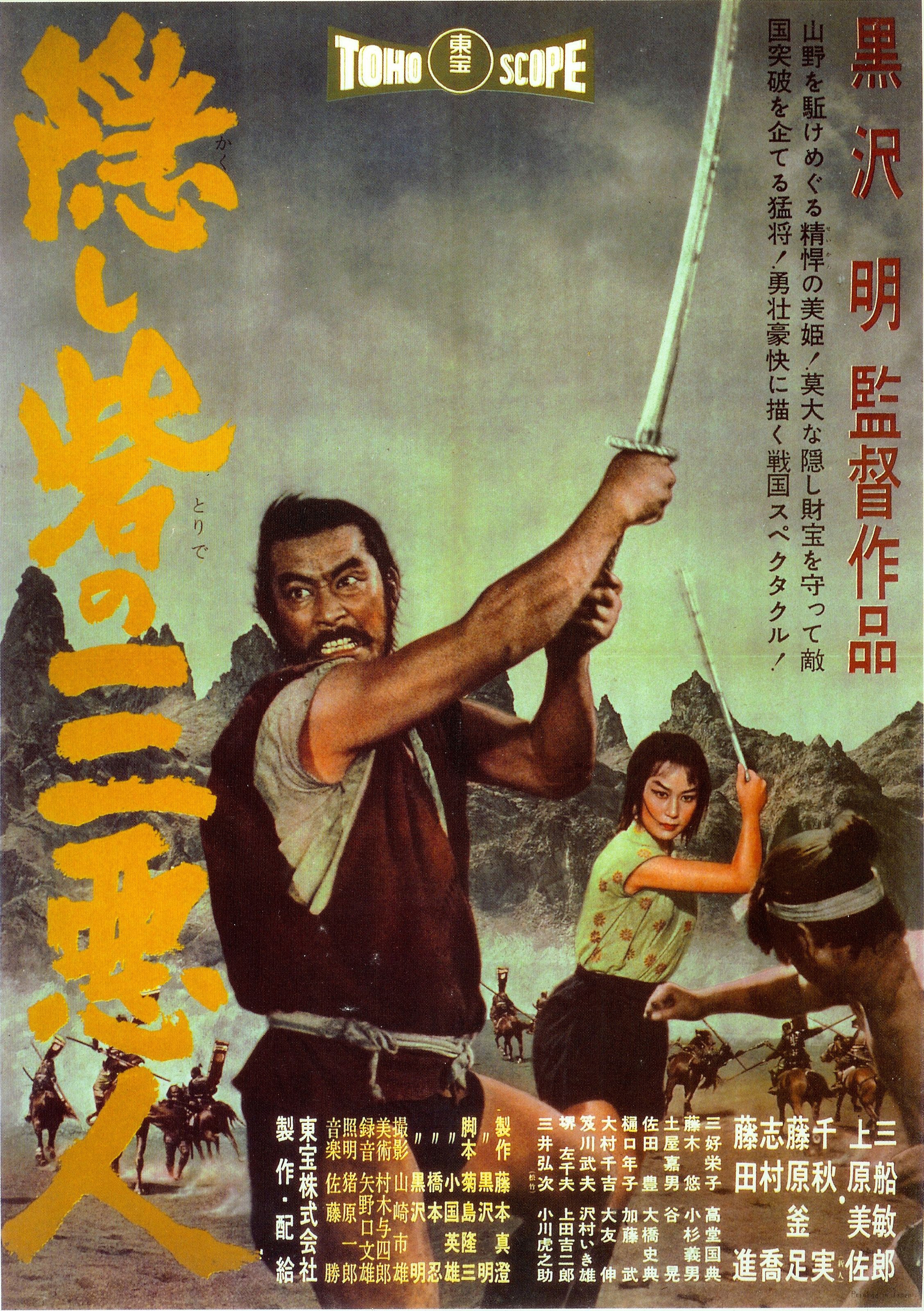
High and Low (天国と地獄, Akira Kurosawa, 1963)

A self-made man is landed with an unthinkable dilemma when his chauffeur’s son is kidnapped in place of his own just at the moment he’s staked his entire fortune on a manoeuvre to outsmart cynical executives set on taking over his company in Kurosawa’s post-war crime film, High and Low (天国と地獄, Tengoku to Jigoku). The movie’s Japanese title, Heaven and Hell, might hint more strongly at the growing economic disparities in the era of the economic miracle but also at the dualities embodied in the hero’s choices. “Success isn’t worth losing your humanity” his wife tells him, but he still struggles with the validity of choosing his heart over his head knowing that to pay anyway even though it’s another man’s son means financial ruin, the final question being if he is really prepared to allow a child to die simply to maintain his own wealth and status. 

The problem is that Gondo (Toshiro Mifune) has attempted to mount a rebellion against the evils of consumerism, incurring the ire of the cynical executives who attempt to get him on their side in their attempt to oust the boss whose outdated ideas are running the business into the ground. Though Gondo appears sympathetic, hinting that he might be interested if there’s a good enough promotion in it, he later tells them where to go on seeing that their business plan is to start producing poor quality disposable footwear. Gondo started on the factory floor and he doesn’t want to put the company’s name on such shoddy produce nor does he think that their admittedly fair point that if the shoes are well made and last a long time no one will need to buy any is a good way to do business. He doesn’t think the boss is right either and wants to make shoes his own way which is why he’s remortgaged the sizeable mansion he owns on top of a hill overlooking the city and has pretty much run through his wife’s dowry to buy a majority stake in the company.

On top of a hill is a good place to live if you want a good vantage point to oversee the land below, but while you’re looking down others look up and not all of them kindly. Gondo is as he says a self-made man, but also out of touch with contemporary society and not so far from an ambitious courtier always after a little more. He says it isn’t about getting the top job but getting shoes made right, but it seems he too had been bitten by the consumerist bug and is otherwise unable to affirm his status without material proof. When he thinks it’s his own son that’s been kidnapped, he’d have given it all away but when it’s the driver’s boy it’s a different question. Shinichi (Masahiko Shimazu) isn’t his responsibility and as he points out there are plenty of other wealthy men, why is he the only one to pay? While his wife (Kyoko Kagawa) tearfully urges him to do the right thing, his assistant (Tatsuya Mihashi) tries stop him, insisting he should take the sizeable cheque they’ve had drawn up to Osaka and the stakeholder he’s buying the shares from. 

While he vacillates, the driver, Aoki (Yutaka Sada), is humiliated and forced into servitude. Gondo seems to have the old-fashioned idea that the kidnappers would simply let Shinichi go on realising they’ve got the wrong boy and his father can’t pay, but Aoki knows there’s nothing he can do to save his son but throw himself on Gondo’s mercy. He falls to the ground and prostrates himself, but later retracts all telling Gondo it doesn’t matter, that he hadn’t realised what he was asking of him, and insisting that Shinichi is a bright boy who will look for a chance to escape on his own. Once the boy is returned he treats him harshly, interrogating him about anything he might have forgotten and later driving him around looking for the hideout where he was kept in an attempt to do something and repay the debt he now feels he owes to Gondo by helping the police retrieve the money Gondo eventually agreed to pay for him. 

In agreeing to give up the money, Gondo is in a sense unburdened knowing he has made the right choice and realising that he would never live a comfortable life in that house if cost a child’s life to keep it. Part of his rationale for not wanting to pay had been that though he had been poor before and might be again, his wife had not been and does not truly understand what it is to live in poverty much as she says her life of luxury means nothing to her. She has never wanted for anything, after all. As for the kidnapper, Ginjiro (Tsutomu Yamazaki), we know little of his motives save for his intense resentment living quite literally in the shadow of Gondo’s mansion and feeling as if it were mocking him. Then again, though his life is hard Ginjiro already had a path to success in that he would soon have completed his medical studies implying at least that he or someone else was able to cover his tuition and costs of living, that he was able to continue in education, and really had no need to take such drastic action in rebellion against the antagonistic capitalism of the post-war society. “Do you think we have to hate each other?” Gondo asks him, but Ginjiro has no answer only his intense resentment for everything he represents.

The “hell” that Gondo inhabits is a backstreet wasteland peopled by the hopeless. Tokura (Tatsuya Nakadai), the earnest policeman, follows him through thronging clubs and on into “dope alley” where Ginjiro picked up his accomplices so desperate to escape their suffering that they’d agree to help him kidnap a child. Though it costs him his job, Gondo decision to do the right thing makes him a national hero, the working class millionaire who mows his own lawn and can still knock up a pair of shoes should the occasion call while women across the country decide to boycott the company in protest at his treatment. Ginjiro can only howl like a caged animal while facing a death sentence for the coldblooded murder of his accomplices. The light bouncing off his mirrored sunshades gives him an eerie supernatural quality, a demon arising from depths of hell to wreak havoc in heaven but finding only infinite tragedy in the contradictions of the consumerist post-war society.


High and Low screens at the BFI Southbank, London on 19th January 2023 as part of the Kurosawa season.

Original trailer (English subtitles)

The Idiot (白痴, Akira Kurosawa, 1951)

“He was too good for this world” a matriarch finally concedes of the pure soul at the centre of Akira Kurosawa’s The Idiot (白痴, Hakuchi), though like most she had found his goodness unnerving. Adapted from the Dostoyevsky novel, Kurosawa’s poetic morality play is like much of his contemporary work a meditation on the post-war future but perhaps also an admission that this “faithless world” isn’t meant for pure souls and that goodness too can be destructive in its incompatibility with a world ruled by cruelty and selfishness. 

Relocated to a wintery Hokkaido, the film opens with former soldier Kameda (Masayuki Mori) travelling north to stay with a relative after a spell in a psychiatric hospital in Okinawa. Having been sentenced to death for war crimes in what he claims was a case of mistaken identity and then unexpectedly reprieved, Kameda suffered a nervous breakdown but also describes himself as having been reborn, as if everything that had happened to him up to that point had happened to someone else. Ever since then he’s been a pure soul, selfless and ethereal but also with, as someone later puts it, an eerie power to see into people’s hearts that leaves some feeling shamed or uncomfortable in the stinging light of his goodness. 

In the outdated language of the time, he is called an “idiot” because of his epilepsy which has he says caused him epileptic dementia. In the title cards that open the film, it is said that goodness is often conflated with idiocy as if to be good is only to be naive for sophistication necessarily favours calculation over feeling. He is an outcast firstly because of the stigma surrounding his condition and secondly because of the way his goodness reflects on others, leaving them feeling exposed or perhaps judged and found wanting. 

He finds his mirror in a young woman, Taeko (Setsuko Hara), who is loved by a man he met on the train, Akama (Toshiro Mifune), but is herself an outcast because she has been the mistress of a wealthy man, Tohata (Eijiro Yanagi), since she was only 14 years old. On seeing a photograph of her in a shop window near the station he remarks that she seems very unhappy, later explaining that in her eyes he saw only long years of lonely suffering that reminded him of the eyes of a young soldier executed by firing squad who looked back at him with eyes filled with reproach that he must be sacrificed for the folly of the war. But whereas Kameda’s awakening as a pure soul has opened him up to the world, Taeko’s internalised shame has made her cold and indifferent. Kameda’s recognition of her as another pure soul grants her the courage to escape one kind of suffering in abandoning the wealthy man who has ruined her life, but only provokes further destruction in her conviction that Kameda is the one man she can never love for she will only ruin him. 

Kameda, meanwhile, falls in love with the daughter of his relative, Ayako (Yoshiko Kuga), who is proud and largely unable to express her feelings honestly often saying the direct opposite of what she actually means. She too has her idea of goodness, breaking with her childhood sweetheart Kayama (Minoru Chiaki) when he is tempted by an offer from Tohata to enter into a sham marriage with Taeko for appearance’s sake in return for a large sum of money and guaranteed social advancement. Though Ayako originally rejects Kameda because of the shame and humiliation she would feel married to a man with a disability, she nevertheless fails in love with him but is unable to accept the equality of his love in his inability to abandon Taeko to whom he has come to represent a kind of salvation. 

Ayako later comes to believe that it was she who was truly the “idiot” in her petty jealousy lamenting that “if only we could all love without hatred” as Kameda had done though it was in the end his selfless love that sealed his fate, while for Akama it was perhaps the opposite in realising that he would never possess Taeko’s heart and that the only reason she returned to him was because she thought him to be a man of so little importance that ruining him was of no consequence and ruin him she did in the madness of his love. Guileless, Kameda is also a pauper cheated out of his inheritance by a relative and then again exploited by a duplicitous businessman, his poverty another proof of his goodness while others squabble over money. Having escaped an authoritarian father and come in to his inheritance, Akama wagers his fortune trying to buy Taeko from Tohata by gazumping Kayama who later redeems himself by letting the money burn but never really escapes the stain of his temptation. 

Kurosawa frames the tale as high gothic, filled with eerie winds and mist and fire in the midst of snow. The stove of Akama’s otherwise dark and gloomy mansion seems to flare with the intensity of confrontation as the passions of these four tortured souls rise and fall while each seeking a kind of salvation which necessarily cannot satisfy all. Originally intended to run in two parts over 265 minutes, the film was famously too big for producers at Shochiku for whom Kurosawa was working outside of his regular studio Toho. They cut 100 minutes to suit their exhibition needs, excising most of the prologue and inserting a number of clumsily placed intertitles absent from the rest of the film while undercutting the sense of mounting dread in the tragic backstories of each of these doomed romantics. But even in this compromised version, Kurosawa captures something of the gothic fatalism that surrounds Kameda, an innocent lamb in a world of wolves as Akama describes him, whose boundless, selfless love has no place in this faithless world. 


The Idiot screens at the BFI Southbank, London on 13th & 21st January 2023 as part of the Kurosawa season.

Kagemusha (影武者, Akira Kurosawa, 1980)

“The shadow of a man can never stand up and walk on its own” a shadow warrior laments, wondering what happens to the shadow once the man is gone. Set at the tail end of the Sengoku era, Akira Kurosawa’s Kagemusha (影武者) charts the transformation of a man reborn as someone else and discovers that he’s better at playing the role he’s been assigned than the man who was born to play it only to fall victim to his own hubris and self-delusion. 

The nameless hero (Tatsuya Nakadai) is a lowborn thief sentenced to death only to be reprieved thanks to his uncanny resemblance to the local lord, Takeda Shingen (also Tatsuya Nakadai), whose double he must play if he’s to keep his life. The shadow objects to this characterisation, outraged that a man who has killed hundreds and robbed whole domains dares to call him a scoundrel. Shingen agrees he too is morally compromised. He banished his father and killed his own son but justifies it as a necessary evil in his quest to conquer Japan hoping to unify it bringing an end to the Warring States period and ensuring peace throughout the land. 

The shadow goes along with it, but does not really realise the full implications of his decision. He tries to smash a giant urn hoping to find treasure to escape with, but is confronted by a corpse bearing his own face. Shingen has been killed by an enemy sniper in an act of hubris sneaking around a castle under siege hoping (not) to hear the sound of a flute. Before passing away, Shingen instructs his men to keep his death a secret for three years, retreating to defend their own domain rather than conquer others. But there are spies everywhere and news of his apparent demise soon travels to the allied Oda Nobunaga (Daisuke Ryu) and Tokugawa Ieyasu (Masayuki Yui), his rivals for the potential hegemony over a unified Japan. The shadow Shingen must keep up the pretence to keep the dream alive and protect the Takeda Clan from being swallowed whole by the advance of Nobunaga. 

Shingen had been the “immoveable mountain”, the solid force that anchors his troops from behind but also an implacable leader famed for his austerity. The shadow Shingen is almost caught out by the honest reaction of his grandson and heir Takemaru (Kota Yui) who immediately blurts out that this man is not his grandfather because he is no longer scary, while he’s also bucked by Shingen’s horse who in the end cannot be fooled. His retainers wisely come up with a ruse that he’s too ill to see his mistresses lest they realise the thief’s body does not bear the same scars even as everything about him from the way he talks and moves and laughs is different. Yet in his sudden conversion on witnessing Shingen’s funeral on lake Suwa and resolving that he wants to do something to serve the man who saved his life, the shadow proves an effective leader who earns the trust and affection of his immediate retainers but is equally struck by their sacrifice as they give their lives to protect him. 

Meanwhile, his illegitimate son Katsuyori (Kenichi Hagiwara), skipped over in the succession, complains that he can never emerge from his father’s shadow emphasising the ways in which the feudal order disrupts genuine relationships between people and bringing a note of poignancy to the connection that emerges between the shadow Shingen and little Takemaru otherwise raised to perpetuate that same emotional austerity. Hoping to eclipse his father, Katsuyori too experiences a moment of hubris, successful in his first campaign but then over ambitious, forgetting his father’s teachings and walking straight into a trap only to be defeated by Nobunaga’s superior technology. 

Nobukado (Tsutomu Yamazaki), Shingen’s brother and sometime shadow, remarks that he hardly knew who he was once his brother was gone, and wonders what will become of the shadow once the three years are up. In a sense, the thief is already dead. As Nobukado puts it, it’s as if Shingen has possessed him, his confidence in his alternate persona apparently solidified by the victory at Takatenjin castle. But the sight of so many dead seems to unnerve him in the hellish spectacle of death that is a Sengoku battlefield knowing that these men died if not quite for him than for his image. When he attempts to mount Shingen’s horse, it’s either born of hubristic self-delusion in wanting to prove that he truly has become him, or else a bid for freedom and to be relieved of his shadow persona. Either way, he becomes a kind of ghost, once again watching his men from behind but this time invisibly and powerless to do anything but watch as they are massacred by Nobunaga’s guns. 

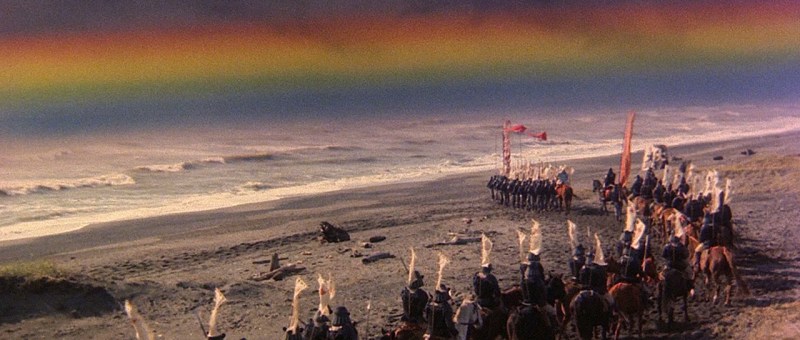
Earlier on he’d had a kind of nightmare, painted in surrealist hues by Kurosawa who conjures battlegrounds of angry reds and violent purples along with ominous rainbows, seeing himself dragged down into the water by Shingen’s ghost which he has now seemingly become. In the end all he can do is accept his fate in a final act of futility running defenceless towards the enemy line and reaching out to retrieve his banner from its watery fate only to be carried past it on a current of red. “I’m not a puppet, you can’t control me” the thief had said, but in the end just like everyone else he was powerless, another casualty of the casual cruelties and meaningless struggles of the feudal order. 


Kagemusha screens at the BFI Southbank, London on 11th & 31st January 2023 as part of the Kurosawa season.
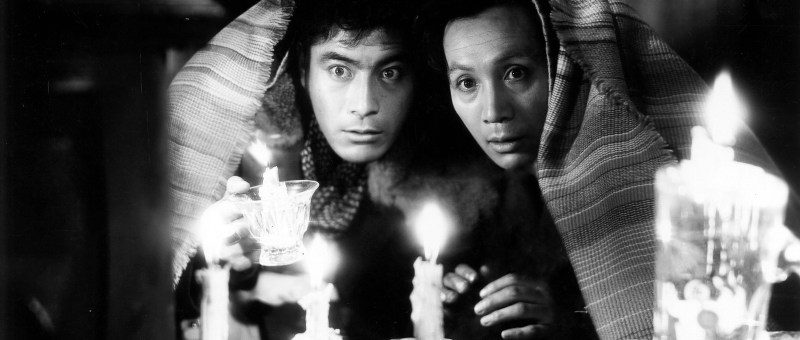
Original trailer (English subtitles)

Scandal (醜聞, Akira Kurosawa, 1950)

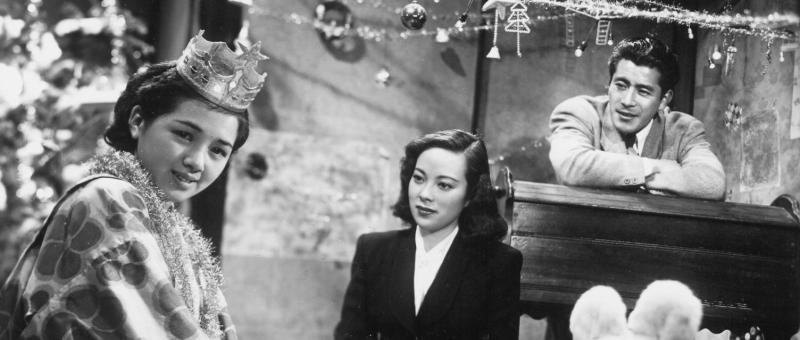
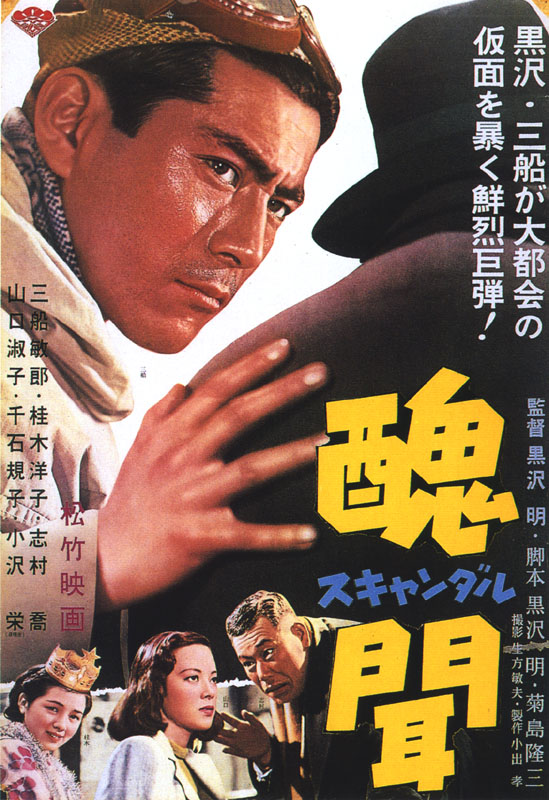
“Freedom of the press or harassment?” The more things change, the more they stay the same. Akira Kurosawa’s attack on the declining moral standards of the post-war society as reflected in the duplicity of the gutter press has unexpected resonance in the present day in which the media is simultaneously unwilling to challenge authority and in thrall to the populist allure of celebrity gossip with sometimes tragic results. The aptly named Scandal (醜聞) is essentially a morality tale which draws additional power from its seasonal setting and embodies the soul of the contemporary society in a conflicted lawyer consumed by internal struggle against despair and hopelessness. 

The more literal scandal however revolves around a well known singer, Miyako Saijo (Yoshiko (Shirley) Yamaguchi), and a motorcycle-riding artist, Ichiro Aoe (Toshiro Mifune), who meet by chance while staying at the same remote mountain inn. Having ironically headed to the mountains to escape the various “annoying things” that plague her in the city, Miyako has been pursued by two muckrakers from the tabloid press who take umbrage at her refusal to see them. They are then fairly delighted when they manage to snap a picture of Ichiro and Miyako standing on her balcony looking out at the mountains like a young couple in love. They deliver the photo to their seedy boss, Hori (Eitaro Ozawa), who is over the moon with excitement at his new business prospects. Suddenly Ichiro and Miyako are on posters all around the city with headlines such as “Love on a Motorcycle” and “Miyako Saijo’s secret love – revealed!”. 

Though Ichiro is a semi-public figure himself having been featured in magazine spreads as an artist on the rise, he is not a worldly man and is shocked by the idea that the press can make something up and print it with no consequences. He feels he must resist not just on a personal level angry to have been misrepresented but for the post-war future to ensure that the press is held to account and that it does not misuse its power to breach the privacy of ordinary citizens. To his mind, they only get away with it because most people just ignore them and wait for the scandal to pass, a sentiment born out by Hori who dismisses a concerned underling with the reminder that they’ve never yet been sued so they need have no fear saying whatever they like whether it’s true or not. “The kind of snobs we target think the law is beneath them” he adds, suggesting that most people prefer to think of the gutter press as something they can safely ignore and that it’s only themselves that they show up in their torrid obsession with the lives of others. 

But Hori also ironically defends his right to press freedom and quickly hits back that he’s being oppressed by those who wish to silence his right to free speech even when what he’s saying isn’t true. Lawyer Hiruta (Takashi Shimura) who offers to represent Ichiro in his lawsuit quickly identifies Hori as a duplicitous conman but also allows himself to be manipulated accidentally accepting a bribe after being led to believe that Hori has a top legal expert on retainer and the case is hopeless unless Miyako, who has so far maintained a dignified silence, can be persuaded to join as co-plaintiff. Ichiro had decided to accept Hiruta’s offer of representation largely on meeting his teenage daughter, Masako (Yoko Katsuragi), who has been bedridden with TB for the last five years. Masako is a pure soul whose isolation from the contemporary society has allowed her to maintain her innocence and humanity but it’s also true that it’s the society that made her ill in the first place.

The morality play reaches a climax on Christmas Day as Ichiro delivers a tree on his motorbike while Miyako sings carols for a radiant Masako who is at least sitting up and looking much healthier than she’s ever been before. But the more Hiruta debases himself, caught between an accidental debt to Hori, his own lack of conviction, and the frustrated desire to do right, the sicker she gets as if poisoned by post-war duplicity. Even so, Ichiro continues to defend him insisting that Hiruta isn’t a bad person just a weak one and that in the end he won’t be able to go through with betraying him but will eventually come clean and tell the truth when it counts. Ichiro’s faith is as much in the institutions of the new democratic Japan as it is in Hiruta as he explains at the trial admitting that he may have been naive in placing too much trust in the legal system thinking that he couldn’t lose because he knows he’s in the right. As the opposition lawyer points out, that’s not a very good legal argument because his client thinks he’s in the right too only he doesn’t know that Hori is both a liar and an idiot who’s staked everything on the assumption that Hiruta won’t expose him for bribery, which would at least strongly imply he can’t back up his story, because it would mean destroying himself. 

In the end it’s Hiruta who puts himself on trial, baring his soul to the court which he acknowledges he has betrayed in his negligence and wilful obstruction of justice. It’s a victory for truth and decency and a turn away from the duplicitous, capitalistic mores of men like Hori who think they can do whatever they want and only laugh at those who value fairness and compassion. “In all my 50 years I’ve never seen a more confused age” Hiruta explains speaking of post-war chaos and the forced comprises of the intervening years of despair and desperation. As he coaxes the denizens of a small bar into an early rendition of Auld Lang Syne on Christmas Day, each vowing that this time next year things really will be better, many of them breakdown in frustrated longing drowning their sorrows as they continue to yearn for better times they do not really believe will come. But then like all the best Christmas films, this is also a redemption story of a man who decided that it wasn’t too late after all and that he might have to destroy himself in order make himself anew and be the man his daughter always knew he could be even if in the end he could not save her from the ravages of the post-war society.


Scandal screens at the BFI Southbank, London on 10th & 24th January 2023 as part of the Kurosawa season.

Rashomon (羅生門, Akira Kurosawa, 1950)

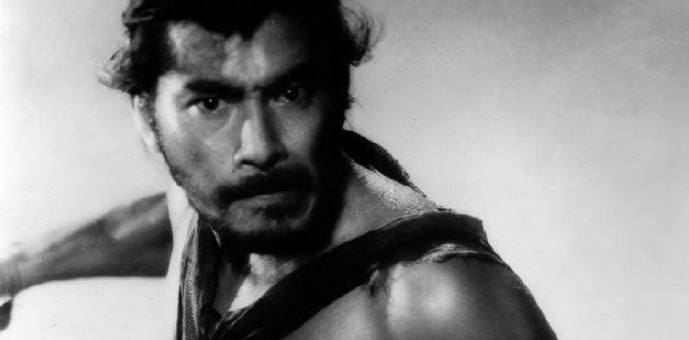
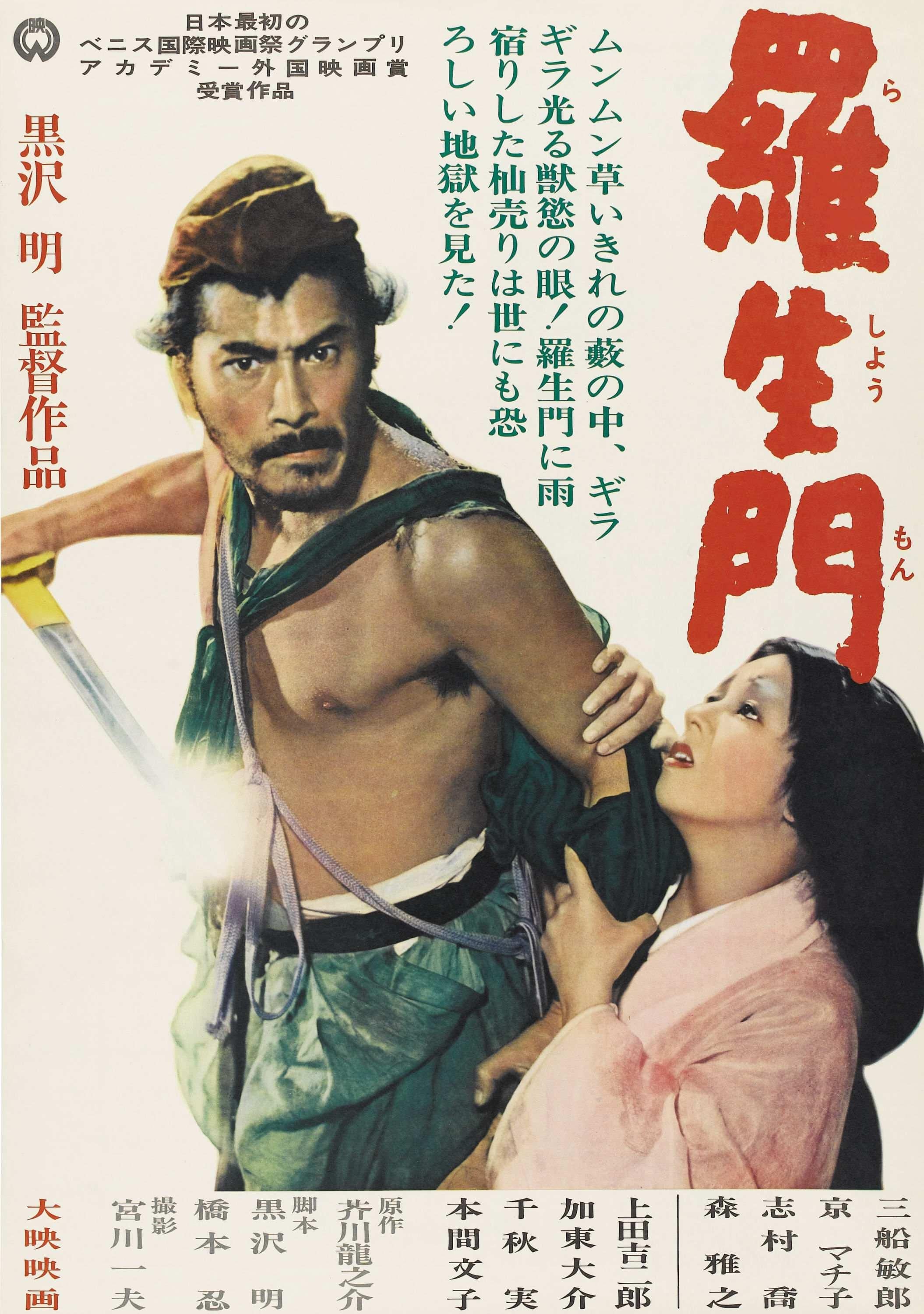
Is there such a thing as objective truth, or only an agreed upon “reality”? Like many of his early films, Akira Kurosawa’s adaptation of a pair of short stories by Ryunosuke Akutagawa is concerned with the idea of authenticity, or the difference between the truth and a lie, but is also acutely aware that the lines between the two aren’t as clear as we’d like them to be largely because we lie to ourselves and come to believe our own perceptions as “truth” assuming that it is others who are mistaken or duplicitous. 

After all, the film opens with the words “I don’t understand”, as the woodsman (Takashi Shimura), who later tells us unprompted that he does not lie, tries to reconcile the conflicting testimonies of a series of witnesses at the trial of the bandit Tajomaru (Toshiro Mifune) who is accused of raping a noble woman (Machiko Kyo) in the forest and killing her husband (Masayuki Mori). At the end of the film it becomes clear that most of his confusion is born of the fact that he witnessed more than he claimed, later presenting a more objective version of the events while justifying his decision not reveal it earlier by saying he didn’t want to get involved. Not wanting to get involved might be understandable, he has six children and presumably won’t be paid for his time nor will he want to risk being accused of something himself. Then again as the cynical peasant (Kichijiro Ueda) sheltering with him at the already ruined Rashomon Gate seems to have figured out, it might equally be that he took the precious dagger repeatedly mentioned in the trial before running off to find the police. He has six children to feed after all. 

The woodsman is simply confused if also guilty, but the Buddhist monk (Minoru Chiaki) who saw the couple on the road some days previously has been thrown into existential despair and is on the brink of losing his faith in humanity. He can’t bear to live in a world in which everyone is selfish and dishonest. Yet “dishonest” is not quite the right word to describe the testimony, for there’s reason to believe that the witnesses may believe what they say when saying it or have at least deluded themselves into believing a subjective version of the truth that shows them in a better light than the “objective” might have. At least, none of the suspects are lying in order to escape justice as each confesses to the crime though for varying reasons. 

The bandit flatters himself by assuming dominance over the situation, baldly stating that he killed the samurai to rape the wife only she took a liking to him and he killed the husband in a fair fight even remarking on his skill as a swordsman. As we later see Kurosawa frames these fights in a more naturalistic fashion than your average chambara. They are often clumsy and desperate, won more by chance than by skill. Tajomaru also describes the wife as “fierce” in an unwomanly fashion though she is meek and cheerful on the stand and later states that she fainted after her husband rejected her for her “faithlessness” and woke up to find her dagger in his chest, while his beyond the grave testimony delivered via spirit medium claims that he killed himself unable to bear the humiliation of his wife’s betrayal in agreeing to leave with Tajomaru. 

As the peasant points out, Tajomaru lies because he is insecure and so tells a story that makes him seem more “heroic” than he actually is, while the wife lies to overcome her shame, and the samurai to reclaim agency over his death and escape the twin humiliations of having been unable to protect his wife and being murdered by a petty bandit. As the three men sheltering under the Rashomon Gate concede, we don’t know our own souls and often resort to narrative to tell ourselves who we are. As usual, the truth is a little of everything, all the tales are partly true and less “lies” than wilful self-delusion to help the witness accept an unpalatable “reality”. Kurosawa perhaps hints at this in his use of extreme closeup while otherwise forcing the viewer into the roles alternately of witness and judge as if we were like the woodman watching from the bushes or hearing testimony from the dais while the action proceeds to the maddening rhythms of a bolero. Despite the hopeless of the situation, the reality that everyone lies and the world is a duplicitous place, the monk’s faith is eventually restored in the acknowledgment that there are truths other than the literal as he witnesses the woodsman’s compassion and humanity, the skies ahead of them beginning to clear as they leave the shelter of the ruined gate for a world which seems no less uncertain but perhaps not so cynical as it had before.


Rashomon is re-released in UK cinemas on 6th January courtesy of BFI.

Re-release trailer (English subtitles)

No Regrets for Our Youth (わが青春に悔なし, Akira Kurosawa, 1946)

“Freedom is something you have to fight for” a young woman is ironically reminded by her progressively-minded father as she finds herself torn between the conservatism of her upbringing as an upper middle class daughter of an academic family and a bid for independence in the freedoms of the post-war society. In part a lament for a lost generation whose resistance towards rising militarism had been all but forgotten, No Regrets for Our Youth (わが青春に悔なし, Waga Seishun ni Kuinashi), is also the story of a post-war woman seeking new directions which in this case eventually send her back to the land.

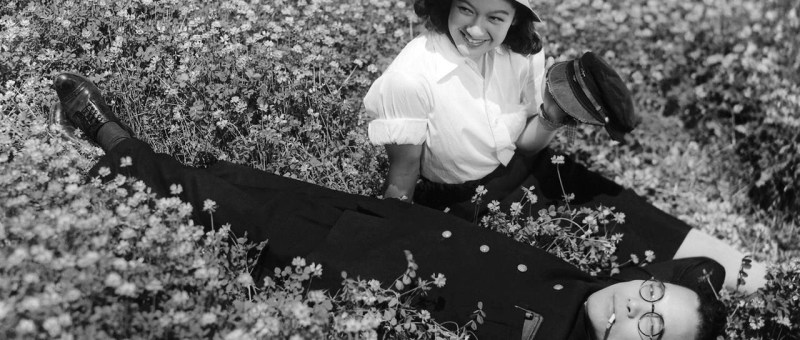
Then again, there’s no denying that Yukie’s (Setsuko Hara) dilemma is framed as romantic, torn between a dynamic communist and a spineless conservative while otherwise in her youth fairly vacuous. As the film opens, she frolics with some of her father’s students at a local mountain that overlooks Kyoto University. Caught on a stepping stone she awaits help from either the charismatic Noge (Susumu Fujita) or the diffident Itokawa (Akitake Kono) before Noge boldly dashes forward and carries her to the bank. Seeing Itokawa looking sheepish and embarrassed, she tugs on his student cap as if she hasn’t quite yet made up her mind which path she will take. “If I married you, my life would be calm and peaceful,” Yukie later reveals to Itokawa, “but it would also be a bit boring”, whereas if she married Noge “my life would burn so brightly that I might be blinded.” 

Even so, her outlook as the professor’s daughter leans towards the conservative. During the picnic on the mountain, the students suddenly hear the sound of cadets training with firearms Yukie exclaiming that it makes her heart race before ominously discovering the body of a wounded solider in the overgrowth. She declares that she hates “leftists” and that her father is a “liberal” not a “red” but will any case eventually be vindicated. Though attracted to Noge’s passionate nature, she seems to find him dull company, “boring” in his constant conversation about the rise of fascism while visibly bristling when he all but calls her a vacuous socialite and says she needs a “slap in the face to grow up” which is in a sense what he’s just given her. Her life had been that of a privileged upperclass girl cosseted from the world, engaging with refined pursuits such as playing the piano and learning traditional flower arrangement. Her epiphany seems to come when she realises she’s been doing as she’s told, reminded that flower arrangement is a means of self-expression suddenly tearing the heads off chrysanthemums and crafting something truly avant-garde that is in its own way quietly shocking. Notably her flower arrangements while living with Noge are much more harmonious. 

Still she wavers, wondering if she should give in to the quiet life she’d have with a man like Itokawa, a man with no ideology who sides with the militarists and becomes a prosecutor because it is expedient to do so, or continue to wait for Noge who by this point has been in prison and ostensibly renounced his socialist beliefs to join the army. What she chooses independence, breaking with the conventional life her mother wanted for her to support herself with a job at a trading company in Tokyo. Running into Itokawa in the city, he strongly hints to her that Noge is, from his point of view, up to no good running a kind of think tank as an expert on China. 

When Yukie chooses Noge she implies it’s because she wants “something I can throw myself into body and soul”, hoping to join him in his new cause prepared as her father had warned her to make sacrifices in the struggle for freedom. In the one sense, it’s Yukie making up her own mind to abandon her privileged background to live her life with no regrets, but it’s also impossible to ignore that the cause she dedicates herself to is that of her husband. Committed to making Noge’s parents, both peasant farmers, understand that he was not an “ungrateful” son but a man who did his best to oppose the war and fight for peace and prosperity in Japan, she commits herself to the land and wins them over with the strength of her resolve. The hands that once played piano are now rough with work and it is in this she has found her purpose. Yet it’s difficult to say if the austerity of her new life represents ultimate freedom or only further constraint in the imperative of her continued suffering. Perhaps it doesn’t really matter, if as she says she has no regrets for her youth as she joins hands with the peasant farmers leaving her privileged upbringing behind her even as her mother remarks that with her father reinstated at the university it’s as if nothing had changed. There is then something quite poignant as she sits by the stream and sees the students file past her singing their song of protest that in the end went unheeded while she prepares to reject modernity in its entirety and return to the simplicity of the land.


No Regrets for Our Youth screens at the BFI Southbank, London on 2nd & 10th January 2023 as part of the Kurosawa season.
The Most Beautiful (一番美しく, Akira Kurosawa, 1944)

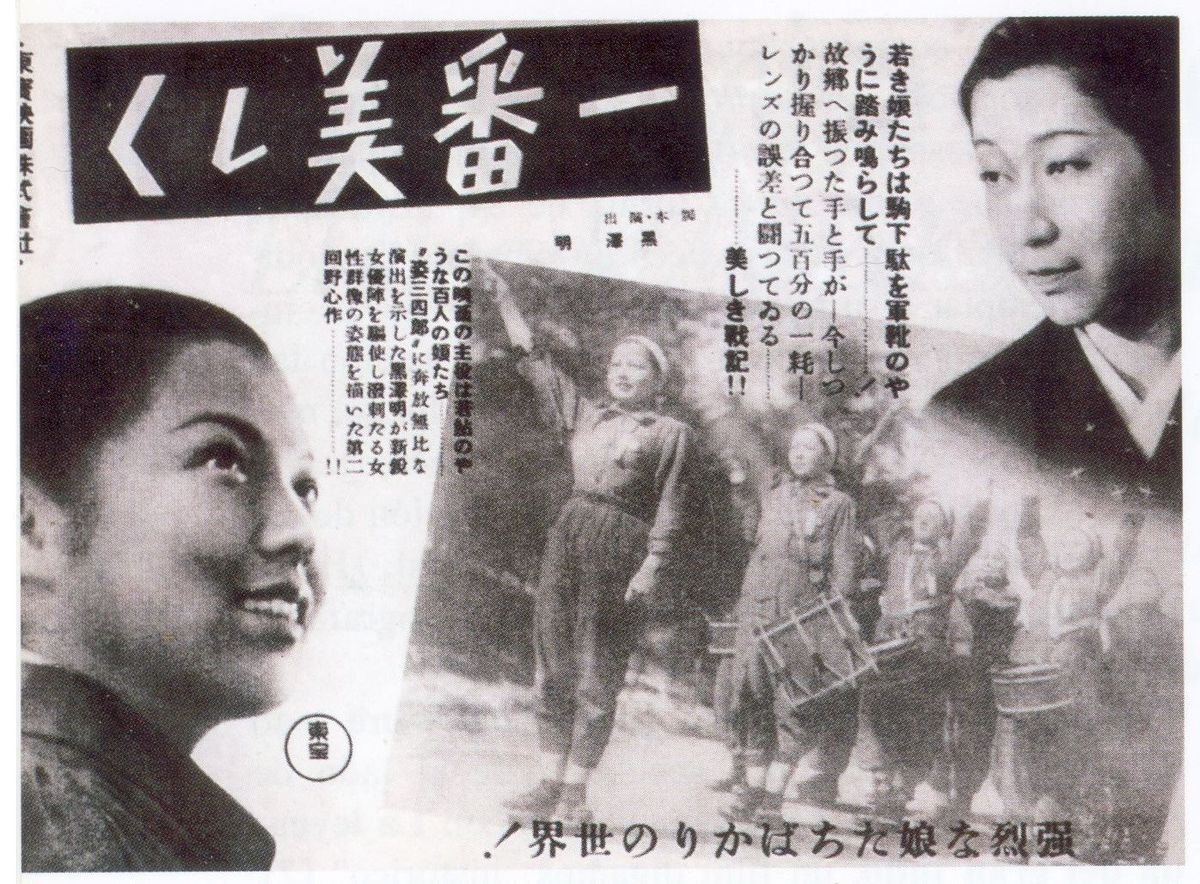
“One can’t improve productivity without improving one’s character” the manager of a factory crafting lenses for the military repeatedly insists, though by “character” he largely seems to mean a total erasure of the self in favour of service to the state. Kurosawa’s second feature is a National Policy Film intended to foster a spirit of patriotic fervour in which not only the factory girls at its centre but everyone else too must “become an outstanding human being” forgoing all human feeling to ensure Japan will win a war even the film seems to concede is already lost. 

Indeed, even for a relatively late propaganda film, The Most Beautiful (一番美しく, Ichiban Utsukushiku) makes little attempt to gloss over the undercurrent of defeat. At one point names of foreign territories fallen to the Americans briefly flash up on the screen leaving the girls looking increasingly bereft if resolving to work even harder. Then again even in the opening which sees all the workers lined up in military fashion it’s obvious that the factory is staffed by those who have not been deployed to more pressing duties, overwhelmingly teenage girls along with boys too young for the army, old men and those otherwise unable to serve in the military. 

Even so the atmosphere among the young women is often cheerful though the film is keen to show them overcoming their loneliness while bowing to photos of their far off parents, often farmers, in distant parts of Japan. They are looked after by a kind of nurse/chaperone, Mrs Mizushima (Takako Irie) whose husband has already been killed in the war marking her out as an example of the self-sacrifice that is being asked of the girls. Many of them have come of their own volition expressly to support the war effort and take their work incredibly seriously especially as the factory manager reminds them that the lenses they make are crucial to to production of military instrumentation and without them there would be no fighter planes or sniper rifles. 

So self-sacrificing are they that the girls go into huff when it’s announced that the factory will be entering a period of increased productivity (another thinly veiled hint that the war is not going well), yet they are upset not because they resent being asked to work harder, nor by the implication that they have more to give than they have been giving, but by the fact they’ve been underestimated having had their quotas increased by only 50% as opposed to the men’s 100%. Their leader, Watanabe (Yoko Yaguchi), explains that, though they know they cannot match the men, they are sure they can do better and will produce at least 2/3 more rather than just half. The managers seem to think that this is naive, but are wary of talking the girls down in fear of damaging their morale which they see as the most crucial thing when it comes to generating “productivity”. Yet that notion of “morale” is mostly a kind of internecine peer pressure brokered by petty competition and a desire not to be the one who lets everyone else down. Hence the girls continue working while they’re sick, which is no good at all for productivity if all they do is spread it around while unable to work at full capacity, afraid to tell anyone in case they get sent home to recover. 

Watanabe is tempted to to take a trip to see her family after receiving a letter from her father to say that her mother has been taken ill, though her parents are also fiercely patriotic and insist that she should not leave but stay and do her duty. She is guilted out of her temptation by another girl, Yamaguchi (Shizuko Yamaguchi), who is sickly by nature but has been hiding her suffering in order to be allowed to stay. Being out of the line fosters feelings of guilt and failure, not only in having let the country down but in increasing the burden on their friends who will now have to work harder in their stead. The “character” that they are supposed to be building, is in the end only in service of their “productivity” that they work to the point of collapse with no thought for themselves or their feelings wilfully sacrificing the opportunity to see dying relatives to prove their dedication. 

In what now might seem like subversive touches but just as well may have been sincere, Kurosawa often flashes signs and slogans which appear in the factory including one urging the girls to “follow the example of the war dead” suggesting that the only real way to prove your devotion is to die in the service of the emperor. On the other hand, the girls don’t actually seem to do a lot of factory work but are otherwise expected to participate in band practice banging out military marches on the drum or else improving their physicality through playing volleyball. In any case as they begin wear themselves out tempers begin to fray leaving the girls at odds, tired and resentful if not actively hopeless in beginning to realise they probably won’t make their overly ambitious quota as a tacit acceptance that Japan most likely is not going to win the war and all their efforts are for nothing. At the film’s conclusion, Mrs Mizushima exclaims that Watanabe has become “such a good girl”, ironically forced to abandon the directly filial for the national in prioritising her role as an imperial daughter rather than a biological one. Even so, the film discovers a much more comfortable sense of solidarity between the young women even if brokered by militarist fervour and a nihilistic bid for self-destruction in perpetual servitude. 


The Most Beautiful screens at the BFI Southbank, London on 1st & 9th January 2023 as part of the Kurosawa season.

Untamed (あらくれ, Mikio Naruse, 1957)

“Don’t let guys control you. You have to make them men” the heroine of Mikio Naruse’s Taisho-era drama Untamed (あらくれ, Arakure, AKA Untamed Woman) advises a former rival, yet largely fails to do so herself in the fiercely patriarchal post-Meiji society. Based on a serialised novel by Shusei Tokuda published in 1915 but set in late Meiji rather than early Taisho, Naruse’s adaptation essentially drops a contemporary post-war woman into a by then almost unrecognisable Japan, but finds her hamstrung firstly by feckless and entitled men and then by complicit women who themselves cannot accept her transgressive femininity. 

As the film opens, a teenage Shima (Hideko Takamine) has just married wealthy grocery store owner Tsuru (Ken Uehara) but the marriage is already a failure. Though Shima is compared favourably with Tsuru’s previous wife who was apparently in poor health, presumably suffering with TB which required a sojourn by the sea, it soon becomes clear that Tsuru is as trapped by the archaic patriarchal social system as she is. He was apparently in love with a woman from a higher social class he was too afraid to pursue and despite still seeing her also has a mistress near their factory in Hokkaido whom he often visits under the guise of a business trip. Yet when Shima tells him she thinks she may be pregnant, he is unimpressed, immediately questioning the paternity of the child while harping on about her having been married before which it seems is not quite true. Perhaps the reason that she has ended up a second wife despite her youth and beauty, Shima ran out on a marriage to a childhood friend arranged for her by her adoptive parents the night before the wedding not realising they had already registered the union without her knowledge or consent. 

This transgressive act at once signals Shima’s total disregard for conventionality and insistence on her own autonomy, yet it is also indicative of the fact she married Tsuru in search of a better life, knowing that to marry her adoptive parents’ choice meant only a life of servitude on the family farm. She is not always a terribly likeable figure, coldly explaining that she didn’t mind being fostered out because the adoptive family were wealthier and could give her a better life than she had with her birth parents. Yet it’s this sense of familial dislocation and the liminal status it gives her that allow her to take agency over her life in the way other women might not, unwilling to lose the familial security Shima may not feel she ever had. Tsuru is also an adopted son, but the price for disobedience for him may be even higher and indeed as we later hear his inability to sort out his love life eventually sees him out on his ear. His pettiness in refusing to accept the child is his leads to an argument which causes Shima to slip on the stairs and miscarry, the implication being that she may not be able to bear more children leaving her unlikely to remarry and thereby spurring her desire for a tempered independence. 

The fall is the last straw. Tsuru divorces Shima citing her inability to play the role of the proper wife while her birth family, from whom she is emotionally estranged, refuse to take her back as do the adoptive parents because of the embarrassment she caused them with the marriage stunt. She is often described as “like a man”, unable to win as Tsuru at once insists she wear the frumpy kimonos left behind by his previous wife who was a decade older, complains she wears too much makeup, and tells her to loosen her kimono belt to de-emphasises her figure, while criticising her for being unfeminine in her refusal to simply put up with his bad behaviour as is expected for a wife in this era. Shima fulfils all her wifely duties and as we see is in fact running his business as the women of the family are often seen to do while their husbands spend the money they earn for them on other women whether drinking with geishas or supporting mistresses in second homes. When her husband hits her, she fights back rather than shrinking away chastened as intended. 

Yet she cannot overcome the sense that a man is necessary for her success which cannot be accomplished alone. Cast out from her family, her brother installs her in the mountains to work in a geisha house if only as kitchen staff but soon does a flit to reunite with his married lover who has left her husband for him. While there she falls for the quiet and sensitive inn owner Hamaya (Masayuki Mori), also an adopted heir, whose wife is again ill with TB. Hamaya may be treating his wife a little better than Tsuru did his, but quite clearly assumes she’ll die in starting an affair with Shima who is then sent away to an even more remote inn to avoid a potential scandal. As Tsuru did with the woman he apparently loved, Shima continues to see Hamaya until he too succumbs to TB as an ideal of an impossible love while simultaneously accepting that he failed her in being too weak and cowardly to fight for their romance, outright refusing to become his mistress. 

This may be one reason she is determined never again to be an employee but to own her own store which is why she ends up marrying tailor Onoda (Daisuke Kato) who introduces her to textiles and seamstressing at which she quickly proves adept having mastered the modern sewing machine. She marries Onoda in believing him “reliable”, but soon comes to regard him as lazy and feckless. The first shop fails because he can’t keep up with her. The male employees are always taking breaks to drink tea and play shogi, Onoda complaining that he’s tired while she does all his work for him and the housework too. Yet he also criticises her for a lack of femininity, snapping back that it must be her time of the month when she berates him in front of their employees while later after they’ve become successful complaining it’s “embarrassing” that his workhorse wife doesn’t know the things a sophisticated society woman would such as ikebana while flirting with the teacher he’s hired ostensibility to teach her. He even forces her to wear a frumpy and already somewhat dated classically Edwardian dress with a fancy bonnet which more resembles something a country girl might wear to church than the latest in Western fashions in an attempt to advertise their tailoring which seems primed to backfire. 

That she learns to ride a bicycle in this rather ridiculous outfit is again a symbol of her desire to seize and manipulate modernity even giving rise to a piece of innuendo from her much younger assistant Kimura (Tatsuya Nakadai) as to the pounding she’s been getting from the saddle. Kimura seems to think the problem with the business is that Onoda’s patterns are outdated, offering her a new modernity while she prepares to cut Onoda out on catching him with his mistress taking their best employee with her to ruin his business and start another of her own. Though once again she cannot leave alone only with a man the ending is perhaps more hopeful than might be expected from a Naruse film allowing Shima to commit herself fully to the sense of industry she embodies always ready to start again, work harder, and achieve her desires unwilling to be bound by conventional ideas of femininity or to simply put up with useless men who refuse to accept her for all she is. Yet she largely fails to make men of them, each of her various suitors failing to live up to her, ruined by an oppressive social system that encourages them to exploit female labour while taking it for granted in their intense sense of patriarchal entitlement. 


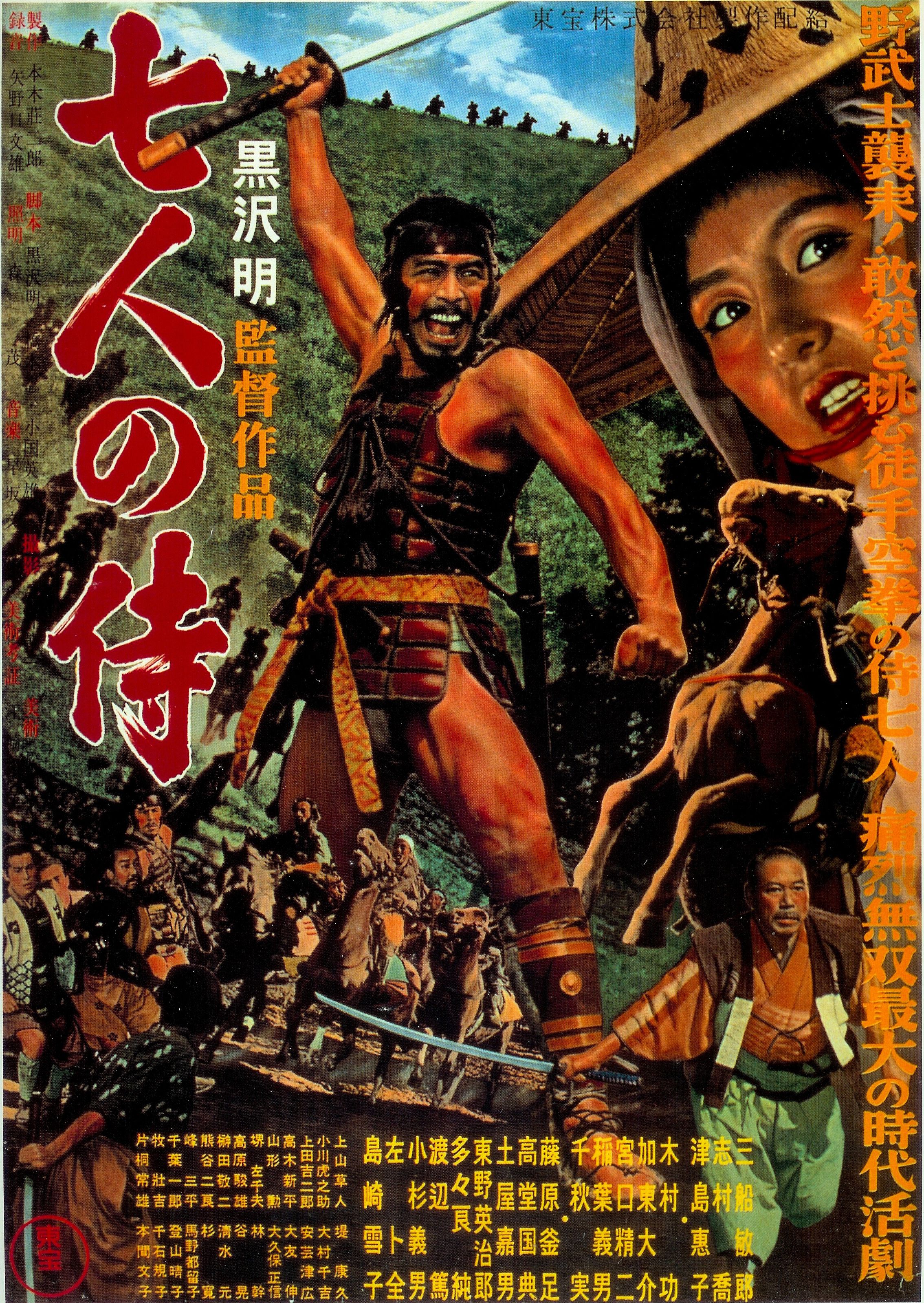
Seven Samurai (七人の侍, Akira Kurosawa, 1954)

An eclipse of the accepted order allows a temporary truce in the ongoing class conflict that defines feudal society in Akira Kurosawa’s seminal post-war historical epic, Seven Samurai (七人の侍, Shichinin no Samurai). Set in the late 16th century, the action takes place in a world on the brink of collapse. The Sengoku era is drawing to a close but is also in a moment of intense crisis which has left large numbers of highly skilled warriors essentially orphaned, wandering the land torn between their basic needs for food and shelter and their dignity as members of a theoretic aristocracy. 

Plagued by bandits, many of whom may be these orphaned swordsmen, a small village contemplates the unthinkable in hiring samurai, otherwise their oppressors and uniquely responsible for the chaos which surrounds them, for protection. “Land tax, forced labour, drought…and now bandits!” one woman exclaims shortly before suggesting they simply surrender all their grain and then hang themselves. As they can offer only expenses in the form of rice, the only samurai they can hope to recruit are already desperate, so hungry that they may be willing to deign to defending their social inferiors with whom they would not usually mix unwilling to accept that they are both victims of the inherently corrupt social order. This explains why the villagers’ early entreaties are met with such scorn and cynicism, either rudely rejected out of hand or ending only in deception. 

In this there is an echo of the world of 1954 which was beginning edge away from the chaos and privation of the immediate post-war society, bandits standing in for thieves and profiteers themselves a product of intense food insecurity. Yet here it’s desperation that allows a temporary merging of the world of lord and peasant, brokered finally by unexpected compassion on the part of a noble samurai who, in an act of extreme transgression, symbolically erases his elite status by shaving his head in order to save a child taken as a hostage by another desperate man. Kambei (Takashi Shimura) may be somewhat reduced in circumstances but refuses to give in to the immorality of the world around him, finally agreeing to help the villagers essentially out of a sense of pity willing to accept only the gift of sustenance moved by the villagers’ sacrifice in discovering that they give him the last of their white rice while subsisting only on millet. 

Yet having taken this step, the villagers remain uncertain they can really trust the men they’ve hired to protect them who are after all each trained in death. Later we discover that they have, like many of the time, occasionally finished off the odd lone samurai fleeing the battlefield in order to loot the bodies as a large stockpile of samurai armour later discovered by the samurai-pretender Kikuchiyo (Toshiro Mifune) testifies. On being confronted with this uncomfortable reality, the samurai fall silent knowing this armour was stripped from men much like themselves, but can ultimately offer little by way of defence when presented with an angry rant from Kikuchiyo who points out that they are themselves responsible in having created this world of chaos through their internecine quests for power. “In war you burn their villages, trample their fields, steal their food, work them like slaves, rape their women, and kill ‘em if they resist. What to you expect ‘em to do?”

When Kambei and the others first arrive in the village, there is no welcoming committee. The villagers all hide, frightened to leave their homes partly because of paranoia spread by widowed father Manzo (Kamatari Fujiwara) convinced that randy samurai are going ravish all of their daughters who will, doubtless, be overcome with awe by these sophisticated men of the elite. In an echo of Kambei’s transgression, Manzo forces something similar on his teenage daughter Shino (Keiko Tsushima), roughly cutting her hair while she cries and resists before dressing her up as a boy so that she’ll be safe from lusty samurai. The plan, however, backfires in that she later engages in a doomed romance with the young Katsuhiro (Isao Kimura). Their eventual union is the symbolic merging of the two worlds, a moment of eclipse in the usual hierarchy, but it’s born of the same impulses than brought Kambei and the others to the village. In fear and desperation, they behave as if there’s no tomorrow, only tomorrow must come and just as sun and moon must eventually move apart and resume their regular orbits so the relationship between Katsuhiro and Shino is an impossibility. 

Like Kambei, Katsuhiro had occupied a slightly liminal position because of his relative youth, neither boy nor man. He first encounters Shino while marvelling at the natural beauty of the forest, only to berate her for doing the same. “Is this any time for an able-bodied man to be picking flowers?”, he ironically asks her, yet he is repeatedly forced back towards conventional masculinity as marker of adulthood virtually ignoring her when tasked with carrying a dummy to the ridge, while she later returns the same gesture reassuming her femininity in joining the rice planting, a peasant woman once again. “What’s wrong with two people in love?” the wounded Rikichi (Yoshio Tsuchiya) asks Manzo, trying to smooth over this moment of cross-class crisis, only for Monzo to ask what he’s supposed to now his only daughter has become “damaged goods”, unfit for marriage in a fiercely patriarchal society in which it is impossible to survive without a husband. 

Katsuhiro cannot marry her, this sense of solidarity if not quite equality can be only temporary. Kambei himself admits as much as he reflects that the battle has been won but the victory belongs not to them but to the peasants, anticipating his a sense his own obsolescence the end of the Sengoku era bringing about a change in the nature of the samurai that two centuries later will lead to its abolition. Our sympathies might shift, witnessing Kambei’s obvious disapproval of the peasants’ relish in taking revenge on the bandits who have caused them so much misery in their own way perhaps perpetuating the cycle of violence and resentment that drives the feudal engine. One cannot help but pity him, displaced once again returning to a life of ceaseless wandering, his presence in the village now no longer necessary and in fact inappropriate. 

Returning to the world of 1954, there might be something a little uncomfortable in this lament for the death of the samurai who can have no place either in the modern society or in a peasant village in 1587, as there may be in the implication that the peasants are savage and vindictive while Kambei alone is good and kind even if the roots of his compassion lie in his willingness to literally sever himself from his elite status. The roles had in a sense been reversed, the samurai hired hands to peasant bosses, but the inversion can be only temporary. In insisting that only by protecting others can one hope to protect oneself, Kambei may be advocating for a more compassionate society but as much as he has attempted to remove himself from the class system he can not in the end overcome it. Nevertheless, in the gruelling battle scene that closes the film, all rain, mud, death and misery, Kurosawa himself deals the final blow to the samurai in the nihilistic futility of violence manifesting itself once again in the lingering feudalism of the mid-century society. 


Seven Samurai is re-released in UK cinemas in its recent 4K restoration as part of BFI Japan on 29th October.

BFI re-release trailer (English subtitles)

The Men Who Tread on the Tiger’s Tail (虎の尾を踏む男達, Akira Kurosawa, 1952)

Like many directors of his age, Akira Kurosawa began his career during the war sometimes working on what were effectively propaganda films yet perhaps attempting to skirt around the least palatable implications of the task at hand. The Men Who Tread on the Tiger’s Tail (虎の尾を踏む男達, Tora no O wo Fumu Otokotachi) is an example of just that, repurposing a well known historical incident from its noh and kabuki roots and subtly undercutting it with a dose of irreverent humour unwelcome to those who liked historical tales because of their nationalistic connotations. This was not, however, the reason the film found itself out of favour so much as an ironically personal issue in which Kurosawa had apparently irritated one of the censors by pointing out his ignorance of cultural tradition leading him to conveniently leave Tiger’s Tail off the list of titles in production resulting in the American Censors rejecting it for being an unknown, illegal film which is why it languished on the shelf for seven years after filming was completed in 1945. The Americans may not have liked it much either given their aversion to period drama which they feared encouraged the kind of thinking incompatible with the democratic era, but like many of Kurosawa’s samurai dramas it has a rather ambivalent attitude to feudal loyalty both admiring of nobility and despairing of its austerity. 

Set in the late 12th century, the action takes place during a period of warfare in which warrior Yoshitsune (Iwai Hanshiro X) has returned a victory for his brother, the ruler. His brother Yoritomo, however, feels as if his victory has perhaps been too good and he is therefore a threat to him. Yoritomo accuses his brother of sedition and puts a purge in motion, leaving Yoshitsune with no option other than to flee. With six of his best retainers, he escapes dressed as an itinerant Buddhist monk and tries to make his way to neutral territory in the North. To get there, however, they need to pass through a series of checkpoints which is why they’re currently accompanied by a cheerful fool in the form of a lowly porter (Kenichi Enomoto) supposedly guiding them along a secret path through mountain forests. 

The porter is a new addition to the story added by Kurosawa for reasons of expediency and comic relief, yet his intrusion is also one which deeply angered the more nationalistic of the censors who resented the director’s irreverence towards a key historical event. Like many other of Kurosawa’s bumbling peasants, he’s both contemptuous and in awe of the world of the samurai, offering down to earth common sense takes on the politics of the day. He has already heard all about the Yoritomo/Yoshitsune drama and recounts it in the manner of a soap opera, quite reasonably asking if a quarrel between brothers could not have been sorted out with a good old-fashioned private fist fight rather than a state mandated manhunt which is also quite inconvenient for ordinary people in addition to being somewhat heartless. 

The samurai, not wanting to break cover, can only look sad and lament the cruelty of their codes, yet it’s precisely in the subversion of their ideology that they are able to escape. They have already transgressed, some with shaved heads and all already in the clothes of a monk. The porter looks at Yoshitsune, apparently a successful warrior, and remarks on his delicate physique and seeming femininity. Eventually he says too much, realises that the men are the fugitives everyone’s looking for and is suddenly afraid, forgetting for the moment that they need him to get out of the woods and knowing that samurai think nothing of killing “insignificant nobodies” like him. Nevertheless they do not kill him, but on hearing that there are lookouts on the horizon aware of Yoshitsune’s presence, they ask their lord to change places with a peasant, wearing his worn out clothes and carrying his heavy pack though the weight of it perhaps betrays him. As the porter points out, he does not have the look of a man used to trekking through the mountains and his delicate legs are already shaking under the unfamiliar strain. 

When the band is intercepted by loyal retainer Togashi (Susumu Fujita) who has been instructed to stop all priests in case Yoshitsune comes his way, Benkei (Denjiro Okochi), a real monk if also a warrior with a talent for bluff, manages to talk his way out of Togashi’s questioning, improvising an entire prospectus on the spot to convince him that they really are collecting money to repair a temple, quickly explaining that his robes are ornate because even ascetics have fashion sense. It’s not entirely clear if Togashi simply believes him, or if he too is wilfully subverting the code having recognised Yoshitsune and decided to help him escape. Might that not, in a certain sense, be the better way of serving a lord, preventing him from making a huge and painful mistake in killing his own brother out of a misplaced sense of paranoia? 

In any case, Benkei talks his way out of trouble only for a minor retainer to intervene, insisting that the porter is too pretty and bears a striking resemblance to Yoshitsune. Reacting quickly again, Benkei does the unthinkable. He strikes his lord and loudly berates him as if he really were a lazy porter failing in the duties for which he has been paid. The real porter becomes upset, placing himself in between Benkei’s staff and Yoshitsune’s body, either out of empathetic identification or horror in the betrayal of feudal loyalty. Benkei knows he must now be believed, no one would ever do what he has done because it is a complete and total negation of the samurai code. Yet in breaking it he saves his lord, which is all that really matters. Yoshitsune later forgives him, because he is a good lord after all and how could he not. But as Benkei was keen to keep pointing out, this isn’t the only checkpoint they must pass and their journey is without end, all they can do is “continue without rest”, taking this brief moment of unexpected levity provided by apology wine from Togashi and the hilarious antics from the porter before setting off once again. As for the porter, he is soon abandoned, left on one side of the samurai divide as the curtain closes on this brief strange tale. 


Currently streaming in the UK via BFI Player as part of Japan 2020. Also available to stream in the US via Criterion Channel.