Cupola, Where the Furnaces Glow (キューポラのある街, Kirio Urayama, 1962)

(C) Nikkatsu 1962

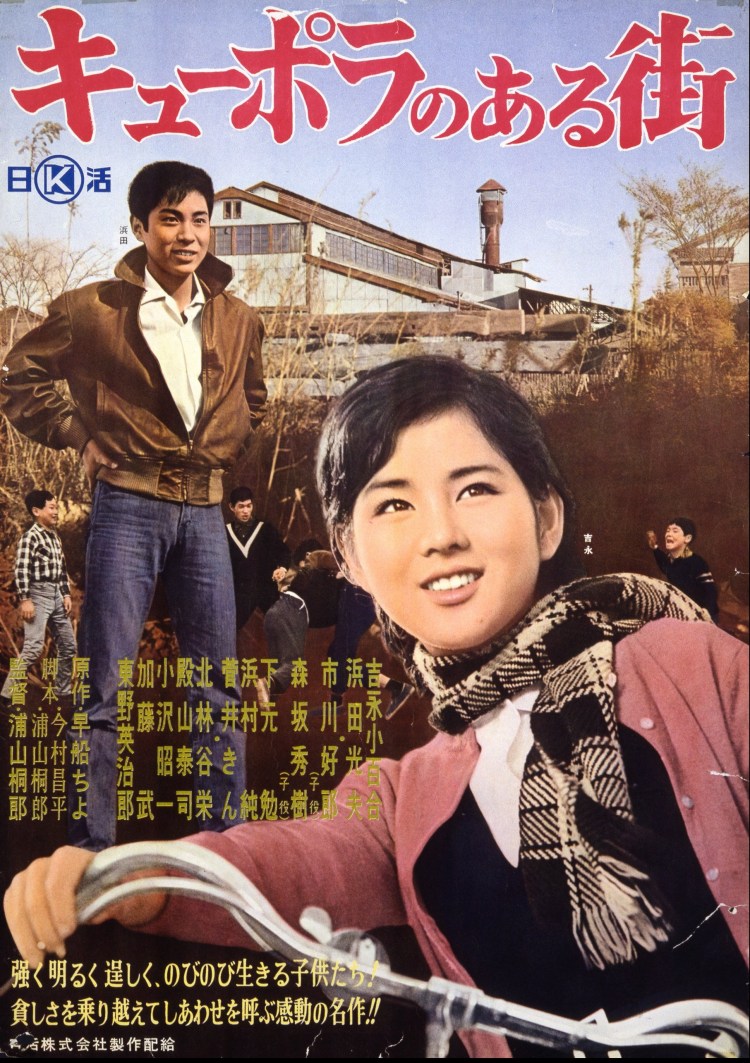
cupola-poster-e1539038053246.jpgThe “shomin-geki” is generally associated with naturalistic depictions of the lives of “ordinary people”, but in reality most often focuses on the polite lower middle classes – white collar workers, shop keepers, small business holders etc, in short the sort of people who aren’t wealthy but aren’t starving either and generally live in moderate family homes rather than tenements or cramped apartment blocks. Blue collar lives are a less frequent sight on screen – something director Kirio Urayama seems to highlight in his mildly exoticised opening which introduces us to Kawaguchi, Saitama, a small town across long bridge not so far from Tokyo.

Unlike the bustling city still fighting its way back from post-war privation, Kawaguchi is a “town of fire and sweat” where the landscape is dominated by the “cupolas” of the title (Cupola, Where the Furnaces Glow , キューポラのある街, Cupola no aru Machi, AKA Foundry Town). Rather than the beautiful architectural domes the name might imply, these cupolas are the industrial kind – chimneys from the 500 foundries which are the area’s dominant economic force. There is, however, trouble in that the steel industry has been decline since the immediate post-war heyday and increasing automation is changing the face of working life.

Our heroine, Jun (Sayuri Yoshinaga), is a young woman with post-war ambitions trapped in the depressing blue collar world of Kawaguchi. She’s currently in her last year of middle school and is determined to carry on to high school and perhaps even beyond, but the family is poor and her father, Tatsugoro (Eijiro Tono), has just lost his job at the local steel works. The family’s neighbour, Katsumi (Mitsuo Hamada), is big into the labour movement and has been protesting the changes at the works which has been bought by a bigger concern who are intent on compulsory layoffs. Tatsugoro, however, likes to think of himself as a “craftsman” rather than a “worker” and refuses to join the union partly out of snobbery and partly out of an entrenched fear of “communism”. He refuses to fight his compulsory redundancy because he is still wedded to the old ideas about loyalty to one’s superiors whilst simultaneously viewing himself as “better” than the other workers because of his long experience and skilled craftsmanship.

Nevertheless, Tatsugoro continues to selfishly abnegate his responsibilities to his family, refusing to insist on his severance pay and drinking the little money he still has left. Tatsugoro has four children ranging from teenager Jun to an infant born just as he lost his job. Some way into the film, Jun and and her younger brother Takayuki (Yoshio Ichikawa) take their father to task for his continued selfishness but the confrontation ends only in defeat. Tatsugoro simply doesn’t care. Loudly exclaiming that he has no daughter and will send Takayuki to the boys’ home, Tatsugoro destroys their hopes by reminding them that their fate is the same his – leave school early, work in a factory, marriage, children, drink yourself into an early grave. The argument proves so disheartening that Jun gives up on a school trip she’d been given a special subsidy to attend to roam around the streets, sadly visiting the prefectural high school that she has now given up on attending and accidentally witnessing another reason to give up on life that she, naively, misunderstands.

Meanwhile, Jun and Takayuki have also made friends with a family from North Korea who will be returning (without their mother) under a preferential “repatriation” programme organised by North Korean officials in Japan with the backing of the US and the Japanese government which, uncomfortably enough, saw only advantage in reducing the ethnic minority population. Though the film adopts a mildly positive view of repatriation – after all, no one really knew what North Korea was like in 1961 and many saying goodbye to their friends fully expect to stay in touch and perhaps meet again one day, it does highlight the persistent layer of xenophobic prejudice that the children face. Sankichi (Hideki Morisaka), one of Takayuki’s best friends, is taunted from the audience whilst on stage in a children’s play by cries of “Korean Carrot” (he is wearing a funny wig at the time) while Jun’s mother makes no secret of her dislike of the children’s friendships, believing that the Koreans are “dangerous”. Others associate the North Korean (in particular) population with communism and possible insurrection, fearing that Japan might be pulled into another nuclear war in Asia by political troubles across the sea.

The repatriation program is attractive not only as a means of escaping a world of constant oppression, but because of the entrenched poverty of the Kawaguchi area and the relative impossibility of escaping it. In a poignant, resentful school essay Jun wonders why her future is dictated by a lack of money, why she alone will be prevented from going on to high school and pulling herself out of the lower orders solely because of her responsibility to her family and father’s fecklessness. Tatsugoro is eventually offered another job thanks to the kindness of the father of one of Jun’s wealthier school friends, but continues to view himself as a “craftsman” and resents being ordered around by youngsters. What’s more, the factory is much more advanced – doubtless, the father of Jun’s friend (so different from her own) thought it might be better for Tatsugoro whose health is poor because the work would be less physically strenuous, but Tatsugoro finds it impossible to adapt to automated working methods and soon quits, leaving the family cash strapped once again.

An inability to adapt is Tatsugoro’s tragedy though he later makes amends when he consents to join Katsumi’s union and takes a job in a new factory, confident that he can’t be summarily dismissed ever again. Jun, meanwhile, has discovered a third way. Longing to escape the burden of her family she resolves to step forward alone but also instep with her society. Having discovered the existence of a progressive factory which is run with friendliness and consideration and even provides education for employees, Jun realises she can have the best of both worlds. Though Jun’s decision is perhaps one of individualism and a bold assertion of her own agency, it’s also in keeping with the broadly socialist message of the film which insists that a problem shared is a problem halved and places its faith in ordinary people to look after each other. Optimistic, perhaps, but a perfect encapsulation of post-war humanism and growing hopes for the future for those who are prepared to work hard on behalf not only of themselves but also for the social good.


Original trailer (no subtitles)

Cupola, Where the Furnaces Glow was scripted by Shohei Imamura whose work often focusses on the working classes and rural poor. As such it shares some similarity with his early film My Second Brother which also touches on the lives of ethnic Koreans living in Japan though this time in a mining village where the labour movement is engaged in actively opposing the exploitative practices of the corporate mine owners.

Downtown Heroes (ダウンタウンヒーローズ, AKA Hope and Pain, Yoji Yamada, 1988)

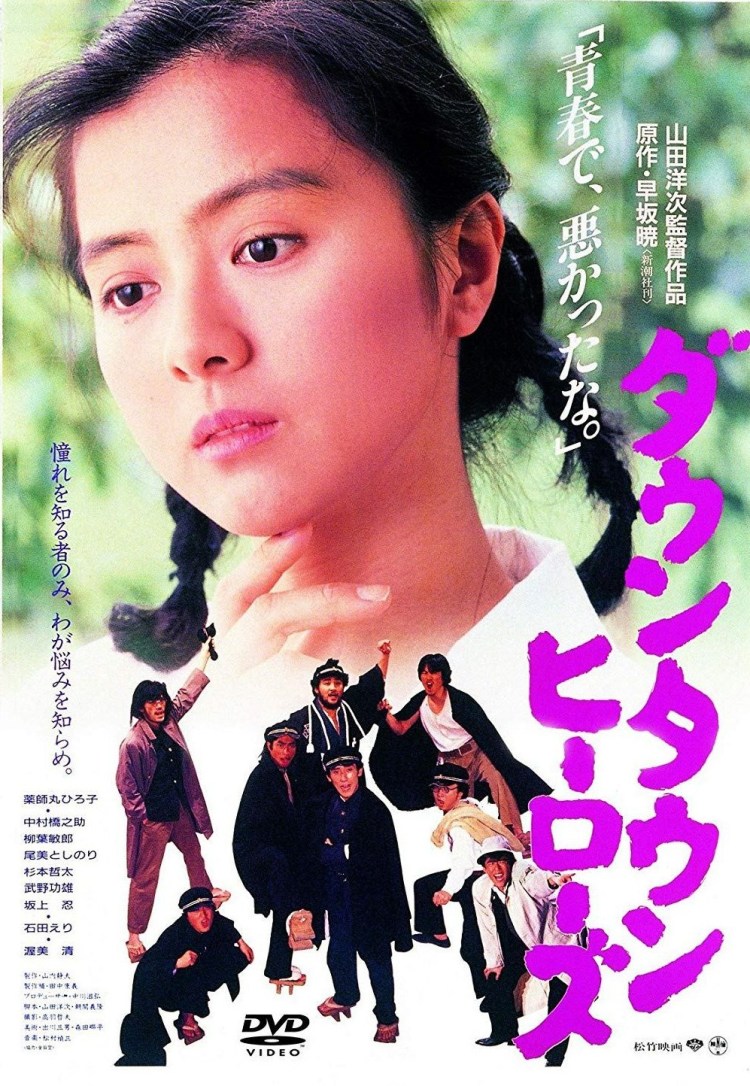
Downtown Heroes posterUnlike many of his contemporaries, Yoji Yamada was an infrequent visitor to the youth movie. Best remembered for his long running Tora-san series, Yamada’s later output is marked by an alternation of laughter and tears, running between raucous family comedies and poignant examinations of wartime loss. Set in the immediate postwar period, 1988’s Downtown Heroes (ダウンタウンヒーローズ, AKA Hope and Pain) adapts the autobiographical novel by Akira Hayasaka for a twin tale of endings and beginnings as a group of boys prepare to leave the Japan of their childhood behind and set out into the brand-new post-war future.

Our narrator for the tale is Hayasaka’s stand-in, Kosuke (Hashinosuke Nakamura), a sensitive young man from the mountains studying at the prestigious boys’ boarding school in town. The Matsuyama high school is one of the last to still be operating in Japan’s pre-war educational model. In fact, when the boys graduate the school will shut down in favour of the American 6-3-3 standard model of organising the educational system. Nevertheless, Kosuke and his friends enjoy what seems like a fantastically broad curriculum to modern eyes, much of which consists of classic German literature. Rather than their family names, the boys refer to each other with a series of nicknames inspired by their studies and have been heavily influenced by European left-wing political ideology. Accordingly, they are less than happy about the imposed American “reforms” and, paradoxically, the restrictions placed on their individual “freedom” by the “imperialist” occupation.

The central drama revolves around two episodes occurring one after another during the final year of high school. The first involves Kosuke’s friend Arles (Toshinori Omi) and a prostitute he helps to rescue from the red light district – Sakiko (Eri Ishida) was supposed to elope with a student from the school, but he didn’t show up and if the people from the brothel she was sold to find her she’ll be in big trouble. Her suitor turns out to be a fraud, but the boys are committed to saving her and hide Sakiko in their dorm, sharing their meagre rations with her before helping her escape to her home town. Meanwhile, the boys are also preparing for the very last culture festival the school will ever see at which they will present their adaptation of a classic German play. The snag is, the play needs a girl. Eventually the gang enlist the help of Fusako (Hiroko Yakushimaru) – a student at the girls’ school recently repatriated from Manchuria who also happens to be the young lady Kosuke had a meet cute with on the road and has been in love with ever since. Trouble brews when Gan (Tetta Sugimoto), the play’s director, falls in love with her too.

Told from the POV both of the old and the young Kosuke, the atmosphere is one of intense melancholy and inescapable nostalgia. Though these were times of hardship – rationing is fierce and intense, so much so that the school no longer serves meals at all on Sundays and the boys largely subsist on rice gruel, they were also times of joy and possibility. These are however youngsters in the best tradition of the sensitive young men of Japanese literature. They feel everything deeply, fully aware that they are living on the cusp of something new, which necessarily also means to be standing atop a grave. Their world is collapsing and the values they’ve been given (progressive though they seem to be) are about to be thrown out of the window. They have been taught that nothing is more important than their personal autonomy and that personal freedom is attained only through overcoming hardship, but their lives will increasingly be dictated by occupying forces and they feel themselves robbed of something without the right to reply.

Nevertheless their problems are also ordinary teenage ones of romantic crises and friendship dilemmas. Kosuke struggles with his love at first sight crush on Fusako but remains too diffident to say anything until it’s almost too late, while he also struggles to figure out what the most proper thing to do is when Gan reveals he is also in love with her. Gan, a sensitive writer, apparently burns with longing – so much so that he’s written a book long confession of love in apology for being unable to declare himself in person. Kosuke, a good friend, agrees to deliver the letter but both of them have neglected to consider Fusakao’s feelings so bound up are they in their own solipsistic dramas. Fusako was also struck by the love bug on her first meeting with Kosuke and has been patiently waiting for him to say something (as is the custom of the time). She is therefore doubly hurt and offended when he delivers a mini-tome on the theme of love from someone else before attempting to leave abruptly in a huff. Truth be told, there are few women who would enjoy being handed a thesis as a confession, but Fusako is really not in the mood to read one now.

Ending on a melancholy epilogue in which the old Kosuke looks on at field of young men playing American football before some others in running shorts brush past him and a young couple enjoy an evening walk, Yamada embraces the mild sense of deflation that has been building since the beginning. Young love faded and the dreams of youth were destined to come to nothing – not quite a tragedy, or perhaps only one of the ordinary kind, but food for the regrets of age all the same. The times were hard, and then they got better but somehow they were never so happy again. A youth drama indeed.


Original trailer (no subtitles)

Theme song “Jidai” performed by Hiroko Yakushimaru

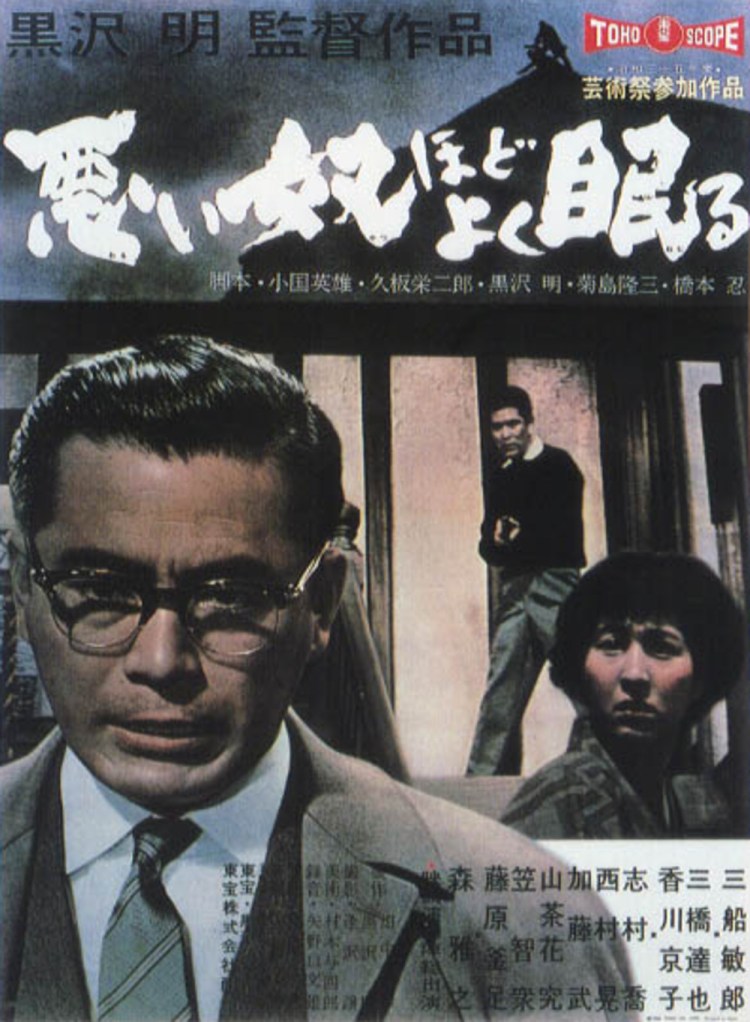
The Bad Sleep Well (悪い奴ほどよく眠る, Akira Kurosawa, 1960)

Bad Sleep Well posterThere’s something rotten in the state of Japan – The Bad Sleep Well (悪い奴ほどよく眠る, Warui Yatsu Hodo Yoku Nemuru), Akira Kurosawa’s take on Hamlet, unlike his previous two Shakespearean adaptations, is set firmly in the murky post-war society which, it becomes clear, is so mired in systems of corruption as to be entirely built on top of them. Our hero, like Hamlet himself, is a conflicted revenger. He intends to hold a mirror up to society, reflecting the ugly picture back to the yet unknowing world in the hope that something will really change. Change, however, comes slow – especially when it comes at the disadvantage of those who currently hold all the cards.

We open at a wedding. A small number of attendants lineup around a lift waiting for the arrival of the married couple only for a carriage full of reporters to pour out, apparently in hope of scandal though this is no gossip worthy society function but the wedding of a CEO’s daughter to his secretary. The press is in attendance because the police are – they believe there will be arrests today in connection with the ongoing corruption scandal engulfing the company in which a number of employees are suspected of engaging in kickbacks on government funded projects.

The rather strange wedding proceeds with the top brass sweating buckets while the bride’s brother (Tatsuya Mihashi), already drunk on champagne, takes to the mic with a bizarre speech “refuting” the claims that the groom, Nishi (Toshiro Mifune), has only married the bride, Yoshiko (Kyoko Kagawa), for financial gain before avowing that he will kill his new brother-in-law if he makes his little sister sad. Nishi, as we later discover, has indeed married with an ulterior motive which is anticipated by the arrival of a second wedding cake in the shape of a building at the centre of a previous corruption scandal with one black rose sticking out of the seventh floor window from which an employee, Furuya, committed suicide five years previously.

The police are keen to interview their suspects, the press are keen to report on scandal, but somehow or other the system of corruption perpetuates itself. The top guys cover for each other, and when they can’t they “commit suicide” rather than embarrass their “superiors” by submitting themselves to justice. The system of loyalty and reward, of misplaced “honour” mixed with personal greed, ensures its own survival through homosocial bonding with backroom deals done in hostess bars and the lingering threat of scandal and personal ruin for all should one rogue whistleblower dare to threaten the governing principle of an entire economy.

Nishi chooses to threaten it, partly as an act of revolution but mainly as an act of filial piety in avenging the wrongful death of his father who had, in a sense, cast him aside for financial gain and societal success. Wanting to get on, Nishi’s father refused to marry his mother and instead married the woman his “superiors” told him to. Later, his father threw himself out of a seventh floor window because his “superiors” made him understand this was what was expected of him. Furuya wasn’t the last, each time a man’s transgressions progress too far his “superiors” sacrifice him to ensure the survival of the system. Strangely no one seems to rebel, the men go to their deaths willingly, accepting their fate without question rather than submitting themselves to the law and taking their co-conspirators down with them though should someone refuse to do the “decent” thing, there are other ways to ensure their continuing silence.

Reinforcing the post-war message, Nishi chooses a disused munitions factory for his secret base. Both he and his co-conspirator, a war orphan, had been high school conscripts until the factory was destroyed by firebombing and thereafter were forced to live by their wits alone on the streets. Nishi swears that he wants to take revenge on those who manipulate the vulnerable, but finds himself becoming ever more like his prey and worse, hardly caring, wanting only to steel himself for the difficult task ahead.

In any revolution there will be casualties, but these casualties will often be those whom Nishi claims to represent. Chief among them his new wife, Yoshiko, who has been largely cushioned from the harshness of the outside world thanks to her father’s wealth and seeming care. She loves her husband and wants to believe in her father or more particularly that the moral arc of her society points towards goodness. Nishi, tragically falling for his mark, married his wife to destroy her family but ironically finds himself torn between genuine love for Yoshiko, a desire for revenge, and a mission of social justice. Can he, and should he, be prepared to “sacrifice” an innocent in the same way the “superiors” of the world sacrifice their underlings in order to end a system of oppression or should he abandon his plan and save his wife the pain of learning the truth about her husband, her father, and the world in which she lives?

In the end, Nishi will waver. Yoshiko’s father, Iwabuchi (Masayuki Mori), will not. Goodness becomes a weakness – Iwabuchi turns his daughter’s love and faith against her, subverting her innocence for his own evil. He makes a sacrifice of her in service of his own “superiors” who may be about to declare that they “have complete faith” in him at any given moment. The only thing that remains clear is that Iwabuchi will not be forgiven, the wronged children of the post-war era will not be so quick to bow to injustice. Let the great axe fall? One can only hope.


Original trailer (English subtitles)

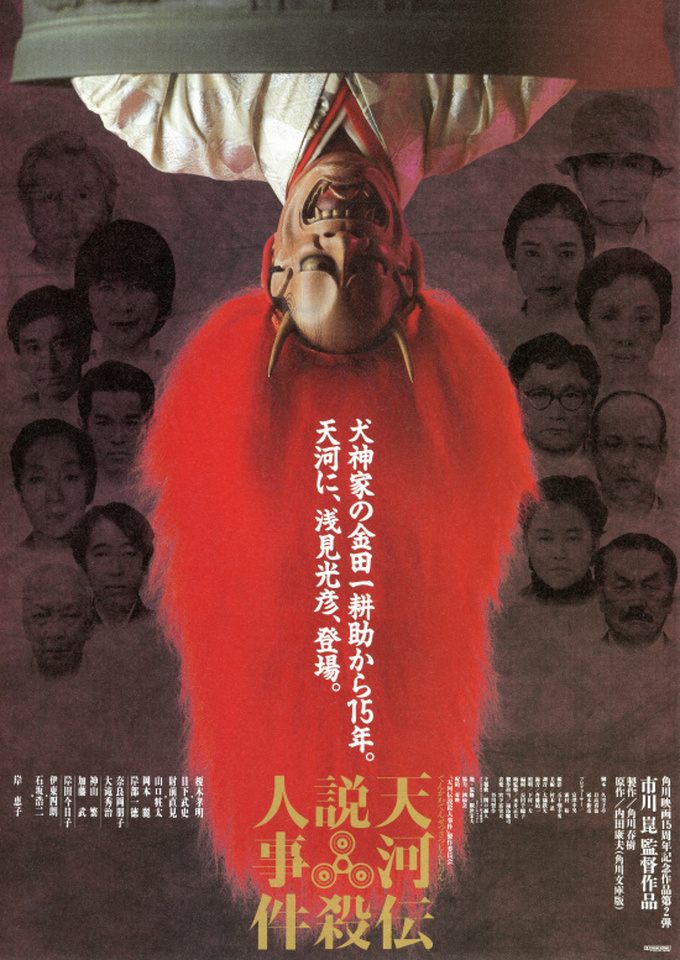
Noh Mask Murders (天河伝説殺人事件, Kon Ichikawa, 1991)

noh mask murders posterFor one reason or another, Japanese mystery novels have yet to achieve the impact recently afforded to their Scandinavian brethren. Japan does however have a long and distinguished history of detective fiction and a number of distinctive, eccentric sleuths echoing the European classics. Mitsuhiko Asami is just one among many of Japan’s not quite normal investigators, and though Noh Mask Murders (天河伝説殺人事件, Tenkawa Densetsu Satsujin Jiken) is technically the 23rd in the Asami series, Kon Ichikawa’s adaptation sets itself up as the very first Asami case file and as something close to an origin story.

Ichikawa, though he may be best remembered for his ‘60s arthouse masterpieces, was able to go on filmmaking where others perhaps were not precisely because of his forays into the populist with a series of mystery thrillers including several featuring top Japanese detective Kindaichi (who receives brief name check in Noh Mask Murders). Published by Kadokawa, Noh Mask Murders is produced by Haruki Kadokawa towards the end of his populist heyday and features many of the hallmarks of a “Kadokawa” film but Ichikawa also takes the opportunity for a little formal experimentation to supplement what is perhaps a weaker locked room mystery.

Asami (Takaaki Enoki) begins with a voice over as four plot strands occur at the same temporal moment at different spaces across the city. In Shinjuku, a salaryman drops dead on the street, while a young couple enjoy a secret tryst in a secluded forest, a troupe of actors rehearse a noh play, and Asami himself is arrested by an officious policeman who notices him walking around with a dead bird in his hand and accuses him of poaching. As he will later prove, all of these moments are connected either by fate or coincidence but setting in motion a series of events which will eventually claim a few more lives before its sorry conclusion.

To begin with Asami, he is a slightly strange and ethereal man from an elite background who has been content to drift aimlessly through life to the consternation of his conservative family which includes a police chief brother. He harbours no particular desire to become a detective and is originally irritated by a family friend’s attempts to foist a job on him but gives in when he learns he will have the opportunity to visit Tenkawa which is where, he’s been told, the mysterious woman who helped him out with the policeman in the opening sequence keeps an inn. Hoping to learn more about her, he agrees to write a book about the history of Noh and then becomes embroiled in a second murder which links back to the Mizugami Noh Family which is currently facing a succession crisis as the grandfather finds himself torn over choosing his heir – he wants to choose his granddaughter Hidemi (Naomi Zaizen) who is the better performer but the troupe has never had a female leader and there are other reasons which push him towards picking his grandson, Kazutaka (Shota Yamaguchi).

As with almost all Japanese mysteries, the solution depends on a secret and the possibilities of blackmail and/or potential scandal. The mechanics of murders themselves (save perhaps the first one) are not particularly difficult to figure out and the identity of the killer almost certainly obvious to those who count themselves mystery fans though there are a few red herrings thrown in including a very “obvious” suspect presented early on who turns out to be entirely incidental.

Ichikawa attempts to reinforce the everything is connected moral of the story through an innovative and deliberately disorientating cross cutting technique which begins in the prologue as Ichikawa allows the conversations between the grandchildren to bleed into those of Asami and his friend as if they were in direct dialogue with each other. He foregrounds a sad story of persistent female subjugation and undue reliance on superstition and tradition which is indirectly to blame for the events which come to pass. Everyone regrets the past, and after a little murder begins to see things more clearly in acknowledging the wickedness of their own actions as well as their own sense of guilt and complicity. Noh is, apparently, like a marriage, a matter of mutual responsibility, fostering understanding between people and so, apparently is murder, and one way or another Asami seems to have found his calling.


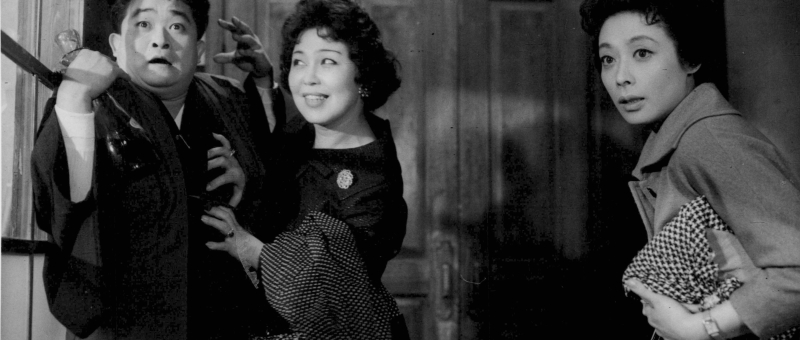
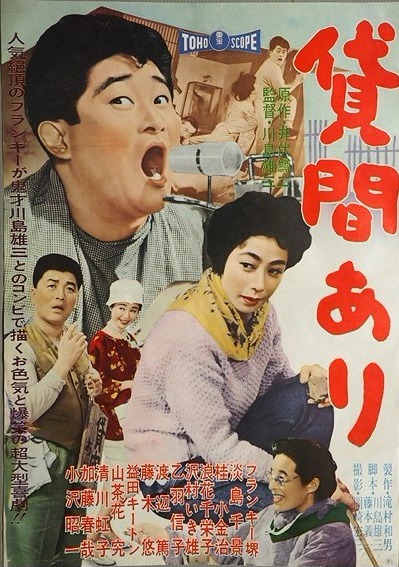
Room for Let (貸間あり, Yuzo Kawashima, 1959)

room for rent poster“Life is just goodbyes” exclaims a tenant of the small, rundown boarding house at the centre of Yuzo Kawashima’s Room for Let (貸間あり, Kashima Ari). Best remembered for his anarchic farces, Kawashima takes a trip down south to the comedy capital of Japan for an exploration of life on the margins of a major metropolis as a host of eccentric characters attempt to negotiate the difficult post-war economy, each in someway having failed badly enough to end up here. Though the setting is perhaps depressing, the lively atmosphere of the boarding house is anything but and the residents, depending on each other as a community of solidarity, know they have the ultimate resource at their disposal in the form of infinitely kind hearted, multi-talented fixer Goro Yoda.

Our introduction to the boarding house follows the passage of an outsider, Yumiko Tsuyama (Chikage Awashima) – a ceramicist who wants to make use of Goro’s printing facilities, but to find him she’ll first have to run the gamut of eccentric residents from the batty bee keeper to the geisha currently trying to fumigate one of her patrons by riding him around the room and the henpecked husband who responds to his wife’s frequent shouts of “Darling!” with a military style “yes, sir!”. On her way to Goro’s jam packed annex, Yumiko notices a room to let sign along with a kiln in the courtyard which catches her eye. Taking a liking both to the room and to Goro, Yumiko moves in and subsequently gets herself involved in the oddly exciting world of an old-fashioned courtyard standing on a ridge above a rapidly evolving city.

Played by well known comedian Frankie Sakai (who played a similar role in Kawashima’s Bakumatsu Taiyoden of two years earlier), Goro is an awkward symbol of post-war malaise and confusion. Goro, a jack of all trades, is the man everyone turns to when they run into a seemingly unsolvable problem, and Goro almost always knows a way to solve them (for a price). His sign in the marketplace proclaims that he speaks several languages and is available for tutoring students, he’s written “how to” books on just about everything you can imagine, he knows how to make the perfect cabbage rolls and konyaku, ghostwrites serial fiction, and runs a small printing enterprise, yet Goro is not a scholar, (licensed) lawyer, doctor, or successful businessman he’s a goodhearted chancer living on his wits. He runs away from success and eventually from love because he doesn’t think he deserves it due his continuing “fakery”.

Despite his minor shadiness, Goro’s kindness and sincerity stand in stark contrast to the evils of his age. Like Goro, many of the boarding house residents are trying to get ahead through somewhat unconventional means including the bawdy lady from upstairs whose main business is blackmarket booze, the peeping-tom street punk who peddles dirty pictures near the station, and the sad young woman working as an independent geisha (Nobuko Otowa) to save enough money to marry her betrothed whom she hopes is still waiting for her at home in her tiny village. That’s not to mention the mad scientist bee keeper who can’t help describing everything he sees in terms of bees and has attempted to turn their apian secretions into a cream which increases sexual potency, or the enterprising landlady who realises she could charge a few more pennies for patrons who want to sit in a fancy seat or watch TV while they eat dinner.

Yumiko isn’t the only outsider sending shockwaves through the community, a young student armed with a camera and the determination to avoid parental disapproval, intends to petition Goro to take his exams for him. The aptly named Eto (Shoichi Ozawa) is a dim boy with seemingly infinite wealth who’d rather scheme his way to the top than invest his energy in getting there the honest way. In this he’s the inverse of Goro whose simple sincerity and easy going nature are, it is subtly suggested, partly the reason he hasn’t made his way in the increasingly duplicitous post-war society. Goro does, however, give in to Eto’s nefarious plan even if it conflicts with his otherwise solid honour code which also sees him turn down the “opportunity” of sleeping with his neighbour’s seemingly insatiable wife in one of the stranger requests coming in to his do anything shop.

Kawashima’s true mastery lies not in the myriad moments of small comedy that pepper the main narrative, but in the glorious way he brings them all together as a perfectly constructed farce. The residents of the boarding house (one of whom is so proud of the “room to let” sign he made that he doesn’t want to rent the room because then he’d have to take the sign down) each face their own difficulties and disappointments but even when darkness creeps in (suicides, arrest, sexual assault, and animal cruelty all raising their ugly heads) the absurd positivity and warmth of these ordinary Osakans seems to be enough to combat it. Life may be a series of goodbyes, but it must still be lived, at least to the best of one’s ability.


 Screened as part of the Japan Foundation Touring Film Programme 2018.

Also screening at:

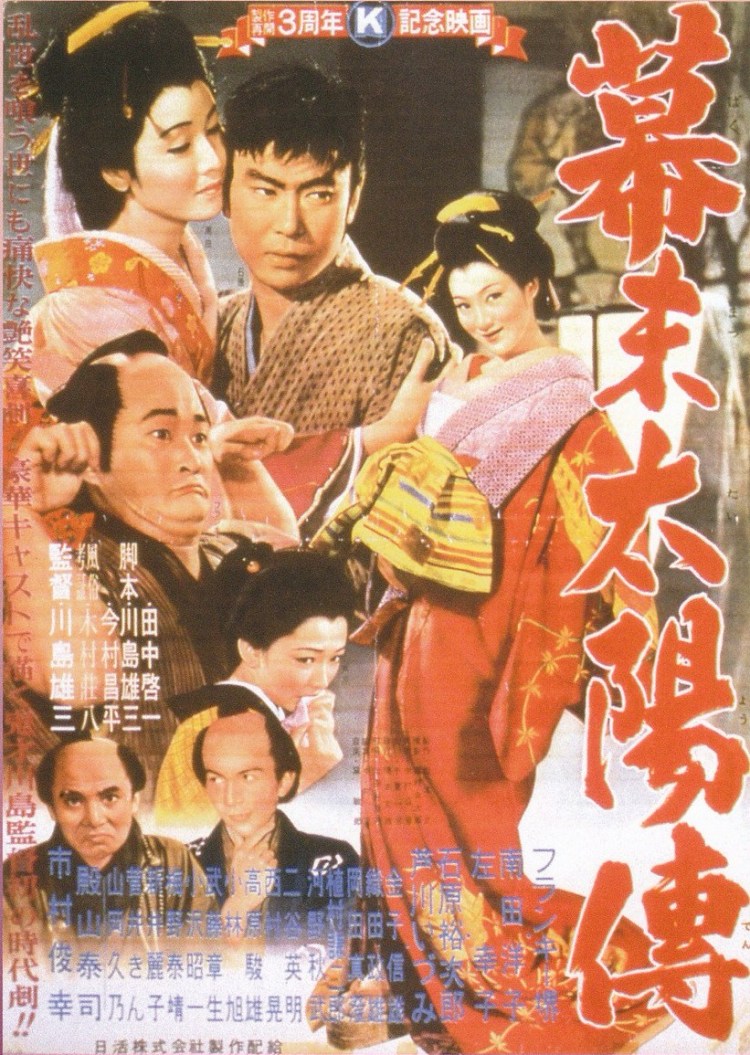
Bakumatsu Taiyoden (幕末太陽傳, Yuzo Kawashima, 1957)

bakumatsu taiyoden posterMany things were changing in the Japan of 1957. In terms of cinema, a short lived series of films known as the “Sun Tribe” movement had provoked widespread social panic about rowdy Westernised youth. Inspired by the novels of Shintaro Ishihara (later a right-leaning mayor of Tokyo), the movement proved so provocative that it had to be halted after three films such was the public outcry at the outrageous depictions of privileged young people indulging in promiscuous sex, drugs, alcohol, and above all total apathy – frivolous lives frittered away on self destructive pleasures. The Sun Tribe movies had perhaps gone too far becoming an easy source of parody, though the studio that engineered them, Nikkatsu, largely continued in a similar vein making stories of youth gone wild their stock in trade.

Yuzo Kawashima, a generation older than the Sun Tribe boys and girls, attempts to subvert the moral outrage by reframing the hysteria as a ribald rakugo story set in the last period of intense cultural crisis – the “Bakumatsu” era, which is to say the period between the great black ships which forcibly re-opened Japan to the outside world, and the fall of the Shogunate. The title, Bakumatsu Taiyoden (幕末太陽傳), literally means “legend of the sun (tribe) in the Bakumatsu era”, and, Kawashima seems to suggest, perhaps things now aren’t really so different from 100 years earlier. Kawashima deliberately casts Nikkatsu’s A-list matinee idols – in particular Yujiro Ishihara (the brother of Shintaro and the face of the movement), but also Akira Kobayashi and familiar supporting face Hideaki Nitani, all actors generally featured in contemporary dramas and rarely in kimono. Rather than the rather stately acting style of the period drama, Kawashima allows his youthful cast to act the way they usually would – post-war youth in the closing days of the shogunate.

They are, however, not quite the main draw. Well known comedian and rakugo performer Frankie Sakai anchors the tale as a genial chancer, a dishonest but kindly man whose roguish charm makes him an endearing (if sometimes infuriating) character. After a post-modern opening depicting contemporary Shinagawa – a faded red light district now on its way out following the introduction of anti-prostitution legislation enacted under the American occupation, Kawashima takes us back to the Shinagawa of 1862 when business was, if not exactly booming, at least ticking along.

Nicknamed “The Grifter”, Saiheiji (Frankie Sakai) has picked up a rare watch dropped by a samurai on his way to plot revolution and retired to a geisha house for a night of debauchery he has no intention of actually paying for. Though he keeps assuring the owners that he will pay “later” when other friends turn up with the money, he is eventually revealed to be a con-man and a charlatan but offers to work off his debt by doing odd jobs around the inn. Strangely enough Saiheiji is actually a cheerful little worker and busily gets on with the job, gradually endearing himself to all at the brothel with his ability for scheming which often gets them out of sticky situations ranging from fake ghosts to customers who won’t leave.

Saiheiji eventually gets himself involved with a shady group of samurai led by Shinshaku Takasugi (Yujiro Ishihara) – a real life figure of the Bakumatsu rebellion. Like their Sun Tribe equivalents these young men are angry about “the humiliating American treaty”, but their anger seems to be imbued with purpose albeit a destructive one as they commit to burning down the recently completed “Foreign Quarter” as an act of protest-cum-terrorism. The Bakumatsu rebels are torn over the best path for future – they’ve seen what happened in China, and they fear a weak Japan will soon be torn up and devoured by European empire builders. Some think rapid Westernisation is the answer – fight fire with fire, others think showing the foreigners who’s boss is a better option (or even just expelling them all so everything goes back to “normal”). America, just as in the contemporary world, is the existential threat to the Japanese notion of Japaneseness – these young samurai are opposed to cultural colonisation, but their great grandchildren have perhaps swung the other way, drunk on new freedoms and bopping away to rock n roll wearing denim and drinking Coca Cola. They too resent American imperialism (increasingly as history would prove), but their rebellions lack focus or intent, their anger without purpose or aim.

Kawashima’s opening crawl directly references the anti-prostitution law enacted by the American occupying forces – an imposition of Western notions of “morality” onto “traditional” Japanese culture. In a round about way, the film suggests that all of this youthful rebellion is perhaps provoked by the sexual frustration of young men now that the safe and legal sex trade is no longer available to them – echoing the often used defence of the sex trade that it keeps “decent” women, and society at large, safe. Then again, the sex trade of the Bakumatsu era is as unpleasant as it’s always been even if the familiar enough problems are played for laughs – the warring geisha, the prostitute driven in desperation to double suicide, the young woman about to be sold into prostitution against her will in payment of an irresponsible father’s debt, etc. One geisha has signed engagement promises with almost all her clients – it keeps the punters happy and most of them are meaningless anyway. As she says, deception is her business – whatever the men might say about it, it’s a game they are willingly playing, buying affection and then seeming hurt to realise that affection is necessarily false and conditional on payment of the bill.   

Playing it for laughs is, however, Kawashima’s main aim – asking small questions with a wry smile as Saiheiji goes about his shady schemes with a cleverness that’s more cheeky than malicious. He warns people they shouldn’t trust him, but in the end they always can because despite his shady surface his heart is in the right place. Warned he’ll go to hell if he keeps on lying his way though life, Saiheiji laughs, exclaims to hell with that – he’s his own life to live, and so he gleefully runs away from the Bakumatsu chaos into the unseen future.


Masters of Cinema release trailer (English subtitles)

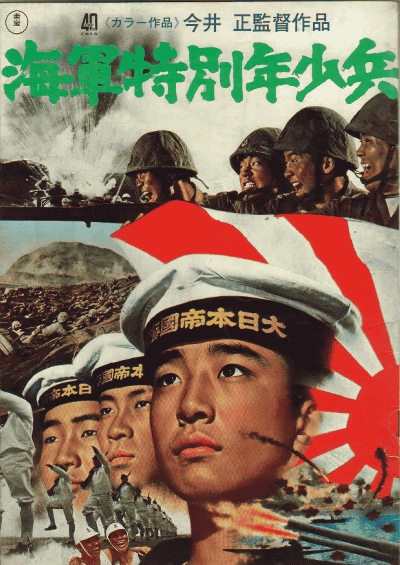
Eternal Cause (海軍特別年少兵, Tadashi Imai, 1972)

Marines cadets posterOften regarded as a “left-wing” filmmaker, even later pledging allegiance to the Communist Party of Japan, Tadashi Imai began his career making propaganda films under the militarist regime. Describing this unfortunate period as the biggest mistake of his life, Imai’s later career was dedicated to socially conscious filmmaking often focusing on those oppressed by Japan’s conservative social structure including the disenfranchised poor and the continued unfairness that often marks the life of women. 1972’s Eternal Cause (海軍特別年少兵, Kaigun Tokubetsu Nensho-hei, AKA Marines Cadets/ Special Boy Soldiers of the Navy) sends him back to those early propaganda days but with the opposite spin. Painting Japan’s tendency towards authoritarianism and its headlong descent into the folly of warfare as a direct result of social inequalities and the hierarchical society, Imai tells the dark story of the “special cadets”, children from military academies who eventually found themselves on the battlefield as members of the last, desperate defence of an already lost empire.

Imai opens at the grim conclusion – February 1945, Iwo Jima. A squad of young men catch sight of their “Instructor” just as he falls and are shortly all killed themselves by approaching American forces. The Americans, sympathetically portrayed, wander the corpse laden battlefield and lift the arm of one particular body lamenting that the fallen soldier is “just a boy”, and that Japan must be in a very bad state indeed if it has come to this. One of the soldiers, not quite dead as it turns out, manages to get to his feet. The Americans are wary but give him time in case he wants to surrender but the boy tries to charge them, crying out that he is a “Marine Cadet”. They have no choice but to shoot him dead.

Moving back around 18 months to June 1943, the “Marine Cadets” are new students at a military academy. On arrival they are instructed that everything they brought with them, including the clothes they are wearing, must be sent home. They are now at war and must forget civilian life. This dividing line neatly marks out the central contradiction in the Marine Cadets’ existence – they are children, but also marines.

Enrolment in the school is voluntary rather than conscription based and the young men have many reasons for having decided to enter the military, most of them having little to do with dying bravely for the Emperor. There is, however, a persistent strain of patriotism which brought them to this point as they find the sacrifice they offer to make all too readily accepted by their nation. The education on offer is wide-ranging and of high quality – the boys will learn English as well as geography, history, science and maths, all of which will hopefully turn them into well educated, efficient military officers, but there is profound disagreement between the teaching staff and “instructors” as to how that education should be delivered.

Sympathethetic teacher Yoshinaga (Katsuhiko Sasaki) believes in education and wants to contribute to raising these children in love seeing as he is in loco parentis. Kudo (Takeo Chii) the military instructor, however, disagrees. He believes in harsh discipline in which progress is encouraged through physical punishment and a strong shame culture. Yoshinaga reminds Kudo that the boys are just children and that such punishment based motivational techniques place the boys at each other’s throats and will undermine the spirit of comradeship and togetherness which is essential for the well functioning of any military unit. Kudo counters that the boys became men when they enlisted, that he was raised this way himself, and that a culture of violence binds the men together into a kind of hive mind which moves and thinks as one. Kudo does not waver in this belief even after his tactics have tragic consequences, but does come to love the children in his care, entrusting them to Yoshinaga as he prepares to face the battlefield himself.

As Kudo leaves, he stops to admit that the boys are children but also wants Yoshinaga to understand something he thinks may not have occurred to him. The boys are mostly poor children, who, he says, have only themselves to rely on unlike the officers who are by and large from middle-class families with extended safety nets of privilege. Kudo’s doctrine of progress through strength is born of being born at the bottom of the heap and needing to struggle to survive. They have made themselves strong in order to resist the consistent oppression of their economic circumstances which often prize nothing other than their physical capabilities.

Poverty is indeed a major motivator. The most sympathetic of the boys, Hayashi (Michiko Araki), has enlisted alongside another boy from his village, Enami (Taketoshi Naito), whose teacher father has fallen headlong for the militarist folly and is even allowing military representatives into his classroom to offer recruitment talks to the boys. He recommends Hayashi join the Marine Cadets as a matter of practically – Hayashi’s family is dirt poor and his father is a drunkard. Joining the academy means reducing the burden on the family who have many other children and also that he will eventually be able to send money home as well as being well provided for himself. Despite a lack of aptitude for soldiering, Hayashi is eventually grateful – in the academy he gets a taste of comfort he never knew at home as well as a sense of comradeship and brotherhood away from the hostile home environment dominated by the violence of a drunken father. Another boy makes a similar decision to escape his indifferent foster family after being orphaned. Despite the fact that his sister has embarked on a life of prostitution to support him, his relatives offer him only scant comfort and keep most of her money for themselves.

Yoshinaga’s complaints about the nature of the education the boys receive is quite naturally countered with a question as to why he is at the school at all given that these boys are destined only to become cannon fodder in a war which clearly all but over. His pleas for kindness and compassion largely fall on deaf ears. The boys are still children – our narrator is 14 when he enlists at the academy, but they have been encouraged to think of themselves as men. Their halfling status embarrasses them and they’re keen to prove themselves as brave soldiers of Japan. Yoshinaga, true to his word, tries to save the boys – ordering them to hide during final attack sure that the Americans will take pity on these child soldiers and prevent their lives from becoming meaningless sacrifices laid on the altar of an uncaring nation. He is unsuccessful because the boys’ heads are already filled with the idea of glorious sacrifice. Ashamed to be thought of anything other than Marine Cadets, they launch their own attack and sacrifice their lives willingly.

Imai is at great pains to remind us that this society cares nothing for the boys, 5,020 of whom fall on the battlefield, or for the poor in general who bear the brunt of a war that is waged against their interests. The approach is distinctly old fashioned for 1972 and the message at times unsubtle, but given that the film appears less than thirty years later than the events it depicts when those who survived would themselves still be young, perhaps fathers of teenage sons themselves, it serves as a timely reminder of past madness and a pointed warning for the consumerist future.


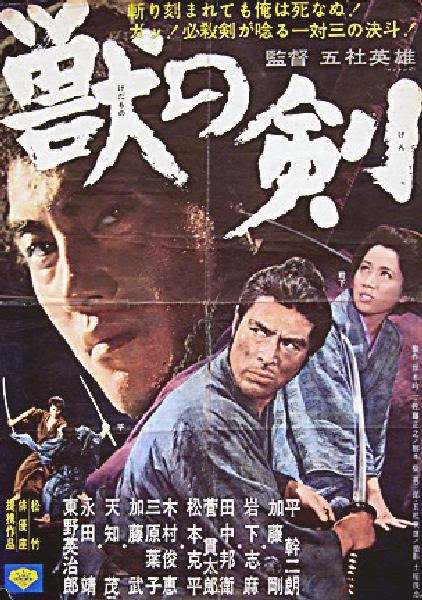
Sword of the Beast (獣の剣, Hideo Gosha, 1965)

sword of the beast posterHideo Gosha’s later career increasingly focussed on men at odds with their times – ageing gangsters who couldn’t see their eras were ending. His second feature, Sword of the Beast (獣の剣 Kedamono no Ken), is much the same in this regard but its youthful hero knows perfectly that change is on the horizon. Gennosuke (Mikijiro Hira) tries to ride that change into a better, more equal future but the forces of order will not allow him. The cinematic samurai world of the post-war era is no longer that of honourable men, manfully living out the samurai code even when it pains them to do so. It is one of men broken by oppressive feudal rule, denied their futures, and forced to betray themselves in service to systemic hypocrisy. Yet even if men think of reforming the system, they rarely think to escape it unless it actively spits them out.

When we first meet Gennosuke, he’s crawling around in a muddy grass field, dishevelled and hungry. A lone woman spots him and plies her trade leading Gennosuke to embrace his baser instincts and give vent to his lust, but the pair are interrupted by the sound of approaching horses. Gennosuke is on the run from his clan for his part in the murder of a lord. His pursuers scream at him, “have you no pride?”, lamenting his lack of stoical resignation to one’s fate so central to the samurai ideal. “To hell with name and pride” Gensosuke throws back, “I’ll run and never stop.”

Gennosuke’s odyssey leads him into the path of petty bandits who’ve been swiping gold out of the local river. Unbeknownst to them, a couple from another clan have been living an isolated life in a small cottage where they too have been skimming the Emperor’s gold, only they’ve been doing it for their lord. The man, Jurota (Go Kato), is excited about this work because he thinks when it is completed he’ll finally be accepted as a true samurai and the future for himself and his wife, Taka (Shima Iwashita), will be much brighter. He is quite wrong in this assumption.

Gennosuke, it is later revealed, committed his fateful act of murder upon the assumption that he was part of a revolutionary vanguard, removing cruel and corrupt lords from their positions so fairer minded, decent men could rule in their stead. Instead he realises he’s been rendered a disposable pawn in a political game and that the new master he believed would usher in a brighter future only envisaged one for himself. Jurota has been duped in much the same way, asked to do something illicit, immoral, and against the samurai code under the assumption that he will finally be accepted as “one of us”. He has not considered the corruption of those he wants to join, and does not see that his crime likely means he cannot be allowed to live.

Gennosuke and Jurota are cynical men who nevertheless possess true faith in the way of the samurai. Exiled from his clan, Gennosuke is a wandering beast who pretends not to care about the people he meets, but ends up saving them anyway. Yet if Gennosuke has been “freed” from his illusions, Jurota’s devotion to them makes him a less heroic figure. When Taka is captured by bandits who threaten her life, Jurota has a difficult decision to make – surrender the gold or his wife. Jurota chooses poorly and abandons his wife to a fate worse than death at the hands of uncivilised ruffians. Taka finds this hard to forgive. No longer wishing to stay with a man who values her so lightly she turns to Gennosuke – her accidental saviour, and reveals to him that she longs to become “a beast” like him. Now “freed” of her own illusions as regards her husband’s love, their shared mission, and the fallacy of their future together as noble samurai, Taka is prepared to exile herself from the samurai world as Gennosuke has, but, as he tells her, the wife of a retainer cannot choose the life of a beast.

This world of samurai is facing its own eclipse. The Black Ships have arrived, the spell has been broken, and the modern world awaits. Gennosuke can see this future, he tried to grasp it in the murder of his lord, but it is not here yet. Gennosuke’s friend, Daizaburo (Kantaro Suga), is duty bound to take his revenge as the fiancé of the murdered lord’s daughter though he’d rather not do it, and does so only to give Gennosuke an “honourable” death. The daughter, Misa (Toshie Kimura), is understandably angry and filled with hate but she pays dearly for her vengeance. Following their ordeal, neither Daizaburo or Misa can return to their clan. They are also “freed”, their illusions broken, their debts forgiven. Breaking with the burden of their past, they would now follow Gennosuke into his new world, even if none of them know exactly where they’re going.

These private revolutions amount to a kind of deprogramming, reawakening a sense of individual agency but one which is unselfish and carries with it the best of samurai honour. Gennosuke may be a “beast” on the run, reduced to a creature of needs rather than thoughts, but there’s honesty in this uncivilised quest for satisfaction which leaves no room for artifice or hypocrisy. It may be a rough world and lonely with it, but it is not unkind. To hell with name and pride, Gennosuke will have his honour, even as a nameless beast, a self-exile from a world of cruelty, greed, and inhumanity.


Original trailer (no subtitles)
https://www.youtube.com/watch?v=R_eddPRh5eY

Queen Bee (女王蜂, Kon Ichikawa, 1978)

queen beeKon Ichikawa may be best remembered for his mid career work, particularly his war films The Burmese Harp and Fires on the Plain as well as his melodramas Ototo and Bonchi, but he was one of the few directors who was prepared to keep one foot in the commercial arena as well as making more personal, “artistic” efforts. For this reason he was able to go on working through the creatively dry ‘80s when other big name directors, in particular Akira Kurosawa, found themselves locked out of the cinematic arena in their native country. Ichikawa’s biggest box office success was in fact the literary adaptation of a popular mystery novel The Inugamis (which he actually remade in 1999 as his final feature film). 1978’s Queen Bee (女王蜂, Jooubachi) is one of five films that Ichikawa made based on the work of popular mystery writer Seishi Yokomizo which feature the eccentric detective Kousuke Kindaichi.

In many ways, Queen Bee is the perfect synthesis of European and Japanese mystery styles as it technically plays host to its strange detective but places him off centre, more as an onlooker to events than the protagonist. Though it follows something like a classical Agatha Christie approach, it also brings in the Japanese love of puzzles and the importance of long buried secrets bubbling to the surface and coming back to haunt everyone involved in the original incident. It’s also important to note that Ichikawa is deliberately playing up the camp comedy of the situation too as he makes his bumbling policeman a definite figure of fun as well as sending Kindaichi tumbling into a pond among other oddly comic elements for this multiple murder mystery.

The story itself begins in 1932 as two students, Hitoshi and Ginzo, leave a small town where they’ve been learning all about the local folklore. Hitoshi later returns under less than pleasant circumstances as he’s come to get his grandmother’s ring back after giving it to a local girl, Kotoe, whom he’d agreed to marry, only his mother objects so now he wants to hold off a bit. Unfortunately this is not a good idea as Kotoe is already pregnant with his child. Sometime later Hitoshi dies in mysterious circumstances and we flash forward to 1936 when the daughter, Tomoko, is three years old and Ginzo comes back to propose to Kotoe.

Now we fast forward to 1952 when Tomoko is about to turn 19. Kotoe has died, Tomoko has been adopted by Ginzo, and three folklore loving students have set their eyes on her as a bride. Unfortunately, one of these suitors also winds up getting killed with Tomoko the prime suspect and it looks like history may be about to repeat itself.

Queen Bee may be a more mainstream effort, but Ichikawa films in a noticeably anarchic fashion with extremely strange cuts and juxtapositions, not to mention the almost parodic tone of the film. He adopts a fairly perverse approach to the entire enterprise even allowing his veteran star Tatsuya Nakadai to play the 20 year old version of himself in the brief 1930s scenes which is, it has to be said, something of a mistake. As fine an actor as Nakadai is, playing a 20 year old at 50 is a stretch and one which serves as a point of alienation during the deepest historical layer of the film.

As is usual with Japanese mysteries, the plot relies on the solution of various puzzles, riddles and the mechanics of crime much more so than the human psychology and importance placed on motive that dominate Western detective tales. As well as the long buried secrets, Queen Bee brings in some commentary on the place of social class in the post-war world, the folly of misplaced love, and how the failure to act honestly and in the best interests of others by putting your own feelings aside can cause extreme repercussions not only in your own future but those of generations to come. Once again, only by exposing previously unexpressed emotions and lies both accidental and deliberate can the trauma be resolved and crises come to an end.

Queen Bee is a strange film which plays up its European detective novel atmosphere complete with the drawing room lecture that has become a hallmark of the genre but also adds in a layer of irony and an almost winking jokiness that make for an oddly amusing tone. The mystery element itself is satisfying enough to keep even the most seasoned crime fan guessing with plenty of red herrings and misinformation along the way. That said, Queen Bee is also very much of its time and perhaps fails to offer much more than an enjoyably old fashioned detective story, albeit one which is anchored by strong performances from its veteran cast.


Unsubtitled trailer:

https://www.youtube.com/watch?v=TPZ64PbVOio

Ran (乱, Akira Kurosawa, 1985)

ran posterAkira Kurosawa is arguably the most internationally well known Japanese director – after all, Seven Samurai is the one “foreign film” everyone who “doesn’t do subtitles” has seen. Though he’s often thought of as being quintessentially Japanese, his fellow countryman often regarded him as too Western in terms of his filming style. They may have a point when you consider that he made three different movies inspired by the works of Shakespeare (The Bad Sleep Well – Hamlet, Throne of Blood – Macbeth, and Ran – King Lear) though in each case it’s clear that “inspired” is very much the right word for these very liberal treatments.

In the case of Ran (乱) – a loose adaptation of King Lear, Kurosawa moves the story to feudal Japan and an ageing king who this time has three sons rather than three daughters. This leaves Hidetora (Tatsuya Nakadai) with a smaller problem than Lear’s though in his original idea of making his eldest son his heir with the other two inheriting smaller roles it’s clear things aren’t going to end well. Just as in the original play, the oldest two sons Taro and Jiro sing their father’s praises with cynical glee but the youngest and most sincere, Saburo, refuses to play this game as his respect for his father is genuine. Unfortunately, Saburo’s honesty sees him banished from his father’s kingdom and his share of responsibility given over to his treacherous brothers. Predictably, neither is satisfied with what they’ve been given and it’s not long before a familial conflict has sparked into a bloody civil war.

How sharper than a serpent’s tooth it is to have a thankless child….Hidetora is not quite as far gone as Lear in Shakespeare’s original text at the beginning of the film yet he is still unable to see that his oldest two sons have placed personal ambition ahead of filial piety. Hidetora was once a fearsome, if cruel, warrior, famous for burning enemy villages and creating peace only through destruction. He’s old now, and tired and so he proposes to hand over the running of the kingdom to his eldest son, yet – he wants to remain the de facto leader until the very end. Of course, that doesn’t sit well with Taro, or more to the point his ambitious wife Lady Kaede. Hidetora is thrown out of Taro’s castle and then also from Jiro’s before all out war erupts between the two leaving him totally isolated – a king without a kingdom.

Hidetora’s true madness begins when he realises not only how little regard his eldest two sons hold for him, but also that his failure to recognise the true nature of the situation has lead to the deaths of the people in his care that have remained loyal to him to the very end. As the enemy begin to engulf the castle, concubines begin helping each other to commit suicide in order to avoid ravishment while others try to escape but are cut down by arrow fire. This is all his own fault – his ruthless cruelty has been filtered down to his two oldest sons who, as he did, will stop at nothing in the pursuit of power. What is a king if not the father of a nation, and as a father he has failed. Neither Taro or Jiro are worthy of the offices afforded to them and lack both basic humanity and the princely power one needs to become the unifying force of a people.

Only too late does Hidetora see the wisdom in Saburo’s words and finally understand that he has alienated the only one of his children that truly loved him. From this point on his madness increases and Nakaidai’s performance becomes increasingly mannered and theatrical as if Hidetora himself is acting in another play which only he can see. Wandering and lonely, the once great king is reduced to the estate of a beggar led only by his fool and sheltered by the ruins of a castle which he himself burned down.

However, as great as Nakadai is (and he always is), he’s very nearly upstaged by the young Mieko Harada as one of the all time great screen villainesses with the Lady Macbeth a-like Lady Kaede. Filled with a vengeful fury, Kaede is unafraid to use every weapon at her disposal to achieve her goal. No sooner is she brought the news of her first plan’s failure in the death of her husband than she’s embarking on a plot to seduce his brother which includes getting him to execute his wife. Vile as Kaede’s actions often are, her desire for revenge is an understandable one when you consider that Hidetora was responsible for the deaths of her family leaving her to become a trophy bride for the son of the man that killed them. Viewed from another angle, it would be easy to sympathise with Kaede’s desire to rid the world of these cruel and tyrannical lords were it not for her insistence on the death of Lady Sue – a woman in exactly the same position as herself whose death would not actually advance her cause very much at all.

Kurosawa films all of this from a distance. We, the audience, almost become the gods he speaks of – the ones who weep for us, watching silent and helpless, unable to save us from ourselves. We see the world for what it is – chaos, horses and men and blood. The battles aren’t glorious, they are frenetic, frightening and ultimately pointless. Though for all that there is a beauty to it too and the sheer scale of the production with its colour coded princes and immense armies is one the like of which we will never see again.

Ran presents us with a prognosis which is even more pessimistic than that of Lear. At the end of Shakespeare’s play, as profoundly tragic as it is, there is at least the glimmer of hope. There is a new, rightful king and the idea that something has been restored. Here there is no such resolution, we are the blind man casting a stick around the edge of a precipice, entirely alone and unable to see the gaping chasm which extends before us into which we may plunge headlong driven only by the chaos in our own hearts. In the end, Kurosawa’s message is not so different from Shakespeare’s – all the weight of this sad time we must obey, speak what we feel, not what we ought to say. Fathers and sons must strive to understand each other, and themselves, lest we fall into the eternal chaos which leads us to build our very own hell here on Earth.


Ran is currently playing in UK cinemas in a brand new 4K restoration courtesy of StudioCanal!