
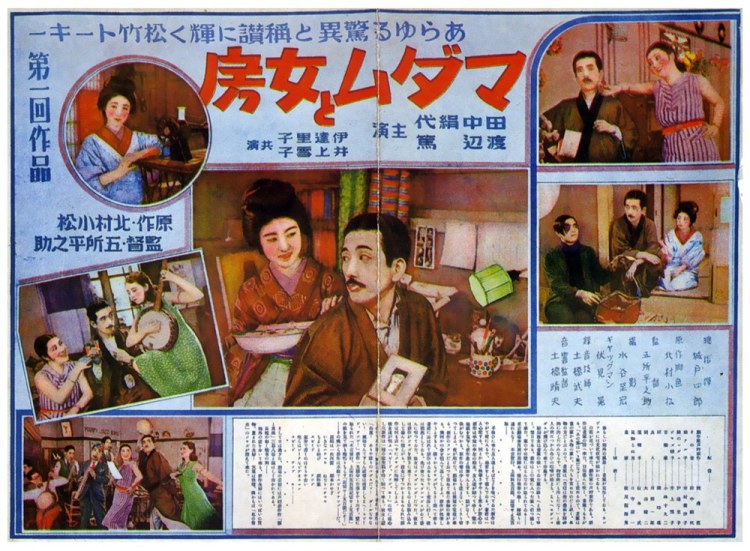
 There’s an especial irony in the fact that Japan’s first talkie is essentially all about how annoying sound can be. Directed by Heinosuke Gosho, pioneer of the shomingeki and a longstanding devotee of melancholy comedy, The Neighbor’s Wife and Mine (マダムと女房, Madame to Nyobo) is another in a long line of contemporary farces set in an idealised middle-class world but as much as Gosho goes out of his way to include as much soundplay as humanly possible he never lets the gimmick get the better of him.
Gosho opens with a brief prologue sequence otherwise detached from the main narrative in which down on his luck playwright Shibano (Atsushi Watanabe) gets into an argument with a precious artist busily painting a canvas of the house opposite him and gleefully admiring his own work. The painter likes this spot because of its silent serenity – an atmosphere quickly broken when Shibano struts up, whistling loudly, humming, making conversation. Unfortunately Shibano doesn’t rate the painter’s work and is also non-plussed that he doesn’t know who Shibano, apparently a “famous” playwright, is and doesn’t seem to respect writers as fellow artists anyway. A fight breaks out and all because of some unwanted noise pollution. Eventually the two men end up friends again after bonding in their mutual appreciation of the charms of “madame” (Satoko Date) the woman who lives in the house next to the one Shibano has just decided to rent on a whim with the intention of getting some “peace and quiet” in the countryside to finish his overdue manuscript.
The country is, as it turns out, not as quiet as you’d think. No sooner has Shibano moved in than he’s assailed by noise – mostly from within his own household as he’s a father of two, a little girl of perhaps four or five, and a bawling infant son. He doesn’t help matters by winding up his exhausted wife Kinuyo (Kinuyo Tanaka) by loudly impersonating a distressed cat during the middle of the night but a bigger problem is about to present itself in the form of the Mammy Jazz Band who, led by the woman Shibano was so smitten with after bumping into her during his altercation with the painter, use the house next-door as their rehearsal studio.
The house of Shibano is, apparently, a fairly happy one though long suffering wife and mother Kinuyo has reason enough for exasperation as her husband wastes his time drinking and playing mahjong while the deadline for the manuscript he’s supposed to be writing draws ever closer. In charge of the household finances, Kinuyo is keenly aware the family are low on funds – something presumably not helped by Shibano’s impulsive decision to rent a cottage in the country. He’s left himself a dozen inspirational notes reminding himself that manuscripts don’t write themselves, but still Shibano can’t buckle down. Having come to the country to escape the noise of city life, he finds himself assaulted by a silence differential in dealing first with his noisy children and responsibilities as a father, and then the constant intrusion of unexpected sounds which, in the city, might hardly be noticed against the constant background hum.
Trying everything from plugging his ears to tying a scarf around his head and finally jumping inside a cardboard box, Shibano decides to enlist Kinuyo to tell next-door to keep it down but she, an elegant Japanese wife, would hardly dare to disturb the “peace”. She tells her lazy husband to sort it out himself only to regret her decision when she spots him laughing away with the sophisticated modern woman next-door, drinking in the party atmosphere of her Bohemian home and enjoying a private concert as the “noisy” jazz band rehearse their latest numbers.
Despite his occupation which might imply a little Bohemianism in itself, Shibano is a traditionally minded sort. He may have turned up in swanky hat and pinstripe suit carrying a cane, but in his new home he dresses exclusively in kimono, as does his dutiful wife, who can only trail behind her husband in exasperation offering the occasional barbed comment as her only form of mild resistance. His household demands quietude, but cannot attain it. He is, therefore, naturally led away to the woman next door like a time traveller suddenly given a glimpse of the new and exciting future. The musical repertoire of the Mammy Jazz Band is all about “speed”, they move fast and with no thought to the disturbance they trail through the air around them. They are going somewhere, in contrast to Shibano who has been in a state of inertia for quite sometime.
It is, however, a little sad that it’s “madame” that finally speeds on Shibano rather than his wife and children even if there is nothing improper in their relationship – Madame is not particularly interested in Shibano in anything other than a neighbourly fashion, her people pleasing friendliness and genuine kindness perhaps running in contrast to the conventional depiction of a “modern” woman as Kinuyo later points out in jealousy when she remarks that women like that are all “100% sex delinquents”.
The film’s Japanese title is certainly drawing a contrast between the modern “madame” and the traditionally minded “nyobo” though it comes down on neither side, allowing room for both sorts of women in this rapidly changing society. Shibano maybe a lazy, easily distracted sort of man but he’s knows what’s good for him and when all’s said and done his relationship with his wife is as solid as they come despite their frequent financial woes, childcare spats, and momentary pangs of jealousy or anguish. The family, repaired and in motion once again, finally get their day in the sun enjoying a rare moment of blissful happiness as they break into a chorus of “My Blue Heaven”, positively rupturing the silence with their own joyful voices as they join the “noisy” cavalcade heading towards the exciting “speed era” waiting for them in the future.
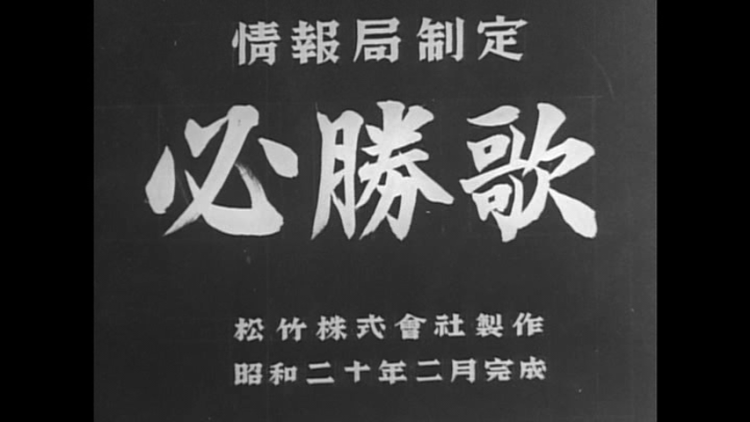 Completed in 1945, Victory Song (必勝歌, Hisshoka) is a strangely optimistic title for this full on propaganda effort intended to show how ordinary people were still working hard for the Emperor and refusing to read the writing on the wall. Like all propaganda films it is supposed to reinforce the views of the ruling regime, encourage conformity, and raise morale yet there are also tiny background hints of ongoing suffering which must be endured. Composed of 13 parts, Victory Song pictures the lives of ordinary people from all walks of life though all, of course, in some way connected with the military or the war effort more generally. Seven directors worked on the film – Masahiro Makino, Kenji Mizoguchi, Hiroshi Shimizu, Tomotaka Tasaka, Tatsuo Osone, Koichi Takagi, and Tetsuo Ichikawa, and it appears to have been a speedy production, made for little money though starring some of the studio’s biggest stars in smallish roles.
 Japan’s political climate had become difficult by 1938 with militarism in full swing. Young men were disappearing from their villages and being shipped off to war, and growing economic strife also saw young women sold into prostitution by their families. Cinema needed to be escapist and aspirational but it also needed to reflect the values of the ruling regime. Adapted from a novel by Katsutaro Kawaguchi, Aizen Katsura (愛染かつら) is an attempt to marry both of these aims whilst staying within the realm of the traditional romantic melodrama. The values are modern and even progressive, to a point, but most importantly they imply that there is always room for hope and that happy endings are always possible.
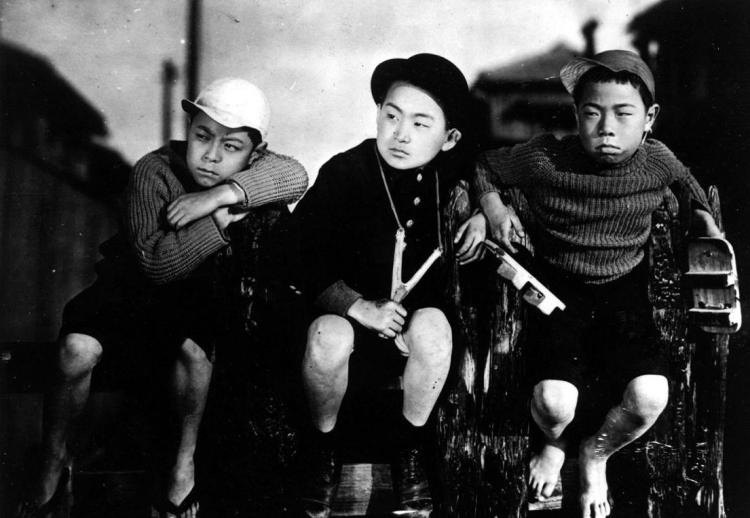 When one thinks of the classic examples of children in Japanese cinema, Hiroshi Shimizu is the name which comes to mind but family chronicler Yasujiro Ozu also made a few notable forays into the genre. I Was Born, But… (大人の見る絵本 生れてはみたけれど, Otona no miru ehon – Umarete wa mita keredo) stars one of the premier child actors of the silent era in Tokkan Kozo (later known as Tomio Aoki) who also worked repeatedly with Shimizu (
 Despite being at the forefront of early Japanese cinema, directing Japan’s very first talkie, Heinosuke Gosho remains largely unknown overseas. Like many films of the era, much of Gosho’s silent work is lost but the director was among the pioneers of the “shomin-geki” genre which dealt with ordinary, lower middle class society in contemporary Japan. Burden of Life (人生のお荷物, Jinsei no Onimotsu) is another in the long line of girls getting married movies, but Gosho allows his particular brand of irrevent, ironic humour to colour the scene as an ageing patriarch muses on retiring from the fathering business before resentfully remembering his only son, born to him when he was already 50 years old.
 Shimizu, strenuously avoiding comment on the current situation, retreats entirely from urban society for this 1941 effort, Introspection Tower (みかへりの塔, Mikaheri no Tou). Set entirely within the confines of a progressive reformatory for troubled children, the film does, however, praise the virtues popular at the time from self discipline to community mindedness and the ability to put the individual to one side in order for the group to prosper. These qualities are, of course, common to both the extreme left and extreme right and Shimizu is walking a tightrope here, strung up over a great chasm of political thought, but as usual he does so with a broad smile whilst sticking to his humanist values all the way.
 Isn’t it sad that it’s always the kids that end up hurt when parents fight? Throughout Shimizu’s long career of child centric cinema, the one recurring motif is in the sheer pain of a child who suddenly finds the other kids won’t play with him anymore even though he doesn’t think he’s done anything wrong. Four Seasons of Children (子どもの四季, Kodomo no Shiki) is actually a kind of companion piece to
 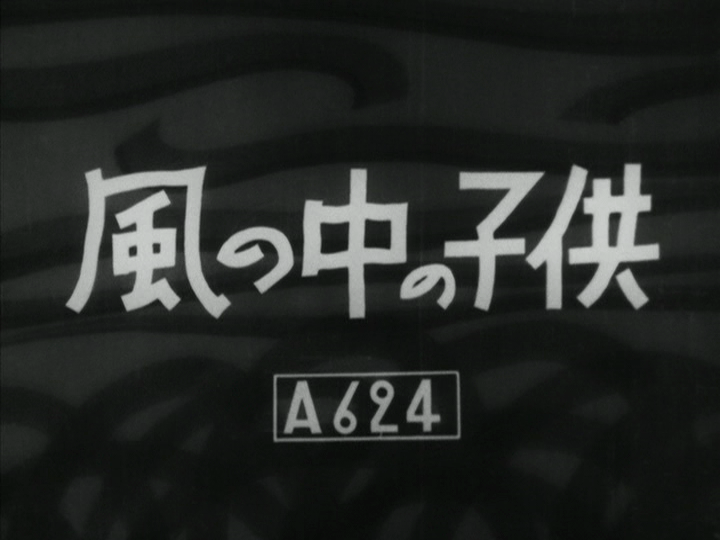 It would be a mistake to say that Hiroshi Shimizu made “children’s films” in that his work is not particularly intended for younger audiences though it often takes their point of view. This is certainly true of one of his most well known pieces, Children in the Wind (風の中の子供, Kaze no Naka no Kodomo), which is told entirely from the perspective of the two young boys who suddenly find themselves thrown into an entirely different world when their father is framed for embezzlement and arrested. Encompassing Shimizu’s constant themes of injustice, compassion and resilience, Children in the Wind is one of his kindest films, if perhaps one of his lightest.
 It’s tough being young. The Boss’ Son At College (大学の若旦那, Daigaku no Wakadanna) is the first, and only surviving, film in a series which followed the adventures of the well to do son of a soy sauce manufacturer set in the contemporary era. Somewhat autobiographical, Shimizu’s film centres around the titular boss’ son as he struggles with conflicting influences – those of his father and the traditional past and those of his forward looking, hedonistic youth.
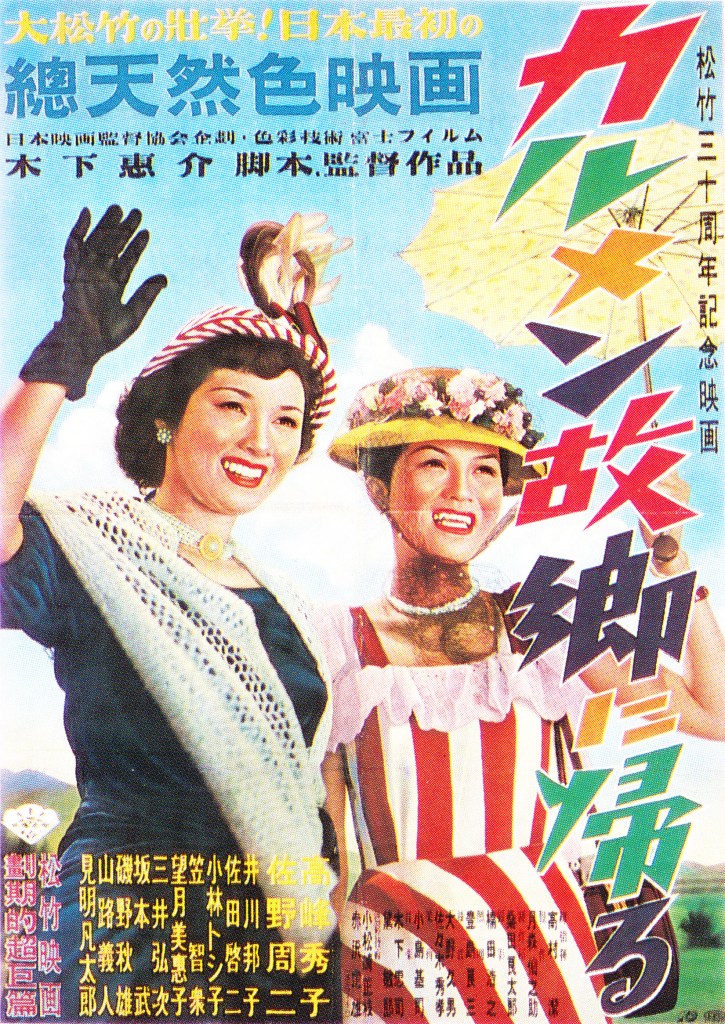 Shochiku was doing pretty well in 1951. Accordingly they could afford to splash out a little in their 30th anniversary year in commissioning the first ever full colour film to be shot in Japan, Carmen Comes Home (カルメン故郷に帰る, Carmen Kokyou ni Kaeru). For this landmark project they chose trusted director Keisuke Kinoshita and opted to use the home grown Fujicolor which has a much more saturated look than the film stocks favoured by overseas studios or those which would become more common in Japan such as Eastman Colour or Agfa. Fujicolour also had a lot of optimum condition requirements including the necessity of shooting outdoors, and so we find ourselves visiting a picturesque mountain village along with a showgirl runaway on her first visit home hoping to show off what a success she’s made for herself in the city.
