The Wolves (狼, Kaneto Shindo, 1955)

Post-war desperation drives a collection of otherwise honest men and women towards a criminal act that for all its politeness they are ill-equipped to live with in Kaneto Shindo’s biting social drama The Wolves (狼, Okami). “Wolves” is what the criminals are branded, but the title hints more at the wolfish society which threatens to swallow them whole. After all, it’s eat or be eaten in this dog eat dog world, at least according to a cynical insurance salesman hellbent on exploiting those without means. 

Each of the five “criminals” is an employee at Toyo Insurance where they’re immediately pitted against each other, reminded that in order to qualify for a full-time position they need to meet their quotas for six months. The orientation meeting is cultilke in its intensity, the boss insisting that only in insurance can you become a self-made man while recounting his own epiphany as to the worthiness of his profession. They are told that the only two things they need are “faith and honesty”, and then “faith and pursuasion”, while encouraged to think of their work as an act of “worship”, “for the salvation of everyone”. 

Yet they’re also told to exploit their friends and family by pressuring them into taking out life insurance policies in order to help them meet their quotas. As one man points out, friends and relatives of the poor are likely to be poor themselves, but these are exactly the kind of people they’re expected to target. They’re told there’s no point going after the weathly because they’re already insured, but there’s something doubly insidious in trying to coax desperate people who can’t quite afford to feed themselves into paying out money they don’t have on the promise of protecting their families from ruin. One man even asks if the policy covers suicide and is told it does if you pay in for a year, sighing that he doesn’t want to wait that long.

“Suicide or robbery, choose one,” one of the salespeople reflects after failing to make their quota once again. They each have reasons to be desperate, all of them already excluded from the mainstream society and uncertain how they will find work if the job falls through. Akiko (Nobuko Otowa) is a war widow with a young son who is being bullied at school because of his cleft palate for which he needs an expensive operation. She’s already tried working as a bar hostess but is quiet by nature and found little success with it. Fujibayashi (Sanae Takasugi) is widowed too with two children and five months behind rent for a dingy flat in a bomb damaged slum where the landlord is about to turn off her electric. Harajima (Jun Hamamura) used to work in a bank but was fired for joining a union and is trapped in a toxic marriage to woman looking for material comfort he can’t offer. Mikawa (Taiji Tonoyama) too is resented by his wife, a former dancer, having lost his factory job to a workplace injury while the ageing Yoshikawa (Ichiro Sugai) was once a famous screenwriter but as he explains people in the film industry turn cold when you’re not hot stuff any more. 

Their unlikely descent into crime has its own kind of inevitability in the crushing impossibility of their lives. They may rationalise that what they’re doing is no different from the insurance company that exploits the vulnerable for its own gain, thinking that if they can just get a little ahead they’d be alright while feeling as if robbery and suicide are the only choices left to them and at the end of the day they want to survive. Perhaps you could call them “wolves” for that, but they’re the kind of wolves that give the guards from the cash van they robbed their train fare home after bowing profusely in apology. The real wolves are those like Toyo who think nothing of devouring the weakness of others, promising the poor the future they can’t afford while draining what little they have left out of them. As the film opens, Akiko looks down at a bug writhing in the dirt attacked by ants from all sides and perhaps recognises herself in that image as the sun beats down oppressively on both of them. Breaking into expressionistic storms and unsubtly driving past a US airbase to make clear the source of the decline, Shindo paints a bleak picture of the post-war world as a land of venal wolves which makes criminals of us all. 


The Passionate Spinster (結婚相談, Ko Nakahira, 1965)

A woman still unmarried at the comparatively late age of 30 begins to go out of her mind while on a hellish descent into vice and crime in Ko Nakahira’s darkly comic satire, The Passionate Spinster (結婚相談, Kekkon Sodan). Shimako (Izumi Ashikawa) begins to feel as if her existence has no value as a single woman who has already aged out of the arranged marriage market, pressured by her family members to settle down and with seemingly no possibility of supporting herself as an independent woman almost as if such a thing could not exist even in the more enlightened world of 1965.

Shimako’s age is her primary problem. We often see her using some kind anti-aging device on her face and reapplying her makeup but as others reveal men in search of marriage are looking for women in their early 20s as is soon confirmed to her when she decides to visit a matchmaking agency after attending the wedding of a close friend, Mikiko (Michiyo Yokoyama), at which she is made to feel like something of an embarrassment giggled at by her younger coworkers who regard her with thinly concealed pity. As a voiceover explains, far more women sign up to matchmaking agencies than men while the age range is typically late 20s. Men’s only condition is that the woman be young, while women are mainly concerned with a man’s height and educational background. Shimako is not particularly picky and simply lists that she’d prefer a man of over 170cm in height, under 35 years old, and a university graduate but despite the beauty with which she is often credited she soon discovers that being over 30 is a deal breaker for most. 

The first man she meets remarks to the matchmaker that she looks “young” for her age and then inappropriately adds that she must be virgin, but eventually decides to marry a 24-year-old woman introduced by his boss. The second, a farmer with an interest in electronics, makes her an offer but is quickly vetoed by his family who feel that there must simply be something wrong with a woman who remains unmarried at 30. The last man the matchmaker, Tonobe (Sadako Sawamura), suggests is a 50-year-old widower named Hidaka (Tatsuo Matsushita) whom Shimako only considers out of desperation but later warms to uncomfortably because he reminds her of the father she lost in the war. Hidaka tells he that once they marry he will be a “father” to her too while taking this as a firm promise Shimako ends up sleeping with him to seal the deal. 

It’s with this that she damns herself, driven into a near nervous breakdown on realising that Hidaka may have been just another married man using a dating agency for extramarital sex. Then again, she’s told this by Tonobe who as it turns out, despite her frequent claims of being “not a yakuza” and concern for her agency’s reputation fearing she will be accused of running an illicit sex ring, is actually doing exactly that. Shimako accepted money from Hidaka and in so doing could be taken for a sex worker. Reminding her that sex work is against the law, Tonobe essentially blackmails Shimako into quitting her office job to work for the agency full time as a call girl, “protected” and “observed” by her two goons one of whom the agency’s other girl, Asako (Michiko Sasamori), suggests is actually Tonobe’s husband. 

In another kind of film, Shimako’s new line of work may have proved liberating, freeing her from the patriarchal ideals surrounding marriage, but it’s true enough that she falls into in a dangerous underworld as a virtual slave of the increasingly monstrous Tonobe whose demonic laughter begins to ring in Shimako’s ears along with all the criticism she’s received from men so far regarding her age. She seeks romantic escape after bumping into office lothario Takabayashi (Masaya Takahashi) who ironically asks her to pose as his fiancée to help him get rid of a problematic bar hostess who’s latched on to him. He promises to marry her too, only it soon transpires that he has massive debts and has been embezzling money from the company which he fears will soon be discovered because of an unexpected merger. Just as Hidaka had offered to become her father, Takabayashi likens her to his mother adding that he was never breast fed. 

With somewhat incestuous overturns, the lines between to blur between the ideals of wife and motherhood as Shimako becomes in effect responsible for a failed man pledging that she will use her body to pay off the debt that Takabayashi owes so that he won’t be prosecuted while believing that he will actually marry her. But her body belongs to Tonobe who reminds her that though she doesn’t care who she marries (an odd comment considering how they met) uncompensated romance is against the rules and she must now be punished in being sent to a further level of hell in essentially being offered up to an ogre in a remote Western-style mansion. Taking on gothic overtones, Shimako unexpectedly finds a kind of fulfilment while essentially embodying maternity in fulfilling the oedipal desires of a young man apparently driven mad who immediately tells her that avatars of his mother have appeared in this place before ominously adding that he has killed all the “fake” ones. Shimako later tells his sympathetic mother that her son was the best of the men she’s met while doing this kind of work and the first she’s slept with whose feelings were pure. 

Through this expressionist sequence which takes place during a gothic, violent storm surrounded by pictures of the Madonna, Shimako undergoes the first of her rebirths in effect giving birth to herself as a woman no longer quite so concerned with the necessity of being married though the film strongly implies she soon maybe. Her maternity is later reconfirmed when she unexpectedly reunites with her former boss, possibly the only “good” man seen in the film in having embraced his own paternity while caring for a wife with a longterm illness and raising his two children. His wife having died, when Shimako meets him again it’s almost as if she were meeting her own father in the memory she described to Hidaka though he is much closer to her in age while also unlikely to have any strong feelings either way regarding either her being over 30 or the scandals surrounding everything that happened to her after quitting the company. 

The film may suggest that it’s partly Shimako who is “old-fashioned”, something she later accuses her mother of being once she discovers that Shimako has been engaging in a sexual relationship with Takabayashi on only the promise of marriage, in contrasting her with the slightly younger Sakata (Kaoru Hama) who scoffs that she wants to put off her (already confirmed) marriage because she’s only 23 and wants to have a little fun first later seen in a nightclub with a gang of rough-looking guys who nearly cart off a near comatose Shimako, but then stops short of actually critiquing the institution of marriage only suggesting that Shimako’s intense anxiety was misplaced because the right man would have come along eventually. It may expose the matchmaking agency for what is really is and in its way fight back against the archaism of the arranged marriage along with the patriarchal social system and its intrinsic ageism but leans towards the view that a woman’s value lies in maternity in positioning Shimako to become a stepmother rather than simply a wife. Nakahira shoots with a noirish intensity before descending into a gothic eeriness in the demonic laughter of the incredibly sleazy Tonobe and creepiness of the mansion even if what Shimako discovers there is perversely a kind of purity that finally allows her to reclaim an image of herself as a pure woman even in the depths of her degradation. 


The Hunter’s Diary (猟人日記, Ko Nakahira, 1964)

Ko Nakahira is most closely associated with the seminal Nikkatsu Sun Tribe film Crazed Fruit which sent Yujiro Ishihara to stardom though he began his career at Shochiku in 1948 alongside Seijun Suzuki who like Nakahira would transfer to the newly re-established Nikkatsu when it resumed production in 1954. Suzuki was rather famously let go in 1968 due to creative differences with Nakahira also leaving the studio that year in similar circumstances having decamped to Shaw Brothers in Hong Kong in 1967 where he remade some of his previous hits including 1964’s Hunter’s Diary (猟人日記, Ryojin Nikki). 

Based on a mystery novel by Masako Togawa who in fact stars in her only film role as the hero’s little seen wife, Hunter’s Diary is one of a string of films in the mid-1960s critical of the functioning of the legal system in the post-war society. Nakahira opens with a lengthy sequence introducing new forensic technologies which anticipate the use of DNA as an investigative tool in the use of blood type analysis to place a suspect at a crime scene. This science will however be undercut by the sympathetic lawyer Hatanaka (Kazuo Kitamura) who reminds us that the presence of such evidence is not proof in and of itself in much the same way that DNA has since become the new smoking gun and is as susceptible to misuse as any other kind of forensic technique. 

It’s a problem for the hero, Honda (Noboru Nakaya), because his blood type is incredibly rare. In fact he was once in the paper for saving a baby by coming to the rescue with a donation just in time which as we later discover is ironic because much of his behaviour is shaped by the loss of his own child who was born with osteogenesis imperfecta and did not survive. The traumatic circumstances of the birth left his wife, Taneko, with a fear of pregnancy that eventually destroyed their marriage. The couple now live largely apart, she in her family’s country mansion painting disturbing pictures and he in the city “hunting” women for one night stands adopting the persona of a man who is foreign or part-Japanese. There is something of the fear of foreignness seen in other similarly themed films of the era in the fact that Honda’s child is born in Mexico while the couple had met and married in the US, Taneko convinced that had they returned to Japan earlier her baby may have survived while Honda claims that “intellectual” women are drawn to foreign men as he assumes his rather creepy “Monsieur Soubra” alter-ego complete with a funny accent and slightly broken Japanese. 

He positions his “hunting” as a way of dealing with the collapse of his marriage and his guilt over the death of his child overcoming his sense of impotence through transgressive sexuality though many of the women Hatanaka later interviews describe him as disappointingly vanilla and as we discover his games might have begun long before. Meanwhile the women are themselves judged for their sexuality, the discovery of a male muscle magazine in the home of a mousy spinster somewhat amusing to Honda while the unintended darkness of his sport is brought home by the film’s opening sequence in which a 19-year-old woman who became pregnant after he seduced and abandoned her takes her own life in shame and desperation only to be branded an “idiot” by her grieving sister for having slept with a man she had only just met. When a previous conquest of his is murdered in her apartment, Honda is momentarily worried but assumes it’s a grim coincidence. When her death is followed by that of a woman who could have provided him with an alibi he comes to the conclusion that someone is trying to frame him. 

Hatanaka’s conviction is that “the law is everything in court” and that Honda should not be judged on his moral character for his sleazy philandering only on the basis of the evidence presented which he believes may have been deliberately planted to incriminate him. His investigations take him to unlikely places discovering the potentially unethical practices of blood donation programs along with the illegal sale of blood and other bodily fluids such as semen while seeing the tables turned on visiting a gay bar where a male sex worker reports a weird encounter with a suspicious client, and salesman continues to frequent a Turkish bath hoping to run into a woman who seduced him but may only have been interested in his blood type. Honda soon forgets the name of the woman who took her own life, but is haunted by the visions of the women he has harmed while simultaneously rejecting the labels placed on him as a pervert or a predator and believing that his child’s death is punishment for his “abnormal sexuality” as some may brand it. 

This sense of guilt is also reflected in his worry that he is a “spreader of death”, as if though he did not kill them directly he were the carrier of a disease or else some kind of grim reaper beckoning these women towards their demise though he evidently thinks little of them outside of their status as trophies and does not stop to consider the consequences of his actions on others. Above his bed in his city hideout (officially he lives in a hotel) there is a picture of a fox hunt making plain that his satisfaction lies in the chase rather than its conclusion yet otherwise his motives are rather banal. He cannot leave his wife because he married into her prominent family and his social standing depends on his connection to them, likewise he decides against alerting the police or the building’s caretaker on discovering one of the women’s bodies because his reputation would be ruined if were to become involved in a murder and his secret life exposed. Ironically his salvation comes precisely because of this social standing when his wealthy father-in-law hires Hatanaka to handle his appeal and save him from the death penalty. 

Hatanaka had resigned from a previous position in opposition to the system, disappointed on meeting the lawyer who defended Honda at trial and realising they did not attempt to mount a defence nor investigate his case simply try to mitigate it in the hope of working it down to a custodial sentence. He instructs his naive young assistant who wonders if Honda is the sort of man they should be saving that she should approach every case on its merits as if the defendant is innocent without bringing in external moral judgements on his character. As he tells him, Honda may be legally vindicated but his moral judgement would depend on how he lives his life from then on later offering him a kind of absolution in telling him that one of his conquests, who does not want to be identified, gave birth to a son who is healthy and happy signalling that his is not an original sin and he does not bear that kind of responsibility for the death of his child. Veering towards the avant-garde Nakahira makes frequent use of superimposition and dissolves to reflect Honda’s fracturing mental state along with the persistence of his guilt while shifting into the purely documentarian in his lengthy explanation of forensic techniques and the science behind blood types but always returns to the Hitchcockian interplay of sex, death, and remorse which is true source of Honda’s trial. 


DVD remaster trailer (no subtitles)

A Certain Killer (ある殺し屋, Kazuo Mori, 1967)

A nihilistic hitman safeguards the post-war future in Kazuo Mori’s chivalrous B-movie noir, A Certain Killer (ある殺し屋, Aru Koroshiya). Set against the backdrop of the Vietnam War with US airplanes flying constantly overhead, Mori’s crime thriller situates itself in the barren wasteland of a rehabilitated city in which betrayal, exploitation and duplicity have become the norm while a former tokkotai pilot turned killer for hire takes his revenge on social hypocrisy as a product of his society, a man who did not die but knows only killing. 

Shiozawa (Raizo Ichikawa) runs a stylish restaurant by day and supplements his income by night as a killer for hire, apparently highly regarded by the local underworld. As such, he’s approached by a yakuza underling, Maeda (Mikio Narita), on behalf of the Kimura gang who want him to off another gangster, Oowada (Tatsuo Matsushita), who double crossed them in contravention of the yakuza codes of honour. Shiozawa is resolutely uninterested in yakuza drama and so turns the job down but changes his mind when he’s paid a visit by boss Kimura (Asao Koike) himself who sells him a different kind of mission. Kimura characterises Oowada as a “bad” yakuza, one has subverted the traditional gangster nobility by dealing in the “dirty” sides of organised crime, corrupting the modern society by trafficking in illegal prostitution, drugs, and extortion, where as he is a “good” yakuza mostly running construction scams and therefore building the post-war future. His crime is, literally, constructive, where Oowada’s is not. 

Shiozawa doesn’t quite buy his justifications, but men like Oowada represent everything he hates. “They’re not worthy of this world. They’re nothing but cockroaches” he laments, recalling the young men who served with him and gave their lives because they believed in a country which betrayed them. He agrees to take the job in rebellion against post-war venality, but only at a price, asking for four times the original fee. Kimura is willing to pay, because his true aim is profit more than revenge. He plans to take over Oowada’s remaining business concerns. 

Fully aware of this, Shiozawa seems almost uninterested in the money despite having asked for so much of it. He runs his shop as a front for his side business and otherwise lives a quiet, unostentatious life keeping mostly to himself. He is not, it would seem, a cold blooded killer, often making a point of leaving those who get in his way incapacitated but alive. Targeted by a street punk for supposedly messing with his girl he cooly disarms him and walks away, only for the girl to follow attracted partly by his icy manliness and partly by the thickness of his wallet as glimpsed when he made the fatal decision to offer to pay for her meal in order to save the chef from embarrassment over her attempts to pay with things other than money. Unable to get by on her own, Keiko (Yumiko Nogawa) attaches herself to various capable men beginning with the pimp, transferring her affections to Shiozawa whom she petitions to marry her, and then to Maeda, eventually vowing to find a new partner and make lots of money. 

Both Maeda and Keiko chase Shiozawa and are rebuffed. Impressed by his cool handling of the Oowada affair, not to mention the amount of money he now realises you can make in his line of business, Maeda asks to become his pupil in order to become a “real man”. Shiozawa doesn’t regard his work as something “real men” do, and in any case prefers to work to alone. Maeda repeatedly asks to be allowed to accompany him even after plotting betrayal, only to be rejected once again as Shiozawa tells him that he doesn’t like people who don’t know the difference between the job and romance, flagging up the homoerotic subtext for those not paying attention. Maeda parrots his words back to Keiko with whom he had begun a halfhearted affair as joint revenge against Shiozawa’s indifference. 

Following the successful offing of the mob boss, Shiozawa finds himself coopted into another job robbing a drug handoff between Oowada’s former associates, the illicit narcotics ironically packaged inside cartons intended for baby powder. Shiozawa apparently doesn’t object to profiting off the drug trade himself, but later abandons the loot in protest while the remainder is lost or squandered during the final battle with the remaining gang members, Shiozawa’s cartons left sitting ironically on top of a gravestone taken by no one. Cool as ice, Shiozawa places himself above petty criminality, always one step ahead, trusting no one and looking out for himself but reacting as a man created by his times, forged by a war he was a not intended to survive while looking on at another cruel and senseless conflict across the sea. Adapting the hardboiled novel by Shunji Fujiwara, Yasuzo Masumura’s jagged, non-linear script (co-written with Yoshihiro Ishimatsu) is imbued with his characteristic irony but also coloured with nihilistic despair for the post-Olympics society and its wholesale descent into soulless capitalistic consumerism.


Update, 13th February 2025: now available to stream via Arrow Player.

Original trailer (no subtitles)

Living by Karate (無鉄砲大将, Seijun Suzuki, 1961)

Nikkatsu’s brand of youth cinema could often have a nasty edge, its damaged heroes caught up in complicated rebellion but necessarily outsiders in a changing world which they feared held no real place for them. For each of those, however, there are others filled with life and possibility, not to mention a cartoonish sense of fun and infinite safety which perhaps largely disappeared from the films of the 1960s only to be found again in Kadokawa’s similarly aspirational teen movies of the bubble era. 

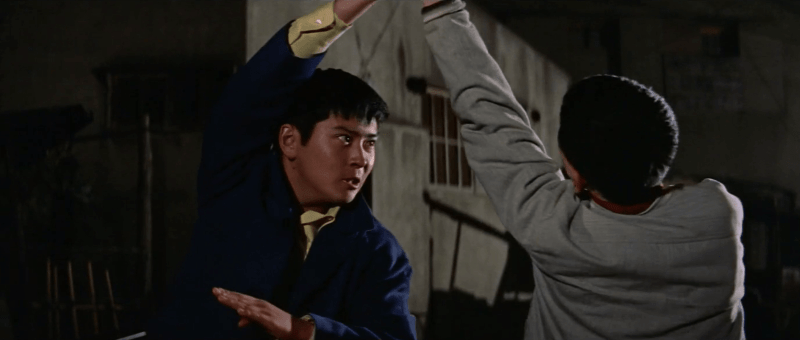
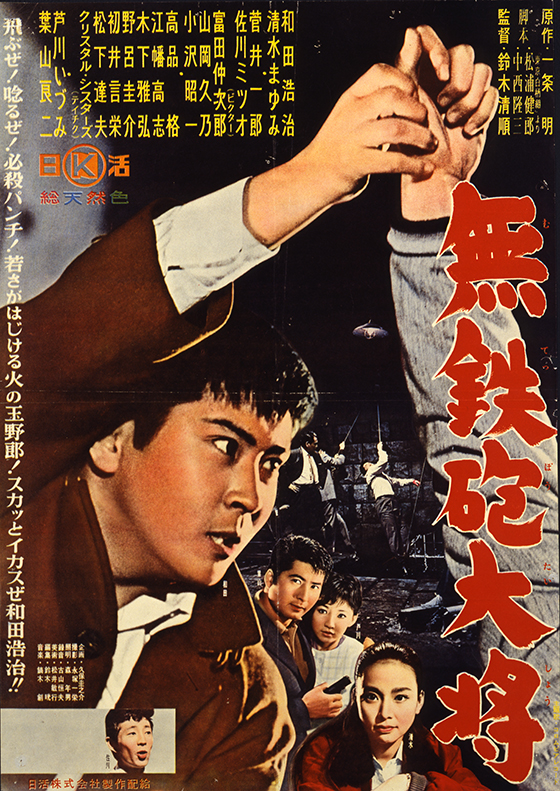
Living by Karate (無鉄砲大将, Muteppo Daisho, AKA Reckless Boss / A Hell of a Guy) once again stars Koji Wada as an earnest young man kicking back against the corrupt wartime generation. Still in high school, Eiji has a part-time job at an ice rink which he doesn’t treat quite as seriously as he ought to but his boss lets him get away with it because his handsome face is a hit with the local ladies. Eiji and two of his friends are keen members of a karate club and have decided to use their skills to fight for justice in their lawless town by going on “patrol”, clearing up the kinds of crimes the police might not make it to in time. Their plan backfires, however, when they come across the body of a recently deceased union leader and are arrested by a local bobby after getting caught with a joke knife one of the boys made for fun at his job on the family scrap yard. 

It comes as no surprise that Eiji’s arch enemy, sleazy mob boss Shinkai (Nakajiro Tomita), is behind the murder, apparently hired by a corrupt corporate CEO trying to stop his workforce exercising their legal rights. Eiji hates Shinkai because he bankrolled his widowed mother’s (Kotoe Hatsui) bar business but did so perhaps in return for being able to control her and by extension him by wielding his economic power against them. His loathing intensifies once he realises that the slightly older young woman he’s carrying a torch for, Yukiyo (Izumi Ashikawa), has fallen for one of Shinkai’s men, Goro (Ryoji Hayama). 

Goro is the classically “good” gangster who feels indebted to Shinkai because he took him in after the war, but wants to leave the underworld behind, going straight in Kobe where he intends to live a settled married life with Yukiyo. The modern yakuza is in many ways a Showa era phenomenon, a mechanism for men without families to protect themselves in the desperate post-war environment. By 1961, however, its existence was perhaps becoming harder to justify. The war orphans had grown up and had families of their own, the economy had significantly improved, and there was no need anymore to live a life of crime and heartlessness – a conclusion Goro has come to on his own after meeting the earnest Yukiyo who has similar problems with her goodhearted yet permanently drunk doctor father. 

Knowing he might have messed things up for his mother in interfering with her relationship with Shinkai, Eiji confesses that doesn’t “know what to do with the grownup world”. For him, everything is still very black and white. He hates yakuza because they prey on the vulnerable and Shinkai in particular because he does it so insidiously, forcing desperate people to accept loans on bad terms so that he can in fact “own” them and use them as he wishes. Eiji and his peer group kick back against what they see as the selfish corruption of the wartime generation, agitating for a fairer, more just world. The wealthy daughter of a corrupt CEO (Mayumi Shimizu) who has a crush on Eiji though he only has eyes for Yukiyo comes up with the idea of selling her fancy car to get money to help Eiji’s mother escape Shinkai’s control, but her father snaps at her that other people aren’t her responsibility and that she doesn’t understand how the real world works. 

Somewhat chastened by the youngsters’ pure hearted love of justice, he eventually comes up with a compromise in buying the car off her himself, but before that Eiji and his friends have to think carefully about the form they want their revolution to take. Taking him to task, Yukiyo points out that if all you do is fight with yakuza then maybe you’re a yakuza yourself, which shifts Eiji’s perspective towards ensuring that his rebellion is fully legal and involves the justice systems already in place. He comes to recognise that Goro is much like himself, and if he’s going to take down a sleazy brute like Shinkai it will take more than some fancy karate. Their resistance starts at home, giving others courage to stand up to yakuza oppression while living right themselves in the hope of creating a better, fairer world free of heartless organised crime.


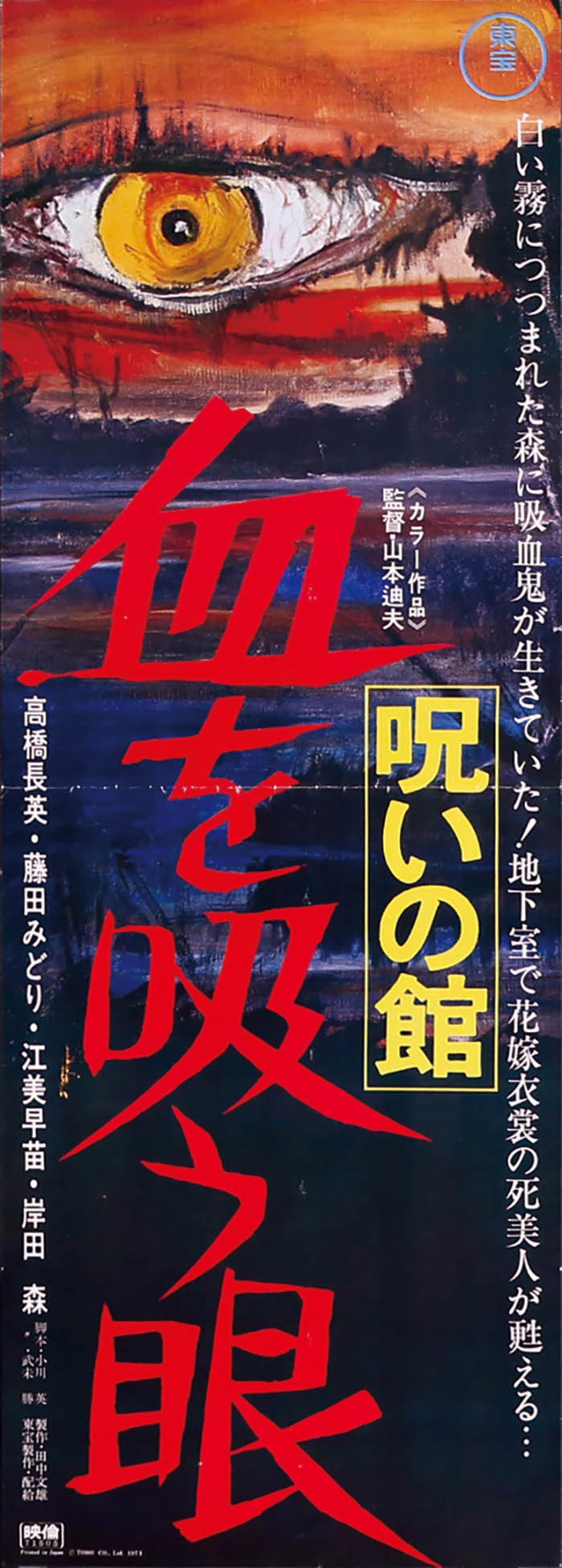
Lake of Dracula (呪いの館 血を吸う眼, Michio Yamamoto, 1971)

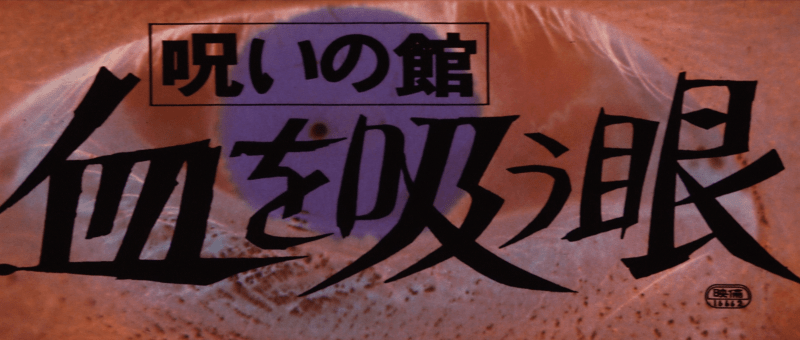
Lake of Dracula posterThe Vampire Doll, the first in a loose trilogy of films along vampiric themes released by Toho in the 1970s, had done its best to relocate Hammer-style horror to contemporary Japan. Adopting the best of the gothic from thundery skies to creepy mansions in the middle of nowhere, Vampire Doll successfully merged the Japanese longhaired grudge bearing ghost with the “romantic” bloodsucking tragedy of a young woman corrupted by illicit desires (though in this case for revenge). Returning to the theme a year later, Michio Yamamoto steps away from Japanese folklore altogether and positions his “foreign” Dracula as a “living” embodiment of repressed trauma, sucking the life out of his unwitting enemy until she finally learns to remember him, burning him away in the bright sunlight of his own eye.

Unlike Vampire Doll, Lake of Dracula (呪いの館 血を吸う眼, Noroi no Yakata: Chi wo Su Me) begins with a short prologue in which some children play on a rocky outcrop underneath a strangely ominous pink sky. When little Akiko’s pet dog Leo uncharacteristically runs off, she follows him and he leads her straight into the path of danger. Finding herself in a creepy mansion complete with stained glass windows and a dead body posed at a piano, the last thing that Akiko remembers is the pale face of a strange man with golden eyes and blood staining his chin.

Flashforward 20 years and Akiko (Midori Fujita) is a school teacher still living with her younger sister Natsuko (Sanae Emi) in their childhood home. She is convinced her traumatic childhood incident must have been a dream though it continues to haunt her enough to be a frequent subject in her artwork including a striking canvas she has just completed featuring a frightening golden eye looming over a tiny girl and her dog. Akiko has nice boyfriend, Takashi (Choei Takahashi), who is a doctor in the city, and all things considered a pretty nice life. Sadly it is not to last.

The trouble begins when someone randomly delivers a coffin to the local boathouse. First Akiko’s dog goes missing, then her trusted uncle figure tries to attack her before running off never to be seen again. Meanwhile, at Takashi’s hospital, a young “runaway” has been brought in in a catatonic state though no one can find much wrong with her until Takashi spots two suspicious bite marks on her neck. In case you’d forgotten about Natsuko, she has also begun behaving strangely – offering snide comments to her sister, going out alone in the middle of the night, and most alarmingly she has begun to grow pale.

Like Vampire Doll, Lake of Dracula is also an experimental vampire movie hybrid – a B-movie stalker picture in which Dracula is the creepy guy who can’t seem to take no for an answer. Yamamoto films the “naturalistic” action in standard Toho fashion but shifts into a higher register for his conception of heightened vampiric romanticism as Akiko’s “dream” erupts under a blood red sky and eventually leads her to an artfully appointed gothic cottage in which even the dead bodies are tastefully arranged.

Yet what Dracula comes to represent is the soul sucking power of the repressed past. Akiko has largely been able to move past her traumatic childhood adventure, convincing herself it was nothing more than a dream, and seems to be living a pleasant enough life even if her paintings betray her continuing anxiety. As we later find out, it is not quite so much the episode itself as the refusal to accept it which has caused Akiko so many problems – not least a buried rift with her treasured sister resulting from unfortunate sibling rivalry never fully dealt with both because of the incident and the early death of their parents. Akiko, resentful of having a new sister who had “displaced” her in her parents’ affections, sought to win back her rightful place by being the ideal child – good and obedient. Hence when no one believed her about the creepy house and strange man, she backed down, let them tell her it was only a dream to avoid being thought argumentative. Now she wonders if Natsuko harboured ill will towards her too for “stealing” back her parents’ love through her crazy story and perhaps relegating her to second place when she had become used to first.

Familial love becomes an odd kind of theme as we discover Dracula had a father of his own – a descendent of non-Japanese immigrants who had purposefully built a creepy mansion in the middle of nowhere in order to limit the possibility of his “bad blood” wreaking havoc in the world. The bad blood apparently skips a generation here and there and so Dracula, the third generation, is the first to be affected by it. His father tried to sacrifice himself to control his son, but now the demon is loose and is after Akiko who, creepily enough, seems to have caught his eye all those years ago (when she was five!) and he is determined to make her his “wife”. Vampirising someone’s sister is probably not a good way to win their heart, but Dracula, oddly, has never been very good at conventional romance.

Dracula’s “foreign” origins are perhaps an uncomfortable nod back to the xenophobic nature of the vampire myth. Despite being 3/4 Japanese and born and raised in Japan, Dracula’s late in the game exposure as not properly “Japanese” enough unfortunately reinforces the idea that “mixed” blood is somehow “impure”, even dangerous, and that even those who’ve spent their lives in Japan are not the same as those who are descended from long lines fully recorded 100% Japanese ancestors. Thus the danger becomes a “foreign object” which must be expelled to restore the integrity of the whole.

Restoring integrity is Akiko’s quest as she, along with her doctor boyfriend, attempts to solve the mystery through revisiting her traumatic childhood incident and finally learns to put it behind her. Yamamoto’s direction shifts between standard B-movie naturalism and florid avant-garde compositions but perhaps fails to capitalise on their inherent theatricality. Picking up the pace for the final set piece, Yamamoto also allows himself to go grim in taking a leaf directly out of the Hammer book by lifting the final death scene from the Christopher Lee starring Hammer Horror from 1958 in his crumbling, melting vampire, not to mention the other decomposing corpse resting in the house whose skin slides sickeningly from his body. A strange, hybrid adventure, Lake of Dracula makes an early attempt to pair the vampire chiller with serial killer thriller and does so moderately successfully even if its psychology remains firmly within the realms of the B-movie.


Lake of Dracula is the second of three films included in Arrow’s Bloodthirsty Trilogy box set which also includes extensive liner notes by Jasper Sharp detailing the history of vampires and horror cinema in Japan.

Original trailer (no subtitles)

https://www.youtube.com/watch?v=b1V2hCpxMNU

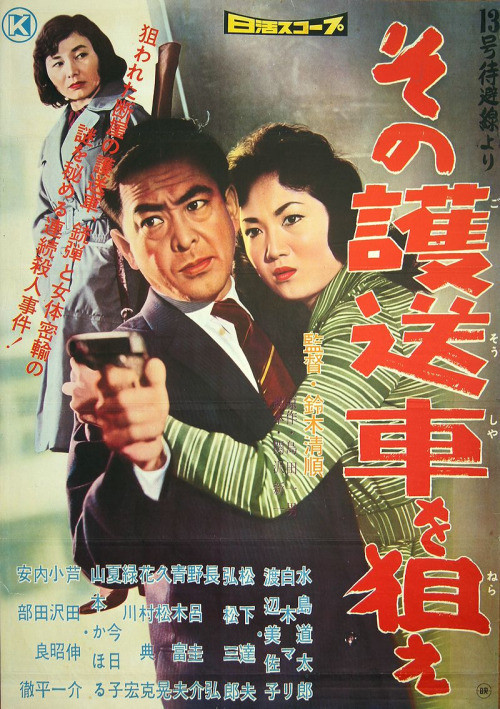
Take Aim at the Police Van (13号待避線より その護送車を狙え, Seijun Suzuki, 1960)

o0500070913581105946Nikkatsu’s main stock in trade during its 50s/60s heyday was the youth movie – films which captured the frustrations of being young (and usually male) in the scrappy post-war years. It’s a surprise then that the hero of Seijun Suzuki’s “action” movie Take Aim at the Police Van (13号待避線より その護送車を狙え, Jusango Taihisen Yori: Sono Gososha wo Nerae) is a genial middle-aged man who’s more Cary Grant in North by Northwest than Japanese James Dean. A programme picture, there’s nothing particularly interesting about the movie on paper but it’s among the first in which Suzuki indulges his talent for the surreal including a number of fantastically choreographed action sequences.

The film opens with a warning as a sniper trains his sights on a set of road signs which state that many accidents have occurred in this area. The one which is about to befall unlucky prison warden Tamon (Michitaro Mizushima) is however entirely man made. Momentarily confused by the figure of a woman watching the bus from the roadside, Tamon is blindsided when the sniper opens fire and kills several of the passengers while another, Goro (Shoichi Ozawa), cowers in the back. Tamon is suspended for six months but isn’t particularly upset about it. He’s not a detective and he knows he should leave it to the professionals, but he’s desperate to know why someone would bother attack such a lowly crew of petty criminals. Wondering who the woman was and how she fits into the case, who the snipers were aiming for and if they got them, and perhaps wanting to assuage his own feelings of powerlessness during the attack Tamon gets on the case.

Tamon is not your typical Nikkatsu action hero. He’s a little on the old side for starters – hardly the marquee face the studio was beginning to favour with its collection of “Diamond Guys”. He’s also not a policeman or a detective, he has no idea what he’s doing or what he’s getting himself into. What Tamon is is a righteous man. Almost immediately he’s sucked into the seedy underbelly of late ‘50s Tokyo with its strip clubs, trafficked women, and petty gangsters. This world is alien to him and he’s disgusted by it. Meeting the female manager of the “talent agency” which supplies in-room strippers to sleazy hotels where businessmen go when they’ve told their wives they’re at a conference, Tamon is horrified to hear her admit she thinks of the girls as “merchandise”. He pauses to explain to her that he always thought of the felons he looked after as “humans” rather than “criminals”, no matter what it was they’d done. Such naive humanitarianism is too much for Yuko (Misako Watanabe) – she’s instantly smitten, which is a problem because it means she needs to play both sides of her own game.

The pair end up in an uneasy alliance as Tamon’s goodness begins to work its magic. An unlikely white knight, Tamon finds himself wanting to save all the ladies threatened by “Akiba’s” dastardly plan from the icy charms of Yuko to Goro’s cabaret girl Tsunako (Mari Shiraki), and another young one, Shoko (Kyoko Natsu), about to get sucked into the Akiba web. What he discovers is a nasty trail of exploitation running from the bars and clubs of the city centre to the genial holiday spa towns where the moderately wealthy travel to pursue their discrete pleasures.

Tamon may be a little older than your average Nikkatsu action star, but he’s also a perfect fit for a film noir hero in wrong man mould. Tamon is not on the run, but he is out of place in this world, perhaps harking back to a presumably more innocent age where honesty and compassion still counted for something. He views his job as a prison warden as a public service, believing that there is goodness in everyone and it’s the job of people like him to find it and bring it to the surface. This he does at least seem to accomplish with Yuko who (despite her role in events so far) seems to have “reformed” and intends to follow Tamon’s lead in taking her “talent agency” in a more legitimate direction. 

Suzuki often claimed that Youth of the Beast was the first of his films where he was able to fully embrace his madcap desires, but Take Aim at the Police Van contains a fair few Suzuki touches of its own from the bold opening sequence shot through the sights of a sniper rifle, to the show girl killed by an arrow to her bare breast, bizarre murder by petrol tanker set piece, and exciting train station finale. Keeping the camera fluid, Suzuki captures a world in motion, seemingly running away from our noble hero until justice, in the form of an unstoppable steam train, finally arrives.


Attack on the police van clip (English subtitles)

https://www.youtube.com/watch?v=D2FcJY003HA