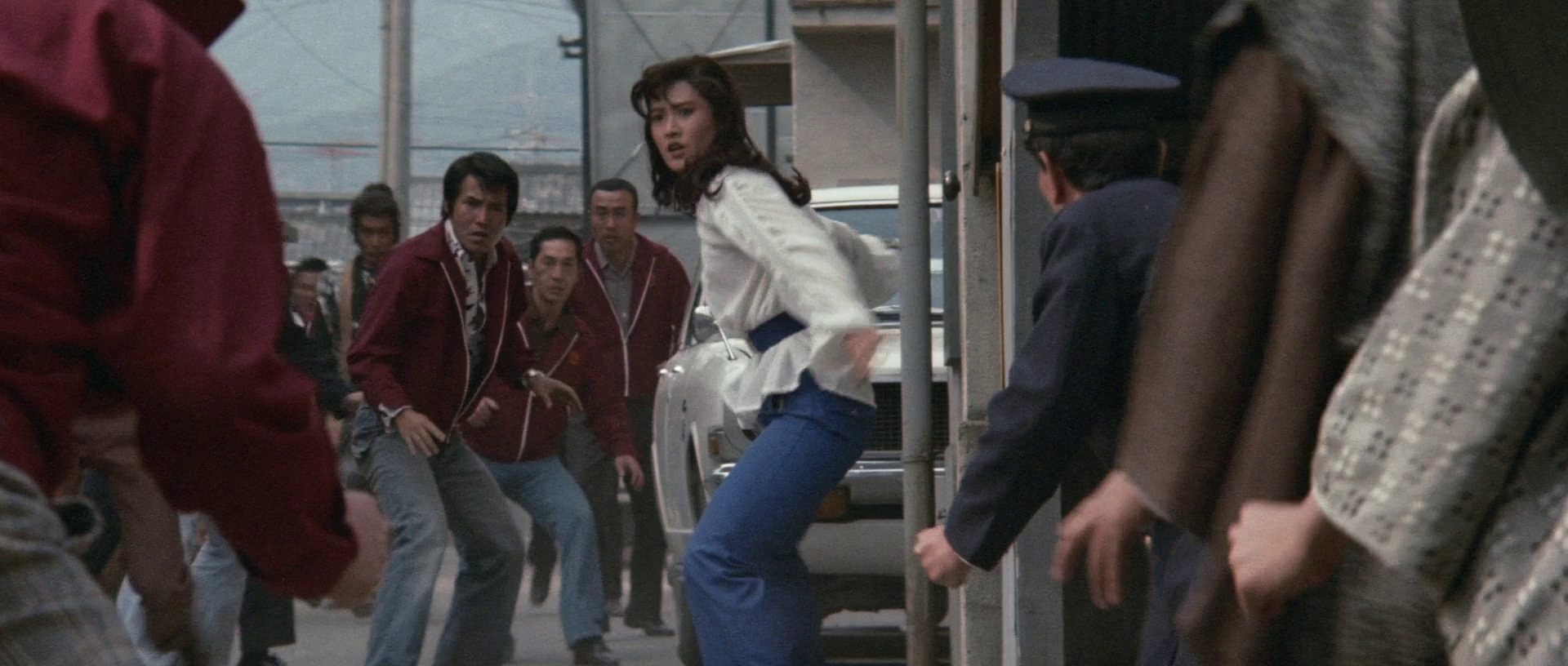
Sister Street Fighter: Fifth Level Fist (女必殺五段拳, Shigehiro Ozawa, 1976)

Though it’s tacked on to the Sister Street Fighter series, Level Five Fist (女必殺五段拳, Onna hissatsu godan ken) actually has nothing to do with it save borrowing a part of the title which is intended to signal the presence of its star. Thus, this is not really a martial arts movie but a much more conventional Toei action film in which the leading role is technically split between Etsuko Shihomi’s posh girl karate champ and Tsunehiko Watase’s sexist cop. It does however continue the smuggling theme with the drugs this time first being packed inside fish and then encased in Buddha statues to be exported to America.

Like many Toei films of the time, there is an underlying theme of anti-Americanism as the “Far East” big boss, posing as a Hollywood movie exec, is supposedly from there but has a strong accent suggesting otherwise. Meanwhile, the brother and sister at the film’s centre are a pair of children who were fathered by American servicemen at the bases in Okinawa who presumably took no responsibility for their upbringing. The brother’s father was black, while the sister’s was white, and though they have both suffered prejudice and discrimination because of their mixed ethnicity, it’s clear that Jim (Ken Wallace) has had it worse. Michi (Mitchi Love) makes good use of her native-level English abilities and martial arts skills to work as a bodyguard / interpreter for visiting dignitaries, but Jim seems to struggle to find employment and subsequently ends up working for a Korean gang run out of a local nightclub. 

The pair have a dream of saving up enough money to return to Okinawa, which was returned to Japan in 1971 after an extended period of US occupation, and opening a restaurant which the film positions as a desire to escape from the racism they experience on the mainland. When Jim says that Kiku (Etsuko Shihomi) is their only friend, he half implies that the discrimination they face is down to being Okinawan rather than their mixed ethnicity which would continue to be an issue even on the islands as it was in their childhood even if there may be more understanding given the continuing presence of the American military and larger numbers of mixed-ethnicity people. In any case, it’s true enough that even those from Okinawa do also experience discrimination on the mainland and are not always accepted as “Japanese” while their Okinawan identity is not respected either. 

Kiku is trying to protect her friends, but finds herself hamstrung by rigid cop Takagi (Tsunehiko Watase) who also happens to be the son of a friend of her father’s. Kiku’s father is apparently a self-made man and successful kimono merchant married to a more conservative woman with higher social ambitions. As the film opens, Kiku is dressed in a kimono and being subject to a formal omiai meeting for an arranged marriage with an admittedly promising candidate who graduated from an elite university and works for a prominent bank. But Kiku looks bored throughout and defiantly flouts social convention by suddenly claiming to have an appointment and walking out, much to her mother’s embarrassment. Her father lets her go and is apparently less bothered about this sort of propriety though later trying to put his foot down when she leaves the house dressed like a hippy rather than in a fine kimono which is not, after all, a very good advert for the family business. 

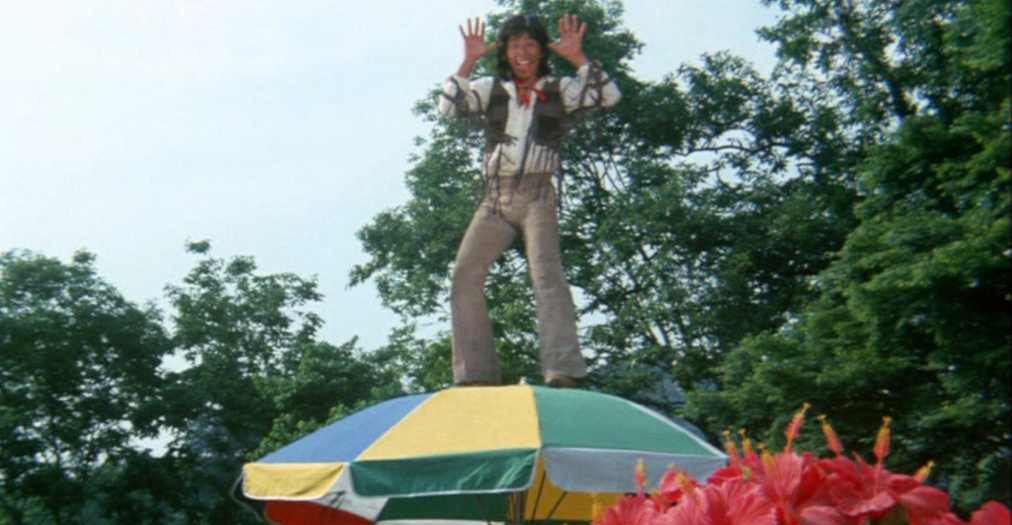
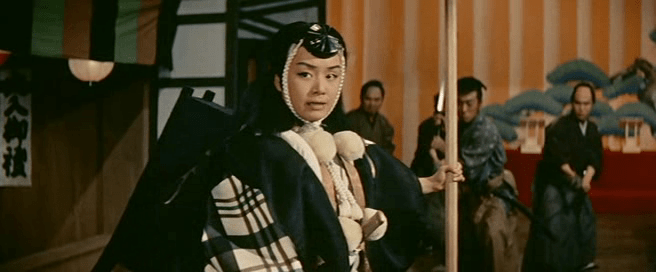
Her father also tries to set Kiku up with Takagi, but like her mother, Takagi also tells her to keep her nose out of the case and “try trusting a man for once”. He criticises her for saying that she doesn’t want to lose to a man and explains that men are attracted to women because of their “gentleness.” He adds that cooking and raising children are what make women happy, with the clear implication that Kiku is in the wrong for flouting conventional gender roles and should quickly conform by getting married and becoming a wife. Kiku appears to give him the benefit of the doubt and this confusion over gender roles is compounded when she poses as a boy and takes a job as a extra on the jidaigeki film set at the studio which turns out to be a front for drug runners. A queer-coded actor who is later told off for “stalking people again” tries to hit on her in a clear allusion to her masculinity. But unlike in the Sister Street Fighter films, she is ultimately defeated and tied to a log with a buzz saw coming at her only to be saved by the intervention of Takagi while the final scenes see her supporting him after he is (possibly fatally) injured defeating the bad guys.

All in all, it’s some rather confusing messaging but seems to come out on the side of male authority as represented by the police rather than Kiku’s father who is depicted as a weakened figure of masculinity owing to being henpecked by his wife and hoodwinked by his feisty daughter. Even the grinning sap from the gym who tried to put Chanel No. 5 on Kiku’s karate outfit, much to her annoyance, is later revealed to be an undercover cop. Which is all to say, that Kiku’s martial arts ability is almost a kind of joke and something that places her outside of conventional gender norms which should otherwise be “corrected” rather than praised, as it was in the Sister Streetfighter series which placed more emphasis on martial arts philosophy. Then again, the original trilogy ended on a similarly sour note in reaffirming Koyu’s maternity. It seems it’s less sisters doing it for themselves, than sisters doing as they’re told, which aside from anything else is a disappointing conclusion to one of the few female–led action franchises of the 1970s.


Original trailer (English subtitles)

Roaring Fire (吼えろ鉄拳, Norifumi Suzuki, 1981)

If Chiba’s karate films and the Sister Streetfighter series had been influenced by Shaw Brother’s kung fu films, Roaring Fire (吼えろ鉄拳, Hoero Tekken) is an homage to contemporary action and in some senses anticipates Jackie Chan and heroic bloodshed though in other ways harking back to the classic serial with its diamond-themed MacGuffin. A vehicle for rising action star Hiroyuki Sanada, the film reflects a new internationalist Japan but also confronts the toxic legacy of the feudal past in the fall of a once noble house.

Joji (Hiroyuki Sanada) has spent his entire life on a ranch in Texas only to discover from a deathbed confession by the man that he thought was his father that he had been kidnapped as an infant and is actually the son of the wealthy Hinohara family. But on travelling there, he immediately finds himself in the middle of a conspiracy. His twin brother Toru has gone missing after going to London to study ophthalmology in order to cure his sister Chihiro’s (Etsuko Shihomi) eye condition. Though his uncle, Ikki (Mikio Narita), welcomes him with open arms, a weird ventriloquist act by a man called Mr. Magic (Shinichi Chiba) that he’s taken to see suggests that the plane crash his parents died in may not have been an accident and his uncle killed them to take over the family business. 

Ikki is mixed up in the drugs trade with Hong Kong Triads and in keeping with Suzuki’s other films, we once again have a new solution to smuggling in hiding drugs in underripe banana skins. Lured to Ikki’s underground lair which has a large photo of Hitler on the wall and other Nazi memorabilia scattered around, Joji is given the “join us or die” speech, but ultimately manages to escape with some help from Abdullah the Butcher who is working as some kind of bodyguard but apparently takes a liking to Joji and declares they will be the best of friends forever after their initial fight. In any case, we soon realise that Ikki’s purpose in life is feudal revenge in that his mother was a geisha who died young because of her poverty and the nature of her work while staring at the Hinohiras’ giant mansion though his father apparently took no responsibility for him until after his mother died. His only goal in life is to take over the estate and otherwise destroy the rest of the family that never fully accepted him. 

Of course, Joji is in his way, but Joji doesn’t really want this legacy either and only wants to save his sister who turns out to be a kung fu ace despite her blindness but is otherwise unable to escape. In his final confrontation with Ikki, he reclaims the name of the man who raised him, Hibiki, and rejects that of Hinohara as if symbolically refusing his feudal inheritance. Mr Magic, really an Interpol agent, makes an executive decision to let him go which is also a representative authority figure setting him, and the younger generation, free from the feudal legacy to live a more international life. 

Nevertheless, Suzuki fills the film with a series of high-impact action sequences and extreme stunt work such as a crazy bus chase through Hong Kong which predates that in Police Story by a few years. The shuttles back and forth between Hong Kong and Japan, but it’s clear here that Ikki and his weird Nazi cohorts are the villains rather than the Hong Kong gangsters who really just exist and otherwise only factor into the story because of their desire for Queen of Sheba diamond that Joji’s birth father hid before he died so Ikki wouldn’t get his hands on it. A possibly poor taste allusion to the holocaust aside, Suzuki sticks to the plucky teen adventure format in which Joji gets into fights with the local guys and is quickly befriended by Chihiro’s teenage friends who all hang out at the mansion, rather than opt for a gloomy sense of paranoia and conspiracy even as Joji finds himself at the centre of a Hamlet-esque plot in which his uncle has usurped the throne and he must return to set it right. Yet rather than restoring the existing order, Joji effectively resets it by ending the family’s influence and then moving on into a freer existence shorn of filial responsibilities. 


Trailer (no subtitles)

The Inferno (地獄, Tatsumi Kumashiro, 1979)

No one can escape from their sins according to the ominous voiceover that opens Tatsumi Kumashiro’s loose reimagining of Nobuo Nakagawa’s Jigoku, The Inferno (地獄, Jigoku). Then again, some of these “sins” seem worse than others, so why is it that a woman must bear a heavy burden for adulterous transgression while the man who killed her seemingly suffers far less? Perhaps hell, in this case, is born of conservative social attitudes more than anything else besides the darker elements of the human heart such as jealousy and romantic humiliation. 

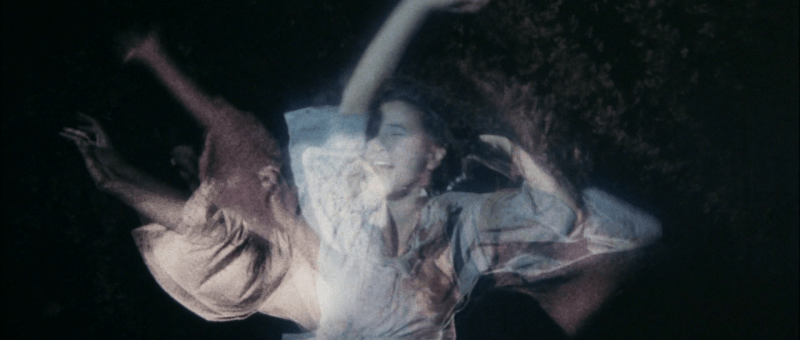
Those negative emotions are however as old as time as reflected in the folk song which opens the film about a young couple, though not the young couple currently onscreen, who are eloping because their incestuous desire is not accepted by the world around them. The connection between the couple onscreen might also be deemed semi-incestuous for Ryuzo (Ken Nishida) has run off with the wife of his brother, Miho (Mieko Harada), who is carrying (what she claims to be) Ryuzo’s child. Unpei (Kunie Tanaka), the brother, finally catches up with them and shoots Ryuzo with a shot gun. Miho tries to escape, but her foot is caught in a bear trap and Unpei decides to leave here there to die, while Ryuzo’s jealous wife Shima (Kyoko Kishida) later does the same. The body is found by local hunters, and in a strange miracle the baby is born from Miho’s dead body while Miho is dragged to hell for her “sins” where she learns that her baby has been born in hell but remains above. Not knowing what to do, the locals give the baby, Aki, to Shima but she obviously doesn’t want it and so swaps it with a foundling thanks to a weird old man, Yamachi, coming to love this other child, Kumi, as a daughter. 

This is quite literally a tale of the sins of the parents being visited on the child, the 20-year old Aki (Mieko Harada) later lamenting that she has no identity of her own and is solely a vehicle for her mother’s revenge. Though she apparently ends up in the same rural town “by chance” knowing nothing of her past, she resembles her mother physically and discovers she has some of her talents such as an innate ability to play the shamisen. What she also has is a trance-like lust that bewitches the men around her, though this is in a sense complicated by the fact it does not seem to be of her own volition so much so as a manifestation of her mother’s curse. Thus she ends up sleeping with the vulgar younger brother of the man she actually likes, Suchio, who in truly ironic fashion is actually her half-brother. She describes herself as having her mother’s “tainted blood”, while Shima later adds in a degree of class and social snobbery revealing that Miho had been a geisha Unpei unwisely fell for and was unworthy even of being a maid in their upper-middle class household let alone the wife of the second son. 

For all of her resentment, Shima is otherwise a loving mother to her sons and even to Kumi whom she is able to accept as a daughter in a way she would never have accepted Aki who was after all an embodiment of her husband’s betrayal. Colder and more austere than Aki or Miho would seem to be, she clings to the mummified body of her husband kept in a secret vault as a secret triumph over her humiliation laughingly remarking that now he’s hers forever and will never cheat on her again. Even if she left Miho to die, Shima does not particularly resist her fate well aware that her son has fallen for his half-sister (which probably wouldn’t have happened if she hadn’t swapped babies) and merely hoping Aki can be convinced to leave town alone rather than plotting any more drastic action. 

But the inferno of hell envelopes them all, crying out for retribution as the cycles of repressed or inappropriate attractions repeat themselves. Kumi realises that her love for her brother, Suchio, is actually not inappropriate because they are not related after all but is then consumed by her own hell in realising that he does in fact love his biological half-sister but is uncertain if he accept damnation in order to pursue it. What she, Miho, and Aki are punished for is female sexual desire aside the arguably taboo qualities of its direction though in hell it seems men are punished for this too, or more accurately for giving in to it, in a way they often aren’t in the mortal realm. “They cut their own flesh and blood for the vision of a woman in the future,” the guide explains as the brothers and Unpei literally climb over each other reaching for an illusionary representation of Aki/Miho at the top of the tree. In the mortal world they do something similar, grappling with each other, mired in competitions of masculinity as mediated through sexual dominance, conquest, or humiliation. 

Yet Aki’s path to hell is also a confrontation with her femininity and her search for an identity as a woman by reuniting with the birth mother who died before she was born. Kumashiro’s visions of hell are terrifying and outlandish, a giant land in which the dead are thrown into a huge meat grinder they then have to push themselves. For the sin of eating meat, others are condemned to spend eternity eating human flesh. Miho has lost all sense of reason and is incapable of recognising her daughter seeing her only as another source of food but there is a kind of rebirth that takes place even if it’s only once again to be born in the underworld. Surreal and harrowing, Kumashiro’s eerie land of giant demons and shuffling corpses does indeed suggest that as the opening titles put it we all live our lives alongside hell.


Original trailer (no subtitles)

Eighteen Years in Prison (懲役十八年, Tai Kato, 1967)

Genre star Noburu Ando had a certain cachet in that he had been a yakuza prior to becoming an actor. He had in fact been the head of his own gang which at its high point had over 300 members and controlled much of the lucrative Shibuya nightlife scene. His first onscreen appearance was in a gangster movie in which he played himself. Rather than the jitsuroku epics he would later become associated with, Tai Kato’s Eighteen Years in Prison (懲役十八年, Choueki Juhachi Nen) essentially casts him in a ninkyo role as a noble if compromised former captain of the kamikaze squad who finds himself caught between the contradictions of post-war Japan and the American occupation. 

Indeed, in this as in many other yakuza movies set during the immediate post-war era, the Americans are really just the biggest gang. Suffering with survivor’s guilt, Captain Kawada (Noboru Ando) has set up an association together with former comrade Tsukada (Asao Koike) to look after he dependent relatives of men who fell in war. To do this, he has to resort to criminality raiding American boats for supplies such as sugar and rice which he redistributes to war widows and their families. His ultimate goal is amassing enough money to buy a patch of land in the town centre and do away with the black market which exploits the vulnerable replacing it with a legitimate market so the surviving family members can set up businesses to support themselves. 

Around this time, the association manages to track down the younger sister of one of their men who died as a kamikaze, Hisako (Hiroko Sakuramachi ), and discovers she is living in desperation having lost the family home to aerial bombing. As her mother is seriously ill and she needs money for food and medical treatment, Hisako contemplates turning to sex work and is almost assaulted by a gang of drunk and abusive American servicemen from whom she is rescued by a passing Kawada. This incident makes plain his resentment towards the occupation and sense that it is the American influence that is wilfully suppressing the efforts of the Japanese people to rebuild their society. It’s this resentment that lends a note of justification to Kawada’s decision to rob a nearby factory of valuable copper wire to get the money to save Hisako’s mother thereby saving her from falling into sex work and thereafter helping to achieve their ultimate goal of building the market. The raid, however, goes wrong. Kawada sends an injured Tsukada back to the association and is arrested.

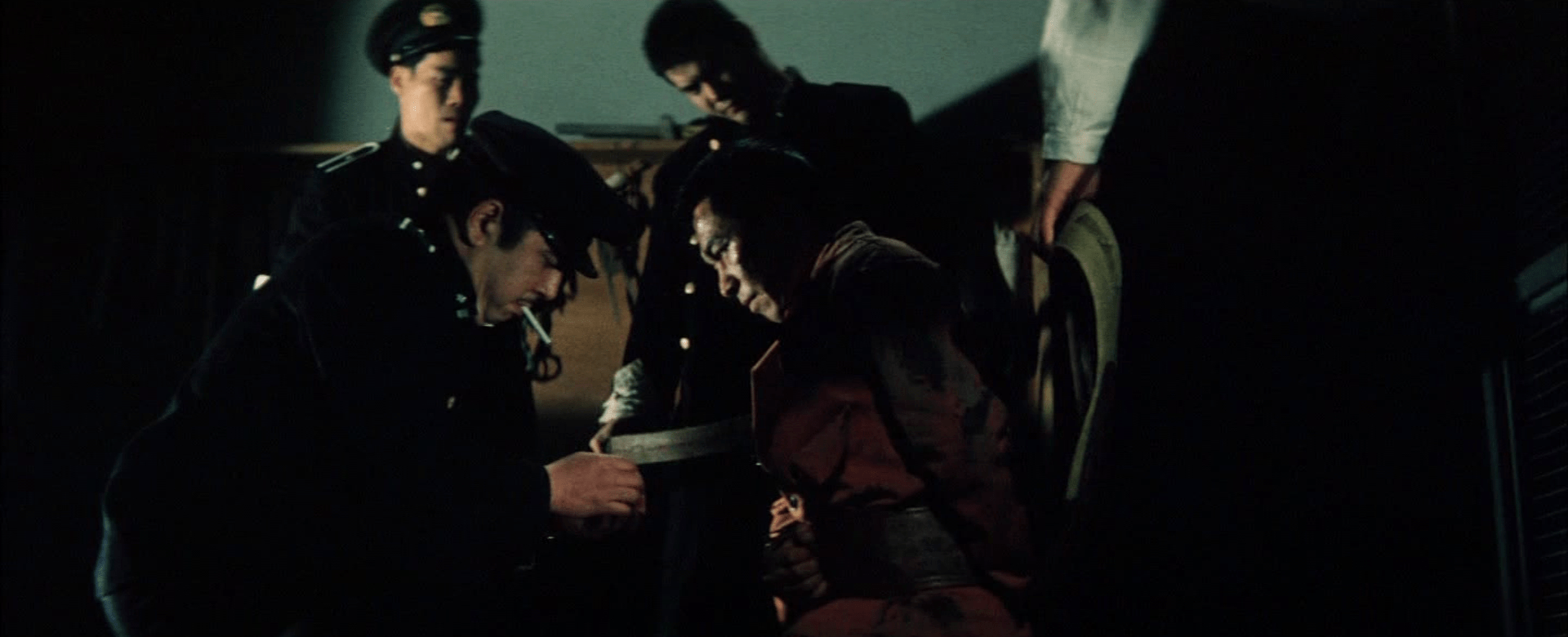
In prison he discovers only more corrupt authority in which guards beat and torture prisoners, just another bigger gang. He finds out that block warden Hanya (Tomisaburo Wakayama) is actively accepting bribes and in cahoots with some of the inmates that attempt to terrorise newbies to the point that one attempts suicide by swallowing glass though Hanya refuses to call for help forcing Kawada and some of the other men to pull the alarm themselves. The sources of moral authority lie in the new college-educated deputy warden recently returned from five years as a POW in Manila, and a veteran yakuza with a grudge against Hanya who apparently had his girlfriend raped leading to her suicide. 

Though the film is titled eighteen years in prison, Kawada becomes eligible for parole in 1952 which is of course the year the occupation ends. By this point he discovers that Tsukada has abandoned their idealistic mission and turned full yakuza, building an immense red-light district on the land they bought for the market and making himself rich through the violent trafficking and exploitation of women. Eventually confronted, he tries to convince Kawada that the world has changed, that the post-war years of privation are over and that he sees only “the ghost of a nation that lost the war” rather than burgeoning new economy stimulated by the Korean War and an ironically a repositioned America now no longer occupiers but still somehow influential if leaving a vacuum a man like Tsukada may step into. It’s no coincidence that he threatens Hisako with deportation to a brothel in Okinawa he’s set up to service American servicemen in a place where the conditions of occupation are still largely in place. 

Tsukada clearly feels that he need have no more responsibility for his wartime conduct, roundly telling Kawada that the families of the fallen are not his responsibility and should “stop leeching off other people and start working for a living”. Hisako’s long lost younger brother Kenichi (Masaomi Kondo) who ended up alone on the streets after being conscripted as a student factory worker and returning to find his home in ashes, turns the blame back on the authorities reminding them that it’s their fault, they started the war the cost him his home and family and turned him into the half-crazed man of violence who immediately introduces himself as “King” on moving up from a juvie prison. Much of Kawada’s prison life is then given over to saving Kenichi, a representative of the next generation, from becoming mired in a life of nihilistic crime. 

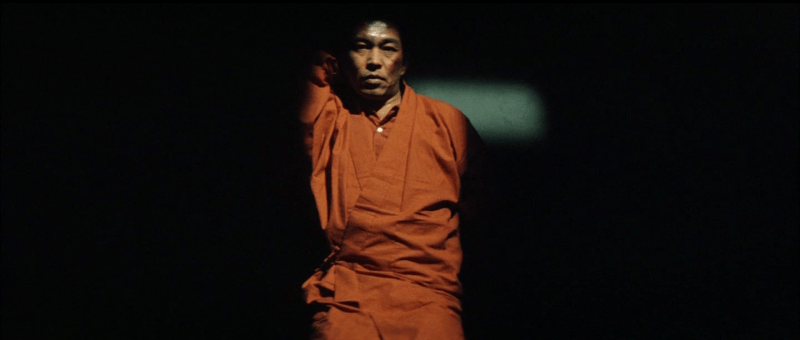
In many ways, he remains a squad leader trying to atone for having sent so many young men to die by accepting the responsibility for their families while trying to protect those left behind from the vagaries of the post-war era including the amoral capitalism represented by the infinitely corrupt Tsukada. Dressed in a military uniform ironically pinched from an American soldier he goes on the rampage knowing that he has to deal with Tsukada himself in order to defend the post-war future from those like him who’ve apparently learned nothing much at all even from such recent history. Shooting from his characteristically low angles, Kato explores the seedy underbelly of the beginnings of the economic miracle while his noble hero does his best to offer a course correction to those who have already forgotten their responsibility not just to others but to those they left behind.


Road Warriors (あやめ笠 喧嘩街道, Tai Kato, 1960)

A penniless wanderer finds himself mixed up in chaos and conspiracy after deciding to help a lady travelling alone for the purposes of revenge in Tai Kato’s Toei chanbara, Road Warriors (あやめ笠 喧嘩街道, Ayame Kasa: Kenka Kaido). Truth be told, the hero isn’t much of a warrior at all and wisely prefers to avoid a fight if possible but is prepared to put his sword where his mouth is when the occasion calls. Still the conspiracy in this instance is small scale and incredibly petty as a trio of ambitious retainers attempt to frame their one time bodyguard for the murder of a lord.

Before all that, however, Gantaro (Ryuji Shinagawa) is as he’s fond of introducing himself a penniless traveller who makes his ends meet through gambling. In debt to local boss Hidegoro (Ushio Akashi) he agrees to act as an intermediary in a dispute with the greedy Onizo (Eijiro Yanagi) who has usurped some of their territory. Gantaro suggests they settle the matter through gambling but is then challenged to combat by the gang’s bodyguard, Akiyama (Shin Tokudaiji). The young man looks noticeably afraid, sweating at the temples and gripping his sword at an unusual angle, but holds his own in the fight until Onizo tries to cheat by sending in one of his minions to finish him off. Noticing what’s happening, Akiyama proves his nobility by ending the fight and accepting defeat. Onizo appears cheerful and even asks Gantaro to join his gang, but seconds after the young man leaves he sends his guys out after him and evidently has no intention of enforcing a truce with Hidegoro.

Meanwhile, Gantaro runs into a melancholy samurai woman, Miyuki (Kyoko Aoyama), chasing after a thief who has stolen something from her far more precious than money. Discovering the thief has robbed him too, Gantaro springs into action and soon discovers that Miyuki is on a quest for revenge against the man who killed her father but that she’s been betrayed by her three retainers and has managed to ditch them to proceed alone. Unsprisingly, the prime suspect appears to be Akiyama but as stabbing a man in the back and running away don’t seem to fit with the noble character he displayed in the fight, Gantaro has an idea that something’s not quite right. 

Of course, he also begins to fall for Miyuki despite the obvious affection held for him by Hidegoro’s daughter Omitsu (Hiromi Hanazono) which he otherwise seems keen to escape. It’s reasonable to assume that loveable rogue Gantaro is the love them and leave them type, though his love for a samurai’s daughter is always going to be an impossibility no matter how much she may come to admire him. Even so, the conspiracy angle along with Onizo’s smug and overbearing duplicity do begin to awaken his sense of justice especially while travelling with an incredibly cynical thief who will sell anything or anyone in search of a quick buck. Even he however eventually comes around to the idea of helping Miyuki get away from her retainers and enact her revenge especially after overhearing the truth while cowering behind some barrels. 

It may be an overly familiar chanbara tale if one enlivened by Gantaro’s wisecracking antics, but Kato brings to it his characteristic sense of uncertainty in the potent mists that seem to surround Gantaro and Miyuki as they travel the mountain paths in search their enemy. Then again, there are shades of unexpected darkness not least in the implication that Gantaro was about to rape Miyuki before she fainted and brought him back to his senses. Nevertheless, her retainers may tell her that she has “no choice” but to obey them, but Gantaro seems to feel differently if abruptly giving up his intention of protecting her on learning that she has someone else in her heart. This is indeed a harsh world for women samurai and otherwise, a mother and daughter are saved by Akiyama after being harassed by Onizo when he annexes the local market while both Miyuki and Omitsu are left to finish their father’s unfinished business in the wake of their untimely deaths. Notably, it is indeed they who finally strike the final blow to eliminate the corruption which surrounds them. Penniless wanderer Gantaro doesn’t have it that easy either, gambling his life away and ending up with debts both financial and moral that may have dangerous consequences while often beset by cynicism even if latterly deciding to help those in need for no reward. In any case, like any good wanderer all he can do is smile and wave as he departs for the next adventure on the violent streets of the Edo-era society.


Sasuke and His Comedians (真田風雲録, Tai Kato, 1963)

Criminally unknown in the Anglophone world, where Tai Kato is remembered at all it’s for his contribution to Toei’s ninkyo eiga series though his best known piece is likely to be post-war take on High Noon made at Shochiku, By a Man’s Face Shall You Know Him in which a jaded doctor finds himself caught in the middle of rising tensions between local Japanese gangsters and Zainichi Koreans. Kato’s distinctive visual style shooting from extreme low angles with a preference for long takes, closeups and deep focus already make him an unusual presence in the Toei roster, but there can be few more unusual entries in the studio’s back catalogue than the wilfully anarchic Sasuke and his Comedians (真田風雲録, Sanada Fuunroku), a bizarre mix of musical comedy, historical chanbara, and ninja movie, loosely satirising the present day student movement and the limits revolutionary idealism. 

An opening crawl introduces us to the scene at Sekigahara, a legendary battle of 1600 that brought an end to Japan’s warring states period and ushered in centuries of peace under the Tokugawa. Onscreen text explains that this is the story of the boys of who came of age in such a warlike era, giving way to a small gang of war orphans looting the bodies of fallen soldiers and later teaming up with a 19-year-old former samurai realising that the world as he knew it has come to an end. Soon the gang is introduced to the titular Sasuke who, as he explains, has special powers having been irradiated during a meteor strike as a baby. Recognising him as one of them, the war orphans offer to let Sasuke join their gang, but he declines because he’s convinced they’ll eventually reject him in fear of his awesome capabilities. Flashing forward 15 years, the kids are all grown up and the only girl, Okiri (Misako Watanabe), is still carrying a torch for Sasuke (Kinnosuke Nakamura) who dutifully reappears as the gang find themselves drawn into a revolutionary movement led by Sanada Yukimura (Minoru Chiaki) culminating in the Siege of Osaka in 1614. 

Don’t worry, this is not a history lesson though these are obviously extremely well known historical events the target audience will be well familiar with. A parallel is being drawn with the young people of early ‘60s Japan who too came of age in a warlike era and who are now also engaging in minor revolutionary thought most clearly expressed in the mass protests against the ANPO treaty in 1960 which in a sense failed because the treaty was indeed signed in spite of public opinion. Kato’s Sanada Yukimura is a slightly bumbling figure, first introduced banging his head on a low-hanging beam, wandering the land in search of talented ronin to join up with the Toyotomi rebellion against the already repressive Tokugawa regime. His underling sells this to the gang as they overlook a mile long parade of peasants headed to Osaka Castle as a means of bringing about a different future that they can’t quite define but imply will be less feudal and more egalitarian which is how they’ve caught the attention of so many exploited farmers. 

Of course, we all already know how the Siege of Osaka worked out (not particularly well for anyone other than the Tokugawa) so we know that this version of the 16th century better world did not come to pass the implication being that the 1960s one won’t either. The nobles are playing their own game, the Toyotomi trying to cut deals but ultimately being betrayed, while the gang fight bravely for their ideals naively believing in the possibility of victory. Sasuke, for his part, is a well known ahistorical figure popular in children’s literature and this post-modern adventure is in essence a kids’ serial aimed at a student audience, filled with humorous anachronisms and silliness while Kato actively mimics manga-style storytelling mixed with kabuki-esque effects. Boasting slightly higher production values than your average Toei programmer, location shooting gives way to obvious stage sets and fantastical set pieces of colour and light which are a far cry from the studio’s grittier fare with which Kato was most closely associated. That might be one reason that the studio was reportedly so unhappy with the film that it almost got Kato fired, but nevertheless its strange mix of musical satire and general craziness remain an enduring cult classic even in its ironic defeatism. 


Original trailer (no subtitles)

A Certain Killer (ある殺し屋, Kazuo Mori, 1967)

A nihilistic hitman safeguards the post-war future in Kazuo Mori’s chivalrous B-movie noir, A Certain Killer (ある殺し屋, Aru Koroshiya). Set against the backdrop of the Vietnam War with US airplanes flying constantly overhead, Mori’s crime thriller situates itself in the barren wasteland of a rehabilitated city in which betrayal, exploitation and duplicity have become the norm while a former tokkotai pilot turned killer for hire takes his revenge on social hypocrisy as a product of his society, a man who did not die but knows only killing. 

Shiozawa (Raizo Ichikawa) runs a stylish restaurant by day and supplements his income by night as a killer for hire, apparently highly regarded by the local underworld. As such, he’s approached by a yakuza underling, Maeda (Mikio Narita), on behalf of the Kimura gang who want him to off another gangster, Oowada (Tatsuo Matsushita), who double crossed them in contravention of the yakuza codes of honour. Shiozawa is resolutely uninterested in yakuza drama and so turns the job down but changes his mind when he’s paid a visit by boss Kimura (Asao Koike) himself who sells him a different kind of mission. Kimura characterises Oowada as a “bad” yakuza, one has subverted the traditional gangster nobility by dealing in the “dirty” sides of organised crime, corrupting the modern society by trafficking in illegal prostitution, drugs, and extortion, where as he is a “good” yakuza mostly running construction scams and therefore building the post-war future. His crime is, literally, constructive, where Oowada’s is not. 

Shiozawa doesn’t quite buy his justifications, but men like Oowada represent everything he hates. “They’re not worthy of this world. They’re nothing but cockroaches” he laments, recalling the young men who served with him and gave their lives because they believed in a country which betrayed them. He agrees to take the job in rebellion against post-war venality, but only at a price, asking for four times the original fee. Kimura is willing to pay, because his true aim is profit more than revenge. He plans to take over Oowada’s remaining business concerns. 

Fully aware of this, Shiozawa seems almost uninterested in the money despite having asked for so much of it. He runs his shop as a front for his side business and otherwise lives a quiet, unostentatious life keeping mostly to himself. He is not, it would seem, a cold blooded killer, often making a point of leaving those who get in his way incapacitated but alive. Targeted by a street punk for supposedly messing with his girl he cooly disarms him and walks away, only for the girl to follow attracted partly by his icy manliness and partly by the thickness of his wallet as glimpsed when he made the fatal decision to offer to pay for her meal in order to save the chef from embarrassment over her attempts to pay with things other than money. Unable to get by on her own, Keiko (Yumiko Nogawa) attaches herself to various capable men beginning with the pimp, transferring her affections to Shiozawa whom she petitions to marry her, and then to Maeda, eventually vowing to find a new partner and make lots of money. 

Both Maeda and Keiko chase Shiozawa and are rebuffed. Impressed by his cool handling of the Oowada affair, not to mention the amount of money he now realises you can make in his line of business, Maeda asks to become his pupil in order to become a “real man”. Shiozawa doesn’t regard his work as something “real men” do, and in any case prefers to work to alone. Maeda repeatedly asks to be allowed to accompany him even after plotting betrayal, only to be rejected once again as Shiozawa tells him that he doesn’t like people who don’t know the difference between the job and romance, flagging up the homoerotic subtext for those not paying attention. Maeda parrots his words back to Keiko with whom he had begun a halfhearted affair as joint revenge against Shiozawa’s indifference. 

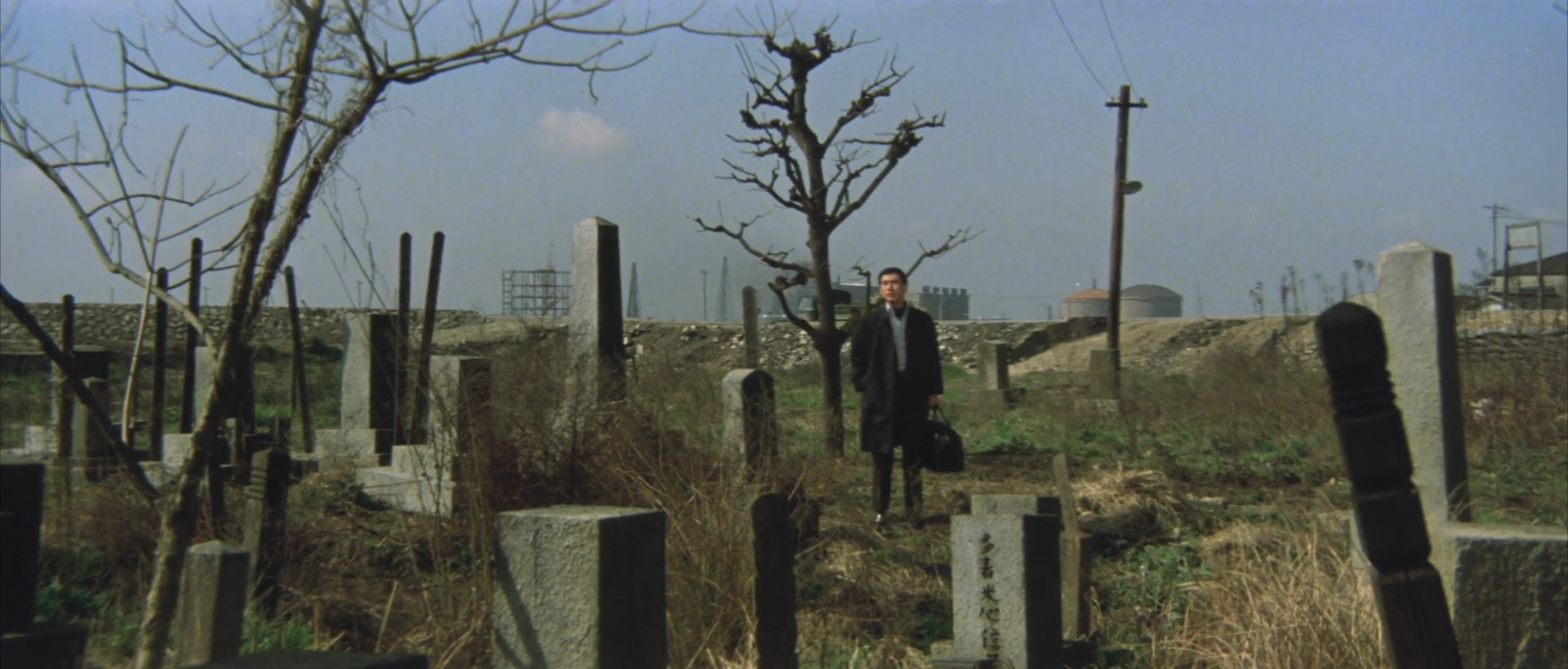
Following the successful offing of the mob boss, Shiozawa finds himself coopted into another job robbing a drug handoff between Oowada’s former associates, the illicit narcotics ironically packaged inside cartons intended for baby powder. Shiozawa apparently doesn’t object to profiting off the drug trade himself, but later abandons the loot in protest while the remainder is lost or squandered during the final battle with the remaining gang members, Shiozawa’s cartons left sitting ironically on top of a gravestone taken by no one. Cool as ice, Shiozawa places himself above petty criminality, always one step ahead, trusting no one and looking out for himself but reacting as a man created by his times, forged by a war he was a not intended to survive while looking on at another cruel and senseless conflict across the sea. Adapting the hardboiled novel by Shunji Fujiwara, Yasuzo Masumura’s jagged, non-linear script (co-written with Yoshihiro Ishimatsu) is imbued with his characteristic irony but also coloured with nihilistic despair for the post-Olympics society and its wholesale descent into soulless capitalistic consumerism.


Update, 13th February 2025: now available to stream via Arrow Player.

Original trailer (no subtitles)

Detective Hibari 1: Case of the Golden Hairpins (ひばり捕物帖 かんざし小判, Tadashi Sawashima, 1958)

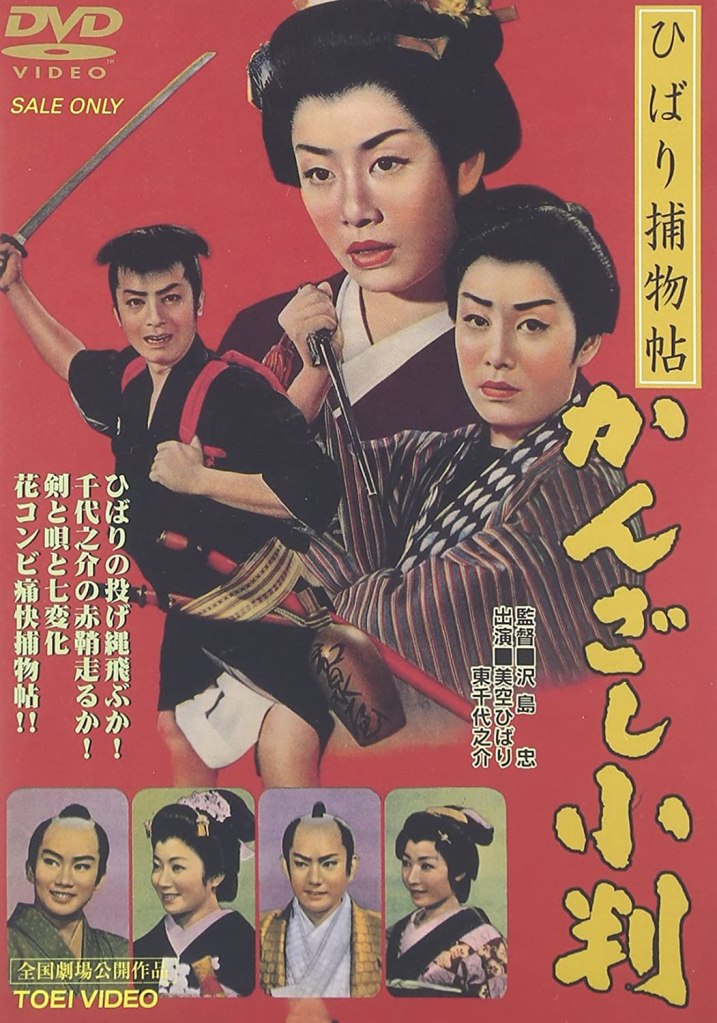
Two years after Mysteries of Edo and a year after its sequel, Hibari Misora returns as Oshichi in a new series of films, still living undercover in Edo solving crimes and living her best life as a singer and performer. Like Mysteries, Detective Hibari 1: Case of the Golden Hairpins (ひばり捕物帖 かんざし小判, Hibari Torimonocho: Kanzashi Koban, AKA Edo Girl Detective / Here Comes the Girl Detective) sees Oshichi investigating murders of women, though this time the crime is far less involved and much more typical of Toei’s period films in its venal samurai and their insatiable appetites for wealth and status. Oshichi is, essentially, an agent of the state but a much less ambiguous one than she’d become in the following pictures, fighting bravely against corruption and standing proudly for justice in the face of implacable samurai arrogance. 

Having escaped the cage of her noble birth, Princess Tae/Oshichi (Hibari Misora) is still living as an “ordinary” woman in Edo and has just won a singing competition to be named as Queen Beauty. The competition is marred however when one of the other contestants is offed on the way home. Still working with her trusty sidekick Gorohachi (Shunji Sakai), Oshichi quickly realises the woman seems to have been murdered with an ornate hairpin and starts an investigation.

What she discovers is that an unscrupulous gang of samurai is attempting to recover a set of three hairpins which were stolen in a robbery some years previously. The lord claims he’s doing it to satisfy his clan’s honour, but more likely has a less honorable goal in in mind. To put the plan in action, he’s mobilised his conflicted daughter, Sumie (Eiko Maruyama), who thinks this is all a bit much for set of shiny hair ornaments, and her boyfriend Tamiya (Kotaro Satomi) whose family originally owned the jewels which is why he sees it as his duty to get them back, even if that means murdering innocent women and sending the entire city into a panic in the process. Of course, Oshichi agrees with Sumie, and as usual immediately sympathises with her romantic dilemma which earns her a few sarcastic comments from sometime love interest Hyoma (Chiyonosuke Azuma) who will recur throughout the rest of the series.

Hyoma, posing as a drunken ronin but in reality shadowing Oshichi as a protector, like Kawashima in Mysteries, expresses consternation with Oshichi’s atypical feminity, echoing Kawashima’s words that “a woman should be feminine” while claiming not to find Oshichi’s manly fortitude very effective. Kawashima’s words may have wounded her, but Hyoma’s only irritate. She fires back that as a talented samurai he’s wasting his potential drowning himself in drink and he should “stop fighting and do something for society”. Meanwhile, she doubles down – dressing as a man and even joining a kendo dojo to spy on the corrupt lords, scrapping with the best of them and holding her own in a fight. 

Swinging the other way, another of her investigative tactics sees her posing as a geisha and then later as a noble lady, even getting dressed up in her formal princess clothes to beg a favour from her extremely understanding brother. Sympathy for Sumie and a few romantic songs may be the sole concessions to conventional femininity, but Oshichi remains proudly defiant and intent on maintaining her freedoms. It may be true that the unusual degree of freedom she has is permitted her because of her progressively minded brother who ignores “advice” from an elderly servant to exercise more control because he can see being of use to society makes his sister happy and that she’ll probably come home when she wants to, but it’s also freedom that she has actively chosen for herself and chooses to maintain. 

Oshichi gets drunk with Hyoma (apparently for the first time), fights bad guys, and gives orders that stop seasoned samurai in their tracks but not so much for herself as to help those like Sumie who have become victims of corrupt samurai ethics. She does this, however, as someone who largely believes in the righteousness of the system, that the Shogunate is kind and forgiving while local lords may be avaricious or cruel. When her brother arrives to save the day, he announces that the hairpins will be sent to the Shogun who will return them to the people, sharing the treasure with everyone rather than keeping it for himself. Oshichi, meanwhile has found something greater – a worthy sparring partner in the dashingly romantic Hyoma, and the confirmation of herself not as Tae the caged princess but Oshichi who owns the very ground she walks upon and allows no other to tell her where she may be permitted to go. 


Original trailer (no subtitles)

Mysteries of Edo (ふり袖捕物帖 若衆変化, Shoji Matsumura, 1956)

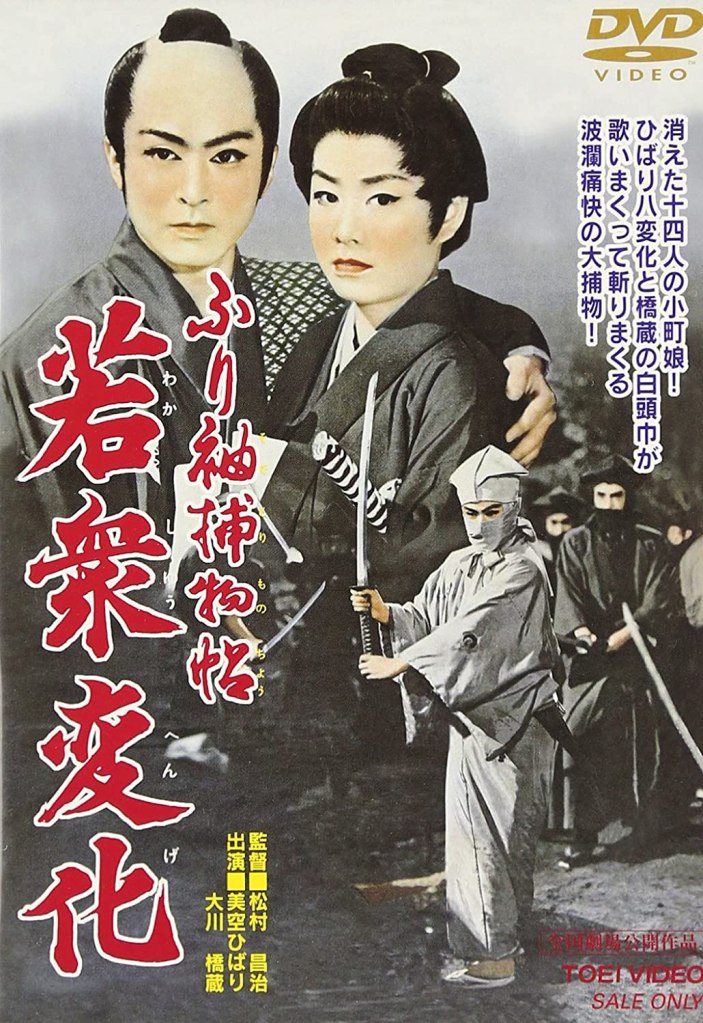
The voice of the post-war era, Hibari Misora was a major marquee star but in contrast to expectation, appears to have been fully in command of her contradictory brand, selling an image of herself not as docile and innocent in the manner of many a manufactured idol but feisty and true, refusing to backdown in the face of injustice. In her contemporary movies, she stood up to gangsters and corrupt corporations alike with salt of the earth charm, while her period roles saw her do much the same only against the inherently corrupt samurai order. An early outing for Toei, Mysteries of Edo (ふり袖捕物帖 若衆変化, Furisode Torimonocho: Wakashu Henge) sees her star in the first of a series of films as a princess in hiding turned feminist detective, investigating series of abductions in the rapidly changing bakumatsu society. 

A “newspaper” seller in the street informs us that 14 girls have recently gone missing in this area of town, and no one’s doing much about it. A dance teacher escorts her pupils home to be on the safe side while her apprentice, Oshichi (Hibari Misori), stays behind to teach cowardly samurai Kawashima (Hashizo Okawa) some moves. Local bobby Gorohachi (Shunji Sakai), himself a dance enthusiast, arrives to get some guidance from Oshichi but their lesson is interrupted by the news that the dance mistress and her daughter have become the latest two abduction victims. Oshichi springs into action but quickly falls under suspicion from a rival policeman, Gonroku (Haruhisa Kawada), who questions her background. All too soon, the body of a young woman is discovered at the local shrine and believed to be connected to the abduction cases. Gonroku accepts a bribe from a samurai to get rid of the body as quickly as possible, but Oshichi immediately notices the bruises on the woman’s neck and concludes it’s a murder. She and Gorohachi trace the samurai back to the red light district and discover some shady goings on in a “back house” behind a brothel belonging to a prominent merchant. 

During this era, Japan was still in its isolationist period during which consorting with foreigners was forbidden outside of a few explicitly designated trading spots. Oshichi figures out that the merchant, Nagasaki (Ryosuke Kagawa), is involved with smuggling and uses his second house as a place to entertain foreigners in collusion with local politicians. When he ran out of courtesans from the brothel next door, he started simply abducting random women off the street to entertain his guests with more authentic charms. Those who don’t comply are threatened with being sold off on slave ships, itself another evil of the age. 

Of course, a lowly dance teacher and a bumbling policeman aren’t much of a match for entrenched samurai corruption, but Oshichi has a trump card – she’s secretly a princess in hiding. Bored with the life of an upperclass noblewoman, she ran away from her brother’s home to live an independent life in Edo but can still rely on her class background when necessary. Stealing a pistol and a letter box, she rebrands herself as a man and gets a job in the ministry to try and spy on the corrupt lords while hoping to save her boss, keeping up the ruse well enough but eventually unmasked as a girl. 

As in many of her films, Misora plays on gender ambiguity. Rejecting the cosseted life of a lady, she takes to the streets and then takes charge. She’s technically Gorohachi’s subordinate, but in reality he follows her lead, and she gives as good as she gets in the frequent fight sequences. In the end, however, she’s “rescued” by a masked samurai dressed in white with whom she becomes instantly smitten. She dreams of meeting him in a deserted field where he mildly berates her for her lack of femininity, insisting that he liked “the Oshichi from before”, meanwhile she conjures up the figure of Kawashima who manfully wades in to save her. Previously, in refusing to help, Kawashima had told her that “a woman should know her place and act like a woman”. Oshichi tells him perhaps he should act like a man, practice kendo or something else more manly rather than prancing about learning to dance. His words have perhaps cut her because he tells her the same thing in her dream, insisting that he “could fall for the womanly Oshichi”.

Oshichi tries on womanliness for size, but it only seems to confuse the “real” Kawashima who describes her attempt at genial femininity as “creepy”. She quickly goes back to holding her own, pushing forward where the men hold back perhaps bashful in love but never in justice. Even if it’s true that the dashing samurai arrives to save the day, Oshichi is no damsel in distress watching passively from the sidelines but an active participant threatening bad guys with a gun cunningly smuggled in while she distracted them with a song, and grabbing a sword off the wall to wade into the fray. Rewarded for her good work and asked what she’d like in return, Oshichi chooses her freedom, intending to stay in the town a little longer, solving crimes in old Edo and ensuring that no one, even those who think they have a right to be, is truly above the law.