Husband and Wife (夫婦, Mikio Naruse, 1953)

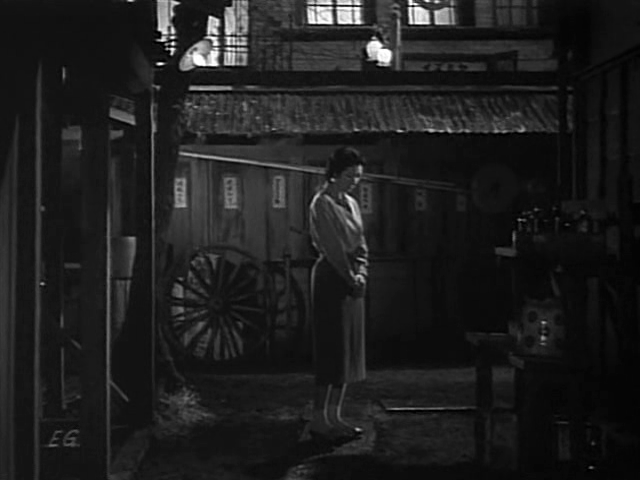
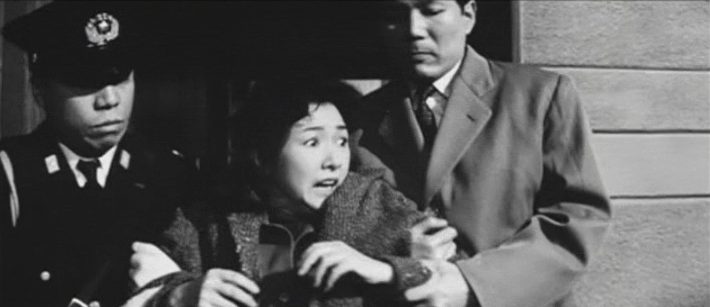
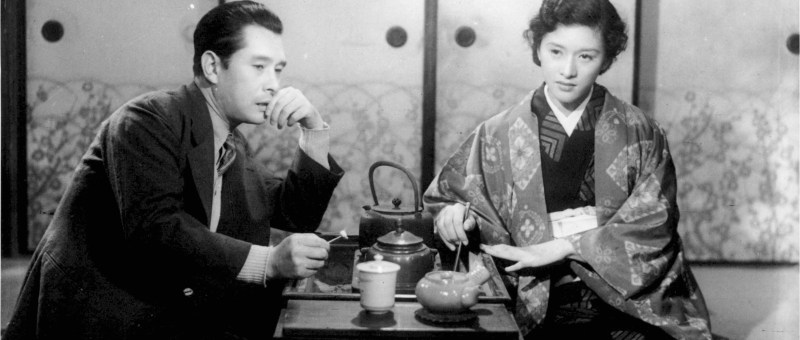
Kikuko (Yoko Sugi) climbs the stairs to the roof of a department store and pauses at the top looking down on her friends below, but they appear to be looking down on her. They’re disappointed. She looks so “provincial”, even though she has no children and therefore more time to spend on herself. They’re envious of her “freedom” to return home late while they have to get back to their husbands or in-laws, but Kikuno isn’t really free at all while trapped in a stifling marriage to the incredibly dull and petulant Isaku (Ken Uehara). 

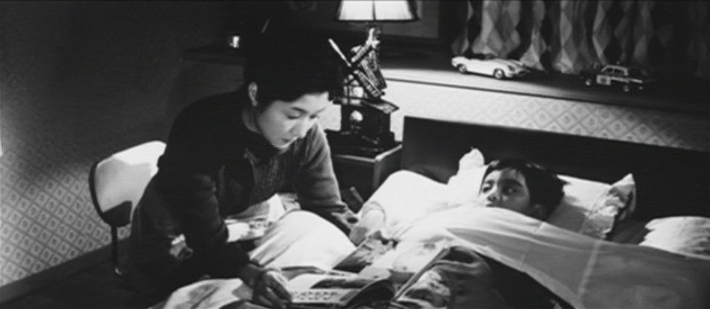
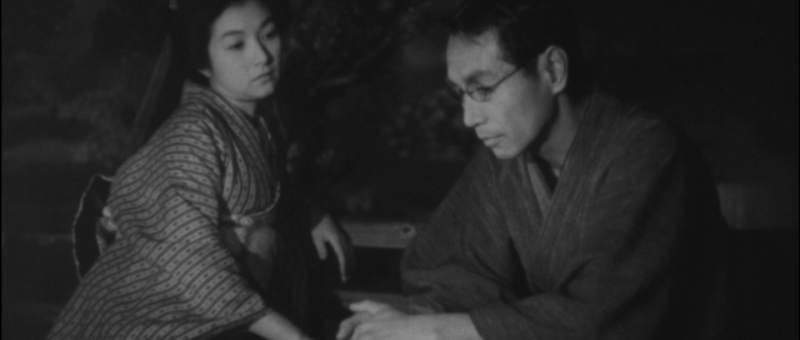
One of a series of films about marriage and originally envisaged as a sequel to Repast until Setsuko Hara fell ill, Husband and Wife (夫婦, Fufu) paints a rather bleak picture of married life even by Naruse’s standards. The couple are quite literally but also spiritually “homeless” in that they cannot find a home to share, while the absence of a domestic space to call their own prevents them from solidifying their marriage. They’re pushed out of Kikuko’s parents’ home because her brother’s getting married and they need the space, but Isaku drags his feet over finding somewhere else and leaves much of the legwork to Kikuko alone. The main problem seems to be that Isaku can’t afford anything decent, which places a strain on his male pride, but in a repeated motif, rather than confront the situation, he ignores it completely and then crassly presses his recently widowed colleague to let them rent a room in his now much emptier house. 

It’s a mystery why Isaku has so many financial problems when he and Takemura (Rentaro Mikuni) work for the same company, save that Isaku had evidently spent some time working in the provinces, and his colleague had already bought a home with no apparent money worries, but it further sets the two men apart and fuels Isaku’s sense of inadequacy. Having returned from a leave of absence following his wife’s death, Takemura is grief-stricken and apparently uxorious. He complains that he’ll never find another woman like his late wife, all while Isaku won’t shut up about the house and others relentlessly encourage him to remarry. Nevertheless, after the couple move in with him, a natural connection arises between Kikuko and Takemura who is Isaku’s total opposite, both in his treatment of Kikuko and general personality. Where Isaku is sullen and resentful, Takemura is cheerful despite his grief and generous of spirit. Kikuko effectively becomes a wife to both men, taking care of each of them by cooking and cleaning, but while Takemura goes out of his way to thank her, all Isaku does is run her down and humiliate her in front of company.

Then again, having fallen in love with Kikuko precisely because she is a “proper wife,” Takemura then runs his own late wife down by complaining that she wasn’t very pretty and couldn’t cook. The only thing she had going for her was her health, and then she died. He says got a bum deal, and that Kikuko has shown him a different side of womanhood. When two colleagues come to the house and compliment Kikuko’s cooking but are surprised when she eats nothing herself (because they have no money), Isaku responds to their assertion that it’s difficult to be a housewife by replying that men work hard all day while women “only” have to look after the house. For her part, Kikuko says that she was happier when she was working. Men can fall in love several times, but once a woman’s married her romantic life is over. As her friend tells her, men soon get bored of their wives and hers has already taken a mistress at work. 

At several points and with the women in earshot, the men warn each other about the pitfalls of marriage. Irritated that Kikuko has returned to their home on New Year’s Eve after becoming fed up with Isaku, her father advises her brother that women show their true faces after six or seven years and it’s going to horrify him. Isaku tells him not to be too nice or obedient during the early days because his wife will get used to it, while Kikuko counters that men are overgrown children and as long as you make sure to cradle them like babies everything will be fine. Neither of them seem to have a very positive idea of what marriage should be and frame it almost in terms of a war in which they are continually at odds with each other. Isaku describes a husband and wife as a pair of scissors, intending it as a positive metaphor about how one half can’t cut alone, before reframing it as two knives coming together. He becomes unpleasant and chauvinistic, blaming Kikuko for everything by complaining that it’s her fault that he wears a torn up old coat that causes him some embarrassment in front of his boss and a tactless geisha, while criticising her for not having the bath ready when he comes home tired from working all day. Kikuko points out that men seem to assume they’re the only ones who get tired while her loved up brother swears he’ll be different and even if they’re in the honeymoon phase, they do seem much happier and more suited than the already resentful Kikuko and Isaku.

It’s the sister-in-law who throws them a lifeline by introducing them to a relative looking to rent a vacant room, allowing them a means to save their marriage by leaving Takemura’s house. Increasingly resentful of the growing attachment between Kikuko and Takemura, Isaku starts avoiding coming home and hanging out with a young woman at the office with, at least, the danger of a burgeoning affair for which he’s taken to task by Takemura. As Takemura says, it’s not much of a marriage if Isaku can’t trust his wife while Kikuko is eventually so sick of the cold shoulder and constant denigration that she considers leaving him. The new apartment finally gives them a domestic space they can call their own, but it comes with the caveat. The landlady doesn’t allow children because the tenant next door is an ikebana teacher who demands peace and quiet, but Kikuko is in fact already pregnant which might present another means of saving their marriage by becoming a family but Isaku immediately rejects it. He complains he doesn’t have any more money to move again and tells Kikuko to get an abortion, strong-arming her when she refuses. Kikuko can’t go through with it and the nicest thing Isaku says to her in the entire picture is that they can go home, he’s giving in and will raise the child even if it’s difficult. But even this bittersweet moment seems more like condemning them to marriage rather than repairing their relationship with Isaku only grudgingly accepting, most likely because he realises that his marriage is dead anyway if he forces Kikuko to give up their child against her wishes. Despite the changing season, the air between them remains frosty, and marriage is exposed for the prison that it is trapping each of them in loneliness and resentment rather than bringing them together in joy as they prepare to become a family rather than just husband and wife.


Husband and Wife  screened at Japan Society New York as part of Mikio Naruse: The World Betrays Us – Part I.

A Wife’s Heart (妻の心, Mikio Naruse, 1956)

“We’re too late for everything these days,” mutters an overly cheerful geisha whose behaviour is becoming ever more erratic. A sense of fatalism, that everything has already been decided and there is no real escape from the misery of life, hangs over much of Naruse’s filmmaking even if his heroines often do their best to rail against it and on occasion succeed. Kiyoko (Hideko Takamine), the heroine of A Wife’s Heart (妻の心, Tsuma no Kokoro), finds herself faced with just this dilemma while considering which side of a generational divide she might be on and whether she has the power to escape from her disappointing life to chase emotional fulfilment. 

We can see the literal distance between herself and her husband Shinji (Keiju Kobayashi) in the opening sequence as he stands in a vacant lot at the back of their property and she firmly within the domestic space hanging washing. Yet for all that she seems excited, perhaps even a little giddy as they plot their escape together through planning to turn that vacant space into a cafe in an attempt to fend off the economic changes ravaging their town and wider society of Japan in the mid-1950s. Out and about on his bike, Shinji looks anxiously at the construction of a new pharmacy much larger than his own and with flashy modern signage. Their business is failing and they don’t know how to save it so the cafe is their way out and also a break with the depressing past represented by Shinji’s grumpy mother, Ko (Eiko Miyoshi), who is predictably dead against the cafe idea. 

The new business, in its way, is also a stand-in for the child they don’t have and a means for Kiyoko to find domestic fulfilment in a society ruled by motherhood. This one reason that the sudden arrival of her sister-in-law Kaoru (Chieko Nakakita) with her small daughter Rumiko causes so much disruption. Kaoru has fulfilled the social obligations which Kiyoko has not and quickly insinuates herself within the house, taking over the domestic space as symbolised by her otherwise trivial action of putting back a pair of nail clippers in the place she sees fit rather than their usual home. Yet she does this in part because her husband, Zenichi (Minoru Chiaki) who left the family to become a salaryman in Tokyo, is so obviously unreliable and appears to have not for the first time lost his job while employed at a company possibly involved in something untoward. On getting wind of Shinji’s plans to open a cafe, Zenichi announces he’s thinking of opening one himself and gets his mother to put pressure on the couple to give him the money they borrowed for their dream project.

It’s the loan that in part allowed Kiyoko to consider life beyond her marriage in reuniting with the still unmarried brother of her best friend Yumiko (Yoko Sugi). Kenkichi (Toshiro Mifune) is everything Shinji is not, handsome, well dressed, and with a good, middle-class job working at a bank. On a visit to her relatives, Kiyoko’s aunt remarks that everyone wanted to marry her provoking a slight twinge of pain in Kiyoko’s face. Mother-in-law Ko arranges marriages and it’s likely she arranged the one between Kiyoko and her son and that Kiyoko likely agreed out to of social obligation under the rationale that Shinji was a good catch as the proprietor of a successful business. The implication is that if, like Yumiko, she had held out a little longer she probably would have fallen in love and married Kenkichi. As the atmosphere in the family home grows ever more toxic, she grows closer to him yet at least in part as a symbol of the path not taken, what her life may have been like if only she had resisted and claimed a little more freedom for herself. 

Ko has also arranged a marriage for youngest daughter Sumiko (Akemi Negishi) who asks her if all of her matches were happy. An indignant Ko replies that only one or two have split up, but as Sumiko points out just because a couple stays together does not mean they are happy. “Women don’t have the courage, they just give up,” she remarks implying that she, as a representative of the younger generation, might be less minded to simply accept a disappointing situation in the same way as someone of Kiyoko’s age may feel she had to. For these reasons Kiyoko is torn. Yumiko remarks that she and Shinji didn’t even particularly like each other when they married and perhaps remain indifferent to each other now. The cafe may have brought them closer as a couple, but now it’s causing a rift in the wider family while also offering Kiyoko the faintest glimmer of an escape route. When she returns to the cafe where she was learning the ropes as a part-time employee, much to Ko’s chagrin at losing a domestic helper, it’s clear that she’s doing so in part to have a means of supporting herself as she leans closer to the idea of leaving Shinji. 

But for all that it seems unlikely that she has the courage, as Sumiko put it, to break with the traditional social codes of feminity by leaving a husband who was not really bad but that she did not love and made her unhappy. In rebellion, Shinji has an indiscretion with a local geisha who goes missing on the way home from a hot springs and is later found dead having taken her own life because she was trapped in a bad relationship with her husband. The implication is that this is the only way many women find to escape from their dismal circumstances and may soon present itself to Kiyoko if she cannot find a way to reconcile herself to her life with Shinji or find the confidence to leave it. The enemy is the increasingly outdated institution of arranged marriages as advocated by the austere Ko who refuses to hire maids while believing herself entitled to the free labour of her daughters-in-law, and the patriarchal social codes of a modernising nation in which Shinji can have his dalliance with a geisha and his wife is expected to put up with it, but merely being seen walking with a man not one’s husband provokes gossip and jealousy. 

When Shinji implies he suspects her of having an affair with Kenkichi, he tells her that she’s free to follow her heart and he understands if she chooses to leave him but of course by telling her this he seals her fate by making it almost impossible for her to do so. The couple repairs itself, but the resolution is far from comfortable as it becomes clear that each is essentially resigning themselves to misery because of social convention vowing that they’ll build their cafe in the next season though it seems like a dream destined to go unfulfilled while the institution of Rumiko left behind in the family superficially fills the void it was designed to fill. The fades to black between scenes seem to echo an exhalation of bleakness as the interrupted thought of Kenkichi’s dangerous “Kiyoko…” as an admission that the prospect of escape is only ever a torturous fantasy and a heart is something that must be sacrificed in the name of conventional success. 


Late Chrysanthemums (晩菊, Mikio Naruse, 1954)

The post-war economy was difficult for most, though by the mid-1950s the situation was perhaps improving. The four former geishas at the centre of Naruse’s Late Chrysanthemums (晩菊, Bangiku) , adapted once again from a series of stories by Fumiko Hayashi, are all in their way attempting to find a way through to the modern society but are nevertheless stuck in the past, unable to move forward as women more or less left behind by a changing idea of “modernity” which no longer has a place for them. 

The most successful of the women, Kin (Haruko Sugimura), has become a ruthless moneylender engaging in real estate speculation. As the film opens she’s waiting for the arrival of a business associate for a meeting about a house she’s trying to flip, clear that they’ll need to kick out the desperate widow who is currently living there. Kin has lent money to her old “friends” with whom she spent her youth as a geisha before the war. Otamae (Chikako Hosokawa) and Otomi (Yuko Mochizuki) are widows with unfilial children, Otamae now working as a maid in a love hotel while her son Kiyoshi (Hiroshi Koizumi) struggles to find a job, and Otomi a washerwoman selling blackmarket cigarettes as a sideline while her daughter Sachiko (Ineko Arima) is a forthright modern woman who refuses to enable her mother’s irresponsible vices. Nobu (Sadako Sawamura), meanwhile, married late to a man from outside of Japan and has opened a small bar where she hopes to start a family, brushing off Kin’s insensitive insistence that she is already too old to bear a child. 

Kin has prospered and become wealthy, but she’s done so largely at the sacrifice of maternity. She disparages the other women, telling them she’s grateful not to have had children because not even they can be depended upon, but is also embittered that she’s missed out on life and love, substituting material wealth for emotional fulfilment. Otomi and Otamae have problems with their children and regrets about their lives, but they both resent Kin for her heartless rationality. Kin is in a sense supporting them with her money, even if she wants it back with interest, and continues to see herself as doing a favour for women she considers friends, hurt that they often run or hide when they see her coming but insisting that she is only trying to survive while implying that the other women have failed to achieve the self-sufficiency she has achieved because they’ve lived irresponsibly by placing their trust in men and frittering their money away on the temporary pleasures of drink and gambling. 

Otomi’s thoroughly modern daughter Sachiko thinks something much the same. When Otomi approaches her for a loan, she says no, fearing that her mother has another lover she will end up subsidising or that she will spend it all on drink and pachinko. Sachiko does, however, offer to buy her mother dinner which at least ensures she will get a good meal. Sachiko’s shock news is that she plans to marry an older man, though he seems not to be particularly wealthy seeing as she later sarcastically asks Kin to buy her a house because they’ll be living with other tenants in a small flat. Otomi objects, not only because Sachiko hasn’t mentioned any of this to her before, but because she thinks Sachiko is being overly practical and gives her some surprisingly transgressive advice to the effect that she should have her fun with various men while she’s young so she’ll be able to figure out which is the best to spend a life with. Sachiko quite reasonably asks how that worked out for her, to which Otomi obviously has no answer and leaves the restaurant feeling dejected enough to ask Kin for the money she was after instead. 

Otamae’s problem is of the opposite order. Her son Kiyoshi cheerfully rolls home in the morning after staying out all night and tells her he’s become a kind of gigalo, dating a slightly older woman who is technically the kept mistress of another man. The situation is ironic in the extreme, but despite her own past as a geisha, Otamae doesn’t like it that her son is engaging in a compensated relationship, while he suggests that perhaps she messed him up by making him refer to her as his sister in public. Eventually Kiyoshi is offered a job in a mine in Hokkaido, salmoning the post-war migratory movement and leaving his mother (as well as the mistress) behind to fuel the economic recovery from the provinces. 

Otomi and Otamae have only each other to rely on, men and children have all proved undependable. Kin, the most fiercely independent, is literally haunted by the spectre of failed romance. Nobu, snaps that Kin made her money by swindling her clients, which might be why she takes the side of Seki (Bontaro Miake), a man who tried to commit double suicide with Kin but survived and was ruined. Kin sees it differently. Seki tried to kill her when she refused to die with him, so understandably she is not keen to reconnect. Nobu advises him to visit her and ask for money as “compensation”, which whichever way you look at it is crass and troubling, that Kin is expected to compensate a man for his ruined prospects caused by his obsessive romantic violence towards her which she claims has put her off men for life. Nevertheless, she continues to meditate on the memory of Tabe (Ken Uehara) whom she loved when he was a student, even visiting him in his Hiroshima barracks after he was drafted. She is thrilled to receive a letter from her first love, but declares herself disappointed minutes after he arrives for a visit. Tabe is just another failed salaryman who thinks women like her have it easy and harps on about how looking at his “old” wife makes him nostalgic for the women he loved in his youth. Like everyone else, he’s after her money. Kin burns the photo of him in uniform and gives up any lingering dream she might have had of romantic fulfilment. 

The women find themselves trapped by conflicting visions of “modernity” which are wildly different from those of their youth. They miss their “carefree” lives as geishas, now perhaps somewhat romanticised, along with the misplaced idealism of their time of Manchuria, while lamenting that as single older women they cannot be anything other than dependent. Only Kin is able to achieve self-sufficiency, but does so effectively as the film suggests at the cost of her “femininity”, becoming hard and cold, ruthlessly practical but not perhaps uncaring even as she continues to subsidise the only “friends” she has perhaps in the knowledge that they fiercely resent her. Yet their lives continue. Nobu runs her bar, Otomi and Otamae send their children off with grudging respect while vowing to follow their examples, and Kin, after a moment of crisis, ventures off towards new prospects. For good or ill they shift towards the modern world, more understanding of its rhythms and their place within it than before, but perhaps no more secure.


Song of the Flower Basket (花籠の歌, Heinosuke Gosho, 1937)

The daughter of a tonkatsu shop finds herself with an overabundance of suitors in Heinosuke Gosho’s generally cheerful yet occasionally dark melodrama Song of the Flower Basket (花籠の歌, Hanakago no Uta). Adapted from a novel by Fumitaka Iwasaki and scripted by Kogo Noda, the film finds its heroine caught at a moment of social change as she battles her snooty aunt for the right to decide her romantic future while her impoverished student boyfriend does something much the same in defying his family’s attempts to micromanage his life dreaming of the bright lights of Ginza. 

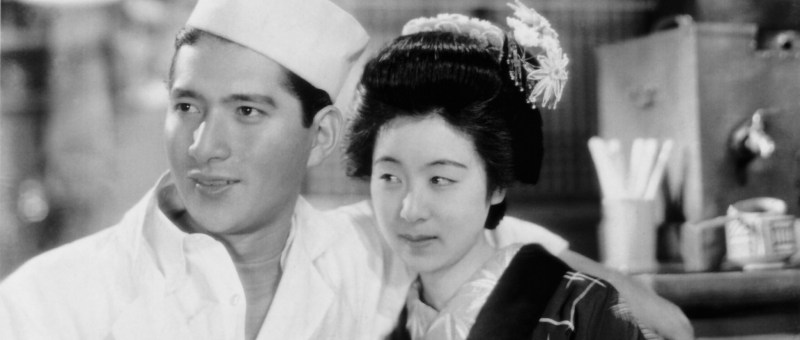
Yoko (Kinuyo Tanaka) is the “kanban musume” of her father Keizo’s (Reikichi Kawamura) pork cutlet restaurant, attracting customers with her charm and beauty while the Chinese chef her father brought back with him from Shanghai, Lee (Shin Tokudaiji), is the culinary star. Lee is secretly in love with Yoko whom he continues to refer to largely as “the young lady” and has long been writing an ode in her honour. Yoko meanwhile is in love with a penniless student, Ono (Shuji Sano), who at the beginning of the film has just returned home after visiting his family whom he has alienated by declaring that he doesn’t want to work in an office in the country while refusing an offer to marry into another family as an adopted son-in-law. The reason for this is less his pride than his desire to stay in Tokyo amid the bright lights of Ginza, sighing as he looks out into the neon-lit night gazing at adverts for Club Hamigaki toothpaste and Meiji Chocolate. The second reason may also be that he’s fallen for Yoko but given his precarious financial situation and lack of prospects does not quite dare to imagine a future with her. 

He must however be serious as we later learn he’s given up going to hostess bars with his friends, a bar girl greeting him in the restaurant evidently not having seen him in ages asking where he’s been much to Yoko’s embarrassment. The encounter places a seed of doubt in her mind in a minor role reversal as she begins to resent Ono’s past irrationally annoyed by the idea he has dated other women. Meanwhile, at the memorial event marking 11 years since her mother passed away while working as a steward on a boat in Singapore, Yoko’s snooty aunt tries to set her up with an arranged marriage to an Osakan doctor who may or may not marry depending on the “negotiations” but has also been promised his own clinic by his wealthy parents if the marriage is confirmed. Okamoto (Toshiaki Konoe) has visited the restaurant to get a better look at Yoko making him the third suitor to encircle her even though the chief concern of the family is that Yoko is almost 24 and therefore ageing out of top tier matches.  

To his credit, Yoko’s father is fully in her corner trying to stand up to the domineering aunt who is definitely overreaching in trying to micromanage the romantic lives of her nieces in the absence of her sister. He determines to find out if Yoko has her eye on someone already to get the aunt off their backs, but the situation develops in an unexpected direction when Lee mistakenly assumes that she likes him back. Too shy to say himself, he advises Keizo to ask frequent customer and best friend of Ono, Hotta (Chishu Ryu), who is on track to become a Buddhist priest and take over the family temple, only Hotta obviously tells him, correctly, that Yoko is in love with Ono having completely forgotten that Lee had once confessed his feelings to him. 

The film does its best to present a more positive vision an internationalist Japan even in 1937 despite the Aunt’s obvious disapproval of the family’s wandering past and is largely sympathetic of the lovelorn Lee yet implies that a romance between he and Yoko is so unthinkable that no one really considered the possibility that he may be in love with her himself even though it is incredibly obvious given his ongoing attempts to write a love song while he’s even torn out a picture of Yoko which appeared in a magazine and hung it on his wall. Yoko is oblivious to his feelings, believing that he is in love with their waitress, Oteru (Yaeko Izumo), who is indeed in love with him, and perhaps doesn’t appreciate the effect moving Ono in as a trainee chef will have on him both professionally and emotionally. The message that is emerges accidentally or otherwise is that Lee’s place at the cafe is insecure despite his skill being a large part of its success as he falls into a deep depression and eventually decides it’s too painful for him to stay. 

The revelations surrounding Lee further destabilise Yoko’s confidence in her choice of Ono whom she constantly doubts even suspecting he may have committed a violent crime when carted off by the police after newspaper reports stating the bar hostess he introduced her to earlier has been murdered in her apartment. Perhaps it’s normal enough to be uncertain if you’ve made the right choice in the early days of a marriage, but believing your spouse capable of murder is a significant stumbling block as is her final admission that she doesn’t really trust him and isn’t ready to accept his past with other women in a further reversal of their roles given he has now married into her family and taken her name. Nevertheless, the crisis seems to be repaired by her father’s simple act of ordering a round of beers making clear that he plans to celebrate and obviously still has confidence in Ono while preparing to adapt their restaurant to their new circumstances by branching out into sukiyaki. Expressing some of the anxieties of the 1930s from the precarious economy and uncertainty of the future to changing social mores as young people reject the traditional to craft their own romantic futures, Song of the Flower Basket nevertheless ends on a note of melancholy in the wandering Lee’s ode to loneliness and heartbreak under the neon lights of Ginza.


The Age of Assassins (殺人狂時代, Kihachi Okamoto, 1967)

“Hey, what’s going on around here?” a sidekick asks directly to camera at the conclusion of Kihachi Okamoto’s characteristically anarchic conspiracy-thriller-cum-spy-spoof The Age of Assassins (殺人狂時代, Satsujinkyo Jidai). Sparked by Bond mania, the late 1960s saw a marked trend in B-movie espionage parody though Okamoto’s take on the genre is darker than the norm even if embracing his trademark taste for absurdist humour leaving us wondering who our hero really is and which side, if any, he’s really on in the confusing geopolitical realities of 1967 Japan. 

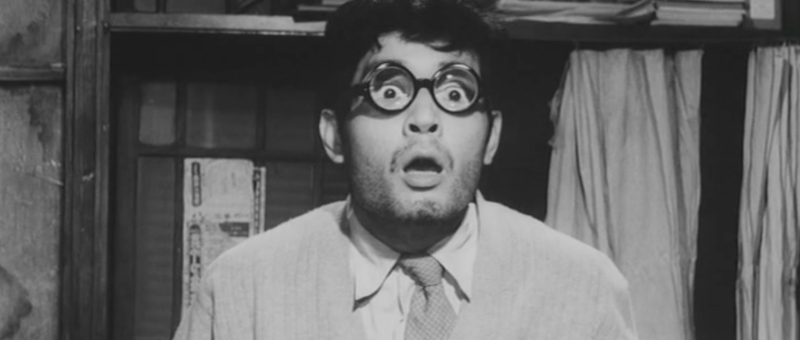
As we first meet him, the hero is bumbling professor of criminal psychology Shinji Kikyo (Tatsuya Nakadai) who has extreme myopia and a persistent case of athlete’s foot not to mention a prominent mother complex. Unbeknownst to him, he’s one of three targets picked not quite at random by Rudolf von Bruckmayer (Bruno Lucique), former Gestapo chief, who is interested in hiring some assassins trained by the megalomaniac psychiatrist Mizorogi (Hideyo Amamoto) who’s been turning his mentally distressed patients into hyper-efficient killing machines (sometimes literally) under the rationale that all great men throughout history have been in a certain sense “crazy”. Mizorogi is also in charge of a eugenicist project titled “The Greater Japan Population Control Council” which believes that Japan is already overpopulated but they have to ensure that “the lives of people who might become useful in the future must not be destroyed before they’re born.” Therefore, “the people who will be useless should be asked to bow out”, the assassin calmly explains shortly before Shinji is saved by the divine energy of his late mother as her bust falls from a shelf and knocks the killer out. 

The central conceit plays into a real anxiety about the post-war baby boom expressed in earlier films such as Yuzo Kawashima’s Burden of Love while attacking the capitalistic philosophy that regards some people as more useful than others. By the late 1960s, Nazis had begun to make frequent appearances in these kinds spy spoofs as comedy villains usually crazed to the point of being little real threat. Mizorogi too is eventually exposed as exalting the “mad” interested more in the art of chaos and the impulse to murder than in any greater political goal. Indeed, the central MacGuffin turns out to be less to do with a grand conspiracy to create some kind of super society than the very B-movie-esque missing diamond known as Cleopatra’s Tear.

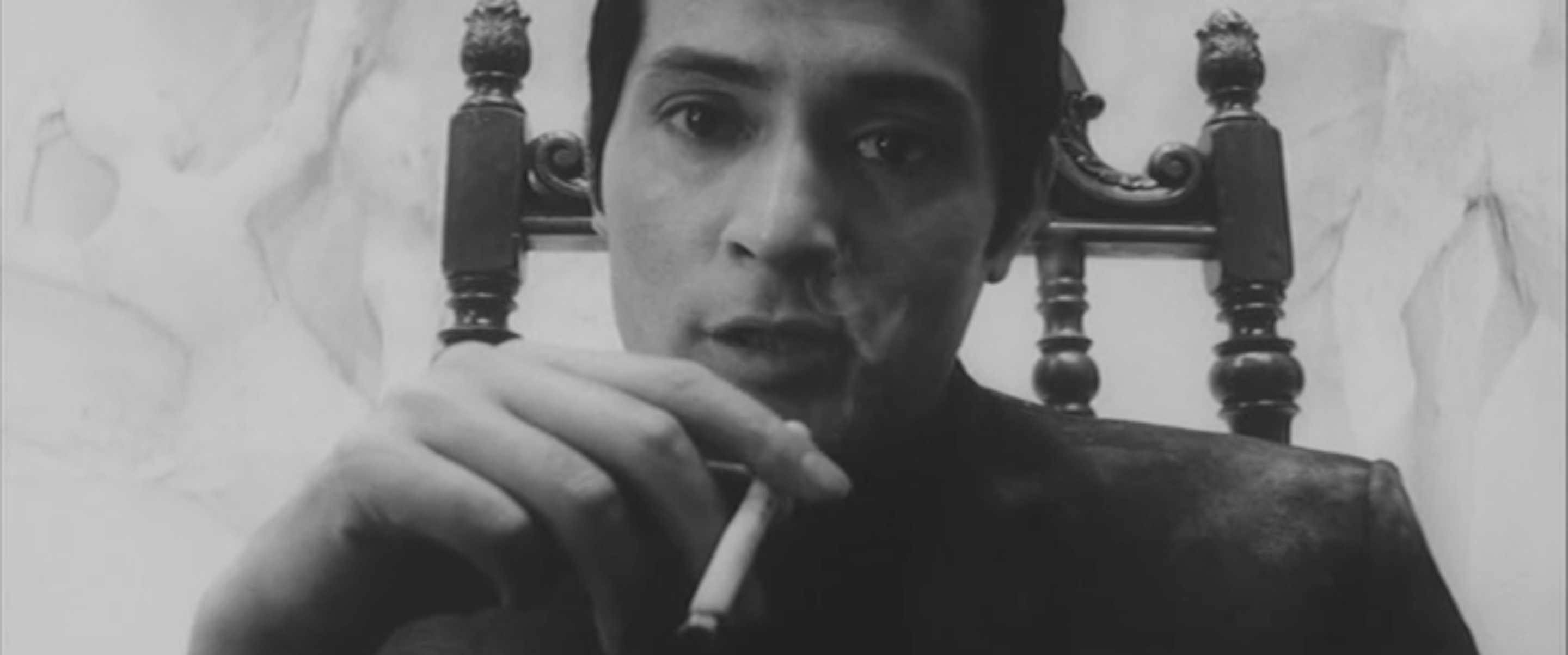
Okamoto piles each of these subplots one on top of the other as if he were making it up as he goes along suddenly undercutting what we thought we knew with an unexpected reversal. Shedding his glasses and shaving his scraggly beard, Shinji shifts from myopic professor to suave super agent using profiling and psychology to stay one step ahead while encountering plots by spiritualist cults, overly cheerful self defence force officers in the middle of training exercises, and eccentric assassins. From a modern standpoint, it might seem uncomfortable that each of the killers is manifesting disability in order to seem non-threatening, a female operative concealing a deadly weapon behind an eyepatch, while her poetry-obsessed colleague stores his in a fake crutch, but then again they are each pawns of a game being played by the crazed Mizorogi. Aided by female reporter Keiko (Reiko Dan) and car thief sidekick Otomo Bill (Hideo Sunazuka), Shinji seems to bumble from one bizarre episode to another but may actually be far more in charge of the situation than we might have assumed. 

Among the most visually striking of Okamoto’s late ‘60s pictures and once again making great use of animation, Age of Assassins features high concept production design, Mizorogi’s asylum lair a maddening corridor of Omega-shaped passages with ornate cell bars on either side behind which we can see a room full of men often engaged in what seems to be a military exercise regime while the plaster effigies of human form seem to be bursting from the walls. As in all of Okamoto’s films the central message lies in the absurdity of violence suggesting in a sense that the dog-eat-dog ethos of contemporary capitalist consumerism is in itself a kind of internecine madness countered only by Shinji’s rather childish mentality crafting his various gadgets out of household objects while attacking this elitist individualism with nothing more sophisticated than a vegetable peeler. 


Original trailer (no subtitles)

Hit and Run (ひき逃げ, Mikio Naruse, 1966)

The contradictions of the contemporary society drive two women out of their minds in Mikio Naruse’s dark psychological drama, Hit and Run (ひき逃げ, Hikinige, AKA A Moment of Terror). Scripted by Zenzo Matsuyama and starring his wife Hideko Takamine in her final collaboration with the director, Naruse’s penultimate film takes aim at the persistent unfairness of a post-war society already corrupted by increasing corporatisation while caught at a moment of transition that leaves neither woman free to escape the outdated patriarchal social codes of the feudal era. 

The two women, both mothers to five-year-old boys, are mirror images of each other. Kuniko (Hideko Takamine), the heroine, is a widow working in a noodle bar and continually exasperated by her energetic son Takeshi who keeps escaping kindergarten to play pachinko which is not a suitable environment for a small child. Kinuko (Yoko Tsukasa), meanwhile, is mother to Kenichi and married to a high ranking executive at Yamano Motors, Kakinuma (Eitaro Ozawa). These two worlds quite literally collide when Kinuko, emotionally distressed and driving a little too fast, knocks over little Takeshi while he is out playing with some of the other neighbourhood boys. As she is with her lover, Susumu (Jin Nakayama), she decides to drive on abandoning Takeshi to his fate but discovers blood on the bumper of her shiny white convertible on returning home and thereafter decides to tell her husband everything aside from revealing her affair. Kakinuma covers the whole thing up by forcing their driver to take the rap to protect not his wife but the company along with his own status and success fearing that a scandal concerning his wife driving carelessly may have adverse consequences seeing as Yamano Motors is about to launch a new super fast engine that will make them worldwide industry leaders. 

Perhaps in a way the true villain, Kakinuma cares about nothing other than his corporate success. Kinuko states as much in complaining that he’s never once considered her feelings only his own and that their marriage was a failure from the start, little more than an act of exploitation in which she was traded by her father for money in return for political connections. For these reasons she seeks escape through her extra-marital affair but is unable to leave partly in the psychological conflict of breaking with tradition and partly because she has a son whom she would likely not be permitted to take with her even if it were practical to do so. Another woman says something similar in disparaging Kuniko, implying that her life is in some ways over as few men would be interested in marrying a widow with a child. 

Takeshi’s loss is therefore additionally devastating in severing Kuniko’s only lifeline. A brief flashback reveals that Kuniko was once a post-war sex worker, she and her yakuza brother Koji war orphans who lost their parents in the aerial bombing. When she married and had a child she thought the gods had smiled on her but in true Narusean fashion they gave only to take away leaving her a widow and finally robbing her even of her child. To add insult to injury, they try to put a price on her son’s life, a mere 500,000 yen for a boy of five hit by a car. When the driver stands in the dock, he gets off with only a 30,000 yen fine for the death of a child. Then again on visiting his home, there appears to be a boy of around five there too, perhaps you can’t blame him for taking the money having been robbed of his youth in wartime service. 

Still, on hearing from an eye witness that it was a woman who was driving, Kuniko quickly realises that Kinuko must have been responsible. Quitting her job she joins a maid agency in order to infiltrate the house and gain revenge later settling on the idea of killing little Kenichi, who takes an instant liking to her, to hurt his mother in the way she has been hurt only to be torn by her unexpected maternal connection with the boy. The conflict between the two women is emotional, but also tinged with class resentment that a wealthy woman like Kinuko should be allowed to escape justice with so little thought to those around her while Kuniko is tormented not only by her grief but the persistent injustice of the cover up. 

As in all things, it’s the lie that does the most damage in ironically exposing the truth of all it touches. Kinuko’s escape route is closed when her lover reveals that he’s lost faith in her, unable to trust a woman who’d run away from the scene of a crime and allow someone else to take the blame, while Kakinuma’s emotional abandonment of his social family for the corporate is thrown into stark relief by his immediate decision to further exploit their driver just as he will later their maid. Driven out of her mind, Kuniko has white hot flashes of lustful vengeance as she imagines herself engineering an accident for Kenichi, throwing him off a rollercoaster or coaxing him into traffic, only to regain her senses unable to go through with it so pushed to the brink of madness is she that no other action makes sense. 

Even so the conclusion is brutally ironic, Kuniko accused of a crime she did not commit but half believing that she must have done it because she wanted to so very much. Kakinuma gets a minor comeuppance, encouraged by his servant to make clear what actually happened and exonerate Kuniko thereby walking back his total commitment to the corporate (then again it seems his dream project was itself under threat from a potential plagiarism scandal) though the damage may already have been done. This societal violence of an unequal, increasingly corporatised and unfeeling society, eventually comes full circle bringing with it only death and madness as the two women seek escape from their internal torment. Naruse experiments with handheld camera and canted angles to emphasise the destabilisation of the women’s sense of reality along with blow out and solarisation in the visions that plague them, but curiously ends with a set of motor vehicle accident stats as if this had been a roundabout public information film to encourage careful driving. Then again perhaps in a way it is, a cautionary tale about the dangerous curves of untapped modernity and the cruelties of the nakedly consumerist era.  


Untamed (あらくれ, Mikio Naruse, 1957)

“Don’t let guys control you. You have to make them men” the heroine of Mikio Naruse’s Taisho-era drama Untamed (あらくれ, Arakure, AKA Untamed Woman) advises a former rival, yet largely fails to do so herself in the fiercely patriarchal post-Meiji society. Based on a serialised novel by Shusei Tokuda published in 1915 but set in late Meiji rather than early Taisho, Naruse’s adaptation essentially drops a contemporary post-war woman into a by then almost unrecognisable Japan, but finds her hamstrung firstly by feckless and entitled men and then by complicit women who themselves cannot accept her transgressive femininity. 

As the film opens, a teenage Shima (Hideko Takamine) has just married wealthy grocery store owner Tsuru (Ken Uehara) but the marriage is already a failure. Though Shima is compared favourably with Tsuru’s previous wife who was apparently in poor health, presumably suffering with TB which required a sojourn by the sea, it soon becomes clear that Tsuru is as trapped by the archaic patriarchal social system as she is. He was apparently in love with a woman from a higher social class he was too afraid to pursue and despite still seeing her also has a mistress near their factory in Hokkaido whom he often visits under the guise of a business trip. Yet when Shima tells him she thinks she may be pregnant, he is unimpressed, immediately questioning the paternity of the child while harping on about her having been married before which it seems is not quite true. Perhaps the reason that she has ended up a second wife despite her youth and beauty, Shima ran out on a marriage to a childhood friend arranged for her by her adoptive parents the night before the wedding not realising they had already registered the union without her knowledge or consent. 

This transgressive act at once signals Shima’s total disregard for conventionality and insistence on her own autonomy, yet it is also indicative of the fact she married Tsuru in search of a better life, knowing that to marry her adoptive parents’ choice meant only a life of servitude on the family farm. She is not always a terribly likeable figure, coldly explaining that she didn’t mind being fostered out because the adoptive family were wealthier and could give her a better life than she had with her birth parents. Yet it’s this sense of familial dislocation and the liminal status it gives her that allow her to take agency over her life in the way other women might not, unwilling to lose the familial security Shima may not feel she ever had. Tsuru is also an adopted son, but the price for disobedience for him may be even higher and indeed as we later hear his inability to sort out his love life eventually sees him out on his ear. His pettiness in refusing to accept the child is his leads to an argument which causes Shima to slip on the stairs and miscarry, the implication being that she may not be able to bear more children leaving her unlikely to remarry and thereby spurring her desire for a tempered independence. 

The fall is the last straw. Tsuru divorces Shima citing her inability to play the role of the proper wife while her birth family, from whom she is emotionally estranged, refuse to take her back as do the adoptive parents because of the embarrassment she caused them with the marriage stunt. She is often described as “like a man”, unable to win as Tsuru at once insists she wear the frumpy kimonos left behind by his previous wife who was a decade older, complains she wears too much makeup, and tells her to loosen her kimono belt to de-emphasises her figure, while criticising her for being unfeminine in her refusal to simply put up with his bad behaviour as is expected for a wife in this era. Shima fulfils all her wifely duties and as we see is in fact running his business as the women of the family are often seen to do while their husbands spend the money they earn for them on other women whether drinking with geishas or supporting mistresses in second homes. When her husband hits her, she fights back rather than shrinking away chastened as intended. 

Yet she cannot overcome the sense that a man is necessary for her success which cannot be accomplished alone. Cast out from her family, her brother installs her in the mountains to work in a geisha house if only as kitchen staff but soon does a flit to reunite with his married lover who has left her husband for him. While there she falls for the quiet and sensitive inn owner Hamaya (Masayuki Mori), also an adopted heir, whose wife is again ill with TB. Hamaya may be treating his wife a little better than Tsuru did his, but quite clearly assumes she’ll die in starting an affair with Shima who is then sent away to an even more remote inn to avoid a potential scandal. As Tsuru did with the woman he apparently loved, Shima continues to see Hamaya until he too succumbs to TB as an ideal of an impossible love while simultaneously accepting that he failed her in being too weak and cowardly to fight for their romance, outright refusing to become his mistress. 

This may be one reason she is determined never again to be an employee but to own her own store which is why she ends up marrying tailor Onoda (Daisuke Kato) who introduces her to textiles and seamstressing at which she quickly proves adept having mastered the modern sewing machine. She marries Onoda in believing him “reliable”, but soon comes to regard him as lazy and feckless. The first shop fails because he can’t keep up with her. The male employees are always taking breaks to drink tea and play shogi, Onoda complaining that he’s tired while she does all his work for him and the housework too. Yet he also criticises her for a lack of femininity, snapping back that it must be her time of the month when she berates him in front of their employees while later after they’ve become successful complaining it’s “embarrassing” that his workhorse wife doesn’t know the things a sophisticated society woman would such as ikebana while flirting with the teacher he’s hired ostensibility to teach her. He even forces her to wear a frumpy and already somewhat dated classically Edwardian dress with a fancy bonnet which more resembles something a country girl might wear to church than the latest in Western fashions in an attempt to advertise their tailoring which seems primed to backfire. 

That she learns to ride a bicycle in this rather ridiculous outfit is again a symbol of her desire to seize and manipulate modernity even giving rise to a piece of innuendo from her much younger assistant Kimura (Tatsuya Nakadai) as to the pounding she’s been getting from the saddle. Kimura seems to think the problem with the business is that Onoda’s patterns are outdated, offering her a new modernity while she prepares to cut Onoda out on catching him with his mistress taking their best employee with her to ruin his business and start another of her own. Though once again she cannot leave alone only with a man the ending is perhaps more hopeful than might be expected from a Naruse film allowing Shima to commit herself fully to the sense of industry she embodies always ready to start again, work harder, and achieve her desires unwilling to be bound by conventional ideas of femininity or to simply put up with useless men who refuse to accept her for all she is. Yet she largely fails to make men of them, each of her various suitors failing to live up to her, ruined by an oppressive social system that encourages them to exploit female labour while taking it for granted in their intense sense of patriarchal entitlement. 


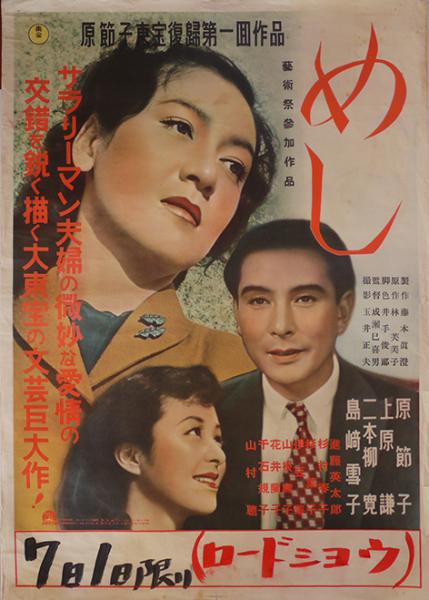
Repast (めし, Mikio Naruse, 1951)

“Must every woman grow old and die feeling empty?” asks the unhappy heroine of Naruse’s 1951 melodrama Repast (めし, Meshi) only to conclude that yes, she must, but that this in fact constitutes “happiness” as a woman. The first of Naruse’s Fumiko Hayashi adaptations Repast arrived in the year of the author’s death and is inspired by a short story left unfinished at the time of her passing. Screenwriter Sumie Tanaka was apparently convinced that the film should end with a divorce, as Sound of the Mountain would two years later, and consequently left the project after the studio mandated a more “sympathetic” ending. Superficially happy as it might seem, however, the conclusion is as bleak as one might expect from Naruse in which the heroine simply accepts that she must recalibrate her idea of happiness to that which is available to her and learn to find fulfilment in shared endeavour with her husband. 

As she explains in her opening voiceover, Michiyo (Setsuko Hara) married her husband Hatsunosuke (Ken Uehara) five years ago in Tokyo against her family’s wishes and has been living on the outskirts of Osaka for the past three. Marital bliss has quite clearly worn off. As we see from the repeated morning scenes of the local community sending their sons off to school and husbands to the office, every day is the same and all Michiyo ever seems to do is cook and clean. The only words Hatsunosuke says to her are “I’m hungry”, and the only source of solace in her life is her cat, Yuri. Yet even this constant state of unhappy frustration is disrupted by the unexpected arrival of Hatsunosuke’s spoilt and immature niece Satoko (Yukiko Shimazaki) who has apparently run away from home in rebellion against an arranged marriage. 

There is obviously a blood relation between Hatsunosuke and Satoko, but Michiyo’s jealously is not exactly unreasonable given the young woman’s childish flirtation with her uncle, perhaps an adolescent extension of her propensity to pout and preen to get her own way. Aside from all that, finances weigh heavily on Michiyo’s mind. Other than her drudgery, the constant source of friction in the relationship is Hatsunosuke’s low salary and lack of career success. Satoko’s family are a little wealthier and having been brought up in relative comfort she has little idea of the real world and is often tactless, remarking on Hatsunosuke’s worn out tie much to Michiyo’s chagrin. Hatsunosuke is happy enough to have her, but Michiyo is wondering if there’s enough rice in the jar to see them through and Satoko never stops to consider that they’re feeding her for free even falling asleep when Michiyo enjoys her one and only day off reuniting with old friends rather than preparing dinner as she’d been asked. Perhaps aware of the disruptive effect of her presence, Satoko pours salt on the wound by constantly asking her uncle if Michiyo doesn’t like her or is angry, further placing a wedge between husband and wife. 

For all that, however, Hatsunosuke would not be accounted a “bad” husband for the time save perhaps for his lack of career success. He is not cruel or violent, merely insensitive and distant, taking his wife for granted and unable to see that she is deeply unhappy while otherwise internalising a sense of guilt and failure in his inability to adequately provide for her. She meanwhile sometimes takes her dissatisfaction out on him in barbed comments about his low salary, her barely hidden contempt never far from the surface. Yet as her mother later points out in encouraging her go back to him he is “reliable, discreet, and honest”, qualities borne out by his later refusal to go along with a dodgy scheme organised by the old elite along with his nervous rebuttal of the attentions of the “mistress” from across the way. 

At heart a conservative woman, Michiyo too looks down on Ms Kanazawa (Kumeko Otowa) for her taboo status as the illicit lover of a wealthy man which is only in a sense her way of seizing her future as an independent woman running her own bar. Satoko, a woman of the modern era, sees less of a problem with it and is far less judgemental, though her own attempts are destined to end in failure thanks to her inability to work out that her present lifestyle is far above her current reach. Retreating to her Tokyo home, Michiyo looks for other options, admiring the apparently happier relationship between her younger sister and brother-in-law who now run the family shop. She asks a sympathetic cousin, Kazuo (Hiroshi Nihonyanagi) who provides an alternate love interest, to help her find work but encounters the brutalising line outside the local employment office and then an old friend now a war widow desperate for employment because her benefits are about to run out and she has a young son to support. Later she spots the same woman handing out flyers, suddenly realising the fallacy of her fantasy of starting again as an independent woman. She pens a letter to her husband admitting that she’s realised how vulnerable she is without his protection, but remains undecided enough to avoid sending it. 

Hearing that Satoko, still childish but perhaps not quite as naive as she assumed her to be, has been laying her claws into Kazuo the final nail seems to have been struck. Michiyo knows she will return to Osaka, but does so not because she has rekindled her love for her husband but because she has accepted there are no better options. Hatsunosuke is dull, but he is in a sense reliable, and honest to the extent that he may be about to be rewarded for his moral unshakability. He cares enough about her to show up in Tokyo hoping, but not insisting, she will return with him which is perhaps as close to a declaration of love that one could hope for. On reflection she decides that a woman’s happiness is found in sharing the journey with her husband, accepting that she must subsume her own desires into his and cannot hope to expect emotional fulfilment other than that found in his satisfaction. Even for a Naruse film, and one as peppered with moments of slapstick humour as this one is, it’s an extraordinarily bleak conclusion subtly hinting at the iniquities of life in a patriarchal society in which the best a woman can hope for is a life of unrewarded drudgery. 


Snow Country (雪国, Shiro Toyoda, 1957)

Closely associated with literary adaptation, Shiro Toyoda had been wanting to adapt Yasunari Kawabata’s Snow Country (雪国) since its serialisation and apparently spent four years preparing his treatment ahead of the 1957 film starring Ryo Ikebe as the solipsistic aesthete at the novel’s centre. Characteristically, however, he takes several liberties with the source material, notably introducing an entirely different conclusion which perhaps helps in re-centring the tale away from the hero Shimamura to the melancholy geisha who apparently falls for him because of his intense loneliness. 

A brief reference to a failed military insurrection in Manchuria sets us firmly in the mid-1930s as do repeated mentions of the ongoing depression which causes additional anxiety to local business owners in a small holiday resort town. Mimicking the novel’s famous opening, Toyoda opens with a POV shot of a train exiting a tunnel into the snow-covered landscape, the hero Shimamura (Ryo Ikebe) sitting sadly gazing out of a window and eventually captivated by the reflection of a young woman devotedly caring for a young man who appears to be in poor health. Meanwhile, another young woman, Komako (Keiko Kishi), gazes at her own reflection in a train station window, waiting once again as if unable to depart. As we discover, Shimamura has returned with the intention of seeing Komako with whom he’d struck up a relationship during a summer trip but is somewhat disappointed to learn that she has since become a geisha.

In a flashback to their first meeting, Komako asks Shimamura if he has come for “escape”, a question he doesn’t exactly answer while petulantly complaining about his lack of artistic success as someone who paints pictures apparently out of step with his times. When the head of the local commerce association tries to involve him in conversation about the failed insurrection, he bluntly tells him that he’s an artist and as such has no interest in such things, but it does indeed seem that he is looking for some kind of escape from the turbulent times, expressing that here the war seems very far away as does “the depression”. Komako, a more modern and perhaps prophetic figure than it might at first seem, is the only one to bring up the war directly speculating that it may be about to intensify while the frustrated affair between the two seems to be informed by the mounting tensions against which they are attempting to live their lives. 

Rather self-absorbed, Shimamura in a sense may even identify with Komako explaining that he too has a “patron” and implying that his flight is perhaps a response to his sense of powerlessness, that he feels constrained by his financial dependency presumably on his father-in-law though his relative economic superiority which leads Komako to frequently remark on his “extravagance” obviously affords him the freedom to make these random solo trips to ski resorts and indulge his career as a painter regardless of its capacity to support himself and his family. Komako must know on some level that the relationship is a fantasy, yet she believes in it enough to end her connection with an elderly patron on suspecting that she is carrying Shimamura’s child only to have her hopes dashed when he does not turn up for a local festival as promised with the consequence that all of her dependents are turfed out of the home he had provided for her. 

Komako is not “free” in the same way that Shimamura evidently is, her entire life dictated by the fact that she is poor and female. Fostered by a shamisen teacher, she may have been technically engaged to the young man, Yukio (Akira Nakamura), Shimamura saw on the train being cared for by Yoko (Kaoru Yachigusa), Komako’s foster sister in love with him herself, but intensely resents the burdens she is expected to bear quite literally with her body. She later tells Shimamura that she didn’t become a geisha for Yukio in order to pay his medical bills but out of a sense of obligation, while she is also responsible for her birth family, the now bedridden shamisen teacher, and Yoko who intensely resents her for her callous treatment of Yukio and generally “dissolute”, selfish way of living. During the famous fire in a cinema that closes the novel (but not the film), Komako even exclaims that her life would be easier if Yoko burned to death, but on witnessing her either fall or jump from the burning building she can do nothing other than run to her side. 

Indeed, the novel’s climax finds Shimaura standing alone indifferent to the fate of Yoko, a young woman he had come to admire if only for her contrary qualities, admiring instead the beauty of the night sky. In Toyoda’s characterisation, Yoko is in one sense the conventionally good woman whose selfless devotion to the sickly Yukio so captivates Shimamura, but her goodness is nevertheless undercut by the degree of her animosity towards Komako even as the two women remain trapped in a complex web of frustrated affection and intense resentment, each perhaps knowing they neither can have the man they want and are condemned to an eternal unhappiness as the snow mounts all around them in this perpetually cold and depressing moribund resort town. Switching between studio matte paintings ironically mimicking Shimamura’s art and on-location footage of the deepening snows, Toyoda’s sense of near nihilistic melancholy evoking the atmosphere of Japan in the mid-1930s hints at grand tragedy but finds resolution only in stoicism as the heroine picks up her shamisen and trudges onward amid the quickening blizzard.  


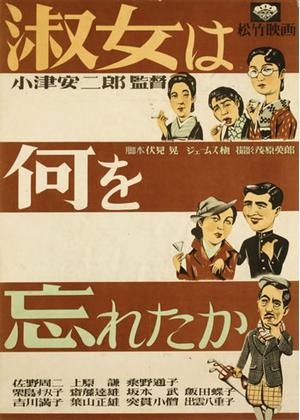
What Did the Lady Forget? (淑女は何を忘れたか, Yasujiro Ozu, 1937)

Japan was in a precarious position in 1937. Ozu’s What Did the Lady Forget? (淑女は何を忘れたか, Shukujo wa Nani wo Wasureta ka) was released in March of that year but by July the Second Sino-Japanese War would be in full swing and on the home front increasing censorship would render this kind of inconsequential comedy a much less easy sell. True enough, the film includes no “patriotic” content though it does eventually reinforce a set of patriarchal values in the remasculinisation of a henpecked husband while quietly sniggering at a new bourgeois social class.

The drama unfolds in the home of a medical professor, Komiya (Tatsuo Saito), and his austere wife Tokiko (Sumiko Kurishima). The couple have no children and mostly lead separate lives. Tokiko spends her days with two close friends, widowed single-mother Mitsuko (Mitsuko Yoshikawa), and wealthy older woman Chiyoko (Choko Iida) who is married to her husband’s friend, Sugiyama (Takeshi Sakamoto). The three women gossip about the usual things from fancy department store kimonos to new ways to laugh so you don’t get wrinkles along with the bizarrely difficult maths problems Mitsuko’s son has been studying in preparation for middle-school that none of them can answer. To help with the embarrassingly taxing homework, Tokiko offers to find a tutor, press-ganging her husband’s best student, Okada (Shuji Sano), into spending time with Mitsuko’s son Fujio (Masao Hayama) though it turns out that he too, a college graduate, is unable to solve these middle-school level problems. 

The real drama occurs when the couple’s neice, Setsuko (Michiko Kuwano), whom Tokiko had described as “proper” and “wholesome” rocks up from Osaka having become the epitome of a modern girl. Setsuko’s arrival further strains the Komiyas’ already fraying relationship as her surprising habits which include driving, smoking, drinking, and hanging out with geisha, continue to exasperate her aunt whose main objection to all of those things is that they aren’t appropriate because Setsuko is not yet married. To get away from his nagging wife who forces him to go golfing as usual when he doesn’t really want to, Komiya stashes his clubs with Okada and goes to a bar in Ginza where he meets Sugiyama who has also been forced outside by his wife. Sugiyama really does go golfing, promising to mail a previously written postcard to Tokiko on Komiya’s behalf, while he is eventually joined by Setsuko who has tracked him down to the bar despite being told to stay home and mind the house (the Komiyas have two live-in maids so the instruction seems unnecessary at best).  

As a “modern gal” Setsuko has some strangely old fashioned ideas even as she behaves like a 1930s ladette, striding around like man while drinking, smoking, and generally being almost as intimidating as Tokiko just in a more likeable fashion. Setsuko finds Komiya’s deferral to his wife embarrassing, encouraging him to be more masculine and stand up for himself even advising that he use violence to reassert his position as the man of the house. He seems uncomfortable with the idea but eventually does just that after a climactic argument once his lying about the golf and Setsuko’s nighttime adventures have been exposed. Caught in a moment of frustration, he slaps Tokiko across the face, leaving her to retreat in shock apparently “beaten”. The thing is, however, Tokiko likes it. She sees his slapping her as a sign of his love, as if she’s been needling him all this time in hope of a reaction while frustrated that perhaps he doesn’t care for her. Once he hits her, the marriage is rebalanced and repaired with traditional gender dynamics restored. She becomes more cheerful and deferent to his male authority, he acknowledges that he enabled her “arrogance” with his weakness as a man.  

Setsuko however, continues to shout at her uncle, disappointed that he apologised for his reaction and accusing him of giving away the victory he’d just won. He tells her that he’s simply using reverse psychology because wives like to believe they’re in charge and in the main it’s best to let them. Setsuko seems satisfied, but jokes with her new love interest Okada that he better not use reverse psychology on her. Or, he can, but she’ll just use reverse reverse psychology to get the upper hand, which perhaps undercuts the central message in praise of traditional gender roles. Nevertheless, What Did the Lady Forget? is full of Lubitschy late-30s charms from an unexpected sighting of real life star Ken Uehara at the Kabuki to Setsuko’s movie magazines featuring Marlene Dietrich and repeated references to Frederich March and William Powell proving that Ginza is open even in 1937, while the Komiya household descends into an oddly peaceful harmony of delayed marital bliss. 


Currently streaming in the UK via BFI Player as part of Japan 2020. Also available to stream in the US via Criterion Channel.