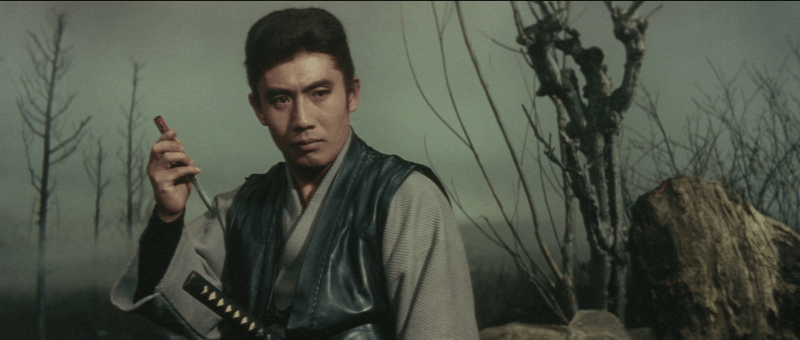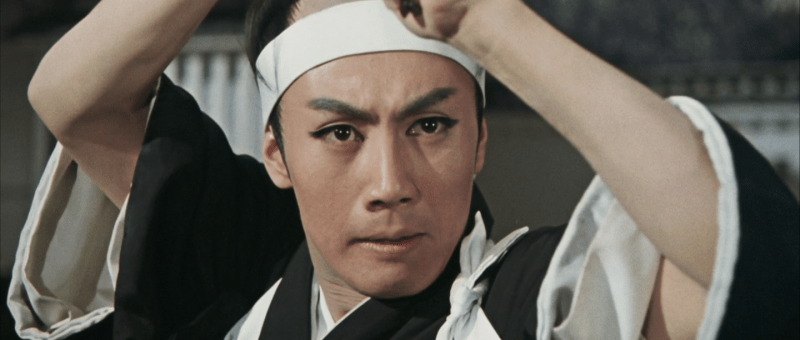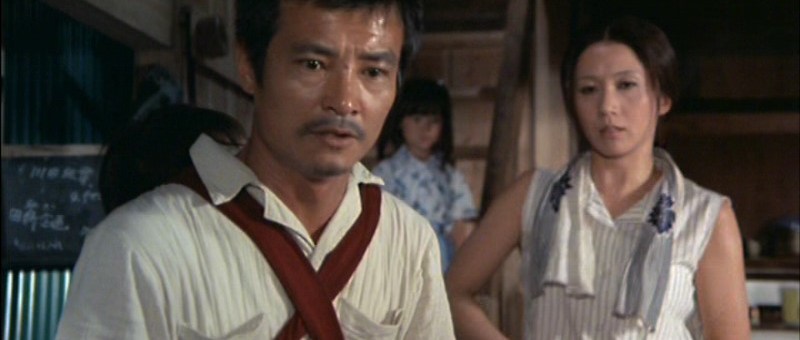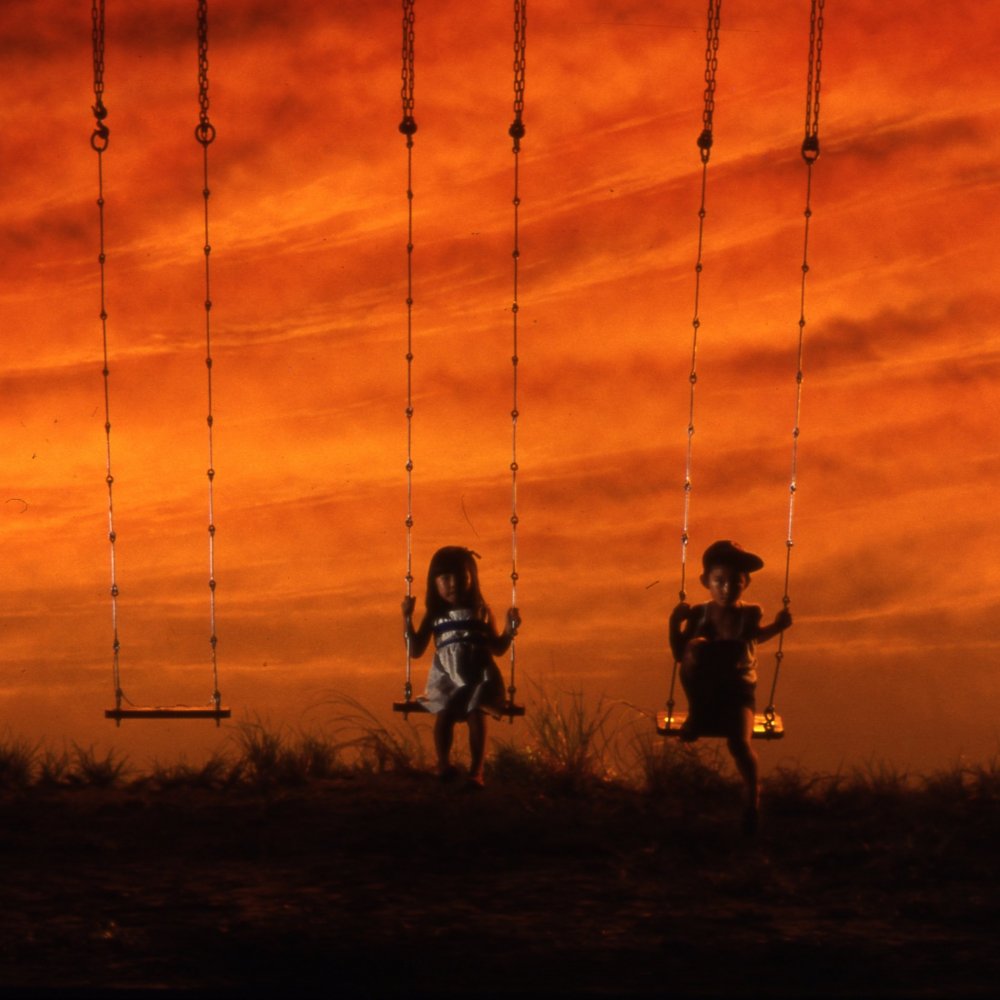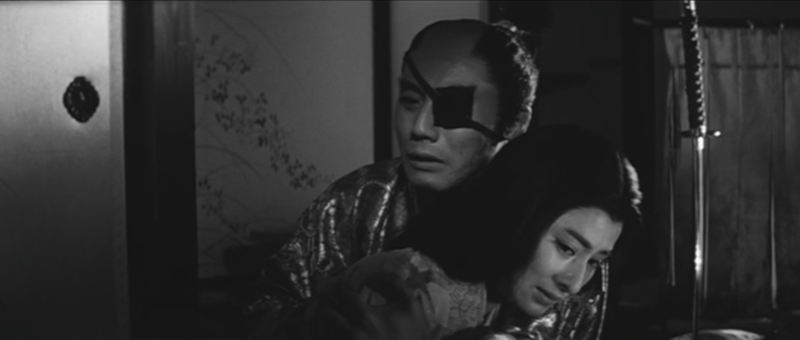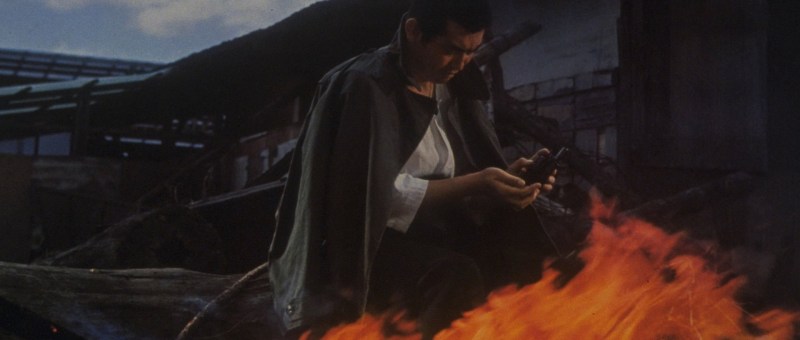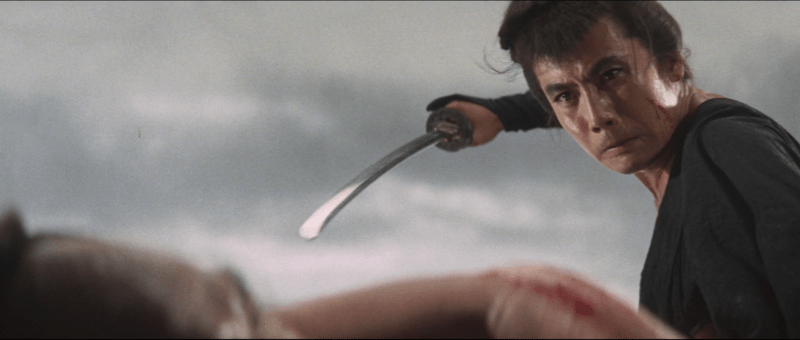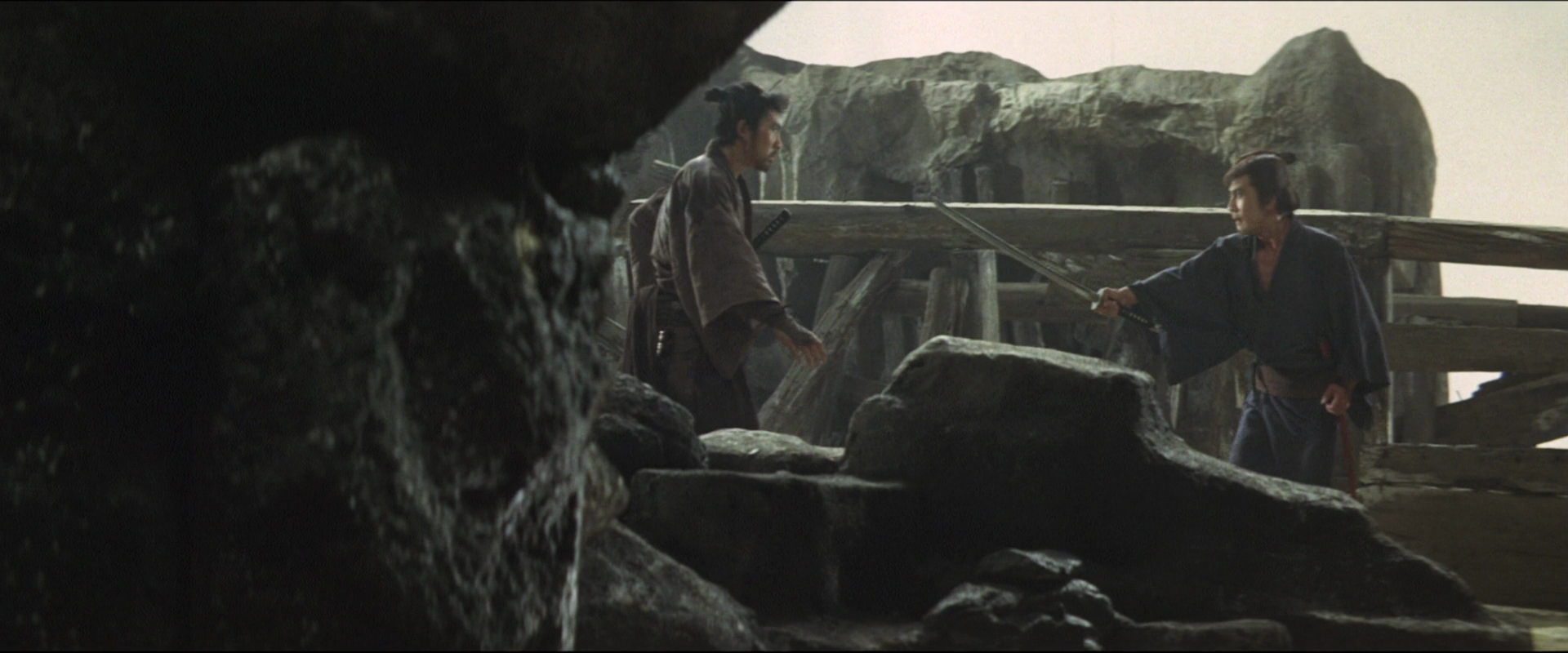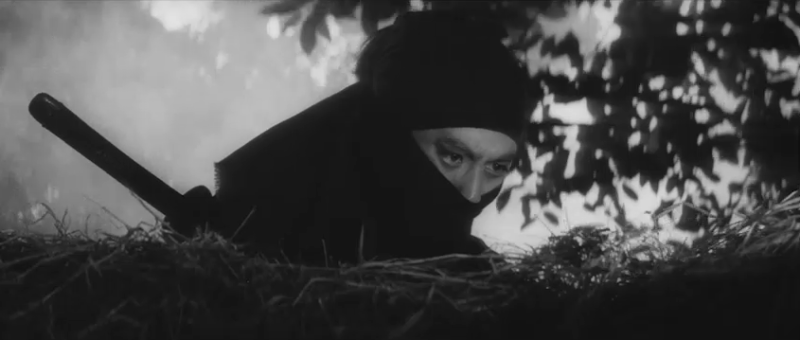
Shinobi no Mono 4: Siege (忍びの者 霧隠才蔵, Tokuzo Tanaka, 1964)

When he began what would become the Shinobi no Mono series, Satsuo Yamamoto had wanted to put a more realistic spin on the ninja movie, shifting from the fantasy-esque wuxia with which the genre had been associated since the silent days to something that was largely devoid of romanticism. In the films he directed, the ninja are powerless manipulators doomed to live unhappy lives defined by a cruel and heartless code. Though still based on the same novel, the third film began to compromise that vision in the hero’s miraculous escape from certain death, ending on a note of ambivalent positivity in which Goemon declines the offer to join Ieyasu and instead walks out into independent freedom. 

The first three films had covered all of the action in Tomoyoshi Murayama’s serialised novel, and so the following four are based on original ideas by screenwriter Hajime Takaiwa save for episode six which is scripted by Kei Hattori and Kinya Naoi. Many of the same actors appear but in different roles while the action has moved on 15 years, skipping ahead from the unseen battle of Sekigahara to the siege of Osaka and the end of the Toyotomi. Raizo Ichikawa stars as another displaced Iga ninja nominally in the service of the Toyotomi but secretly longing to bump off Ieyasu not for reasons of revenge but because there is no place for ninja in his new and peaceful society. If they’re able to unseat him, they assume the situation will revert to the civil war society with the effete Hideyori (Junichiro Narita) too ineffective to assume control over the nascent nation. 

It has to be said, this version of events has rather misogynistic overtones with frequent speeches from Sanada Yukimura (Tomisaburo Wakayama) avowing that it’s all Lady’s Yodo’s (Otome Tsukimiya) fault for giving her son bad advice that he is too naive to know not to follow. In negotiating to end the siege at Osaka castle, Yukimura had advised it was better to strike back against Ieyasu and kill him as soon as possible, but Lady Yodo vetoed it and insisted she and her son remain locked up in relative safety. His conviction is somewhat born out seeing as Ieyasu had deliberately targeted the area of the castle where they assumed she was staying in order to further frighten her.

Nevertheless, he’s astute in realising it was all essentially a ruse and part of Ieyasu’s plan to force the Toyotomi into submission. The attack on the castle was only ever intended to engineer a peace treaty which Ieasyu himself presented and forced Hideyori to sign. Then again, there’s some strange symmetry in play. When Saizo enters the castle in an attempt to assassinate Ieyasu he mangles to trick him into killing his double instead, then when Ieyasu’s ninja try to assassinate Yukimura after following Saizo having known he would pretend to be dead and dig himself out of his own grave they also kill his double much to Ieyasu’s consternation. 

It’s this similarity that Saizo hints at when he pities a retainer of Ieyasu’s explaining that Nobunaga and Hideyoshi had tried to eliminate them but they survived while Ieyasu now wants to use them for his own ends but will likely do the same when they are no longer necessary to him. Thus what they want is a kind of chaos, desperate to assassinate Ieyasu to return to the world in which the ninja are able to influence events from the shadows. Even so his conviction is apparently shaken. As in the previous series, Saizo gains a love interest, Lady Akane (Midori Isomura), who has become a sex worker as an apparent act of self-harm after being raped by Tokugawa soldiers during the fall of Osaka castle. But as we’ve been repeatedly told, a ninja’s heart lies under the blade. Born in darkness, they shall die in darkness and are not permitted to fall in love. Thus Saizo rejects her affections, but eventually declares himself corrupted by wanting to die alongside Yukimura as a loyal soldier. The in-film lore would have us believe that Yukimura did not in fact die during the final assault but was spirited away by Saizo to plot Ieyasu’s downfall in the shadows. 

Directed by Tokuzo Tanaka in his only instalment in the series, the film is shot more like a conventional jidaigeki but returns something of the fantasy aesthetic to the ninja as they somersault through the forest. Saizo’s surname effectively means “hidden in the mist”, which is partly ironic seeing as Akane also describes her rape as being overcome by a thick fog, but is also symbolic of his frequent use of smoke bombs as a disappearing trick which again undermines the sense of realism with which the series began. Yukimura is fond of declaring that the clock cannot be turned back, a sentiment echoed by Akane and emphasising the sense of melancholy fatalism that cannot be avoided in a historical drama in which the outcome is already very well known, imbuing Tanaka’s take with the sense of elegy and legend Yamamoto had so deliberately rejected. 

Ninja, A Band of Assassins (忍びの者, Satsuo Yamamoto, 1962)

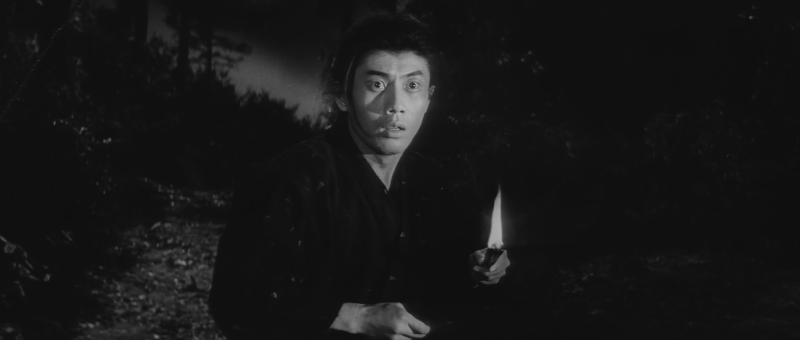
Ninja in Japanese cinema had largely been relegated to the realms of childish fantasy prior to Satsuo Yamamoto’s Ninja, A Band of Assassins (忍びの者, Shinobi no Mono) which cast a distinctly less heroic light on the famed mercenary spies of the feudal era. Indeed, there’s something reminiscent of the cult of militarism in the repressive nature of the ninja code and the hero Goemon’s (Raizo Ichikawa) original allegiance to it despite his father’s wariness and attempt to warn him that human happiness has no place in the life of a ninja. 

As the leader of Goemon’s clan, Sandayu (Yunosuke Ito), explains the ninja are obliged to serve whichever lords require their service, but he refuses to work with Oda Nobunaga (Tomisaburo Wakayama, billed as Kenzaburo Jo) owing to his famous animosity towards them. He even goes so far as to call Nobunaga a greater threat to the ninja than demons or devils. Opening in 1573, the film takes place at a tumultuous moment as Nobunaga continues to solidify his plan to unite the whole of the land under his banner by absorbing or defeating rival clans. The pre-credits sequence finds Goemon playing dead on a battlefield surrounded by ominous crows and encountering another ninja from a rival clan, Kizaru (Ko Nishimura), who has become a more literal kind of vulture in stealing from the dead.

Stealing is against the ninja code and something of which the young and idealistic Goemon fiercely disapproves. Nevertheless, in a cruel irony he’s forced to become a burglar in an effort to raise funds for more weapons to combat Nobunaga whom he has also been ordered to assassinate in return for his life after having been caught having an affair with Sandayu’s wife, Inone (Kyoko Kishida). Goemon is inspired by the legendary figure dubbed the Japanese Robin Hood for his mission stealing money from the rich to give to the poor, but here is far from heroic. When his affair with Inone is discovered by a servant, Goemon kills him to maintain the silence. He then believes that Inone has also been killed after falling into a well and attempts to flee the scene only to be confronted by Sandayu. 

Only too late does to he begin to understand what his father tried to warn him about, that the code of the ninja is cruel and unforgiving. It cannot grant him pride or happiness despite the self-satisfied glow he feels on having been singled out by Sandayu as a protege. A ninja must be ready to sever all ties to those he loves and endure intense torture without speaking. If caught in an impossible situation he must scar his face and take his own life as one of Goemon’s acquaintances eventually does after being captured by Nobunaga. Goemon assumes he has no reason to be afraid because he is the most skilled ninja in the garrison and a single ninja can take down a fortress all on his own, but in reality he is powerless, merely a puppet manipulated by Sandayu for his own ends. After falling in love with a sex worker, Maki (Shiho Fujimura), he grows tired of his missions, gives up on burglary, and makes no move to assassinate Nobunaga but is pursued by Sandayu’s minions, the irony being that not even a ninja can escape from the confined space of ninjadom.

This world is so steeped in secrecy that nothing is as it seems and Goemon discovers the rug pulled out from under him in more ways than one before beginning to realise that Sandayu has deliberately engineered his downfall and was most likely behind his father’s murder in an attempt to get his hands on his recipe for gunpowder which is, as Nobunaga says, the future of warfare. Nevertheless, even within its commitment to realism the film contains plenty of ninja tricks from sudden appearances to superhuman leaps and expert shuriken throwing and grappling hooks.  The sense of melancholy futility implied by the presence of the crows in the opening scenes never recedes, Yamamoto frequently descending into mists as Goemon sinks into his confusion and eventual disillusionment with the tenets of ninjadom. Rival ninja clans more obsessed with their reputation and status vie for the head of Nobunga while all Goemon wants is the right to live a quiet life with Maki though that’s something that largely cannot be found amid the constant chaos of the feudal era. 

Bloody Shuriken (赤い手裏剣, Tokuzo Tanaka, 1965)

A cynical ronin spots a business opportunity when he rides into a town beset by gangsters in Tokuzo Tanaka’s samurai western, Bloody Shuriken (赤い手裏剣, Akai Shuriken). Despite the name, this is not a ninja movie. The title refers to the knives the hero throws with almost supernatural skill. Adapted from a short story by noir master Haruhiko Oyabu, the action may sound reminiscent of Yojimbo but there’s a different kind of irony in its humour and a lightheartedness to its cynicism even if its final message is that the wages of greed are death.

We can tell that Ibuki (Raizo Ichikawa) is both good man and bad in that he immediately breaks up a fight between rival gangs on entering town, depriving the men in question of their money, but then handing it straight to the owner of the bar they were fighting in to cover the damage. He’s concerned about his horse too, but can’t quite afford the lodging fees at the stable run by the grumpy Yuki (Chitose Kobayashi) who loathes samurai, and with good reason. After hearing about the complicated makeup of the town’s hierarchy, Ibuki decides to stay and make some money by essentially playing each of the three gang leaders off against each other so they end up taking care of themselves. 

So far, so Yojimbo. But this town seems to be even further out, much more like a decrepit western outpost filled with scum and villainy. When the wind picks up, the dust blows through as if signalling the murky air and sense of futility. We’re told that the leader of the biggest gang, Hotoke (Isao Yamagata), is also the police chief, while his rival Sumiya (Yoshio Yoshida) complains that he’s usurped his position as his family has been there longer. Hotoke arrived a starving man three years previously and got back on his feet thanks to the support of the community, but then he turned around and got rich running a gambling den targeting local miners. Kinuya (Fujio Suga) has been here a little longer, but is otherwise biding his time until the other gangs fall from grace.

Of course, Ibuki foments conflict and strikes deals with all of them, but the real trouble is some missing gold that was stolen from the government causing even more disruption in the town with inspectors targeting ordinary people who weren’t even involved. Bar owner Chinami (Masumi Harukawa) is one of many interested in finding out what happened to the money, but she’s also in a precarious position, on the one hand throwing her lot in with Hotoke but on the other hating him and approaching both Ibuki and moody ronin Masa (Koji Nanbara ) to help her be free of the troublesome gangster. 

The fact that the two most prominent business owners are women is perhaps uncomfortably intended to signal the breakdown of the town in which Ibuki becomes the only real “proper” man amid bumbling gangsters and crazed ronin. Yet Chinami is directly contrasted with the pure and innocent Yuki who hates all the gangsters, as well as the samurai and generally everyone who isn’t a horse. Cynical and greedy, Chinami wants the gold and she’s prepared to use her body to manipulate men into doing what she wants, whereas Yuki defiantly keeps her head down and refuses to participate in gangster nonsense because she just wants to run her stables in peace. Only later does she develop a fondness for Ibuki on realising that he’s not so cynical after all and is interested in a kind of justice and getting rid of the corruption in the town for reasons other than money. Having discovered the location for the gold, he leaves the knowledge to Yuki so she can avenge her father who was killed during the robbery. 

But in other ways, this is already a post-apocalyptic hellscape as Ibuki discovers on spotting a pair of crows feeding on a corpse in a river. Perhaps taking pity on one less fortunate than himself, he throws one of his darts and skewers them. Ibuki’s knife supply seems to be inexhaustible, and he never appears to go back and retrieve the ones he’s thrown though his skill does seem to lend him an almost supernatural quality. In any case, Tanaka injects a degree of weird humour in the strange town with its eccentric residents including ronin Masa who looks permanently evil yet has a strange love of dolls, while the fight scenes themselves are often somewhat comical as the gangs seem to clash like a pair of cats slapping each other. There’s even something quite funny about the way the film bluntly drops exposition at unexpected moments even in the midst of the farcical scheming between the gangsters and Ibuki running back and forth to stoke the fires of conflict. This land is so bleak, it seems to say, all you can do is laugh or you’ll end up face down in a river with crows picking at your back too, so you might as well ride off into the sunset like Ibuki looking for the next corrupt town to purify and onward towards the bounty on the horizon. 


Trailer (no subtitles)

Freelance Samurai (桃太郎侍, Kenji Misumi, 1957)

An abandoned son resolves to wander Japan killing the “demons” of Edo-era society in Kenji Misumi’s adaptation of the popular novel by Kiichiro Yamate, Freelance Samurai (桃太郎侍, Momotaro-Zamurai, AKA The Demon Crusader). Starring a young Raizo Ichikawa in dual roles as twins separated at birth, a familiar jidaigeki plot device, Misumi’s drama is among his most conventional but still finds the demon-hunting hero of the title resolutely rejecting the “silly rules of the samurai” in refusing to serve or be served while resisting the persistent corruptions of the feudal society. 

First spotted returning a paper balloon to some children playing in the street, the hero (Raizo Ichikawa) later gives his name as “Momotaro”, the legendary folklore champion who was born from a peach and then went on to befriend various forest creatures travelling with them to fight the cruel demons who had been oppressing the peasants of the farmland where his adoptive parents lived. The name is a sense ironic in that it reflects his own fatherless existence having discovered that he is actually Shinjiro, the younger brother of the heir to a nearby clan, Shinnosuke (also Raizo Ichikawa). At this particular cultural moment, twins were thought inauspicious with one usually cast out, Momotaro in someways more fortunate than most in that he was sent away and raised by his mother to whom he was apparently devoted. In fact, as he says, he only delayed his demon-killing mission out of consideration for her but that now that she has sadly passed away he is free to pursue justice as a wandering ronin determined to serve no master but himself. 

This insistence on justice and opposition to samurai oppression is made plain in the opening scene in which he rescues pickpocket Kosuzu (Michiyo Kogure) from two samurai she’d robbed who were hassling her. She of course falls in love with him, but is also party to the central conspiracy engineered by high ranking retainer Shuzen (Shosaku Sugiyama) who is plotting to unseat Shinnosuke in favour of the lord’s illegitimate young son Mantaro (Junta Yamamoto) with the help of ambitious underling Iga (Seizaburo Kawazu). Momotaro is swept into the intrigue when he rescues the beautiful daughter of loyal retainer Iori (Gen Shimizu), Yuri (Yoko Uraji), from an attempted kidnapping. Both sides want to recruit him for his bravery and sword skill, but Momotaro is reluctant to help either of them especially on discovering the ironic coincidence that he finds himself caught up in a succession struggle in the very clan which previously cast him out. 

Deciding to help when hearing that Shinnosuke has been poisoned, Momotaro demonstrates his strategic abilities in coming up with a ruse to trick the conspirators but remains somewhat conflicted remembering his mother’s dying words that he should hold no grudges even as a part of him continues to resent his abandonment. That may in part explain his defiant rejection of the hierarchal society, ignoring the “silly” rules of the samurai while insisting on equality in refusing to serve or be served by anyone else. In a nod to the folktale, his greatest friend is a humble peddler, Inosuke “the monkey man” (Shunji Sakai) who gives him a place to stay in the rundown tenement where he lives affectionately known as “ghost apartments”. Even so, Inosuke as much servant as sidekick, and while he is in a sense torn between the earthy pickpocket Kosuzu who is later redeemed through her loyalty to him and the beautiful samurai daughter Yuri it seems fairly clear that he will eventually opt for his class-appropriate match the only surprising thing being that it is she who transgressively breaks with convention in abandoning her samurai home in order to follow Momotaro out on the road as he hunts other “demons” corrupting the social order all over Japan. 

Shot in colour academy ratio, Freelance Samurai features little of Misumi’s trademark natural vistas save for the poignant pillow shots of flowers growing in the compound though it does reflect his preoccupation with absent fathers and perpetual wandering. In the many dualities in play, it is also interesting that Momotaro is depicted as the more capable of the brothers, Ichikawa’s characterisation of the cosseted Shinnosuke as a kind and compassionate, effete young man rather than the strapping warrior the heir to a clan is expected to be hinting perhaps at the perceived weakness that allowed the conspirators to assume they could usurp him. Similarly, it’s Michiyo Kogure’s tragic pickpocket undone by her love for the noble samurai that makes the deeper impression rather than the rather insipid Yuri who makes her mark only in her final decision to follow Momotaro unbidden. Momotaro’s quest may in a sense be ironic in that he outwardly rejects the superiority of the samurai but effectively preserves it even as he determines to clean out the oppressive “demons” intent on corrupting the land just as his folkloric namesake had done, but in its own way has its defiant nobility in his fierce love of justice and equality. 


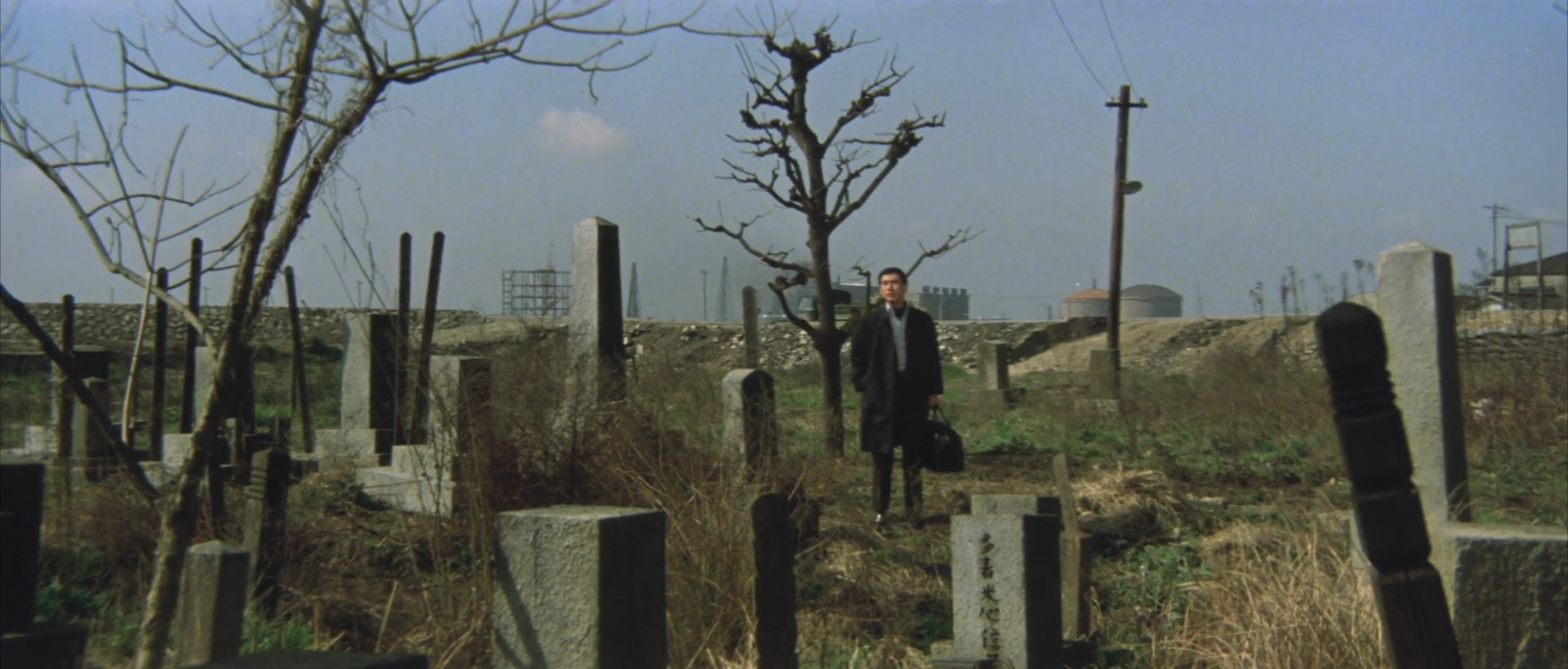
The Demon (鬼畜, Yoshitaro Nomura, 1978)

By the late 1970s Japan had achieved its economic miracle, but it had yet perhaps to deal with the traumas of the immediate post-war era. Once again adapted from a story by Seicho Matsumoto, Yoshitaro Nomura’s shocking social drama The Demon (鬼畜, Kichiku) explores the radiating effects of orphanhood and economic privation on the family unit producing as a rather judgemental policeman eventually puts it a generation of parents who don’t know how to raise children and may even lack the inclination to do so even if thankfully not to the extent of the couple at the film’s centre.

Nomura opens with one of his trademark lengthy train sequences following a harried mother and her three children travelling in the sweltering heat from the countryside to the city as she makes a last, desperate attempt to remind the father, Sokichi Takeshita (Ken Ogata), of his responsibilities. Once a successful businessman, Sokichi has become financially ruined after a fire destroyed his print shop and no longer has the means to maintain a second household for his mistress and children at a discrete distance from the home he shares with his wife, Oume (Shima Iwashita). As Kikuyo (Mayumi Ogawa) points out to him, she is unable to support herself economically while caring for the children but he has little answer for her especially once the previously oblivious Oume overhears their conversation. After a series of heated arguments, Kikuyo makes the radical decision to simply abandon the children with their father and thereafter disappears having vacated her previous home and left no forwarding address. 

A part of the problem in the Takeshitas’ marriage had been that they have no children of their own, Sokichi remarking to Kikuyo, whom he met while she was working in a traditional teahouse where he used to take clients, that he had always wanted a child. Conventional gender roles have in a sense been reversed, Oume angrily insisting that her husband would never have made any money had not been for her while it appears that she is more or less in charge of their business affairs and he is the one largely looking after the children to the extent that they are “looked after”. To Oume, the siblings are partly a reminder that her husband betrayed her with another woman but also an attack on her femininity in reminding her that she was unable to become a mother while someone else has given birth to Sokichi’s children. For all of these reasons they are to her children which cannot continue to exist. She undermines Sokichi’s attachment to them by frequently questioning their paternity pointing out that they share little physical resemblance while reminding him that he met Kikuyo through her occupation on the fringes of the sex trade. 

Her mistreatment begins as neglect, refusing to feed or bathe “a stranger’s” child and then graduates to physical violence stuffing food into the mouth of Sokichi’s infant son Shoji after catching him playing with the dinner bowls. Yet when Sokichi finds her endangering the baby while moving heavy papers from a shelf he does nothing, suspecting his wife has become a threat to the children’s safety but also as she later implies wanting to be rid of them himself. The couple could, of course, have simply surrendered the children to an orphanage (it remains unclear how exactly their existence has been registered), but ultimately choose not to as if they wanted to obliterate the idea of them as if they had never been born. 

It may be tempting to view Sokichi as a helpless victim casting Oume as terrifying Lady Macbeth intimidating him into destroying the evidence of his indiscretion, but even if it was Sokichi “looking after” the children, it is finally he who must also “take care” of them. During his abandonment of his second child, 3-year-old daughter Yoshiko (Miyuki Yoshizawa), he takes her into a toy store where a group of boys are playing with remote control cars demonstrating that this is no longer an age of economic privation and that in the end the reason for the children’s second abandonment is not primarily financial even if Sokichi has been in a sense humbled, deluded into a false sense of security in his business success only to be robbed of the era’s increasing prosperity through a freak accident. “Everybody’s struggling” he eventually reflects as his assistant (Keizo Kanie) informs him that he is leaving, ironically to take better care of his ageing parents and small children presumably in a less toxic environment.

Yet as we discover the reasons for Sokichi’s sense of displacement stem back to his own post-war childhood, apparently born out of wedlock never knowing his father and then abandoned by his mother, bounced around between relatives all of them poor who viewed him as nothing more than a burden until effectively indentured to a print shop at ten years old by an uncle who stole his advance pay and once again abandoned him. These kinds of familial disruptions whether caused by a literal orphanhood or the economic constraints of the immediate post-war period have produced according to the moralising policeman at the film’s conclusion a generation of people who do not know how to parent because they were not effectively parented themselves many of whom go on to have children perhaps accidentally but have no idea how to relate to them, frightened of the responsibility or resentful of the “burden” as Sokichi eventually seems to have become. 

Nevertheless, Nomura ends on a note of ambiguity, the goodness in eldest son Riichi (Hiroki Iwase) emphasised as he refuses to name his father or reveal his abuse, an action interpreted by the police as an attempt to protect Sokichi but could equally be a trauma response owing to have been returned to him by the police once before. In any case the film asks if in being rescued from his toxic family circumstances, effectively orphaned, Riichi will simply end up continuing the cycle of displacement, another man unable to become a “father”. But then again, what of Kikuyo who branded Sokichi “inhuman” yet left her children with him and disappeared, perhaps as a neighbour implies with another man? A sympathetic policewoman (Shinobu Otake) reassures Riichi they’ll look for his mother, but as she too abandoned him would that actually help? The jury seems to be out on whether this sense of displacement, in essence the integrity of the traditional family, can ever effectively be repaired even as an increasingly consumerist society continues to erode its foundations. 


The Demon screens at the BFI on 12/19 December as part of BFI Japan. It is also available to stream in the US via Criterion Channel.

Original trailer (no subtitles)

The Third Shadow Warrior (第三の影武者, Umetsugu Inoue, 1963)

“In this world the weak are playthings of the strong” according to the hidden villain concealing himself slightly to the side in Umetsugu Inoue’s dark identity drama The Third Shadow Warrior (第三の影武者, Daisan no Kagemusha). Adapting a novel by Norio Nanjo, Inoue, most closely associated with sophisticated musicals, shoots in the manner of a ghost story adapting the trappings of a minor parable on the consequences of selling one’s soul for advancement in complicity with an inherently broken feudal order. 

Opening in 1564, the film wastes no time reminding us that the samurai were cruel and duplicitous, a troop of them riding through the contested mountain territory of Hida bearing the severed heads of their enemies casually insulting peasants as they go. Young farmer Kyonosuke (Raizo Ichikawa), however, can’t help but think that they’re heroic and dashing, longing like many young men as the voiceover explains to make his fortune as a samurai in this the age of war. Kyonosuke gets his wish when retainer Shinomura (Nobuo Kaneko) turns up and offers him a job at the castle, only it’s not quite what he expected. Bearing a striking similarity to lord Yasutaka, he has been hired as his third “shadow”, a decoy intended to shield the lord from harm. 

Sitting down with his two new brothers, Kyonosuke remarks how ironic it is that he’s here to escape the land but Kuwano (Katsuhiko Kobayashi) is patiently saving up his pay with the intention of using it to buy a farm and settle down with a beautiful wife. His is the most dangerous of doubling roles as the lord’s battlefield stand-in, while Ishihara (Yuji Hamada), a former actor apparently not much good with the sword, takes his place behind closed walls. Kyonosuke is quite taken with the world of the samurai, but Ishihara cautions that he’ll soon tire of this “phoney life”. In accepting this devil’s bargain, Kyonosuke has in essence consented to his own murder. A shadow man, he can no longer call himself Kyonosuke, but nor can he say he is Yasutaka. He has no fixed identity and is merely in waiting for a veil. Worse still as Ishihara has begun to suspect, they no longer have bodily autonomy because their physicality must match that of the lord. When he is blinded in a battlefield mishap with an arrow, so must they be. Deciding he’d rather not lose an arm, Kyonosuke finds himself in an altercation with his other self which leads to his demise. He intends to make a life for himself under his own name with another clan, but is forced to permanently assume Yasutaka’s identity after being cornered by Shinomura intent on manipulating him for his own ends. 

“I’m no puppet, I no longer need a puppeteer” Kyonosuke exclaims drawing strength from embracing his new identity as a samurai lord, but perhaps overreaches himself in ambitious desire failing to see the various ways he is still merely a pawn in a bigger game as Yasutaka himself once was because the lord is only ever an empty vessel and far more expendable than might be assumed. Princess Teru (Hizuru Takachiho), Yasutaka’s conquest bride, declares that she is “just a doll, the strongest will win me” but is of course playing a role herself, one which she does not desire but has been thrust upon her while her cousin, Sadamitsu (Shigeru Amachi), is engaged in a much more active piece of long form role play. Only the lord’s concubine (Masayo Banri) sees through him, falling for the gentle peasant after the rough lord who toyed with her, but their complicated love eventually seals his fate even as he believes it offers him victory. Kyonosuke became a samurai to escape his lack of agency but is arguably much less free than he ever was, driven slowly out of his mind by his fractured sense of identity and realising that in killing the only man who knew who he “really” was, he also killed himself. 

Quite literally imprisoned, Kyonosuke finds himself a shadow once again neither one man nor another, denied an identity and forever a puppet of duplicitous game players better versed in the realities of the samurai existence. “How ugly fighting over this transient kingdom” the princess disdainfully remarks while herself engaging this apparently meaningless foolishness, reminded by her cousin that a princess may hold the keys to a castle or even a nation even if he implies she is little more than his tool, a puppet to be manipulated if knowingly. Shooting with deep, expressionist shadows, chiaroscuro lighting, and a melancholy voiceover Inoue frames his tale as a parabolic caution against selling one’s soul for gold but also a crushing indictment of the inequalities of the feudal order built on wilful hypocrisy and cynical exploitation. 


Graveyard of Honor (仁義の墓場, Kinji Fukasaku, 1975)

“Like hell you’re free” the “hero” of Kinji Fukasaku’s Graveyard of Honor (仁義の墓場, Jingi no Hakaba) coolly snaps back in squaring off against a rival gang in a crowded marketplace. Perhaps a familiar scene in the jitsuroku eiga, a genre Fukasaku had helped usher into being and later solidified in the hugely influential Battles Without Honour and Humanity series. A reaction against the increasingly outdated ninkyo eiga and their tales of noble pre-war gangsterdom, the jitsuroku or “true account” movie claimed a higher level of authenticity, inspired by the real lives of notorious gangsters and depicting the chaotic post-war period as it really was, a Graveyard of Honor. 

Based on another true crime novel by Battles Without Honour and Humanity’s Goro Fujita, Graveyard of Honour charts the slow self-implosion of reckless gangster Rikio Ishikawa (Tetsuya Watari). In keeping with the jitsuroku mould, Fukasaku opens in documentary mode, onscreen text giving us Rikio’s pregnant birthdate of 6th August, 1924 before giving way to the voices of, we assume, real people who actually knew him when he was child. They describe him alternately as shy, an oversensitive crybaby, and an evil genius in waiting who was always different from the others and had a lifelong ambition to become a yakuza. They wonder if it was the chaos of the post-war world which turned him into a “rabid dog” but note that he was in fact just as crazy before the war and after.

A cellmate during his time in juvenile detention recalls that Rikio would often liken himself to a balloon, intending to rise and rise until he burst but his trajectory will be quite the opposite. A mess of contradictions, he repeatedly tells his remarkably understanding boss Kawada (Hajime Hana) that whatever it is he’s done this time it was all for the gang but all he ever does is cause trouble, picking fights with the rival area gangs in an obsessive need for masculine dominance over his surroundings. His trip to juvie was apparently down to getting into a fight defending Kawada’s honour, implying that he was “the sort of kid who genuinely respected his godfather”, yet it’s in transgressing this most important of unwritten yakuza rules that he damns himself. Beaten up as punishment for setting fire to the car of a gang boss he felt slighted him, Rikio is asked for his finger but gets so drunk psyching himself up that he eventually turns on his own side and is exiled from the capital for a decade. 

That gang boss, meanwhile, Nozu (Noboru Ando), is currently running for political office in Japan’s new push towards democracy. He eventually loses but only by a small margin, bearing out that in this extremely difficult post-war environment, the yakuza is still a respected, if perhaps also feared, force providing services which ordinary people are sometimes grateful for in that they provide a buffer against other kinds of threat. Meanwhile, the first of Rikio’s gang raids is undertaken against so called “third country nationals” a dogwhistle euphemism for Zainichi Koreans, Chinese, Taiwanese, and other citizens from nations colonised by Japan during in its imperialist expansion who entered the country as Japanese citizens but have now been “liberated” only to face further oppression while those like Rikio accuse them of looking down on and taking revenge against the Japanese for the abuse they suffered as imperial subjects. When both sides are arrested a racist policeman allows the yakuza to escape, thanking them for helping him round up all the Chinese businessmen who will now go to jail for illegal gambling allowing the local gangs to seize their turf. 

The greatest irony is, however, that the American occupation forces may be the biggest gang of all, willingly collaborating with Kawada in peddling blackmarket whiskey (amongst other things) from the local base. The yakuza is also in collaboration with the local sex workers who use their connections with American servicemen to facilitate yakuza business. When Rikio starts a fight with a rival gang in a local bar that threatens to spark a war, it’s the Americans who are called in as neutral third party mediator, Nozu being unable to fulfil that role in having an affiliation with Kawada. The Americans, however, merely issue a loudspeaker announcement for the gang members to disperse or face possible arrest, keeping the peace if somewhat hypocritically. 

Rikio, meanwhile, continues to flounder. Exiled from his gang, he becomes addicted to hard drugs and gets a problematic minion of his own, Ozaki (Kunie Tanaka), not to mention contracting tuberculosis. In a particularly morbid moment, he has his own gravestone carved, perhaps detecting that the end is near or at least that an ending is coming for him. In another somewhat inexplicable turn of his life, though a common trope in jitsuroku, he eventually marries the sex worker who fell in love with him after he raped her, presumably touched by his concern after he burned a hole in her tatami mat floor. Wearied by grief and already out of his mind, a final act of nihilistic craziness sees him approach his former boss for the turf and capital to form his own gang, crunching his late wife’s bones as hardened gang members look on in utter disbelief. 

Rikio’s desire for freedom, to be his own boss, is elusive as the red balloon we often see floating away away from him, free in a way he’ll never be. “Don’t these young people respect the code anymore?” Kawada exasperatedly asks on hearing that Rikio has broken the terms of his exile and returned only a year into his sentence. But Rikio’s tragedy may in a sense be that he understood the code too well. On the side of his tombstone he writes the word “jingi”, honour and humanity, full in the knowledge that such concepts in which he seems to have believed no longer exist in the cruel and chaotic post-war world which forces even true believers to betray themselves in a desperate bid for survival. “We all live by a code” his friend echoes, “there’s just no way around the rules”. 

A case of printing the legend, Fukasaku’s take on the life of Rikio Ishikawa may not quite be the “true account” it claims but is in its own strange way a tale of frustrated gangster nobility, a cry baby’s failure to become the man he wanted to be in the complicated post-war landscape. Capturing the confusion of the era through frantic, handheld camera Fukasaku nevertheless takes a turn for the melancholy and mediative in his shifts to sepia, the listless vacant look of a drugged up Rikio somehow standing in for the nihilistic emptiness of a life lived in honour’s graveyard. 


Original trailer (English subtitles)

On the Road Forever (無宿者, Kenji Misumi, 1964)

“I take to the road whether or not I am alive” confesses the spiritually defeated hero of Kenji Misumi’s filiality drama, On the Road Forever (無宿者, Mushukumono). Two sons each seeking vengeance for a wronged father become first accidental friends, then almost enemies, and finally something more like brothers bound and ruined by the failures of the samurai code. The villain may not unfairly claim that the system of the world is one “dirty great monster”, but the implications of his revelations lead directly back into the infinite corruptions of the samurai order as mediated through the failures of fatherhood. 

“Drifting crow” Ipponmatsu (Raizo Ichikawa) temporarily teams up with fallen samurai Kuroki Yaichiro (Jun Fujimaki) who has become desperate enough to unwisely attempt robbing a gambling den. Nevertheless, we are clued in to the idea that these are the good guys when they’re helped by a young village woman, Haru (Mikiko Tsubouchi), who lends them her father’s horse instructing them to return it to him at a nearby village which the guys later do even attempting to hand the old man some of their ill-gotten gains as a thank you though he refuses and warns them not to hang around too long because “it’s a rough neighbourhood”. All too soon we discover what he means. A big wig former yakuza who suspiciously came into massive amounts of money two years previously has pressed the villagers into debt and is currently inducting them into indentured servitude on Sado island in order to recoup costs. Perhaps Ipponmatsu doesn’t approve, but he’s on a journey for a reason and would have carried on by had he not heard word that that shady yakuza Shima-ya Jubei (Toru Abe) may be connected to the death of his father during a high stakes robbery on a mountain pass. 

Ipponmatsu, whose name literally means “a single pine”, is the archetypal wandering son who ran away from his clan without permission in rebellion against his authoritarian father who raised him alone after his mother’s death and tried to instil in him the values typical of his class through the medium of violence. Having come across a decomposed body with his father’s distinctive sword at the scene of the robbery, Ipponmatsu has had a change of heart and dedicated his wandering to avenging his memory. Sticking around in the town, he comes to suspect that Yaichiro’s father Hanbei may have been behind the theft of the missing imperial gold only later realising that he too is on a quest to learn the truth in the hope of clearing his father’s name. The two men end up raising swords against each other but discovering they are indeed different, Yaichiro a gentle soul who apparently excelled in the dojo but has no “courage” in the field and Ipponmatsu a fiery hothead who thinks killing is less a matter of skill than “courage and explosiveness”. 

There is, it has to be said, a fairly obvious twist that neither man perhaps too bound up in their own sense of responsibility fully considers. Nevertheless, they are both faced with the decision of what to do should they discover the truth considering that raising a sword against one’s father is an unforgivable sin while knowing that such a heinous betrayal of their code cannot go unpunished. The villains boast of their well connected networks and supposed untouchability laying bare the essential corruption of the samurai order as they wilfully manipulate and exploit impoverished peasantry for their own ends while cruelly joking that all classes are alike in their greed when tempted with riches, entirely unrepentant even as they lament the hypocrisy of the samurai who have no money yet continue in their arrogance. 

Despite having been raised in a homosocial environment told that falling in love with women is a pointless waste of time, Ipponmatsu picks up the affections of two firstly earnest farm girl Haru and secondly misused mistress and sister of Shima-ya, Osei (Eiko Taki). This is however a manly drama concerned with the ways in which men interact with other men, firstly in the awkward fraternity of Ipponmatsu and Yaichiro and then in their mutual and continually changing relationships with their absent fathers living in the shadow of patricide and justice. Elegantly composed as always, Misumi frequently shoots through obstacles imprisoning the men within the broken beams of ruined buildings or spying in a POV shot from an upstairs balcony while making full use of his trademark love for the natural world in closing with a painful confrontation in which the nature of filiality is turned inside out as a corrupt father falls on his sword for his noble son amid the rocks surrounded by rolling waves. As the title suggests, the melancholy ending severs the hero from his ancestral “home” leaving him forever a wanderer untethered yet in a sense never free of his paternal legacy. 


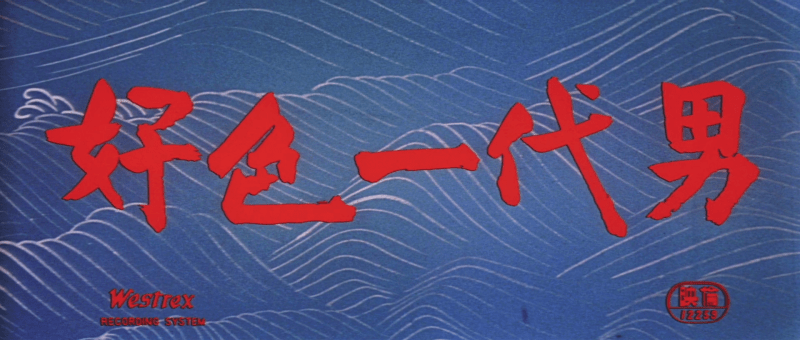
A Lustful Man (好色一代男, Yasuzo Masumura, 1961)

“Why are women in Japan so unhappy?” the carefree Casanova at the centre of Yasuzo Masumura’s 1961 sex romp A Lustful Man (好色一代男, Koshoku Ichidai Otoko) laments, never quite grasping the essential inequalities of the world in which he lives. Masumura is best known for extremity, a wilful iconoclast who flew in the face of golden age cinema’s genial classism, but shock was not his only weapon and he could also be surprisingly playful. Adapted from a well known novel by creator of the “floating world” Ihara Saikaku, A Lustful Man finds him indulging in ironic satire as his hero sets out to “make all the women in Japan happy” chiefly by satisfying their unfulfilled sexual desire while resolutely ignoring all of the entrenched patriarchal social codes which ensure that their lives will be miserable. 

Set in the Edo era, the film opens not with the hero Yonosuke (Raizo Ichikawa) but with his miserly father who berates a servant after discovering a single grain of rice on the hall floor. According to him, the central virtues necessary to become rich are endurance, diligence, and vitality. You must treasure each and every grain of rice in order to accumulate. A cruel and austere man who only thinks of money, Yonosuke’s father keeps his wife in earnest poverty despite their wealth, angrily grabbing an obviously worn kimono out of her hands and insisting that it’s still good for another year, apparently caring nothing for appearances in the otherwise class conscious Kyoto society. It’s this meanness that Yonosuke can’t seem to stand. He hates the way his father disrespects his mother, and her misery is a primary motivator in his lifelong quest to cheer up Japan’s melancholy women though the weapon he has chosen is sex, a convenient excuse to live as a genial libertine to whom money means essentially nothing. 

Yonosuke’s father has set him up with an arranged marriage into a much wealthier family, which is not something he’s very interested in despite the fact she seems to be quite pretty but on learning that she has transgressively found love with the family butler he determines to help her instead, ending the marriage meeting by chasing her round the garden like a dog in heat. Several similar stunts eventually get him sent away from his native Kyoto to Edo but he takes the opportunity to escape, travelling all over Japan making women “happy” as he goes. 

As the first example proves, Yonosuke genuinely hates to see women suffer. His own pleasure, though perhaps not far from his mind, is secondary and he never seeks to take advantage of a woman’s vulnerability only to ease her loneliness. Despite that, however, he remains essentially superficial opting for the transience of postcoital bliss while ignoring the very real societal factors which make an escape from misery all but impossible. During an early adventure, he spends all of the money he conned out of his new employer on redeeming a geisha (at more than three times the asking price) so that she can be with the man she loves, but he continues to visit sex workers without interrogating their existence as indentured servants, “merchandise” which is bought and sold, traded between men and entirely deprived of freedom. In fact, he proudly collects hair cuttings from the various geishas he has known as a kind of trophy only to later discover the grim truth, that the hair likely doesn’t belong to the geisha herself but is sold to them by middlemen who get it by digging up dead bodies. 

Yonosuke remains seemingly oblivious to the duplicitous hypocrisy of the yoshiwara, but is repeatedly confronted by the evils of Edo-era feudalism with its proto-capitalist cruelty where everything is status and transaction. He is often told that as he is not a samurai he would not understand, but seems to understand pretty well that “samurai are idiots” and that their heartless elitism is the leading cause of all the world’s misery. To some a feckless fool, Yonosuke refuses to give in to the false allure of worldly riches. As soon as he gets money he spends it, and does so in ways he believes enrich the lives of women (even if that only extends to paying them for sex), eventually getting himself into trouble once again reneging on his taxes after trying to prove a geisha is worth her weight in gold. 

Yogiri (Ayako Wakao) complains that women are but “merchandise”, valued only as toys for men. “Japan is not a good country for women” Yonosuke agrees, suggesting they run away together to find a place where women are respected, indifferent to Yogiri’s rebuttal “no, wherever you go, no one can change women’s sad fate”. Yonosuke’s naive attempts to rescue women from their misery often end in disaster, a runaway mistress is dragged back and hanged, the woman he was set to marry goes mad after her father and lover are beheaded for having the temerity to speak out about corrupt lords, Yogiri is killed by a samurai intent on arresting him for tax evasion, and his own mother dies seconds after his father only to be immediately praised as “the epitome of a Japanese wife”. Yet he remains undaunted, wandering around like an Edo-era Candide, setting off into exile to look for a supposed female paradise without ever really engaging with the systems which propagate misery or with his own accidental complicity with them. Nevertheless, he does perhaps enact his own resistance in refusing to conform to the rules of a society he knows to be cruel and unfair even if his resistance is essentially superficial, self-involved, and usually counterproductive which is, in its own way, perfectly in keeping with Masumura’s central philosophies on the impossibilities of individual freedom within an inherently oppressive social order.


A Certain Killer (ある殺し屋, Kazuo Mori, 1967)

A nihilistic hitman safeguards the post-war future in Kazuo Mori’s chivalrous B-movie noir, A Certain Killer (ある殺し屋, Aru Koroshiya). Set against the backdrop of the Vietnam War with US airplanes flying constantly overhead, Mori’s crime thriller situates itself in the barren wasteland of a rehabilitated city in which betrayal, exploitation and duplicity have become the norm while a former tokkotai pilot turned killer for hire takes his revenge on social hypocrisy as a product of his society, a man who did not die but knows only killing. 

Shiozawa (Raizo Ichikawa) runs a stylish restaurant by day and supplements his income by night as a killer for hire, apparently highly regarded by the local underworld. As such, he’s approached by a yakuza underling, Maeda (Mikio Narita), on behalf of the Kimura gang who want him to off another gangster, Oowada (Tatsuo Matsushita), who double crossed them in contravention of the yakuza codes of honour. Shiozawa is resolutely uninterested in yakuza drama and so turns the job down but changes his mind when he’s paid a visit by boss Kimura (Asao Koike) himself who sells him a different kind of mission. Kimura characterises Oowada as a “bad” yakuza, one has subverted the traditional gangster nobility by dealing in the “dirty” sides of organised crime, corrupting the modern society by trafficking in illegal prostitution, drugs, and extortion, where as he is a “good” yakuza mostly running construction scams and therefore building the post-war future. His crime is, literally, constructive, where Oowada’s is not. 

Shiozawa doesn’t quite buy his justifications, but men like Oowada represent everything he hates. “They’re not worthy of this world. They’re nothing but cockroaches” he laments, recalling the young men who served with him and gave their lives because they believed in a country which betrayed them. He agrees to take the job in rebellion against post-war venality, but only at a price, asking for four times the original fee. Kimura is willing to pay, because his true aim is profit more than revenge. He plans to take over Oowada’s remaining business concerns. 

Fully aware of this, Shiozawa seems almost uninterested in the money despite having asked for so much of it. He runs his shop as a front for his side business and otherwise lives a quiet, unostentatious life keeping mostly to himself. He is not, it would seem, a cold blooded killer, often making a point of leaving those who get in his way incapacitated but alive. Targeted by a street punk for supposedly messing with his girl he cooly disarms him and walks away, only for the girl to follow attracted partly by his icy manliness and partly by the thickness of his wallet as glimpsed when he made the fatal decision to offer to pay for her meal in order to save the chef from embarrassment over her attempts to pay with things other than money. Unable to get by on her own, Keiko (Yumiko Nogawa) attaches herself to various capable men beginning with the pimp, transferring her affections to Shiozawa whom she petitions to marry her, and then to Maeda, eventually vowing to find a new partner and make lots of money. 

Both Maeda and Keiko chase Shiozawa and are rebuffed. Impressed by his cool handling of the Oowada affair, not to mention the amount of money he now realises you can make in his line of business, Maeda asks to become his pupil in order to become a “real man”. Shiozawa doesn’t regard his work as something “real men” do, and in any case prefers to work to alone. Maeda repeatedly asks to be allowed to accompany him even after plotting betrayal, only to be rejected once again as Shiozawa tells him that he doesn’t like people who don’t know the difference between the job and romance, flagging up the homoerotic subtext for those not paying attention. Maeda parrots his words back to Keiko with whom he had begun a halfhearted affair as joint revenge against Shiozawa’s indifference. 

Following the successful offing of the mob boss, Shiozawa finds himself coopted into another job robbing a drug handoff between Oowada’s former associates, the illicit narcotics ironically packaged inside cartons intended for baby powder. Shiozawa apparently doesn’t object to profiting off the drug trade himself, but later abandons the loot in protest while the remainder is lost or squandered during the final battle with the remaining gang members, Shiozawa’s cartons left sitting ironically on top of a gravestone taken by no one. Cool as ice, Shiozawa places himself above petty criminality, always one step ahead, trusting no one and looking out for himself but reacting as a man created by his times, forged by a war he was a not intended to survive while looking on at another cruel and senseless conflict across the sea. Adapting the hardboiled novel by Shunji Fujiwara, Yasuzo Masumura’s jagged, non-linear script (co-written with Yoshihiro Ishimatsu) is imbued with his characteristic irony but also coloured with nihilistic despair for the post-Olympics society and its wholesale descent into soulless capitalistic consumerism.


Update, 13th February 2025: now available to stream via Arrow Player.

Original trailer (no subtitles)