Equinox Flower (彼岸花, Yasujiro Ozu, 1958)

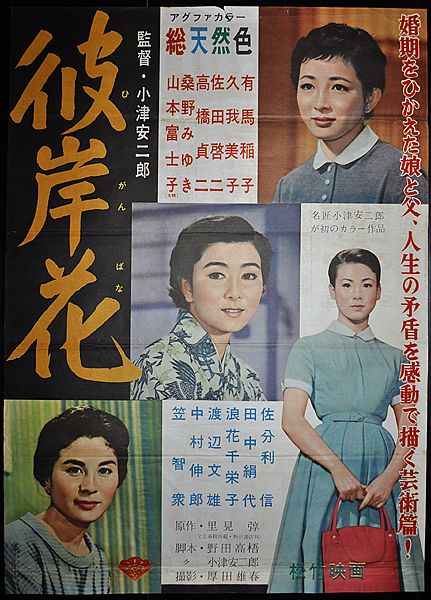
Japanese golden age cinema is famed for its centring of female stories, but while it’s true that many of Yasujiro Ozu’s family dramas revolve around a young woman’s feelings towards marriage, the perspective is often surprisingly male. Equinox Flower (彼岸花, Higanbana), his first film in colour, marks something of a change in direction in its spirited defence of the young, but at heart is still a story as much about impending old age, the responsibilities of fatherhood, and changing times as it is about contemporary family dynamics or female agency. 

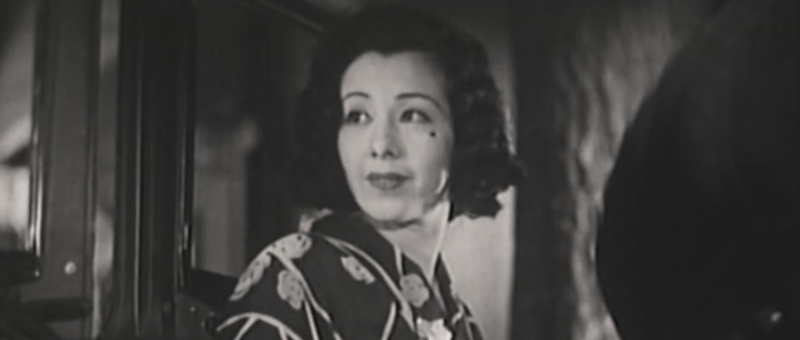
The father in question, Hirayama (Shin Saburi), is a high ranking executive with two daughters. The older, Setsuko (Ineko Arima), is working at another company, and the younger, Hisako (Miyuki Kuwano), is still in school. Marriage is on his mind because he’s just attended the wedding of an old school friend’s daughter at which he gave a speech, with his wife Kiyoko (Kinuyo Tanaka) sitting awkwardly next to him, describing the arranged marriage he had with her as “pragmatic, routine” while he envies the young couple’s “fortunate opportunity” to indulge in romance. He and Kiyoko idly discuss the idea of Setsuko’s marriage, it seems as if there is a promising match on the horizon, with Hirayama conflicted while Kiyoko is very much in favour of doing things the traditional way. She’s already mentioned it to her daughter, but all she does is smile demurely which seems to provoke different interpretations from each of the parents. 

While thinking about all of that, Hirayama receives a visit from an old friend who was a notable absence at the wedding asking him to check up on his daughter Fumiko (Yoshiko Kuga) who ran away from home two months ago to live with a musician after he tried to veto her intention to marry without consulting him. Hirayama is sympathetic, perhaps thinking his friend has acted foolishly and pushed his daughter away. After visiting the bar where she works, he comes to the conclusion that as long as she’s happy with her choice then everyone else should be too. That all goes out the window, however, when a young man, Taniguchi (Keiji Sada), visits him unexpectedly at work and asks for permission to marry Setsuko. Hirayama quite rudely asks him to leave and then irritatedly talks the matter over with Setsuko before petulantly refusing his consent, not because he objects to Taniguchi, but because he is hurt on emotional level that she hadn’t talked to him about this first (not least so that they stop worrying about arranging a marriage) while resentful that she’s gone behind his back and undercut his patriarchal authority. 

In addition to the changing nature of family dynamics, Hirayama is perhaps conscious of his advancing age, feeling himself increasingly obsolescent and therefore additionally wounded by this assault on his authority as a father. The generation gap, however, is all too present. Both Setsuko and Fumiko feel as if they simply cannot talk to their parents because they wouldn’t listen and will never understand. Yukiko (Fujiko Yamamoto), the daughter of another friend, feels something similar in her exasperation with her well-meaning single mother who keeps hatching plans to set her up with various men she isn’t interested in. Intellectually, Hirayama sides with the young, envying them their freedoms and advising Yukiko firstly not to marry at all, and then encouraging her desire to resist arranged marriages despite trying to foist them on his own daughters. 

Even Kiyoko eventually describes her husband’s continuing petulance as “inconsistent”. It seems obvious that Kiyoko is siding with her daughter, immediately taking a liking to Taniguchi who politely brought her home after she stormed out following an argument with her father, but she continues to behave as a “good wife” should, politely minding her husband while gently hoping that he will eventually come round. Only once pushed does she try to explain to him, again politely, that he’s being selfish and unreasonable, but he continues on in resentment while causing his daughter emotional pain simply for trying to find her own happiness rather letting him decide for her. Kiyoko is afraid that if it carries on like this, then Setsuko will, like Fumiko, eventually leave and they’ll lose her completely, something which Hirayama either hasn’t fully considered or is actively encouraging through his petulance. 

In the end the conclusion he comes to is that the parents will eventually have to give way or risk losing their children entirely. He tells both Fumiko and Yukiko that all parents want is for their children to be happy and so nothing else matters, but struggles to put his advice into practice when it comes to his own daughter. Like pretty much everyone in an Ozu film, Hirayama is a good, kind person, even if one struggling against himself as he contemplates a loss of authority, a change in standing, and the difficulty of dealing with complex emotions as a man in a patriarchal society. Predictably, it’s women who essentially bully him into making better decisions, Yukiko “interfering” in the nicest of ways, while his wife makes it clear that though she thinks he’s wrong she will continue to stand by him if only in the hope he will eventually see the light. “Life is absurd, we’re not all perfect” he admits, only later realising how his stubborn foolishness may have caused unnecessary suffering to those he loves the most.


Currently streaming in the UK via BFI Player as part of Japan 2020. Also available to stream in the US via Criterion Channel.

Original trailer (no subtitles)
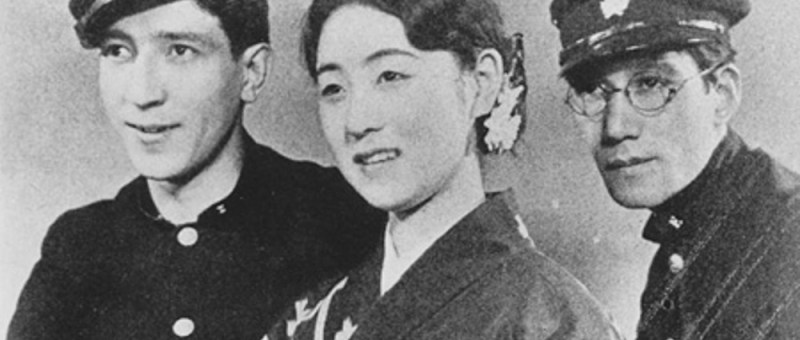
Where Now Are the Dreams of Youth? (靑春の夢いまいづこ, Yasujiro Ozu, 1932)

It’s lonely at the top. Perhaps surprisingly, Japan’s depression-era cinema had considerable space for lamenting the complicated position of the young master and, as Hiroshi Shimizu’s The Boss’ Son at College would do the following year, Ozu’s Where Now are the Dreams of Youth (靑春の夢いまいづこ, Seishun no Yume Ima Izuko) follows a young man of privilege realising that inequality is bad for friendship and no matter how much you try to manipulate an inherently unfair system for the good of those you love it is the system itself which will always stand between you. 

Ozu begins, however, in familiar territory continuing in the vein of student comedy which was proving such a big hit for home studio Shochiku and in fact reusing a few gags from his previous films in the genre such as the guys’ persistent attempts to cheat on their exams. The opening sequence in which three of the four friends goof off rehearsing a cheerleading routine neatly sets up the already existing divisions between them as Saiki (Tatsuo Saito), the gang’s outlier, hovers on the sidelines attempting to study explaining to a young woman the guys know from the bakery, Shige (Kinuyo Tanaka), that he has only his mother and cannot afford to spend his time messing around. Despite that, however, we’re also told that Saiki is a hopeless case forever falling his exams and regarded as essentially feckless. 

The hero, Tetsuo (Ureo Egawa), is the son of a company president and even if he doesn’t notice it the guys are already deferring to him as a kind of leader though they are all, in one sense, still “equals” as students at the same university taking the same classes. They all wear the same universal student uniform and drink in the same cafe, though they perhaps have different fears and anxieties for their futures at this difficult economic moment. The friendship is suddenly disrupted by the unexpected death of Tetsuo’s father which necessitates his leaving university to take over the family firm, though it’s also clear that he is not quite in charge and his conservative uncle is in fact running the show. 

Tetsuo’s new status as a company president, now dressed in an expensive tailored business suit, forever sets him apart from his friends who eventually come to him for help on being unable to find jobs in the midst of an economic depression. He decides to use his privilege to help them but in an underhanded way, insisting they sit the company exam but giving them the answer sheet beforehand just like in their school days helping each other to cheat. Nevertheless, he fails to realise that you can’t be both friend and boss and it hurts him that they are now polite and deferent in his presence. Gone is their old camaraderie and foolishness, fear and dependency gradually erode their friendship. 

Meanwhile, Tetsuo has continued to carry a torch for Shige but again has failed to realise that they now live in different worlds. His uncle keeps trying to arrange suitable marriages for him which he delights in frustrating with childish pranks. Now settled in his professional life he tries to abide by a college era bro code in asking for the guys’ permission to ask for Shige’s hand, knowing that they had all taken a liking to her. He places himself on their level but only superficially, acting with a degree of self-confident entitlement which assumes firstly that the others will defer to him and back off, and that Shige is his for the asking. What hurts him most is that none of the guys, who must all know, were brave enough to tell him that Saiki and Shige are already engaged. Fearful for his job, Saiki would have sacrificed the woman he loves, essentially traded her for economic stability. Finding out from Saiki’s mother (Choko Iida), Tetsuo confronts Shige who tells him that she agreed to marry Saiki out of pity and despair after growing weary of waiting for him believing that a company president would never marry a woman like her. 

Tetsuo surrenders his love on the altar of friendship. Despite confirming their love for each other, he and Shige are separated by the great wall of social class in a hierarchal society along with the economic pressures of an ongoing depression. What Tetsuo chooses to save is his male friendship, striking Saiki, who does not fight back, for his moral cowardice in debasing himself by allowing those with power and privilege to rob him of his rights and freedoms. The guys sort things out with a fist fight, restoring an artificial “equality” that provokes a “happy” ending despite the fact that nothing has really changed. Tetsuo has to say goodbye to the dreams of youth in acceptance of the disappointments of adulthood but tries to salvage something as he moves forward in preserving what he can of cross-class friendship as bulwark against the inequalities of his age.


Currently streaming in the UK via BFI Player as part of Japan 2020. Also available to stream in the US via Criterion Channel.

Woman of Tokyo (東京の女, Yasujiro Ozu, 1933)

Most closely associated with his family dramas, the films of Yasujiro Ozu while often deeply moving are generally safe spaces filled with warmth and love. He was never, however, afraid to explore the darkness of his society as the uncharacteristically bleak silent Woman of Tokyo (東京の女, Tokyo no Onna) makes plain. A tale of disintegrating families, Ozu substitutes a loyal sister for a self sacrificing mother but once again places her at the mercy of a conservative society which refuses to accept the nature of the sacrifice she has chosen to make on its behalf. 

The heroine, Chikako (Yoshiko Okada), is better off than most during these years of depression in that she has a steady full-time job as a typist with which she is able to support her younger brother, Ryoichi (Ureo Egawa), who is a student. Somewhat unusually, Ozu shows us a fairly progressive working environment in which Chikako is one of many women working alongside men in an open plan office which is arranged in a far less stressful manner than the one we later observe in the American film which Ryoichi and his girlfriend Harue (Kinuyo Tanaka) see at the cinema (If I Had a Million, 1932, the segment directed by Ernst Lubitsch, “The Clerk”) in which the desks are laid out in regimented style and staffed entirely by identically dressed men.  

In any case, the job apparently does not quite pay enough to cover Ryoichi’s fees and so Chikako has taken on a part-time gig assisting a professor with translation at his home in the evenings, or so she said. Unbeknownst to her, a policeman turns up at her office and asks to see her attendance records. Again surprisingly, Chikako’s boss is calm and supportive, telling the policeman she’s a model employee of four years’ standing and obviously confused as to how she could be the subject of any criminal investigation. The policeman does not explain, shutting the interview down as soon as the boss motions to ask Chikako about the mysterious professor presumably not wanting her to know she is under investigation. 

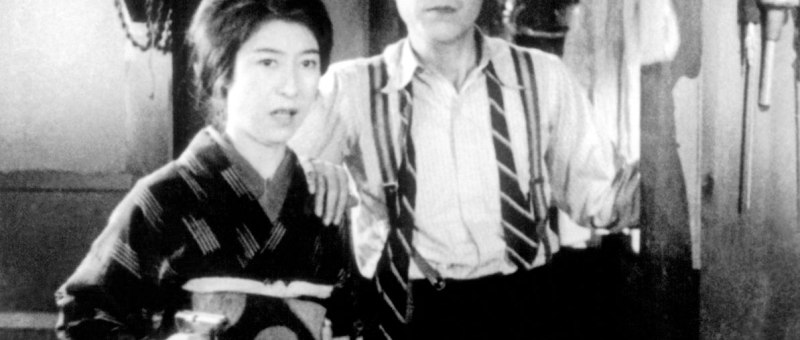
Rumours, however, will start and it is those rumours more than the truth of them which will prove the most fatal. Harue’s brother (Shinyo Nara) is a policeman and he’s heard that Chikako has been moonlighting as a bar girl and engaging in sex work. Harue decides to put the matter to her boyfriend, but he is immediately offended, brought to tears by anger, and throws Harue out for slandering his sister. The issue is that, as a woman and most particularly as a sister in place of a mother, Chikako is expected to sacrifice herself on her brother’s behalf. Her career, and implicitly the reason she is not yet married, is not for her personal fulfilment or financial security but only for her brother’s future. She has given up everything for him, and now apparently has also surrendered her body yet he rejects and shames her for it. He does not thank her, nor does he feel guilt for being the cause of her supposed degradation but again foregrounds his own suffering as the brother of a fallen woman. 

Harue, by contrast, is presented as a the soul of properness, not unkind but disapproving. In a difficult conversation with Chikako, she admits it’s not the right thing to say but immediately pities Ryoichi rather than sympathising with another woman who has found herself making difficult choices solely on his behalf. Ryoichi rejects her suffering and sees only the shame. Yet Chikako is not ashamed. She does not seem unhappy with her choices and is defiant in the face of censure. She hoped that Ryoichi would one day understand, but the decision he makes is cruel and selfish, ruining all her hope and rendering her long years of suffering void. She resents his cowardice in being unable to face and accept the truth in the depth of her love for him. 

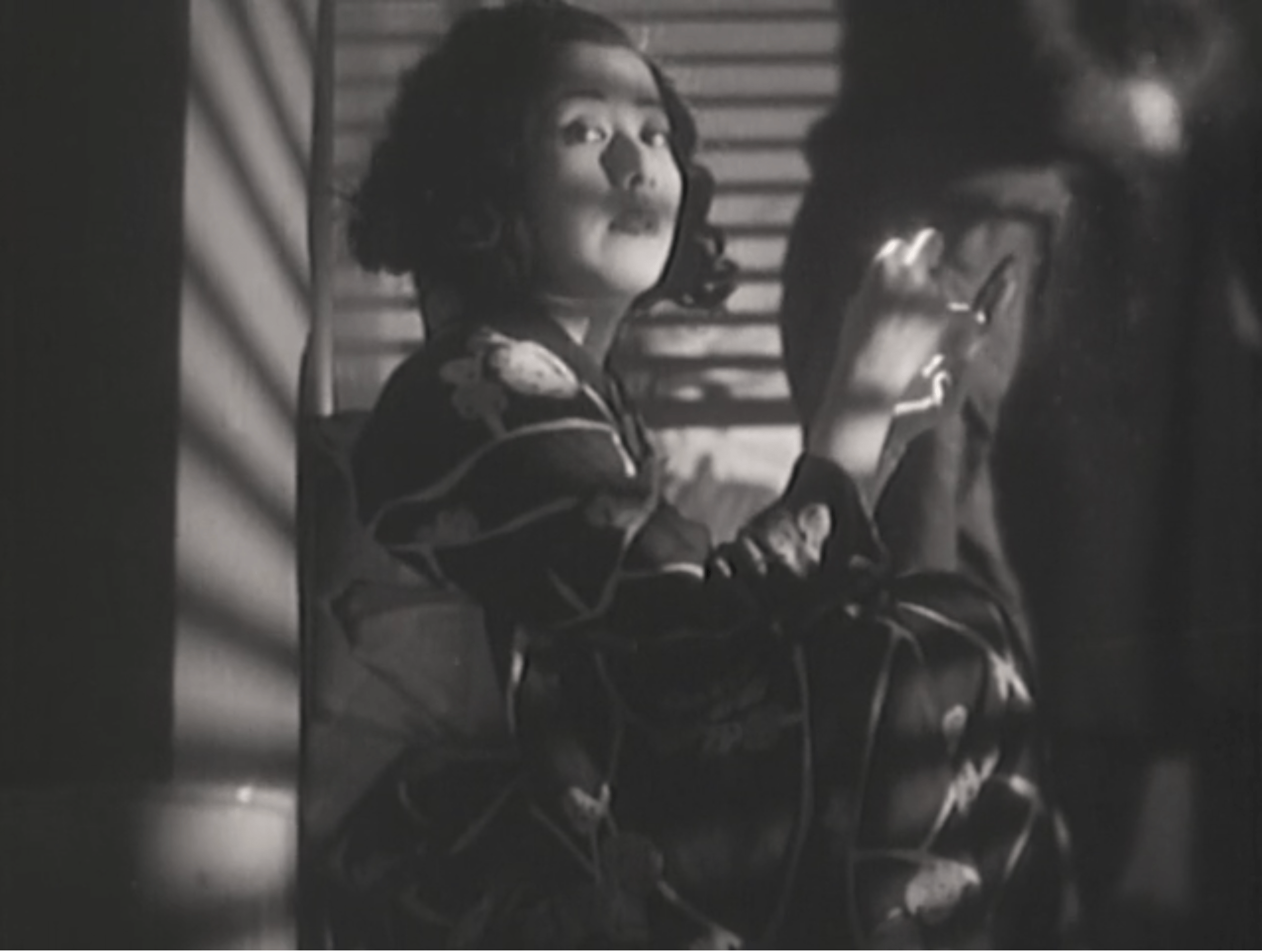
In this instance, the family fails but only because of an oppressive social structure that is inherently unequal and refuses to accept either female agency or sacrifice. Chikako lives in a world of film noir despair, haunted by ominous shadows – policemen’s swords, gloves against the shoji, nooses in shadows on the walls, a boiling kettle giving way to a pillow shot of smoke pouring from a chimney in funereal foreshadowing that forever traps her in impossibility. Frustrated, Ryoichi tries to reassert his manhood through physical violence but remains impotent, dependent on his sister but resenting her for shaming him in transgressing against an oppressive society. Meanwhile, Chikako is one of many women of Tokyo enduring the same old tragedies, her suffering barely registers. Reporters leave her door giggling after concluding there’s nothing to see here before taking to the streets in search of greater scandal in a readily devolving city filled with only emptiness and despair. 


Currently streaming in the UK via BFI Player as part of Japan 2020. Also available to stream in the US via Criterion Channel.

That Night’s Wife (その夜の妻, Yasujiro Ozu, 1930)

Most closely associated with his late career family dramas, Yasujiro Ozu has acquired a reputation for geniality which may in a sense be slightly unfair. He was always an astute chronicler of his times, often choosing to view them through the frame of family, and was never as blind to the issues of the day as some would have it. Ozu’s ‘30s work, that which survives at least, is in a sense fiercely political in its critique of the inequalities of the depression-era society. One of his early crime movies, the silent That Night’s Wife (その夜の妻, Sono yo no Tsuma) insists that justice must be done but does so with compassion in its full and total empathy for a man driven to extremes by the depth of his paternal love. 

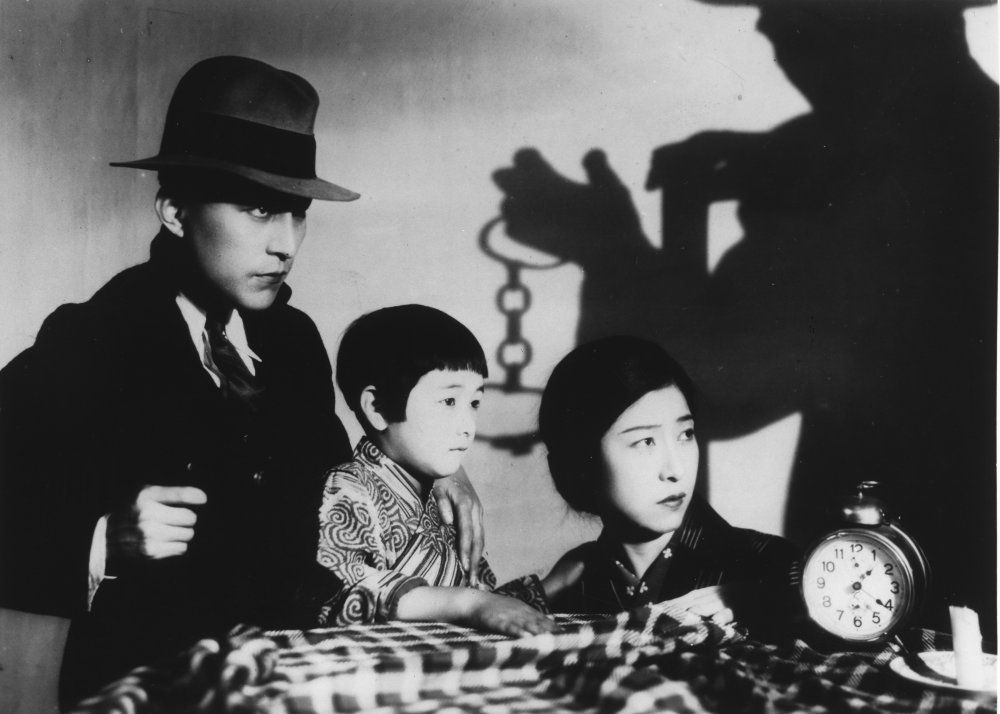
Indeed, the early part of the film is tense noir chase as the hero, desperate father Shuji (Tokihiko Okada), attempts to evade a police dragnet to make his way home after robbing a bank to get money to pay for his sick daughter Michiko’s (Mitsuko Ichimura) medical care. Meanwhile, loyal wife Mayumi (Emiko Yagumo) has been patiently waiting at home tending to the child who refuses to sleep because she only wants her father and constantly asks where he is. Shuji eventually makes it back and tells his horrified wife what he has done, agreeing that he will turn himself in to the police once Michiko is well, but he’s already out of luck. The taxi he darted into was being driven by an undercover cop (Chishu Ryu) who installs himself in the apartment but agrees to wait until the doctor comes in the morning before taking Shuji in. 

Out of keeping with the rest of Ozu’s career but very much in the vein of his depression-era silents, That Night’s Wife concerns a poor but happy family mustering what little resources they have in the face of despair. Filled with tension as the policeman waits impatiently, the camera pans around the one room apartment where the family live and finds it to be a homely, bohemian space, apparently an artist’s studio with foreign film posters and travel souvenirs hanging from the walls. By all indications a starving painter, Shuji is a poor man brought to ruin by accidental tragedy. His daughter is deathly ill and doctors cost money. We can see that, by the standards of the time, he is a very hands on father beloved by his little girl and is obviously willing to sacrifice himself and his future to ensure her survival

It’s Mayumi, however, to whom the film’s title refers and in her role as wife rather than mother. The doctor (Tatsuo Saito) worries that she has not slept in the last few days, how could she when her child is so ill, but it’s she who eventually picks up the gun to protect the family by disarming the policeman and, essentially, keeping him hostage until the morning when, she claims, Shuji will willingly go with him after confirming Michiko’s survival. The world is turned upside down, no one quite plays the role they’ve been assigned. The loving father, an effete artist, turns unconvincing master criminal, the loyal wife gangster’s moll, and the policeman a calm and compassionate guardian deeply moved by the family’s predicament but also knowing that the law must be served. 

In a typically Ozu touch, the policeman pretends to be asleep with the intention of letting Shuji escape, but he once again makes an atypical choice. He refuses to run, swearing off “crazy ideas” but unrepentant in his crime. Shuji determines to pay his debt to society so that he can return home as a redeemed father and hold his daughter as a man unburned by his transgression. The message isn’t so much that crime doesn’t pay as that crime must be paid for. Shuji is acquitted in the moral courts of the audience’s hearts and not even the policeman blames him for what he has done which is all he could do as a father in an oppressive and indifferent society. A strange complicity develops between the two men who are restored to their original roles, both acknowledging that of the other and sorry for what they each know must happen next but already resigned. The father saves his family only through accepting his exile from it, but unlike Ozu’s wandering fathers of the 1930s, seems destined to return after redeeming himself in the eyes of a society which had long since abandoned him. 


Currently streaming in the UK via BFI Player as part of Japan 2020. Also available to stream in the US via Criterion Channel.

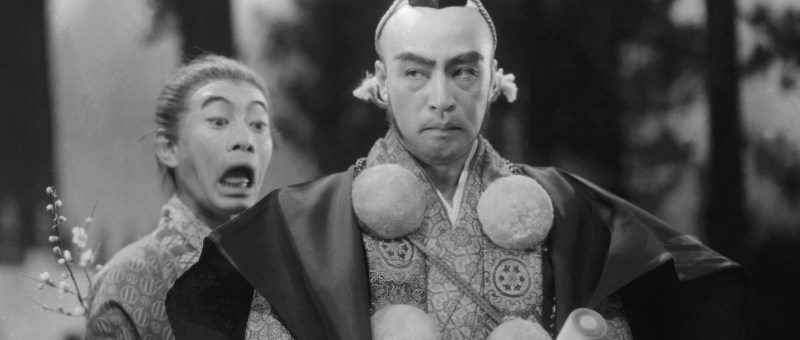
The Men Who Tread on the Tiger’s Tail (虎の尾を踏む男達, Akira Kurosawa, 1952)

Like many directors of his age, Akira Kurosawa began his career during the war sometimes working on what were effectively propaganda films yet perhaps attempting to skirt around the least palatable implications of the task at hand. The Men Who Tread on the Tiger’s Tail (虎の尾を踏む男達, Tora no O wo Fumu Otokotachi) is an example of just that, repurposing a well known historical incident from its noh and kabuki roots and subtly undercutting it with a dose of irreverent humour unwelcome to those who liked historical tales because of their nationalistic connotations. This was not, however, the reason the film found itself out of favour so much as an ironically personal issue in which Kurosawa had apparently irritated one of the censors by pointing out his ignorance of cultural tradition leading him to conveniently leave Tiger’s Tail off the list of titles in production resulting in the American Censors rejecting it for being an unknown, illegal film which is why it languished on the shelf for seven years after filming was completed in 1945. The Americans may not have liked it much either given their aversion to period drama which they feared encouraged the kind of thinking incompatible with the democratic era, but like many of Kurosawa’s samurai dramas it has a rather ambivalent attitude to feudal loyalty both admiring of nobility and despairing of its austerity. 

Set in the late 12th century, the action takes place during a period of warfare in which warrior Yoshitsune (Iwai Hanshiro X) has returned a victory for his brother, the ruler. His brother Yoritomo, however, feels as if his victory has perhaps been too good and he is therefore a threat to him. Yoritomo accuses his brother of sedition and puts a purge in motion, leaving Yoshitsune with no option other than to flee. With six of his best retainers, he escapes dressed as an itinerant Buddhist monk and tries to make his way to neutral territory in the North. To get there, however, they need to pass through a series of checkpoints which is why they’re currently accompanied by a cheerful fool in the form of a lowly porter (Kenichi Enomoto) supposedly guiding them along a secret path through mountain forests. 

The porter is a new addition to the story added by Kurosawa for reasons of expediency and comic relief, yet his intrusion is also one which deeply angered the more nationalistic of the censors who resented the director’s irreverence towards a key historical event. Like many other of Kurosawa’s bumbling peasants, he’s both contemptuous and in awe of the world of the samurai, offering down to earth common sense takes on the politics of the day. He has already heard all about the Yoritomo/Yoshitsune drama and recounts it in the manner of a soap opera, quite reasonably asking if a quarrel between brothers could not have been sorted out with a good old-fashioned private fist fight rather than a state mandated manhunt which is also quite inconvenient for ordinary people in addition to being somewhat heartless. 

The samurai, not wanting to break cover, can only look sad and lament the cruelty of their codes, yet it’s precisely in the subversion of their ideology that they are able to escape. They have already transgressed, some with shaved heads and all already in the clothes of a monk. The porter looks at Yoshitsune, apparently a successful warrior, and remarks on his delicate physique and seeming femininity. Eventually he says too much, realises that the men are the fugitives everyone’s looking for and is suddenly afraid, forgetting for the moment that they need him to get out of the woods and knowing that samurai think nothing of killing “insignificant nobodies” like him. Nevertheless they do not kill him, but on hearing that there are lookouts on the horizon aware of Yoshitsune’s presence, they ask their lord to change places with a peasant, wearing his worn out clothes and carrying his heavy pack though the weight of it perhaps betrays him. As the porter points out, he does not have the look of a man used to trekking through the mountains and his delicate legs are already shaking under the unfamiliar strain. 

When the band is intercepted by loyal retainer Togashi (Susumu Fujita) who has been instructed to stop all priests in case Yoshitsune comes his way, Benkei (Denjiro Okochi), a real monk if also a warrior with a talent for bluff, manages to talk his way out of Togashi’s questioning, improvising an entire prospectus on the spot to convince him that they really are collecting money to repair a temple, quickly explaining that his robes are ornate because even ascetics have fashion sense. It’s not entirely clear if Togashi simply believes him, or if he too is wilfully subverting the code having recognised Yoshitsune and decided to help him escape. Might that not, in a certain sense, be the better way of serving a lord, preventing him from making a huge and painful mistake in killing his own brother out of a misplaced sense of paranoia? 

In any case, Benkei talks his way out of trouble only for a minor retainer to intervene, insisting that the porter is too pretty and bears a striking resemblance to Yoshitsune. Reacting quickly again, Benkei does the unthinkable. He strikes his lord and loudly berates him as if he really were a lazy porter failing in the duties for which he has been paid. The real porter becomes upset, placing himself in between Benkei’s staff and Yoshitsune’s body, either out of empathetic identification or horror in the betrayal of feudal loyalty. Benkei knows he must now be believed, no one would ever do what he has done because it is a complete and total negation of the samurai code. Yet in breaking it he saves his lord, which is all that really matters. Yoshitsune later forgives him, because he is a good lord after all and how could he not. But as Benkei was keen to keep pointing out, this isn’t the only checkpoint they must pass and their journey is without end, all they can do is “continue without rest”, taking this brief moment of unexpected levity provided by apology wine from Togashi and the hilarious antics from the porter before setting off once again. As for the porter, he is soon abandoned, left on one side of the samurai divide as the curtain closes on this brief strange tale. 


Currently streaming in the UK via BFI Player as part of Japan 2020. Also available to stream in the US via Criterion Channel.

Tokyo Twilight (東京暮色, Yasujiro Ozu, 1957)

Closely associated with the family drama, Yasujiro Ozu is perhaps the most socially conservative of golden age directors. Unlike Naruse or Mizoguchi, he cheerfully reinforces patriarchal social norms and foregrounds the paternal experience while upholding the primacy of the traditional family in a rapidly modernising society. In his later career he’d come to sympathise more strongly with the young, but 1957’s Tokyo Twilight (東京暮色, Tokyo Boshoku), perhaps his bleakest take on familial failure, is essentially a treatise on the legacy of corrupted motherhood and rebuke to growing post-war freedom in which a young woman is made to feel that her future is impossible because of maternal betrayal while her sister is forced back into an unhappy marriage to an abusive husband in order to avoid the same fate befalling her own daughter. 

Unlike most Ozu families, the Sugiyamas do not seem to be particularly happy in each other’s company, living in superficial politeness rather than true intimacy. This may partly be because the sisters had a brother who passed away young in a mountain climbing accident, but it also seems that Mr. Sugiyama (Chishu Ryu), though kind and polite, is a typically authoritarian, distant father. Oldest daughter Takako (Setsuko Hara) has returned home declaring herself unable to go on living with her professor husband Numata (Kinzo Shin) who, she says, has become increasingly erratic, taking out his petty professional disappointment on their small daughter Michiko whom he seems to resent. Younger sister Akiko (Ineko Arima) meanwhile is sullen and introverted. Unmarried, she lives at home and is studying to become a stenographer. 

As we later discover, the girls’ mother Kikuko (Isuzu Yamada) left the family during the war after falling in love with the junior officer Mr. Sugiyama enlisted to look in on the family while he was away in Seoul. Akiko was only three when their mother left and barely remembers her. Takako attributes her wayward behaviour to “loneliness”, that she has been forever corrupted through never knowing a mother’s love. Mr. Sugiyama admits he tried his best, but both agree that children need two parents and no matter how much he wants to a father cannot make up a mother’s share. 

This atmosphere of alienation is perhaps why Akiko feels as if she has no one to turn to in her own moment of maternal crisis. She has become pregnant by her college student boyfriend who has been avoiding her and even has the audacity to ask if the baby’s his when Akiko finally manages to pin him down. Trying to borrow money for an abortion, Akiko visits her aunt who declines to give it to her without knowing why, eventually turning to a family friend who apparently provides no questions asked. The woman at the clinic assumes she is a bar girl, as does a policeman who eventually “arrests” her for loitering in a sleazy cafe where her boyfriend has obviously stood her up which is quite openly being used as a place for men to pick up call girls. All of this contributes to Akiko’s increasing sense of shame and worthlessness. She sees herself as a fallen woman, convinced that she is all her mother’s child contaminated by her “bad blood” which makes a conventionally successful life as an ordinary wife and mother an impossibility. 

Akiko’s aunt wants to set her up with arranged marriage matches, but Akiko declares she has no intention of marrying or having children. Without knowing anything of Akiko’s circumstances, Takako assumes this is because of her obviously unhappy marriage, trying to convince her sister that there are plenty of happy couples she is merely unlucky. Mr. Sugiyama attempts to talk to his son-in-law but finds him strange and indifferent, offering treatises on familial love while implying that he has little of it. He regrets pressuring Takako to marry him when he knew that she preferred someone else while Takako is once again haunted by the spectre of corrupted maternity in her mother’s decision to leave the family for emotional fulfilment and is fearful of making the same mistake creating another troubled daughter just like Akiko in denying her a father’s love (which seems a moot point given that Numata does not care for the child). 

Neither woman is able to escape paying for their mother’s transgression. Akiko is punished firstly for embracing her sexuality and secondly for the rejection of motherhood in choosing to have an abortion. Alone and humiliated by her unreliable boyfriend, she is denied the opportunity to start over, while Takako meditates on female failure and believes that her only option is to live in misery with a cruel and narcissistic husband because that is the “proper” thing to do and the only way to bring her daughter up “right”. The absent mother, meanwhile, is denied reconciliation and left only with the painful separation from her daughter who finally rejects her in order to reclaim the image of the good wife and mother by returning to her unhappy home. Bleak as it is, all of this is presented as a kind of happy ending in that it restores the idea of the traditional family, increasingly threatened by post-war modernity, to its original primacy. We leave with Mr. Sugiyama rehiring his maid and heading cheerfully back to the male world of work, making the fresh start that his daughters have been so cruelly denied.  


Currently streaming in the UK via BFI Player as part of Japan 2020. Also available to stream in the US via Criterion Channel.

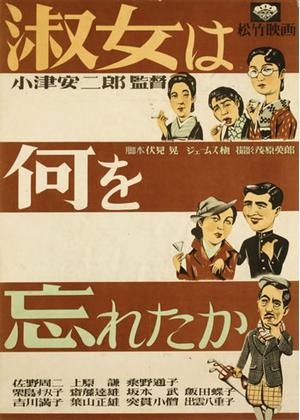
What Did the Lady Forget? (淑女は何を忘れたか, Yasujiro Ozu, 1937)

Japan was in a precarious position in 1937. Ozu’s What Did the Lady Forget? (淑女は何を忘れたか, Shukujo wa Nani wo Wasureta ka) was released in March of that year but by July the Second Sino-Japanese War would be in full swing and on the home front increasing censorship would render this kind of inconsequential comedy a much less easy sell. True enough, the film includes no “patriotic” content though it does eventually reinforce a set of patriarchal values in the remasculinisation of a henpecked husband while quietly sniggering at a new bourgeois social class.

The drama unfolds in the home of a medical professor, Komiya (Tatsuo Saito), and his austere wife Tokiko (Sumiko Kurishima). The couple have no children and mostly lead separate lives. Tokiko spends her days with two close friends, widowed single-mother Mitsuko (Mitsuko Yoshikawa), and wealthy older woman Chiyoko (Choko Iida) who is married to her husband’s friend, Sugiyama (Takeshi Sakamoto). The three women gossip about the usual things from fancy department store kimonos to new ways to laugh so you don’t get wrinkles along with the bizarrely difficult maths problems Mitsuko’s son has been studying in preparation for middle-school that none of them can answer. To help with the embarrassingly taxing homework, Tokiko offers to find a tutor, press-ganging her husband’s best student, Okada (Shuji Sano), into spending time with Mitsuko’s son Fujio (Masao Hayama) though it turns out that he too, a college graduate, is unable to solve these middle-school level problems. 

The real drama occurs when the couple’s neice, Setsuko (Michiko Kuwano), whom Tokiko had described as “proper” and “wholesome” rocks up from Osaka having become the epitome of a modern girl. Setsuko’s arrival further strains the Komiyas’ already fraying relationship as her surprising habits which include driving, smoking, drinking, and hanging out with geisha, continue to exasperate her aunt whose main objection to all of those things is that they aren’t appropriate because Setsuko is not yet married. To get away from his nagging wife who forces him to go golfing as usual when he doesn’t really want to, Komiya stashes his clubs with Okada and goes to a bar in Ginza where he meets Sugiyama who has also been forced outside by his wife. Sugiyama really does go golfing, promising to mail a previously written postcard to Tokiko on Komiya’s behalf, while he is eventually joined by Setsuko who has tracked him down to the bar despite being told to stay home and mind the house (the Komiyas have two live-in maids so the instruction seems unnecessary at best).  

As a “modern gal” Setsuko has some strangely old fashioned ideas even as she behaves like a 1930s ladette, striding around like man while drinking, smoking, and generally being almost as intimidating as Tokiko just in a more likeable fashion. Setsuko finds Komiya’s deferral to his wife embarrassing, encouraging him to be more masculine and stand up for himself even advising that he use violence to reassert his position as the man of the house. He seems uncomfortable with the idea but eventually does just that after a climactic argument once his lying about the golf and Setsuko’s nighttime adventures have been exposed. Caught in a moment of frustration, he slaps Tokiko across the face, leaving her to retreat in shock apparently “beaten”. The thing is, however, Tokiko likes it. She sees his slapping her as a sign of his love, as if she’s been needling him all this time in hope of a reaction while frustrated that perhaps he doesn’t care for her. Once he hits her, the marriage is rebalanced and repaired with traditional gender dynamics restored. She becomes more cheerful and deferent to his male authority, he acknowledges that he enabled her “arrogance” with his weakness as a man.  

Setsuko however, continues to shout at her uncle, disappointed that he apologised for his reaction and accusing him of giving away the victory he’d just won. He tells her that he’s simply using reverse psychology because wives like to believe they’re in charge and in the main it’s best to let them. Setsuko seems satisfied, but jokes with her new love interest Okada that he better not use reverse psychology on her. Or, he can, but she’ll just use reverse reverse psychology to get the upper hand, which perhaps undercuts the central message in praise of traditional gender roles. Nevertheless, What Did the Lady Forget? is full of Lubitschy late-30s charms from an unexpected sighting of real life star Ken Uehara at the Kabuki to Setsuko’s movie magazines featuring Marlene Dietrich and repeated references to Frederich March and William Powell proving that Ginza is open even in 1937, while the Komiya household descends into an oddly peaceful harmony of delayed marital bliss. 


Currently streaming in the UK via BFI Player as part of Japan 2020. Also available to stream in the US via Criterion Channel.

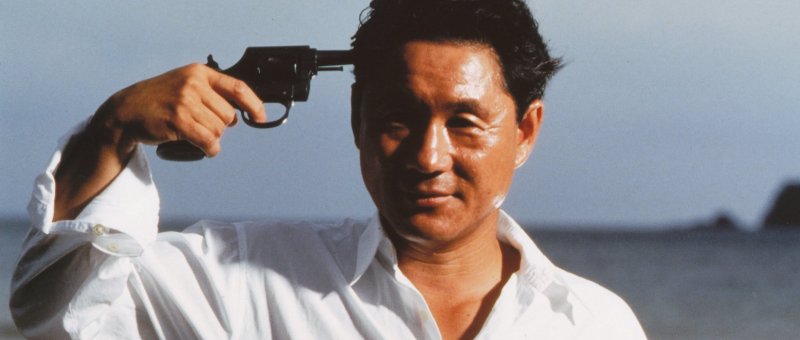
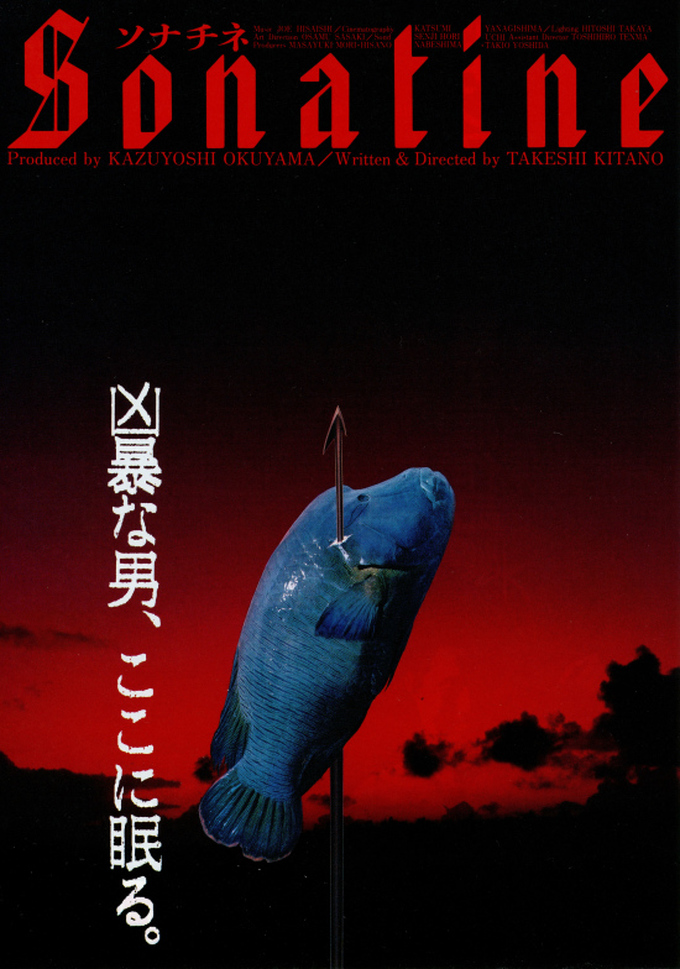
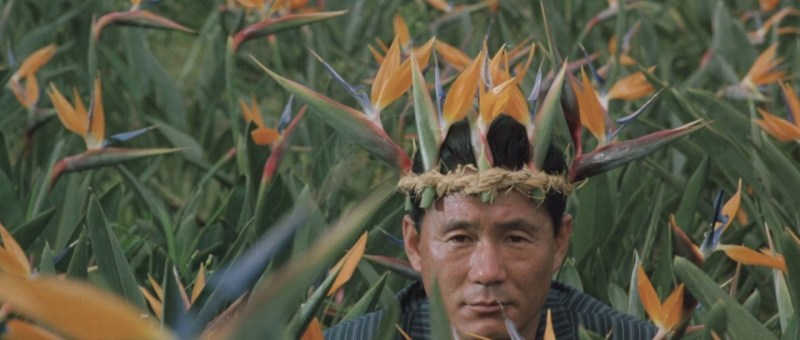
Sonatine (ソナチネ, Takeshi Kitano, 1993)

The problem with being a yakuza is that there is never any rest. Staying alive means constant vigilance, make a mistake and it could be the end of you or, conversely, get too good at your job and place a target on your own back. The hero of Takeshi Kitano’s Sonatine (ソナチネ) declares himself tired, not just of the life but life itself. By his fourth picture, Kitano was perhaps feeling something similar, later describing the near-fatal motorcycle accident he encountered some months after the film’s completion as an unconscious suicide attempt. For years he’d been one of Japan’s top TV personalities working a breakneck schedule that left him little time for other outlets such as painting, novels, and acting for others, but still he longed to be taken more seriously as an artist in his home nation where audiences largely stayed away from his “serious” films, as they did with Sonatine which flopped at the box office and put an end to his arrangement with Shochiku who had distributed his first two features in which he had also starred. 

For this third film, A Scene at the Sea, Kitano remained behind the camera and distanced himself from the themes of crime and violence which defined his early career, crafting instead an intensely melancholy tone poem about a deaf surfer falling in love with the ocean. In Sonatine he casts himself as the lead for the first time since Violent Cop, this time as a gangster experiencing extreme existential malaise when confronted with the futility and emptiness of his life in organised crime. Murakawa (Takeshi Kitano) is aware he has probably reached the zenith of his career as a mid-tier gang boss working as a, by all accounts, unexpectedly successful enforcer in a rundown area of the city. His first crisis concerns the owner of a mahjong parlour who thinks the yakuza are an outdated institution and refuses to take their threats seriously. He sees no need to pay them the customary protection money and assumes they’ll back off he simply tells them he’s not interested, but he is very wrong. Murakawa has him kidnapped to teach him a lesson, observing while his minions attach him to a crane and threaten him by dunking him in a large pool of water. Immediately apologetic, the man sees the error of his ways, but Murakawa doesn’t really care about the money anymore and so they dunk him again to see how long it takes a man to drown, barely shrugging as they realise he really died. 

Either because he’s an unusual man, or because he is simply tired of everything, Murakawa no longer bothers to abide by the rules of petty gangsterdom. He doesn’t do deference, smoking away long before his boss offers permission to do so and feeling unafraid to voice his reluctance when he’s ordered to take some of his guys to Okinawa to settle a nascent gang war involving one of their affiliates. Murakawa doesn’t want to go because he lost three men in a similar job in Hokkaido, but in reality has little choice. Later events prove he was right to be suspicious. The Okinawan gang boss tells him that he reported some minor friction with another gang out of courtesy and is confused he’s been sent reinforcements, not that he’s not glad to see them. As soon as they arrive, however, the tension rises and Murakawa and the guys are forced into hiding, holing up at the beach as they await orders from head office or word on a possible truce. 

Murakawa, his two right-hand men, and the Okinawan gangsters adjust to tranquil island life, playing on the beach and taking the time to master the art of Okinawan folk dance, but the grim spectres of death and violence present themselves even here in empty games of Russian roulette and Murakawa’s childish prank of digging sand traps for the guys to fall into as if into their graves. While he’s busy admiring the night sky, the silence is ruptured by a local tough chasing a young woman onto the beach where he proceeds to rape her. Murakawa doesn’t intervene but is challenged anyway and then forced to kill the puffed up youngster while the young woman, Miyuki (Aya Kokumai), becomes strangely attached to him, impressed by his cool dispatch of her attacker. 

Murakawa’s somehow innocent relationship with the young woman creates a minor rift with his men who resent the absence of his leadership at a time of crisis while he ponders alternate futures outside of the gangster brotherhood. But deep down he knows that his idyllic beach holiday cannot last forever and that he will have to leave this liminal space eventually for a destination of which he is all too aware. As he explains to Miyuki, when you fear death so intensely you begin to long for it if only for an end to its terrible anxiety. 

The title “Sonatine” is apparently inspired by the “sonatina”, a short, tripartite piece piano players attempt to mark an attainment of skills before choosing the future direction of their musical career. Murakawa undergoes three distinct arcs, from the city to the beach and back again, but perhaps knows there is no future direction in which for him to travel only the nihilistic fatalism of a life of violence. As for Kitano, it does perhaps draw a line in the sand marking the end of an apprenticeship and its associated compromises as he fully embraces an authentic personal style, like Murakawa no longer prepared to be deferent in an admittedly exhausting world. 


Sonatine is the third of three films included in the BFI’s Takeshi Kitano Collection blu-ray box set and is accompanied by an audio commentary by Chris D recorded in 2008. The first pressing includes a 44-page booklet featuring an essay on Sonatine and introduction to Kitano’s career by Jasper Sharp,  an essay on Violent Cop by Tom Mes, a piece on Boiling Point from Mark Schilling, an archival review by Geoff Andrew, and an appreciation of Beat Takeshi by James-Masaki Ryan.

The Takeshi Kitano Collection is released 29th June while Violent Cop, Boiling Point, and Sonatine will also be available to stream via BFI Player from 27th July as part of BFI Japan.

Original trailer (English subtitles)

Boiling Point (3-4X10月, Takeshi Kitano, 1990)

The heroes of Takeshi Kitano’s films are often gentle men, capable of great tenderness but also filled with quietly mounting rage permanently on the brink of explosion. Everyone perhaps has their Boiling Point, the straw that breaks the camel’s back and sends it careering towards a self-destructive attempt at restitution. “Boiling Point”, however, has absolutely nothing to do with the original Japanese title (3-4X10月) which references the score on the board at a baseball game and the originally scheduled month of the film’s release, October (it was later moved up to September making the whole thing even more meaningless). This perverse randomness was apparently another minor win for Kitano who had scored a critical hit with his debut feature Violent Cop but had struggled to convince the team around him to embrace his unconventional vision. Working with greater independence, Kitano minimises camera movement in favour long takes with static camera which perfectly compliment his deadpan sense of the absurd. 

He also relegates himself to a supporting role unseen on screen for over half of the running time. Our hero is small town loser Masaki (Yurei Yanagi) who we first meet hiding in a toilet during an amateur baseball game in which he is desperate to play but strikes out when given the opportunity in the first of many petty humiliations. He has been taken under the wing of the team’s coach, Iguchi (Taka Guadalcanal), a former yakuza attempting to go straight by running a dive bar, and has a part-time job at a petrol station. Masaki perhaps images himself as something greater, as evidenced by his extremely cool motorcycle jacket and bike, but is a dreamer at heart, nervous and tongue-tied, unable to unlock his hidden potential. Even he has a boiling point, however, which is later hit when he gets into an altercation with a teddy boy yakuza at the garage who starts a pointless argument about being kept waiting, pulling the old trick of goading Masaki into fighting back to get leverage over their shop and begin extorting it. Masaki has just got his boss into trouble through losing his cool, but is ironically offered a job by a visiting thug jokingly admiring his fighting prowess. 

Iguchi meanwhile is a man divided, permanently on the brink of boiling over. When some irritating sophisticates “ironically” visit his bar clutching their designer handbags and holding their noses, he’s obliged to be nice to them but he simply can’t. Unable to bear their snotty arrogance, he glasses one of the women on the way back from the bathroom and throws the whole gang out. The yakuza has it seems been reawakened, and though he was reluctant before, he to decides approach his old boss, Otomo (Hisashi Igawa), on Masaki’s behalf. The reception he receives is not as he expected. Iguchi is reminded that he chose the civilian life and being a yakuza isn’t a part-time job, you can’t just pick it back up again when it suits you. Not being able to help Masaki is another small humiliation, one he perhaps intends to overcome through turning violence on an old underling who disrespected him in refusing the customary deference. Predictably, it backfires, you can’t be half a yakuza after all. Iguchi is completely finished, boiling with rage but too humiliated to do much about it other than vow revenge by going to Okinawa to buy a gun in order to put an end to the lot of them. To protect his mentor, an oddly yakuza-esque gesture, Masaki volunteers to go in his stead, dragging his catcher friend Kazuo (Duncan) along for the ride. 

A complicated liminal space, Okinawa is both an enticing holiday destination and source of political contention thanks to the controversial presence of the US military bases. It’s indeed corrupt foreign influences who can provide our guys with guns, but Okinawa is also a place slightly out of time, trapped in the Showa-era past while the rest of Japan has already transitioned to an economically prosperous mid-Bubble Heisei. Consequently, these are Showa-era yakuza with fancy outfits and sunshades hanging out in neon-lit bars with butterflies on the walls. Uehara (Takeshi Kitano) is in the process of being humiliated in front of his gang for supposed embezzlement of collective funds. He too wants a gun to enact his revenge, something which he fantasises about in an eerie and fatalistic flash forward. Before that, however, he’s befriended our guys and taken quite a liking to Kazuo, hinting a latent homosexuality in another example of the unwelcome association of queerness and savagery often seen in yakuza movies. Uehara has a girlfriend but treats her with utter contempt, insisting that she sleep with his underling only to punish her for it afterwards and take over halfway through to rape him. In fact all of his subsequent sexual actions are rapes, his assaults on women cold and mechanical as if purely performative, implying that it is his repressed homosexuality which underpins the sense of humiliation that fuels his violence and his cruelty. 

Unlike Uehara and Iguchi, our guys have not even one foot in the yakuza world and despite their ingenious plan to get the guns on the plane have no idea what they’re going to do with them, marching all the way over to Otomo’s before realising they don’t know anything about the use of firearms with the consequence that they become useless lumps of metal in their hands. They are boys playing gangster out of a misguided ideal of heroic nobility in their desire to avenge Iguchi who by all accounts is still sulking alone at home. This is their greatest and final humiliation, failing as men in front of men. Yet, their friendship perhaps survives, patched up in silence over shared ice lollies. Even so, Masaki is about to boil over, travelling towards a split second moment of fiery self-destruction and misdirected rage. But then Kitano pulls the rug out from under us again. Was this all a dream after all, grim wish-fulfilment from a repressed young man longing to burn out bright, or perhaps a lengthy vision of the kind visited on Uehara which would at least explain Kitano’s many non-sequitur cuts and ellipses? Who can say, but the humiliating sense of impossibility is all too real for those unable to take a swing at life’s many opportunities.


Boiling Point is the second of three films included in the BFI’s Takeshi Kitano Collection blu-ray box set and is accompanied by a new audio commentary by Little White Lies’ David Jenkins, plus a featurette recorded in 2016. The first pressing includes a 44-page booklet featuring a piece on Boiling Point from Mark Schilling, an essay on Violent Cop by Tom Mes, an introduction to Kitano’s career & writing on Sonatine by Jasper Sharp, an archival review by Geoff Andrew, and an appreciation of Beat Takeshi by James-Masaki Ryan.

The Takeshi Kitano Collection is released 29th June while Violent Cop, Boiling Point, and Sonatine will also be available to stream via BFI Player from 27th July as part of BFI Japan.

Original trailer (English subtitles)

Violent Cop (その男、凶暴につき, Takeshi Kitano, 1989)

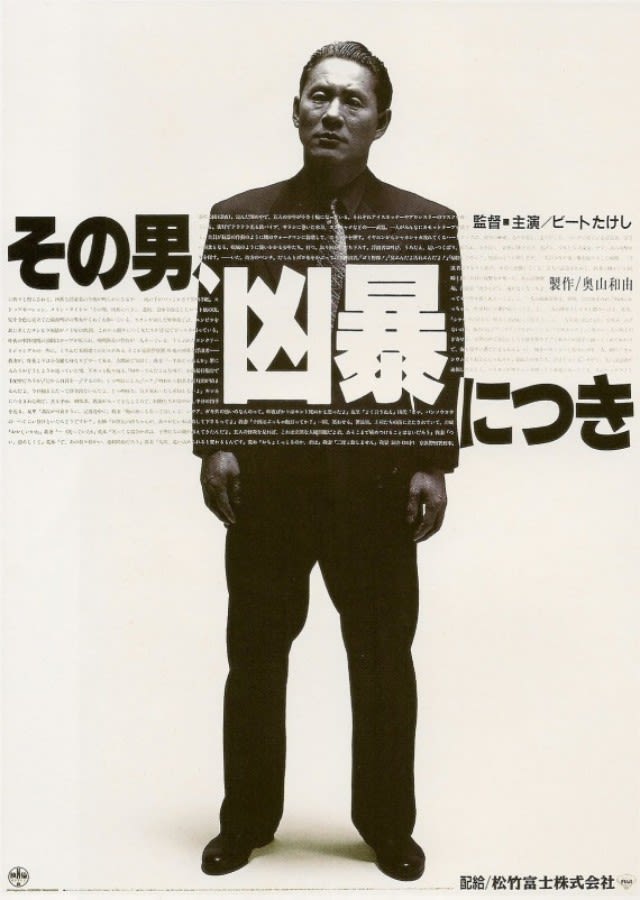
By and large, policemen in Japanese cinema are at least nominally a force for good. They may be bumbling and inefficient, occasionally idiotic and easily outclassed by a master detective, but are not generally depicted as actively corrupt or malicious. A notable exception would be within the films of Kinji Fukasaku whose jitsuroku gangster movies were never afraid to suggest that the line between thug and cop can be surprisingly thin. Fukasaku was originally slated to direct Violent Cop (その男、凶暴につき, Sono Otoko, Kyobo ni tsuki), casting top TV variety star “Beat” Takeshi in the title role in an adaptation of a hardboiled parody by Hisashi Nozawa. The project later fell apart due to Kitano’s heavy work schedule which eventually led to him directing the film himself, heavily rewriting the script in order to boil it down to its nihilistic essence while rejecting the broad comedy his TV fans would doubtless have been expecting. 

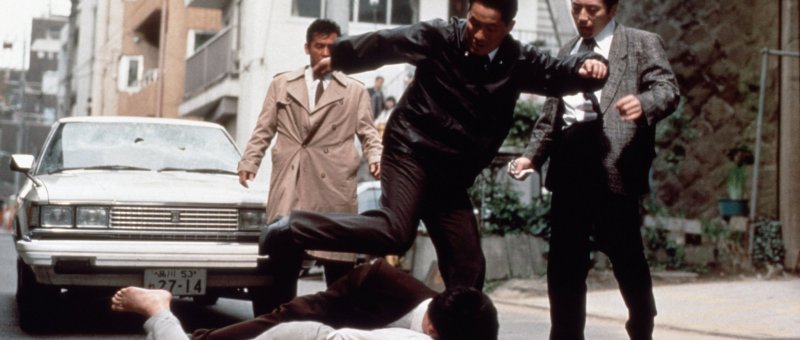
Kitano’s trademark deadpan is, however, very much in evidence even in this his debut feature in which he struggled to convince a veteran crew to accept his idiosyncratic directorial vision. He opens not with the “hero”, but with a toothless old man, a hobo beset by petty delinquents so bored by the ease of their comfortable upperclass lives that they terrorise the less fortunate for fun. Azuma (Takeshi Kitano), the violent cop, does not approve but neither does he intervene, later explaining to his boss that it would have been foolish to do so without backup. Having observed from the shadows, he tails one of the boys to his well-appointed home, barges past his mother, and asks to have a word, immediately punching the kid in the face as soon as he opens the door. Rather than simply arrest him, he strongly encourages that he and his friends turn themselves in at the police station the next day or, he implies, expect more of the same. The kid complies. 

Azuma embodies a certain kind of justice acting in direct opposition to the corruptions of the Bubble era which are indirectly responsible for the creation of these infinitely bored teens who live only for sadistic thrills. He arrives too late, however, to have any effect on the next generation, cheerfully smiling at a bunch of primary school children running off to play after throwing cans at an old man on a boat. Children always seem to be standing by, witnessing and absorbing violence from the world around them as when a fellow officer is badly assaulted by a suspect following Azuma’s botched attempt to arrest him in serial rather than parallel with his equally thuggish colleagues. But for all that Azuma’s violence is inappropriate for a man of the law, it is never condemned by his fellow officers who regard him only as slightly eccentric and a potential liability. Even his new boss on hearing of his reputation tells him that he doesn’t necessarily disapprove but would appreciate it if Azuma could avoid making the kind of trouble that would cause him inconvenience. 

That’s obviously not going to happen. What we gradually realise is that Azuma may be in some ways the most sane of men or at least the most in tune with the world in which he lives, only losing his cool when a suspect spits back that he’s just as crazy as his sister who has recently been discharged from a psychiatric institution. Azuma has accepted that his world is defined by violence and no longer expects to be spared a violent end. He smirks ironically as he slaps his suspects, connecting with them on more than one level in indulging in the cosmic joke of existential battery. To Kitano, violence is cartoonish, unreal, and absurd. The only time the violence is shocking and seems as if it actually hurts is when it is visited directly on Azuma, the camera suddenly shifting into a quasi-PV shot as a foot strikes just below the frame. The targets are otherwise misdirected, a young woman caught by a stray bullet while waiting outside a cinema or a cop shot in the tussle over a gun, and again the children who only witness but are raised in the normalisation of violence. 

Meanwhile, organised crime has attempted to subvert its violent image by adopting the trappings of the age, swapping post-war scrappiness for Bubble-era sophistication. Nito (Ittoku Kishibe), the big bad, has an entire floor as an office containing just his oversize desk and that of his secretary. These days, even gangsters have admin staff. Minimalist in the extreme with its plain white walls and spacious sense of emptiness, the office ought to be a peaceful space but the effect of its deliberately unstimulating decor is quite the reverse, intimidating and filled with anxiety. Behind Nito the ordinary office blinds look almost like prison bars. Meanwhile, the police locker room in much the same colours has a similarly claustrophobic quality, almost embodying a sense of violence as if the walls themselves are intensifying the pressure on all within them. 

Azuma is indeed constrained, even while also the most “free” in having decided to live by his own codes in rejection of those offered by his increasingly corrupt society. He walks a dark and nihilistic path fuelled by the futility of violence, ending in a Hamlet-esque tableaux with only a dubious Fortinbras on hand to offer the ironic commentary that “they’re all mad”, before stepping neatly into another vacated space in willing collaboration with the systemic madness of the world in which he lives. With its incongruously whimsical score and deadpan humour Violent Cop never shies away from life’s absurdity, but has only a lyrical sadness for those seeking to numb the pain in a world of constant anxiety. 


Violent Cop is the first of three films included in the BFI’s Takeshi Kitano Collection blu-ray box set and is accompanied by an audio commentary by Chris D recorded in 2008, plus a featurette recorded in 2016. The first pressing includes a 44-page booklet featuring an essay on Violent Cop by Tom Mes, as well as an introduction to Kitano’s career & writing on Sonatine by Jasper Sharp, a piece on Boiling Point from Mark Schilling, an archival review by Geoff Andrew, and an appreciation of Beat Takeshi by James-Masaki Ryan.

The Takeshi Kitano Collection is released 29th June while Violent Cop, Boiling Point, and Sonatine will also be available to stream via BFI Player from 27th July as part of BFI Japan.

Original trailer (English subtitles)