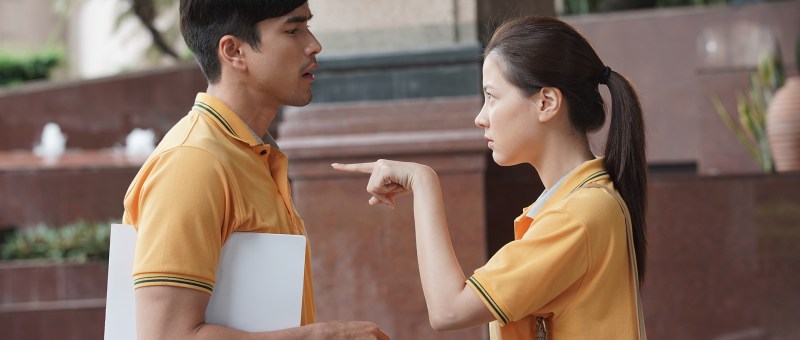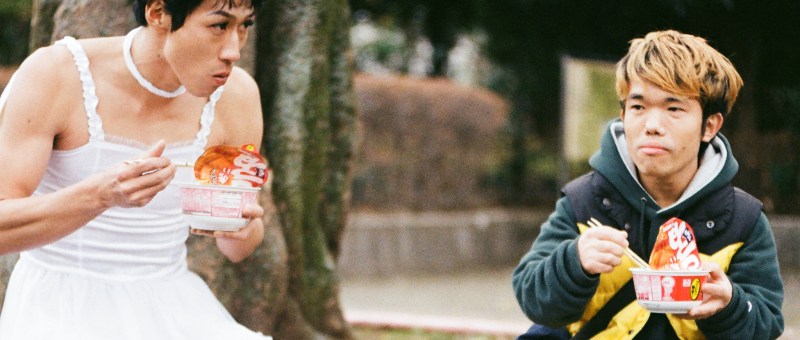

Spider Lilies (刺青, Zero Chou, 2007)

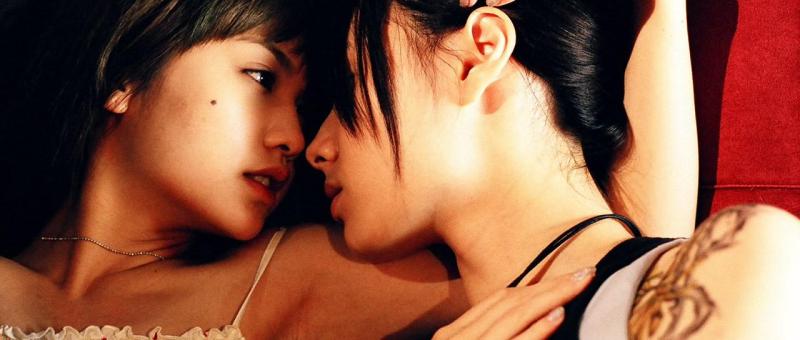
“I have no choice but to live in a virtual world” according to the lovelorn heroine of Zero Chou’s ethereal reflection on love and the legacy of trauma, Spider Lilies (刺青, Cìqīng). Two women connected by childhood tragedy struggle to overcome their respective anxieties in order to progress towards romantic fulfilment, eventually freeing themselves only by destroying the image of that which traps them. 

In the present day, Jade (Rainie Yang) is an unsuccessful camgirl with a habit of shutting down her clients on a whim which doesn’t play well with her boss. In an effort to spice up her live show, she decides to get a raunchy tattoo only to realise that the tattooist, Takeko (Isabella Leong), is in fact her long lost first love, a neighbour she took a fancy to at the tender age of nine. For her part, Takeko appears not to remember Jade but cannot deny the presence of her unusual spider lily tattoo, a version of which hangs prominently on her wall. Hoping to maintain contact, Jade decides to get the spider lily tattoo herself but Takeko is reluctant, explaining that the spider lily is a flower that leads only to hell. 

According to Takeko’s master, there is a secret behind every tattoo and the responsibility of the tattooist is to figure out what it is but never reveal it. Thus Takeko crafts bespoke tattoo designs for each of her clients designed to heal whatever wound the tattoo is intended to cover up, such as the ghost head and flaming blades she tattoos on a would-be gangster who secretly desires them in order to feel a strength he does not really have. Her tattoo, however, is intended as a bridge to the past, a literal way of assuming her late father’s legacy in order to maintain connection with her younger brother (Kris Shen) who has learning difficulties and memory loss unable to remember anything past the traumatic death of their father in an earthquake which occurred while she was busy with her own first love, a girl from school. Feeding into her internalised shame, the tattoo is also is a means of masking the guilt that has seen her forswear romance in a mistaken sense of atonement as if her sole transgression really did cause the earth to shake and destroy the foundations of her home. 

Then again, every time Takeko seems to get close to another woman something awful seems to happen. Jade, meanwhile, affected and not by the same earthquake is burdened by the legacy of abandonment and the fear of being forgotten. Living with her grandmother who now has dementia the anxiety of being unremembered has become acute even aside from the absence of the mother who left her behind and the father last seen in jail. “Childhood memories are unreliable” she’s repeatedly told, firstly by Takeko trying to refuse their connection, and secondly by a mysterious online presence she misidentifies as her lost love but is actually a melancholy policeman with a stammer charged with bringing down her illicit camgirl ring. The policeman judgementally instructs her to stop degrading herself, having taken a liking to her because he says he can tell that she seems lonely. 

A kind of illusionary world of its own, Jade’s camgirl existence is an attempt at frustrated connection, necessarily one sided given that her fans are not visible to her and communicate mainly in text. It’s easy for her to project the image of Takeko onto the figure of the mystery messenger because they are both in a sense illusionary, figments of her own creation arising from her “unreliable” memories. Jade wants the tattoo to preserve the memory of love as a bulwark against its corruption, at once a connection to Takeko and a link to the past, but the tattoo she eventually gets is of another flower echoing the melancholy folksong she is often heard singing in which the lovelorn protagonist begs not to be forgotten. 

“I am a phantom in your dream and you too live in mine” Jade’s mystery messenger types, hinting at the ethereality of romance and fantasy of love. Caught somewhere between dream and memory the women struggle to free themselves from the legacy of past trauma and internalised shame, but eventually begin to find their way towards the centre in making peace with the past in a sprit of self-acceptance and mutual forward motion.


Spider Lilies streams in the UK 26th April to 2nd May courtesy of Queer East

Original trailer (English subtitles)
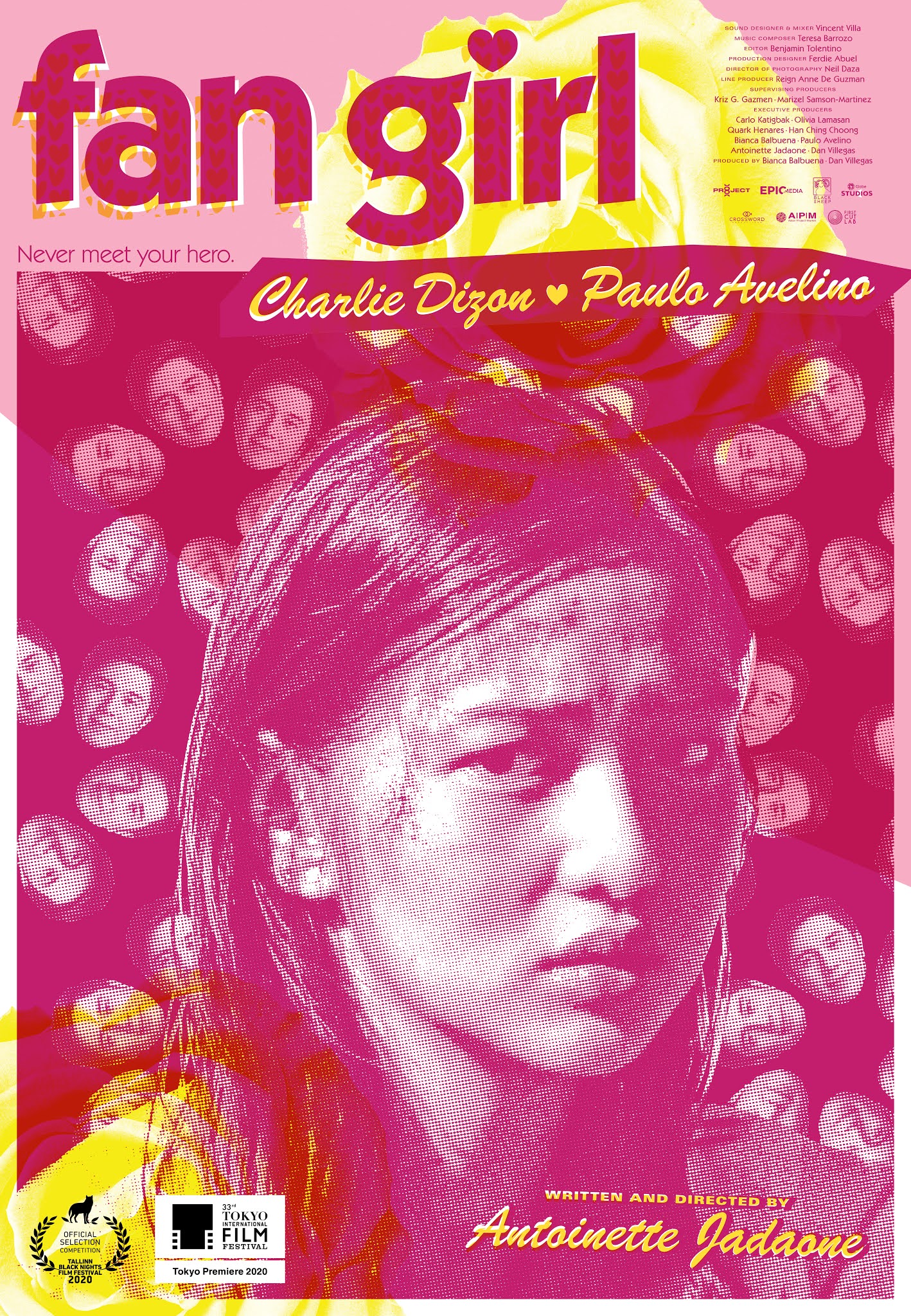
Fan Girl (Antoinette Jadaone, 2020)

Never meet your heroes is the conventional wisdom, and for good reason in that nobody’s perfect and when you place someone on a pedestal they can’t help but disappoint you when they step down. For the heroine of Antoinette Jadaone’s Fan Girl, however, the clash between her youthful escapist delusions and the ugly truth that lies behind them is more than just a cautionary tale about the commodification of the human image exposing the unpleasant duplicities of a fiercely patriarchal, misogynistic society that those escapist images both mask and reinforce. 

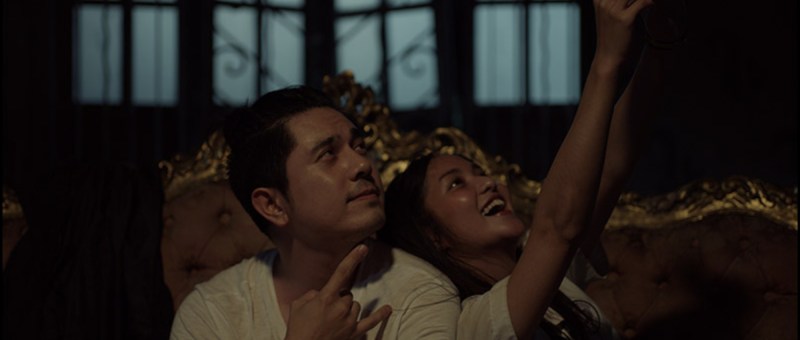
16-year-old Jane (Charlie Dizon) is completely obsessed with rom-com star Paulo Avelino (playing a heavily fictionalised version of himself), bunking off school to attend a publicity event at a local mall at which he and his co-star Bea Alonzo (also playing “herself”) with whom he is apparently in a real relationship are set to appear to promote their latest movie. In the ensuing crush, Jane manages to slip away from the crowd and stowaway on a pickup truck that improbably enough belongs to Paulo who will be driving himself away from the event. Excited in her illicit adventure, Jane snaps candid picks of her crush peeing on the roadside scandalised by the realisation that she’s glimpsed his intimate area, zooming in on her pic while messaging her friend to share the news that Paulo is “a biggie”. Soon after, however, she falls asleep and when she wakes up it’s already dark. The truck has arrived at a creepy gothic mansion out in the country. She thinks she sees Paulo beckon her inside and jumps the gate, only the figure she spots on the upstairs balcony doesn’t match the idea of the romantic prince in her mind nor is he very excited to see her. 

To begin with, perhaps our sympathies are all with Paulo unwittingly stalked by this obsessive teenage fan who’s already invaded his privacy and feels herself entitled to his attention solely because of her devotion towards him. Yet we also fear for her, in the beginning at least Paulo is careful to rebuff her youthful romantic feelings and shows no signs of taking advantage of a naive teenager in the way some other stars might. In this situation of mutual threat, we can’t be sure who is most in danger, the vulnerable star struck fan or famous actor pursued by crazed stalker. 

Nevertheless, Paulo is quickly stripped of his star appeal, his gentlemanliness undercut by his constant insistence that “this can’t get out” eventually knocking Jane’s phone out of her hand as she takes a selfie next to his sleeping face lest she post it online and cause a scandal. As soon as he climbs inside his pickup truck he begins to shed his star persona, wiping the makeup from his face complaining they’ve made him look “like a faggot”, pausing only when stopped by police who immediately let him off after getting him to sign one of the many posters he has on hand for their lovestruck teenage daughter at home. Sitting in the back Jane can perhaps hear his constant swearing, but it doesn’t seem to penetrate. When she calls out his name in the villa she finds him shirtless, slightly pudgy with a lewd tattoo of a cobra woman on his back, his long hair greasy as he snorts cocaine from his curled fist. 

Paulo appears to live in the mansion but its gates remain permanently locked as if he doesn’t carry the key while the place is almost devoid of furniture, creepy its dusty emptiness. Perhaps it in a sense reflects his sense of self, somewhat hollow and ill-defined. Unravelling throughout his night with Jane he hints at a sense of impotence and despair, that he’s a slave to his image and in a sense no longer exists. The image Jane has of “Paulo Avelino” is entirely created by the marketing department, as is his apparently fictitious relationship with Bea, while he inhabits this shabby castle like a moody vampire apparently in love with a local woman who bore his child but is married to someone else. His lover later complains he treats her “like a whore”, stopping by only when he feels lonely or unfulfilled but apparently unready or unwilling to take real responsibility. 

Nevertheless, the scales do not fall from Jane’s eyes for quite some time. We gradually realise that her warm romantic fantasies are a displacement activity masking her fear and her sorrow over all the men who have already betrayed her. We might ask if her mother isn’t wondering where she is, but she later calls only to complain about her abusive boyfriend who hasn’t returned home fearing he is with another woman. Jane recalls seeing her estranged father who abandoned her with his new family, perhaps reflecting on Paulo’s complicated familial situation while clinging fiercely to the image of “Paulo Avelino” from the movies, a sensitive, romantic man who’s not afraid to cry. But underneath it all the real Paulo is just as much a product of toxic masculinity as any other man, a closet misogynist who thinks all women are “whores” and reacts with violence when his authority is challenged.  

Jane keeps insisting that she isn’t a kid anymore, consciously acting older drinking and smoking to perform the role of a mature woman, but finally comes of age only when all her illusions are shattered realising that Paulo is just another violent, abusive, man child resentful of his own insecurities. Returning home she surveys her pinups of him with a sense of regret, now denied even this small refuge of fantasy from the realities of her existence. Yet now she truly is no longer a child, angry but also realising that she doesn’t have to simply accept it in the way her mother has done resolving to seize her own agency though it remains unclear what kind of consequences if any her act of resistance may eventually provoke. A dark exploration of the interplay between fan and idol, the duplicities of image, and the persistent harm of an authoritarian patriarchy as evoked by the ubiquitous Duterte posters, Antoinette Jadaone’s nuanced drama paints a bleak portrait of the contemporary society but ends perhaps on a brief note of hope if also of tragedy as Jane smokes her cigarettes, not a kid anymore. 


Fan Girl streams in the US until May 2 as part of San Diego Asian Film Festival’s Spring Showcase.

Original trailer (English subtitles)

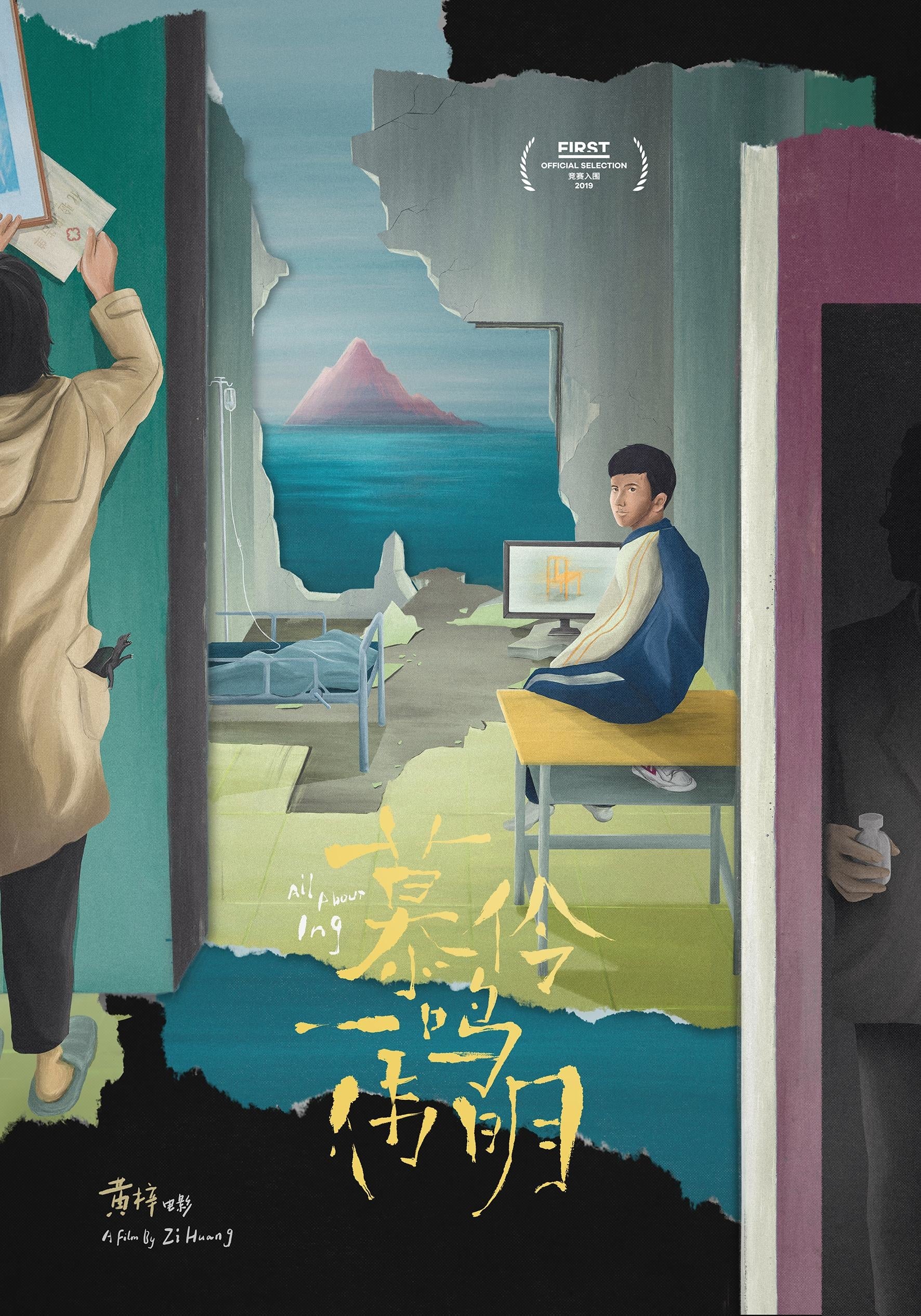
All About Ing (小伟, Huang Zi, 2019)

A small family finds itself pulled in different directions in the wake of a medical emergency in Huang Zi’s poetic family drama All About Ing (小伟, Xiǎo Wěi). The three are perhaps in slightly different places, each longing for freedom from one thing or another but finding themselves bound by a sense of legacy while haunted by both past and future as they attempt to reorient themselves around their shared loss, searching for new ways forward while always looking back. 

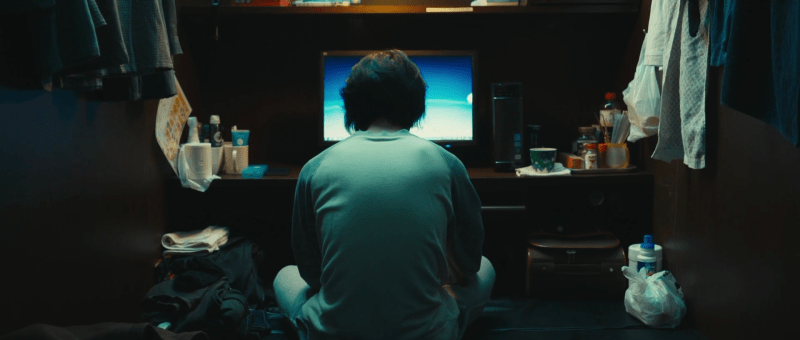
Opening with the poignant image of an empty chair, Huang slowly walks us into the “Ing” home (not their name though each of their names contain it) as patriarch Weiming (Ko Hon-man) gets a haircut from his wife while his son Yiming (Howard Sit Lap-Yin) lazes on the sofa behind. The sense of familial harmony is however soon broken as mother Muling (Janis Pang Hang-ying) chases down her indifferent son while her husband has recently entered hospital with a condition that appears to be much more serious than he thought it to be. Firstly criticising the hospital unsure if he’s getting the best care because the place seems “too new”, Weiming is convinced there’s nothing seriously wrong with him because the doctor says he can go home in a few days. Muling, however, is aware the reality is a little different and has decided not to tell her husband that he has advanced liver cancer letting him believe he merely has “cirrhosis”. 

Divided into three arcs following each of the family members as they attempt to come to terms with the ways their lives will change, the first part of the film follows Muling as she finds herself carrying the burden of family all alone trying to keep them together while her son dreams of escaping abroad and her husband is in continual denial about the state of his health. Perhaps she wants to escape too, her friends at a factory cafeteria gossiping about a mutual acquaintance who was so set on going abroad that she apparently left her husband to marry a wealthy old man living in Cyprus. “What freedom? Is abandoning her son and husband freedom now?” her friend asks while Muling pensively stirs her soup thinking something much the same, later identifying with the lonely old granny who keeps wandering off from the flat next-door while her family it seems don’t even really bother to look for her. Will that be her future too, wandering all alone like a living ghost forgotten by those closest to her? 

A teenage boy Yiming is not particularly primed to see things from his mother’s perspective, longing for escape through studying abroad keeping the news of his acceptance at university in the US a secret from Muling just as she keeps the extent of Weiming’s illness a secret from him. He resents her for her thinking “something bad” will happen to his father while slacking off in class, rejecting her offer of an introduction to a cram school run by a friend but cheating on his homework by copying another girl’s answers. Like Muling’s friend, Yiming’s classmates are convinced there’s no future for them in China joking about jobs as security guards or successful shop merchants while determined to seek their fortunes abroad perhaps partly out of a sense of teenage rebellion against constraining family mores. Yet Yiming is also struggling to process the idea of death experiencing strange dreams of a ruined village he eventually visits with his father on a last trip back to his hometown. 

Weiming’s elderly mother looks not unlike the escaped granny framed vaguely from behind, while his brother too appears somewhat ghostlike as if frozen in time dressed in an old-fashioned donkey jacket and carrying a mysterious photo tube. The two boys he meets on a misty beach who do not acknowledge his presence appear like ghosts of their younger selves while Weiming himself has begun to haunt the landscape ominously looking in through a window at his wife and son on the other side. The family went back to visit Weiming’s family grave but they can’t find it, the town now in ruins while a holiday resort is currently under construction slowly taking over the mountain featured in a picture the family retrieve of Weiming’s father they will later hang on their living room wall. “I want to change the world” Yiming idly mutters on the train home though Weiming doesn’t hear him, the son poignantly turning round to share something with his father after they return home only to find his chair empty. Another his elliptical long shots, Huang closes by returning to his opening POV once again a ghost exiting the space as if returning to a familiar chair while the family attempts to repair itself, moving forward in memory of the past not trapped by it but carrying it with them as they go. 


All About Ing is currently available to stream in the UK as part of the Chinese Cinema Season.

Original trailer (English / Simplified Chinese subtitles)

Black Light (빛과 철, Bae Jong-dae, 2020)

“Everyone here is at fault” according to the heroine of Bae Jong-dae’s spiralling mystery drama, Black Light (빛과 철, Bich-gwa Cheol). Two women on opposite sides of an accident that may have been something darker find not so much common ground as mutual resistance as they each alternately long for and reject answers as to how and why their husbands eventually collided in a deadly car crash which has had very different consequences for each of their families, discovering a sense of conspiracy and corruption which leads straight to the dark heart of modern capitalism. 

Distressed and anxious, 30-something Hee-ju (Kim Si-eun) has returned to her hometown and is about to start back at the factory where she worked five years’ previously prior to her marriage. As we later realise, Hee-ju’s husband passed away in a car accident which was ruled to have been his own fault after he veered across the central reservation and collided with another vehicle the driver of which has been in a coma ever since. What Hee-ju doesn’t know is that Young-nam (Yeom Hye-ran), the other man’s wife, also works at the same factory while looking after her teenage daughter and caring for her husband, who is not thought likely to wake up, at the local hospital. 

Filled with a sense of guilt, Hee-ju avoids Young-nam like the plague, dropping her shopping in the street and running in the other direction after catching sight of her on the other side of a pedestrian crossing even though Young-nam makes an attempt to be kind to her and obviously bears no ill will. That sense of guilt, however, soon turns to resentment after she accidentally befriend’s Young-nam’s daughter Eun-young (Park Ji-hoo) who in the depths of her own grief and internalised guilt gives her cause to believe that what she’s been told of the accident may not in fact be the whole truth. 

Everyone is indeed acting out of a sense of guilt in that they feel their own actions in some way contributed to the fatal collision, certain that if they had acted differently Hee-ju’s husband may still be alive. Spitting fire and vengeance, Hee-ju determines to discover “the truth”, now convinced that her late husband has been unfairly maligned and is in fact the victim rather than the guilty party, but the more questions she asks the more frustrated she feels. According to her, the police investigation may have been flawed with crucial evidence uncollected, later discovering that her own brother who dealt with the aftermath of the accident in her absence may have been involved in an effort to cover something up not quite realising that he may have attempting to protect her from an uncomfortable truth she may be better off never knowing. 

Meanwhile, she also realises that the causes of the collision may stem back to a workplace accident caused by improper labour practices at the factory and that her own position, and perhaps that of Young-nam, is directly related to the factory’s desire to assuage their guilt while preventing any possible blowback from the two women should they draw a direct line between the oppressive working environment and the eventual collision. Hee-ju is desperate to apportion blame so that she can let herself off the hook. A nervous wreck of a woman she is plagued by a debilitating ringing in her ears and at least appears to be somewhat unbalanced. Young-nam, meanwhile, appears to be genuinely kind and forgiving if urging herself towards a kind of stoicism resentful of her husband and fearful that her daughter’s guilt-ridden conclusions about why he went out that day may in fact be correct.  

Nevertheless, Young-nam as a middle-aged woman with a teenage daughter is in a much different position from the still young and childless Hee-ju having lost her source of economic support with few savings to fall back on. She needs to make sure she keeps the insurance payout because she needs to pay her husband’s medical fees even while the doctors caution her it may be time to consider longterm hospice care, implying there’s little more that can be done for him medically and he will likely never regain consciousness. With heartbreaking simplicity she explains to Hee-ju that in someways it may be better to die, implying perhaps that if her husband were “guilty” then he, or more to the point she, is already paying for it. She just wants to move on and resents Hee-ju’s attempts to dig up the past while also sorry for her, realising she knows almost nothing and that what she doesn’t know is only going to end up causing her more pain. Forced to confront their mutual sense of guilt and responsibility, the two women eventually find an uneasy solidarity in their desire for answers, only to wonder if the accident was just that after all if informed by a confluence of ugly circumstances from rampant capitalism to relationship breakdown and emotional crisis. The light at the end of the tunnel is pitch black. It really doesn’t matter whose fault the accident was, the waves of guilt and recrimination spiral all the same. 


Black Light screens at Chicago’s Lincoln Yards Drive-in on April 22 as part of the 12th season of Asian Pop-Up Cinema.

Original trailer (English subtitles)
Goto-san (ゴトーさん, Hiroshi Gokan, 2020)

It doesn’t take much to remind you that even the most stable of lives can be upended in an instant, often not even by disaster or tragedy just the vagaries of life, but for those living on the margins certainty is an unattainable luxury. The eponymous hero of Hiroshi Gokan’s Goto-san (ゴトーさん) seems happy enough living his day-to-day life, not really worrying too much about the future but perhaps mourning a hidden past or in flight from something or other no one else knows, never suspecting that the rug may suddenly be pulled from under him. 

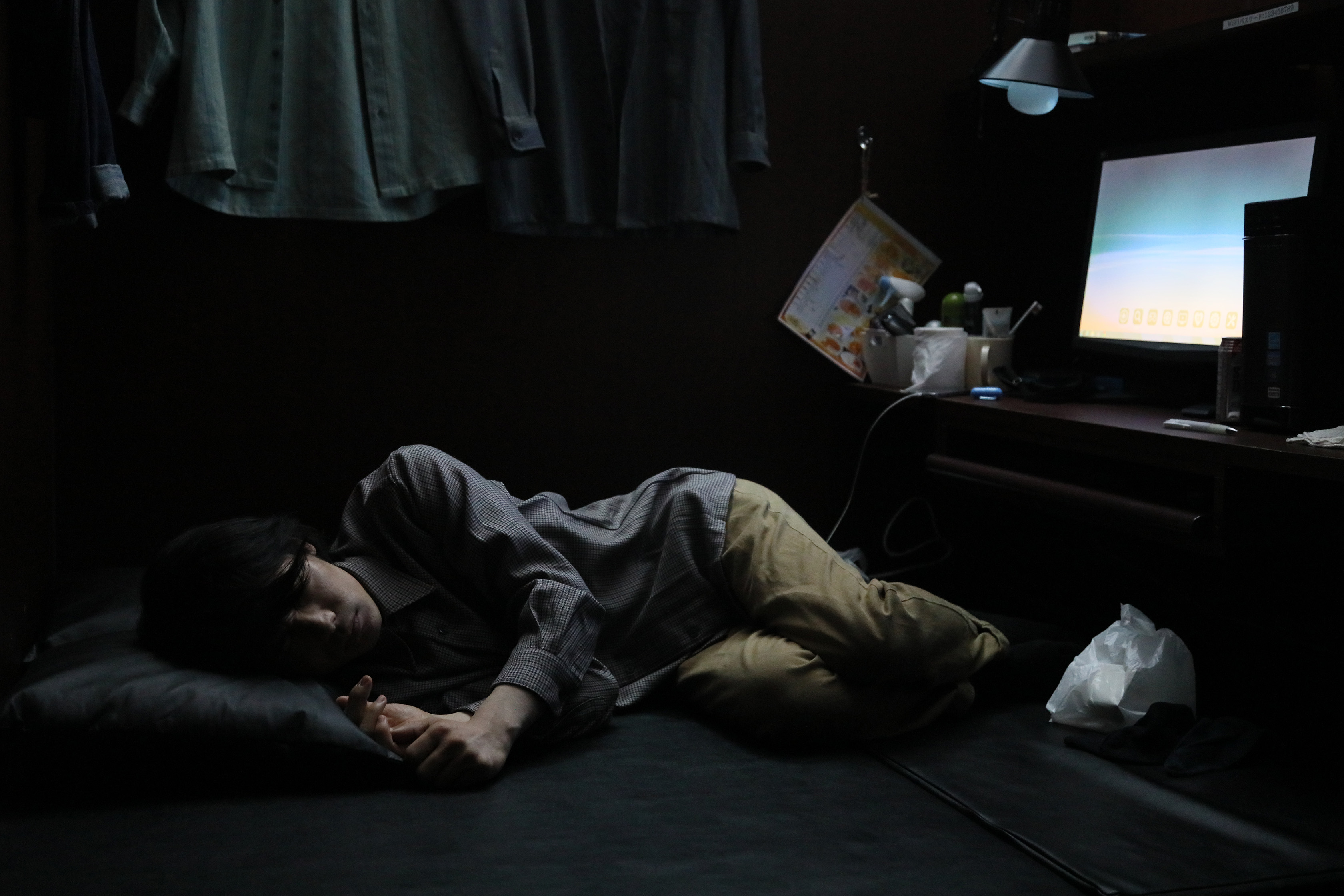
Goto (Hirofumi Suzuki) has been living and working at 24-hour mangacafe Sunflower for at least two years, no one knows exactly how long because he’s “always” been there. The first sign of trouble arrives when an old man who often frequented the cafe and was thought to be homeless is found dead in his room. The panicked manager asks “clean-freak” Goto to sort it all out for him, surprised that he seems to have taken a death on the premises in his stride. Meanwhile, a young woman, Riko, is renting room 208 on a daily basis eschewing the weekly rate presumably because she’s hoping to move on either today or tomorrow or someday at least and a longterm agreement seems like admitting defeat. 

Gokan opens the film with scenes of a Tokyo under construction, busy in the run up to the 2020 Olympics while Goto’s boss and an official-looking man in a suit make ominous comments about “that virus” and its capacity to mess up their business. A small group of men are currently holding a protest, flying a banner reading “never forgive corporate exploitation of dead end job labour” while announcing statistics over a megaphone to the effect that one in seven children lives in poverty, one in five elderly people is struggling, and one in three single women face hardship as do a majority of young people. Can you really say that holding the Olympics in these circumstances is a good idea? The protest group at least seems to think it’s a bit of a slap in the face to low income workers who might be experiencing a temporary bounce but are also facing potential exploitation and will likely be forgotten once the construction frenzy’s over. 

Taking their battle off the streets, the protest group decide to take the message into the manga cafe which is perhaps insensitive, preaching to the converted, or a potential annoyance to this drop out community who may be well aware of the oppressive nature of modern day capitalism and have decided not to participate. For his part, Goto’s motives remain ambiguous though he seems happy enough with his quality of life until he gets a coupon for sex services and ends up accidentally meeting Riko. Perhaps recalling an old dream, owning a boating license and fascinated by a wind-up toy of an ocean liner left behind by the dead man, he tells her he’s a first mate on a cruise ship, pretending to live in another part of town little knowing that they live in the same building. Wanting to get to know her socially, he ends up looking for extra work, but his job-hunting experience later comes to nothing when he has to leave the cafe abruptly discovering that it’s almost impossible to find work without access to online resources and a permanent address. Some might think a change in his circumstances is an opportunity to reset, but Goto seems not to take it ironically ending up in much the same position he was before.

Riko, meanwhile, seems to think differently eventually spring-boarded into the determination to change her life escaping the world of sex work and manga cafes she finds disappointing to chase something better though we might wonder what exactly it is she finds as she crosses Shibuya scramble inches from an oblivious Goto who might dream of sailing overseas but remains ironically landlocked to the local area. Opening with a jaunty detachment, the whimsical score perfectly matching the surreality of life at the manga cafe, Gokan’s screenplay becomes progressively darker as Goto finds himself at the mercy of his times trapped by economic malaise, running aground while the river flows on all around him.  


Goto-san screened as part of the 2021 Osaka Asian Film Festival. 

Original trailer (no subtitles)

Born to be Human (生而為人, Lily Ni, 2021)

Taiwan is often regarded as among the more liberal of Asian nations, but it is certainly not free of outdated ideas of gender and sexuality as Lily Ni’s powerful sci-fi-inflected drama Born to Be Human (生而為人, Shēng ér Wèirén) makes clear. Like the similarly themed Metamorphosis from the Philippines which also made much of butterfly imagery, Born to Be Human finds a teenager’s ordinary existence upended by the sudden discovery that they are intersex along with the realisation that they have almost no agency over their medical decisions, but is ultimately more concerned with undermining the fallacy of the gender binary along with the sometimes duplicitous actions of the medical profession than with exploring the intersex identity. 

Unpopular at school 14-year-old Shi-nan (Lily Lee) is a regular teenage boy who secretly buys porn mags from the old man on the corner and enjoys playing online video games. Still embarrassed about his body, he is deeply worried on noticing blood in his urine after experiencing painful stomach cramps and half-convinces himself he has bladder cancer while too anxious to tell his parents or seek medical help. When his parents eventually find out they take him straight to the hospital but are fobbed off by an overworked doctor who diagnoses him with a urinary tract infection caused by an infected foreskin, something which they assume can be fixed by circumcision. Returning to school after some time off to recover, however, the problem recurs with Shi-nan collapsing during a sports lesson his shorts stained with blood. A more comprehensive medical exam reveals that Shi-nan is in fact intersex and has a functioning womb directly connected to external male genitalia. 

This unfortunately brings Shi-nan into the orbit of Dr. Lee (Yin Jau-Der), apparently a specialist in urology with an improbably futuristic office, who immediately latches on to Shi-nan’s case as a means of advancing his own career. He recommends to Shi-nan’s parents that they “correct” his physical body according to his chromosomal makeup, explaining that he may be at increased risk of cancer maintaining both sets of sex characteristics. On discovering the analysis has come back female, Shi-nan’s father’s first question is how he can carry on the family name if his son is now a daughter while his mother and the doctor fixate on Shi-nan’s viable womb and the all important ability to procreate. Feeling he will not understand, the parents decide not to share his medical diagnosis with Shi-nan even while he continues to believe that he is dying from bladder cancer, telling him only that he will undergo circumcision signing the consent forms for his gender confirmation surgery without ever consulting him. 

Already 14 years old and having lived all his life as a boy, this forced gender transition provokes a secondary sense of dysphoria as Shi-nan becomes Shi-lan and moves to the capital to attend an elite school presumably offered some kind of financial incentive from Dr. Lee who continues to monitor her progress. Removed from her previous environment, Shi-lan is plunged into hyper femininity as if the entirety of her previous personality had been erased. On her birthday she is given a pink cake with frills and a selection of dolls, while her bedroom is similarly pink and frilly, apparently part of Dr. Lee’s treatment programme to acclimatise Shi-lan to her new identity. Even her mother laments that she’s behind on her feminine education, unable to cook or do chores which she fears will interfere with her ability to get married. Shi-lan says she doesn’t intend to marry, but her refusal is met only with confusion as if a woman’s entire purpose lies in marriage and childbirth. Of course, the secondary issue is that Shi-lan is sexually attracted to women, upset and embarrassed to receive a love letter from a boy at school while pining for her sympathetic deskmate who later becomes her first friend. 

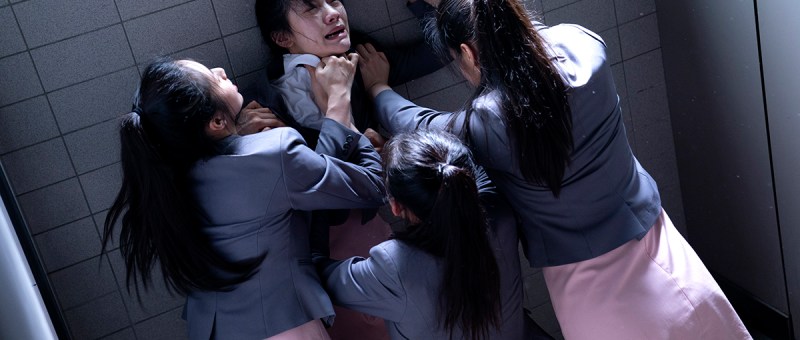
Meanwhile, she is forced to adopt a female personality more or less against her will, later explaining an old photo of herself as one of a younger brother who has unfortunately passed away but will remain always in her heart. Having been bullied at her last school, Shi-lan fears discovery but is subject to a secondary prejudice after a nosy girl goes through her bag and finds a bottle of pills she identifies as being for the treatment of depression later getting her parents to complain to the school that they shouldn’t be forced to share a class with a “mental patient”. 

In fact, Shi-lan has been lied to again, the pills aren’t for depression and she is in fact being tricked to take them against her will as part of her forced transition. She describes herself as a “monster”, neither male nor female, and is acutely compelled to feel that those are her only two options. Her new friend, Tian Qi (Bonnie Liang Ru-Xuan), takes her to a Taiwanese opera performance starring her mother in which a female scholar poses as a man in order to get her education only to fall for a classmate making it clear that an idea of gender fluidity has cultural currency yet Shi-lan has been denied the right to define her own identity, told that what she is is wrong or incomplete, and ultimately reduced to a subject for experimentation by an unethical doctor. Confronting him to be told he has turned her into a “normal person”, she later insists that she can ruin his work just as he has ruined her life, walking through a market witnessing flesh being butchered and fish gutted, before buying a bouquet of sunflowers echoing those on the doctor’s jigsaw puzzle. Whatever her intentions, Shi-lan perhaps comes into herself even if with a dark purpose in mind, actively claiming an identity that is defiantly her own in rebellion against a conservative society that refuses to accept her for all that she is.


Born to be Human screened as part of the 2021 Osaka Asian Film Festival. 

Original trailer (dialogue free)

The Con-Heartist (อ้าย..คนหล่อลวง, Mez Tharatorn, 2020)

Is love the greatest swindle of all? In these strange times scams are on the rise as amoral fraudsters attempt to take advantage of our various anxieties, hoping we’ll be just distracted enough to fall for one of their tricks. The heroine of Mez Tharatorn’s heist caper rom-com The Con-Heartist (อ้าย..คนหล่อลวง), however, had her heart stolen out from under her well before the world began to wind down and other than stealing back what was stolen from you what better way of getting revenge is there than scamming a scammer out of their ill-gotten gains. 

25-year-old Ina (Pimchanok Luevisadpaibul) used to work in a bank but now has an unsatisfying job as a credit agent chasing bad debt, a minor irony because she’s in a significant amount herself as the post-it notes lining her wall detailing various repayment dates demonstrate. It seems that Ina has been unlucky in love, meeting the suave and handsome Petch (Thiti Mahayotaruk) through an app and falling head over heels for him. Thinking it was the real thing, she didn’t really question it when he kept asking her to lend him money, eventually taking out a sizeable loan to supposedly pay for his tuition using her mother’s farmland as security. Realising she’d been scammed, Ina tried to go to the police but as Petch claimed she gave him the money willingly there’s nothing they can do while he unceremoniously dumps her even as she humiliates herself clinging to him. That’s one reason why when she’s cold called by con-man Tower (Nadech Kugimiya) claiming to be from the tax office she nearly falls for his obvious scam despite being a former bank employee presumably familiar with official protocols. Finally catching on she decides to play Tower at his own game, recording their conversation as she uses her connections to unmask his “true” identity and then attempting to blackmail him before hatching on a new plan – getting him to scam Petch to get her money back (along with a little satisfaction not to mention revenge) and thereby save her mother’s farm. 

“No one dies from being conned out of money,” Ina later tearfully explains, “It just breaks your heart. It makes you want to run into an electric pole and die.” Perhaps people really do die of being conned out of money, but still there is a moral judgement being made between men like Tower doing small scale, one-off telephone scams and those like Petch, heartless gigolos leveraging the sincere feelings of perhaps vulnerable women for financial gain. After breaking up with Ina, Petch got onto a sure thing with an older woman who runs a travel agency and is apparently financially supporting him with gifts of expensive suits and fancy cars while he works at her company. 

Ina and Tower’s scam aims to take advantage of his weakness by convincing her old Chinese teacher Ms Nongnuch (Kathaleeya McIntosh), who is in a mountain of debt herself, to pose as the cougarish CEO of a Chinese beer company. Scamming a scammer is always a challenge, but the trio, later a quartet roping in Tower’s weird con-man brother Jone (Pongsatorn Jongwilak), hope they can unbalance Petch by poking at his weaknesses to undermine his natural cynicism. During the course of their scheming, Tower and Ina begin to draw closer but Tower is after all a conman, maybe he’s just playing an extra long con and Ina is about to get her heart broken all over again or on the other hand her earnestness may just reform him. Who is swindling who? It might be difficult to say. 

Shot with the customary slickness of a Thai heist move, Mez Tharatorn’s comedy caper throws in a series of twists and reversals while playing on the ironies of good scammers and bad as the gang determine to take down the “wolf” Petch to protect meek “sheep” like Ina while she perhaps begins to fall for Tower precisely because she already knows she can’t trust him. An epilogue a year on from the original action brings us up to the present day in which everyone is wearing visors and bumping buttons with their elbows, but in an odd way there has been a kind of healing as even scammers find themselves caught out by their greed in the midst of a deadly disease.


The Con-Heartist screened as part of the 2021 Osaka Asian Film Festival. 

International trailer (English subtitles)

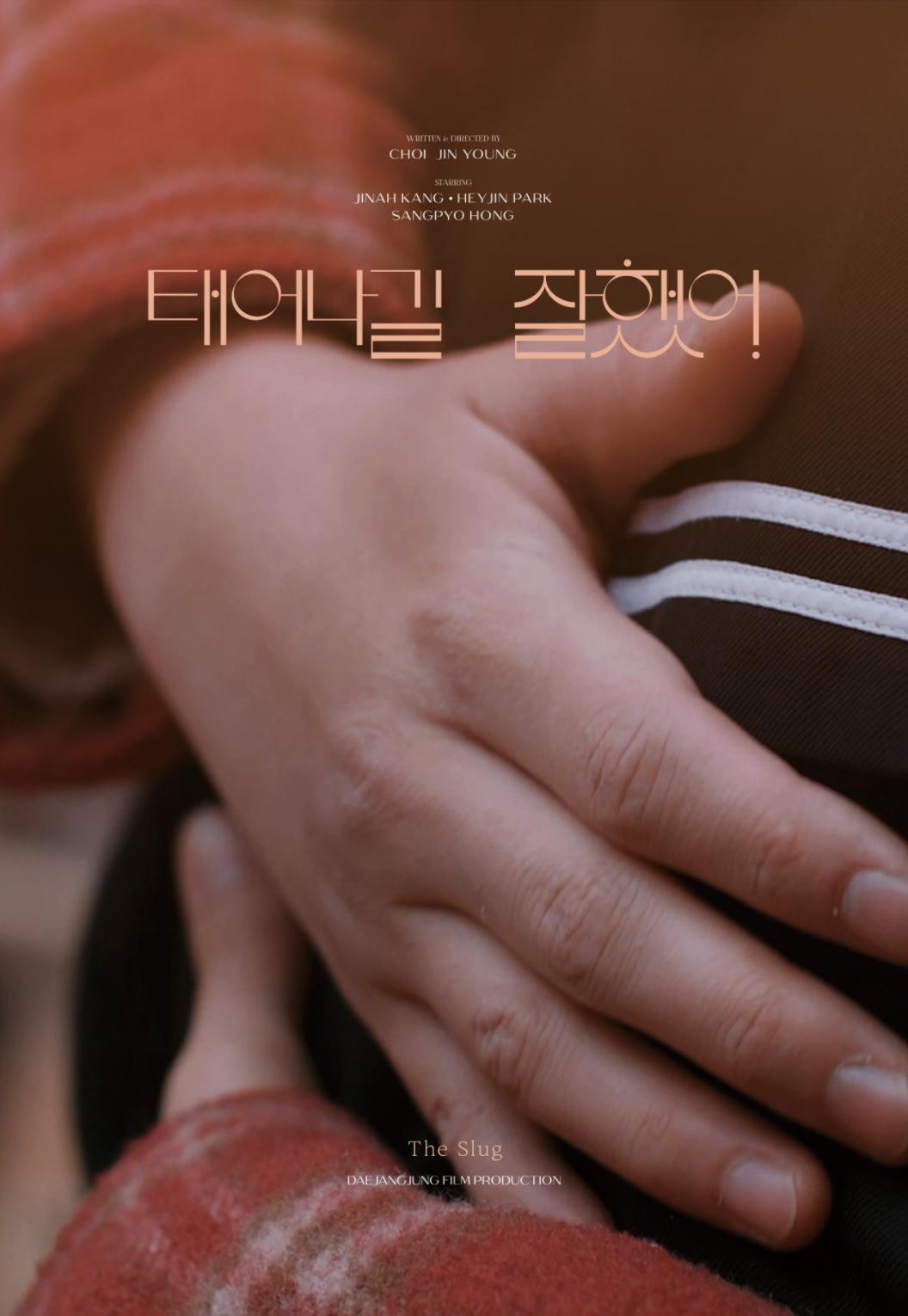
The Slug (태어나길 잘했어, Choi Jin-young, 2020)

“My name is Park Chunhee. I’m a little…drenched.” “From the weight of life?” asks a fellow sufferer a little too excitedly. “In sweat” she flatly replies, though in her case less from existential anxiety than a persistent medical condition she finds so embarrassing it prevents her leading a fulfilling life. Although, it seems, that’s not the only reason that Park Chunhee has found herself arrested since the age of 15. A whimsical tale of growing self-acceptance, Choi Jin-young’s The Slug (태어나길 잘했어, Taeeonagil Jalhaesseo) reconnects its lonely, defeated soon-to-be middle aged heroine with her teenage counterpart to make both sense of and peace with the past in order to “find purpose and meaning somewhere in this world”.

We first meet Chunhee (Kang Jin-a / Park Hye-jin) in 1998, shortly after the Asian Financial Crisis, entering the home of her uncle (Ko Jo-yeong) and aunt (Kim Geum-sun) following the funeral of her parents. It seems although the family has agreed to take her in, little thought has been given to her place within the household. Her cousin Yura (Kim Yeon-woo) flat out refuses to share her room while her aunt is reluctant to allow her to use the room of her son Wonseok (Lim Ho-jun / Yoo Gyeong-san) who is away at university in case he should come back. Slightly exasperated, grandma (Byeon Joong-hee) agrees she can come in with her, but her uncle has another idea – the attic crawlspace, according her aunt freezing and rat infested and though he offers to fix it up it’s clear he won’t be doing it himself and doesn’t want to pay. Nevertheless, it’s where she ends up staying, hidden away and treated quite literally as a poor relation with no one but grandma showing her the slightest bit of affection. 

20 years later, Chunhee is still living in the house though apparently alone. Her attic room is more or less unchanged, pinups of a teenage Prince William still affixed to her windowsill along with a family photo. She finds strange companionship in an errant slug crawling on the wall, partly in the trail she leaves after herself because of her excessive sweating that caused her aunt to be forever berating her to mop the floor after she passed through in socks. These days she makes ends meet by pealing copious amounts of garlic for a local restaurant while saving up for an operation to cure her sweating. After being mysteriously struck by lightning, however, her life becomes even stranger as she’s haunted by the younger version of herself and plagued with flashbacks to her teenage trauma.

Besides the sweating, Chunhee’s problem seems to lie in the conviction that her life is worthless and it would have been better if she had died along with her parents but best if she were never born at all. After accidentally wandering into a weird support group under the name of “Time to Face Myself” she ends up bonding with a similarly dejected man who has developed a stammer after being beaten by his father and regrets that his life has been a series of missed opportunities as a consequence. Yet she still doubts that she has a right to love or happiness, convinced that people don’t like her and that she is a toxic person destined to make others unhappy. Only by reconnecting with the younger Chunhee and bonding with the kind yet awkward Juhwang (Hong Sang-pyo) does she begin to see that it was never her fault, she was not in the wrong, and has as much right to life as anyone else.

Originally changing the locks because it’s her house and she doesn’t want anyone else inside, Chunhee finally manages to escape her strange limbo land even as her feckless family members flounder, Wonseok apparently ruined by his failed revolution while her uncle died a failed poet and Yura apparently became an unsuccessful film director. “Life is cold” Chunhee is reminded by a new friend engineered by her innate kindness, realising that though she feared being alone alone is all she’s ever been. Nevertheless, her new connections have perhaps in a sense liberated her, given her courage to face herself and rediscover a sense of self worth that gives her the confidence to venture out into the world in search of answers walking towards a large heart comprised of several smaller ones as she embarks on an existential quest for meaning open to whatever it is that awaits her.


The Slug screened as part of the 2021 Osaka Asian Film Festival. 

Original trailer (no subtitles)

Wrath of Desire (愛・殺, Zero Chou, 2021)

“Desire is the only truth. The body never lies” according to the prison missives penned by the heroine of Zero Chou’s latest meditation on sex, death, guilt, and repression, Wrath of Desire (愛・殺, Ài・Shā). As the title perhaps implies, Chou frames her epic tale in the extremes of Greek tragedy, opening with an ethereal desert scene and cryptic Butoh dance that equates desire with death as the victim later laments “it was I myself who pointed the knife at my heart”. 

The dreamlike opening gives way to a prophetic scene of violence as an androgynous young woman fends off an attack from a “burglar” who is later discovered to be part of a conspiracy sent to steal evidence that could be used against her father, a political candidate anxious that her existence as his love child not affect his chances of election. Visibly shaking from her traumatic encounter, Phoenix Du (Peace Yang) is comforted by the sympathetic female prosecutor in charge of her case, Jade Liu (Weng Chia-Wei), who finds herself somehow captivated by the intense tattoo artist. Witnessing her capacity for violence after they are attacked by more of the mayor’s thugs when she perhaps inappropriately offers her a ride home from the courthouse, Jade takes Phoenix back to her flat to tend to her wounds only to find herself overcome by desire when Phoenix playfully kisses her as if to test her naive hypocrisy. The two women share a single night of intense passion, but Jade is a pastor’s daughter and failure to resist her “blasphemous” desires leaves her only with shame and fear. In retaliation she has Phoenix sentenced to three years in prison hoping to forget her, while Phoenix spends her time inside writing 372 extremely intense love letters insistent that the body doesn’t lie and convinced that Jade has in fact imprisoned herself in her wilful repression. 

God is always between them, a cross hanging from the rear mirror in Jade’s car as they make their high speed getaway while it’s the Lord’s name that Jade cries out during their night of passion but out of guilt more than ecstasy as Phoenix urges her to let herself go, aware it seems that she continues to struggle against herself. While Phoenix is inside, Jade finds herself drawn to an androgynous young man, Meng Ye (Hsu Yu-Ting), who is accused of stabbing a cousin (Huang Shang-Ho) who had become his legal guardian and thereafter molested him. Referring to her as “sister’ Meng Ye reminds Jade of the younger brother who took his own life after being rejected by their religious family because of his homosexuality, something which undoubtedly contributes to her ongoing inability to accept her same sex desires describing her feelings for Phoenix as lust rather than love, something dirty and sinful to be rejected. After becoming aware of her inner conflict, Meng Ye suggests a platonic marriage to create a “family free from desire”, offering Jade the “stable family” she’s been looking for while he gains “social acceptance”. Yet on Phoenix’s release it’s Meng Ye who determines on bringing her into their life as a “friend” only to find himself consumed by jealousy while questioning the nature of desire. 

Chou intercuts the non-linear action with a series of black and white intertitles featuring Phoenix’s charred letters along with noirish, Rashomon-esque testimony from a handcuffed Jade and Meng Ye along with a third woman, Chrys (Chen Yu-Chun), who had apparently fallen for Phoenix in prison only to remain frustrated by her lack of interest in anyone outside of Jade. “Sex without love is as empty as violence without hate” Phoenix writes in one of her letters, repeating that the body does not lie and Jade is only harming herself in her continued denial. Phoenix is indeed correct, though 372 letters is rather excessive as is her stalkerish insistence in the face of Jade’s refusal. Nevertheless the ménage à trois eventually turns dark as Meng Ye determines to exorcise his resentment by making Phoenix betray herself in unmasking the hypocritical repression of her own desires. Meng Ye claims he’s a “pet” to his cousin and brother to Jade, what he wants from Phoenix is a love she might not choose to give him, but is also bound for a dark and nihilistic destination.

Though the mayoral conspiracy angle is an outlandish detail strangely forgotten in the ongoing narrative, all three are in a sense wounded orphans betrayed by parental failure and left adrift without firm anchor in a hostile society each looking for safe harbour whether in the certainty of bodily desire, its rejection, or subversion. Apparently the “first” in a six film series each set in different Asian cities (though the “second” The Substitute set in Beijing and filmed in 2017 is currently streaming via Gagaoolala, as is the reported third We Are Gamily set in Chengdu now streaming as a five-part webseries while the feature edit is also streaming via Amazon Prime US), Chou’s latest more than lives up to its name as the trio find themselves consumed by the fire of desire while unable to extricate themselves from a complex spiral of shame and repression.


Wrath of Desire screened as part of the 2021 Osaka Asian Film Festival. 

Original trailer (English subtitles)

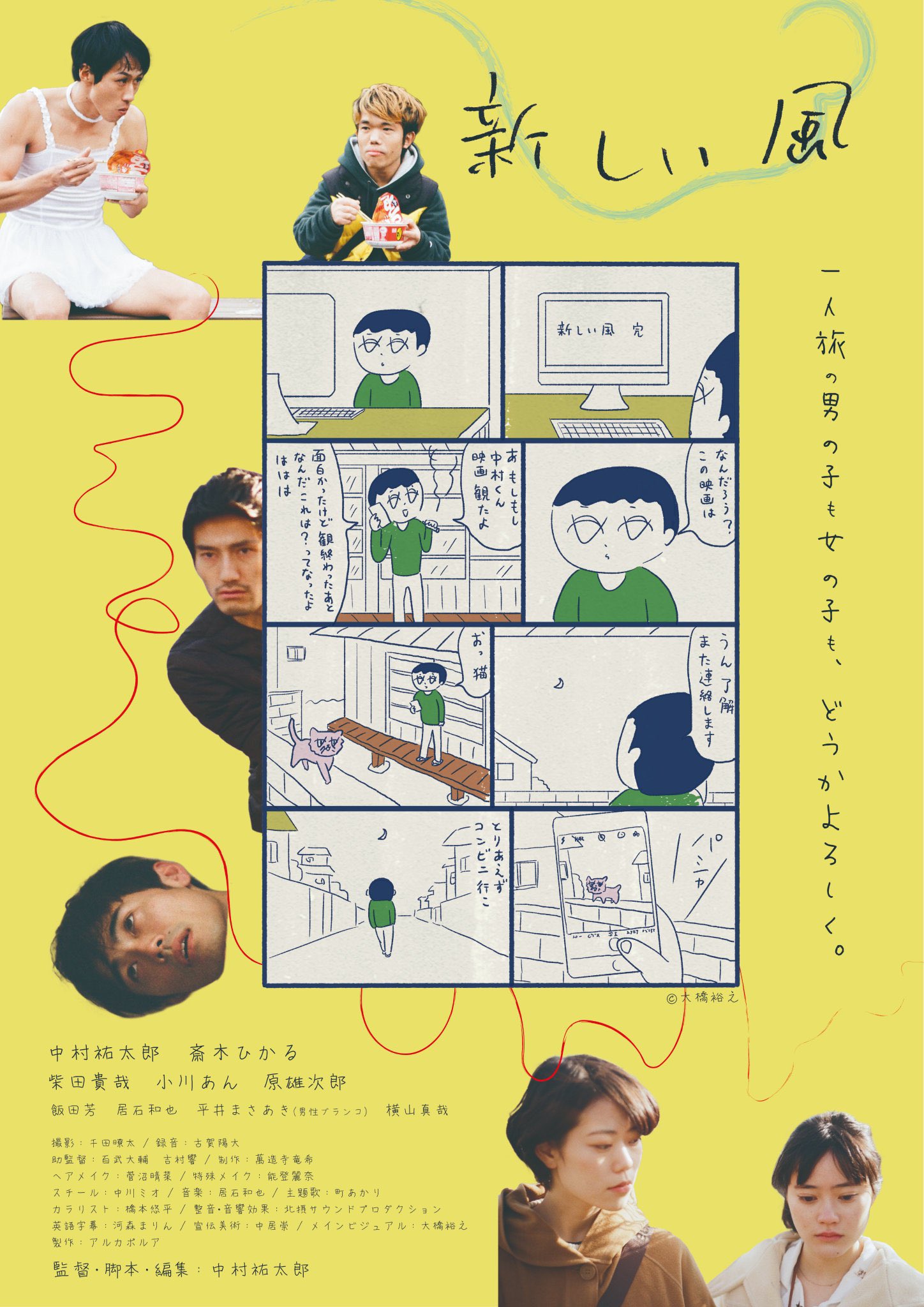
A New Wind Blows (新しい風, Yutaro Nakamura, 2021)

Seemingly brought together by fate, a collection of lovelorn Tokyoites have a very weird New Year in Yutaro Nakamura’s absurdist farce, A New Wind Blows (新しい風, Atarashii Kaze). A collection of interesting, sometimes contradictory vignettes, Nakamura’s various tales of frustrated love and interpersonal tension are perhaps variations on a theme illustrated, sometimes literally, with an ethereal logic in which events repeat themselves from differing angles or familiar faces recur in slightly different roles. “What kind of future, if any at all, can we picture?” the opening title asks us, suggesting that this strange night might be imagined but in the end at least filled with a kind of possibility.

Opening in long shot, the first scene follows a pair of teenage friends who forcibly begin trying to play football with a boy who quite clearly wants to play on his own. Eventually, they give him his ball back, and he cries. In an apparent flash forward we find ourselves in contemporary Tokyo as Hikari (Hikaru Saiki), the young woman, goes on a non-date with a friend, Kotaro (Yutaro Nakamura), who confesses his feelings to her at the end of the evening and immediately apologises but gets no real reply. In any case, the moment is later interrupted as Hikari runs into an old friend, Yujiro (Yujiro Hara), the young man, who now works as an Uber Eats driver. Realising they’ve missed the last train, Hikari decides to hit up an old friend, Anzu (An Ogawa), to see if they can stay with her. Anzu is not very welcoming, it is New Year’s Eve after all, but eventually lets them in which is when we realise there is tension in the house. It turns out that Hikari used to live with Anzu until a couple of weeks previously when she kicked her out, presumably to move in the boyfriend, Takaya (Takaya Shibata), who wastes no time at all behaving like a complete tool firstly irritated to have guests at all and then apparently challenged by the double masculine presence of the extremely tall Yujiro and the smaller Kotaro who, equally, is somewhat inappropriately fussed over and infantilised by Anzu who asks him a series of insensitive questions and later brands him a “fairy”. 

Before the evening’s out, Takaya, the lonely solo footballer, has burst into tears once again after trying to start several fights, threatening to kill people, demanding that someone kill him and then making an unexpected declaration of love to a surprise third party. Taking to the streets in a random angel costume he ups the hyper-masculine act, turning up shortly after another street harasser to harass Hikari as a song plays describing her, presumably, as a “princess running away from desire and dominance”. Kotaro and Hikari had been continuing their non-date with typical New Year activities such as visiting a shrine, yet he is the only one willing to sit with the obviously distressed Takaya and attempt to talk him down with the aid of some instant udon and gentle wisdom. “The sky is blue today. The sun is warm. But we shouldn’t take it for granted. Such quiet days can often bring happiness.”

That is perhaps in a sense the lesson. The weird New Year crisis eventually begins to fade, a kind of calm finally returning and then giving way to a second possible flashback or merely a waking up returning to the opening scenes as the teens, slightly changed, attempt to heal the gaping wound while Takaya cries into his sleeve. Is this present a dream of the past or vice versa? In any case, romantic crises apparently pass and some find their feelings are returned after all, assuming it is not also a dream. Making frequent use of music accompanied by fun karaoke-style onscreen lyrics as well as stylish graphics and illustrations, Nakamura’s quiet indie dramedy revels in everyday strangeness and the pathos of frustrated dreams be they going to London to play guitar, making a friend, or having your feelings returned. Quiet days can indeed bring happiness if of a quiet kind despite the madness of everyday life allowing a new wind to blow carrying new possibility for a hopefully happier future. 


A New Wind Blows screened as part of the 2021 Osaka Asian Film Festival. 

Original trailer (no subtitles)